EP0058384B1 - Anionische grenzflächenaktive Verbindungen auf Basis oxalkylierter Naphthol-Novolake und deren Verwendung - Google Patents
Anionische grenzflächenaktive Verbindungen auf Basis oxalkylierter Naphthol-Novolake und deren Verwendung Download PDFInfo
- Publication number
- EP0058384B1 EP0058384B1 EP82100956A EP82100956A EP0058384B1 EP 0058384 B1 EP0058384 B1 EP 0058384B1 EP 82100956 A EP82100956 A EP 82100956A EP 82100956 A EP82100956 A EP 82100956A EP 0058384 B1 EP0058384 B1 EP 0058384B1
- Authority
- EP
- European Patent Office
- Prior art keywords
- denotes
- compound
- alkyl
- preparation
- parts
- Prior art date
- Legal status (The legal status is an assumption and is not a legal conclusion. Google has not performed a legal analysis and makes no representation as to the accuracy of the status listed.)
- Expired
Links
- 150000001875 compounds Chemical class 0.000 title claims description 44
- 125000000129 anionic group Chemical group 0.000 title description 3
- 150000004780 naphthols Chemical class 0.000 title description 3
- 238000002360 preparation method Methods 0.000 claims description 33
- 239000000049 pigment Substances 0.000 claims description 28
- IAYPIBMASNFSPL-UHFFFAOYSA-N Ethylene oxide Chemical compound C1CO1 IAYPIBMASNFSPL-UHFFFAOYSA-N 0.000 claims description 22
- 125000000217 alkyl group Chemical group 0.000 claims description 22
- 230000008878 coupling Effects 0.000 claims description 14
- 238000010168 coupling process Methods 0.000 claims description 14
- 238000005859 coupling reaction Methods 0.000 claims description 14
- 229910052739 hydrogen Inorganic materials 0.000 claims description 12
- 239000001257 hydrogen Substances 0.000 claims description 12
- UFHFLCQGNIYNRP-UHFFFAOYSA-N Hydrogen Chemical compound [H][H] UFHFLCQGNIYNRP-UHFFFAOYSA-N 0.000 claims description 11
- 238000000034 method Methods 0.000 claims description 11
- 125000004432 carbon atom Chemical group C* 0.000 claims description 10
- 238000006243 chemical reaction Methods 0.000 claims description 10
- QGZKDVFQNNGYKY-UHFFFAOYSA-N Ammonia Chemical compound N QGZKDVFQNNGYKY-UHFFFAOYSA-N 0.000 claims description 9
- GOOHAUXETOMSMM-UHFFFAOYSA-N Propylene oxide Chemical group CC1CO1 GOOHAUXETOMSMM-UHFFFAOYSA-N 0.000 claims description 8
- 239000004094 surface-active agent Substances 0.000 claims description 7
- OFOBLEOULBTSOW-UHFFFAOYSA-N Malonic acid Chemical compound OC(=O)CC(O)=O OFOBLEOULBTSOW-UHFFFAOYSA-N 0.000 claims description 6
- LSNNMFCWUKXFEE-UHFFFAOYSA-N Sulfurous acid Chemical class OS(O)=O LSNNMFCWUKXFEE-UHFFFAOYSA-N 0.000 claims description 6
- 239000002270 dispersing agent Substances 0.000 claims description 6
- 238000004043 dyeing Methods 0.000 claims description 6
- UFWIBTONFRDIAS-UHFFFAOYSA-N Naphthalene Chemical compound C1=CC=CC2=CC=CC=C21 UFWIBTONFRDIAS-UHFFFAOYSA-N 0.000 claims description 5
- 239000003086 colorant Substances 0.000 claims description 5
- 229910052784 alkaline earth metal Inorganic materials 0.000 claims description 4
- 150000003973 alkyl amines Chemical class 0.000 claims description 4
- 229910021529 ammonia Inorganic materials 0.000 claims description 4
- QGZKDVFQNNGYKY-UHFFFAOYSA-O ammonium group Chemical group [NH4+] QGZKDVFQNNGYKY-UHFFFAOYSA-O 0.000 claims description 4
- 150000008064 anhydrides Chemical class 0.000 claims description 4
- 150000002431 hydrogen Chemical class 0.000 claims description 4
- 150000003839 salts Chemical class 0.000 claims description 4
- 238000009736 wetting Methods 0.000 claims description 4
- 230000001804 emulsifying effect Effects 0.000 claims description 3
- 229910052783 alkali metal Inorganic materials 0.000 claims description 2
- 150000001340 alkali metals Chemical class 0.000 claims description 2
- 150000001342 alkaline earth metals Chemical class 0.000 claims description 2
- 125000003178 carboxy group Chemical group [H]OC(*)=O 0.000 claims description 2
- 150000001768 cations Chemical class 0.000 claims description 2
- 125000004429 atom Chemical group 0.000 claims 1
- HEMHJVSKTPXQMS-UHFFFAOYSA-M Sodium hydroxide Chemical compound [OH-].[Na+] HEMHJVSKTPXQMS-UHFFFAOYSA-M 0.000 description 57
- XLYOFNOQVPJJNP-UHFFFAOYSA-N water Substances O XLYOFNOQVPJJNP-UHFFFAOYSA-N 0.000 description 35
- 239000000203 mixture Substances 0.000 description 34
- IJGRMHOSHXDMSA-UHFFFAOYSA-N Atomic nitrogen Chemical compound N#N IJGRMHOSHXDMSA-UHFFFAOYSA-N 0.000 description 28
- 229920003986 novolac Polymers 0.000 description 27
- 239000000243 solution Substances 0.000 description 27
- VEXZGXHMUGYJMC-UHFFFAOYSA-N Hydrochloric acid Chemical compound Cl VEXZGXHMUGYJMC-UHFFFAOYSA-N 0.000 description 22
- 235000011121 sodium hydroxide Nutrition 0.000 description 19
- GEHJYWRUCIMESM-UHFFFAOYSA-L sodium sulfite Chemical compound [Na+].[Na+].[O-]S([O-])=O GEHJYWRUCIMESM-UHFFFAOYSA-L 0.000 description 16
- WSFSSNUMVMOOMR-UHFFFAOYSA-N Formaldehyde Chemical compound O=C WSFSSNUMVMOOMR-UHFFFAOYSA-N 0.000 description 15
- FPYJFEHAWHCUMM-UHFFFAOYSA-N maleic anhydride Chemical compound O=C1OC(=O)C=C1 FPYJFEHAWHCUMM-UHFFFAOYSA-N 0.000 description 14
- 229910052757 nitrogen Inorganic materials 0.000 description 14
- 238000003756 stirring Methods 0.000 description 14
- -1 for example Chemical compound 0.000 description 12
- JWAZRIHNYRIHIV-UHFFFAOYSA-N 2-naphthol Chemical compound C1=CC=CC2=CC(O)=CC=C21 JWAZRIHNYRIHIV-UHFFFAOYSA-N 0.000 description 10
- ULUAUXLGCMPNKK-UHFFFAOYSA-N Sulfobutanedioic acid Chemical compound OC(=O)CC(C(O)=O)S(O)(=O)=O ULUAUXLGCMPNKK-UHFFFAOYSA-N 0.000 description 10
- 238000004519 manufacturing process Methods 0.000 description 9
- 239000006185 dispersion Substances 0.000 description 8
- 235000010265 sodium sulphite Nutrition 0.000 description 8
- 239000000975 dye Substances 0.000 description 7
- 229920002866 paraformaldehyde Polymers 0.000 description 7
- 229920005989 resin Polymers 0.000 description 7
- 239000011347 resin Substances 0.000 description 7
- 239000000126 substance Substances 0.000 description 7
- ZTQSAGDEMFDKMZ-UHFFFAOYSA-N Butyraldehyde Chemical compound CCCC=O ZTQSAGDEMFDKMZ-UHFFFAOYSA-N 0.000 description 6
- 229930040373 Paraformaldehyde Natural products 0.000 description 6
- LGRFSURHDFAFJT-UHFFFAOYSA-N Phthalic anhydride Natural products C1=CC=C2C(=O)OC(=O)C2=C1 LGRFSURHDFAFJT-UHFFFAOYSA-N 0.000 description 6
- 239000007864 aqueous solution Substances 0.000 description 6
- JHIWVOJDXOSYLW-UHFFFAOYSA-N butyl 2,2-difluorocyclopropane-1-carboxylate Chemical compound CCCCOC(=O)C1CC1(F)F JHIWVOJDXOSYLW-UHFFFAOYSA-N 0.000 description 6
- 125000002887 hydroxy group Chemical group [H]O* 0.000 description 6
- 239000000047 product Substances 0.000 description 6
- LPXPTNMVRIOKMN-UHFFFAOYSA-M sodium nitrite Chemical compound [Na+].[O-]N=O LPXPTNMVRIOKMN-UHFFFAOYSA-M 0.000 description 6
- 239000000725 suspension Substances 0.000 description 6
- QTBSBXVTEAMEQO-UHFFFAOYSA-N Acetic acid Chemical compound CC(O)=O QTBSBXVTEAMEQO-UHFFFAOYSA-N 0.000 description 5
- 239000003054 catalyst Substances 0.000 description 5
- 238000001816 cooling Methods 0.000 description 5
- XNGIFLGASWRNHJ-UHFFFAOYSA-N phthalic acid Chemical class OC(=O)C1=CC=CC=C1C(O)=O XNGIFLGASWRNHJ-UHFFFAOYSA-N 0.000 description 5
- VZCYOOQTPOCHFL-UHFFFAOYSA-N trans-butenedioic acid Natural products OC(=O)C=CC(O)=O VZCYOOQTPOCHFL-UHFFFAOYSA-N 0.000 description 5
- WQDUMFSSJAZKTM-UHFFFAOYSA-N Sodium methoxide Chemical compound [Na+].[O-]C WQDUMFSSJAZKTM-UHFFFAOYSA-N 0.000 description 4
- QAOWNCQODCNURD-UHFFFAOYSA-N Sulfuric acid Chemical compound OS(O)(=O)=O QAOWNCQODCNURD-UHFFFAOYSA-N 0.000 description 4
- 125000002947 alkylene group Chemical group 0.000 description 4
- 239000003795 chemical substances by application Substances 0.000 description 4
- 239000007859 condensation product Substances 0.000 description 4
- VZCYOOQTPOCHFL-UPHRSURJSA-N maleic acid Chemical compound OC(=O)\C=C/C(O)=O VZCYOOQTPOCHFL-UPHRSURJSA-N 0.000 description 4
- 239000011976 maleic acid Substances 0.000 description 4
- 239000011734 sodium Substances 0.000 description 4
- LSNNMFCWUKXFEE-UHFFFAOYSA-L sulfite Chemical class [O-]S([O-])=O LSNNMFCWUKXFEE-UHFFFAOYSA-L 0.000 description 4
- 125000000020 sulfo group Chemical group O=S(=O)([*])O[H] 0.000 description 4
- FYSNRJHAOHDILO-UHFFFAOYSA-N thionyl chloride Chemical compound ClS(Cl)=O FYSNRJHAOHDILO-UHFFFAOYSA-N 0.000 description 4
- BRLQWZUYTZBJKN-UHFFFAOYSA-N Epichlorohydrin Chemical compound ClCC1CO1 BRLQWZUYTZBJKN-UHFFFAOYSA-N 0.000 description 3
- KWYUFKZDYYNOTN-UHFFFAOYSA-M Potassium hydroxide Chemical compound [OH-].[K+] KWYUFKZDYYNOTN-UHFFFAOYSA-M 0.000 description 3
- NBBJYMSMWIIQGU-UHFFFAOYSA-N Propionic aldehyde Chemical compound CCC=O NBBJYMSMWIIQGU-UHFFFAOYSA-N 0.000 description 3
- 230000002378 acidificating effect Effects 0.000 description 3
- 230000010933 acylation Effects 0.000 description 3
- 238000005917 acylation reaction Methods 0.000 description 3
- 150000008044 alkali metal hydroxides Chemical class 0.000 description 3
- 239000003945 anionic surfactant Substances 0.000 description 3
- 239000012954 diazonium Substances 0.000 description 3
- 150000001989 diazonium salts Chemical class 0.000 description 3
- 238000010790 dilution Methods 0.000 description 3
- 239000012895 dilution Substances 0.000 description 3
- 239000000986 disperse dye Substances 0.000 description 3
- 238000009826 distribution Methods 0.000 description 3
- 150000002148 esters Chemical class 0.000 description 3
- 125000004435 hydrogen atom Chemical group [H]* 0.000 description 3
- 125000002496 methyl group Chemical group [H]C([H])([H])* 0.000 description 3
- 239000002736 nonionic surfactant Substances 0.000 description 3
- 229920000728 polyester Polymers 0.000 description 3
- 235000010288 sodium nitrite Nutrition 0.000 description 3
- BGJSXRVXTHVRSN-UHFFFAOYSA-N 1,3,5-trioxane Chemical compound C1OCOCO1 BGJSXRVXTHVRSN-UHFFFAOYSA-N 0.000 description 2
- KJCVRFUGPWSIIH-UHFFFAOYSA-N 1-naphthol Chemical compound C1=CC=C2C(O)=CC=CC2=C1 KJCVRFUGPWSIIH-UHFFFAOYSA-N 0.000 description 2
- KDSNLYIMUZNERS-UHFFFAOYSA-N 2-methylpropanamine Chemical compound CC(C)CN KDSNLYIMUZNERS-UHFFFAOYSA-N 0.000 description 2
- BHOOSPBGGKYHCM-UHFFFAOYSA-N 3-[4-[(2-chloro-4-nitrophenyl)diazenyl]-n-ethyl-3-methylanilino]propanenitrile Chemical compound CC1=CC(N(CCC#N)CC)=CC=C1N=NC1=CC=C([N+]([O-])=O)C=C1Cl BHOOSPBGGKYHCM-UHFFFAOYSA-N 0.000 description 2
- 229920000742 Cotton Polymers 0.000 description 2
- QUSNBJAOOMFDIB-UHFFFAOYSA-N Ethylamine Chemical compound CCN QUSNBJAOOMFDIB-UHFFFAOYSA-N 0.000 description 2
- VZCYOOQTPOCHFL-OWOJBTEDSA-N Fumaric acid Chemical compound OC(=O)\C=C\C(O)=O VZCYOOQTPOCHFL-OWOJBTEDSA-N 0.000 description 2
- DGAQECJNVWCQMB-PUAWFVPOSA-M Ilexoside XXIX Chemical compound C[C@@H]1CC[C@@]2(CC[C@@]3(C(=CC[C@H]4[C@]3(CC[C@@H]5[C@@]4(CC[C@@H](C5(C)C)OS(=O)(=O)[O-])C)C)[C@@H]2[C@]1(C)O)C)C(=O)O[C@H]6[C@@H]([C@H]([C@@H]([C@H](O6)CO)O)O)O.[Na+] DGAQECJNVWCQMB-PUAWFVPOSA-M 0.000 description 2
- NBIIXXVUZAFLBC-UHFFFAOYSA-N Phosphoric acid Chemical compound OP(O)(O)=O NBIIXXVUZAFLBC-UHFFFAOYSA-N 0.000 description 2
- KKEYFWRCBNTPAC-UHFFFAOYSA-N Terephthalic acid Chemical compound OC(=O)C1=CC=C(C(O)=O)C=C1 KKEYFWRCBNTPAC-UHFFFAOYSA-N 0.000 description 2
- 229910021627 Tin(IV) chloride Inorganic materials 0.000 description 2
- 229960000583 acetic acid Drugs 0.000 description 2
- 239000002253 acid Substances 0.000 description 2
- 150000007513 acids Chemical class 0.000 description 2
- 239000003513 alkali Substances 0.000 description 2
- 150000004703 alkoxides Chemical class 0.000 description 2
- 229920000180 alkyd Polymers 0.000 description 2
- 239000000987 azo dye Substances 0.000 description 2
- 230000015572 biosynthetic process Effects 0.000 description 2
- 229920002678 cellulose Polymers 0.000 description 2
- 239000001913 cellulose Substances 0.000 description 2
- 125000001309 chloro group Chemical group Cl* 0.000 description 2
- 230000005494 condensation Effects 0.000 description 2
- 230000001419 dependent effect Effects 0.000 description 2
- 238000001035 drying Methods 0.000 description 2
- 239000012362 glacial acetic acid Substances 0.000 description 2
- 230000002140 halogenating effect Effects 0.000 description 2
- 239000000976 ink Substances 0.000 description 2
- 239000000543 intermediate Substances 0.000 description 2
- 239000004922 lacquer Substances 0.000 description 2
- 238000002156 mixing Methods 0.000 description 2
- BFVHBHKMLIBQNN-UHFFFAOYSA-N n-(2-chlorophenyl)-3-oxobutanamide Chemical compound CC(=O)CC(=O)NC1=CC=CC=C1Cl BFVHBHKMLIBQNN-UHFFFAOYSA-N 0.000 description 2
- 238000007645 offset printing Methods 0.000 description 2
- SQYNKIJPMDEDEG-UHFFFAOYSA-N paraldehyde Chemical compound CC1OC(C)OC(C)O1 SQYNKIJPMDEDEG-UHFFFAOYSA-N 0.000 description 2
- 238000007639 printing Methods 0.000 description 2
- WGYKZJWCGVVSQN-UHFFFAOYSA-N propylamine Chemical compound CCCN WGYKZJWCGVVSQN-UHFFFAOYSA-N 0.000 description 2
- 229910052708 sodium Inorganic materials 0.000 description 2
- 239000007787 solid Substances 0.000 description 2
- 230000006641 stabilisation Effects 0.000 description 2
- 238000011105 stabilization Methods 0.000 description 2
- 238000003860 storage Methods 0.000 description 2
- KDYFGRWQOYBRFD-UHFFFAOYSA-N succinic acid Chemical class OC(=O)CCC(O)=O KDYFGRWQOYBRFD-UHFFFAOYSA-N 0.000 description 2
- BDHFUVZGWQCTTF-UHFFFAOYSA-M sulfonate Chemical compound [O-]S(=O)=O BDHFUVZGWQCTTF-UHFFFAOYSA-M 0.000 description 2
- HPGGPRDJHPYFRM-UHFFFAOYSA-J tin(iv) chloride Chemical compound Cl[Sn](Cl)(Cl)Cl HPGGPRDJHPYFRM-UHFFFAOYSA-J 0.000 description 2
- HGBOYTHUEUWSSQ-UHFFFAOYSA-N valeric aldehyde Natural products CCCCC=O HGBOYTHUEUWSSQ-UHFFFAOYSA-N 0.000 description 2
- 210000002268 wool Anatomy 0.000 description 2
- AZUYLZMQTIKGSC-UHFFFAOYSA-N 1-[6-[4-(5-chloro-6-methyl-1H-indazol-4-yl)-5-methyl-3-(1-methylindazol-5-yl)pyrazol-1-yl]-2-azaspiro[3.3]heptan-2-yl]prop-2-en-1-one Chemical compound ClC=1C(=C2C=NNC2=CC=1C)C=1C(=NN(C=1C)C1CC2(CN(C2)C(C=C)=O)C1)C=1C=C2C=NN(C2=CC=1)C AZUYLZMQTIKGSC-UHFFFAOYSA-N 0.000 description 1
- BFIAIMMAHAIVFT-UHFFFAOYSA-N 1-[bis(2-hydroxybutyl)amino]butan-2-ol Chemical compound CCC(O)CN(CC(O)CC)CC(O)CC BFIAIMMAHAIVFT-UHFFFAOYSA-N 0.000 description 1
- HXKKHQJGJAFBHI-UHFFFAOYSA-N 1-aminopropan-2-ol Chemical compound CC(O)CN HXKKHQJGJAFBHI-UHFFFAOYSA-N 0.000 description 1
- BBOCZFGVXFNCTC-UHFFFAOYSA-N 1-methylnaphthalen-2-ol Chemical compound C1=CC=C2C(C)=C(O)C=CC2=C1 BBOCZFGVXFNCTC-UHFFFAOYSA-N 0.000 description 1
- VILCJCGEZXAXTO-UHFFFAOYSA-N 2,2,2-tetramine Chemical compound NCCNCCNCCN VILCJCGEZXAXTO-UHFFFAOYSA-N 0.000 description 1
- HZAXFHJVJLSVMW-UHFFFAOYSA-N 2-Aminoethan-1-ol Chemical compound NCCO HZAXFHJVJLSVMW-UHFFFAOYSA-N 0.000 description 1
- WONRDHPFOHAWOG-UHFFFAOYSA-N 2-chloronaphthalen-1-ol Chemical class C1=CC=C2C(O)=C(Cl)C=CC2=C1 WONRDHPFOHAWOG-UHFFFAOYSA-N 0.000 description 1
- WBIQQQGBSDOWNP-UHFFFAOYSA-N 2-dodecylbenzenesulfonic acid Chemical compound CCCCCCCCCCCCC1=CC=CC=C1S(O)(=O)=O WBIQQQGBSDOWNP-UHFFFAOYSA-N 0.000 description 1
- DLURHXYXQYMPLT-UHFFFAOYSA-N 2-nitro-p-toluidine Chemical compound CC1=CC=C(N)C([N+]([O-])=O)=C1 DLURHXYXQYMPLT-UHFFFAOYSA-N 0.000 description 1
- ZAXCZCOUDLENMH-UHFFFAOYSA-N 3,3,3-tetramine Chemical compound NCCCNCCCNCCCN ZAXCZCOUDLENMH-UHFFFAOYSA-N 0.000 description 1
- ZRYCRPNCXLQHPN-UHFFFAOYSA-N 3-hydroxy-2-methylbenzaldehyde Chemical class CC1=C(O)C=CC=C1C=O ZRYCRPNCXLQHPN-UHFFFAOYSA-N 0.000 description 1
- PBGKNXWGYQPUJK-UHFFFAOYSA-N 4-chloro-2-nitroaniline Chemical compound NC1=CC=C(Cl)C=C1[N+]([O-])=O PBGKNXWGYQPUJK-UHFFFAOYSA-N 0.000 description 1
- IKHGUXGNUITLKF-UHFFFAOYSA-N Acetaldehyde Chemical compound CC=O IKHGUXGNUITLKF-UHFFFAOYSA-N 0.000 description 1
- ZAMOUSCENKQFHK-UHFFFAOYSA-N Chlorine atom Chemical compound [Cl] ZAMOUSCENKQFHK-UHFFFAOYSA-N 0.000 description 1
- 229940126062 Compound A Drugs 0.000 description 1
- RPNUMPOLZDHAAY-UHFFFAOYSA-N Diethylenetriamine Chemical compound NCCNCCN RPNUMPOLZDHAAY-UHFFFAOYSA-N 0.000 description 1
- SNRUBQQJIBEYMU-UHFFFAOYSA-N Dodecane Natural products CCCCCCCCCCCC SNRUBQQJIBEYMU-UHFFFAOYSA-N 0.000 description 1
- PIICEJLVQHRZGT-UHFFFAOYSA-N Ethylenediamine Chemical compound NCCN PIICEJLVQHRZGT-UHFFFAOYSA-N 0.000 description 1
- NLDMNSXOCDLTTB-UHFFFAOYSA-N Heterophylliin A Natural products O1C2COC(=O)C3=CC(O)=C(O)C(O)=C3C3=C(O)C(O)=C(O)C=C3C(=O)OC2C(OC(=O)C=2C=C(O)C(O)=C(O)C=2)C(O)C1OC(=O)C1=CC(O)=C(O)C(O)=C1 NLDMNSXOCDLTTB-UHFFFAOYSA-N 0.000 description 1
- 229920001732 Lignosulfonate Polymers 0.000 description 1
- ISWSIDIOOBJBQZ-UHFFFAOYSA-N Phenol Chemical compound OC1=CC=CC=C1 ISWSIDIOOBJBQZ-UHFFFAOYSA-N 0.000 description 1
- 239000004952 Polyamide Substances 0.000 description 1
- GSEJCLTVZPLZKY-UHFFFAOYSA-N Triethanolamine Chemical compound OCCN(CCO)CCO GSEJCLTVZPLZKY-UHFFFAOYSA-N 0.000 description 1
- IKHGUXGNUITLKF-XPULMUKRSA-N acetaldehyde Chemical compound [14CH]([14CH3])=O IKHGUXGNUITLKF-XPULMUKRSA-N 0.000 description 1
- DYRDKSSFIWVSNM-UHFFFAOYSA-N acetoacetanilide Chemical compound CC(=O)CC(=O)NC1=CC=CC=C1 DYRDKSSFIWVSNM-UHFFFAOYSA-N 0.000 description 1
- 239000000654 additive Substances 0.000 description 1
- 150000001299 aldehydes Chemical class 0.000 description 1
- 229910001854 alkali hydroxide Inorganic materials 0.000 description 1
- 229910000147 aluminium phosphate Inorganic materials 0.000 description 1
- 150000001412 amines Chemical class 0.000 description 1
- CBTVGIZVANVGBH-UHFFFAOYSA-N aminomethyl propanol Chemical compound CC(C)(N)CO CBTVGIZVANVGBH-UHFFFAOYSA-N 0.000 description 1
- 150000004982 aromatic amines Chemical class 0.000 description 1
- 239000002585 base Substances 0.000 description 1
- 239000011324 bead Substances 0.000 description 1
- 239000003139 biocide Substances 0.000 description 1
- HQABUPZFAYXKJW-UHFFFAOYSA-N butan-1-amine Chemical compound CCCCN HQABUPZFAYXKJW-UHFFFAOYSA-N 0.000 description 1
- 125000000484 butyl group Chemical group [H]C([*])([H])C([H])([H])C([H])([H])C([H])([H])[H] 0.000 description 1
- 239000006227 byproduct Substances 0.000 description 1
- 229910052799 carbon Inorganic materials 0.000 description 1
- 229920002301 cellulose acetate Polymers 0.000 description 1
- 239000000460 chlorine Substances 0.000 description 1
- 229910052801 chlorine Inorganic materials 0.000 description 1
- 238000004040 coloring Methods 0.000 description 1
- 230000000052 comparative effect Effects 0.000 description 1
- JNGZXGGOCLZBFB-IVCQMTBJSA-N compound E Chemical compound N([C@@H](C)C(=O)N[C@@H]1C(N(C)C2=CC=CC=C2C(C=2C=CC=CC=2)=N1)=O)C(=O)CC1=CC(F)=CC(F)=C1 JNGZXGGOCLZBFB-IVCQMTBJSA-N 0.000 description 1
- 238000009833 condensation Methods 0.000 description 1
- 239000012043 crude product Substances 0.000 description 1
- 125000002704 decyl group Chemical group [H]C([H])([H])C([H])([H])C([H])([H])C([H])([H])C([H])([H])C([H])([H])C([H])([H])C([H])([H])C([H])([H])C([H])([H])* 0.000 description 1
- 150000001991 dicarboxylic acids Chemical class 0.000 description 1
- 238000007865 diluting Methods 0.000 description 1
- 125000003438 dodecyl group Chemical group [H]C([H])([H])C([H])([H])C([H])([H])C([H])([H])C([H])([H])C([H])([H])C([H])([H])C([H])([H])C([H])([H])C([H])([H])C([H])([H])C([H])([H])* 0.000 description 1
- 229940060296 dodecylbenzenesulfonic acid Drugs 0.000 description 1
- 239000000839 emulsion Substances 0.000 description 1
- 239000004744 fabric Substances 0.000 description 1
- 239000000835 fiber Substances 0.000 description 1
- 239000002657 fibrous material Substances 0.000 description 1
- 230000009969 flowable effect Effects 0.000 description 1
- 239000006260 foam Substances 0.000 description 1
- 238000005187 foaming Methods 0.000 description 1
- 238000009472 formulation Methods 0.000 description 1
- 239000001530 fumaric acid Substances 0.000 description 1
- 238000000227 grinding Methods 0.000 description 1
- 125000005843 halogen group Chemical group 0.000 description 1
- 230000026030 halogenation Effects 0.000 description 1
- 238000005658 halogenation reaction Methods 0.000 description 1
- 238000010438 heat treatment Methods 0.000 description 1
- 229910052500 inorganic mineral Inorganic materials 0.000 description 1
- JJWLVOIRVHMVIS-UHFFFAOYSA-N isopropylamine Chemical compound CC(C)N JJWLVOIRVHMVIS-UHFFFAOYSA-N 0.000 description 1
- GKQPCPXONLDCMU-CCEZHUSRSA-N lacidipine Chemical compound CCOC(=O)C1=C(C)NC(C)=C(C(=O)OCC)C1C1=CC=CC=C1\C=C\C(=O)OC(C)(C)C GKQPCPXONLDCMU-CCEZHUSRSA-N 0.000 description 1
- 238000007644 letterpress printing Methods 0.000 description 1
- 239000007788 liquid Substances 0.000 description 1
- 239000000463 material Substances 0.000 description 1
- WSFSSNUMVMOOMR-NJFSPNSNSA-N methanone Chemical compound O=[14CH2] WSFSSNUMVMOOMR-NJFSPNSNSA-N 0.000 description 1
- 235000010755 mineral Nutrition 0.000 description 1
- 239000011707 mineral Substances 0.000 description 1
- 125000001421 myristyl group Chemical group [H]C([*])([H])C([H])([H])C([H])([H])C([H])([H])C([H])([H])C([H])([H])C([H])([H])C([H])([H])C([H])([H])C([H])([H])C([H])([H])C([H])([H])C([H])([H])C([H])([H])[H] 0.000 description 1
- LZGUHMNOBNWABZ-UHFFFAOYSA-N n-nitro-n-phenylnitramide Chemical compound [O-][N+](=O)N([N+]([O-])=O)C1=CC=CC=C1 LZGUHMNOBNWABZ-UHFFFAOYSA-N 0.000 description 1
- 125000001400 nonyl group Chemical group [H]C([*])([H])C([H])([H])C([H])([H])C([H])([H])C([H])([H])C([H])([H])C([H])([H])C([H])([H])C([H])([H])[H] 0.000 description 1
- 125000002347 octyl group Chemical group [H]C([*])([H])C([H])([H])C([H])([H])C([H])([H])C([H])([H])C([H])([H])C([H])([H])C([H])([H])[H] 0.000 description 1
- CBFCDTFDPHXCNY-UHFFFAOYSA-N octyldodecane Natural products CCCCCCCCCCCCCCCCCCCC CBFCDTFDPHXCNY-UHFFFAOYSA-N 0.000 description 1
- 229960003868 paraldehyde Drugs 0.000 description 1
- 239000000575 pesticide Substances 0.000 description 1
- 229920001568 phenolic resin Polymers 0.000 description 1
- 239000005011 phenolic resin Substances 0.000 description 1
- ZCMNKVCDDNEDMB-UHFFFAOYSA-N phthalic acid;2-sulfobutanedioic acid Chemical compound OC(=O)CC(C(O)=O)S(O)(=O)=O.OC(=O)C1=CC=CC=C1C(O)=O ZCMNKVCDDNEDMB-UHFFFAOYSA-N 0.000 description 1
- 229920002239 polyacrylonitrile Polymers 0.000 description 1
- 229920002647 polyamide Polymers 0.000 description 1
- 229920000768 polyamine Polymers 0.000 description 1
- 238000001556 precipitation Methods 0.000 description 1
- AOHJOMMDDJHIJH-UHFFFAOYSA-N propylenediamine Chemical compound CC(N)CN AOHJOMMDDJHIJH-UHFFFAOYSA-N 0.000 description 1
- 239000011814 protection agent Substances 0.000 description 1
- 108090000623 proteins and genes Proteins 0.000 description 1
- LVTJOONKWUXEFR-FZRMHRINSA-N protoneodioscin Natural products O(C[C@@H](CC[C@]1(O)[C@H](C)[C@@H]2[C@]3(C)[C@H]([C@H]4[C@@H]([C@]5(C)C(=CC4)C[C@@H](O[C@@H]4[C@H](O[C@H]6[C@@H](O)[C@@H](O)[C@@H](O)[C@H](C)O6)[C@@H](O)[C@H](O[C@H]6[C@@H](O)[C@@H](O)[C@@H](O)[C@H](C)O6)[C@H](CO)O4)CC5)CC3)C[C@@H]2O1)C)[C@H]1[C@H](O)[C@H](O)[C@H](O)[C@@H](CO)O1 LVTJOONKWUXEFR-FZRMHRINSA-N 0.000 description 1
- 239000011044 quartzite Substances 0.000 description 1
- 230000035484 reaction time Effects 0.000 description 1
- 239000012048 reactive intermediate Substances 0.000 description 1
- APSBXTVYXVQYAB-UHFFFAOYSA-M sodium docusate Chemical group [Na+].CCCCC(CC)COC(=O)CC(S([O-])(=O)=O)C(=O)OCC(CC)CCCC APSBXTVYXVQYAB-UHFFFAOYSA-M 0.000 description 1
- 239000007858 starting material Substances 0.000 description 1
- 125000001424 substituent group Chemical group 0.000 description 1
- 150000003460 sulfonic acids Chemical class 0.000 description 1
- 229920002994 synthetic fiber Polymers 0.000 description 1
- 239000012209 synthetic fiber Substances 0.000 description 1
- 238000010998 test method Methods 0.000 description 1
- ILJSQTXMGCGYMG-UHFFFAOYSA-N triacetic acid Chemical compound CC(=O)CC(=O)CC(O)=O ILJSQTXMGCGYMG-UHFFFAOYSA-N 0.000 description 1
Classifications
-
- C—CHEMISTRY; METALLURGY
- C11—ANIMAL OR VEGETABLE OILS, FATS, FATTY SUBSTANCES OR WAXES; FATTY ACIDS THEREFROM; DETERGENTS; CANDLES
- C11D—DETERGENT COMPOSITIONS; USE OF SINGLE SUBSTANCES AS DETERGENTS; SOAP OR SOAP-MAKING; RESIN SOAPS; RECOVERY OF GLYCEROL
- C11D1/00—Detergent compositions based essentially on surface-active compounds; Use of these compounds as a detergent
-
- C—CHEMISTRY; METALLURGY
- C09—DYES; PAINTS; POLISHES; NATURAL RESINS; ADHESIVES; COMPOSITIONS NOT OTHERWISE PROVIDED FOR; APPLICATIONS OF MATERIALS NOT OTHERWISE PROVIDED FOR
- C09B—ORGANIC DYES OR CLOSELY-RELATED COMPOUNDS FOR PRODUCING DYES, e.g. PIGMENTS; MORDANTS; LAKES
- C09B41/00—Special methods of performing the coupling reaction
- C09B41/001—Special methods of performing the coupling reaction characterised by the coupling medium
- C09B41/005—Special methods of performing the coupling reaction characterised by the coupling medium containing low molecular weight dispersing agents; containing surface active polythylene gylcols
-
- C—CHEMISTRY; METALLURGY
- C08—ORGANIC MACROMOLECULAR COMPOUNDS; THEIR PREPARATION OR CHEMICAL WORKING-UP; COMPOSITIONS BASED THEREON
- C08G—MACROMOLECULAR COMPOUNDS OBTAINED OTHERWISE THAN BY REACTIONS ONLY INVOLVING UNSATURATED CARBON-TO-CARBON BONDS
- C08G8/00—Condensation polymers of aldehydes or ketones with phenols only
- C08G8/28—Chemically modified polycondensates
-
- C—CHEMISTRY; METALLURGY
- C08—ORGANIC MACROMOLECULAR COMPOUNDS; THEIR PREPARATION OR CHEMICAL WORKING-UP; COMPOSITIONS BASED THEREON
- C08G—MACROMOLECULAR COMPOUNDS OBTAINED OTHERWISE THAN BY REACTIONS ONLY INVOLVING UNSATURATED CARBON-TO-CARBON BONDS
- C08G8/00—Condensation polymers of aldehydes or ketones with phenols only
- C08G8/28—Chemically modified polycondensates
- C08G8/36—Chemically modified polycondensates by etherifying
-
- C—CHEMISTRY; METALLURGY
- C09—DYES; PAINTS; POLISHES; NATURAL RESINS; ADHESIVES; COMPOSITIONS NOT OTHERWISE PROVIDED FOR; APPLICATIONS OF MATERIALS NOT OTHERWISE PROVIDED FOR
- C09B—ORGANIC DYES OR CLOSELY-RELATED COMPOUNDS FOR PRODUCING DYES, e.g. PIGMENTS; MORDANTS; LAKES
- C09B67/00—Influencing the physical, e.g. the dyeing or printing properties of dyestuffs without chemical reactions, e.g. by treating with solvents grinding or grinding assistants, coating of pigments or dyes; Process features in the making of dyestuff preparations; Dyestuff preparations of a special physical nature, e.g. tablets, films
- C09B67/0071—Process features in the making of dyestuff preparations; Dehydrating agents; Dispersing agents; Dustfree compositions
- C09B67/0084—Dispersions of dyes
- C09B67/0085—Non common dispersing agents
- C09B67/0086—Non common dispersing agents anionic dispersing agents
-
- C—CHEMISTRY; METALLURGY
- C09—DYES; PAINTS; POLISHES; NATURAL RESINS; ADHESIVES; COMPOSITIONS NOT OTHERWISE PROVIDED FOR; APPLICATIONS OF MATERIALS NOT OTHERWISE PROVIDED FOR
- C09K—MATERIALS FOR MISCELLANEOUS APPLICATIONS, NOT PROVIDED FOR ELSEWHERE
- C09K23/00—Use of substances as emulsifying, wetting, dispersing, or foam-producing agents
- C09K23/02—Alkyl sulfonates or sulfuric acid ester salts derived from monohydric alcohols
-
- C—CHEMISTRY; METALLURGY
- C09—DYES; PAINTS; POLISHES; NATURAL RESINS; ADHESIVES; COMPOSITIONS NOT OTHERWISE PROVIDED FOR; APPLICATIONS OF MATERIALS NOT OTHERWISE PROVIDED FOR
- C09K—MATERIALS FOR MISCELLANEOUS APPLICATIONS, NOT PROVIDED FOR ELSEWHERE
- C09K23/00—Use of substances as emulsifying, wetting, dispersing, or foam-producing agents
- C09K23/42—Ethers, e.g. polyglycol ethers of alcohols or phenols
-
- D—TEXTILES; PAPER
- D06—TREATMENT OF TEXTILES OR THE LIKE; LAUNDERING; FLEXIBLE MATERIALS NOT OTHERWISE PROVIDED FOR
- D06P—DYEING OR PRINTING TEXTILES; DYEING LEATHER, FURS OR SOLID MACROMOLECULAR SUBSTANCES IN ANY FORM
- D06P1/00—General processes of dyeing or printing textiles, or general processes of dyeing leather, furs, or solid macromolecular substances in any form, classified according to the dyes, pigments, or auxiliary substances employed
- D06P1/44—General processes of dyeing or printing textiles, or general processes of dyeing leather, furs, or solid macromolecular substances in any form, classified according to the dyes, pigments, or auxiliary substances employed using insoluble pigments or auxiliary substances, e.g. binders
- D06P1/60—General processes of dyeing or printing textiles, or general processes of dyeing leather, furs, or solid macromolecular substances in any form, classified according to the dyes, pigments, or auxiliary substances employed using insoluble pigments or auxiliary substances, e.g. binders using compositions containing polyethers
- D06P1/613—Polyethers without nitrogen
-
- Y—GENERAL TAGGING OF NEW TECHNOLOGICAL DEVELOPMENTS; GENERAL TAGGING OF CROSS-SECTIONAL TECHNOLOGIES SPANNING OVER SEVERAL SECTIONS OF THE IPC; TECHNICAL SUBJECTS COVERED BY FORMER USPC CROSS-REFERENCE ART COLLECTIONS [XRACs] AND DIGESTS
- Y10—TECHNICAL SUBJECTS COVERED BY FORMER USPC
- Y10S—TECHNICAL SUBJECTS COVERED BY FORMER USPC CROSS-REFERENCE ART COLLECTIONS [XRACs] AND DIGESTS
- Y10S516/00—Colloid systems and wetting agents; subcombinations thereof; processes of
- Y10S516/01—Wetting, emulsifying, dispersing, or stabilizing agents
- Y10S516/03—Organic sulfoxy compound containing
Definitions
- the invention relates to surface-active compounds which can be used in particular as coupling aids for the production of azo pigments and as dispersants in the production of colorant dispersions or as wetting, emulsifying, leveling and dyeing aids.
- DE-C-1 222 258 already discloses a process for the preparation of polyadducts from formaldehyde and ethoxylated naphthol or ethoxylated chloronaphthol.
- the polyadducts are low-foaming dispersants for the production of aqueous dispersions of pigments and dyes.
- the surface-active properties of these compounds are often considered to be insufficient.
- CH-A5-583 183 discloses a process for the preparation of sulfosuccinic acid semiesters of oxyalkylated alkylphenol novolaks.
- the products and their salts are suitable as dispersants for water-insoluble organic substances (especially biocides).
- DE-C3-2 132 403 describes the use of these dispersants for the preparation of dye and pigment dispersions.
- EP-A-0 015 557 it is known to produce stable aqueous dispersions of aromatic amines, which can be used to produce water-insoluble azo dyes on the fiber using the ice-dye technique, with the aid of mixtures of anionic and nonionic surfactants.
- the nonionic surfactants used are compounds with oxyalkylated hydroxy- and / or carboxy-containing aromatic radicals, which may also be etherified at the end.
- Certain lignin sulfonates, sulfo-containing phenol, naphthol or cresol-formaldehyde adducts are preferably used as anionic surfactants.
- the use of these surfactant mixtures for dispersing water-insoluble dyes or pigments and as a coupling aid for the production of azo dyes is not mentioned and is associated with disadvantages.
- the compounds according to the invention have improved surface-active properties.
- the invention further relates to the use of the compounds of the formula I as surfactants, in particular as coupling aids for the production of azo pigments and as dispersants in the production of colorant dispersions, preferably disperse dyes and pigments, and also as wetting, emulsifying, leveling and Dyeing aids.
- novolaks of the formula IV are reacted with ethylene oxide and / or propylene oxide, giving compounds of the formula 1 in which Y is X and Z is OH. Such compounds can be contained in a minor amount in the compounds according to the invention.
- the products obtained can be used as starting materials for the preparation of the corresponding sulfosuccinic acid esters by adding sulfites to these products.
- the terminal hydroxyl groups of the oxyalkylate chains can be wholly or partly converted into more reactive substituents, for example into halogen atoms by the action of appropriate halogenating agents such as thionyl chloride. It is also possible to react the oxyalkylates with epichlorohydrin, to obtain intermediates for the preparation of compounds of the formula 1 in which Y is -CH 2 -CHOH-CH 2 -.
- Suitable starting products for the formation of the novolaks are preferably alkylnaphthols based on ⁇ -naphthol, such as, for example, methyl, butyl, octyl, nonyl, decyl, dodecyl, tetradecyl, dibutyl, dioctyl, dinonyl, didecyl -, Didodecyl- Ditetradecyl- or Tributylnaphthol as well as their mixtures whereby the alkyl residues can be straight-chain or branched.
- the monoalkylnaphthols are preferred.
- Monoalkylnaphthols with formaldehyde in a molar ratio of 2: 1 to 10: 6, especially 3: 2 to 7: 6, are preferably used for the preparation of the novolaks by methods known per se (e.g. Hultzsch, "Chemistry of Phenolic Resins” (1950) , P. 114) condensed in the presence of acidic catalysts.
- the formaldehyde can be used as an aqueous solution or as paraformaldehyde, an excess of 5-10 mol percent optionally being used.
- Mineral acids such as sulfuric acid or phosphoric acid and sulfonic acids such as dodecylbenzenesulfonic acid or, owing to their easy removability when distilling off the water, preferably hydrochloric acid can be used as acidic catalysts.
- the acids are generally used in a concentration of 0.1 to 5%, based on alkylnaphthol.
- the water of reaction formed after a reaction time of 3 to 20 hours is distilled off to a water content in the novolak resin of less than 0.5%.
- the last step is to work under reduced pressure of less than about 65 mbar.
- the novolaks obtained are more or less viscous to wax-like or brittle, clear light to dark brown colored resins. Their composition is primarily dependent on the ratio of alkylnaphthol to formaldehyde and they have an average molecular weight between 500 and 6000.
- the alkoxylation of the novolaks is carried out by known methods, preferably using alkali metal hydroxides or alkoxides as a catalyst at 100 to 200 ° C., preferably 140 to 180 ° C.
- the amount of ethylene oxide and / or propylene oxide is measured so that a stable emulsion or complete solubility of the novolak oxyalkylates is achieved in water, i. H.
- the amount of alkylene oxide added depends on the desired degree of hydrophilicity. 1 to 150, preferably 2 to 25, in particular 8 to 20, moles of ethylene oxide and / or propylene oxide are preferably added to each hydroxyl group of the novolak resins. If both ethylene oxide and propylene oxide are used, they can be used separately, ie batchwise, or as a mixture.
- Potassium hydroxide or preferably sodium hydroxide are suitable as alkali hydroxide, sodium methylate or ethylate as alkali alkoxide; the concentration is preferably 0.05 to 1.0%, based on the novolak.
- the oxyalkylation can be carried out without pressure or in pressure vessels, and the alkylene oxide can be supplied in gaseous or liquid form.
- the working pressure is 1 to 10, preferably 2 to 4 bar.
- the reaction of the novolaks with maleic anhydride or phthalic anhydride to form the maleic semiesters or phthalic semiesters is carried out by mixing the components and stirring at 20 to 100 ° C., preferably 40 to 80 ° C., in the presence of alkali metal hydroxides, the concentration of which is 0.1 to 1.0% , based on the total mixture.
- maleic anhydride tends to sublime, it is advantageous to work in pressure vessels with an overpressure of 0.2 - 1.0 bar nitrogen or air and to ensure vigorous mixing, since the molten maleic anhydride is difficult to mix with the oxyalkylates at the start of the reaction .
- the amount of maleic anhydride or phthalic anhydride is preferably such that all oxyalkylate hydroxyl end groups are reacted.
- the maleic acid half-ester compounds are converted into the corresponding sulfosuccinic acid half-esters after the addition of aqueous solutions of sulfites or hydro-. gene sulfites.
- 1.0 to 1.5, preferably 1.0 to 1.1, moles of sulfurous acid in the form of alkali or alkaline earth metal sulfites or hydrogen sulfites or pyrosulfites are used for each maleic acid half-ester group.
- sulfites are particularly suitable for the formation of the dialkali salts of sulfosuccinic acid semiesters
- bases such as ammonia, low molecular weight alkylamines or alkylolamines or their alkylene oxide adducts, with 1 mol of ammonia or amine containing 1 to 100, preferably 5 to 30 mol of propylene oxide and / or preferably ethylene oxide are added to additionally influence the degree of hydrophilicity.
- Residues with up to 4 carbon atoms are considered to be "lower" molecular.
- alkylamines or alkylolamines ethylamine, n-propylamine, iso-propylamine, n-butylamine, iso-butylamine, monoethanolamine, mono-n-propanolamine, mono-iso-propanolamine, mono-n-butanolamine, mono iso-butanolamine, di-ethanolamine, di-n-propanolamine, di-n-butanolamine, triethanolamine, tripropanolamine or tributanolamine as well as di- and polyamines such as ethylenediamine, Diethylenetriamine, triethylenetetramine, propylenediamine, dipropylenetriamine or tripropylenetetramine.
- the amount of water added can be 50 to 85%, based on the total solution or mixture, and is dependent on the solubility of the sulfosuccinic acid semiester salts and the viscosity of the solutions.
- the reaction temperatures are 20 to 100 ° C, preferably 40 to 80 ° C.
- the reactive groups preferably chlorine atoms
- the reactive groups are added at the end of the ethylene oxide and / or ethylene oxide / propylene oxide chain (s), for example by addition of epichlorohydrin to the terminal (s) hydroxy group (s) at temperatures between 20 and 100 ° C, preferably between 40 to 90 ° C, in the presence of catalysts such as tin tetrachloride or by direct halogenation with halogenating agents such as thionyl chloride at temperatures between 40 to 100 ° C, introduced into the molecule, the terminal OH group (s) be replaced in whole or in part by chlorine atoms.
- the chlorine-containing intermediates thus obtained are reacted with sodium sulfite in a pressure vessel at temperatures between 100 and 200 ° C., preferably at 140 to 180 ° C.
- the compounds according to the invention and their mixtures are emulsifiable to clearly soluble in water and, according to the Ross Miles Test (DIN 53902), show only a slight tendency to foam and at the same time the surface tension is reduced by the ring tearing method (DIN 53914) up to an optimal 4510-3N / m .
- they wet cotton fabrics using the dip-wetting method (DIN 53901) at 70 ° within seconds and are stable in the alkaline and acidic application areas that are common for surfactants.
- the substances according to the invention can be used for a wide range of applications. This applies above all to use as a coupling aid in the manufacture of.
- Azo colorants in particular azo pigments, and as dispersing and distributing agents for the fine distribution and stabilization of sparingly soluble and insoluble colorants, preferably disperse dyes, as preferred in the form of dye dispersions, for dyeing natural and synthetic fiber material, such as cotton, wool, cellulose, and cellulose , Cellulose acetate, triacetate, polyester, polyamide and polyacrylonitrile, or of fiber materials containing these substances can be used.
- the substances according to the invention are very well suited for the production of aqueous, flowable pigment dispersions, for the formulation of crop protection agents and pesticides and as leveling and dyeing auxiliaries.
- the compounds according to the invention can all be used individually as mixtures or in combinations with other nonionic and / or anionic surfactant compounds, builder substances and other additives or auxiliaries.
- Example Aa 150 parts of methyl- ⁇ -naphthol are mixed according to Example Aa) with 54.3 parts of butyraldehyde and after the addition of 3 parts. conc. Hydrochloric acid condensed for 15 hours at 110 ° C internal temperature.
- Nonyl-ß-naphthol are presented and 166 TI at room temperature with slow stirring.
- Paraformaldehyde entered. With a blanket of nitrogen, the mixture is stirred at 50 ° C. for 1 hour and, after the internal temperature has risen to 90 ° C., 9.0 TI. conc. Dropped in hydrochloric acid. Thereafter, the mixture is stirred at 110 ° C. for 6 hours while passing nitrogen through it at the same time, and after further increasing the internal temperature to 135 to 140 ° C., the water of reaction is removed within 4 hours. The pressure is then reduced to about 20 to 30 mbar and the mixture is stirred at 135 to 140 ° C. for 2 hours. After cooling, a dark reddish brown clear solid resin is obtained.
- Nonyl-ß-naphthol are introduced and 132 parts of paraformaldehyde are added at room temperature with slow stirring. With a blanket of nitrogen, the mixture is stirred at 50 ° C. for 1 hour and after increasing the internal temperature to 90 ° C., 15.1 parts of conc. Dropped in hydrochloric acid. The mixture is then stirred at 110 ° C. for 10 hours while nitrogen is passed through at the same time, and after the internal temperature has been raised to 135 to 140 ° C., the water of reaction is removed within 4 hours. Then the pressure is reduced to about 20 to 30 mbar and stirred for 2 hours at 135 to 140 °. After cooling, a dark red-brown solid resin is obtained.
- oxyethylate Db 500 parts are added after the addition of 66.2 to 72.8 parts of phthalic anhydride and 0.56 parts of caustic soda for 4 hours at 70 to 80 ° with nitrogen, then diluted with water and neutralized with sodium hydroxide solution.
- the amount of water added can be between 50 and 80% of the final solution.
- oxyethylate Db 500 parts are added after the addition of 26.4 to 28.1 parts of phthalic anhydride, 26.3 to 29.9 parts.
- Maleic anhydride and 0.5 parts of caustic soda stirred for 4 hours at 70 to 80 ° with a blanket of nitrogen.
- the mixture is then diluted with water and 33.8 to 37.2 parts of sodium sulfite are added in portions at 40 to 80 ° until the batch has become clearly soluble.
- the mixture is then stirred for 1 hour and neutralized with sodium hydroxide solution.
- the amount of water added can be between 50 and 85% of the final solution.
- 500 parts of oxyethylate Db) are esterified after addition of 43.8 to 48.2 parts of maleic anhydride and 0.5 parts of caustic soda analogous to compound Ac; then - after dilution with water - 56.4 to 62.0 TI.
- Sodium sulfite (as an aqueous solution) was stirred at 40 to 80 ° within 15 to 120 minutes until the mixture had become clearly soluble. The mixture is then stirred for 1 hour.
- the amount of water added can range from 50 to 85% of the final solution.
- Nonyl-ß-naphthol are introduced and 84 parts of paraformaldehyde are added at room temperature with slow stirring. With a blanket of nitrogen, the mixture is stirred at 50 ° C. for 1 hour and, after the internal temperature has risen to 90 ° C., 9.3 TI. conc. Dropped in hydrochloric acid. It is then condensed in accordance with compound Ba) for 15 hours at 110 ° C. while passing nitrogen through and stirred for a further 4 hours at an internal temperature of 135 to 140 ° C., the water of reaction being removed. The mixture is then stirred at 135 to 140 ° C for 2 hours. After cooling, a dark red-brown, clear, brittle resin is obtained.
- 500 TI. of the oxethylate obtained according to b) are in accordance with compound G with 41.6 to 45.8 TI.
- the amount of water added can be between 50 and 85% of the final solution.
- the storage stability can be after diluting the samples to the desired dye concentration, storing the samples at 50 ° in a drying cabinet and repeating the run-out samples after e.g. B. 1, 3 and 6 weeks of storage, the time given below corresponds to good stability.
- Dinitroaniline are diazotized in a known manner in a mixture of sulfuric acid and hydrochloric acid with 10.4 parts of 40% sodium nitrite solution.
- the coupling to the C.I. Pigment Orange 5 is then carried out in a known manner by adding the clarified diazonium salt solution to the suspension of the precipitated ⁇ -naphthol. The pigment is then filtered, washed with water and finally dried.
- the pigment quality can be influenced by adding surface-active agents during the precipitation of the coupling component to the solution of the ⁇ -naphthol and / or to the hydrochloric acid.
- Pigment Orange 5 is coupled as described in Example 1, but 1 TI is added before the ⁇ naphthol solution is added dropwise. the compound G to the mixture of 300 parts of water and 10 parts. 31% hydrochloric acid there.
- the pigment obtained in this way differs from that described in Example 1 in that it has a significantly yellow shade and a significantly higher color strength in both letterpress and offset printing and in aqueous preparations for flexographic printing or dispersion inks.
- the printing inks and preparations are characterized by low viscosity.
- the pigment thus obtained shows greater gloss and better transparency in book and offset printing.
- the quality of the pigment can be influenced by adding the surface-active agents to the suspension of the coupling component.
- Pigment Yellow 3 is coupled as described in Example 2, but 4 TI is used to suspend the acetoacetic acid-2-chloroanilide.
- Compound G can be added.
- the pigment obtained in this way shows a significantly higher color strength, high transparency and a greener and purer color tone in a long-oil alkyd resin lacquer than the pigment Yellow 3 produced according to Example 2.
- 3-nitro-4-aminotoluene are diazotized in dilute hydrochloric acid with 35 parts of 40% sodium nitrite solution in a known manner and then clarified.
- the coupling to the C.I. Pigment Yellow 1 is then carried out at 10 to 20 ° in such a way that the diazonium salt solution runs under the surface of the coupling component suspension.
- the pH of the dome broth is kept at 4.5 by adding dilute sodium hydroxide solution.
- the pigment is then filtered, washed with water and finally dried.
- the quality of the pigment can be influenced by adding surface-active agents to the suspension of the acetoacetanilide.
- Pigment Yellow 1 is coupled as described in Example 3, but 3.5 TI are added to the suspension of the acetoessiganilide before the start of the coupling.
- Compound G The pigment obtained in this way shows a significantly higher transparency in a long-oil alkyd resin lacquer than the pigment Yellow 1 produced according to Example 3.
Landscapes
- Chemical & Material Sciences (AREA)
- Organic Chemistry (AREA)
- Engineering & Computer Science (AREA)
- Chemical Kinetics & Catalysis (AREA)
- Materials Engineering (AREA)
- Health & Medical Sciences (AREA)
- Polymers & Plastics (AREA)
- Medicinal Chemistry (AREA)
- General Chemical & Material Sciences (AREA)
- Dispersion Chemistry (AREA)
- Textile Engineering (AREA)
- Wood Science & Technology (AREA)
- Oil, Petroleum & Natural Gas (AREA)
- Life Sciences & Earth Sciences (AREA)
- Emulsifying, Dispersing, Foam-Producing Or Wetting Agents (AREA)
- Organic Low-Molecular-Weight Compounds And Preparation Thereof (AREA)
- Phenolic Resins Or Amino Resins (AREA)
- Coloring (AREA)
- Detergent Compositions (AREA)
Description
- Die Erfindung betrifft grenzflächenaktive Verbindungen, die insbesondere als Kuppelhilfsmittel für die Herstellung von Azopigmenten sowie als Dispergiermittel bei der Herstellung von Farbmitteldispersionen oder als Netz-, Emulgier-, Egalisier- und Färbereihilfsmittel eingesetzt werden können.
- Aus der DE-C-1 222 258 ist bereits ein Verfahren zur Herstellung von Polyaddukten aus Formaldehyd und oxethyliertem Naphthol oder oxethyliertem Chlornaphthol bekannt. Die Polyaddukte sind schaumarme Dispergiermittel zur Herstelung wäßriger Dispersionen von Pigmenten und Farbstoffen. Die oberflächenaktiven Eigenschaften dieser Verbindungen werden jedoch vielfach als nicht ausreichend angesehen.
- Aus der CH-A5-583 183 ist ein Verfahren zur Herstellung von Sulfobernsteinsäurehalbestern von oxalkylierten Alkylphenol-Novolaken bekannt. Die Produkte und deren Salze sind als Dispergiermittel für wasserunlösliche organische Substanzen (speziell Biozide) geeignet. Die DE-C3-2 132 403 beschreibt die Verwendung dieser Dispergiermittel zur Herstellung von Farbstoff- und Pigmentdispersionen.
- Aus der EP-A-0 015 557 ist bekannt, stabile wäßrige Dispersionen aromatischer Amine, die zur Erzeugung wasserunlöslicher Azofarbstoffe auf der Faser nach der Eisfarbentechnik eingesetzt werden können, mit Hilfe von Gemischen anionischer und nichtionischer Tenside herzustellen. Als nichtionische Tenside werden dabei Verbindungen mit oxalkylierten hydroxy- und/oder carboxyhaltigen aromatischen Resten verwendet, die endständig auch verethert sein können. Als anionische Tenside werden bevorzugt bestimmte Ligninsulfonate, sulfogruppenhaltige Phenol-, Naphthol- oder Kresol-Formaldehyd-Addukte eingesetzt. Die Verwendung dieser Tensidgemische zum Dispergieren wasserunlöslicher Farbstoffe oder Pigmente sowie als Kuppelhilfsmittel zur Herstellung von Azofarbstoffen wird nicht erwähnt und ist mit Nachteilen verbunden.
- Gegenüber den obengenannten bekannten Verbindungen weisen die erfindungsgemäßen Verbindungen verbesserte oberflächenaktive Eigenschaften auf.
- Gegenstand der Erfindung sind Verbindungen der allgemeinen Formel

- Ar Naphthalin,
- X -CH2-CH2- und/oder -CH2-CH(CH3)-,
- Y gleiche oder verschiedene Reste der Formeln -CH2-CH2-, -CH2-CH(CH3)- und -CHZ-CHOH-CH2-,
- Z gleiche oder verschiedene Reste der Formeln -OH, -O-CO-CH = CH-COOM, -d-CO-CH2-CH(S03M)-COOM,

- wobei M für ein Kation steht, mit der Maßgabe, daß mindestens ein Rest Z von OH verschieden ist,
- R1, R2 und R3 Wasserstoff oder Alkyl mit 1 bis 14 C-Atomen, wobei mindestens einer der Reste R1,R2 und R3 Alkyl sein muß,
- R Wasserstoff oder Alkyl mit 1 bis 9 C-Atomen,
- m eine Zahl von 1 bis 150 und
- n eine Zahl von 1 bis 9 bedeuten.
- Bevorzugt sind Verbindungen der Formel in denen
- X -CH2-CH2-,
- Y -CH2-CH2- oder -CH2-CHOH-CH2-,
- Z -O-CO-CH2-CH(SO3M)-COOM,
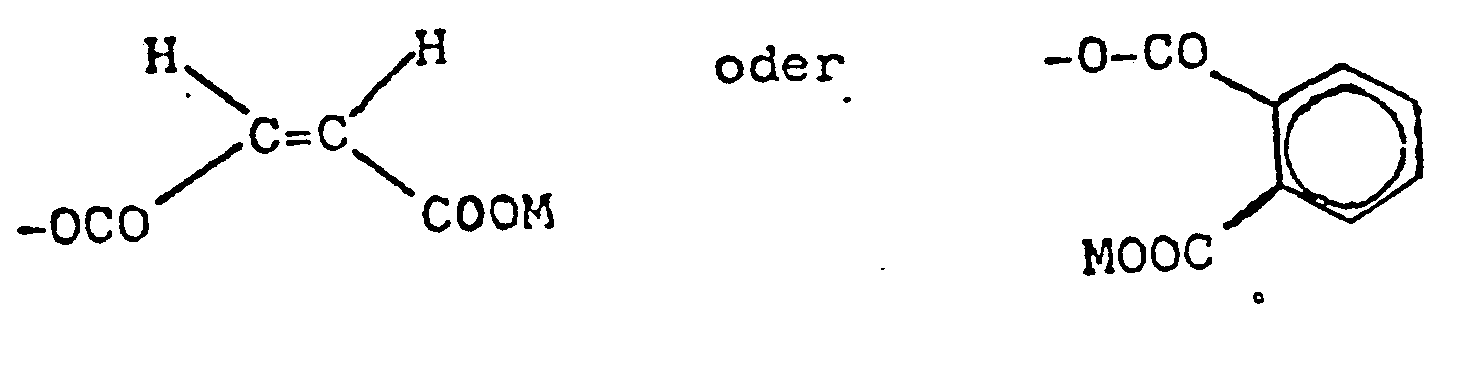
- Rl Alkyl mit 1 bis 12 C-Atomen,
- R2 und R3 Wasserstoff,
- R Wasserstoff oder Alkyl mit 1 bis 4 C-Atomen,
- m eine Zahl von 2 bis 25,
- n eine Zahl von 2 bis 6 und
- M Wasserstoff, ein Alkalimetall, ein äquivalent Erdalkalimetall oder eine Ammoniumgruppe, die durch niederes Alkyl substituiert sein kann, sowie eine aus Ammoniak oder solchen niederen Alkylaminen durch Anlagerung von bis zu 100 Ethylenoxid- und/oder Propylenoxideinheiten erhaltene Ammoniumgruppe bedeuten.
- Besonders bevorzugt sind Verbindungen der Formel 1, in denen
- Z -O-CO-CH2-CH(SO3Na)-COONa,
- Rl Methyl oder Alkyl mit 6 bis 12 C-Atomen,
- R Wasserstoff und
- m eine Zahl von 8 bis 20 bedeuten.
- Die Erfindung betrifft weiterhin die Verwendung der Verbindungen der Formel I als grenzflächenaktive Mittel, insbesondere als Kuppelhilfsmittel für die Herstellung von Azopigmenten sowie als Dispergiermittel bei der Herstellung von Farbmitteldispersionen, vorzugsweise von Dispersionsfarbstoffen und Pigmenten, und weiterhin als Netz-, Emulgier-, Egalisier- und Färbereihilfsmittel.
- Im folgenden wird die Herstellung der Verbindungen der Formel 1 erläutert, wobei die Reste und Indizes die vorstehend genannten Bedeutungen haben:
- Durch Kondensation von (n + 1) Mol eines oder mehrerer Naphthole der Formel ll

- R-CHO (lll)
- werden Kondensationsprodukte erhalten, die im wesentlichen der Formel IV

- entsprechen. Diese Kondensationsprodukte werden im folgenden als "Novolake" bezeichnet, wobei es sich auch beim Einsatz von nur einem Naphtol und nur einem Aldehyd um Gemische von Kondensationsprodukten handelt, d. h. in der Formel IV entspricht n nur für das Hauptprodukt der Anzahl der eingesetzten Mol Alkanal der Formel lll, und Kondensationsprodukte mit niedrigeren und höheren Werten für n liegen als Nebenprodukte vor.
- Die Novolake der Formel IV werden mit Ethylenoxid und/oder Propylenoxid umgesetzt, wobei Verbindungen der Formel 1 erhalten werden, in denen Y die Bedeutung von X hat und Z OH bedeutet. Solche Verbindungen können in untergeordneter Menge in den erfindungsgemäßen Verbindungen enthalten sein.
- Zur Einführung der anionischen Funktion Z kommen mehrere Verfahren in Betracht:
- Die endständigen Hydroxygruppen an den Oxalkylatketten können mehr oder weniger vollständig durch Azylierung mit 1,2-Ethylendicarbonsäuren oder Benzoldicarbonsäuren bzw. den entsprechenden azylierenden Derivaten, beispielsweise den Anhydriden, in die entsprechenden Halbester übergeführt werden. Bevorzugte Acylierungsmittel sind Phthalsäureanhydrid und insbesondere Maleinsäureanhydrid.
- Bei der Acylierung mit 1,2-Ethylendicarbonsäuren bzw. ihren Derivaten, insbesondere mit Maleinanhydrid, können die erhaltenen Produkte als Ausgangsmaterialien zur Herstellung der entsprechenden Sulfobernsteinsäureester verwendet werden, indem an diese Produkte Sulfite angelagert werden.
- Zur Einführung der Sulfogruppe bestehen ebenfalls mehrere Möglichkeiten:
- Die terminalen Hydroxygruppen der Oxalkylatketten können ganz oder teilweise in reaktionsfähigere Substituenten übergeführt werden,beispielsweise in Halogenatome durch Einwirkung entsprechender Halogenierungsmittel wie Thionylchlorid. Weiterhin ist es möglich, die Oxalkylate mit Epichlorhydrin umzusetzen, wobei Zwischenprodukte zur Herstellung von Verbindungen der Formel 1 erhalten werden, in denen Y die Bedeutung -CH2-CHOH-CH2- hat.
- Diese reaktionsfähigen Zwischenprodukte können dann mit Sulfit zu den entsprechenden Sulfoverbindungen umgesetzt werden.
- Im folgenden werden besonders bevorzugte Ausgestaltungen der Erfindung näher erläutert, wobei sich Prozentangaben auf das Gewicht beziehen, sofern nichts anderes angegeben ist.
- Als Ausgangsprodukte zur Bildung der Novolake eignen sich bevorzugt Alkylnaphthole auf Basis von β-Naphthol, wie beispielsweise Methyl-, Butyl-, Octyl-, Nonyl-, Decyl-, Dodecyl-, Tetradecyl-, Dibutyl-, Dioctyl-, Dinonyl-, Didecyl-, Didodecyl- Ditetradecyl- oder Tributylnaphthol sowie deren Mischungen wobei die Alkylreste geradkettig oder verzweigt sein können. Bevorzugt sind die Monoalkylnaphthole.
- Bei den Alkanalen können folgende Beispiele angeführt werden:
- Formaldehyd, Acetaldehyd, Propionaldehyd und Butyraldehyd, sowie solche Alkanale bildende Verbindungen wie Paraformaldehyd, Trioxan, Tetraoxamethylen und Paraldehyd.
- Für die Herstellung der Novolake werden bevorzugt Monoalkylnaphthole mit Formaldehyd im Molverhältnis 2:1 bis 10:6, vor allem 3:2 bis 7:6, nach an sich bekannten Verfahren (z. B. Hultzsch,"Chemie der Phenolharze" (1950), S. 114) in Gegenwart von sauren Katalysatoren kondensiert. Bei der Umsetzung kann der Formaldehyd als wäßrige Lösung oder als Paraformaldehyd eingesetzt werden, wobei gegebenenfalls ein Überschuß von 5 - 10 Mol-Prozent zur Anwendung kommt. Als saure Katalysatoren können Mineralsäuren wie Schwefelsäure oder Phosphorsäure sowie Sulfonsäuren wie Dodecylbenzolsulfosäure oder wegen ihrer leichten Entfernbarkeit bei der Abdestillation des Wassers bevorzugt Salzsäure verwendet werden. Die Säuren werden im allgemeinen in einer Konzentration von 0,1 bis 5 %, bezogen auf Alkylnaphthol, angewendet. Das nach einer Reaktionszeit von 3 bis 20 Stunden gebildete Reaktionswasser wird bis zu einem Wassergehalt im Novolakharz von weniger als 0,5 % abdestilliert. Hierbei wird zuletzt unter vermindertem Druck von weniger als etwa 65 mbar gearbeitet.
- Die erhaltenen Novolake sind mehr oder weniger zähflüssige bis wachsartige bzw. spröde, klare hell- bis dunkelbraun gefärbte Harze. Ihre Zusammensetzung ist vor allem von dem Verhältnis Alkylnaphthol zu Formaldehyd abhängig, und sie besitzen ein mittleres Molekulargewicht zwischen 500 und 6000.
- Die Oxalkylierung der Novolake erfolgt nach bekannten Methoden, vorzugsweise mit Alkalihydroxiden oder -alkoxiden als Katalysator bei 100 bis 200°C, bevorzugt bei 140 bis 180°C.
- Die Menge Ethylenoxid und/oder Propylenoxid wird so bemessen, daß eine stabile Emulsion bzw. eine völlige Löslichkeit der Novolak-Oxalkylate in Wasser erreicht wird, d. h. die Menge des angelagerten Alkylenoxids bemißt sich nach dem angestrebten Grad der Hydrophilie. Bevorzugt werden an jede Hydroxygruppe der Novolakharze 1 bis 150, vorzugsweise 2 bis 25, insbesondere 8 bis 20 Mol Ethylenoxid und/ oder Propylenoxid angelagert. Sofern sowohl Ethylenoxid als auch Propylenoxid eingesetzt werden, können diese getrennt, also absatzweise, oder als Gemisch angewendet werden.
- Als Alkalihydroxid eignen sich Kaliumhydroxid oder bevorzugt Natriumhydroxid, als Alkalialkoxid Natriummethylat oder -ethylat; die Konzentration ist bevorzugt 0,05 bis 1.0 %, bezogen auf den Novolak. Die Oxalkylierung kann drucklos oder in Druckgefäßen durchgeführt werden, wobei das Alkylenoxid gasförmig oder flüssig zugeführt werden kann. Der Arbeitsdruck beträgt 1 bis 10, vorzugsweise 2 bis 4 bar.
- Als Vertreter der Dicarbonsäuren bzw. der entsprechenden Anhydride zur Acylierung der Oxalkylate seien genannt: Maleinsäure, Fumarsäure, Maleinsäureanhydrid, Phthalsäure, Terephthalsäure und Phthalsäureanhydrid.
- Die Reaktion der Novolake mit Maleinsäureanhydrid oder Phthalsäureanhydrid zu den Maleinsäurehalbestern bzw. Phthalsäurehalbestern erfolgt durch Mischen der Komponenten und Verrühren bei 20 bis 100°C, bevorzugt 40 bis 80° C, in Anwesenheit von Alkalihydroxiden, deren Konzentration 0,1 bis 1,0 %, bezogen auf die Gesamtmischung, beträgt. Da Maleinsäureanhydrid zur Sublimation neigt, ist es vorteilhaft, in Druckgefäßen mit einem Überdruck von 0,2 - 1,0 bar Stickstoff oder Luft zu arbeiten und für kräftige Durchmischung zu sorgen, da zu Beginn der Reaktion das geschmolzene Maleinsäureanhydrid mit den Oxalkylaten schlecht mischbar ist. Die Menge des Maleinsäureanhydrids bzw. Phthalsäureanhydrids wird vorzugsweise so bemessen, daß alle Oxalkylat-Hydroxy-Endgruppen umgesetzt werden.
- Die Überführung der Maleinsäurehalbester-Verbindungen in die entsprechenden Sulfobernsteinsäurehalbester erfolgt nach Zugabe von wäßrigen Lösungen von Sulfiten oder Hydro-. gensulfiten. Auf jede Maleinsäurehalbestergruppe werden 1,0 bis 1,5, bevorzugt 1,0 - 1,1 Mol schwefelige Säure in Form von Alkali-oder Erdalkalisulfiten oder -hydrogensulfiten bzw. -pyrosulfiten eingesetzt.
- Während sich die Sulfite besonders zur Bildung der Dialkalisalze der Sulfobernsteinsäurehalbester eignen, ist es bei der Anlagerung von Hydrogensulfiten möglich, durch Neutralisation mit Basen wie Ammoniak, niedermolekularen Alkylaminen oder Alkylolaminen bzw. deren Alkylenoxidaddukten, wobei an 1 Mol Ammoniak bzw. Amin 1 bis 100, vorzugsweise 5 bis 30 Mol Propylenoxid und/oder bevorzugt Ethylenoxid angelagert sind, den Grad der Hydrophilie zusätzlich zu beeinflussen. Als "nieder"-molekular gelten Reste mit bis zu 4 C-Atomen. Als Vertreter der niedermolekularen Alkylamine oder Alkylolamine seien genannt: Ethylamin, n-Propylamin, iso-Propylamin, n-Butylamin, iso-Butylamin, Monoethanolamin, Mono-n-propanolamin, Mono-iso-propanolamin, Mono-n-butanolamin, Mono-iso-butanolamin, Di-ethanolamin, Di-n-propanolamin, Di-n-butanolamin, Triethanolamin, Tripropanolamin oder Tributanolamin sowie Di- und Polyamine wie Ethylendiamin, Diethylentriamin, Triethylentetramin, Propylendiamin, Dipropylentriamin oder Tripropylentetramin. Die zugesetzte Wassermenge kann 50 bis 85 %, bezogen auf die gesamte Lösung bzw. Mischung, betragen und ist abhängig von der Löslichkeit der Sulfobernsteinsäurehalbestersalze und der Viskosität der Lösungen. Die Reaktionstemperaturen betragen 20 bis 100°C, bevorzugt 40 bis 80° C.
- Für die Herstellung der sulfogruppenhaltigen Produkte werden am Ende der Ethylenoxid- und/oder Ethylenoxid/Propylenoxidkette(n) die reaktionsfähigen Gruppen, bevorzugt Chloratome, beispielsweise durch Anlagerung von Epichlorhydrin an die endständige(n) Hydroxygruppe(n) bei Temperaturen zwischen 20 und 100°C, vorzugsweise zwischen 40 bis 90°C, in Gegenwart von Katalysatoren wie Zinntetrachlorid oder durch direkte Halogenierung mit Halogenierungsmitteln wie Thionylchlorid bei Temperaturen zwischen 40 bis 100°C, in das Molekül eingeführt, wobei die endständige(n) OH-Gruppe(n) ganz oder teilweise gegen Chloratome ausgetauscht werden. Die so erhaltenen chlorhaltigen Zwischenprodukte werden mit Natriumsulfit in einem Druckgefäß bei Temperaturen zwischen 100 und 200°C, vorzugsweise bei 140 bis 180°C umgesetzt.
- Die erfindungsgemäßen Verbindungen und ihre Gemische sind in Wasser emulgierbar bis klar löslich und zeigen nach dem Ross-Miles-Test (DIN 53902) nur eine geringe Schaumneigung bei gleichzeitiger Herabsetzung der Oberflächenspannung nach der Ringabreißmethode (DIN 53914) bis zu optimal 4510-3N/m. Gleichzeitig netzen sie Baumwollgewebe nach der Tauchnetzmethode (DIN 53901) bei 70° innerhalb von Sekunden und sind in den alkalischen und sauren Anwendungsbereichen, wie sie für Tenside üblich sind, beständig.
- Die erfindungsgemäßen Substanzen können aufgrund ihrer vielseitigen oberflächenaktiven Eigenschaften für ein breites Anwendungsspektrum verwendet werden. Dies gilt vor allem für den Einsatz als Kuppelhilfsmittel bei der Herstellung von. Azofarbmitteln, insbesondere von Azopigmenten, sowie als Dispergier- und Verteilungsmittel für die Feinverteilung und Stabilisierung von schwerlöslichen und unlöslichen Farbmitteln, vorzugsweise Dispersionsfarbstoffen, wie sie in Form von Farbstoffdispersionen bevorzugt-zum Färben von natürlichem und synthetischem Fasermaterial, wie Baumwolle, Wolle, Cellulose, Zellwolle, Celluloseacetat, -triacetat, Polyester, Polyamid und Polyacrylnitril, oder von Fasermaterialien, die diese Stoffe enthalten, verwendet werden. Darüber hinaus sind die erfindungsgemäßen Substanzen für die Herstellung von wäßrigen fließfähigen Pigmentdispersionen, für die Formulierung von Pflanzenschutz- und Schädlingsbekämpfungsmitteln sowie als Egalisier- und Färbereihilfsmittel sehr gut geeignet. Dabei können die erfindungsgemäßen Verbindungen alle einzeln als Gemische oder in Kombinationen mit anderen nichtionogenen und/oder anionaktiven Tensidverbindungen, Gerüstsubstanzen und anderen Zusätzen oder Hilfsstoffen zur Anwendung kommen.
- Die nachfolgenden Beispiele dienen zur näheren Erläuterung der Erfindung. Teile und Prozentangaben beziehen sich auf das Gewicht, Druckangaben sind "Überdruck", sofern nichts anderes angegeben ist.
- In den folgenden Beispielen A - I wird die Herstellung der erfindungsgemäßen Verbindungen beschrieben.
- 200 Tl. Methyl-ß-naphthol werden bei 60° Innentemperatur geschmolzen und unter langsamem Rühren 33,8 Tl. Paraformaldehyd eingetragen. unter Überlagerung mit Stickstoff wird 30 Minuten bei 60° gerührt und nach Erhöhung der Innentemperatur auf 90° werden 2,5 Tl. konz. Salzsäure zugetropft. Danach wird 16 Stunden bei 110° unter gleichzeitigem Durchleiten von Stickstoff gerührt. Nach weiterer Steigerung der Innentemperatur auf 135 bis 140° wird innerhalb 2 Stunden das Reaktionswasser entfernt. Anschließend wird der Druck auf etwa 20 bis 30 mbar reduziert und 1 Stunde bei 135 bis 140° nachgerührt. Nach dem Erkalten erhält man ein rotbraunes, klares, sprödes Harz.
- 200 TI. des nach a) erhaltenen Novolaks werden nach Zugabe von 1,1 TI. frisch pulverisiertem Ätznatron in einem Druckgefäß unter Rühren und Zuführung von 206 Tl. Ethylenoxid bei 150 bis 160° Innentemperatur unter Aufrechterhaltung eines Druckes von 2 bis 4 bar oxethyliert. Wenn das gesamte Ethylenoxid aufgedrückt ist, wird 1 Stunde bei 150 bis 160° nachgerührt. Das erhaltene zähflüssige Oxethylat enthält 50 Mol Ethylenoxid.
- 300 TI. des nach b) erhaltenen Oxethylats werden nach Zugabe von 105,6 bis 116,2 Tl. Maleinsäureanhydrid und 0,3 Tl. Ätznatron in 3 Stunden bei 70 bis 80° unter Überlagerung mit Stickstoff verestert. Anschließend werden nach Verdünnen mit Wasser 135,8 bis 149,4 TI. Natriumsulfit als wäßrige Lösung bei 40 bis 80° innerhalb 15 bis 120 Minuten zugerührt. Sobald der Ansatz klar geworden ist, wird noch 1 Stunde nachgerührt. Die Menge des zugesetzten Wassers kann zwischen 50 und 85 % der Endlösung betragen.
- 150 Tl. Methyl-ß-naphthol werden gemäß Beispiel Aa) mit 54,3 Tl. Butyraldehyd versetzt und nach Zugabe von 3 TI. konz. Salzsäure 15 Stunden bei 110°C Innentemperatur kondensiert.
- 160 TI. des nach a) erhaltenen Novolaks werden entsprechend Verbindung Ab) nach Zugabe von 1,5 Tl. Natriummethylat in einem Druckgefäß bei 150 bis 160° C Innentemperatur mit 650 Tl. Ethylenoxid umgesetzt. Das erhaltene zähflüssige Oxethylat enthält 80 Mol Ethylenoxid.
- 200 Tl. des nach b) erhaltenen Oxethylats werden gemäß Verbindung Ac) mit 21,6 bis 23,76 Tl. Maleinsäureanhydrid und 27,8 bis 30,6 Tl. Natriumsulfit unter Zusatz von Wasser umgesetzt. Die Menge des zugesetzten Wassers kann zwischen 50 und 85 % der Endlösung betragen.
- 810 TI. Nonyl-ß-naphthol werden vorgelegt und bei Raumtemperatur unter langsamem Rühren 166 TI. Paraformaldehyd eingetragen. Unter Überlagerung mit Stickstoff wird 1 Stunde bei 50° C gerührt und nach Erhöhung der Innentemperatur auf 90° C werden 9,0 TI. konz. Salzsäure zugetropft. Danach wird 6 Stunden bei 110° C unter gleichzeitigem Durchleiten von Stickstoff gerührt und nach weiterer Steigerung der Innentemperatur auf 135 bis 140°C wird innerhalb 4 Stunden das Reaktionswasser entfernt. Dann wird der Druck auf etwa 20 bis 30 mbar reduziert und 2 Stunden bei 135 bis 140°C nachgerührt. Nach dem Erkalten erhält man ein dunkel-rotbraunes klares festes Harz.
- 200 TI. des nach a) erhaltenen Novolaks werden nach Zugabe von 1,1 Tl. frisch pulverisiertem ätznatron in einem Druckgefäß unter Rühren und Zuführung von 603 TI. Ethylenoxid bei 160 bis 170°C unter Aufrechterhaltung eines Druckes von 2 bis 4 bar oxethyliert. Wenn das gesamte Ethylenoxid aufgedrückt ist, wird 1 Stunde bei 160 bis 170° C nachgerührt. Das erhaltene zähflüssige Oxethylat enthält 60 Mol Ethylenoxid.
- 300 TI. des nach b) erhaltenen Oxethylats werden nach Zugabe von 25,2 bis 27,7 Tl. Maleinsäureanhydrid und 0,3 Tl. ätznatron in 3 Stunden bei 70 bis 80° C unter Überlagerung mit Stickstoff verestert. Anschließend werden nach Verdünnen mit Wasser 32,2 bis 35,4 Tl. Natriumsulfit als wäßrige Lösung bei 40 bis 80° C innerhalb 15 bis 120 Minuten zugerührt. Wenn der Ansatz klar wasserlöslich geworden ist, wird noch 1 Stunde nachgerührt. Die Menge des zugesetzten Wassers kann zwischen 50 und 85 % der Endlösung betragen.
- 1350 TI. Nonyl-ß-naphthol werden vorgelegt und bei Raumtemperatur unter langsamem Rühren 132 Tl. Paraformaldehyd eingetragen. Unter Überlagerung mit Stickstoff wird 1 Stunde bei 50° C gerührt und nach Erhöhung der Innentemperatur auf 90° C werden 15,1 Tl. konz. Salzsäure zugetropft. Danach wird 10 Stunden bei 110°C bei gleichzeitigem Durchleiten von Stickstoff gerührt und nach Steigerung der Innentemperatur auf 135 bis 140 C wird innerhalb von 4 Stunden das Reaktionswasser entfernt. Dann wird der Druck auf etwa 20 bis 30 mbar reduziert und 2 Stunden bei 135 bis 140° nachgerührt. Nach dem Erkalten erhält man ein dunkles rotbraunes festes Harz.
- 200 TI. des nach a) erhaltenen Novolaks werden nach Zugabe von 1,1 g frisch pulverisiertem ätznatron in einem Druckgefäß unter Rühren und Zuführung von 572 TI. Ethylenoxid bei 160 bis 170°C unter Aufrechterhaltung eines Druckes von 2 bis 4 bar oxethyliert. Wenn das gesamte Ethylenoxid aufgedrückt ist, wird 1 Stunde bei 160 bis 170 C nachgerührt. Das erhaltene zähflüssige Oxethylat enthält 95 Mol Ethylenoxid.
- 500 TI. des nach b) erhaltenen Oxethylats werden nach Zugabe von 43,8 bis 48,2 Tl. Maleinsäureanhydrid und 0,5 Tl. Ätznatron 3 Stunden bei 70 bis 80° unter Überlagerung mit Stickstoff gerührt, anschließend mit Wasser verdünnt und mit Natronlauge neutral gestellt. Die Menge des zugesetzten Wassers kann zwischen 50 und 80 % der Endlösung betragen.
- 500 Tl. Oxethylat Db) werden nach Zugabe von 66,2 bis 72,8 Teilen Phthalsäureanhydrid und 0,56 Tl. Ätznatron 4 Stunden bei 70 bis 80° unter Überlagerung mit Stickstoff gerührt, anschließend mit Wasser verdünnt und mit Natronlauge neutralisiert. Die Menge des zugesetzten Wassers kann zwischen 50 und 80 % der Endlösung betragen.
- 500 Tl. Oxethylat Db) werden nach Zugabe von 26,4 bis 28,1 Tl. Phthalsäureanhydrid, 26,3 bis 29,9 TI. Maleinsäureanhydrid und 0,5 Tl. Ätznatron 4 Stunden bei 70 bis 80° unter Überlagerung mit Stickstoff gerührt. Anschließend wird mit Wasser verdünnt und bei 40 bis 80° portionsweise mit 33,8 bis 37,2 Tl. Natriumsulfit versetzt, bis der Ansatz klar löslich geworden ist. Anschließend wird 1 Stunde nachgerührt und mit Natronlauge neutralisiert. Die Menge des zugesetzten Wassers kann zwischen 50 und 85 % der Endlösung betragen.
- 500 Tl. Oxethylat Db) werden nach Zugabe von 43,8 bis 48,2 Tl. Maleinsäureanhydrid und 0,5 Tl. Ätznatron analog Verbindung Ac verestert; anschließend - nach Verdünnen mit Wasser - werden 56,4 bis 62,0 TI. Natriumsulfit (als wäßrige Lösung) bei 40 bis 80° innerhalb 15 bis 120 Minuten zugerührt, bis der Ansatz klar löslich geworden ist. Anschließend wird 1 Stunde nachgerührt. Die Menge des zugesetzten Wassers kann zwischen 50 bis 85 % der Endlösung betragen.
- 500 TI. Oxethylat Db) werden nach Erwärmen auf 90° mit 25 TI. Zinntetrachlorid versetzt. Anschließend werden 41,4TI. Epichlorhydrin innerhalb 30 bis 40 Minuten zugetropft. Bei 80° wird 2 Stunden nachgerührt. Nach Entfernen des Katalysators wird das Rohprodukt mit 56,4 Tl. Natriumsulfit innerhalb 4 Stunden bei 160° und 4 bis 6 bar in einem Autoklav umgesetzt. Nach Aufarbeiten und Trocknen im Vakuum bei 80° erhält man das Natriumsulfonat.
- 800 TI. Nonyl-ß-naphthol werden vorgelegt und bei Raumtemperatur unter langsamem Rühren 84 Tl. Paraformaldehyd eingetragen. Unter Überlagerung mit Stickstoff wird 1 Stunde bei 50° C gerührt und nach Erhöhung der Innentemperatur auf 90°C werden 9,3 TI. konz. Salzsäure zugetropft. Danach kondensiert man gemäß Verbindung Ba) 15 Stunden bei 110°C unter Durchleiten von Stickstoff und rührt noch weitere 4 Stunden bei einer Innentemperatur von 135 bis 140°C, wobei das Reaktionswasser entfernt wird. Anschließend rührt man noch 2 Stunden bei 135 bis 140°C nach. Nach dem Erkalten erhält man ein dunkel-rotbraunes, klares sprödes Harz.
- 200 TI. des nach a) erhaltenen Novolaks werden nach Zugabe von 1,1 TI. frisch pulverisiertem Ätznatron gemäß Verbindung Bb) mit 625 Tl. Ethylenoxid umgesetzt. Das erhaltene zähflüssige Alkylenoxidaddukt enthält 140 Mol Ethylenoxid.
- 500 TI. des nach b) erhaltenen Oxethylats werden gemäß Verbindung G mit 41,6 bis 45,8 TI. Maleinsäureanhydrid bei 70 bis 80°C und 53,4 bis 58,9 Tl. Natriumsulfit (als wäßrige Lösung) umgesetzt. Die Menge des zugesetzten Wassers kann zwischen 50 und 85 % der Endlösung betragen.
- Für die Prüfung der Dispergiereigenschaften der erfindungsgemäßen Substanzen für die Feinverteilung und Stabilisierung von Dispersionsfarbstoffen wird nachstehendes Prüfverfahren benutzt:
- Für vergleichende Mahlversuche werden entsprechend der DE-OS 21 32 403 ca. 10 g Farbstoff C.I. Disperse Red 65 mit der zu prüfenden Verbindung, Wasser und 50 g Sili-Quarzitperlen (1 mm 0) mit einem 2-Scheibenrührer ähnlich den üblichen Rührern in Rührwerksmühlen in einem kleinen Zylinder mit einem Laborrührmotor unter Kühlung gemahlen. Der Fortschritt der Feinverteilung wird in regelmäßigen Abständen durch Auslauf-Filterproben mit mikroskopischer Untersuchung verfolgt und nach einer 5-Punkte-Skala (1 = sehr schlecht, 5 = sehr gut) beurteilt.
- Die Lagerstabilität kann man nach Verdünnen der Proben auf die gewunschte Farbstoffkonzentration, Lagern der Proben bei 50° im Trockenschrank und Wiederholung der Auslaufproben nach z. B. 1, 3 und 6 Wochen Lagerung beurteilen, wobei die unten angeführte Zeitangabe einer guten Stabilität entspricht.
- Als Maß für das Färbeverhalten bei 106° wurde ein Gemisch Polyester/Wolle und bei 130° Polyester nach bekannten Verfahren gefärbt.Das Ergebnis wird in der nachfolgenden Tabelle durch die Ziffern 1 bis 5 festgelegt. Es bedeuten: 1 kein Färbeverhalten
- 2 schwach
- 3 brauchbar
- 4 gut
- 5 sehr gut

- Die Anwendung der erfindungsgemäßen Substanzen als Kuppelhilfsmittel für Azopigmente wird in den folgenden Beispielen erläutert, ohne auf diese beschränkt zu sein.
- 11 TI. Dinitroanilin werden in bekannter Weise in einer Mischung aus Schwefelsäure und Salzsäure mit 10,4 Tl. 40%iger Natriumnitritlösung diazotiert.
- Eine Lösung von 8,64 Tl. β-Naphthol in einer Mischung von 100 TI. Wasser und 8 Tl. 33%iger Natronlauge wird gefällt, indem man sie zu einer Mischung von 300 TI. Wasser und 10 TI. 31 %iger Salzsäure tropft. Die Kupplung zum C.I. Pigment Orange 5 erfolgt sodann in bekannter Weise durch Zulauf der geklärten Diazoniumsalzlösung zur Suspension des gefällten β-Naphthols. Anschließend wird das Pigment filtriert, mit Wasser gewaschen und schließlich getrocknet.
- Die Pigmentqualität läßt sich beeinflussen, indem man bei der Fällung der Kupplungskomponente zur Lösung des β-Naphthols und/oder zur vorgelegten Salzsäure oberflächenaktive Mittel zugibt.
- Man kuppelt Pigment Orange 5 wie in Beispiel 1 beschrieben, wobei man aber vor dem Eintropfen der β Naphthol-Lösung noch 1 TI. der Verbindung G zur vorgelegten Mischung aus 300 Tl. Wasser und 10 TI. 31%iger Salzsäure gibt. Das so erhaltene Pigment unterscheidet sich von dem unter Beispiel 1 beschriebenen durch deutlich gelbere Nuance und wesentlich höhere Farbstärke sowohl im Buch- und Offsetdruck als auch in wäßrigen Präparationen für Flexodruck oder Dispersionsfarben. Die Druckfarben und Präparationen zeichnen sich durch niedrige Viskosität aus.
- Außerdem zeigt das so erhaltene Pigment im Buch- und Offsetdruck stärkeren Glanz und bessere Transparenz.
- 34,5 Tl. 4-Chlor-2-nitroanilin werden in verdünnter Salzsäure angerührt, dann mit 34,7 Tl. 40%iger Natriumnitritlösung in bekannter Weise diazotiert und anschließend gaklärt.
- In ein Gemisch aus 800 Tl. Wasser, 4 Tl. Eisessig und 8,1 Teilen 33%iger Natronlauge werden 43,25 Tl. Acetessigsäure-2-chloranilid eingerührt. Die Kupplung zum C.1. Pigment Yellow 3 erfolgt dann bei 10 bis 20° C derart, daß die Diazoniumsalzlösung unter die Oberfläche der Kupplungskomponentensuspension zuläuft. Der pH-Wert der Kuppelbrühe wird dabei durch Zugabe von verdünnter Natronlauge bei 4 bis 4,5 gehalten. Anschließend wird das Pigment filtriert, mit Wasser gewaschen und schließlich getrocknet.
- Die Qualität des Pigmentes läßt sich beeinflussen durch Zugabe der oberflächenaktiven Mittel zur Suspension der Kupplungskomponente.
- Man kuppelt Pigment Yellow 3 wie unter Beispiel 2 beschrieben, wobei aber zur Suspension des Acetessig-2- chloranilids 4 TI. Verbindung G zugesetzt werden.
- Das so erhaltene Pigment zeigt in einem langöligen Alkydharzlack wesentlich höhere Farbstärke, hohe Transparenz und einen grüneren und reineren Farbton als das nach Beispiel 2 hergestellte Pigment Yellow 3.
- 30,4 TI. 3-Nitro-4-aminotoluol werden in verdünnter Salzsäure mit 35 Tl. 40%iger Natriumnitritlösung in bekannter Weise diazotiert und anschließend geklärt.
- In eine Mischung aus 600 Tl. Wasser, 4 Tl. Eisessig und 8,1 TI. 33%iger Natronlauge werden 36 TI. Acetessiganilid eingerührt.
- Die Kupplung zum C.I. Pigment Yellow 1 erfolgt dann bei 10 bis 20° derart, daß die Diazoniumsalzlösung unter die Oberfläche der Kupplungskomponentensuspension zuläuft. Der pH-Wert der Kuppelbrühe wird dabei durch Zugabe von ververdünnter Natronlauge bei 4,5 gehalten. Anschließend wird das Pigment filtriert, mit Wasser gewaschen und schließlich getrocknet.
- Durch Zusatz oberflächenaktiver Mittel zur Suspension des Acetessiganilids läßt sich die Qualität des Pigmentes beeinflussen.
- Man kuppelt Pigment Yellow 1 wie in Beispiel 3 beschrieben, versetzt aber die Suspension des Acetessiganilids vor Beginn der Kupplung mit 3,5 TI. Verbindung G. Das so erhaltene Pigment zeigt in einem langöligen Alkydharzlack deutlich höhere Transparenz als das nach Beispiel 3 hergestellte Pigment Yellow 1.
Claims (10)




Applications Claiming Priority (2)
| Application Number | Priority Date | Filing Date | Title |
|---|---|---|---|
| DE3104991 | 1981-02-12 | ||
| DE19813104991 DE3104991A1 (de) | 1981-02-12 | 1981-02-12 | Anionische grenzflaechenaktive verbindungen auf basis oxalkylierter naphthol-novolake und deren verwendung |
Publications (2)
| Publication Number | Publication Date |
|---|---|
| EP0058384A1 EP0058384A1 (de) | 1982-08-25 |
| EP0058384B1 true EP0058384B1 (de) | 1986-07-23 |
Family
ID=6124638
Family Applications (1)
| Application Number | Title | Priority Date | Filing Date |
|---|---|---|---|
| EP82100956A Expired EP0058384B1 (de) | 1981-02-12 | 1982-02-10 | Anionische grenzflächenaktive Verbindungen auf Basis oxalkylierter Naphthol-Novolake und deren Verwendung |
Country Status (11)
| Country | Link |
|---|---|
| US (1) | US4403079A (de) |
| EP (1) | EP0058384B1 (de) |
| JP (1) | JPS57154146A (de) |
| KR (1) | KR890001680B1 (de) |
| BR (1) | BR8200741A (de) |
| CA (1) | CA1184924A (de) |
| DE (2) | DE3104991A1 (de) |
| DK (1) | DK60982A (de) |
| FI (1) | FI70034C (de) |
| IN (1) | IN156610B (de) |
| MX (1) | MX156652A (de) |
Families Citing this family (14)
| Publication number | Priority date | Publication date | Assignee | Title |
|---|---|---|---|---|
| DE3120697A1 (de) * | 1981-05-23 | 1982-12-09 | Hoechst Ag, 6000 Frankfurt | Anionische verbindungen auf basis modifizierter novolack-oxalkylate, ihre herstellung und ihre verwendung als schaumfreie grenzflaechenaktive mittel |
| CH653068A5 (de) * | 1982-01-02 | 1985-12-13 | Sandoz Ag | Hilfsmittel fuer das faerben mit dispersionsfarbstoffen. |
| JPS5936123A (ja) * | 1982-08-20 | 1984-02-28 | Sumitomo Chem Co Ltd | 新規なノボラツク型置換フエノ−ル樹脂のグリシジルエ−テル、その製造法およびこれを主成分とする封止剤 |
| DE3729657A1 (de) * | 1987-09-04 | 1989-03-23 | Hoechst Ag | Harzsaeureester auf basis von novolakoxalkylaten, ihre herstellung und verwendung |
| US5194665A (en) * | 1988-06-30 | 1993-03-16 | Hoechst Ag | Surfactants based on hydroxynaphthoic esters and preparation and use thereof |
| DE3822043A1 (de) * | 1988-06-30 | 1990-01-11 | Hoechst Ag | Grenzflaechenaktive verbindungen auf basis von oxynaphthoesaeureestern, ihre herstellung und verwendung |
| DE3823826A1 (de) * | 1988-07-14 | 1990-01-18 | Hoechst Ag | Verfahren zur badpigmentierung von leder |
| DE3927471A1 (de) * | 1989-08-19 | 1991-02-21 | Hoechst Ag | Verfahren zur badpigmentierung von leder |
| EP0497172B1 (de) * | 1991-01-22 | 1994-12-28 | Hoechst Aktiengesellschaft | Dispergiermittel |
| EP0549968A1 (de) * | 1991-12-20 | 1993-07-07 | Hoechst Aktiengesellschaft | Grenzflächenaktive Verbindungen auf Basis modifizierter Novolakoxalklylate, ihre Herstellung und ihre Verwendung |
| DE19535246A1 (de) * | 1995-09-22 | 1997-03-27 | Bayer Ag | Tensidgemische |
| EP0948393A1 (de) * | 1996-10-04 | 1999-10-13 | Rhodia Inc. | Waschmittelzusammensetzungen mit geringer konzentration an geminitensiden |
| US7910223B2 (en) | 2003-07-17 | 2011-03-22 | Honeywell International Inc. | Planarization films for advanced microelectronic applications and devices and methods of production thereof |
| JP6441216B2 (ja) * | 2013-04-30 | 2018-12-19 | 明和化成株式会社 | フェノール樹脂、エポキシ樹脂組成物及びそれを用いた硬化物、銅張り積層板、半導体封止材 |
Citations (1)
| Publication number | Priority date | Publication date | Assignee | Title |
|---|---|---|---|---|
| EP0015557A1 (de) * | 1979-03-12 | 1980-09-17 | Hoechst Aktiengesellschaft | Wässrige Dispersionen von primären aromatischen Aminen und ihre Verwendung zur Erzeugung von wasserunlöslichen Azofarbstoffen auf der Faser sowie Verwendung eines anionaktiven Tensides zur Herstellung dieser Dispersionen |
Family Cites Families (7)
| Publication number | Priority date | Publication date | Assignee | Title |
|---|---|---|---|---|
| US2581392A (en) * | 1949-05-06 | 1952-01-08 | Petrolite Corp | Quaternary ammonium derivatives of chloroxy propylated oxyalkylated phenol-aldehyde resins |
| US2766213A (en) * | 1953-01-26 | 1956-10-09 | Petrolite Corp | Process for breaking petroleum emulsions |
| US3244770A (en) * | 1962-06-25 | 1966-04-05 | Nalco Chemical Co | Surface active agents derived from polycarboxylic acids esterified with oxyalkylated phenolics and polyoxy-alkylene glycol |
| BE785703A (fr) * | 1971-06-30 | 1973-01-02 | Hoechst Ag | Dispersions de colorants |
| BE785711A (fr) * | 1971-06-30 | 1973-01-02 | Hoechst Ag | Dispersants et mouillants pour des agents biocides organiques |
| US4032514A (en) * | 1971-08-18 | 1977-06-28 | Petrolite Corporation | Oxyalkylated cyclic phenol-aldehyde resins and uses therefor |
| GB2041388B (en) * | 1979-01-23 | 1982-12-08 | Yorkshire Chemicals Ltd | Sulphited polyoxyethylene esters |
-
1981
- 1981-02-12 DE DE19813104991 patent/DE3104991A1/de not_active Withdrawn
-
1982
- 1982-02-05 IN IN140/CAL/82A patent/IN156610B/en unknown
- 1982-02-10 JP JP57018997A patent/JPS57154146A/ja active Granted
- 1982-02-10 EP EP82100956A patent/EP0058384B1/de not_active Expired
- 1982-02-10 US US06/347,485 patent/US4403079A/en not_active Expired - Lifetime
- 1982-02-10 FI FI820426A patent/FI70034C/fi not_active IP Right Cessation
- 1982-02-10 DE DE8282100956T patent/DE3272062D1/de not_active Expired
- 1982-02-11 CA CA000396098A patent/CA1184924A/en not_active Expired
- 1982-02-11 MX MX191350A patent/MX156652A/es unknown
- 1982-02-11 DK DK60982A patent/DK60982A/da not_active Application Discontinuation
- 1982-02-11 KR KR8200587A patent/KR890001680B1/ko not_active Expired
- 1982-02-11 BR BR8200741A patent/BR8200741A/pt unknown
Patent Citations (1)
| Publication number | Priority date | Publication date | Assignee | Title |
|---|---|---|---|---|
| EP0015557A1 (de) * | 1979-03-12 | 1980-09-17 | Hoechst Aktiengesellschaft | Wässrige Dispersionen von primären aromatischen Aminen und ihre Verwendung zur Erzeugung von wasserunlöslichen Azofarbstoffen auf der Faser sowie Verwendung eines anionaktiven Tensides zur Herstellung dieser Dispersionen |
Non-Patent Citations (1)
| Title |
|---|
| Ullmann's Encyclopädie der technischen Chemie, 4. Auflage, Band 8, Seite 252, 1974 * |
Also Published As
| Publication number | Publication date |
|---|---|
| US4403079A (en) | 1983-09-06 |
| DE3104991A1 (de) | 1982-08-19 |
| KR830009210A (ko) | 1983-12-19 |
| JPS57154146A (en) | 1982-09-22 |
| MX156652A (es) | 1988-09-22 |
| CA1184924A (en) | 1985-04-02 |
| JPH044306B2 (de) | 1992-01-27 |
| FI70034B (fi) | 1986-01-31 |
| KR890001680B1 (ko) | 1989-05-13 |
| FI820426L (fi) | 1982-08-13 |
| IN156610B (de) | 1985-09-21 |
| DK60982A (da) | 1982-08-13 |
| EP0058384A1 (de) | 1982-08-25 |
| DE3272062D1 (en) | 1986-08-28 |
| BR8200741A (pt) | 1982-12-21 |
| FI70034C (fi) | 1986-09-12 |
Similar Documents
| Publication | Publication Date | Title |
|---|---|---|
| EP0065751B1 (de) | Anionische Verbindungen auf Basis modifizierter Novolak-Oxalkylate, ihre Herstellung und ihre Verwendung als schaumfreie grenzflächenaktive Mittel | |
| EP0009648B1 (de) | Grenzflächenaktive Verbindungen auf Basis natürlicher Harzsäuren und ihre Verwendung | |
| EP0582928B1 (de) | Grenzflächenaktive Verbindungen auf Basis modifizierter Rizinusölfettkörper | |
| EP0058384B1 (de) | Anionische grenzflächenaktive Verbindungen auf Basis oxalkylierter Naphthol-Novolake und deren Verwendung | |
| EP0032188B1 (de) | Oberflächenaktive Verbindungen auf Basis arylierter Fettkörper und deren Verwendung | |
| EP0033913B1 (de) | Verfahren zur Herstellung von Pigmentpräparationen und ihre Verwendung | |
| DE2914299B2 (de) | Pigmentpräparate, Verfahren zu ihrer Herstellung und ihre Verwendung | |
| EP0305885B1 (de) | Harzsäureester auf Basis von Novolakoxalkylaten,ihre Herstellung und Verwendung | |
| CH622547A5 (de) | ||
| DE2732732C3 (de) | Wäßrige Farbstoffdispersionen und ihre Verwendung | |
| EP0549968A1 (de) | Grenzflächenaktive Verbindungen auf Basis modifizierter Novolakoxalklylate, ihre Herstellung und ihre Verwendung | |
| DE2711240C3 (de) | Wäßrige Farbstoffdispersionen | |
| DE2132403B2 (de) | Dispergiermittel für die Feinverteilung und Stabilisierung von Farbstoffen und Pigmenten | |
| EP0382054A2 (de) | Chemisch modifizierte Proteine | |
| EP0047882A2 (de) | Formaldehydkondensate enthaltende Dispergiermittel | |
| DE2301638C3 (de) | Verfahren zur Herstellung von sulfongruppenhaltigen Phenol-Formaldehyd-Kondensationsprodukten | |
| EP0408508B1 (de) | Flüssige Farbstoffzubereitungen, Verfahren zu ihrer Herstellung und ihre Verwendung | |
| EP0585812A2 (de) | Grenzflächenaktive Verbindungen auf Basis alkoxylierter Fettamine | |
| EP0056991B1 (de) | Flüssige Farbstoffpräparate | |
| EP0138104B1 (de) | Azopigmentpräparationen | |
| DE2262817C3 (de) | Stabile Dispersionen basischer Farbstoffe | |
| DE4125458A1 (de) | Sulfonsaeuregruppenhaltige mischkondensate, verfahren zu ihrer herstellung und ihre verwendung | |
| DE2132404B2 (de) | Verwendung von Sulfobernsteinsäurehalbestern in Pigmentpräparationen für wässrige Flexodruckfarben | |
| DE3000569A1 (de) | Farbstoffzubereitungen und deren verwendung | |
| DE2306104C3 (de) | Farbstoff- und Pigmentdispersionen |
Legal Events
| Date | Code | Title | Description |
|---|---|---|---|
| PUAI | Public reference made under article 153(3) epc to a published international application that has entered the european phase |
Free format text: ORIGINAL CODE: 0009012 |
|
| AK | Designated contracting states |
Designated state(s): BE CH DE FR GB IT NL |
|
| 17P | Request for examination filed |
Effective date: 19830128 |
|
| GRAA | (expected) grant |
Free format text: ORIGINAL CODE: 0009210 |
|
| AK | Designated contracting states |
Kind code of ref document: B1 Designated state(s): BE CH DE FR GB IT LI NL |
|
| ITF | It: translation for a ep patent filed | ||
| REF | Corresponds to: |
Ref document number: 3272062 Country of ref document: DE Date of ref document: 19860828 |
|
| ET | Fr: translation filed | ||
| PLBE | No opposition filed within time limit |
Free format text: ORIGINAL CODE: 0009261 |
|
| STAA | Information on the status of an ep patent application or granted ep patent |
Free format text: STATUS: NO OPPOSITION FILED WITHIN TIME LIMIT |
|
| 26N | No opposition filed | ||
| PGFP | Annual fee paid to national office [announced via postgrant information from national office to epo] |
Ref country code: NL Payment date: 19900228 Year of fee payment: 9 |
|
| PGFP | Annual fee paid to national office [announced via postgrant information from national office to epo] |
Ref country code: BE Payment date: 19900405 Year of fee payment: 9 |
|
| ITTA | It: last paid annual fee | ||
| PG25 | Lapsed in a contracting state [announced via postgrant information from national office to epo] |
Ref country code: BE Effective date: 19910228 |
|
| PG25 | Lapsed in a contracting state [announced via postgrant information from national office to epo] |
Ref country code: NL Effective date: 19910901 |
|
| PGFP | Annual fee paid to national office [announced via postgrant information from national office to epo] |
Ref country code: GB Payment date: 19930121 Year of fee payment: 12 |
|
| PG25 | Lapsed in a contracting state [announced via postgrant information from national office to epo] |
Ref country code: GB Effective date: 19940210 |
|
| PGFP | Annual fee paid to national office [announced via postgrant information from national office to epo] |
Ref country code: DE Payment date: 19940428 Year of fee payment: 13 |
|
| GBPC | Gb: european patent ceased through non-payment of renewal fee |
Effective date: 19940210 |
|
| PGFP | Annual fee paid to national office [announced via postgrant information from national office to epo] |
Ref country code: FR Payment date: 19950118 Year of fee payment: 14 |
|
| PGFP | Annual fee paid to national office [announced via postgrant information from national office to epo] |
Ref country code: CH Payment date: 19950123 Year of fee payment: 14 |
|
| PG25 | Lapsed in a contracting state [announced via postgrant information from national office to epo] |
Ref country code: DE Effective date: 19951101 |
|
| PG25 | Lapsed in a contracting state [announced via postgrant information from national office to epo] |
Ref country code: LI Free format text: LAPSE BECAUSE OF NON-PAYMENT OF DUE FEES Effective date: 19960228 Ref country code: CH Free format text: LAPSE BECAUSE OF NON-PAYMENT OF DUE FEES Effective date: 19960228 |
|
| REG | Reference to a national code |
Ref country code: CH Ref legal event code: PL |
|
| PG25 | Lapsed in a contracting state [announced via postgrant information from national office to epo] |
Ref country code: FR Effective date: 19961031 |
|
| REG | Reference to a national code |
Ref country code: FR Ref legal event code: ST |