EP0056576A2 - Verfahren zur Herstellung von gegebenenfalls geschäumten Polyurethanen - Google Patents
Verfahren zur Herstellung von gegebenenfalls geschäumten Polyurethanen Download PDFInfo
- Publication number
- EP0056576A2 EP0056576A2 EP82100039A EP82100039A EP0056576A2 EP 0056576 A2 EP0056576 A2 EP 0056576A2 EP 82100039 A EP82100039 A EP 82100039A EP 82100039 A EP82100039 A EP 82100039A EP 0056576 A2 EP0056576 A2 EP 0056576A2
- Authority
- EP
- European Patent Office
- Prior art keywords
- atoms
- compounds
- und
- activators
- oder
- Prior art date
- Legal status (The legal status is an assumption and is not a legal conclusion. Google has not performed a legal analysis and makes no representation as to the accuracy of the status listed.)
- Granted
Links
- 239000004814 polyurethane Substances 0.000 title claims abstract description 16
- 229920002635 polyurethane Polymers 0.000 title claims abstract description 12
- 238000000034 method Methods 0.000 title claims description 19
- 239000012948 isocyanate Substances 0.000 claims abstract description 29
- 150000002513 isocyanates Chemical class 0.000 claims abstract description 28
- 239000005056 polyisocyanate Substances 0.000 claims abstract description 27
- 229920001228 polyisocyanate Polymers 0.000 claims abstract description 27
- 150000001875 compounds Chemical class 0.000 claims abstract description 24
- 239000012190 activator Substances 0.000 claims abstract description 22
- 125000004432 carbon atom Chemical group C* 0.000 claims abstract description 15
- 125000004435 hydrogen atom Chemical group [H]* 0.000 claims abstract description 15
- 125000001931 aliphatic group Chemical group 0.000 claims abstract description 11
- 239000004970 Chain extender Substances 0.000 claims abstract description 6
- 125000005843 halogen group Chemical group 0.000 claims abstract description 5
- 239000004604 Blowing Agent Substances 0.000 claims abstract description 4
- 239000001257 hydrogen Substances 0.000 claims abstract description 4
- 229910052739 hydrogen Inorganic materials 0.000 claims abstract description 4
- 125000002877 alkyl aryl group Chemical group 0.000 claims abstract description 3
- 125000000217 alkyl group Chemical group 0.000 claims abstract description 3
- 125000000753 cycloalkyl group Chemical group 0.000 claims abstract description 3
- 150000002894 organic compounds Chemical class 0.000 claims abstract description 3
- 239000006260 foam Substances 0.000 claims description 25
- 125000002723 alicyclic group Chemical group 0.000 claims description 8
- 239000000654 additive Substances 0.000 claims description 7
- 230000001413 cellular effect Effects 0.000 claims description 5
- 125000001309 chloro group Chemical group Cl* 0.000 claims description 3
- 238000009826 distribution Methods 0.000 claims description 3
- 229910052801 chlorine Inorganic materials 0.000 claims description 2
- 238000002360 preparation method Methods 0.000 claims description 2
- UFHFLCQGNIYNRP-UHFFFAOYSA-N Hydrogen Chemical compound [H][H] UFHFLCQGNIYNRP-UHFFFAOYSA-N 0.000 abstract description 3
- 125000003837 (C1-C20) alkyl group Chemical group 0.000 abstract description 2
- 229920005862 polyol Polymers 0.000 description 39
- 150000003077 polyols Chemical class 0.000 description 39
- 239000003054 catalyst Substances 0.000 description 35
- LYCAIKOWRPUZTN-UHFFFAOYSA-N Ethylene glycol Chemical compound OCCO LYCAIKOWRPUZTN-UHFFFAOYSA-N 0.000 description 21
- -1 diazabicyclonones Chemical compound 0.000 description 15
- WADSJYLPJPTMLN-UHFFFAOYSA-N 3-(cycloundecen-1-yl)-1,2-diazacycloundec-2-ene Chemical compound C1CCCCCCCCC=C1C1=NNCCCCCCCC1 WADSJYLPJPTMLN-UHFFFAOYSA-N 0.000 description 13
- 238000006243 chemical reaction Methods 0.000 description 12
- ZBCBWPMODOFKDW-UHFFFAOYSA-N diethanolamine Chemical compound OCCNCCO ZBCBWPMODOFKDW-UHFFFAOYSA-N 0.000 description 11
- UKLDJPRMSDWDSL-UHFFFAOYSA-L [dibutyl(dodecanoyloxy)stannyl] dodecanoate Chemical compound CCCCCCCCCCCC(=O)O[Sn](CCCC)(CCCC)OC(=O)CCCCCCCCCCC UKLDJPRMSDWDSL-UHFFFAOYSA-L 0.000 description 10
- 229920000570 polyether Polymers 0.000 description 10
- 239000004721 Polyphenylene oxide Substances 0.000 description 9
- 150000001412 amines Chemical class 0.000 description 9
- 239000012975 dibutyltin dilaurate Substances 0.000 description 9
- OWIKHYCFFJSOEH-UHFFFAOYSA-N Isocyanic acid Chemical compound N=C=O OWIKHYCFFJSOEH-UHFFFAOYSA-N 0.000 description 8
- 239000000203 mixture Substances 0.000 description 7
- 239000011541 reaction mixture Substances 0.000 description 7
- 239000003381 stabilizer Substances 0.000 description 7
- IMNIMPAHZVJRPE-UHFFFAOYSA-N triethylenediamine Chemical compound C1CN2CCN1CC2 IMNIMPAHZVJRPE-UHFFFAOYSA-N 0.000 description 7
- DNIAPMSPPWPWGF-UHFFFAOYSA-N Propylene glycol Chemical compound CC(O)CO DNIAPMSPPWPWGF-UHFFFAOYSA-N 0.000 description 6
- 239000012973 diazabicyclooctane Substances 0.000 description 6
- 230000000694 effects Effects 0.000 description 6
- 238000002474 experimental method Methods 0.000 description 6
- 238000004519 manufacturing process Methods 0.000 description 6
- CYRMSUTZVYGINF-UHFFFAOYSA-N trichlorofluoromethane Chemical compound FC(Cl)(Cl)Cl CYRMSUTZVYGINF-UHFFFAOYSA-N 0.000 description 6
- 229940029284 trichlorofluoromethane Drugs 0.000 description 6
- XLYOFNOQVPJJNP-UHFFFAOYSA-N water Substances O XLYOFNOQVPJJNP-UHFFFAOYSA-N 0.000 description 6
- PEDCQBHIVMGVHV-UHFFFAOYSA-N Glycerine Chemical compound OCC(O)CO PEDCQBHIVMGVHV-UHFFFAOYSA-N 0.000 description 5
- 229920005830 Polyurethane Foam Polymers 0.000 description 5
- ZJCCRDAZUWHFQH-UHFFFAOYSA-N Trimethylolpropane Chemical compound CCC(CO)(CO)CO ZJCCRDAZUWHFQH-UHFFFAOYSA-N 0.000 description 5
- 239000003795 chemical substances by application Substances 0.000 description 5
- 125000002887 hydroxy group Chemical group [H]O* 0.000 description 5
- 229910052751 metal Inorganic materials 0.000 description 5
- 239000002184 metal Substances 0.000 description 5
- 239000011496 polyurethane foam Substances 0.000 description 5
- 239000000047 product Substances 0.000 description 5
- KSBAEPSJVUENNK-UHFFFAOYSA-L tin(ii) 2-ethylhexanoate Chemical compound [Sn+2].CCCCC(CC)C([O-])=O.CCCCC(CC)C([O-])=O KSBAEPSJVUENNK-UHFFFAOYSA-L 0.000 description 5
- POILWHVDKZOXJZ-ARJAWSKDSA-M (z)-4-oxopent-2-en-2-olate Chemical compound C\C([O-])=C\C(C)=O POILWHVDKZOXJZ-ARJAWSKDSA-M 0.000 description 4
- OFOBLEOULBTSOW-UHFFFAOYSA-N Malonic acid Chemical compound OC(=O)CC(O)=O OFOBLEOULBTSOW-UHFFFAOYSA-N 0.000 description 4
- WNLRTRBMVRJNCN-UHFFFAOYSA-N adipic acid Chemical compound OC(=O)CCCCC(O)=O WNLRTRBMVRJNCN-UHFFFAOYSA-N 0.000 description 4
- 229910052782 aluminium Inorganic materials 0.000 description 4
- XAGFODPZIPBFFR-UHFFFAOYSA-N aluminium Chemical compound [Al] XAGFODPZIPBFFR-UHFFFAOYSA-N 0.000 description 4
- 125000003118 aryl group Chemical group 0.000 description 4
- PWEVMPIIOJUPRI-UHFFFAOYSA-N dimethyltin Chemical compound C[Sn]C PWEVMPIIOJUPRI-UHFFFAOYSA-N 0.000 description 4
- 238000005187 foaming Methods 0.000 description 4
- RRAMGCGOFNQTLD-UHFFFAOYSA-N hexamethylene diisocyanate Chemical compound O=C=NCCCCCCN=C=O RRAMGCGOFNQTLD-UHFFFAOYSA-N 0.000 description 4
- 239000013518 molded foam Substances 0.000 description 4
- OBETXYAYXDNJHR-UHFFFAOYSA-N 2-Ethylhexanoic acid Chemical compound CCCCC(CC)C(O)=O OBETXYAYXDNJHR-UHFFFAOYSA-N 0.000 description 3
- UPMLOUAZCHDJJD-UHFFFAOYSA-N 4,4'-Diphenylmethane Diisocyanate Chemical compound C1=CC(N=C=O)=CC=C1CC1=CC=C(N=C=O)C=C1 UPMLOUAZCHDJJD-UHFFFAOYSA-N 0.000 description 3
- QTBSBXVTEAMEQO-UHFFFAOYSA-N Acetic acid Chemical compound CC(O)=O QTBSBXVTEAMEQO-UHFFFAOYSA-N 0.000 description 3
- YMWUJEATGCHHMB-UHFFFAOYSA-N Dichloromethane Chemical compound ClCCl YMWUJEATGCHHMB-UHFFFAOYSA-N 0.000 description 3
- ZMXDDKWLCZADIW-UHFFFAOYSA-N N,N-Dimethylformamide Chemical compound CN(C)C=O ZMXDDKWLCZADIW-UHFFFAOYSA-N 0.000 description 3
- YXFVVABEGXRONW-UHFFFAOYSA-N Toluene Chemical compound CC1=CC=CC=C1 YXFVVABEGXRONW-UHFFFAOYSA-N 0.000 description 3
- 125000003277 amino group Chemical group 0.000 description 3
- OHJMTUPIZMNBFR-UHFFFAOYSA-N biuret Chemical group NC(=O)NC(N)=O OHJMTUPIZMNBFR-UHFFFAOYSA-N 0.000 description 3
- 150000001735 carboxylic acids Chemical class 0.000 description 3
- 238000006555 catalytic reaction Methods 0.000 description 3
- CZRDZAGTSCUWNG-UHFFFAOYSA-M chloro(dimethyl)tin Chemical compound C[Sn](C)Cl CZRDZAGTSCUWNG-UHFFFAOYSA-M 0.000 description 3
- RJGHQTVXGKYATR-UHFFFAOYSA-L dibutyl(dichloro)stannane Chemical compound CCCC[Sn](Cl)(Cl)CCCC RJGHQTVXGKYATR-UHFFFAOYSA-L 0.000 description 3
- POULHZVOKOAJMA-UHFFFAOYSA-N dodecanoic acid Chemical compound CCCCCCCCCCCC(O)=O POULHZVOKOAJMA-UHFFFAOYSA-N 0.000 description 3
- 150000002148 esters Chemical class 0.000 description 3
- RTZKZFJDLAIYFH-UHFFFAOYSA-N ether Substances CCOCC RTZKZFJDLAIYFH-UHFFFAOYSA-N 0.000 description 3
- 238000010438 heat treatment Methods 0.000 description 3
- NIMLQBUJDJZYEJ-UHFFFAOYSA-N isophorone diisocyanate Chemical compound CC1(C)CC(N=C=O)CC(C)(CN=C=O)C1 NIMLQBUJDJZYEJ-UHFFFAOYSA-N 0.000 description 3
- 239000000463 material Substances 0.000 description 3
- 150000002736 metal compounds Chemical class 0.000 description 3
- 238000000465 moulding Methods 0.000 description 3
- 229920003023 plastic Polymers 0.000 description 3
- 239000004033 plastic Substances 0.000 description 3
- 229920000728 polyester Polymers 0.000 description 3
- 150000003839 salts Chemical class 0.000 description 3
- 239000000126 substance Substances 0.000 description 3
- VZCYOOQTPOCHFL-UHFFFAOYSA-N trans-butenedioic acid Natural products OC(=O)C=CC(O)=O VZCYOOQTPOCHFL-UHFFFAOYSA-N 0.000 description 3
- NFDXQGNDWIPXQL-UHFFFAOYSA-N 1-cyclooctyldiazocane Chemical compound C1CCCCCCC1N1NCCCCCC1 NFDXQGNDWIPXQL-UHFFFAOYSA-N 0.000 description 2
- YILMRQQRUSWBIG-UHFFFAOYSA-L 2-chloroacetate;dimethyltin(2+) Chemical compound C[Sn+2]C.[O-]C(=O)CCl.[O-]C(=O)CCl YILMRQQRUSWBIG-UHFFFAOYSA-L 0.000 description 2
- RVNYZHUBGHPMDR-UHFFFAOYSA-L 2-chlorododecanoate;dimethyltin(2+) Chemical compound C[Sn+2]C.CCCCCCCCCCC(Cl)C([O-])=O.CCCCCCCCCCC(Cl)C([O-])=O RVNYZHUBGHPMDR-UHFFFAOYSA-L 0.000 description 2
- UWSMKYBKUPAEJQ-UHFFFAOYSA-N 5-Chloro-2-(3,5-di-tert-butyl-2-hydroxyphenyl)-2H-benzotriazole Chemical compound CC(C)(C)C1=CC(C(C)(C)C)=CC(N2N=C3C=C(Cl)C=CC3=N2)=C1O UWSMKYBKUPAEJQ-UHFFFAOYSA-N 0.000 description 2
- 239000004215 Carbon black (E152) Substances 0.000 description 2
- CURLTUGMZLYLDI-UHFFFAOYSA-N Carbon dioxide Chemical compound O=C=O CURLTUGMZLYLDI-UHFFFAOYSA-N 0.000 description 2
- IAZDPXIOMUYVGZ-UHFFFAOYSA-N Dimethylsulphoxide Chemical compound CS(C)=O IAZDPXIOMUYVGZ-UHFFFAOYSA-N 0.000 description 2
- VZCYOOQTPOCHFL-OWOJBTEDSA-N Fumaric acid Chemical compound OC(=O)\C=C\C(O)=O VZCYOOQTPOCHFL-OWOJBTEDSA-N 0.000 description 2
- ZRALSGWEFCBTJO-UHFFFAOYSA-N Guanidine Chemical compound NC(N)=N ZRALSGWEFCBTJO-UHFFFAOYSA-N 0.000 description 2
- 238000005684 Liebig rearrangement reaction Methods 0.000 description 2
- GOOHAUXETOMSMM-UHFFFAOYSA-N Propylene oxide Chemical compound CC1CO1 GOOHAUXETOMSMM-UHFFFAOYSA-N 0.000 description 2
- JJLKTTCRRLHVGL-UHFFFAOYSA-L [acetyloxy(dibutyl)stannyl] acetate Chemical compound CC([O-])=O.CC([O-])=O.CCCC[Sn+2]CCCC JJLKTTCRRLHVGL-UHFFFAOYSA-L 0.000 description 2
- 239000001361 adipic acid Substances 0.000 description 2
- 235000011037 adipic acid Nutrition 0.000 description 2
- 230000015572 biosynthetic process Effects 0.000 description 2
- 150000001622 bismuth compounds Chemical class 0.000 description 2
- 125000003178 carboxy group Chemical group [H]OC(*)=O 0.000 description 2
- 150000001732 carboxylic acid derivatives Chemical class 0.000 description 2
- 230000003197 catalytic effect Effects 0.000 description 2
- 239000007795 chemical reaction product Substances 0.000 description 2
- 239000011248 coating agent Substances 0.000 description 2
- 239000013065 commercial product Substances 0.000 description 2
- 230000000052 comparative effect Effects 0.000 description 2
- 239000000470 constituent Substances 0.000 description 2
- 239000003431 cross linking reagent Substances 0.000 description 2
- PKKGKUDPKRTKLJ-UHFFFAOYSA-L dichloro(dimethyl)stannane Chemical compound C[Sn](C)(Cl)Cl PKKGKUDPKRTKLJ-UHFFFAOYSA-L 0.000 description 2
- XBDQKXXYIPTUBI-UHFFFAOYSA-N dimethylselenoniopropionate Natural products CCC(O)=O XBDQKXXYIPTUBI-UHFFFAOYSA-N 0.000 description 2
- 239000000975 dye Substances 0.000 description 2
- 239000000945 filler Substances 0.000 description 2
- 239000003063 flame retardant Substances 0.000 description 2
- 238000010097 foam moulding Methods 0.000 description 2
- 239000004872 foam stabilizing agent Substances 0.000 description 2
- 235000011187 glycerol Nutrition 0.000 description 2
- FUZZWVXGSFPDMH-UHFFFAOYSA-N hexanoic acid Chemical compound CCCCCC(O)=O FUZZWVXGSFPDMH-UHFFFAOYSA-N 0.000 description 2
- 229930195733 hydrocarbon Natural products 0.000 description 2
- 150000002611 lead compounds Chemical class 0.000 description 2
- VZCYOOQTPOCHFL-UPHRSURJSA-N maleic acid Chemical compound OC(=O)\C=C/C(O)=O VZCYOOQTPOCHFL-UPHRSURJSA-N 0.000 description 2
- 239000011976 maleic acid Substances 0.000 description 2
- BDJRBEYXGGNYIS-UHFFFAOYSA-N nonanedioic acid Chemical compound OC(=O)CCCCCCCC(O)=O BDJRBEYXGGNYIS-UHFFFAOYSA-N 0.000 description 2
- WWZKQHOCKIZLMA-UHFFFAOYSA-N octanoic acid Chemical compound CCCCCCCC(O)=O WWZKQHOCKIZLMA-UHFFFAOYSA-N 0.000 description 2
- WLJVNTCWHIRURA-UHFFFAOYSA-N pimelic acid Chemical compound OC(=O)CCCCCC(O)=O WLJVNTCWHIRURA-UHFFFAOYSA-N 0.000 description 2
- 229920000515 polycarbonate Polymers 0.000 description 2
- 239000004417 polycarbonate Substances 0.000 description 2
- 229920006149 polyester-amide block copolymer Polymers 0.000 description 2
- 229920006295 polythiol Polymers 0.000 description 2
- 239000002904 solvent Substances 0.000 description 2
- 238000003860 storage Methods 0.000 description 2
- TYFQFVWCELRYAO-UHFFFAOYSA-N suberic acid Chemical compound OC(=O)CCCCCCC(O)=O TYFQFVWCELRYAO-UHFFFAOYSA-N 0.000 description 2
- VZGDMQKNWNREIO-UHFFFAOYSA-N tetrachloromethane Chemical compound ClC(Cl)(Cl)Cl VZGDMQKNWNREIO-UHFFFAOYSA-N 0.000 description 2
- 125000003396 thiol group Chemical group [H]S* 0.000 description 2
- ZDPHROOEEOARMN-UHFFFAOYSA-N undecanoic acid Chemical compound CCCCCCCCCCC(O)=O ZDPHROOEEOARMN-UHFFFAOYSA-N 0.000 description 2
- PUPZLCDOIYMWBV-UHFFFAOYSA-N (+/-)-1,3-Butanediol Chemical compound CC(O)CCO PUPZLCDOIYMWBV-UHFFFAOYSA-N 0.000 description 1
- OBETXYAYXDNJHR-SSDOTTSWSA-M (2r)-2-ethylhexanoate Chemical compound CCCC[C@@H](CC)C([O-])=O OBETXYAYXDNJHR-SSDOTTSWSA-M 0.000 description 1
- OYHQOLUKZRVURQ-NTGFUMLPSA-N (9Z,12Z)-9,10,12,13-tetratritiooctadeca-9,12-dienoic acid Chemical compound C(CCCCCCC\C(=C(/C\C(=C(/CCCCC)\[3H])\[3H])\[3H])\[3H])(=O)O OYHQOLUKZRVURQ-NTGFUMLPSA-N 0.000 description 1
- WRIDQFICGBMAFQ-UHFFFAOYSA-N (E)-8-Octadecenoic acid Natural products CCCCCCCCCC=CCCCCCCC(O)=O WRIDQFICGBMAFQ-UHFFFAOYSA-N 0.000 description 1
- KYVBNYUBXIEUFW-UHFFFAOYSA-N 1,1,3,3-tetramethylguanidine Chemical compound CN(C)C(=N)N(C)C KYVBNYUBXIEUFW-UHFFFAOYSA-N 0.000 description 1
- RYHBNJHYFVUHQT-UHFFFAOYSA-N 1,4-Dioxane Chemical compound C1COCCO1 RYHBNJHYFVUHQT-UHFFFAOYSA-N 0.000 description 1
- 229940008841 1,6-hexamethylene diisocyanate Drugs 0.000 description 1
- SMNOVRZDAZZQTI-UHFFFAOYSA-N 1-[dibutyl(dodecanoyl)stannyl]dodecan-1-one Chemical compound CCCCCCCCCCCC(=O)[Sn](CCCC)(CCCC)C(=O)CCCCCCCCCCC SMNOVRZDAZZQTI-UHFFFAOYSA-N 0.000 description 1
- GYSCBCSGKXNZRH-UHFFFAOYSA-N 1-benzothiophene-2-carboxamide Chemical compound C1=CC=C2SC(C(=O)N)=CC2=C1 GYSCBCSGKXNZRH-UHFFFAOYSA-N 0.000 description 1
- VZAWCLCJGSBATP-UHFFFAOYSA-N 1-cycloundecyl-1,2-diazacycloundecane Chemical compound C1CCCCCCCCCC1N1NCCCCCCCCC1 VZAWCLCJGSBATP-UHFFFAOYSA-N 0.000 description 1
- RNFJDJUURJAICM-UHFFFAOYSA-N 2,2,4,4,6,6-hexaphenoxy-1,3,5-triaza-2$l^{5},4$l^{5},6$l^{5}-triphosphacyclohexa-1,3,5-triene Chemical compound N=1P(OC=2C=CC=CC=2)(OC=2C=CC=CC=2)=NP(OC=2C=CC=CC=2)(OC=2C=CC=CC=2)=NP=1(OC=1C=CC=CC=1)OC1=CC=CC=C1 RNFJDJUURJAICM-UHFFFAOYSA-N 0.000 description 1
- SFWXMFQDGKFTLH-UHFFFAOYSA-N 2,3-dimethyl-2,6-dihydro-1h-pyrimidine Chemical compound CC1NCC=CN1C SFWXMFQDGKFTLH-UHFFFAOYSA-N 0.000 description 1
- LCZVSXRMYJUNFX-UHFFFAOYSA-N 2-[2-(2-hydroxypropoxy)propoxy]propan-1-ol Chemical compound CC(O)COC(C)COC(C)CO LCZVSXRMYJUNFX-UHFFFAOYSA-N 0.000 description 1
- CTUFHVMIEYJGRG-UHFFFAOYSA-L 2-chloroacetate;diethyltin(2+) Chemical compound CC[Sn+2]CC.[O-]C(=O)CCl.[O-]C(=O)CCl CTUFHVMIEYJGRG-UHFFFAOYSA-L 0.000 description 1
- LQJBNNIYVWPHFW-UHFFFAOYSA-N 20:1omega9c fatty acid Natural products CCCCCCCCCCC=CCCCCCCCC(O)=O LQJBNNIYVWPHFW-UHFFFAOYSA-N 0.000 description 1
- QSBYPNXLFMSGKH-UHFFFAOYSA-N 9-Heptadecensaeure Natural products CCCCCCCC=CCCCCCCCC(O)=O QSBYPNXLFMSGKH-UHFFFAOYSA-N 0.000 description 1
- BVKZGUZCCUSVTD-UHFFFAOYSA-M Bicarbonate Chemical compound OC([O-])=O BVKZGUZCCUSVTD-UHFFFAOYSA-M 0.000 description 1
- AJNCEUNWYSFVIC-UHFFFAOYSA-L CC(O[Sn](C)(C)Cl)=O Chemical compound CC(O[Sn](C)(C)Cl)=O AJNCEUNWYSFVIC-UHFFFAOYSA-L 0.000 description 1
- LRIQFCMWEZLGDQ-UHFFFAOYSA-L CC[Sn](C)(OC(C)=O)Cl Chemical compound CC[Sn](C)(OC(C)=O)Cl LRIQFCMWEZLGDQ-UHFFFAOYSA-L 0.000 description 1
- GHVNFZFCNZKVNT-UHFFFAOYSA-N Decanoic acid Natural products CCCCCCCCCC(O)=O GHVNFZFCNZKVNT-UHFFFAOYSA-N 0.000 description 1
- XTHFKEDIFFGKHM-UHFFFAOYSA-N Dimethoxyethane Chemical compound COCCOC XTHFKEDIFFGKHM-UHFFFAOYSA-N 0.000 description 1
- VTLYFUHAOXGGBS-UHFFFAOYSA-N Fe3+ Chemical compound [Fe+3] VTLYFUHAOXGGBS-UHFFFAOYSA-N 0.000 description 1
- 239000005058 Isophorone diisocyanate Substances 0.000 description 1
- CHJJGSNFBQVOTG-UHFFFAOYSA-N N-methyl-guanidine Natural products CNC(N)=N CHJJGSNFBQVOTG-UHFFFAOYSA-N 0.000 description 1
- 239000005642 Oleic acid Substances 0.000 description 1
- ZQPPMHVWECSIRJ-UHFFFAOYSA-N Oleic acid Natural products CCCCCCCCC=CCCCCCCCC(O)=O ZQPPMHVWECSIRJ-UHFFFAOYSA-N 0.000 description 1
- 239000004743 Polypropylene Substances 0.000 description 1
- 229920002396 Polyurea Polymers 0.000 description 1
- KDYFGRWQOYBRFD-UHFFFAOYSA-N Succinic acid Natural products OC(=O)CCC(O)=O KDYFGRWQOYBRFD-UHFFFAOYSA-N 0.000 description 1
- ISKQADXMHQSTHK-UHFFFAOYSA-N [4-(aminomethyl)phenyl]methanamine Chemical compound NCC1=CC=C(CN)C=C1 ISKQADXMHQSTHK-UHFFFAOYSA-N 0.000 description 1
- 239000006096 absorbing agent Substances 0.000 description 1
- 125000005595 acetylacetonate group Chemical group 0.000 description 1
- 239000002253 acid Substances 0.000 description 1
- 239000013543 active substance Substances 0.000 description 1
- 230000032683 aging Effects 0.000 description 1
- 125000002947 alkylene group Chemical group 0.000 description 1
- 150000001409 amidines Chemical class 0.000 description 1
- 150000003863 ammonium salts Chemical class 0.000 description 1
- 125000000732 arylene group Chemical group 0.000 description 1
- 239000000022 bacteriostatic agent Substances 0.000 description 1
- 239000002585 base Substances 0.000 description 1
- NUMHJBONQMZPBW-UHFFFAOYSA-K bis(2-ethylhexanoyloxy)bismuthanyl 2-ethylhexanoate Chemical compound [Bi+3].CCCCC(CC)C([O-])=O.CCCCC(CC)C([O-])=O.CCCCC(CC)C([O-])=O NUMHJBONQMZPBW-UHFFFAOYSA-K 0.000 description 1
- 229920001400 block copolymer Polymers 0.000 description 1
- CDQSJQSWAWPGKG-UHFFFAOYSA-N butane-1,1-diol Chemical compound CCCC(O)O CDQSJQSWAWPGKG-UHFFFAOYSA-N 0.000 description 1
- KDYFGRWQOYBRFD-NUQCWPJISA-N butanedioic acid Chemical compound O[14C](=O)CC[14C](O)=O KDYFGRWQOYBRFD-NUQCWPJISA-N 0.000 description 1
- SHZIWNPUGXLXDT-UHFFFAOYSA-N caproic acid ethyl ester Natural products CCCCCC(=O)OCC SHZIWNPUGXLXDT-UHFFFAOYSA-N 0.000 description 1
- 239000001569 carbon dioxide Substances 0.000 description 1
- 229910002092 carbon dioxide Inorganic materials 0.000 description 1
- 238000001460 carbon-13 nuclear magnetic resonance spectrum Methods 0.000 description 1
- 150000008280 chlorinated hydrocarbons Chemical class 0.000 description 1
- 238000003776 cleavage reaction Methods 0.000 description 1
- 238000000576 coating method Methods 0.000 description 1
- 238000010276 construction Methods 0.000 description 1
- 238000004132 cross linking Methods 0.000 description 1
- 125000002993 cycloalkylene group Chemical group 0.000 description 1
- 238000000354 decomposition reaction Methods 0.000 description 1
- CTESAYWIBGYWGR-UHFFFAOYSA-L dibutyl(chloro)stannanylium;acetate Chemical compound CCCC[Sn](Cl)(OC(C)=O)CCCC CTESAYWIBGYWGR-UHFFFAOYSA-L 0.000 description 1
- MTHSVFCYNBDYFN-UHFFFAOYSA-N diethylene glycol Chemical compound OCCOCCO MTHSVFCYNBDYFN-UHFFFAOYSA-N 0.000 description 1
- LVTYICIALWPMFW-UHFFFAOYSA-N diisopropanolamine Chemical compound CC(O)CNCC(C)O LVTYICIALWPMFW-UHFFFAOYSA-N 0.000 description 1
- 229940043276 diisopropanolamine Drugs 0.000 description 1
- SWSQBOPZIKWTGO-UHFFFAOYSA-N dimethylaminoamidine Natural products CN(C)C(N)=N SWSQBOPZIKWTGO-UHFFFAOYSA-N 0.000 description 1
- SBOSGIJGEHWBKV-UHFFFAOYSA-L dioctyltin(2+);dichloride Chemical compound CCCCCCCC[Sn](Cl)(Cl)CCCCCCCC SBOSGIJGEHWBKV-UHFFFAOYSA-L 0.000 description 1
- SZXQTJUDPRGNJN-UHFFFAOYSA-N dipropylene glycol Chemical compound OCCCOCCCO SZXQTJUDPRGNJN-UHFFFAOYSA-N 0.000 description 1
- 238000002845 discoloration Methods 0.000 description 1
- WNAHIZMDSQCWRP-UHFFFAOYSA-N dodecane-1-thiol Chemical compound CCCCCCCCCCCCS WNAHIZMDSQCWRP-UHFFFAOYSA-N 0.000 description 1
- POULHZVOKOAJMA-UHFFFAOYSA-M dodecanoate Chemical compound CCCCCCCCCCCC([O-])=O POULHZVOKOAJMA-UHFFFAOYSA-M 0.000 description 1
- 229920001971 elastomer Polymers 0.000 description 1
- 239000000806 elastomer Substances 0.000 description 1
- 239000003995 emulsifying agent Substances 0.000 description 1
- 239000003822 epoxy resin Substances 0.000 description 1
- 238000011067 equilibration Methods 0.000 description 1
- 239000001530 fumaric acid Substances 0.000 description 1
- 230000001408 fungistatic effect Effects 0.000 description 1
- 150000002357 guanidines Chemical class 0.000 description 1
- 125000000623 heterocyclic group Chemical group 0.000 description 1
- 230000007062 hydrolysis Effects 0.000 description 1
- 238000006460 hydrolysis reaction Methods 0.000 description 1
- 239000012774 insulation material Substances 0.000 description 1
- ZFSLODLOARCGLH-UHFFFAOYSA-N isocyanuric acid Chemical group OC1=NC(O)=NC(O)=N1 ZFSLODLOARCGLH-UHFFFAOYSA-N 0.000 description 1
- QXJSBBXBKPUZAA-UHFFFAOYSA-N isooleic acid Natural products CCCCCCCC=CCCCCCCCCC(O)=O QXJSBBXBKPUZAA-UHFFFAOYSA-N 0.000 description 1
- 239000004922 lacquer Substances 0.000 description 1
- 229940070765 laurate Drugs 0.000 description 1
- 239000004611 light stabiliser Substances 0.000 description 1
- 239000007788 liquid Substances 0.000 description 1
- 238000002844 melting Methods 0.000 description 1
- 230000008018 melting Effects 0.000 description 1
- 150000002739 metals Chemical class 0.000 description 1
- 239000012778 molding material Substances 0.000 description 1
- ZQPPMHVWECSIRJ-KTKRTIGZSA-N oleic acid Chemical compound CCCCCCCC\C=C/CCCCCCCC(O)=O ZQPPMHVWECSIRJ-KTKRTIGZSA-N 0.000 description 1
- 239000012766 organic filler Substances 0.000 description 1
- 239000005022 packaging material Substances 0.000 description 1
- 230000000737 periodic effect Effects 0.000 description 1
- OJMIONKXNSYLSR-UHFFFAOYSA-N phosphorous acid Chemical compound OP(O)O OJMIONKXNSYLSR-UHFFFAOYSA-N 0.000 description 1
- 239000000049 pigment Substances 0.000 description 1
- 239000004014 plasticizer Substances 0.000 description 1
- 229920000233 poly(alkylene oxides) Polymers 0.000 description 1
- 229920000647 polyepoxide Polymers 0.000 description 1
- 229920005906 polyester polyol Polymers 0.000 description 1
- 229920006324 polyoxymethylene Polymers 0.000 description 1
- 229920001155 polypropylene Polymers 0.000 description 1
- 229920001451 polypropylene glycol Polymers 0.000 description 1
- 229920003225 polyurethane elastomer Polymers 0.000 description 1
- 235000019260 propionic acid Nutrition 0.000 description 1
- 230000001681 protective effect Effects 0.000 description 1
- 238000000425 proton nuclear magnetic resonance spectrum Methods 0.000 description 1
- IUVKMZGDUIUOCP-BTNSXGMBSA-N quinbolone Chemical compound O([C@H]1CC[C@H]2[C@H]3[C@@H]([C@]4(C=CC(=O)C=C4CC3)C)CC[C@@]21C)C1=CCCC1 IUVKMZGDUIUOCP-BTNSXGMBSA-N 0.000 description 1
- 230000035484 reaction time Effects 0.000 description 1
- WBHHMMIMDMUBKC-XLNAKTSKSA-N ricinelaidic acid Chemical compound CCCCCC[C@@H](O)C\C=C\CCCCCCCC(O)=O WBHHMMIMDMUBKC-XLNAKTSKSA-N 0.000 description 1
- 229960003656 ricinoleic acid Drugs 0.000 description 1
- FEUQNCSVHBHROZ-UHFFFAOYSA-N ricinoleic acid Natural products CCCCCCC(O[Si](C)(C)C)CC=CCCCCCCCC(=O)OC FEUQNCSVHBHROZ-UHFFFAOYSA-N 0.000 description 1
- 230000007017 scission Effects 0.000 description 1
- 230000035939 shock Effects 0.000 description 1
- 229920002545 silicone oil Polymers 0.000 description 1
- 239000007787 solid Substances 0.000 description 1
- 238000003756 stirring Methods 0.000 description 1
- HXJUTPCZVOIRIF-UHFFFAOYSA-N sulfolane Chemical compound O=S1(=O)CCCC1 HXJUTPCZVOIRIF-UHFFFAOYSA-N 0.000 description 1
- 230000000475 sunscreen effect Effects 0.000 description 1
- 239000000516 sunscreening agent Substances 0.000 description 1
- 239000000725 suspension Substances 0.000 description 1
- 238000010998 test method Methods 0.000 description 1
- 239000012974 tin catalyst Substances 0.000 description 1
- DVKJHBMWWAPEIU-UHFFFAOYSA-N toluene 2,4-diisocyanate Chemical compound CC1=CC=C(N=C=O)C=C1N=C=O DVKJHBMWWAPEIU-UHFFFAOYSA-N 0.000 description 1
- 239000013638 trimer Substances 0.000 description 1
- XSQUKJJJFZCRTK-UHFFFAOYSA-N urea group Chemical group NC(=O)N XSQUKJJJFZCRTK-UHFFFAOYSA-N 0.000 description 1
- AVWRKZWQTYIKIY-UHFFFAOYSA-N urea-1-carboxylic acid Chemical group NC(=O)NC(O)=O AVWRKZWQTYIKIY-UHFFFAOYSA-N 0.000 description 1
- JOYRKODLDBILNP-UHFFFAOYSA-N urethane group Chemical group NC(=O)OCC JOYRKODLDBILNP-UHFFFAOYSA-N 0.000 description 1
- 239000008096 xylene Substances 0.000 description 1
- 150000003738 xylenes Chemical class 0.000 description 1
Classifications
-
- C—CHEMISTRY; METALLURGY
- C08—ORGANIC MACROMOLECULAR COMPOUNDS; THEIR PREPARATION OR CHEMICAL WORKING-UP; COMPOSITIONS BASED THEREON
- C08G—MACROMOLECULAR COMPOUNDS OBTAINED OTHERWISE THAN BY REACTIONS ONLY INVOLVING UNSATURATED CARBON-TO-CARBON BONDS
- C08G18/00—Polymeric products of isocyanates or isothiocyanates
- C08G18/06—Polymeric products of isocyanates or isothiocyanates with compounds having active hydrogen
- C08G18/08—Processes
- C08G18/16—Catalysts
- C08G18/22—Catalysts containing metal compounds
- C08G18/24—Catalysts containing metal compounds of tin
- C08G18/244—Catalysts containing metal compounds of tin tin salts of carboxylic acids
- C08G18/246—Catalysts containing metal compounds of tin tin salts of carboxylic acids containing also tin-carbon bonds
Definitions
- the present invention relates to a process for the production of polyurethanes, in particular of polyurethane foam moldings with a compact surface and cellular core and integral density distribution over the cross section of the moldings (integral foams), using special activators.
- polyurethane formation is based, between polyhydroxyl compounds and polyisocyanates, in particular aliphatic and alicyclic polyisocyanates, requires suitable catalysis in order to obtain a reaction which is sufficiently rapid for industrial purposes.
- metal compounds used are, for example, the biscarboxylates of dialkyltin compounds such as di-n-butyltin dilaurate or the bismercaptides of dialkyltin compounds such as dimethyltin bis (lauryl mercaptide), metal acetylacetonates such as Fe (II) acetylacetonate, Fe (III) acetylacetonate, dibutyl (IV) acetylacetonate, lead II acetylacetonate, furthermore lead compounds such as lead di (2-ethylhexanoate) or bismuth compounds such as bismuth (III) -2-ethylhexanoate.
- dialkyltin compounds such as di-n-butyltin dilaurate or the bismercaptides of dialkyltin compounds such as dimethyltin bis (lauryl mercaptide
- metal acetylacetonates such as Fe (II) ace
- the catalytic activity of these exemplified metal compounds is not sufficient for industrial processes. Therefore, basic cocatalysts such as e.g. Amidines (e.g. diazabicycloundecene, diazabicyclonones, dimethyltetrahydropyrimidine), guanidines (e.g. guanidine, tetramethylguanidine) or tert. Amines such as diazabicyclooctane also used.
- Amidines e.g. diazabicycloundecene, diazabicyclonones, dimethyltetrahydropyrimidine
- guanidines e.g. guanidine, tetramethylguanidine
- Amines such as diazabicyclooctane also used.
- the invention relates to a process for the production of optionally foamed polyurethanes by reacting polyisocyanates with organic compounds having at least two hydrogen atoms active against isocyanates with a molecular weight of 400-10000 in the presence of activators and optionally in the presence of blowing agents and chain extenders with a molecular weight of 32-400 and others auxiliaries and additives known per se, characterized in that compounds of the general formula are used as activators
- molded foam bodies with a compact surface and cellular core and an integral density distribution over the cross section the moldings are produced (see, for example, DBP 1 694 138) and that aliphatic and / or alicyclic polyisocyanates are preferably used as polyisocyanates.
- the soft, semi-hard and hard polyurethane foam moldings previously offered are generally based on the crosslinking of aromatic polyisocyanates with polyether or polyester polyols, optionally in combination with known chain extenders and crosslinking agents.
- Shaped bodies of this type have a high level of mechanical value, which they have for many applications, e.g. suitable for furniture, vehicle and house construction, or of elastic molded parts such as pillows, shock absorbers and shoe soles.
- a disadvantage of all these molded parts is that they turn yellow due to weathering and additionally roughen the surface due to chemical structure, so that e.g. Moldings for increased demands usually have to be provided with a protective lacquer layer.
- Suitable, non-Sn-containing catalysts for such a bis (2-hydroxyalkyl) amine-containing system are lead compounds, which are, however, physiologically questionable and bismuth compounds, which, however, are unstable especially when exposed to light, so that both product classes should be avoided.
- the activators according to the invention are able to act as effective catalysts in PU systems in which essentially aliphatic and / or alicyclic polyisocyanates are used as polyisocyanates, optionally with the use of chain extenders with a molecular weight of 32 -400. these often consist entirely or partially of bis (2-hydroxyalkyl) amines.
- the activators to be used according to the invention are known per se. Parker and Carmän in Advances in Chem. Soc., 169, 363 (1978) discuss the occurrence of dibutylchlorotin laurate by equilibration of dibutyltin dilaurate and dibutyltin dichloride using 1 H-NMR spectra. Davies and Harrison report in J. Chem. Sec. C, 1967, p. 298 on the formation of dibutylchlorotin acetate in the combination of dibutyltin dichloride and dibutyltin diacetate in carbon tetrachloride. TN Mitchell describes in J. Organometall. Chem. 59, 189 (1973) the 13 C-NMR spectrum of the latter compound, but without reporting its preparation.
- the activators according to the invention are produced, for example, by reacting dialkyltin dihalides with carboxylic acid metal salts. This reaction is preferably carried out in a solvent.
- suitable solvents are toluene, xylenes, 1,4-dioxane, dimethylformamide, sulfolane, dimethyl sulfoxide, dimethoxyethane.
- Dialkyltin dichlorides such as dimethyltin dichloride, di-n-butyltin dichloride, di-n-octyltin dichloride are preferably used as diorganyltin dihalides, dimethyltin dichloride is very particularly preferred.
- the carboxylic acid metal salts used are preferably the salts of organic carboxylic acids with metals of groups I, II and III of the periodic system, very particularly preferably those from the 1st main group.
- carboxylic acids include acetic acid, propionic acid, octanoic acid, 2-ethylhexanoic acid, decanoic acid, undecanoic acid, dodecanoic acid, oleic acid, ricinoleic acid, linoleic acid, malonic acid, succinic acid, maleic acid, fumaric acid, adipic acid, pimelic acid, suberic acid, azelaic acid, dodecanic acid, sebacanic acid.
- maleic acid is most preferred.
- the activators according to the invention can be easily dissolved both in the compounds having at least two active H atoms of molecular weight 400-10000 and in the isocyanate component.
- the activators can also be added to the reaction mixture in solid form. It has been shown that the activity of the dispersed activators is often only from the activity of dissolved activators. is slightly different.
- the activators used according to the invention are usually used in amounts of 0.005-10% by weight, based on the compounds having at least two active H atoms of molecular weight 400-10000, preferably in an amount of 0.05-5% by weight, very particularly preferably in an amount of 0.1-4% by weight.
- the activators according to the invention are generally low to medium high melting compounds without decomposition.
- mixtures of different compounds with at least two isocyanate-reactive hydrogen atoms with a molecular weight of 32 to 400 can be used.
- R eTHERsverzögerer also cell regulators of the type known per se, as well as pigments or dyes and flame retardants of the type known per se, also stabilizers against aging and weathering, softeners and fungistatic and bacteriostatic substances, and fillers. All of these auxiliaries and additives are described, for example, in DE-OS 2 916 139 on pages 33-38.
- foaming can also be carried out in closed molds according to the invention.
- the reaction mixture is introduced into a mold.
- Metal for example aluminum, or plastic, for example epoxy resin, can be used as the molding material.
- the foamable reaction mixture foams in the mold and forms the shaped body.
- the foaming of the mold can be carried out so that the molded part has a cell structure on its surface, but it can also be carried out so that the molded part has a has compact skin and a cellular core.
- one can proceed in this connection in such a way that so much foamable reaction mixture is introduced into the mold that the foam formed just fills the mold.
- cold-curing foams can also be produced (cf. GB patent specification 1 162 517, DE patent publication 2 153 086).
- foams' by block foaming or by the known double conveyor belt process can be prepared.
- the products obtainable according to the invention find e.g. following application: as shoe soles, car steering wheels, armrests, headrests, upholstery material, sound insulation materials, coating agents, packaging material, mattresses.
- Isocyanate A Semiprepolymer of isophorone diisocyanate and a polypropylene glycol ether (OH number 670) started on glycerine with an NCO value of 28%.
- Isocyanate B prepolymer of 1,6-diisocyanatohexane and dipropylene glycol with an NCO value of 14%.
- Isocyanate C Modified 1,6-diisocyanatohexane, which contains biuret units, with an NCO value of 21.3%.
- Isocyanate D semiprepolymer of 4,4'-diisocyanatodiphenylmethane and tripropylene glycol with an NCO value of 22.8%.
- Isocyanate E Modified 1,6-diisocyanatohexane, which contains biuret units, with an NCO content of 23%.
- Isocyanate F Mixture of 80% by weight tolylene diisocyanate and 20% by weight polymeric 4,4'-diisocyanatodiphenylmethane (NCO content: 44.5%).
- Polyol A Trifunctional PO / EO polyether polyol started on trimethylolpropane (22% by weight final EO) with an OH number of 27 and an average molecular weight of 6222.
- Polvol B Difunctional PO // EO polyether polyol started on propylene glycol (20% by weight. EO) with an OH number of 28 and an average molecular weight of 4000.
- Polyol C Trifunctional PO / EO polyether polyol (13.5% by weight final EO) started on trimethylolpropane with an OH number of 35 and an average molecular weight of 4500.
- Polyol D reaction product of glycerol and propylene oxide with an OH number of 1050.
- Polyol E reaction product of trimethylolpropane with propylene oxide with an OH number of 930.
- Polyol F PO / EO polyether polyol (30% by weight EO) started on trimethylolpropane and propylene glycol with a functionality of 2.78, an average molecular weight of 3700 and an OH number of 42.
- Polyol G Trifunctional PO / EO polyether polyol started on trimethylolpropane with an OH number of 28.
- Polyol H Trifunctional PO / EO polyether polyol with an OH number 28 (17% by weight EO) modified with an organic filler (polyurea).
- Catalyst A dimethyltin monochloro (2-ethyl) hexanoate of the formula
- Catalyst B dimethyltin monochlorododecanoate of the formula
- Catalyst C dimethyltin monochloroacetate of the formula
- Catalyst D dimethyltin monochloroleate of the formula
- Catalyst E Diethyltin monochloroacetate of the formula
- Catalyst F Dodecanedioic acid-1,12-bis- (dimethylmonochlorotin) ester of the formula
- the components of the A component are combined at room temperature, mixed intensively with a high-speed high-speed stirrer for 30 seconds, mixed with the specified amount of the B component, mixed intensively for a further 30 seconds at room temperature and then foamed in a free-foam packet.
- a start time of 37 ⁇ 3 seconds and a setting time of 130 ⁇ 10 seconds were found.
- the constituents of the A component were combined at room temperature, mixed intensively with a high-speed high-speed stirrer for 30 seconds, admixed with the stated amount of isocyanate, mixed intensively for a further 30 seconds at room temperature and then foamed in a free-foam packet.
- a start time of 36 t 3 seconds and a setting time of 89 ⁇ 5 seconds were obtained.
- An integral molded foam sheet of 20 x 20 x 1 cm 3 produced in a conventional aluminum laboratory folding mold had a Shore A hardness of 57 at a density of 660 kg / m 3 , was easy to demold and had a high elasticity.
- the components of the A component are combined at room temperature, mixed intensively with a high-speed high-speed stirrer for 30 seconds, mixed with the stated amount of B component, mixed intensively for a further 30 seconds at room temperature and then foamed in a free-foam packet.
- a start time of 35 ⁇ 3 seconds and a setting time of 84 ⁇ 5 seconds were obtained.
- An integral molded foam sheet of 20 x 20 x 1 cm 3 produced with the above mixture in a conventional aluminum laboratory folding mold had one room weight of 665 kg / m 3 a Shore A hardness of 69, was easy to demold and had a high elasticity.
- a start time of 35-3 seconds and a setting time of 110 ⁇ 10 seconds were obtained.
- the constituents of the A component were combined at room temperature, mixed intensively with a high-speed high-speed stirrer for 30 seconds, admixed with the stated amount of isocyanate, mixed intensively for a further 30 seconds at room temperature and then foamed in a free-foam packet.
- diazabicycloundecane and dibutyltin dilaurate are replaced by the catalysts to be used according to the invention.
- These examples also illustrate the good effect of the suspended catalysts. The tests are carried out as described in Comparative Example 5.1.
- This example compares the catalytic capabilities of a diazabicycloundecene / dibutyltin dilaurate combination with a combination of diazabicycloundecene and one of the catalysts to be used according to the invention.
- This example demonstrates the storage stability of (as a representative example) Catalyst A at room temperature.
- Polyurethane elastomers with a Shore A hardness of approx. 52 are obtained.
- Example 7 If the polyether specified in Example 7 is replaced by 100 g of a mixed polyester composed of adipic acid and ethylene glycol / butylene glycol (molecular weight 2000, OH value: 56), the addition of 0.5 g of catalysts A, B, C, D E and 3 hours heating at 120 ° C an elastic polyurethane material with a S hore A hardness of 60. Without catalysis, no reaction occurs even after a long heating phase and the reaction mixture remains liquid.
- a mixed polyester composed of adipic acid and ethylene glycol / butylene glycol (molecular weight 2000, OH value: 56)
- a molded foam produced in a manner known per se using the above recipe in an aluminum box mold had the following data:
Landscapes
- Chemical & Material Sciences (AREA)
- Health & Medical Sciences (AREA)
- Chemical Kinetics & Catalysis (AREA)
- Medicinal Chemistry (AREA)
- Polymers & Plastics (AREA)
- Organic Chemistry (AREA)
- Polyurethanes Or Polyureas (AREA)
- Manufacture Of Porous Articles, And Recovery And Treatment Of Waste Products (AREA)
Abstract
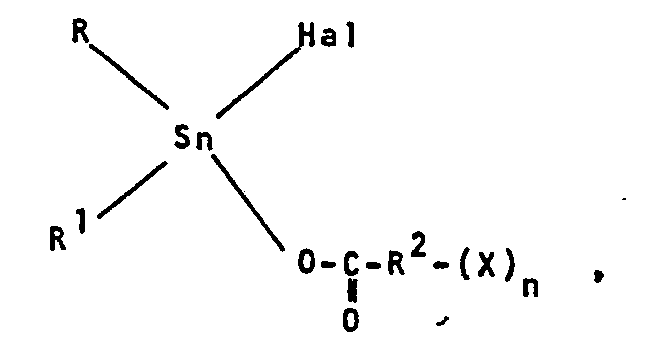
- R und R1 gleich oder verschieden sind und C1-C20-Alkyl, C5-C7-Cycloalkyl oder C7-C30-Alkaryl,
- Hal ein Halogenatom und
- R2 einen n + 1-wertigen, 1-30 C-Atome aufweisenden aliphatischen, 4-7 C-Atome aufweisenden cycloaliphatischen oder einen 6-14 C-Atome aufweisenden aromatischen Rest,
- X Wasserstoff oder eine Gruppe der Formel
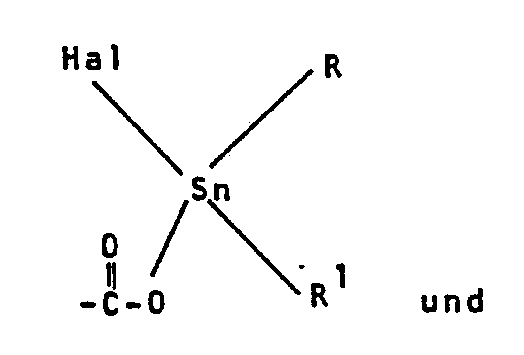
- n eine ganze Zahl von 1-3 bedeuten, als Aktivatoren hergestellt.
Description
- Die vorliegende Erfindung betrifft ein Verfahren zur Herstellung von Polyurethanen, insbesondere von Polyurethan-Schaumstofformkörpern mit kompakter Oberfläche und zelligem Kern und integraler Dichteverteilung über den Querschnitt der Formkörper (Integralschaumstoffe), unter Verwendung von speziellen Aktivatoren.
- Die der Polyurethanbildung zugrundeliegende Polyadditionsreaktion zwischen Polyhydroxylverbindungen und Polyisocyanaten, insbesondere aliphatischen und alicyclischen Polyisocyanaten, bedarf, um eine für industrielle Zwecke genügend schnelle Reaktion zu erhalten, einer geeigneten Katalyse.
- Es ist bekannt, hierfür Aktivatorkombinationen aus Metallverbindungen und aminischen Katalysatoren oder anderen basischen Katalysatoren zu verwenden. Beispiele für verwendete Metallverbindungen sind etwa die Biscarboxylate von Dialkylzinnverbindungen wie Di-n-butylzinn-dilaurat oder die Bismercaptide von Dialkylzinnverbindungen wie Dimethylzinn-bis(lauryl- mercaptid), Metallacetylacetonate wie Fe(II)-acetylacetonat, Fe(III)-acetylacetonat, Dibutylzinn(IV)-acetylacetonat, Blei-II-acetylacetonat, weiterhin Bleiverbindungen wie Blei-di-(2-ethylhexanoat) oder Wismutverbindungen wie z.B. Wismut(III)-2-ethylhexanoat.
- Im allgemeinen genügt die katalytische Aktivität dieser beispielhaft genannten Metallverbindungen für industrielle Verfahren nicht. Daher werden oft basische Cokatalysatoren wie z.B. Amidine (z:B. Diazabicycloundecen, Diazabicyclononen, Dimethyltetrahydropyrimidin), Guanidine (z.B. Guanidin, Tetramethylguanidin) oder tert. Amine wie Diazabicyclooctan mitverwendet.
- Die Mitverwendung dieser aminischen Cokatalysatoren bringt vielfach eine Reihe schwerwiegender Nachteile mit sich. Es hat sich z.B. gezeigt, daß mit Diazabicycloundecen (DBU) versehene Polyolkomponenten bei der Lagerung ihre Aktivität zum Teil verlieren, so daß nachkatalysiert werden muß. Man hat dies auf eine Reaktion des Diazabicycloundecens mit Wasser und Kohlendioxid, die zu einem weniger aktiven DBU-Hydrogencarbonat führt, sowie auf eine Hydrolyse der reaktiven Kohlenstoff-Stickstoff-Doppelbindung zurückgeführt. Es ist z.B. auch problematisch, chlorierte Kohlenwasserstoffe wie Dichlormethan und Katalysatoren wie z.B. Diazabicyclooctan (Triethylendiamin, DABCO Ⓡ zusammen zu lagern, da Ammoniumsalzbindung eintritt. Nachteilig bei der Verwendung dieser starken Aminbasen ist auch der für gewöhnlich üble Geruch, der besonders bei der Fertigung von Polyurethanprodukten auftritt und der.- da es sich um in der Regel auch bei Raumtemperatur flüchtige Stoffe handelt - diesen Produkten noch lange anhaftet und ihren Gebrauchswert mindert.
- Mit der vorliegenden Erfindung werden diese Nachteile vermieden.
- Gegenstand der Erfindung ist ein Verfahren zur Herstellung von gegebenenfalls geschäumten Polyurethanen durch Umsetzung von Polyisocyanaten mit organischen Verbindungen mit mindestens zwei gegenüber Isocyanaten aktiven Wasserstoffatomen vom Molekulargewicht 400-10000 in Gegenwart von Aktivatoren und gegebenenfalls in Gegenwart von Treibmitteln und Kettenverlängerungsmittels vom Molekulargewicht 32-400 und weiteren an sich bekannten Hilfs- und Zusatzstoffen, dadurch gekennzeichnet, daß man als Aktivatoren Verbindungen der allgemeinen Formel
-

- R und R1 gleich oder verschieden sind und C1-C20-Alkyl, C5-C7-Cycloalkyl oder C7-C30-Alkaryl,
- Hal ein Halogenatom, vorzugsweise ein Chloratom, und
- R 2 einen n + 1-wertigen, 1-30 C-Atome, vorzugsweise 1-20 C-Atome, aufweisenden gesättigten aliphatischen Rest, einen n+1-wertigen, 2-18 C-Atome aufweisenden ungesättigten aliphatischen Rest, einen n+1- wertigen, 4-7 C-Atome. aufweisenden cycloaliphatischen oder einen 6-14 C-Atome aufweisenden aromatischen Rest,
- X Wasserstoff oder eine Gruppe der Formel

- n eine ganze Zahl von 1-3
- Erfindungsgemäß ist bevorzugt, daß Schaumstofformkörper mit kompakter Oberfläche und zelligem Kern sowie integraler Dichteverteilung über den Querschnitt der Formkörper hergestellt werden (vgl. z.B. DBP 1 694 138), und daß man vorzugsweise als Polyisocyanate aliphatische und/oder alicyclische Polyisocyanate verwendet.
- Außer der Tatsache, daß nunmehr auf aminische Cokatalysatoren.- die mit den obengenannten Nachteilen behaftet sind - und andere stark basische Cokatalysatoren verzichtet werden kann, bietet die Verwendung von Katalysatoren gemäß Erfindung folgende weitere Vorteile:
- 1. Es hat sich gezeigt,-daß z.B. auf Lenkrädern oder Kopfstützen, die aus aliphatischen Polyisocyanaten und Polyhydroxylverbindungen unter Verwendung von Diazabicycloundecen als Katalysator hergestellt wurden, ein weißer Belag auftritt, der z.T. aus Diazabicycloundecen besteht und der für industrielle Zwecke sehr störend ist. Da bei Verwendung der Aktivatoren gemäß Erfindung keine Cokatalysatoren nötig sind, kann ein solcher, durch die Flüchtigkeit der verwandten aminischen Verbindungen bedingter Effekt hier nicht auftreten.
- 2. Es ist bekannt, daß Aminkatalysatoren auch die Spaltung von Urethanbindungen und von Etherbindungen katalysieren. Dies kann bei der alleinigen Verwendung von Katalysatoren gemäß Erfindung nicht eintreten.
- 3. Da nur eine katalytisch wirksame Komponente benötigt wird, brauchen keine Probleme der Aktivitätsbalance in Betracht gezogen zu werden, wie dies bei der Verwendung mehrerer Katalysatoren der Fall ist.
- Die bisher im Markt angebotenen weichen, halbharten und harten Polyurethanschaumstoff-Formteile basieren in der Regel auf der Vernetzung von aromatischen Polyisocyanaten mit Polyether- bzw. Polyesterpolyolen, gegebenenfalls in Kombination mit bekannten Kettenverlängeren und Vernetzungsmitteln. Derartige Formkörper weisen ein hohes mechanisches Werteniveau auf, das sie für viele Anwendungen wie z.B. für den Möbel-, Fahrzeug- und Hausbau, bzw. von elastischen Formteilen wie Kissen, Stoßdämpfer und Schuhsohlen geeignet macht.
- Ein Nachteil all dieser Formteile ist es, daß sie durch Bewitterung vergilben und zusätzlich in der Oberfläche durch chemischen Aufbau aufrauhen, so daß z.B. Formteile für erhöhte Ansprüche in der Regel mit einer schützenden Lackschicht versehen werden müssen.
- Die Verfärbung von Polyurethanen unter dem Einfluß von Licht ist bekannt und tritt insbesondere dann ein, wenn aromatische Polyisocyanate verwendet werden. Deshalb sind in neuerer Zeit Versuche unternommen worden, Polyurethan-Schaumstoffe einschließlich Integralschaumstoffe auf Basis aliphatischer und/oder alicyclischer Polyisocyanate herzustellen.
- Besonders vorteilhafte Eigenschaften erhält man dabei, wenn man entweder anteilig oder vollständig als Vernetzerkomponehte ein Bis(2-hydroxyalkyl)amin wie z.B. Diethanolamin oder Diisopropanolamin verwendet. Dabei hat sich gezeigt, daß übliche Zinnkatalysatoren alleine oder in Kombination mit üblicherweise in der PU-Chemie verwendeten aminischen Katalysatoren keine befriedigenden Produkteigenschaften und teilweise auch eine unbefriedigende Reaktionskinetik ergeben.
- Geeignete, nicht Sn-enthaltende Katalysatoren für ein solches, Bis(2-hydroxyalkyl)amin-enthaltenes System sind Bleiverbindungen, die jedoch physiologisch bedenklich sind und Wismutverbindungen, die jedoch insbesondere bei Belichtung instabil sind, so daß beide Produktklassen vermieden werden sollten.
- überraschenderweise wurde nun gefunden, daß die Aktivatoren gemäß Erfindung in der Lage sind, als effektive Katalysatoren auch in solchen PU-Systemen zu wirken, bei denen als Polyisocyanate im wesentlichen aliphatische und/oder alicyclische Polyisocyanate verwendet werden, gegebenenfalls unter Mitverwendung von Kettenverlängerern vom Molekulargewicht 32-400, wobei diese oft bevorzugt ganz oder teilweise aus Bis(2-hydroxyalkyl)aminen bestehen.
- Die erfindungsgemäß zu verwendenden Aktivatoren sind an sich bekannt. So diskutieren Parker und Carmän in Advances in Chem. Soc., 169, 363 (1978) das Auftreten von Dibutylchlorozinnlaurat durch Äquilibrierung von Dibutylzinndilaurat und Dibutylzinndichlorid an Hand von 1H-NMR-Spektren. Davies und Harrison berichten in J. Chem. Sec. C, 1967, S. 298 über die Bildung von Dibutylchlorozinnacetat-bei der Vereinigung von Dibutylzinndichlorid und Dibutylzinndiacetat in Tetrachlormethan. T. N. Mitchell beschreibt in J. Organometall. Chem. 59, 189 (1973) das 13C-NMR-Spektrum der letztgenannten Verbindung, ohne allerdings über deren Herstellung zu berichten.
- Bevorzugt sind Verbindungen der genannten allgemeinen Formel, in denen R und R1 C1-C6-Alkyl, R2 C1-C8-Alkylen, C4-C7-Cycloalkylen oder C6-C10-Arylen und Hal ein Cl-Atom bedeuten und n 2 ist. Vielfach ist auch bevorzugt, daß in der allgemeinen Formel X Wasserstoff bedeutet und n = 1 ist.
- Die Aktivatoren gemäß Erfindung werden z.B. durch Umsetzung von Dialkylzinndihalogeniden mit Carbonsäuremetallsalzen hergestellt. Diese Umsetzung wird bevorzugt in einem Lösungsmittel vorgenommen. Beispiele für geeignete Lösungsmittel sind Toluol, Xylole, 1,4-Dioxan, Dimethylformamid, Sulfolan, Dimethylsulfoxid, Dimethoxyethan. Als Diorganylzinndihalogenide werden bevorzugt Dialkylzinndichloride wie Dimethylzinndichlorid, Di-n-butylzinndichlorid, Di-n-octylzinndichlorid verwendet, Dimethylzinndichlorid ist ganz besonders bevorzugt. Als Carbonsäuremetallsalze werden bevorzugt die Salze von organischen Carbonsäuren mit Metallen der Gruppen I, II und III des periodischen Systems, ganz besonders bevorzugt solche aus der 1. Hauptgruppe, verwendet. Als Carbonsäuren seien folgende beispielhaft genannt: Essigsäure, Propionsäure, Octansäure, 2-Ethylhexansäure, Decansäure, Undecansäure, Dodecansäure, ölsäure, Ricinolsäure, Linolsäure, Malonsäure, Bernsteinsäure, Maleinsäure, Fumarsäure, Adipinsäure, Pimelinsäure, Korksäure, Azelainsäure, Sebacinsäure, Dodekandisäure. Von den ungesättigten Carbonsäuren ist Maleinsäure am meisten bevorzugt.
- Erfindungsgemäß werden folgende Aktivatoren bevorzugt eingesetzt:
- Dimethylzinnmonochloracetat der Formel.

- Dimethylzinnmonochloroctoat der Formel
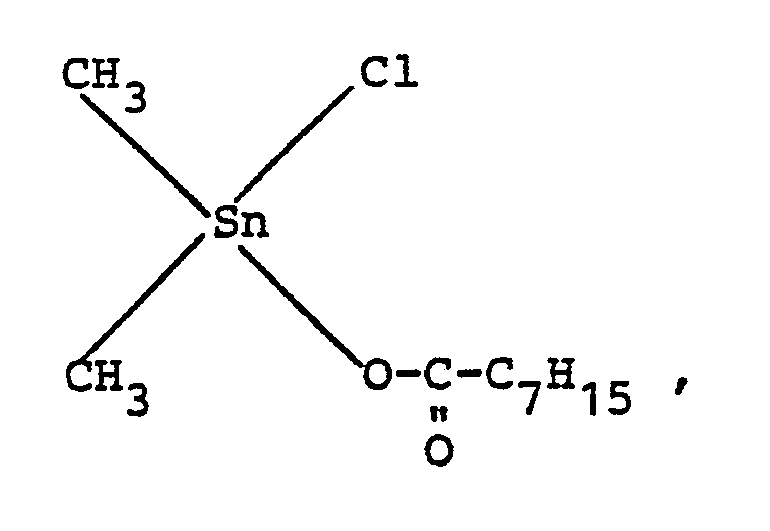
- Dimethylzinnmonochlor-(2-ethyl)hexanoat der Formel

- Dimethylzinnmonochlordodecanoat der Formel

- 1,12-Dodecandisäure-1,12(dimethylmonochlorzinn)ester der Formel

- Die Aktivatoren gemäß Erfindung können im Regelfall sowohl in den Verbindungen mit mindestens zwei aktiven H-Atomen vom Molekulargewicht 400-10000 als auch in der Isocyanatkomponente ohne Schwierigkeiten gelöst werden.
- Bevorzugt werden sie unter Erwärmen in den Verbindungen mit mindestens zwei aktiven H-Atomen vom Molekulargewicht 400-10000 gelöst, wobei überraschenderweise keine Reaktion zwischen dieser Komponente und den Aktivatoren auftritt.
- Die Aktivatoren können dem Reaktionsgemisch jedoch auch in fester Form zugegeben werden. Dabei hat sich gezeigt, daß die Aktivität der dispergierten Aktivatoren von der Aktivität gelöster Aktivatoren oft nur. gering unterschiedlich ist.
- Die erfindungsgemäß verwendeten Aktivatoren werden üblicherweise in Mengen von 0,005 - 10 Gew.-%, bezogen auf die Verbindungen mit mindestens zwei aktiven H-Atomen vom Molekulargewicht 400-10000 eingesetzt, bevorzugt in einer Menge von 0,05 - 5 Gew.-%, ganz besonders bevorzugt in einer Menge von 0,1 - 4 Gew.-%.
- Die Aktivatoren gemäß Erfindung sind im allgemeinen niedrig bis mittelhoch unzersetzt schmelzende Verbindungen.
- Für die Durchführung des erfindungsgemäßen Verfahrens werden eingesetzt:
- 1. Als Ausgangskomponenten aliphatische, cycloaliphatische, araliphatische, aromatische und heterocyclische Polyisocyanate, wie sie z.B. von W. Siefken in Justus Liebigs Annalen der Chemie, 562, Seiten 75 bis 136, beschrieben werden, beispielsweise solche der Formel
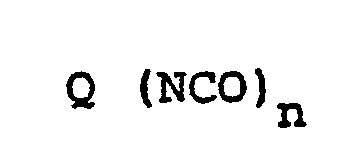
- n = 2-4, vorzugsweise.2, und
- Q einen aliphatischen Kohlenwasserstoffrest mit 2-18, vorzugsweise 6-10 C-Atomen, einen cycloaliphatischen Kohlenwasserstoffrest mit 4-15, vorzugsweise 5-10 C-Atomen, einen aromatischen'Kohlenwasserstoffrest mit 6-15, vorzugsweise 6-13 C-Atomen, oder einen araliphatischen Kohlenwasserstoffrest mit 8-15, vorzugsweise 8-13 C-Atomen, bedeuten, z.B. solche, wie sie in der DE-OS 2 916 139 auf den Seiten 16-18 beschrieben werden.
Bevorzugte Polyisocyanate sind aliphatische und alicyclische Polyisocyanate wie 1,6-Hexamethylendiisocyanat, 1,12-Dodecandiisocyanat, Cyclobutan-1,3-diisocyanat, Cyclohexan-1,3- und -1,4-diisocyanat sowie beliebige Gemische dieser Isomeren, 1-Isocyanato-3,3,5-trimethyl-5-isocyanatomethylcyclohexan (DE-Auslegeschrift 1 202 785, US-Patentschrift 3 401 190), 2,4- und 2,6-Hexahydrotoluylendiisocyanat sowie beliebige Gemische dieser Isomeren, Hexahydro-1,3- und/oder -1,4-phenylendiisocyanat, Perhydro-2,4'- und/oder -4,4'-diphenylmethan-diisocyanat und daraus hergestellte, durch Urethangruppen, Allophanatgruppen, Isocyanuratgruppen, Harnstoffgruppen oder Biuretgruppen modifizierte Polyisocyanate, ferner Mischtrimerisate verschiedener solcher aliphatischer und/oder alicyclischer Polyisocyanate. - 2. Als Ausgangskomponenten ferner Verbindungen mit mindestens zwei gegenüber Isocyanaten reaktionsfähigen Wasserstoffatomen und einem Molekulargewicht in der Regel von 400-10 000. Hierunter versteht man neben Aminogruppen, Thiolgruppen oder Carboxylgruppen aufweisenden Verbindungen vorzugsweise Hydroxylgruppen aufweisende Verbindungen, insbesondere zwei bis acht Hydroxylgruppen aufweisende Verbindungen, speziell solche vom Molekulargewicht 1000 bis 8000, vorzugsweise 1500 bis 6000, z.B. mindestens zwei, in der Regel 2 bis 8, vorzugsweise aber 2 bis 4, Hydroxylgruppen auf-- weisende Polyester, Polyether, Polythioether, Polyacetale, Polycarbonate und Polyesteramide, wie sie für die Herstellung von homogenen und von zellförmigen Polyurethanen an sich bekannt sind (vergleiche DE-OS 2 916 139, Seiten 19-26).
- 3. Gegebenenfalls als Ausgangskomponenten Verbindungen mit mindestens zwei gegenüber Isocyanaten reaktionsfähigen Wasserstoffatomen und einem Molekulargewicht von 32 bis 400. Auch in diesem Fall versteht man hierunter Hydroxylgruppen und/oder Aminogruppen und/oder Thiolgruppen und/oder Carboxylgruppen aufweisende Verbindungen, vorzugsweise Hydroxylgruppen und/oder Aminogruppen aufweisende Verbindungen, die als Kettenverlängerungsmittel oder Vernetzungsmittel dienen. Diese Verbindungen weisen in der Regel 2 bis 8, vorzugsweise 2 bis 4, gegenüber Isocyanaten reaktionsfähige-Wasserstoffatome auf.
- Auch in diesem Fall können Mischungen von verschiedenen Verbindungen mit mindestens zwei gegenüber Isocyanaten reaktionsfähigen Wasserstoffatomen mit einem-Molekulargewicht von 32 bis 400 verwendet werden.
- Als Beispiele für derartige Verbindungen seien solche genannt, wie sie in der DE-OS 2 916 139 auf den Seiten 27-33 beschrieben werden.
- Wasser und/oder leicht flüchtige anorganische oder organische Substanzen als Treibmittel, weitere Katalysatoren der an sich bekannten Art (in der Regel in einer Menge zwischen etwa 0,001 und 10 Gew.-%, bezogen auf die Gesamtmenge an Verbindungen mit mindestens zwei gegenüber Isocyanaten reaktionsfähigen Wasserstoffatomen),
- Oberflächenaktive Zusatzstoffe, wie Emulgatoren und Schaumstabilisatoren,
- Reaktionsverzögerer, ferner Zellregler der an sich bekannten Art sowie Pigmente oder Farbstoffe und Flammschutzmittel der an sich bekannten Art, ferner Stabilisatoren gegen Alterungs- und Witterungseinflüsse, Weichmacher und fungistatisch und bakteriostatisch wirkende Substanzen sowie Füllstoffe. Alle diese Hilfs- und Zusatzmittel werden z.B. in der DE-OS 2 916 139 auf den Seiten 33-38 beschrieben.
- Weitere Beispiele von gegebenenfalls erfindungsgemäß mitzuverwendenden oberflächenaktiven Zusatzstoffen und Schaumstabilisatoren sowie Zellreglern, Reaktionsverzögerern, Stabilisatoren, flammhemmenden Substanzen, Weichmachern, Farbstoffen und Füllstoffen sowie fungistatisch und bakteriostatisch wirksamen Substanzen sowie Einzelheiten über Verwendungs- und Wirkungsweise dieser Zusatzmittel sind im Kunststoff-Handbuch, Band VII, herausgegeben von Vieweg und Höchtlen, Carl-Hanser-Verlag, München 1966, z.B. auf den Seiten 103 bis 113 beschrieben.
- Durchführung des erfindungsgemäßen Verfahrens:
- Die Reaktionskomponenten werden erfindungsgemäß nach dem an sich bekannten Einstufenverfahren, dem Prepolymerverfahren oder dem Semiprepolymerverfahren zur Umsetzung gebracht, wobei man sich oft maschineller Einrichtungen bedient, z.B. solcher, die in der US-Patentschrift 2 764 565 beschrieben werden. Einzelheiten über Verarbeitungseinrichtungen, die auch erfindungsgemäß in Frage kommen, werden im Kunststoff-Handbuch, Band VII, herausgegeben von Vieweg und Höchtlen, Carl-Hanser-Verlag, München 1966, z.B. auf den Seiten 121 bis 205 beschrieben.
- Bei der Schaumstoffherstellung kann erfindungsgemäß die Verschäumung auch in geschlossenen Formen durchgeführt werden. Dabei wird das Reaktionsgemisch in eine Form eingetragen. Als Formmaterial kommt .Metall, z.B. Aluminium, oder Kunststoff, z.B. Epoxidharz, in Frage. In der Form schäumt das schäumfähige Reaktionsgemisch auf und bildet den Formkörper. Die Formverschäumung kann dabei so durchgeführt werden, daß das Formteil an seiner Oberfläche Zellstruktur aufweist, sie kann aber auch so durchgeführt werden, daß das Formteil eine kompakte Haut und einen zelligen Kern aufweist. Erfindungsgemäß kann man in diesem Zusammenhang so vorgehen, daß man in die Form so viel schäumfähiges Reaktionsgemisch einträgt, daß der gebildete Schaumstoff die Form gerade ausfüllt. Man kann aber auch so arbeiten, daß man mehr schäumfähiges Reaktionsgemisch in die Form einträgt, als zur Ausfüllung des Forminneren mit Schaumstoff notwendig ist. Im letztgenannten Fall wird somit unter "overcharging" gearbeitet; eine derartige Verfahrensweise ist z.B. aus den US-Patentschriften 3 178 490 und 3 182 104 bekannt.
- Bei der Formverschäumung werden vielfach an sich bekannte "äußere Trennmittel", wie Siliconöle, mitverwendet. Man kann aber auch sogenannte "innere Trennmittel", gegebenenfalls im Gemisch mit äußeren Trennmitteln, verwenden, wie sie z.B. aus den DE-Offenlegungsschriften 2 121 670 und 2 307 589 bekanntgeworden sind.
- Erfindungsgemäß lassen sich auch kalthärtende Schaumstoffe herstellen (vgl. GB-Patentschrift 1 162 517, DE-Offenlegungsschrift 2 153 086).
- Selbstverständlich können aber auch Schaumstoffe' durch Blockverschäumung oder nach dem an sich bekannten Doppeltransportbandverfahren hergestellt werden.
- Die nach der Erfindung erhältlichen Produkte finden z.B. folgende Anwendung: als Schuhsohlen, Autolenkräder, Armstützen, Kopfstützen, Polstermaterial, Schalldämmstoffe, Beschichtungsmittel, Verpackungsmaterial, Matratzen.
- Isocyanat A: Semiprepolymer aus Isophorondiisocyanat und einem auf Glyzerin gestarteten Polypropylenglykolether (OH-Zahl 670) mit einem NCO-Wert von 28 %.
- Isocyanat B: Prepolymer aus 1,6-Diisocyanatohexan und Dipropylenglykol mit einem NCO-Wert von 14 %.
- Isocyanat C: Modifiziertes 1,6-Diisocyanatohexan, das Biureteinheiten enthält, mit einem NCO-Wert von 21,3 %.
- Isocyanat D: Semiprepolymer aus 4,4'-Diisocyanatodiphenylmethan und Tripropylenglykol mit einem NCO-Wert von 22,8 %.
- Isocyanat E: Modifiziertes 1,6-Diisocyanatohexan, das Biureteinheiten enthält, mit einem NCO-Gehalt von 23 %.
- Isocyanat F: Mischung aus 80 Gew.-% Toluylendiisocyanat und 20 Gew.-% polymerem 4,4'-Diisocyanatodiphenylmethan (NCO-Gehalt: 44,5%).
- Polyol A: Trifunktionelles, auf Trimethylolpropan gestartetes PO/EO-Polyetherpolyol (22 Gew.-% endständ. EO) mit einer OH-Zahl von 27 und einem mittleren Molekulargewicht von 6222.
- Polvol B: Difunktionelles, auf Propylenglykol gestartetes PO//EO-Polyetherpolyol (20 Gew.-% enständ. EO) mit einer OH-Zahl von 28 und einem mittleren Molekulargewicht von 4000.
- Polyol C: Trifunktionelles, auf Trimethylolpropan gestartetes PO/EO-Polyetherpolyol (13,5 Gew.-% endständ. EO) mit einer OH-Zahl von 35 und einem mittleren Molekulargewicht von 4500.
- Polyol D: Umsetzungsprodukt von Glycerin und Propylenoxid mit einer OH-Zahl von 1050.
- Polyol E: Umsetzungsprodukt von Trimethylolpropan mit Propylenoxid mit einer OH-Zahl von 930.
- Polyol F: Auf Trimethylolpropan und Propylenglykol gestartetes PO/EO-Polyetherpolyol (30 Gew.-% EO) mit einer Funktionalität von 2,78, einem mittleren Molekulargewicht von 3700 und einer OH-Zahl von 42.
- Polyol G: Trifunktionelles, auf Trimethylolpropan gestartetes PO/EO-Polyetherpolyol mit einer OH-Zahl von 28.
- Polyol H: Trifunktionelles, mit einem organischen Füllstoff (Polyharnstoff) modifiziertes PO/EO-Polyetherpolyol der OH-Zahl 28 ( 17 Gew.-% EO).
- Katalysator A: Dimethylzinnmonochlor-(2-ethyl)hexanoat der Formel
-

- Katalysator B: Dimethylzinnmonochlordodecanoat der Formel
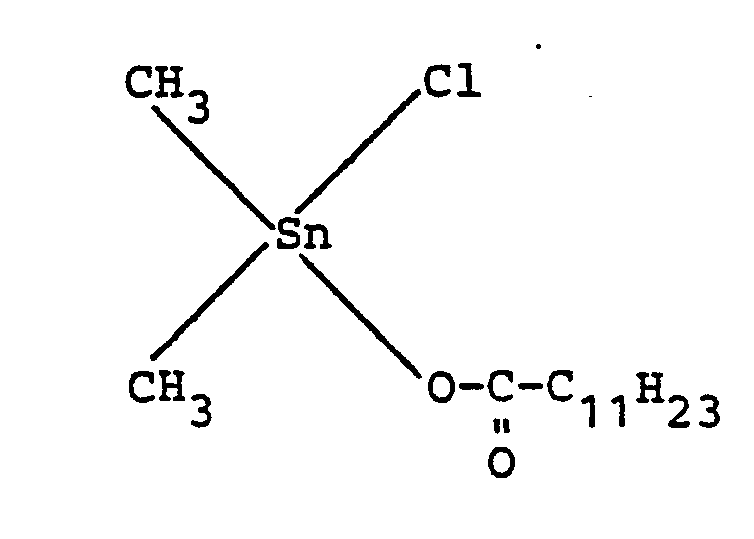
- Katalysator C: Dimethylzinnmonochloracetat der Formel

- Katalysator D: Dimethylzinnmonochloroleat der Formel

- Katalysator E: Diethylzinnmonochloracetat der Formel

- Katalysator F: Dodecandisäure-1,12-bis-(dimethylmono- chlorzinn)-ester der Formel
-

- Die in den Anwendungsbeispielen aufgeführten Reaktionszeiten sind folgendermaßen definiert:
- T1 = Startzeit (Zeit in sec. nach der Einrührung der Isocyanatkomponente, bei der das Gemisch zu schäumen beginnt);
- T2 = Steigzeit (Zeit in sec. nach der Einrührung der Isocyanatkomponente, nach der der Steigvorgang beendet ist);
- T3 = Klebfreizeit (Zeit in sec. nach der Einrührung der Isocyanatkomponente, nach der die Oberfläche des Schaums nicht mehr klebrig ist);
- T4 = Zupfzeit (Zeit in sec. nach der Einrührung der Isocyanatkomponente, nach der es nicht mehr möglich ist, kleine Stücke mit den Fingern aus dem Schaum zu reißen).
- Halbharter Polyurethan-Integralschaum auf Basis aliphatischer bzw. alicyclischer Polyisocyanate
- Rezeptur: A-Komponente:
- 90 g Polyol A
- 5 g Ethylenglykol
- 4 g Diethanolamin
- 1 g Katalysator B
- 12 g Trichlorfluormethan
- B-Komponente:
- 46 g Isocyanat A
- Die Bestandteile der A-Komponente werden bei Raumtemperatur zusammengegeben, mit einem hochtourigen Schnellrührer 30 sec. intensiv vermischt, mit der angegebenen Menge der B-Komponente versetzt, weitere 30 sec. bei Raumtemperatur intensiv vermischt und dann in einem Freischaumpäckchen verschäumt.
- Es wurde eine Startzeit von 37±3 sec. und eine Abbindezeit von 130±10 sec. gefunden.
- Wiederholt man obigen Versuch unter Verwendung von 1 g Zinndioctoat bzw. 1 g Dibutylzinndilaurat, so bleiben die Schäume mehrere Tage klebrig und nicht abgebunden.
- Rezeptur: A-Komponente:
- 90 g Polyol A
- 5 g Ethylenglykol
- 4 g Diethanolamin
- 1 g Tinuvin 327Ⓡ (Lichtschutzmittel, Handelsprodukt der Ciba-Geigy AG)
- 12 g Trichlorfluormethan
- 1 g Katalysator A
- B-Komponente:
- 89 g Isocyanat B
- Die Bestandteile der A-Komponente wurden bei Raumtemperatur zusammengegeben, mit einem hochtourigen Schnellrührer 30 sec. intensiv vermischt, mit der angegebenen Menge Isocyanat versetzt, weitere 30 sec. bei Raumtemperatur intensiv vermischt und dann in einem Freischaumpäckchen verschäumt.
- Es wurde eine Startzeit von 36t3 sec. und eine Abbindezeit von 89±5 sec. erhalten.
- Eine in einer üblichen Aluminium-Laborklappform hergestellte Integralformschaumplatte der Maße 20 x 20 x 1 cm3 hatte bei einem Raumgewicht von 660 kg/m3 eine Shore A-Härte von 57, ließ sich gut entformen und wies eine hohe Elastizität auf.
- Wiederholt man obigen Versuch unter Verwendung von 1 g Zinndioctoat, so wird eine Startzeit von 60±5 sec. und eine Abbindezeit von >5 min. erhalten, wobei der Schaum noch lange klebrig bleibt.
- Rezeptur: A-Komponente:
- 169 g Polyol A
- 9,4 g Ethylenglykol
- 7,5 g Diethanolamin
- 1,87 g Katalysator A
- 20 g Trichlorfluormethan
- 2 g Tinuvin 327®(Lichtschutzmittel,
- Handelsprodukt der Ciba-Geigy AG)
- B-Komponente:
- 119 g Isocyanat C
- 3 g Stabilisator (handelsüblicher
- Phosphit-Stabilisator)
- Die Bestandteile der A-Komponente werden bei Raumtemperatur zusammengegeben, mit einem hochtourigen Schnellrührer 30 sec. intensiv vermischt, mit der angegebenen Menge B-Komponente versetzt, weitere 30 sec. bei Raumtemperatur intensiv vermischt und dann in einem Freischaumpäckchen verschäumt.
- Es wurde eine Startzeit von 35±3 sec. und eine Abbindezeit von 84±5 sec. erhalten.
- Eine mit obigem Gemisch in einer üblichen Aluminium-Laborklappform hergestellte Integralformschaumstoffplatte der Maße 20 x 20 x 1 cm3 hatte bei einem Raumgewicht von 665 kg/m3 eine Shore A-Härte von 69, ließ sich gut entformen und wies eine hohe Elastizität auf.
- Wiederholt man obigen Versuch unter Verwendung von 1 g Zinndioctoat bzw. 1 g Dibutylzinndilaurat, so bleiben die Schäume mehrere Tage klebrig und nicht abgebunden.
- Rezeptur: A-Komponente:
- 90 g Polyol A
- 5 g Ethylenglykol
- 4 g Diethanolamin
- 10 g Trichlorfluormethan
- 1 g Katalysator E
- B-Komponente:
- 46 g Isocyanat A
- Zur Versuchsdurchführung wird wie in Beispiel 3 vorgegangen.
- Es wurde eine Startzeit von 35-3 sec. und eine Abbindezeit von 110±10 sec. erhalten.
- Wiederholt man obigen Versuch unter Verwendung von 1 g Zinndioctoat bzw. 1 g Dibutylzinndilaurat, so bleiben die Schäume mehrere Tage klebrig und nicht abgebunden.
- Halbharter Polyurethan-Integralschaum auf Basis aromatischer Polyisocyanate
- Rezeptur: A-Komponente:
- 70 g Polyol B
- 20 g Polyol C
- 1 g Ethylenglykol
- 14 g Butandiol -14
- 0,1 g Wasser
- 0,02 g Katalysator F x g -Triethylendiamin (DABCO®)
- B-Komponente:
- 74 g Isocyanat D
- Zur Versuchsdurchführung wird wie in Beispiel 3 vorgegangen.
- Es werden folgende Zeiten erhalten:

- Harter Polyurethan-Integralschaum auf Basis aliphatischer Isocyanate
- Rezeptur: A-Komponente:
- 35 g Polyol D
- 35 g Polyol E
- 30 g Polyol F
- 1 g Schaumstabilisator (Stabilisator der Fa. Goldschmidt, Essen auf Polysiloxan-Polyalkylenoxid-Blockcopolymer-Basis)
- 0,8 g Diazabicycloundecen
- 1,3 g Dibutylzinndilaurat
- 30 g Trichlorfluormethan
- B-Komponente:
- 252,4 g Isocyanat E
- Die Bestandteile der A-Komponente wurden bei Raumtemperatur zusammengegeben, mit einem hochtourigen Schnellrührer 30 sec. intensiv vermischt, mit der angegebenen Menge Isocyanat versetzt, weitere 30 sec. bei Raumtemperatur intensiv vermischt und dann in einem Freischaumpäckchen verschäumt.
- Es wurde eine Startzeit von 38±3 sec. und eine Abbindezeit von 47-3 sec. gefunden.
- In diesen Beispielen werden Diazabicycloundecan und Dibutylzinndilaurat durch die erfindungsgemäß zu verwendenden Katalysatoren ersetzt. Diese Beispiele verdeutlichen auch die gute Wirkung der suspendierten Katalysatoren.

- Dieses Beispiel vergleicht die katalytischen Fähigkeiten einer Diazabicycloundecen/Dibutylzinndilaurat-Kombination mit einer Kombination aus Diazabicycloundecen und einem der erfindungsgemäß zu verwendenden Katalysatoren.
- Verwendet man die in 6.1 angegebene Rezeptur und ersetzt Dibutylzinndilaurat durch Katalysator B, so erhält man - bei 5.1 - analoger Versuchsdurchführung - folgende Zeiten:

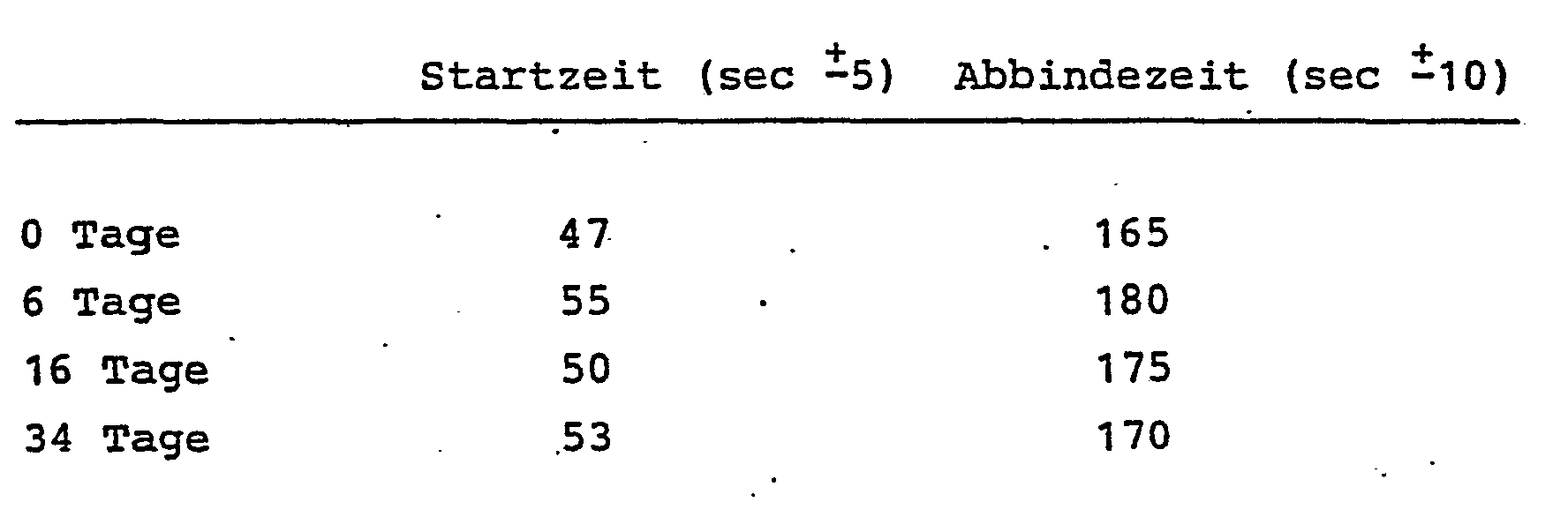
- Dieses Beispiel demonstriert die Lagerstabilität von (als stellvertretendes Beispiel) Katalysator A beiRaumtemperatur.
- Rezeptur: A-Katalysator:
- 900 g Polyol A
- 50 g Ethylenglykol
- 40 g Diethanolamin
- 10 g Katalysator A
- B-Komponente:
- Isocyanat A
- In regelmäßigen Abständen wurden 100 g der einphasigen A-Komponente-mit 12 g Trichlorfluormethan und 46 g Isocyanat A versetzt, bei Raumtemperatur sorgfältig mit einem hochtourigen Schnellrührer vermischt und in einem Freischaumpäckchen verschäumt.
- Es wurden folgende Daten gemessen:
- 100 g eines linearen Polypropylenethers (Molekulargewicht 2000, OH-Zahl 56) werden mit 29 g eines nach bekannten Methoden hergestellten dimeren 4,4'-Diisocyanatodiphenylmethans (Uretdiondiisocyanat; NCO-Wert: 14,5 %) innig vermischt. Zu dieser Suspension werden jeweils 0,5 g der Katalysatoren zugesetzt und die Reaktionsmischung 4 h bei 120°C ausgeheizt.
- Man erhält Polyurethan-Elastomere mit einer Shore A-Härte von ca. 52.
- Durch Zusetzen von 0,5 g Zinndioctoat an Stelle der Katalysatoren A, B, C, D, E erhält man unter diesen Reaktionsbedingungen wesentlich weichere Polyurethan-Materialien (Shore A-Härte von 30-40), was auf unvollständige Reaktion hindeutet.
- Wird der im Beispiel 7 angegebene Polyether durch 100 g eines Mischpolyesters aus Adipinsäure und Ethylenglykol/ Butylenglykol (Molekulargewicht 2000, OH-Wert: 56) ersetzt, so erhält man nach Zugabe von 0,5 g der Katalysatoren A, B, C, D ,E und 3-stündigem Erhitzen auf 120°C ein elastisches Polyurethanmaterial mit einer Shore A-Härte von 60. Ohne Katalyse tritt auch nach langer Ausheizphase keine Reaktion ein und die Reaktionsmischung bleibt flüssig.
- Rezeptur: A-Komponente:
- 80 g Polyol G
- 20 g Polyol H
- 3,1 g Wasser
- 1 g handelsüblicher Schaumstabilisator 0,1 g Aktivator (Niax A1 der Union
- Carbide Co).
- 0,5 g Aktivator (PU 3117 der Bayer AG) 0,2 g Katalysator D
- B-Komponente:
- 37,1 g Isocyanat F
- Ein mit obiger Rezeptur in einer Aluminium-Kastenform (Formtemperatur 50-55°C) in an sich bekannter Weise hergestellter Formschaum wies folgende Daten auf:

bedeutet, verwendet.
Claims (5)


bedeuten, verwendet.
Applications Claiming Priority (2)
| Application Number | Priority Date | Filing Date | Title |
|---|---|---|---|
| DE19813100977 DE3100977A1 (de) | 1981-01-15 | 1981-01-15 | Verfahren zur herstellung von gegebenenfalls geschaeumten polyurethanen |
| DE3100977 | 1981-01-15 |
Publications (3)
| Publication Number | Publication Date |
|---|---|
| EP0056576A2 true EP0056576A2 (de) | 1982-07-28 |
| EP0056576A3 EP0056576A3 (en) | 1982-12-15 |
| EP0056576B1 EP0056576B1 (de) | 1985-08-28 |
Family
ID=6122609
Family Applications (1)
| Application Number | Title | Priority Date | Filing Date |
|---|---|---|---|
| EP82100039A Expired EP0056576B1 (de) | 1981-01-15 | 1982-01-07 | Verfahren zur Herstellung von gegebenenfalls geschäumten Polyurethanen |
Country Status (5)
| Country | Link |
|---|---|
| US (1) | US4390640A (de) |
| EP (1) | EP0056576B1 (de) |
| JP (1) | JPS57137316A (de) |
| AU (1) | AU545958B2 (de) |
| DE (2) | DE3100977A1 (de) |
Cited By (1)
| Publication number | Priority date | Publication date | Assignee | Title |
|---|---|---|---|---|
| EP0210566A3 (de) * | 1985-08-02 | 1988-01-20 | Bayer Ag | Verfahren zur Herstellung von lichtbeständigen, elastischen Polyurethan-Formteilen |
Families Citing this family (13)
| Publication number | Priority date | Publication date | Assignee | Title |
|---|---|---|---|---|
| WO1984003288A1 (en) * | 1983-02-16 | 1984-08-30 | Dow Chemical Co | An active hydrogen-containing composition which provides mold release properties to a molded article, an internal mold release composition for preparing the active hydrogen-containing composition, and a process for preparing molded polymeric products from the active hydrogen-containing composition |
| US4876019A (en) * | 1983-02-16 | 1989-10-24 | The Dow Chemical Company | Internal mold release compositions |
| US5008033A (en) * | 1983-02-16 | 1991-04-16 | The Dow Chemical Company | Internal mold release compositions |
| US5011647A (en) * | 1983-02-16 | 1991-04-30 | The Dow Chemical Company | Internal mold release compositions |
| FR2630444B1 (fr) * | 1988-04-21 | 1990-09-07 | Rhone Poulenc Chimie | Composes d'etain utilisables notamment comme catalyseurs latents pour la preparation de polyurethannes |
| US5089583A (en) * | 1989-10-20 | 1992-02-18 | Air Products And Chemicals, Inc. | Heterocyclic diorganotin catalysts for use in polyurethane systems |
| US5089584A (en) * | 1989-10-20 | 1992-02-18 | Air Products And Chemicals, Inc. | Polymeric diorganotin catalysts for use in polyurethane systems |
| US5013810A (en) * | 1990-02-09 | 1991-05-07 | Mobay Corporation | Impact absorbing media |
| US5043463A (en) * | 1990-08-17 | 1991-08-27 | Florida Atlantic University | Novel compounds for the control of microorganisms |
| AU2001277762A1 (en) * | 2000-08-11 | 2002-02-25 | France Bed Co. Ltd. | Cushion and forming die for cushion |
| JP5706525B2 (ja) | 2010-07-09 | 2015-04-22 | エア プロダクツ アンド ケミカルズ インコーポレイテッドAir Products And Chemicals Incorporated | ポリウレタンフォームの性能を改良するための添加剤 |
| US9447223B2 (en) * | 2011-07-07 | 2016-09-20 | Air Products And Chemicals, Inc. | Additives for improving natural oil based polyurethane foam performance |
| CN118406206A (zh) * | 2024-05-22 | 2024-07-30 | 惠东县华辰鞋业有限公司 | 一种耐老化pu鞋底材料及其制备方法 |
Family Cites Families (4)
| Publication number | Priority date | Publication date | Assignee | Title |
|---|---|---|---|---|
| US3306926A (en) * | 1962-03-23 | 1967-02-28 | Battelle Memorial Institute | Process for preparation of leathertreating compounds |
| DE1214237B (de) * | 1964-07-10 | 1966-04-14 | Studiengesellschaft Kohle Mbh | Verfahren zur Herstellung von halogenhaltigen Organozinnverbindungen |
| DE1595256A1 (de) * | 1965-02-19 | 1969-08-21 | Allied Chem | Haertbare Urethanmassen |
| US3887505A (en) * | 1973-12-03 | 1975-06-03 | Basf Wyandotte Corp | Preparation of low density flexible urethane foams with enhanced load-bearing properties |
-
1981
- 1981-01-15 DE DE19813100977 patent/DE3100977A1/de not_active Withdrawn
-
1982
- 1982-01-07 EP EP82100039A patent/EP0056576B1/de not_active Expired
- 1982-01-07 DE DE8282100039T patent/DE3265675D1/de not_active Expired
- 1982-01-13 AU AU79469/82A patent/AU545958B2/en not_active Ceased
- 1982-01-13 JP JP57002890A patent/JPS57137316A/ja active Pending
- 1982-01-25 US US06/342,303 patent/US4390640A/en not_active Expired - Lifetime
Cited By (1)
| Publication number | Priority date | Publication date | Assignee | Title |
|---|---|---|---|---|
| EP0210566A3 (de) * | 1985-08-02 | 1988-01-20 | Bayer Ag | Verfahren zur Herstellung von lichtbeständigen, elastischen Polyurethan-Formteilen |
Also Published As
| Publication number | Publication date |
|---|---|
| JPS57137316A (en) | 1982-08-24 |
| US4390640A (en) | 1983-06-28 |
| EP0056576B1 (de) | 1985-08-28 |
| AU545958B2 (en) | 1985-08-08 |
| EP0056576A3 (en) | 1982-12-15 |
| DE3265675D1 (en) | 1985-10-03 |
| DE3100977A1 (de) | 1982-08-05 |
| AU7946982A (en) | 1982-07-22 |
Similar Documents
| Publication | Publication Date | Title |
|---|---|---|
| DE3586481T2 (de) | Verzoegerte katalyse mit gesteigerter haertungswirkung in polyurethansystemen. | |
| DE2427273C2 (de) | Verfahren zur Herstellung von formverschäumten Schaumstoffen mit selbsttrennenden Eigenschaften | |
| DE2523633C2 (de) | Verfahren zur Herstellung von Polyurethanschaumstoffen und Katalysatoren zur Durchführung des Verfahrens | |
| DE3587254T2 (de) | Katalysatorsysteme für Polyurethanzusammensetzungen. | |
| EP0056576B1 (de) | Verfahren zur Herstellung von gegebenenfalls geschäumten Polyurethanen | |
| DE3435070A1 (de) | Verfahren zur herstellung von gegebenenfalls geschaeumten polyurethanen, die mit einem anderen werkstoff verbunden oder konfektioniert worden sind | |
| DE2319648A1 (de) | Verfahren zur herstellung von schaumstoffen | |
| DE2356692A1 (de) | Verfahren zur herstellung von schaumstoffen | |
| DE2307589A1 (de) | Verfahren zur herstellung von schaumstoffen | |
| DE1520384A1 (de) | Verfahren zur Herstellung von organischen Verbindungen und daraus erhaltene Polyurethanmassen | |
| DE3219040A1 (de) | Verfahren zur herstellung eines urethan- und/oder isocyanuratgruppen aufweisenden zellfoermigen kunststoff-verbundteils | |
| EP0024323A1 (de) | Verfahren zur Herstellung von dynamisch besonders belastbaren Luftreifen | |
| DE2621582C2 (de) | Verfahren zur Herstellung von flammfesten, keinen Rauch entwickelnden Polyurethanschaumstoffen | |
| DE3015440A1 (de) | Verfahren zur herstellung von polyurethan-kunststoffen unter verwendung von cyclischen, n-hydroxyalkyl-substituierten, amidingruppen aufweisenden verbindungen als katalysatoren | |
| DE2601082A1 (de) | Katalysatoren fuer isocyanat-polyadditionsreaktionen | |
| DE2914134A1 (de) | Verfahren zur herstellung von polyurethan-schaumstoffen | |
| EP0243777A2 (de) | Verfahren zur Herstellung von Polyharnstoffschaum-Formteilen | |
| EP0649440B1 (de) | Verfahren zur herstellung von harten urethangruppen und überwiegend isocyanuratgruppen aufweisenden schaumstoffen | |
| EP0471260A2 (de) | Verfahren zur Herstellung von offenzelligen Polyurethan-Weichschaumstoffen und deren Verwendung als Polstermaterial | |
| EP0138102B1 (de) | Verfahren zur Herstellung von Urethangruppen aufweisenden Schaumstoffen und nach diesem Verfahren erhältliche Schaumstoffe | |
| EP1329471B1 (de) | Verfahren zur Herstellung von Polyurethanen und/oder Polyharnstoffen unter Verwendung von Amin-N-oxid-Katalysatoren und Zusammensetzungen enthaltend Amin-N-oxide | |
| EP1454933A1 (de) | Verfahren zur Herstellung von geruchsarmen und lagerstabilen monomerhaltigen Polyisocyanuraten auf Basis von Isophorondiisocyanat | |
| DE2106726A1 (de) | Hydrolyseschutzmittel für estergruppenhaltige Kunststoffe | |
| EP0025572A1 (de) | Dialkoxy-phosphonyl-N-alkyl-ameisensäureamide und ihre Verwendung als Zusatzmittel bei der Herstellung von flammkaschierbaren und hochfrequenzverschweissbaren Polyurethanschaumstoffen | |
| EP0077937B1 (de) | Verfahren zur Herstellung von gegebenenfalls geschäumten Polyurethanen und lagerstabiles Vorprodukt für die Durchführung eines solchen Verfahrens |
Legal Events
| Date | Code | Title | Description |
|---|---|---|---|
| PUAI | Public reference made under article 153(3) epc to a published international application that has entered the european phase |
Free format text: ORIGINAL CODE: 0009012 |
|
| 17P | Request for examination filed |
Effective date: 19820107 |
|
| AK | Designated contracting states |
Designated state(s): BE DE FR GB IT NL SE |
|
| PUAL | Search report despatched |
Free format text: ORIGINAL CODE: 0009013 |
|
| AK | Designated contracting states |
Designated state(s): BE DE FR GB IT NL SE |
|
| ITF | It: translation for a ep patent filed | ||
| GRAA | (expected) grant |
Free format text: ORIGINAL CODE: 0009210 |
|
| AK | Designated contracting states |
Designated state(s): BE DE FR GB IT NL SE |
|
| REF | Corresponds to: |
Ref document number: 3265675 Country of ref document: DE Date of ref document: 19851003 |
|
| ET | Fr: translation filed | ||
| PLBE | No opposition filed within time limit |
Free format text: ORIGINAL CODE: 0009261 |
|
| STAA | Information on the status of an ep patent application or granted ep patent |
Free format text: STATUS: NO OPPOSITION FILED WITHIN TIME LIMIT |
|
| 26N | No opposition filed | ||
| PGFP | Annual fee paid to national office [announced via postgrant information from national office to epo] |
Ref country code: NL Payment date: 19870131 Year of fee payment: 6 |
|
| PG25 | Lapsed in a contracting state [announced via postgrant information from national office to epo] |
Ref country code: GB Effective date: 19890107 |
|
| PG25 | Lapsed in a contracting state [announced via postgrant information from national office to epo] |
Ref country code: SE Effective date: 19890108 |
|
| PG25 | Lapsed in a contracting state [announced via postgrant information from national office to epo] |
Ref country code: BE Effective date: 19890131 |
|
| BERE | Be: lapsed |
Owner name: BAYER A.G. Effective date: 19890131 |
|
| PG25 | Lapsed in a contracting state [announced via postgrant information from national office to epo] |
Ref country code: NL Effective date: 19890801 |
|
| NLV4 | Nl: lapsed or anulled due to non-payment of the annual fee | ||
| GBPC | Gb: european patent ceased through non-payment of renewal fee | ||
| PG25 | Lapsed in a contracting state [announced via postgrant information from national office to epo] |
Ref country code: FR Free format text: LAPSE BECAUSE OF NON-PAYMENT OF DUE FEES Effective date: 19890929 |
|
| PG25 | Lapsed in a contracting state [announced via postgrant information from national office to epo] |
Ref country code: DE Effective date: 19891003 |
|
| REG | Reference to a national code |
Ref country code: FR Ref legal event code: ST |
|
| EUG | Se: european patent has lapsed |
Ref document number: 82100039.5 Effective date: 19891204 |