EP0054610B1 - Verfahren zum gleichzeitigen, kontinuierlichen Verfestigen und Beschichten eines Vliesstoffes - Google Patents
Verfahren zum gleichzeitigen, kontinuierlichen Verfestigen und Beschichten eines Vliesstoffes Download PDFInfo
- Publication number
- EP0054610B1 EP0054610B1 EP81106160A EP81106160A EP0054610B1 EP 0054610 B1 EP0054610 B1 EP 0054610B1 EP 81106160 A EP81106160 A EP 81106160A EP 81106160 A EP81106160 A EP 81106160A EP 0054610 B1 EP0054610 B1 EP 0054610B1
- Authority
- EP
- European Patent Office
- Prior art keywords
- binder
- nonwoven
- printed onto
- printed
- process according
- Prior art date
- Legal status (The legal status is an assumption and is not a legal conclusion. Google has not performed a legal analysis and makes no representation as to the accuracy of the status listed.)
- Expired
Links
- 238000000034 method Methods 0.000 title claims description 25
- 230000008569 process Effects 0.000 title claims description 20
- 239000011248 coating agent Substances 0.000 title claims description 4
- 238000000576 coating method Methods 0.000 title claims description 4
- 239000004744 fabric Substances 0.000 title description 3
- 238000005728 strengthening Methods 0.000 title description 2
- 239000011230 binding agent Substances 0.000 claims description 36
- 239000000853 adhesive Substances 0.000 claims description 30
- 230000001070 adhesive effect Effects 0.000 claims description 30
- 238000007639 printing Methods 0.000 claims description 21
- 239000000203 mixture Substances 0.000 claims description 11
- 229920001971 elastomer Polymers 0.000 claims description 6
- 238000004132 cross linking Methods 0.000 claims description 5
- 229920001169 thermoplastic Polymers 0.000 claims description 5
- 239000004416 thermosoftening plastic Substances 0.000 claims description 5
- QSHDDOUJBYECFT-UHFFFAOYSA-N mercury Chemical compound [Hg] QSHDDOUJBYECFT-UHFFFAOYSA-N 0.000 claims description 3
- 229910052753 mercury Inorganic materials 0.000 claims description 3
- 238000010894 electron beam technology Methods 0.000 claims description 2
- 238000007646 gravure printing Methods 0.000 claims description 2
- 230000005855 radiation Effects 0.000 claims 2
- 239000004745 nonwoven fabric Substances 0.000 description 15
- 239000000835 fiber Substances 0.000 description 8
- 239000004831 Hot glue Substances 0.000 description 4
- 238000003825 pressing Methods 0.000 description 4
- 239000000126 substance Substances 0.000 description 4
- 230000008901 benefit Effects 0.000 description 3
- 150000001875 compounds Chemical class 0.000 description 3
- 238000001816 cooling Methods 0.000 description 3
- 229920001634 Copolyester Polymers 0.000 description 2
- XEEYBQQBJWHFJM-UHFFFAOYSA-N Iron Chemical compound [Fe] XEEYBQQBJWHFJM-UHFFFAOYSA-N 0.000 description 2
- 238000007596 consolidation process Methods 0.000 description 2
- 239000012943 hotmelt Substances 0.000 description 2
- 238000010409 ironing Methods 0.000 description 2
- 238000002844 melting Methods 0.000 description 2
- 230000008018 melting Effects 0.000 description 2
- 229920000728 polyester Polymers 0.000 description 2
- 238000007711 solidification Methods 0.000 description 2
- 230000008023 solidification Effects 0.000 description 2
- 230000002269 spontaneous effect Effects 0.000 description 2
- 238000012546 transfer Methods 0.000 description 2
- 230000004913 activation Effects 0.000 description 1
- 230000005540 biological transmission Effects 0.000 description 1
- 238000009960 carding Methods 0.000 description 1
- 230000008859 change Effects 0.000 description 1
- 239000000470 constituent Substances 0.000 description 1
- 238000011109 contamination Methods 0.000 description 1
- -1 copolyamides Polymers 0.000 description 1
- 230000008878 coupling Effects 0.000 description 1
- 238000010168 coupling process Methods 0.000 description 1
- 238000005859 coupling reaction Methods 0.000 description 1
- 238000007598 dipping method Methods 0.000 description 1
- 238000009826 distribution Methods 0.000 description 1
- 238000005108 dry cleaning Methods 0.000 description 1
- 238000001035 drying Methods 0.000 description 1
- 238000005265 energy consumption Methods 0.000 description 1
- 230000002349 favourable effect Effects 0.000 description 1
- 238000009998 heat setting Methods 0.000 description 1
- 238000010438 heat treatment Methods 0.000 description 1
- 238000007654 immersion Methods 0.000 description 1
- 229910052742 iron Inorganic materials 0.000 description 1
- 239000007788 liquid Substances 0.000 description 1
- 239000000155 melt Substances 0.000 description 1
- 229910052751 metal Inorganic materials 0.000 description 1
- 239000002184 metal Substances 0.000 description 1
- 230000004048 modification Effects 0.000 description 1
- 238000012986 modification Methods 0.000 description 1
- 238000010915 one-step procedure Methods 0.000 description 1
- 238000005457 optimization Methods 0.000 description 1
- 230000035515 penetration Effects 0.000 description 1
- 229920000642 polymer Polymers 0.000 description 1
- 229920000098 polyolefin Polymers 0.000 description 1
- 229920001296 polysiloxane Polymers 0.000 description 1
- 239000004810 polytetrafluoroethylene Substances 0.000 description 1
- 229920001343 polytetrafluoroethylene Polymers 0.000 description 1
- 229920002635 polyurethane Polymers 0.000 description 1
- 239000004814 polyurethane Substances 0.000 description 1
- 230000009467 reduction Effects 0.000 description 1
- 230000002787 reinforcement Effects 0.000 description 1
- 238000012216 screening Methods 0.000 description 1
- 239000004753 textile Substances 0.000 description 1
Images
Classifications
-
- D—TEXTILES; PAPER
- D04—BRAIDING; LACE-MAKING; KNITTING; TRIMMINGS; NON-WOVEN FABRICS
- D04H—MAKING TEXTILE FABRICS, e.g. FROM FIBRES OR FILAMENTARY MATERIAL; FABRICS MADE BY SUCH PROCESSES OR APPARATUS, e.g. FELTS, NON-WOVEN FABRICS; COTTON-WOOL; WADDING ; NON-WOVEN FABRICS FROM STAPLE FIBRES, FILAMENTS OR YARNS, BONDED WITH AT LEAST ONE WEB-LIKE MATERIAL DURING THEIR CONSOLIDATION
- D04H1/00—Non-woven fabrics formed wholly or mainly of staple fibres or like relatively short fibres
- D04H1/40—Non-woven fabrics formed wholly or mainly of staple fibres or like relatively short fibres from fleeces or layers composed of fibres without existing or potential cohesive properties
- D04H1/42—Non-woven fabrics formed wholly or mainly of staple fibres or like relatively short fibres from fleeces or layers composed of fibres without existing or potential cohesive properties characterised by the use of certain kinds of fibres insofar as this use has no preponderant influence on the consolidation of the fleece
- D04H1/4326—Condensation or reaction polymers
- D04H1/435—Polyesters
-
- D—TEXTILES; PAPER
- D04—BRAIDING; LACE-MAKING; KNITTING; TRIMMINGS; NON-WOVEN FABRICS
- D04H—MAKING TEXTILE FABRICS, e.g. FROM FIBRES OR FILAMENTARY MATERIAL; FABRICS MADE BY SUCH PROCESSES OR APPARATUS, e.g. FELTS, NON-WOVEN FABRICS; COTTON-WOOL; WADDING ; NON-WOVEN FABRICS FROM STAPLE FIBRES, FILAMENTS OR YARNS, BONDED WITH AT LEAST ONE WEB-LIKE MATERIAL DURING THEIR CONSOLIDATION
- D04H1/00—Non-woven fabrics formed wholly or mainly of staple fibres or like relatively short fibres
- D04H1/40—Non-woven fabrics formed wholly or mainly of staple fibres or like relatively short fibres from fleeces or layers composed of fibres without existing or potential cohesive properties
- D04H1/58—Non-woven fabrics formed wholly or mainly of staple fibres or like relatively short fibres from fleeces or layers composed of fibres without existing or potential cohesive properties by applying, incorporating or activating chemical or thermoplastic bonding agents, e.g. adhesives
- D04H1/64—Non-woven fabrics formed wholly or mainly of staple fibres or like relatively short fibres from fleeces or layers composed of fibres without existing or potential cohesive properties by applying, incorporating or activating chemical or thermoplastic bonding agents, e.g. adhesives the bonding agent being applied in wet state, e.g. chemical agents in dispersions or solutions
- D04H1/66—Non-woven fabrics formed wholly or mainly of staple fibres or like relatively short fibres from fleeces or layers composed of fibres without existing or potential cohesive properties by applying, incorporating or activating chemical or thermoplastic bonding agents, e.g. adhesives the bonding agent being applied in wet state, e.g. chemical agents in dispersions or solutions at spaced points or locations
-
- D—TEXTILES; PAPER
- D06—TREATMENT OF TEXTILES OR THE LIKE; LAUNDERING; FLEXIBLE MATERIALS NOT OTHERWISE PROVIDED FOR
- D06M—TREATMENT, NOT PROVIDED FOR ELSEWHERE IN CLASS D06, OF FIBRES, THREADS, YARNS, FABRICS, FEATHERS OR FIBROUS GOODS MADE FROM SUCH MATERIALS
- D06M17/00—Producing multi-layer textile fabrics
Definitions
- the invention relates to a process for the simultaneous, continuous solidification and coating of a nonwoven fabric with a binder and with an adhesive, in which the binder is counter-pressed from one side synchronously against the adhesive compound printed on the other side in the form of partial areas that cover it, the Partial areas have a distance from each other.
- Binders primarily serve to bond the fibers of a nonwoven fabric to one another and thereby give it strength. The more fibers are glued together, the greater the strength. It is therefore desirable for the binder to penetrate into the interior of the treated nonwoven and, after it has solidified, to be distributed as evenly as possible over the entire cross section.
- crosslinkable polymeric substances are used as binders for practical use.
- the adhesive compositions applied to the surface of fixing inserts serve to enable bonding with another substance.
- Common adhesive compositions are thermoplastic substances, and the activation is effected by applying pressure and heat, for example with the aid of an iron.
- the binder it is therefore desirable that the adhesive does not penetrate into the interior of the nonwoven used, even when ironing, but is available as completely and concentrated as possible for the mutual bonding of the superimposed surfaces.
- the method mentioned at the beginning makes it possible to apply the binder and the adhesive composition congruently to the top and to the bottom of the nonwoven used. Due to the identical printing process used in the treatment of the top and bottom surfaces, however, the same press-in forces result, and it is therefore extremely difficult to practically implement the desired different press-in of binder and adhesive. A mutual modification of the size of the applied partial areas is not possible, and higher printing speeds can lead to an unclean printed image and thus to undefined properties of the fixing insert obtained, especially when treating non-pre-consolidated nonwovens.
- the invention is based on the object of further developing the method mentioned at the outset in such a way that - when simultaneous, continuous printing of a binder and an adhesive on an unconsolidated nonwoven fabric in the form of partial areas with a congruent center line, a precise printed image is achieved on both sides, which enables to vary the mutual specific order quantity as well as the mutual pressing in at high working speeds and which enables a reduction in the specific energy required.
- a radiation-crosslinkable binder is printed from the underside against a thermoplastic adhesive compound printed on the top of the nonwoven fabric according to the hotmelt principle and crosslinked by subsequent irradiation.
- Both the binder paste and the adhesive melt contain no constituents that have to be removed by complex, subsequent drying processes, and the crosslinking of the binder can be brought about almost suddenly using high-energy rays.
- the proposed method is not only extremely unproblematic to use due to the one-step procedure, but it also enables high working speeds of, for example, 50 to 150 m / min to be achieved with a reduced specific energy consumption. It is an advantage to be emphasized that a prior consolidation of the nonwovens used is not necessary. Rather, it is sufficient if these are compressed to such an extent by a previous pressing in the inner structure that the fiber structure is not destroyed during the printing process. This goal can be achieved without difficulty if a nonwoven fabric made of fibers with a stack length of at least 25 mm is used, the fibers of which are assigned to one another in a tangled distribution.
- the printing paste or melt used is applied from both sides in partial areas, the centers of which are arranged on a common center line. In this respect they are assigned to each other symmetrically.
- the size of the partial areas can be varied relative to one another, and can therefore be easily determined in such a way that the desired purpose in each case, namely the strengthening of the nonwoven fabric in itself or heat setting with an outer fabric, is achieved in an optimal manner.
- a Such optimization would, however, mean that the processor would have to stock a special fixing insert depending on the absorbency and other properties of each special outer fabric, which would quickly remove the obvious advantage. It has therefore proven useful to print the binder in partial areas whose diameter is at least as large as that of the adhesive.
- a particularly good puncture resistance against the penetration of the adhesive during the ironing through the fixing insert can be achieved if the partial surfaces made of binder have a larger diameter than the partial surfaces made of adhesive. The difference should not exceed 60% in order to prevent undesired stiffening of the fixing insert.
- the partial areas are distributed on the fixing insert in a surface grid that can be divided evenly or unevenly. In addition to the stiffness of the fixing insert, this can influence the textile case.
- the printing processes used for the application of the adhesive and the binder basically belong to different types, which means that the two substances, which are intended to perform different tasks, can be applied in a favorable mutual coordination. It is also essential that at least one of the two opposing printing cylinders has soft-elastic properties, by means of which differences in thickness or elasticity of the printed nonwoven fabric are compensated during the printing process to such an extent that a disturbance in the printed image generated is avoided.
- the binder is applied using a high pressure, flat or gravure cylinder with a soft, elastic jacket made of rubber. In all three cases, a good pressing into the interior of the nonwoven fabric is achieved. In addition, the high-pressure process combines the further advantage of a particularly good elasticity of the surface with good protection against soiling compared to fiber components detaching from the surface of the printed nonwoven fabric.
- the specific amount of binder applied can be continuously changed by adjusting the printing device used. If a corresponding change is required when using an intaglio printing process, the use of a correspondingly modified printing roller is necessary. Modified printing rollers are still required if the size of the partial areas is to be modified in the high, flat or gravure printing process.
- thermoplastic adhesive compound printed on the top The use of a binder that can be crosslinked by UV rays enables the binder to be cured almost rapidly with a high energy density during crosslinking.
- All the relevant adhesive compositions can be processed, for example those based on polyolefin, copolyamides, polyurethanes or copolyesters.
- the melting point is generally in the range between 100 and 130 ° C.
- the adhesive used is printed in a melted form with the help of a heated bowl. To prevent contamination of the surface, it is specially equipped, for example with a silicone or a PTFE coating.
- the upper and the lower pressure roller are connected by a gear transmission, which ensures that the mutual assignment of the printed partial surfaces of binder and adhesive is always assigned to one another in a constant form.
- the rigid coupling enables a mutual assignment of extraordinarily high precision, in which the centers of the partial areas printed on both sides can completely coincide with a working width of more than 1 m and a diameter of the partial areas of less than 1 m.
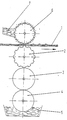
- the nonwoven web is passed through a printing device according to the attached drawing.
- the lower pressure roller 2 is designed as a rubber high-pressure roller.
- the rubber is resistant to organic liquids and has a Shore A hardness of 65.
- the division of the high-pressure pattern can be, for example, a 17 mesh row point, which corresponds to a so-called computer point, at which 52 statistically distributed elevations per cm 2 are provided are.
- the printing roller 6 provided with a hot melt engraving has an identical division.
- the diameter of the printing surface of the high-pressure roller is 0.8 mm, the engraving depth is 0.4 mm.
- the immersion roller 4 made of rubber and also heated to a temperature of 60 ° C, provided with a 60 mesh engraving, chrome-plated transfer roller 3 on the Transfer rubber high pressure roller.
- the speed of the dipping roller 4 is set so that a print application from the high-pressure roller to the fleece results in 2.5 g / m 2 .
- the two pressure rollers 2 and 6 are set so that the binder and adhesive are transferred to the nonwoven web in a symmetrically superimposed pattern.
- the binder mixture fed to the printing roller has the following composition:
- a copolyester is used as the hot-melt adhesive 7, the melting range of which is 113 to 116 ° C. and the melt index 12/140 ° C. of 18 g / 10 min. having. It is melted in an extruder at a final temperature of 175 ° C and fed to the hot melt adhesive trough, which is also heated, via a heated slot die.
- the pressure roller 6 has a temperature of 170 ° C.
- the well diameter of the pressure roller is 0.55 mm, the well depth is 0.2 mm.
- the fleece After leaving the printing unit, the fleece is transported using a metal conveyor belt through a light lock into an exposure box, where it is passed through two rows of high-pressure mercury lamps with an output of 200 watts / cm - one row each from above and from below .
- the fleece leaves the exposure box through a second light lock and, after passing through a cooling roller, is cut into two webs, each with a finished width of 90 cm, and rolled up.
- the heat-fixable interlining nonwoven fabric produced in this way is extremely soft and drapable, as well as very dry-cleaning-resistant and excellent wash-resistant. It is easy to process on the usual flat and continuous presses and shows no tendency to stick back, even with strong steam. H. to penetrate the adhesive through the reinforcement insert.
Landscapes
- Textile Engineering (AREA)
- Engineering & Computer Science (AREA)
- Chemical & Material Sciences (AREA)
- Chemical Kinetics & Catalysis (AREA)
- Dispersion Chemistry (AREA)
- General Chemical & Material Sciences (AREA)
- Treatments For Attaching Organic Compounds To Fibrous Goods (AREA)
- Application Of Or Painting With Fluid Materials (AREA)
- Laminated Bodies (AREA)
- Treatment Of Fiber Materials (AREA)
- Chemical Or Physical Treatment Of Fibers (AREA)
- Manufacturing Of Multi-Layer Textile Fabrics (AREA)
- Nonwoven Fabrics (AREA)
- Printing Plates And Materials Therefor (AREA)
Description
- Die Erfindung betrifft ein Verfahren zum gleichzeitigen, kontinuierlichen Verfestigen und Beschichten eines Vliesstoffes mit einem Bindemittel und mit einer Haftmasse, bei dem das Bindemittel von der einen Seite synchron gegen die von der anderen Seite aufgedruckte Haftmasse in Form sich damit deckender Teilflächen gegengedruckt wird, wobei die Teilflächen untereinander jeweils einen Abstand haben.
- Ein solches Verfahren ist aus der japanischen Offenlegungsschrift 1667/1975 bekannt. Das Bindemittel und die Haftmasse werden dabei während des Hindurchleitens des Vliesstoffes durch ein Paar Gravur- oder Siebrollen aufgebracht.
- Bindemittel dienen primär dazu, die Fasern eines Vliesstoffes untereinander zu verkleben und ihm dadurch Festigkeit zu verleihen. Die Festigkeit ist um so größer, je mehr Fasern untereinander verklebt sind. Es ist deshalb erwünscht, daß das Bindemittel in das Innere des behandelten Vliesstoffes eindringt und nach dessen Verfestigung möglichst gleichmäßig über den gesamten Querschnitt verteilt ist. Als Bindemittel kommen insbesondere vernetzbare polymere Substanzen zur praktischen Anwendung.
- Die auf die Oberfläche von Fixiereinlagen aufgebrachten Haftmassen dienen demgegenüber dazu, eine Verklebung mit einem anderen Stoff zu ermöglichen. Gebräuchliche Haftmassen sind thermoplastische Substanzen, und die Aktivierung wird durch Anwendung von Druck und Wärme, beispielsweise unter Zuhilfenahme eines Bügeleisens, bewirkt. Im Gegensatz zu dem Bindemittel ist es deshalb erwünscht, daß die Haftmasse auch während des Verbügelns möglichst nicht in das Innere des verwendeten Vliesstoffes eindringt, sondern möglichst vollständig und konzentriert für die gegenseitige Verklebung der aufeinanderliegenden Oberflächen zur Verfügung steht.
- Das eingangs angesprochene Verfahren ermöglicht es, das Bindemittel und die Haftmasse deckungsgleich auf die Ober- und auf die Unterseite des verwendeten Vliesstoffes aufzubringen. Bedingt durch das bei der Behandlung der Ober-und der Unterseite angewendete, identische Druckverfahren ergeben sich jedoch gleiche Einpreßkräfte, und es ist deshalb äußerst schwierig, die erwünschte unterschiedliche Einpressung von Bindemittel und Haftmasse praktisch zu realisieren. Eine gegenseitige Modifizierung der Größe der aufgebrachten Teilflächen ist nicht möglich und größere Druckgeschwindigkeiten können insbesondere beim Behandeln nicht vorverfestigter Faservliese zu einem unsauberen Druckbild und damit zu undefinierten Eigenschaften der erhaltenen Fixiereinlage führen.
- Aus der europäischen Patentanmeldung 12 776 ist ein Verfahren bekannt, welches die Verfestigung eines Vliesstoffes durch Aufdrucken eines UV-härtebaren Bindemittels und anschließende Bestrahlung mit einer Quecksilber-Hochdrucklampe bei Arbeitsgeschwindigkeiten von mehr als 50 m/min. ermöglicht. Das Aufbringen einer Haftmasse wird nicht angesprochen.
- Der Erfindung liegt die Aufgabe zugrunde, das eingangs angesprochene Verfahren derart weiter zu entwickeln, daß- beim gleichzeitigen, kontinuierlichen Aufdrucken eines Bindemittels und einer Haftmasse auf einen unverfestigten Vliesstoff in Form von Teilflächen mit deckungsgleicher Mittellinie beiderseits ein präzises Druckbild erzielt wird, das es ermöglicht, die beiderseitige spezifische Auftragsmenge sowie die beiderseitige Einpressung bei hohen Arbeitsgeschwindigkeiten zu variieren und das eine Verminderung des benötigten, spezifischen Energieeinsatzes ermöglicht.
- Diese Aufgabe wird erfindungsgemäß mit den kennzeichnenden Merkmalen des Anspruches gelöst. Auf vorteilhafte Ausgestaltungen ist in den Unteransprüchen Bezug genommen.
- Bei dem erfindungsgemäßen Verfahren wird ein strahlungsvernetzbares Bindemittel von der Unterseite gegen eine nach dem Hotmelt-Prinzip auf die Oberseite des Vliesstoffes aufgedruckte, thermoplastische Haftmasse gedruckt und durch anschließende Bestrahlung vernetzt.
- Sowohl die Bindemittelpaste als auch die Haftmassenschmelze enthalten keinerlei Bestandteile, die durch aufwendige, nachträgliche Trocknungsvorgänge entfernt werden müssen, und die Vernetzung des Bindemittels läßt sich unter Anwendung energiereicher Strahlen nahezu schlagartig bewirken. Das vorgeschlagene Verfahren ist aufgrund der einstufigen Arbeitsweise nicht nur außerordentlich unproblematisch in der Anwendung, sondern es ermöglicht bei einem gesenkten spezifischen Energieverbrauch die Erzielung großer Arbeitsgeschwindigkeiten von beispielsweise 50 bis 150 m/min. Dabei ist es ein hervorzuhebender Vorteil, daß eine vorausgehende Verfestigung der eingesetzten Faservliese nicht erforderlich ist. Es genügt vielmehr, wenn diese durch eine vorausgehende Verpressung in der inneren Struktur soweit verdichtet sind, daß der Faserverband während des Druckvorganges nicht zerstört wird. Dieses Ziel läßt sich ohne Schwierigkeiten erreichen, wenn ein Vliesstoff aus Fasern mit einer Stapellänge von wenigstens 25 mm eingesetzt wird, dessen Fasern einander in einer wirren Verteilung zugeordnet sind.
- Die verwendete Druckpaste oder Schmelze wird von beiden Seiten in Teilflächen aufgebracht, deren Mittelpunkte auf einer gemeinsamen Mittellinie angeordnet sind. Sie sind insofern einander symmetrisch zugeordnet.
- Die Größe der Teilflächen kann relativ zueinander variiert werden, und läßt sich demzufolge ohne weiteres so festlegen, daß der jeweils erwünschte Zweck, nämlich die Verfestigung des Vliesstoffes in sich bzw. Thermofixierung mit einem Oberstoff in optimaler Weise gelingt. Eine derartige Optimierung würde aber dazu führen, daß der Verarbeiter in Abhängigkeit von der Saugfähigkeit und von anderen Eigenschaften eines jeden speziellen Oberstoffes jeweils eine spezielle Fixiereinlage bevorraten müßte, was den offensichtlichen Vorteil schnell wieder beseitigen würde. Es hat sich deshalb bewährt, das Bindemittel in Teilflächen aufzudrucken, deren Durchmesser wenigstens so groß ist wie derjenige der Haftmasse. Eine besonders gute Durchschlagssicherheit gegen das Durchschlagen der Haftmasse während des Verbügels durch die Fixiereinlage läßt sich erreichen, wenn die Teilflächen aus Bindemittel einen größeren Durchmesser haben als die Teilflächen aus Haftmasse. Der Unterschied soll 60 % nicht überschreiten, um zu verhindern, daß sich eine unerwünschte Versteifung der Fixiereinlage ergibt.
- Die Teilflächen sind auf der Fixiereinlage in einem Flächenraster verteilt, das gleichmäßig oder das ungleichmäßig geteilt sein kann. Neben der Steifkraft der Fixiereinlage läßt sich hierdurch der textile Fall beeinflussen.
- Die für die Aufbringung der Haftmasse und des Bindemittels angewendeten Druckverfahren gehören grundsätzlich verschiedenen Gattungen an, wodurch erreicht wird, daß die beiden Substanzen, die bestimmungsgemäß verschiedenartige Aufgaben zu erfüllen haben, in einer günstigen gegenseitigen Abstimmung aufgebracht werden können. Es ist weiterhin von wesentlicher Bedeutung, daß von den beiden gegeneinanderlaufenden Druckzylindern zumindest einer weichelastische Eigenschaften aufweist, durch die Dicken- oder Elastizitätsunterschiede des bedruckten Vliesstoffes während des Druckvorganges soweit ausgeglichen werden, daß eine Störung des erzeugten Druckbildes vermieden wird.
- Das Bindemittel wird unter Anwendung eines Hoch-, Flach- oder Tiefdruckzylinders mit einem weichelastischen Mantel aus Gummi aufgebracht. In allen drei Fällen wird eine gute Einpressung in das Innere des Vliesstoffes erreicht. Das Hochdruckverfahren vereinigt in sich darüberhinaus den weiteren Vorteil einer besonders guten Elastizität der Oberfläche mit einer guten Verschmutzungssicherheit gegenüber sich von der Oberfläche des bedruckten Vliesstoffes ablösenden Faserbestandteilen.
- Beim Hoch- und Flachdruckverfahren kann die spezifisch aufgetragene Bindemittelmenge durch Verstellen der verwendeten Druckeinrichtung kontinuierlich verändert werden. Sofern eine entsprechende Änderung bei Anwendung eines Tiefdruckverfahrens erforderlich ist, ist der Einsatz einer entsprechend geänderten Druckwalze erforderlich. Geänderte Druckwalzen sind weiterhin erforderlich, wenn die Größe der Teilflächen beim Hoch-, Flach- oder Tiefdruckverfahren modifiziert werden soll.
- Die Verwendung eines durch UV-Strahlen vernetzbaren Bindemittels ermöglicht durch eine große Energiedichte beim Vernetzen eine nahezu spantan ablaufende Aushärtung des Bindemittels. Die unvermeidbar aufzuwendende Überschußenergie, die 50 % der insgesamt eingesetzten Energie betragen kann, kann bei unzureichender Kühlung aber zu einem Auseinanderlaufen und damit zu einer schlechten Konturenschärfe der auf die Oberseite aufgedruckten, thermoplastischen Haftmasse führen.
- Dieser Nachteil läßt sich vermeiden, wenn ein Bindemittel eingesetzt wird, das durch Elektronenstrahlen vernetzbar ist. Eine weitere Erwärmung der Haftmasse findet in diesem Falle während der Vernetzung des Bindemittels nicht statt, sondern die spontane Abkühlung der thermoplastisch erschmolzenen Haftmasse gegen das mit einer Temperatur von z. B. nur 60 °C aufgedruckte Bindemittel führt zu einer spontanen Erstarrung und damit zu einem Druckbild von größter Präzision.
- Es lassen sich alle einschlägig verwendeten Haftmassen verarbeiten, beispielsweise solche auf Polyolefinbasis, Copolyamide, Polyurethane oder Copolyester. Der Schmelzpunkt liegt im allgemeinen im Bereich zwischen 100 und 130°C.
- Die eingesetzte Haftmasse wird in erschmolzener Form aufgedruckt unter Zuhilfenahme einer beheizten Näpfcherwalze. Um Verschmutzungen der Oberfläche zu verhindern, ist diese besonders ausgerüstet, beispielsweise durch eine Silicon-oder durch eine PTFE-Beschichtung.
- Die obere und die untere Druckwalze sind durch eine Zahnradübersetzung verbunden, wodurch erreicht wird, daß die gegenseitige Zuordnung der aufgedruckten Teilflächen aus Bindemittel und Haftmasse einander stets in gleichbleibender Form zugeordnet sind. Die starre Kopplung ermöglicht eine gegenseitige Zuordnung von außerordentlich großer Präzision, bei der sich die Mittelpunkte der beiderseits aufgedruckten Teilflächen bei einer Arbeitsbreite von mehr als 1 m und einem Durchmesser der Teilflächen von weniger als 1 m vollständig decken können.
- Das erfindungsgemäße Verfahren wird durch die in der Anlage beigefügte Zeichnung und das nachfolgende Beispiel näher erläutert :
- Mit Hilfe mehrerer in Längsrichtung stehender Krempelanlagen wird ein 25 g/m2 schweres Faservlies aus 50 % Polyesterfasern 1,7 dtex/38 mm und 50 % Polyesterfasern 3,3 dtex/60 mm mit einer Geschwindigkeit von 65 m/min hergestellt. Das Vlies wird durch ein Paar mit einem Liniendruck von 13 kp/cm gegeneinander angestellter Walzen geleitet, deren Oberflächentemperatur 165 °C beträgt und es zu einer Vliesbahn verdichtet.
- Unmittelbar anschließend wird die Vliesbahn durch eine Druckvorrichtung nach der beigefügten Zeichnung geführt.
- Die untere Druckwalze 2 ist als Gummi-Hochdruckwalze ausgebildet. Der Gummi ist beständig gegen organische Flüssigkeiten und weist eine Shore-A-Härte von 65 auf. Die Teilung des Hochdruckmusters kann beispielsweise einem 17 mesh-Reihenpunkt, der einen sogenannten Computerpunkt entsprechen, bei dem 52 statistisch verteilte Erhebungen pro cm2 vorgesehen sind. Die mit einer Hotmelt-Gravierung versehene Druckwalze 6 hat eine identische Teilung.
- Der Durchmesser der Druckflächen der Hochdruckwalze beträgt 0,8 mm, die Gravurtiefe 0,4 mm.
- Von der auf eine Temperatur von 60 °C vorgeheizten Wanne mit Präpolymer 5 wird die unten beschriebene Bindemittelmischung über die Tauchwalze 4 aus Gummi und die ebenfalls auf eine Temperatur von 60 °C erwärmte, mit einer 60 mesh-Gravierung versehene, verchromte Übertragwalze 3 auf die Gummi-Hochdruckwalze übertragen. Die Geschwindigkeit der Tauchwalze 4 ist so eingestellt, daß ein Druckauftrag von der Hochdruckwalze auf das Vlies 2,5 g/m2 resultiert.
- Die beiden Druckwalzen 2 und 6 sind so eingestellt, daß Bindemittel und Haftmasse in einem symetrisch übereinanderliegenden Muster auf die Vliesbahn übertragen werden. Die der Druckwalze zugeführte Bindemittelmischung hat die folgende Zusammensetzung :

- Als Schmelzkleber 7 wird ein Copolyester verwendet, dessen Schmelzbereich 113 bis 116°C beträgt und der einen Schmelzindex 12/140 °C von 18 g/10 min. aufweist. Er wird in einem Extruder bei einer Endtemperatur von 175 °C aufgeschmolzen und über eine beheizte Breitschlitzdüse der ebenfalls beheizten Schmelzkleberwanne zugeführt. Die Druckwalze 6 weist eine Temperatur von 170 °C auf.
- Der Näpfchen-Durchmesser der Druckwalze beträgt 0,55 mm, die Näpfchentiefe 0,2 mm.
- Die Näpfchen der rotierenden Druckwalze füllen sich in der Schmelzkleberwanne mit geschmolzenem Polymer, welches auf die Vliesbahn übertragen wird. Synchron zu diesem Vorgang wird von der Unterseite über die Druckwalze 2 Bindemittel mit einer Temperatur von 60 °C in das Innere des Vliesstoffes eingepresst, wodurch eine spontane Abkühlung und Erstarrung der auf die Oberseite aufgedruckten Haftmasse 7 bewirkt wird. Es werden pro m2 14 g Haftmasse aufgetragen. Eine weitere Behandlung des Schmelzklebers ist nicht erforderlich.
- Nach Verlassen des Druckwerkes wird das Vlies mit Hilfe eines Transportbandes aus Metall durch eine Lichtschleuse in einen Belichtungskasten transportiert, wo es durch zwei Reihen von Quecksilber-Hochdrucklampen mit einer Leistung von 200 Watt/cm - je eine Reihe von oben und von unten - geleitet wird. Das Vlies verläßt durch eine zweite Lichtschleuse den Belichtungskasten und wird nach Passieren einer Kühlwalze in zwei Bahnen von je 90 cm Fertigbreite geschnitten und aufgerollt.
- Der so hergestellte, thermofixierbare Einlagevliesstoff ist extrem weich und drapierfähig sowie sehr gut chemisch-reinigungsbeständig und ausgezeichnet waschbeständig. Er ist auf den üblichen Flach- und Durchlaufpressen einwandfrei zu verarbeiten und zeigt selbst bei starker Dampfeinwirkung keinerlei Neigung zur Rückverklebung, d. H. zum Durchschlagen der Haftmasse durch die Verstärkungseinlage.
Claims (6)
Priority Applications (1)
| Application Number | Priority Date | Filing Date | Title |
|---|---|---|---|
| AT81106160T ATE8281T1 (de) | 1980-12-24 | 1981-08-06 | Verfahren zum gleichzeitigen, kontinuierlichen verfestigen und beschichten eines vliesstoffes. |
Applications Claiming Priority (2)
| Application Number | Priority Date | Filing Date | Title |
|---|---|---|---|
| DE3049037 | 1980-12-24 | ||
| DE3049037A DE3049037C2 (de) | 1980-12-24 | 1980-12-24 | Verfahren zum gleichzeitigen, kontinuierlichen Verfestigen und Beschichten eines Vliesstoffes |
Publications (2)
| Publication Number | Publication Date |
|---|---|
| EP0054610A1 EP0054610A1 (de) | 1982-06-30 |
| EP0054610B1 true EP0054610B1 (de) | 1984-07-04 |
Family
ID=6120286
Family Applications (1)
| Application Number | Title | Priority Date | Filing Date |
|---|---|---|---|
| EP81106160A Expired EP0054610B1 (de) | 1980-12-24 | 1981-08-06 | Verfahren zum gleichzeitigen, kontinuierlichen Verfestigen und Beschichten eines Vliesstoffes |
Country Status (8)
| Country | Link |
|---|---|
| EP (1) | EP0054610B1 (de) |
| JP (1) | JPS57128248A (de) |
| AR (1) | AR229251A1 (de) |
| AT (1) | ATE8281T1 (de) |
| CA (1) | CA1182067A (de) |
| DE (2) | DE3049037C2 (de) |
| ES (1) | ES8301297A1 (de) |
| ZA (1) | ZA818889B (de) |
Families Citing this family (7)
| Publication number | Priority date | Publication date | Assignee | Title |
|---|---|---|---|---|
| JPS5891859A (ja) * | 1981-11-20 | 1983-05-31 | 日本バイリ−ン株式会社 | 不織布の製造方法 |
| EP0775773A4 (de) * | 1994-08-09 | 1998-08-26 | Asahi Chemical Ind | Klebendes polstermaterial, verfahren zu dessen herstellung und bindemittel für polsterungen |
| US6638605B1 (en) * | 1999-11-16 | 2003-10-28 | Allegiance Corporation | Intermittently bonded nonwoven disposable surgical laminates |
| US20040043212A1 (en) | 2000-08-05 | 2004-03-04 | Peter Grynaeus | Thermal control nonwoven material |
| DE10156734A1 (de) * | 2001-11-19 | 2003-05-28 | Truetzschler Gmbh & Co Kg | Vorrichtung zum Verfestigen eines förderbaren Faservlieses |
| DE102005030484B4 (de) | 2005-06-28 | 2007-11-15 | Carl Freudenberg Kg | Elastischer Vliesstoff, Verfahren zu dessen Herstellung und dessen Verwendung |
| WO2017079294A1 (en) * | 2015-11-02 | 2017-05-11 | Trimaco, Llc | Slip-resistant protective mat |
Family Cites Families (10)
| Publication number | Priority date | Publication date | Assignee | Title |
|---|---|---|---|---|
| NL276182A (de) * | 1961-04-05 | 1900-01-01 | ||
| NL7010013A (de) * | 1969-10-30 | 1972-01-11 | ||
| JPS5028094B2 (de) * | 1971-08-14 | 1975-09-12 | ||
| CH1306371A4 (de) * | 1971-09-06 | 1975-08-29 | Schaetti & Co Kunstoffwerk | Verfahren zum Aufbringen eines gleichmässig verteilten, aus thermoplastischem oder thermohärtbarem Kunststoff bestehenden Beschichtungsmusters auf eine Stoffbahn |
| JPS4981659A (de) * | 1972-12-13 | 1974-08-06 | ||
| JPS565574B2 (de) * | 1973-05-07 | 1981-02-05 | ||
| JPS5042171A (de) * | 1973-08-22 | 1975-04-17 | ||
| JPS5361768A (en) * | 1976-11-12 | 1978-06-02 | Kanai Hiroyuki | Nonnwoven core fabric for iron adhering |
| DE2862131D1 (en) * | 1978-12-21 | 1983-01-20 | Freudenberg Carl Fa | Process for bonding non-woven fabrics |
| DE2914617C2 (de) * | 1979-04-11 | 1982-06-03 | Fa. Carl Freudenberg, 6940 Weinheim | Verfahren und Vorrichtung zum gleichzeitigen, kontinuierlichen Aufbringen von Pasten auf einander gegenüberliegende Oberflächenzonen der Vorder- und Rückseite eines flexiblen, porösen Flächengebildes |
-
1980
- 1980-12-24 DE DE3049037A patent/DE3049037C2/de not_active Expired
-
1981
- 1981-08-06 AT AT81106160T patent/ATE8281T1/de active
- 1981-08-06 DE DE8181106160T patent/DE3164567D1/de not_active Expired
- 1981-08-06 EP EP81106160A patent/EP0054610B1/de not_active Expired
- 1981-10-20 AR AR287149A patent/AR229251A1/es active
- 1981-12-11 JP JP56199970A patent/JPS57128248A/ja active Granted
- 1981-12-22 ZA ZA818889A patent/ZA818889B/xx unknown
- 1981-12-22 CA CA000392878A patent/CA1182067A/en not_active Expired
- 1981-12-23 ES ES508331A patent/ES8301297A1/es not_active Expired
Also Published As
| Publication number | Publication date |
|---|---|
| EP0054610A1 (de) | 1982-06-30 |
| ES508331A0 (es) | 1982-12-01 |
| DE3164567D1 (en) | 1984-08-09 |
| CA1182067A (en) | 1985-02-05 |
| JPS6317148B2 (de) | 1988-04-12 |
| ATE8281T1 (de) | 1984-07-15 |
| AR229251A1 (es) | 1983-07-15 |
| ES8301297A1 (es) | 1982-12-01 |
| DE3049037C2 (de) | 1984-05-03 |
| DE3049037A1 (de) | 1982-07-22 |
| ZA818889B (en) | 1983-03-30 |
| JPS57128248A (en) | 1982-08-09 |
Similar Documents
| Publication | Publication Date | Title |
|---|---|---|
| DE69213791T2 (de) | Thermoplastischer Futterstoff und Verfahren zur Herstellung desselben | |
| DE69304970T2 (de) | Verfahren und Anlage zum Herstellen eines Vliesstoffes mit einer Bedruckung | |
| DE2619616A1 (de) | Verfahren und vorrichtung zur herstellung eines flockenabdrucks | |
| DE69703993T2 (de) | Einbügelbarer Einlagestoff und Verfahren zu dessen Herstellung | |
| DE19916628C2 (de) | Verfahren zur Herstellung fixierbarer Einlagestoffe | |
| EP0080144A1 (de) | Verfahren zur Verfestigung eines Vlieses | |
| DE3049036C2 (de) | Verfahren zum gleichzeitigen, kontinuierlichen Verfestigen und Beschichten eines Vliesstoffes | |
| DE2314963A1 (de) | Brandsohle und verfahren zu ihrer herstellung | |
| DE68911370T2 (de) | Verfahren zum Anbringen von Teilchen und eines Bindemittels aus einem Grundgewebe. | |
| EP0054610B1 (de) | Verfahren zum gleichzeitigen, kontinuierlichen Verfestigen und Beschichten eines Vliesstoffes | |
| EP1160016B1 (de) | Vorrichtung zum partiellen Auftragen einer Oberflächenbeschichtung | |
| EP0012776B1 (de) | Verfahren zur Verfestigung von Vliesstoffen | |
| DE2914617A1 (de) | Verfahren zum gleichzeitigen, kontinuierlichen bedrucken eines poroesen und flexiblen flaechengebildes | |
| DE2248181A1 (de) | Verfahren und vorrichtung zum verkleben flaechenfoermiger textilstuecke | |
| DE2939637A1 (de) | Verfahren zur herstellung von hochbelasteten druckbaendern | |
| DE2146309B2 (de) | ||
| DE2016336A1 (de) | Filmdruckmaschine | |
| DE1635699B2 (de) | Verfahren zur Herstellung eines für die Kunstlederherstellung geeigneten Faserverbundstoffes | |
| EP0362684A2 (de) | Leder und Verfahren zu seiner Herstellung | |
| DE2037989A1 (de) | ||
| DE69505557T2 (de) | Übertragungsdruck- und laminiertestuch | |
| DE3044361A1 (de) | Verfahren zum herstellen von fadengelegen | |
| DE102012017874A1 (de) | Verfahren zur Herstellung eines Reibbelags sowie Reibbelag | |
| DE102011112656A1 (de) | Lederverbundstoff sowie Verfahren zu seiner Herstellung | |
| DE4103389A1 (de) | Verfahren zum herstellen von werkstuecken zur oertlichen versteifung von gegenstaenden aus schmiegsamem material, insbesondere innenkappen fuer schuhe |
Legal Events
| Date | Code | Title | Description |
|---|---|---|---|
| PUAI | Public reference made under article 153(3) epc to a published international application that has entered the european phase |
Free format text: ORIGINAL CODE: 0009012 |
|
| AK | Designated contracting states |
Designated state(s): AT BE CH DE FR GB IT LU NL SE |
|
| 17P | Request for examination filed |
Effective date: 19820517 |
|
| ITF | It: translation for a ep patent filed | ||
| GRAA | (expected) grant |
Free format text: ORIGINAL CODE: 0009210 |
|
| AK | Designated contracting states |
Designated state(s): AT BE CH DE FR GB IT LI LU NL SE |
|
| REF | Corresponds to: |
Ref document number: 8281 Country of ref document: AT Date of ref document: 19840715 Kind code of ref document: T |
|
| REF | Corresponds to: |
Ref document number: 3164567 Country of ref document: DE Date of ref document: 19840809 |
|
| ET | Fr: translation filed | ||
| PLBE | No opposition filed within time limit |
Free format text: ORIGINAL CODE: 0009261 |
|
| STAA | Information on the status of an ep patent application or granted ep patent |
Free format text: STATUS: NO OPPOSITION FILED WITHIN TIME LIMIT |
|
| REG | Reference to a national code |
Ref country code: FR Ref legal event code: ST |
|
| 26N | No opposition filed | ||
| REG | Reference to a national code |
Ref country code: FR Ref legal event code: AR |
|
| REG | Reference to a national code |
Ref country code: FR Ref legal event code: BR |
|
| PGFP | Annual fee paid to national office [announced via postgrant information from national office to epo] |
Ref country code: SE Payment date: 19910708 Year of fee payment: 11 Ref country code: GB Payment date: 19910708 Year of fee payment: 11 Ref country code: CH Payment date: 19910708 Year of fee payment: 11 |
|
| PGFP | Annual fee paid to national office [announced via postgrant information from national office to epo] |
Ref country code: LU Payment date: 19910725 Year of fee payment: 11 |
|
| PGFP | Annual fee paid to national office [announced via postgrant information from national office to epo] |
Ref country code: FR Payment date: 19910730 Year of fee payment: 11 |
|
| PGFP | Annual fee paid to national office [announced via postgrant information from national office to epo] |
Ref country code: AT Payment date: 19910812 Year of fee payment: 11 |
|
| ITTA | It: last paid annual fee | ||
| PGFP | Annual fee paid to national office [announced via postgrant information from national office to epo] |
Ref country code: NL Payment date: 19910831 Year of fee payment: 11 |
|
| PGFP | Annual fee paid to national office [announced via postgrant information from national office to epo] |
Ref country code: BE Payment date: 19910911 Year of fee payment: 11 |
|
| EPTA | Lu: last paid annual fee | ||
| PG25 | Lapsed in a contracting state [announced via postgrant information from national office to epo] |
Ref country code: LU Free format text: LAPSE BECAUSE OF NON-PAYMENT OF DUE FEES Effective date: 19920806 Ref country code: GB Effective date: 19920806 Ref country code: AT Effective date: 19920806 |
|
| PG25 | Lapsed in a contracting state [announced via postgrant information from national office to epo] |
Ref country code: SE Effective date: 19920807 |
|
| PG25 | Lapsed in a contracting state [announced via postgrant information from national office to epo] |
Ref country code: LI Effective date: 19920831 Ref country code: CH Effective date: 19920831 Ref country code: BE Effective date: 19920831 |
|
| BERE | Be: lapsed |
Owner name: FIRMA CARL FREUDENBERG Effective date: 19920831 |
|
| PG25 | Lapsed in a contracting state [announced via postgrant information from national office to epo] |
Ref country code: NL Effective date: 19930301 |
|
| GBPC | Gb: european patent ceased through non-payment of renewal fee |
Effective date: 19920806 |
|
| NLV4 | Nl: lapsed or anulled due to non-payment of the annual fee | ||
| PG25 | Lapsed in a contracting state [announced via postgrant information from national office to epo] |
Ref country code: FR Effective date: 19930430 |
|
| REG | Reference to a national code |
Ref country code: CH Ref legal event code: PL |
|
| REG | Reference to a national code |
Ref country code: FR Ref legal event code: ST |
|
| PGFP | Annual fee paid to national office [announced via postgrant information from national office to epo] |
Ref country code: DE Payment date: 19940727 Year of fee payment: 14 |
|
| EUG | Se: european patent has lapsed |
Ref document number: 81106160.5 Effective date: 19930307 |
|
| PG25 | Lapsed in a contracting state [announced via postgrant information from national office to epo] |
Ref country code: DE Effective date: 19950916 |