EP0048681B2 - Verfahren zur Herstellung eines Verbundharzes, vorzugsweise zur Verwendung als zahnärztliches Material - Google Patents
Verfahren zur Herstellung eines Verbundharzes, vorzugsweise zur Verwendung als zahnärztliches Material Download PDFInfo
- Publication number
- EP0048681B2 EP0048681B2 EP81710047A EP81710047A EP0048681B2 EP 0048681 B2 EP0048681 B2 EP 0048681B2 EP 81710047 A EP81710047 A EP 81710047A EP 81710047 A EP81710047 A EP 81710047A EP 0048681 B2 EP0048681 B2 EP 0048681B2
- Authority
- EP
- European Patent Office
- Prior art keywords
- particles
- inorganic particles
- resin
- porous
- resin material
- Prior art date
- Legal status (The legal status is an assumption and is not a legal conclusion. Google has not performed a legal analysis and makes no representation as to the accuracy of the status listed.)
- Expired
Links
- 238000000034 method Methods 0.000 title claims description 64
- 239000000805 composite resin Substances 0.000 title claims description 8
- 239000005548 dental material Substances 0.000 title description 2
- 239000011347 resin Substances 0.000 claims description 69
- 229920005989 resin Polymers 0.000 claims description 69
- 239000002245 particle Substances 0.000 claims description 52
- 239000000463 material Substances 0.000 claims description 38
- 239000010954 inorganic particle Substances 0.000 claims description 34
- 239000000178 monomer Substances 0.000 claims description 26
- 239000011521 glass Substances 0.000 claims description 13
- 239000000203 mixture Substances 0.000 claims description 11
- 238000006116 polymerization reaction Methods 0.000 claims description 11
- NIXOWILDQLNWCW-UHFFFAOYSA-N acrylic acid group Chemical group C(C=C)(=O)O NIXOWILDQLNWCW-UHFFFAOYSA-N 0.000 claims description 10
- 239000011148 porous material Substances 0.000 claims description 8
- VYPSYNLAJGMNEJ-UHFFFAOYSA-N Silicium dioxide Chemical compound O=[Si]=O VYPSYNLAJGMNEJ-UHFFFAOYSA-N 0.000 claims description 7
- PPBRXRYQALVLMV-UHFFFAOYSA-N Styrene Chemical compound C=CC1=CC=CC=C1 PPBRXRYQALVLMV-UHFFFAOYSA-N 0.000 claims description 7
- 239000000919 ceramic Substances 0.000 claims description 7
- 239000002131 composite material Substances 0.000 claims description 7
- 229920000642 polymer Polymers 0.000 claims description 7
- 229910000077 silane Inorganic materials 0.000 claims description 7
- BLRPTPMANUNPDV-UHFFFAOYSA-N Silane Chemical compound [SiH4] BLRPTPMANUNPDV-UHFFFAOYSA-N 0.000 claims description 6
- 238000010438 heat treatment Methods 0.000 claims description 6
- AMFGWXWBFGVCKG-UHFFFAOYSA-N Panavia opaque Chemical compound C1=CC(OCC(O)COC(=O)C(=C)C)=CC=C1C(C)(C)C1=CC=C(OCC(O)COC(=O)C(C)=C)C=C1 AMFGWXWBFGVCKG-UHFFFAOYSA-N 0.000 claims description 5
- 229920001577 copolymer Polymers 0.000 claims description 5
- 239000000945 filler Substances 0.000 claims description 5
- KAKZBPTYRLMSJV-UHFFFAOYSA-N Butadiene Chemical compound C=CC=C KAKZBPTYRLMSJV-UHFFFAOYSA-N 0.000 claims description 4
- IISBACLAFKSPIT-UHFFFAOYSA-N bisphenol A Chemical class C=1C=C(O)C=CC=1C(C)(C)C1=CC=C(O)C=C1 IISBACLAFKSPIT-UHFFFAOYSA-N 0.000 claims description 4
- 239000004925 Acrylic resin Substances 0.000 claims description 3
- 229920000178 Acrylic resin Polymers 0.000 claims description 3
- 238000007906 compression Methods 0.000 claims description 3
- 238000003825 pressing Methods 0.000 claims description 3
- SMZOUWXMTYCWNB-UHFFFAOYSA-N 2-(2-methoxy-5-methylphenyl)ethanamine Chemical compound COC1=CC=C(C)C=C1CCN SMZOUWXMTYCWNB-UHFFFAOYSA-N 0.000 claims description 2
- VGGSQFUCUMXWEO-UHFFFAOYSA-N Ethene Chemical compound C=C VGGSQFUCUMXWEO-UHFFFAOYSA-N 0.000 claims description 2
- JIGUQPWFLRLWPJ-UHFFFAOYSA-N Ethyl acrylate Chemical compound CCOC(=O)C=C JIGUQPWFLRLWPJ-UHFFFAOYSA-N 0.000 claims description 2
- 239000005977 Ethylene Substances 0.000 claims description 2
- BZHJMEDXRYGGRV-UHFFFAOYSA-N Vinyl chloride Chemical compound ClC=C BZHJMEDXRYGGRV-UHFFFAOYSA-N 0.000 claims description 2
- 229920002301 cellulose acetate Polymers 0.000 claims description 2
- 230000006835 compression Effects 0.000 claims description 2
- 238000002844 melting Methods 0.000 claims description 2
- 230000008018 melting Effects 0.000 claims description 2
- PNJWIWWMYCMZRO-UHFFFAOYSA-N pent‐4‐en‐2‐one Natural products CC(=O)CC=C PNJWIWWMYCMZRO-UHFFFAOYSA-N 0.000 claims description 2
- 229920005992 thermoplastic resin Polymers 0.000 claims description 2
- PNEYBMLMFCGWSK-UHFFFAOYSA-N Alumina Chemical compound [O-2].[O-2].[O-2].[Al+3].[Al+3] PNEYBMLMFCGWSK-UHFFFAOYSA-N 0.000 claims 3
- 229910010293 ceramic material Inorganic materials 0.000 claims 2
- 239000000126 substance Substances 0.000 claims 2
- VVQNEPGJFQJSBK-UHFFFAOYSA-N Methyl methacrylate Chemical compound COC(=O)C(C)=C VVQNEPGJFQJSBK-UHFFFAOYSA-N 0.000 claims 1
- 230000010062 adhesion mechanism Effects 0.000 claims 1
- 229960005363 aluminium oxide Drugs 0.000 claims 1
- 239000007767 bonding agent Substances 0.000 claims 1
- 239000007822 coupling agent Substances 0.000 claims 1
- SUPCQIBBMFXVTL-UHFFFAOYSA-N ethyl 2-methylprop-2-enoate Chemical compound CCOC(=O)C(C)=C SUPCQIBBMFXVTL-UHFFFAOYSA-N 0.000 claims 1
- 230000007246 mechanism Effects 0.000 claims 1
- 230000035515 penetration Effects 0.000 claims 1
- 230000001737 promoting effect Effects 0.000 claims 1
- 239000000835 fiber Substances 0.000 description 13
- 230000008439 repair process Effects 0.000 description 11
- 239000000843 powder Substances 0.000 description 9
- 239000007788 liquid Substances 0.000 description 7
- 239000003795 chemical substances by application Substances 0.000 description 6
- 238000011049 filling Methods 0.000 description 6
- 239000010410 layer Substances 0.000 description 6
- 230000008569 process Effects 0.000 description 6
- 238000001723 curing Methods 0.000 description 5
- CSCPPACGZOOCGX-UHFFFAOYSA-N Acetone Chemical compound CC(C)=O CSCPPACGZOOCGX-UHFFFAOYSA-N 0.000 description 4
- 210000000988 bone and bone Anatomy 0.000 description 4
- 239000000470 constituent Substances 0.000 description 4
- 239000003513 alkali Substances 0.000 description 3
- 239000003054 catalyst Substances 0.000 description 3
- 238000005056 compaction Methods 0.000 description 3
- 239000012153 distilled water Substances 0.000 description 3
- 239000012784 inorganic fiber Substances 0.000 description 3
- 238000004519 manufacturing process Methods 0.000 description 3
- 238000005245 sintering Methods 0.000 description 3
- 239000007787 solid Substances 0.000 description 3
- XLYOFNOQVPJJNP-UHFFFAOYSA-N water Chemical compound O XLYOFNOQVPJJNP-UHFFFAOYSA-N 0.000 description 3
- HWSSEYVMGDIFMH-UHFFFAOYSA-N 2-[2-[2-(2-methylprop-2-enoyloxy)ethoxy]ethoxy]ethyl 2-methylprop-2-enoate Chemical compound CC(=C)C(=O)OCCOCCOCCOC(=O)C(C)=C HWSSEYVMGDIFMH-UHFFFAOYSA-N 0.000 description 2
- 229910000497 Amalgam Inorganic materials 0.000 description 2
- KRHYYFGTRYWZRS-UHFFFAOYSA-N Fluorane Chemical compound F KRHYYFGTRYWZRS-UHFFFAOYSA-N 0.000 description 2
- VEXZGXHMUGYJMC-UHFFFAOYSA-N Hydrochloric acid Chemical compound Cl VEXZGXHMUGYJMC-UHFFFAOYSA-N 0.000 description 2
- 230000003213 activating effect Effects 0.000 description 2
- QVGXLLKOCUKJST-UHFFFAOYSA-N atomic oxygen Chemical compound [O] QVGXLLKOCUKJST-UHFFFAOYSA-N 0.000 description 2
- 239000011230 binding agent Substances 0.000 description 2
- 230000015572 biosynthetic process Effects 0.000 description 2
- 230000008859 change Effects 0.000 description 2
- 238000005253 cladding Methods 0.000 description 2
- 229940075614 colloidal silicon dioxide Drugs 0.000 description 2
- 238000000280 densification Methods 0.000 description 2
- 239000003085 diluting agent Substances 0.000 description 2
- 229920001971 elastomer Polymers 0.000 description 2
- 239000003365 glass fiber Substances 0.000 description 2
- 239000004570 mortar (masonry) Substances 0.000 description 2
- TWNQGVIAIRXVLR-UHFFFAOYSA-N oxo(oxoalumanyloxy)alumane Chemical compound O=[Al]O[Al]=O TWNQGVIAIRXVLR-UHFFFAOYSA-N 0.000 description 2
- 229910052760 oxygen Inorganic materials 0.000 description 2
- 239000001301 oxygen Substances 0.000 description 2
- 239000004033 plastic Substances 0.000 description 2
- 229920003023 plastic Polymers 0.000 description 2
- 238000005498 polishing Methods 0.000 description 2
- 238000012545 processing Methods 0.000 description 2
- 230000005855 radiation Effects 0.000 description 2
- 238000007711 solidification Methods 0.000 description 2
- 230000008023 solidification Effects 0.000 description 2
- 229910001220 stainless steel Inorganic materials 0.000 description 2
- 239000010935 stainless steel Substances 0.000 description 2
- 239000002344 surface layer Substances 0.000 description 2
- 229920001187 thermosetting polymer Polymers 0.000 description 2
- BQZJOQXSCSZQPS-UHFFFAOYSA-N 2-methoxy-1,2-diphenylethanone Chemical compound C=1C=CC=CC=1C(OC)C(=O)C1=CC=CC=C1 BQZJOQXSCSZQPS-UHFFFAOYSA-N 0.000 description 1
- JJYWRQLLQAKNAD-UHFFFAOYSA-N 2-methylpent-2-enoic acid Chemical compound CCC=C(C)C(O)=O JJYWRQLLQAKNAD-UHFFFAOYSA-N 0.000 description 1
- 229910002012 Aerosil® Inorganic materials 0.000 description 1
- 229910001312 Amalgam (dentistry) Inorganic materials 0.000 description 1
- UIERETOOQGIECD-UHFFFAOYSA-N Angelic acid Natural products CC=C(C)C(O)=O UIERETOOQGIECD-UHFFFAOYSA-N 0.000 description 1
- 241000208199 Buxus sempervirens Species 0.000 description 1
- OKTJSMMVPCPJKN-UHFFFAOYSA-N Carbon Chemical compound [C] OKTJSMMVPCPJKN-UHFFFAOYSA-N 0.000 description 1
- 241000700143 Castor fiber Species 0.000 description 1
- CERQOIWHTDAKMF-UHFFFAOYSA-M Methacrylate Chemical compound CC(=C)C([O-])=O CERQOIWHTDAKMF-UHFFFAOYSA-M 0.000 description 1
- 241000700159 Rattus Species 0.000 description 1
- 239000006087 Silane Coupling Agent Substances 0.000 description 1
- 229910000831 Steel Inorganic materials 0.000 description 1
- 239000012190 activator Substances 0.000 description 1
- 239000000853 adhesive Substances 0.000 description 1
- 230000001070 adhesive effect Effects 0.000 description 1
- 238000013459 approach Methods 0.000 description 1
- 239000007900 aqueous suspension Substances 0.000 description 1
- 239000002585 base Substances 0.000 description 1
- 239000007795 chemical reaction product Substances 0.000 description 1
- 238000007796 conventional method Methods 0.000 description 1
- 229910052593 corundum Inorganic materials 0.000 description 1
- 239000010431 corundum Substances 0.000 description 1
- 239000005331 crown glasses (windows) Substances 0.000 description 1
- 239000000448 dental amalgam Substances 0.000 description 1
- 208000002925 dental caries Diseases 0.000 description 1
- 239000011350 dental composite resin Substances 0.000 description 1
- 238000009826 distribution Methods 0.000 description 1
- 230000000694 effects Effects 0.000 description 1
- 238000010218 electron microscopic analysis Methods 0.000 description 1
- 238000002474 experimental method Methods 0.000 description 1
- 238000000605 extraction Methods 0.000 description 1
- 230000002349 favourable effect Effects 0.000 description 1
- 238000013007 heat curing Methods 0.000 description 1
- 239000011396 hydraulic cement Substances 0.000 description 1
- 239000007943 implant Substances 0.000 description 1
- 238000005470 impregnation Methods 0.000 description 1
- 230000005764 inhibitory process Effects 0.000 description 1
- 239000011256 inorganic filler Substances 0.000 description 1
- 229910003475 inorganic filler Inorganic materials 0.000 description 1
- 238000003780 insertion Methods 0.000 description 1
- 230000037431 insertion Effects 0.000 description 1
- 230000014759 maintenance of location Effects 0.000 description 1
- NWVVVBRKAWDGAB-UHFFFAOYSA-N p-methoxyphenol Chemical compound COC1=CC=C(O)C=C1 NWVVVBRKAWDGAB-UHFFFAOYSA-N 0.000 description 1
- 235000011837 pasties Nutrition 0.000 description 1
- 150000002978 peroxides Chemical class 0.000 description 1
- 229910052573 porcelain Inorganic materials 0.000 description 1
- 239000005373 porous glass Substances 0.000 description 1
- 238000012805 post-processing Methods 0.000 description 1
- 239000000047 product Substances 0.000 description 1
- 239000011342 resin composition Substances 0.000 description 1
- 229910010271 silicon carbide Inorganic materials 0.000 description 1
- 229910052814 silicon oxide Inorganic materials 0.000 description 1
- 125000006850 spacer group Chemical group 0.000 description 1
- 239000003381 stabilizer Substances 0.000 description 1
- 239000010959 steel Substances 0.000 description 1
- 238000005728 strengthening Methods 0.000 description 1
- 125000003011 styrenyl group Chemical group [H]\C(*)=C(/[H])C1=C([H])C([H])=C([H])C([H])=C1[H] 0.000 description 1
- 238000004381 surface treatment Methods 0.000 description 1
- 239000003826 tablet Substances 0.000 description 1
- 238000012360 testing method Methods 0.000 description 1
- UIERETOOQGIECD-ONEGZZNKSA-N tiglic acid Chemical compound C\C=C(/C)C(O)=O UIERETOOQGIECD-ONEGZZNKSA-N 0.000 description 1
- 239000011800 void material Substances 0.000 description 1
- 238000003466 welding Methods 0.000 description 1
Images
Classifications
-
- C—CHEMISTRY; METALLURGY
- C04—CEMENTS; CONCRETE; ARTIFICIAL STONE; CERAMICS; REFRACTORIES
- C04B—LIME, MAGNESIA; SLAG; CEMENTS; COMPOSITIONS THEREOF, e.g. MORTARS, CONCRETE OR LIKE BUILDING MATERIALS; ARTIFICIAL STONE; CERAMICS; REFRACTORIES; TREATMENT OF NATURAL STONE
- C04B20/00—Use of materials as fillers for mortars, concrete or artificial stone according to more than one of groups C04B14/00 - C04B18/00 and characterised by shape or grain distribution; Treatment of materials according to more than one of the groups C04B14/00 - C04B18/00 specially adapted to enhance their filling properties in mortars, concrete or artificial stone; Expanding or defibrillating materials
- C04B20/10—Coating or impregnating
- C04B20/1018—Coating or impregnating with organic materials
- C04B20/1029—Macromolecular compounds
-
- C—CHEMISTRY; METALLURGY
- C08—ORGANIC MACROMOLECULAR COMPOUNDS; THEIR PREPARATION OR CHEMICAL WORKING-UP; COMPOSITIONS BASED THEREON
- C08K—Use of inorganic or non-macromolecular organic substances as compounding ingredients
- C08K7/00—Use of ingredients characterised by shape
- C08K7/22—Expanded, porous or hollow particles
- C08K7/24—Expanded, porous or hollow particles inorganic
-
- A—HUMAN NECESSITIES
- A61—MEDICAL OR VETERINARY SCIENCE; HYGIENE
- A61K—PREPARATIONS FOR MEDICAL, DENTAL OR TOILETRY PURPOSES
- A61K6/00—Preparations for dentistry
- A61K6/80—Preparations for artificial teeth, for filling teeth or for capping teeth
- A61K6/884—Preparations for artificial teeth, for filling teeth or for capping teeth comprising natural or synthetic resins
- A61K6/887—Compounds obtained by reactions only involving carbon-to-carbon unsaturated bonds
-
- C—CHEMISTRY; METALLURGY
- C04—CEMENTS; CONCRETE; ARTIFICIAL STONE; CERAMICS; REFRACTORIES
- C04B—LIME, MAGNESIA; SLAG; CEMENTS; COMPOSITIONS THEREOF, e.g. MORTARS, CONCRETE OR LIKE BUILDING MATERIALS; ARTIFICIAL STONE; CERAMICS; REFRACTORIES; TREATMENT OF NATURAL STONE
- C04B26/00—Compositions of mortars, concrete or artificial stone, containing only organic binders, e.g. polymer or resin concrete
- C04B26/02—Macromolecular compounds
Definitions
- the invention relates to a method for producing composite resins, preferably for use as dental material, including filler and cladding material, binders, material for crowns and bridges, and material for artificial dentures and teeth.
- a method for producing composite materials in which ceramic particles are bonded with a resin is known.
- a pasty or putty-like mixture of a curable monomer (organic liquid resin) and solid ceramic particles is generally assumed.
- the ceramic particles are glued when the monomer cures. This process requires an excessive amount of the monomer, which results in the particles in the cured structure being spaced a substantial distance apart.
- the resin component therefore has a negative effect on the properties of the composite material, at least in terms of strength, rigidity and surface structure. Other properties such as thermal behavior and viscoelastic properties, color stability, surface smoothness and shrinkage during hardening are also affected.
- Such a composite resin for tooth repairs, with a mixture of a liquid polymerizable organic binder and a solid inorganic filler is described in US Pat. No. 3,066,112.
- the object of the invention is to eliminate these disadvantages of the conventional methods and to provide a method and a composition which substantially improves the properties of composite resins in this regard.
- the invention therefore relates to a method for producing a composite of organic resin and inorganic porous particles, preferably for use as a dental repair material, characterized in that porous inorganic particles are impregnated with at least partially curable resin material, pressed together or otherwise subjected to pressure in such a way that the particles touch each other and the pressure in the resin is balanced by plastic flow of the excess resin through the pores of the inorganic particles, and that the particles are glued together by curing at least a part of the curable resin material and thereby a resin structure with an adjacent, with Form resin-impregnated inorganic phase, the porous inorganic particles, excluding all other porous fillers, containing a rigid three-dimensional network of inorganic fibers that are welded together are by heating to a sufficient temperature to bring about the melting and complete welding of essentially all individual fibers at their points of contact into a network in which the porosity runs continuously through the whole part at the points of contact at which the fibers lie against one another.
- the composite resin produced by this method also offers advantageous processing properties when carrying out dental repairs.
- the method according to the invention allows the use of resins with better properties than those previously available, especially since resins with a higher average molecular weight and higher viscosity can now be used. It is possible to achieve a composite material with less resin between the particles than was previously known.
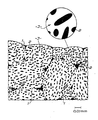
- the composite resin shown in the figure was produced by the method according to the invention, wherein a mass of porous inorganic particles 1 is completely or partially impregnated with at least partially curable resin material 2 in such a way that the particles touch each other and when at least a part of the curable resin material are glued together and thereby form a resin structure with an adjacent inorganic phase.
- the amount of glass fiber required between the plates to achieve the desired porosity was calculated using a glass density of 2.5 g / cm 3 . Two degrees of porosity were used, one giving the sintered layer an average glass volume fraction of approximately 40% and the other of approximately 56%.
- the sintered layers were crushed and ground with a porcelain mortar and a mortar stick.
- the powder was sieved through a series of standard sieves (DIN 4188) and the partial quantities were designated according to the mesh size (in micrometers) of the sieve from which they were removed and the next larger mesh size.
- a subset of "coarse” (250/160), two “medium” (160/100, 100/71) and one "fine (71/40) size types of the particles were removed.
- the powders were treated with normal hydrochloric acid for 24 hours and then washed with distilled water and acetone.
- the most expedient particle size distribution of the powder portion of the tooth filling material is such that the particles preferably have diameters of less than 250 but more than 10 micrometers. However, this depends to some extent on the type of porous glass used and in some cases particle sizes less than 10 microns can be used.
- silane surface treatment with a weight fraction of approx. 1/2% of the powder was added as silane dissolved in acetone (Silane A 174, Union Carbide Co., Lot 803 080 174).
- the powder was allowed to dry at room temperature after which it was heated at 110 ° C for 45 minutes. If the powder did not allow a droplet of distilled water to penetrate within 5 minutes with careful pressing, the silane treatment was considered satisfactory.
- the proportion of the repair composition of inorganic particles should be between 40 and 90% by volume, preferably between 50 and 80% by volume. With an increased volume fraction, the gloss and hardness of the glass surface is improved.
- Bis-GMA (Freeman Chemical Co., Port Washington, Wi., USA, lot 124543), a reaction product of bisphenol A and glycydyl methacrylate as described in US Pat. No. 3,006,112, was treated with TEGDMA (triethylene glycol dimethacrylate) diluted in the ratio given in the following table.
- a photoinitiator (benzoin methyl ether, 0.8%) and a stabilizer (hydroquinone monomethyl ether, 0.008%) were added to the monomer composition.
- Colloidal silicon dioxide (Aerosil. R 972), Degussa. Frankfurt. FRG) was added in different amounts according to the information in the table in order to increase the proportion of inorganic constituents and to adjust the monomer viscosity.
- the powder-resin mixtures were filled into cylindrical cavities (diameter 4 mm, depth 2 mm) in acrylic rods (4 cm long) with a square cross-section (1 x 1 cm).
- An amalgam compressor with a flat and circular compressor tip (diameter 1.8 mm) was used to exert pressure. The applied force was measured by placing the acrylic stick on a simple balance.
- the compression was carried out at right angles to the bottom of the cavity. It started in the middle and the tip of the compressor was then gradually moved over the surface until it was covered with overlapping impressions. This was repeated once.
- the first time a relatively low pressure was applied to give a first solidification and a flat surface achieve.
- Table 1 When the maximum pressure (Table 1) was applied, it was held constant for about 1 second. In each case, portions were introduced one after the other, which gave a 1 to 1.5 mm thick layer of compacted material. Each layer was cured by 60 to 80 seconds of exposure to UV radiation (Nuva-Lite ®, LD Caulk Company, Canada).
- the solidification pressure used is given in Table 1, this pressure can vary depending on the particle density. For example, higher density particles may require higher pressures over the same time period, ie 1 second, as described above.
- the cavities were provided with an excess filling of approx. 0.5 mm thickness in order to ensure the complete removal of the surface layer with oxygen inhibition during surface processing. Filling and curing took place at room temperature (22 ⁇ 1 ° C). The excess was removed and the pattern was sanded flush with the # 600 carborundum paper to the surface of the acrylic rod. Subsequently. was carried out on polishing lines with an aqueous suspension of corundum powder with a particle size of 0.3 micrometers.
- Etch patterns were cut in the center plane and the exposed cross-sectional area was ground. Then the pattern was fixed with cold curing acrylic resin and sanded as before. The surface showing a cross section of the pattern was etched with hydrofluoric acid (40%) for 1/2 hour and rinsed in distilled water.
- the hardness on the polished surface of the sample was measured with a Vickers hardness tester (type Z3, 2A, Zwick & Co., Einsingen, Ulm / Donau, FRG) according to DIN 50133 with a load of 10 daN (10 kp).
- the samples were stored for one week before testing (22 ⁇ 1 ° C and 50 ⁇ 5% relative humidity).
- the etched areas were examined microscopically in the case of obliquely incident light (x 40). With this method, the resin / particle interface was clearly defined.
- sample surfaces were ground with aluminum oxide discs (Sof-Lex °, grain size medium-fine, fine and extremely fine.3M Co., St. Paul, Minnesota, USA) and then with a white rubber disc (Identoflex b , type 1008, extra-fine, Identoflex AG , Buchs, Switzerland) polished, both at low speed.
- aluminum oxide discs Sof-Lex °, grain size medium-fine, fine and extremely fine.3M Co., St. Paul, Minnesota, USA
- a white rubber disc Identoflex b , type 1008, extra-fine, Identoflex AG , Buchs, Switzerland
- the method gave a mass which had contact between the individual particles 1. In most cases they were in very good contact so that no free zones between the particles were visible. A change in the hardness number was primarily the result of fluctuations in the inorganic content.
- the compacted material had a solid surface that could be shaped with the tip of an amalgam compactor. All surfaces that were produced by polishing with rubber discs showed a glossy surface smoothness, which showed an increasing tendency with increasing hardness number.
- the Vickers hardness number of the polymer which corresponded to the different liquid resin compositions, fluctuated only to a small and insignificant extent, as a preliminary study showed.
- the hardness number therefore mainly reflects the concentration of the porous parts and the density of the individual particles 1.
- the amount of diluent was small in relation to the amount generally used.
- the compaction process could be carried out even if the viscosity was further increased by adding colloidal silicon dioxide.
- particles with both colloidal and non-colloidal sizes and preferably with high radiation opacity can be used.
- Reduced shrinkage during polymerization and a lower tendency to color shifts can e.g. B. for monomers based on bis-GMA, which have a higher average molecular weight (and therefore also a higher viscosity) than the commonly used conventional monomers.
- Such an increase in molecular weight could be achieved by changing the amount and molecular size of the diluent and / or by adding molecules larger than Bis-GMA.
- a lower shrinkage during the polymerization results in a lower build-up of internal stresses and a reduced void formation.
- Increasing the average molecular weight also improves the mechanical strength and the tendency to inhibit oxygen during the polymerization is reduced.
- the particles are held together not only by mechanical interlocking but also by the fact that there is adhesion between the resin and the glass due to a silane treatment (organic-functional adhesion activator).
- a silane treatment organic-functional adhesion activator
- Such a treatment is known in the prior art, but has so far not been able to produce sufficiently strong bonds with normal types of composite materials.
- the invention not only uses this adhesive connection, but also a mechanical toothing resulting from the method according to the invention.
- the diameter of the channel porosity can fluctuate as long as the particles are tightly packed under more or less strong deformation, while at the same time the pressure in the resin is compensated for by plastic flow of the excess resin through the pores of the inorganic network.
- Methods other than the photoinitiation used to initiate the polymerization reaction in the present example can also be used.
- An example of such a process is heat curing, in which the free radicals required for the polymerization arise when heating a monomer which, for. B. contains peroxide.
- the mass is first divided into two parts, the first part containing a catalyst for the thermosetting resin in addition to a thermosetting resin and inorganic constituents, and the second part containing an activating agent for the catalyst. The polymerization then begins when the two subsets are mixed.
- the selection of the specific catalyst and the activating agent and their amounts are within the scope of the prior art and depend on the specific amount of resin used.
- porous inorganic particles 1 which only contain hardenable resin 2 in the outer regions and hardened resin 2 in the middle regions.
- the former can be pretreated with a suitable organically functional silane coupling agent, as described above.
- a suitable organically functional silane coupling agent as described above.
- at least part of the silane can also be added to the resin.
- the porous inorganic particles 1 can be impregnated with thermoplastic resin 2, and when heated, the mass can be pressed together such that the porous inorganic particles are glued together.
- the inorganic particles in the curable resin 2 comprise ceramic particles, preferably made of aluminum oxide or silicon oxide (Si0 2 ).
- the curable resin 2 can essentially contain at least one monomer and / or polymer which is selected from a group comprising acrylic resin, vinyl chloride, cellulose acetate, styrene and acrylonitrile copolymer.
- the curable resin 2 can also contain at least one acrylic monomer and / or polymer selected from the group comprising ethyl methacrylic acid ester, ethyl acrylate and methyl methacrylic acid ester.
- the curable resin 2 can essentially be a copolymer of an acrylic monomer and another copolymerizable monomer.
- the copolymerizable monomer is selected from the group consisting of styrene, butadiene, ethylene and acrylic acid.
- the curable resin 2 essentially contains bis-GMA or any other derivative of bisphenol A, and curing can be accomplished by photoinitiation of a polymerization reaction.
- the method according to the invention is preferably used to carry out tooth repairs such as fillings, cladding, artificial teeth and the like.
- the method is characterized in that a dental composite resin consists essentially of porous inorganic particles which are wholly or partly with an at least partially polymerizable monomer and / or polymer impregnated, and that the particles are compacted or otherwise applied such that they touch each other and stick together during the polymerization to form a resin structure with an adjacent inorganic phase.
- the method of mechanically strengthening and compacting a material in a tooth cavity is known to dentists in connection with dental amalgam. It has known advantages in that it allows the filler material to be closely adapted to the walls of the cavity and enables a firm contact to be made between the repaired tooth and the adjacent tooth. Furthermore, this method enables the repair to be given its final anatomical shape before curing. This eliminates the time-consuming and difficult post-processing with rotating instruments. These advantages are also achieved with the method according to the invention, which was previously not possible with tooth-like repair material.
- the preferred embodiment is particularly advantageous because of the excellent ability of the particles to interlock, interrelate, and be closely packed, and also because of the resulting pore structure in which the pressure in the liquid organic resin is easily balanced.
- the compaction can therefore be carried out clinically by using pressures of less than 20 MPa, which is important for the clinical process, the processability and the protection of the patient.
- the fiber diameter being less than 4 micrometers, shows that the fibers are fused to one another and form a glass skeleton which is permeated by a micro-pore system.
- This glass skeleton can be used as a retention agent and has a structure which is favorable in terms of strength, rigidity and adhesiveness.
- the cavities of the skeleton or network are arranged continuously, which enables the material to be deeply impregnated with resins, if necessary using a reduced pressure, i. H. by applying a vacuum. It is preferable to carry out the deep impregnation with larger units of the network structure.
- the impregnated larger network structure is then cured and, after being formed, ground into a particulate filling material.
- the impregnating agent (resin) of the filler material i.e. the resin used to impregnate the glass skeleton
- the inorganic mesh can be used in large-profile parts for filling, stiffening and solidifying dental repair and build-up material as well as material for implants.
- the remarkable properties that can be achieved with the material mentioned in the example with a fiber diameter of less than 4 micrometers and in particular an average fiber diameter of 2 micrometers, when inserted into hard bone tissue, were described by Ehrnford et al. in a publication entitled "Formation of Bone Tissue in a Sintered Micropore Glass Fiber Network Planted in Extraction Bases in Rats," Scand. J. Dent. Res. 1980: 88: 130-133.
- bone tissue was shown how it grew into the extremely fine meshes of cell size, which made it possible for the first time to anchor composite material to bone tissue.
Landscapes
- Chemical & Material Sciences (AREA)
- Health & Medical Sciences (AREA)
- Ceramic Engineering (AREA)
- Engineering & Computer Science (AREA)
- Organic Chemistry (AREA)
- Oral & Maxillofacial Surgery (AREA)
- Structural Engineering (AREA)
- Materials Engineering (AREA)
- Medicinal Chemistry (AREA)
- Polymers & Plastics (AREA)
- Chemical Kinetics & Catalysis (AREA)
- Epidemiology (AREA)
- Public Health (AREA)
- Veterinary Medicine (AREA)
- General Health & Medical Sciences (AREA)
- Animal Behavior & Ethology (AREA)
- Life Sciences & Earth Sciences (AREA)
- Plastic & Reconstructive Surgery (AREA)
- Dental Preparations (AREA)
- Casting Or Compression Moulding Of Plastics Or The Like (AREA)
Applications Claiming Priority (2)
| Application Number | Priority Date | Filing Date | Title |
|---|---|---|---|
| SE8006576-6A SE423395B (sv) | 1980-09-19 | 1980-09-19 | Saett att framstaella plastkomposit,foeretraedesvis avsedd att anvaendas som dentalmaterial |
| SE8006576 | 1980-09-19 |
Publications (3)
| Publication Number | Publication Date |
|---|---|
| EP0048681A1 EP0048681A1 (de) | 1982-03-31 |
| EP0048681B1 EP0048681B1 (de) | 1984-05-09 |
| EP0048681B2 true EP0048681B2 (de) | 1987-04-15 |
Family
ID=20341774
Family Applications (1)
| Application Number | Title | Priority Date | Filing Date |
|---|---|---|---|
| EP81710047A Expired EP0048681B2 (de) | 1980-09-19 | 1981-09-18 | Verfahren zur Herstellung eines Verbundharzes, vorzugsweise zur Verwendung als zahnärztliches Material |
Country Status (6)
| Country | Link |
|---|---|
| EP (1) | EP0048681B2 (enExample) |
| JP (1) | JPS5782302A (enExample) |
| BR (1) | BR8105957A (enExample) |
| CA (1) | CA1149125A (enExample) |
| DE (1) | DE3163518D1 (enExample) |
| SE (1) | SE423395B (enExample) |
Families Citing this family (7)
| Publication number | Priority date | Publication date | Assignee | Title |
|---|---|---|---|---|
| DE3430801A1 (de) * | 1984-08-22 | 1986-03-06 | Bayer Ag, 5090 Leverkusen | Verwendung von poroesen fuellstoffen in polymerisierbaren massen, solche massen und deren verwendung zur herstellung von formkoerpern |
| US4978640A (en) * | 1988-02-24 | 1990-12-18 | Massachusetts Institute Of Technology | Dispersion strengthened composite |
| FR2641697B1 (fr) * | 1989-01-16 | 1994-09-16 | Reynaud Marc | Tenon d'ancrage dentaire physiologique en materiau composite |
| DE19615763C2 (de) * | 1996-04-20 | 1999-10-28 | Heraeus Kulzer Gmbh & Co Kg | Füllstoff auf Siliciumdioxid-Basis, Verfahren zu seiner Herstellung und seine Verwendung |
| DE19846556A1 (de) * | 1998-10-09 | 2000-04-13 | Degussa | Dentalwerkstoff aufweisend poröse Glaskeramiken, poröse Glaskeramiken, Verfahren und Verwendung |
| DE10042050A1 (de) * | 2000-08-26 | 2002-03-14 | Degussa | Dentalkomposite aufweisend Hybridfüllstoffe und Verfahren zur Herstellung |
| JP4837209B2 (ja) * | 2001-09-28 | 2011-12-14 | クラレメディカル株式会社 | 歯科用材料及び歯科用補綴物 |
Family Cites Families (6)
| Publication number | Priority date | Publication date | Assignee | Title |
|---|---|---|---|---|
| US3066112A (en) * | 1959-01-30 | 1962-11-27 | Rafael L Bowen | Dental filling material comprising vinyl silane treated fused silica and a binder consisting of the reaction product of bis phenol and glycidyl acrylate |
| DE2403211C3 (de) * | 1974-01-23 | 1981-12-24 | Etablissement Dentaire Ivoclar, Schaan | Werkstoff für Dentalzwecke |
| SE411613B (sv) * | 1976-03-16 | 1980-01-21 | Ehrnford Lars Edgar Martin | Forstyvnings- och forsterkningselement och/eller retentionselement |
| DE2724814C3 (de) * | 1977-06-02 | 1980-03-27 | Kulzer & Co Gmbh, 6380 Bad Homburg | Vorprodukt fur die Zubereitung von Knochenzement |
| US4215033A (en) * | 1978-09-08 | 1980-07-29 | American Dental Association Health Foundation | Composite dental material |
| DE2938875A1 (de) * | 1979-09-26 | 1981-04-23 | Bayer Ag, 5090 Leverkusen | Dentalwerkstoffe auf basis von organischen kunststoffen in pastoeser form |
-
1980
- 1980-09-19 SE SE8006576-6A patent/SE423395B/sv not_active IP Right Cessation
-
1981
- 1981-09-03 CA CA000385124A patent/CA1149125A/en not_active Expired
- 1981-09-17 BR BR8105957A patent/BR8105957A/pt not_active IP Right Cessation
- 1981-09-18 EP EP81710047A patent/EP0048681B2/de not_active Expired
- 1981-09-18 DE DE8181710047T patent/DE3163518D1/de not_active Expired
- 1981-09-18 JP JP56148673A patent/JPS5782302A/ja active Granted
Also Published As
| Publication number | Publication date |
|---|---|
| CA1149125A (en) | 1983-07-05 |
| SE423395B (sv) | 1982-05-03 |
| SE8006576L (enExample) | 1982-03-20 |
| EP0048681A1 (de) | 1982-03-31 |
| EP0048681B1 (de) | 1984-05-09 |
| JPS5782302A (en) | 1982-05-22 |
| DE3163518D1 (en) | 1984-06-14 |
| JPH0233003B2 (enExample) | 1990-07-25 |
| BR8105957A (pt) | 1982-05-04 |
Similar Documents
| Publication | Publication Date | Title |
|---|---|---|
| US4381918A (en) | Method of producing a composite resin, preferably for use as a dental material | |
| EP0480472B1 (de) | Durch Einwirkung von Schwingungen herstellbare und verarbeitbare Dentalmassen und Verfahren zu ihrer Herstellung | |
| DE3525720C2 (de) | Dentalmaterial | |
| DE19848886C2 (de) | Lichtpolymerisierbares Einkomponenten-Dentalmaterial | |
| DE69835554T2 (de) | Verfahren zur Herstellung einer Zahnprothese | |
| DE69926816T2 (de) | Dental-Wiederherstellungskomposit | |
| DE3708618C2 (enExample) | ||
| DE69412847T3 (de) | Dentale prothese mit schalenähnlicher zusammengesetzter stütze und überzug ausvorimprägniertem gewebestück sowie verfahren zur herstellung | |
| DE2403211C3 (de) | Werkstoff für Dentalzwecke | |
| DE60115194T2 (de) | Photohärtbares material für zahnreparaturen | |
| DE3725502C2 (de) | Harzartige Zubereitungen für Zahnprothesengrundlagen | |
| DE2405578B2 (de) | Polymerisierbares Bindemittel enthaltender Dentalwerkstoff und seine Verwendung für Zähne und Zahnersatzteile | |
| EP0325266A2 (de) | Dentalmassen | |
| DE69028488T2 (de) | Verstärktes kompositharz | |
| DE3902817C2 (de) | Auskleidungsmaterial aus einer wärmehärtenden Dentalsiliconmasse | |
| DE3430801A1 (de) | Verwendung von poroesen fuellstoffen in polymerisierbaren massen, solche massen und deren verwendung zur herstellung von formkoerpern | |
| DE69921231T2 (de) | Dentalmasse und daraus hergestellter künstlicher Zahn | |
| DE2454101A1 (de) | Dreikomponenten-zahnfuellungsmasse | |
| EP0048681B1 (de) | Verfahren zur Herstellung eines Verbundharzes, vorzugsweise zur Verwendung als zahnärztliches Material | |
| DE2438411A1 (de) | 1,3-bis- eckige klammer auf 2,3-di(methacryloxy)-propoxy eckige klammer zu -benzol, verfahren zu dessen herstellung und diese verbindung enthaltende zementmassen | |
| DE2312258C2 (de) | Dentalwerkstoffe für prothetische Zwecke | |
| Ehrnford | Composite resins with a condensable inorganic phase | |
| AT508313B1 (de) | Verfahren zur reparatur einer beschädigung | |
| DE2408640A1 (de) | Acrylpolymermischungen | |
| DE69303030T2 (de) | Zusammensetzung mit bestellbarer vernetzung |
Legal Events
| Date | Code | Title | Description |
|---|---|---|---|
| PUAI | Public reference made under article 153(3) epc to a published international application that has entered the european phase |
Free format text: ORIGINAL CODE: 0009012 |
|
| AK | Designated contracting states |
Designated state(s): CH DE FR GB SE |
|
| 17P | Request for examination filed |
Effective date: 19820726 |
|
| GRAA | (expected) grant |
Free format text: ORIGINAL CODE: 0009210 |
|
| AK | Designated contracting states |
Designated state(s): CH DE FR GB LI SE |
|
| REF | Corresponds to: |
Ref document number: 3163518 Country of ref document: DE Date of ref document: 19840614 |
|
| ET | Fr: translation filed | ||
| PLBI | Opposition filed |
Free format text: ORIGINAL CODE: 0009260 |
|
| PLAB | Opposition data, opponent's data or that of the opponent's representative modified |
Free format text: ORIGINAL CODE: 0009299OPPO |
|
| 26 | Opposition filed |
Opponent name: TVB TREUHANDGESELLSCHAFT FUER VERMOEGENSVERWALTUNG Effective date: 19850207 |
|
| R26 | Opposition filed (corrected) |
Opponent name: TVB TREUHANDGESELLSCHAFT FUER VERMOEGENSVERWALTUNG Effective date: 19850207 |
|
| REG | Reference to a national code |
Ref country code: CH Ref legal event code: PUE Owner name: AUSTENAL INTERNATIONAL, INC. |
|
| REG | Reference to a national code |
Ref country code: FR Ref legal event code: TP |
|
| PUAH | Patent maintained in amended form |
Free format text: ORIGINAL CODE: 0009272 |
|
| STAA | Information on the status of an ep patent application or granted ep patent |
Free format text: STATUS: PATENT MAINTAINED AS AMENDED |
|
| 27A | Patent maintained in amended form |
Effective date: 19870415 |
|
| AK | Designated contracting states |
Kind code of ref document: B2 Designated state(s): CH DE FR GB LI SE |
|
| ET3 | Fr: translation filed ** decision concerning opposition | ||
| REG | Reference to a national code |
Ref country code: GB Ref legal event code: 732 |
|
| REG | Reference to a national code |
Ref country code: GB Ref legal event code: 732 |
|
| PGFP | Annual fee paid to national office [announced via postgrant information from national office to epo] |
Ref country code: SE Payment date: 19930824 Year of fee payment: 13 |
|
| PGFP | Annual fee paid to national office [announced via postgrant information from national office to epo] |
Ref country code: GB Payment date: 19930908 Year of fee payment: 13 Ref country code: DE Payment date: 19930908 Year of fee payment: 13 |
|
| PGFP | Annual fee paid to national office [announced via postgrant information from national office to epo] |
Ref country code: FR Payment date: 19930909 Year of fee payment: 13 |
|
| PGFP | Annual fee paid to national office [announced via postgrant information from national office to epo] |
Ref country code: CH Payment date: 19930915 Year of fee payment: 13 |
|
| PG25 | Lapsed in a contracting state [announced via postgrant information from national office to epo] |
Ref country code: GB Effective date: 19940918 |
|
| PG25 | Lapsed in a contracting state [announced via postgrant information from national office to epo] |
Ref country code: SE Effective date: 19940919 |
|
| PG25 | Lapsed in a contracting state [announced via postgrant information from national office to epo] |
Ref country code: LI Effective date: 19940930 Ref country code: CH Effective date: 19940930 |
|
| EAL | Se: european patent in force in sweden |
Ref document number: 81710047.2 |
|
| GBPC | Gb: european patent ceased through non-payment of renewal fee |
Effective date: 19940918 |
|
| PG25 | Lapsed in a contracting state [announced via postgrant information from national office to epo] |
Ref country code: FR Effective date: 19950531 |
|
| REG | Reference to a national code |
Ref country code: CH Ref legal event code: PL |
|
| PG25 | Lapsed in a contracting state [announced via postgrant information from national office to epo] |
Ref country code: DE Effective date: 19950601 |
|
| EUG | Se: european patent has lapsed |
Ref document number: 81710047.2 |
|
| REG | Reference to a national code |
Ref country code: FR Ref legal event code: ST |