EP0042617B1 - Verfahren zur Herstellung von Formkörpern und Überzügen - Google Patents
Verfahren zur Herstellung von Formkörpern und Überzügen Download PDFInfo
- Publication number
- EP0042617B1 EP0042617B1 EP81104829A EP81104829A EP0042617B1 EP 0042617 B1 EP0042617 B1 EP 0042617B1 EP 81104829 A EP81104829 A EP 81104829A EP 81104829 A EP81104829 A EP 81104829A EP 0042617 B1 EP0042617 B1 EP 0042617B1
- Authority
- EP
- European Patent Office
- Prior art keywords
- formula
- phenol
- free
- reaction
- mannich
- Prior art date
- Legal status (The legal status is an assumption and is not a legal conclusion. Google has not performed a legal analysis and makes no representation as to the accuracy of the status listed.)
- Expired
Links
- 238000000034 method Methods 0.000 title claims abstract description 30
- 238000000576 coating method Methods 0.000 title claims abstract description 21
- 230000008569 process Effects 0.000 title claims abstract description 14
- 238000004519 manufacturing process Methods 0.000 title description 9
- ISWSIDIOOBJBQZ-UHFFFAOYSA-N Phenol Chemical compound OC1=CC=CC=C1 ISWSIDIOOBJBQZ-UHFFFAOYSA-N 0.000 claims abstract description 51
- 239000001257 hydrogen Substances 0.000 claims abstract description 33
- 229910052739 hydrogen Inorganic materials 0.000 claims abstract description 33
- ROSDSFDQCJNGOL-UHFFFAOYSA-N Dimethylamine Chemical compound CNC ROSDSFDQCJNGOL-UHFFFAOYSA-N 0.000 claims abstract description 30
- 150000001412 amines Chemical class 0.000 claims abstract description 26
- QGZKDVFQNNGYKY-UHFFFAOYSA-N Ammonia Chemical compound N QGZKDVFQNNGYKY-UHFFFAOYSA-N 0.000 claims abstract description 23
- 238000006243 chemical reaction Methods 0.000 claims abstract description 21
- 150000001875 compounds Chemical class 0.000 claims abstract description 21
- WSFSSNUMVMOOMR-UHFFFAOYSA-N Formaldehyde Chemical compound O=C WSFSSNUMVMOOMR-UHFFFAOYSA-N 0.000 claims abstract description 20
- 150000002989 phenols Chemical class 0.000 claims abstract description 19
- 239000000047 product Substances 0.000 claims abstract description 15
- FUIQBJHUESBZNU-UHFFFAOYSA-N 2-[(dimethylazaniumyl)methyl]phenolate Chemical compound CN(C)CC1=CC=CC=C1O FUIQBJHUESBZNU-UHFFFAOYSA-N 0.000 claims abstract description 14
- 229910021529 ammonia Inorganic materials 0.000 claims abstract description 11
- 238000005984 hydrogenation reaction Methods 0.000 claims abstract description 11
- 239000004593 Epoxy Substances 0.000 claims abstract description 10
- XZAHJRZBUWYCBM-UHFFFAOYSA-N [1-(aminomethyl)cyclohexyl]methanamine Chemical class NCC1(CN)CCCCC1 XZAHJRZBUWYCBM-UHFFFAOYSA-N 0.000 claims abstract description 7
- 125000001931 aliphatic group Chemical group 0.000 claims abstract description 7
- 239000007859 condensation product Substances 0.000 claims abstract description 5
- 125000004435 hydrogen atom Chemical group [H]* 0.000 claims abstract description 4
- 238000006467 substitution reaction Methods 0.000 claims abstract description 4
- 238000002360 preparation method Methods 0.000 claims abstract description 3
- 229910052799 carbon Inorganic materials 0.000 claims abstract 2
- 125000001183 hydrocarbyl group Chemical group 0.000 claims abstract 2
- 239000000203 mixture Substances 0.000 claims description 20
- RREANTFLPGEWEN-MBLPBCRHSA-N 7-[4-[[(3z)-3-[4-amino-5-[(3,4,5-trimethoxyphenyl)methyl]pyrimidin-2-yl]imino-5-fluoro-2-oxoindol-1-yl]methyl]piperazin-1-yl]-1-cyclopropyl-6-fluoro-4-oxoquinoline-3-carboxylic acid Chemical compound COC1=C(OC)C(OC)=CC(CC=2C(=NC(\N=C/3C4=CC(F)=CC=C4N(CN4CCN(CC4)C=4C(=CC=5C(=O)C(C(O)=O)=CN(C=5C=4)C4CC4)F)C\3=O)=NC=2)N)=C1 RREANTFLPGEWEN-MBLPBCRHSA-N 0.000 claims description 13
- 239000003822 epoxy resin Substances 0.000 claims description 11
- 229920000647 polyepoxide Polymers 0.000 claims description 11
- 239000004848 polyfunctional curative Substances 0.000 claims description 9
- SMQUZDBALVYZAC-UHFFFAOYSA-N salicylaldehyde Chemical class OC1=CC=CC=C1C=O SMQUZDBALVYZAC-UHFFFAOYSA-N 0.000 claims description 8
- -1 amines compounds Chemical class 0.000 claims description 7
- ZWVHTXAYIKBMEE-UHFFFAOYSA-N 2-hydroxyacetophenone Chemical class OCC(=O)C1=CC=CC=C1 ZWVHTXAYIKBMEE-UHFFFAOYSA-N 0.000 claims description 3
- 125000003700 epoxy group Chemical group 0.000 claims description 2
- XBTRYWRVOBZSGM-UHFFFAOYSA-N (4-methylphenyl)methanediamine Chemical compound CC1=CC=C(C(N)N)C=C1 XBTRYWRVOBZSGM-UHFFFAOYSA-N 0.000 claims 1
- 230000015572 biosynthetic process Effects 0.000 claims 1
- 125000002887 hydroxy group Chemical group [H]O* 0.000 abstract description 32
- RGHHSNMVTDWUBI-UHFFFAOYSA-N 4-hydroxybenzaldehyde Chemical compound OC1=CC=C(C=O)C=C1 RGHHSNMVTDWUBI-UHFFFAOYSA-N 0.000 abstract description 14
- 239000000126 substance Substances 0.000 abstract description 14
- 239000004312 hexamethylene tetramine Substances 0.000 abstract description 10
- TXFPEBPIARQUIG-UHFFFAOYSA-N 4'-hydroxyacetophenone Chemical compound CC(=O)C1=CC=C(O)C=C1 TXFPEBPIARQUIG-UHFFFAOYSA-N 0.000 abstract description 6
- GKXVJHDEWHKBFH-UHFFFAOYSA-N [2-(aminomethyl)phenyl]methanamine Chemical compound NCC1=CC=CC=C1CN GKXVJHDEWHKBFH-UHFFFAOYSA-N 0.000 abstract description 5
- 125000002496 methyl group Chemical group [H]C([H])([H])* 0.000 abstract description 3
- 150000001896 cresols Chemical class 0.000 abstract 1
- 125000001424 substituent group Chemical group 0.000 abstract 1
- YXFVVABEGXRONW-UHFFFAOYSA-N Toluene Chemical compound CC1=CC=CC=C1 YXFVVABEGXRONW-UHFFFAOYSA-N 0.000 description 54
- 239000002585 base Substances 0.000 description 51
- FDLQZKYLHJJBHD-UHFFFAOYSA-N [3-(aminomethyl)phenyl]methanamine Chemical compound NCC1=CC=CC(CN)=C1 FDLQZKYLHJJBHD-UHFFFAOYSA-N 0.000 description 31
- UFHFLCQGNIYNRP-UHFFFAOYSA-N Hydrogen Chemical compound [H][H] UFHFLCQGNIYNRP-UHFFFAOYSA-N 0.000 description 29
- VKYKSIONXSXAKP-UHFFFAOYSA-N hexamethylenetetramine Chemical compound C1N(C2)CN3CN1CN2C3 VKYKSIONXSXAKP-UHFFFAOYSA-N 0.000 description 16
- XLYOFNOQVPJJNP-UHFFFAOYSA-N water Substances O XLYOFNOQVPJJNP-UHFFFAOYSA-N 0.000 description 15
- 239000003795 chemical substances by application Substances 0.000 description 13
- 238000004821 distillation Methods 0.000 description 10
- 150000007524 organic acids Chemical class 0.000 description 9
- 235000005985 organic acids Nutrition 0.000 description 9
- 239000011541 reaction mixture Substances 0.000 description 9
- 230000000052 comparative effect Effects 0.000 description 8
- 235000019441 ethanol Nutrition 0.000 description 8
- 238000002474 experimental method Methods 0.000 description 8
- 235000010299 hexamethylene tetramine Nutrition 0.000 description 8
- VILCJCGEZXAXTO-UHFFFAOYSA-N 2,2,2-tetramine Chemical compound NCCNCCNCCN VILCJCGEZXAXTO-UHFFFAOYSA-N 0.000 description 7
- 235000013305 food Nutrition 0.000 description 7
- 229960001124 trientine Drugs 0.000 description 7
- 239000002262 Schiff base Substances 0.000 description 6
- 150000004753 Schiff bases Chemical class 0.000 description 6
- 239000007795 chemical reaction product Substances 0.000 description 6
- GHMLBKRAJCXXBS-UHFFFAOYSA-N resorcinol Chemical compound OC1=CC=CC(O)=C1 GHMLBKRAJCXXBS-UHFFFAOYSA-N 0.000 description 6
- YGSDEFSMJLZEOE-UHFFFAOYSA-N salicylic acid Chemical compound OC(=O)C1=CC=CC=C1O YGSDEFSMJLZEOE-UHFFFAOYSA-N 0.000 description 6
- 238000003756 stirring Methods 0.000 description 6
- GELMWIVBBPAMIO-UHFFFAOYSA-N 2-methylbutan-2-amine Chemical compound CCC(C)(C)N GELMWIVBBPAMIO-UHFFFAOYSA-N 0.000 description 5
- 150000001298 alcohols Chemical class 0.000 description 5
- 239000011248 coating agent Substances 0.000 description 5
- 238000001816 cooling Methods 0.000 description 5
- 239000000243 solution Substances 0.000 description 5
- 239000002904 solvent Substances 0.000 description 5
- YBRBMKDOPFTVDT-UHFFFAOYSA-N tert-butylamine Chemical compound CC(C)(C)N YBRBMKDOPFTVDT-UHFFFAOYSA-N 0.000 description 5
- YIWUKEYIRIRTPP-UHFFFAOYSA-N 2-ethylhexan-1-ol Chemical compound CCCCC(CC)CO YIWUKEYIRIRTPP-UHFFFAOYSA-N 0.000 description 4
- IJGRMHOSHXDMSA-UHFFFAOYSA-N Atomic nitrogen Chemical compound N#N IJGRMHOSHXDMSA-UHFFFAOYSA-N 0.000 description 4
- LFQSCWFLJHTTHZ-UHFFFAOYSA-N Ethanol Chemical compound CCO LFQSCWFLJHTTHZ-UHFFFAOYSA-N 0.000 description 4
- PIICEJLVQHRZGT-UHFFFAOYSA-N Ethylenediamine Chemical compound NCCN PIICEJLVQHRZGT-UHFFFAOYSA-N 0.000 description 4
- OKKJLVBELUTLKV-UHFFFAOYSA-N Methanol Chemical group OC OKKJLVBELUTLKV-UHFFFAOYSA-N 0.000 description 4
- LRHPLDYGYMQRHN-UHFFFAOYSA-N N-Butanol Chemical compound CCCCO LRHPLDYGYMQRHN-UHFFFAOYSA-N 0.000 description 4
- QAOWNCQODCNURD-UHFFFAOYSA-N Sulfuric acid Chemical compound OS(O)(=O)=O QAOWNCQODCNURD-UHFFFAOYSA-N 0.000 description 4
- 150000001299 aldehydes Chemical class 0.000 description 4
- IISBACLAFKSPIT-UHFFFAOYSA-N bisphenol A Chemical compound C=1C=C(O)C=CC=1C(C)(C)C1=CC=C(O)C=C1 IISBACLAFKSPIT-UHFFFAOYSA-N 0.000 description 4
- GYZLOYUZLJXAJU-UHFFFAOYSA-N diglycidyl ether Chemical compound C1OC1COCC1CO1 GYZLOYUZLJXAJU-UHFFFAOYSA-N 0.000 description 4
- LNEPOXFFQSENCJ-UHFFFAOYSA-N haloperidol Chemical compound C1CC(O)(C=2C=CC(Cl)=CC=2)CCN1CCCC(=O)C1=CC=C(F)C=C1 LNEPOXFFQSENCJ-UHFFFAOYSA-N 0.000 description 4
- 229910052757 nitrogen Inorganic materials 0.000 description 4
- QWVGKYWNOKOFNN-UHFFFAOYSA-N o-cresol Chemical compound CC1=CC=CC=C1O QWVGKYWNOKOFNN-UHFFFAOYSA-N 0.000 description 4
- FJKROLUGYXJWQN-UHFFFAOYSA-N papa-hydroxy-benzoic acid Natural products OC(=O)C1=CC=C(O)C=C1 FJKROLUGYXJWQN-UHFFFAOYSA-N 0.000 description 4
- JECYUBVRTQDVAT-UHFFFAOYSA-N 2-acetylphenol Chemical compound CC(=O)C1=CC=CC=C1O JECYUBVRTQDVAT-UHFFFAOYSA-N 0.000 description 3
- QTBSBXVTEAMEQO-UHFFFAOYSA-N Acetic acid Chemical compound CC(O)=O QTBSBXVTEAMEQO-UHFFFAOYSA-N 0.000 description 3
- WVDDGKGOMKODPV-UHFFFAOYSA-N Benzyl alcohol Chemical compound OCC1=CC=CC=C1 WVDDGKGOMKODPV-UHFFFAOYSA-N 0.000 description 3
- LYCAIKOWRPUZTN-UHFFFAOYSA-N Ethylene glycol Chemical compound OCCO LYCAIKOWRPUZTN-UHFFFAOYSA-N 0.000 description 3
- PEDCQBHIVMGVHV-UHFFFAOYSA-N Glycerine Chemical compound OCC(O)CO PEDCQBHIVMGVHV-UHFFFAOYSA-N 0.000 description 3
- CTQNGGLPUBDAKN-UHFFFAOYSA-N O-Xylene Chemical compound CC1=CC=CC=C1C CTQNGGLPUBDAKN-UHFFFAOYSA-N 0.000 description 3
- 239000007868 Raney catalyst Substances 0.000 description 3
- NPXOKRUENSOPAO-UHFFFAOYSA-N Raney nickel Chemical compound [Al].[Ni] NPXOKRUENSOPAO-UHFFFAOYSA-N 0.000 description 3
- 229910000564 Raney nickel Inorganic materials 0.000 description 3
- 239000002253 acid Substances 0.000 description 3
- 125000004432 carbon atom Chemical group C* 0.000 description 3
- 238000009833 condensation Methods 0.000 description 3
- 230000005494 condensation Effects 0.000 description 3
- 230000008030 elimination Effects 0.000 description 3
- 238000003379 elimination reaction Methods 0.000 description 3
- 150000002576 ketones Chemical class 0.000 description 3
- 238000000465 moulding Methods 0.000 description 3
- 229920000768 polyamine Polymers 0.000 description 3
- 238000010992 reflux Methods 0.000 description 3
- 229960004889 salicylic acid Drugs 0.000 description 3
- 150000005846 sugar alcohols Polymers 0.000 description 3
- 239000008096 xylene Substances 0.000 description 3
- QHZRZIWCGRXBRY-UHFFFAOYSA-N 2-methylhexan-2-amine Chemical compound CCCCC(C)(C)N QHZRZIWCGRXBRY-UHFFFAOYSA-N 0.000 description 2
- 239000004971 Cross linker Substances 0.000 description 2
- XDTMQSROBMDMFD-UHFFFAOYSA-N Cyclohexane Chemical compound C1CCCCC1 XDTMQSROBMDMFD-UHFFFAOYSA-N 0.000 description 2
- QIGBRXMKCJKVMJ-UHFFFAOYSA-N Hydroquinone Chemical compound OC1=CC=C(O)C=C1 QIGBRXMKCJKVMJ-UHFFFAOYSA-N 0.000 description 2
- XEEYBQQBJWHFJM-UHFFFAOYSA-N Iron Chemical compound [Fe] XEEYBQQBJWHFJM-UHFFFAOYSA-N 0.000 description 2
- ATUOYWHBWRKTHZ-UHFFFAOYSA-N Propane Chemical compound CCC ATUOYWHBWRKTHZ-UHFFFAOYSA-N 0.000 description 2
- WYURNTSHIVDZCO-UHFFFAOYSA-N Tetrahydrofuran Chemical compound C1CCOC1 WYURNTSHIVDZCO-UHFFFAOYSA-N 0.000 description 2
- GWEVSGVZZGPLCZ-UHFFFAOYSA-N Titan oxide Chemical compound O=[Ti]=O GWEVSGVZZGPLCZ-UHFFFAOYSA-N 0.000 description 2
- FZNCGRZWXLXZSZ-CIQUZCHMSA-N Voglibose Chemical compound OCC(CO)N[C@H]1C[C@](O)(CO)[C@@H](O)[C@H](O)[C@H]1O FZNCGRZWXLXZSZ-CIQUZCHMSA-N 0.000 description 2
- 230000004913 activation Effects 0.000 description 2
- 125000004429 atom Chemical group 0.000 description 2
- 235000019445 benzyl alcohol Nutrition 0.000 description 2
- HQABUPZFAYXKJW-UHFFFAOYSA-N butan-1-amine Chemical compound CCCCN HQABUPZFAYXKJW-UHFFFAOYSA-N 0.000 description 2
- 238000004132 cross linking Methods 0.000 description 2
- 239000003431 cross linking reagent Substances 0.000 description 2
- PAFZNILMFXTMIY-UHFFFAOYSA-N cyclohexylamine Chemical compound NC1CCCCC1 PAFZNILMFXTMIY-UHFFFAOYSA-N 0.000 description 2
- 150000004985 diamines Chemical class 0.000 description 2
- JVTAAEKCZFNVCJ-UHFFFAOYSA-N lactic acid Chemical compound CC(O)C(O)=O JVTAAEKCZFNVCJ-UHFFFAOYSA-N 0.000 description 2
- 239000007788 liquid Substances 0.000 description 2
- VNWKTOKETHGBQD-UHFFFAOYSA-N methane Chemical compound C VNWKTOKETHGBQD-UHFFFAOYSA-N 0.000 description 2
- BDAGIHXWWSANSR-UHFFFAOYSA-N methanoic acid Natural products OC=O BDAGIHXWWSANSR-UHFFFAOYSA-N 0.000 description 2
- RSUCYDXEFFBUSN-UHFFFAOYSA-N n-tert-butylmethanimine Chemical compound CC(C)(C)N=C RSUCYDXEFFBUSN-UHFFFAOYSA-N 0.000 description 2
- PXHVJJICTQNCMI-UHFFFAOYSA-N nickel Substances [Ni] PXHVJJICTQNCMI-UHFFFAOYSA-N 0.000 description 2
- ZWRUINPWMLAQRD-UHFFFAOYSA-N nonan-1-ol Chemical compound CCCCCCCCCO ZWRUINPWMLAQRD-UHFFFAOYSA-N 0.000 description 2
- 239000003960 organic solvent Substances 0.000 description 2
- 239000003973 paint Substances 0.000 description 2
- XNGIFLGASWRNHJ-UHFFFAOYSA-N phthalic acid Chemical compound OC(=O)C1=CC=CC=C1C(O)=O XNGIFLGASWRNHJ-UHFFFAOYSA-N 0.000 description 2
- BASFCYQUMIYNBI-UHFFFAOYSA-N platinum Chemical compound [Pt] BASFCYQUMIYNBI-UHFFFAOYSA-N 0.000 description 2
- 150000003335 secondary amines Chemical class 0.000 description 2
- QJAOMCZUZUTZNO-UHFFFAOYSA-N 1,3-dihydroxy-1,3-diphenylpropan-2-one Chemical class C=1C=CC=CC=1C(O)C(=O)C(O)C1=CC=CC=C1 QJAOMCZUZUTZNO-UHFFFAOYSA-N 0.000 description 1
- QAFODUGVXFNLBE-UHFFFAOYSA-N 1-methoxybutan-2-amine Chemical compound CCC(N)COC QAFODUGVXFNLBE-UHFFFAOYSA-N 0.000 description 1
- KPNJYXKRHWAPHP-UHFFFAOYSA-N 2-methylpentan-2-amine Chemical compound CCCC(C)(C)N KPNJYXKRHWAPHP-UHFFFAOYSA-N 0.000 description 1
- RNLHGQLZWXBQNY-UHFFFAOYSA-N 3-(aminomethyl)-3,5,5-trimethylcyclohexan-1-amine Chemical compound CC1(C)CC(N)CC(C)(CN)C1 RNLHGQLZWXBQNY-UHFFFAOYSA-N 0.000 description 1
- ANQCZUIKBWWCJF-UHFFFAOYSA-N 3-[(dimethylamino)methyl]-2-methylphenol Chemical compound CN(C)CC1=CC=CC(O)=C1C ANQCZUIKBWWCJF-UHFFFAOYSA-N 0.000 description 1
- OSWFIVFLDKOXQC-UHFFFAOYSA-N 4-(3-methoxyphenyl)aniline Chemical compound COC1=CC=CC(C=2C=CC(N)=CC=2)=C1 OSWFIVFLDKOXQC-UHFFFAOYSA-N 0.000 description 1
- QHPQWRBYOIRBIT-UHFFFAOYSA-N 4-tert-butylphenol Chemical compound CC(C)(C)C1=CC=C(O)C=C1 QHPQWRBYOIRBIT-UHFFFAOYSA-N 0.000 description 1
- 239000004215 Carbon black (E152) Substances 0.000 description 1
- RPNUMPOLZDHAAY-UHFFFAOYSA-N Diethylenetriamine Chemical compound NCCNCCN RPNUMPOLZDHAAY-UHFFFAOYSA-N 0.000 description 1
- 238000005618 Fries rearrangement reaction Methods 0.000 description 1
- AMQJEAYHLZJPGS-UHFFFAOYSA-N N-Pentanol Chemical compound CCCCCO AMQJEAYHLZJPGS-UHFFFAOYSA-N 0.000 description 1
- 241000872198 Serjania polyphylla Species 0.000 description 1
- VYPSYNLAJGMNEJ-UHFFFAOYSA-N Silicium dioxide Chemical compound O=[Si]=O VYPSYNLAJGMNEJ-UHFFFAOYSA-N 0.000 description 1
- 229920001807 Urea-formaldehyde Polymers 0.000 description 1
- OXIKYYJDTWKERT-UHFFFAOYSA-N [4-(aminomethyl)cyclohexyl]methanamine Chemical compound NCC1CCC(CN)CC1 OXIKYYJDTWKERT-UHFFFAOYSA-N 0.000 description 1
- 235000011054 acetic acid Nutrition 0.000 description 1
- 150000007513 acids Chemical class 0.000 description 1
- 230000010933 acylation Effects 0.000 description 1
- 238000005917 acylation reaction Methods 0.000 description 1
- 239000000654 additive Substances 0.000 description 1
- 239000000853 adhesive Substances 0.000 description 1
- 230000001070 adhesive effect Effects 0.000 description 1
- 230000002411 adverse Effects 0.000 description 1
- GZCGUPFRVQAUEE-SLPGGIOYSA-N aldehydo-D-glucose Chemical compound OC[C@@H](O)[C@@H](O)[C@H](O)[C@@H](O)C=O GZCGUPFRVQAUEE-SLPGGIOYSA-N 0.000 description 1
- 125000000217 alkyl group Chemical group 0.000 description 1
- IMUDHTPIFIBORV-UHFFFAOYSA-N aminoethylpiperazine Chemical compound NCCN1CCNCC1 IMUDHTPIFIBORV-UHFFFAOYSA-N 0.000 description 1
- 150000008064 anhydrides Chemical class 0.000 description 1
- 239000007864 aqueous solution Substances 0.000 description 1
- 150000004982 aromatic amines Chemical class 0.000 description 1
- 125000003118 aryl group Chemical group 0.000 description 1
- 230000008901 benefit Effects 0.000 description 1
- 150000003938 benzyl alcohols Chemical class 0.000 description 1
- 238000009835 boiling Methods 0.000 description 1
- CDQSJQSWAWPGKG-UHFFFAOYSA-N butane-1,1-diol Chemical compound CCCC(O)O CDQSJQSWAWPGKG-UHFFFAOYSA-N 0.000 description 1
- 239000003054 catalyst Substances 0.000 description 1
- 239000004568 cement Substances 0.000 description 1
- 150000001805 chlorine compounds Chemical class 0.000 description 1
- 239000008199 coating composition Substances 0.000 description 1
- 238000004040 coloring Methods 0.000 description 1
- 239000000470 constituent Substances 0.000 description 1
- 229930003836 cresol Natural products 0.000 description 1
- IFDVQVHZEKPUSC-UHFFFAOYSA-N cyclohex-3-ene-1,2-dicarboxylic acid Chemical compound OC(=O)C1CCC=CC1C(O)=O IFDVQVHZEKPUSC-UHFFFAOYSA-N 0.000 description 1
- QSAWQNUELGIYBC-UHFFFAOYSA-N cyclohexane-1,2-dicarboxylic acid Chemical compound OC(=O)C1CCCCC1C(O)=O QSAWQNUELGIYBC-UHFFFAOYSA-N 0.000 description 1
- 230000006735 deficit Effects 0.000 description 1
- 230000006866 deterioration Effects 0.000 description 1
- 239000012153 distilled water Substances 0.000 description 1
- 150000002118 epoxides Chemical class 0.000 description 1
- 125000001033 ether group Chemical group 0.000 description 1
- 238000000605 extraction Methods 0.000 description 1
- 230000002349 favourable effect Effects 0.000 description 1
- SZVJSHCCFOBDDC-UHFFFAOYSA-N ferrosoferric oxide Chemical compound O=[Fe]O[Fe]O[Fe]=O SZVJSHCCFOBDDC-UHFFFAOYSA-N 0.000 description 1
- SLGWESQGEUXWJQ-UHFFFAOYSA-N formaldehyde;phenol Chemical compound O=C.OC1=CC=CC=C1 SLGWESQGEUXWJQ-UHFFFAOYSA-N 0.000 description 1
- 235000019253 formic acid Nutrition 0.000 description 1
- 235000015203 fruit juice Nutrition 0.000 description 1
- 229910021485 fumed silica Inorganic materials 0.000 description 1
- 125000003055 glycidyl group Chemical group C(C1CO1)* 0.000 description 1
- 238000010438 heat treatment Methods 0.000 description 1
- 229930195733 hydrocarbon Natural products 0.000 description 1
- 239000001023 inorganic pigment Substances 0.000 description 1
- 229910052742 iron Inorganic materials 0.000 description 1
- ZXEKIIBDNHEJCQ-UHFFFAOYSA-N isobutanol Chemical compound CC(C)CO ZXEKIIBDNHEJCQ-UHFFFAOYSA-N 0.000 description 1
- JJWLVOIRVHMVIS-UHFFFAOYSA-N isopropylamine Chemical compound CC(C)N JJWLVOIRVHMVIS-UHFFFAOYSA-N 0.000 description 1
- 239000003350 kerosene Substances 0.000 description 1
- 239000004310 lactic acid Substances 0.000 description 1
- 235000014655 lactic acid Nutrition 0.000 description 1
- 239000004850 liquid epoxy resins (LERs) Substances 0.000 description 1
- 239000012280 lithium aluminium hydride Substances 0.000 description 1
- 239000000463 material Substances 0.000 description 1
- 238000002156 mixing Methods 0.000 description 1
- SYSQUGFVNFXIIT-UHFFFAOYSA-N n-[4-(1,3-benzoxazol-2-yl)phenyl]-4-nitrobenzenesulfonamide Chemical class C1=CC([N+](=O)[O-])=CC=C1S(=O)(=O)NC1=CC=C(C=2OC3=CC=CC=C3N=2)C=C1 SYSQUGFVNFXIIT-UHFFFAOYSA-N 0.000 description 1
- 229910052759 nickel Inorganic materials 0.000 description 1
- 239000012860 organic pigment Substances 0.000 description 1
- 229910052763 palladium Inorganic materials 0.000 description 1
- KDLHZDBZIXYQEI-UHFFFAOYSA-N palladium Substances [Pd] KDLHZDBZIXYQEI-UHFFFAOYSA-N 0.000 description 1
- WXZMFSXDPGVJKK-UHFFFAOYSA-N pentaerythritol Chemical compound OCC(CO)(CO)CO WXZMFSXDPGVJKK-UHFFFAOYSA-N 0.000 description 1
- 238000005191 phase separation Methods 0.000 description 1
- 150000007965 phenolic acids Chemical class 0.000 description 1
- 229920001568 phenolic resin Polymers 0.000 description 1
- 125000005498 phthalate group Chemical class 0.000 description 1
- 239000004033 plastic Substances 0.000 description 1
- 229920003023 plastic Polymers 0.000 description 1
- 229910052697 platinum Inorganic materials 0.000 description 1
- 239000001294 propane Substances 0.000 description 1
- 230000009257 reactivity Effects 0.000 description 1
- 238000004064 recycling Methods 0.000 description 1
- 230000009467 reduction Effects 0.000 description 1
- 230000008439 repair process Effects 0.000 description 1
- 229920005989 resin Polymers 0.000 description 1
- 239000011347 resin Substances 0.000 description 1
- 150000003872 salicylic acid derivatives Chemical class 0.000 description 1
- 229920002545 silicone oil Polymers 0.000 description 1
- 229920003002 synthetic resin Polymers 0.000 description 1
- 239000000057 synthetic resin Substances 0.000 description 1
- 238000005494 tarnishing Methods 0.000 description 1
- FAGUFWYHJQFNRV-UHFFFAOYSA-N tetraethylenepentamine Chemical compound NCCNCCNCCNCCN FAGUFWYHJQFNRV-UHFFFAOYSA-N 0.000 description 1
- YLQBMQCUIZJEEH-UHFFFAOYSA-N tetrahydrofuran Natural products C=1C=COC=1 YLQBMQCUIZJEEH-UHFFFAOYSA-N 0.000 description 1
- UFDHBDMSHIXOKF-UHFFFAOYSA-N tetrahydrophthalic acid Natural products OC(=O)C1=C(C(O)=O)CCCC1 UFDHBDMSHIXOKF-UHFFFAOYSA-N 0.000 description 1
- 239000013008 thixotropic agent Substances 0.000 description 1
- 239000004408 titanium dioxide Substances 0.000 description 1
- QXJQHYBHAIHNGG-UHFFFAOYSA-N trimethylolethane Chemical compound OCC(C)(CO)CO QXJQHYBHAIHNGG-UHFFFAOYSA-N 0.000 description 1
- 238000005406 washing Methods 0.000 description 1
Classifications
-
- C—CHEMISTRY; METALLURGY
- C09—DYES; PAINTS; POLISHES; NATURAL RESINS; ADHESIVES; COMPOSITIONS NOT OTHERWISE PROVIDED FOR; APPLICATIONS OF MATERIALS NOT OTHERWISE PROVIDED FOR
- C09D—COATING COMPOSITIONS, e.g. PAINTS, VARNISHES OR LACQUERS; FILLING PASTES; CHEMICAL PAINT OR INK REMOVERS; INKS; CORRECTING FLUIDS; WOODSTAINS; PASTES OR SOLIDS FOR COLOURING OR PRINTING; USE OF MATERIALS THEREFOR
- C09D163/00—Coating compositions based on epoxy resins; Coating compositions based on derivatives of epoxy resins
-
- C—CHEMISTRY; METALLURGY
- C03—GLASS; MINERAL OR SLAG WOOL
- C03C—CHEMICAL COMPOSITION OF GLASSES, GLAZES OR VITREOUS ENAMELS; SURFACE TREATMENT OF GLASS; SURFACE TREATMENT OF FIBRES OR FILAMENTS MADE FROM GLASS, MINERALS OR SLAGS; JOINING GLASS TO GLASS OR OTHER MATERIALS
- C03C17/00—Surface treatment of glass, not in the form of fibres or filaments, by coating
- C03C17/34—Surface treatment of glass, not in the form of fibres or filaments, by coating with at least two coatings having different compositions
- C03C17/36—Surface treatment of glass, not in the form of fibres or filaments, by coating with at least two coatings having different compositions at least one coating being a metal
- C03C17/38—Surface treatment of glass, not in the form of fibres or filaments, by coating with at least two coatings having different compositions at least one coating being a metal at least one coating being a coating of an organic material
-
- C—CHEMISTRY; METALLURGY
- C08—ORGANIC MACROMOLECULAR COMPOUNDS; THEIR PREPARATION OR CHEMICAL WORKING-UP; COMPOSITIONS BASED THEREON
- C08G—MACROMOLECULAR COMPOUNDS OBTAINED OTHERWISE THAN BY REACTIONS ONLY INVOLVING UNSATURATED CARBON-TO-CARBON BONDS
- C08G59/00—Polycondensates containing more than one epoxy group per molecule; Macromolecules obtained by polymerising compounds containing more than one epoxy group per molecule using curing agents or catalysts which react with the epoxy groups
- C08G59/18—Macromolecules obtained by polymerising compounds containing more than one epoxy group per molecule using curing agents or catalysts which react with the epoxy groups ; e.g. general methods of curing
- C08G59/40—Macromolecules obtained by polymerising compounds containing more than one epoxy group per molecule using curing agents or catalysts which react with the epoxy groups ; e.g. general methods of curing characterised by the curing agents used
- C08G59/50—Amines
-
- C—CHEMISTRY; METALLURGY
- C08—ORGANIC MACROMOLECULAR COMPOUNDS; THEIR PREPARATION OR CHEMICAL WORKING-UP; COMPOSITIONS BASED THEREON
- C08G—MACROMOLECULAR COMPOUNDS OBTAINED OTHERWISE THAN BY REACTIONS ONLY INVOLVING UNSATURATED CARBON-TO-CARBON BONDS
- C08G59/00—Polycondensates containing more than one epoxy group per molecule; Macromolecules obtained by polymerising compounds containing more than one epoxy group per molecule using curing agents or catalysts which react with the epoxy groups
- C08G59/18—Macromolecules obtained by polymerising compounds containing more than one epoxy group per molecule using curing agents or catalysts which react with the epoxy groups ; e.g. general methods of curing
- C08G59/40—Macromolecules obtained by polymerising compounds containing more than one epoxy group per molecule using curing agents or catalysts which react with the epoxy groups ; e.g. general methods of curing characterised by the curing agents used
- C08G59/62—Alcohols or phenols
-
- C—CHEMISTRY; METALLURGY
- C08—ORGANIC MACROMOLECULAR COMPOUNDS; THEIR PREPARATION OR CHEMICAL WORKING-UP; COMPOSITIONS BASED THEREON
- C08G—MACROMOLECULAR COMPOUNDS OBTAINED OTHERWISE THAN BY REACTIONS ONLY INVOLVING UNSATURATED CARBON-TO-CARBON BONDS
- C08G59/00—Polycondensates containing more than one epoxy group per molecule; Macromolecules obtained by polymerising compounds containing more than one epoxy group per molecule using curing agents or catalysts which react with the epoxy groups
- C08G59/18—Macromolecules obtained by polymerising compounds containing more than one epoxy group per molecule using curing agents or catalysts which react with the epoxy groups ; e.g. general methods of curing
- C08G59/40—Macromolecules obtained by polymerising compounds containing more than one epoxy group per molecule using curing agents or catalysts which react with the epoxy groups ; e.g. general methods of curing characterised by the curing agents used
- C08G59/62—Alcohols or phenols
- C08G59/64—Amino alcohols
Definitions
- aliphatic or cycloaliphatic amines such as triethylenetetramine, isophoronediamine, m-xylylenediamine or 2-aminoethylpiperazine, either unmodified or in the form of epoxy adducts together with liquid epoxy resins based on aromatic or aliphatic base bodies as a solvent-free coating system.
- Such products are commercially available and may also contain modifying agents (low-molecular mono- or diglycidyl compounds and accelerators) in order to achieve optimum processing properties.
- the coatings are cured in the temperature range from 10 to 30 ° C.
- diamines which are used as crosslinkers for epoxy compounds, for.
- B ethylenediamine, diethylenetriamine, 'triethylenetetramine, tetraethylenepentamine or cycloaliphatic diaminane by condensation with phenols and aldehydes or by reaction e.g. of 3,3,5-trimethyl-5-aminomethyicyciohexyiamine with phenol-aldehyde reaction products.
- these condensation products bring some improvements over simple activation of the polyamines by admixing phenols, they do not yet meet all requirements.
- amine hardeners can be synthesized by reacting aliphatic amines with formaldehyde and phenol, the mixtures of which with epoxides give films with good resistance to organic acids and dilute alcohols.
- these hardeners contain free phenol, which can also be removed from the films by solvents, which makes the use of such systems from the food sector impossible.
- DE-AS 20 25 159 as condensation product 8 is the preparation of a Mannich base of the general formula described, which contains no free phenol and 35% by weight in 4,4'-diamino-3,3'-dimethyl-cyclohexyl-methane, can serve as a crosslinking agent for epoxy resins.
- This compound in the food sector is possible because of the absence of phenol. Due to the small proportion of phenolic hydroxyl groups of 2.4% by weight in this solution of Marnich base and amine, however, only very slow curing can be achieved, especially at low temperatures.
- reaction products which are prepared from Mannich bases and polyamines with amine exchange and elimination of secondary amine, as curing agents.
- These curing agents are reaction products made from polyamines or aromatic amines with Mannich bases made from formaldehyde, phenols and secondary amines. Since they only contain phenol in a bound form, they can be used to a certain extent for coatings based on epoxy resins in the food sector. However, such coatings are destroyed after only a short time by dilute aqueous solutions of organic acids, such as formic acid, acetic acid or lactic acid.
- the aim of the present invention is. To provide curing agents that are both free of unbound phenol and have excellent chemical resistance, especially to organic acids.
- the processes according to the invention can be used to produce coatings with excellent chemical resistance.
- Raney nickel can also be used in the hydrogenation platinum, palladium hydrogen, lithium aluminum hydride, boranates, such as Na BH 4 or the like.
- reaction a the following can be used as hydroxybenzaldehydes or hydroxyacetophenones, for example: o- and / or p-hydroxyacetophenone, further hydroxyphenylmethyl ketones which can be synthesized in a customary manner, preferably salicylaldehyde and / or p-hydroxybenzaldehyde.
- o-Hydroxyphenylmethylketone z.
- the corresponding p-hydroxyphenylalkyl ketones can also be formed in addition to the Schiff bases of the o-hydroxyphenylalkyl ketones.
- R 1 and R 3 have the already mentioned meaning.
- the reaction b) can be carried out directly at an elevated temperature of 100 to 200 ° C. or under the same conditions in an organic solvent which is inert under the reaction conditions, such as cyclohexane, tetrahydrofuran and in particular toluene or xylene.
- an organic solvent which is inert under the reaction conditions, such as cyclohexane, tetrahydrofuran and in particular toluene or xylene.
- primary monoamines are, for. B. those which have an em aC atom branched alkyl radical or cycloalkyl radical, and / or their substitution products with alkyl, hydroxyl or ether groups of aliphatic monohydric alcohols, the alkyl radical each having 1 to 5 carbon atoms, and that of the structural formula correspond in which R 4 to R 6 represent identical or different alkyl radicals having 1 to 5 C atoms, but one of the radicals R 4 to R 6 can also be hydrogen and in this case the other two together represent an alkylene radical of 4 to 6 C. -Atoms can represent. Examples include isopropylamine, sec.
- T-Butylamine and t-amylamine are preferably used.
- reaction c) those compounds of the formulas (IV) or (V) are reacted which, for example, by condensation of the phenols with hexamethylenetetramine.
- the unbound phenol is removed from the mass obtained, optionally ground or dissolved in solvent, by extraction with water.
- Diphenols and / or phenotarboxylic acids can also be used as phenols, e.g. B. resorcinol, hydroquinone, salicylic acid and / or p-hydroxyphenylcarboxylic acid. All three processes are preferably based on m-xylylenediamine and its isomer mixtures or its hydrogenation products.
- the purified condensates obtained are added in a corresponding molar ratio with the diamine at temperatures of 100 to 200 ° C., preferably 120 to 160, in particular 130 to 150 ° C. directly or under the same temperature conditions in an organic solvent as toluene or xylene according to reaction c) implemented the Mannich bases, whereby ammonia escapes.
- the condensation of the phenols, diphenols and / or phenolcarboxylic acids with hexamethylenetetramine can also be carried out directly with xylylenediamine and / or its hydrogenation products at elevated temperatures of 100 to 200 ° C., preferably 120 to 160 ° C., the reactions (7) being eliminated with ammonia and (8) run sequentially.
- Suitable epoxy resins are e.g. B. those with a viscosity of 2000 to 40,000, preferably 5000 to 15,000 mPa.s / 25 ° C, such as diglycidyl ether based on diphenylolpropane and methane, glycidyl ether of phenol-formaldehyde condensates (epoxy hovolaks), each individually or in a mixture and in a mixture with glycidyl ethers of aliphatic monohydric or polyhydric alcohols such as n-butanol, 2-ethylhexanol, butanediol, pentaerythritol or phenols or alkylphenols, such as o-cresol or p-tert-butylphenol, glycidyl esters of phthalic acid, hexahydrophthalic acid, tetrahydrophthalic acid.
- the coating compositions which contain the amines obtained according to the invention can contain customary organic and / or inorganic pigments for coloring and other customary additives, such as thixotropic agents, for. B. fumed silica, coating aids such as leveling, dispersing and anti-settling agents. You can also use solvents such as lower alcohols, toluene, xylene, benzyl alcohols, ketones or flexibilizers such as phthalates of monohydric alcohols, e.g. B.
- n-butanol amyl alcohol, 2-ethylhexanol, nonanol, benzyl alcohol individually or in a mixture, y-butyrolactone, ö-valcrolactone, s-caprolactone, lower and higher-molecular polyhydric alcohols, e.g. B. glycerol, trimethylol-ethane or propane, ethylene glycol and oxyethylated or oxypropylated polyhydric alcohols and crosslinking accelerators.
- B. glycerol trimethylol-ethane or propane, ethylene glycol and oxyethylated or oxypropylated polyhydric alcohols and crosslinking accelerators.
- the substituted amines are expediently used as curing agents in amounts which are equivalent to the epoxy groups contained in the epoxy resin, but in many cases an excess of up to 50 mol% is possible. It should be emphasized that with the new crosslinking agents, crosslinking takes place even at low temperatures of about 0 ° C., possibly even at -5 ° C. It can also be cured in high humidity, and in some cases even under water.
- Crosslinked epoxy resin plastics are obtained which have excellent water, acid and chemical resistance, good surface gloss and very good elasticity.
- the moldings can also be in the form of laminates, adhesive or putty bonds, and coating, lining and repair material for concrete floors and concrete pipes, hardened according to the invention. They can also contain the reaction products obtained according to the invention as synthetic resin cements.
- % means% by weight.
- the amines were placed in a three-necked flask equipped with a water separator, and 20%, based in each case on the total amount of amine / aldehyde, were added to toluene.
- the aldehyde was added with cooling and stirring.
- 1 mol of H 2 O was deposited at an elevated temperature with recycling of the toluene per mol of aldehyde.
- the toluene was removed under reduced pressure of approx. 25 mbar with an increase in temperature up to 100 ° C.
- the Schiff bases were obtained as viscous liquids which partially crystallized.
- the amine numbers were as follows:
- the Schiff bases were dissolved 1: 1 in methanol, mixed with 1.5 to 4% Raney nickel, based on the solution, and at 80 ° C. and 50 to 100 bar with hydrogen until the H 2 uptake had ended hydrated.
- the catalyst was then filtered off and the solvent was distilled off under reduced pressure until the temperature rose to 100.degree.
- the Mannich bases were obtained as viscous liquids, which mainly consist of the compounds (9) to (12) and (13 V) (comparison) (see formula sheet). In order, these formulas correspond to the products of Examples 1 to 4 and Comparison 5.
- the Ni content of Mannich bases 1 to 4 was less than 0.01%, in the case of the salicylic acid derivative it was 0.4%.
- the Mannich base made of p-hydroxybenzaldehyde / triethylenetetramine contained approx. 1.5% Ni.
- a phenol-free, viscous Mannich base was obtained with a phenolic OH group content of 6.68% and a hydrogen equivalent weight of 88.5.
- Example 11 was repeated using 108 g of c-cresol instead of the phenol.
- the reaction product of o-cresol and hexamethylenetetramine contained 4.25% N and 12.86% phenolic OH groups.
- the isolated phenol-free Mannich base had a phenolic OH group content of 6.51% and a hydrogen equivalent weight of 84.5.
- the Mannich base obtained had a content of 6.4% phenolic OH groups (including that of salicylic acid) and a hydrogen equivalent weight of 78.2.
- the Mannich base obtained had a content of 7.7% phenolic OH groups and a hydrogen equivalent weight of 67.6.
- 100 g of a low molecular weight diphenylolpropane diglycidyl ether with a viscosity of approx. 9000 mPa.s (25 ° C) and an epoxy equivalent weight of 185 were mixed with 8 g of rutile-type titanium dioxide and 8 g of iron oxide black with the aid of 1 g of one with i-butanol etherified urea-formaldehyde resin and 0.5 g of a silicone oil suitable as leveling agent.
- Coatings made of the pigmented epoxy resin and the Mannich base according to Example 2 or their solutions in m-xylylenediamine as hardening agent were applied to degreased and rusted iron sheets (8 x 5 x 0.2 cm), whereby epoxy resin and hardening agent corresponded to their epoxy equivalent and hydrogen equivalent weight were mixed.
- the hardeners were, if necessary, diluted to approx. 5000 mPa.s (25 ° C) with ethyl alcohol or other suitable alcohols.
- the coating was applied three times on all sides at intervals of 24 hours, so that a layer thickness of about 500 ⁇ m resulted.
Landscapes
- Chemical & Material Sciences (AREA)
- Organic Chemistry (AREA)
- Chemical Kinetics & Catalysis (AREA)
- Polymers & Plastics (AREA)
- Health & Medical Sciences (AREA)
- Medicinal Chemistry (AREA)
- Engineering & Computer Science (AREA)
- Materials Engineering (AREA)
- Life Sciences & Earth Sciences (AREA)
- Wood Science & Technology (AREA)
- General Chemical & Material Sciences (AREA)
- Geochemistry & Mineralogy (AREA)
- Epoxy Resins (AREA)
- Organic Low-Molecular-Weight Compounds And Preparation Thereof (AREA)
- Paints Or Removers (AREA)
- Application Of Or Painting With Fluid Materials (AREA)
Description
- Es ist bekannt, aliphatische oder cycloaliphatische Amine, wie Triäthylentetramin, Isophorondiamin, m-Xylylendiamin oder 2-Aminoäthylpiperazin, entweder unmodifiziert oder in Form von Epoxidaddukten zusammen mit flüssigen Epoxidharzen auf der Basis von aromatischen oder aliphatischen Grundkörpern als lösungsmittelfreie Anstrichsystem zu verwenden. Derartige Produkt sind im Handel und können zur Erzielung optimaler Verarbeitungseigenschaften noch Modifizierungsmittel (niedermolekulare Mono- oder Diglycidylverbindungen sowie Beschleuniger) enthalten. Die Aushärtung der-Anstriche erfolgt im Temperaturbereich von 10 bis 30°C.
- Man erhält farbstabile Anstrieche, jedoch mit schlechten lacktechnischen Eigenschaften und schlechten Beständigkeiten gegenüber Chemikalien. Ver allem wird die Filmoberfläche bei der Aushärtung im Temperaturbereich von 10 bis 30°C und in Gegenwart von Luftfeuchtigkeit und CO2 sehr nachteillig beeinflußt: Es treten Glanzminderung, Schleier, Weißanlaufen ("flushing") und Ausschwitzungen auf, die die Anwendung dieser Härter für viele Anwendungszwecke unmöglich machen. Derartige System eignen sich aush nicht zur Herstellung von Anstrichen, die mit Lebensmitteln in Kontakt kommen, da die Härter auf Basis von Amin den Epoxidharzbeschichtungen eine ungenügende Resistenz gegenüber organischen Säuren (z. B. Fruchtsäften) verleihen.
- Durch Zusatz von Phenolen, z. B. Alkylphenolen, oder methylolgruppenhaltigen Verbindungen zu den obigen Systemen konnten zwar gewisse Verbesserungen erzielt werden, von denen die bessere Filmoberfläche hervorzuheben ist. Nach wie vor unbefriedigend ist jedoch einerseits die kurze Topfzeit der Mischungen und andererseits die Bewständigkeit der erzeugten Filme gegenüber organischen Säuren, wäßrigen Agenzien und Alkohollösungen. Mit diesen Lösungsmitteln werden nämlich Bestandteile des Films, insbesondere die als Beschleuniger zugesetzten Phenole, herausgelöst, was den Einsatz solcher System auf dem Lebensmittelsektor unmöglich macht.
- Nachteilig ist außer der hohen Reaktivität und der dadurch bedingten bereits erwähnten kurzen Topfzeit die Eigenviskosität dieser Härtungsmittel.
- Bekannt ist auch die Aktivierung von Diaminen, die als Vernetzer für Epoxidverbindungen eingesetzt werden, z. B. Äthylendiamin, Diäthylentriamin,' Triäthylentetramin, Tetraäthylenpentamin oder cycloaliphatischen Diaminan durch gemeinsame Kondensation mit Phenolen und Aldehyden bzw. durch Umsetzung z.B. von 3,3,5-Trimethyt-5-aminomethyicyciohexyiamin mit Phenol-Aldehyd-Reaktionsprodukten. Obgleich diese Kondensationsprodukte sehon einige Verbesserungen gegenüber einer einfachen Aktivierung der Polyamine durch Zumischung von Phenolen bringen, genügen sie noch nicht allen Ansprüchen.
- Die mit diesen bekannten Vernetzern mit Epoxidharzen auf Bisphenol A-Basis hergestellten Beschichtungen werden auch in starkem Maße durch organische Säuren angegriffen oder bilden beim Benetzen mit Wasser einen weißen Belag aus. Außerdem sind auch die mechanischen Eigenschaften der ausgehärteten Epoxidharzmassen unbefriedigend.
- Aus der DE-OS 2 612 211 und DE-AS 2 025 159 ist weiter bekannt, daß durch Umsetzung aliphatischer Amine mit Formaldehyd und Phenol Aminhärter synthetisiert werden können, deren Mischungen mit Epoxiden Filme mit guten Beständigkeiten gegenüber organischen Säuren und verdünnten Alkoholen ergeben. Diese Härtungsmittel enthalten jedoch freies Phenol, das ebenfalls durch Lösungsmittel aus den Filmen herausgelöst werden kann, was den Einsatz solcher System aus dem Labensmittelsektor unmöglich macht.
- In der DE-AS 20 25 159 ist als Kondensationsprodukt 8 die Herstellung einer Mannichbase der allgemeinen Formel

- Bekannt ist weiterhin nach DE-OS 28 23 682, als Härtungsmittel Umsetzungsprodukte, die aus Mannichbasen und Polyaminen unter Aminaustausch und Abspaltung von sekundärem Amin hergestellt werden, einzusetzen. Diese Härtungsmittel sind Umsetzungsprodukte aus Polyaminen oder aromatischen Aminen mit Mannichbasen aus Formaldehyd, Phenolen und sekundären Aminen. Sie können, da sie Phenol nur in gebundener Form enthalten, in gewissem Umfang für Beschichtungen auf Basis von Epoxidharzen auf dem Lebensmittelsektor eingesetzt werden. Jedoch werden derartige Beschichtungen schon durch verdünnte wäßrige Lösungen organischer Säuren, wie Ameisensäure, Essigsäure oder Milchsäure, nach kurzer Zeit zerstört.
- Ziel der vorliegenden Erfindung ist es. Härtungsmittel zur Verfügung zu stellen, die sowohl frei von ungebundenem Phenol sind als auch sind eine hervorragende Chemikalienbeständigkeit, besonders gegenüber organischen Säuren, aufweisen.
- Überraschenderweise wurde nun ein Verfahren zum Herstellen von Formkörpern und Uberzügen durch Umsetzen von Epoxidverbindung mit mehr als einer 1,2-Epoxidgruppe pro Molekül, die sich gegebenenfalls im Gemisch mit Monoepoxiden befinden, mit substituierten Aminen gefunden, wobei man als substituierte Amine Verbindungen der allgemeinen Formel .


- a) mit Hydroxybenzaldehyden oder Hydroxyacetophenonen in erster Stufe zu den Schiff'schen Basen, in zweiter Stufe deren Hydrierung zu Verbindungen der Formel (1),
- b) mit phenolfreiem Dimethylaminomethyl-phenol oder -kersoi bzw. mit phenolfreien Mannich-Basen aus Phenolen, Formaldehyd und solchen primären Monoaminen, deren aliphatisches a-C-Atom an mindestens zwei aliphatische C-Atome von Kohlenwasserstoffresten gebunden ist, und/oder deren Substitutionsprodukte, die eine für die Reaktion inerte Gruppe enthalten, unter weitgehender oder vollständiger Abspaltung des Dimethylamins bzw. der in der Mannich-Base enthaltenen primären Monoamine unter Bildung von Verbindungen der Formel (I),
- c) mit Phenol-Hexamethylentetramin-Kondensationsprodukten der Formeln

- Nach den erfindungsgemäßen Verfahren lassen sich Beschichtungen mit einer hervorragenden Chemikalienbeständigkeit herstellen.
- Im erzeinen verläuft die Herstellung der Aminhärter z. B. wie folgt:
- Umsetzung zu den Schiff'schen Basen und anschließende Hydrierung, z. B. mit Raney-Nickel in methanolischer Lösung bei 50 bis 100 bar H2, zu den Mannich-Basen nach Reaktionsschema A (siehe Formelblatt, Gleichungen (1)―(2) und (3)―(4)).
- Ansteille von Raney-Nickel können bei der Hydrierung auch Platin-, Palladium-Wasserstoff, Lithium-Aluminium-Hydrid, Boranate, Wie Na BH4 oder dergleichen verwendet werden.
- Diese Reaktion verläuft nach Schema B (sieh Formelblatt, Gleichung (5)-(6)), wobei im Fall der Mannich-Basen die Gruppe -N(CH3)2 durch

- Reaktionsverlauf C (siehe Formelblatt, Gleichungen (7) und (8)).
- Bei der Umsetzung a) können als Hydroxybenzaldehyde bzw. Hydroxyacetophenone beispielsweise eingesetzt werden: o- und/oder p-Hydroxyacetophenon, weitere Hydroxyphenylmethylketone, die in üblicher Weise synthetisiert werden können, vorzugsweise Salicylaldehyd und/oder p-Hydroxybenzaldehyd. o-Hydroxyphenylmethylketone erhält man z. B. durch Acylierung von Phenolen mit Säurechloriden oder Anhydriden und nachfolgender Friesumlagerung D (siehe Formelblatt, Gleichung D)). Befindet sich in p-Stellung zur OH-Gruppe ein Wasserstoffatom (R3 = H), so können neben den Schiffschen Basen der o-Hydroxyphenylalkylketone auch die entsprechenden p-Hydroxyphenylalkylketone entstehen.
- R1 und R3 haben die schon gennate Bedeutung.
- Die Unsetzung b) kann direkt bei erhöhter Temperatur von 100 bis 200°C oder auch bei gleichen Bedingungen in einem unter den Reaktionsbedigungen inerten organischen Lösungsmittel wie Cyclohexan, Tetrahydrofuran und insbesondere Toluol oder Xylol durchgeführt werden.
- Als primäre Monoamine eignen sich z. B. solche, die einen em a-C-Atom verzweigten Alkylrest oder Cycloalkylrest aufweisen, und/oder deren Substitutionsprodukte mit Alkyl-, Hydroxy- oder Äthergruppen von aliphatischen einwertigen Alkoholen, wobei der Alkylrest jeweils 1 bis 5 C-Atome hat, und die der Strukturformel

- Bei der Umsetzung c) werden solche Verbindungen der Formeln (IV) bzw. (V) zur Reaktion gebracht, die durch Kondensation der Phenole mit Hexamethylentetramin z. B. im Molverhältnis 3:1 bis 6:1, vorzugsweise (3,5 bis 4,5):1 im Temperaturbereich von 130 bis 190°C in einem Druckgefäß hergestellt worden sind. Aus der erhaltenen, gegebenenfalls gemahlenen bzw. in Lösungsmittel gelösten Masse wird durch Extraktion mit Wasser das nicht gebundene Phenol entfernt. Als Phenole könne auch Diphenole und/oder Phenotcarbonsäuren verwendet werden, z. B. Resorcin, Hydrochinon, Salicylsäure und/oder p-Hydroxyphenylcarbonsäure. Vorzugsweise geht man bei allen drei Verfahren vom m-Xylylendiamin und dessen Isomerengemischen bzw. dessen Hydrierungsprodukten aus.
- Die erhalten gereinigten Kondensate werden im entsprechenden Molverhältnis mit dem Diamin bei Temperaturen von 100 bis 200°C, bevorzugt 120 bis 160, insbesondere 130 bis 150°C direkt oder bei den gleichen Temperaturbedingungen in einem organischen Lösungsmittel wir Toluol oder Xylol gemäß Reaktion c) zu den Mannich-Basen umgesetzt, wobei Ammoniak entweicht.
- Die Kondensation der Phenole, Diphenole und/oder Phenolcarbonsäuren mit Hexamethylentetramin kann auch direkt mit Xylylendiamin und/oder seinen Hydrierungsprodukten bei erhöhten Temperaturen von 100 bis 200°C, bevorzugt 120 bis 160°C, vorgenommen werden, wobei unter Ammoniakabspaltung die Reaktionen (7) und (8) nacheinander ablaufen.
- Auf die erfindungsgemäße Weise ist es entgegen dem bisherigen Stand der Technik möglich, Produkte zu erhalten, die einen Mindestgehalt an phenolischen OH-Gruppen von 6, 3, vorzugsweise über 6, 7 Gew.- % aufweisen. Ein solch besonders hoher Gehalt an phenolischen OH-Gruppen ist nun wegen seiner hohen Chemikalienbeständigkeit, vor allem gegenüber organischen Säuren, für die Herstellung von Beschichtungen, insbesondere auf dem Lebensmittelsektor, z. B. für Konservendosen, wünschenswert. Die Erfindung ermöglicht es daher also erstmalig. Formkörper und Überzüge herzustellen, die eine ausgezeichnete Ghemikalienbeständigkeit aufweisen. Ferner zeigen sie einen hohen Glanz. Besonders günstig für die Verwendung auf dem Lebensmittelsektor wirkt sich auch die Tatsache aus, daß die als Härter eingesetzten Mannich-Basen keine freien Phenole enthalten. Ein weiterer Vorteil ist darin zu sehen, daß die Härtung der Epoxydverbindungen auch bei niedrigen Temperaturen erfolgen kann.
- Geeignete Epoxidharze sind z. B. solche mit einer Viskosität von 2000 bis 40 000, bevorzugt 5000 bis 15,000 mPa.s/25°C, wie Diglycidyläther auf Basis von Diphenylolpropan und -methan, Glycidyläther von Phenol-Formaldehyd-Kondensaten (Epoxidhovolake), jeweils einzeln oder im Gemisch sowie im Gemisch mit Glycidyläthern von aliphatischen ein- oder mehrwertigen Alkoholen wie n-Butanol, 2-Äthylhexanol, Butandiöl, Pentaerythrit oder Phenolen bzw. Alkylphenolen wir o-Kresol oder p-tert.-Butylphenol, Glycidylestern von Phthalsäure, Hexahydrophthalsäure, Tetrahydrophthalsäure.
- Die Beschichtungsmassen, die die erfindungsgemäß erhaltenen Amine enthalten, können übliche organische und/oder anorganische Pigmente zur Farbgebung enthalten und weitere übliche Zusätze, wie Thixotropiermittel, z. B. pyrogene Kieselsäure, Lackhilfsmittel, wie Verlaufs-, Dispergier- und Antiabsetzmittel. Sie können außerdem Lösungsmittel wie niedere Alkohole, Toluol, Xylol, Benzylalkohole, Ketone oder Flexibilisatoren wie Phthalsäureester von einwertigen Alkoholen, z. B. n-Butanol, Amylalkohol, 2- Äthylhexanol, Nonanol, Benzylalkohol einzeln oder im Gemisch, y-Butyrolacton, ö-Valcrolacton, s-Caprolacton, niedriger- und höher-mölekulare mehrwertige Alkohole, z. B. Glyzerin, Trimethylol-äthan oder-propan, Äthylenglykol sowie oxäthylierte oder oxpropylierte mehrwertige Alkohole sowie Vernetzungsbeschleuniger enthalten.
- Zweckmäßig werden die substituierten Amine als Härtungsmittel in solchen Mengen eingesetzt, die den im Epoxidharz enthaltenen Epoxydgruppen äquivalent sind, jedoch ist in vielen Fällen.ein Überschuß bis zu 50 Mol-% möglich. Hervorzuheben ist, daß mit den neuen Vernetzungsmitteln auch bei niedrigen Temperaturen von etwa 0°C, gegebenenfalls schon bei -5°C eine Vernetzung erfolgt. Auch kann bei hoher Luftfeuchtigkeit, und in manchen Fällen sogar unter Wasser ausgehärtet werden.
- Man erhält vernetzte Epoxidharzkunststoffe, die eine ausgezeichnete Wasser-, Säure- und Chemiekalienfestigkeit, guten Oberflächenglanz und sehr gute Elastizität besitzen. Die Formkörper können auch als Laminate, Klebe- oder Kittbindungen sowie Beschichtungs-, Auskleidungs- und Reparaturmaterial für Betonfußböden und Betonrohre erfindungsgemäß gehärtet vorliegen. Sie können die erfindungsgemäß erhaltenen Umsetzungsprodukte auch als Kunstharzzemente enthalten.
- In den -folgenden Beispielen bedeutet % Gew.-%.
- 1 bis 4 nach Verfahren a) und Vergleich 5V zu Verfahren a)
- Aus Molaren Mengen
- 1) Salicylaldehyd und m-Xylylendiamin,
- 2) p-Hydroxybenzaldehyd und m-Xylylendiamin,
- 3) p-Hydroxyacetophenon und m-Xylylendiamin,
- 4) p-Hydroxybenzaldehyd und einem Isomerengemisch von 1,3- und 1,4-Bis(aminomethyl-)cyclohexan und
- 5V) p-Hydroxybenzaldehyd und Triäthylentetramin
- Dazu wurden die Amine in einem mit einem Wasserabscheider ausgerüsteten Dreihalskolben vorgelegt, mit 20%, jeweils auf die Gesamtmenge Amin/Aldehyd bezogen, Toluol versetzt. Unter Kühlung und Rühren wurde der Aldehyd zugesetzt. Im Kreislauf wurde bei erhöhter Temperatur unter Rückführung des Toluols pro Mol Aldehyd 1 Mol H20 abgeschieden. War die theoretische Wassermenge entfernt, wurde unter vermindertem Druck von ca. 25 mbar bei Temperatur-steigerung bis 100°C das Toluol entfernt. Man erhielt die Schiff'schen Basen als viskose Flüssigkeiten, die teilweise kristallisierten. Die Aminzahlen waren wie folgt:

- Die Schiff'schen Basen wurden 1 : 1 in Methanol gelöst, mit 1,5 bis 4% Raney-Nickel, bezogen auf die Lösung, versetzt und bei 80°C und 50 bis 100 bar mit Wasserstoff bis zur Beendigung der H2-Aufnahme hydriert. Danach wurde vom Katalysator abfiltriert und das Lösungsmittel unter vermindertem Druck bis zu einer Temperatursteigerung bis 100°C wieder abdestilliert.
- Man erhielt die Mannich-Basen als viskose Flüssigkeiten, die hauptsächlich aus den Verbindungen (9) bis (12) und (13 V) (Vergleich) (siehe Formelblatt) bestehen. Diese Formeln entsprechen in der Reihenfolge den Produkten der Beispiele 1 bis 4 und Vergleich 5.
- Der Ni-Gehalt der Mannich-Basen 1 bis 4 war kleiner als 0,01%, im Falle des Salizylaidehyd-Derivats betrug er 0,4%.
- Die Mannich-Base aus p-Hydroxybenzaldehyd/Triäthylentetramin enthielt ca. 1,5% Ni.
- Der Gehalt an phenolischem OH entsprach der Theorie:

- 465 g phenolfreies Dimethylaminomethylphenol, 7,10 mVal N/g und 6,20 mVal OH/g enthaltend, wurden in 581 g Toluol gelöst und 19 Stunden lang mit 392 g m-Xyiylendiamin am Rückfluß erhitzt. Das Mol-Verhältnis Dimethylaminomethylphenol/m-Xylylendiamin entsprach 1 : 0,87. Das durch m-Xylylendiamin verdrängte Dimethylamin wurde in Wasser aufgefangen. Nach Abspaltung von ca. 90% der theoretischen Dimethylamin-Menge wurde das Reaktionsgemisch filtriert und durch Destillation unter vermindertem Druck von ca. 25 mbar vom Toluol befreit. Man erhielt eine phenolfreie, viskose Mannich- Base mit einem Gehalt an phenolischen OH-Gruppen von 6,59% und einem Wasserstoffäquivalentgewicht von 86.
- 600 g phenolfreies Dimethylaminomethylphenol, 7,10 mVal N/g und 6,20 mVal OH/g enthaltend, wurden in 750 g Toluol gelöst, 18 Stunden lang mit 580 g m-Xylylendiamin am Rückfluß erhitzt. Das Moi-Verhältnis Dimethylaminomethylphenol/m-Xylylendiamin entsprach 1 : 1. Das durch m-Xylylendiamin verdrängte Dimethylamin wurde in Wasser aufgefangen. Nach Abspaltung von ca. 92% der theoretischen Dimethylamin-Menge wurde das Reaktionsgemisch filtriert und durch Destillation unter vermindertem Druck von ca. 20 mm Hg vom Toluol befreit. Man erhielt eine phenolfreie, viskose Mannich-Base mit einem Gehalt an phenolischen OH-Gruppen von 6,45% und einem Wasserstoffäquivalentgewicht von 77,3.
- 163 g phenolfreies Dimethylaminomethylphenol, 7,10 mVal N/g und 6,20 mVal OH/g enthaltend, wurden in 150 g Toluol gelöst und 17 Stunden lang mit 142 g Bis-(aminomethyl-)cyclohexan am Rückfluß erhitzt. Das Mol-Verhältnis Dimethylaminomethylphenol/Bis-(aminomethyl-)cyclohexan entsprach 1 : 1. Das durch Bis-(aminomethyl-)cyclohexan verdrängte Dimethylamin wurde in Wasser aufgefangen. Nach Abspaltung von ca. 93% der theoretischen Dimethylamin-Menge wurde das Reaktionsgemisch filtriert und durch Destillation unter vermindertem Druck von ca. 25 mbar vom Toluol befreit.
- Man erhielt eine phenolfreie, viskose Mannich-Base mit einem Gehalt an phenolischen OH-Gruppen von 6,68% und einem Wasserstoffäquivalentgewicht von 88,5.
- 505 g kresolfreies Dimethylaminomethylkresol, 7,10 m-Val N/g und 6,20 m Val OH/g enthaltend, wurde in 581 g Toluol gelöst und 20 Stunden lang mit 392 g m-Xylylendiamin am Rückfluß erhitzt. Das Moi-Verhältnis Dimethylaminomethylkresol/m-Xylylendiamin entsprach 1 : 0,87. Das durch m-Xylylendiamin verdrängte Dimethylamin wurde in Wasser aufgefangen. Nach Abspaltung von ca. 93% der theoretischen Dimethylamin-Menge wurde das Reaktionsgemisch filtriert und durch Destillation unter vermindertem Druck von ca. 25 mbar von Toluol befreit. Man erhielt eine kresolfreie, viskose Mannich-Base mit einem Gehalt an phenolischen OH-Gruppen von 6,3 Gew.-% und einem Wasserstoffäquivalentgewicht von 94.
- 435 g phenolfreies Dimethylaminomethylphenol, 7,10 mVal N/g und 6,20 mVal OH/g enthaltend, wurdan, in 375 g Toluol gelöst, 18 Stunden lang mit 180 g Äthylendiamin am Rückfluß erhitzt. Das Mol- Verhältnis Dimethylaminomethylphenol/Äthylendiamin entsprach 1 : 1. Das durch Äthylendiamin verdrängte Dimethylamin wurde in Wasser aufgefangen. Nach Abspaltung von ca. 92% der theoretischen Dimethylamin-Menge wurde das Reaktionsgemisch filtriert und durch Destillation unter vermindertem Druck von ca. 25 mbar vom Toluol befreit. Man erhielt eine phenolfreie, viskose Mannich-Base mit einem Gehalt an phenolischen OH-Gruppen von 9,32% und einem Wasserstoffäquivalentgewicht von 53,3.
- 163 g phenolfreies Dimethylaminomethylphenol, 7,10 mVal N/g und 6,20 mVal OH/g enthaltend, wurden, in 150 g Toluol gelöst, 19 Stunden lang mit 146 g Triäthylentetramin unter Rückfluß erhitzt. Das Mol-Verhältnis Dimethylaminomethylphenol/Triäthylentetramin entsprach 1 : 1. Das durch Triäthylentetramin verdrängte Dimethylamin wurde in Wasser aufgefangen. Nach Abspaltung von ca. 91% der theoretischen Dimethylamin-Menge wurde das Reaktionsgemisch filtriert und durch Destillation unter vermindertem Druck von ca. 25 mbar vom Toluol befreit.
- Man erhielt eine phenolfreie, viskose Mannich-Base mit einem Gehalt an phenolischen OH-Gruppen von 6,58% einem Wasserstoffäquivalentgewicht von 53.
- 94 g Phenol (1 Mol) und 35 g Hexamethylentetramin (0,25 Mol) wurden in einem Dreihalskolben zusammen auf 180°C erhitzt und 15 Minuten bei dieser Temperatur belassen. Nach dem Abkühlen wurde das Reaktionsgemisch pulverisiert und durch mehrmaliges Waschen mit H20 von nicht umgesetztem Phenol und Hexamethylentetramin befreit. Anschließend wurde das Reaktionsprodukt, das 4,72% N und 14,63% phenolisches OH enthielt, mit 110 g m-Xylylendiamin versetzt und bis zum Aufhören der Ammoniak-Entwicklung am Rückfluß zum Sieden erhitzt.
- Man erhielt eine phenolfreie, viskose Mannich-Base mit einem Gehalt an phenolischen OH-Gruppen von 6,75% und einem Wasserstoffäquivalentgewicht von 81,5.
- Beispiel 11 wurde wiederholt, wobei anstelle des Phenols 108 g c-Kresol eingesetzt wurden. Das Umsetzungsprodukt aus o-Kresol und Hexamethylentetramin enthielt 4,25% N und 12,86% phenolische OH-Gruppen. Die isolierte phenolfreie Mannich-Base hatte einen Gehalt an phenolischen OH-Gruppen von 6,51 % und ein Wasserstoffäquivalentgewicht von 84,5.
- In einem Dreihalskolben mit Rührer, Rückflußkühler und Thermometer wurden 163 g m-Xylylendiamin vorgelegt und unter Rühren 113 g Phenol und anschließend 28 g Hexamethylentetramin eingetragen. Dann wurde über das Reaktionsgemisch ein Stickstoffstrom geleitet, der über den Kühler zur Absorption des Ammoniaks in eine Vorlage mit 7 n Schwefelsäure geführt wurde. Nun wurde innerhalb von 45 Minuten auf 140°C erwärmt und 4 Stunden bei dieser Temperatur gehalten. Die ausgetriebene Ammoniakmenge betrug 13,6 g. Jetzt wurden 77 g m-Xylylendiamin zugegeben, die Temperatur auf 105°C gesenkt und 55 g Salicylsäure sowie 9,4 g Hexamethylentetramin nachgegeben. Dabei trat eine exotherme Reaktion ein und die Temperatur stieg auf 118°C. Durch zusätzliche Heizung wurde 3 Stunden bei 115 bis 118°C gehalten. In dieser Zeit wurden 4,6 Ammoniak übergetrieben.
- Die erhaltene Mannichbase hatte einen Gehalt von 6,4% phenolischen OH-Gruppen (einschließlich der der Salicylsäure) und ein Wasserstoffäquivalentgewicht von 78,2.
- In einem Dreihalskolben mit Rührer, Rückflußkühler und Thermometer wurden 136 g m-Xylylendiamin vorgelegt und unter Rühren 94 g Phenol und anschließend 23,4 g Hexamethylentetramin eingetragen. Dann wurde über das Reaktionsgemisch ein Stickstoffstrom geleitet, der über den Kühler zur Absorption des Ammoniaks in eine Vorlage mit 7 n Schwefelsäure geführt wurde. Nun wurde innerhalb einer Stunde auf 140°C erwärmt und 4 Stunden bei dieser Temperatur gehalten. Dann wurde auf 100°C abgekühlt und 136 g m-Xylylendiamin und 55 g Resorcin nachgegeben. Das Resorcin wurde durch Rühren bei 90 bis 100°C innerhalb von 15 Minuten gelöst, auf 115°C geheizt und 3 Stunden bei dieser Temperatur gehalten. Insgesamt werden 17 g Ammoniak agespalten.
- Die erhaltene Mannichbase hatte einen Gehalt von 7,7% phenolischen OH-Gruppen und ein Wasserstoffäquivalentgewicht von 67,6.
- 16a) 730 g t-Butylamin (10 Mol) wurden unter Rühren innerhalb 1 Stunde tropfenweise mit 820 g Formaldehyd (36,5 %ig) (10 Mol) versetzt, wobei die exotherme Reaktion durch Kühlen bei 40°C gehalten wurde. Der Ansatz wurde noch 30 Minuten bei dieser Temperatur belassen und nach Abkühlen auf Raumtemperatur in einen Scheidetrichter übergeführt. Nach vollständiger Phasentrennung wurde zunächst das Wasser abgelassen und als obere Phase 814 g (95,5% d.Th.) N-Methylen-t-butylamin erhalten.
- b) 691 g N-Methylen-t-butylamin (8,13 Mol) wurden innerhalb von 15 Minuten mit 650 g Phenol (6,91 Mol) versetzt und auf 50°C erwärmt, wobei eine exotherme Reaktion einsetzte, die durch Kühlen bei 50°C gehalten wurde. Nach Abklingen der Wärmetönung wurde 2 Stunden bei 50―55°C gerührt, auf 80°C geheizt und 1 Stunde bei dieser Temperatur gehalten. Dann wurde langsam ein Vakuum von 40-65 mbar angelegt und dieses 30 Minuten aufrechterhalten. Dabei destillierte Wasser und überschüssiges Amin ab. Die Ausbeute betrug 1268 g (94,6% d.Th.), und die Viskosität der Mannich-Base lag bei 80 mPa.s bei 25°C; Wasserstoffäquivalent 165; Gehalt an phenolischem Hydroxyl 8,76%.
- c) 165 g t-Butylamin-Mannich-Base (1 Mol) wurden unter Rühren mit 136 g m-Xylylendiamin (1 Mol) versetzt und auf 120°C erwärmt. Dabei trat die Destillation von t-Butylamin ein (Brüdentemperatur 43°C), das in einem auf 0°C gekühlten Intensivkühler kondensiert wurde. Die Temperatur des Ansatzes stieg innerhalb von 1 Stunde von 120°C auf 140°C und wurde bei dieser Temperatur noch 1 Stunde gehalten, bis die Destillation vollständig beendet war. Es wurden 66 g t-Butylamin (90% d.Th.) als Destillat erhalten. Die Mannich-Base (Viskosität 35 000 mPa.s bei 25°C) hatte einen phenolischen Hydroxylgruppengehalt von 6,34% und ein Wasserstoffäquivalent von 76.
- 17a) 174 g t-Amylamin (2 Mol) wurden unter Rühren mit 160 g Phenol (1,7 Mol) versetzt und 164 g Formaldehyd (36,5 %ig) innerhalb 1 Stunde bei 40°C zugetropft. Dann wurde 5 Stunden bei 40°C gerührt, auf Raumtemperatur abgekühlt und der Ansatz in einen Scheidetrichter übergeführt. Die Phasen wurden getrennt und die Harzphase 1 Stunde bei 80°C bei einem Vakuum von 40-65 mbar gehalten, wobei restliches Wasser und überschüssiges Amin abdestillierten. Es wurden 320 g (ca. 90% d.Th.) Mannich-Base mit einer Viskosität von 97 mPa.s erhalten. Der Hydroxylgruppengehalt dieses Produkts betrug 8,08% und das Wasserstoffäquivalent 179.
- b) 179 g der t-Amylamin-Mannich-Base (1 Mol) wurden unter Rühren mit 136 g m-Xylylendiamin (1 Mol) versetzt und auf 120°C erwärmt. Dabei trat die Destillation von t-Amylamin ein (Brüdentemperatur 75°C). Die Temperatur des Ansatzes stieg innerhalb von 1 Stunde von 120°C auf 140°C und wurde bei dieser Temperatur noch 1 Stunde gehalten, bis die Destillation vollständig beendet war. Es wurden 78 g t-Amylamin (89,7% d.Th.) als Destillat erhalten. Die relativ niedrigviskose Mannich-Base hatte einen phenolischen Hydroxylgruppengehalt von 6,34% und ein Wasserstoffäquivalent von 76.
- Zur Herstellung von Beschichtungen wurden, ausgehend von der Mannich-Base gemäß Beispiel 2, Härtungsmittel verschiedener Konzentration, d.h. mit unterschiedlichem Gehalt an phenolischen OH-
- Gruppen, eingesetzt:
- 18) Mannich-Base gemäß Beispiel 2,
- Gehalt an phenolischem Hydroxyl: 6,95%
- Wasserstoffäquivalent-Gewicht: 80,7.
- 19a V) Vergleich
- Mannich-Base gemäß Beispiel 2, verdünnt mit 10% m-Xylylendiamin,
- Gehalt an phenolischem Hydroxyl: 6,26%
- Wasserstoffäquivalent-Gewicht: 71,2.
- 19b V) Vergleich
- Mannich-Base gemäß Beispiel 2, verdünnt mit 20% m-Xylylendiamin
- Gehalt an phenolischem Hydroxyl: 5,56%
- Wasserstoffäquivalent-Gewicht: 63,4.
- 19c V) Vergleich
- Mannich-Base gemäß Beispiel 2, verdünnt mit 30% m-Xylylendiamin,
- Gehalt an phenolischem Hydroxyl: 4,87%
- Wasserstoffäquivalent-Gewicht: 57,2
- 100 g eines niedrigmolekularen Diphenylolpropan-Diglycidyläthers mit einer Viskosität von ca. 9000 mPa.s (25°C) und einem Epoxidäquivalentgewicht von 185 wurden mit 8 g Titandioxid vom Rutiltyp und 8 g Eisenoxid-schwarz unter Zuhilfenahme von 1 g eines mit i-Butanol verätherten Harnstoff-Formaldehydharzes und 0,5 g eines als Verlaufmittel geeigneten Siliconöls angerieben.
- Auf entfetteten und entrosteten Eisenblechen (8 x 5 x 0,2 cm) wurden Beschichtungen aus dem pigmentierten Epoxidharz und der Mannich-Base gemäß Beispiel 2 bzw. ihren Lösungen in m-Xylylendiamin als Härtungsmittel aufgetragen, wobei Epoxidharz und Härtungsmittel entsprechend ihrem Epoxydäquivalent und Wasserstoffäquivalentgewicht gemischt wurden. Zur besseren Vermischung wurden die Härtungsmittel, wenn notwendig, mit Äthylalkohol oder anderen geeigneten Alkoholen auf ca. 5000 mPa.s (25°C) verdünnt. Die Beschichtung wurde dreimal allseitig im Abstand von je 24 Stunden aufgetragen, so daß eine Schichtstärke von etwa 500 um resultierte.
- Diese beschichteten Bleche wurden nach einer Durchhärtungszeit von 14 Tagen in verschiedenen Medien zur Prüfung der Chemikalienbeständigkeit gelagert. Die Veränderungen der Filme wurde täglich beobachtet.
- Die Ergebnisse sind nachstehenden Tabellen zu entnehmen. d bedeutet Tag.
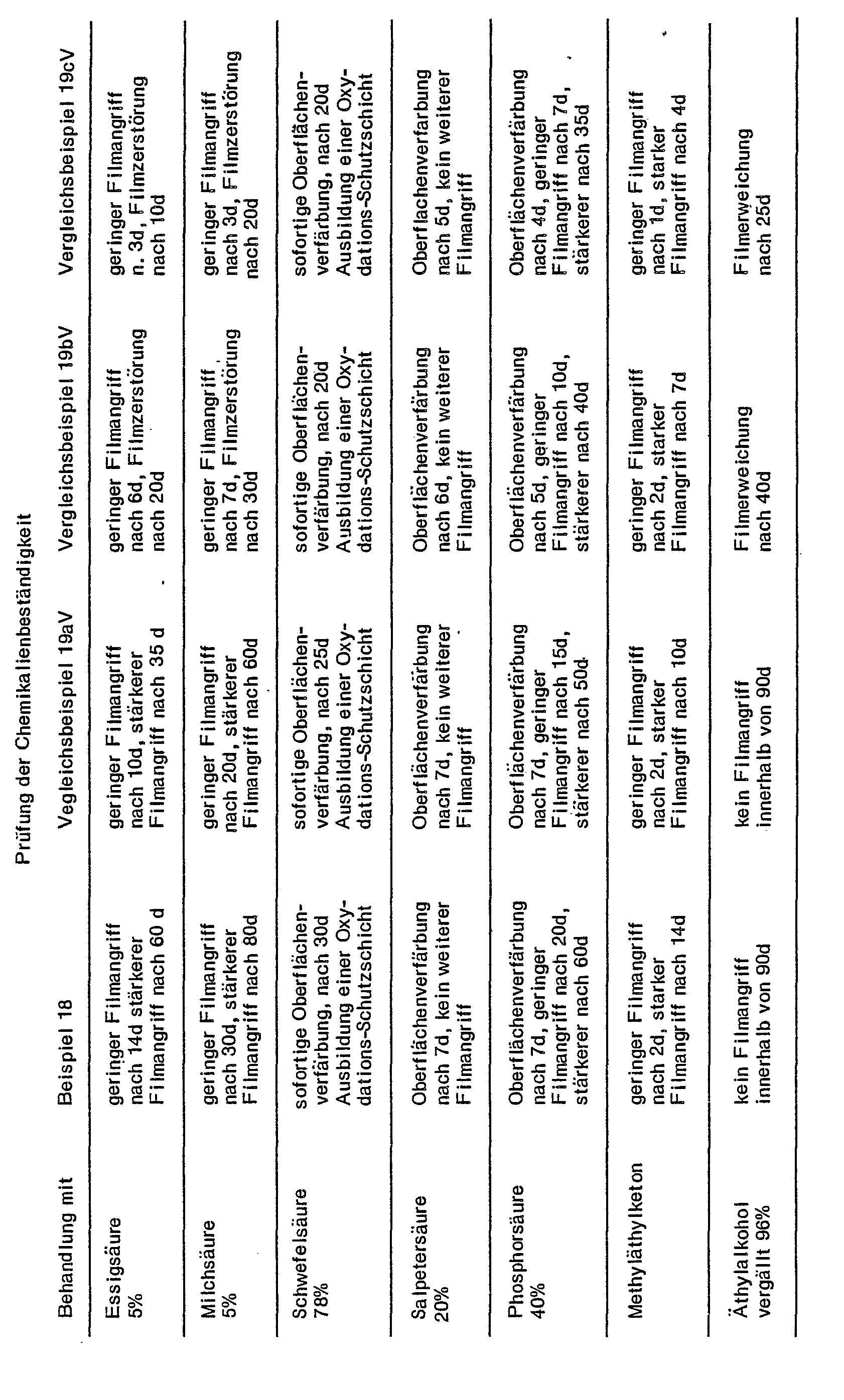
- Aus den Vergleichsversuchen ergibt sich deutlich die Verschlechterung der Chemikalienbeständigkeit insbesondere gegenüber organischen Säuren und Alkohol bei Verwendung von Härtungsmitteln mit Gehalten an phenolischem Hydroxyl <6,3 Gew.-%.
- In einer weiteren Versuchsserie wurden unter den gleichen Bedingungen folgende phenolfreien Mannich-Basen auf ihre Chemikalienbeständigkeit untersucht:
- 20) Mannich-Base gemäß Beispiel 1 mit einem Gehalt an phenolischem Hydroxyl von 6,91% und einem Wasserstoffäquivalentgewicht von 80,7.
- 21) Mannich-Base gemäß Beispiel 6 mit einem Gehalt an phenolischem Hydroxyl von 6,59% und einem Wasserstoffäquivalentgewicht von 86.
- 22) Mannich-Base gemäß Beispiel 16c mit einem Gehalt an phenolischem Hydroxyl von 6,34% und einem Wasserstoffäquivaleni von 76.
- 23a V) Vergleich Mannich-Base gemäß Vergleichs-Beispiel 10V mit einem Gehalt an phenolischem Hydroxyl von 9,32% und einem Wasserstoffäquivalentgewicht von 53,3.
- 23b V) Vergleich Mannich-Base gemäß Vergleichs-Beispiel 11V mit einem Gehalt an phenolischem Hydroxyl von 6,58% und einem Wasserstoffäquivalentgewicht von 53.


- Aus den Vergleichs-Versuchen 20 bis 23b V ist zu ersehen, daß für eine ausreichende Chemikalienbeständigkeit, insbesondere eine Beständigkeit gegenüber organischen Säuren neben einem Gehalt von phenolischem Hydroxyl >6,3% als basischer Partner der Mannich-Base unbedingt Xylylendiamin bzw. dessen Hydrierungsprodukt erforderlich ist. Auch Versuche mit der Mannich-Base gemäß Vergleichs-beispiel 5V zeigten eine schlechtere Chemikalienbeständigkeit als die mit Mannich-Basen aus Xylylendiamin hergestellten Proben.
- In dieser Versuchsserie werden Mannich-Basen unterschiedlicher Struktur auf ihre Chemikalienbeständigkeit untersucht.
- 24) Mannich-Base gemäß Beispiel 4 mit einem Gehalt an phenolischem Hydroxyl von 6,83% und einem Wasserstoffäquivalentgewicht von 82,7,
- 25) Mannich-Base gemäß Beispiel 3 mit einem Gehalt an phenolischem Hydroxyl von 6,59% und einem Wasserstoffäquivalentgewicht von 85,3,
- 26) Mannich-Base gemäß Beispiel 7 mit einem Gehalt an phenolischem Hydroxyl von 6,45% und einem Wasserstoffäquivalentgewicht von 77,3.
- Wie sich aus nachstehender Tabelle ergibt, tritt zwischen der Mannich-Base aus m-Xylylendiamin und Bis-(aminomethyl-)-cyclohexan kein Unterschied in der Chemikalienbeständigkeit auf, während der Methylsubstituent eine geringe Beeinträchtigung hervorruft (Versuch 25).


wurden jeweils die Schiff'schen Basen hergestellt.
Claims (5)


Priority Applications (1)
| Application Number | Priority Date | Filing Date | Title |
|---|---|---|---|
| AT81104829T ATE12510T1 (de) | 1980-06-24 | 1981-06-23 | Verfahren zur herstellung von formkoerpern und ueberzuegen. |
Applications Claiming Priority (2)
| Application Number | Priority Date | Filing Date | Title |
|---|---|---|---|
| DE3023464 | 1980-06-24 | ||
| DE19803023464 DE3023464A1 (de) | 1980-06-24 | 1980-06-24 | Verfahren zur herstellung von formkoerpern und ueberzuegen |
Publications (2)
| Publication Number | Publication Date |
|---|---|
| EP0042617A1 EP0042617A1 (de) | 1981-12-30 |
| EP0042617B1 true EP0042617B1 (de) | 1985-04-03 |
Family
ID=6105242
Family Applications (1)
| Application Number | Title | Priority Date | Filing Date |
|---|---|---|---|
| EP81104829A Expired EP0042617B1 (de) | 1980-06-24 | 1981-06-23 | Verfahren zur Herstellung von Formkörpern und Überzügen |
Country Status (5)
| Country | Link |
|---|---|
| US (1) | US4399268A (de) |
| EP (1) | EP0042617B1 (de) |
| JP (1) | JPS5817776B2 (de) |
| AT (1) | ATE12510T1 (de) |
| DE (2) | DE3023464A1 (de) |
Families Citing this family (12)
| Publication number | Priority date | Publication date | Assignee | Title |
|---|---|---|---|---|
| DE3124370A1 (de) * | 1981-06-20 | 1982-12-30 | Hoechst Ag, 6000 Frankfurt | Verwendung von mannich-basen zur herstellung von formkoerpern, neue mannich-basen und verfahren zu ihrer herstellung |
| JPH0355833U (de) * | 1989-10-06 | 1991-05-29 | ||
| EP0684268A1 (de) * | 1994-05-18 | 1995-11-29 | Air Products And Chemicals, Inc. | Niedrigtemperaturhärter für Epoxyhärze |
| US5914357A (en) * | 1995-09-08 | 1999-06-22 | Nippon Paint Co., Ltd. | Hydrolyzable resin containing aldehyde bounded thereto and self-polishing antifouling paint |
| DE19631370A1 (de) * | 1996-08-02 | 1998-02-05 | Hoechst Ag | Härtungsmittel für Epoxidharz-Systeme |
| US6262148B1 (en) * | 1998-07-01 | 2001-07-17 | Vantico Inc. | Phenalkamine curing agents and epoxy resin compositions containing the same |
| DE102004008464A1 (de) * | 2004-02-19 | 2005-09-15 | Fischerwerke Artur Fischer Gmbh & Co. Kg | Mehrkomponentenkit für Befestigungszwecke und dessen Verwendung |
| US20080040968A1 (en) * | 2006-08-17 | 2008-02-21 | Malfer Dennis J | Fuel additive compounds and method of making the compounds |
| EP2546276A1 (de) * | 2011-07-15 | 2013-01-16 | Sika Technology AG | Härter für Epoxidharze |
| US10584268B2 (en) * | 2015-03-23 | 2020-03-10 | Sika Technology Ag | Cold curing epoxy resin primer or adhesive |
| EP3205682A1 (de) * | 2016-02-15 | 2017-08-16 | Sika Technology AG | Härter für emissionsarme epoxidharz-zusammensetzungen |
| CN109053999A (zh) * | 2018-05-31 | 2018-12-21 | 广东省建筑材料研究院 | 一种芳香胺固化剂及其制备方法 |
Citations (1)
| Publication number | Priority date | Publication date | Assignee | Title |
|---|---|---|---|---|
| DE2025343A1 (de) * | 1969-06-19 | 1970-12-23 |
Family Cites Families (9)
| Publication number | Priority date | Publication date | Assignee | Title |
|---|---|---|---|---|
| DE1951524B2 (de) * | 1968-11-13 | 1975-11-13 | Hoechst Ag, 6000 Frankfurt | Verfahren zur Herstellung von Formkörpern und Überzügen |
| CH522016A (de) * | 1969-06-19 | 1972-04-30 | Reichhold Albert Chemie Ag | Verfahren zur Herstellung von Formkörpern und Überzügen |
| DE2025349A1 (de) * | 1970-05-23 | 1971-12-09 | Xaver Fendt & Co, 8952 Marktoberdorf | Motor- und Schaltgetriebeanordnung bei einem landwirtschaftlichen Fahrzeug |
| US3950451A (en) * | 1971-02-27 | 1976-04-13 | Asahi Denka Kogyo K.K. | Hardenable epoxy resin composition |
| DE2220864B2 (de) * | 1971-05-05 | 1977-02-17 | Hoechst Ag, 6000 Frankfurt | Verfahren zur herstellung von selbstaendigen oder an anderen koerpern haftenden geformten gebilden aus epoxidverbindungen unter verwendung von substituierten phenolen |
| CH603713A5 (de) * | 1972-07-25 | 1978-08-31 | Hoechst Ag | |
| CH602857A5 (de) * | 1976-12-10 | 1978-08-15 | Ciba Geigy Ag | |
| US4163098A (en) * | 1977-09-05 | 1979-07-31 | Ciba-Geigy Corporation | Coating compound based on epoxide resin, an amine curing agent, and a hydrazone modifier |
| EP0003479B1 (de) * | 1978-02-11 | 1981-09-16 | Schering Aktiengesellschaft | Härtungsmittel und Verfahren zur Herstellung von Epoxid-Polyaddukten |
-
1980
- 1980-06-24 DE DE19803023464 patent/DE3023464A1/de not_active Withdrawn
-
1981
- 1981-06-23 AT AT81104829T patent/ATE12510T1/de not_active IP Right Cessation
- 1981-06-23 DE DE8181104829T patent/DE3169661D1/de not_active Expired
- 1981-06-23 EP EP81104829A patent/EP0042617B1/de not_active Expired
- 1981-06-23 US US06/276,687 patent/US4399268A/en not_active Expired - Fee Related
- 1981-06-23 JP JP56096091A patent/JPS5817776B2/ja not_active Expired
Patent Citations (1)
| Publication number | Priority date | Publication date | Assignee | Title |
|---|---|---|---|---|
| DE2025343A1 (de) * | 1969-06-19 | 1970-12-23 |
Also Published As
| Publication number | Publication date |
|---|---|
| DE3023464A1 (de) | 1982-02-04 |
| JPS5744621A (en) | 1982-03-13 |
| US4399268A (en) | 1983-08-16 |
| DE3169661D1 (en) | 1985-05-09 |
| JPS5817776B2 (ja) | 1983-04-09 |
| EP0042617A1 (de) | 1981-12-30 |
| ATE12510T1 (de) | 1985-04-15 |
Similar Documents
| Publication | Publication Date | Title |
|---|---|---|
| EP0003479B1 (de) | Härtungsmittel und Verfahren zur Herstellung von Epoxid-Polyaddukten | |
| EP0597806B1 (de) | Neue cyclohexylgruppenhaltige Glycidylether | |
| DE69911775T2 (de) | Phenylalkylaminderivate, ihre verwendung als härtungsmittel in epoxidharzzusammensetzungen und sie enthaltende härtbare epoxidharzzusammensetzungen | |
| DE3820301A1 (de) | Stabile waessrige epoxidharz-dispersion, verfahren zu deren herstellung und deren verwendung | |
| DE2833170A1 (de) | N-alkylpolyamine und ihre verwendung zum haerten von epoxyharzen | |
| EP0645408A1 (de) | Härtungskomponente für Epoxidharze | |
| EP0042617A1 (de) | Verfahren zur Herstellung von Formkörpern und Überzügen | |
| EP3770200A1 (de) | Epoxidharz-zusammensetzung für chemikalienresistente beschichtungszwecke | |
| EP0103266A2 (de) | Härtungsmittel für Epoxidharze und Verfahren zum Härten von Epoxidharzen | |
| EP0735070A1 (de) | Härtungsmittel für elastische Epoxidharz-Systeme | |
| DE69711474T2 (de) | Reaktive Beschleuniger für Amin-gehärtete Epoxidharze | |
| DE69608087T2 (de) | Methylamin-Additionsprodukte für Härtung von Epoxydharzen | |
| EP0824124A1 (de) | Härter für Epoxidharze | |
| DE1418692C3 (de) | ||
| EP0068263B1 (de) | Verwendung von Mannich-Basen zur Herstellung von Formkörpern, neue Mannich-Basen und Verfahren zu ihrer Herstellung | |
| DE69914779T2 (de) | Epoxy-härtungsmittel aus phenol-aldehyd das mit polyamin reagiert hat | |
| EP0822212B1 (de) | Verfahren zur Herstellung eines Härtungsmittels für Expoxidharz-Systeme | |
| DE10014655A1 (de) | Mannichbasen und weitere Verbindungen basierend auf Alkyldipropylentriaminen | |
| DE3624314A1 (de) | Verwendung von epoxidharz/haerter-mischungen zur herstellung von beschichtungen mit erhoehter zwischenschichthaftung | |
| DE102011015193A1 (de) | Epoxidierte Arylalkylphenole | |
| JPH1171540A (ja) | 電着塗料 | |
| DE1121815B (de) | Verfahren zur Herstellung von harzartigen, Hydrozylgruppen enthaltenden Polyaethern | |
| EP0012293B1 (de) | Cyanethylierte Polyamidamine als Härter für Polyepoxide | |
| DE3124232A1 (de) | Verfahren zur herstellung von formkoerpern und ueberzuegen | |
| DE2951603C2 (de) |
Legal Events
| Date | Code | Title | Description |
|---|---|---|---|
| PUAI | Public reference made under article 153(3) epc to a published international application that has entered the european phase |
Free format text: ORIGINAL CODE: 0009012 |
|
| AK | Designated contracting states |
Designated state(s): AT BE CH DE FR GB IT NL SE |
|
| 17P | Request for examination filed |
Effective date: 19820121 |
|
| RBV | Designated contracting states (corrected) |
Designated state(s): AT CH DE FR GB LI |
|
| GRAA | (expected) grant |
Free format text: ORIGINAL CODE: 0009210 |
|
| AK | Designated contracting states |
Designated state(s): AT CH DE FR GB LI |
|
| REF | Corresponds to: |
Ref document number: 12510 Country of ref document: AT Date of ref document: 19850415 Kind code of ref document: T |
|
| REF | Corresponds to: |
Ref document number: 3169661 Country of ref document: DE Date of ref document: 19850509 |
|
| ET | Fr: translation filed | ||
| PLBE | No opposition filed within time limit |
Free format text: ORIGINAL CODE: 0009261 |
|
| STAA | Information on the status of an ep patent application or granted ep patent |
Free format text: STATUS: NO OPPOSITION FILED WITHIN TIME LIMIT |
|
| 26N | No opposition filed | ||
| PGFP | Annual fee paid to national office [announced via postgrant information from national office to epo] |
Ref country code: FR Payment date: 19940510 Year of fee payment: 14 |
|
| PGFP | Annual fee paid to national office [announced via postgrant information from national office to epo] |
Ref country code: CH Payment date: 19940513 Year of fee payment: 14 |
|
| PGFP | Annual fee paid to national office [announced via postgrant information from national office to epo] |
Ref country code: GB Payment date: 19940516 Year of fee payment: 14 |
|
| PGFP | Annual fee paid to national office [announced via postgrant information from national office to epo] |
Ref country code: AT Payment date: 19940520 Year of fee payment: 14 |
|
| PGFP | Annual fee paid to national office [announced via postgrant information from national office to epo] |
Ref country code: DE Payment date: 19940812 Year of fee payment: 14 |
|
| PG25 | Lapsed in a contracting state [announced via postgrant information from national office to epo] |
Ref country code: GB Effective date: 19950623 Ref country code: AT Effective date: 19950623 |
|
| PG25 | Lapsed in a contracting state [announced via postgrant information from national office to epo] |
Ref country code: LI Effective date: 19950630 Ref country code: CH Effective date: 19950630 |
|
| GBPC | Gb: european patent ceased through non-payment of renewal fee |
Effective date: 19950623 |
|
| PG25 | Lapsed in a contracting state [announced via postgrant information from national office to epo] |
Ref country code: FR Effective date: 19960229 |
|
| REG | Reference to a national code |
Ref country code: CH Ref legal event code: PL |
|
| PG25 | Lapsed in a contracting state [announced via postgrant information from national office to epo] |
Ref country code: DE Effective date: 19960301 |
|
| REG | Reference to a national code |
Ref country code: FR Ref legal event code: ST |