EP0036545B1 - Wasserunlösliche Monoazofarbstoffe, ihre Herstellung und ihre Verwendung - Google Patents
Wasserunlösliche Monoazofarbstoffe, ihre Herstellung und ihre Verwendung Download PDFInfo
- Publication number
- EP0036545B1 EP0036545B1 EP81101701A EP81101701A EP0036545B1 EP 0036545 B1 EP0036545 B1 EP 0036545B1 EP 81101701 A EP81101701 A EP 81101701A EP 81101701 A EP81101701 A EP 81101701A EP 0036545 B1 EP0036545 B1 EP 0036545B1
- Authority
- EP
- European Patent Office
- Prior art keywords
- formula
- dyestuffs
- atoms
- denotes
- alkoxy
- Prior art date
- Legal status (The legal status is an assumption and is not a legal conclusion. Google has not performed a legal analysis and makes no representation as to the accuracy of the status listed.)
- Expired
Links
- 239000000975 dye Substances 0.000 title claims description 47
- NYGZLYXAPMMJTE-UHFFFAOYSA-M metanil yellow Chemical group [Na+].[O-]S(=O)(=O)C1=CC=CC(N=NC=2C=CC(NC=3C=CC=CC=3)=CC=2)=C1 NYGZLYXAPMMJTE-UHFFFAOYSA-M 0.000 title claims description 11
- XLYOFNOQVPJJNP-UHFFFAOYSA-N water Substances O XLYOFNOQVPJJNP-UHFFFAOYSA-N 0.000 title description 6
- 238000002360 preparation method Methods 0.000 title description 4
- 125000004432 carbon atom Chemical group C* 0.000 claims description 22
- 239000000203 mixture Substances 0.000 claims description 22
- 125000003545 alkoxy group Chemical group 0.000 claims description 19
- 238000005859 coupling reaction Methods 0.000 claims description 13
- 230000008878 coupling Effects 0.000 claims description 12
- 238000010168 coupling process Methods 0.000 claims description 12
- 150000001412 amines Chemical class 0.000 claims description 10
- 238000004043 dyeing Methods 0.000 claims description 10
- 229910052739 hydrogen Inorganic materials 0.000 claims description 10
- 239000001257 hydrogen Substances 0.000 claims description 10
- -1 methylsulphonyl Chemical group 0.000 claims description 9
- 125000001997 phenyl group Chemical group [H]C1=C([H])C([H])=C(*)C([H])=C1[H] 0.000 claims description 9
- 125000000217 alkyl group Chemical group 0.000 claims description 7
- 239000000463 material Substances 0.000 claims description 7
- 125000000951 phenoxy group Chemical group [H]C1=C([H])C([H])=C(O*)C([H])=C1[H] 0.000 claims description 7
- 238000000034 method Methods 0.000 claims description 6
- ZAMOUSCENKQFHK-UHFFFAOYSA-N Chlorine atom Chemical compound [Cl] ZAMOUSCENKQFHK-UHFFFAOYSA-N 0.000 claims description 5
- 125000002496 methyl group Chemical group [H]C([H])([H])* 0.000 claims description 5
- WKBOTKDWSSQWDR-UHFFFAOYSA-N Bromine atom Chemical compound [Br] WKBOTKDWSSQWDR-UHFFFAOYSA-N 0.000 claims description 4
- 229910052801 chlorine Inorganic materials 0.000 claims description 4
- 239000000460 chlorine Substances 0.000 claims description 4
- 125000004093 cyano group Chemical group *C#N 0.000 claims description 4
- 125000001495 ethyl group Chemical group [H]C([H])([H])C([H])([H])* 0.000 claims description 4
- 229910052736 halogen Inorganic materials 0.000 claims description 4
- 150000002367 halogens Chemical class 0.000 claims description 4
- 229920000728 polyester Polymers 0.000 claims description 4
- GDTBXPJZTBHREO-UHFFFAOYSA-N bromine Substances BrBr GDTBXPJZTBHREO-UHFFFAOYSA-N 0.000 claims description 3
- 229910052794 bromium Inorganic materials 0.000 claims description 3
- 229920002284 Cellulose triacetate Polymers 0.000 claims description 2
- NNLVGZFZQQXQNW-ADJNRHBOSA-N [(2r,3r,4s,5r,6s)-4,5-diacetyloxy-3-[(2s,3r,4s,5r,6r)-3,4,5-triacetyloxy-6-(acetyloxymethyl)oxan-2-yl]oxy-6-[(2r,3r,4s,5r,6s)-4,5,6-triacetyloxy-2-(acetyloxymethyl)oxan-3-yl]oxyoxan-2-yl]methyl acetate Chemical compound O([C@@H]1O[C@@H]([C@H]([C@H](OC(C)=O)[C@H]1OC(C)=O)O[C@H]1[C@@H]([C@@H](OC(C)=O)[C@H](OC(C)=O)[C@@H](COC(C)=O)O1)OC(C)=O)COC(=O)C)[C@@H]1[C@@H](COC(C)=O)O[C@@H](OC(C)=O)[C@H](OC(C)=O)[C@H]1OC(C)=O NNLVGZFZQQXQNW-ADJNRHBOSA-N 0.000 claims description 2
- 125000000449 nitro group Chemical group [O-][N+](*)=O 0.000 claims description 2
- 125000004435 hydrogen atom Chemical class [H]* 0.000 claims 3
- 238000004519 manufacturing process Methods 0.000 claims 2
- QTBSBXVTEAMEQO-UHFFFAOYSA-N Acetic acid Chemical compound CC(O)=O QTBSBXVTEAMEQO-UHFFFAOYSA-N 0.000 description 8
- 150000003254 radicals Chemical class 0.000 description 6
- LRHPLDYGYMQRHN-UHFFFAOYSA-N N-Butanol Chemical compound CCCCO LRHPLDYGYMQRHN-UHFFFAOYSA-N 0.000 description 5
- 150000002431 hydrogen Chemical class 0.000 description 5
- UFHFLCQGNIYNRP-UHFFFAOYSA-N Hydrogen Chemical compound [H][H] UFHFLCQGNIYNRP-UHFFFAOYSA-N 0.000 description 4
- 239000000835 fiber Substances 0.000 description 4
- 238000009998 heat setting Methods 0.000 description 4
- 230000002209 hydrophobic effect Effects 0.000 description 4
- 125000001424 substituent group Chemical group 0.000 description 4
- JBIJLHTVPXGSAM-UHFFFAOYSA-N 2-naphthylamine Chemical class C1=CC=CC2=CC(N)=CC=C21 JBIJLHTVPXGSAM-UHFFFAOYSA-N 0.000 description 3
- RXQNKKRGJJRMKD-UHFFFAOYSA-N 5-bromo-2-methylaniline Chemical compound CC1=CC=C(Br)C=C1N RXQNKKRGJJRMKD-UHFFFAOYSA-N 0.000 description 3
- 229960000583 acetic acid Drugs 0.000 description 3
- 125000005415 substituted alkoxy group Chemical group 0.000 description 3
- LXQOQPGNCGEELI-UHFFFAOYSA-N 2,4-dinitroaniline Chemical compound NC1=CC=C([N+]([O-])=O)C=C1[N+]([O-])=O LXQOQPGNCGEELI-UHFFFAOYSA-N 0.000 description 2
- RTZKZFJDLAIYFH-UHFFFAOYSA-N Diethyl ether Chemical compound CCOCC RTZKZFJDLAIYFH-UHFFFAOYSA-N 0.000 description 2
- VEXZGXHMUGYJMC-UHFFFAOYSA-N Hydrochloric acid Chemical compound Cl VEXZGXHMUGYJMC-UHFFFAOYSA-N 0.000 description 2
- IOVCWXUNBOPUCH-UHFFFAOYSA-N Nitrous acid Chemical compound ON=O IOVCWXUNBOPUCH-UHFFFAOYSA-N 0.000 description 2
- 239000002202 Polyethylene glycol Substances 0.000 description 2
- QAOWNCQODCNURD-UHFFFAOYSA-N Sulfuric acid Chemical compound OS(O)(=O)=O QAOWNCQODCNURD-UHFFFAOYSA-N 0.000 description 2
- 150000007933 aliphatic carboxylic acids Chemical class 0.000 description 2
- 239000000969 carrier Substances 0.000 description 2
- 238000006193 diazotization reaction Methods 0.000 description 2
- XBDQKXXYIPTUBI-UHFFFAOYSA-N dimethylselenoniopropionate Natural products CCC(O)=O XBDQKXXYIPTUBI-UHFFFAOYSA-N 0.000 description 2
- 238000001035 drying Methods 0.000 description 2
- 125000004170 methylsulfonyl group Chemical group [H]C([H])([H])S(*)(=O)=O 0.000 description 2
- 229920001223 polyethylene glycol Polymers 0.000 description 2
- 230000002829 reductive effect Effects 0.000 description 2
- LPXPTNMVRIOKMN-UHFFFAOYSA-M sodium nitrite Chemical compound [Na+].[O-]N=O LPXPTNMVRIOKMN-UHFFFAOYSA-M 0.000 description 2
- KKEYFWRCBNTPAC-UHFFFAOYSA-L terephthalate(2-) Chemical compound [O-]C(=O)C1=CC=C(C([O-])=O)C=C1 KKEYFWRCBNTPAC-UHFFFAOYSA-L 0.000 description 2
- ZYECOAILUNWEAL-NUDFZHEQSA-N (4z)-4-[[2-methoxy-5-(phenylcarbamoyl)phenyl]hydrazinylidene]-n-(3-nitrophenyl)-3-oxonaphthalene-2-carboxamide Chemical compound COC1=CC=C(C(=O)NC=2C=CC=CC=2)C=C1N\N=C(C1=CC=CC=C1C=1)/C(=O)C=1C(=O)NC1=CC=CC([N+]([O-])=O)=C1 ZYECOAILUNWEAL-NUDFZHEQSA-N 0.000 description 1
- ALSTYHKOOCGGFT-KTKRTIGZSA-N (9Z)-octadecen-1-ol Chemical compound CCCCCCCC\C=C/CCCCCCCCO ALSTYHKOOCGGFT-KTKRTIGZSA-N 0.000 description 1
- 0 *c(cc(cc1)[N+]([O-])=O)c1N=N[C@]1C=CC(*)=C2C=CC=CC12 Chemical compound *c(cc(cc1)[N+]([O-])=O)c1N=N[C@]1C=CC(*)=C2C=CC=CC12 0.000 description 1
- MGCGMYPNXAFGFA-UHFFFAOYSA-N 2-amino-5-nitrobenzonitrile Chemical compound NC1=CC=C([N+]([O-])=O)C=C1C#N MGCGMYPNXAFGFA-UHFFFAOYSA-N 0.000 description 1
- LHRIICYSGQGXSX-UHFFFAOYSA-N 2-chloro-4,6-dinitroaniline Chemical compound NC1=C(Cl)C=C([N+]([O-])=O)C=C1[N+]([O-])=O LHRIICYSGQGXSX-UHFFFAOYSA-N 0.000 description 1
- AUSRSVRJOXYXMI-UHFFFAOYSA-N 2-methylsulfonylaniline Chemical compound CS(=O)(=O)C1=CC=CC=C1N AUSRSVRJOXYXMI-UHFFFAOYSA-N 0.000 description 1
- 229920003043 Cellulose fiber Polymers 0.000 description 1
- LFQSCWFLJHTTHZ-UHFFFAOYSA-N Ethanol Chemical compound CCO LFQSCWFLJHTTHZ-UHFFFAOYSA-N 0.000 description 1
- 244000299507 Gossypium hirsutum Species 0.000 description 1
- JCXJVPUVTGWSNB-UHFFFAOYSA-N Nitrogen dioxide Chemical class O=[N]=O JCXJVPUVTGWSNB-UHFFFAOYSA-N 0.000 description 1
- 239000004952 Polyamide Substances 0.000 description 1
- VMHLLURERBWHNL-UHFFFAOYSA-M Sodium acetate Chemical compound [Na+].CC([O-])=O VMHLLURERBWHNL-UHFFFAOYSA-M 0.000 description 1
- VJMAITQRABEEKP-UHFFFAOYSA-N [6-(phenylmethoxymethyl)-1,4-dioxan-2-yl]methyl acetate Chemical compound O1C(COC(=O)C)COCC1COCC1=CC=CC=C1 VJMAITQRABEEKP-UHFFFAOYSA-N 0.000 description 1
- 230000002378 acidificating effect Effects 0.000 description 1
- 239000003513 alkali Substances 0.000 description 1
- 239000012736 aqueous medium Substances 0.000 description 1
- 239000007900 aqueous suspension Substances 0.000 description 1
- 230000015572 biosynthetic process Effects 0.000 description 1
- 238000006243 chemical reaction Methods 0.000 description 1
- 238000004040 coloring Methods 0.000 description 1
- 150000001875 compounds Chemical class 0.000 description 1
- 230000007812 deficiency Effects 0.000 description 1
- 239000000986 disperse dye Substances 0.000 description 1
- 239000004744 fabric Substances 0.000 description 1
- 239000002657 fibrous material Substances 0.000 description 1
- 239000012362 glacial acetic acid Substances 0.000 description 1
- ZXEKIIBDNHEJCQ-UHFFFAOYSA-N isobutanol Chemical compound CC(C)CO ZXEKIIBDNHEJCQ-UHFFFAOYSA-N 0.000 description 1
- 125000001449 isopropyl group Chemical group [H]C([H])([H])C([H])(*)C([H])([H])[H] 0.000 description 1
- 239000000155 melt Substances 0.000 description 1
- 125000000956 methoxy group Chemical group [H]C([H])([H])O* 0.000 description 1
- 238000002156 mixing Methods 0.000 description 1
- 229940055577 oleyl alcohol Drugs 0.000 description 1
- XMLQWXUVTXCDDL-UHFFFAOYSA-N oleyl alcohol Natural products CCCCCCC=CCCCCCCCCCCO XMLQWXUVTXCDDL-UHFFFAOYSA-N 0.000 description 1
- 239000003960 organic solvent Substances 0.000 description 1
- 229920002401 polyacrylamide Polymers 0.000 description 1
- 229920002647 polyamide Polymers 0.000 description 1
- 229920000151 polyglycol Polymers 0.000 description 1
- 239000010695 polyglycol Substances 0.000 description 1
- 235000019260 propionic acid Nutrition 0.000 description 1
- IUVKMZGDUIUOCP-BTNSXGMBSA-N quinbolone Chemical compound O([C@H]1CC[C@H]2[C@H]3[C@@H]([C@]4(C=CC(=O)C=C4CC3)C)CC[C@@]21C)C1=CCCC1 IUVKMZGDUIUOCP-BTNSXGMBSA-N 0.000 description 1
- 239000004627 regenerated cellulose Substances 0.000 description 1
- 230000035945 sensitivity Effects 0.000 description 1
- 239000001632 sodium acetate Substances 0.000 description 1
- 235000017281 sodium acetate Nutrition 0.000 description 1
- JVBXVOWTABLYPX-UHFFFAOYSA-L sodium dithionite Chemical compound [Na+].[Na+].[O-]S(=O)S([O-])=O JVBXVOWTABLYPX-UHFFFAOYSA-L 0.000 description 1
- 235000010288 sodium nitrite Nutrition 0.000 description 1
- 238000000859 sublimation Methods 0.000 description 1
- 230000008022 sublimation Effects 0.000 description 1
- 239000000725 suspension Substances 0.000 description 1
- 229920003002 synthetic resin Polymers 0.000 description 1
- 239000000057 synthetic resin Substances 0.000 description 1
- 210000002268 wool Anatomy 0.000 description 1
Classifications
-
- C—CHEMISTRY; METALLURGY
- C09—DYES; PAINTS; POLISHES; NATURAL RESINS; ADHESIVES; COMPOSITIONS NOT OTHERWISE PROVIDED FOR; APPLICATIONS OF MATERIALS NOT OTHERWISE PROVIDED FOR
- C09B—ORGANIC DYES OR CLOSELY-RELATED COMPOUNDS FOR PRODUCING DYES, e.g. PIGMENTS; MORDANTS; LAKES
- C09B29/00—Monoazo dyes prepared by diazotising and coupling
- C09B29/06—Monoazo dyes prepared by diazotising and coupling from coupling components containing amino as the only directing group
- C09B29/095—Amino naphthalenes
-
- Y—GENERAL TAGGING OF NEW TECHNOLOGICAL DEVELOPMENTS; GENERAL TAGGING OF CROSS-SECTIONAL TECHNOLOGIES SPANNING OVER SEVERAL SECTIONS OF THE IPC; TECHNICAL SUBJECTS COVERED BY FORMER USPC CROSS-REFERENCE ART COLLECTIONS [XRACs] AND DIGESTS
- Y10—TECHNICAL SUBJECTS COVERED BY FORMER USPC
- Y10S—TECHNICAL SUBJECTS COVERED BY FORMER USPC CROSS-REFERENCE ART COLLECTIONS [XRACs] AND DIGESTS
- Y10S534/00—Organic compounds -- part of the class 532-570 series
- Y10S534/01—Mixtures of azo compounds
Definitions
- Dyes with a-naphthylamine coupling components have already been described in numerous publications. Dyes in which 2,4-dinitro-, 2-cyano-4-nitro- and 2-methylsulfonyl-aniline have been coupled to a-naphthylamine coupling components are also described, for example, in British Pat. No. 1,428,129, DOS 2,054,685 , DOS 2 709 774, JA-PS 7 235 353, US-PS 2 266 142 and US-PS 2 045 324.
- Phenoxy groups which represent Z can also carry one of the substituents specified above in the phenyl core.
- This substituent, as well as the substituent R 2 of the radical representing R 1 can be in the 2-, 3- or 4-position, based on the binding site of the phenyl nucleus to the O-, N- or. C atom stand.
- Phenyl groups which occur as substituents in alkoxy which represents Z can in turn bear one of the substituents methyl, methoxy or chlorine in the 2-, 3- or 4-position.
- Optionally substituted phenoxy radicals which can represent Z are, for example, 2-methylphenoxy, 3-methylphenoxy, 4-methylphenoxy, 4-methoxyphenoxy, 2-chlorophenoxy, 3-chlorophenoxy, 4-chlorophenoxy.
- Optionally substituted alkoxy groups with 1 to 4 carbon atoms, for which Z can stand are, for example, methoxy, ethoxy, propoxy, i-propoxy, butoxy, i-butoxy, tert-butoxy, 2-hydroxy-ethoxy, 2-methoxyethoxy, 2 -Ethoxyethoxy, 2-propoxyethoxy, 2-butoxy-ethoxy, 3-hydroxypropoxy, 3-methoxypropoxy, 3-ethoxypropoxy, 3-methoxybutoxy, 3-ethoxybutoxy, 4-hydroxybutoxy, 4-methoxybutoxy, 2-acetoxyethoxy, 2-propanoyloxyethoxy, 2 -Butyryloxyethoxy.
- Preferred dyes are those of the formula in which R 1 is a radical of the formula Ib, in particular those in which R 2 is hydrogen, methyl, ethyl, i-propyl, methoxy, ethoxy, propoxy, i-propoxy, butoxy, i-butoxy.
- Preferred alkoxy groups for Z are the unsubstituted with 1 to 4 C atoms or the alkoxy groups with 2 to 4 C atoms substituted by alkoxy with 1 or 2 C atoms.
- R 1 is a radical of the formula Ia
- Y 1 is hydrogen and Z is optionally substituted alkoxy with 1 to 4 C atoms, optionally substituted phenoxy as indicated above, are also very advantageous mean.
- the number m which can be between 0 and 2, is advantageously 0 if Y 1 is hydrogen or methyl and Z is cyano, it is advantageously 1 if Y 1 is hydrogen, Z optionally substituted alkoxy with 1 to 4 C- Atoms or optionally substituted phenoxy as indicated above.
- Such dye mixtures according to the invention have a content of 10 to 90, preferably 30 to 70% by weight of dyes of the formula and 90 to 10, preferably 70 to 30% by weight of dyes of the formula II.
- the dyes of the formula II and their preparation are known. (See GB 985 254, DE-AS 2 510 112, DE-OS 2 319 709, DE-OS 2 116 315, FR 792 450, DE-OS 1 963 590, JA 7 235 353 and DE-OS 1 544 396 ).
- the dyes of the formula I according to the invention are prepared by using an amine of the general formula III wherein X 'has the meanings given above, diazotized and on a coupling component of the general formula IV wherein R 1 has the meanings given above, couples.
- the diazotization of the amine of the formula III takes place in a manner known per se by the action of nitrous acid or compounds which split off nitrous acid.
- acetic acid or propionic acid are dissolved and diazotized at 0 to 60 ° C by adding nitrosylsulfuric acid or sodium nitrite.
- the coupling is carried out in an acidic aqueous medium, in a lower aliphatic carboxylic acid, such as. B.
- acetic acid which is expediently diluted with water or in a mixture of water and a sparingly water-soluble alcohol, such as n- or i-butanol, at temperatures from 0 to 30 ° C. The temperature range from 0 to 15 ° C. is preferred.
- alkalis such as. B. from sodium acetate to a value of 3 to 6.
- the dyes of the invention are particularly suitable for dyeing and printing hydrophobic fiber materials, such as polyamide, cellulose-2 1/2 acetate, cellulose triacetate and in particular polyester materials, e.g. B. polyethylene glycol terephthalate. They then deliver strong, red-violet to black dyeings and prints with very good fastness properties, in particular very good fastness to light, dry heat pleating and dry heat fixation and very good behavior in synthetic resin equipment with very good thermomigration behavior, using customary dyeing and printing processes.
- hydrophobic fiber materials such as polyamide, cellulose-2 1/2 acetate, cellulose triacetate and in particular polyester materials, e.g. B. polyethylene glycol terephthalate.
- the dyeing of the fibers mentioned, individually or in a mixture with other types of fibers such. B. cotton, regenerated cellulose fibers or wool, with the dyes according to the invention is advantageously carried out from aqueous suspension in the presence of carriers between about 80-110 ° C in the absence of carriers between about 110-140 ° C, and by the so-called heat setting method at about 180-230 ° C.
- the printing of the materials mentioned can be carried out in such a way that the goods printed with the new dyes are steamed in the presence of a carrier at temperatures between approximately 80-110 ° C. or even in the absence of a carrier at approximately 110-140 ° C. or else according to the so-called Heat setting process is treated at about 180-230 ° C.
- the dyes according to the invention are also suitable for dyeing the hydrophobic materials listed above from organic solvents and for dyeing in bulk.
- the dyes of the formula according to the invention and in particular their mixtures with one another and with dyes of the formula are surprisingly, when applied by one of the processes mentioned above, the previously known comparable dyes in terms of color strength, lightfastness, sublimation, pH resistance, alkali resistance, reduction resistance, temperature resistance and Considerably superior in build-up and pull-out capacity.
- the dyes according to the invention provide shades that are clearer and more pure in color.
- the dyes according to the invention are also insensitive to fluctuations in the pH.
- a fabric made of polyethylene glycol terephthalate is padded on the pad at 30 ° C. with a liquor containing 30.0 g of the finely divided dye of Example 2, 1.0 g of polyacrylamide with a K value of 120 and 0.5 g of a polyglycol ether Contains oleyl alcohol and 968.5 g water. After drying, it is fixed in the heat setting frame at 210 ° C for 60 seconds. After subsequent rinsing, reductive aftertreatment with a 0.2% alkaline sodium dithionite solution for 15 minutes at 70 to 80 ° C., rinsing and drying, a black color is obtained with very good coloristic properties, in particular very good fastness to light and heat setting.
- the dyes and dye mixtures according to the invention from the following tables can be prepared analogously to Examples 1 and 2. They also dye hydrophobic fibers in full brown to black shades of excellent fastness.
Landscapes
- Chemical & Material Sciences (AREA)
- Organic Chemistry (AREA)
- Coloring (AREA)
Description
- Die vorliegende Erfindung betrifft wertvolle Monoazofarbstoffe der allgemeinen Formel I

- X' Nitro, Cyan, Methylsulfonyl,
- R1 einen Rest der Formel Ia oder Ib


- Y1 Wasserstoff, Methyl oder Ethyl
- Z Cyan, Phenyl, Phenoxy, gegebenenfalls substituiert durch Alkyl mit 1 bis 4 C-Atomen, Alkoxy mit 1 bis 4 C-Atomen oder Halogen; Alkoxy mit 1 bis 4 C-Atomen gegebenenfalls substituiert durch Alkoxy mit 1 bis 4 C-Atomen, Cyan oder Phenyl;
- m eine Zahl von 0 bis 2 und
- R2 Wasserstoff, Alkyl mit 1 bis 4 C-Atomen oder Alkoxy mit 1 bis 4 C-Atomen bedeuten,
- Farbstoffe mit a-Naphthylamin-Kupplungskomponenten sind bereits in zahlreichen Veröffentlichungen beschrieben worden. Auch Farbstoffe, bei denen auf a-Naphthylamin-Kupplungskomponenten diazotiertes 2,4-Dinitro-, 2-Cyan-4-nitro- und 2-Methylsulfonyl-anilin gekuppelt wurde, sind beispielsweise aus GB-PS 1 428 129, DOS 2 054 685, DOS 2 709 774, JA-PS 7 235 353, US-PS 2 266 142 und US-PS 2 045 324 bekannt.
- Diese bekannten Farbstoffe lassen jedoch noch zahlreiche Wünsche der Praxis offen, insbesondere im Hinblick auf die Applikation, wo sich beispielsweise Mängel im Aufbauvermögen in derTemperaturstabilität, in der pH-Beständigkeit und in der Reduktionsempfindlichkeit, bzw. daraus resultierender Egalitätsmängel, aber auch im Hinblick auf die Echtheiten der Färbungen und nicht zuletzt auf die Kosten der Färbung unter Berücksichtigung der Farbstärke zeigen. Die Farbstoffe der vorliegenden Erfindung tragen überraschenderweise den Bedürfnissen der Praxis in weit höherem Maße Rechnung als die bisher bekannten.
- Phenoxygruppen, die für Z stehen, können im Phenylkem noch einen der oben angegebenen Substituenten tragen. Dieser Substituent, wie auch der Substituent R2 des für R1 stehenden Restes

- Phenylgruppen, die als Substituenten in für Z stehendem Alkoxy vorkommen, können ihrerseits in 2-, 3- oder 4-Stellung einen der Substituenten Methyl, Methoxy oder Chlor tragen.
- Gegebenenfalls substituierte Phenoxy-Reste, die für Z stehen können, sind beispielsweise 2-Methyl- phenoxy, 3-Methylphenoxy, 4-Methyl-phenoxy, 4-Methoxyphenoxy, 2-Chlorphenoxy, 3-Chlorphenoxy, 4-Chlorphenoxy.
- Gegebenenfalls substituierte Alkoxygruppen mit 1 bis 4 C-Atomen, für die Z stehen kann, sind beispielsweise Methoxy, Ethoxy, Propoxy, i-Propoxy, Butoxy, i-Butoxy, tert.Butoxy, 2-Hydroxy-ethoxy, 2-Methoxyethoxy, 2-Ethoxyethoxy, 2-Propoxyethoxy, 2-Butoxy-ethoxy, 3-Hydroxypropoxy, 3-Methoxypropoxy, 3-Ethoxypropoxy, 3-Methoxybutoxy, 3-Ethoxybutoxy, 4-Hydroxybutoxy, 4-Methoxybutoxy, 2-Acetoxyethoxy, 2-Propanoyloxyethoxy, 2-Butyryloxyethoxy.
- Bevorzugt sind solche Farbstoffe der Formel worin R1 ein Rest der Formel Ib ist, insbesondere diejenigen, in denen R2 Wasserstoff, Methyl, Ethyl, i-Propyl, Methoxy, Ethoxy, Propoxy, i-Propoxy, Butoxy, i-Butoxy ist.
- In der Gruppe der erfindungsgemäßen Farbstoffe der Formel in denen R' ein Rest der Formel la ist, kommt man zu den besonders vorteilhaften Individuen, wenn man die folgenden Gesichtspunkte berücksichtigt.
- Bevorzugte für Z stehende Alkoxygruppen sind die unsubstituierten mit 1 bis 4 C-Atomen oder die durch Alkoxy mit 1 oder 2 C-Atomen substituierten Alkoxygruppen mit 2 bis 4 C-Atomen.
- Aus derGruppe von erfindungsgemäßen Farbstoffen, in denen R1 ein Rest der Formel Ia ist, sind auch diejenigen sehr vorteilhaft, in denen Y1 Wasserstoff und Z gegebenenfalls wie oben angegeben substituiertes Alkoxy mit 1 bis 4 C-Atomen, gegebenenfalls wie oben angegeben substituiertes Phenoxy bedeuten.
- Die Zahl m, die zwischen 0 und 2 liegen kann, ist vorteilhafterweise 0, wenn Y1 Wasserstoff oder Methyl und Z Cyan bedeuten, sie ist vorteilhafterweise 1, wenn Y1 Wasserstoff, Z gegebenenfalls wie oben angegeben substituiertes Alkoxy mit 1 bis 4 C-Atomen oder gegebenenfalls wie oben angegeben substituiertes Phenoxy bedeuten.
- Besonders vorteilhaft sind auch diejenigen erfindungsgemäßen Farbstoffe, in denen R' ein Rest der Formel la ist, wenn Y1 Wasserstoff, m Null und Z Cyan ist.
- Besonders bevorzugt sind solche erfindungsgemäßen Farbstoffe der Formel I, die mehrere vorteilhafte oder bevorzugte Merkmale aufweisen.
- Technisch besonders vorteilhaft in Bezug auf Farbstoffausbeute, Ziehvermögen und Echtheit der Färbungen bzw. Drucke sind Mischungen von erfindungsgemäßen Monoazofarbstoffen der allgem. Formel 1 mit Monoazofarbstoffen der allgem. Formel 11

- Derartige erfindungsgemäße Farbstoffmischungen haben einen Gehalt von 10 bis 90, vorzugsweise 30 bis 70 Gew.-%an Farbstoffen der Formel und 90 bis 10, vorzugsweise 70 bis 30 Gew.-%an Farbstoffen der Formel II.
- Die Farbstoffe der Formel II und ihre Herstellung sind bekannt. (Vergl. GB 985 254, DE-AS 2 510 112, DE-OS 2 319 709, DE-OS 2 116 315, FR 792 450, DE-OS 1 963 590, JA 7 235 353 und DE-OS 1 544 396).
- Die Herstellung der erfindungsgemäßen Farbstoffe der Formel I erfolgt, indem man ein Amin der allgemeinen Formel III


- Die Diazotierung des Amins der Formel III geschieht in an sich bekannter Weise durch Einwirkung von salpetriger Säure oder salpetrige Säure abspaltende Verbindungen. Beispielsweise können die Amine in Schwefelsäure, Salzsäure oder in niederen aliphatischen Carbonsäuren, wie z. B. Essigsäure oder Propionsäure, gelöst werden und bei 0 bis 60°C durch Zusatz von Nitrosylschwefelsäure bzw. Natriumnitrit diazotiert werden. Die Kupplung wird im sauren wäßrigen Medium, in einer niederen aliphatischen Carbonsäure, wie z. B. Essigsäure, die zweckmäßigerweise mit Wasser verdünnt ist bzw. in einer Mischung aus Wasser und einem in Wasser wenig löslichen Alkohol, wie n- oder i-Butanol, bei Temperaturen von 0 bis 30°C ausgeführt. Bevorzugt wird hierbei der Temperaturbereich von 0 bis 15°C. Zur Vervollständigung der Kupplungsreaktion kann es zweckmäßig sein, den pH-Wert des Kupplungsansatzes gegen Ende der Reaktion durch Zusatz von Alkalien, wie z. B. von Natriumacetat auf einen Wert von 3 bis 6 zu puffern. Es kann im Hinblick auf die Formierung der Dispersionsfarbstoffe oder hinsichtlich ihrer Farbausbeute von Vorteil sein, ein Gemisch von diazotierten Aminen der Formel III mit einer Kupplungskomponente der Formel IV oder ein diazotiertes Amin der Formel III mit einem Gemisch von Kupplungskomponenten der allgem. Formel IV zu kuppeln oder zwei oder mehrere auf getrenntem Wege dargestellte Einzelfarbstoffe zu mischen.
- Will man Mischungen von erfindungsgemäßen Farbstoffen der Formel mit Farbstoffen der Formel II herstellen so ist es zweckmäßig, Mischungen von Aminen der allgemeinen Formeln III und V


- Die erfindungsgemäßen Farbstoffe eignen sich insbesondere zum Färben und Bedrucken von hydrophoben Fasermaterialien, wie beispielsweise Polyamid, Cellulose-2 1/2 acetat, Cellulosetriacetat und insbesondere Polyestermaterialien, z. B. Polyethylenglykolterephthalat. Sie liefern hierauf nach üblichen Färbe- und Druckverfahren farbstarke, rotviolette bis schwarze Färbungen und Drucke mit sehr guten Echtheitseigenschaften, insbesondere sehr guter Licht-, Trockenhitzeplissier- und Trockenhitzefixierechtheit und einem sehr guten Verhalten bei der Kunstharzausrüstung bei sehr gutem Thermomigrationsverhalten.
- Das Färben der genannten Fasern, die einzeln oder im Gemisch mit anderen Faserarten wie z. B. Baumwolle, regenerierter Zellulosefasern oder Wolle vorliegen können, mit den erfindungsgemäßen Farbstoffen erfolgt zweckmäßig aus wäßriger Suspension in Gegenwart von Carriern zwischen etwa 80-110°C in Abwesenheit von Carriern zwischen etwa 110-140°C, sowie nach dem sogenannten Thermofixierverfahren bei etwa 180-230°C. Das Bedrucken der genannten Materialien kann so durchgeführt werden, daß die mit den neuen Farbstoffen bedruckte Ware in Gegenwart eines Carriers bei Temperaturen zwischen etwa 80-110°C oder auch in Abwesenheit eines Carriers bei etwa 110-140°C gedämpft oder auch nach dem sogenannten Thermofixierverfahren bei etwa 180-230°C behandelt wird.
- Die erfindungsgemäßen Farbstoffe eignen sich auch zum Färben der vorstehend aufgeführten hydrophoben Materialien aus organischen Lösungsmitteln und zum Färben in der Masse.
- Die erfindungsgemäßen Farbstoffe der Formel sowie insbesondere ihre Mischungen untereinander und mit Farbstoffen der Formel sind bei der Applikation nach einem der oben angegebenen Verfahren den bisher bekannten vergleichbaren Farbstoffen überraschenderweise in Bezug auf Farbstärke, Lichtechtheit, Sublimerechtheit, pH-Beständigkeit, Alkalibeständigkeit, Reduktionsbeständigkeit, Temperaturbeständigkeit und im Aufbau- und Ausziehvermögen erheblich überlegen.
- Gegenüber den ähnlichen Farbstoffen nach der schweizerischen Patentschrift Nr. 589 695 liefern die erfindungsgemäßen Farbstoffe Nuancen, die klarer und farbreiner sind. Auch sind die erfindungsgemäßen Farbstoffe unempfindlich gegenüber Schwankungen des pH-Wertes.
- Die folgenden Ausführungsbeispiele veranschaulichen die Herstellung der erfindungsgemäßen Farbstoffe und Farbstoffmischungen und eine Möglichkeit zu ihrer Anwendung.
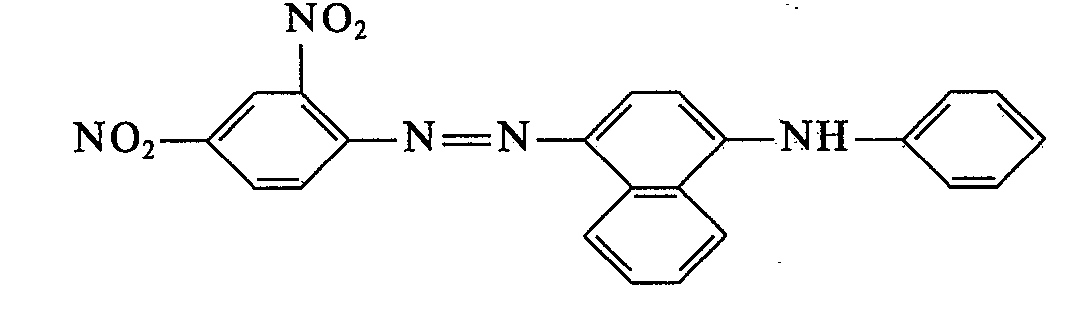
- 18,3 g 2,4-Dinitranilin werden bei 15°C in Eisessig durch Zugabe von 34,2 g Nitrosylschwefelsäure diazotiert und bei 0―5°C auf eine Suspension von 23,0 g N-Phenyl-a-naphthylamin in 200 ml n-Butanol und 400 ml Wasser gekuppelt. Nach 3 Stunden wird der entstandene Farbstoff abgesaugt, mit' n-Butanol und Wasser gewaschen und unter vermindertem Druck getrocknet.
- Man erhält auf diese Weise 35,3 g des Farbstoffs der Formel
- Werden analog Beispiel 1 18,3 g 2,4-Dinitranilin und 21,8 g 2,4-Dinitro-6-chloranilin durch Zusatz von 68,4 g Nitrosylschwefelsäure diazotiert, auf 46,0 g N-Phenyl-a-naphthylamin gekuppelt und der entstandene Farbstoff isoliert, so erhält man 34,6 g einer Mischung die zu 50%den Farbstoff vom Beispiel 1 und zu 50% den Farbstoff der Formel

- Ein Gewebe aus Polyethylenglykolterephthalat wird auf dem Foulard bei 30°C mit einer Flotte geklotzt, die 30,0 g des in feine Verteilung gebrachten Farbstoffs des Beispiels 2, 1,0 g Polyacrylamid von K-Wert 120 und 0,5 g eines Polyglykolethers des Oleylalkohols und 968,5 g Wasser enthält. Nach dem Trocknen wird 60 Sekunden bei 210°C im Thermofixierrahmen fixiert. Nach anschließendem Spülen, reduktiver Nachbehandlung mit einer 0,2%igen alkalischen Natriumdithionitlösung während 15 Minuten bei 70 bis 80°C, Spülen und Trocknen, erhält man eine schwarze Färbung mit sehr guten coloristischen Eigenschaften, insbesondere einer sehr guten Licht- und Thermofixierechtheit.
- Analog den Beispielen 1 und 2 lassen sich die erfindungsgemäßen Farbstoffe und Farbstoffmischungen der folgenden Tabellen herstellen. Sie färben hydrophobe Fasern ebenfalls in vollen braunen bis schwarzen Nuancen von ausgezeichneter Echtheit.

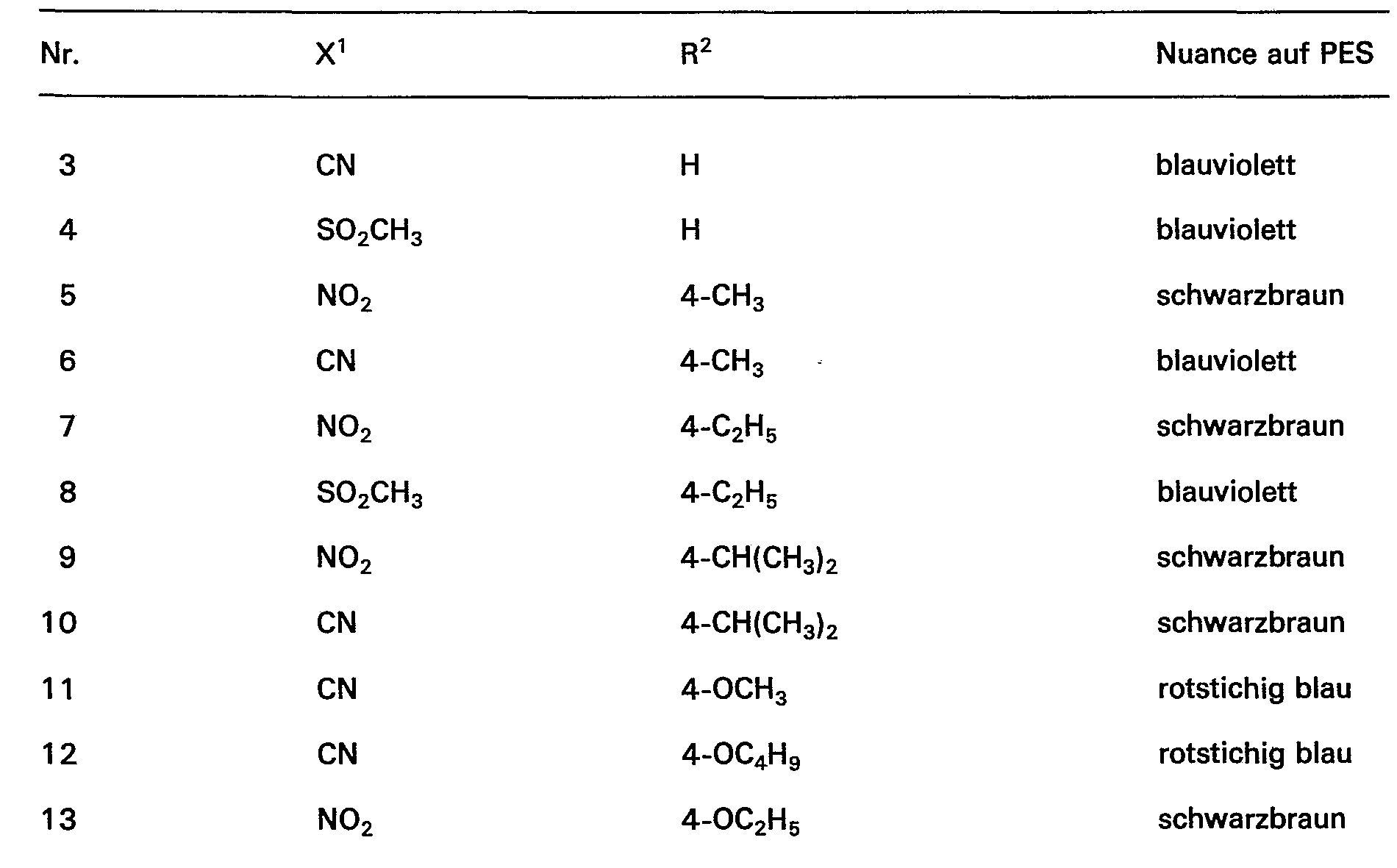


ihre Mischungen mit Monoazofarbstoffen der allgemeinen Formel II


Claims (7)



Applications Claiming Priority (2)
| Application Number | Priority Date | Filing Date | Title |
|---|---|---|---|
| DE19803011178 DE3011178A1 (de) | 1980-03-22 | 1980-03-22 | Wasserunloesliche monoazofarbstoffe, ihre herstellung und ihre verwendung |
| DE3011178 | 1980-03-22 |
Publications (2)
| Publication Number | Publication Date |
|---|---|
| EP0036545A1 EP0036545A1 (de) | 1981-09-30 |
| EP0036545B1 true EP0036545B1 (de) | 1984-04-25 |
Family
ID=6098064
Family Applications (1)
| Application Number | Title | Priority Date | Filing Date |
|---|---|---|---|
| EP81101701A Expired EP0036545B1 (de) | 1980-03-22 | 1981-03-09 | Wasserunlösliche Monoazofarbstoffe, ihre Herstellung und ihre Verwendung |
Country Status (5)
| Country | Link |
|---|---|
| US (1) | US4415494A (de) |
| EP (1) | EP0036545B1 (de) |
| JP (1) | JPS56147853A (de) |
| BR (1) | BR8101661A (de) |
| DE (2) | DE3011178A1 (de) |
Families Citing this family (2)
| Publication number | Priority date | Publication date | Assignee | Title |
|---|---|---|---|---|
| JPS57205451A (en) * | 1981-06-10 | 1982-12-16 | Sumitomo Chem Co Ltd | Monoazo compound and dyeing method using same |
| JPS57205450A (en) * | 1981-06-10 | 1982-12-16 | Sumitomo Chem Co Ltd | Monoazo compound and dyeing method using same |
Family Cites Families (11)
| Publication number | Priority date | Publication date | Assignee | Title |
|---|---|---|---|---|
| DE589695C (de) * | 1933-12-12 | August Karolus Dr | Verfahren zur Zonenabtastung kontinuierlich bewegter Filmbilder und gleichzeitigen UEbertragung auf einer den Bildzonen entsprechenden Anzahl von Telegraphierkanaelen | |
| US1217042A (en) * | 1916-01-29 | 1917-02-20 | William Edward Mounsey | Monoazo dyes. |
| FR785958A (fr) * | 1934-02-23 | 1935-08-23 | Ste Ind Chim Bale | Nouveaux colorants azoïques |
| US2151857A (en) * | 1935-04-04 | 1939-03-28 | Gen Aniline Works Inc | Water insoluble azo dyestuff |
| US2373700A (en) * | 1940-06-29 | 1945-04-17 | Eastman Kodak Co | Azo compounds and material colored therewith |
| US2323314A (en) * | 1940-11-09 | 1943-07-06 | Eastman Kodak Co | Azo compounds and material colored therewith |
| US2311033A (en) * | 1941-06-04 | 1943-02-16 | Eastman Kodak Co | Azo compounds and material colored therewith |
| US3598802A (en) * | 1968-12-19 | 1971-08-10 | Eastman Kodak Co | Azo compounds from 1-naphthylamines |
| CH589695A5 (de) * | 1974-01-11 | 1977-07-15 | Sandoz Ag | |
| US4054560A (en) * | 1974-03-07 | 1977-10-18 | E. I. Du Pont De Nemours And Company | 1-(4-Acyloxyalkylaminonaphthylazo)-4-nitrobenzene disperse dyes |
| DE3004653A1 (de) * | 1980-02-08 | 1981-08-13 | Basf Ag, 6700 Ludwigshafen | Marineblaue farbstoffmischungen |
-
1980
- 1980-03-22 DE DE19803011178 patent/DE3011178A1/de not_active Withdrawn
-
1981
- 1981-03-09 EP EP81101701A patent/EP0036545B1/de not_active Expired
- 1981-03-09 DE DE8181101701T patent/DE3163272D1/de not_active Expired
- 1981-03-19 US US06/245,630 patent/US4415494A/en not_active Expired - Fee Related
- 1981-03-20 JP JP3967381A patent/JPS56147853A/ja active Pending
- 1981-03-20 BR BR8101661A patent/BR8101661A/pt unknown
Also Published As
| Publication number | Publication date |
|---|---|
| BR8101661A (pt) | 1981-09-22 |
| DE3011178A1 (de) | 1981-10-01 |
| US4415494A (en) | 1983-11-15 |
| JPS56147853A (en) | 1981-11-17 |
| DE3163272D1 (en) | 1984-05-30 |
| EP0036545A1 (de) | 1981-09-30 |
Similar Documents
| Publication | Publication Date | Title |
|---|---|---|
| DE1295115B (de) | Verfahren zur Herstellung von Monoazofarbstoffen | |
| DE1644328C3 (de) | Verfahren zur Herstellung von Monoazofarbstoffen | |
| EP0038439B1 (de) | Farbstoffmischung, Verfahren zu ihrer Herstellung, sie enthaltende Farbstoffe und Verfahren zum Färben und Bedrucken von synthetischem, hydrophobem Fasermaterial | |
| DE1769262B2 (de) | In wasser schwerloesliche azofarbstoffe, verfahren zu ihrer herstellung und ihre verwendung | |
| DE2120877C3 (de) | In Wasser schwer lösliche Monoazoverbindungen, Verfahren zu ihrer Herstellung und ihre Verwendung | |
| DE1769263C3 (de) | Von in Wasser ionogen-salzbildenden Gruppen freie Monoazofarbstoffe, Verfahren zu ihrer Herstellung und ihre Verwendung | |
| DE1644342A1 (de) | Verfahren zur Herstellung von Dispersionsfarbstoffen der Monoazoreihe | |
| EP0009191B1 (de) | Wasserunlösliche Disazofarbstoffe, ihre Herstellung und Verwendung | |
| EP0039054B1 (de) | Wasserunlösliche Azofarbstoffe, Verfahren zu ihrer Herstellung und ihre Verwendung | |
| DE2254017C2 (de) | Wasserunlösliche Azofarbstoffe und Verfahren zu ihrer Herstellung | |
| EP0035671B1 (de) | Wasserunlösliche Azofarbstoffe, Verfahren zu ihrer Herstellung und Verwendung zum Färben und Bedrucken von synthetischem, hydrophobem Fasermaterial | |
| DE1644259B2 (de) | In wasser schwerloesliche azofarbstoffe, verfahren zu deren herstellung und ihre verwendung zum faerben | |
| DE2842186A1 (de) | Azofarbstoffe | |
| EP0036545A1 (de) | Wasserunlösliche Monoazofarbstoffe, ihre Herstellung und ihre Verwendung | |
| DE2116315C3 (de) | Monoazofarbstoffe, Verfahren zu ihrer Herstellung und Verwendung | |
| DE2111734A1 (de) | Azofarbstoffe,Verfahren zu ihrer Herstellung und ihre Verwendung | |
| EP0047376B1 (de) | Mischung von Monoazodispersionsfarbstoffen, Verfahren zu ihrer Herstellung und Verfahren zum Färben und Bedrucken von synthetischem, hydrophobem Fasermaterial unter Verwendung der Mischung | |
| DE2834054A1 (de) | Wasserunloesliche disazofarbstoffe, ihre herstellung und verwendung | |
| DE1929573C3 (de) | Wasserunlösliche Monoazofarbstoffe, Verfahren zu ihrer Herstellung und ihre Verwendung zum Färben oder Bedrucken | |
| EP0073414A1 (de) | Neue marineblaue Dispersionsfarbstoffe, Verfahren zu deren Herstellung und deren Verwendung zum Färben oder Bedrucken von synthetischen Fasermaterialien | |
| EP0109527A1 (de) | Wasserunlösliche Monoazofarbstoffe, Verfahren zu deren Herstellung und Verwendung | |
| DE2935011A1 (de) | Disperse monoazofarbstoffe und verfahren zu ihrer herstellung sowie ihre verwendung zum faerben von synthetischen textilmaterialien | |
| DE2523632A1 (de) | Wasserunloesliche monoazofarbstoffe und verfahren zu ihrer herstellung | |
| DE1644373C (de) | Monoazofarbstoffe, ihre Herstellung und Verwendung | |
| AT240998B (de) | Verfahren zur Herstellung von neuen, von sauren, wasserlöslichmachenden Gruppen freien Disazofarbstoffen |
Legal Events
| Date | Code | Title | Description |
|---|---|---|---|
| PUAI | Public reference made under article 153(3) epc to a published international application that has entered the european phase |
Free format text: ORIGINAL CODE: 0009012 |
|
| AK | Designated contracting states |
Designated state(s): BE CH DE FR GB IT |
|
| 17P | Request for examination filed |
Effective date: 19820325 |
|
| ITF | It: translation for a ep patent filed | ||
| GRAA | (expected) grant |
Free format text: ORIGINAL CODE: 0009210 |
|
| AK | Designated contracting states |
Designated state(s): BE CH DE FR GB IT LI |
|
| REF | Corresponds to: |
Ref document number: 3163272 Country of ref document: DE Date of ref document: 19840530 |
|
| ET | Fr: translation filed | ||
| PLBE | No opposition filed within time limit |
Free format text: ORIGINAL CODE: 0009261 |
|
| STAA | Information on the status of an ep patent application or granted ep patent |
Free format text: STATUS: NO OPPOSITION FILED WITHIN TIME LIMIT |
|
| PG25 | Lapsed in a contracting state [announced via postgrant information from national office to epo] |
Ref country code: BE Effective date: 19850331 |
|
| 26N | No opposition filed | ||
| BERE | Be: lapsed |
Owner name: CASSELLA A.G. Effective date: 19850309 |
|
| PG25 | Lapsed in a contracting state [announced via postgrant information from national office to epo] |
Ref country code: FR Free format text: LAPSE BECAUSE OF NON-PAYMENT OF DUE FEES Effective date: 19861128 |
|
| REG | Reference to a national code |
Ref country code: FR Ref legal event code: ST |
|
| PG25 | Lapsed in a contracting state [announced via postgrant information from national office to epo] |
Ref country code: GB Effective date: 19890309 |
|
| PG25 | Lapsed in a contracting state [announced via postgrant information from national office to epo] |
Ref country code: LI Effective date: 19890331 Ref country code: CH Effective date: 19890331 |
|
| GBPC | Gb: european patent ceased through non-payment of renewal fee | ||
| REG | Reference to a national code |
Ref country code: CH Ref legal event code: PL |
|
| PG25 | Lapsed in a contracting state [announced via postgrant information from national office to epo] |
Ref country code: DE Effective date: 19891201 |