EP0036159B1 - 4-(2,5-Dihydroxyphen-1-yl)-crotonsäure und deren Derivate sowie Verfahren zur Herstellung dieser Verbindungen - Google Patents
4-(2,5-Dihydroxyphen-1-yl)-crotonsäure und deren Derivate sowie Verfahren zur Herstellung dieser Verbindungen Download PDFInfo
- Publication number
- EP0036159B1 EP0036159B1 EP81101713A EP81101713A EP0036159B1 EP 0036159 B1 EP0036159 B1 EP 0036159B1 EP 81101713 A EP81101713 A EP 81101713A EP 81101713 A EP81101713 A EP 81101713A EP 0036159 B1 EP0036159 B1 EP 0036159B1
- Authority
- EP
- European Patent Office
- Prior art keywords
- compounds
- derivatives
- alkyl
- crotonic acid
- preparation
- Prior art date
- Legal status (The legal status is an assumption and is not a legal conclusion. Google has not performed a legal analysis and makes no representation as to the accuracy of the status listed.)
- Expired
Links
- 238000000034 method Methods 0.000 title claims description 12
- 150000001875 compounds Chemical class 0.000 title claims description 11
- 238000002360 preparation method Methods 0.000 title claims description 4
- LDHQCZJRKDOVOX-NSCUHMNNSA-N crotonic acid Chemical compound C\C=C\C(O)=O LDHQCZJRKDOVOX-NSCUHMNNSA-N 0.000 title claims description 3
- LDHQCZJRKDOVOX-UHFFFAOYSA-N trans-crotonic acid Natural products CC=CC(O)=O LDHQCZJRKDOVOX-UHFFFAOYSA-N 0.000 title 1
- 125000001797 benzyl group Chemical group [H]C1=C([H])C([H])=C(C([H])=C1[H])C([H])([H])* 0.000 claims description 7
- 239000002841 Lewis acid Substances 0.000 claims description 6
- 150000007517 lewis acids Chemical class 0.000 claims description 6
- 125000004209 (C1-C8) alkyl group Chemical group 0.000 claims description 5
- QIGBRXMKCJKVMJ-UHFFFAOYSA-N Hydroquinone Chemical compound OC1=CC=C(O)C=C1 QIGBRXMKCJKVMJ-UHFFFAOYSA-N 0.000 claims description 4
- -1 R5 is H Chemical group 0.000 claims description 4
- 125000002252 acyl group Chemical group 0.000 claims description 4
- 125000001424 substituent group Chemical group 0.000 claims description 4
- 125000000739 C2-C30 alkenyl group Chemical group 0.000 claims description 3
- 229910052736 halogen Inorganic materials 0.000 claims description 3
- 125000000923 (C1-C30) alkyl group Chemical group 0.000 claims description 2
- VBWPSWWDYVWZKA-UHFFFAOYSA-N 2-hydroxybut-3-enoic acid Chemical class C=CC(O)C(O)=O VBWPSWWDYVWZKA-UHFFFAOYSA-N 0.000 claims description 2
- 125000004423 acyloxy group Chemical group 0.000 claims description 2
- 125000002887 hydroxy group Chemical group [H]O* 0.000 claims description 2
- 125000000229 (C1-C4)alkoxy group Chemical group 0.000 claims 1
- 125000005843 halogen group Chemical group 0.000 claims 1
- 238000006243 chemical reaction Methods 0.000 description 8
- IMNFDUFMRHMDMM-UHFFFAOYSA-N N-Heptane Chemical compound CCCCCCC IMNFDUFMRHMDMM-UHFFFAOYSA-N 0.000 description 7
- 239000000047 product Substances 0.000 description 7
- YXFVVABEGXRONW-UHFFFAOYSA-N Toluene Chemical compound CC1=CC=CC=C1 YXFVVABEGXRONW-UHFFFAOYSA-N 0.000 description 6
- 239000000203 mixture Substances 0.000 description 6
- 239000002253 acid Substances 0.000 description 5
- 238000003756 stirring Methods 0.000 description 5
- 125000000217 alkyl group Chemical group 0.000 description 4
- 239000002904 solvent Substances 0.000 description 4
- 239000003381 stabilizer Substances 0.000 description 4
- AUFZRCJENRSRLY-UHFFFAOYSA-N 2,3,5-trimethylhydroquinone Chemical compound CC1=CC(O)=C(C)C(C)=C1O AUFZRCJENRSRLY-UHFFFAOYSA-N 0.000 description 3
- WEVYAHXRMPXWCK-UHFFFAOYSA-N Acetonitrile Chemical compound CC#N WEVYAHXRMPXWCK-UHFFFAOYSA-N 0.000 description 3
- UHOVQNZJYSORNB-UHFFFAOYSA-N Benzene Chemical compound C1=CC=CC=C1 UHOVQNZJYSORNB-UHFFFAOYSA-N 0.000 description 3
- YMWUJEATGCHHMB-UHFFFAOYSA-N Dichloromethane Chemical compound ClCCl YMWUJEATGCHHMB-UHFFFAOYSA-N 0.000 description 3
- VEXZGXHMUGYJMC-UHFFFAOYSA-N Hydrochloric acid Chemical compound Cl VEXZGXHMUGYJMC-UHFFFAOYSA-N 0.000 description 3
- OKKJLVBELUTLKV-UHFFFAOYSA-N Methanol Chemical compound OC OKKJLVBELUTLKV-UHFFFAOYSA-N 0.000 description 3
- VZWXIQHBIQLMPN-UHFFFAOYSA-N chromane Chemical class C1=CC=C2CCCOC2=C1 VZWXIQHBIQLMPN-UHFFFAOYSA-N 0.000 description 3
- 229910052739 hydrogen Inorganic materials 0.000 description 3
- 239000001257 hydrogen Substances 0.000 description 3
- 239000011541 reaction mixture Substances 0.000 description 3
- XLYOFNOQVPJJNP-UHFFFAOYSA-N water Substances O XLYOFNOQVPJJNP-UHFFFAOYSA-N 0.000 description 3
- HEDRZPFGACZZDS-UHFFFAOYSA-N Chloroform Chemical compound ClC(Cl)Cl HEDRZPFGACZZDS-UHFFFAOYSA-N 0.000 description 2
- MVPPADPHJFYWMZ-UHFFFAOYSA-N chlorobenzene Chemical compound ClC1=CC=CC=C1 MVPPADPHJFYWMZ-UHFFFAOYSA-N 0.000 description 2
- 239000007789 gas Substances 0.000 description 2
- 150000002367 halogens Chemical class 0.000 description 2
- 150000002431 hydrogen Chemical class 0.000 description 2
- 229910000041 hydrogen chloride Inorganic materials 0.000 description 2
- IXCSERBJSXMMFS-UHFFFAOYSA-N hydrogen chloride Substances Cl.Cl IXCSERBJSXMMFS-UHFFFAOYSA-N 0.000 description 2
- 229910052500 inorganic mineral Inorganic materials 0.000 description 2
- 125000002496 methyl group Chemical group [H]C([H])([H])* 0.000 description 2
- 239000011707 mineral Substances 0.000 description 2
- VLKZOEOYAKHREP-UHFFFAOYSA-N n-Hexane Chemical compound CCCCCC VLKZOEOYAKHREP-UHFFFAOYSA-N 0.000 description 2
- LYGJENNIWJXYER-UHFFFAOYSA-N nitromethane Chemical compound C[N+]([O-])=O LYGJENNIWJXYER-UHFFFAOYSA-N 0.000 description 2
- 239000012071 phase Substances 0.000 description 2
- 239000000376 reactant Substances 0.000 description 2
- QIVUCLWGARAQIO-OLIXTKCUSA-N (3s)-n-[(3s,5s,6r)-6-methyl-2-oxo-1-(2,2,2-trifluoroethyl)-5-(2,3,6-trifluorophenyl)piperidin-3-yl]-2-oxospiro[1h-pyrrolo[2,3-b]pyridine-3,6'-5,7-dihydrocyclopenta[b]pyridine]-3'-carboxamide Chemical compound C1([C@H]2[C@H](N(C(=O)[C@@H](NC(=O)C=3C=C4C[C@]5(CC4=NC=3)C3=CC=CN=C3NC5=O)C2)CC(F)(F)F)C)=C(F)C=CC(F)=C1F QIVUCLWGARAQIO-OLIXTKCUSA-N 0.000 description 1
- ZDSZDMJETWINGZ-DUXPYHPUSA-N (e)-4-chloro-2-methylbut-2-enoic acid Chemical compound OC(=O)C(/C)=C/CCl ZDSZDMJETWINGZ-DUXPYHPUSA-N 0.000 description 1
- WSLDOOZREJYCGB-UHFFFAOYSA-N 1,2-Dichloroethane Chemical compound ClCCCl WSLDOOZREJYCGB-UHFFFAOYSA-N 0.000 description 1
- 150000005208 1,4-dihydroxybenzenes Chemical class 0.000 description 1
- SXQCPXKZTFJHQI-UHFFFAOYSA-N 2-hydroxy-2-methylbut-3-enoic acid Chemical compound C=CC(O)(C)C(O)=O SXQCPXKZTFJHQI-UHFFFAOYSA-N 0.000 description 1
- 0 C*c1c(*N)c(*)c(*)c(*)c1P Chemical compound C*c1c(*N)c(*)c(*)c(*)c1P 0.000 description 1
- UFHFLCQGNIYNRP-UHFFFAOYSA-N Hydrogen Chemical compound [H][H] UFHFLCQGNIYNRP-UHFFFAOYSA-N 0.000 description 1
- 238000006683 Mannich reaction Methods 0.000 description 1
- 150000007513 acids Chemical class 0.000 description 1
- 125000003342 alkenyl group Chemical group 0.000 description 1
- 239000000010 aprotic solvent Substances 0.000 description 1
- 230000015572 biosynthetic process Effects 0.000 description 1
- 238000009835 boiling Methods 0.000 description 1
- 239000013078 crystal Substances 0.000 description 1
- 230000000694 effects Effects 0.000 description 1
- 230000007717 exclusion Effects 0.000 description 1
- MFXKHTBHGIKGHK-UHFFFAOYSA-N heptyl 2-hydroxy-2-methylbut-3-enoate Chemical compound CCCCCCCOC(=O)C(C)(O)C=C MFXKHTBHGIKGHK-UHFFFAOYSA-N 0.000 description 1
- 238000007327 hydrogenolysis reaction Methods 0.000 description 1
- 230000007062 hydrolysis Effects 0.000 description 1
- 238000006460 hydrolysis reaction Methods 0.000 description 1
- 125000000687 hydroquinonyl group Chemical group C1(O)=C(C=C(O)C=C1)* 0.000 description 1
- 239000000543 intermediate Substances 0.000 description 1
- 238000004519 manufacturing process Methods 0.000 description 1
- 150000002825 nitriles Chemical class 0.000 description 1
- 239000012074 organic phase Substances 0.000 description 1
- 239000007800 oxidant agent Substances 0.000 description 1
- 230000003647 oxidation Effects 0.000 description 1
- 238000007254 oxidation reaction Methods 0.000 description 1
- 229920003023 plastic Polymers 0.000 description 1
- 239000004033 plastic Substances 0.000 description 1
- 239000002244 precipitate Substances 0.000 description 1
- 230000001376 precipitating effect Effects 0.000 description 1
- 125000006239 protecting group Chemical group 0.000 description 1
- 238000010992 reflux Methods 0.000 description 1
- 230000035945 sensitivity Effects 0.000 description 1
- 239000007858 starting material Substances 0.000 description 1
- 238000003786 synthesis reaction Methods 0.000 description 1
- 125000000999 tert-butyl group Chemical group [H]C([H])([H])C(*)(C([H])([H])[H])C([H])([H])[H] 0.000 description 1
- 231100000331 toxic Toxicity 0.000 description 1
- 230000002588 toxic effect Effects 0.000 description 1
- 238000010626 work up procedure Methods 0.000 description 1
- GVJHHUAWPYXKBD-IEOSBIPESA-N α-tocopherol Chemical compound OC1=C(C)C(C)=C2O[C@@](CCC[C@H](C)CCC[C@H](C)CCCC(C)C)(C)CCC2=C1C GVJHHUAWPYXKBD-IEOSBIPESA-N 0.000 description 1
Classifications
-
- C—CHEMISTRY; METALLURGY
- C07—ORGANIC CHEMISTRY
- C07C—ACYCLIC OR CARBOCYCLIC COMPOUNDS
- C07C59/00—Compounds having carboxyl groups bound to acyclic carbon atoms and containing any of the groups OH, O—metal, —CHO, keto, ether, groups, groups, or groups
- C07C59/40—Unsaturated compounds
- C07C59/58—Unsaturated compounds containing ether groups, groups, groups, or groups
- C07C59/64—Unsaturated compounds containing ether groups, groups, groups, or groups containing six-membered aromatic rings
-
- C—CHEMISTRY; METALLURGY
- C07—ORGANIC CHEMISTRY
- C07C—ACYCLIC OR CARBOCYCLIC COMPOUNDS
- C07C59/00—Compounds having carboxyl groups bound to acyclic carbon atoms and containing any of the groups OH, O—metal, —CHO, keto, ether, groups, groups, or groups
- C07C59/40—Unsaturated compounds
- C07C59/42—Unsaturated compounds containing hydroxy or O-metal groups
- C07C59/52—Unsaturated compounds containing hydroxy or O-metal groups a hydroxy or O-metal group being bound to a carbon atom of a six-membered aromatic ring
Definitions
- the present invention relates to 4- (2,5-dihydroxyphen-1-yl) -crotonic acid and its derivatives of the general formula
- the invention also relates to the preparation of these compounds.
- the object of the invention was to create new hydroquinone derivatives which can themselves be used as stabilizers or which are suitable for the preparation of such stabilizers and which in general expand the synthetic possibilities in this field.
- chroman derivatives IV are of particular importance here to, which have so far only been accessible in a multi-stage synthesis using highly toxic cyanides or in the way associated with inadequate yields (approx. 15% pure product) via a Mannich reaction (US Pat. No. 3,947,473).
- Suitable Lewis acids are, for example, BF 3 , AICI 3 , ZnBr 2 , ZnJ 2 and especially ZnCl 2 , preferably in amounts of 0.2 to 1 mol per mol 11.
- the use of 1 to 5 mol of a strong one is particularly advantageous anhydrous mineral acid per mole of Lewis acid.
- Such acids are mainly HCI and HBr.
- Compounds II and IIla or IIIb are preferably reacted with one another in an equimolar ratio, but it may also be expedient to use Illa or IIIb in an up to 1.5 molar excess.
- the reaction temperature is preferably between 30 and 150 ° C., in particular between 60 and 130 ° C. Since the reaction can be carried out under normal pressure, working under reduced or elevated pressure is generally not necessary.
- the reaction is carried out according to the usual preparative techniques of the Friedel-Craffts reaction, for example by introducing a mixture of II and Lewis acid and gradually adding IIIa or Illb at the reaction temperature. If a strong mineral acid is used, about half of this acid is also added and the other half is metered in during the reaction. In all cases, it is advisable to stir the reaction mixture vigorously and to work in the absence of air because of the oxidation sensitivity of the reactants.
- reaction mixture is worked up in the customary manner by adding water to the mixture and isolating process product I from the organic phase.
- the yields of I are generally between 50 and 75%.
- the radical R 5 is preferably a C 10 -C 30 alkyl or alkenyl group.
- R 'does not stand for hydrogen but for one of the protective groups according to the definition, the methyl group, the tert-butyl group and the benzyl group are particularly suitable for this, since these groups can be split off again particularly easily by hydrolysis or hydrogenolysis.
- R 'can in addition to hydrogen, R 'can preferably be a C 1 -C 8 alkyl or acyl group or a benzyl group which is optionally substituted by inert substituents.
- the starting compounds II, Illa and Illb on which the compounds I are based are known or can be obtained by known methods.
- the compounds I can be converted into chroman derivatives, as illustrated by the following example:
Landscapes
- Chemical & Material Sciences (AREA)
- Organic Chemistry (AREA)
- Organic Low-Molecular-Weight Compounds And Preparation Thereof (AREA)
Description
- Die vorliegende Erfindung betrifft die 4-(2,5-Dihydroxyphen-1-yl)-crotonsäure und deren Derivate der allgemeinen Formel

- Hierin haben die Substituenten folgende Bedeutung:
- R1-R4 H; C1-C8-Alkyl
- R5 H; C1-C30-Alkyl; C2-C30-Alkenyl
- R' H; C1-C8-Alkyl oder Acyl; Benzyl oder durch inerte Substituenten substituiertes Benzyl
- Außerdem betrifft die Erfindung die Herstellung dieser Verbindungen.
- Es ist allgemein bekannt, daß sich Verbindungen, die in ihrem Molekül eine Hydrochinonstruktur enthalten, als Stabilisatoren von organischen Massen, vor allem von Kunststoffen, gegen die Einflüsse von Licht, Wärme und Oxidationsmitteln eignen. Solche Verbindungen sind z. B. das a-Tocopherol

- Der Erfindung lagen neue Hydrochinonderivate als Aufgabe zugrunde, die selber als Stabilisatoren verwendet werden können oder die sich zur Herstellung von derartigen Stabilisatoren eignen und die ganz allgemein die Synthesemöglichkeiten auf diesem Gebiet erweitern.
- Besondere Bedeutung kommt hierbei der Herstellung der Chromanderivate IV

- Demgemäß wurden die eingangs definierten neuen Verbindungen gefunden, die man erhält, wenn man ein Hydrochinon II
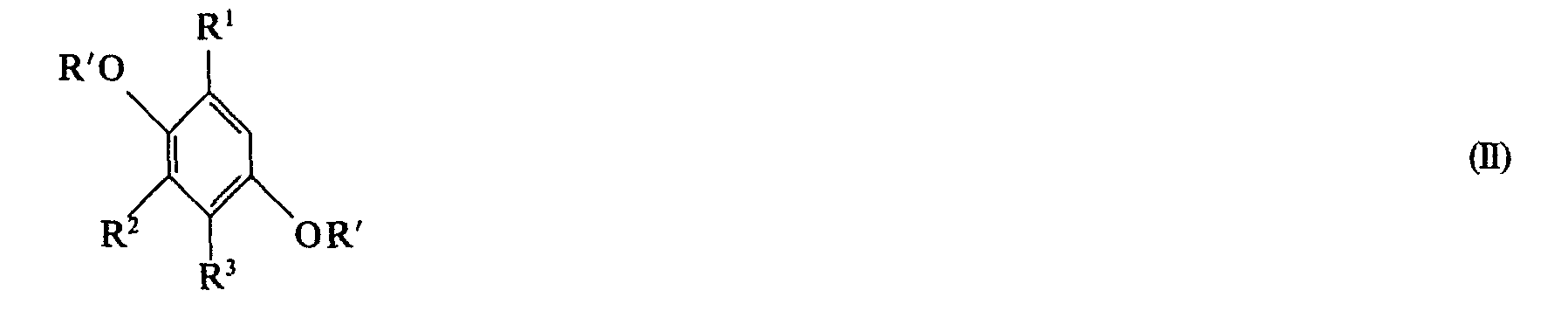
- a) mit einem Vinylglycolsäurederivat IIIa

- b) mit einem Crotonsäurederivat IIIb

- Als Lewissäuren eignen sich beispielsweise BF3, AICI3, ZnBr2, ZnJ2 und vor allem ZnCl2, und zwar vorzugsweise in Mengen von 0,2 bis 1 mol pro Mol 11. Besonders vorteilhaft ist die Mitverwendung von 1 bis 5 mol einer starken wasserfreien Mineralsäure pro Mol der Lewissäure. Solche Säuren sind vor allem HCI und HBr.
- Vorzugsweise setzt man die Verbindungen II und llla bzw. Illb im äquimolaren Mengenverhältnis miteinander um, jedoch kann es auch zweckmäßig sein, Illa bzw. IIIb in einem bis zu 1,5molaren Überschuß einzusetzen.
- Es empfiehlt sich, beide Verfahrensvarianten (a) und (b) in Gegenwart eines inerten aprotischen Lösungsmittels vorzunehmen, dessen Donizität höchstens 20 beträgt. Die Donizität, die in »Angew. Chemie«, Band 82 (1972), S. 858, definiert ist, ist eine Maßzahl für die Stabilität von Komplexverbindungen aus Lewissäuren und Lösungsmitteln. Demgemäß eignen sich schwach komplexbildende Lösungsmittel wie Benzol, Chlorbenzol, Nitromethan, Acetonitril, Dichlormethan, 1,2-Dichloräthan, Chloroform und vor allem n-Hexan, n-Heptan und Toluol. Die Funktion der Lösungsmittel besteht darin, mindestens einen Teil der Reaktionspartner in Lösung zu halten.
- Hieraus ergibt sich die Menge des Lösungsmittels, die in weiten Grenzen schwanken kann, jedoch im allgemeinen 5 bis 15 kg pro Kilogramm 11 beträgt.
- Die Reaktionstemperatur liegt vorzugsweise zwischen 30 und 150" C, insbesondere zwischen 60 und 130°C. Da die Reaktion bei Normaldruck ausgeführt werden kann, ist das Arbeiten bei vermindertem oder erhöhtem Druck im allgemeinen nicht erforderlich.
- Die Reaktionsführung erfolgt nach den üblichen präparativen Techniken der Friedel-Craffts-Reaktion, indem man etwa ein Gemisch aus II und der Lewissäure vorlegt und hierzu bei der Reaktionstemperatur allmählich IIIa bzw. Illb gibt. Verwendet man eine starke Mineralsäure mit, so legt man etwa die Hälfte dieser Säure ebenfalls vor und dosiert die andere Hälfte im Laufe der Reaktion zu. In allen Fällen ist es zweckmäßig, das Reaktionsgemisch intensiv zu rühren und wegen der Oxidationsempfindlichkeit der Reaktionspartner unter Luftausschluß zu arbeiten.
- Nach beendeter Reaktion, die normalerweise 3 bis 10 Stunden in Anspruch nimmt, arbeitet man das Reaktionsgemisch wie üblich auf, indem man das Gemisch mit Wasser versetzt und das Verfahrensprodukt I aus der organischen Phase isoliert. Die Ausbeuten an I liegen im allgemeinen zwischen 50 und 75%.
- Unter den Verfahrensprodukten I haben diejenigen die größte Bedeutung, in denen die Reste Rl bis R4 für Methylgruppen stehen.
- Sollen die Verbindungen I selber als Stabilisatoren dienen, so ist der Rest R5 vorzugsweise eine C10-C30-Alkyl- oder Alkenylgruppe.
- Als Zwischenprodukte kommen hingegen vornehmlich solche in Betracht, in denen R5 Wasserstoff bedeutet.
- Soweit R' nicht für Wasserstoff, sondern für eine der definitionsgemäßen Schutzgruppen steht, kommen hierfür vor allem die Methylgruppe, die tert.-Butylgruppe sowie die Benzylgruppe in Betracht, da diese Gruppen sich hydrolytisch oder hydrogenolytisch besonders leicht wieder abspalten lassen. Allgemein kann R' neben Wasserstoff vorzugsweise eine C1-C8-Alkyl- oder Acylgruppe oder eine gegebenenfalls durch inerte Substituenten substituierte Benzylgruppe sein.
- Die den Verbindungen I zugrunde liegenden Ausgangsverbindungen II, Illa und Illb sind bekannt oder nach bekannten Methoden erhältlich.
- Die Verbindungen I lassen sich in Chromanderivate überführen, wie an folgendem Beispiel veranschaulicht sei:

- Ein Gemisch aus 24 g (0,2 mol) Vinylmilchsäure und 10 g 0,07 mol) wasserfreiem ZnCl2 wurde unter intensivem Rühren und unter Luftausschluß zum Sieden erhitzt. Danach wurde innerhalb von 15 min 1 I wasserfreier Chlorwasserstoff eingeleitet und innerhalb weiterer 45 min 30,4 g (0,2 mol) Trimethylhydrochinon hinzugegeben. Nachdem nochmals 200 ml HCI-Gas eingeleitet worden waren, wurde das Gemisch zur Vervollständigung der Umsetzung noch 4 h unter Rückflußkühlung erhitzt. Die übliche Aufarbeitung lieferte das oben genannte Verfahrensprodukt in 65%iger Ausbeute; Smp.208°C(Zers.).
- In ein auf 98" C erhitztes Gemisch aus 9,0 g (0,06 mol) Trimethylhydrochinon, 8,0 g (0,06 mol) 4-Chlor-2-methylcrotonsäure, 3 g (0,02 mol) wasserfreiem ZnCl2 und 80 ml Heptan wurden in Laufe einer Stunde 31 HCI-Gas eingeleitet. Nach zweistündigem Rühren wurde die Heptanphase dekantiert und der verbleibende ölige Rückstand 24 h bei 20° C mit Methanol gerührt. Hierbei kristallisierte ein Teil des Verfahrensproduktes aus. Der restliche Teil wurde mit Wasser aus der methanolischen Phase ausgefällt. Kristallisat und Niederschlag wurden vereinigt und aus Wasser umkristallisiert. Die Ausbeute an dem oben genannten Produkt betrug 62%.
- In eine Lösung aus 34 ml Nitromethan und 250 ml Toluol wurden unter Rühren bei 0°C im Laufe von 45 min zunächst mit 23 g (0,34 mol) BF3 eingeleitet. Danach wurde die Lösung mit 51,4 g (0,34 mol) 2,3,5-Trimethylhydrochinon und anschließend im Laufe von 3 h mit 44,2 g (0,34 mol) Vinylmilchsäuremethylester versetzt. Nach weiterem 10stündigem Rühren bei 15 C wurde das Reaktionsgemisch wie üblich aufgearbeitet, wobei das oben genannte Verfahrensprodukt in 20%iger Ausbeute ausfiel; Smp. 109-111°C.
- Analog Beispiel 3, jedoch ausgehend vom Vinylmilchsäure-n-heptylester, wurde die oben genannte Verbindung in 15%iger Ausbeute hergestellt; Smp.39-42°C.
Claims (2)


Applications Claiming Priority (2)
| Application Number | Priority Date | Filing Date | Title |
|---|---|---|---|
| DE19803010474 DE3010474A1 (de) | 1980-03-19 | 1980-03-19 | 4-(dihydroxyphen-l-yl)-crotonsaeure und deren derivate sowie verfahren zur herstellung dieser verbindungen |
| DE3010474 | 1980-03-19 |
Publications (2)
| Publication Number | Publication Date |
|---|---|
| EP0036159A1 EP0036159A1 (de) | 1981-09-23 |
| EP0036159B1 true EP0036159B1 (de) | 1984-06-27 |
Family
ID=6097626
Family Applications (1)
| Application Number | Title | Priority Date | Filing Date |
|---|---|---|---|
| EP81101713A Expired EP0036159B1 (de) | 1980-03-19 | 1981-03-09 | 4-(2,5-Dihydroxyphen-1-yl)-crotonsäure und deren Derivate sowie Verfahren zur Herstellung dieser Verbindungen |
Country Status (4)
| Country | Link |
|---|---|
| US (1) | US4353836A (de) |
| EP (1) | EP0036159B1 (de) |
| JP (1) | JPS56145240A (de) |
| DE (2) | DE3010474A1 (de) |
Families Citing this family (2)
| Publication number | Priority date | Publication date | Assignee | Title |
|---|---|---|---|---|
| GB8430072D0 (en) * | 1984-11-28 | 1985-01-09 | Lilly Industries Ltd | Pharmaceutical compounds |
| DE3725848A1 (de) * | 1987-08-04 | 1989-02-16 | Bayer Ag | Polymere dihydroxyverbindungen und ihre verwendung als stabilisatoren fuer polymere |
Family Cites Families (5)
| Publication number | Priority date | Publication date | Assignee | Title |
|---|---|---|---|---|
| US3825584A (en) * | 1970-02-07 | 1974-07-23 | Takeda Chemical Industries Ltd | 4-hexenoic compounds |
| US3947473A (en) * | 1972-12-22 | 1976-03-30 | Hoffman-La Roche Inc. | Antioxidant chroman compounds |
| FR2218881A1 (en) * | 1973-02-22 | 1974-09-20 | Unicler | Cis-3-(2,4-Dimethoxyphenyl)-crotonic acid - with choleretic and spasmolytic activity |
| JPS5919930B2 (ja) * | 1974-05-02 | 1984-05-09 | 武田薬品工業株式会社 | キノン酸誘導体の製造法 |
| JPS567737A (en) * | 1979-07-02 | 1981-01-27 | Takeda Chem Ind Ltd | Physiologically active quinone and its preparation |
-
1980
- 1980-03-19 DE DE19803010474 patent/DE3010474A1/de not_active Withdrawn
-
1981
- 1981-02-26 US US06/238,609 patent/US4353836A/en not_active Expired - Fee Related
- 1981-03-09 EP EP81101713A patent/EP0036159B1/de not_active Expired
- 1981-03-09 DE DE8181101713T patent/DE3164366D1/de not_active Expired
- 1981-03-19 JP JP3880881A patent/JPS56145240A/ja active Pending
Also Published As
| Publication number | Publication date |
|---|---|
| EP0036159A1 (de) | 1981-09-23 |
| JPS56145240A (en) | 1981-11-11 |
| DE3164366D1 (en) | 1984-08-02 |
| DE3010474A1 (de) | 1981-10-01 |
| US4353836A (en) | 1982-10-12 |
Similar Documents
| Publication | Publication Date | Title |
|---|---|---|
| DE3037094A1 (de) | Cytostatisch wirkende pharmazeutische zubereitungen, neue isocyanursaeurederivate und verfahren zu ihrer herstellung | |
| EP0082413B1 (de) | Verfahren zur Herstellung von 2-(Hydroxyphenoxy)-carbonsäureestern | |
| EP0735016B1 (de) | Verfahren zur Herstellung von Alpha-Chloralkylarylketonen | |
| EP0046243A2 (de) | Cytostatisch wirkende Arzneimittel, neue Isocyanursäurederivate und Verfahren zu ihrer Herstellung | |
| EP0074121B1 (de) | 2,3,4,5-Tetrahydro-1-benzoxepin-3,5-dion-Derivate und Verfahren zu deren Herstellung | |
| EP0032576A1 (de) | Verfahren zur Herstellung von p-substituierten Phenylpropanolen und deren Estern sowie von p-substituierten 3-Phenyl-2-methyl-propanalen | |
| DE2902129A1 (de) | 5-phenethyl-2-oxazolidon-derivate, verfahren zu deren herstellung und diese enthaltende arzneimittel | |
| DE1104965B (de) | Verfahren zur Herstellung von Derivaten des Urazols | |
| EP0036159A1 (de) | 4-(2,5-Dihydroxyphen-1-yl)-crotonsäure und deren Derivate sowie Verfahren zur Herstellung dieser Verbindungen | |
| EP1070718B1 (de) | Verfahren zur Herstellung von Grignard-Reagenzien und neue Grignard-Reagenzien | |
| DE2538310C3 (de) | Verfahren zur Herstellung von O.O-Dialkylthionophosphorsäurechloriden | |
| EP0217269B1 (de) | Verfahren zur Herstellung von N-Alkyl-substituierten Hydroxylammoniumchloriden | |
| EP0206147A2 (de) | Verfahren zur Herstellung von 4,4'-Dinitrodibenzylen | |
| DE2759994C2 (de) | Ketale von 4-(1-Hydroxy-1-methylethyl)-3-cyclohexen-1-on und Verfahren zu ihrer Herstellung | |
| EP0025935B1 (de) | Verfahren zur Herstellung von 5-(2,2,2-Trihalogenethyl)-dialkyl-tetrahydrofuran-2-onen | |
| DE69009698T2 (de) | Verfahren zur Herstellung von Halogenacetalen aus Enaminen. | |
| DE3603100C2 (de) | Verfahren zur Herstellung von Nitromethylen-Derivaten | |
| EP0003484B1 (de) | Verfahren zur Herstellung von Chromanderivaten | |
| EP0010281B1 (de) | Verfahren zur Herstellung von alpha, beta-Dihalogenalkylisocyanaten | |
| DE1618310C3 (de) | ||
| EP0089586A1 (de) | 2-Alkyl-2,4-diacyloxy-3-butenale | |
| EP1076636B1 (de) | Verfahren zur herstellung von substituierten benzolen | |
| DE2012272C3 (de) | Verfahren zur Herstellung von Dithiophosphorsäuren-0,0,S-triestern | |
| EP0195329B1 (de) | Verfahren zur Herstellung des (-)-Antipoden des (E)-1-Cyclohexyl-4,4-dimethyl-3-hydroxy-2-(1,2,4-triazol-1-yl)-pent-1-ens | |
| DE2542413A1 (de) | Verfahren zur herstellung von glycol-2-(p-chlorphenoxy)-2-methylpropionatnicotinat |
Legal Events
| Date | Code | Title | Description |
|---|---|---|---|
| PUAI | Public reference made under article 153(3) epc to a published international application that has entered the european phase |
Free format text: ORIGINAL CODE: 0009012 |
|
| AK | Designated contracting states |
Designated state(s): BE CH DE FR GB IT NL |
|
| 17P | Request for examination filed |
Effective date: 19811007 |
|
| ITF | It: translation for a ep patent filed | ||
| GRAA | (expected) grant |
Free format text: ORIGINAL CODE: 0009210 |
|
| AK | Designated contracting states |
Designated state(s): BE CH DE FR GB IT LI NL |
|
| REF | Corresponds to: |
Ref document number: 3164366 Country of ref document: DE Date of ref document: 19840802 |
|
| ET | Fr: translation filed | ||
| PLBE | No opposition filed within time limit |
Free format text: ORIGINAL CODE: 0009261 |
|
| STAA | Information on the status of an ep patent application or granted ep patent |
Free format text: STATUS: NO OPPOSITION FILED WITHIN TIME LIMIT |
|
| 26N | No opposition filed | ||
| PGFP | Annual fee paid to national office [announced via postgrant information from national office to epo] |
Ref country code: CH Payment date: 19890228 Year of fee payment: 9 |
|
| PGFP | Annual fee paid to national office [announced via postgrant information from national office to epo] |
Ref country code: BE Payment date: 19890306 Year of fee payment: 9 |
|
| PG25 | Lapsed in a contracting state [announced via postgrant information from national office to epo] |
Ref country code: GB Effective date: 19890309 |
|
| PGFP | Annual fee paid to national office [announced via postgrant information from national office to epo] |
Ref country code: NL Payment date: 19890331 Year of fee payment: 9 |
|
| GBPC | Gb: european patent ceased through non-payment of renewal fee | ||
| PG25 | Lapsed in a contracting state [announced via postgrant information from national office to epo] |
Ref country code: FR Free format text: LAPSE BECAUSE OF NON-PAYMENT OF DUE FEES Effective date: 19891130 |
|
| PG25 | Lapsed in a contracting state [announced via postgrant information from national office to epo] |
Ref country code: DE Effective date: 19891201 |
|
| REG | Reference to a national code |
Ref country code: FR Ref legal event code: ST |
|
| PG25 | Lapsed in a contracting state [announced via postgrant information from national office to epo] |
Ref country code: LI Effective date: 19900331 Ref country code: CH Effective date: 19900331 Ref country code: BE Effective date: 19900331 |
|
| BERE | Be: lapsed |
Owner name: BASF A.G. Effective date: 19900331 |
|
| PG25 | Lapsed in a contracting state [announced via postgrant information from national office to epo] |
Ref country code: NL Effective date: 19901001 |
|
| NLV4 | Nl: lapsed or anulled due to non-payment of the annual fee | ||
| REG | Reference to a national code |
Ref country code: CH Ref legal event code: PL |