EP0031924B1 - Verwendung von Alkanolaminsalzen cyclischer Amidsäuren als Korrosionsschutzmittel in wässrigen Systemen - Google Patents
Verwendung von Alkanolaminsalzen cyclischer Amidsäuren als Korrosionsschutzmittel in wässrigen Systemen Download PDFInfo
- Publication number
- EP0031924B1 EP0031924B1 EP80107851A EP80107851A EP0031924B1 EP 0031924 B1 EP0031924 B1 EP 0031924B1 EP 80107851 A EP80107851 A EP 80107851A EP 80107851 A EP80107851 A EP 80107851A EP 0031924 B1 EP0031924 B1 EP 0031924B1
- Authority
- EP
- European Patent Office
- Prior art keywords
- weight
- gew
- carbon atoms
- teile
- acid
- Prior art date
- Legal status (The legal status is an assumption and is not a legal conclusion. Google has not performed a legal analysis and makes no representation as to the accuracy of the status listed.)
- Expired
Links
Classifications
-
- C—CHEMISTRY; METALLURGY
- C10—PETROLEUM, GAS OR COKE INDUSTRIES; TECHNICAL GASES CONTAINING CARBON MONOXIDE; FUELS; LUBRICANTS; PEAT
- C10M—LUBRICATING COMPOSITIONS; USE OF CHEMICAL SUBSTANCES EITHER ALONE OR AS LUBRICATING INGREDIENTS IN A LUBRICATING COMPOSITION
- C10M133/00—Lubricating compositions characterised by the additive being an organic non-macromolecular compound containing nitrogen
- C10M133/02—Lubricating compositions characterised by the additive being an organic non-macromolecular compound containing nitrogen having a carbon chain of less than 30 atoms
- C10M133/16—Amides; Imides
-
- C—CHEMISTRY; METALLURGY
- C10—PETROLEUM, GAS OR COKE INDUSTRIES; TECHNICAL GASES CONTAINING CARBON MONOXIDE; FUELS; LUBRICANTS; PEAT
- C10M—LUBRICATING COMPOSITIONS; USE OF CHEMICAL SUBSTANCES EITHER ALONE OR AS LUBRICATING INGREDIENTS IN A LUBRICATING COMPOSITION
- C10M173/00—Lubricating compositions containing more than 10% water
- C10M173/02—Lubricating compositions containing more than 10% water not containing mineral or fatty oils
-
- C—CHEMISTRY; METALLURGY
- C23—COATING METALLIC MATERIAL; COATING MATERIAL WITH METALLIC MATERIAL; CHEMICAL SURFACE TREATMENT; DIFFUSION TREATMENT OF METALLIC MATERIAL; COATING BY VACUUM EVAPORATION, BY SPUTTERING, BY ION IMPLANTATION OR BY CHEMICAL VAPOUR DEPOSITION, IN GENERAL; INHIBITING CORROSION OF METALLIC MATERIAL OR INCRUSTATION IN GENERAL
- C23F—NON-MECHANICAL REMOVAL OF METALLIC MATERIAL FROM SURFACE; INHIBITING CORROSION OF METALLIC MATERIAL OR INCRUSTATION IN GENERAL; MULTI-STEP PROCESSES FOR SURFACE TREATMENT OF METALLIC MATERIAL INVOLVING AT LEAST ONE PROCESS PROVIDED FOR IN CLASS C23 AND AT LEAST ONE PROCESS COVERED BY SUBCLASS C21D OR C22F OR CLASS C25
- C23F11/00—Inhibiting corrosion of metallic material by applying inhibitors to the surface in danger of corrosion or adding them to the corrosive agent
- C23F11/08—Inhibiting corrosion of metallic material by applying inhibitors to the surface in danger of corrosion or adding them to the corrosive agent in other liquids
- C23F11/10—Inhibiting corrosion of metallic material by applying inhibitors to the surface in danger of corrosion or adding them to the corrosive agent in other liquids using organic inhibitors
- C23F11/14—Nitrogen-containing compounds
- C23F11/145—Amides; N-substituted amides
-
- C—CHEMISTRY; METALLURGY
- C10—PETROLEUM, GAS OR COKE INDUSTRIES; TECHNICAL GASES CONTAINING CARBON MONOXIDE; FUELS; LUBRICANTS; PEAT
- C10M—LUBRICATING COMPOSITIONS; USE OF CHEMICAL SUBSTANCES EITHER ALONE OR AS LUBRICATING INGREDIENTS IN A LUBRICATING COMPOSITION
- C10M2201/00—Inorganic compounds or elements as ingredients in lubricant compositions
- C10M2201/02—Water
-
- C—CHEMISTRY; METALLURGY
- C10—PETROLEUM, GAS OR COKE INDUSTRIES; TECHNICAL GASES CONTAINING CARBON MONOXIDE; FUELS; LUBRICANTS; PEAT
- C10M—LUBRICATING COMPOSITIONS; USE OF CHEMICAL SUBSTANCES EITHER ALONE OR AS LUBRICATING INGREDIENTS IN A LUBRICATING COMPOSITION
- C10M2215/00—Organic non-macromolecular compounds containing nitrogen as ingredients in lubricant Compositions
- C10M2215/12—Partial amides of polycarboxylic acids
-
- C—CHEMISTRY; METALLURGY
- C10—PETROLEUM, GAS OR COKE INDUSTRIES; TECHNICAL GASES CONTAINING CARBON MONOXIDE; FUELS; LUBRICANTS; PEAT
- C10N—INDEXING SCHEME ASSOCIATED WITH SUBCLASS C10M RELATING TO LUBRICATING COMPOSITIONS
- C10N2030/00—Specified physical or chemical properties which is improved by the additive characterising the lubricating composition, e.g. multifunctional additives
- C10N2030/12—Inhibition of corrosion, e.g. anti-rust agents or anti-corrosives
-
- C—CHEMISTRY; METALLURGY
- C10—PETROLEUM, GAS OR COKE INDUSTRIES; TECHNICAL GASES CONTAINING CARBON MONOXIDE; FUELS; LUBRICANTS; PEAT
- C10N—INDEXING SCHEME ASSOCIATED WITH SUBCLASS C10M RELATING TO LUBRICATING COMPOSITIONS
- C10N2050/00—Form in which the lubricant is applied to the material being lubricated
- C10N2050/01—Emulsions, colloids, or micelles
Definitions
- the invention relates to the use of alkanolamine salts of cyclic amic acids as corrosion inhibitors in aqueous systems.
- Certain forms of application e.g. if contact corrosion between different metals is to be prevented, e.g. When machining metal, require higher concentrations of inhibitors so that adequate corrosion protection can be achieved.
- the low foam of the process medium is of particular importance.
- the maleic acid salts to be used according to the above-mentioned literature are not sufficient with regard to low foam.
- the aim of the invention were those substances which do not foam even in higher concentrations - with an otherwise equally good corrosion protection effect.
- cyclic amide acids of the definition given in claim 1 are at the same time low-foaming and offer very good corrosion protection when they are present as alkanolamine salts.
- the measure of using such amide acids as alkanolamine salts and thus in water-soluble form may seem obvious, but it has been found that depending on the chain length and structure of the longer alkyl radical bonded to the amide nitrogen, either (if the chain is too long) too strong foaming agents are almost water-insoluble, or if the chain is too short or an n-alkyl chain has no branches, the corrosion protection effect at least decreases significantly.
- the narrow range of chain length and degree of isomerization according to the invention thus makes it possible to achieve the desired goal; at the same time, the sensitivity to electrolytes also decreases.
- amic acid salts to be used according to the invention are derived from the cyclic amic acids and alkanolamines as defined.
- amic acids in which the carboxylic acid and carbonamide groups are adjacent and in which the C atoms bearing these groups are not olefinic can be obtained, for example, by reacting the corresponding cyclic acid anhydrides of the formula (II) in which the circle according to formula (1) is defined in claim 1, with amines of formula (III) in which R 'and R 2 are also defined according to formula (I) in claim 1.
- the ring can be mononuclear aromatic, for example a benzene ring which can optionally be substituted by C 1 -C 4 -alkyl groups, fluorine, chlorine, bromine atoms, nitro groups or carboxyl groups.
- cyclopentane, cyclopentene, cyclohexane, cyclohexene, the bicyclo- [2.2.1] -heptane, -heptene residue or the bicyclo- [2.2.2] -octane or -octene residue come in as ring system here Consider.
- the above-mentioned substituents are also possible here.
- the preferred anhydrides are e.g. Phthalic, tetrahydrophthalic, hexahydrophthalic or bicyclo- [2.2.1] -hept-2-en-5,6-dicarboxylic acid anhydride as starting compounds.
- Amines which are reacted with such anhydrides are e.g. primary amines such as isooctylamines, isononylamines, isodecylamines, isoundecylamines and isododecylamines, preferably the isooctylamines and isononylamines or secondary amines such as N-methyl-N-isooctylamines, N-ethyl-N-isooctylamines, N-propyl-N-isooctylamines, N- (n-butyl) -N-isooctylamine, N- (iso-butyl) -N-isooctylamine, N-methyl-N-isononylamine, N-ethyl-N-isononylamine, N- (n-butyl) -N-isononylamine, N- (iso-buty
- N-Methyl-N-isooctyl- and -isononylamines are particularly preferred here.
- amines can be used in a mixture with corresponding nC 8 -C 12 -alkyl- or C 1 - to C 4 -alkyl-nC 8 -C 12 -alkylamines, in an amount such that the later end products up to 90% by weight. -% - related on alkanolamine salt - contained on the corresponding n-alkylamide acid salts.
- These mixtures originate, for example, from oxo synthesis.
- the anhydrides can be reacted with the amines by customary methods, which require no special explanation.
- amic acids obtained are then neutralized in a manner known per se with the alkanolamines.
- Alkanolamines may be all the relevant agents when they are capable of forming water-soluble salts, ie mainly C 2 - to C 4 alkanolamines or NC i - C 4 alkyl-C 2 - to C 4 -alkanolamines.
- alkanolamines derived from ethylenediamine can also be considered, for example 4-fold ethoxylated or propoxylated ethylenediamine.
- N-2-ethylhexyl-, N-methyl-N- (2-ethylhexyl) -, the N-isonyl- and the N-methyl-N-isononylhalamides of phthalic acid and tetrahydrophthalic acid which have been found to be particularly effective inhibitors, have also been found to be effective Triethanolamine or Diethanolamine have been neutralized.
- anti-corrosion agents have been found that are extremely effective in aqueous systems and practically do not foam even in higher application concentrations.
- the agents are added to the process media in an amount of 0.01 to 5% by weight, based on the medium. Exceeding and falling short are possible, but do not bring any additional advantages.
- the corrosion protection effect is demonstrated in 1% and 2% aqueous solution of active substance and in various water hardnesses using the Herbert test system introduced in the metalworking sector.
- This consists of a standardized gray cast iron plate and also standardized steel chips of 5 mm length, which are supplied by Alfred Herbert, Coventry / England.
- the square plate with the dimensions 100 X 100 X 5 mm is carefully sanded before testing using a belt grinder with 120 corundum emery belt, washed with white spirit and ethanol and dried with a clean cloth.
- the steel chips supplied with the test system which are obtained under standardized conditions from 0.40% carbon steel, are placed on the prepared cast steel plate in four piles using a suitable metal or plastic spoon with the capacity of a normal teaspoon so that they separate from each other and have the same distance from the edges of the plate.
- the chips should lie in a single layer in the narrowest possible position.
- the solutions or emulsions to be tested for their corrosion behavior are applied to the piles of chips by means of a measuring pipette in such a quantity that the liquid reaching the cast steel plate is held together by the chips. After standing for 24 hours in an atmosphere of 70% relative humidity, the chips are shaken off the plate by tilting. The clearly visible outline of the dried aqueous medium remains. Depending on the corrosiveness of the liquid, rust marks of smaller or larger extent have formed at the contact points of the chips, which could also have grown together to form a closed rust layer. The assessment can be made by visually estimating the percentage of rust in the area.
- the impact method was used based on DIN 53 902.
- the simple test procedure was sufficient, in which the punch with the perforated plate was manually inserted and removed 30 times in 30 s and then carefully pulled out (IG impact method).
- the foam volume is on the graded Foam cylinder after 1, 5 and 10 min. read in ml. Information about temperature, concentration and water hardness are also important.
Landscapes
- Chemical & Material Sciences (AREA)
- Organic Chemistry (AREA)
- Chemical Kinetics & Catalysis (AREA)
- General Chemical & Material Sciences (AREA)
- Oil, Petroleum & Natural Gas (AREA)
- Engineering & Computer Science (AREA)
- Materials Engineering (AREA)
- Mechanical Engineering (AREA)
- Metallurgy (AREA)
- Lubricants (AREA)
- Preventing Corrosion Or Incrustation Of Metals (AREA)
Description
- Die Erfindung betrifft die Verwendung von Alkanolaminsalzen cyclischer Amidsäuren als Korrosionsschutzmittel in wässrigen Systemen.
- In technischen Prozessen, die sich in Gegenwart von Wasser abspielen, stellt sich immer das Problem des Korrosionsschutzes, wenn korrosionsgefährdete Metalle, wie Eisen, Aluminium Zink, Kufer oder deren Legierungen durch diese Prozesse tangiert werden, z.B. in Reinigungsprozessen, in Kühlwässern oder Kühlschmierstoffen sowie in Hydraulikflüssigkeiten.
- Bei solchen Prozessmedien tritt zusätzlich noch das Problem der zu starken Schaumbildung auf, und zwar besonders dann, wenn als Korrosionsschutzmittel Stoffe mit Tensid-Eigenschaften anwesend sind. Dieses Problem konnte bisher nur durch zusätzlich anwesende Schaumdämpfer gelöst werden, die aber die erwähnten Prozesse wenn nicht störten, so doch zumindest unwirtschaftlicher machten.
- Aus der DE-A-2 758 123 sind Alkanolamin-Salze von Malein-N-(C8- bis C12)-alkylamidsäuren bekannt, mit denen diese Probleme gelöst werden können, sofern diese Salze in geringer Konzentration im Prozessmedium anwesend sind.
- Bestimmte Anwendungsformen, z.B. wenn Kontaktkorrosionen zwischen verschiedenen Metallen verhindert werden sollen, z.B. bei der spanabhebenden Metallbearbeitung, erfordern höhere Konzentrationen an Inhibitoren, damit ein ausreichender Korrosionsschutz erreicht werden kann.
- Bei der spanabhebenden Bearbeitung von Metallen, wie beim Bohren, Gewindeschneiden, Fräsen, Sägen oder Schleifen von Werkstücken, ist die Schaumarmut des Prozessmediums von besonderer Wichtigkeit. Für derartige höhere Konzentrationen reichen aber die gemäss der obengenannten Literaturstelle zu verwendenden Maleinamidsäure-Salze hinsichtlich der Schaumarmut noch nicht aus.
- Ziel der Erfindung waren solche Substanzen, die auch in höherer Konzentration - bei sonst zumindest gleich guter Korrosionsschutzwirkung - nicht schäumen.
- Das Ziel der Erfindung wurde überraschenderweise mit Alkanolaminsalzen cyclischer Amidsäuren gemäss Definition der Patentansprüche erreicht.
- Aus der US-A-2 378 442 sind Calciumsalze von N-alkylierten Phthalamidsäuren als rostschützende Schmieröladditive zwar bekannt, und desgleichen lehrt die US-A-3 095 286 cyclische Amidsäuren als Korrosionsinhibitoren. Diese Verbindungen sind aber gemäss den genannten Literaturstellen öl- aber nicht wasserlöslich - sie finden nur als Schmieröl- oder Brennstoffadditive Verwendung - .
- Erfindungsgemäss hat sich nun herausgestellt, dass cyclische Amidsäuren der im Anspruch 1 gegebenen Definition gleichzeitig schaumarm sind und einen sehr guten Korrosionsschutz bieten, wenn sie als Alkanolaminsalze vorliegen. Auf den ersten Blick mag die Massnahme, solche Amidsäuren als Alkanolaminsalze und damit in wasserlöslicher Form einzusetzen naheliegend erscheinen, doch hat sich herausgestellt, dass je nach Kettenlänge und Struktur des am Amidstickstoff gebundenen längeren Alkylrestes entweder (bei zu langer Kette) zu starke Schäumer, die fast wasserunlöslich sind, entstehen, oder bei zu kurzer Kette oder einer n-Alkylkette ohne Verzweigungen die Korrosionsschutzwirkung zumindest stark zurückgeht.
- Der erfindungsgemässe enge Bereich der Kettenlänge und des Isomerisierungsgrades ermöglicht somit die Realisierung des angestrebten Ziels; gleichzeitig vermindert sich auch die Elektrolytempfindlichkeit.
- Im einzelnen wurde festgestellt, dass mit Amidsäuren der Formel (I) (siehe Anspruch 1) - als Alkanolaminsalze - die antikorrosive Wirkung stark zurückgeht, wenn R' einen n-Octyl- oder niedrigeren n-Alkylrest bedeutet. Wenn R' Isoalkyl bedeutet, tritt diese Wirkungsminderung bei Resten mit weniger als 8 C-Atomen auf.
- Bei zu grosser Kohlenstoffzahl in der längsten Kette des Isoalkylrestes (> 8) wird bereits die Schaumentwicklung zu gross.
- Die erfindungsgemäss zu verwendenden Amidsäure-Salze leiten sich von den definitionsgemässen cyclischen Amidsäuren und Alkanolaminen ab.
- Die Amidsäuren, bei denen Carbonsäure- und Carbonamidgruppe benachbart stehen, und bei denen die diese Gruppen tragenden C-Atome nicht olefinisch sind, erhält man z.B. durch Umsetzung der entsprechenden cyclischen Säureanhydride der Formel (II)


- Der Ring kann einkernig aromatisch sein, also beispielsweise ein Benzolring, der gegebenenfalls durch C, bis C4-Alkylgruppen, Fluor-, Chlor-, Bromatome, Nitrogruppen oder Carboxylgruppen substituiert sein kann.
- Er kann auch aliphatisch sein, und zwar mono-oder bicyclisch, wobei pro Ring 5 oder 6 C-Atome anwesend sind. Als Ringsystem kommen hier der Cyclopentan-, Cyclopenten-, Cyclohexan-, Cyclohexen-, der Bicyclo-[2.2.1]-heptan-, -hepten-Rest oder der Bicyclo-[2.2.2]-octan- oder -octenrest in Betracht. Auch hier sind die oben genannten Substituenten möglich.
- Als bevorzugte Anhydride wählt man z.B. Phthalsäure-, Tetrahydrophthalsäure-, Hexahydrophthalsäure- oder Bicyclo-[2.2.1]-hept-2-en-5,6-dicarbonsäure-anhydrid als Ausgangsverbindungen.
- Amine, die mit derartigen Anhydriden zur Umsetzung gelangen, sind z.B. primäre Amine wie Isooctylamine, Isononylamine, Isodecylamine, Isoundecylamine und Isododecylamine, bevorzugt die Isooctyl- und Isononylamine oder sekundäre Amine, wie N-Methyl-N-isooctylamine, N-Ethyl-N-isooctylamine, N-Propyl-N-isooctylamine, N-(n-Butyl)-N-isooctylamine, N-(iso-Butyl)-N-isooctylamine, N-Methyl-N-isononylamine, N-Ethyl-N-isononylamine, N-(n-Butyl)-N-isononylamine, N-(iso-Butyl)-N-isononylamine, N-Methyl-N-isodecylamine, N-Ethyl-N-isodecylamine, N-Methyl-N-isoundecylamine, N-Methyl-N-isododecylamine, mit 6 bis 8 C-Atomen in der längsten Alkylkette.
- Besonders bevorzugt sind hier N-Methyl-N-isooctyl- und -isononylamine.
- Diese Amine können in Mischung mit entsprechenden n-C8-C12-Alkyl- oder C1- bis C4-Alkyl-n-C8-C12-alkylaminen eingesetzt werden, und zwar in einer Menge, dass die späteren Endprodukte bis zu 90 Gew.-% - bez. auf Alkanolaminsalz - an den entsprechenden n-Alkylamidsäure-Salzen enthalten. Diese Mischungen entstammen beispielsweise der Oxosynthese.
- Die Umsetzung der Anhydride mit den Aminen kann nach üblichen Methoden erfolgen, die keiner speziellen Erläuterung bedürfen.
- Die erhaltenen Amidsäuren werden anschliessend in an sich bekannter Weise mit den Alkanolaminen neutralisiert.
- Um eine flüssige Konsistenz zu erreichen, kann man den erhaltenen Salzen bis zu 25 Gew.-% Wasser zumischen.
- «Alkanolamine» im Sinne der Erfindung können alle in Betracht kommenden Vertreter sein, soweit sie zur Bildung wasserlöslicher Salze befähigt sind, also vornehmlich C2- bis C4-Alkanolamine oder N-Ci- bis C4-alkyl-C2- bis C4-alkanolamine.
- Einzelne spezielle Vertreter sind beispielsweise Mono-, Di- oder Triethanol- oder -isopropanolamin oder N-Methyl-mono- oder -di-ethanol- oder -isopropanolamin. Schliesslich können auch vom Ethylendiamin sich ableitende Alkanolamine in Betracht gezogen werden, und zwar beispielsweise 4fach ethoxyliertes oder propoxyliertes Ethylendiamin.
- Als besonders wirksame Inhibitoren haben sich die N-2-Ethylhexyl-, N-Methyl-N-(2-ethylhexyl)-, die N-isonyl- und die N-Methyl-N-isononylhalbamide der Phthalsäure und der Tetrahydrophthalsäure erwiesen, die mit Triethanolamin oder Diethanolamin neutralisiert worden sind.
- Mit diesen Mitteln sind Korrosionsschutzmittel gefunden worden, die in wässrigen Systemen hervorragend wirksam sind und auch in höherer Anwendungskonzentration praktisch nicht schäumen.
- Die Mittel werden je nach Verwendungszweck den Prozessmedien zu 0,01 bis 5 Gew.-% - bezogen auf das Medium zugesetzt. Über- und Unterschreitungen sind möglich, bringen aber keine zusätzlichen Vorteile.
- Die nun folgenden Beispiele erläutern die Erfindung.
- Zu einer Suspension von 148 g (1,0 Mol) Phthalsäureanhydrid in 500 ml Toluol tropft man unter Rühren 129 g (1,0 Mol) 2-Ethylhexylamin, wobei die Temperatur durch schwache Kühlung auf 50 °C gehalten wird. Die entstandene klare Lösung wird 2 h nachgerührt. Dabei fallen weisse Kristalle aus. Man verdünnt mit 250 ml n-Heptan und saugt bei +10°C ab. Die Kristalle werden im Wasserstrahlvakuum getrocknet.
- Schmelzpunkt 82-83 °C.
- Säurezahl 197 (theoretisch 202).
- 38 Gew.-Teile dieser Phthalamidsäure,
- 60 Gew.-Teile Triethanolamin mit einem Anteil Diethanolamin und
- 15 Gew.-Teile Wasser werden bei 30 °C gemischt, bis sich eine klare Flüssigkeit ergibt.
- Beispiel 2
- Zu einer Suspension von 148 g Phthalsäureanhydrid in 500 ml Toluol tropft man unter Rühren 171 g C9/C11-Alkylamingemisch (entstammend der Oxosynthese; Kp3,0 60 bis 80 °C). Die Temperatur wird durch Kühlen unter 50 °C gehalten. Es entsteht eine klare Lösung. Toluol wird bei 50 °C im Wasserstrahlvakuum abgedampft. Letzte Reste des Lösungsmittels werden durch dreimalige Azeotropdestillation mit je 20 ml Wasser bei 50 °C im Wasserstrahlvakuum entfernt. Zurück bleibt ein hellgelbes Öl mit einem Wassergehalt von 3-5%.
- Säurezahl 160 (theoretisch 176 für C,1).
- 36 Gew.-Teile dieses Phthalamidsäuregemisches und
- 34,7 Gew.-Teile Triethanolamin (wie in Beispiel 1) werden bei 30 °C gemischt, bis sich eine klare Flüssigkeit ergibt.
- Zu einer Suspension von 74 g (0,5 Mol) Phthalsäureanhydrid in 250 ml Toluol tropft man unter Rühren 71,6 g (0,5 Mo!) Isononylamin, wobei die Reaktionstemperatur durch Kühlen unter 50 °C gehalten wird. Die entstandene klare Lösung wird 2 Std. nachgerührt. Die dabei ausgefallenen Kristalle werden nach Verdünnen mit 250 ml n-Heptan abgesaugt und getrocknet.
- Schmelzpunkt 79 °C.
- Säurezahl 186 (theor. 192,5).
- 36 Gew.-Teile der entstandenen Phthalamidsäure,
- 47,1 Gew.-Teile Triethanolamin (wie in Beispiel 1) und
- 10 Gew.-Teile Wasser werden bei 30 °C gerührt, bis eine klare Flüssigkeit entsteht.
- Zu einer Suspension von 152 g (1,0 Mol) Tetrahydrophthalsäureanhydrid in 500 ml Toluol tropft man unter Rühren 129 g (1,0 Mol) 2-Ethylhexylamin. Die Reaktionstemperatur wird durch Kühlen unter 50 °C gehalten. Anschliessend rührt man noch 2 Std. und engt die klare Reaktionslösung am Wasserstrahlvakuum ein. Der Rückstand erstarrt zu einer gelben wachsartigen Masse.
- Säurezahl 194 (theor. 199,6).
- 36 Gew: Teile dieser Tetrahydrophthalamidsäure und
- 49,7 Gew.-Teile Triethanolamin (wie in Beispiel 1) werden bei 30 °C gemischt, bis sich eine klare Flüssigkeit ergibt.
- Zu einer Suspension von 24,8 g (0,17 Mol) Phthalsäureanhydrid in 85 ml Toluol werden unter Rühren 24 g (0,17 Mol) N-Methyl-N-(2-ethylhexyl) amin zugetropft. Nach Abziehen des Lösungsmittels bleibt ein 0) zurück.
- Säurezahl 187 (theor. 193).
- 52 Gew.-Teile dieser Phthalamidsäure und 54,4 Gew.-Teile Triethanolamin (wie in Beispiel 1) werden bei 30 °C gerührt, bis eine klare Flüssigkeit entsteht.
- Zu einer Suspension von 49,3 g (0,3 Mol) Bicyclo-[2.2.1 ]-hept-2-en-5,6-dicarbonsäureanhydrid in 120 ml Toluol tropft man unter Rühren 36,7 g (0,28 Mol) 2-Ethylhexylamin, wobei die Temperatur auf ca. 45 °C ansteigt und eine klare Lösung entsteht. Das Reaktionsgemisch wird 2 Std. nachgerührt. Die unterdessen ausgefallenen Kristalle werden abgesaugt und bei 50 °C im Wasserstrahlvakuum getrocknet.
- Schmelzpunkt 128 °C.
- Säurezahl 188 (theoretisch 191,5).
- 40 Gew.-Teile obiger Amidsäure,
- 56 Gew.-Teile Triethanolamin (wie in Beispiel 1) und
- 20 Gew.-Teile Wasser werden bei 50 °C gerührt, bis eine klare Flüssigkeit entsteht.
- Zu einer Suspension von 17,8 g (0,1 Mol) Bicy- clo-[2.2.2]-oct-2-en-5,6-dicarbonsäureanhydrid in 60 ml Toluol tropft man 12,2 g (0,095 Mol) 2-Ethylhexylamin. Die Temperatur steigt auf ca. 40 °C an, es entsteht eine klare Lösung. Beim Nachrühren fallen Kristalle aus, welche abgesaugt, mit Toluol gewaschen und anschliessend bei 50 °C im Wasserstrahlvakuum getrocknet werden.
- Schmelzpunkt 125°C.
- Säurezahl 177 (theoretisch 183).
- 23,5 Gew.-Teile obiger Amidsäure,
- 33,0 Gew.-Teile Triethanolamin (wie in Beispiel 1) und
- 15 Gew.-Teile Wasser werden bei 50 °C gemischt, bis eine klare Flüssigkeit entsteht.
- Zu einer Suspension von 49,3 g (0,3 Mol) Bicyclo-[2.2.1 ]-hept-2-en-5,6-dicarbonsäureanhydrid
in 500 ml Toluol werden 40,7 g (0,28 Mol) N-Methyl-N-(2-ethylhexyl)amin getropft. Die Temperatur steigt auf ca. 35 °C an. Nachdem zunächst alles in Lösung geht, fallen beim Nachrühren Kristalle aus. Man engt ein, saugt die Kristalle ab, wäscht mit n-Heptan nach und trocknet bei 50 °C im Wasserstrahlvakuum. - Schmelzpunkt 79 °C.
- Säurezahl 180 (theoretisch 183).
- 40 Gew.-Teile obiger Amidsäure,
- 60,8 Gew.-Teile Triethanolamin (wie in Beispiel 1) und
- 15 Gew.-Teile Wasser werden bei 50 °C gerührt, bis sich eine klare Flüssigkeit ergibt.
- Herstellung der Phthalamidsäure wie in Beispiel 1.
- 30 Gew.-Teile dieser Phthalamidsäure und
- 70 Gew.-Teile N,N,N',N'-tetrakis-(2-hydroxypropyl)-ethylendiamin werden gemischt, bis sich eine klare Flüssigkeit ergibt.
- Herstellung der Phthalamidsäure wie in Beispiel 1.
- 30 Gew.-Teile dieser Phthalamidsäure und
- 70 Gew.-Teile N,N,N',N'-tetrakis-(2-hydroxyethyl)-ethylendiamin werden gemischt, bis sich eine klare Flüssigkeit ergibt.
-
- Vergleich 1:
- Phthalsäure-mono-isoamyl-amid als Triethanolaminsalz
- Vergleich 2:
- Phthalsäure-mono-n-octyl-amid als Triethanolaminsalz
- Vergleich 3:
- Phthalsäure-mono-o-toluidid als Triethanolaminsalz
- Vergleich 4:
- Phthalsäure-mono-di(2-ethylhexyl)amid als Triethanolaminsalz
- Vergleich 5:
- Phthalsäure-mono-tridecylamid als Triethanolaminsalz
- Vergleich 6:
- Maleinsäure-mono-2-ethylhexyl-amid als Triethanolaminsalz gemäss DE-A-2 758 123
- Anwendungstechnische Prüfung der erfindungsgemässen Produkte und von Vergleichssubstanzen
- Neben den in den Beispielen genannten erfindungsgemässen Produkten werden in der Tabelle eine Reihe anderer Amidsäuren als Vergleich herangezogen, womit der äusserst enge Bereich des Zusammentreffens der verschiedenen anwendungstechnischen Eigenschaften nachgewiesen wird, die das Ziel der Erfindung bilden. Vergleich 6 stellt demgegenüber den fortschrittlichsten Stand der Technik dar, der hier vor allem in der Schaumarmut (3%ige Lösung) übertroffen wird. Besonders zu beachten ist dabei die Schaumbeständigkeit, also das Schaumvolumen nach 10 Min.
- Die Korrosionstests wurden wie folgt durchgeführt:
- Die Korrosionsschutzwirkung wird in an Wirksubstanz ein- und 2-%iger wässriger Lösung und bei verschiedenen Wasserhärten an dem auf dem Metallverarbeitungssektor eingeführten Herbert-Test-System veranschaulicht. Dieses besteht aus einer standardisierten Grauguss-Platte und ebenfalls standardisierten Stahlspänen von 5 mm Länge, die von der Firma Alfred Herbert, Coventry/ England geliefert werden. Die quadratische Platte mit den Abmessungen 100 X 100 X 5 mm wird vor der Prüfung mittels einer Bandschleifmaschine mit Korund-Schmirgelband der Körnung 120 sorgfältig abgeschliffen, mit Testbenzin und Äthanol gewaschen sowie mit einem reinen Tuch getrocknet.
- Dann werden die mit dem Prüfsystem gelieferten Stahlspäne, die unter standardisierten Bedingungen aus 0,40%igem Kohlenstoffstahl gewonnen werden, mittels eines geeigneten Metall- oder Plastiklöffels mit dem Fassungsvermögen eines normalen Teelöffels in vier Häufchen so auf die vorbereitete Gussstahlplatte gesetzt, dass sie voneinander und von den Rändern der Platte gleichen Abstand haben. Die Späne sollen in einfacher Schicht bei engstmöglicher Lage liegen.
- Die auf ihr Korrosionsverhalten zu prüfenden Lösungen bzw. Emulsionen werden mittels einer Messpipette in solcher Menge auf die Späne-Häufchen gegeben, dass die die Gussstahlplatte erreichende Flüssigkeit gerade von den Spänen zusammengehalten wird. Nach einer Standzeit von 24 Stunden in einer Atmosphäre von 70% relativer Luftfeuchtigkeit werden die Späne von der Platte durch kippen heruntergeschüttelt. Es hinterbleibt der deutlich sichtbare Umriss des angetrockneten wässrigen Mediums. An den Kontaktstellen der Späne mit der Platte haben sich je nach Korrosivität der Flüssigkeit Rostmarken kleinerer oder grösserer Ausdehnung ausgebildet, die auch zu einer geschlossenen Rostschicht zusammengewachsen sein könnten. Die Beurteilung kann durch visuelles Abschätzen in Flächenprozent Rostanteil geschehen.
- Eine weitere Korrosionsprüfung besteht in der Grauguss-Filterpapierprobe. Verwendet wird eine Petrischale von ca. 10 cm Innendurchmesser mit passender Deckelschale. In die Petrischale legt man ein Schwarzband-Rundfilter. Auf das Filter werden mit einem passenden Löffel 5 bis 10 g grobe Grauguss-GG-20-Späne so verteilt, dass ein gleichmässiger Haufen in der Mitte entsteht, der ringsum ca. 1,5 cm vom Rand Abstand hat. Die Späne haben ca. 5 bis 8 mm Länge und müssen aus sauberem Grauguss-GG-20-Material ohne Verwendung von Bohröl oder sonstigen Kühlschmiermitteln gewonnen sein. Alle feinen Bestandteile müssen abgesiebt werden. Von der auf Koorosivität zu prüfenden Lösung oder Emulsion werden jeweils 5 ml gleichmässig mit einer Messpipette auf die Späne gegeben. Der pH-Wert der Prüfflüssigkeit wird registriert, da er für die Beurteilung von wesentlicher Bedeutung ist. Er kann auf einen bestimmten Standardwert, z.B. 8,5 gestellt sein. Nach der Befeuchtung wird die Deckelschale aufgesetzt und 2 Stunden unter normalen Laborbedingungen bei 23 bis 25 °C und ca. 70% relativer Luftfeuchtigkeit stehen gelassen. Danach wird der Deckel abgenommen und das Filter kurz umgekehrt und auf die Oberfläche von Leitungswasser gelegt, wodurch es von den Spänen befreit wird. Gleich darauf wird das so befreite Filterpapier mit einer Indikatorlösung folgender Zusammensetzung besprüht und dadurch durchtränkt:
- 1 g Kaliumhexacyanoferrat (III)
30 g Kochsalz - 1 I Wasser.
- Dann lässt man den Indikator 17 Sekunden lang an der Luft einwirken. Schliesslich wird sorgfältig in fliessendem Trinkwasser gespült und an mässig warmem Ort an der Luft getrocknet. Auf dem Filterpapier ergeben sich nach dieser Prozedur, je nach Korrosivität des Mediums, braungelbe, gelbe und/oder blaugrüne Flecken verschiedener Intensität, wobei die braungelbe oder gelbe Farbe ungünstiger zu bewerten ist. Ein einwandfreies Verhalten zeigt sich durch Fehlen jeglicher Braun-oder Gelbfärbung und allenfalls spurenweisem Vorhandensein von blaugrünen, blassen Flecken an. Die Filter sind völlig farbstabil und können deshalb zur Dokumentation dienen. Eine Bewertungsskala kann folgendermassen lauten:
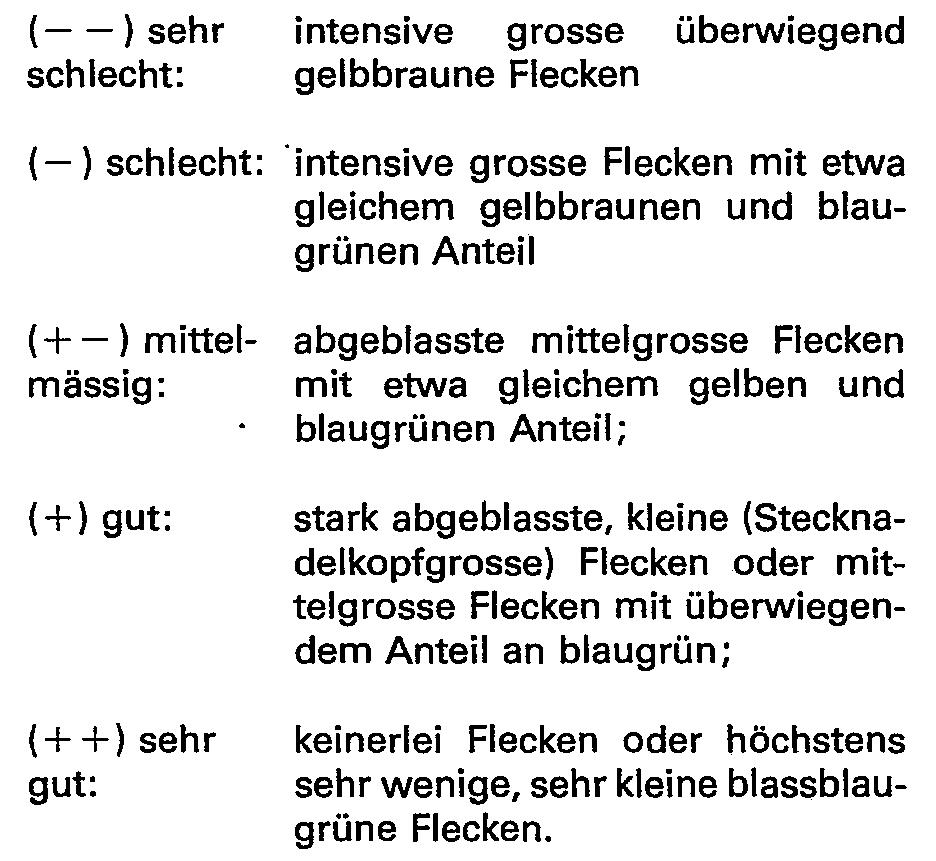
- Es wurde in Anlehnung an die DIN 53 902 die Schlagmethode verwendet. Zur Prüfung genügte das einfache Prüfungsverfahren, bei dem der Stempel mit der Lochplatte per Hand 30mal in 30 s gleichmässig auf- und abgeführt und dann vorsichtig herausgezogen wird (IG-Schlagmethode). Das Schaumvolumen wird an dem qraduierten Schaumzylinder nach 1, 5 und 10 min. in ml abgelesen. Von Wichtigkeit sind daneben Angaben über Temperatur, Konzentration und Wasserhärte.


Claims (2)

einsetzt, in der R' einen n-Alkylrest mit 8 bis 12 C-Atomen und R2 einen Alkylrest mit 1 bis 4 C-Atomen oder Wasserstoff bedeuten.
Applications Claiming Priority (2)
| Application Number | Priority Date | Filing Date | Title |
|---|---|---|---|
| DE19792951542 DE2951542A1 (de) | 1979-12-21 | 1979-12-21 | Verwendung von alkanolaminsalzen cyclischer amidsaeuren als korrosionsschutzmittel in waessrigen systemen |
| DE2951542 | 1979-12-21 |
Publications (2)
| Publication Number | Publication Date |
|---|---|
| EP0031924A1 EP0031924A1 (de) | 1981-07-15 |
| EP0031924B1 true EP0031924B1 (de) | 1983-05-18 |
Family
ID=6089137
Family Applications (1)
| Application Number | Title | Priority Date | Filing Date |
|---|---|---|---|
| EP80107851A Expired EP0031924B1 (de) | 1979-12-21 | 1980-12-12 | Verwendung von Alkanolaminsalzen cyclischer Amidsäuren als Korrosionsschutzmittel in wässrigen Systemen |
Country Status (2)
| Country | Link |
|---|---|
| EP (1) | EP0031924B1 (de) |
| DE (2) | DE2951542A1 (de) |
Families Citing this family (4)
| Publication number | Priority date | Publication date | Assignee | Title |
|---|---|---|---|---|
| US4379063A (en) * | 1981-02-20 | 1983-04-05 | Cincinnati Milacron Inc. | Novel functional fluid |
| DE3719101A1 (de) * | 1987-06-06 | 1988-12-15 | Bayer Ag | Neue korrosionsinhibitoren |
| DE69025404T2 (de) * | 1989-08-08 | 1996-07-04 | Stepan Co | Zyklische amidokarboxyoberflächenaktive verbindungen, herstellung und deren verwendung |
| AU1231799A (en) | 1997-10-24 | 1999-05-17 | D.D.C. Planungs-Entwicklungs- Und Management Ag | Method and device for constructing a structure and structures |
Citations (5)
| Publication number | Priority date | Publication date | Assignee | Title |
|---|---|---|---|---|
| US2944969A (en) * | 1957-02-06 | 1960-07-12 | Petrolite Corp | Prevention of rust and corrosion |
| US3231607A (en) * | 1962-03-29 | 1966-01-25 | Chevron Res | Partial amides of benzene polycarboxylic acids |
| US3704090A (en) * | 1971-04-26 | 1972-11-28 | Hexcel Corp | Corrosion inhibition using n-aminoalkyl phthalamides |
| FR2268791A1 (en) * | 1974-04-25 | 1975-11-21 | Nobel Hoechst Chimie | Para-alkyl benzoic acid alkanolamine condensate - useful as water-soluble or dispersable corrosion inhibitors for ferrous metals |
| FR2427400A1 (fr) * | 1978-06-02 | 1979-12-28 | Snam Progetti | Agent anti-rouille pour systemes aqueux et compositions lubrifiantes empechant la rouille |
-
1979
- 1979-12-21 DE DE19792951542 patent/DE2951542A1/de not_active Withdrawn
-
1980
- 1980-12-12 DE DE8080107851T patent/DE3063379D1/de not_active Expired
- 1980-12-12 EP EP80107851A patent/EP0031924B1/de not_active Expired
Patent Citations (5)
| Publication number | Priority date | Publication date | Assignee | Title |
|---|---|---|---|---|
| US2944969A (en) * | 1957-02-06 | 1960-07-12 | Petrolite Corp | Prevention of rust and corrosion |
| US3231607A (en) * | 1962-03-29 | 1966-01-25 | Chevron Res | Partial amides of benzene polycarboxylic acids |
| US3704090A (en) * | 1971-04-26 | 1972-11-28 | Hexcel Corp | Corrosion inhibition using n-aminoalkyl phthalamides |
| FR2268791A1 (en) * | 1974-04-25 | 1975-11-21 | Nobel Hoechst Chimie | Para-alkyl benzoic acid alkanolamine condensate - useful as water-soluble or dispersable corrosion inhibitors for ferrous metals |
| FR2427400A1 (fr) * | 1978-06-02 | 1979-12-28 | Snam Progetti | Agent anti-rouille pour systemes aqueux et compositions lubrifiantes empechant la rouille |
Also Published As
| Publication number | Publication date |
|---|---|
| DE2951542A1 (de) | 1981-07-02 |
| EP0031924A1 (de) | 1981-07-15 |
| DE3063379D1 (en) | 1983-07-07 |
Similar Documents
| Publication | Publication Date | Title |
|---|---|---|
| DE2357951C3 (de) | Verwendung von en-Addukten des Maleinsäureanhydrids als Korrosionsschutzmittel | |
| EP0222311B1 (de) | Verwendung von Alkoxyhydroxyfettsäuren als Korrosionsinhibitoren in Ölen und Ölhaltigen Emulsionen | |
| EP0002780B1 (de) | Verwendung von Korrosionsinhibitoren in wässrigen Systemen | |
| DE2731711A1 (de) | Verfahren zur hemmung der korrosion der eisenmetalle in waesserigem medium, insbesondere meerwasser | |
| DE2943963C2 (de) | ||
| EP0249162A1 (de) | Verwendung von acylierten 3-Amino-1,2,4-triazolen als Korrosionsinhibitoren für Buntmetalle | |
| EP0029529A1 (de) | Umsetzungsprodukte aus Sulfon- oder Carbonamidocarbonsäuren mit Alkanolaminen und ihre Verwendung als schaumarme Korrosionsinhibitoren | |
| DE2722819A1 (de) | Korrosionsinhibierendes kuehl- und metallbearbeitungsmittel | |
| EP0031924A1 (de) | Verwendung von Alkanolaminsalzen cyclischer Amidsäuren als Korrosionsschutzmittel in wässrigen Systemen | |
| DE3222996C2 (de) | ||
| DE2026035A1 (de) | Schmiermittel | |
| US4473491A (en) | Alkanolamine salts of cyclic amide acids and their use as metal corrosion inhibitors in aqueous systems | |
| DE1939789A1 (de) | Korrosionsschutzmasse | |
| EP0015442B1 (de) | Schaumarme Korrosionsinhibitoren mit antimikrobiellen Eigenschaften, die als wirksames Prinzip Borsäure-Alkanolamin-Umsetzungsprodukte enthalten | |
| EP0060224A1 (de) | Korrosionsschutzmittelzusammensetzung | |
| DE2522370A1 (de) | Schmieroel-zusammensetzung mit verbesserten dampfraum-rostschutzeigenschaften | |
| DE3006115A1 (de) | Verfahen zur herstellung von umsetzungsprodukten aus fettsaeuren und alkanolaminen sowie die verwendung der umsetzungsprodukte als technische emulgatoren | |
| DE3416120A1 (de) | Benzoylalanine und ihre verwendung als korrosionsinhibitoren fuer waessrige systeme | |
| DE19959588A1 (de) | Metallbehandlungsflüssigkeit für den neutralen pH-Bereich | |
| DE3600401A1 (de) | Verwendung von alkylbenzoylacrylsaeuren als korrosionsinhibitoren | |
| EP0823494B1 (de) | Lactobionsäureamide enthaltende Korrosionschutzmittel und Korrosions-Inhibitoren | |
| DE681307C (de) | Entrostungsmittel | |
| DE3102353A1 (de) | Alkyllactoncarbonsaeuren (hydrierte pyronderivate) bzw. ihrer salze, verfahren zu ihrer herstellung und ihre verwendung als korrosionsschutzmittel | |
| EP0142627B1 (de) | Korrosionsinhibitoren | |
| DE3701719A1 (de) | Korrosionsschutzmittel, enthaltend mischungen mit amidsaeuren |
Legal Events
| Date | Code | Title | Description |
|---|---|---|---|
| PUAI | Public reference made under article 153(3) epc to a published international application that has entered the european phase |
Free format text: ORIGINAL CODE: 0009012 |
|
| AK | Designated contracting states |
Designated state(s): BE DE FR GB IT SE |
|
| 17P | Request for examination filed |
Effective date: 19810709 |
|
| ITF | It: translation for a ep patent filed | ||
| GRAA | (expected) grant |
Free format text: ORIGINAL CODE: 0009210 |
|
| AK | Designated contracting states |
Designated state(s): BE DE FR GB IT SE |
|
| REF | Corresponds to: |
Ref document number: 3063379 Country of ref document: DE Date of ref document: 19830707 |
|
| ET | Fr: translation filed | ||
| PLBE | No opposition filed within time limit |
Free format text: ORIGINAL CODE: 0009261 |
|
| STAA | Information on the status of an ep patent application or granted ep patent |
Free format text: STATUS: NO OPPOSITION FILED WITHIN TIME LIMIT |
|
| 26N | No opposition filed | ||
| ITTA | It: last paid annual fee | ||
| PGFP | Annual fee paid to national office [announced via postgrant information from national office to epo] |
Ref country code: SE Payment date: 19931116 Year of fee payment: 14 |
|
| PGFP | Annual fee paid to national office [announced via postgrant information from national office to epo] |
Ref country code: BE Payment date: 19931224 Year of fee payment: 14 |
|
| PG25 | Lapsed in a contracting state [announced via postgrant information from national office to epo] |
Ref country code: SE Effective date: 19941213 |
|
| PG25 | Lapsed in a contracting state [announced via postgrant information from national office to epo] |
Ref country code: BE Effective date: 19941231 |
|
| EAL | Se: european patent in force in sweden |
Ref document number: 80107851.0 |
|
| BERE | Be: lapsed |
Owner name: BASF A.G. Effective date: 19941231 |
|
| EUG | Se: european patent has lapsed |
Ref document number: 80107851.0 |
|
| PGFP | Annual fee paid to national office [announced via postgrant information from national office to epo] |
Ref country code: FR Payment date: 19991122 Year of fee payment: 20 |
|
| PGFP | Annual fee paid to national office [announced via postgrant information from national office to epo] |
Ref country code: GB Payment date: 19991201 Year of fee payment: 20 |
|
| PGFP | Annual fee paid to national office [announced via postgrant information from national office to epo] |
Ref country code: DE Payment date: 19991216 Year of fee payment: 20 |
|
| PG25 | Lapsed in a contracting state [announced via postgrant information from national office to epo] |
Ref country code: GB Free format text: LAPSE BECAUSE OF EXPIRATION OF PROTECTION Effective date: 20001211 |
|
| REG | Reference to a national code |
Ref country code: GB Ref legal event code: PE20 Effective date: 20001211 |