EP0028362A2 - Procédé de séparation de l'eau des mélanges avec l'acétate de vinyle et l'acide acétique - Google Patents
Procédé de séparation de l'eau des mélanges avec l'acétate de vinyle et l'acide acétique Download PDFInfo
- Publication number
- EP0028362A2 EP0028362A2 EP80106460A EP80106460A EP0028362A2 EP 0028362 A2 EP0028362 A2 EP 0028362A2 EP 80106460 A EP80106460 A EP 80106460A EP 80106460 A EP80106460 A EP 80106460A EP 0028362 A2 EP0028362 A2 EP 0028362A2
- Authority
- EP
- European Patent Office
- Prior art keywords
- vinyl acetate
- water
- acetic acid
- condensate
- feed point
- Prior art date
- Legal status (The legal status is an assumption and is not a legal conclusion. Google has not performed a legal analysis and makes no representation as to the accuracy of the status listed.)
- Granted
Links
Images
Classifications
-
- C—CHEMISTRY; METALLURGY
- C07—ORGANIC CHEMISTRY
- C07C—ACYCLIC OR CARBOCYCLIC COMPOUNDS
- C07C67/00—Preparation of carboxylic acid esters
- C07C67/04—Preparation of carboxylic acid esters by reacting carboxylic acids or symmetrical anhydrides onto unsaturated carbon-to-carbon bonds
- C07C67/05—Preparation of carboxylic acid esters by reacting carboxylic acids or symmetrical anhydrides onto unsaturated carbon-to-carbon bonds with oxidation
- C07C67/055—Preparation of carboxylic acid esters by reacting carboxylic acids or symmetrical anhydrides onto unsaturated carbon-to-carbon bonds with oxidation in the presence of platinum group metals or their compounds
-
- C—CHEMISTRY; METALLURGY
- C07—ORGANIC CHEMISTRY
- C07C—ACYCLIC OR CARBOCYCLIC COMPOUNDS
- C07C67/00—Preparation of carboxylic acid esters
- C07C67/48—Separation; Purification; Stabilisation; Use of additives
- C07C67/52—Separation; Purification; Stabilisation; Use of additives by change in the physical state, e.g. crystallisation
- C07C67/54—Separation; Purification; Stabilisation; Use of additives by change in the physical state, e.g. crystallisation by distillation
-
- B—PERFORMING OPERATIONS; TRANSPORTING
- B01—PHYSICAL OR CHEMICAL PROCESSES OR APPARATUS IN GENERAL
- B01J—CHEMICAL OR PHYSICAL PROCESSES, e.g. CATALYSIS OR COLLOID CHEMISTRY; THEIR RELEVANT APPARATUS
- B01J2219/00—Chemical, physical or physico-chemical processes in general; Their relevant apparatus
- B01J2219/19—Details relating to the geometry of the reactor
- B01J2219/194—Details relating to the geometry of the reactor round
- B01J2219/1941—Details relating to the geometry of the reactor round circular or disk-shaped
- B01J2219/1942—Details relating to the geometry of the reactor round circular or disk-shaped spherical
Definitions
- the production of vinyl acetate by reacting ethylene with acetic acid and oxygen or gases containing oxygen over fixed bed catalysts in the gas phase is already known.
- the reaction generally takes place at pressures of 1 to 25 bar and temperatures of 100 to 250 ° C.
- Suitable catalysts contain a noble metal component and an activator component.
- the precious metal component consists of palladium and / or its compounds; gold or its compounds may also be present.
- the activator portion consists of compounds of elements of the 1st main group and / or the 2nd main group and / or cadmium.
- the palladium content in the catalyst is generally between 0.5 and 5% by weight.
- gold or one of its compounds is used, it is added in a proportion of 0.01 to 4% by weight.
- the catalysts palladium acetate / potassium acetate / cadmium acetate and palladium acetate / barium acetoaurate / potassium acetate are particularly preferred.
- the mixture used for the reaction contains a multiple molar excess over the stoichiometry of ethylene. Accordingly, the ethylene conversion in the reaction is low and the unreacted ethylene has to be recycled to the reaction.
- the vinyl acetate formed is separated off from the gas mixture behind the vinyl acetate reactor in two or more stages. First, the hot reaction mixture leaving the reactor, which essentially consists of unreacted ethylene, unconverted acetic acid, unconverted oxygen, vinyl acetate, water of reaction, CO 2 , and also the inerts introduced with the oxygen and ethylene (for example N 2 and argon), cooled down. Most of the acetic acid, vinyl acetate and water are condensed. The resulting liquid mixture is referred to below as "condensate".
- the condensate contains about 15-30% by weight vinyl acetate and 6-11% by weight water, the rest are acetic acid and traces of other by-products (such as ethyl acetate, ethylene diacetate, acetaldehyde).
- the amount of condensate is about 1-3 times the amount of the bottom drain of the acetic acid wash. This contains about 15-30% by weight vinyl acetate and 1-3% by weight water, so it is less water than the condensate; the rest is essentially acetic acid.
- the crude vinyl acetate formed from the condensate and the bottom drain of the acetic acid wash contains about 15-30% by weight of vinyl acetate, 5-8% by weight of water, the rest is essentially acetic acid.
- the crude vinyl acetate is separated by distillation into pure vinyl acetate and acetic acid, which is returned to the reaction as so-called re-acetic acid.
- the crude vinyl acetate is generally worked up by distillation using one of the following two processes: In one variant (DE-OS 1 807 738, DE-OS 1 768 412), the vinyl acetate and the water are distilled overhead and in a first column deducted as sump acetic acid.
- the water phase is drawn off from the distillate, which separates into two phases. Part of the vinyl acetate phase is used as reflux and at the same time serves as an azeotrope for the water to be distilled overhead.
- the remaining part of the (water-saturated) vinyl acetate phase is dried in a second column in that a part is distilled overhead as an azeotrope with the water still contained therein.
- the other part arrives in the anhydrous bottom of this second column and is worked up in a third column to pure vinyl acetate, which is distilled overhead, and high boilers and polymers which are taken off as the bottom.
- the water is distilled overhead in a first column using vinyl acetate as an azeotrope former; only the water phase is drawn off from the distillate separating into two phases and the entire vinyl acetate phase is returned to the column as reflux.
- this column also contains an attachment for separating low boilers (e.g. acetaldehyde) which boil lower than vinyl acetate.
- vinyl acetate and water are removed below this attachment and fed to a phase separator. The water phase is drawn off again and the vinyl acetate phase is returned to the column as reflux below the removal point for vinyl acetate / water.
- the low boilers can then be drawn off directly at the top of the column attachment.
- An anhydrous vinyl acetate / acetic acid mixture is drawn off at the bottom of the column and is separated in a second column into pure vinyl acetate (top product) and acetic acid (bottom product).
- the separation of the water requires 60-80% of the total energy required to obtain pure vinyl acetate. Any improvement in distillative water separation therefore means a significant process improvement.
- a measure of the energy consumption during dewatering is the percentage of water in the distillate of the blob for azeotropic dewatering.
- a high water concentration in the above-mentioned distillate means that less vinyl acetate was also evaporated for the azeotropic water removal and therefore less energy was expended than with smaller ones Water concentration in the distillate.
- the invention now relates to a method by which the energy consumption for dewatering the crude vinyl acetate is substantially reduced.
- the vinyl acetate phase is then further processed, for example as in one of the two distillation processes mentioned above, to give pure vinyl acetate.
- step a) the gas mixture i. generally cooled to 15-50 ° C, preferably to 25-40 ° C.
- the absorption of the remaining vinyl acetate and water in step b) is carried out i. generally in a washing column with acetic acid as the absorbent.
- the distillation column used in step c) has i. generally 50-80 floors.
- the feed points of condensate and solution have i. generally a distance of 4-30, preferably 6-20 floors.
- the feed point of the condensate is i. generally at least 5 trays below the column head and at least 30 trays above the column bottom.
- the water content in the distillate of the column is significantly higher when the water-rich condensate from step a) and the lower-water solution from step b) are fed separately according to the invention than when they were fed together according to the prior art.
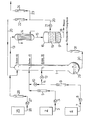
- a bubble-cap column (1) made of glass (with vacuum jacket, electrical sump heating, 60 trays, inner diameter 50 mm), (water-rich) condensate from the storage vessel (2) is fed through line (3) via pump (4) and flow meter (5) to the 45th Ground fed.
- the vapors at the top of the column (1) pass through line (13) into the water cooler (14).
- the distillate liquefied there passes via line (15) into the collecting vessel (16), where it separates into two phases.
- the aqueous lower phase (17) is drawn off via line (18) and discarded.
- the vinyl acetate phase (19) is drawn off via line (20).
- it is pumped (21) and flow meter (22) - after discharging a small portion via line (23) and flow meter (24) to remove small amounts of acetaldehyde, which is formed by vinyl acetate hydrolysis are returned to the top of the column (1) as reflux.
- a stabilizer solution is pumped from the storage vessel (25) through line (26) via pump (27), flow meter (28) and line (20) to the top of column (1).
- the liquid level in the bottom (29) of the column (1) is kept constant by withdrawing a corresponding amount of anhydrous vinyl acetate / acetic acid mixture via line (30) and flow meter (31).
- 1000 g / h of mixture are fed from the storage vessel (2) to the 45th tray of the column (1) and 600 g / h of mixture from the storage vessel (6) with the valve (10) and valve (12) open.
- the bottom heating of the column (1) is now adjusted so that 2400 g / h of organic phase are obtained in the distillate collecting vessel (16).
- the entire organic phase (19) is pumped back to the top of the column (1) by pump (21) and flow meter (22). 20 g / h are discharged from this return via flow meter (24).
- a solution of 1% by weight of hydroquinone in vinyl acetate is pumped from the storage vessel (25) to the top of the column (1), the amount being 20 g / h.
- the water concentration (ie the weight fraction of the aqueous phase) in the distillate is increased from 3.8% by weight to 4.8% by weight, which means a relative increase of approximately 25%.
Landscapes
- Chemical & Material Sciences (AREA)
- Organic Chemistry (AREA)
- Crystallography & Structural Chemistry (AREA)
- Organic Low-Molecular-Weight Compounds And Preparation Thereof (AREA)
Applications Claiming Priority (2)
| Application Number | Priority Date | Filing Date | Title |
|---|---|---|---|
| DE2943985 | 1979-10-31 | ||
| DE19792943985 DE2943985A1 (de) | 1979-10-31 | 1979-10-31 | Verfahren zur abtrennung von wasser aus gemischen mit vinylacetat und essigsaeure |
Publications (3)
| Publication Number | Publication Date |
|---|---|
| EP0028362A2 true EP0028362A2 (fr) | 1981-05-13 |
| EP0028362A3 EP0028362A3 (en) | 1981-10-14 |
| EP0028362B1 EP0028362B1 (fr) | 1983-11-16 |
Family
ID=6084835
Family Applications (1)
| Application Number | Title | Priority Date | Filing Date |
|---|---|---|---|
| EP80106460A Expired EP0028362B1 (fr) | 1979-10-31 | 1980-10-23 | Procédé de séparation de l'eau des mélanges avec l'acétate de vinyle et l'acide acétique |
Country Status (6)
| Country | Link |
|---|---|
| US (1) | US4353783A (fr) |
| EP (1) | EP0028362B1 (fr) |
| JP (1) | JPS5679639A (fr) |
| CA (1) | CA1172597A (fr) |
| DE (2) | DE2943985A1 (fr) |
| ES (1) | ES8106878A1 (fr) |
Cited By (4)
| Publication number | Priority date | Publication date | Assignee | Title |
|---|---|---|---|---|
| US4818347A (en) * | 1984-06-18 | 1989-04-04 | Hoechst Aktiengesellschaft | Process for the isolation of vinyl acetate |
| US5066365A (en) * | 1989-10-17 | 1991-11-19 | Hoechst Aktiengesellschaft | Process for the isolation of vinyl acetate by distillation |
| US6180821B1 (en) | 1996-08-07 | 2001-01-30 | Bp Chemicals Limited | Integrated process for the production of vinyl acetate and/or acetic acid using a fluidized bed |
| US7189377B1 (en) | 1996-08-07 | 2007-03-13 | Bp Chemicals Limited | Apparatus for performing integrated process for reproduction of vinyl acetate and/or acetic acid using a fluidized bed |
Families Citing this family (8)
| Publication number | Priority date | Publication date | Assignee | Title |
|---|---|---|---|---|
| US4654801A (en) * | 1984-11-30 | 1987-03-31 | Phillips Petroleum Company | Control of a vinyl acetate process |
| US6410817B1 (en) * | 1999-06-29 | 2002-06-25 | Celanese International Corporation | Ethylene recovery system |
| CN100364954C (zh) * | 2004-05-20 | 2008-01-30 | 中国石化上海石油化工股份有限公司 | 醋酸乙烯粗产品的精制方法 |
| DE102005036930B4 (de) * | 2005-08-05 | 2014-01-23 | Celanese Chemicals Europe Gmbh | Verfahren zur Isolierung von Vinylacetat |
| DE102010001097A1 (de) | 2010-01-21 | 2011-07-28 | Wacker Chemie AG, 81737 | Verfahren zur Herstellung von Vinylacetat |
| US20140073812A1 (en) * | 2012-09-13 | 2014-03-13 | Celanese International Corporation | Process for Making Acrylic Acid by Integrating Acetic Acid Feed Stream from Carbonylation Process |
| CN105964008B (zh) * | 2016-07-14 | 2018-05-04 | 中国石化长城能源化工(宁夏)有限公司 | 一种高纯度醋酸乙烯分离系统 |
| CN111473916B (zh) * | 2020-04-10 | 2022-05-31 | 中国石油化工股份有限公司 | 结晶器腐蚀泄漏情况的监测方法 |
Family Cites Families (5)
| Publication number | Priority date | Publication date | Assignee | Title |
|---|---|---|---|---|
| FR1490688A (fr) * | 1966-06-22 | 1967-08-04 | Melle Usines Sa | Procédé pour séparer les constituants de mélanges azéotropiques de méthanol et d'ester aliphatique inférieur |
| US3636087A (en) * | 1966-09-12 | 1972-01-18 | Atlantic Richfield Co | Vinyl acetate recovery process |
| DE1807738C3 (de) * | 1968-11-08 | 1973-10-31 | Bayer Ag, 5090 Leverkusen | Verfahren zur Gewinnung von reinem Vinylacetat |
| RO69229A (fr) * | 1973-07-13 | 1980-12-30 | Farbwerke Hoechst Ag,De | Procede pour la separation de l'eau des melanges organiques rganique |
| DE2610624C2 (de) * | 1976-03-13 | 1985-02-14 | Hoechst Ag, 6230 Frankfurt | Verfahren zur Gewinnung von Vinylacetat aus den Gasgemischen, die bei dessen Herstellung anfallen |
-
1979
- 1979-10-31 DE DE19792943985 patent/DE2943985A1/de not_active Withdrawn
-
1980
- 1980-10-23 DE DE8080106460T patent/DE3065628D1/de not_active Expired
- 1980-10-23 EP EP80106460A patent/EP0028362B1/fr not_active Expired
- 1980-10-24 ES ES496260A patent/ES8106878A1/es not_active Expired
- 1980-10-29 US US06/201,752 patent/US4353783A/en not_active Expired - Lifetime
- 1980-10-30 CA CA000363606A patent/CA1172597A/fr not_active Expired
- 1980-10-30 JP JP15154380A patent/JPS5679639A/ja active Granted
Cited By (5)
| Publication number | Priority date | Publication date | Assignee | Title |
|---|---|---|---|---|
| US4818347A (en) * | 1984-06-18 | 1989-04-04 | Hoechst Aktiengesellschaft | Process for the isolation of vinyl acetate |
| US5066365A (en) * | 1989-10-17 | 1991-11-19 | Hoechst Aktiengesellschaft | Process for the isolation of vinyl acetate by distillation |
| US6180821B1 (en) | 1996-08-07 | 2001-01-30 | Bp Chemicals Limited | Integrated process for the production of vinyl acetate and/or acetic acid using a fluidized bed |
| US7189377B1 (en) | 1996-08-07 | 2007-03-13 | Bp Chemicals Limited | Apparatus for performing integrated process for reproduction of vinyl acetate and/or acetic acid using a fluidized bed |
| US7491843B2 (en) | 1996-08-07 | 2009-02-17 | Bp Chemicals Limited | Integrated process for the production of vinyl acetate and/or acetic acid |
Also Published As
| Publication number | Publication date |
|---|---|
| ES496260A0 (es) | 1981-10-01 |
| DE2943985A1 (de) | 1981-05-14 |
| US4353783A (en) | 1982-10-12 |
| JPS5679639A (en) | 1981-06-30 |
| EP0028362A3 (en) | 1981-10-14 |
| EP0028362B1 (fr) | 1983-11-16 |
| JPS6366305B2 (fr) | 1988-12-20 |
| CA1172597A (fr) | 1984-08-14 |
| DE3065628D1 (en) | 1983-12-22 |
| ES8106878A1 (es) | 1981-10-01 |
Similar Documents
| Publication | Publication Date | Title |
|---|---|---|
| EP0423658B1 (fr) | Procédé d'isolement de l'acétate de vinyl | |
| DE69311585T2 (de) | Verfahren zur Reinigung von Acrylsäure zu hoher Reinheit bei der Herstellung von Acrylsäure | |
| DE2629769C3 (de) | Verfahren zur Herstellung von reinem Methyl-tertiär-butyläther | |
| EP0040724B1 (fr) | Procédé de préparation continue d'esters d'acide acétique | |
| DE69327411T2 (de) | Verfahren zur Herstellung von Acetaldehyddimethylacetal | |
| DE2814448C2 (fr) | ||
| EP0028362B1 (fr) | Procédé de séparation de l'eau des mélanges avec l'acétate de vinyle et l'acide acétique | |
| DE3422575C2 (fr) | ||
| DE2244229B2 (de) | Verfahren zur Gewinnung von Äthylenglycol oder Propylenglycol | |
| DE102010001097A1 (de) | Verfahren zur Herstellung von Vinylacetat | |
| DE2945913C2 (fr) | ||
| EP0962444A1 (fr) | Procédé de traitement d'acétate de vinyle brut liquide | |
| DE2139460A1 (de) | Verfahren zur Herstellung von gemischten Estern aus Aldehyden | |
| DE2132362A1 (de) | Verfahren zur Gewinnung von Vinylacetat aus fluessigen Gemischen,die Vinylacetat,Wasser,Methylacetat und gegebenenfalls Acetaldehyd enthalten | |
| DE2903890C2 (de) | Verfahren zur kontinuierlichen Herstellung von Äthylenglykolmonoäthylätheracetat | |
| EP0072484A1 (fr) | Procédé de traitement d'acétate de vinyle liquide brut | |
| EP0424861B2 (fr) | Procédé de préparation continue d'esters d'acides carboxyliques inférieurs et d'alcools inférieurs | |
| DE2060190C3 (de) | Verfahren zur Abtrennung von Propionsäure bzw. Buttersäure aus einem Gemisch von Epichlorhydrin, Allylchlorid und einer der vorgenannten Carbonsäuren | |
| DE3855070T2 (de) | Herstellungsverfahren von Propionsäureestern | |
| DE1643256B2 (de) | Verfahren zur herstellung von trioxan. zusatz zu p 15 43 390.6 | |
| DE69400130T2 (de) | Verfahren zur Herstellung von Alkylen-Carbonaten | |
| EP0387674B1 (fr) | Procédé de préparation continue d'un mélange anhydre d'acétate de méthyle et de méthanol | |
| DE2935910C2 (de) | Verfahren zur kontinuierlichen Herstellung von Butandiolen und/oder Butendiolen | |
| DE2849248C3 (de) | Verfahren zur Herstellung von Ethylenglykol und Propylenglykol | |
| DE2533429B2 (de) | Verfahren zur Herstellung von 2-Chlorbutadien-(13) |
Legal Events
| Date | Code | Title | Description |
|---|---|---|---|
| PUAI | Public reference made under article 153(3) epc to a published international application that has entered the european phase |
Free format text: ORIGINAL CODE: 0009012 |
|
| AK | Designated contracting states |
Designated state(s): BE DE FR GB IT NL |
|
| RAP1 | Party data changed (applicant data changed or rights of an application transferred) |
Owner name: WACKER-CHEMIE GMBH Owner name: HOECHST AKTIENGESELLSCHAFT |
|
| PUAL | Search report despatched |
Free format text: ORIGINAL CODE: 0009013 |
|
| AK | Designated contracting states |
Designated state(s): BE DE FR GB IT NL |
|
| 17P | Request for examination filed |
Effective date: 19811029 |
|
| ITF | It: translation for a ep patent filed | ||
| GRAA | (expected) grant |
Free format text: ORIGINAL CODE: 0009210 |
|
| AK | Designated contracting states |
Designated state(s): BE DE FR GB IT NL |
|
| REF | Corresponds to: |
Ref document number: 3065628 Country of ref document: DE Date of ref document: 19831222 |
|
| ET | Fr: translation filed | ||
| PLBE | No opposition filed within time limit |
Free format text: ORIGINAL CODE: 0009261 |
|
| STAA | Information on the status of an ep patent application or granted ep patent |
Free format text: STATUS: NO OPPOSITION FILED WITHIN TIME LIMIT |
|
| PGFP | Annual fee paid to national office [announced via postgrant information from national office to epo] |
Ref country code: BE Payment date: 19840930 Year of fee payment: 5 |
|
| 26N | No opposition filed | ||
| PGFP | Annual fee paid to national office [announced via postgrant information from national office to epo] |
Ref country code: NL Payment date: 19851031 Year of fee payment: 6 |
|
| PG25 | Lapsed in a contracting state [announced via postgrant information from national office to epo] |
Ref country code: BE Effective date: 19861031 |
|
| BERE | Be: lapsed |
Owner name: WACKER-CHEMIE G.M.B.H. Effective date: 19861031 Owner name: HOECHST A.G. Effective date: 19861031 |
|
| PG25 | Lapsed in a contracting state [announced via postgrant information from national office to epo] |
Ref country code: NL Effective date: 19870501 |
|
| NLV4 | Nl: lapsed or anulled due to non-payment of the annual fee | ||
| ITTA | It: last paid annual fee | ||
| PGFP | Annual fee paid to national office [announced via postgrant information from national office to epo] |
Ref country code: DE Payment date: 19990927 Year of fee payment: 20 |
|
| PGFP | Annual fee paid to national office [announced via postgrant information from national office to epo] |
Ref country code: GB Payment date: 19991020 Year of fee payment: 20 |
|
| PGFP | Annual fee paid to national office [announced via postgrant information from national office to epo] |
Ref country code: FR Payment date: 19991026 Year of fee payment: 20 |
|
| PG25 | Lapsed in a contracting state [announced via postgrant information from national office to epo] |
Ref country code: GB Free format text: LAPSE BECAUSE OF EXPIRATION OF PROTECTION Effective date: 20001022 |
|
| REG | Reference to a national code |
Ref country code: GB Ref legal event code: PE20 Effective date: 20001022 |