EP0028007A1 - Funksystem mit Synchronisation der Teilnehmereinrichtungen - Google Patents
Funksystem mit Synchronisation der Teilnehmereinrichtungen Download PDFInfo
- Publication number
- EP0028007A1 EP0028007A1 EP80106451A EP80106451A EP0028007A1 EP 0028007 A1 EP0028007 A1 EP 0028007A1 EP 80106451 A EP80106451 A EP 80106451A EP 80106451 A EP80106451 A EP 80106451A EP 0028007 A1 EP0028007 A1 EP 0028007A1
- Authority
- EP
- European Patent Office
- Prior art keywords
- network
- subscriber
- transit time
- star point
- subscriber device
- Prior art date
- Legal status (The legal status is an assumption and is not a legal conclusion. Google has not performed a legal analysis and makes no representation as to the accuracy of the status listed.)
- Granted
Links
- 230000005540 biological transmission Effects 0.000 claims abstract description 9
- 238000011161 development Methods 0.000 description 2
- 230000018109 developmental process Effects 0.000 description 2
- 230000007774 longterm Effects 0.000 description 2
- 230000001934 delay Effects 0.000 description 1
- 230000007257 malfunction Effects 0.000 description 1
- 238000000034 method Methods 0.000 description 1
- 238000009420 retrofitting Methods 0.000 description 1
Images


Classifications
-
- H—ELECTRICITY
- H04—ELECTRIC COMMUNICATION TECHNIQUE
- H04L—TRANSMISSION OF DIGITAL INFORMATION, e.g. TELEGRAPHIC COMMUNICATION
- H04L12/00—Data switching networks
- H04L12/28—Data switching networks characterised by path configuration, e.g. LAN [Local Area Networks] or WAN [Wide Area Networks]
- H04L12/42—Loop networks
- H04L12/422—Synchronisation for ring networks
-
- H—ELECTRICITY
- H04—ELECTRIC COMMUNICATION TECHNIQUE
- H04J—MULTIPLEX COMMUNICATION
- H04J3/00—Time-division multiplex systems
- H04J3/02—Details
- H04J3/06—Synchronising arrangements
- H04J3/0635—Clock or time synchronisation in a network
- H04J3/0682—Clock or time synchronisation in a network by delay compensation, e.g. by compensation of propagation delay or variations thereof, by ranging
-
- H—ELECTRICITY
- H04—ELECTRIC COMMUNICATION TECHNIQUE
- H04K—SECRET COMMUNICATION; JAMMING OF COMMUNICATION
- H04K1/00—Secret communication
-
- H—ELECTRICITY
- H04—ELECTRIC COMMUNICATION TECHNIQUE
- H04W—WIRELESS COMMUNICATION NETWORKS
- H04W56/00—Synchronisation arrangements
- H04W56/001—Synchronization between nodes
Definitions
- the invention relates to a method according to the preamble of claim 1.
- preamble synchronization it is known to carry out preamble synchronization or permanent synchronization for the synchronization of subscribers in a radio network.
- preamble synchronization the synchronization grid is redefined each time a call is changed. Participants who do not receive the preamble undisturbed cannot understand the message.
- continuous synchronization it is necessary to receive an undisturbed, decipherable message for a certain period of time until a disguised message can be unveiled after a malfunction.
- the object of the invention is to provide a radio network which, in the case of a complex network structure and exchange of disguised or encrypted information allows interference-free synchronization of all subscriber facilities.
- the invention permits synchronization of all subscriber devices by arranging a main synchronizer in the network star point, and in that the signal propagation times from the network star point to all subscriber devices on the periphery are made the same.
- FIG. 1 shows a star-shaped network configuration in which speech is spoken openly without obfuscation / encryption.
- Mean: ⁇ 1 to ⁇ 4 and ⁇ 11 to ⁇ 14 are the signal propagation times between the network nodes.
- FIG. 2 shows an embodiment of the invention.
- four transit time elements are required between the wire subscriber equipment and cable connections, so that the same maximum transit time is achieved in all traffic directions between the transmitting and receiving subscriber equipment.
- the transmission grid is ahead of the reception grid by all subscriber devices by ⁇ max. In order for the mobile subscribers who are in the area of a relay station to communicate with one another, it is necessary to compensate for the transit time in this station (timers 35 and 44).
- FIG. 3 shows a preferred embodiment of the invention.
- Mobile subscribers regardless of whether they communicate via relays or via the node, can always receive after the maximum runtime. Fixed participants can listen to all speech traffic and speak in the correct grid.
- branches are present at the subscriber stations between the relay station and the network star point, these are advantageously switched according to FIG. 4 executed.
- the arrangement shown corresponds to the delay compensation according to FIG. 3 (or claim 2). Additional runtime elements must ensure that the runtimes in the direction of the periphery are the same in both ways.
- a branch can also correspond to the compensation according to FIG. 2 are carried out.
- the various network branches can also be brought to the same maximum runtime by inserting only one runtime element either in the outward or return route. This must have the sum of the terms of the term elements described above (1 and 2 in FIG. 3, or 21 and 22 in FIG. 2, or 53 and 54 in FIG. 4).
- the radio network is then no longer completely symmetrical, but retrofitting in existing cable routes is easier.
- mobile subscriber devices can be used both in a network with runtime compensation according to FIG. 2 as well as in a network according to FIG. 3 (or 4) can be used. Furthermore, a network is conceivable in which subscriber devices are both shown in FIG. 2 and also according to FIG. 3 can be connected.
- concealed or encrypted message exchange can be handled just as easily as in a system without concealment or encryption.
- the invention can also be used advantageously for PCM-coded message traffic.
Landscapes
- Engineering & Computer Science (AREA)
- Computer Networks & Wireless Communication (AREA)
- Signal Processing (AREA)
- Mobile Radio Communication Systems (AREA)
- Small-Scale Networks (AREA)
- Transmitters (AREA)
- Socks And Pantyhose (AREA)
- Devices For Checking Fares Or Tickets At Control Points (AREA)
Abstract
Description
- Die Erfindung betrifft ein Verfahren nach dem Oberbegriff des Anspruchs 1.
- Es ist bekannt, zur Synchronisierung von Teilnehmern in einem Funknetz eine Präambelsynchronisation oder eine Dauersynchronisation durchzuführen. Bei der Präambelsynchronisation wird bei jedem Gesprächswechsel das Synchronisationsraster neu festgelegt. Teilnehmer, die die Präambel nicht ungestört empfangen, können die Nachricht nicht verstehen. Bei der Dauersynchronisation ist für eine gewisse Zeit der Empfang einer ungestörten, an sich entzifferbaren Nachricht erforderlich, bis nach einer Störung wieder ein Entschleiern einer verschleierten Nachricht möglich wird.
- Aufgabe der Erfindung ist es, ein Funknetz anzugeben, welches bei komplexer Netzstruktur und Austausch von verschleierten oder verschlüsselten Informationen eine störungsunempfindliche Synchronisation aller Teilnehmereinrichtungen erlaubt.
- Die Aufgabe wird durch die im Anspruch 1 gekennzeichneten Merkmale gelöst. Die Unteransprüche beschreiben vorteilhafte Ausbildungen bzw. Weiterbildungen der Erfindung.
- In einem komplexen Sprechfunknetz, bei dem jeder Teilnehmer jeden anderen hören und sprechen können soll, in dem verschleiert gesprochen wird und in dem Übertragungsstörungen auftreten können, muß eine einheitliche Langzeit-Synchronisation vorgenommen werden. Dabei ist gleichgültig, ob die Verschleierung mit Bandvertauschung (ohne Zeitverzögerung) oder über Zeitverwürfelung (mit Zeitverzögerung) vorgenommen wird.
- In einem ausgedehnten Netz, in dem die Übertragungsstrecken aus Kabel- und Funkstrecken bestehen, treten außerdem erhebliche Signallaufzeiten auf, die eine einheitliche Langzeit-Synchronisation ohne besondere Maßnahmen ausschließen.
- Die Erfindung erlaubt eine Synchronisation aller Teilnehmereinrichtungen durch die Anordnung eines Hauptsynchronisators im Netzsternpunkt, und dadurch, daß die Signallaufzeiten vom Netzsternpunkt zu allen Teilnehmereinrichtungen an der Peripherie gleich groß gemacht werden.
- Die Erfindung soll anhand der Figuren näher beschrieben werden.
- FIG. 1 zeigt eine sternförmige Netzkonfiguration, in der offen ohne Verschleierung/Verschlüsselung gesprochen wird.
- Dabei bedeuten:

- FIG. 2 zeigt ein Ausführungsbeispiel der Erfindung. Dort bedeuten:
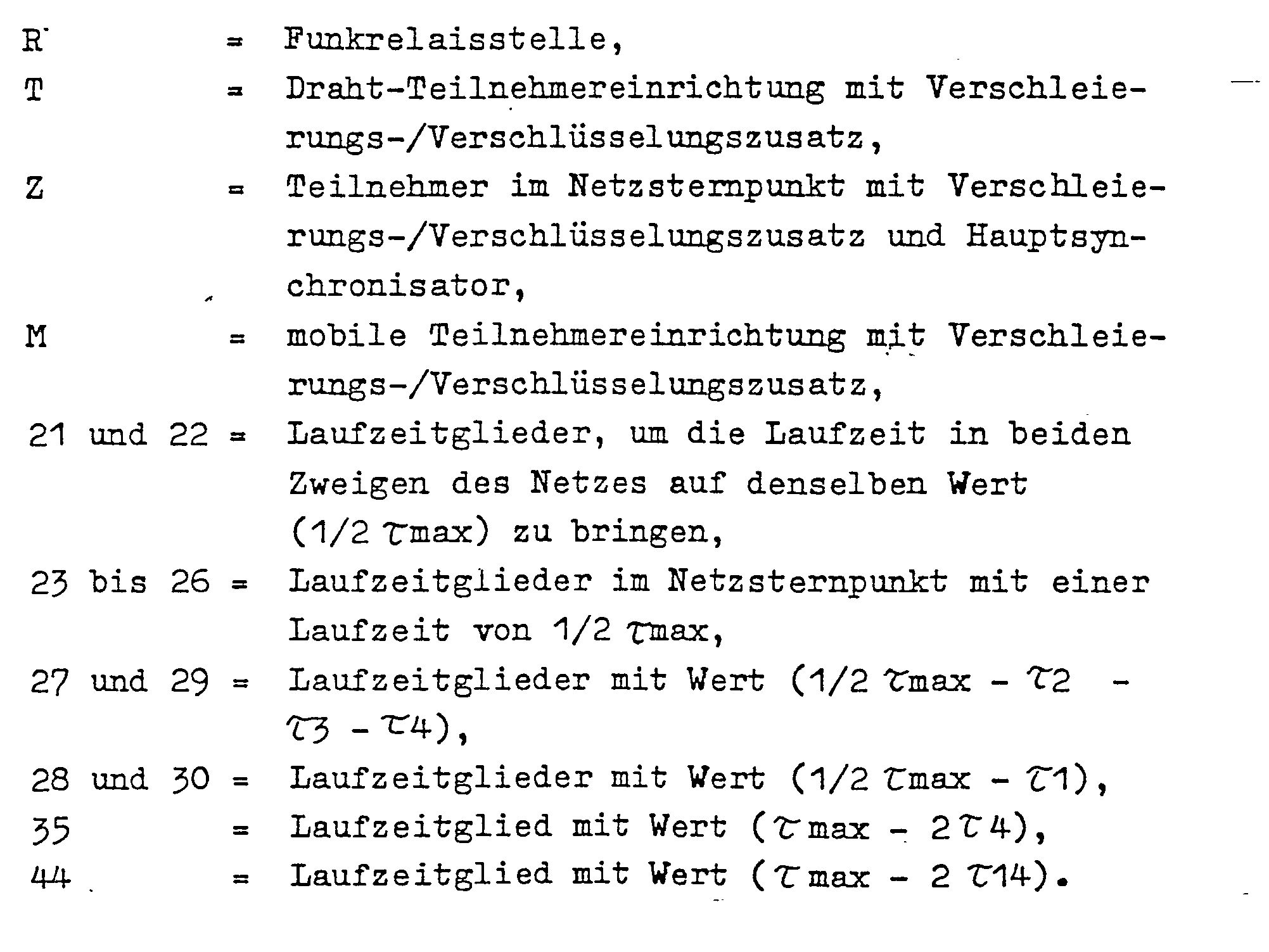
- In FIG. 3 ist ein bevorzugtes Ausführungsbeispiel der Erfindung dargestellt.
- Hierbei bedeuten:

- In dieser Anordnung werden zwischen Draht-Teilnehmereinrichtungen und Kabelanschlüssen nur zwei (gleiche) Laufzeitglieder benötigt. Die ortsfesten Teilnehmereinrichtungen haben unterschiedliche Zeiten eingestellt. um das Senderaster gegenüber dem Empfangsr
- Bei den mobilen Teilnehmern hat der Versatz des Senderasters wie nach FIG. 2 den Wert τmax = τ1 + τ2 + τ3 + τ4 + τ11 + τ12 + f13 + τ14. Mobile Teilnehmer können sich, gleichgültig ob sie sich über Relais oder über den Knoten verständigen, immer nach der Maximallaufzeit empfangen. Ortsfeste Teilnehmer können sämtlichen Sprechverkehr mithören und im richtigen Raster einsprechen.
- Sind Abzweige an Teilnehmerstellen zwischen Relaisstelle und Netzsternpunkt vorhanden, so werden diese vorteilhafterweise entsprechend FIG. 4 ausgeführt. Die dargestellte Anordnung entspricht der Laufzeitkompensation nach FIG. 3 (bzw. Anspruch 2). Durch zusätzliche Laufzeitglieder muß sichergestellt werden, daß die Laufzeiten in Richtung Peripherie auf beiden Wegen gleich groß sind.
- Es bedeuten:

- Selbstverständlich kann ein Abzweig auch entsprechend der Kompensation nach FIG. 2 durchgeführt werden.
- Die verschiedenen Netzzweige können auch dadurch auf gleiche maximale Laufzeit gebracht werden, daß nur ein Laufzeitglied entweder in den Hinweg oder Rückweg eingefügt wird. Dieses muß die Summe der Laufzeiten der oben beschriebenen Laufzeitglieder aufweisen, (1 und 2 in FIG. 3, bzw. 21 und 22 in FIG. 2, bzw. 53 und 54 in FIG. 4). Das Funknetz ist dann zwar nicht mehr vollständig symmetrisch, eine Nachrüstung in bestehenden Kabelstrecken wird jedoch einfacher.
- Bei gleicher Maximallaufzeit tmax können mobile Teilnehmereinrichtungen sowohl in einem Netz mit Laufzeitkompensation nach FIG. 2 als auch in einem Netz nach FIG. 3 (oder 4) eingesetzt werden. Ferner ist ein Netz denkbar, in dem Teilnehmereinrichtungen sowohl gemäß FIG. 2 als auch gemäß FIG. 3 angeschlossen werden.
- In dem erfindungsgemäßen Funksystem läßt sich verschleierter oder verschlüsselter Nachrichtenaustausch ebenso unproblematisch abwickeln, wie in einem System ohne Verschleierung oder Verschlüsselung. Selbstverständlich kann die Erfindung auch für PCM-codierten Nachrichtenverkehr vorteilhaft eingesetzt werden.
Claims (7)
Priority Applications (1)
| Application Number | Priority Date | Filing Date | Title |
|---|---|---|---|
| AT80106451T ATE5166T1 (de) | 1979-10-25 | 1980-10-23 | Funksystem mit synchronisation der teilnehmereinrichtungen. |
Applications Claiming Priority (2)
| Application Number | Priority Date | Filing Date | Title |
|---|---|---|---|
| DE2943059 | 1979-10-25 | ||
| DE2943059A DE2943059C2 (de) | 1979-10-25 | 1979-10-25 | Funksystem mit Synchronisation der Teilnehmereinrichtungen |
Publications (2)
| Publication Number | Publication Date |
|---|---|
| EP0028007A1 true EP0028007A1 (de) | 1981-05-06 |
| EP0028007B1 EP0028007B1 (de) | 1983-10-26 |
Family
ID=6084313
Family Applications (1)
| Application Number | Title | Priority Date | Filing Date |
|---|---|---|---|
| EP80106451A Expired EP0028007B1 (de) | 1979-10-25 | 1980-10-23 | Funksystem mit Synchronisation der Teilnehmereinrichtungen |
Country Status (4)
| Country | Link |
|---|---|
| EP (1) | EP0028007B1 (de) |
| AT (1) | ATE5166T1 (de) |
| DE (1) | DE2943059C2 (de) |
| ES (1) | ES496162A0 (de) |
Cited By (3)
| Publication number | Priority date | Publication date | Assignee | Title |
|---|---|---|---|---|
| GB2130847A (en) * | 1982-09-22 | 1984-06-06 | Fujitsu Ltd | The timing of reception and transmission channels in communications systems |
| GB2147770A (en) * | 1983-10-08 | 1985-05-15 | Standard Telephones Cables Ltd | Data transmission system |
| EP0660544A1 (de) * | 1993-12-27 | 1995-06-28 | Motorola, Inc. | Kommunikation über einen Kanal mit veränderbarer Verzögerungszeit |
Citations (9)
| Publication number | Priority date | Publication date | Assignee | Title |
|---|---|---|---|---|
| US2530140A (en) * | 1944-08-11 | 1950-11-14 | Tung Sol Lamp Works Inc | Secret signaling system |
| DE889311C (de) * | 1951-08-21 | 1953-09-10 | Hans W R Krueger | Verfahren zur Geheimtelefonie mittels beliebiger, individueller, unregelmaessig ablaufender Verschluesselung der Sprechfrequenzen |
| US2723309A (en) * | 1950-03-10 | 1955-11-08 | Int Standard Electric Corp | Telephone system |
| DE1954754A1 (de) * | 1969-10-30 | 1971-05-06 | Siemens Ag | Mit Verschluesselung der zu uebertragenden Nachrichtensignale arbeitendes Funktelefoniesystem |
| DE2048037A1 (de) * | 1970-09-30 | 1972-04-13 | Licentia Gmbh | Verfahren und Schaltungen für die Synchronisation eines im Zeitvielfach betriebenen Nachrichtennetzes |
| DE2060461A1 (de) * | 1970-12-09 | 1972-06-22 | Licentia Gmbh | UEbertragungsanlage fuer binaercodierte Nachrichten |
| DE2517073C1 (de) * | 1975-04-18 | 1978-02-09 | Siemens Ag | Mit Gegenverkehr arbeitendes UEbertragungssystem |
| DE2645901A1 (de) * | 1976-10-12 | 1978-04-13 | Licentia Gmbh | Sprech- und/oder datenfunksystem |
| EP0005045A1 (de) * | 1978-04-20 | 1979-10-31 | Network Systems Corporation | Impulsdatenkommunikationssystem und Adapter |
-
1979
- 1979-10-25 DE DE2943059A patent/DE2943059C2/de not_active Expired
-
1980
- 1980-10-22 ES ES496162A patent/ES496162A0/es active Granted
- 1980-10-23 EP EP80106451A patent/EP0028007B1/de not_active Expired
- 1980-10-23 AT AT80106451T patent/ATE5166T1/de not_active IP Right Cessation
Patent Citations (9)
| Publication number | Priority date | Publication date | Assignee | Title |
|---|---|---|---|---|
| US2530140A (en) * | 1944-08-11 | 1950-11-14 | Tung Sol Lamp Works Inc | Secret signaling system |
| US2723309A (en) * | 1950-03-10 | 1955-11-08 | Int Standard Electric Corp | Telephone system |
| DE889311C (de) * | 1951-08-21 | 1953-09-10 | Hans W R Krueger | Verfahren zur Geheimtelefonie mittels beliebiger, individueller, unregelmaessig ablaufender Verschluesselung der Sprechfrequenzen |
| DE1954754A1 (de) * | 1969-10-30 | 1971-05-06 | Siemens Ag | Mit Verschluesselung der zu uebertragenden Nachrichtensignale arbeitendes Funktelefoniesystem |
| DE2048037A1 (de) * | 1970-09-30 | 1972-04-13 | Licentia Gmbh | Verfahren und Schaltungen für die Synchronisation eines im Zeitvielfach betriebenen Nachrichtennetzes |
| DE2060461A1 (de) * | 1970-12-09 | 1972-06-22 | Licentia Gmbh | UEbertragungsanlage fuer binaercodierte Nachrichten |
| DE2517073C1 (de) * | 1975-04-18 | 1978-02-09 | Siemens Ag | Mit Gegenverkehr arbeitendes UEbertragungssystem |
| DE2645901A1 (de) * | 1976-10-12 | 1978-04-13 | Licentia Gmbh | Sprech- und/oder datenfunksystem |
| EP0005045A1 (de) * | 1978-04-20 | 1979-10-31 | Network Systems Corporation | Impulsdatenkommunikationssystem und Adapter |
Non-Patent Citations (1)
| Title |
|---|
| NACHRICHTEN TECHNISCHE ZEITSCHRIFT, Jahrgang 27, Heft 7, Juli 1974, Berlin, DE, W. HEROLD: "Ein Funktelephonsystem mit Codemultiplex", Seiten 253-259 * Seite 256, rechte Spalte, Zeilen 6-15, 21-26 * * |
Cited By (5)
| Publication number | Priority date | Publication date | Assignee | Title |
|---|---|---|---|---|
| GB2130847A (en) * | 1982-09-22 | 1984-06-06 | Fujitsu Ltd | The timing of reception and transmission channels in communications systems |
| US4562573A (en) * | 1982-09-22 | 1985-12-31 | Fujitsu Limited | Method and apparatus for adjusting channel insertion timing |
| GB2147770A (en) * | 1983-10-08 | 1985-05-15 | Standard Telephones Cables Ltd | Data transmission system |
| EP0660544A1 (de) * | 1993-12-27 | 1995-06-28 | Motorola, Inc. | Kommunikation über einen Kanal mit veränderbarer Verzögerungszeit |
| US5440562A (en) * | 1993-12-27 | 1995-08-08 | Motorola, Inc. | Communication through a channel having a variable propagation delay |
Also Published As
| Publication number | Publication date |
|---|---|
| ES8106822A1 (es) | 1981-09-16 |
| EP0028007B1 (de) | 1983-10-26 |
| DE2943059A1 (de) | 1981-05-14 |
| ES496162A0 (es) | 1981-09-16 |
| DE2943059C2 (de) | 1984-01-05 |
| ATE5166T1 (de) | 1983-11-15 |
Similar Documents
| Publication | Publication Date | Title |
|---|---|---|
| DE69527427T2 (de) | Verfahren zur erhöhung der qualität der verbindungen in einer zellularen funkübertragungsanordnung und basisstation dafür | |
| DE2213962A1 (de) | Funkfeld in einem richtfunksystem | |
| EP0210396A2 (de) | Verfahren zur Ortsbestimmung von Mobilstationen | |
| DE19535021A1 (de) | Mobilfunkendgerät/Mobilfunkrelais | |
| EP0028007A1 (de) | Funksystem mit Synchronisation der Teilnehmereinrichtungen | |
| EP0590412A1 (de) | Bussystem für Kommunikation und Steuerung in einer Mobilfunk-Feststation | |
| DE69224120T2 (de) | Quittungssystem für einen Zeitduplexkanal | |
| DE2316166B2 (de) | Gemeinschaftsantennenanlage mit Alarmgebern für die einzelnen Teilnehmer | |
| EP0448927B1 (de) | Verfahren zum Übertragen von zeitdiskreten Informationen | |
| DE2645929C3 (de) | System zur Fehlerkorrektur | |
| DE19901755A1 (de) | Frequenzbandvergabe an Funk-Kommunikationssysteme | |
| EP0023558B1 (de) | Verfahren zur vierdrahtmässigen Übertragung von digitalen Nachrichtensignalen auf einer Zweidrahtübertragungsleitung | |
| DE3423289A1 (de) | Funknetz | |
| DE69532075T2 (de) | Zwischenverstärker-anordnung in einem funkkommunikationssystem | |
| DE60003296T2 (de) | Datenübertragungsverfahren und funkverbindungssystem | |
| DE1258476B (de) | Schaltungsanordnung zum UEbertragen von Nachrichten ueber einen Zeitmultiplexuebertragungsweg in Fernmeldevermittlungsanlagen | |
| DE2141333C3 (de) | Nachrichtenübertragungssystem | |
| DE69532854T2 (de) | Einrichtung für telekommunikationssysteme | |
| EP0778679A2 (de) | Funknetz | |
| EP0915578B1 (de) | Digitale Telekommunikationseinrichtung mit Mobilteil und TDMA Verfahren | |
| DE2256081C2 (de) | Fernmeldeanlage mit Verbindungsverkehr zwischen ortsfesten und beweglichen Teilnehmerstellen über Relaisstationen | |
| DE765208C (de) | Traegerfrequenztelephoniesystem mit zwei Traegerfrequenzen und Zwischenverstaerkern und Zwischenverstaerkern | |
| DE2943115A1 (de) | Verfahren zur synchronisation von teilnehmern in einem funknetz mit relaisstelle | |
| EP0310705A1 (de) | Funkübertragungssystem | |
| DE3236364C2 (de) |
Legal Events
| Date | Code | Title | Description |
|---|---|---|---|
| PUAI | Public reference made under article 153(3) epc to a published international application that has entered the european phase |
Free format text: ORIGINAL CODE: 0009012 |
|
| AK | Designated contracting states |
Designated state(s): AT BE CH GB IT LU NL |
|
| 17P | Request for examination filed |
Effective date: 19810409 |
|
| ITF | It: translation for a ep patent filed | ||
| GRAA | (expected) grant |
Free format text: ORIGINAL CODE: 0009210 |
|
| AK | Designated contracting states |
Designated state(s): AT BE CH GB IT LI LU NL |
|
| REF | Corresponds to: |
Ref document number: 5166 Country of ref document: AT Date of ref document: 19831115 Kind code of ref document: T |
|
| PLBE | No opposition filed within time limit |
Free format text: ORIGINAL CODE: 0009261 |
|
| STAA | Information on the status of an ep patent application or granted ep patent |
Free format text: STATUS: NO OPPOSITION FILED WITHIN TIME LIMIT |
|
| PG25 | Lapsed in a contracting state [announced via postgrant information from national office to epo] |
Ref country code: LU Free format text: LAPSE BECAUSE OF NON-PAYMENT OF DUE FEES Effective date: 19841031 |
|
| 26N | No opposition filed | ||
| PGFP | Annual fee paid to national office [announced via postgrant information from national office to epo] |
Ref country code: CH Payment date: 19841122 Year of fee payment: 5 |
|
| PGFP | Annual fee paid to national office [announced via postgrant information from national office to epo] |
Ref country code: BE Payment date: 19841231 Year of fee payment: 5 |
|
| PG25 | Lapsed in a contracting state [announced via postgrant information from national office to epo] |
Ref country code: NL Effective date: 19850501 |
|
| NLV4 | Nl: lapsed or anulled due to non-payment of the annual fee | ||
| PG25 | Lapsed in a contracting state [announced via postgrant information from national office to epo] |
Ref country code: LI Effective date: 19851031 Ref country code: CH Effective date: 19851031 |
|
| GBPC | Gb: european patent ceased through non-payment of renewal fee | ||
| REG | Reference to a national code |
Ref country code: CH Ref legal event code: PL |
|
| PGFP | Annual fee paid to national office [announced via postgrant information from national office to epo] |
Ref country code: AT Payment date: 19861030 Year of fee payment: 7 |
|
| PG25 | Lapsed in a contracting state [announced via postgrant information from national office to epo] |
Ref country code: AT Effective date: 19871023 |
|
| PG25 | Lapsed in a contracting state [announced via postgrant information from national office to epo] |
Ref country code: BE Effective date: 19871031 |
|
| BERE | Be: lapsed |
Owner name: LICENTIA PATENT-VERWALTUNGS-G.M.B.H. Effective date: 19871031 |
|
| PG25 | Lapsed in a contracting state [announced via postgrant information from national office to epo] |
Ref country code: GB Effective date: 19881118 |