EP0022484A1 - Verfahren zur Herstellung aromatischer Dicarbonsäuredichloride und ihre Verwendung bei der Herstellung von Polykondensaten - Google Patents
Verfahren zur Herstellung aromatischer Dicarbonsäuredichloride und ihre Verwendung bei der Herstellung von Polykondensaten Download PDFInfo
- Publication number
- EP0022484A1 EP0022484A1 EP80103484A EP80103484A EP0022484A1 EP 0022484 A1 EP0022484 A1 EP 0022484A1 EP 80103484 A EP80103484 A EP 80103484A EP 80103484 A EP80103484 A EP 80103484A EP 0022484 A1 EP0022484 A1 EP 0022484A1
- Authority
- EP
- European Patent Office
- Prior art keywords
- aromatic dicarboxylic
- dicarboxylic acid
- preparation
- polycondensates
- phosgene
- Prior art date
- Legal status (The legal status is an assumption and is not a legal conclusion. Google has not performed a legal analysis and makes no representation as to the accuracy of the status listed.)
- Granted
Links
Classifications
-
- C—CHEMISTRY; METALLURGY
- C07—ORGANIC CHEMISTRY
- C07C—ACYCLIC OR CARBOCYCLIC COMPOUNDS
- C07C51/00—Preparation of carboxylic acids or their salts, halides or anhydrides
- C07C51/58—Preparation of carboxylic acid halides
- C07C51/60—Preparation of carboxylic acid halides by conversion of carboxylic acids or their anhydrides or esters, lactones, salts into halides with the same carboxylic acid part
-
- B—PERFORMING OPERATIONS; TRANSPORTING
- B01—PHYSICAL OR CHEMICAL PROCESSES OR APPARATUS IN GENERAL
- B01J—CHEMICAL OR PHYSICAL PROCESSES, e.g. CATALYSIS OR COLLOID CHEMISTRY; THEIR RELEVANT APPARATUS
- B01J31/00—Catalysts comprising hydrides, coordination complexes or organic compounds
- B01J31/02—Catalysts comprising hydrides, coordination complexes or organic compounds containing organic compounds or metal hydrides
- B01J31/0234—Nitrogen-, phosphorus-, arsenic- or antimony-containing compounds
- B01J31/0255—Phosphorus containing compounds
- B01J31/0264—Phosphorus acid amides
- B01J31/0265—Phosphazenes, oligomers thereof or the corresponding phosphazenium salts
Definitions
- the invention relates to a one-step process for the production of highly pure polycondensation aromatic dicarboxylic acid dichlorides.
- the object of the invention a one-step process for the preparation of pure aromatic dicarboxylic acid dichlorides by reacting an aromatic dicarboxylic acid with phosgene in the presence of a catalyst and optionally in a solvent and / or diluent, which is characterized in that hosphinimine as catalysts P or phosphorimidates or their Mixtures used.
- the aromatic dicarboxylic acid dichlorides obtained in this way are practically colorless and, in addition to the catalysts used, contain 0.1% or less impurities, so that they can be used for the production of colorless, high molecular weight polycondensates without subsequent purification.
- the phosphinimines or phosphorimidates or mixtures of phosphinimines or phosphorimidates used as catalysts according to the invention interfere, for example the production of aromatic polyesters is not.
- the catalysts are separated from the organic polymer solution by the aqueous alkaline phase.
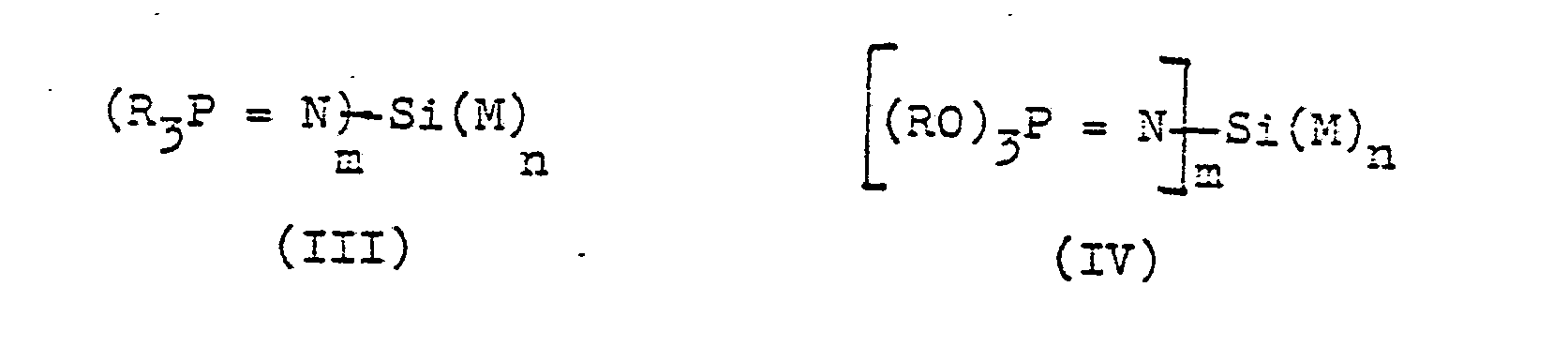
- Phosphinimines of the general structure (I) and phosphorimidates of the general structure (II) are suitable as catalysts according to the invention.
- phosphinimines of the general structures (I) and (III) or phosphorimidates of the general structures (II) and (IV) which are suitable as catalysts according to the invention can be prepared, for example, by reaction tertiary phosphines or the phosphites with the corresponding azides with nitrogen elimination take place according to the following reaction scheme (cf. Kosolapoff, Maier "Organic Phosphorous Compounds", Vol. 3, S. 71-73, S. 127-153, Vol. 6, S. 611-612):
- phosphinimines or phosphorimidates 0.1 to 3.0% by weight, preferably 0.2 to 1.5% by weight, based on the aromatic dicarboxylic acids used, of phosphinimines or phosphorimidates or mixtures of phosphinimines or phosphorimidates are used.
- Mixtures can also be used.
- the preferred solvent or diluent is the aromatic dicarboxylic acid dichloride (s) which are formed during the reaction.
- Inert diluents such as aliphatic or aromatic hydrocarbons, halogen-substituted aromatic hydrocarbons, halogen-substituted aliphatic hydrocarbons or saturated aliphatic ethers, can also be used.
- the reaction temperature is generally 70 to 180 ° C, preferably 100 to 160 ° C.
- the molar ratio of aromatic dicarboxylic acid to phosgene is preferably 1: 2 to 1: 2.5, ie a small excess of phosgene is advisable to compensate for losses resulting from the expulsion of CO 2 and HCl gas from the reaction mixture arise during phosgenation.
- the process according to the invention can be carried out batchwise or continuously.
- a solution of aromatic dicarboxylic acid, dicarboxylic acid dichloride and catalyst is allowed to flow downward against flowing phosgene gas in a reaction tube and aromatic dicarboxylic acid dichloride and catalyst are removed from the bottom of the reaction tube.
- aromatic dicarboxylic acid, aromatic dicarboxylic acid dichloride and catalyst are introduced under normal pressure.
- the mixture is then heated to 140 to 160 ° C. with stirring, the aromatic dicarboxylic acid dissolving in whole or in part.
- 2 to 2.5 moles of gaseous phosgene are introduced per mole of aromatic dicarboxylic acid.
- Isophthalic acid, 83 g (0.5 mol) terephthalic acid and 0.3 g of the catalyst are, as described in Example 1, reacted with phosgene.
Landscapes
- Chemical & Material Sciences (AREA)
- Organic Chemistry (AREA)
- Engineering & Computer Science (AREA)
- Oil, Petroleum & Natural Gas (AREA)
- Materials Engineering (AREA)
- Chemical Kinetics & Catalysis (AREA)
- Organic Low-Molecular-Weight Compounds And Preparation Thereof (AREA)
- Low-Molecular Organic Synthesis Reactions Using Catalysts (AREA)
- Polyesters Or Polycarbonates (AREA)
- Macromolecular Compounds Obtained By Forming Nitrogen-Containing Linkages In General (AREA)
Abstract
Description
- Die Erfindung betrifft ein Einstufen-Verfahren zur Herstellung von hochreinen polykondensationsfähigen aromatischen Dicarbonsäuredichloriden.
- Die Erzeugung von aliphatischen und aromatischen Säurechloriden durch Reaktion einer Carbonsäure mit Phosgen ist in den US-PS 3 184 506, 3 544 626, 3 544 627, 3 547 960 sowie in den DE-OS 2 400 007 und 2 321 122 beschrieben.Nach diesen Verfahren werden als Reaktionsprodukte dunkelgefärbte Carbonsäurechloride in einer Reinheit von 96 bis 99 erhalten. Aromatische Dicarbonsäuredichloride dieses geringen Reinheitsgrades können nicht direkt nach dem Zweiphasengrenzflächenpolykondensationsverfahren zur Herstellung von hochmolekularen Polykondensaten, wie aromatischen Polyamiden oder aromatischen Polyestern, eingesetzt werden. Ihr Gehalt an nicht oder nur halbseitig umgesetzten Dicarbonsäuren stört die Polykondensation, verursacht unerwünschten Kettenabbruch, und ergibt Polymerisate mit endständigen Carboxylgruppen. Die so hergestellten aromatischen Dicarbonsäuredichloride sind durch Verunreinigungen dunkel gefärbt und enthalten durch Umsetzung mit den Katalysatoren entstandene störende Carbamidsäurechloride (vergl. Chem. Ref. 1973, Vol. 73, Nr. 1, Seite 77 oder Angewandte Chemie (1974), Jahrg. 1962, Nr. 21, Seite 864).
- Um farblose Dicarbonsäuredichloride zu erhalten, müssen die Rohprodukte durch Umkristallisation oder Destillation gereinigt werden. Dies erfordert zusätzlichen Aufwand und vermindert die Ausbeute; bei aromatischen Dicarbonsäuredichloriden besteht die Gefahr einer spontanen Zersetzung.
- Gegenstand der Erfindung ist ein Einstufen-Verfahren zur Herstellung von reinen aromatischen Dicarbonsäuredichloriden durch Umsetzung einer aromatischen Dicarbonsäure mit Phosgen in Anwesenheit eines Katalysators und gegebenenfalls in einem Lösungsmittel und/oder Verdünnungsmittel, das dadurch gekennzeichnet ist, daß man als Katalysatoren Phosphinimine oder Phosphorimidate oder deren Mischungen verwendet. Die so erhaltenen aromatischen Dicarbonsäuredichloride sind praktisch farblos und enthalten neben den eingesetzten Katalysatoren 0,1 % Verunreinigungen oder weniger, so daß sie ohne Nachreinigung zur Herstellung von farblosen, hochmolekularen Polykondensaten eingesetzt werden können.
- Die erfindungsgemäß als Katalysatoren eingesetzten Phosphinimine oder Phosphorimidate oder Gemische von Phosphiniminen oder Phosphorimidaten stören beispielsweise die Herstellung von aromatischen Polyestern nicht. Bei den Waschvorgängen im Anschluß an das Polykondensationsverfahren nach der 2-Phasengrenzflächenmethode werden die Katalysatoren durch die wäßrig-alkalische Phase von der organischen Polymerlösung abgetrennt.
- Als erfindungsgemäße Katalysatoren sind Phosphinimine der allgemeinen Struktur (I) und Phosphorimidate der allgemeinen Struktur (II) geeignet.


- Ebenfalls geeignet als erfindungsgemäße Katalysatoren sind Phosphinimine oder Phosphorimidate der allgemeinen Strukturen (III) und (IV)
- Folgende Einzelverbindungen sind beispielsweise geeignet:


- Die Herstellung der erfindungsgemäß als Katalysatoren geeigneten Phosphinimine der allgemeinen Strukturen (I) und(III) oder Phosphorimidate der allgemeinen Strukturen (II) und (IV) kann beispielsweise durch Umsetzung tertiärer Phosphine oder der Phosphite mit den entsprechenden Aziden unter Stickstoffabspaltung gemäß dem folgenden Reaktionsschema erfolgen (vgl. Kosolapoff, Maier "Organic Phosphorous Compounds", Vol. 3, S. 71-73, S. 127-153, Vol. 6, S. 611-612):


- Besonders geeignet sind folgende Einzelverbindungen:


- Erfindungsgemäß werden 0,1 bis 3,0 Gew.-%, vorzugsweise 0,2 bis 1,5 Gew.-%, bezogen auf die eingesetzten aromatischen Dicarbonsäuren, an Phosphiniminen oder Phosphorimidaten oder Gemischen an Phosphiniminen oder Phosphorimidaten eingesetzt.
- Aromatische Dicarbonsäuren entsprechen den folgenden Formeln:


- Auch Gemische können verwendet werden.
- Beispielsweise seien genannt:
- Phthalsäure, Isophthalsäure, Terephthalsäure, Gemische aus Iso- und Terephthalsäure, Diphensäure und 1,4-Naphthalindicarbonsäure.
- Als Lösungs- oder Verdünnungsmittel werden vorzugsweise das oder die (bei Gemischen) aromatischen Dicarbonsäuredichloride eingesetzt, die während der Reaktion gebildet werden. Inerte Verdünnungsmittel, wie aliphatische oder aromatische Kohlenwasserstoffe, Halogen-substituierte aromatische Kohlenwasserstoffe, Halogen-substituierte aliphatische Kohlenwasserstoffe oder gesättigte aliphatische Ether, können mitverwendet werden. Die Reaktionstemperatur ist im allgemeinen 70 bis 180°C, vorzugsweise 100 bis 160°C.
- Das Mol-Verhältnis aromatische Dicarbonsäure zu Phosgen ist bevorzugt 1:2 bis 1:2,5, d.h., ein geringer Überschuß an Phosgen ist ratsam, um Verluste zu ersetzen, die bei der Austreibung von C02- und HCl-Gas aus dem Reaktionsgemisch während der Phosgenierung entstehen.
- Das erfindungsgemäße Verfahren kann diskontinuierlich oder kontinuierlich ausgeführt werden. In einer kontinuierlichen Ausführungsform läßt man in einem Reaktionsrohr eine Lösung aus aromatischer Dicarbonsäure, Dicarbonsäuredichlorid und Katalysator nach unten gegen aufströmendes Phosgengas strömen und nimmt am Boden des Reaktionsrohres aromatisches Dicarbonsäuredichlorid und Katalysator ab.
- In einer diskontinuierlichen Ausführungsform werden unter Normaldruck aromatische Dicarbonsäure, aromatisches Dicarbonsäuredichlorid und Katalysator vorgelegt. Dann wird unter Rühren auf 140 bis 160°C erhitzt, wobei sich die aromatische Dicarbonsäure ganz oder teilweise löst. Bei dieser Temperatur werden pro Mol aromatischer Dicarbonsäure 2 bis 2,5 Mol gasförmiges Phosgen eingeleitet.
- Nach Entfernen von überschüssigem Phosgen, HCl- und CO2-Gas durch kurzzeitiges Anlegen von Vakuum erhält man einen Rückstand, der neben der Menge an eingesetztem Katalysator zu ≥ 99,9 % aus aromatischem Dicarbonsäuredichlorid besteht, und der ohne Nachreinigung zu hochmolekularen, farblosen Polykondensaten umgesetzt werden kann.
- 203 g (1 Mol) Isophthalsäuredichlorid, 166 g Isophthalsäure (1 Mol) und 0,8 g

- Nach Abkühlen auf 120°C wird Wasserstrahlvakuum angelegt, wodurch überschüssiges Phosgen sowie im Reaktionsgemisch gelöstes HC1- und CO2-Gas entfernt werden.
- Ausbeute: 406,5 g eines farblosen Rückstandes, der aus 0,8 g des eingesetzten Phosphinimin-Katalysators und 405,7 g eines 100 %igen Isophthalsäuredichlorids (titrimetrisch bestimmt) besteht.
- 101,5 g (0,5 Mol) Isophthalsäuredichlorid, 101,5 g (0,5 Mol) Terephthalsäure-dichlorid, 83 g (0,5 Mol) Isophthalsäure, 83 g (0,5 Mol) Terephthalsäure und 0,8 g

- Ausbeute: 406,8 g eines farblosen Rückstandes, der zu 0,8 g aus eingesetztem Phosphorimidat-Katalysator und zu 406 g eines Gemisches aus 100 %igem Iso- und Terephthalsäuredichlorid (titrimetrisch bestimmt) besteht.
- 101,5 g (0,5 Mol) Isophthalsäuredichlorid, 101,5 g (0,5 Mol) Terephthalsäuredichlorid, 83 g (0,5 Mol) Isophthalsäure, 83 g (0,5 Mol) Terephthalsäure und 0,8 g

- Ausbeute: 406 g 99,9 %iges Iso- und Terephthalsäuredichlorid und 0,8 g eingesetzter Phosphinimin-Katalysator.
- 101,5 g (0,5 Mol) Isophthalsäuredichlorid, 101,5 g (0,5 Mol) Terephthalsäuredichlorid, 83 g (0,5 Mol)
- Isophthalsäure, 83 g (0,5 Mol) Terephthalsäure und 0,3 g des Katalysators

- Ausbeute: 406 g eines nahezu farblosen Rückstandes aus 0,3 g Katalysator und 405,7 g eines Gemisches aus 100 %igem Iso- und Terephthalsäuredichlorid (titrimetrisch bestimmt).
Claims (2)
Applications Claiming Priority (2)
| Application Number | Priority Date | Filing Date | Title |
|---|---|---|---|
| DE19792926789 DE2926789A1 (de) | 1979-07-03 | 1979-07-03 | Verfahren zur herstellung von aromatischen dicarbonsaeuredichloriden iii |
| DE2926789 | 1979-07-03 |
Publications (2)
| Publication Number | Publication Date |
|---|---|
| EP0022484A1 true EP0022484A1 (de) | 1981-01-21 |
| EP0022484B1 EP0022484B1 (de) | 1982-06-30 |
Family
ID=6074784
Family Applications (1)
| Application Number | Title | Priority Date | Filing Date |
|---|---|---|---|
| EP80103484A Expired EP0022484B1 (de) | 1979-07-03 | 1980-06-21 | Verfahren zur Herstellung aromatischer Dicarbonsäuredichloride und ihre Verwendung bei der Herstellung von Polykondensaten |
Country Status (4)
| Country | Link |
|---|---|
| US (1) | US4322373A (de) |
| EP (1) | EP0022484B1 (de) |
| JP (1) | JPS5612338A (de) |
| DE (2) | DE2926789A1 (de) |
Cited By (1)
| Publication number | Priority date | Publication date | Assignee | Title |
|---|---|---|---|---|
| EP0220516A1 (de) * | 1985-10-09 | 1987-05-06 | Bayer Ag | Verfahren zur Herstellung von aromatischen Carbonsäurechloriden |
Families Citing this family (3)
| Publication number | Priority date | Publication date | Assignee | Title |
|---|---|---|---|---|
| JPH0677804B2 (ja) * | 1985-02-20 | 1994-10-05 | トヨタ自動車株式会社 | 減圧充填鋳造設備 |
| JPH0615408A (ja) * | 1992-06-29 | 1994-01-25 | Tokyo Tekko Co Ltd | 薄肉鋳物の製造方法 |
| KR102674286B1 (ko) * | 2021-08-02 | 2024-06-10 | 주식회사 엘지에너지솔루션 | 배터리 관리 장치 및 방법 |
Citations (1)
| Publication number | Priority date | Publication date | Assignee | Title |
|---|---|---|---|---|
| DE2657734A1 (de) * | 1975-12-31 | 1977-07-07 | Poudres & Explosifs Ste Nale | Verfahren zur herstellung von saeurechloriden durch katalytische heissphosgenierung von carbonsaeuren |
Family Cites Families (1)
| Publication number | Priority date | Publication date | Assignee | Title |
|---|---|---|---|---|
| US3810940A (en) * | 1972-04-07 | 1974-05-14 | Union Carbide Corp | Process for producing acid chlorides |
-
1979
- 1979-07-03 DE DE19792926789 patent/DE2926789A1/de not_active Withdrawn
-
1980
- 1980-06-21 DE DE8080103484T patent/DE3060620D1/de not_active Expired
- 1980-06-21 EP EP80103484A patent/EP0022484B1/de not_active Expired
- 1980-06-30 US US06/164,342 patent/US4322373A/en not_active Expired - Lifetime
- 1980-07-03 JP JP9004180A patent/JPS5612338A/ja active Granted
Patent Citations (1)
| Publication number | Priority date | Publication date | Assignee | Title |
|---|---|---|---|---|
| DE2657734A1 (de) * | 1975-12-31 | 1977-07-07 | Poudres & Explosifs Ste Nale | Verfahren zur herstellung von saeurechloriden durch katalytische heissphosgenierung von carbonsaeuren |
Non-Patent Citations (1)
| Title |
|---|
| CHEMICAL ABSTRACTS, Band 84, Nr. 21, 24. Mai 1976, Zusammenfassung Nr. 150214w, Seite 510, Columbus, Ohio, US & JP-A-51 001410 (NIPPON POLYURETHANE INDUSTRY CO. LTD.) 08-01-1976 * |
Cited By (1)
| Publication number | Priority date | Publication date | Assignee | Title |
|---|---|---|---|---|
| EP0220516A1 (de) * | 1985-10-09 | 1987-05-06 | Bayer Ag | Verfahren zur Herstellung von aromatischen Carbonsäurechloriden |
Also Published As
| Publication number | Publication date |
|---|---|
| DE2926789A1 (de) | 1981-01-15 |
| JPS5612338A (en) | 1981-02-06 |
| US4322373A (en) | 1982-03-30 |
| JPS6251255B2 (de) | 1987-10-29 |
| DE3060620D1 (en) | 1982-08-19 |
| EP0022484B1 (de) | 1982-06-30 |
Similar Documents
| Publication | Publication Date | Title |
|---|---|---|
| EP0319767B1 (de) | Verfahren zur Herstellung von Trifluormethansulfonsäurechlorid | |
| EP0024286B1 (de) | Verfahren zur Herstellung aromatischer Dicarbonsäuredichloride und ihre Verwendung bei der Herstellung von Polykondensaten | |
| EP0021373B1 (de) | Verfahren zur Herstellung aromatischer Dicarbonsäuredichloride und ihre Verwendung bei der Herstellung von Polykondensaten | |
| EP0022484B1 (de) | Verfahren zur Herstellung aromatischer Dicarbonsäuredichloride und ihre Verwendung bei der Herstellung von Polykondensaten | |
| EP0024492B1 (de) | Verfahren zur Herstellung aromatischer Dicarbonsäuredichloride und ihre Verwendung bei der Herstellung von Polykondensaten | |
| EP0050775B1 (de) | Verfahren zur Herstellung von aromatischen Carbonsäurechloriden | |
| DE2525442B2 (de) | Verfahren zur herstellung geminaler dihalogenide | |
| EP1084091B1 (de) | Verfahren zur herstellung von alkyl-, alkenyl- und alkinylchloriden | |
| EP0050783B1 (de) | Verfahren zur Herstellung von aromatischen Carbonsäurechloriden | |
| DE3104388A1 (de) | Verfahren zur herstellung von 1-alkyl-2-chlor-5-nitro-4-benzol-sulfonsaeuren | |
| EP0846692B1 (de) | Verfahren zur Herstellung von 3-Chlorbenzisothiazolen | |
| DE2226774A1 (de) | Verfahren zur Herstellung von Distannanen | |
| EP0266544B1 (de) | Verfahren zur Herstellung von Halogenalkoholen | |
| EP1125913A1 (de) | Verfahren zur Herstellung von 3,5-Bis-(trifluormethyl)-benzoylchloriden und neue 3,5-Bis-(trihalogenomethyl)- und 3,5-Dimethylbenzoylhalogenide | |
| EP0558938B1 (de) | Fluorsubstituierte Dicarbonsäuren sowie ein Verfahren zu ihrer Herstellung und Verwendung | |
| EP0010595A1 (de) | Bis(4-hydroxyphenylthiophenyl)biphenyldisulfone und Bis(4-hydroxyphenylsulfonylphenyl)-biphenyldisulfone, ihre Herstellung und Verwendung | |
| DE2357677A1 (de) | Verfahren zur herstellung von alphachlor-acrylsaeurechlorid | |
| DE2357678C3 (de) | Verfahren zur Herstellung von Alkenphosphonsäurechloriden und Alkenphosphmsäurechloriden | |
| DE2920536A1 (de) | Polyhalogenierte kohlenwasserstoffe und verfahren zu ihrer herstellung | |
| DE3342462A1 (de) | Verfahren zur herstellung von 4,4'-diaminobenzophenonen | |
| DE1104501B (de) | Verfahren zur Herstellung von O, O-Dialkylthionophosphor-saeurechloriden | |
| DE1170928B (de) | Verfahren zur Herstellung von Benzoldicarbonsaeuredichloriden oder deren Gemischen | |
| DE2113439A1 (de) | Verfahren zur Herstellung von 4-Chlorformyl-phtalsaeureanhydrid |
Legal Events
| Date | Code | Title | Description |
|---|---|---|---|
| PUAI | Public reference made under article 153(3) epc to a published international application that has entered the european phase |
Free format text: ORIGINAL CODE: 0009012 |
|
| 17P | Request for examination filed |
Effective date: 19800621 |
|
| AK | Designated contracting states |
Designated state(s): BE DE FR GB IT NL |
|
| ITF | It: translation for a ep patent filed | ||
| GRAA | (expected) grant |
Free format text: ORIGINAL CODE: 0009210 |
|
| AK | Designated contracting states |
Designated state(s): BE DE FR GB IT NL |
|
| DB1 | Publication of patent cancelled | ||
| PUAC | Information related to the publication of a b1 document modified or deleted |
Free format text: ORIGINAL CODE: 0009299EPPU |
|
| REF | Corresponds to: |
Ref document number: 3060620 Country of ref document: DE Date of ref document: 19820819 |
|
| AK | Designated contracting states |
Designated state(s): BE DE FR GB IT NL |
|
| RB1 | B1 document published (corrected) |
Effective date: 19820922 |
|
| PGFP | Annual fee paid to national office [announced via postgrant information from national office to epo] |
Ref country code: NL Payment date: 19830630 Year of fee payment: 4 |
|
| PG25 | Lapsed in a contracting state [announced via postgrant information from national office to epo] |
Ref country code: NL Effective date: 19850101 |
|
| NLV4 | Nl: lapsed or anulled due to non-payment of the annual fee | ||
| PGFP | Annual fee paid to national office [announced via postgrant information from national office to epo] |
Ref country code: GB Payment date: 19890531 Year of fee payment: 10 |
|
| PGFP | Annual fee paid to national office [announced via postgrant information from national office to epo] |
Ref country code: BE Payment date: 19890621 Year of fee payment: 10 |
|
| ITTA | It: last paid annual fee | ||
| PGFP | Annual fee paid to national office [announced via postgrant information from national office to epo] |
Ref country code: FR Payment date: 19890630 Year of fee payment: 10 |
|
| PG25 | Lapsed in a contracting state [announced via postgrant information from national office to epo] |
Ref country code: GB Effective date: 19900621 |
|
| PG25 | Lapsed in a contracting state [announced via postgrant information from national office to epo] |
Ref country code: BE Effective date: 19900630 |
|
| BERE | Be: lapsed |
Owner name: BAYER A.G. Effective date: 19900630 |
|
| GBPC | Gb: european patent ceased through non-payment of renewal fee | ||
| PG25 | Lapsed in a contracting state [announced via postgrant information from national office to epo] |
Ref country code: FR Effective date: 19910228 |
|
| REG | Reference to a national code |
Ref country code: FR Ref legal event code: ST |
|
| PGFP | Annual fee paid to national office [announced via postgrant information from national office to epo] |
Ref country code: DE Payment date: 19910528 Year of fee payment: 12 |
|
| PG25 | Lapsed in a contracting state [announced via postgrant information from national office to epo] |
Ref country code: DE Effective date: 19930302 |
|
| PLBE | No opposition filed within time limit |
Free format text: ORIGINAL CODE: 0009261 |
|
| STAA | Information on the status of an ep patent application or granted ep patent |
Free format text: STATUS: NO OPPOSITION FILED WITHIN TIME LIMIT |