EP0021183B1 - Ceramic material processing - Google Patents
Ceramic material processing Download PDFInfo
- Publication number
- EP0021183B1 EP0021183B1 EP80103149A EP80103149A EP0021183B1 EP 0021183 B1 EP0021183 B1 EP 0021183B1 EP 80103149 A EP80103149 A EP 80103149A EP 80103149 A EP80103149 A EP 80103149A EP 0021183 B1 EP0021183 B1 EP 0021183B1
- Authority
- EP
- European Patent Office
- Prior art keywords
- mold
- green body
- slip
- station
- microwave
- Prior art date
- Legal status (The legal status is an assumption and is not a legal conclusion. Google has not performed a legal analysis and makes no representation as to the accuracy of the status listed.)
- Expired
Links
Images
Classifications
-
- B—PERFORMING OPERATIONS; TRANSPORTING
- B28—WORKING CEMENT, CLAY, OR STONE
- B28B—SHAPING CLAY OR OTHER CERAMIC COMPOSITIONS; SHAPING SLAG; SHAPING MIXTURES CONTAINING CEMENTITIOUS MATERIAL, e.g. PLASTER
- B28B1/00—Producing shaped prefabricated articles from the material
- B28B1/26—Producing shaped prefabricated articles from the material by slip-casting, i.e. by casting a suspension or dispersion of the material in a liquid-absorbent or porous mould, the liquid being allowed to soak into or pass through the walls of the mould; Moulds therefor ; specially for manufacturing articles starting from a ceramic slip; Moulds therefor
Definitions
- This invention relates to ceramic material processes according to the first part of claim 1. Such a process is known from FR-A-2079945.
- microwave energy removes water from slip, clay and plaster-of-paris molds with surprising rapidity and with impressive efficiency.
- a three- to four- minute microwave exposure at approximately 750 watts is sufficient with a set time of about twenty minutes, for example, to produce a "green body" with the same green strength and mechanical stability as a body produced in one hour to two hours in the conventional manner of the prior art.
- microwave application to ware production decouples the process from the plant atmosphere by rapidly expelling water from plaster molds to a degree of dryness that enables these molds to be ready for use within a "green body" set-up cycle.
- wet plaster couples to microwave energy much more efficiently than dry plaster, thereby enabling the moisture removing heat to be preferentially generated in the wet portions of the mold. This phenomenon further decreases not only the mold drying time but also reduces the energy requirements for this portion of the process.
- Mold drying in this manner is so efficient that after microwave application the individual molds are, in accordance with a specific feature of the invention, weighed and subjected to a water spray in order to achieve a proper degree of wetness.
- the entire matter of mold preparation is removed from a dependency upon the personal judgment of a skilled technician with attendant quality assurance problems, and placed on an analytical basis that is independent of personal judgment. "Green body" production yields are markedly improved.
- the molds have been dried as a consequence of the microwave process during the set up time in the oven.
- the molds then are weighed to determine actual moisture content and moistened to adjust the weight to that required for proper casting if necessary, in order to make the molds so treated immediately available for another "slip" pouring.
- the mold inventory for a given ware production level reduced markedly, but three-shift operation with the same molds becomes possible and plant or drying room atmosphere control is no longer required.
- the process is "balanced” in that the mold, mold and "green body", or only the “green body”, is coordinated with the conveyor mechanism and the dwell time that this mechanism establishes within a microwave oven to time the transfer of the material that is being processed to move at a steady, continuous pace through the oven or ovens.
- the material emerging from the oven will have completed a particular phase of the heating or drying process as a part of a continuously moving production line.
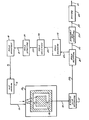
- an illustrative embodiment of the invention involves an initial step of mold assembly at a mold assembly station 10.
- a mold assembly station 10 permeable and suitably dry plaster-of-paris segments of a mold are fitted together to form a complete mold.
- One or more of these assembled molds are placed on a robot, or moving conveyor 11, for transport to a "slip" pouring station 12.
- the mold is filled and the combination mold and "slip" then are moved on a conveyor 13 to a microwave oven 14.
- a mold and slip combination 15 in a microwave test oven at an exposure of approximately 750 watts for about four minutes will, after setting for about twenty minutes followed by "slip" dump, produce a "green body".
- the mold and slip combination 15 is moved out of the oven 14 on a conveyor 16 during an interval of about twenty minutes to an excess slip decanting station 17.
- the liquid slip is drained from the mold.
- the mold now encloses only a "green body”.
- the mold and "green body” both are moved from the slip decanting station 17 along a conveyor 20 to a mold removal station 21.
- the plaster-of-paris portions of the mold are separated from each other and from the "green body”.
- test data is as follows:
- the robot or the conveyor 13 can run several mold and "slip" combinations into the microwave oven 14 for a period of time. After this initial period, the conveyor 16 may withdraw the mold, mold surface cake and "slip” combination from the oven 14 in order to decant the excess "slip” at the "slip” decanting station 17. In accordance with this illustrative embodiment of the invention, however, the robot or conveyor 16 can then transfer the mold and mold cake combination back into another microwave oven 15 in the direction of arrow 18 for about twelve minutes of drying to enable the mold surface cake to set up to green strength. Naturally, the combination mold and "green body" are transferred to the mold removal station 21 for separation and further processing. The process selected may include variations of the two methods.
- the now separated mold is sent by way of a conveyor 22 to a mold cleaning station 23.
- a mold cleaning station 23 At the cleaning station 23, any bits of the "green body” that adhere to the surface of the mold are removed in order to prevent matter of this character from marring the appearance of subsequent articles produced in this mold.
- the now dry mold segments are transferred by means of a conveyor 25 to a mold-weighing station 26 in order to determine the precise quantity of absorbed water that was expelled from the segments in the process by comparing with the tare weight.
- microwave processes have been found to be extremely efficient in drying wet plaster-of-paris molds. For example, in practicing the invention, approximately three pounds of water is removed per hour per kW at an efficiency (depending on size of load - more load, more efficient) approaching 50 percent of line input power to the microwave oven.
- the mold segments are dried to such a degree that it actually is necessary to add water to these molds in order to bring them up to an acceptable level of dampness.
- the actual degree of mold dryness is determined to a high degree of accuracy by weighing the mold at the station 26.
- a conveyor 27 draws the dry, weighed molds to a mold-spraying station 30 for moisture addition.
- sufficient water is added to the mold under consideration as determined, for example, through the increase in mold weight, to attain the proper degree of dampness for acceptable "green body” set up.
- the functions of the mold-weighing station 26 and the mold-spraying station 30 can be combined, depending on the desired production system organization.
- the now moistened mold is transported by means of a conveyor 31 to the mold assembly station 10, to enable the above- described process of "green body” production to begin anew.
- a “dried bowl” is defined as one which neither gained nor lost weight as it cooled overnight; a “super-dried Bowl” is one which showed unmistakable weight gain during cooling. Specific results in that regard are dependent upon ambient humidity conditions. Humidity measurements were not made.
- Tests were performed using both microwave frequencies allocated for industrial purposes, 915 MHz and 2450 MHz. No significant differences were noted between the ovens in terms of efficiency or allowable rate of drying. Because of considerations of access to the 2450 MHz (i.e., a small door requiring much manipulation of parts in the oven), tests attempting the drying of two bowls at once were run only in the 915 MHz oven.
- Process parameters presented are those associated with drying the toilet bowl, the gating item in terms of process time and energy levels.
- the basic drying process requires about 4 kWhrs of microwave energy/bowl. The time required in hours is then 4/divided by the power level in kW.
- the data shows that under the specific test conditions, at power level of three (3) kilowatts, the bodies burst. At two (2) kilowatts, cracking or bursts are likely. At one (1) kilowatt, parts can be predictably produced under ambient conditions without much attention to air flow. At a level of 1.5 kilowatts, second order effects begin to appear. Air flow velocities and distributions become significant. Proper management of air, at ambient humidity, will allow predictable fault-free drying.
- a conveyor 36 transfers the dried ware to glazing and firing stations (not shown in the drawing), for final treatment in a kiln, or the like.
Landscapes
- Engineering & Computer Science (AREA)
- Chemical & Material Sciences (AREA)
- Ceramic Engineering (AREA)
- Dispersion Chemistry (AREA)
- Manufacturing & Machinery (AREA)
- Mechanical Engineering (AREA)
- Devices For Post-Treatments, Processing, Supply, Discharge, And Other Processes (AREA)
- Molds, Cores, And Manufacturing Methods Thereof (AREA)
- Drying Of Solid Materials (AREA)
- Producing Shaped Articles From Materials (AREA)
Applications Claiming Priority (2)
| Application Number | Priority Date | Filing Date | Title |
|---|---|---|---|
| US06/052,874 US4292262A (en) | 1979-06-28 | 1979-06-28 | Ceramic material processing |
| US52874 | 1993-04-26 |
Publications (2)
| Publication Number | Publication Date |
|---|---|
| EP0021183A1 EP0021183A1 (en) | 1981-01-07 |
| EP0021183B1 true EP0021183B1 (en) | 1983-09-21 |
Family
ID=21980464
Family Applications (1)
| Application Number | Title | Priority Date | Filing Date |
|---|---|---|---|
| EP80103149A Expired EP0021183B1 (en) | 1979-06-28 | 1980-06-06 | Ceramic material processing |
Country Status (7)
| Country | Link |
|---|---|
| US (1) | US4292262A (member.php) |
| EP (1) | EP0021183B1 (member.php) |
| JP (1) | JPS568210A (member.php) |
| BR (1) | BR8003997A (member.php) |
| CA (1) | CA1155278A (member.php) |
| DE (1) | DE3064907D1 (member.php) |
| GR (1) | GR69279B (member.php) |
Families Citing this family (12)
| Publication number | Priority date | Publication date | Assignee | Title |
|---|---|---|---|---|
| US4883621A (en) * | 1985-07-12 | 1989-11-28 | Hitachi, Ltd. | Method for forming cast article by slip casting |
| EP0257587B1 (en) * | 1986-08-29 | 1990-10-31 | AT&T Corp. | Methods of soot overcladding an optical preform |
| US4757172A (en) * | 1986-09-24 | 1988-07-12 | Questech Inc. | Method and apparatus for the microwave joining of nonoxide ceramic items |
| US4767902A (en) * | 1986-09-24 | 1988-08-30 | Questech Inc. | Method and apparatus for the microwave joining of ceramic items |
| FR2683761B1 (fr) * | 1991-11-19 | 1999-04-09 | Forgel Sa | Dispositif de sechage de moule en platre. |
| CA2110171C (en) * | 1992-03-26 | 1997-06-03 | Ritsu Sato | Composition for high pressure casting slip, high pressure casting slip and method for preparing the composition and slip |
| AUPO304896A0 (en) * | 1996-10-17 | 1996-11-14 | Caroma Industries Limited | Continuous production of green ware articles |
| AU718558B2 (en) * | 1996-10-17 | 2000-04-13 | Caroma Industries Limited | Continuous production of green ware articles |
| JP2000510434A (ja) * | 1997-04-10 | 2000-08-15 | ニューコン システムズ、インコーポレイション | 厚壁セラミック製品の製造方法および装置 |
| US6134821A (en) * | 1998-01-16 | 2000-10-24 | Magnum Magnetics | Magnetic signage systems and processes related thereto |
| EP1249156A4 (en) | 1999-12-28 | 2004-11-17 | Corning Inc | HYBRID METHOD FOR BURNING CERAMIC PRODUCTS |
| US6344635B2 (en) | 1999-12-28 | 2002-02-05 | Corning Incorporated | Hybrid method for firing of ceramics |
Family Cites Families (10)
| Publication number | Priority date | Publication date | Assignee | Title |
|---|---|---|---|---|
| CH454719A (de) * | 1963-11-14 | 1968-04-15 | Tesla Np | Verfahren und Vorrichtung zur Verfestigung und Vortrocknung von keramischem oder ähnlichem Schlicker |
| US3469053A (en) * | 1965-10-19 | 1969-09-23 | Melvin L Levinson | Microwave kiln |
| FR2079945A5 (member.php) * | 1970-02-18 | 1971-11-12 | Materiel Telephonique | |
| US3673288A (en) * | 1970-09-17 | 1972-06-27 | Dolomite Brick Corp Of America | Microwave method for tempering tar-bonded refractory bricks |
| US3935060A (en) * | 1973-10-25 | 1976-01-27 | Mcdonnell Douglas Corporation | Fibrous insulation and process for making the same |
| US3953703A (en) * | 1974-10-03 | 1976-04-27 | Materials Research Corporation | Method for drying ceramic tape |
| FR2335470A2 (fr) * | 1975-08-26 | 1977-07-15 | Automatisme & Technique | Procede et installation pour le frittage de produits ceramiques |
| US4126651A (en) * | 1975-09-02 | 1978-11-21 | Valentine Match Plate Company | Production of plaster molds by microwave treatment |
| SE412504B (sv) * | 1977-04-07 | 1980-03-03 | Inst For Mikrovagsteknik Vid T | Sett och anordning for att medelst mikrovagsenergi astadkomma en i huvudsak likformig uppvermning |
| US4150514A (en) * | 1977-10-28 | 1979-04-24 | Ferro Corporation | Process for molding bonded refractory particles |
-
1979
- 1979-06-28 US US06/052,874 patent/US4292262A/en not_active Expired - Lifetime
-
1980
- 1980-06-03 CA CA000353266A patent/CA1155278A/en not_active Expired
- 1980-06-06 DE DE8080103149T patent/DE3064907D1/de not_active Expired
- 1980-06-06 GR GR62145A patent/GR69279B/el unknown
- 1980-06-06 EP EP80103149A patent/EP0021183B1/en not_active Expired
- 1980-06-26 BR BR8003997A patent/BR8003997A/pt unknown
- 1980-06-27 JP JP8672980A patent/JPS568210A/ja active Pending
Also Published As
| Publication number | Publication date |
|---|---|
| EP0021183A1 (en) | 1981-01-07 |
| JPS568210A (en) | 1981-01-28 |
| CA1155278A (en) | 1983-10-18 |
| US4292262A (en) | 1981-09-29 |
| BR8003997A (pt) | 1981-01-21 |
| GR69279B (member.php) | 1982-05-13 |
| DE3064907D1 (en) | 1983-10-27 |
Similar Documents
| Publication | Publication Date | Title |
|---|---|---|
| EP0021183B1 (en) | Ceramic material processing | |
| US3732048A (en) | Apparatus for casting of ceramics | |
| EP0009669B1 (en) | Microwave drying of ceramic shell molds | |
| DK486285D0 (da) | Fremgangsmaade og apparat til toerring af overtrukne emner ved infraroedstraaling | |
| EP0266967B1 (en) | Method of drying refractory coated foam patterns | |
| US4271203A (en) | Microwave proofing and baking bread utilizing metal pans | |
| SE7708799L (sv) | Forfarande och apparat till torkning av inneslutningsgjutformar | |
| US4341724A (en) | Method for the manufacture of ceramic products | |
| CN117550873A (zh) | 实心陶瓷及其制备方法 | |
| SU1141643A1 (ru) | Способ изготовления многослойной оболочковой формы по выплавляемым моделям | |
| JPS5523911A (en) | Ice cream manufacturing device | |
| JPS57186440A (en) | Steaming nethod and steaming apparatus for preparing green tea | |
| JPS62289344A (ja) | 精密鋳型製造における脱ロウ方法 | |
| SU1033111A1 (ru) | Способ производства зеленого байхового ча | |
| JPS56117860A (en) | Production of mold | |
| KR20180069714A (ko) | 인스턴트 라이스의 제조 방법 | |
| JPH0113348B2 (member.php) | ||
| RU2225289C1 (ru) | Способ изготовления пенодиатомитовых кирпичей | |
| JPS5296444A (en) | Defrozing method and apparatus | |
| SU791696A1 (ru) | Способ изготовлени изделий из керамических материалов | |
| JPH06265266A (ja) | 水分含有物の乾燥方法 | |
| SU749810A1 (ru) | Способ изготовлени теплоизол ционных изделий | |
| JPH0657618B2 (ja) | 窯業製品の製造方法及びその装置 | |
| JPS5597497A (en) | Drying and baking of paint film formed by powder electrodeposition coating method | |
| JPS6211938B2 (member.php) |
Legal Events
| Date | Code | Title | Description |
|---|---|---|---|
| PUAI | Public reference made under article 153(3) epc to a published international application that has entered the european phase |
Free format text: ORIGINAL CODE: 0009012 |
|
| AK | Designated contracting states |
Designated state(s): BE DE FR GB IT NL |
|
| 17P | Request for examination filed |
Effective date: 19810612 |
|
| ITF | It: translation for a ep patent filed | ||
| GRAA | (expected) grant |
Free format text: ORIGINAL CODE: 0009210 |
|
| AK | Designated contracting states |
Designated state(s): BE DE FR GB IT NL |
|
| REF | Corresponds to: |
Ref document number: 3064907 Country of ref document: DE Date of ref document: 19831027 |
|
| ET | Fr: translation filed | ||
| PGFP | Annual fee paid to national office [announced via postgrant information from national office to epo] |
Ref country code: DE Payment date: 19840516 Year of fee payment: 5 |
|
| PGFP | Annual fee paid to national office [announced via postgrant information from national office to epo] |
Ref country code: BE Payment date: 19840630 Year of fee payment: 5 |
|
| PLBE | No opposition filed within time limit |
Free format text: ORIGINAL CODE: 0009261 |
|
| STAA | Information on the status of an ep patent application or granted ep patent |
Free format text: STATUS: NO OPPOSITION FILED WITHIN TIME LIMIT |
|
| 26N | No opposition filed | ||
| PGFP | Annual fee paid to national office [announced via postgrant information from national office to epo] |
Ref country code: FR Payment date: 19841009 Year of fee payment: 5 |
|
| PGFP | Annual fee paid to national office [announced via postgrant information from national office to epo] |
Ref country code: NL Payment date: 19850630 Year of fee payment: 6 |
|
| PG25 | Lapsed in a contracting state [announced via postgrant information from national office to epo] |
Ref country code: NL Effective date: 19870101 |
|
| NLV4 | Nl: lapsed or anulled due to non-payment of the annual fee | ||
| BERE | Be: lapsed |
Owner name: TOBIN LEO WILLIAM JR Effective date: 19870630 |
|
| PG25 | Lapsed in a contracting state [announced via postgrant information from national office to epo] |
Ref country code: FR Free format text: LAPSE BECAUSE OF NON-PAYMENT OF DUE FEES Effective date: 19890228 |
|
| REG | Reference to a national code |
Ref country code: FR Ref legal event code: ST |
|
| PG25 | Lapsed in a contracting state [announced via postgrant information from national office to epo] |
Ref country code: GB Effective date: 19890606 |
|
| PG25 | Lapsed in a contracting state [announced via postgrant information from national office to epo] |
Ref country code: BE Effective date: 19890630 |
|
| GBPC | Gb: european patent ceased through non-payment of renewal fee | ||
| PG25 | Lapsed in a contracting state [announced via postgrant information from national office to epo] |
Ref country code: DE Effective date: 19900301 |
|
| ITTA | It: last paid annual fee |