EP0016251B1 - Elektronische Dünnschichtschaltung und deren Herstellungsverfahren - Google Patents
Elektronische Dünnschichtschaltung und deren Herstellungsverfahren Download PDFInfo
- Publication number
- EP0016251B1 EP0016251B1 EP79104498A EP79104498A EP0016251B1 EP 0016251 B1 EP0016251 B1 EP 0016251B1 EP 79104498 A EP79104498 A EP 79104498A EP 79104498 A EP79104498 A EP 79104498A EP 0016251 B1 EP0016251 B1 EP 0016251B1
- Authority
- EP
- European Patent Office
- Prior art keywords
- layer
- nickel
- valve metal
- pattern
- film circuit
- Prior art date
- Legal status (The legal status is an assumption and is not a legal conclusion. Google has not performed a legal analysis and makes no representation as to the accuracy of the status listed.)
- Expired
Links
Images



Classifications
-
- H—ELECTRICITY
- H10—SEMICONDUCTOR DEVICES; ELECTRIC SOLID-STATE DEVICES NOT OTHERWISE PROVIDED FOR
- H10D—INORGANIC ELECTRIC SEMICONDUCTOR DEVICES
- H10D86/00—Integrated devices formed in or on insulating or conducting substrates, e.g. formed in silicon-on-insulator [SOI] substrates or on stainless steel or glass substrates
- H10D86/80—Integrated devices formed in or on insulating or conducting substrates, e.g. formed in silicon-on-insulator [SOI] substrates or on stainless steel or glass substrates characterised by multiple passive components, e.g. resistors, capacitors or inductors
- H10D86/85—Integrated devices formed in or on insulating or conducting substrates, e.g. formed in silicon-on-insulator [SOI] substrates or on stainless steel or glass substrates characterised by multiple passive components, e.g. resistors, capacitors or inductors characterised by only passive components
-
- Y—GENERAL TAGGING OF NEW TECHNOLOGICAL DEVELOPMENTS; GENERAL TAGGING OF CROSS-SECTIONAL TECHNOLOGIES SPANNING OVER SEVERAL SECTIONS OF THE IPC; TECHNICAL SUBJECTS COVERED BY FORMER USPC CROSS-REFERENCE ART COLLECTIONS [XRACs] AND DIGESTS
- Y10—TECHNICAL SUBJECTS COVERED BY FORMER USPC
- Y10T—TECHNICAL SUBJECTS COVERED BY FORMER US CLASSIFICATION
- Y10T29/00—Metal working
- Y10T29/49—Method of mechanical manufacture
- Y10T29/49002—Electrical device making
- Y10T29/49082—Resistor making
- Y10T29/49099—Coating resistive material on a base
-
- Y—GENERAL TAGGING OF NEW TECHNOLOGICAL DEVELOPMENTS; GENERAL TAGGING OF CROSS-SECTIONAL TECHNOLOGIES SPANNING OVER SEVERAL SECTIONS OF THE IPC; TECHNICAL SUBJECTS COVERED BY FORMER USPC CROSS-REFERENCE ART COLLECTIONS [XRACs] AND DIGESTS
- Y10—TECHNICAL SUBJECTS COVERED BY FORMER USPC
- Y10T—TECHNICAL SUBJECTS COVERED BY FORMER US CLASSIFICATION
- Y10T29/00—Metal working
- Y10T29/49—Method of mechanical manufacture
- Y10T29/49002—Electrical device making
- Y10T29/49082—Resistor making
- Y10T29/49101—Applying terminal
-
- Y—GENERAL TAGGING OF NEW TECHNOLOGICAL DEVELOPMENTS; GENERAL TAGGING OF CROSS-SECTIONAL TECHNOLOGIES SPANNING OVER SEVERAL SECTIONS OF THE IPC; TECHNICAL SUBJECTS COVERED BY FORMER USPC CROSS-REFERENCE ART COLLECTIONS [XRACs] AND DIGESTS
- Y10—TECHNICAL SUBJECTS COVERED BY FORMER USPC
- Y10T—TECHNICAL SUBJECTS COVERED BY FORMER US CLASSIFICATION
- Y10T428/00—Stock material or miscellaneous articles
- Y10T428/24—Structurally defined web or sheet [e.g., overall dimension, etc.]
- Y10T428/24802—Discontinuous or differential coating, impregnation or bond [e.g., artwork, printing, retouched photograph, etc.]
- Y10T428/24917—Discontinuous or differential coating, impregnation or bond [e.g., artwork, printing, retouched photograph, etc.] including metal layer
Definitions
- the invention relates to an electronic thin film circuit according to the preamble of the main claim.
- An electronic thin-film circuit of this type is already known from US Pat. No. 3256588, in which the nickel layer is applied directly to the valve metal-containing layer in the region of the first pattern for forming the conductor tracks and / or connection contacts. With this thin-layer circuit it is difficult to apply the nickel layer with good adhesion to the valve metal-containing layer. If a connecting wire is to be attached to the nickel layer by soldering, there is a risk with longer soldering times that the nickel layer dissolves in the applied solder to such an extent that its adhesion to the layer containing the valve metal is lost.
- the thin-layer circuit according to the invention with the characterizing features of claim 1 has the advantage that the transition layer arranged between the nickel layer and the valve metal-containing layer considerably improves the adhesion of the nickel layer to the valve metal-containing layer. If a connecting wire is to be attached to the nickel layer in the area of the first pattern by soldering and / or if the entire area of the nickel layer is to be reinforced by applying a solder layer, the solder can no longer penetrate to the valve metal-containing layer, since the transition layer as Diffusion barrier works.
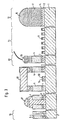
- FIG. 1 shows a partial section through a thin-film circuit according to the invention, which contains a temperature-independent and a temperature-dependent resistor
- FIGS. 2a to 2n show the thin-film circuit according to FIG. 1 being produced in the various process steps to be carried out according to the invention
- Fig. 4a to 4d is a schematic representation of the formation of the transition layer and its effect as a solder barrier.
- Fig. 1 denotes an insulating substrate plate, which consists, for example, of soft glass or Al 2 O 3 ceramic or of a metal plate covered with an insulation layer, for example of spring steel or ferrite.
- a tantalum layer 2 containing the basic geometry of the circuit network is applied to the substrate plate 1.
- Layer 2 can also consist of tantalum nitride or tantalum oxynitride (TaO 2 N y ) or of a tantalum aluminum alloy. Instead of tantalum, it can also contain another valve metal, for example niobium, aluminum, zirconium or hafnium, as the main component.
- the tantalum layer 2 forms a first, a second and a third pattern of the electronic thin-film circuit, of which the first pattern M, a conductor track and / or a connection contact, the second pattern M z defines a temperature-independent resistor and the third pattern M 3 defines a temperature-dependent resistor .
- the tantalum layer 2 is covered with a transition layer 4, which contains tantalum, tantalum oxide, nickel, nickel oxide and mixed phases of these components.
- a nickel layer 5 is arranged on the transition layer 4 in the region of the first pattern M 1 and a solder layer 6 is arranged on the nickel layer 5, which layer may consist of lead-tin soft solder.
- the layers 2, 4, 5 and 6 form the conductor track and / or the connection contact in the region of the first pattern M 1 .
- the solder layer 6 can also be omitted or replaced by a galvanically applied reinforcing layer.
- the tantalum layer 2 forms the temperature-independent resistance and is covered with a tantalum oxide layer 9.
- the tantalum layer 2 is covered, as in the area of the first pattern M, with the transition layer 4 and the transition layer 4 with the nickel layer 5.
- the layers 2, 4 and 5 form the temperature-dependent resistance (sensor) in the region of the third pattern M 3 .
- the tantalum oxide layer 9 provided in the area of the second pattern M 2 can also be replaced by a layer 30 (compare FIGS. 2i and 3), the formation and composition of which is described below.
- FIG. 2a to 2n show the electronic thin-film circuit according to FIG. 1, which is being produced, in the various process steps to be carried out according to the invention.
- the tantalum layer 2 is first applied to the insulating substrate plate 1 as a continuous layer by sputtering (FIG. 2a). Their layer thickness results from the two tasks that are assigned to this tantalum layer. It is an adhesion promoter between the substrate plate 1 and all subsequent layers.
- the second pattern M 2 long-term stable, anodically adjustable, largely temperature-independent resistors with a temperature coefficient of less than 100 ppm / ° C are produced, the relative change in resistance due to mechanical deformation is about twice as large as that caused by relative extension of resistance.
- this tantalum adhesive and resistance layer 2 should have a sheet resistance which is between 20 and 200 Q, preferably at 50 ⁇ .
- the tantalum layer 2 is now first oxidized to form the tantalum oxide layer 3 (FIG. 2b) on the exposed surface, preferably in a plate washing and drying process in which all foreign particles are removed from its surface at the same time, which lead to defects in the further layer structure can.
- the thickness of the tantalum oxide layer 3 is adjusted to 3 to 10 nm, preferably to 5 nm, with the aid of the temperature and duration of the plate drying. It is in any case thicker than the natural tantalum surface oxide layer, which slowly forms when the plates are stored.
- the oxide layer 3 can also be produced by other methods, for example with the aid of anodic oxidation, in which case the desired thickness can then be set via the adjustment parameters.
- the tantalum layer 2 covered with the closed oxide layer 3 is covered over the entire area with a nickel layer 5, the sputtering energy being selected so high that, firstly, the tantalum layer 2 is pre-aged due to the thermal load and thus maintains its long-term stability, and that it secondly, there is an intermetallic diffusion of nickel atoms into the tantalum oxide layer 3, a transition layer 4 (FIG. 2c) containing tantalum, tantalum oxide, nickel, nickel oxide and mixed phases of these constituents being formed via reduction and oxidation processes and which excels the nickel layer 5 on the tantalum layer 2 anchored and produces a good ohmic contact between the tantalum layer 2 and the nickel layer 5.
- a transition layer 4 FIG. 2c
- the necessary surface oxidation of the tantalum layer is produced in a delayed cooling phase by reaction with the residual oxidation gas. If the energy of nickel dusting has to be kept so low for other reasons that the nickel diffusion into the tantalum oxide layer has not yet taken place sufficiently, the diffusion process and the aging of the tantatum layer can also take place in a subsequent tempering process.
- the nickel layer 5 fulfills the following tasks:
- the third pattern M 3 (see FIG. 1) temperature-sensitive resistance layer with a practically linear temperature dependence of the electrical resistance (temperature sensor). Since the temperature coefficient increases with increasing layer thickness, but the resistance value is inversely proportional to the layer thickness given the geometrical dimensions and the defined length-width ratio of the resistance meanders, the thickness of the nickel layer 5 inevitably results from the demands made of the R and TKR values of the temperature sensor. Your surface resistance is then between 0.1 and 5 ⁇ , preferably 0.5 ß.
- the nickel layer 5 in the area of the first pattern M 1 or in partial areas thereof can be the basis for galvanic amplification in order to also include active components, for example chip transistors, by means of bond connections (FIG. 3). to be included in the thin-film circuit.
- the surface resistance of the nickel layer should be less than 5 ⁇ , preferably 0.5 ⁇ .
- the nickel layer 5 in the area of the first pattern M 1 (cf. FIG. 1) or in partial areas of it (cf. FIG. 3) can be a soldering partner for the lead-tin-soft solder layer 6 required to achieve sufficient good conductivity, which preferably overlaps extends all conductor tracks, connection points and connection contacts, that is, the main component of these areas M 1 itself. It is particularly important for the present invention that the thickness of the nickel layer 5 does not have to be adapted to the soldering process, but its thickness is optimized in accordance with the other two tasks, and that the layer system nevertheless has excellent soldering stability. This is due to the transition layer 4 introduced according to the invention, which is only partially soluble in the lead-tin soft solder (FIG. 4d).
- the transition layer 4 prevents the soft solder from coming into contact with the tantalum layer 2 and contracts in a drop shape.
- the adhesion of the solder layer and the components and connection conductors soldered to it remains unchanged, so that even if the soft solder has penetrated to the transition layer 4, the adhesion is limited by the breaking strength of the substrate material used or of the solder itself.
- the sputtering of the nickel layer 5 is preferably carried out with hydrogen doping of the discharge gas in order to increase the temperature coefficients of the nickel layer and because then the solder wetting unexpectedly proceeds so well that it can be soldered without protective gold plating and without surface activation by etching or flux.
- the etching is carried out in a two-step process.
- the rest 30 of the transition layer 4 and the tantalum layer 2 are mixed with 190 g / l (NH 4 ) 2 S 2 O 8 with 125 g / l HF, which nickel is practically not attacks, etched off.
- the nickel layer 5 is therefore an etching mask for the tantalum layer 2, as a result of which the undercut of the tantalum is limited to 1 ( L m) in relation to the lacquer edge.
- the nickel etching under the lacquer edge is practically negligible even in the case of long overetching in order to expose the tantalum resistance surfaces safely. Even with an etching time that is ten times longer than the normal etching time, the undercut remains limited to 4 ⁇ m. After the free etching in the surface, a nickel passivation layer unexpectedly forms on the nickel-lacquer etching edge, which prevents under-etching.
- the dissolving process ends particularly quickly if the generator used has a high current limit, so that the charge required for the dissolving process can flow unhindered. At the same time, all of the remaining nickel layer residues are then removed from the resistance tracks, which are left as etching residues in selective nickel etching, for example due to paint mask defects.
- a high adjustment current should be selected to shorten the resolution process until a noticeable R adjustment takes place, for example up to 10% R increase.
- the rest of the adjustment must then be carried out with such a low current density that all the resistances of the circuit after the adjustment lie within the required tolerance limit, and the R-stroke can be selected specifically for the circuit by means of high current.
- the tantalum layer 2 is covered with a tantalum oxide layer 9 in the area of the second pattern M 2 (FIG. 21).
- the matching mask 91 is now removed (FIG. 2 m) and then a mask 92 made of solder mask is applied to the nickel layer 5 in the area of the third pattern M 3 (FIG. 2 n).
- the system 1, 2, 4, 5, 9, 92 shown in FIG. 2n is now immersed in liquid lead-tin soft solder.
- the liquid solder does not wet the resistance tracks 2 with the valve metal oxide layer 9 in the area of the second pattern M 2 and the resistance tracks 2,4,5 covered with the mask 92 in the area of the third pattern M 3 .
- the upper side of the metallization 2, 4, 5 exposed in the area of the first pattern M 1 is wetted by the liquid solder to form a solder layer 6, so that after the solder mask 92 is detached, the structure shown in FIG. 1 is formed, which is the finished electronic Represents thin film circuit. Applying the solder layer considerably increases the electrical conductivity of the conductor tracks and connection contacts.
- FIG. 3 shows a thin-film hybrid as an application example of an electronic thin-film circuit according to the invention.
- the substrate plate is again designated 1, the tantalum layer 2.
- 9 denotes an oxide layer formed by anodic oxidation on a balanced tantalum resistor 11.
- a conductor track area reinforced with a lead-tin soft solder layer is shown at 10.
- a galvanically reinforced conductor track part with bond contact 16 is shown at 12.
- An unbalanced tantalum resistor with protective layer 30 is shown at 14.
- 15 denotes a temperature-dependent resistor (sensor)
- 17 denotes a pressed-in CP resistor (conductive plastic resistor).
- FIG. 4a to 4d schematically show the formation of the transition layer 4 and its effect as a solder barrier layer.
- 4a shows the layer system 2, 3 after the formation of the tantalum oxide layer 3.
- FIG. 4b shows the same layer system after the additional application of the Nikke layer 5. It can be seen how the transition layer 4 has been formed from the oxide layer 3. 30 denotes that part of the transition layer 4 which does not dissolve in the selective nickel etchant and which serves as a protective layer in the case of the unbalanced tantalum resistor (compare position 14 in FIG. 3).
- FIGS. 4c and 4d show the same layer system as in FIG. 4b, but after the application of the lead-tin soft solder layer 6.
- FIG. 4a shows the layer system 2, 3 after the formation of the tantalum oxide layer 3.
- FIG. 4b shows the same layer system after the additional application of the Nikke layer 5. It can be seen how the transition layer 4 has been formed from the oxide layer 3. 30 denotes that part of the transition layer 4 which
- FIG. 4c shows this system with a short soldering time and / or low soldering temperature, FIG. 4d with a long soldering time and / or high soldering temperature.
- FIG. 4c only a part of the nickel layer 5 has dissolved in the solder 6, in FIG. 4d the entire nickel layer 5. Furthermore, a part 8 of the transition layer 4 has still been detached from the solder there.
- 7 denotes the part of the nickel layer dissolved in solder 6.
Landscapes
- Apparatuses And Processes For Manufacturing Resistors (AREA)
- Parts Printed On Printed Circuit Boards (AREA)
- Non-Adjustable Resistors (AREA)
- Manufacturing Of Printed Circuit Boards (AREA)
- Manufacturing Of Printed Wiring (AREA)
Applications Claiming Priority (2)
| Application Number | Priority Date | Filing Date | Title |
|---|---|---|---|
| DE2906813 | 1979-02-22 | ||
| DE2906813A DE2906813C2 (de) | 1979-02-22 | 1979-02-22 | Elektronische Dünnschichtschaltung |
Publications (2)
| Publication Number | Publication Date |
|---|---|
| EP0016251A1 EP0016251A1 (de) | 1980-10-01 |
| EP0016251B1 true EP0016251B1 (de) | 1982-06-16 |
Family
ID=6063581
Family Applications (1)
| Application Number | Title | Priority Date | Filing Date |
|---|---|---|---|
| EP79104498A Expired EP0016251B1 (de) | 1979-02-22 | 1979-11-14 | Elektronische Dünnschichtschaltung und deren Herstellungsverfahren |
Country Status (4)
| Country | Link |
|---|---|
| US (1) | US4358748A (enExample) |
| EP (1) | EP0016251B1 (enExample) |
| JP (1) | JPS55146902A (enExample) |
| DE (2) | DE2906813C2 (enExample) |
Families Citing this family (18)
| Publication number | Priority date | Publication date | Assignee | Title |
|---|---|---|---|---|
| DE3024297C2 (de) * | 1980-06-27 | 1985-08-14 | Endress U. Hauser Gmbh U. Co, 7867 Maulburg | Kapazitiver Feuchtigkeitsfühler und Verfahren zum Herstellen seiner feuchtigkeitsempfindlichen Schicht |
| DE3136198A1 (de) * | 1981-01-15 | 1982-08-05 | Robert Bosch Gmbh, 7000 Stuttgart | "elektronische duennschichtschaltung" |
| DE3113745A1 (de) * | 1981-04-04 | 1982-10-21 | Robert Bosch Gmbh, 7000 Stuttgart | Duennschicht-dehnungsmessstreifen und verfahren zu seiner herstellung |
| DE3139670A1 (de) * | 1981-10-06 | 1983-04-21 | Robert Bosch Gmbh, 7000 Stuttgart | Elektronische duennschichtschaltung und deren herstellungsverfahren |
| DE3151630C2 (de) * | 1981-12-28 | 1986-07-03 | Endress U. Hauser Gmbh U. Co, 7867 Maulburg | Feuchtigkeitsfühler und Verfahren zu seiner Herstellung |
| JPS59185801U (ja) * | 1983-05-26 | 1984-12-10 | アルプス電気株式会社 | チツプ抵抗 |
| US4847445A (en) * | 1985-02-01 | 1989-07-11 | Tektronix, Inc. | Zirconium thin-film metal conductor systems |
| DE3604368A1 (de) * | 1985-02-13 | 1986-08-14 | Sharp K.K., Osaka | Verfahren zur herstellung eines duennfilm-transistors |
| DE3605425A1 (de) * | 1986-02-20 | 1987-08-27 | Standard Elektrik Lorenz Ag | Duennschichtschaltung und ein verfahren zu ihrer herstellung |
| US4719443A (en) * | 1986-04-03 | 1988-01-12 | General Electric Company | Low capacitance power resistor using beryllia dielectric heat sink layer and low toxicity method for its manufacture |
| US4829553A (en) * | 1988-01-19 | 1989-05-09 | Matsushita Electric Industrial Co., Ltd. | Chip type component |
| DE3829195A1 (de) * | 1988-08-29 | 1990-03-08 | Bosch Gmbh Robert | Temperaturfuehler |
| US5079606A (en) * | 1989-01-26 | 1992-01-07 | Casio Computer Co., Ltd. | Thin-film memory element |
| US5591480A (en) * | 1995-08-21 | 1997-01-07 | Motorola, Inc. | Method for fabricating metallization patterns on an electronic substrate |
| US6933186B2 (en) * | 2001-09-21 | 2005-08-23 | International Business Machines Corporation | Method for BEOL resistor tolerance improvement using anodic oxidation |
| JP4811756B2 (ja) * | 2001-09-28 | 2011-11-09 | Dowaメタルテック株式会社 | 金属−セラミックス接合回路基板の製造方法 |
| US7771604B2 (en) * | 2004-10-04 | 2010-08-10 | International Business Machines Corporation | Reduced mask count gate conductor definition |
| DE102005053930B4 (de) * | 2005-11-11 | 2014-10-30 | Rohde & Schwarz Gmbh & Co. Kg | Befestigungs- und Kontaktvorrichtung für ein Substrat |
Family Cites Families (14)
| Publication number | Priority date | Publication date | Assignee | Title |
|---|---|---|---|---|
| US3256588A (en) * | 1962-10-23 | 1966-06-21 | Philco Corp | Method of fabricating thin film r-c circuits on single substrate |
| US3487522A (en) * | 1966-02-01 | 1970-01-06 | Western Electric Co | Multilayered thin-film intermediates employing parting layers to permit selective,sequential etching |
| DE1665571B1 (de) * | 1966-03-08 | 1971-09-09 | Siemens Ag | Verfahren zur herstellung von duennschichtbaugruppen der elektronik |
| US3544287A (en) * | 1967-04-13 | 1970-12-01 | Western Electric Co | Heat treatment of multilayered thin film structures employing oxide parting layers |
| US3621442A (en) * | 1968-11-07 | 1971-11-16 | Allen Bradley Co | Terminal connection of electronic devices |
| US3718565A (en) * | 1970-11-27 | 1973-02-27 | Bell Telephone Labor Inc | Technique for the fabrication of discrete rc structure |
| GB1424980A (en) * | 1973-06-20 | 1976-02-11 | Siemens Ag | Thin-film electrical circuits |
| DE2509912C3 (de) * | 1975-03-07 | 1979-11-29 | Robert Bosch Gmbh, 7000 Stuttgart | Elektronische Dünnfilmschaltung |
| DE2522944C3 (de) * | 1975-05-23 | 1980-11-27 | Siemens Ag, 1000 Berlin Und 8000 Muenchen | Verfahren zur Herstellung einer elektrischen Dünnfilmschaltung |
| DE2657949A1 (de) * | 1975-10-17 | 1978-06-22 | Siemens Ag | Verfahren zum herstellen einer duennschichtschaltung |
| DE2606086C3 (de) * | 1976-02-16 | 1980-08-14 | Bernd Dr.-Ing. 7250 Leonberg Kaiser | Herstellung von integrierten Dünnschichtschaltungen aus mit dünnen Schichten mehrlagig beschichteter Unterlage |
| US4107632A (en) * | 1976-08-09 | 1978-08-15 | Texscan Corporation | Attenuator element |
| CH631214A5 (en) * | 1977-09-14 | 1982-07-30 | Bbc Brown Boveri & Cie | Process for producing local anodic oxide layers |
| US4199745A (en) * | 1977-12-15 | 1980-04-22 | Trx, Inc. | Discrete electrical components |
-
1979
- 1979-02-22 DE DE2906813A patent/DE2906813C2/de not_active Expired
- 1979-11-14 DE DE7979104498T patent/DE2963126D1/de not_active Expired
- 1979-11-14 EP EP79104498A patent/EP0016251B1/de not_active Expired
-
1980
- 1980-02-01 US US06/117,452 patent/US4358748A/en not_active Expired - Lifetime
- 1980-02-22 JP JP2070380A patent/JPS55146902A/ja active Granted
Also Published As
| Publication number | Publication date |
|---|---|
| DE2906813C2 (de) | 1982-06-03 |
| JPS55146902A (en) | 1980-11-15 |
| DE2963126D1 (en) | 1982-08-05 |
| EP0016251A1 (de) | 1980-10-01 |
| JPS6255706B2 (enExample) | 1987-11-20 |
| DE2906813A1 (de) | 1980-09-04 |
| US4358748A (en) | 1982-11-09 |
Similar Documents
| Publication | Publication Date | Title |
|---|---|---|
| EP0016251B1 (de) | Elektronische Dünnschichtschaltung und deren Herstellungsverfahren | |
| DE2729030C2 (de) | Verfahren zum Herstellen eines mehrschichtigen Leiterzugsmusters für monolithisch integrierte Halbleiterschaltungen | |
| DE69014871T2 (de) | Verfahren zur Bildung metallischer Kontaktflächen und Anschlüsse auf Halbleiterchips. | |
| DE69005785T2 (de) | Elektrischer Widerstand in Chip-Bauweise für Oberflächenbestückung und Verfahren zu seiner Herstellung. | |
| DE2709986C2 (de) | Verfahren zum Herstellen einer koplanaren Schichtstruktur | |
| DE3340563C2 (de) | Schichtkondensator und Verfahren zur Herstellung desselben | |
| DE2554691C2 (de) | Verfahren zum Herstellen elektrischer Leiter auf einem isolierenden Substrat und danach hergestellte Dünnschichtschaltung | |
| DE2901697C3 (de) | Verfahren zur Ausbildung von Leitungsverbindungen auf einem Substrat | |
| DE2509912C3 (de) | Elektronische Dünnfilmschaltung | |
| DE2709933A1 (de) | Verfahren zum herstellen durchgehender metallischer verbindungen zwischen mehreren metallisierungsebenen in halbleitervorrichtungen | |
| DE2024494A1 (de) | Verfahren zur Beseitigung von durch Fehlstellen, insbesondere Nadellöcher verursachten Kurzschlüssen in DünnschichtÜberkreuzungen | |
| DE3123213A1 (de) | Hybridschaltung mit integrierten kondensatoren und widerstaenden und verfahren zu ihrer herstellung | |
| DE3414781A1 (de) | Vielschicht-verbindungsstruktur einer halbleitereinrichtung | |
| DE10039710B4 (de) | Verfahren zur Herstellung passiver Bauelemente auf einem Halbleitersubstrat | |
| EP0013728B1 (de) | Verfahren zur Herstellung von elektrischen Verbindungen zwischen Leiterschichten in Halbleiterstrukturen | |
| EP0234487B1 (de) | Dünnschichtschaltung und ein Verfahren zu ihrer Herstellung | |
| DE3639604A1 (de) | Verfahren zur herstellung lotverstaerkter leiterbahnen | |
| DE19501693C2 (de) | Verfahren zum Herstellen von elektronischen Bauelementen und mit diesem Verfahren hergestelltes elektronisches Bauelement | |
| DE2926516A1 (de) | Verfahren zur herstellung eines metallfolienwiderstandes und metallfolienwiderstand | |
| EP0153650A2 (de) | Dünnschichthybridschaltung | |
| DE3704547A1 (de) | Verfahren zur herstellung von loetpads und bondpads auf duennschichthybridschaltungen | |
| DE2653814C3 (de) | Verfahren zur Herstellung einer elektrischen Dünnschichtschaltung | |
| DE1614786C3 (de) | Halbleiteranordnung mit mehrschichtigen Leiterbahnen und Verfahren zum Herstellen dieser Halbleiteranordnung | |
| DE2346669C3 (de) | Verfahren zur Herstellung einer integrierten Dünnfilmanordnung mit abgleichbaren Widerständen | |
| DE2331586C3 (de) | Aluminium-Tantal-Schichten für Dünnschichtschaltungen sowie diskrete Widerstände und Kondensatoren |
Legal Events
| Date | Code | Title | Description |
|---|---|---|---|
| PUAI | Public reference made under article 153(3) epc to a published international application that has entered the european phase |
Free format text: ORIGINAL CODE: 0009012 |
|
| 17P | Request for examination filed | ||
| AK | Designated contracting states |
Designated state(s): CH DE FR GB IT NL |
|
| ITF | It: translation for a ep patent filed | ||
| GRAA | (expected) grant |
Free format text: ORIGINAL CODE: 0009210 |
|
| AK | Designated contracting states |
Designated state(s): CH DE FR GB IT NL |
|
| REF | Corresponds to: |
Ref document number: 2963126 Country of ref document: DE Date of ref document: 19820805 |
|
| REG | Reference to a national code |
Ref country code: FR Ref legal event code: DL |
|
| REG | Reference to a national code |
Ref country code: GB Ref legal event code: 746 |
|
| ITPR | It: changes in ownership of a european patent |
Owner name: OFFERTA DI LICENZA AL PUBBLICO |
|
| PGFP | Annual fee paid to national office [announced via postgrant information from national office to epo] |
Ref country code: GB Payment date: 19900905 Year of fee payment: 12 |
|
| PGFP | Annual fee paid to national office [announced via postgrant information from national office to epo] |
Ref country code: FR Payment date: 19901129 Year of fee payment: 12 |
|
| ITTA | It: last paid annual fee | ||
| PGFP | Annual fee paid to national office [announced via postgrant information from national office to epo] |
Ref country code: NL Payment date: 19901130 Year of fee payment: 12 |
|
| PGFP | Annual fee paid to national office [announced via postgrant information from national office to epo] |
Ref country code: CH Payment date: 19910221 Year of fee payment: 12 |
|
| PG25 | Lapsed in a contracting state [announced via postgrant information from national office to epo] |
Ref country code: GB Effective date: 19911114 |
|
| PG25 | Lapsed in a contracting state [announced via postgrant information from national office to epo] |
Ref country code: CH Effective date: 19911130 |
|
| PGFP | Annual fee paid to national office [announced via postgrant information from national office to epo] |
Ref country code: DE Payment date: 19920129 Year of fee payment: 13 |
|
| PG25 | Lapsed in a contracting state [announced via postgrant information from national office to epo] |
Ref country code: NL Effective date: 19920601 |
|
| GBPC | Gb: european patent ceased through non-payment of renewal fee | ||
| NLV4 | Nl: lapsed or anulled due to non-payment of the annual fee | ||
| PG25 | Lapsed in a contracting state [announced via postgrant information from national office to epo] |
Ref country code: FR Effective date: 19920731 |
|
| REG | Reference to a national code |
Ref country code: CH Ref legal event code: PL |
|
| REG | Reference to a national code |
Ref country code: FR Ref legal event code: ST |
|
| PG25 | Lapsed in a contracting state [announced via postgrant information from national office to epo] |
Ref country code: DE Effective date: 19930803 |
|
| PLBE | No opposition filed within time limit |
Free format text: ORIGINAL CODE: 0009261 |
|
| STAA | Information on the status of an ep patent application or granted ep patent |
Free format text: STATUS: NO OPPOSITION FILED WITHIN TIME LIMIT |