EP0014957B1 - Verfahren zur Trennung von Technetium-99m von Molybdän-99 - Google Patents
Verfahren zur Trennung von Technetium-99m von Molybdän-99 Download PDFInfo
- Publication number
- EP0014957B1 EP0014957B1 EP80100734A EP80100734A EP0014957B1 EP 0014957 B1 EP0014957 B1 EP 0014957B1 EP 80100734 A EP80100734 A EP 80100734A EP 80100734 A EP80100734 A EP 80100734A EP 0014957 B1 EP0014957 B1 EP 0014957B1
- Authority
- EP
- European Patent Office
- Prior art keywords
- alumina
- copper
- technetium
- copper salt
- molybdenum
- Prior art date
- Legal status (The legal status is an assumption and is not a legal conclusion. Google has not performed a legal analysis and makes no representation as to the accuracy of the status listed.)
- Expired
Links
- ZOKXTWBITQBERF-AKLPVKDBSA-N Molybdenum Mo-99 Chemical compound [99Mo] ZOKXTWBITQBERF-AKLPVKDBSA-N 0.000 title claims abstract description 13
- 238000000034 method Methods 0.000 title claims abstract description 13
- GKLVYJBZJHMRIY-OUBTZVSYSA-N Technetium-99 Chemical compound [99Tc] GKLVYJBZJHMRIY-OUBTZVSYSA-N 0.000 title claims abstract description 9
- 229940056501 technetium 99m Drugs 0.000 title claims abstract description 9
- 229950009740 molybdenum mo-99 Drugs 0.000 title claims abstract description 5
- PNEYBMLMFCGWSK-UHFFFAOYSA-N aluminium oxide Inorganic materials [O-2].[O-2].[O-2].[Al+3].[Al+3] PNEYBMLMFCGWSK-UHFFFAOYSA-N 0.000 claims abstract description 15
- 239000003480 eluent Substances 0.000 claims abstract description 11
- 150000001879 copper Chemical class 0.000 claims abstract description 10
- 239000010949 copper Substances 0.000 claims abstract description 9
- RYGMFSIKBFXOCR-UHFFFAOYSA-N Copper Chemical compound [Cu] RYGMFSIKBFXOCR-UHFFFAOYSA-N 0.000 claims abstract description 7
- 229910052802 copper Inorganic materials 0.000 claims abstract description 6
- XLYOFNOQVPJJNP-UHFFFAOYSA-N water Substances O XLYOFNOQVPJJNP-UHFFFAOYSA-N 0.000 claims abstract description 5
- 239000002253 acid Substances 0.000 claims abstract description 3
- 238000001035 drying Methods 0.000 claims abstract 2
- ORTQZVOHEJQUHG-UHFFFAOYSA-L copper(II) chloride Chemical group Cl[Cu]Cl ORTQZVOHEJQUHG-UHFFFAOYSA-L 0.000 claims description 4
- 229910021592 Copper(II) chloride Inorganic materials 0.000 claims description 2
- 229910052593 corundum Inorganic materials 0.000 claims 1
- 229910001845 yogo sapphire Inorganic materials 0.000 claims 1
- 229910018404 Al2 O3 Inorganic materials 0.000 abstract 1
- TWNQGVIAIRXVLR-UHFFFAOYSA-N oxo(oxoalumanyloxy)alumane Chemical compound O=[Al]O[Al]=O TWNQGVIAIRXVLR-UHFFFAOYSA-N 0.000 description 17
- 238000010828 elution Methods 0.000 description 14
- NHNBFGGVMKEFGY-UHFFFAOYSA-N Nitrate Chemical compound [O-][N+]([O-])=O NHNBFGGVMKEFGY-UHFFFAOYSA-N 0.000 description 7
- 239000007800 oxidant agent Substances 0.000 description 7
- IOVCWXUNBOPUCH-UHFFFAOYSA-M Nitrite anion Chemical compound [O-]N=O IOVCWXUNBOPUCH-UHFFFAOYSA-M 0.000 description 6
- 239000001301 oxygen Substances 0.000 description 6
- 229910052760 oxygen Inorganic materials 0.000 description 6
- 230000005855 radiation Effects 0.000 description 6
- 229910052713 technetium Inorganic materials 0.000 description 6
- GKLVYJBZJHMRIY-UHFFFAOYSA-N technetium atom Chemical compound [Tc] GKLVYJBZJHMRIY-UHFFFAOYSA-N 0.000 description 6
- 230000002378 acidificating effect Effects 0.000 description 5
- 229910021591 Copper(I) chloride Inorganic materials 0.000 description 4
- 229910002651 NO3 Inorganic materials 0.000 description 4
- OXBLHERUFWYNTN-UHFFFAOYSA-M copper(I) chloride Chemical compound [Cu]Cl OXBLHERUFWYNTN-UHFFFAOYSA-M 0.000 description 4
- 230000000694 effects Effects 0.000 description 4
- 239000002504 physiological saline solution Substances 0.000 description 4
- 239000000243 solution Substances 0.000 description 4
- JPVYNHNXODAKFH-UHFFFAOYSA-N Cu2+ Chemical compound [Cu+2] JPVYNHNXODAKFH-UHFFFAOYSA-N 0.000 description 3
- MYMOFIZGZYHOMD-UHFFFAOYSA-N Dioxygen Chemical compound O=O MYMOFIZGZYHOMD-UHFFFAOYSA-N 0.000 description 3
- VEXZGXHMUGYJMC-UHFFFAOYSA-N Hydrochloric acid Chemical compound Cl VEXZGXHMUGYJMC-UHFFFAOYSA-N 0.000 description 3
- MHAJPDPJQMAIIY-UHFFFAOYSA-N Hydrogen peroxide Chemical compound OO MHAJPDPJQMAIIY-UHFFFAOYSA-N 0.000 description 3
- ZOKXTWBITQBERF-UHFFFAOYSA-N Molybdenum Chemical compound [Mo] ZOKXTWBITQBERF-UHFFFAOYSA-N 0.000 description 3
- HEMHJVSKTPXQMS-UHFFFAOYSA-M Sodium hydroxide Chemical compound [OH-].[Na+] HEMHJVSKTPXQMS-UHFFFAOYSA-M 0.000 description 3
- QVGXLLKOCUKJST-UHFFFAOYSA-N atomic oxygen Chemical compound [O] QVGXLLKOCUKJST-UHFFFAOYSA-N 0.000 description 3
- 229910052750 molybdenum Inorganic materials 0.000 description 3
- 239000011733 molybdenum Substances 0.000 description 3
- YYVYAPXYZVYDHN-UHFFFAOYSA-N 9,10-phenanthroquinone Chemical compound C1=CC=C2C(=O)C(=O)C3=CC=CC=C3C2=C1 YYVYAPXYZVYDHN-UHFFFAOYSA-N 0.000 description 2
- 229910001431 copper ion Inorganic materials 0.000 description 2
- 230000004992 fission Effects 0.000 description 2
- 150000002500 ions Chemical class 0.000 description 2
- 230000003647 oxidation Effects 0.000 description 2
- 238000007254 oxidation reaction Methods 0.000 description 2
- ILVXOBCQQYKLDS-UHFFFAOYSA-N pyridine N-oxide Chemical compound [O-][N+]1=CC=CC=C1 ILVXOBCQQYKLDS-UHFFFAOYSA-N 0.000 description 2
- 239000012266 salt solution Substances 0.000 description 2
- 150000003839 salts Chemical class 0.000 description 2
- SUKJFIGYRHOWBL-UHFFFAOYSA-N sodium hypochlorite Chemical compound [Na+].Cl[O-] SUKJFIGYRHOWBL-UHFFFAOYSA-N 0.000 description 2
- 239000000126 substance Substances 0.000 description 2
- QTBSBXVTEAMEQO-UHFFFAOYSA-M Acetate Chemical compound CC([O-])=O QTBSBXVTEAMEQO-UHFFFAOYSA-M 0.000 description 1
- 229910018072 Al 2 O 3 Inorganic materials 0.000 description 1
- VEXZGXHMUGYJMC-UHFFFAOYSA-M Chloride anion Chemical compound [Cl-] VEXZGXHMUGYJMC-UHFFFAOYSA-M 0.000 description 1
- 241001295925 Gegenes Species 0.000 description 1
- 229910021578 Iron(III) chloride Inorganic materials 0.000 description 1
- 229910019093 NaOCl Inorganic materials 0.000 description 1
- GRYLNZFGIOXLOG-UHFFFAOYSA-N Nitric acid Chemical compound O[N+]([O-])=O GRYLNZFGIOXLOG-UHFFFAOYSA-N 0.000 description 1
- KFSLWBXXFJQRDL-UHFFFAOYSA-N Peracetic acid Chemical class CC(=O)OO KFSLWBXXFJQRDL-UHFFFAOYSA-N 0.000 description 1
- 239000005708 Sodium hypochlorite Substances 0.000 description 1
- 231100000987 absorbed dose Toxicity 0.000 description 1
- 150000007513 acids Chemical class 0.000 description 1
- 239000003463 adsorbent Substances 0.000 description 1
- 229910052783 alkali metal Inorganic materials 0.000 description 1
- 150000001340 alkali metals Chemical class 0.000 description 1
- UNRNJMFGIMDYKL-UHFFFAOYSA-N aluminum copper oxygen(2-) Chemical compound [O-2].[Al+3].[Cu+2] UNRNJMFGIMDYKL-UHFFFAOYSA-N 0.000 description 1
- 238000009835 boiling Methods 0.000 description 1
- 230000036952 cancer formation Effects 0.000 description 1
- 230000015556 catabolic process Effects 0.000 description 1
- 230000002349 favourable effect Effects 0.000 description 1
- 239000011521 glass Substances 0.000 description 1
- 239000012535 impurity Substances 0.000 description 1
- 229910052500 inorganic mineral Inorganic materials 0.000 description 1
- RBTARNINKXHZNM-UHFFFAOYSA-K iron trichloride Chemical compound Cl[Fe](Cl)Cl RBTARNINKXHZNM-UHFFFAOYSA-K 0.000 description 1
- 238000004519 manufacturing process Methods 0.000 description 1
- 239000011707 mineral Substances 0.000 description 1
- 239000000203 mixture Substances 0.000 description 1
- 229910017604 nitric acid Inorganic materials 0.000 description 1
- 238000009206 nuclear medicine Methods 0.000 description 1
- 210000000056 organ Anatomy 0.000 description 1
- 238000004806 packaging method and process Methods 0.000 description 1
- 230000000704 physical effect Effects 0.000 description 1
- 239000004014 plasticizer Substances 0.000 description 1
- 239000012286 potassium permanganate Substances 0.000 description 1
- 230000008929 regeneration Effects 0.000 description 1
- 238000011069 regeneration method Methods 0.000 description 1
- 238000000926 separation method Methods 0.000 description 1
- 210000002966 serum Anatomy 0.000 description 1
- 210000002023 somite Anatomy 0.000 description 1
- 239000003381 stabilizer Substances 0.000 description 1
- 238000003756 stirring Methods 0.000 description 1
- JFALSRSLKYAFGM-OIOBTWANSA-N uranium-235 Chemical compound [235U] JFALSRSLKYAFGM-OIOBTWANSA-N 0.000 description 1
Classifications
-
- G—PHYSICS
- G21—NUCLEAR PHYSICS; NUCLEAR ENGINEERING
- G21G—CONVERSION OF CHEMICAL ELEMENTS; RADIOACTIVE SOURCES
- G21G1/00—Arrangements for converting chemical elements by electromagnetic radiation, corpuscular radiation or particle bombardment, e.g. producing radioactive isotopes
- G21G1/04—Arrangements for converting chemical elements by electromagnetic radiation, corpuscular radiation or particle bombardment, e.g. producing radioactive isotopes outside nuclear reactors or particle accelerators
Definitions
- a technetium-99m generator can be eluted once or twice a day for one to two weeks.
- the invention relates to a process for the separation of technetium-99m from molybdenum-99 bound to aluminum oxide with eluents from nuclide generators, characterized in that a copper salt in the weight ratio Cu to A1 2 0 3 between 1:10 and 1: 5000 - preferably between 1:50 and 1: 300 - fixed on the aluminum oxide by dissolving the copper salt in water and suspending the corresponding amount of acidic aluminum oxide in this solution, then adjusting the pH to a value between 4 and 9 - preferably between 6. 5 and 7.5 - and the aluminum oxide loaded with copper is separated and dried at temperatures between 120 and 250 ° C.
- the laden alumina copper salt at 180-220 0 C is dried.
- the nitrate, acetate and preferably the chloride are used as the copper (11) salt.
- Salt solutions in particular physiological salt solutions such as physiological saline, and furthermore dilute mineral acids such as dilute hydrochloric acid or nitric acid, are expediently used as eluents.
- the aluminum oxide filling of the generator column is made of two parts, the upper part of which is loaded with copper salt Aluminum oxide and the lower part consists of untreated aluminum oxide.
- the alumina volume at the upper end of the column where later the Mo-99 is fixed is filled with the copper loaded salt alumina, while the remaining Part of the space available in the column for the aluminum oxide is filled with untreated aluminum oxide (acidic).
- the copper ion content in the eluate is generally less than 1 ppm, it being immaterial within the limits specified how much copper salt is added to the eluent or the aluminum oxide. (The normal level of copper in human serum is around 1.2 ppm.)
- the method according to the invention enables the production and the operation of technetium generators without loss of yield by radiation reduction; it is neither necessary to suck the generator column dry between the individual elutions, nor can a significant part of the yield stabilizer used get into the eluate.
- Table 1 shows that when CuCl 2 .2 H 2 O is added to the eluent, the elution yield is around 80% in the expected range, while without this addition it drops significantly below this value after the 3rd elution.
- Table 2 shows that the addition of CuCl 2 .2 H 2 O to aluminum oxide prevents breakdowns in yield which, under certain circumstances, can occur very massively without this addition.
- Table 3 shows that the addition of copper (II) chloride to aluminum oxide results in the elution yields of the expected order of magnitude over the entire period of use, whereas without this addition they are significantly lower from the 3rd elution.
Landscapes
- Chemical & Material Sciences (AREA)
- Chemical Kinetics & Catalysis (AREA)
- General Chemical & Material Sciences (AREA)
- Physics & Mathematics (AREA)
- Engineering & Computer Science (AREA)
- General Engineering & Computer Science (AREA)
- High Energy & Nuclear Physics (AREA)
- Manufacture And Refinement Of Metals (AREA)
- Medicines Containing Antibodies Or Antigens For Use As Internal Diagnostic Agents (AREA)
- Inorganic Compounds Of Heavy Metals (AREA)
- Pharmaceuticals Containing Other Organic And Inorganic Compounds (AREA)
Description
- In der nuklearmedizinischen Diagnostik hat sich in den letzten Jahren Technetium-99m wegen seiner günstigen physikalischen Eigenschaften (keine Korpuskularstrahlung, y-Energie von 140 keV, Halbwertszeit von 6 h) und der damit verbundenen geringen Strahlenbelastung für Patienten und Personal weitgehend durchgesetzt. Wegen der kurzen Halbwertszeit des Technetium-99m und den damit verbundenen starken Aktivitätsverlusten beim Transport wird es nur noch selten in isolierter Form versandt. Mit einem Technetium-Generator kann Tc-99m leicht von seinem Mutternuklid Mo-99 abgetrennt werden. Wegen der längeren Halbwertszeit von Mo-99 (HWZ=66,7 h) werden die durch den Transport bedingten Aktivitätsverluste in Grenzen gehalten. Weil nach Abtrennung des Tc-99m durch Elution aus dem noch auf der Säule vorhandenen Molybdän-99 wieder Technetium-99m nachgebildet wird, kann ein Technetium-99m-Generator ein bis zwei Wochen lang täglich ein- bis zweimal eluiert werden.
- Es ist bekannt, daß die berechneten Mengen an Technetium-99m vor allem bei Generatoren mit einer größeren Mo-99-Beladung oft deutlich unterschritten werden. Diese Ausbeuteeinbußen, in besonderen Fällen Ausbeutezusammenbrüche werden durch »Strahlenreduktion« verursacht. Die als ß-Strahlung des Mo-99 emittierten Elektronen reduzieren das in der Aluminiumoxid-Säule als Pertechnetat-Ion Tc04- vorliegende Technetium (Oxidationsstufe +7) zu einer niedrigeren Oxidationsstufe. Das reduzierte Technetium ist im Gegensatz zum Pertechnetat an das Aluminiumoxid der Generatorsäule gebunden und kann nicht eluiert werden. Je größer die Strahlendosis in dem Teil der Säule ist, in dem das Tc-99m entsteht, desto mehr Pertechnetat wird reduziert. Bei Generatoren, die mit aus den Spaltprodukten des Uran-235 gewonnenem Mo-99 (sogenanntem Spaltmolybdän) hergestellt werden, ist dieser Teil der Säule wegen der hohen spezifischen Aktivität des Mo-99 besonders klein und folglich die absorbierte Dosis besonders hoch. Deshalb ist auch das Risiko der Ausbeuteverminderung bei mit Spaltmolybdän hergestellten Generatoren besonders hoch.
- Um Ausbeuteeinbußen durch Strahlenreduktion zu verhindern, sind mehrere Möglichkeiten beschrieben worden, die jedoch alle gewisse Nachteile haben.
- 1. Man kann einer als Elutionsmittel dienenden physiologischen Kochsalzlösung ein Oxidationsmittel wie H202 oder NaOCI zusetzen, das das reduzierte Technetium wieder zum Pertechnetat oxidiert. Der Nachteil dieses Verfahrens besteht darin, daß solche Oxidationsmittel vor der Verwendung der Eluate für die Markierung bestimmter organspezifischer Substanzen wieder zerstört werden muß, z. B. durch Verkochen.
- 2. Bringt man nach jeder Elution durch Trockensaugen der Säule frischen Sauerstoff in das System, so wird die Strahlenreduktion so lange verhindert, wie noch genug Sauerstoff in der Säule vorhanden ist. Der Nachteil dieser Methode ist eine umständlichere Elutionstechnik.
- 3. Aus DE-B-2 238 503 ist bekannt, daß durch den Zusatz von Nitrat oder Nitrit zum Elutionsmittel die Reduktion des Pertechnetat-Ions verhindert werden kann. Gegen die Verwendung von Nitrat und Nitrit, die beide ins Eluat und somit in den Organismus gelangen, spricht die noch nicht geklärte Rolle, die Nitrit, das in kleinen Mengen auch aus dem Nitrat entsteht, bei der Krebsbildung spielt.
- 4. Aus DE-A-1 929 067 ist bekannt, daß man durch Zusatz eines Oxidationsmittels zur Elutionslösung die Ausbeute an Tochterisotopen beträchtlich erhöhen kann. Als solche Oxidationsmittel werden beispielsweise genannt Sauerstoff, Natriumhypochlorit, Kaliumpermanganat, Eisen-III-chlorid, Wasserstoffperoxid oder ein Alkalimetallperhalogenat; weiterhin sowohl organische als auch anorganische oxidierende Mittel, z. B. Peressigsäuren, Kupfer-II-acetat, Jodisobenzol, Phenanthrenchinon und Pyridin-N-oxid. Es werden keine Maßnahmen empfohlen, ein Oxidationsmittel auf dem Adsorbens zu fixieren, weshalb im Eluat störende Mengen an Oxidationsmittel auftreten.
- Gegenstand der Erfindung ist ein Verfahren zur Trennung von Technetium-99m von an Aluminiumoxid gebundenem Molybdän-99 mit Elutionsmitteln aus Nuklidgeneratoren, dadurch gekennzeichnet, daß man ein Kupfer-Salz im Gewichtsverhältnis Cu zu A1203 zwischen 1 : 10 und 1 : 5000 - vorzugsweise zwischen 1 : 50 und 1 : 300 - auf dem Aluminiumoxid fixiert, indem man das Kupfer-Salz in Wasser löst und die entsprechende Menge saures Aluminiumoxid in dieser Lösung suspendiert, anschließend den pH auf einen Wert zwischen 4 und 9 - vorzugsweise zwischen 6,5 und 7,5 - einstellt und das so mit Kupfer beladene Aluminiumoxid abtrennt und bei Temperaturen zwischen 120 und 250° C trocknet.
- Vorzugsweise wird das mit Kupfer-Salz beladene Aluminiumoxid bei 180-2200 C getrocknet.
- Als Kupfer-(11)-Salz werden insbesondere das Nitrat, Acetat und vorzugsweise das Chlorid verwendet.
- Als Elutionsmittel werden zweckmäßig Salzlösungen, insbesondere physiologische Salzlösungen wie physiologische Kochsalzlösung, weiterhin verdünnte Mineralsäuren wie verdünnte Salzsäure oder Salpetersäure, verwendet.
- Um den Gehalt an Kupferionen im Eluat niedrig zu halten, wird die Aluminiumoxidfüllung der Generatorsäule aus zwei Teilen hergestellt, von der der obere Teil aus mit Kupfersalz beladenem Aluminiumoxid und der Unterteil aus unbehandeltem Aluminiumoxid besteht. Vorteilhaft werden nur 1/20 bis ½, vorzugsweise 1/10 bis 1/3, des Aluminiumoxid-Volumens am oberen Ende der Säule, wo später das Mo-99 fixiert wird, mit dem mit Kupfer-Salz beladenen Aluminiumoxid gefüllt, während der verbleibende Teil des in der Säule für das Aluminiumoxid zur Verfügung stehenden Raums mit unbehandeltem Aluminiumoxid (sauer) gefüllt wird.
- Bei dieser Verfahrensweise liegt der Gehalt an Kupferionen im Eluat in der Regel unter 1 ppm, wobei es in den angegebenen Grenzen gleichgültig ist, wieviel Kupfer-Salz dem Elutionsmittel bzw. dem Aluminiumoxid zugesetzt wird. (Der normale Gehalt an Kupfer im menschlichen Serum liegt bei etwa 1,2 ppm.)
- Das Verfahren gemäß der Erfindung ermöglicht die Herstellung und den Betrieb von Technetiumgeneratoren ohne Ausbeuteeinbuße durch Strahlenreduktion; dabei ist es weder erforderlich, zwischen den einzelnen Elutionen die Generatorsäule trockenzusaugen, noch kann ein nennenswerter Teil des verwendeten Ausbeutestabilisators ins Eluat gelangen.
- Es werden mehrere Generatorsäulen, die je 1,4 g Aluminiumoxid S, sauer, superaktiv; Fa. Riedel de Haen, Best.-Nr. 31183 enthalten, mit einer Spaltmolybdän-Lösung beladen und arbeitstäglich eluiert, wobei als Elutionsmittel physiologische Kochsalzlösung verwendet wird, der unterschiedliche Mengen an CUCl2- 2 H2O zugesetzt wurde. In Tabelle 1 sind die Elutionsausbeuten in % bezogen auf die vorhandene Mo99-Aktivität angegeben.

- Aus Tabelle 1 geht hervor, daß bei Zusatz von CuCl2 · 2 H2O zum Elutionsmittel die Elutionsausbeute mit etwa 80% im zu erwartenden Bereich liegt, während sie ohne diesen Zusatz ab der 3. Elution deutlich unter diesen Wert sinkt.
- 10 g CUCl2 · 2 H2O werden in 400 ml bidest. Wasser gelöst. Dann werden unter kräftigem Rühren 200 g A1203 (sauer) langsam zugegeben. Anschließend werden 10 ml 20%ige Natronlauge zugesetzt und so lange gerührt (15-20 min), bis sich der pH-Wert stabilisiert hat (er beträgt dann etwa 8,5). Danach wird der pH-Wert mit konz. Salzsäure (ca. 0,5 ml) etwa auf pH 7 gebracht. Wenn sich der pH-Wert stabilisiert hat, wird dekantiert, mit bidest. Wasser aufgeschlämmt, erneut dekantiert und 15 Stunden bei 200° C getrocknet.
- In eine Glassäule werden 1 g unbehandeltes Aluminiumoxid (sauer) und darüber 150 mg eines wie oben beschriebenen mit Kupfer-(II)-lonen beladenen Aluminiumoxids eingefüllt. Diese Säule wird mit Mo-99 beladen und arbeitstäglich eluiert. Als Elutionsmittel diente eine physiologische Kochsalzlösung, die mit üblicherweise zur Verpackung dienender PVC-Folie zusammen im Autoklaven erhitzt wurde. Es ist bekannt, daß dabei ein Teil des Weichmachers der Folie in das Elutionsmittel gelangt, und daß durch solche organischen Verunreinigungen starke Ausbeuteverminderungen auftreten. Zum Vergleich wurde eine Säule untersucht, die nur unbehandeltes Aluminiumoxid enthielt.
- Die Elutionsausbeuten sind in Tabelle 2 angegeben:

- Tabelle 2 zeigt, daß durch den Zusatz von CuCl2 · 2 H2O zu Aluminiumoxid Ausbeutezusammenbrüche verhindert werden, die ohne diesen Zusatz unter bestimmten Umständen sehr massiv auftreten können.
- Entsprechend dem in Beispiel 2 angegebenen Verfahren wurden Säulen mit 10, 20, 30, 40 und 50 mg CuCl2 · 2 H2O pro g Al2O3 hergestellt und arbeitstäglich eluiert. Die Elutionsausbeuten sind in Tabelle 3 angegeben:
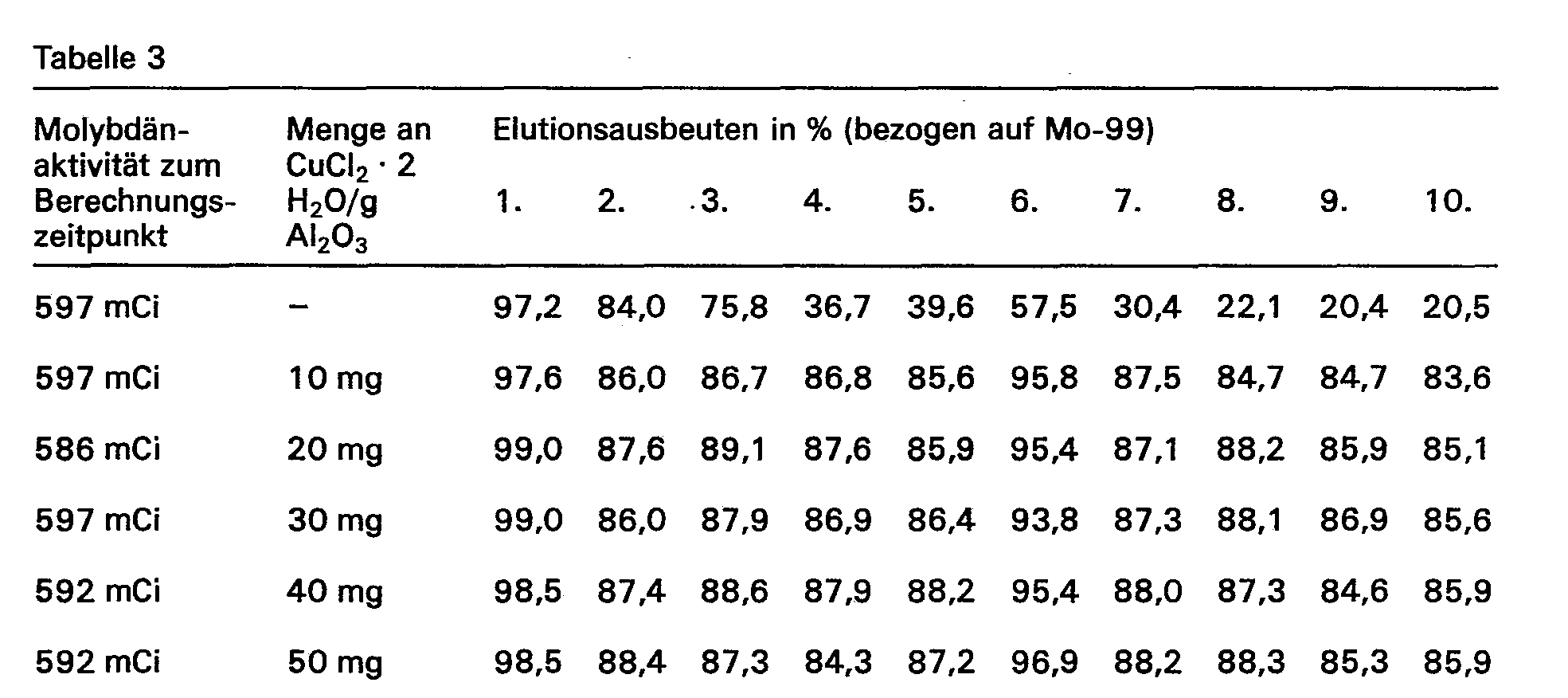
- Tabelle 3 zeigt, daß durch den Zusatz von Kupfer-(II)-chlorid zu Aluminiumoxid die Elutionsausbeuten über den gesamten Verwendungszeitraum in der erwarteten Größenordnung liegen, während sie ohne diesen Zusatz ab der 3. Elution deutlich niedriger sind.
- Entsprechend dem in Beispiel 2 angegebenen Verfahren wurden Säulen mit 15 mg Kupfer-(I)-chlorid pro g A1203 hergestellt und arbeitstäglich eluiert. Die Ausbeuten sind in Tabelle 4 angegeben:

Claims (3)
Priority Applications (1)
| Application Number | Priority Date | Filing Date | Title |
|---|---|---|---|
| AT80100734T ATE4024T1 (de) | 1979-02-20 | 1980-02-14 | Verfahren zur trennung von technetium-99m von molybdaen-99. |
Applications Claiming Priority (2)
| Application Number | Priority Date | Filing Date | Title |
|---|---|---|---|
| DE2906439 | 1979-02-20 | ||
| DE19792906439 DE2906439A1 (de) | 1979-02-20 | 1979-02-20 | Verfahren zur trennung von technetium-99m von molybaen-99 |
Publications (2)
| Publication Number | Publication Date |
|---|---|
| EP0014957A1 EP0014957A1 (de) | 1980-09-03 |
| EP0014957B1 true EP0014957B1 (de) | 1983-07-06 |
Family
ID=6063381
Family Applications (1)
| Application Number | Title | Priority Date | Filing Date |
|---|---|---|---|
| EP80100734A Expired EP0014957B1 (de) | 1979-02-20 | 1980-02-14 | Verfahren zur Trennung von Technetium-99m von Molybdän-99 |
Country Status (4)
| Country | Link |
|---|---|
| EP (1) | EP0014957B1 (de) |
| JP (1) | JPS55113628A (de) |
| AT (1) | ATE4024T1 (de) |
| DE (2) | DE2906439A1 (de) |
Cited By (1)
| Publication number | Priority date | Publication date | Assignee | Title |
|---|---|---|---|---|
| DE4229327A1 (de) * | 1992-09-02 | 1994-03-03 | Rossendorf Forschzent | Verfahren zur Konzentrierung und Reinigung von [·9··9··m·Tc] - Pertechnetatlös ungen sowie Einrichtung zur Durchführung des Verfahrens |
Families Citing this family (1)
| Publication number | Priority date | Publication date | Assignee | Title |
|---|---|---|---|---|
| DE3531355A1 (de) * | 1985-09-03 | 1987-03-12 | Hoechst Ag | Technetium-99m-generator, seine herstellung und verwendung |
Family Cites Families (2)
| Publication number | Priority date | Publication date | Assignee | Title |
|---|---|---|---|---|
| US3664964A (en) * | 1968-07-03 | 1972-05-23 | Squibb & Sons Inc | Eluent for radioisotopes |
| GB1361988A (en) * | 1971-08-06 | 1974-07-30 | Radiochemical Centre Ltd | Technetium-99m generators |
-
1979
- 1979-02-20 DE DE19792906439 patent/DE2906439A1/de not_active Withdrawn
-
1980
- 1980-02-14 AT AT80100734T patent/ATE4024T1/de not_active IP Right Cessation
- 1980-02-14 EP EP80100734A patent/EP0014957B1/de not_active Expired
- 1980-02-14 DE DE8080100734T patent/DE3064003D1/de not_active Expired
- 1980-02-20 JP JP1928180A patent/JPS55113628A/ja active Granted
Cited By (1)
| Publication number | Priority date | Publication date | Assignee | Title |
|---|---|---|---|---|
| DE4229327A1 (de) * | 1992-09-02 | 1994-03-03 | Rossendorf Forschzent | Verfahren zur Konzentrierung und Reinigung von [·9··9··m·Tc] - Pertechnetatlös ungen sowie Einrichtung zur Durchführung des Verfahrens |
Also Published As
| Publication number | Publication date |
|---|---|
| JPS55113628A (en) | 1980-09-02 |
| DE2906439A1 (de) | 1980-09-04 |
| EP0014957A1 (de) | 1980-09-03 |
| JPH0149647B2 (de) | 1989-10-25 |
| DE3064003D1 (en) | 1983-08-11 |
| ATE4024T1 (de) | 1983-07-15 |
Similar Documents
| Publication | Publication Date | Title |
|---|---|---|
| DE2825216C2 (de) | ||
| WO1991013443A1 (de) | Verfahren zur erzeugung von aktinium-225 und wismuth-213 | |
| DE1758118C3 (de) | Verfahren zur Gewinnung von radioaktivem Technetium-99m | |
| DE2542415A1 (de) | Hoch 82 sr- hoch 82 rb-radioisotop- generator | |
| DE2207309C3 (de) | Isotopengenerator | |
| DE1929067A1 (de) | Elutionsmittel fuer Radioisotop-Generatoren | |
| EP0213589B1 (de) | Technetium-99m-Generator, seine Herstellung und Verwendung | |
| EP1311303B1 (de) | Neue, 224 ra enthaltende, radiotherapeutisch wirksame formulierungen und verfahren zu ihrer herstellung | |
| DE2447556A1 (de) | Radiopharmazeutikum | |
| EP0014957A1 (de) | Verfahren zur Trennung von Technetium-99m von Molybdän-99 | |
| EP0141100B1 (de) | N-(4-Aminobenzoyl)-aminodicarbonsäuren zur Stabilisierung von Technetium-99m-Präparaten, stabilisierte Injektionspräparate und Verfahren zu ihrer Herstellung | |
| DE2242395A1 (de) | Radionuclid-generator und verfahren zu dessen herstellung | |
| EP0003041B1 (de) | Technetium-99m-markiertes Diagnostikum zur Darstellung des retikuloendothelialen Systems (RES) und Verfahren zu seiner Herstellung | |
| DE2100801B2 (de) | Verfahren zur Gewinnung von radioaktivem Jod-131 | |
| US4876073A (en) | Radionuclide generator | |
| DE1943416C3 (de) | Verfahren zur Herstellung von radioaktivem Barium - hoch 137 m | |
| DE2213137A1 (de) | Verfahren zum Wiederbeladen eines Technetium-99m-Generators | |
| DE1158803B (de) | Verfahren zur Abtrennung radioaktiver Kationen aus Milch | |
| DE2511712C3 (de) | Herstellung eines Technetium-99m-Generators | |
| Molter et al. | Method to separate 99m technetium from 99 molybdenum | |
| DE3402348C2 (de) | ||
| CH636724A5 (de) | Verfahren zur herstellung von (52)mangan. | |
| DE2030102B2 (de) | Verfahren zur gewinnung von technetium-99m aus einer waessrigen loesung eines anorganischen salzes von molybdaen99 | |
| DE1942146C3 (de) | Verwendung von Thoriumhydrogenarsenat zur Reinigung und Konzentrierung von Lithiumionen in Lösungen | |
| DE2752165C3 (de) | Verfahren zur Herstellung von52 Mangan |
Legal Events
| Date | Code | Title | Description |
|---|---|---|---|
| PUAI | Public reference made under article 153(3) epc to a published international application that has entered the european phase |
Free format text: ORIGINAL CODE: 0009012 |
|
| AK | Designated contracting states |
Designated state(s): AT BE CH DE FR GB IT LU NL SE |
|
| 17P | Request for examination filed |
Effective date: 19801025 |
|
| ITF | It: translation for a ep patent filed | ||
| GRAA | (expected) grant |
Free format text: ORIGINAL CODE: 0009210 |
|
| AK | Designated contracting states |
Designated state(s): AT BE CH DE FR GB IT LU NL SE |
|
| REF | Corresponds to: |
Ref document number: 4024 Country of ref document: AT Date of ref document: 19830715 Kind code of ref document: T |
|
| REF | Corresponds to: |
Ref document number: 3064003 Country of ref document: DE Date of ref document: 19830811 |
|
| ET | Fr: translation filed | ||
| PGFP | Annual fee paid to national office [announced via postgrant information from national office to epo] |
Ref country code: FR Payment date: 19840116 Year of fee payment: 5 |
|
| PG25 | Lapsed in a contracting state [announced via postgrant information from national office to epo] |
Ref country code: LU Free format text: LAPSE BECAUSE OF NON-PAYMENT OF DUE FEES Effective date: 19840229 |
|
| PGFP | Annual fee paid to national office [announced via postgrant information from national office to epo] |
Ref country code: BE Payment date: 19840331 Year of fee payment: 5 |
|
| PLBE | No opposition filed within time limit |
Free format text: ORIGINAL CODE: 0009261 |
|
| STAA | Information on the status of an ep patent application or granted ep patent |
Free format text: STATUS: NO OPPOSITION FILED WITHIN TIME LIMIT |
|
| 26N | No opposition filed | ||
| PGFP | Annual fee paid to national office [announced via postgrant information from national office to epo] |
Ref country code: LU Payment date: 19860122 Year of fee payment: 7 |
|
| BERE | Be: lapsed |
Owner name: HOECHST A.G. Effective date: 19880228 |
|
| PG25 | Lapsed in a contracting state [announced via postgrant information from national office to epo] |
Ref country code: FR Free format text: LAPSE BECAUSE OF NON-PAYMENT OF DUE FEES Effective date: 19881028 |
|
| PG25 | Lapsed in a contracting state [announced via postgrant information from national office to epo] |
Ref country code: GB Free format text: LAPSE BECAUSE OF NON-PAYMENT OF DUE FEES Effective date: 19881118 |
|
| REG | Reference to a national code |
Ref country code: FR Ref legal event code: ST |
|
| PG25 | Lapsed in a contracting state [announced via postgrant information from national office to epo] |
Ref country code: BE Effective date: 19890228 |
|
| PGFP | Annual fee paid to national office [announced via postgrant information from national office to epo] |
Ref country code: SE Payment date: 19900122 Year of fee payment: 11 |
|
| PGFP | Annual fee paid to national office [announced via postgrant information from national office to epo] |
Ref country code: AT Payment date: 19900125 Year of fee payment: 11 |
|
| ITTA | It: last paid annual fee | ||
| PGFP | Annual fee paid to national office [announced via postgrant information from national office to epo] |
Ref country code: NL Payment date: 19900228 Year of fee payment: 11 |
|
| PGFP | Annual fee paid to national office [announced via postgrant information from national office to epo] |
Ref country code: CH Payment date: 19900423 Year of fee payment: 11 |
|
| PG25 | Lapsed in a contracting state [announced via postgrant information from national office to epo] |
Ref country code: AT Effective date: 19910214 |
|
| PG25 | Lapsed in a contracting state [announced via postgrant information from national office to epo] |
Ref country code: SE Effective date: 19910215 |
|
| PG25 | Lapsed in a contracting state [announced via postgrant information from national office to epo] |
Ref country code: CH Effective date: 19910228 |
|
| PG25 | Lapsed in a contracting state [announced via postgrant information from national office to epo] |
Ref country code: NL Effective date: 19910901 |
|
| NLV4 | Nl: lapsed or anulled due to non-payment of the annual fee | ||
| REG | Reference to a national code |
Ref country code: CH Ref legal event code: PL |
|
| PGFP | Annual fee paid to national office [announced via postgrant information from national office to epo] |
Ref country code: DE Payment date: 19930416 Year of fee payment: 14 |
|
| PG25 | Lapsed in a contracting state [announced via postgrant information from national office to epo] |
Ref country code: DE Effective date: 19941101 |
|
| EUG | Se: european patent has lapsed |
Ref document number: 80100734.5 Effective date: 19911002 |