EP0014479B1 - Haarbehandlungsmittel - Google Patents
Haarbehandlungsmittel Download PDFInfo
- Publication number
- EP0014479B1 EP0014479B1 EP80100689A EP80100689A EP0014479B1 EP 0014479 B1 EP0014479 B1 EP 0014479B1 EP 80100689 A EP80100689 A EP 80100689A EP 80100689 A EP80100689 A EP 80100689A EP 0014479 B1 EP0014479 B1 EP 0014479B1
- Authority
- EP
- European Patent Office
- Prior art keywords
- active
- hair
- capillary
- cation
- composition according
- Prior art date
- Legal status (The legal status is an assumption and is not a legal conclusion. Google has not performed a legal analysis and makes no representation as to the accuracy of the status listed.)
- Expired
Links
- 239000000203 mixture Substances 0.000 title claims description 17
- 238000009835 boiling Methods 0.000 claims description 9
- 150000001875 compounds Chemical class 0.000 claims description 8
- -1 imidazoline compound Chemical class 0.000 claims description 7
- PEDCQBHIVMGVHV-UHFFFAOYSA-N Glycerine Chemical compound OCC(O)CO PEDCQBHIVMGVHV-UHFFFAOYSA-N 0.000 claims description 6
- 238000004804 winding Methods 0.000 claims description 6
- DIOQZVSQGTUSAI-UHFFFAOYSA-N decane Chemical compound CCCCCCCCCC DIOQZVSQGTUSAI-UHFFFAOYSA-N 0.000 claims description 4
- SYSQUGFVNFXIIT-UHFFFAOYSA-N n-[4-(1,3-benzoxazol-2-yl)phenyl]-4-nitrobenzenesulfonamide Chemical class C1=CC([N+](=O)[O-])=CC=C1S(=O)(=O)NC1=CC=C(C=2OC3=CC=CC=C3N=2)C=C1 SYSQUGFVNFXIIT-UHFFFAOYSA-N 0.000 claims description 4
- BKIMMITUMNQMOS-UHFFFAOYSA-N nonane Chemical compound CCCCCCCCC BKIMMITUMNQMOS-UHFFFAOYSA-N 0.000 claims description 4
- 239000011347 resin Substances 0.000 claims description 4
- 229920005989 resin Polymers 0.000 claims description 4
- 239000001913 cellulose Substances 0.000 claims description 3
- 229920002678 cellulose Polymers 0.000 claims description 3
- 239000012188 paraffin wax Substances 0.000 claims description 3
- OMMLUKLXGSRPHK-UHFFFAOYSA-N tetramethylbutane Chemical compound CC(C)(C)C(C)(C)C OMMLUKLXGSRPHK-UHFFFAOYSA-N 0.000 claims description 3
- JVSWJIKNEAIKJW-UHFFFAOYSA-N 2-Methylheptane Chemical compound CCCCCC(C)C JVSWJIKNEAIKJW-UHFFFAOYSA-N 0.000 claims description 2
- NHTMVDHEPJAVLT-UHFFFAOYSA-N Isooctane Chemical compound CC(C)CC(C)(C)C NHTMVDHEPJAVLT-UHFFFAOYSA-N 0.000 claims description 2
- YFCGDEUVHLPRCZ-UHFFFAOYSA-N [dimethyl(trimethylsilyloxy)silyl]oxy-dimethyl-trimethylsilyloxysilane Chemical compound C[Si](C)(C)O[Si](C)(C)O[Si](C)(C)O[Si](C)(C)C YFCGDEUVHLPRCZ-UHFFFAOYSA-N 0.000 claims description 2
- 239000013543 active substance Substances 0.000 claims description 2
- 150000001298 alcohols Chemical class 0.000 claims description 2
- 125000004432 carbon atom Chemical group C* 0.000 claims description 2
- UQEAIHBTYFGYIE-UHFFFAOYSA-N hexamethyldisiloxane Chemical group C[Si](C)(C)O[Si](C)(C)C UQEAIHBTYFGYIE-UHFFFAOYSA-N 0.000 claims description 2
- CXQXSVUQTKDNFP-UHFFFAOYSA-N octamethyltrisiloxane Chemical compound C[Si](C)(C)O[Si](C)(C)O[Si](C)(C)C CXQXSVUQTKDNFP-UHFFFAOYSA-N 0.000 claims description 2
- 239000003921 oil Substances 0.000 claims description 2
- 239000002304 perfume Substances 0.000 claims description 2
- 230000008961 swelling Effects 0.000 claims description 2
- FLTJDUOFAQWHDF-UHFFFAOYSA-N trimethyl pentane Natural products CCCCC(C)(C)C FLTJDUOFAQWHDF-UHFFFAOYSA-N 0.000 claims description 2
- 102000004190 Enzymes Human genes 0.000 claims 1
- 108090000790 Enzymes Proteins 0.000 claims 1
- 239000000490 cosmetic additive Substances 0.000 claims 1
- 239000000975 dye Substances 0.000 claims 1
- 229940073561 hexamethyldisiloxane Drugs 0.000 claims 1
- 150000002430 hydrocarbons Chemical group 0.000 claims 1
- 125000002496 methyl group Chemical group [H]C([H])([H])* 0.000 claims 1
- 229920001296 polysiloxane Polymers 0.000 claims 1
- 239000003795 chemical substances by application Substances 0.000 description 18
- 230000000694 effects Effects 0.000 description 6
- 125000002091 cationic group Chemical group 0.000 description 5
- 150000002462 imidazolines Chemical class 0.000 description 5
- 238000000034 method Methods 0.000 description 5
- 239000000126 substance Substances 0.000 description 5
- 239000000243 solution Substances 0.000 description 4
- QGZKDVFQNNGYKY-UHFFFAOYSA-N Ammonia Chemical compound N QGZKDVFQNNGYKY-UHFFFAOYSA-N 0.000 description 2
- ATRRKUHOCOJYRX-UHFFFAOYSA-N Ammonium bicarbonate Chemical compound [NH4+].OC([O-])=O ATRRKUHOCOJYRX-UHFFFAOYSA-N 0.000 description 2
- RTZKZFJDLAIYFH-UHFFFAOYSA-N Diethyl ether Chemical compound CCOCC RTZKZFJDLAIYFH-UHFFFAOYSA-N 0.000 description 2
- LFQSCWFLJHTTHZ-UHFFFAOYSA-N Ethanol Chemical compound CCO LFQSCWFLJHTTHZ-UHFFFAOYSA-N 0.000 description 2
- KFZMGEQAYNKOFK-UHFFFAOYSA-N Isopropanol Chemical compound CC(C)O KFZMGEQAYNKOFK-UHFFFAOYSA-N 0.000 description 2
- 239000001099 ammonium carbonate Substances 0.000 description 2
- 230000003766 combability Effects 0.000 description 2
- 239000000470 constituent Substances 0.000 description 2
- 229920001519 homopolymer Polymers 0.000 description 2
- 239000007791 liquid phase Substances 0.000 description 2
- 229920000642 polymer Polymers 0.000 description 2
- 238000005406 washing Methods 0.000 description 2
- JKNCOURZONDCGV-UHFFFAOYSA-N 2-(dimethylamino)ethyl 2-methylprop-2-enoate Chemical compound CN(C)CCOC(=O)C(C)=C JKNCOURZONDCGV-UHFFFAOYSA-N 0.000 description 1
- HZAXFHJVJLSVMW-UHFFFAOYSA-N 2-Aminoethan-1-ol Chemical compound NCCO HZAXFHJVJLSVMW-UHFFFAOYSA-N 0.000 description 1
- IGFHQQFPSIBGKE-UHFFFAOYSA-N 4-nonylphenol Chemical compound CCCCCCCCCC1=CC=C(O)C=C1 IGFHQQFPSIBGKE-UHFFFAOYSA-N 0.000 description 1
- 201000004384 Alopecia Diseases 0.000 description 1
- 229910000013 Ammonium bicarbonate Inorganic materials 0.000 description 1
- 239000004215 Carbon black (E152) Substances 0.000 description 1
- 208000001840 Dandruff Diseases 0.000 description 1
- KIWBPDUYBMNFTB-UHFFFAOYSA-N Ethyl hydrogen sulfate Chemical compound CCOS(O)(=O)=O KIWBPDUYBMNFTB-UHFFFAOYSA-N 0.000 description 1
- MHAJPDPJQMAIIY-UHFFFAOYSA-N Hydrogen peroxide Chemical compound OO MHAJPDPJQMAIIY-UHFFFAOYSA-N 0.000 description 1
- 239000004166 Lanolin Substances 0.000 description 1
- 239000004367 Lipase Substances 0.000 description 1
- 102000004882 Lipase Human genes 0.000 description 1
- 108090001060 Lipase Proteins 0.000 description 1
- CERQOIWHTDAKMF-UHFFFAOYSA-M Methacrylate Chemical compound CC(=C)C([O-])=O CERQOIWHTDAKMF-UHFFFAOYSA-M 0.000 description 1
- 240000004808 Saccharomyces cerevisiae Species 0.000 description 1
- 235000014680 Saccharomyces cerevisiae Nutrition 0.000 description 1
- 206010044625 Trichorrhexis Diseases 0.000 description 1
- XSQUKJJJFZCRTK-UHFFFAOYSA-N Urea Chemical compound NC(N)=O XSQUKJJJFZCRTK-UHFFFAOYSA-N 0.000 description 1
- 108010046334 Urease Proteins 0.000 description 1
- NJSSICCENMLTKO-HRCBOCMUSA-N [(1r,2s,4r,5r)-3-hydroxy-4-(4-methylphenyl)sulfonyloxy-6,8-dioxabicyclo[3.2.1]octan-2-yl] 4-methylbenzenesulfonate Chemical compound C1=CC(C)=CC=C1S(=O)(=O)O[C@H]1C(O)[C@@H](OS(=O)(=O)C=2C=CC(C)=CC=2)[C@@H]2OC[C@H]1O2 NJSSICCENMLTKO-HRCBOCMUSA-N 0.000 description 1
- 238000010521 absorption reaction Methods 0.000 description 1
- 239000000654 additive Substances 0.000 description 1
- 239000003513 alkali Substances 0.000 description 1
- 230000003113 alkalizing effect Effects 0.000 description 1
- 150000008051 alkyl sulfates Chemical class 0.000 description 1
- 229910021529 ammonia Inorganic materials 0.000 description 1
- 235000012538 ammonium bicarbonate Nutrition 0.000 description 1
- 235000012501 ammonium carbonate Nutrition 0.000 description 1
- 239000008346 aqueous phase Substances 0.000 description 1
- 239000007864 aqueous solution Substances 0.000 description 1
- 239000004202 carbamide Substances 0.000 description 1
- 239000004359 castor oil Substances 0.000 description 1
- 235000019438 castor oil Nutrition 0.000 description 1
- 229920003086 cellulose ether Polymers 0.000 description 1
- WOWHHFRSBJGXCM-UHFFFAOYSA-M cetyltrimethylammonium chloride Chemical compound [Cl-].CCCCCCCCCCCCCCCC[N+](C)(C)C WOWHHFRSBJGXCM-UHFFFAOYSA-M 0.000 description 1
- 238000004140 cleaning Methods 0.000 description 1
- 230000003750 conditioning effect Effects 0.000 description 1
- 239000002537 cosmetic Substances 0.000 description 1
- 239000003599 detergent Substances 0.000 description 1
- VAYGXNSJCAHWJZ-UHFFFAOYSA-N dimethyl sulfate Chemical compound COS(=O)(=O)OC VAYGXNSJCAHWJZ-UHFFFAOYSA-N 0.000 description 1
- 239000000839 emulsion Substances 0.000 description 1
- 238000009950 felting Methods 0.000 description 1
- ZEMPKEQAKRGZGQ-XOQCFJPHSA-N glycerol triricinoleate Natural products CCCCCC[C@@H](O)CC=CCCCCCCCC(=O)OC[C@@H](COC(=O)CCCCCCCC=CC[C@@H](O)CCCCCC)OC(=O)CCCCCCCC=CC[C@H](O)CCCCCC ZEMPKEQAKRGZGQ-XOQCFJPHSA-N 0.000 description 1
- 230000003700 hair damage Effects 0.000 description 1
- 230000003676 hair loss Effects 0.000 description 1
- 208000024963 hair loss Diseases 0.000 description 1
- 229930195733 hydrocarbon Natural products 0.000 description 1
- 229940039717 lanolin Drugs 0.000 description 1
- 235000019388 lanolin Nutrition 0.000 description 1
- 235000019421 lipase Nutrition 0.000 description 1
- 239000007788 liquid Substances 0.000 description 1
- QJGQUHMNIGDVPM-UHFFFAOYSA-N nitrogen group Chemical group [N] QJGQUHMNIGDVPM-UHFFFAOYSA-N 0.000 description 1
- 230000001590 oxidative effect Effects 0.000 description 1
- 239000003973 paint Substances 0.000 description 1
- 239000012071 phase Substances 0.000 description 1
- BDERNNFJNOPAEC-UHFFFAOYSA-N propan-1-ol Chemical compound CCCO BDERNNFJNOPAEC-UHFFFAOYSA-N 0.000 description 1
- 230000000717 retained effect Effects 0.000 description 1
- 229910052710 silicon Inorganic materials 0.000 description 1
- 239000010703 silicon Substances 0.000 description 1
- 239000002904 solvent Substances 0.000 description 1
- 238000004659 sterilization and disinfection Methods 0.000 description 1
- LSNNMFCWUKXFEE-UHFFFAOYSA-L sulfite Chemical class [O-]S([O-])=O LSNNMFCWUKXFEE-UHFFFAOYSA-L 0.000 description 1
- 230000037072 sun protection Effects 0.000 description 1
- 239000004094 surface-active agent Substances 0.000 description 1
Classifications
-
- A—HUMAN NECESSITIES
- A61—MEDICAL OR VETERINARY SCIENCE; HYGIENE
- A61K—PREPARATIONS FOR MEDICAL, DENTAL OR TOILETRY PURPOSES
- A61K8/00—Cosmetics or similar toiletry preparations
- A61K8/18—Cosmetics or similar toiletry preparations characterised by the composition
- A61K8/30—Cosmetics or similar toiletry preparations characterised by the composition containing organic compounds
- A61K8/31—Hydrocarbons
-
- A—HUMAN NECESSITIES
- A61—MEDICAL OR VETERINARY SCIENCE; HYGIENE
- A61K—PREPARATIONS FOR MEDICAL, DENTAL OR TOILETRY PURPOSES
- A61K8/00—Cosmetics or similar toiletry preparations
- A61K8/18—Cosmetics or similar toiletry preparations characterised by the composition
- A61K8/30—Cosmetics or similar toiletry preparations characterised by the composition containing organic compounds
- A61K8/49—Cosmetics or similar toiletry preparations characterised by the composition containing organic compounds containing heterocyclic compounds
- A61K8/494—Cosmetics or similar toiletry preparations characterised by the composition containing organic compounds containing heterocyclic compounds with more than one nitrogen as the only hetero atom
- A61K8/4946—Imidazoles or their condensed derivatives, e.g. benzimidazoles
-
- A—HUMAN NECESSITIES
- A61—MEDICAL OR VETERINARY SCIENCE; HYGIENE
- A61K—PREPARATIONS FOR MEDICAL, DENTAL OR TOILETRY PURPOSES
- A61K8/00—Cosmetics or similar toiletry preparations
- A61K8/18—Cosmetics or similar toiletry preparations characterised by the composition
- A61K8/30—Cosmetics or similar toiletry preparations characterised by the composition containing organic compounds
- A61K8/58—Cosmetics or similar toiletry preparations characterised by the composition containing organic compounds containing atoms other than carbon, hydrogen, halogen, oxygen, nitrogen, sulfur or phosphorus
- A61K8/585—Organosilicon compounds
-
- A—HUMAN NECESSITIES
- A61—MEDICAL OR VETERINARY SCIENCE; HYGIENE
- A61K—PREPARATIONS FOR MEDICAL, DENTAL OR TOILETRY PURPOSES
- A61K8/00—Cosmetics or similar toiletry preparations
- A61K8/18—Cosmetics or similar toiletry preparations characterised by the composition
- A61K8/72—Cosmetics or similar toiletry preparations characterised by the composition containing organic macromolecular compounds
- A61K8/73—Polysaccharides
- A61K8/731—Cellulose; Quaternized cellulose derivatives
-
- A—HUMAN NECESSITIES
- A61—MEDICAL OR VETERINARY SCIENCE; HYGIENE
- A61K—PREPARATIONS FOR MEDICAL, DENTAL OR TOILETRY PURPOSES
- A61K8/00—Cosmetics or similar toiletry preparations
- A61K8/18—Cosmetics or similar toiletry preparations characterised by the composition
- A61K8/72—Cosmetics or similar toiletry preparations characterised by the composition containing organic macromolecular compounds
- A61K8/81—Cosmetics or similar toiletry preparations characterised by the composition containing organic macromolecular compounds obtained by reactions involving only carbon-to-carbon unsaturated bonds
- A61K8/8141—Compositions of homopolymers or copolymers of compounds having one or more unsaturated aliphatic radicals, each having only one carbon-to-carbon double bond, and at least one being terminated by only one carboxyl radical, or of salts, anhydrides, esters, amides, imides or nitriles thereof; Compositions of derivatives of such polymers
- A61K8/8152—Homopolymers or copolymers of esters, e.g. (meth)acrylic acid esters; Compositions of derivatives of such polymers
-
- A—HUMAN NECESSITIES
- A61—MEDICAL OR VETERINARY SCIENCE; HYGIENE
- A61K—PREPARATIONS FOR MEDICAL, DENTAL OR TOILETRY PURPOSES
- A61K8/00—Cosmetics or similar toiletry preparations
- A61K8/18—Cosmetics or similar toiletry preparations characterised by the composition
- A61K8/72—Cosmetics or similar toiletry preparations characterised by the composition containing organic macromolecular compounds
- A61K8/81—Cosmetics or similar toiletry preparations characterised by the composition containing organic macromolecular compounds obtained by reactions involving only carbon-to-carbon unsaturated bonds
- A61K8/817—Compositions of homopolymers or copolymers of compounds having one or more unsaturated aliphatic radicals, each having only one carbon-to-carbon double bond, and at least one being terminated by a single or double bond to nitrogen or by a heterocyclic ring containing nitrogen; Compositions or derivatives of such polymers, e.g. vinylimidazol, vinylcaprolactame, allylamines (Polyquaternium 6)
-
- A—HUMAN NECESSITIES
- A61—MEDICAL OR VETERINARY SCIENCE; HYGIENE
- A61K—PREPARATIONS FOR MEDICAL, DENTAL OR TOILETRY PURPOSES
- A61K8/00—Cosmetics or similar toiletry preparations
- A61K8/18—Cosmetics or similar toiletry preparations characterised by the composition
- A61K8/72—Cosmetics or similar toiletry preparations characterised by the composition containing organic macromolecular compounds
- A61K8/81—Cosmetics or similar toiletry preparations characterised by the composition containing organic macromolecular compounds obtained by reactions involving only carbon-to-carbon unsaturated bonds
- A61K8/817—Compositions of homopolymers or copolymers of compounds having one or more unsaturated aliphatic radicals, each having only one carbon-to-carbon double bond, and at least one being terminated by a single or double bond to nitrogen or by a heterocyclic ring containing nitrogen; Compositions or derivatives of such polymers, e.g. vinylimidazol, vinylcaprolactame, allylamines (Polyquaternium 6)
- A61K8/8182—Copolymers of vinyl-pyrrolidones. Compositions of derivatives of such polymers
-
- A—HUMAN NECESSITIES
- A61—MEDICAL OR VETERINARY SCIENCE; HYGIENE
- A61Q—SPECIFIC USE OF COSMETICS OR SIMILAR TOILETRY PREPARATIONS
- A61Q5/00—Preparations for care of the hair
-
- A—HUMAN NECESSITIES
- A61—MEDICAL OR VETERINARY SCIENCE; HYGIENE
- A61K—PREPARATIONS FOR MEDICAL, DENTAL OR TOILETRY PURPOSES
- A61K2800/00—Properties of cosmetic compositions or active ingredients thereof or formulation aids used therein and process related aspects
- A61K2800/40—Chemical, physico-chemical or functional or structural properties of particular ingredients
- A61K2800/54—Polymers characterized by specific structures/properties
- A61K2800/542—Polymers characterized by specific structures/properties characterized by the charge
- A61K2800/5426—Polymers characterized by specific structures/properties characterized by the charge cationic
-
- Y—GENERAL TAGGING OF NEW TECHNOLOGICAL DEVELOPMENTS; GENERAL TAGGING OF CROSS-SECTIONAL TECHNOLOGIES SPANNING OVER SEVERAL SECTIONS OF THE IPC; TECHNICAL SUBJECTS COVERED BY FORMER USPC CROSS-REFERENCE ART COLLECTIONS [XRACs] AND DIGESTS
- Y10—TECHNICAL SUBJECTS COVERED BY FORMER USPC
- Y10S—TECHNICAL SUBJECTS COVERED BY FORMER USPC CROSS-REFERENCE ART COLLECTIONS [XRACs] AND DIGESTS
- Y10S424/00—Drug, bio-affecting and body treating compositions
- Y10S424/01—Aerosol hair preparation
Definitions
- the present invention relates to agents for the treatment of hair before winding on permanent wave curlers.
- Detergents which use a combination of (1) an organic surfactant such as e.g. an amphoteric capillary-active imidazoline derivative, (2) at least one water-soluble cationic, nitrogen-containing polymer such as, for example, a quaternary cellulose derivative or quaternary polydimethyl- or polydiethylaminoethyl methacrylate, with a molecular weight of 2000-3,000,000 and a cationic charge density of more than 0.001 in aqueous solution and ( ) a water-insoluble or poorly soluble, particulate substance such as Silicon "F-1 57" from Dow Corning.
- an organic surfactant such as e.g. an amphoteric capillary-active imidazoline derivative
- at least one water-soluble cationic, nitrogen-containing polymer such as, for example, a quaternary cellulose derivative or quaternary polydimethyl- or polydiethylaminoethyl methacrylate, with a mole
- the polymer contained makes it possible that after washing, the particulate substances also contained, with their special action such as anti-dandruff, disinfection or sun protection effects, are retained on the skin and can remain effective there for a long time (cf. FR- PS 1 588 952).
- hair treatment compositions have already become known which have a content of branched low molecular weight isoparaffins with a boiling range from 45 ° C. to 250 ° C.
- the agents are suitable which are particularly suitable for chemically pretreated, e.g. Eliminate permanently waved, hair felting that occurs after washing, and make the hair easy to comb and easy to style again (cf. BE-PS 839 646).
- hair styling agents containing a hair-substantive quaternary resin such as e.g. a quaternized cellulose ether and a hair care substance such as a substituted imidazoline. While the quaternary resin is capable of being drawn onto the hair and giving it a firm hold, the hair-care substance is supposed to be deposited on the film-like hair cover and give the hair caring effects such as suppleness, soft feel, shine, antistatic properties, natural appearance and conditioning effect (see U.S. Patent 3,876,760).
- a hair-substantive quaternary resin such as e.g. a quaternized cellulose ether
- a hair care substance such as a substituted imidazoline.
- the invention relates to a means for treating hair before winding on permanent wave curlers.
- the preferred procedure today is to divide the previously washed and wiped off hair with a towel into strands, then wrap these strands individually on curlers and then moisten them with the reducing permanent waving solution.
- This method has various advantages over the older method, according to which the hair is pre-moistened with the permanent wave solution before it is wrapped.
- the 20-minute contact of the hairdresser's hands with the permanent waving solution, which is otherwise required to wind the hair is avoided, and on the other hand the permanent waving takes place under conditions that are more gentle on the hair.
- the hair softening that occurs when the hair is pre-moistened with the permanent world solution can namely lead to over-stretching of the hair during the winding process and later to hair breakage and hair loss.
- the individual, parallel-combed strands of hair should be wound up with a slight pull, the pull being distributed as evenly as possible over all hair.
- the hair tips are placed between a folded thin sheet - preferably made of paper - and then wrapped.
- the hair is rinsed thoroughly and then fixed in the desired form by an oxidizing treatment, for example with a hydrogen peroxide solution .
- the hair has a different absorption capacity for the permanent wave liquid between the hairline and the tip of the hair.
- the tips of the hair swell the most and show the greatest deformation. Their strong deformation is also due to the fact that the hair tips lie directly against the curler and, based on the entire strand of hair, are bent the most.
- the hair damage occurring in the permanent wave treatment according to the described prior art is noticeable, inter alia, by poor combability of the hair and inadequate durability of the hair frill, particularly in the area of the hair tips.
- these agents are said to contain in particular the compounds hexamethyldisiloxane, octamethyltrisiloxane and decamethyltetrasiloxane.
- paraffins or isoparaffins contained in these agents are, in particular, n-nonane, n-decane, methylheptane (mixture of isomers with a boiling point of about 118 ° C.), trimethylpentane (mixture of isomers with a boiling point of 100 to 114 ° C.) and 2.2. 3.3. To name tetramethylbutane.
- the methylsiloxanes, paraffins and isoparaffins are preferably present in the agents according to the invention in a total concentration of altogether 25 to 55 percent by weight.
- the content of cation-active, non-capillary-active compounds and of ampholytic, capillary-active imidazoline compounds in the compositions is preferably 0.2 to 3.0 percent by weight, the amount of imidazoline compounds not exceeding the amount of cation-active, non-capillary-active compounds.
- the agents according to the present invention can also include additives customary in cosmetic agents, namely alcohols such as preferably ethanol, propanol and isopropanol, solubilizers such as, for example, ethylated castor oil and 4-n-nonylphenol decaglycol ether, furthermore substances which promote hair swelling, in particular urea and alkali sulfites, alkalizing agents such as ammonia , Monoethanolamine, ammonium hydrogen carbonate and ammonium carbonate, furthermore contain capillary-active, cation-active substances such as, for example, hexadecyltrimethylammonium chloride, paints, perfume oils, glycerol, lanolin and others.
- a ferment such as urease, lipase or brewer's yeast, can optionally be added to these agents before use.
- the hair treatment compositions described here consist of two liquid phases, of which the upper phase contains the constituents listed at the beginning under A), while the constituents mentioned at the beginning under B) and C) are in the lower, aqueous phase.
- the hair treatment compositions according to the invention are used in such a way that the two liquid phases of the compositions are converted into a more or less easily breaking emulsion immediately by use by briefly shaking in a closed container. These is then applied evenly to previously washed, towel-dried hair. For a hair treatment, depending on the fullness of the hair, an amount of about 15 to 25 grams of the agent is required. The hair is then combed through, separated into strands, then wound on curlers and finally subjected to the usual permanent wave treatment.
- the advantageous effect of the agents is that they make combing, separating into strands and winding the hair much easier. Furthermore, the effect of the permanent waving agent on the hair tips is reduced, thereby achieving an even wave result from the hairline to the hair tips. In addition, the hair has an excellent hair texture after the permanent wave treatment, in particular with regard to the feel, shine and combability of the hair.
- agents according to the invention are calculated with respect to the total amounts indicated for one treatment in each case.
Landscapes
- Life Sciences & Earth Sciences (AREA)
- Health & Medical Sciences (AREA)
- Animal Behavior & Ethology (AREA)
- General Health & Medical Sciences (AREA)
- Public Health (AREA)
- Veterinary Medicine (AREA)
- Birds (AREA)
- Epidemiology (AREA)
- Cosmetics (AREA)
- Compositions Of Macromolecular Compounds (AREA)
Description
- Die vorliegende Erfindung betrifft Mittel zur Behandlung von Haaren vor dem Wickeln auf Dauerwellwickler.
- Es sind bereits Reinigungsmittel bekannt, die eine Kombination von (1) einer organischen oberflächenaktiven Substanz wie z.B. einem amphoteren kapillaraktiven lmidazolinderivat, (2) mindestens einem wasserlöslichen kationischen, Stickstoff enthaltenden Polymer wie beispielsweise einem quaternären Zellulosederivat oder quaternären Polydimethyl- bzw. Polydiäthylaminoäthylmethacrylat, mit einem Molekulargewicht von 2000-3 000 000 und einer kationischen Ladungsdichte über 0,001 in wäßriger Lösung sowie (3) einer wasser-unlöslichen bzw. schwerlöslichen, teilchenförmigen Substanz wie z.B. Silicon "F-1 57" der Firma Dow Corning, enthalten. Die Mittel weisen außer der reinigenden Wirkung noch zusätzlich eine spezielle Wirkung auf. Diese wird dadurch erzielt, daß das enthaltene Polymer es ermöglicht, daß nach dem Waschen die ebenfalls enthaltenen teilchenförmigen Substanzen mit ihrer speziellen Wirkung wie Antischuppen-, Desinfektions- oder Sonnenschutzwirkung auf der Haut zurückgehalten werden und dort längere Zeit wirksam bleiben können (vgl. FR-PS 1 588 952).
- Weiterhin sind schon Haarbehandlungsmittel bekannt geworden, welche einen Gehalt an verzweigten niedermolekularen Isoparaffinen mit einem Siedebereich von 45°C bis 250°C aufweisen. Die Mittel sind geeignet, die insbesondere bei chemisch vorbehandeltem, wie z.B. dauergewelltem, Haar eintretende Verfilzung der Haare nach dem Waschen zu beseitigen, und das Haar wieder leicht kämmbar und ohne Schwierigkeiten frisierbar zu machen (vgl. BE-PS 839 646).
- Schließlich sind bereits Haarfrisiermittel mit einem Gehalt an einem haarsubstantiven quaternären Harz wie z.B. einem quaternisierten Zelluloseäther sowie einer haarpflegenden Substanz wie beispielsweise einem substituierten Imidazolin bekannt. Während das quaternäre Harz imstande ist, auf das Haar aufzuziehen und ihm festen Halt zu geben, soll die haarpflegende Substanz sich auf dem filmartigen Haarzüberzug ablagern und dem Haar pflegende Wirkung wie Geschmeidigkeit, weichen Griff, Glanz, antistatische Eigenschaften, natürliches Aussehen sowie konditionierende Wirkung verleihen (vgl. US-PS 3 876 760).
- Gegenstand der Erfindung ist ein Mittel zur Behandlung von Haaren vor dem Wickeln auf Dauerwellwickler.
- Beim Dauerwellen der Haare mit reduzierenden Dauerwellmitteln wird heute vorzugsweise so verfahren, daß die zuvor gewaschenen und mit einem Handtuch abfrottierten Haare in Strähnen aufgeteilt werden, diese Strähnen sodann einzeln auf Wickler gewickelt und anschließend mit der reduzierenden Dauerwellösung befeuchtet werden. Dieses Verfahren weist gegenüber der älteren Verfahrensweise, wonach die Haare bereits vor dem Wickeln mit der Dauerwellösung vorgefeuchtet werden, verschiedene Vorteile auf. Zum einen wird hierbei der sonst zum Wickeln der Haare erforderliche, etwa 20 Minuten dauernde, Kontakt der Hände des Friseurs mit der Dauerwellösung vermieden, zum anderen erfolgt die Dauerwellung unter haarschonenderen Bedingungen. Die beim Vorfeuchten des Haares mit der Dauerweltosung eintretende Haarerweichung kann nämlich beim Wickelvorgang zu einer Überdehnung des Haares und später zu Haarbruch und Haarausfall führen.
- Das Aufwickeln der einzelnen, parallel gekämmten Haarsträhnen soll unter leichtem Zug erfolgen, wobei der Zug möglichst gleichmäßig auf alle Haare zu verteilen ist. Diesen schwierigen Vorgang versucht man durch Verwendung eines sogenannten "Spitzenpapiers" zu erleichtern. Dabei werden die Haarspitzen zwischen ein gefaltetes dünnes Blatt - vorzugsweise aus Papier - gelegt und dann gewickelt.
- Nach der erforderlichen Einwirkungszeit des reduzierenden Dauerwellmittels auf die gewickelten Haare, die je nach der Haarbeschaffenheit und den äußeren Umständen etwa 10 bis 30 Minuten beträgt, wird das Haar gründlich gespült und anschließend durch eine oxidierende Behandlung, beispielsweise mit einer Wasserstoffperoxidlösung, in der gewünschten Form fixiert.
- Das Haar hat zwischen Haaransatz und Haarspitze ein unterschiedliches Aufnahmevermögen für die Dauerwellflüssigkeit. So quellen beispielsweise die Haarspitzen am meisten auf und zeigen die stärkste Verformung. Ihre starke Verformung ist ferner auch darauf zurückzuführen, daß die Haarspitzen direkt am Wickler anliegen und, bezogen auf die gesamte Haarsträhne, am stärksten gekrümmt werden.
- Die bei der Dauerwellbehandlung nach dem geschilderten Stand der Technik auftretenden Haarschädigungen machen sich unter anderem durch mangelhafte Kämmbarkeit des Haares und ungenügende Haltbarkeit der Haarkrause, insbesondere im Bereich der Haarspitzen, bemerkbar.
- Demgegenüber wurde nun gefunden, daß die vorgenannten Nachteile bei der Dauerwellbehandlung von Haaren vermieden werden, wenn man vor dem Wickeln auf Dauerwellwickler das nachstehend beschriebene erfindungsgemäße Mittel auf die Haare aufträgt.
- Die erfindungsgemäßen Mittel zur Behandlung von Haaren sind gekennzeichnet durch einen Gehalt an den Komponenten
- A) 5 bis 60 Gewichtsprozent mindestens eines Methylpolysiloxans mit einem Siedepunkt im Bereich von 100 bis 190°C und/oder mindestens eines Paraffins bzw. Isoparaffins mit einem Siedepunkt im Bereich von 100 bis 190°C,
- B) 0,02 bis 3,0 Gewichtsprozent mindestens einer kationaktiven, nicht kapillaraktiven Verbindung und
- C) 0,02 bis 3,0 Gewichtsprozent mindestens einer ampholytischen, kapillaraktiven Imidazolinverbindung, deren Menge die der Komponente B nicht übertreffen soll.
- Diese Mittel sollen als Methylpolysiloxan insbesondere die Verbindungen Hexamethyldisiloxan, Octamethyltrisiloxan und Dekamethyltetrasiloxan enthalten. Als Beispiele für in diesen Mitteln enthaltene Paraffine bzw. Isoparaffine sind insbesondere n-Nonan, n-Decan, Methylheptan (Isomerengemisch mit einem Siedepunkt von etwa 118°C), Trimethylpentan (Isomerengemisch mit einem Siedepunkt von 100 bis 114°C) und 2.2.3.3. Tetramethylbutan zu nennen.
- Als kationaktive, nicht kapillaraktive Verbindungen, welche in den Mitteln enthalten sein sollen, kommen zum Beispiel a) kationaktive Harze, insbesondere polymeres Dimethylaminoäthylmethacrylat (Homopolymer, zu 75% quaternisiert mit Dimethylsulfat) und polymeres Diallyldimethylammoniumchlorid (Homopolymer) sowie b) kationaktive Cellulose der allgemeinen Formel

- Als ampholytische, kapillaraktive Imidazolinverbindung soll in den Mitteln mindestens ein Imidazolinderivat der allgemeinen Formel


- R3 = geradkettiger Kohlenwasserstoffrest mit 7 bis 17 Kohlenstoffatomen, vorzugsweise C7H15' C9H19, C11H23 und C17H3..
- Die Methylsiloxane, Paraffine und Isoparaffine liegen in den erfindungsgemäßen Mitteln vorzugsweise in einer Gesamtkonzentration von zusammen 25 bis 55 Gewichtsprozent vor. Der Gehalt an kationaktiven, nicht kapillaraktiven Verbindungen sowie an ampholytischen, kapillaraktiven Imidazolinverbindungen in den Mitteln Beträgt jeweils vorzugsweise 0,2 bis 3,0 Gewichtsprozent, wobei die Menge der Imidazolinverbindungen die Menge der kationaktiven, nicht kapillaraktiven Verbindungen nicht übertreffen soll.
- Die Mittel gemäß vorliegender Erfindung können außerdem in kosmetischen Mitteln gebräuchliche Zusatzstoffe, und zwar Alkohole wie vorzugsweise Äthanol, Propanol und Isopropanol, Lösungsvermittler wie beispielsweise oxäthyliertes Rizinusöl und 4-n-Nonylphenoldekaglykoläther, ferner die Haarquellung fördernde Substanzen wie insbesondere Harnstoff und Alkalisulfite, Alkalisierungsmittel wie Ammoniak, Monoäthanolamin, Ammoniumhydrogencarbonat und Ammoniumcarbonat, weiterhin kapillaraktive, kationaktive Substanzen wie beispielsweise Hexadecyltrimethylammoniumchlorid, Farben, Parfümöle, Glycerin, Lanolin und andere enthalten. Weiterhin kann diesen Mitteln vor ihrem Gebrauch gegebenenfalls ein Ferment, wie beispielsweise Urease, Lipase oder Bierhefe zugegeben werden.
- Die hier beschriebenen Haarbehandlungsmittel bestehen aus zwei flüssigen Phasen, von denen die obere Phase die eingangs unter A) angeführten Bestandteile enthält, während sich die eingangs unter B) und C) angeführten Bestandteile in der unteren, wäßrigen Phase befinden.
- Die Anwendung der erfindungsgemäßen Haarbehandlungsmittel erfolgt in der Weise, daß die beiden flüssigen Phasen der Mittel unmittelbar von Gebrauch durch kurzes Schütteln in einem geschlossenen Behältnis in eine mehr oder weniger leicht brechende Emulsion übergeführt werden. Diese wird dann gleichmäßig auf das zuvor gewaschene, handtuchtrokkene Haar aufgetragen. Für eine Haarbehandlung wird hierbei, je nach Haarfülle, eine Menge von etwa 15 bis 25 Gramm des Mittels benötigt. Anschließend werden die Haare durchgekämmt, in Strähnen abgeteilt, sodann auf Wickler gewickelt und schließlich einer üblichen Dauerwellbehandlung unterworfen.
- Die vorteilhafte Wirkung der Mittel besteht darin, daß sie das Kämmen, Abteilen in Strähnen sowie das Wickeln der Haare wesentlich erleichtern. Ferner wird die Einwirkung des Dauerwellmittels auf die Haarspitzen herabgesetzt und dadurch ein vom Haaransatz bis zu den Haarspitzen gleichmäßiges Wellergebnis erreicht. Außerdem weist das Haar nach der Dauerwellbehandlung eine ausgezeichnete Haarbeschaffenheit, insbesondere hinsichtlich Griff, Glanz und Kämmbarkeit des Haares, auf.
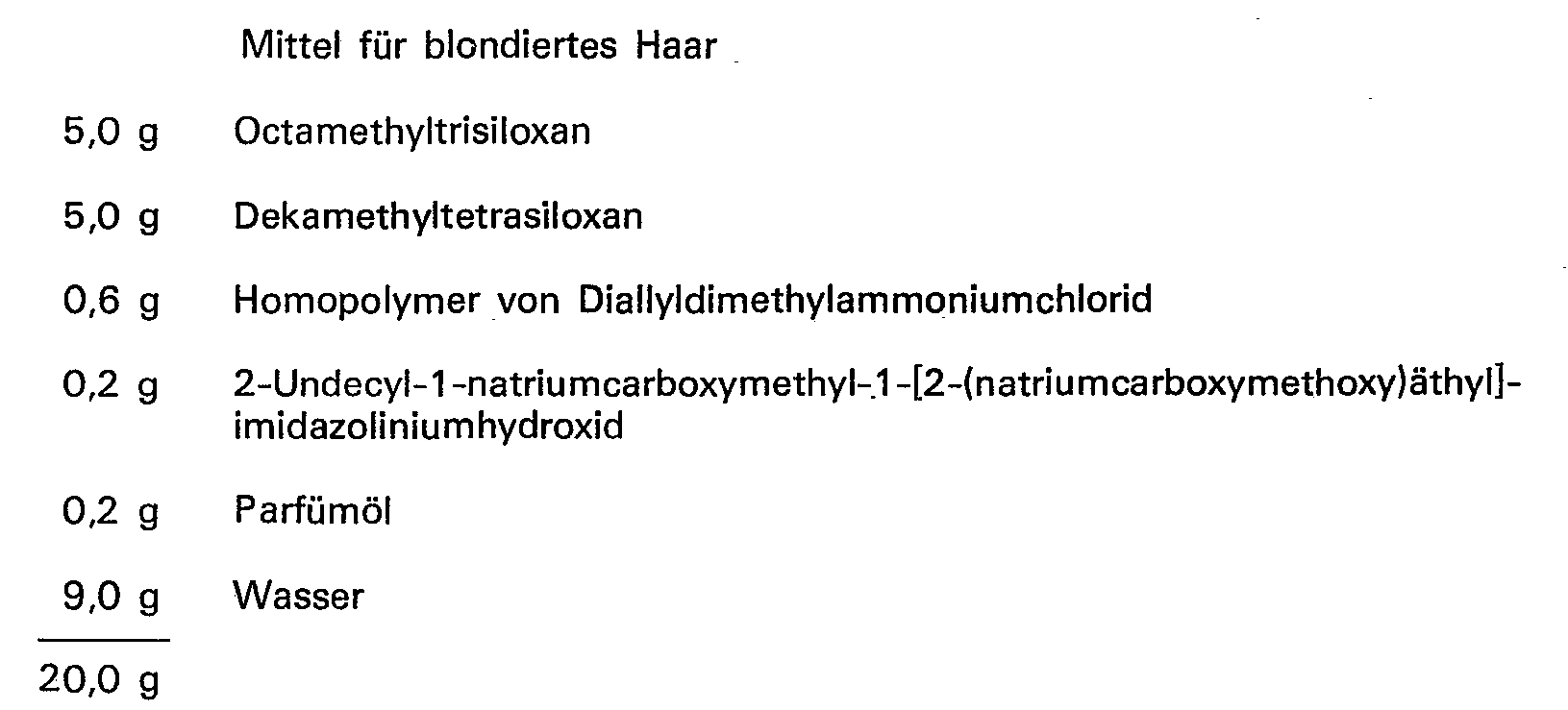
- Die folgenden Beispiele von erfindungsgemäßen Mitteln sind bezüglich der angegebenen Gesamtmengen für jeweils eine Behandlung berechnet.
- Durch diese Beispiele soll der Gegenstand der vorliegenden Erfindung näher erläutert werden.
-

-

-


-

-
Claims (6)


Applications Claiming Priority (2)
| Application Number | Priority Date | Filing Date | Title |
|---|---|---|---|
| DE2905257 | 1979-02-12 | ||
| DE19792905257 DE2905257A1 (de) | 1979-02-12 | 1979-02-12 | Haarbehandlungsmittel |
Publications (3)
| Publication Number | Publication Date |
|---|---|
| EP0014479A2 EP0014479A2 (de) | 1980-08-20 |
| EP0014479A3 EP0014479A3 (en) | 1981-02-04 |
| EP0014479B1 true EP0014479B1 (de) | 1983-06-29 |
Family
ID=6062728
Family Applications (1)
| Application Number | Title | Priority Date | Filing Date |
|---|---|---|---|
| EP80100689A Expired EP0014479B1 (de) | 1979-02-12 | 1980-02-11 | Haarbehandlungsmittel |
Country Status (6)
| Country | Link |
|---|---|
| US (1) | US4331167A (de) |
| EP (1) | EP0014479B1 (de) |
| JP (1) | JPS5914445B2 (de) |
| DE (2) | DE2905257A1 (de) |
| ES (1) | ES488496A0 (de) |
| ZA (1) | ZA80738B (de) |
Cited By (1)
| Publication number | Priority date | Publication date | Assignee | Title |
|---|---|---|---|---|
| US6514918B1 (en) | 2000-08-18 | 2003-02-04 | Johnson & Johnson Consumer Companies, Inc. | Viscous, mild, and effective cleansing compositions |
Families Citing this family (28)
| Publication number | Priority date | Publication date | Assignee | Title |
|---|---|---|---|---|
| FR2478465A1 (fr) * | 1980-03-18 | 1981-09-25 | Oreal | Nouvelles compositions cosmetiques pour cheveux, en deux phases liquides, et leur application |
| DE3138142A1 (de) * | 1981-09-25 | 1983-04-14 | Wella Ag, 6100 Darmstadt | "verduennungsmittel fuer dauerwellpraeparate und verfahren zur anwendung desselben" |
| US4501834A (en) * | 1983-12-22 | 1985-02-26 | Colgate-Palmolive Company | Gels formed from anionic and cationic polymers |
| US4658839A (en) * | 1985-10-04 | 1987-04-21 | Zotos International Inc. | Hair conditioning and enhancing applicator wrap, composition and method |
| DE3627313C1 (de) * | 1986-08-12 | 1988-02-25 | Fribad Cosmetics Gmbh | Kosmetisches Mittel,insbesondere feuchtigkeitsbindendes Hautpflegemittel |
| DE3701098A1 (de) * | 1987-01-16 | 1988-07-28 | Beiersdorf Ag | Haarfaerbemittel und verfahren zur haarfaerbung |
| US5106609A (en) * | 1990-05-01 | 1992-04-21 | The Procter & Gamble Company | Vehicle systems for use in cosmetic compositions |
| US5100658A (en) * | 1989-08-07 | 1992-03-31 | The Procter & Gamble Company | Vehicle systems for use in cosmetic compositions |
| US5104646A (en) * | 1989-08-07 | 1992-04-14 | The Procter & Gamble Company | Vehicle systems for use in cosmetic compositions |
| MY113225A (en) * | 1989-10-26 | 2001-12-31 | Momentive Performance Mat Jp | Vapor drying with polyorganosiloxane |
| US5045310A (en) * | 1989-11-29 | 1991-09-03 | Dow Corning Corporation | Siloxanes useful in permanent waving of hair |
| US5061482A (en) * | 1989-11-29 | 1991-10-29 | Dow Corning Corporation | Siloxanes useful in permanent waving of hair |
| US5100657A (en) * | 1990-05-01 | 1992-03-31 | The Procter & Gamble Company | Clean conditioning compositions for hair |
| US5807543A (en) * | 1993-08-27 | 1998-09-15 | The Procter & Gamble Co. | Cosmetic compositions containing hydrophobically modified nonionic polymer and unsaturated quaternary ammonium surfactant |
| BR9205780A (pt) * | 1991-03-19 | 1994-06-28 | Procter & Gamble | Composições cosméticas contendo polímero não iônico hidrofobicamente modificado e tensoativo de amônio quaternário insaturado |
| DE69212476T2 (de) | 1991-06-07 | 1997-03-06 | Procter & Gamble | Haar-styling-wirkstoffe und hydrophobe haar-styling-polymere enthaltende zusammensetzung |
| US5277899A (en) * | 1991-10-15 | 1994-01-11 | The Procter & Gamble Company | Hair setting composition with combination of cationic conditioners |
| US5858337A (en) * | 1992-04-16 | 1999-01-12 | Kao Corporation | Intermediate treatment composition for permanent wave |
| DE4406670C3 (de) * | 1994-03-01 | 1999-09-09 | Kopp Heinrich Ag | Leitungsschutzschalter |
| US6113924A (en) * | 1994-07-01 | 2000-09-05 | Fribad Cosmetics Gmbh | Moisture-binding skin care product and method of making the same |
| DE4426794C1 (de) * | 1994-07-28 | 1995-07-06 | Goldwell Ag | Mittel zur Haarbehandlung |
| FR2751216B1 (fr) * | 1996-07-18 | 1998-12-24 | Kisby Lab | Lotion capillaire |
| FR2771003B1 (fr) * | 1997-11-19 | 2000-03-03 | Rhodia Chimie Sa | Melanges de silicones volatils non cycliques et compositions cosmetiques a base desdits melanges |
| FR2773070B1 (fr) | 1997-12-31 | 2000-06-30 | Oreal | Compositions pour le traitement des matieres keratiniques contenant l'association d'un polymere zwitterionique et d'une silicone non-volatile et insoluble dans l'eau |
| DE19837850C1 (de) | 1998-08-20 | 2000-01-05 | Wacker Chemie Gmbh | Mischungen flüchtiger linearer Siloxane, Verfahren zu ihrer Herstellung sowie diese enthaltenden kosmetischen Formulierungen |
| DE10058037A1 (de) * | 2000-11-23 | 2002-06-06 | Goldwell Gmbh | Haarbehandlungsmittel und Verfahren zu dessen Herstellung |
| FR2954112B1 (fr) * | 2009-12-23 | 2013-02-22 | Oreal | Composition cosmetique comprenant au moins un alcane lineaire volatil, au moins un tensioactif cationique dans un rapport alcane(s) lineaire(s) volatil(s)/tensioactif(s) cationique(s) particulier |
| FR2954139B1 (fr) * | 2009-12-23 | 2012-05-11 | Oreal | Composition cosmetique comprenant au moins un alcane lineaire volatil et au moins un polymere cationique non-proteique |
Family Cites Families (5)
| Publication number | Priority date | Publication date | Assignee | Title |
|---|---|---|---|---|
| US3580853A (en) * | 1967-09-27 | 1971-05-25 | Procter & Gamble | Detergent compositions containing particle deposition enhancing agents |
| US3876760A (en) * | 1969-10-23 | 1975-04-08 | Bristol Myers Co | Hair dressing compositions containing a hair substantive quaternary resin |
| US3964500A (en) * | 1973-12-26 | 1976-06-22 | Lever Brothers Company | Lusterizing shampoo containing a polysiloxane and a hair-bodying agent |
| BE839646A (fr) * | 1976-03-17 | 1976-07-16 | Produit pour le traitement des cheveux | |
| GB2025228A (en) * | 1978-05-18 | 1980-01-23 | Unilever Ltd | Hair treatment compositions |
-
1979
- 1979-02-12 DE DE19792905257 patent/DE2905257A1/de not_active Withdrawn
-
1980
- 1980-02-07 US US06/120,075 patent/US4331167A/en not_active Expired - Lifetime
- 1980-02-08 ZA ZA00800738A patent/ZA80738B/xx unknown
- 1980-02-11 EP EP80100689A patent/EP0014479B1/de not_active Expired
- 1980-02-11 DE DE8080100689T patent/DE3063937D1/de not_active Expired
- 1980-02-12 ES ES488496A patent/ES488496A0/es active Granted
- 1980-02-12 JP JP55016490A patent/JPS5914445B2/ja not_active Expired
Cited By (1)
| Publication number | Priority date | Publication date | Assignee | Title |
|---|---|---|---|---|
| US6514918B1 (en) | 2000-08-18 | 2003-02-04 | Johnson & Johnson Consumer Companies, Inc. | Viscous, mild, and effective cleansing compositions |
Also Published As
| Publication number | Publication date |
|---|---|
| JPS55111412A (en) | 1980-08-28 |
| ES8100073A1 (es) | 1980-11-01 |
| JPS5914445B2 (ja) | 1984-04-04 |
| ES488496A0 (es) | 1980-11-01 |
| DE3063937D1 (en) | 1983-08-04 |
| US4331167A (en) | 1982-05-25 |
| DE2905257A1 (de) | 1980-08-21 |
| EP0014479A2 (de) | 1980-08-20 |
| EP0014479A3 (en) | 1981-02-04 |
| ZA80738B (en) | 1981-02-25 |
Similar Documents
| Publication | Publication Date | Title |
|---|---|---|
| DE2905257A1 (de) | Haarbehandlungsmittel | |
| DE69002050T2 (de) | Reduzierende kosmetische Zusammensetzung für die Dauerwelle auf Basis von Cysteamin und/oder seinem N-Acetylderivat und einem kationischen Polymer sowie seine Verwendung in einem Verfahren zur Haardauerverformung. | |
| DE3421358C2 (de) | Neutralisier- und Konditionier-Zusammensetzung für Haar und Verfahren zum Neutralisieren und Konditionieren von Haar mit dieser Zusammensetzung | |
| EP0261387B1 (de) | Mittel und Verfahren zur dauerhaften Haarverformung | |
| EP0714654B1 (de) | Mittel und Verfahren zur dauerhaften Haarverformung | |
| DE69933320T2 (de) | Alkalische haarkonditionierende Zusammensetzungen enthaltend kationaktiven Guar | |
| WO1987005500A1 (fr) | Utilisation de dipropyleneglycolmonomethyl-ether dans des composes destines a la mise en forme des cheveux | |
| EP0969791B1 (de) | Mittel und verfahren zur dauerhaften haarverformung und verfahren zur herstellung von n-alkylmercaptoacetamiden | |
| EP0492119A1 (de) | Verfahren zur dauerhaften Verformung von Haaren | |
| DE2316600A1 (de) | Selbstwaermende mittel zur durchfuehrung der zweiten stufe einer dauerhaften verformung der haare und verfahren zur anwendung dieser mittel | |
| DE3100737A1 (de) | "verfahren zum wellig- oder glattmachen von haar" | |
| DE2708336C2 (de) | Mittel zum Dauerwellen oder -glätten des Haares und Verfahren zum Dauerverformen des Haares | |
| EP0625350B1 (de) | Mittel und Verfahren zur dauerhaften Haarverformung | |
| EP0843546B1 (de) | Verfahren und mittel zur dauerhaften haarverformung | |
| EP1071392B1 (de) | Haarverformungsmittel | |
| DE1150491B (de) | Verfahren zum Legen der Haare ohne vorhergehende Dauerwellung | |
| EP0713694B1 (de) | Mittel zur dauerhaften Haarverformung | |
| DE60126541T2 (de) | Verfahren zum Dauerwellen keratischer Materialien mit Anwendung eines organischen Absorptionsmittel | |
| WO1989005627A1 (fr) | Composition et procede d'ondulation permanente des cheveux | |
| DE2924230C2 (de) | ||
| DE19630262C1 (de) | Mittel zur dauerhaften Verformung von menschlichen Haaren | |
| DE2657689C2 (de) | Verwendung von quartären Salzen des Hexamethylentetramins zur Strukturverbesserung geschädigter Haare | |
| DE4109869C1 (de) | ||
| EP0841894B1 (de) | Mittel und verfahren zur dauerhaften haarverformung | |
| WO2023061739A1 (de) | Alkalische lösemittel-vorwäsche der haare zur verlängerung des pflegeeffektes von haarpflegeprodukten |
Legal Events
| Date | Code | Title | Description |
|---|---|---|---|
| PUAI | Public reference made under article 153(3) epc to a published international application that has entered the european phase |
Free format text: ORIGINAL CODE: 0009012 |
|
| AK | Designated contracting states |
Designated state(s): BE DE FR GB IT NL SE |
|
| PUAL | Search report despatched |
Free format text: ORIGINAL CODE: 0009013 |
|
| AK | Designated contracting states |
Designated state(s): BE DE FR GB IT NL SE |
|
| ITCL | It: translation for ep claims filed |
Representative=s name: BARZANO' E ZANARDO ROMA S.P.A. |
|
| 17P | Request for examination filed |
Effective date: 19810214 |
|
| ITF | It: translation for a ep patent filed | ||
| GRAA | (expected) grant |
Free format text: ORIGINAL CODE: 0009210 |
|
| AK | Designated contracting states |
Designated state(s): BE DE FR GB IT NL SE |
|
| REF | Corresponds to: |
Ref document number: 3063937 Country of ref document: DE Date of ref document: 19830804 |
|
| EL | Fr: translation of claims filed | ||
| PLBE | No opposition filed within time limit |
Free format text: ORIGINAL CODE: 0009261 |
|
| STAA | Information on the status of an ep patent application or granted ep patent |
Free format text: STATUS: NO OPPOSITION FILED WITHIN TIME LIMIT |
|
| 26N | No opposition filed | ||
| PGFP | Annual fee paid to national office [announced via postgrant information from national office to epo] |
Ref country code: SE Payment date: 19920117 Year of fee payment: 13 |
|
| PGFP | Annual fee paid to national office [announced via postgrant information from national office to epo] |
Ref country code: BE Payment date: 19920127 Year of fee payment: 13 |
|
| PGFP | Annual fee paid to national office [announced via postgrant information from national office to epo] |
Ref country code: NL Payment date: 19920229 Year of fee payment: 13 |
|
| PG25 | Lapsed in a contracting state [announced via postgrant information from national office to epo] |
Ref country code: SE Effective date: 19930212 |
|
| ITTA | It: last paid annual fee | ||
| PG25 | Lapsed in a contracting state [announced via postgrant information from national office to epo] |
Ref country code: BE Effective date: 19930228 |
|
| BERE | Be: lapsed |
Owner name: WELLA A.G. Effective date: 19930228 |
|
| PG25 | Lapsed in a contracting state [announced via postgrant information from national office to epo] |
Ref country code: NL Effective date: 19930901 |
|
| NLV4 | Nl: lapsed or anulled due to non-payment of the annual fee | ||
| PGFP | Annual fee paid to national office [announced via postgrant information from national office to epo] |
Ref country code: GB Payment date: 19950116 Year of fee payment: 16 |
|
| PGFP | Annual fee paid to national office [announced via postgrant information from national office to epo] |
Ref country code: FR Payment date: 19950120 Year of fee payment: 16 |
|
| EUG | Se: european patent has lapsed |
Ref document number: 80100689.1 Effective date: 19930912 |
|
| PGFP | Annual fee paid to national office [announced via postgrant information from national office to epo] |
Ref country code: DE Payment date: 19950210 Year of fee payment: 16 |
|
| PG25 | Lapsed in a contracting state [announced via postgrant information from national office to epo] |
Ref country code: GB Effective date: 19960211 |
|
| GBPC | Gb: european patent ceased through non-payment of renewal fee |
Effective date: 19960211 |
|
| PG25 | Lapsed in a contracting state [announced via postgrant information from national office to epo] |
Ref country code: FR Effective date: 19961031 |
|
| PG25 | Lapsed in a contracting state [announced via postgrant information from national office to epo] |
Ref country code: DE Effective date: 19961101 |
|
| REG | Reference to a national code |
Ref country code: FR Ref legal event code: ST |