EP0012943A1 - Générateur électrochimique secondaire à électrolyte non aqueux - Google Patents
Générateur électrochimique secondaire à électrolyte non aqueux Download PDFInfo
- Publication number
- EP0012943A1 EP0012943A1 EP79105135A EP79105135A EP0012943A1 EP 0012943 A1 EP0012943 A1 EP 0012943A1 EP 79105135 A EP79105135 A EP 79105135A EP 79105135 A EP79105135 A EP 79105135A EP 0012943 A1 EP0012943 A1 EP 0012943A1
- Authority
- EP
- European Patent Office
- Prior art keywords
- iron
- active material
- material according
- reaction
- compounds
- Prior art date
- Legal status (The legal status is an assumption and is not a legal conclusion. Google has not performed a legal analysis and makes no representation as to the accuracy of the status listed.)
- Granted
Links
- 239000011255 nonaqueous electrolyte Substances 0.000 title claims abstract description 9
- XEEYBQQBJWHFJM-UHFFFAOYSA-N Iron Chemical compound [Fe] XEEYBQQBJWHFJM-UHFFFAOYSA-N 0.000 claims abstract description 51
- 229910052742 iron Inorganic materials 0.000 claims abstract description 25
- 150000001875 compounds Chemical class 0.000 claims abstract description 12
- 239000000203 mixture Substances 0.000 claims abstract description 9
- 230000003647 oxidation Effects 0.000 claims abstract description 6
- 238000007254 oxidation reaction Methods 0.000 claims abstract description 6
- 239000007774 positive electrode material Substances 0.000 claims abstract description 5
- 230000000737 periodic effect Effects 0.000 claims abstract description 4
- 239000011149 active material Substances 0.000 claims description 24
- 238000006243 chemical reaction Methods 0.000 claims description 11
- YAGKRVSRTSUGEY-UHFFFAOYSA-N ferricyanide Chemical compound [Fe+3].N#[C-].N#[C-].N#[C-].N#[C-].N#[C-].N#[C-] YAGKRVSRTSUGEY-UHFFFAOYSA-N 0.000 claims description 8
- 239000003513 alkali Substances 0.000 claims description 6
- 230000002441 reversible effect Effects 0.000 claims description 5
- PXHVJJICTQNCMI-UHFFFAOYSA-N Nickel Chemical compound [Ni] PXHVJJICTQNCMI-UHFFFAOYSA-N 0.000 claims description 4
- 150000003839 salts Chemical class 0.000 claims description 3
- 229910017052 cobalt Inorganic materials 0.000 claims description 2
- 239000010941 cobalt Substances 0.000 claims description 2
- GUTLYIVDDKVIGB-UHFFFAOYSA-N cobalt atom Chemical compound [Co] GUTLYIVDDKVIGB-UHFFFAOYSA-N 0.000 claims description 2
- WPBNNNQJVZRUHP-UHFFFAOYSA-L manganese(2+);methyl n-[[2-(methoxycarbonylcarbamothioylamino)phenyl]carbamothioyl]carbamate;n-[2-(sulfidocarbothioylamino)ethyl]carbamodithioate Chemical compound [Mn+2].[S-]C(=S)NCCNC([S-])=S.COC(=O)NC(=S)NC1=CC=CC=C1NC(=S)NC(=O)OC WPBNNNQJVZRUHP-UHFFFAOYSA-L 0.000 claims description 2
- 229910052759 nickel Inorganic materials 0.000 claims description 2
- 150000002505 iron Chemical class 0.000 claims 3
- VRWKTAYJTKRVCU-UHFFFAOYSA-N iron(6+);hexacyanide Chemical compound [Fe+6].N#[C-].N#[C-].N#[C-].N#[C-].N#[C-].N#[C-] VRWKTAYJTKRVCU-UHFFFAOYSA-N 0.000 abstract description 5
- 208000028659 discharge Diseases 0.000 description 23
- WHXSMMKQMYFTQS-UHFFFAOYSA-N Lithium Chemical compound [Li] WHXSMMKQMYFTQS-UHFFFAOYSA-N 0.000 description 7
- 229910052744 lithium Inorganic materials 0.000 description 7
- 239000000047 product Substances 0.000 description 7
- 239000003792 electrolyte Substances 0.000 description 5
- 150000001768 cations Chemical class 0.000 description 4
- 229960002089 ferrous chloride Drugs 0.000 description 4
- -1 lithium Chemical class 0.000 description 4
- 239000000243 solution Substances 0.000 description 4
- 239000004480 active ingredient Substances 0.000 description 3
- 150000001450 anions Chemical class 0.000 description 3
- NMCUIPGRVMDVDB-UHFFFAOYSA-L iron dichloride Chemical compound Cl[Fe]Cl NMCUIPGRVMDVDB-UHFFFAOYSA-L 0.000 description 3
- 159000000014 iron salts Chemical class 0.000 description 3
- UETZVSHORCDDTH-UHFFFAOYSA-N iron(2+);hexacyanide Chemical compound [Fe+2].N#[C-].N#[C-].N#[C-].N#[C-].N#[C-].N#[C-] UETZVSHORCDDTH-UHFFFAOYSA-N 0.000 description 3
- BASFCYQUMIYNBI-UHFFFAOYSA-N platinum Chemical compound [Pt] BASFCYQUMIYNBI-UHFFFAOYSA-N 0.000 description 3
- 238000002360 preparation method Methods 0.000 description 3
- OKTJSMMVPCPJKN-UHFFFAOYSA-N Carbon Chemical compound [C] OKTJSMMVPCPJKN-UHFFFAOYSA-N 0.000 description 2
- 229910021578 Iron(III) chloride Inorganic materials 0.000 description 2
- 239000007864 aqueous solution Substances 0.000 description 2
- 229910052799 carbon Inorganic materials 0.000 description 2
- 239000013078 crystal Substances 0.000 description 2
- 230000001351 cycling effect Effects 0.000 description 2
- 230000007423 decrease Effects 0.000 description 2
- 229910002804 graphite Inorganic materials 0.000 description 2
- 239000010439 graphite Substances 0.000 description 2
- RBTARNINKXHZNM-UHFFFAOYSA-K iron trichloride Chemical compound Cl[Fe](Cl)Cl RBTARNINKXHZNM-UHFFFAOYSA-K 0.000 description 2
- 230000007246 mechanism Effects 0.000 description 2
- 229910052751 metal Inorganic materials 0.000 description 2
- 239000002184 metal Substances 0.000 description 2
- 229960003351 prussian blue Drugs 0.000 description 2
- 239000013225 prussian blue Substances 0.000 description 2
- 239000000126 substance Substances 0.000 description 2
- AWDBHOZBRXWRKS-UHFFFAOYSA-N tetrapotassium;iron(6+);hexacyanide Chemical compound [K+].[K+].[K+].[K+].[Fe+6].N#[C-].N#[C-].N#[C-].N#[C-].N#[C-].N#[C-] AWDBHOZBRXWRKS-UHFFFAOYSA-N 0.000 description 2
- XLYOFNOQVPJJNP-UHFFFAOYSA-N water Substances O XLYOFNOQVPJJNP-UHFFFAOYSA-N 0.000 description 2
- BVKZGUZCCUSVTD-UHFFFAOYSA-L Carbonate Chemical compound [O-]C([O-])=O BVKZGUZCCUSVTD-UHFFFAOYSA-L 0.000 description 1
- XTHFKEDIFFGKHM-UHFFFAOYSA-N Dimethoxyethane Chemical compound COCCOC XTHFKEDIFFGKHM-UHFFFAOYSA-N 0.000 description 1
- CWYNVVGOOAEACU-UHFFFAOYSA-N Fe2+ Chemical compound [Fe+2] CWYNVVGOOAEACU-UHFFFAOYSA-N 0.000 description 1
- 108010010803 Gelatin Proteins 0.000 description 1
- ZLMJMSJWJFRBEC-UHFFFAOYSA-N Potassium Chemical compound [K] ZLMJMSJWJFRBEC-UHFFFAOYSA-N 0.000 description 1
- QQONPFPTGQHPMA-UHFFFAOYSA-N Propene Chemical compound CC=C QQONPFPTGQHPMA-UHFFFAOYSA-N 0.000 description 1
- 239000003153 chemical reaction reagent Substances 0.000 description 1
- 238000002425 crystallisation Methods 0.000 description 1
- 230000008025 crystallization Effects 0.000 description 1
- 230000006378 damage Effects 0.000 description 1
- 229920000159 gelatin Polymers 0.000 description 1
- 239000008273 gelatin Substances 0.000 description 1
- 235000019322 gelatine Nutrition 0.000 description 1
- 235000011852 gelatine desserts Nutrition 0.000 description 1
- 238000003780 insertion Methods 0.000 description 1
- 230000037431 insertion Effects 0.000 description 1
- 150000002500 ions Chemical class 0.000 description 1
- 239000007788 liquid Substances 0.000 description 1
- MHCFAGZWMAWTNR-UHFFFAOYSA-M lithium perchlorate Chemical compound [Li+].[O-]Cl(=O)(=O)=O MHCFAGZWMAWTNR-UHFFFAOYSA-M 0.000 description 1
- 229910001486 lithium perchlorate Inorganic materials 0.000 description 1
- 150000002739 metals Chemical class 0.000 description 1
- 238000000034 method Methods 0.000 description 1
- 238000002156 mixing Methods 0.000 description 1
- 239000007773 negative electrode material Substances 0.000 description 1
- 239000003960 organic solvent Substances 0.000 description 1
- VLTRZXGMWDSKGL-UHFFFAOYSA-M perchlorate Inorganic materials [O-]Cl(=O)(=O)=O VLTRZXGMWDSKGL-UHFFFAOYSA-M 0.000 description 1
- VLTRZXGMWDSKGL-UHFFFAOYSA-N perchloric acid Chemical compound OCl(=O)(=O)=O VLTRZXGMWDSKGL-UHFFFAOYSA-N 0.000 description 1
- 229910052697 platinum Inorganic materials 0.000 description 1
- 229910052700 potassium Inorganic materials 0.000 description 1
- 239000011591 potassium Substances 0.000 description 1
- 239000000276 potassium ferrocyanide Substances 0.000 description 1
- 239000002244 precipitate Substances 0.000 description 1
- RUOJZAUFBMNUDX-UHFFFAOYSA-N propylene carbonate Chemical compound CC1COC(=O)O1 RUOJZAUFBMNUDX-UHFFFAOYSA-N 0.000 description 1
- 230000009257 reactivity Effects 0.000 description 1
- 239000007784 solid electrolyte Substances 0.000 description 1
- XOGGUFAVLNCTRS-UHFFFAOYSA-N tetrapotassium;iron(2+);hexacyanide Chemical compound [K+].[K+].[K+].[K+].[Fe+2].N#[C-].N#[C-].N#[C-].N#[C-].N#[C-].N#[C-] XOGGUFAVLNCTRS-UHFFFAOYSA-N 0.000 description 1
- 238000005406 washing Methods 0.000 description 1
Images



Classifications
-
- H—ELECTRICITY
- H01—ELECTRIC ELEMENTS
- H01M—PROCESSES OR MEANS, e.g. BATTERIES, FOR THE DIRECT CONVERSION OF CHEMICAL ENERGY INTO ELECTRICAL ENERGY
- H01M4/00—Electrodes
- H01M4/02—Electrodes composed of, or comprising, active material
- H01M4/36—Selection of substances as active materials, active masses, active liquids
- H01M4/58—Selection of substances as active materials, active masses, active liquids of inorganic compounds other than oxides or hydroxides, e.g. sulfides, selenides, tellurides, halogenides or LiCoFy; of polyanionic structures, e.g. phosphates, silicates or borates
-
- C—CHEMISTRY; METALLURGY
- C01—INORGANIC CHEMISTRY
- C01C—AMMONIA; CYANOGEN; COMPOUNDS THEREOF
- C01C3/00—Cyanogen; Compounds thereof
- C01C3/08—Simple or complex cyanides of metals
- C01C3/12—Simple or complex iron cyanides
-
- C—CHEMISTRY; METALLURGY
- C01—INORGANIC CHEMISTRY
- C01P—INDEXING SCHEME RELATING TO STRUCTURAL AND PHYSICAL ASPECTS OF SOLID INORGANIC COMPOUNDS
- C01P2006/00—Physical properties of inorganic compounds
- C01P2006/40—Electric properties
-
- Y—GENERAL TAGGING OF NEW TECHNOLOGICAL DEVELOPMENTS; GENERAL TAGGING OF CROSS-SECTIONAL TECHNOLOGIES SPANNING OVER SEVERAL SECTIONS OF THE IPC; TECHNICAL SUBJECTS COVERED BY FORMER USPC CROSS-REFERENCE ART COLLECTIONS [XRACs] AND DIGESTS
- Y02—TECHNOLOGIES OR APPLICATIONS FOR MITIGATION OR ADAPTATION AGAINST CLIMATE CHANGE
- Y02E—REDUCTION OF GREENHOUSE GAS [GHG] EMISSIONS, RELATED TO ENERGY GENERATION, TRANSMISSION OR DISTRIBUTION
- Y02E60/00—Enabling technologies; Technologies with a potential or indirect contribution to GHG emissions mitigation
- Y02E60/10—Energy storage using batteries
Definitions
- the invention relates to a reversible positive active material for a secondary electrochemical generator with a nonaqueous electrolyte.
- a new family of electrochemical generators has appeared on the market, which is distinguished by the use of non-aqueous electrolytes liquid at ordinary temperature.
- These electrolytes make it possible to have recourse to negative active materials constituted by light and very energetic metals such as lithium, which can only be used with difficulty in the presence of aqueous electrolytes because of their chemical reactivity with respect to the water.
- These generators therefore have mass energies ! significantly higher than generators with aqueous electrolyte, with higher powers than those with solid electrolyte and without the constraints associated with high temperatures.
- the object of the invention is to solve this second difficulty.
- the subject of the invention is a reversible positive active material for a secondary electrochemical generator with a nonaqueous electrolyte, characterized in that it is included in the group formed by iron hexacyanoferrates, the compounds which are derived therefrom by at least partial replacement of the iron by other elements of groups 4A, 5A, 6A, 7A and 8 of the periodic table with at least two stable oxidation states other than the zero state, and mixtures of these compounds.
- Iron hexacyanoferrates are crystalline compounds comprising iron cations and complex anions formed by a central iron atom surrounded by six CN- cyanide groups. Cations can have two or three positive charges depending on whether the iron is divalent or trivalent. Likewise, the Fe (CN) 6 anions can carry four or three negative charges.
- Iron hexacyanoferrates are obtained in particular by reaction of soluble hexacyanoferrates, for example of alkali ferrocyanides or ferricyanides, with iron salts II or III. In addition to the ions indicated above, they can contain alkaline cations, as well as water of crystallization.
- iron hexacyanoferrates there are also compounds derived from iron hexacyanoferrates by at least partial replacement of iron by other elements of groups 4A, 5A, 6A, 7A and 8 of the periodic table presenting as iron at least two stable oxidation states other than the zero state.
- the replacement may affect, in whole or in part, either the cations, or the central atom of the anions, or both at the same time.
- These derived compounds can be used, in the same way as iron hexacyanoferrates, as a reversible active material, as well as mixtures of at least two iron hexacyanoferrates and / or derived compounds.
- iron can be replaced by manganese, cobalt and / or nickel.
- the curve A in FIG. 1 is the curve for the first discharge of an electrode comprising this active material.
- the discharged capacity referred to the mass of active material, and on the ordinate the potential of the electrode relative to lithium.
- the electrochemical efficiency is approximately 87% for a stop voltage of 2 volts.
- the discharge stage close to 3 volts, is relatively inclined, which tends to confirm the discharge mechanism in homogeneous phase.
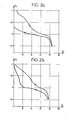
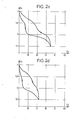
- FIGS. 2a to 2d represent curves of discharges and successive charges of an electrode comprising this same active material, the discharges being continued up to a stop voltage of 2.5V and the charges up to a voltage of 4V shutdown.
- the four figures relate respectively to the 1 st , 10 th , 50 th , 300 discharge-recharge cycles. It is seen that the charges, and the discharges other than the first, are done on two stages, the upper stage being able to correspond to the oxidation and the reduction of iron in sites other than those where the atoms of iron III were in the starting product.
- Figures 3a to 3e show that this active ingredient can be cycled on the lower bearing only by limiting the charging voltage to 3.5V. These five figures represent the discharge-charging curves at 1, 10, 50, 100, 150 cycle. The electrochemical performance of changing 94% in the first cycle to 34% at 150 th cycle.
- Curve B in FIG. 1 is a curve for the first discharge of an electrode comprising this active material, plotted in the same way as curve A.
- the electrochemical efficiency is 55% for the stop voltage of 2 volts.
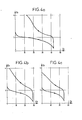
- FIGS. 4a to 4c represent curves of successive discharges and recharges of electrodes comprising this same active material, produced under the same conditions as the curves of FIGS. 2a to 2d. They are respectively related to 1st, 5th and 10th discharge-charge cycles. The yield decreases rapidly, from 41% to 24%. The discharge and charge are carried out on a single level in the area of potential explored.
- a hexacyanoferrate from sera was prepared starting from equimolecular quantities of potassium ferricyanide and ferrous chloride: This product is sometimes called Turnbull blue. Its theoretical yield (1 faraday per mole) is 82.3 Ah / kg.
- Curve C in FIG. 1 is a curve for the first discharge of an electrode containing this active material.
- the discharge potential and the slope of the curve are comparable to those of the electrodes of the previous examples.
- the electrochemical yield reaches 87%.
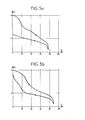
- FIGS. 5a to 5d represent curves of successive discharges and charges of an electrode containing this same active material.
- the four figures are respectively relating to l, 10th, 50th and 250th discharge-charge cycles.
- the observed yield increases at the beginning of cycling: 94% in the first cycle, 107% in the 10th and then decreases to 53% in 250 cycles.
- Obtaining a yield greater than 100% is not surprising, given that the theoretical capacity adopted takes account of the oxidation state of the initial product, which can be exceeded after recharging by switching to the state III of iron atoms which were initially in state II.
- the discharges and recharges are carried out on two bearings situated substantially at the same levels as those of the curves 2a to 2d.
- an active material according to the invention can be obtained by reaction of a ferricyanide and / or a ferrocyanide with iron salts II and / or III in proportions other than those described, the preparation possibly calling simultaneously to a ferricyanide and a ferrocyanide, as well as to iron salts II and III.
- the invention is not further limited by the reactions for obtaining them, by the formulas and by the oxide-reduction mechanisms of these active materials, which have only been proposed as hypotheses.
Landscapes
- Chemical & Material Sciences (AREA)
- Inorganic Chemistry (AREA)
- Health & Medical Sciences (AREA)
- General Health & Medical Sciences (AREA)
- Toxicology (AREA)
- Organic Chemistry (AREA)
- Chemical Kinetics & Catalysis (AREA)
- Electrochemistry (AREA)
- General Chemical & Material Sciences (AREA)
- Battery Electrode And Active Subsutance (AREA)
- Secondary Cells (AREA)
Abstract
Description
- L'invention concerne une matière active positive réversible pour générateur électrochimique secondaire à électrolyte non aqueux. Depuis quelques années est apparue sur le marché une nouvelle famille de générateurs électrochimiques, qui se distingue par l'utilisation d'électrolytes non aqueux liquides à température ordinaire. Ces électrolytes permettent d'avoir recours à des matières actives négatives constituées par des métaux légers et très énergétiques tels que le lithium, qui ne peuvent que difficilement être employés en présence d'électrolytes aqueux en raison de leur réactivité chimique vis-à-vis de l'eau. Ces générateurs présentent donc des énergies massiques!sensiblement plus élevées que les générateurs à électrolyte aqueux, avec des puissances plus fortes que ceux à électrolyte solide et sans les contraintes liées aux hautes températures.
- Toutefois seuls des générateurs primaires à électrolyte non aqueux ont été développés jusqu'ici. En effet la réalisation d'un générateur secondaire se heurte à deux difficultés :
- - la redéposition uniforme pendant la charge du métal léger dissous sous forme de sel lors de la décharge,
- - la mise en oeuvre d'une matière active positive fonctionnant réversiblement dans un milieu électrolytique non aqueux.
- Le but de l'invention est de résoudre cette seconde difficulté. L'invention a pour objet une matière active positive réversible pour générateur électrochimique secondaire à électrolyte non aqueux, caractérisée par le fait qu'elle est comprise dans le groupe formé par les hexacyanoferrates de fer, les composés qui en dérivent par remplacement au moins partiel du fer par d'autres éléments des groupes 4A, 5A, 6A, 7A et 8 de la classification périodique présentant au moins deux états d'oxydation stables autres que l'état zéro, et les mélanges de ces composés.
- Les groupes de la classification des éléments sont désignés conformément au § 1.2 des règles de 1970 pour la nomenclature de chimie inorganique établies par l'Union Internationale de Chimie Pure et Appliquée.
- Les hexacyanoferrates de fer sont des composés cristallisés comprenant des cations fer et des anions complexes formés par un atome central de fer entouré de six groupes cyanure CN-. Les cations peuvent comporter deux ou trois charges positives selon que le fer y est divalent ou trivalent. De même les anions Fe(CN)6 peuvent porter quatre ou trois charges négatives.
- Les hexacyanoferrates de fer sont obtenus notamment par réaction d'hexacyanoferrates solubles, par exemple de ferrocyanures ou ferricyanures alcalins, avec des sels de fer II ou III. Outre les ions indiqués ci-dessus, ils peuvent contenir des cations alcalins, ainsi que de l'eau de cristallisation.
- L'utilité des hexacyanoferrates de fer, qui sont pratiquement insolubles dans les solvants organiques, comme matières actives positives réversibles pour des générateurs électrochimiques secondaires à électrolyte non aqueux, peut s'expliquer, à titre de simple hypothèse, par le fait que le fer présent dans ces composés est susceptible de se réduire de -l'état III à l'état II sans destruction de la structure, avec probablement insertion de cations en provenance de l'électrolyte (Li+ par exemple) pour rétablir la neutralité électrique du cristal, selon l'une des réactions :


- l'indice cr marquant l'appartenance au cristal d'hexacyanoferrate. La réaction inverse est alors possible en charge.
- Il existe également des composés dérivant des hexacyanoferrates de fer par remplacement au moins partiel du fer par d'autres éléments des groupes 4A, 5A, 6A, 7A et 8 de la classification périodique présentant comme le fer au moins deux états d'oxydation stables autre que l'état-zéro. Le remplacement peut affecter, en tout ou en partie, soit les cations, soit l'atome central des anions, soit les deux à la fois. Ces composés dérivés peuvent être utilisés, au même titre que les hexacyanoferrates de fer, comme matière active réversible, ainsi que les mélanges d'au moins deux hexacyanoferrates de fer et/ou composés dérivés.
- En particulier le fer peut être remplacé par du manganèse, du cobalt et/ou du nickel.
- L'invention sera mieux comprise grâce à la description donnée ci-après de quelques exemples de mise en oeuvre, en regard du dessin annexé dans lequel :
- - la figure 1 représente des courbes de première décharge de trois matières actives selon l'invention,
- - les figures 2a à 2d représentent des courbes de décharges et recharges successives de l'une de ces matières actives (correspondant à la courbe A de la figure 1),
- - les figures 3a à 3e représentent des courbes de décharges et recharges successives de cette même matière active, enregistrées dans des conditions de cyclage différentes,
- - les figures 4a à 4c représentent des courbes de décharges et de recharges successives d'une seconde matière active (correspondant à la courbe B de la figure 1),
- - les figures 5a à 5d représentent des courbes de décharges et de recharges successives de la troisième matière active (correspondant à la courbe C de la figure 1).
- Pour toutes les courbes précédentes, on a porté en abscisse la capacité rapportée à la masse de matière active (C, CA, CB, CC) en Ah kg-1 et en ordonnée le potentiel de l'électrode par rapport au lithium (E, E A, E B, E C) en volts.
- Les essais dont les résultats sont donnés ci-après ont été réalisés dans les conditions suivantes :
- Les hexacyanoferrates de fer ont été préparés en mélangeant à température ambiante une solution aqueuse d'hexacyanoferrate II (ferrocyanure) ou d'hexacyanoferrate III (ferricyanure) de potassium et une solution aqueuse de chlorure ferreux ou ferrique, selon le cas. Les précipités obtenus, après lavage, ont été séchés jusqu'à poids constant, soit à 80°C à pression atmosphérique, soit à température ambiante sous vide.
- Les matières actives ont été mélangées à du graphite en quantités équipondérales, la masse étant liée par 0,1 à 1% de gélatine ; 10mg environ de chaque mélange ont été déposés sur un support de platine en une couche de 1 cm2 de surface et 0,1mm d'épaisseur.
- Les électrodes ainsi constituées ont été cyclées, face à des électrodes négatives de lithium, dans un électrolyte constitué par une solution molaire de perchlorate de lithium dans un mélange de 80% de diméthoxyé- thane et 20 % de carbonate de propylène en volume, sous une densité de courant de 1mA/cm .
- Un hexacyanoferrate de fer a été préparé à partir de ferricyanure de potassium et de chlorure ferreux, à raison de 3 moles de ferricyanure pour 4 moles de chlorure ferreux. La réaction et la formule du produit obtenu, telles que données par la littérature, sont les suivantes :

- La capacité massique théorique de ce produit, en supposant exacte la formule indiquée et en considérant la réduction de la totalité de fer III en fer II ( soit 3 faradays par mole) est de 89,3 Ah/kg.
- La courbe A de la figure 1 est la courbe de première décharge d'une électrode comportant cette matière active. En abscisse est portée la capacité déchargée rapportée à la masse de matière active, et en ordonnée le potentiel de l'électrode par rapport au lithium. Le rendement électrochimique est d'environ 87% pour une tension d'arrêt de 2 volts. Le palier de décharge, voisin de 3 volts, est relativement incliné, ce qui tend à confirmer le mécanisme de décharge en phase homogène.
- Les figures 2a à 2d représentent des courbes de décharges et de charges successives d'une électrode comportant cette même matière active, les décharges étant poursuivies jusqu'à une tension d'arrêt de 2,5V et les charges jusqu'à une tension d'arrêt de 4V. Les quatre figures sont relatives respectivement aux 1er, 10 e, 50e, 300 cycles de décharge-recharge. On voit que les charges, et les décharges autres que la première, se font sur deux paliers, le palier supérieur pouvant correspondre à l'oxydation et à la réduction du fer dans des sites autres que ceux où se trouvaient les atomes de fer III dans le produit de départ. Le rendement électrochimique évolue de 94% au 1er cycle à 49% au 300e cycle pour la tension d'arrêt de 2,5V.
- Les figures 3a à 3e montrent que cette matière active peut être cyclée sur le palier inférieur seulement en limitant la tension de charge à 3,5V. Ces cinq figures représentent respectivement les courbes de décharge-recharge aux 1er, 10e, 50 , 100 , 150 cycle. Le rendement électrochimique évolue de 94% au premier cycle à 34% au 150e cycle.
- Un hexacyanoferrate de fer a été préparé en utilisant 3 moles de ferrocyanure de potassium pour 4 moles de chlorure ferrique. La réaction donnée dans la littérature est la suivante :

- Le produit obtenu dans ces conditions est habituellement appelé bleu de Prusse, mais la signification de ce terme n'est pas parfaitement définie, certains auteurs désignant ainsi un composé ayant la formule donnée ci-dessus, d'autres considérant que le bleu de Prusse est un mélange de différents corps. Quoi qu'il en soit de la nature exacte du produit obtenu lors de la présente préparation, sa masse rapportée à celle des réactifs de départ est compatible avec la formule indiquée. La capacité massique théorique correspondante (pour 4 faradays par mole) est 103,0 Ah/kg.
- La courbe B de la figure 1 est une courbe de première décharge d'une électrode comportant cette matière active, tracée de la même manière que la courbe A. Le rendement électrochimique est de 55% pour la tension d'arrêt de 2 volts.
- Les figures 4a à 4c représentent des courbes de décharges et recharges successives d'électrodes comportant cette même matière active, réalisée dans les mêmes conditions que les courbes des figures 2a à 2d. Elles sont relatives respectivement aux 1er, 5e et 10e cycles de décharge-recharge. Le rendement décroît rapidement, de 41% à 24%. La décharge et la charge se font sur un seul palier dans le domaine de potentiel exploré.
- Un hexacyanoferrate de fera été préparé en partant de quantités équimoléculaires de ferricyanure de potassium et de chlorure ferreux :

- La courbe C de la figure 1 est une courbe de première décharge d'une électrode contenant cette matière active. Le potentiel de décharge et la pente de la courbe sont comparables à ceux des électrodes des exemples précédents. Le rendement électrochimique atteint 87%.
- Les figures 5a à 5d représentent des courbes de décharges et de charges successives d'une électrode contenant cette même matière active. Les quatre figures sont relatives respectivement aux ler, 10e, 50e et 250 e cycles de décharge-recharge. Le rendement observé augmente au début du cyclage : 94% au premier cycle, 107% au 10e, puis diminue pour atteindre 53 % au 250 cycle. L'obtention d'un rendement supérieur à 100 % n'est pas surprenante, étant donné que la capacité théorique adoptée tient compte de l'état d'oxydation du produit initial, lequel peut être dépassé après recharge par le passage à l'état III d'atomes de fer qui étaient initialement à l'état II. Les décharges et les recharges se font sur deux paliers situés sensiblement aux mêmes niveaux que ceux des courbes 2a à 2d.
- Les exemples qui viennent d'être décrits montrent qu'il est possible de cycler des électrodes contenant comme matières actives des hexacyanoferrates de fer. De telles substances peuvent être utilisées comme matières actives dans des générateurs secondaires à électrolyte non aqueux, et notamment à électrode négative de lithium.
- L'invention n'est pas limitée aux matières actives citées dans les exemples, ni aux modes de préparation donnés pour celles ci. En particulier une matière active selon l'invention peut être obtenue par réaction d'un ferricyanure et/ou d'un ferrocyanure avec des sels de fer II et/ou III dans d'autres proportions que celles décrites, la préparation pouvant faire appel simultanément à un ferricyanure et un ferrocyanure, ainsi qu'à des sels de fer II et III.
- L'invention n'est pas davantage limitée par les réactions d'obtention, par les formules et par les mécanismes d'oxyde-réduction de ces matières actives, qui n'ont été proposées qu'à titre d'hypothèses.
Claims (6)
Priority Applications (1)
| Application Number | Priority Date | Filing Date | Title |
|---|---|---|---|
| AT79105135T ATE3739T1 (de) | 1978-12-20 | 1979-12-13 | Ein sekundaerer elektrochemischer generator mit einem nichtwaessrigen elektrolyten. |
Applications Claiming Priority (2)
| Application Number | Priority Date | Filing Date | Title |
|---|---|---|---|
| FR7835777A FR2445034A1 (fr) | 1978-12-20 | 1978-12-20 | Matiere active positive reversible pour generateur electrochimique secondaire a electrolyte non aqueux |
| FR7835777 | 1978-12-20 |
Publications (2)
| Publication Number | Publication Date |
|---|---|
| EP0012943A1 true EP0012943A1 (fr) | 1980-07-09 |
| EP0012943B1 EP0012943B1 (fr) | 1983-06-08 |
Family
ID=9216343
Family Applications (1)
| Application Number | Title | Priority Date | Filing Date |
|---|---|---|---|
| EP79105135A Expired EP0012943B1 (fr) | 1978-12-20 | 1979-12-13 | Générateur électrochimique secondaire à électrolyte non aqueux |
Country Status (13)
| Country | Link |
|---|---|
| EP (1) | EP0012943B1 (fr) |
| JP (1) | JPS5586069A (fr) |
| AR (1) | AR224751A1 (fr) |
| AT (1) | ATE3739T1 (fr) |
| AU (1) | AU523604B2 (fr) |
| BR (1) | BR7908356A (fr) |
| CA (1) | CA1138029A (fr) |
| DE (1) | DE2965645D1 (fr) |
| DK (1) | DK544179A (fr) |
| ES (1) | ES487119A1 (fr) |
| FR (1) | FR2445034A1 (fr) |
| IE (1) | IE48721B1 (fr) |
| NO (1) | NO794116L (fr) |
Cited By (3)
| Publication number | Priority date | Publication date | Assignee | Title |
|---|---|---|---|---|
| EP0086555A1 (fr) * | 1982-01-14 | 1983-08-24 | Kabushiki Kaisha Daini Seikosha | Pile électrochimique |
| EP0131392A1 (fr) * | 1983-06-22 | 1985-01-16 | SEIKO INSTRUMENTS & ELECTRONICS LTD. | Pile secondaire |
| WO1998050970A1 (fr) * | 1997-05-05 | 1998-11-12 | Chemergy Ltd. | Pile electrique a base de fer |
Families Citing this family (2)
| Publication number | Priority date | Publication date | Assignee | Title |
|---|---|---|---|---|
| JP5937941B2 (ja) * | 2012-10-04 | 2016-06-22 | 日本電信電話株式会社 | ナトリウム二次電池 |
| KR102196785B1 (ko) * | 2013-04-10 | 2020-12-31 | 나트론 에너지, 인코포레이티드 | 전기화학 소자용 조용매 전해질 |
Citations (5)
| Publication number | Priority date | Publication date | Assignee | Title |
|---|---|---|---|---|
| FR34419E (fr) * | 1929-06-18 | |||
| FR1496367A (fr) * | 1965-10-22 | 1967-09-29 | Tno | Procédé de fabrication d'un dépolarisant pour batteries électriques |
| FR2014606A1 (fr) * | 1968-07-15 | 1970-04-17 | Du Pont | |
| US3694149A (en) * | 1969-03-31 | 1972-09-26 | Kitazato Gakuen | Purified blue colored inorganic macromolecular complex compounds |
| FR2324127A1 (fr) * | 1975-09-15 | 1977-04-08 | Accumulateurs Fixes | Matiere active positive pour piles de grande energie specifique |
-
1978
- 1978-12-20 FR FR7835777A patent/FR2445034A1/fr active Granted
-
1979
- 1979-12-13 DE DE7979105135T patent/DE2965645D1/de not_active Expired
- 1979-12-13 AT AT79105135T patent/ATE3739T1/de not_active IP Right Cessation
- 1979-12-13 EP EP79105135A patent/EP0012943B1/fr not_active Expired
- 1979-12-17 NO NO794116A patent/NO794116L/no unknown
- 1979-12-18 AU AU53959/79A patent/AU523604B2/en not_active Ceased
- 1979-12-18 AR AR279331A patent/AR224751A1/es active
- 1979-12-19 DK DK544179A patent/DK544179A/da unknown
- 1979-12-19 CA CA000342254A patent/CA1138029A/fr not_active Expired
- 1979-12-19 IE IE2479/79A patent/IE48721B1/en unknown
- 1979-12-19 JP JP16418479A patent/JPS5586069A/ja active Pending
- 1979-12-19 BR BR7908356A patent/BR7908356A/pt unknown
- 1979-12-20 ES ES487119A patent/ES487119A1/es not_active Expired
Patent Citations (5)
| Publication number | Priority date | Publication date | Assignee | Title |
|---|---|---|---|---|
| FR34419E (fr) * | 1929-06-18 | |||
| FR1496367A (fr) * | 1965-10-22 | 1967-09-29 | Tno | Procédé de fabrication d'un dépolarisant pour batteries électriques |
| FR2014606A1 (fr) * | 1968-07-15 | 1970-04-17 | Du Pont | |
| US3694149A (en) * | 1969-03-31 | 1972-09-26 | Kitazato Gakuen | Purified blue colored inorganic macromolecular complex compounds |
| FR2324127A1 (fr) * | 1975-09-15 | 1977-04-08 | Accumulateurs Fixes | Matiere active positive pour piles de grande energie specifique |
Cited By (3)
| Publication number | Priority date | Publication date | Assignee | Title |
|---|---|---|---|---|
| EP0086555A1 (fr) * | 1982-01-14 | 1983-08-24 | Kabushiki Kaisha Daini Seikosha | Pile électrochimique |
| EP0131392A1 (fr) * | 1983-06-22 | 1985-01-16 | SEIKO INSTRUMENTS & ELECTRONICS LTD. | Pile secondaire |
| WO1998050970A1 (fr) * | 1997-05-05 | 1998-11-12 | Chemergy Ltd. | Pile electrique a base de fer |
Also Published As
| Publication number | Publication date |
|---|---|
| DK544179A (da) | 1980-06-21 |
| IE48721B1 (en) | 1985-05-01 |
| ES487119A1 (es) | 1980-09-16 |
| ATE3739T1 (de) | 1983-06-15 |
| IE792479L (en) | 1980-06-20 |
| CA1138029A (fr) | 1982-12-21 |
| DE2965645D1 (en) | 1983-07-14 |
| JPS5586069A (en) | 1980-06-28 |
| NO794116L (no) | 1980-06-23 |
| AU5395979A (en) | 1980-06-26 |
| EP0012943B1 (fr) | 1983-06-08 |
| FR2445034B1 (fr) | 1981-01-02 |
| AR224751A1 (es) | 1982-01-15 |
| BR7908356A (pt) | 1980-09-16 |
| AU523604B2 (en) | 1982-08-05 |
| FR2445034A1 (fr) | 1980-07-18 |
Similar Documents
| Publication | Publication Date | Title |
|---|---|---|
| CA2279396C (fr) | Nouveaux materiaux d'electrodes derives de composes ioniques polyquinoniques et leurs utilisations dans les generateurs electrochimiques | |
| EP0267106B1 (fr) | Matériau à conduction ionique | |
| EP0902492A1 (fr) | Solvants et nouvelles compositions électrolytiques possédant un large domaine de stabilité et une conductivité élevée | |
| EP0495073A1 (fr) | Sels de methyline, formulations, electrolytes et piles realises a partir desdits sels. | |
| CN1278445C (zh) | 用于有机锂硫电池的有机电解液及采用它的锂硫电池 | |
| EP0012943B1 (fr) | Générateur électrochimique secondaire à électrolyte non aqueux | |
| EP2855444A1 (fr) | Sel d'anions bicycliques aromatiques pour batteries li-ion | |
| FR2466875A1 (fr) | Pile non aqueuse a anode rechargeable en alliage d'argent | |
| JPH01206571A (ja) | 非水二次電池の過充電保護 | |
| EP0025560B1 (fr) | Générateur électrochimique à électrolyte non aqueux | |
| JPH10189041A (ja) | リチウム二次電池用電解液 | |
| JPH06333598A (ja) | リチウム2次電池用電解液 | |
| KR900007729B1 (ko) | 리튬-이산화황 전기화학 전지용 전해액 첨가제 | |
| EP0415856A2 (fr) | Générateur électrochimique rechargeable comportant des polymères à l'état solide | |
| JPH03152879A (ja) | 非水電解液二次電池 | |
| JP2701327B2 (ja) | 非水電解液二次電池 | |
| JPH03291863A (ja) | 二次電池 | |
| CA2871552A1 (fr) | Sel d'anions bicycliques aromatiques pour batteries li-ion | |
| CA1069973A (fr) | Electrolyte solide et cellule pour celui-ci | |
| JPS58111268A (ja) | 動力電池用電気活性物質 | |
| JP2994705B2 (ja) | 非水系電解液電池 | |
| CA1134607A (fr) | Matiere active positive pour generateur electrochimique a electrolyte non aqueux et generateur electrochimique comprenant une telle matiere active | |
| JPH02239574A (ja) | 非水電解液二次電池 | |
| JPH0763016B2 (ja) | 有機電解質電池 | |
| JPH02126554A (ja) | 非水溶媒二次電池 |
Legal Events
| Date | Code | Title | Description |
|---|---|---|---|
| PUAI | Public reference made under article 153(3) epc to a published international application that has entered the european phase |
Free format text: ORIGINAL CODE: 0009012 |
|
| AK | Designated contracting states |
Designated state(s): AT BE CH DE FR GB IT LU NL SE |
|
| 17P | Request for examination filed | ||
| RAP1 | Party data changed (applicant data changed or rights of an application transferred) |
Owner name: GIPELEC S.A. |
|
| ITF | It: translation for a ep patent filed | ||
| GRAA | (expected) grant |
Free format text: ORIGINAL CODE: 0009210 |
|
| AK | Designated contracting states |
Designated state(s): AT BE CH DE FR GB IT LU NL SE |
|
| REF | Corresponds to: |
Ref document number: 3739 Country of ref document: AT Date of ref document: 19830615 Kind code of ref document: T |
|
| REF | Corresponds to: |
Ref document number: 2965645 Country of ref document: DE Date of ref document: 19830714 |
|
| PGFP | Annual fee paid to national office [announced via postgrant information from national office to epo] |
Ref country code: LU Payment date: 19830829 Year of fee payment: 5 |
|
| PG25 | Lapsed in a contracting state [announced via postgrant information from national office to epo] |
Ref country code: LU Free format text: LAPSE BECAUSE OF NON-PAYMENT OF DUE FEES Effective date: 19831231 |
|
| PGFP | Annual fee paid to national office [announced via postgrant information from national office to epo] |
Ref country code: FR Payment date: 19840322 Year of fee payment: 6 |
|
| PLBE | No opposition filed within time limit |
Free format text: ORIGINAL CODE: 0009261 |
|
| STAA | Information on the status of an ep patent application or granted ep patent |
Free format text: STATUS: NO OPPOSITION FILED WITHIN TIME LIMIT |
|
| 26N | No opposition filed | ||
| PGFP | Annual fee paid to national office [announced via postgrant information from national office to epo] |
Ref country code: CH Payment date: 19840813 Year of fee payment: 6 |
|
| PGFP | Annual fee paid to national office [announced via postgrant information from national office to epo] |
Ref country code: DE Payment date: 19840823 Year of fee payment: 6 |
|
| PGFP | Annual fee paid to national office [announced via postgrant information from national office to epo] |
Ref country code: SE Payment date: 19840930 Year of fee payment: 6 Ref country code: BE Payment date: 19840930 Year of fee payment: 6 |
|
| PGFP | Annual fee paid to national office [announced via postgrant information from national office to epo] |
Ref country code: AT Payment date: 19841217 Year of fee payment: 6 |
|
| PGFP | Annual fee paid to national office [announced via postgrant information from national office to epo] |
Ref country code: NL Payment date: 19841231 Year of fee payment: 6 |
|
| PG25 | Lapsed in a contracting state [announced via postgrant information from national office to epo] |
Ref country code: AT Effective date: 19851213 |
|
| PG25 | Lapsed in a contracting state [announced via postgrant information from national office to epo] |
Ref country code: NL Effective date: 19860701 |
|
| NLV4 | Nl: lapsed or anulled due to non-payment of the annual fee | ||
| PG25 | Lapsed in a contracting state [announced via postgrant information from national office to epo] |
Ref country code: SE Effective date: 19861214 |
|
| PG25 | Lapsed in a contracting state [announced via postgrant information from national office to epo] |
Ref country code: CH Effective date: 19861231 Ref country code: BE Effective date: 19861231 |
|
| BERE | Be: lapsed |
Owner name: GIPELEC S.A. Effective date: 19861231 |
|
| REG | Reference to a national code |
Ref country code: CH Ref legal event code: PL |
|
| GBPC | Gb: european patent ceased through non-payment of renewal fee | ||
| PG25 | Lapsed in a contracting state [announced via postgrant information from national office to epo] |
Ref country code: FR Free format text: LAPSE BECAUSE OF NON-PAYMENT OF DUE FEES Effective date: 19880831 |
|
| PG25 | Lapsed in a contracting state [announced via postgrant information from national office to epo] |
Ref country code: DE Effective date: 19880901 |
|
| REG | Reference to a national code |
Ref country code: FR Ref legal event code: ST |
|
| PG25 | Lapsed in a contracting state [announced via postgrant information from national office to epo] |
Ref country code: GB Free format text: LAPSE BECAUSE OF NON-PAYMENT OF DUE FEES Effective date: 19881118 |
|
| EUG | Se: european patent has lapsed |
Ref document number: 79105135.2 Effective date: 19870902 |