EP0011594B1 - Calculatrice de poche pour la prévision d'événements périodiques comprenant une mémoire électromécanique - Google Patents
Calculatrice de poche pour la prévision d'événements périodiques comprenant une mémoire électromécanique Download PDFInfo
- Publication number
- EP0011594B1 EP0011594B1 EP79810067A EP79810067A EP0011594B1 EP 0011594 B1 EP0011594 B1 EP 0011594B1 EP 79810067 A EP79810067 A EP 79810067A EP 79810067 A EP79810067 A EP 79810067A EP 0011594 B1 EP0011594 B1 EP 0011594B1
- Authority
- EP
- European Patent Office
- Prior art keywords
- memory
- calculator
- data
- electro
- further characterized
- Prior art date
- Legal status (The legal status is an assumption and is not a legal conclusion. Google has not performed a legal analysis and makes no representation as to the accuracy of the status listed.)
- Expired
Links
Images



Classifications
-
- A—HUMAN NECESSITIES
- A61—MEDICAL OR VETERINARY SCIENCE; HYGIENE
- A61B—DIAGNOSIS; SURGERY; IDENTIFICATION
- A61B10/00—Instruments for taking body samples for diagnostic purposes; Other methods or instruments for diagnosis, e.g. for vaccination diagnosis, sex determination or ovulation-period determination; Throat striking implements
- A61B10/0012—Ovulation-period determination
-
- G—PHYSICS
- G06—COMPUTING OR CALCULATING; COUNTING
- G06F—ELECTRIC DIGITAL DATA PROCESSING
- G06F15/00—Digital computers in general; Data processing equipment in general
- G06F15/02—Digital computers in general; Data processing equipment in general manually operated with input through keyboard and computation using a built-in program, e.g. pocket calculators
- G06F15/025—Digital computers in general; Data processing equipment in general manually operated with input through keyboard and computation using a built-in program, e.g. pocket calculators adapted to a specific application
-
- G—PHYSICS
- G16—INFORMATION AND COMMUNICATION TECHNOLOGY [ICT] SPECIALLY ADAPTED FOR SPECIFIC APPLICATION FIELDS
- G16H—HEALTHCARE INFORMATICS, i.e. INFORMATION AND COMMUNICATION TECHNOLOGY [ICT] SPECIALLY ADAPTED FOR THE HANDLING OR PROCESSING OF MEDICAL OR HEALTHCARE DATA
- G16H40/00—ICT specially adapted for the management or administration of healthcare resources or facilities; ICT specially adapted for the management or operation of medical equipment or devices
- G16H40/60—ICT specially adapted for the management or administration of healthcare resources or facilities; ICT specially adapted for the management or operation of medical equipment or devices for the operation of medical equipment or devices
- G16H40/63—ICT specially adapted for the management or administration of healthcare resources or facilities; ICT specially adapted for the management or operation of medical equipment or devices for the operation of medical equipment or devices for local operation
-
- A—HUMAN NECESSITIES
- A61—MEDICAL OR VETERINARY SCIENCE; HYGIENE
- A61B—DIAGNOSIS; SURGERY; IDENTIFICATION
- A61B10/00—Instruments for taking body samples for diagnostic purposes; Other methods or instruments for diagnosis, e.g. for vaccination diagnosis, sex determination or ovulation-period determination; Throat striking implements
- A61B10/0012—Ovulation-period determination
- A61B2010/0019—Ovulation-period determination based on measurement of temperature
-
- A—HUMAN NECESSITIES
- A61—MEDICAL OR VETERINARY SCIENCE; HYGIENE
- A61B—DIAGNOSIS; SURGERY; IDENTIFICATION
- A61B10/00—Instruments for taking body samples for diagnostic purposes; Other methods or instruments for diagnosis, e.g. for vaccination diagnosis, sex determination or ovulation-period determination; Throat striking implements
- A61B10/0012—Ovulation-period determination
- A61B2010/0029—Ovulation-period determination based on time measurement
Definitions
- This data is important and should be kept less than a month. It is obviously not possible to use, for these data, a usual memory circuit which is erased when the supply is cut.
- miniature magnetic cards are used. However, such a means does not represent absolute security here. Indeed, the magnetic card can be lost and the data it contains can be erased or altered by the influence of a magnetic field coming into contact with the card.
- the present invention aims to provide a convenient and secure solution to the problem of keeping some essential data, in particular in the case of a pocket calculator used for forecasting menstrual cycles.
- the calculator according to the invention is the subject of claim 1, the other claims relating to special embodiments.
- the calculator according to the invention presents a convenient solution for people wishing to use a forecasting method such as the Ogino method.
- the essential data are stored in a special memory incorporated in the calculator and not in an external memory medium of the magnetic card type. There is therefore no risk of losing it.
- the memory thus incorporated in the calculator runs virtually no risk of being in direct contact with a magnet which could disturb it, and the memory is thus much safer than a memory on a magnetic card.
- the electro-mechanical memory will have good immunity to external influences such as shocks, variations in temperature and pressure.
- a preferred type of electromechanical element is protected against an acceleration of several tens of G.
- the calculator can be made in such a way that its use is very simple and requires only a minimum of reasoning and attention from the user. Conversely, it can be associated with a relatively complex calculator and / or a digital clock.
- the person may need a forecast program different from a standard and function program, for example, the prescriptions of a gynecologist.
- the memory supporting the program comprises a removable or reprogrammable part.
- the memory block of the calculator may consist of a ROM memory comprising the standard forecast program and replaceable by a different memory, programmed on the basis of the prescriptions of the gynecologist; or else, the memory block includes an EPROM memory, that is to say erasable, in principle using intense ultraviolet rays, and reprogrammable using an auxiliary device that the cynecologist or the company might have distributing the calculator.
- a calculator according to the invention can therefore advantageously be applied to the forecasting of menstrual cycles of women, in particular according to the Ogino method; however, the principles underlying the invention can be applied to any problem which can be submitted to a miniature calculator and of the kind where it is desired to keep, from one period to another, a certain number of essential data that requires a secure memory, incorporated in the calculator and retaining information independently of the power supply.
- the calculator according to the invention could advantageously be adapted to the calculation of biorhythms.
- a biorhythm calculator with essentially electronic operation is known.
- this known calculator has the disadvantage of a volatile memory, that is to say of which the data is lost when the power is turned off.
- the calculator according to the invention would, in such a case, overcome this drawback and keep in memory, even if the power is off, a calculation data such as the date of birth, the memory being read and write electric, and usable as soon as power is restored.
- the present invention could also be advantageously adapted to a digital alarm clock to keep the time of actuation of the ring, even in case the power is cut.
- These signaling means can for example be a flashing of part of the display.
- the solution according to the invention would make it possible, for example, to change the batteries without fear that the important date or the noted time would be lost or altered.
- the invention also relates to the field of miniature electronic devices which are not pure calculators but which, however, such as for example a digital alarm clock, include one or more functions using data, for example the alarm time, data which it is desirable to store conveniently and reliably, even if the power is turned off.
- the calculator shown in fig. 1 comprises a housing 1 containing the circuits and on which are arranged control and reading members.
- the control elements consist of a keyboard 2 comprising an ON / OFF key 22 for switching on and off, numeric keys such as the key 24, function keys 25 to indicate the nature of the data supplied, day , month, year, a command key 26 to request a forecast, and a registration key 29, provided with a security key 28 such that registration is made only if the keys are pressed simultaneously 28 and 29.
- the calculator also includes a display comprising green 31, yellow 32 and red 33 light-emitting diodes. These diodes are intended to indicate the probability that a possible intimate relationship will be followed by a pregnancy according to the following convention: red light, high probability; yellow light, medium probability; green light, low probability.
- the display also includes a digital part comprising at least six cells 42 with seven segments, of the type either electroluminescent or liquid crystal, for digitally displaying the day, the month and the year (units and tens of the number of the year civil).
- the inscriptions 40 such as "DAY”, “MONTH”, “YEAR” facilitate the reading of the date.
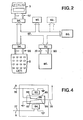
- the diagram in fig. 2 comprises a miniature logic system organized around a central processor unit CPU 50, controlling memories and peripherals via a bus 52.
- a peripheral there is the keyboard 2 connected by lines 55 to a circuit interface 54 connected to processor CPU 50 by bus 52.
- a ROM memory 06 that is to say intended to be read only.
- a ROM can in fact consist of a PROM, that is to say a ROM memory which can be programmed with the aid of auxiliary devices.
- This memory is preferably installed in the form of a removable "chip", that is to say a miniature circuit provided with pins intended to be connected in a base provided with corresponding connectors. A removable chip can be removed for modification or replacement.
- EPROM that is to say an erasable circuit, in principle using intense ultraviolet rays, and reprogrammable using an ad hoc auxiliary device.
- the calculations use auxiliary variables and data from the keyboard which must be stored in a RAM 62 memory: However, if the number of these variables is not too large, we can consider that the processor has the means to store them.
- the known processors usually include a plurality of registers intended for this purpose.
- the calculator aims to perform a certain number of functions to solve the problem posed in the introduction.
- a microprocessor controlling a certain number of peripherals is used as explained above, by means of a program. Any person qualified in the field of microprocessors is capable of carrying out this program housed in the ROM memory 60 in "ASSEMBLER” language, according to the problem posed.
- This person will use for example a microprocessor of the type “6500”, ROM and RAM memories of the type "8 bits” and interfaces of the type "6520", all manufactured for example at “Synertec” or “Intel”, these companies also delivering the related user manuals describing exactly how these devices work.
- chips incorporating both a PROM memory, a portion of EPROM memory, a RAM memory and the central processor CPU itself.
- the principle of the diagram remains the same, but such a circuit can have the advantage of a reduced bulk.
- TMS 1000 model from TEXAS INSTRUMENTS.
- a memory 80 with electro-mechanical elements connected to an interface circuit 70 by lines 72 and 90.
- Such a memory has features linked to the principles underlying the present invention.
- This memory is also controlled by the microprocessor programmed for this purpose.
- Fig. 3 shows the diagram of the electro-mechanical memory 80 and of its interface 70.
- the memory is made up of a plurality of electro-mechanical memory elements 82.
- Each element 82 can be likened to a flip-flop, which can therefore store 1-bit information, and the element will be described in more detail in FIG. 4.
- Each rocker includes an input S (set) for setting to 1 and an input R (reset) for setting to zero, and an output wire 78, all the output wires being connected in a single output wire 90 for all the memory. 80.
- each element 82 are individually connected to one of the outputs of a multiplexer 702.
- the choice of output is controlled by the control wires 73 of the multiplexer and the wire 74 is used to define whether a R or an S.
- a command pulse can be sent by the wire and it will be routed by the multiplexer to the selected entry.
- the R or S recording pulse must have a certain power and a certain duration, for example 10 milliamps for 2 milliseconds, to excite the electro-mechanical organs of element 82.
- a pulse is also sent by the multiplexer to the input S of the element 82 that we want to read, but a much shorter pulse, for example 10 microseconds, is sent.
- This impulse cannot alter the logical state of the rocker.
- the flip-flop is at 1
- the output 78 and the data wire 90 will provide a logical 1 and if the rocker chosen is at zero, the output 78 and the data wire 90 will remain at 0, so that there is, for 10 microseconds, the logic value of the flip-flop chosen on the data wire 90, which is sufficient for reading.
- the multiplexer 702 is itself controlled by the microprocessor through an amplifier 701, the microprocessor managing the inscriptions and readings in the memory 80.
- the amplifier 701 is obviously in two-way communication by means of the bus 52 with the microprocessor 50 on which it depends. It can simply consist of a transistor amplifier circuit.
- the circuit 701 and the multiplexer 702 can be considered as forming the interface of the memory 80.
- Fig. 4 represents the diagram of the electro-mechanical memory element 82.
- the element comprises a bistable contact 85 comprising a blade 89 connected to a terminal 86 and establishing contact either with terminal 88, as in the figure, or with the opposite terminal 87.
- the switching is controlled by two windings 83 and 84.
- a pulse on the winding 83 brings the blade 89 into the position shown in FIG. 4 and an impulse on the other winding 84 brings the blade into the opposite position, indicated in dotted lines.
- One coil is connected to input S and the other coil is connected to input R.
- input S is connected to terminal 88, to allow readings.
- the memory array 80 shown in FIG. 3 can be produced in the form of a printed circuit board carrying a plurality of miniature bistable relays 82 soldered to the plate by their contact terminals.
- a relay model that may be suitable is the TL series relay supplied by Compagnie Deutsch. Such a relay withstands conditions such as 3000 Hz vibration with an acceleration of 30 g or an acceleration of 100 g over 6 milliseconds. Its size is of the order of a cubic centimeter or less so that one can easily accommodate several tens in the housing of a calculator while remaining within acceptable dimensions for a pocket calculator. On the market, there are such relays. It is preferable to use relays of the "TL" series from Deutsch Company.
- An example of a method therefore consists in noting the dates of the successive rules d ,,, d 2 , d 3 , ..., in calculating the corresponding durations of the cycles C 1 , C 2 , C 3 , ..., in verifying that 'they are regular, to establish the average cm and the probable error ec.
- the probable date dp of the next rules is calculated. This date is, of course, the date of the last menstruation dn, plus the average duration of the cycle cm, with uncertainty em:
- g dp-da. If g is between 14 + 4 + ec and 14-3-ec, then the probability of a subsequent pregnancy is high. If g is greater than 14 + ec + 4, the probability is medium. If g is less than 14-ec-4, then the probability is low.
- the important data to memorize are: the date of the start of the last rules and the durations of the last four cycles to be able to establish an average.
- the memorization of a date implies a portion of memory which can store a number j having an arbitrary value between 1 and 365, for the day in the year, as well as a number "a" between 0 and 99 to designate the year.
- the memory 80 contains the date of the last rules as well as the values (reduced by 22) of the durations of the last four cycles, that we are in conditions where the method is applicable and that we are in May 1988.
- She wishes to obtain the forecast for the next day, which is the 20th of the month. For this purpose, it activates on the keyboard the keys bearing the symbols according to the following sequence: which means: day: 20; month: 5; year: 88; order to calculate (key 26).
- the processor 50 controls the display of these numbers as soon as the person enters them on the keyboard.
- the processor 50 calculates the average duration cm of the cycle on the basis of the last four cycles, the probable error ec, the number g of days between this probable date and the date of the 20, by consulting of course the memory 80, without the to alter.
- the processor evaluates, based on g, cm and em, whether the probability is high, medium or low and, depending on the result, lights one of the three red diodes. 31, yellow 32 or green 33, respectively.
- the calculator implements means similar to those used in certain financial calculators pocket, which are equipped with what is called an electronic perpetual calendar.
- the said means will simply include an adequate program and some fixed data, all written in a portion of the ROM memory 60 which is used by the processor 50.
- the program also preferably has routines to detect cases where a reasonable forecast cannot be made, for example because the date for which the forecast is wanted is too far or impossible, or because cycles are too irregular or too short.
- the program then provides for the display of the letter E, for "error" possibly followed by a number indicating the nature of the error, allowing the person to refer to the instructions for use generally attached to the calculator or printed on the back of the calculator.
- This program calculates the last cycle time by difference between the date of the previous rules still written in memory 80, and the date of the recent rules, which has just been supplied. by means of the keyboard 2. It eliminates, among the four cycle durations memorized those relating to the oldest cycle, shifts the other three and writes the duration of the most recent cycle. The program also replaces the date of the period with the last date.
- the memory 80 preferably includes a number of elements greater than the minimum required, which is 32 as we have seen, to be able to write before erasing so that the data is not lost in case the power is cut during the transfer.
- the memory will further include status bits to indicate whether the recording operation is complete or incomplete, to facilitate recovery of the data in the event that the power is cut off during the transfer.
- the memory can include a pointer which says which of the four is the most recent, it being understood that the others are ordered according to a circular "stack". Two bits are enough for the pointer.
- the Ogino method can be supplemented by a temperature test.
- the principle is sufficiently described in the medical literature.
- a variant of the calculator can then include a means for entering the temperature data and programs to complete the calculations with a function taking these data into account. As an entry method, an additional touch is sufficient. Let T be such an additional key.
- the use could be as follows: when the person requests a forecast, he enters on the keyboard not only the date, but also the temperature, for example 37.3 ° C, before requesting the forecast by pressing the 26 key. The sequence would be: then, after checking on the display: T 3 7 3 then * to order the calculation of a forecast.
- the * 26 key can be eliminated.
- the program is arranged so as to carry out the forecast for any date which is entered and which appears on the display.
- Fig. 5 illustrates a second embodiment which is distinguished by a certain simplicity of the keyboard.
- the logic system of such a calculator essentially has the structure described in fig. 2. However, the programs take into account the keyboard specific to this form of execution.
- the touch "1" 127 is used for commissioning, it connects the power supply.
- the "0" 128 key is used to stop and cut the power. However, even if the "0" key is not pressed, the display is put on standby after one minute if no keyboard key has been pressed. The display is activated again if key 1 is pressed again or also if another key is pressed, but excluding the 0 key which stops everything. If no button is pressed for 5 minutes, the system is also switched off.
- the J key is used to modify a digital counter whose content is displayed on the two digits of window 141.
- Said digital counter is obviously essentially software in nature (soft); there is therefore no reason to describe it here.
- the user can use the invert key 125, which has the effect of reversing the counting direction.
- the program is arranged so that the counting is relatively slow when the J key is pressed, then after a few seconds, the counting accelerates if the J key is held.
- the M key 122 displays the month on the digits of window 142 and the A key 123 displays the year on the two digits of window 143.
- the M and A keys have functions similar to that of the J key and are also influenced by the invert key 125.
- the keyboard may include a key 126 ordering the calculation of a forecast. We have seen that such a touch is not essential. Finally, the keyboard includes the registration 28 and security 29 keys, the function of which has already been described.
- Fig. 6 illustrates an exemplary embodiment which, unlike that of FIG. 5, is distinguished by a certain complexity.
- the keyboard has numeric keys and various function keys and could be perfectly suitable for a scientific, financial, arithmetic or other calculator, as well as an electronic clock.
- the keyboard also includes a registration key 29 and a security key 28.
- the display 3 comprises, in the example given, an alphanumeric zone 301 of three positions, a digital zone 302 of four positions and a special zone 303 for displaying the prediction calculation.
- a low probability is displayed as shown in fig. 7A
- an average probability is displayed as shown in fig. 7B
- a high probability is displayed as shown in fig. 7C and, moreover, by a flashing of the special display element 303.
- the display 300 can be produced advantageously, but not exclusively, according to the liquid crystal technique.
- Fig. 9 shows the diagram of a calculator comprising a part used for measuring time.
- This part includes a time base 174 connected to a set of logic time measurement circuits 170 which operate continuously and, among other things, evaluate not only the hour to the nearest second, but also the date. These circuits 170, 174 are intended to operate without interruption.
- Such a permanent time measurement circuit represents a convenient means of bringing up the date of the day, as given. This date can then be used for a forecast calculation or a registration.
- Fig. 8 illustrates some possible states of the display 300.
- Fig. 8A illustrates the display of the time, 10:25 am in the example given.
- the alphanumeric area is used to distinguish morning ("AM”) from afternoon (“PM").
- Fig. 8B illustrates the display of a date, November 12, 1988 in the example given, as well as the display of a forecast calculation which indicates, in the example given, an average probability.
- Fig. 8C indicates a third use of the display, intended for the case where it is possible to supply the forecast calculation program with data relating to the temperature, which is 37.3 ° C. in the example given.
- the examples described above refer specifically to a calculator specially arranged to perform the calculations required by the Ogino method or a similar method.
- the principle consisting in using an electro-mechanical memory composed of a plurality of bistable relays and of reading and recording circuits can apply to other calculators or other electronic devices comprising a digital part using data, in case some important data must be memorized in a convenient and safe way and kept even in the absence of power.
Landscapes
- Engineering & Computer Science (AREA)
- Health & Medical Sciences (AREA)
- Biomedical Technology (AREA)
- Public Health (AREA)
- Theoretical Computer Science (AREA)
- Life Sciences & Earth Sciences (AREA)
- General Health & Medical Sciences (AREA)
- Medical Informatics (AREA)
- Veterinary Medicine (AREA)
- Physics & Mathematics (AREA)
- Pathology (AREA)
- Epidemiology (AREA)
- Heart & Thoracic Surgery (AREA)
- Molecular Biology (AREA)
- Surgery (AREA)
- Animal Behavior & Ethology (AREA)
- General Business, Economics & Management (AREA)
- Computing Systems (AREA)
- Computer Hardware Design (AREA)
- Primary Health Care (AREA)
- General Engineering & Computer Science (AREA)
- General Physics & Mathematics (AREA)
- Business, Economics & Management (AREA)
- Calculators And Similar Devices (AREA)
- Electric Clocks (AREA)
- Navigation (AREA)
- Organic Low-Molecular-Weight Compounds And Preparation Thereof (AREA)
- Compression, Expansion, Code Conversion, And Decoders (AREA)
- Management, Administration, Business Operations System, And Electronic Commerce (AREA)
- Measuring Pulse, Heart Rate, Blood Pressure Or Blood Flow (AREA)
- Power Sources (AREA)
- Medical Treatment And Welfare Office Work (AREA)
Priority Applications (1)
| Application Number | Priority Date | Filing Date | Title |
|---|---|---|---|
| AT79810067T ATE10687T1 (de) | 1978-08-09 | 1979-08-07 | Taschenrechner mit elektromechanischem speicher fuer die voraussage periodischer ereignisse. |
Applications Claiming Priority (2)
| Application Number | Priority Date | Filing Date | Title |
|---|---|---|---|
| CH845578A CH626224B (fr) | 1978-08-09 | 1978-08-09 | Calculatrice de poche pour la prevision de cycles temporels. |
| CH8455/78 | 1978-08-09 |
Publications (2)
| Publication Number | Publication Date |
|---|---|
| EP0011594A1 EP0011594A1 (fr) | 1980-05-28 |
| EP0011594B1 true EP0011594B1 (fr) | 1984-12-05 |
Family
ID=4340635
Family Applications (1)
| Application Number | Title | Priority Date | Filing Date |
|---|---|---|---|
| EP79810067A Expired EP0011594B1 (fr) | 1978-08-09 | 1979-08-07 | Calculatrice de poche pour la prévision d'événements périodiques comprenant une mémoire électromécanique |
Country Status (10)
| Country | Link |
|---|---|
| US (1) | US4367527A (enExample) |
| EP (1) | EP0011594B1 (enExample) |
| JP (1) | JPS55500426A (enExample) |
| AT (1) | ATE10687T1 (enExample) |
| CH (1) | CH626224B (enExample) |
| DE (1) | DE2967320D1 (enExample) |
| DK (1) | DK149680A (enExample) |
| ES (1) | ES483240A1 (enExample) |
| NO (1) | NO792581L (enExample) |
| WO (1) | WO1980000384A1 (enExample) |
Cited By (1)
| Publication number | Priority date | Publication date | Assignee | Title |
|---|---|---|---|---|
| US7632460B2 (en) | 1996-09-27 | 2009-12-15 | Inverness Medical Switzerland Gmbh | Test kits and devices |
Families Citing this family (42)
| Publication number | Priority date | Publication date | Assignee | Title |
|---|---|---|---|---|
| DE3009211C2 (de) * | 1980-03-11 | 1983-08-18 | Volker Prof. Dr. 6905 Schriesheim Hepp | Mobiler Ereignis-Modul |
| JPS5849134A (ja) * | 1981-09-19 | 1983-03-23 | 株式会社コルポ | 女性用生理周期律計 |
| US4465077A (en) * | 1981-11-12 | 1984-08-14 | Howard Schneider | Apparatus and method of determining fertility status |
| CH648662A5 (fr) * | 1981-12-01 | 1985-03-29 | Ares Nv | Instrument electronique pour le controle et le traitement de l'infertilite feminine. |
| US4455610A (en) * | 1982-02-04 | 1984-06-19 | Rodrian James A | Self-contained estrous detection tag |
| JPS61500003A (ja) * | 1983-02-24 | 1986-01-09 | バイオセルフ・インタ−ナショナル・インコ−ポレ−テッド | 人の受精期間の査定装置 |
| USD293715S (en) | 1985-01-23 | 1988-01-12 | Krasnow Gerald P | Cardio-pulmonary resusitation pacer |
| GB2186977A (en) * | 1986-02-25 | 1987-08-26 | Benytone Corp | Fertility indicating thermometer |
| WO1989004140A1 (en) * | 1987-11-11 | 1989-05-18 | Joseph Henry Ruston | Pregnancy monitoring device |
| FR2611062A1 (fr) * | 1987-02-16 | 1988-08-19 | Salomon Felix | Calculateur electronique destine a la realisation des calculs gynecologiques cosmobiologiques |
| FR2617618B1 (fr) * | 1987-06-30 | 1991-09-13 | Derrien Jean | Dispositif permettant de determiner automatiquement les differentes dates necessaires au controle du bon deroulement de la gestation d'un etre vivant |
| JPH0724093Y2 (ja) * | 1989-01-20 | 1995-06-05 | セイコーエプソン株式会社 | 婦人用生理予測装置 |
| US5043888A (en) * | 1990-04-12 | 1991-08-27 | Uriarte Jorge E | Fertility indicator |
| GB9217865D0 (en) | 1992-08-21 | 1992-10-07 | Unilever Plc | Monitoring method |
| GB9217808D0 (en) | 1992-08-21 | 1992-10-07 | Unilever Plc | Advisory method |
| GB9217864D0 (en) | 1992-08-21 | 1992-10-07 | Unilever Plc | Monitoring method |
| GB2279782A (en) * | 1993-07-01 | 1995-01-11 | Wellgain Precision Products Li | Menstrual cycle meter. |
| US7141212B2 (en) | 1993-11-12 | 2006-11-28 | Inverness Medical Switzerland Gmbh | Reading devices and assay devices for use therewith |
| SE504267C2 (sv) * | 1994-06-01 | 1996-12-16 | Tetra Laval Holdings & Finance | Identitets- och kobrunstindikator |
| US6451619B1 (en) | 1994-06-29 | 2002-09-17 | Inverness Medical Switzerland Gmbh | Monitoring methods and devices for use therein |
| US5606535A (en) * | 1995-11-29 | 1997-02-25 | Lynn; Lynn | Digital menstrual wristwatch |
| US6600696B1 (en) * | 1995-11-29 | 2003-07-29 | Lynn Lynn | Woman's electronic monitoring device |
| US5657753A (en) * | 1995-12-29 | 1997-08-19 | Jacober; Jeffrey M. | Home breast self-examination system |
| US5928168A (en) * | 1996-08-27 | 1999-07-27 | Laros, Jr.; Russell K. | Method and apparatus for estimating and displaying fetal development data during pregnancy |
| DE69619236D1 (de) * | 1996-09-27 | 2002-03-21 | Unilever Plc | Überwachungsverfahren |
| US6022323A (en) * | 1997-05-30 | 2000-02-08 | Jackson; Joseph N. | Apparatus and method of providing a personal biorhythmic cycle indicator |
| GB9807134D0 (en) | 1998-04-02 | 1998-06-03 | Unilever Plc | Test methods devices and test kits |
| US6167000A (en) * | 1998-10-20 | 2000-12-26 | Chow; Shiou-Sheng | Multiple timer display |
| AU4425700A (en) | 1999-06-07 | 2000-12-28 | Edmond Desjacques | Method and device for taking a patient's basal body temperature |
| US6950839B1 (en) * | 2001-01-11 | 2005-09-27 | Alesandra Green | Nature's friend |
| US6747917B2 (en) | 2002-02-27 | 2004-06-08 | Georgetown University | Menstrual cycle monitor |
| CA2482938A1 (en) * | 2002-04-12 | 2003-10-23 | Human Genome Sciences, Inc. | Antibodies that specifically bind to tr2 |
| US20040022132A1 (en) * | 2002-07-31 | 2004-02-05 | Richard Rund | Variable mode display for time measurement devices |
| EP1836689A2 (en) * | 2005-01-04 | 2007-09-26 | Koninklijke Philips Electronics N.V. | Card with input elements for entering a pin code and method of entering a pin code |
| US8140605B2 (en) * | 2007-05-29 | 2012-03-20 | Patton Jr Roy Chilson | Electronic date calculator |
| US8077552B1 (en) * | 2009-05-06 | 2011-12-13 | Visilert, L.L.C. | Visual alert device |
| EP3684463B1 (en) | 2017-09-19 | 2025-05-14 | Neuroenhancement Lab, LLC | Method and apparatus for neuroenhancement |
| US11717686B2 (en) | 2017-12-04 | 2023-08-08 | Neuroenhancement Lab, LLC | Method and apparatus for neuroenhancement to facilitate learning and performance |
| US11318277B2 (en) | 2017-12-31 | 2022-05-03 | Neuroenhancement Lab, LLC | Method and apparatus for neuroenhancement to enhance emotional response |
| US12280219B2 (en) | 2017-12-31 | 2025-04-22 | NeuroLight, Inc. | Method and apparatus for neuroenhancement to enhance emotional response |
| US11364361B2 (en) | 2018-04-20 | 2022-06-21 | Neuroenhancement Lab, LLC | System and method for inducing sleep by transplanting mental states |
| US11452839B2 (en) | 2018-09-14 | 2022-09-27 | Neuroenhancement Lab, LLC | System and method of improving sleep |
Citations (2)
| Publication number | Priority date | Publication date | Assignee | Title |
|---|---|---|---|---|
| DE2537400A1 (de) * | 1975-08-22 | 1977-02-24 | Helmut Wilhelm Michael D Braun | Notiergeraet |
| DE2652994A1 (de) * | 1976-11-22 | 1978-05-24 | Siemens Ag | Impulszaehler fuer totalisatoren |
Family Cites Families (11)
| Publication number | Priority date | Publication date | Assignee | Title |
|---|---|---|---|---|
| US3134908A (en) * | 1959-07-13 | 1964-05-26 | Bell Telephone Labor Inc | Magnetically controlled switching devices with non-destructive readout |
| US3042900A (en) * | 1959-10-29 | 1962-07-03 | Gen Electric | Shift registers |
| FR1413757A (fr) * | 1963-11-14 | 1965-10-08 | Ibm | Matrice d'emmagasinage d'informations |
| US3813533A (en) * | 1972-06-02 | 1974-05-28 | Garrett Comtronics Corp | Clock calculator |
| US3973110A (en) * | 1974-07-26 | 1976-08-03 | Hewlett-Packard Company | Circulating shift register time-keeping circuit |
| JPS522356A (en) * | 1975-06-24 | 1977-01-10 | Casio Comput Co Ltd | Electronic desk calculator |
| US4054948A (en) * | 1975-10-14 | 1977-10-18 | Realty & Industrial Corporation | Proportional spacing and electronic typographic apparatus |
| DE2554927B2 (de) * | 1975-12-06 | 1980-01-17 | Dr. Johannes Heidenhain Gmbh, 8225 Traunreut | Digitale elektrische LagemeBeinrichtung |
| US4059952A (en) * | 1976-05-27 | 1977-11-29 | Erwin Kaestner | Bio-rhythm calculator |
| US4151831A (en) * | 1976-11-15 | 1979-05-01 | Safetime Monitors, Inc. | Fertility indicator |
| US4168525A (en) * | 1977-11-29 | 1979-09-18 | Russell John H | Universal timer |
-
1978
- 1978-08-09 CH CH845578A patent/CH626224B/fr not_active IP Right Cessation
-
1979
- 1979-08-07 EP EP79810067A patent/EP0011594B1/fr not_active Expired
- 1979-08-07 WO PCT/CH1979/000108 patent/WO1980000384A1/de not_active Ceased
- 1979-08-07 JP JP50118579A patent/JPS55500426A/ja active Pending
- 1979-08-07 DE DE7979810067T patent/DE2967320D1/de not_active Expired
- 1979-08-07 AT AT79810067T patent/ATE10687T1/de not_active IP Right Cessation
- 1979-08-07 NO NO792581A patent/NO792581L/no unknown
- 1979-08-08 ES ES483240A patent/ES483240A1/es not_active Expired
- 1979-08-09 US US06/196,048 patent/US4367527A/en not_active Expired - Lifetime
-
1980
- 1980-04-08 DK DK149680A patent/DK149680A/da not_active Application Discontinuation
Patent Citations (2)
| Publication number | Priority date | Publication date | Assignee | Title |
|---|---|---|---|---|
| DE2537400A1 (de) * | 1975-08-22 | 1977-02-24 | Helmut Wilhelm Michael D Braun | Notiergeraet |
| DE2652994A1 (de) * | 1976-11-22 | 1978-05-24 | Siemens Ag | Impulszaehler fuer totalisatoren |
Non-Patent Citations (4)
| Title |
|---|
| Elektronik 1975, Heft 2, pp. 56-60 * |
| Hewlett-Packard Journal, vol. 27, no. 3, pp. 2à7, novembre 1975 * |
| IBM Technical Disclosure Bulletin, vol. 19, no. 7, décembre 1976. pp. 2419-2423 * |
| Technische Rundschau, no. 12, 21.3.78, pp. 5,7 * |
Cited By (1)
| Publication number | Priority date | Publication date | Assignee | Title |
|---|---|---|---|---|
| US7632460B2 (en) | 1996-09-27 | 2009-12-15 | Inverness Medical Switzerland Gmbh | Test kits and devices |
Also Published As
| Publication number | Publication date |
|---|---|
| EP0011594A1 (fr) | 1980-05-28 |
| US4367527A (en) | 1983-01-04 |
| WO1980000384A1 (fr) | 1980-03-06 |
| JPS55500426A (enExample) | 1980-07-17 |
| CH626224B (fr) | 1900-01-01 |
| DK149680A (da) | 1980-04-08 |
| ES483240A1 (es) | 1980-04-01 |
| DE2967320D1 (en) | 1985-01-17 |
| ATE10687T1 (de) | 1984-12-15 |
| CH626224GA3 (enExample) | 1981-11-13 |
| NO792581L (no) | 1980-02-12 |
Similar Documents
| Publication | Publication Date | Title |
|---|---|---|
| EP0011594A1 (fr) | Calculatrice de poche pour la prévision d'événements périodiques comprenant une mémoire électromécanique | |
| CA1163018A (fr) | Calculatrice de poche, munie d'une sonde thermometrique, pour le planning familial | |
| EP0128054B1 (fr) | Appareil portatif de saisie et de traitement d'informations relatives à la diététique et/ou à la santé d'une personne | |
| EP0735442B1 (fr) | Pièce d'horlogerie électronique analogique à disque de quantième multifunctionnel | |
| EP2579186A1 (fr) | Procédé d'authentification d'une montre électronique, et montre électronique pour sa mise en oeuvre | |
| EP1528457B1 (fr) | Système à dépassement variable de temps pour un appareil électronique portable alimenté par une pile | |
| CH615520A5 (enExample) | ||
| EP0031077B1 (fr) | Dispositif interactif d'entrée de données pour instrument de petit volume, notamment pour pièce d'horlogerie | |
| EP0136297B1 (fr) | Appareil indicateur de l'etat actuel de fertilite d'une personne | |
| FR2714985A1 (fr) | Procédé de mémorisation et de restitution d'un code secret. | |
| EP1099195B1 (fr) | Enregistreur electronique portable et methode d'exploitation de cet enregistreur | |
| CA1141179A (fr) | Chronometre electronique pour application sportive a un tres grand nombre de participants | |
| CH688497GA3 (fr) | Pièce d'horlogerie à affichage analogique comportant des moyens de traitement d'un nombre décimal. | |
| FR2581222A1 (fr) | Parcmetre electronique autonome | |
| CH688461GA3 (fr) | Pièce d'horlogerie à affichage analogique présentant au moins un mode d'affichage universel de l'heure. | |
| FR2704957A1 (fr) | Dispositif de saisie de données destiné à être fixé à un appareil multimétrique électronique mobile, notamment un multimètre portatif. | |
| CA1141036A (fr) | Calculatrice de poche pour la prevision de cycles temporels | |
| FR2480958A1 (fr) | Piece d'horlogerie a affichage numerique commandee par une seule touche | |
| US7187624B2 (en) | Enhanced control buttons for digital timepieces | |
| EP0480945B1 (fr) | Etui memento pour carte de credit ou analogue | |
| EP0760142B1 (fr) | Dispositif de transcription et d'enregistrement de la posologie d'un medicament prescrit | |
| FR2664413A1 (fr) | Procede de presentation d'informations et dispositif, avantageusement portatif, pour sa mise en óoeuvre. | |
| EP1290505B1 (fr) | Montre munie d'un indicateur de cycles hebdomadaires | |
| FR2755524A1 (fr) | Calculatrice electronique de conversion preprogrammee a taux constants pour la conversion de monnaies nationales en monnaie europeenne et reciproquement | |
| CH705613A2 (fr) | Procédé d'authentification d'une montre électronique, et montre électronique pour sa mise en œuvre. |
Legal Events
| Date | Code | Title | Description |
|---|---|---|---|
| PUAI | Public reference made under article 153(3) epc to a published international application that has entered the european phase |
Free format text: ORIGINAL CODE: 0009012 |
|
| AK | Designated contracting states |
Designated state(s): AT BE CH DE FR GB IT LU NL SE |
|
| 17P | Request for examination filed | ||
| RAP1 | Party data changed (applicant data changed or rights of an application transferred) |
Owner name: BIOSELF INTERNATIONAL INC. |
|
| ITF | It: translation for a ep patent filed | ||
| GRAA | (expected) grant |
Free format text: ORIGINAL CODE: 0009210 |
|
| AK | Designated contracting states |
Designated state(s): AT BE CH DE FR GB IT LU NL SE |
|
| REF | Corresponds to: |
Ref document number: 10687 Country of ref document: AT Date of ref document: 19841215 Kind code of ref document: T |
|
| REF | Corresponds to: |
Ref document number: 2967320 Country of ref document: DE Date of ref document: 19850117 |
|
| PG25 | Lapsed in a contracting state [announced via postgrant information from national office to epo] |
Ref country code: LU Free format text: LAPSE BECAUSE OF NON-PAYMENT OF DUE FEES Effective date: 19850831 |
|
| PLBE | No opposition filed within time limit |
Free format text: ORIGINAL CODE: 0009261 |
|
| STAA | Information on the status of an ep patent application or granted ep patent |
Free format text: STATUS: NO OPPOSITION FILED WITHIN TIME LIMIT |
|
| 26N | No opposition filed | ||
| PGFP | Annual fee paid to national office [announced via postgrant information from national office to epo] |
Ref country code: LU Payment date: 19900713 Year of fee payment: 12 |
|
| PGFP | Annual fee paid to national office [announced via postgrant information from national office to epo] |
Ref country code: AT Payment date: 19900719 Year of fee payment: 12 |
|
| PGFP | Annual fee paid to national office [announced via postgrant information from national office to epo] |
Ref country code: GB Payment date: 19900720 Year of fee payment: 12 |
|
| PGFP | Annual fee paid to national office [announced via postgrant information from national office to epo] |
Ref country code: SE Payment date: 19900724 Year of fee payment: 12 |
|
| PGFP | Annual fee paid to national office [announced via postgrant information from national office to epo] |
Ref country code: BE Payment date: 19900731 Year of fee payment: 12 |
|
| PGFP | Annual fee paid to national office [announced via postgrant information from national office to epo] |
Ref country code: FR Payment date: 19900830 Year of fee payment: 12 |
|
| ITTA | It: last paid annual fee | ||
| PGFP | Annual fee paid to national office [announced via postgrant information from national office to epo] |
Ref country code: NL Payment date: 19900831 Year of fee payment: 12 Ref country code: CH Payment date: 19900831 Year of fee payment: 12 |
|
| PGFP | Annual fee paid to national office [announced via postgrant information from national office to epo] |
Ref country code: DE Payment date: 19901031 Year of fee payment: 12 |
|
| PG25 | Lapsed in a contracting state [announced via postgrant information from national office to epo] |
Ref country code: GB Effective date: 19910807 Ref country code: AT Effective date: 19910807 |
|
| PG25 | Lapsed in a contracting state [announced via postgrant information from national office to epo] |
Ref country code: SE Effective date: 19910808 |
|
| PG25 | Lapsed in a contracting state [announced via postgrant information from national office to epo] |
Ref country code: CH Effective date: 19910831 Ref country code: BE Effective date: 19910831 |
|
| BERE | Be: lapsed |
Owner name: BIOSELF INTERNATIONAL INC. Effective date: 19910831 |
|
| PG25 | Lapsed in a contracting state [announced via postgrant information from national office to epo] |
Ref country code: NL Effective date: 19920301 |
|
| GBPC | Gb: european patent ceased through non-payment of renewal fee | ||
| NLV4 | Nl: lapsed or anulled due to non-payment of the annual fee | ||
| PG25 | Lapsed in a contracting state [announced via postgrant information from national office to epo] |
Ref country code: FR Effective date: 19920430 |
|
| REG | Reference to a national code |
Ref country code: CH Ref legal event code: PL |
|
| PG25 | Lapsed in a contracting state [announced via postgrant information from national office to epo] |
Ref country code: DE Effective date: 19920501 |
|
| REG | Reference to a national code |
Ref country code: FR Ref legal event code: ST |
|
| EUG | Se: european patent has lapsed |
Ref document number: 79810067.3 Effective date: 19920306 |