EP0010373B1 - Verfahren zur Herstellung von Äthanol und/oder Acetaldehyd durch Reaktion von Methanol und Synthesegas - Google Patents
Verfahren zur Herstellung von Äthanol und/oder Acetaldehyd durch Reaktion von Methanol und Synthesegas Download PDFInfo
- Publication number
- EP0010373B1 EP0010373B1 EP19790302053 EP79302053A EP0010373B1 EP 0010373 B1 EP0010373 B1 EP 0010373B1 EP 19790302053 EP19790302053 EP 19790302053 EP 79302053 A EP79302053 A EP 79302053A EP 0010373 B1 EP0010373 B1 EP 0010373B1
- Authority
- EP
- European Patent Office
- Prior art keywords
- independently
- process according
- monovalent organic
- catalyst
- range
- Prior art date
- Legal status (The legal status is an assumption and is not a legal conclusion. Google has not performed a legal analysis and makes no representation as to the accuracy of the status listed.)
- Expired
Links
- OKKJLVBELUTLKV-UHFFFAOYSA-N Methanol Chemical compound OC OKKJLVBELUTLKV-UHFFFAOYSA-N 0.000 title claims description 96
- LFQSCWFLJHTTHZ-UHFFFAOYSA-N Ethanol Chemical compound CCO LFQSCWFLJHTTHZ-UHFFFAOYSA-N 0.000 title claims description 88
- IKHGUXGNUITLKF-UHFFFAOYSA-N Acetaldehyde Chemical compound CC=O IKHGUXGNUITLKF-UHFFFAOYSA-N 0.000 title claims description 42
- 238000000034 method Methods 0.000 title claims description 42
- 230000015572 biosynthetic process Effects 0.000 title claims description 23
- 238000003786 synthesis reaction Methods 0.000 title claims description 20
- 238000004519 manufacturing process Methods 0.000 title claims description 8
- IJGRMHOSHXDMSA-UHFFFAOYSA-N Atomic nitrogen Chemical compound N#N IJGRMHOSHXDMSA-UHFFFAOYSA-N 0.000 claims description 55
- 239000003054 catalyst Substances 0.000 claims description 41
- 239000003446 ligand Substances 0.000 claims description 29
- 229910052757 nitrogen Inorganic materials 0.000 claims description 29
- OAICVXFJPJFONN-UHFFFAOYSA-N Phosphorus Chemical compound [P] OAICVXFJPJFONN-UHFFFAOYSA-N 0.000 claims description 28
- 125000004429 atom Chemical group 0.000 claims description 28
- 229910052698 phosphorus Inorganic materials 0.000 claims description 28
- 239000011574 phosphorus Substances 0.000 claims description 28
- 229910052787 antimony Inorganic materials 0.000 claims description 25
- WATWJIUSRGPENY-UHFFFAOYSA-N antimony atom Chemical compound [Sb] WATWJIUSRGPENY-UHFFFAOYSA-N 0.000 claims description 25
- 229910052785 arsenic Inorganic materials 0.000 claims description 25
- RQNWIZPPADIBDY-UHFFFAOYSA-N arsenic atom Chemical compound [As] RQNWIZPPADIBDY-UHFFFAOYSA-N 0.000 claims description 25
- 229910052797 bismuth Inorganic materials 0.000 claims description 25
- JCXGWMGPZLAOME-UHFFFAOYSA-N bismuth atom Chemical compound [Bi] JCXGWMGPZLAOME-UHFFFAOYSA-N 0.000 claims description 25
- 239000007789 gas Substances 0.000 claims description 24
- 229910017052 cobalt Inorganic materials 0.000 claims description 20
- 239000010941 cobalt Substances 0.000 claims description 20
- GUTLYIVDDKVIGB-UHFFFAOYSA-N cobalt atom Chemical compound [Co] GUTLYIVDDKVIGB-UHFFFAOYSA-N 0.000 claims description 18
- CPELXLSAUQHCOX-UHFFFAOYSA-M Bromide Chemical compound [Br-] CPELXLSAUQHCOX-UHFFFAOYSA-M 0.000 claims description 15
- 125000004435 hydrogen atom Chemical group [H]* 0.000 claims description 15
- 239000001257 hydrogen Substances 0.000 claims description 14
- 229910052739 hydrogen Inorganic materials 0.000 claims description 14
- UGFAIRIUMAVXCW-UHFFFAOYSA-N Carbon monoxide Chemical compound [O+]#[C-] UGFAIRIUMAVXCW-UHFFFAOYSA-N 0.000 claims description 13
- UFHFLCQGNIYNRP-UHFFFAOYSA-N Hydrogen Chemical compound [H][H] UFHFLCQGNIYNRP-UHFFFAOYSA-N 0.000 claims description 13
- 229910002091 carbon monoxide Inorganic materials 0.000 claims description 13
- 125000001997 phenyl group Chemical group [H]C1=C([H])C([H])=C(*)C([H])=C1[H] 0.000 claims description 13
- XMBWDFGMSWQBCA-UHFFFAOYSA-N hydrogen iodide Chemical compound I XMBWDFGMSWQBCA-UHFFFAOYSA-N 0.000 claims description 12
- 125000001931 aliphatic group Chemical group 0.000 claims description 7
- 150000003304 ruthenium compounds Chemical class 0.000 claims description 5
- CREMABGTGYGIQB-UHFFFAOYSA-N carbon carbon Chemical compound C.C CREMABGTGYGIQB-UHFFFAOYSA-N 0.000 claims description 4
- 239000011203 carbon fibre reinforced carbon Substances 0.000 claims description 4
- 125000004432 carbon atom Chemical group C* 0.000 claims description 3
- 229910019891 RuCl3 Inorganic materials 0.000 claims description 2
- NQZFAUXPNWSLBI-UHFFFAOYSA-N carbon monoxide;ruthenium Chemical compound [Ru].[Ru].[Ru].[O+]#[C-].[O+]#[C-].[O+]#[C-].[O+]#[C-].[O+]#[C-].[O+]#[C-].[O+]#[C-].[O+]#[C-].[O+]#[C-].[O+]#[C-].[O+]#[C-].[O+]#[C-] NQZFAUXPNWSLBI-UHFFFAOYSA-N 0.000 claims description 2
- YBCAZPLXEGKKFM-UHFFFAOYSA-K ruthenium(iii) chloride Chemical compound [Cl-].[Cl-].[Cl-].[Ru+3] YBCAZPLXEGKKFM-UHFFFAOYSA-K 0.000 claims description 2
- 229910009112 xH2O Inorganic materials 0.000 claims 1
- 238000006243 chemical reaction Methods 0.000 description 28
- RIOQSEWOXXDEQQ-UHFFFAOYSA-N triphenylphosphine Chemical compound C1=CC=CC=C1P(C=1C=CC=CC=1)C1=CC=CC=C1 RIOQSEWOXXDEQQ-UHFFFAOYSA-N 0.000 description 22
- QTBSBXVTEAMEQO-UHFFFAOYSA-N Acetic acid Chemical compound CC(O)=O QTBSBXVTEAMEQO-UHFFFAOYSA-N 0.000 description 21
- CSCPPACGZOOCGX-UHFFFAOYSA-N Acetone Chemical compound CC(C)=O CSCPPACGZOOCGX-UHFFFAOYSA-N 0.000 description 21
- -1 isoctyl Chemical group 0.000 description 14
- 239000002253 acid Substances 0.000 description 13
- 150000001875 compounds Chemical class 0.000 description 13
- QVGXLLKOCUKJST-UHFFFAOYSA-N atomic oxygen Chemical compound [O] QVGXLLKOCUKJST-UHFFFAOYSA-N 0.000 description 12
- 239000001301 oxygen Substances 0.000 description 12
- 229910052760 oxygen Inorganic materials 0.000 description 12
- 239000000203 mixture Substances 0.000 description 10
- 239000000376 reactant Substances 0.000 description 10
- 125000001183 hydrocarbyl group Chemical group 0.000 description 9
- 239000006227 byproduct Substances 0.000 description 8
- VNWKTOKETHGBQD-UHFFFAOYSA-N methane Chemical compound C VNWKTOKETHGBQD-UHFFFAOYSA-N 0.000 description 6
- 150000002894 organic compounds Chemical class 0.000 description 6
- 239000000047 product Substances 0.000 description 6
- 239000011541 reaction mixture Substances 0.000 description 6
- MVPPADPHJFYWMZ-UHFFFAOYSA-N chlorobenzene Substances ClC1=CC=CC=C1 MVPPADPHJFYWMZ-UHFFFAOYSA-N 0.000 description 5
- XLYOFNOQVPJJNP-UHFFFAOYSA-N water Substances O XLYOFNOQVPJJNP-UHFFFAOYSA-N 0.000 description 5
- XBDQKXXYIPTUBI-UHFFFAOYSA-M Propionate Chemical compound CCC([O-])=O XBDQKXXYIPTUBI-UHFFFAOYSA-M 0.000 description 4
- KXKVLQRXCPHEJC-UHFFFAOYSA-N acetic acid trimethyl ester Natural products COC(C)=O KXKVLQRXCPHEJC-UHFFFAOYSA-N 0.000 description 4
- 239000000654 additive Substances 0.000 description 4
- 150000002148 esters Chemical class 0.000 description 4
- 239000012530 fluid Substances 0.000 description 4
- 230000007062 hydrolysis Effects 0.000 description 4
- 238000006460 hydrolysis reaction Methods 0.000 description 4
- 239000012535 impurity Substances 0.000 description 4
- 239000007788 liquid Substances 0.000 description 4
- 239000012454 non-polar solvent Substances 0.000 description 4
- ZCYVEMRRCGMTRW-UHFFFAOYSA-N 7553-56-2 Chemical compound [I] ZCYVEMRRCGMTRW-UHFFFAOYSA-N 0.000 description 3
- WFDIJRYMOXRFFG-UHFFFAOYSA-N Acetic anhydride Chemical compound CC(=O)OC(C)=O WFDIJRYMOXRFFG-UHFFFAOYSA-N 0.000 description 3
- UHOVQNZJYSORNB-UHFFFAOYSA-N Benzene Chemical compound C1=CC=CC=C1 UHOVQNZJYSORNB-UHFFFAOYSA-N 0.000 description 3
- VGGSQFUCUMXWEO-UHFFFAOYSA-N Ethene Chemical compound C=C VGGSQFUCUMXWEO-UHFFFAOYSA-N 0.000 description 3
- XEKOWRVHYACXOJ-UHFFFAOYSA-N Ethyl acetate Chemical compound CCOC(C)=O XEKOWRVHYACXOJ-UHFFFAOYSA-N 0.000 description 3
- 239000005977 Ethylene Substances 0.000 description 3
- GDTBXPJZTBHREO-UHFFFAOYSA-N bromine Substances BrBr GDTBXPJZTBHREO-UHFFFAOYSA-N 0.000 description 3
- 239000003245 coal Substances 0.000 description 3
- 229910052740 iodine Inorganic materials 0.000 description 3
- 239000011630 iodine Substances 0.000 description 3
- QJGQUHMNIGDVPM-UHFFFAOYSA-N nitrogen group Chemical group [N] QJGQUHMNIGDVPM-UHFFFAOYSA-N 0.000 description 3
- 230000003647 oxidation Effects 0.000 description 3
- 238000007254 oxidation reaction Methods 0.000 description 3
- NLKNQRATVPKPDG-UHFFFAOYSA-M potassium iodide Chemical group [K+].[I-] NLKNQRATVPKPDG-UHFFFAOYSA-M 0.000 description 3
- FVAUCKIRQBBSSJ-UHFFFAOYSA-M sodium iodide Chemical compound [Na+].[I-] FVAUCKIRQBBSSJ-UHFFFAOYSA-M 0.000 description 3
- 125000001424 substituent group Chemical group 0.000 description 3
- SPEUIVXLLWOEMJ-UHFFFAOYSA-N 1,1-dimethoxyethane Chemical compound COC(C)OC SPEUIVXLLWOEMJ-UHFFFAOYSA-N 0.000 description 2
- HSJKGGMUJITCBW-UHFFFAOYSA-N 3-hydroxybutanal Chemical compound CC(O)CC=O HSJKGGMUJITCBW-UHFFFAOYSA-N 0.000 description 2
- WKBOTKDWSSQWDR-UHFFFAOYSA-N Bromine atom Chemical compound [Br] WKBOTKDWSSQWDR-UHFFFAOYSA-N 0.000 description 2
- ZTQSAGDEMFDKMZ-UHFFFAOYSA-N Butyraldehyde Chemical compound CCCC=O ZTQSAGDEMFDKMZ-UHFFFAOYSA-N 0.000 description 2
- CURLTUGMZLYLDI-UHFFFAOYSA-N Carbon dioxide Chemical compound O=C=O CURLTUGMZLYLDI-UHFFFAOYSA-N 0.000 description 2
- LRHPLDYGYMQRHN-UHFFFAOYSA-N N-Butanol Chemical compound CCCCO LRHPLDYGYMQRHN-UHFFFAOYSA-N 0.000 description 2
- NBIIXXVUZAFLBC-UHFFFAOYSA-N Phosphoric acid Chemical compound OP(O)(O)=O NBIIXXVUZAFLBC-UHFFFAOYSA-N 0.000 description 2
- WYURNTSHIVDZCO-UHFFFAOYSA-N Tetrahydrofuran Chemical compound C1CCOC1 WYURNTSHIVDZCO-UHFFFAOYSA-N 0.000 description 2
- YTPLMLYBLZKORZ-UHFFFAOYSA-N Thiophene Chemical compound C=1C=CSC=1 YTPLMLYBLZKORZ-UHFFFAOYSA-N 0.000 description 2
- IKHGUXGNUITLKF-XPULMUKRSA-N acetaldehyde Chemical compound [14CH]([14CH3])=O IKHGUXGNUITLKF-XPULMUKRSA-N 0.000 description 2
- 150000007513 acids Chemical class 0.000 description 2
- 230000000996 additive effect Effects 0.000 description 2
- 125000003118 aryl group Chemical group 0.000 description 2
- 150000001502 aryl halides Chemical class 0.000 description 2
- WPYMKLBDIGXBTP-UHFFFAOYSA-N benzoic acid Chemical compound OC(=O)C1=CC=CC=C1 WPYMKLBDIGXBTP-UHFFFAOYSA-N 0.000 description 2
- 229910052794 bromium Inorganic materials 0.000 description 2
- 229910052799 carbon Inorganic materials 0.000 description 2
- 239000007795 chemical reaction product Substances 0.000 description 2
- 229940011182 cobalt acetate Drugs 0.000 description 2
- 150000001869 cobalt compounds Chemical class 0.000 description 2
- ZBYYWKJVSFHYJL-UHFFFAOYSA-L cobalt(2+);diacetate;tetrahydrate Chemical compound O.O.O.O.[Co+2].CC([O-])=O.CC([O-])=O ZBYYWKJVSFHYJL-UHFFFAOYSA-L 0.000 description 2
- QAHREYKOYSIQPH-UHFFFAOYSA-L cobalt(II) acetate Chemical compound [Co+2].CC([O-])=O.CC([O-])=O QAHREYKOYSIQPH-UHFFFAOYSA-L 0.000 description 2
- 125000004122 cyclic group Chemical group 0.000 description 2
- 230000002939 deleterious effect Effects 0.000 description 2
- XBDQKXXYIPTUBI-UHFFFAOYSA-N dimethylselenoniopropionate Natural products CCC(O)=O XBDQKXXYIPTUBI-UHFFFAOYSA-N 0.000 description 2
- USIUVYZYUHIAEV-UHFFFAOYSA-N diphenyl ether Chemical compound C=1C=CC=CC=1OC1=CC=CC=C1 USIUVYZYUHIAEV-UHFFFAOYSA-N 0.000 description 2
- 229910052736 halogen Inorganic materials 0.000 description 2
- 150000002367 halogens Chemical class 0.000 description 2
- 238000010438 heat treatment Methods 0.000 description 2
- 229930195733 hydrocarbon Natural products 0.000 description 2
- 150000002430 hydrocarbons Chemical class 0.000 description 2
- 239000012442 inert solvent Substances 0.000 description 2
- PNDPGZBMCMUPRI-UHFFFAOYSA-N iodine Chemical compound II PNDPGZBMCMUPRI-UHFFFAOYSA-N 0.000 description 2
- HSZCZNFXUDYRKD-UHFFFAOYSA-M lithium iodide Chemical compound [Li+].[I-] HSZCZNFXUDYRKD-UHFFFAOYSA-M 0.000 description 2
- 229910052751 metal Inorganic materials 0.000 description 2
- 239000002184 metal Substances 0.000 description 2
- 239000003960 organic solvent Substances 0.000 description 2
- XYFCBTPGUUZFHI-UHFFFAOYSA-N phosphine group Chemical group P XYFCBTPGUUZFHI-UHFFFAOYSA-N 0.000 description 2
- BDERNNFJNOPAEC-UHFFFAOYSA-N propan-1-ol Chemical compound CCCO BDERNNFJNOPAEC-UHFFFAOYSA-N 0.000 description 2
- 229920006395 saturated elastomer Polymers 0.000 description 2
- 238000007086 side reaction Methods 0.000 description 2
- 229920002545 silicone oil Polymers 0.000 description 2
- 239000002904 solvent Substances 0.000 description 2
- 229910001220 stainless steel Inorganic materials 0.000 description 2
- 239000010935 stainless steel Substances 0.000 description 2
- YJTKZCDBKVTVBY-UHFFFAOYSA-N 1,3-Diphenylbenzene Chemical group C1=CC=CC=C1C1=CC=CC(C=2C=CC=CC=2)=C1 YJTKZCDBKVTVBY-UHFFFAOYSA-N 0.000 description 1
- RYHBNJHYFVUHQT-UHFFFAOYSA-N 1,4-Dioxane Chemical compound C1COCCO1 RYHBNJHYFVUHQT-UHFFFAOYSA-N 0.000 description 1
- GYSCBCSGKXNZRH-UHFFFAOYSA-N 1-benzothiophene-2-carboxamide Chemical compound C1=CC=C2SC(C(=O)N)=CC2=C1 GYSCBCSGKXNZRH-UHFFFAOYSA-N 0.000 description 1
- WLJVXDMOQOGPHL-PPJXEINESA-N 2-phenylacetic acid Chemical compound O[14C](=O)CC1=CC=CC=C1 WLJVXDMOQOGPHL-PPJXEINESA-N 0.000 description 1
- 239000005711 Benzoic acid Substances 0.000 description 1
- OKTJSMMVPCPJKN-UHFFFAOYSA-N Carbon Chemical compound [C] OKTJSMMVPCPJKN-UHFFFAOYSA-N 0.000 description 1
- 239000004215 Carbon black (E152) Substances 0.000 description 1
- GHVNFZFCNZKVNT-UHFFFAOYSA-N Decanoic acid Natural products CCCCCCCCCC(O)=O GHVNFZFCNZKVNT-UHFFFAOYSA-N 0.000 description 1
- SNRUBQQJIBEYMU-UHFFFAOYSA-N Dodecane Natural products CCCCCCCCCCCC SNRUBQQJIBEYMU-UHFFFAOYSA-N 0.000 description 1
- WSFSSNUMVMOOMR-UHFFFAOYSA-N Formaldehyde Chemical compound O=C WSFSSNUMVMOOMR-UHFFFAOYSA-N 0.000 description 1
- NINIDFKCEFEMDL-UHFFFAOYSA-N Sulfur Chemical compound [S] NINIDFKCEFEMDL-UHFFFAOYSA-N 0.000 description 1
- 239000005864 Sulphur Substances 0.000 description 1
- XTXRWKRVRITETP-UHFFFAOYSA-N Vinyl acetate Chemical compound CC(=O)OC=C XTXRWKRVRITETP-UHFFFAOYSA-N 0.000 description 1
- 239000003377 acid catalyst Substances 0.000 description 1
- 125000002723 alicyclic group Chemical group 0.000 description 1
- 150000001335 aliphatic alkanes Chemical class 0.000 description 1
- 150000004996 alkyl benzenes Chemical class 0.000 description 1
- 125000000217 alkyl group Chemical group 0.000 description 1
- 229910000147 aluminium phosphate Inorganic materials 0.000 description 1
- 150000008378 aryl ethers Chemical class 0.000 description 1
- 150000001503 aryl iodides Chemical class 0.000 description 1
- 230000009286 beneficial effect Effects 0.000 description 1
- 235000010233 benzoic acid Nutrition 0.000 description 1
- 125000001797 benzyl group Chemical group [H]C1=C([H])C([H])=C(C([H])=C1[H])C([H])([H])* 0.000 description 1
- 125000000484 butyl group Chemical group [H]C([*])([H])C([H])([H])C([H])([H])C([H])([H])[H] 0.000 description 1
- 239000001569 carbon dioxide Substances 0.000 description 1
- 229910002092 carbon dioxide Inorganic materials 0.000 description 1
- 239000003575 carbonaceous material Substances 0.000 description 1
- 125000002915 carbonyl group Chemical group [*:2]C([*:1])=O 0.000 description 1
- 150000001768 cations Chemical class 0.000 description 1
- MVPPADPHJFYWMZ-IDEBNGHGSA-N chlorobenzene Chemical group Cl[13C]1=[13CH][13CH]=[13CH][13CH]=[13CH]1 MVPPADPHJFYWMZ-IDEBNGHGSA-N 0.000 description 1
- 239000003426 co-catalyst Substances 0.000 description 1
- 150000004700 cobalt complex Chemical class 0.000 description 1
- AVWLPUQJODERGA-UHFFFAOYSA-L cobalt(2+);diiodide Chemical compound [Co+2].[I-].[I-] AVWLPUQJODERGA-UHFFFAOYSA-L 0.000 description 1
- TZWGXFOSKIHUPW-UHFFFAOYSA-L cobalt(2+);propanoate Chemical compound [Co+2].CCC([O-])=O.CCC([O-])=O TZWGXFOSKIHUPW-UHFFFAOYSA-L 0.000 description 1
- BZRRQSJJPUGBAA-UHFFFAOYSA-L cobalt(ii) bromide Chemical compound Br[Co]Br BZRRQSJJPUGBAA-UHFFFAOYSA-L 0.000 description 1
- PFQLIVQUKOIJJD-UHFFFAOYSA-L cobalt(ii) formate Chemical compound [Co+2].[O-]C=O.[O-]C=O PFQLIVQUKOIJJD-UHFFFAOYSA-L 0.000 description 1
- 239000010779 crude oil Substances 0.000 description 1
- 125000000113 cyclohexyl group Chemical group [H]C1([H])C([H])([H])C([H])([H])C([H])(*)C([H])([H])C1([H])[H] 0.000 description 1
- 125000000640 cyclooctyl group Chemical group [H]C1([H])C([H])([H])C([H])([H])C([H])([H])C([H])(*)C([H])([H])C([H])([H])C1([H])[H] 0.000 description 1
- 125000001511 cyclopentyl group Chemical group [H]C1([H])C([H])([H])C([H])([H])C([H])(*)C1([H])[H] 0.000 description 1
- 125000002704 decyl group Chemical group [H]C([H])([H])C([H])([H])C([H])([H])C([H])([H])C([H])([H])C([H])([H])C([H])([H])C([H])([H])C([H])([H])C([H])([H])* 0.000 description 1
- 238000006356 dehydrogenation reaction Methods 0.000 description 1
- 239000004205 dimethyl polysiloxane Substances 0.000 description 1
- POLCUAVZOMRGSN-UHFFFAOYSA-N dipropyl ether Chemical compound CCCOCCC POLCUAVZOMRGSN-UHFFFAOYSA-N 0.000 description 1
- 125000003438 dodecyl group Chemical group [H]C([H])([H])C([H])([H])C([H])([H])C([H])([H])C([H])([H])C([H])([H])C([H])([H])C([H])([H])C([H])([H])C([H])([H])C([H])([H])C([H])([H])* 0.000 description 1
- 150000002170 ethers Chemical class 0.000 description 1
- 125000001495 ethyl group Chemical group [H]C([H])([H])C([H])([H])* 0.000 description 1
- 238000000855 fermentation Methods 0.000 description 1
- 230000004151 fermentation Effects 0.000 description 1
- 235000019256 formaldehyde Nutrition 0.000 description 1
- FUZZWVXGSFPDMH-UHFFFAOYSA-M hexanoate Chemical compound CCCCCC([O-])=O FUZZWVXGSFPDMH-UHFFFAOYSA-M 0.000 description 1
- NUKZAGXMHTUAFE-UHFFFAOYSA-N hexanoic acid methyl ester Natural products CCCCCC(=O)OC NUKZAGXMHTUAFE-UHFFFAOYSA-N 0.000 description 1
- 230000036571 hydration Effects 0.000 description 1
- 238000006703 hydration reaction Methods 0.000 description 1
- BHEPBYXIRTUNPN-UHFFFAOYSA-N hydridophosphorus(.) (triplet) Chemical compound [PH] BHEPBYXIRTUNPN-UHFFFAOYSA-N 0.000 description 1
- 150000002431 hydrogen Chemical class 0.000 description 1
- 238000011065 in-situ storage Methods 0.000 description 1
- 230000002401 inhibitory effect Effects 0.000 description 1
- 239000007924 injection Substances 0.000 description 1
- 238000002347 injection Methods 0.000 description 1
- INQOMBQAUSQDDS-UHFFFAOYSA-N iodomethane Chemical compound IC INQOMBQAUSQDDS-UHFFFAOYSA-N 0.000 description 1
- 150000002500 ions Chemical class 0.000 description 1
- 125000001449 isopropyl group Chemical group [H]C([H])([H])C([H])(*)C([H])([H])[H] 0.000 description 1
- 239000012263 liquid product Substances 0.000 description 1
- AMXOYNBUYSYVKV-UHFFFAOYSA-M lithium bromide Inorganic materials [Li+].[Br-] AMXOYNBUYSYVKV-UHFFFAOYSA-M 0.000 description 1
- 239000000463 material Substances 0.000 description 1
- 125000002496 methyl group Chemical group [H]C([H])([H])* 0.000 description 1
- LAQFLZHBVPULPL-UHFFFAOYSA-N methyl(phenyl)silicon Chemical compound C[Si]C1=CC=CC=C1 LAQFLZHBVPULPL-UHFFFAOYSA-N 0.000 description 1
- 235000013379 molasses Nutrition 0.000 description 1
- 229930014626 natural product Natural products 0.000 description 1
- 125000005515 organic divalent group Chemical group 0.000 description 1
- 230000000737 periodic effect Effects 0.000 description 1
- 229910000073 phosphorus hydride Inorganic materials 0.000 description 1
- 239000002798 polar solvent Substances 0.000 description 1
- 229920000435 poly(dimethylsiloxane) Polymers 0.000 description 1
- 229920001296 polysiloxane Polymers 0.000 description 1
- IOLCXVTUBQKXJR-UHFFFAOYSA-M potassium bromide Inorganic materials [K+].[Br-] IOLCXVTUBQKXJR-UHFFFAOYSA-M 0.000 description 1
- 239000002243 precursor Substances 0.000 description 1
- 235000019260 propionic acid Nutrition 0.000 description 1
- 125000001436 propyl group Chemical group [H]C([*])([H])C([H])([H])C([H])([H])[H] 0.000 description 1
- 238000010926 purge Methods 0.000 description 1
- IUVKMZGDUIUOCP-BTNSXGMBSA-N quinbolone Chemical compound O([C@H]1CC[C@H]2[C@H]3[C@@H]([C@]4(C=CC(=O)C=C4CC3)C)CC[C@@]21C)C1=CCCC1 IUVKMZGDUIUOCP-BTNSXGMBSA-N 0.000 description 1
- JHJLBTNAGRQEKS-UHFFFAOYSA-M sodium bromide Inorganic materials [Na+].[Br-] JHJLBTNAGRQEKS-UHFFFAOYSA-M 0.000 description 1
- 235000009518 sodium iodide Nutrition 0.000 description 1
- 238000000629 steam reforming Methods 0.000 description 1
- 125000004079 stearyl group Chemical group [H]C([*])([H])C([H])([H])C([H])([H])C([H])([H])C([H])([H])C([H])([H])C([H])([H])C([H])([H])C([H])([H])C([H])([H])C([H])([H])C([H])([H])C([H])([H])C([H])([H])C([H])([H])C([H])([H])C([H])([H])C([H])([H])[H] 0.000 description 1
- HXJUTPCZVOIRIF-UHFFFAOYSA-N sulfolane Chemical compound O=S1(=O)CCCC1 HXJUTPCZVOIRIF-UHFFFAOYSA-N 0.000 description 1
- YLQBMQCUIZJEEH-UHFFFAOYSA-N tetrahydrofuran Natural products C=1C=COC=1 YLQBMQCUIZJEEH-UHFFFAOYSA-N 0.000 description 1
- 229930192474 thiophene Natural products 0.000 description 1
- 125000003944 tolyl group Chemical group 0.000 description 1
- 125000005023 xylyl group Chemical group 0.000 description 1
Classifications
-
- C—CHEMISTRY; METALLURGY
- C07—ORGANIC CHEMISTRY
- C07C—ACYCLIC OR CARBOCYCLIC COMPOUNDS
- C07C29/00—Preparation of compounds having hydroxy or O-metal groups bound to a carbon atom not belonging to a six-membered aromatic ring
- C07C29/32—Preparation of compounds having hydroxy or O-metal groups bound to a carbon atom not belonging to a six-membered aromatic ring increasing the number of carbon atoms by reactions without formation of -OH groups
-
- C—CHEMISTRY; METALLURGY
- C07—ORGANIC CHEMISTRY
- C07C—ACYCLIC OR CARBOCYCLIC COMPOUNDS
- C07C45/00—Preparation of compounds having >C = O groups bound only to carbon or hydrogen atoms; Preparation of chelates of such compounds
- C07C45/49—Preparation of compounds having >C = O groups bound only to carbon or hydrogen atoms; Preparation of chelates of such compounds by reaction with carbon monoxide
-
- Y—GENERAL TAGGING OF NEW TECHNOLOGICAL DEVELOPMENTS; GENERAL TAGGING OF CROSS-SECTIONAL TECHNOLOGIES SPANNING OVER SEVERAL SECTIONS OF THE IPC; TECHNICAL SUBJECTS COVERED BY FORMER USPC CROSS-REFERENCE ART COLLECTIONS [XRACs] AND DIGESTS
- Y02—TECHNOLOGIES OR APPLICATIONS FOR MITIGATION OR ADAPTATION AGAINST CLIMATE CHANGE
- Y02P—CLIMATE CHANGE MITIGATION TECHNOLOGIES IN THE PRODUCTION OR PROCESSING OF GOODS
- Y02P20/00—Technologies relating to chemical industry
- Y02P20/50—Improvements relating to the production of bulk chemicals
- Y02P20/52—Improvements relating to the production of bulk chemicals using catalysts, e.g. selective catalysts
Definitions
- the present invention relates to a process for the production of ethanol and/or acetaldehyde from methanol and a mixture of carbon monoxide and hydrogen (hereinafter to be referred to as synthesis gas) in the presence of novel catalyst systems.
- Ethanol is generally manufactured either by fermentation of natural products, eg molasses or by hydration of ethylene in the presence of an acid catalyst such as phosphoric acid.
- Acetaldehyde is principally produced by the direct oxidation of ethylene or light hydrocarbons, and as a by-product in the production of vinyl acetate.
- Acetaldehyde is also produced by the vapour phase oxidation or dehydrogenation of ethanol.
- a promoter common to the foregoing is embraced within the following general formula: wherein X is nitrogen, phosphorus, arsenic, antimony or bismuth and A, B and C are individually monovalent organic radicals, or X is phosphorus, arsenic, antimony or bismuth and any two of A, B and C together form an organic divalent cyclic ring system bonded to the X atom, or X is nitrogen and all of A, B and C together form an organic trivalent cyclic ring system bonded to the X atom.
- the total realisable yield and selectivity to ethanol and/or acetaldehyde may be increased by the use of a catalyst system comprising cobalt, an iodide or a bromide and a compound containing two or more atoms, which atoms are either identical or combinations of dissimilar atoms of the elements nitrogen, phosphorus, arsenic, antimony or bismuth, with the proviso that no two of the atoms are directly bonded to each other.
- total realisable yield of ethanol within the context of the specification is defined as the yield of free ethanol plus the yield of ethanol realisable by the hydrolysis of ethanol-yielding esters (eg ethyl acetate).
- total realisable yield of acetaldehyde is defined as the yield of free acetaldehyde plus the yield of acetaldehyde realisable by the hydrolysis of acetaldehyde-yielding compounds (eg dimethylacetal)
- realisable methanol is defined as the free methanol plus the methanol realisable by the hydrolysis of methanol-yielding esters (eg methyl acetate).
- the yield of realisable acetic acid is meant the yield of free acetic acid plus the yield of acetic acid realisable by the hydrolysis of acetic acid-yielding esters (eg methyl acetate).
- acetic acid-yielding esters eg methyl acetate.
- a process for the production of a product containing ethanol and/or acetaldehyde which process comprises reacting at elevated temperature and pressure methanol with synthesis gas in the presence of a catalyst comprising (a) cobalt, (b) an iodide or a bromide and (c) a polydenate ligand wherein the donor atoms are either identical or combinations of dissimilar atoms of the elements nitrogen, phosphorus, arsenic, antimony or bismuth, with the proviso that no two of the atoms are directly bonded to each other.
- a catalyst comprising (a) cobalt, (b) an iodide or a bromide and (c) a polydenate ligand wherein the donor atoms are either identical or combinations of dissimilar atoms of the elements nitrogen, phosphorus, arsenic, antimony or bismuth, with the proviso that no two of the atoms are directly bonded to each other.
- the product will contain:
- Methanol is a readily available industrial product. It is generally manufactured on an industrial scale from synthesis gas. Whilst it is preferred that the methanol be substantially pure the presence of small amounts of certain impurities can be tolerated. The methanol may however contain up to 55% by weight of water.
- synthesis gas Mixtures of the gases hydrogen and carbon monoxide are abundantly available in the form of synthesis gas.
- Methods for preparing synthesis gas are well known in the art and usually involve the partial oxidation of a carbonaceous substance, e.g. coal.
- synthesis gas may be prepared, for example, by thermal steam reforming of methane.
- the molar ratio of carbon monoxide to hydrogen may suitably be in the range 2:1 to 1:3, preferably 1:1 to 1:2.
- Methods for adjusting the molar ratio of carbon monoxide to hydrogen are well known to those versed in the art.
- it is preferred to use substantially pure synthesis gas the presence of such impurities as carbon dioxide and nitrogen can be tolerated.
- impurities having a deleterious effect on the reaction should be avoided. Thus it may be necessary in a continuously operated process to employ a gas purge to prevent the build-up of deleterious impurities.
- any source of cobalt which will react with synthesis gas to yield a cobalt carbonyl or carbonyl hydride complex can be used in the process of the present invention.
- Cobalt is preferably employed in the ionic form, but the use of cobalt metal to react in situ to form ionic cobalt which then further reacts to form the desired cobalt complex is within the scope of the invention.
- Typical sources of cobalt are, for example, compounds such as cobalt acetate, cobalt formate, cobalt propionate and the like, which under the reaction conditions form carbonyl complexes.
- the iodide or bromide can be added either in ionic form or as molecular iodine (1 2 ) or bromine (Br 2 ) or as an alkyl or aryl iodide or bromide, preferably methyl iodide.
- the iodide or bromide may be added as cobalt iodide or cobalt bromide.
- the iodide or bromide may also be added in ionic form utilising cations which are inert with regard to the hydrocarbonylation reaction. Typical of the inert form is potassium iodide or bromide, sodium iodide or bromide and lithium iodide or bromide. Of the iodide or the bromide the iodide is preferred.
- component (c) of the catalyst polydentate ligands are defined in "Advanced Inorganic Chemistry” by Cotton F. A. and Wilkinson G. Wiley (USA), 3rd edition 1972, page 140 as ligands having two or more atoms which can simultaneously serve as donors, ligands being defined on page 139 of the same work as any atom, ion or molecule capable of functioning as the donor partner in one or more co-ordinate bonds.
- the polydentate ligand may suitably be one having the formula: wherein X and Y are independently nitrogen, phosphorus, arsenic, antimony or bismuth, n is an integer, R 1 , R 2 , R 3 and R 4 are independently monovalent organic radicals and R 5 and R 6 are independently either hydrogen atoms or monovalent organic radicals.
- n in the compound of formula (11) is in the range 1 to 8, even more preferably 4 to 6.
- Compounds having the formula (II) may be termed bidentate ligands.
- the polydentate ligand may suitably have the formula: wherein X, Y and Z are independently nitrogen, phosphorus, arsenic, antimony or bismuth; n, m and s are integers; R 1 , R 2 , R 3 and R 4 are independently monovalent organic radicals and R 5 , R 6 , R 7 , R 8 and R 9 are independently either hydrogen atoms or monovalent organic radicals.
- the polydentate ligand may also have a branched-chain structure.
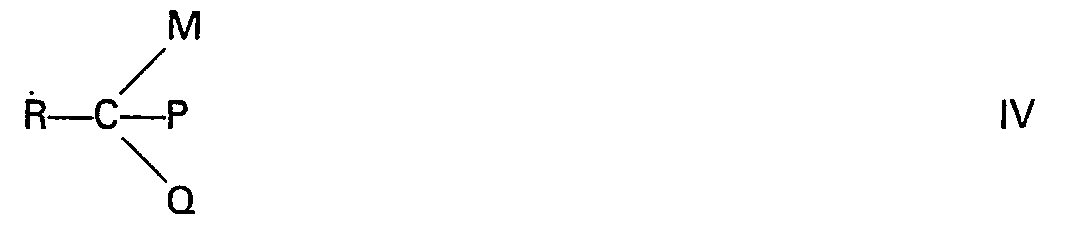
- the ligand may have the formula: wherein R is a monovalent organic radical and either M, P and Q are independently the groups ⁇ X(R 1 )(R 2 ), ⁇ (R 3 )(R 4 ) and ⁇ Z(R 10 )(R 11 ) in which X, Y and Z are independently nitrogen, phosphorus, arsenic, antimony or bismuth and (R 1 ), (R 2 ), (R 3 ), (R 4 ), (R 10 ) and (R 11 ) are monovalent organic radicals, or any two of M, P and Q are independently the groups ⁇ X(R 1 )(R 2 ) and ⁇ Y(R 3 )(R 4 ) and the remaining group M, P or Q is a hydrogen atom or a monovalent organic radical.
- R is a monovalent organic radical and either S, T and V are independently the groups ⁇ [-C(R 5 )(R 6 )] n ⁇ X(R 1 )(R 2 ), ⁇ [-C(R 8 )(R 9 )] m ⁇ Y(R 3 )(R 4 ), and ⁇ [C(R 12 )(R 13 )]q ⁇ Z(R 10 )(R 11 ) in which X, Y and Z are independently nitrogen, phosphorus, arsenic, antimony or bismuth; (R 1 ), (R 2 ), (R 3 ), (R 4 ), (R 10 ) and (R") are independently monovalent organic radicals, n, m and q are integers and (R 5 ), (R 6 ), (R 8 ), (R 9 ), (R 12 ) and (R 13 ) are independently either hydrogen atoms or mono
- the groups R 5 , R 6 , R 8 , R 9 , R 12 and R 13 are preferably hydrogen atoms.
- the groups R 1 , R 2 , R 3 , R 4 , R 7 , R 10 and R 11 , and, optionally, the groups M, P, Q, S, T and V, R 5 , R 6 , R 7 , R 8 , R 9 , R 12 and R 13 are monovalent organic radicals which preferably contain from 1 to 20 carbon atoms and are preferably free from aliphatic carbon-carbon unsaturation.
- the groups are hydrocarbyl groups which may be saturated aliphatic, saturated cycloaliphatic, aromatic, substituted saturated aliphatic, substituted saturated cycloaliphatic or substituted aromatic groups, of which the unsubstituted groups are preferred.
- the substituents are preferably free from aliphatic carbon-carbon unsaturation and may contain, besides atoms of carbon and hydrogen, other atoms, such as oxygen, sulphur and halogen, in particular halogen of atomic number from 9 to 35, provided that such atoms are not directly bonded to nitrogen, phosphorus, arsenic, antimony or bismuth.
- Suitable hydrocarbyl groups are methyl, ethyl, propyl, isopropyl, butyl, isoctyl, decyl, dodecyl, octadecyl, cyclohexyl, cyclopentyl, 3,4-dimethyl cyclopentyl, cyclooctyl, benzyl, ⁇ -phenylethyl, phenyl, tolyl, xylyl, p-ethylphenyl, p-tert-butylphenyl, m-octylphenyl, 2,4-dimethylphenyl, p-phenylphenyl, m-benzylphenyl and 2,4,6-trimethylphenyl.
- the preferred class of ligand is that having the formula (II). Furthermore for ethanol production it is preferred that both X and Y in the formula (II) are phosphorus.
- Illustrative of the polydentate ligands of formula (II) which may be used in the process of the invention are those having the formula (C 6 H 5 ) 2 P(CH 2 ) 9 P(C 6 H 5 ) 2 wherein g is an integer preferably in the range from 1 to 8, even more preferably in the range 4 to 6, of which (C 6 H 5 ) 2 P(CH z )P(C s H s ) 2 ; (C 6 H 5 ) 2 P(CH 2 ) 4 P(C 6 H 5 ) 2 and (C 6 H 5 ) 2 P(CH 2 ) 6 P(C 6 H 5 ) 2 are exemplary.
- hydrocarbyl has been used throughout the foregoing in its accepted meaning as representing a radical formed from a hydrocarbon by removal of a hydrogen atom.
- the exact nature of the catalysts of this invention under the reaction conditions is not known but they are thought to be phosphorus, nitrogen, arsenic, antimony or bismuth-containing ligand/cobalt carbonyl/hydride/halide complexes.
- the cobalt is thought to be in a reduced state but its exact valency is not known.
- the catalyst may be prepared by first reacting the individual components together and then adding the catalyst mixture to the reaction vessel, or by adding the individual components to the reaction vessel and allowing the catalyst to form under the reaction conditions.
- pressures higher than those employed in the subsequent hydrocarbonylation reaction particularly when reaction pressures of about 100 bar are employed.
- methanol may suitably be reacted with carbon monoxide and hydrogen at any temperature in the range 150 to 250, preferably 180 to 230°C and at a pressure greater than 80 bars, preferably in the range 100 to 300 bars.
- methanol may suitably be reacted with carbon monoxide and hydrogen at any temperature in the range 150 to 250, preferably 180 to 230°C and at a pressure greater than 80 bars, preferably in the range 100 to 300 bars.
- lower reaction temperatures are preferred. Whilst the temperature may be in the range 150 to 250°C, preferably the temperature is in the range 165 to 210, even more preferably 165 to 198°C.
- the process may be carried out batchwise or continuously, continuous operation being preferred.
- the process may be carried out continuously for example by continuously feeding methanol and synthesis gas to a reactor containing the catalyst, removing from the reactor a liquid product containing ethanol and/or acetaldehyde, by-products, unchanged methanol, catalyst and unreacted synthesis gas, separating the synthesis gas which may be recycled to the reactor, removing light ends including ethers, separating the product containing ethanol and/or acetaldehyde and by-products from the catalyst and thereafter recovering ethanol and/or acetaldehyde from the by-products, there being recycled to the reactor the catalyst and methanol.
- Other reaction by-products particularly those which can act as precursors for the formation of ethanol and/or acetaldehyde may also be recycled to the reactor with advantage. It may be necessary to feed from time to time further catalyst.
- the residence time may suitably be up to 8 hours, but is preferably in the range of from 10 to 180 minutes.
- arsenic, antimony and bismuth-containing catalysts short residence times are preferred because long residence times may lead to further reaction of acetaldehyde by aldol condensation-type reaction giving, for example, n-butyraldehyde.
- the residence time for batchwise operation is that time during which the reactor is at the specified reaction temperature. When the process is operated continuously the residence time is calculated as follows:
- the methanol may contain up to 50% by weight of water.
- the molar ratio of methanol to synthesis gas fed in both continuous and batch operation may be in the range of from 10:1 to 1:20, preferably from 2:1 to 1:5.
- the molar ratio of cobalt to iodide or bromide may be in the range from 1:3 to 10:1, preferably from 1:1 to 5:1.
- the molar ratio of cobalt to component (c) of the catalyst may be in the range of from 1:3 to 1:20, preferably from 1:1 to 1:10 based on the number of mole equivalents of nitrogen, phosphorus, arsenic, antimony or bismuth in the catalyst.
- the molar ratio of iodide or bromide to component (c) may be in the range of from 2:1 to 1:10, preferably from 1:1 to 1:8 based on the number of mole equivalents of nitrogen, phosphorus, arsenic, antimony or bismuth in the catalyst.
- the molar ratio of cobalt to methanol may be in the range of from 1:10 to 1:1000, preferably from 1:40 to 1:800.
- the methanol may be reacted with synthesis gas in the presence of a deliberately added compound.
- an acid and/or an acid derivative having the formula wherein the substituent R is a hydrocarbyl group or an oxygen containing hydrocarbyl group and the substituent X is the group -QR1 in which R 1 is independently a hydrogen atom, a hydrocarbyl group or an oxygen-containing hydrocarbyl group or X is the group -O-CO-R 2 wherein-R 2 is independently a hydrocarbyl group or an oxygen-containing hydrocarbyl group, as described in our published Belgian Patent No. 867548.
- Suitable compounds having the structural formula (VI) include acetic acid, acetic anhydride, propionic acid, phenylacetic acid, benzoic acid, methyl acetate and butyl acetate.
- Preferred compounds having the structural formula (VI) are acetic acid and methyl acetate.
- the acid and/or acid derivative of structural formula (VI) may be added in an amount such that the molar ratio of acid and/or acid derivative to free methanol can be as high as 1.5:1, more usually in the range of from 0.1:1 to 0.7:1.
- the additive may be an inert liquid which is an aryl halide, a thiophene, a long chain acid or a silicone oil.
- An example of a suitable aryl halide is chlorobenzene.
- a suitable example of a long chain acid is decanoic acid.
- Typical of the silicone oils which may be used are polydimethylsiloxane fluids and methyl phenyl silicone fluids. Specific silicone fluids which have been found useful in the process are the DC 200 series of fluids supplied by Dow Corning.
- the addition of water may be beneficial to the reaction ie the ratio of methanol to water in the feed can be adjusted so that two phases are present either at the start or at the end of the reaction or both.
- the molar ratio of methanol to inert liquid can be varied within wide limits, e.g. from 30:1 to 1:10, preferably from 25:1 to 1:2.
- an oxygen-containing organic compound comprising compounds containing at least one of the groups: which compound preferably exists mainly in the form of a liquid under the reaction conditions employed.
- the oxygen-containing organic compound containing a group may be an aliphatic, alicyclic or aromatic ether it is preferred that those compounds containing groups are, respectively, aliphatic alcohols, aliphatic ketones and aliphatic aldehydes.
- Oxygen-containing organic compounds which may be added include, for example, 1,4-dioxane, tetrahydrofuran, di-n-propylether, diphenylether, acetone, acetaldehyde, n-propanol and n-butanol.
- the oxygen-containing organic compound may be added in an amount such that the molar ratio of methanol to the oxygen-containing organic compound is in the range from 20:1 to 1:3, preferably from 10:1 to 1:1.
- the additive may be a non-polar solvent.
- Suitable non-polar solvents include alkanes, benzene and alkyl-substituted benzenes as disclosed in US patent application Serial No. 585276.
- the molar ratio of methanol to non-polar solvent may suitably be in the range of from 30:1 to 1:10, preferably from 25:1 to 1:2.
- the solvent may be a co-ordinating solvent, such as sulpholane in the proportions as described hereinbefore for inert and polar-solvents addition.
- ruthenium compounds such as Ru 3 (CO) 12' Rul 3 and RuCl3.xH20
- the molar ratio of cobalt compound to ruthenium compound may suitably be in the range 100:1 to 1:1.
- a stainless steel, magnetically-stirred autoclave equipped for pressurised reactions was charged under nitrogen with methanol (7.99 moles) containing cobalt acetate tetrahydrate (0.10 moles) and iodine (0.05 moles).
- the system was purged with nitrogen, then pressurised to 120 bars (roughly equivalent to a pressure of 200 bars at 190°C) with a mixture of carbon monoxide and hydrogen (1 mole carbon monoxide to 2 moles hydrogen).
- the reactor temperature was then raised to 190°C and maintained at this value for 2 hours. When heating was started the pressure in the reactor rose above 120 bars. As soon as the reaction commenced the rate of increase in the pressure began to decrease.
- Comparison Test A The procedure of Comparison Test A was repeated except that triphenyl phosphine was added to the autoclave with the initial charge.
- the amounts of reactants are given in Table 1A and the results in Table 1B.
- triphenyl phosphine contains only one atom of phosphorus. It is included for the purposes of comparison only.
- Comparison Test A The procedure of Comparison Test A was repeated except that (C 6 H 5 ) 2 P(CH 2 ) 6 P(C 6 H 5 ) 2 was added to the autoclave in the inital methanol charge.
- the amounts of reactants are given Table 1A and the results in Table 1B.
- Comparison Test A The procedure of Comparison Test A was repeated except that acetone and triphenyl phosphine were included in the initial reaction mixture fed to the autoclave.
- the amounts of reactants are given in Table 2A and the results in Table 2B.
- triphenyl phosphone contains only one atom of phosphorus. It is included only for the purpose of comparison.
- Comparison Test A The procedure of Comparison Test A was repeated except that acetone and (C 6 H 5 ) 2 P(CH 2 )P(C 6 H 5 ) 2 were included in the initial reaction mixture fed to the autoclave.
- the amounts of reactants are given in Table 2A and the results in Table 2B.
- Comparison Test A The procedure of Comparison Test A was repeated except that acetone and (C 6 H 5 ) 2 P(CH 2 ) 4 P(C 6 H 5 ) 2 were included in the initial reaction mixture fed to the autoclave.
- the amounts of reactants are given in Table 2A and the results in Table 2B.
- Comparison Test A The procedure of Comparison Test A was repeated except that acetone and (C 2 H 5 ) 2 P(CH 2 ) 6 P(C 6 H 5 ) 2 were included in the initial reaction mixture fed to the autoclave.
- the amounts of reactants are given in Table 2A and the results in Table 2B.
- a stainless steel, magnetically-stirred autoclave equipped for pressurised reactions was charged under nitrogen with methanol (1.78 moles) containing cobalt acetate tetrahydrate (0.0225 mole), iodine (0.0113 mole) and triphenylphosphine (0.0394 mole). To this mixture was further added 0.071 mole chlorobenzene. The system was purged with nitrogen, then pressurized to 200 bars with a mixture of carbon monoxide and hydrogen (1:1 molar). The reactor temperature was then raised to 205°C and maintained at this temperature for 2 hours. When heating was started the pressure in the reactor rose above 200 bars and then began to decrease as the reaction commenced.
- Comparison Test D The procedure of Comparison Test D was repeated except that triphenylphosphine was replaced by (C 6 H 5 ) 2 P(CH 2 ) 6 P(C 6 H 5 ) 2 .
- the amounts of reactants are given in Table 3A and the results in Table 3B.
Landscapes
- Chemical & Material Sciences (AREA)
- Organic Chemistry (AREA)
- Chemical Kinetics & Catalysis (AREA)
- Organic Low-Molecular-Weight Compounds And Preparation Thereof (AREA)
- Catalysts (AREA)
- Low-Molecular Organic Synthesis Reactions Using Catalysts (AREA)
Claims (15)



Applications Claiming Priority (2)
| Application Number | Priority Date | Filing Date | Title |
|---|---|---|---|
| GB3905478 | 1978-10-03 | ||
| GB7839054 | 1978-10-03 |
Publications (2)
| Publication Number | Publication Date |
|---|---|
| EP0010373A1 EP0010373A1 (de) | 1980-04-30 |
| EP0010373B1 true EP0010373B1 (de) | 1982-09-01 |
Family
ID=10500071
Family Applications (1)
| Application Number | Title | Priority Date | Filing Date |
|---|---|---|---|
| EP19790302053 Expired EP0010373B1 (de) | 1978-10-03 | 1979-10-01 | Verfahren zur Herstellung von Äthanol und/oder Acetaldehyd durch Reaktion von Methanol und Synthesegas |
Country Status (7)
| Country | Link |
|---|---|
| US (1) | US4262154A (de) |
| EP (1) | EP0010373B1 (de) |
| JP (1) | JPS5549326A (de) |
| CA (1) | CA1133513A (de) |
| DE (1) | DE2963619D1 (de) |
| NZ (1) | NZ191686A (de) |
| ZA (1) | ZA795151B (de) |
Families Citing this family (49)
| Publication number | Priority date | Publication date | Assignee | Title |
|---|---|---|---|---|
| US4346020A (en) * | 1979-05-25 | 1982-08-24 | Gulf Research & Development Company | Novel catalyst system and process for producing ethanol using said novel catalyst system |
| US4339608A (en) * | 1979-05-25 | 1982-07-13 | Gulf Research & Development Company | Process for selective formation of C4 compounds and tertiary organo group VA compound-containing catalyst system used therein |
| US4233466A (en) * | 1979-11-15 | 1980-11-11 | Union Carbide Corporation | Homologation process for the production of ethanol from methanol |
| NZ195586A (en) * | 1979-11-27 | 1983-07-29 | British Petroleum Co | Catalytic preparation of ethanol and/or acetaldehyde from synthesis gas |
| EP0036724A1 (de) * | 1980-03-18 | 1981-09-30 | The British Petroleum Company p.l.c. | Verfahren zum Herstellen von Äthanol durch die flüssige Phase der Hydrocarbonylierung von Methanol |
| CA1155458A (en) * | 1980-04-09 | 1983-10-18 | Union Carbide Corporation | Process for the selective hydroformylation of methanol to acetaldehyde |
| US4277634A (en) * | 1980-04-09 | 1981-07-07 | Union Carbide Corporation | Process for the selective homologation of methanol to ethanol |
| US4301312A (en) * | 1980-05-21 | 1981-11-17 | The United States Of America As Represented By The United States Department Of Energy | Method and system for ethanol production |
| JPS579733A (en) * | 1980-06-18 | 1982-01-19 | Mitsubishi Gas Chem Co Inc | Preparation of acetaldehyde |
| DE3031558C2 (de) * | 1980-08-21 | 1984-04-26 | Union Rheinische Braunkohlen Kraftstoff AG, 5000 Köln | Verfahren zur Herstellung von Acetaldehyd und Ethanol |
| DE3042434A1 (de) * | 1980-11-11 | 1982-05-19 | Ruhrchemie Ag, 4200 Oberhausen | Verfahren zur herstellung von ethanol und n-propanol aus methanol |
| DE3045891C2 (de) * | 1980-12-05 | 1983-03-03 | Union Rheinische Braunkohlen Kraftstoff AG, 5000 Köln | Verfahren zur Herstellung von Acetaldehyd und Ethanol |
| DE3046481A1 (de) * | 1980-12-10 | 1982-07-22 | Ruhrchemie Ag, 4200 Oberhausen | Verfahren zur herstellung von ethanol und n-propanol aus methanol |
| US4339611A (en) * | 1980-12-11 | 1982-07-13 | Gulf Research & Development Company | Process for selective formation of C4 compounds and organic sulfide-containing catalyst system used therein |
| US4339609A (en) * | 1980-12-11 | 1982-07-13 | Gulf Research & Development Company | Process for selective formation of C4 compounds and biphosphine disulfide-containing catalyst system used therein |
| US4339610A (en) * | 1980-12-11 | 1982-07-13 | Gulf Research & Development Company | Process for selective formation of C4 compounds and thiol-containing catalyst system used therein |
| US4447557A (en) * | 1980-12-11 | 1984-05-08 | Gulf Research & Development Company | Process for selective formation of C4 compounds and thiol-containing catalyst system used therein |
| US4374752A (en) * | 1981-06-30 | 1983-02-22 | Union Carbide Corporation | Catalyst and process for the conversion of methanol to acetaldehyde |
| US4352947A (en) * | 1981-08-03 | 1982-10-05 | Gulf Research & Development Company | Process for producing ethanol |
| US4361706A (en) * | 1981-08-03 | 1982-11-30 | Gulf Research & Development Company | Process for preparing aldehydes |
| US4438020A (en) | 1981-08-03 | 1984-03-20 | Gulf Research & Development Company | Catalyst suitable for preparing aldehydes |
| US4361707A (en) * | 1981-08-03 | 1982-11-30 | Gulf Research & Development Company | Process for producing aldehydes |
| US4409405A (en) * | 1982-05-13 | 1983-10-11 | Texaco Inc. | Production of ethanol from methanol and synthesis gas |
| DE3330507A1 (de) * | 1983-08-24 | 1985-03-07 | Ruhrchemie Ag, 4200 Oberhausen | Verfahren zur herstellung von ethanol |
| GB8326986D0 (en) * | 1983-10-08 | 1983-11-09 | British Petroleum Co Plc | Production of ethanol |
| JPS60136525A (ja) * | 1983-12-26 | 1985-07-20 | Agency Of Ind Science & Technol | エタノ−ルの製造法 |
| JPS6191143A (ja) * | 1984-10-08 | 1986-05-09 | テキサコ・デベロツプメント・コ−ポレ−シヨン | 新規な促進剤と共にコバルト化合物を用いる、エタノ−ル及びアセトアルデヒドの合成方法 |
| US4594463A (en) * | 1985-01-28 | 1986-06-10 | Union Carbide Corporation | Synthesis of aldehydes from alcohols |
| JPS63145242A (ja) * | 1986-12-10 | 1988-06-17 | Agency Of Ind Science & Technol | エタノ−ルの製造法 |
| US7199192B2 (en) | 2004-12-21 | 2007-04-03 | Callaway Golf Company | Golf ball |
| CN101517086A (zh) | 2006-07-21 | 2009-08-26 | 希乐克公司 | 生物质转化系统 |
| US8575403B2 (en) | 2010-05-07 | 2013-11-05 | Celanese International Corporation | Hydrolysis of ethyl acetate in ethanol separation process |
| US8859827B2 (en) | 2011-11-18 | 2014-10-14 | Celanese International Corporation | Esterifying acetic acid to produce ester feed for hydrogenolysis |
| US9272970B2 (en) | 2010-07-09 | 2016-03-01 | Celanese International Corporation | Hydrogenolysis of ethyl acetate in alcohol separation processes |
| US8710279B2 (en) | 2010-07-09 | 2014-04-29 | Celanese International Corporation | Hydrogenolysis of ethyl acetate in alcohol separation processes |
| US8704008B2 (en) | 2010-07-09 | 2014-04-22 | Celanese International Corporation | Process for producing ethanol using a stacked bed reactor |
| US8664454B2 (en) | 2010-07-09 | 2014-03-04 | Celanese International Corporation | Process for production of ethanol using a mixed feed using copper containing catalyst |
| US8754268B2 (en) | 2011-04-26 | 2014-06-17 | Celanese International Corporation | Process for removing water from alcohol mixtures |
| US8592635B2 (en) | 2011-04-26 | 2013-11-26 | Celanese International Corporation | Integrated ethanol production by extracting halides from acetic acid |
| US9073816B2 (en) | 2011-04-26 | 2015-07-07 | Celanese International Corporation | Reducing ethyl acetate concentration in recycle streams for ethanol production processes |
| US8895786B2 (en) | 2011-08-03 | 2014-11-25 | Celanese International Corporation | Processes for increasing alcohol production |
| US8748673B2 (en) | 2011-11-18 | 2014-06-10 | Celanese International Corporation | Process of recovery of ethanol from hydrogenolysis process |
| US8829249B2 (en) | 2011-11-18 | 2014-09-09 | Celanese International Corporation | Integrated esterification and hydrogenolysis process for producing ethanol |
| US8802901B2 (en) | 2011-11-18 | 2014-08-12 | Celanese International Corporation | Continuous ethyl acetate production and hydrogenolysis thereof |
| US8829251B2 (en) | 2011-11-18 | 2014-09-09 | Celanese International Corporation | Liquid esterification method to produce ester feed for hydrogenolysis |
| US8853468B2 (en) | 2011-11-18 | 2014-10-07 | Celanese International Corporation | Vapor esterification method to produce ester feed for hydrogenolysis |
| US9024089B2 (en) | 2011-11-18 | 2015-05-05 | Celanese International Corporation | Esterification process using extractive separation to produce feed for hydrogenolysis |
| US8927790B2 (en) | 2011-12-15 | 2015-01-06 | Celanese International Corporation | Multiple vapor feeds for hydrogenation process to produce alcohol |
| US8975451B2 (en) | 2013-03-15 | 2015-03-10 | Celanese International Corporation | Single phase ester feed for hydrogenolysis |
Family Cites Families (10)
| Publication number | Priority date | Publication date | Assignee | Title |
|---|---|---|---|---|
| US3239570A (en) * | 1960-07-22 | 1966-03-08 | Shell Oil Co | Hydroformylation of olefins |
| US3248432A (en) * | 1961-12-12 | 1966-04-26 | Commercial Solvents Corp | Process for the production of ethyl alcohol |
| US3448157A (en) * | 1965-09-27 | 1969-06-03 | Shell Oil Co | Hydroformylation of olefins |
| US3401204A (en) * | 1965-11-26 | 1968-09-10 | Shell Oil Co | Hydrocarbylene-bis (monophosphobicyclononanes) and the preparation thereof |
| GB1127965A (en) * | 1965-11-26 | 1968-09-25 | Shell Int Research | Ditertiary phosphines and application thereof as catalyst components for alcohol production |
| US3594425A (en) * | 1966-07-07 | 1971-07-20 | Jefferson Chem Co Inc | Hydroformylation process |
| GB1228947A (de) * | 1967-10-12 | 1971-04-21 | ||
| US3954877A (en) * | 1967-10-12 | 1976-05-04 | Jefferson Chemical Co., Inc. | Hydroformylation of olefins |
| BE842430A (nl) * | 1975-06-09 | 1976-12-01 | Werkwijze ter bereiding van ethanol uit methanol koolmonoxyde en waterstof | |
| US4133966A (en) * | 1977-12-23 | 1979-01-09 | Gulf Research & Development Company | Selective formation of ethanol from methanol, hydrogen and carbon monoxide |
-
1979
- 1979-09-25 CA CA336,305A patent/CA1133513A/en not_active Expired
- 1979-09-26 NZ NZ19186879A patent/NZ191686A/xx unknown
- 1979-09-27 ZA ZA00795151A patent/ZA795151B/xx unknown
- 1979-10-01 EP EP19790302053 patent/EP0010373B1/de not_active Expired
- 1979-10-01 US US06/080,476 patent/US4262154A/en not_active Expired - Lifetime
- 1979-10-01 DE DE7979302053T patent/DE2963619D1/de not_active Expired
- 1979-10-02 JP JP12723379A patent/JPS5549326A/ja active Pending
Also Published As
| Publication number | Publication date |
|---|---|
| CA1133513A (en) | 1982-10-12 |
| ZA795151B (en) | 1981-05-27 |
| EP0010373A1 (de) | 1980-04-30 |
| NZ191686A (en) | 1981-12-15 |
| US4262154A (en) | 1981-04-14 |
| DE2963619D1 (en) | 1982-10-28 |
| JPS5549326A (en) | 1980-04-09 |
Similar Documents
| Publication | Publication Date | Title |
|---|---|---|
| EP0010373B1 (de) | Verfahren zur Herstellung von Äthanol und/oder Acetaldehyd durch Reaktion von Methanol und Synthesegas | |
| US4328375A (en) | Process for the production of ethanol and/or acetaldehyde in the presence of metal complex catalyst systems | |
| US4133966A (en) | Selective formation of ethanol from methanol, hydrogen and carbon monoxide | |
| US4205190A (en) | Process for the hydrocarbonylation of methanol to ethanol in the presence of added oxygen-containing organic compounds | |
| US4193943A (en) | Hydroformylation catalysts | |
| EP0001937B1 (de) | Verfahren zur Hydrocarbonylierung von Methanol zu Ethanol in Gegenwart einer inerten Flüssigkeit | |
| US3968133A (en) | Carboxylation process for preparing linear fatty acids or esters | |
| US4225517A (en) | Process for the production of acetaldehyde by the reaction of methanol with synthesis gas | |
| GB2036739A (en) | The use of Group VIII metals as co-catalysts in the homologation of methanol | |
| US4239705A (en) | Process for producing acetaldehyde | |
| US4400551A (en) | Process for the production of acetaldehyde and ethanol | |
| EP0068499B1 (de) | Katalysator und Verfahren zur Umwandlung von Methanol in Acetaldehyde | |
| JPS5918371B2 (ja) | メタノ−ルからエタノ−ル及びn−プロパノ−ルを製造する方法 | |
| US4556744A (en) | Process for the production of ethanol and/or acetaldehyde by the metal catalysed liquid phase reaction of methanol, carbon monoxide and hydrogen in the presence of a solvent | |
| US4357480A (en) | Process for the production of ethanol by the liquid phase hydrocarbonylation of methanol | |
| EP0037586B1 (de) | Verfahren zur selektiven Hydroformulierung von Methanol zu Acetaldehyd | |
| US4380681A (en) | Hydrocarbonylation of methanol to ethanol in the presence of added compounds | |
| EP0042633B1 (de) | Verfahren zum Carbonylieren von Alkanolen und/oder Äthern | |
| EP0055887A2 (de) | Katalysatorsystem und Verfahren zum Herstellen von Äthylalkonol unter Verwendung dieses Katalysatorsystems | |
| EP0013464A1 (de) | Selektive Erzeugung von Äthanol aus Methanol, Wasserstoff und Kohlenmonoxyd | |
| US4355192A (en) | Process for the production of ethanol and n-propanol from methanol | |
| US4152357A (en) | Platinum-tin hydroformylation catalyst | |
| GB2089790A (en) | Preparation of ethylene glycol and ethers thereof | |
| US4337365A (en) | Process for the selective hydroformylation of methanol to acetaldehyde | |
| EP0146823B1 (de) | Verfahren zur Herstellung von Carbonsäuren aus organischen Ameisesäureestern |
Legal Events
| Date | Code | Title | Description |
|---|---|---|---|
| PUAI | Public reference made under article 153(3) epc to a published international application that has entered the european phase |
Free format text: ORIGINAL CODE: 0009012 |
|
| AK | Designated contracting states |
Designated state(s): BE DE FR GB IT NL |
|
| 17P | Request for examination filed | ||
| ITF | It: translation for a ep patent filed | ||
| GRAA | (expected) grant |
Free format text: ORIGINAL CODE: 0009210 |
|
| PGFP | Annual fee paid to national office [announced via postgrant information from national office to epo] |
Ref country code: FR Payment date: 19820823 Year of fee payment: 4 |
|
| AK | Designated contracting states |
Designated state(s): BE DE FR GB IT NL |
|
| PGFP | Annual fee paid to national office [announced via postgrant information from national office to epo] |
Ref country code: BE Payment date: 19820930 Year of fee payment: 4 |
|
| REF | Corresponds to: |
Ref document number: 2963619 Country of ref document: DE Date of ref document: 19821028 |
|
| PGFP | Annual fee paid to national office [announced via postgrant information from national office to epo] |
Ref country code: NL Payment date: 19821031 Year of fee payment: 4 |
|
| PGFP | Annual fee paid to national office [announced via postgrant information from national office to epo] |
Ref country code: DE Payment date: 19821231 Year of fee payment: 4 |
|
| PG25 | Lapsed in a contracting state [announced via postgrant information from national office to epo] |
Ref country code: BE Effective date: 19831031 |
|
| PG25 | Lapsed in a contracting state [announced via postgrant information from national office to epo] |
Ref country code: NL Effective date: 19840501 |
|
| NLV4 | Nl: lapsed or anulled due to non-payment of the annual fee | ||
| PG25 | Lapsed in a contracting state [announced via postgrant information from national office to epo] |
Ref country code: FR Free format text: LAPSE BECAUSE OF NON-PAYMENT OF DUE FEES Effective date: 19840629 |
|
| PG25 | Lapsed in a contracting state [announced via postgrant information from national office to epo] |
Ref country code: DE Effective date: 19840703 |
|
| REG | Reference to a national code |
Ref country code: FR Ref legal event code: ST |
|
| PG25 | Lapsed in a contracting state [announced via postgrant information from national office to epo] |
Ref country code: GB Effective date: 19881118 |
|
| PLBE | No opposition filed within time limit |
Free format text: ORIGINAL CODE: 0009261 |
|
| STAA | Information on the status of an ep patent application or granted ep patent |
Free format text: STATUS: NO OPPOSITION FILED WITHIN TIME LIMIT |