EP0004902A2 - Benzodioxolderivate, Verfahren zu ihrer Herstellung und ihre Verwendung als Synergisten in Schädlingsbekämpfungsmitteln - Google Patents
Benzodioxolderivate, Verfahren zu ihrer Herstellung und ihre Verwendung als Synergisten in Schädlingsbekämpfungsmitteln Download PDFInfo
- Publication number
- EP0004902A2 EP0004902A2 EP79101016A EP79101016A EP0004902A2 EP 0004902 A2 EP0004902 A2 EP 0004902A2 EP 79101016 A EP79101016 A EP 79101016A EP 79101016 A EP79101016 A EP 79101016A EP 0004902 A2 EP0004902 A2 EP 0004902A2
- Authority
- EP
- European Patent Office
- Prior art keywords
- formula
- spp
- oder
- und
- halogen
- Prior art date
- Legal status (The legal status is an assumption and is not a legal conclusion. Google has not performed a legal analysis and makes no representation as to the accuracy of the status listed.)
- Granted
Links
- 0 Cc(cc(*)c(*)c1*)c1OCO Chemical compound Cc(cc(*)c(*)c1*)c1OCO 0.000 description 5
- RZIIEHXVBJOPFH-UHFFFAOYSA-N Cc(cc(C)c(Cl)c1Cl)c1O Chemical compound Cc(cc(C)c(Cl)c1Cl)c1O RZIIEHXVBJOPFH-UHFFFAOYSA-N 0.000 description 1
Classifications
-
- C—CHEMISTRY; METALLURGY
- C07—ORGANIC CHEMISTRY
- C07D—HETEROCYCLIC COMPOUNDS
- C07D317/00—Heterocyclic compounds containing five-membered rings having two oxygen atoms as the only ring hetero atoms
- C07D317/08—Heterocyclic compounds containing five-membered rings having two oxygen atoms as the only ring hetero atoms having the hetero atoms in positions 1 and 3
- C07D317/44—Heterocyclic compounds containing five-membered rings having two oxygen atoms as the only ring hetero atoms having the hetero atoms in positions 1 and 3 ortho- or peri-condensed with carbocyclic rings or ring systems
- C07D317/46—Heterocyclic compounds containing five-membered rings having two oxygen atoms as the only ring hetero atoms having the hetero atoms in positions 1 and 3 ortho- or peri-condensed with carbocyclic rings or ring systems condensed with one six-membered ring
- C07D317/48—Methylenedioxybenzenes or hydrogenated methylenedioxybenzenes, unsubstituted on the hetero ring
- C07D317/62—Methylenedioxybenzenes or hydrogenated methylenedioxybenzenes, unsubstituted on the hetero ring with hetero atoms or with carbon atoms having three bonds to hetero atoms with at the most one bond to halogen, e.g. ester or nitrile radicals, directly attached to atoms of the carbocyclic ring
- C07D317/68—Carbon atoms having three bonds to hetero atoms with at the most one bond to halogen
-
- A—HUMAN NECESSITIES
- A01—AGRICULTURE; FORESTRY; ANIMAL HUSBANDRY; HUNTING; TRAPPING; FISHING
- A01N—PRESERVATION OF BODIES OF HUMANS OR ANIMALS OR PLANTS OR PARTS THEREOF; BIOCIDES, e.g. AS DISINFECTANTS, AS PESTICIDES OR AS HERBICIDES; PEST REPELLANTS OR ATTRACTANTS; PLANT GROWTH REGULATORS
- A01N43/00—Biocides, pest repellants or attractants, or plant growth regulators containing heterocyclic compounds
- A01N43/02—Biocides, pest repellants or attractants, or plant growth regulators containing heterocyclic compounds having rings with one or more oxygen or sulfur atoms as the only ring hetero atoms
- A01N43/24—Biocides, pest repellants or attractants, or plant growth regulators containing heterocyclic compounds having rings with one or more oxygen or sulfur atoms as the only ring hetero atoms with two or more hetero atoms
- A01N43/26—Biocides, pest repellants or attractants, or plant growth regulators containing heterocyclic compounds having rings with one or more oxygen or sulfur atoms as the only ring hetero atoms with two or more hetero atoms five-membered rings
- A01N43/28—Biocides, pest repellants or attractants, or plant growth regulators containing heterocyclic compounds having rings with one or more oxygen or sulfur atoms as the only ring hetero atoms with two or more hetero atoms five-membered rings with two hetero atoms in positions 1,3
- A01N43/30—Biocides, pest repellants or attractants, or plant growth regulators containing heterocyclic compounds having rings with one or more oxygen or sulfur atoms as the only ring hetero atoms with two or more hetero atoms five-membered rings with two hetero atoms in positions 1,3 with two oxygen atoms in positions 1,3, condensed with a carbocyclic ring
-
- C—CHEMISTRY; METALLURGY
- C07—ORGANIC CHEMISTRY
- C07D—HETEROCYCLIC COMPOUNDS
- C07D317/00—Heterocyclic compounds containing five-membered rings having two oxygen atoms as the only ring hetero atoms
- C07D317/08—Heterocyclic compounds containing five-membered rings having two oxygen atoms as the only ring hetero atoms having the hetero atoms in positions 1 and 3
- C07D317/44—Heterocyclic compounds containing five-membered rings having two oxygen atoms as the only ring hetero atoms having the hetero atoms in positions 1 and 3 ortho- or peri-condensed with carbocyclic rings or ring systems
- C07D317/46—Heterocyclic compounds containing five-membered rings having two oxygen atoms as the only ring hetero atoms having the hetero atoms in positions 1 and 3 ortho- or peri-condensed with carbocyclic rings or ring systems condensed with one six-membered ring
- C07D317/48—Methylenedioxybenzenes or hydrogenated methylenedioxybenzenes, unsubstituted on the hetero ring
- C07D317/62—Methylenedioxybenzenes or hydrogenated methylenedioxybenzenes, unsubstituted on the hetero ring with hetero atoms or with carbon atoms having three bonds to hetero atoms with at the most one bond to halogen, e.g. ester or nitrile radicals, directly attached to atoms of the carbocyclic ring
Definitions
- the present invention relates to new benzodioxole derivatives, several processes for their preparation and their use as synergists.
- Carboxylic acid esters in which R 7 represents hydrogen, alkyl having 1 to 6 carbon atoms, haloalkyl having 1 to 4 carbon atoms and up to 3 halogen atoms, nitrile or ethynyl are preferred.
- R 8 is phenyl, which is optionally substituted by C 1-4 alkyl, halogen, in particular fluorine or chlorine, optionally halogen- or methyl-substituted phenoxy, optionally substituted benzyl, furthermore furanyl, tetrahydrophthalimido, benzodioxole, which are optionally substituted by halogen, in particular chlorine, alkyl or alkenyl having up to 4 carbon atoms or benzyl group, and furthermore represents Cyclopentonon which is optionally substituted by C 1-4 alkyl, furfuryl, C l-5 -Alkenyl is substituted.
- the insecticide and / or acari. zide effect of the active ingredient combinations according to the invention much higher than the effect of the individual components or the sum of the effects of the individual components. It is also significantly higher than the effect of the already known combination of active ingredients from 2-iso-propoxy-phenyl-N-methyl-carbamate and piperonyl butoxide.
- the benzodioxole derivatives which can be used according to the invention show excellent synergistic activity not only with one class of active substance, but with active substances from a wide variety of chemical groups.
- benzodioxole derivatives according to the invention and the synergistic mixtures containing them represent a valuable addition to the art.
- production variant a can be represented by the following formula:
- the chloromethyl benzodioxoles (Ic) can be used to prepare the other active compounds according to the invention. They react with transition metal catalyzed to form 4-methyl-benzodioxole (Id), with acetate they form 4-acetoxymethylbenzodioxole (Ie), with cyanide 4-cyanomethyl-benzodioxole (If).
- the cyanomethyl benzodioxoles (I f) can be reacted with the corresponding haloalkane-alkenes or -alkynes, the further cyanoalkyl-, cyanoalkenyl- or cyanoalkynyl-benzodioxoles according to the invention are produced (cf. DT-OS 2 215 496; Pure Appl. Chem. 43 (1975), p. 439; Org. Syn. 55 (1976), p . 91):
- the 1,2-dihydroxybenzenes (VII) to be used as precursors for the preparation of the benzodioxoles (I) according to the invention can be prepared from the partially known 2-hydroxybenzaldehyde derivatives, such as 3,5-dichlorosalicylaldehyde, by reaction with hydrogen peroxide according to the so-called Dakin oxidation (compare Am. Chem. J. 42, 488; GB-PS 794 885; Biochem. Journal 59 (1955), pp. 410-415; Chem. Abstr.
- the active substance combinations can be converted into the customary formulations, such as solutions, emulsions, spray powder, suspensions, powders, dusts, foams, pastes, soluble powders, granules, aerosols, suspension emulsion concentrates, seed powders, active substance-impregnated natural and synthetic substances, very fine encapsulations in polymeric substances and in coating compositions for seeds, also in formulations with fuel sets, such as smoking cartridges, cans, spirals and the like. as well as ULV cold and warm fog formulations.
- formulations are prepared in a known manner, for example by mixing the active ingredients with extenders, that is to say liquid solvents, pressurized liquefied gases and / or solid carriers, optionally using surface-active agents, that is to say emulsifiers and / or dispersants and / or foam-generating agents. If water is used as an extender, organic solvents can, for example, also be used as auxiliary solvents.
- extenders that is to say liquid solvents, pressurized liquefied gases and / or solid carriers, optionally using surface-active agents, that is to say emulsifiers and / or dispersants and / or foam-generating agents.
- surface-active agents that is to say emulsifiers and / or dispersants and / or foam-generating agents.
- organic solvents can, for example, also be used as auxiliary solvents.
- liquid solvents aromatics, such as xylene, toluene, or alkylnaphthalenes, chlorinated aromatics or chlorinated aliphatic hydrocarbons, such as chlorobenzenes, chloroethylene or methylene chloride, aliphatic hydrocarbons, such as cyclohexane or paraffins, for example petroleum fractions, alcohols, such as butanol or glycol and their ethers and esters, ketones such as acetone, methyl ethyl ketone, methyl isobutyl ketone or cyclohexanone, strongly polar solvents such as dimethylformamide and dimethyl sulfoxide, and water;
- Liquefied gaseous extenders or carriers mean those liquids which are gaseous at normal temperature and under normal pressure, for example aerosol propellant, such as halogenated hydrocarbons and butane, propane, nitrogen and carbon dioxide;
- suitable solid carriers for example, natural rock powders such as benzenes,
- Adhesives such as carboxymethyl cellulose and natural and synthetic polymers in the form of powders, granules or latices, such as gum arabic, polyvinyl alcohol and polyvinyl acetate, can be used in the formulations.
- Dyes such as inorganic pigments, e.g. Iron oxide, titanium oxide, ferrocyan blue and organic dyes such as alizarin, azole-metal phthalocyanine dyes and trace nutrients such as salts of iron, manganese, boron, copper, cobalt, molybdenum and zinc can be used.
- the formulations generally contain between 0.1 and 95 percent by weight of active compound, preferably between 0.5 and 90%.
- the active compound combinations according to the invention are used in the form of their commercially available formulations and / or the use forms prepared from these formulations.
- the active substance content of the use forms prepared from the commercially available formulations can vary within wide ranges.
- the active substance concentration of the use forms can be from 0.0000001 to 99% by weight of active substance, preferably between 0.01 and 10% by weight.
- the application takes place in a customary manner adapted to the application forms.
- the active ingredients When used against hygiene pests and pests of stored products, the active ingredients are distinguished by an excellent residual action on wood and clay and by a good stability to alkali on limed substrates.
- Solutions are prepared from the active ingredients, synergists and mixtures of active ingredients and synergists, and 2.5 ml of these are pipetted into Petri dishes on filter paper discs with a diameter of 9.5 cm. The filter paper absorbs the solutions. The petri dishes remain open until the solvent has completely evaporated. Then 25 test animals are placed in the Petri dishes and covered with a glass lid.
- the condition of the test animals is checked for up to 6 hours. The time required for a 10 0 % knock-down effect is determined. If the LT 100 is not reached after 6 hours, the percentage of the knock-down test animals is determined.
Landscapes
- Chemical & Material Sciences (AREA)
- Organic Chemistry (AREA)
- Life Sciences & Earth Sciences (AREA)
- Dentistry (AREA)
- Pest Control & Pesticides (AREA)
- Plant Pathology (AREA)
- Health & Medical Sciences (AREA)
- Engineering & Computer Science (AREA)
- Agronomy & Crop Science (AREA)
- General Health & Medical Sciences (AREA)
- Wood Science & Technology (AREA)
- Zoology (AREA)
- Environmental Sciences (AREA)
- Agricultural Chemicals And Associated Chemicals (AREA)
- Heterocyclic Compounds That Contain Two Or More Ring Oxygen Atoms (AREA)
- Nitrogen Condensed Heterocyclic Rings (AREA)
Abstract

- R für Wasserstoff, Halogen, gegebenenfalls substituiertes Alkyl, Alkenyl, Alkinyl, Aralkyl, Acyl oder Cyano und
- X und Y für gleiches oder verschiedenes Halogen stehen. Es wurden die in der Beschreibung angegebenen Verfahren zur Herstellung der neuen Verbindung der Formel (I) gefunden.
- A) Carbamaten und oder
- B) Carbonsäureestern und oder
- C) Phosphorsäureestern und/oder
- D)' Halogenalkane
eine synergistische Beeinflussung dieser Wirkstoffe.
Description
- Die vorliegende Erfindung betrifft neue Benzodioxolderivate mehrere Verfahren zu ihrer Herstellung sowie ihre Verwendung als Synergisten.
- Es ist bereits bekannt, da3 die folgenden Wirkstoffe bzw. Wirkstoffgruppen pestizide, insbesondere insektizide und akarizide Eigenschaften besitzen:
- A) Carbamate, wie z.B. das 2-iso-Propoxy-phenyl-N-methyl-carbamat, 3,4,5-Trimethyl-phenyl-N-methyl-carbamat, 1-Naphthyl-N-methyl-carbamat, 2,3-Dihydro-2,2-dimethyl-7-benzofuranyl-N-methyl-carbamat, 2-(1,3-Dioxolan(2)yl-phenyl)-N-aethyl-carbamat und 2,2-Dimethyl-1,5-benzodioxol(4)yl-N-methyl-carbamat,
- 3) Carbonsäureester, wie z.B. 2,3,4,5-Tetrahydrophthalimido-methyl-chrysanthemat und (5-Benzyl-3-furyl)-methyl-2,2-dmethyl-3-(2-methyl-propenyl)-cyclopropan- carboxylat,
- C) Phosphorsäureester, wie z.B. 0,0-Dimethyl-0-(2,2-dichlorvinyl)-phosphorsäureester und
- D) Halogenalkane, wie z.B. 1,1,1-Trichlor-2,2-bis-(4-methoxyphenyl)-äthan und 1,1,1-Trichlor-2,2-bis-(4- chlorphenyl)-äthan.
- Weiterhin sind synergistische Mischungen von Carbamaten, z.B. 2-iso-Propoxy-phenyl-N-nethylcarbamat oder von Phosphcrsäureestern, z.B. 0,0-Diäthyl-0-(2-isopropyl-4-methylpyrimidin(6)yl)-thionophosphorsäureester oder von natürlichen oder synthetischen Pyrethroiden mit Piperonyläthern, wie z.B.α-(2-(2-Butoxy-äthoxy)-äthoxy)-4,5-methylendioxy-2-propyl-toluol, bekannt (vergleiche Bull. Crg. mond. Sänte/ Bull. Wld. Hlth Org. 1966, 35 691-708; Schrader, G.: Die Entwicklung neuer insektizider Phosphorsäureester 1963, S. 158). Doch ist die Wirksamkeit dieser synergistischen Wirkstoffkombinationen nicht befriedigend. Eine gewisse praktische Bedeutung hat bisher nur das α-(2-(2-Butoxy-äthoxy)-äthoxy)-4,5-methylendioxy-2-propyl-toluol erlangt.
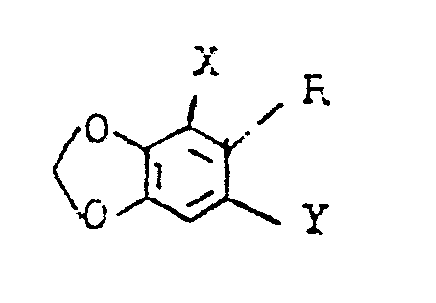
- Es wurden nun die neuen Benzodioxol-Derivate der Formel (I) gefunden,

- R für Wasserstoff, Halogen, gegebenenfalls substituiertes Alkyl, Alkenyl, Alkinyl, Aralkyl, Acyl oder Cyano und
- X und Y für gleiches oder verschiedenes Halogen stehen.
- Die neuen Verbindungen der Formel (I) können hergestellt werden, indem man
- a) 1,2-Dihydroxybenzole der Formel (VII)

- R, X und Y die oben angegebene Bedeutung haben, mit Dihalogenmethanen der Formel (VIII)

- X und Y die oben angegebene Bedeutung haben,
in Gegenwart eines Säureakzeptors und gegebenenfalls in Gegenwart eines Verdünnungsmittels umsetzt,
oder indem man - R, X und Y die oben angegebene Bedeutung haben, mit Dihalogenmethanen der Formel (VIII)
- b) Benzodioxolderivate der Formel (Ia)

- X und Y die oben angegebene Bedeutung haben
mit Halogenierungsmitteln oder mit Formaldehyd/HCl zu Verbindungen der Formel (I) umsetzt, in der X und Y die oben angegebene Bedeutung haben und R für Halogen oder CH2Cl steht, oder indem man - c) Benzodioxolderivate der Formel (Ic)

- X und Y die oben angegebene Bedeutung haben
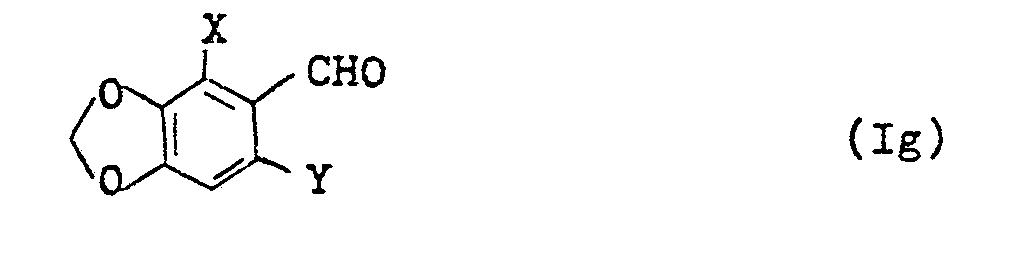
durch katalytische Hydrierung in Verbindungen der Formel (I) umwandelt, in der R für Methyl steht bzw. durch Reaktion mit Verbindungen, welche das Acetat- bzw. Cyanidion enthalten, z.B. mit Natriumacetat bzw. -cyanid, in Verbindungen der Formel (I) umwandelt, in der R für Acetoxymethyl bzw. Cyanomethyl steht bzw. durch Umsetzung mit Hexamethylentetramin in Verbindungen der Formel (I) überführt, in der R für Formyl steht, - d) Benzodioxolderivate der Formel (Ig)

- X und Y die oben angegebene Bedeutung haben, mit Hydroxylamin in die entsprechenden Oxime überführt und daraus mit Dehydratisierungsmitteln die Verbindungen der Formel (I), in welcher R für Cyano steht, erzeugt,
- e) Benzodioxolderivate der Formel (If)

- X und Y die oben angegebene Bedeutung haben
mit Halogenalkanen, -alkenen oder -alkinen zu Verbindungen der Formel (I 1)
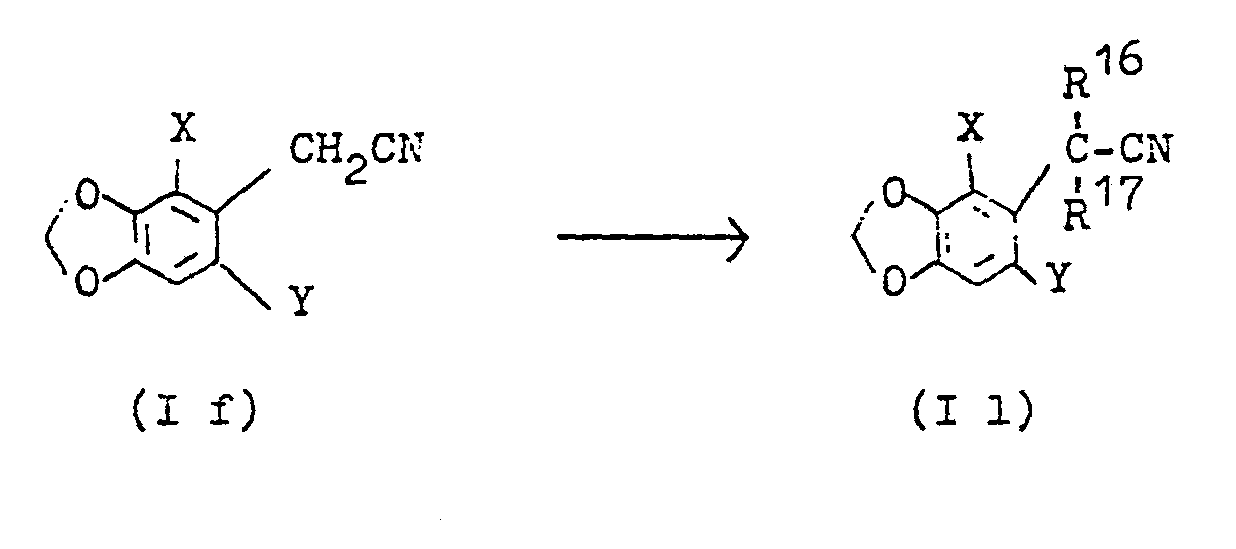
- X, Y, R16, R17 die oben angegebene Bedeutung haben, umsetzt.
- Die neuen Benzodioxolderivate der Formel (I) zeigen in Kombination mit
- A) Carbamaten und/oder
- B) Carbons3ureestern, einschließlich der natürlichen sowie synthetischen Pyrethroide, und/oder
- C) Phosphorsäureestern und/oder
- D) Halogenalkanen
- Die synergistische Wirkung der Verbindungen der allgemeinen Formel I zeigt sich bevorzugt bei
- A) Carbamaten der allgemeinen Formel (II)

- R1 für Aryl, einen Heterocyclus oder einen Oximrest steht,
- R2 für Wasserstoff oder einen Alkylrest mit 1 bis 4 Kohlenstoffatomen steht und
- R3 für Alkyl, Alkylcarbonyl mit 1 bis 6 Kohlenstoffatomen im Alkylrest, der gegebenenfalls auch durch Hydroxy oder Methylthio substituiert sein kann, oder den Rest -S-Z steht, wobei
- Z für einen gegebenenfalls durch Halogen substituierten aliphatischen Rest mit 1 bis 4 Kohlenstoffatomen, insbesondere CCl3 und CF3 sowie für gegebenenfalls bevorzugt durch Nitril, Halogen, insbesondere Chlor, Methyl, Trihalogenmethyl, Trifluormethylmercapto oder Nitro substituierten Arylrest, insbesondere Phenyl, oder für Methoxycarbonyl oder für den Rest -W-SO2-- steht, wobei
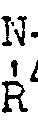
- W für Alkyl, Halogenalkyl oder Alkylamino, Dialkylamino oder einen gegebenenfalls bevorzugt durch Halogen, Trihalogenmethyl, Nitril, Methyl oder Nitro substituierten Arylrest steht.
- R für Phenyl oder Naphthyl steht, die gegebenenfalls substituiert sind durch Alkyl, Alkenyl, Alkoxy, Alkylmercapto oder Alkylthioalkyl mit jeweils 1 bis 6 Kohlenstoffatomen, Dialkylamino, Dialkenylamino mit bis zu 3 Kohlenstoffatomen je Alkyl- bzw. Alkenylteil, Halogen, insbesondere Chlor, Dioxolanyl oder den Rest -N=CH-N(C1-4-Alkyl)2 steht.
- R für 2,3-Dihydrobenzofuranyl, Benzodioxol, Benzothienyl, Pyrimidinyl oder pyrazolyl steht, die gegebenenfalls durch Alkylgruppen mit 1 bis 4 Kohlenstoffatomen, insbesondere Methyl, oder durch Dialkylaminogruppen mit 1 bis 4 Kohlenstoffatomen je Alkylteil substituiert sind.
Weiterhin sind besonders bevorzugt Carbamate der allgemeinen Formel II, worin R1 für einen Rest der Formel (IIa)
- R4 und R5 gleich oder verschieden sind und für Alkyl, Cycloalkyl, Alkenyl, Alkinyl, Alkoxy, Alkylmercapto, Alkoxycarbonyl,Carbonylamid, Alkylmercaptoalkyl, mit jeweils bis zu 5 Kohlenstoffatomen, Nitril, Aryl, insbesondere Fhenyl, einen gegebenenfalls substituierten heterocyclischen Rest oder für Alkyl, das durch einen heterocyclischen Rest substituiert ist oder gemeinsam einen gegebenenfalls durch C1-4-Alkyl substituierten Dioxolanyl-oder Dithiolanylrest stehen; '
- B) Carbonsäureestern der allgemeinen Formel (III)

- R6 für Alkyl, Aralkyl, Aryl oder Cycloalkyl steht, die gegebenenfalls substituiert sein können,
- R7 für Wasserstoff, Alkyl, Halogenalkyl, Alkenyl, Alkinyl, Nitril steht und
- R 8 für Aryl oder einen Heterocyclus steht, oder gemeinsam mit R7 einen gegebenenfalls substituierten Cyclopentenonring bildet.
- Besonders bevorzugt sind Carbonsäureester, in denen R6 für Alkyl mit 1 bis 6 Kohlenstoffatomen, das gegebenenfalls durch gegebenenfalls halogensubstituiertes Phenyl substituiert ist, Cyclopropyl, das gegebenenfalls durch Alkyl, Alkenyl, Halogenalkyl oder Halogenalkenyl mit jeweils bis zu 6 Kohlenstoffatomen substituiert ist, oder für Phenyl, das gegebenenfalls durch Halogeisubstituiert ist, steht. Bevorzugt sind Carbonsäureester, in denen R7 für Wasserstoff, Alkyl mit 1 bis 6 Kohlenstoffatomen, Halogenalkyl mit 1 bis 4 Kohlenstoffatomen und bis zu 3 Halogenatomen, Nitril oder Äthinyl steht.
- Weiter sind besonders bevorzugt Carbonsäureester, in denen R8 für Phenyl steht, das gegebenenfalls durch C1-4-Alkyl, Halogen, insbesondere Fluor oder Chlor, gegebenenfalls halogen- oder methyl-substituiertes Phenoxy, gegebenenfalls substituiertes Benzyl substituiert ist, ferner für Furanyl, Tetrahydrophthalimido, Benzodioxol, die gegebenenfalls durch Halogen, insbesondere Chlor, Alkyl oder Alkenyl mit bis zu 4-Kohlenstoffatomen oder Benzyl substituiert sind, steht, und ferner für Cyclopentonon steht, das gegebenenfalls durch C1-4-Alkyl, Furfuryl, Cl-5-Alkenyl substituiert ist.
- Im einzelnen seinen genannt:
- Essigsäure-(1-(3,4-dichlorphenyl)-2,2,2-trichloräthyl)-ester, 2,3,4,5-Tetrahydrophthalimidomethylchrysanthemat und (5-Benzyl-3-furyl)-methyl-2,2-dimethyl-3-(2-methyl- propenyl)-cyclopropancarboxylat. Weiter sind besonders bevorzugt die natürlich vorkommenden Pyrethroide; Weiter zeigt sich die synergistische Wirkung der Verbindungen der allgemeien Formel I bevorzugt bei
- C) Phosphorsäureestern der allgemeinen Formel IV
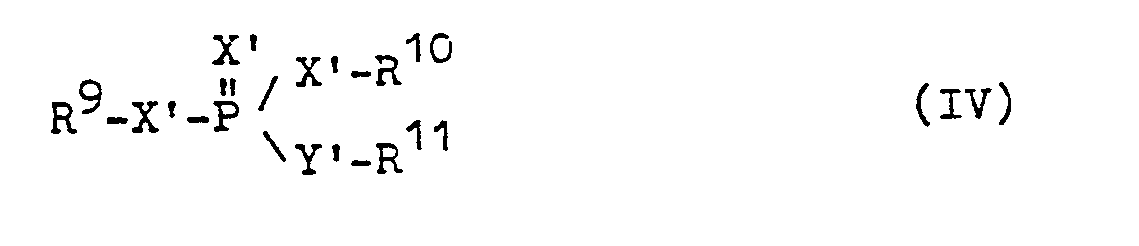
- X' unabhängig voneinander für 0 oder S steht und
- Y' für 0, S, -NH- oder für eine direkte Bindung zwischen dem zentralen P-Atom und dem R11 steht und
- R 9
- und gleich oder verschieden sind und für Alkyl oder R10 Aryl stehen,
- R11 für Alkyl, Aryl, Heteroaryl, Aralkyl, Alkenyl, Dioxanyl, oder einen Oximrest oder für den gleichen Rest steht, an den es gebunden ist.
- Besonders bevorzugt sind Phosphorsäureester, in denen
- R 9
- und gleich oder verschieden sind und für C1-4-Alkyl oder R10 Phenyl stehen,
- R11 für Alkyl mit 1 bis 4 Kohlenstoffatomen steht, das gegebenenfalls durch Halogen, Hydroxyl, Nitril, gegebenenfalls halogensubstituiertes Phenyl, Carbonylamid, Sulfonylalkyl, Sulfoxyalkyl, Carbonylalkyl, Alkoxy, Alkylmercapto, Alkoxycarbonyl, substituiert ist, für Alkenyl mit bis zu 4 Kohlenstoffatomen, das gegebenenfalls durch Halogen, gegebenenfalls halogensubstiruiertes Phenyl oder Alkoxycarbonyl substituiert ist, oder für den Oximrest der allgemeinen Formel

- R11 steht ferner für Dioxanyl, das durch denselben Rest substituiert ist, an den R11 gebunden ist, oder R11 steht für den gleichen Rest, an den er gebunden ist, oder R11 steht für Phenyl, das gegebenenfalls durch Methyl, Nitro, Nitril, Halogen, Methylthio substituiert ist; R11 steht außerdem besonders bevorzugt für gegebenenfalls durch C1-4-Alkyl, Halogen substituierte Heteroaromaten, wie Pyridin, Chinolin, Chinoxalin, Pyrimidin, Diazinon, Benzo-1,2,4-triazin;
- 0,0-Dimethyl- bzw. 0,0-Diäthyl-0-(2,2-dichlor- bzw.
- 2,2-dibromyinyl)-phosphorsäureester,
- O,O-Diäthyl-O-(4-nitro-phenyl)-thionophosphorsäureester,
- 0,0-Dimethyl-0-(3-methyl-4-methylthio)-thionophosphor- säureester,
- 0,0-Dimethyl-0-(3-methyl-4-nitro)-thionophosphorsäure- ester,
- O-Äthyl-S-n-propyl-O-(2,4-dichlorphenyl)-thionophosphor- säureester,
- O-Äthyl-S-n-propyl-O-(4-methylthio-phenyl)-thionophos- phorsäureester,
- O,O-Dimethyl-S-(4-oxo-1,2,3-benzotriazin(3)yl-methyl)-thionothiolphosphorsäureester,
- 0-Methyl-0-(2-iso-propyl-6-methoxy-pyrimidin(4)yl)-thionomethanphosphonsäureester,
- 0,0-Diäthyl-0-(2-iso-propyl-6-methyl-pyrimidin(4)yl)-thionophosphorsäureester,
- 0,0-Diäthyl-0-(3-chlor-4-methyl-cumarin(7)yl)-thiono- phosphorsäureester,
- O,O-Dimethyl-2,2,2-trichlor-1-hydroxy-äthan-phosphon- s'iureester,
- O,O-Dimethyl-S-(methylcarbamoylmethyl)-thionophosphor- säureester.
- Weiter zeigt sich die synergistische Wirkung der Verbindungen der allgemeinen Formel I bevorzugt bei
- D) Halogenalkanen der Formel
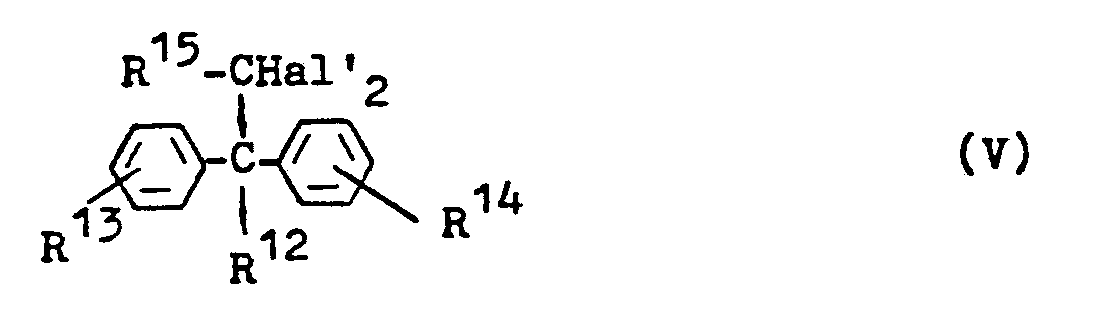
- Hal' für Chlor oder Brom und
- R12 für Wasserstoff oder Hydroxyl stehen,
- R13
- und gleich oder verschieden sind und für Halogen, Alkyl R 14 oder Alkoxy und
- R15 für Wasserstoff oder Halogen stehen.
- Besonders bevorzugt sind Halogenalkane, in denen
- R12 Wasserstoff oder Hydroxyl bedeutet,
- R13
- und für gleiches Halogen, Alkyl bzw. Alkoxy mit 1 bis 4 R14 Kohlenstoffatomen je Alkyl- bzw. Alkoxyrest stehen und
- R15 Halogen bedeutet.
- Im einzelnen seien genannt:
- 1,1,1-Trichlor-2,2-bis(4-chlor- bzw. 4-methoxyphenyl)-äthan-, 1,1,1-Trichlor-2-hydroxy-2,2-bis(4-chlorphenyl)-äthan und 1,1-Dichlor-2,2-bis(4-äthylphenyl)-äthan.
- Überraschenderweise ist die insektizide und/oder akari-. zide Wirkung der erfindungsgemäßen Wirkstoffkombinationen wesentlich höher als die Wirkung der Einzelkomponenten bzw. die Summe der Wirkungen der Einzelkomponenten. Sie ist ferner wesentlich höher als die Wirkung der bereits bekannten Wirkstoffkombination aus 2-iso-Propoxy-phenyl-N-methyl-carbamat und Piperonylbutoxyd. Außerdem zeigen die erfindungsgemäß verwendbaren Benzodioxol-Derivate ausgezeichnete synergistische Wirksamkeit nicht nur bei einer Wirkstoffklasse, sondern bei Wirkstoffen aus den verschiedensten chemischen Stoffgruppen.
- Somit stellen die erfindungsgemäßen Benzodioxol-Derivate und die sie enthaltenden synergistischen Mischungen eine wertvolle Bereicherung der Technik dar.
- Die für die erfindungsgemäße Kombination zu verwendenden Synergisten sind durch die Formel I allgemein definiert. Vorzugsweise stehen darin jedoch
- R für Wasserstoff, Chlor, Brom, Methyl, Chlormethyl, Formyl, Acetoxymethyl und Cyano sowie für den Rest der Formel

- R16 für Wasserstoff oder Methyl steht,
- R17 für Wasserstoff, geradkettiges oder verzweigtes Alkyl mit 1 bis 5, insbesonder 1 bis 3 Kohlenstoffatomen, Allyl, Propargyl oder Benzyl steht sowie
- X und Y für Fluor, Chlor, Brom oder Jod stehen. Als Beispiele für die erfindungsgemäßen Benzodioxole der Formel I seien im einzelnen genannt:
- 3,5-Diflucr-, 3,5-Dichlor-, 3,5-Dibrom-, 3,5-Dijod-,
- 3-Fluor-5-chlor-, 3-Fluor-5-brom-, 3-Fluor-5-jod-,
- 3-Chlor-5-fluor-, 3-Chlor-5-brom-, 3-Chlor-5-jod-,
- 3-Brom-5-fluor-, 3-Brcm-5-chlor-, 3-Brom-5-jod-, 3-Jod-
- 5-fluor-, 3-Jod-5-chlor-, 3-Jod-5-brom-1,2-methylen- dioxybenzol,
- 3,5-Difluor-4-brom-, 3,5-Dichlor-4-brom-, 3,4,5-Tribrom-, 3,5-Dijod-4-brom-, 3-Flucr-5-chlor-4-brom-,
- 3-Fluor-4,5-dibrom-, 3-Fluor-5-jod-4-brom-, 3-Chlor-5-fluor-4-brom-, 3-Chlor-4,5-dibrom-, 3-Chlor-5-jod-4-brom-, 3,4-Dibrom-5-fluor-, 3,4-Dibrom-5-chlor-,
- 3,4-Dibrom-5-jod-, 3-Jod-5-flucr-4-brom-, 3-Jod-5-chlor-4-brom-, 5-Jod-4,5-dibrom-1,2-methylendioxy- benzol,
- 3,5-Difluor-4-chlor-, 3,4,5-Trichlor-, 3,5-Dibrom-4-chlor-, 3,5-Dijod-4-chlor-, 3-Fluor-4,5-dichlor-,
- 3-Fluor-5-brom-4-chlor-, 3-Fluor-5-jod-4-chlor-, 3,4-Dichlor-5-fluor-, 3,4-Dichlor-5-brom-, 3,4-Dichlor-5- jod-, 3-Brom-5-fluor-4-chlor-, 3-Brom-4,5-dichlor-,
- 3-Brom-5-jod-4-chlor-, 3-Jod-5-fluor-4-chlor-, 3-Jod-4,5-dichlor-, 3-Jod-5-brom-4-chlor-1,2-methylendioxy- benzol, ferner
- 3,5-Difluor-, 3,5-Dichlor-, 3,5-Dibrom-, 3,5-Dijod-,
- 3-Fluor-5-chlor-, 3-Fluor-5-brom-, 3-Fluor-5-jod-,
- 3-Chlor-5-fluor-, 3-Chlor-5-brom-, 3-Chlor-5-jod-,
- 3-Brom-5-fluor-, 3-Brom-5-chlor-, 3-Brom-5-jod-, 3-Jod-5-fluor-, 3-Jod-5-chlor-, 3-Jod-5-brom-4-methyl-, -4-chlormethyl-, -4-formyl-, -4-acetoxymethyl-, -4-cyano-, -4-cyanomethyl-, -4-(1-cyano-äthyl)-,
- -4-(1-cyano-n-propyl)-, -4-(1-cyano-iso-propyl)-, -4-(1-cyano-n-butyl)-, -4-(1-cyano-iso-butyl)-, -4-(1-cyano- sek.-butyl)-, -4-(1-cyano-buten(3)yl)-, -4-(1-cyano- butin(3)yl)-, -4-(1-cyano-2-phenyl-äthyl)-1,2-methylen- dioxybenzol.
- Verwendet man 3,4-Dichlor-5-brom-1,2-dihydroxybenzol und Methylenchlorid als Ausgangsstoffe, läßt sich die Herstellungsvariante a) durch folgendes Formelschema wiedergeben:

- Aus Benzodioxolen der Formel I, in welcher R für Wasserstoff steht (Formel 1a) und welche nach der oben erläuterten Methode hergestellt werden können, lassen sich nach den folgenden Formelschemata erfindungsgemäße Benzodioxolderivate herstellen:
- Durch Umsetzung mit Halogenierungsmitteln wie Sulfuryl- chlorid oder Brom erhält man Verbindungen der Formel Ib, worin Hal für Chlor oder rom steht. Reaktion mit Formaldehyd/Salzsäure ergibt die Chlormethyl-benzodioxole der Formel Ic.

- Die Chlormethyl-benzodioxole (Ic) können zur Herstellung der weiteren erfindungsgemäßen Wirkstoffe eingesetzt werden. Sie reagieren mit Wasserstoff übergangsmetallkatalysiert unter Bildung von 4-Methyl-benzodioxolen (Id), mit Acetat bilden sie 4-Acetoxymethylbenzodioxole (Ie), mit Cyanid 4-Cyanomethyl-benzodioxole (If).

- Umsetzung der Chlormethyl-benzodioxole (I c) mit Hexamethylentetramin ergibt Formyl-benzodioxole (I g). Diese können mit Hydroxylamin in Oxime (I h) und letztere mit Dehydratisierungsmitteln, wie z.B. Acetanhydrid, weiter in Nitrile (I k) überführt werden:

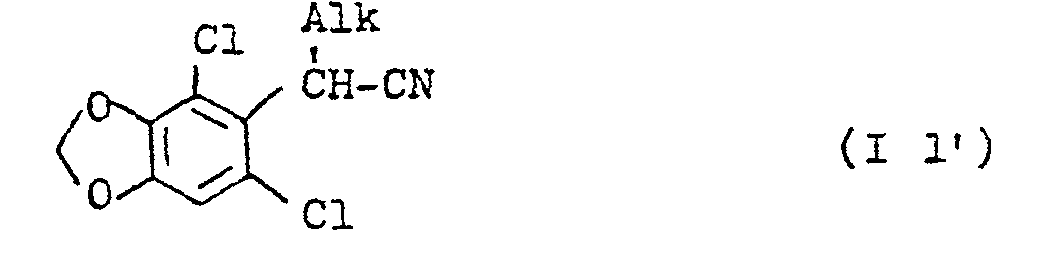
- Aus den Cyanomethyl-benzodioxolen (I f) können durch Umsetzung mit den entsprechenden Halogenalkanen-alkenen oder -alkinen die weiteren erfindungsgemäßen Cyanoalkyl-, Cyanoalkenyl- oder Cyanoalkinyl-benzodioxole hergestellt werden (vergleiche DT-OS 2 215 496; Pure Appl. Chem. 43 (1975), S. 439; Org. Syn. 55 (1976), S. 91):
- Die als Vorprodukte zur Herstellung der erfindungsgemäßen Benzodioxole (I) zu verwendenden 1,2-Dihydroxybenzole (VII) können aus den teilweise bekannten 2-Hydroxy-benzaldehyd-Derivaten, wie z.B. 3,5-Dichlorsalicylaldehyd, durch Reaktion mit Wasserstoffperoxid hergestellt werden nach der sogenannten Dakin-Oxydation (vergleiche Am. Chem. J. 42, 488; GB-PS 794 885; Biochem. Journal 59 (1955), S. 410-415; Chem. Abstr. 49 (1955), 7675h) des folgenden Formelschemas:

- Die Gewichtsverhältnisse der Wirkstoffgruppen können dabei in relativ großen Bereichen schwanken. Im allqemeinen werden die Benzodioxolderivate mit den übrigen Wirkstoffen im Verhältnis 0,1:10 bis 10:0,1 eingesetzt. Als besonders geeignet haben sich jedoch Mischverhältnisse von 0,5:1,0 bis 3,0:1,0 erwiesen. Diese Wirkstoffkombinationen bewirken nicht nur eine schnelle knock-down-Wirkung, sondern pewirken auch die nachhaltige Abtötung von tierischen Schädlingen, insbesondere Insekten und Spinnentieren, die in der Landwirtschaft, in Forsten, im Vorrats- und Materialschutz sowie auf dem Hygienesektor vorkommen. Sie sind gegen normale sensible und resistente Arten sowie gegen alle oder einzelne Entwicklungsstadien wirksam. Zu den oben erwähnten Schädlingen gehören:
- Aus der Ordnung der Isopoda z.B. Oniscus asellus, Armadillidium vulgare, Porcellio scaber.
- Aus der Ordnung der Diplopoda z.B. Blaniulus guttulatus.
- Aus der Ordnung der Chilopoda z.B. Geophilus carpophaus, Scutigera spec.
- Aus der Ordnung der Symphyla z.B. Scutigerella immaculata.
- Aus der Ordnung der Thysanura z.B. Lepisma saccharina.
- Aus der Ordnung der Collembola z.B. Onychiurus armatus.
- Aus der Ordnung der Orthoptera z.B. Blatta orientalis, Periplaneta americana, Leucophaea maderae, Blattella germanica, Acheta domesticus, Gryllotalpa spp., Locusta migratoria migratorioides, Melanoplus differentialis, Schistocerca gregaria.
- Aus der Ordnung der Dermaptera z.B. Forficula auricularia.
- Aus der Ordnung der Isoptera z.B. Reticulitermes spp..
- Aus der Ordnung der Anoplura z.B. Phylloxera vastatrix, Pemphigus spp., Pediculus humanus corporis, Haematopinus spp., Linognathus spp.
- Aus der Ordnung der Mallophaga z.B. Trichodectes spp., Damalinea spp.
- Aus der Ordnung der Thysanoptera z.B. Hercinothrips fermoralis, Thrips tabaci.
- Aus der Ordnung der Heteroptera z.B. Eurygaster spp., Dysdercus intermedius, Piesma quadrata, Cimex lectularius, Rhodnius prolixus, Triatoma spp.
- Aus der Ordnung der Homoptera z.B. Aleurodes brassicae, Bemisia tabaci, Trialeurodes vaporariorum, Aphis gossypii, Brevicoryne brassicae, Cryptomyzus ribis, Doralis fabae, Doralis pomi, Eriosoma lanigerum, Hyalopterus arundinis, Macrosiphum avenae, Myzus spp.,Phorodon humuli, Rhopalosiphum padi, Empoasca spp., Euscelis bilobatus, Nephotettix cincticeps, Lecanium corni, Saissetia oleae, Laodelphax striatellus, Nilaparvata lugens, Aonidiella aurantii, Aspidiotus hederae, Pseudococcus spp. Psylla spp. Aus der Ordnung der Lepidoptera z.B. Pectinophora gossypiella, Bupalus piniarius, Cheimatobia brumata, Lithocolletis blancardella, Hyponomeuta padella, Plutella maculipennis, Malacosoma neustria, Euproctis chrysorrhoea, Lymantria spp. Bucculatrix thurberiella, Phyllocnistis citrella, Agrotis spp., Euxoa spp., Feltia spp. Earias insulana, Heliothis spp., Laphygma exigua, Mamestra brassicae, Panolis flammea, Prodenia litura, Spodoptera spp., Trichoplusia ni, Carpocapsa pomonella, Pieris spp., Chilo spp., Pyrausta nubilalis, Ephestia kuehniella, Galleria mellonella, Cacoecia podana, Capua reticulana, Choristoneura fumiferana, Clysia ambiguella, Homona magnanima, Tortrix viridana.
- Aus der Ordnung der Coleoptera z.B. Anobium punctatum, Rhizopertha dominica, Bruchidius obtectus, Acanthoscelides obtectus, Hylotrupes bajulus, Agelastica alni, Leptinotarsa decemlineata, Phaedon cochleariae, Diabrotica spp., Psylliodes chrysocephala, Epilachna varivestis, Atomaria spp.,Oryzaephilus surinamensis, Anthonomus spp., Sitophilus spp., Otiorrhynchus sulcatus, Cosmopolites sordidus, Ceuthorrhynchus assimilis, Hypera postica, Dermestes spp., Trogoderma spp., Anthrenus spp., Attagenus spp., Lyctus spp., Meligethes aeneus, Ptinus spp., Niptus hololeucus, Gibbium psylloides, Tribolium spp., Tenebrio molitor, Agriotes spp., Conoderus spp., Melolontha melolontha, Amphimallon solstitialis, Costelytra zealandica.
- Aus der Ordnung der Hymenoptera z.B. Diprion spp., Hoplocampa spp., Lasius spp., Monomorium pharaonis, Vespa spp. Aus der Ordnung der Diptera z.B. Aedes spp., Anopheles spp., Culex spp., Drosophila melanogaster, Musca spp., Fannia spp., Calliphora erythrocephala, Lucilia spp., Chrysomyia spp., Cuterebra spp., Gastrophilus spp., Hyppobosca spp., Stomoxys spp., Oestrus spp., Hypoderma spp., Tabanus spp., Tannia spp., Bibio hortulanus, Oscinella frit, Phorbia spp., Pegomyia hyoscyami, Ceratitis capitata, Dacus oleae, Tipula paludosa.
- Aus der Ordnung der Siphonaptera z.B. Xenopsylla cheopis, Ceratophyllus spp..
- Aus der Ordnung der Arachnida z.B. Scorpio maurus, Latrodectus mactans.
- Aus der Ordnung der Acarina z.B. Acarus siro, Argas spp., Ornithodoros spp., Dermanyssus gallinae, Eriophyes ribis, Phyllocoptruta oleivora, Boophilus spp., Rhipicephalus spp., Amblyomma spp., Hyalomma spp., Ixodes spp., Psoroptes spp., Chorioptes spp., Sarcoptes spp., Tarsonemus spp., Bryobia praetiosa, Panonychus spp., Tetranychus spp..
- Die Wirkstoffkombinationen können in die üblichen Formulierungen übergeführt werden, wie Lösungen, Emulsionen, Sprizupulver, Suspensionen, Pulver, Stäubemittel, Schäume, Pasten, lösliche Pulver, Granulate, Aerosole, Suspensions-Emulsionskonzentrate, Saatgutpuder, Wirkstoff-imprägnierte Natur- und synthetische Stoffe, Feinstverkapselungen in polymeren Stoffen und in Hüllmassen für Saatgut, ferner in Formulierungen mit Brennsätzen, wie Räucherpatronen, -dosen, -spiralen u.ä. sowie ULV-Kalt- und Warmnebel-Formulierungen.
- Diese Formulierungen werden in bekannter Weise hergestellt, z.B. durch Vermischen der Wirkstoffe mit Streckmitteln, also flüssigen Lösungsmitteln, unter Druck stehenden verflüssigten Gasen und/oder festen Trägerstoffen, gegebenenfalls unter Verwendung von oberflächenaktiven Mitteln, also Emulgiermitteln und/oder Dispergiermitteln und/oder schaumerzeugenden Mitteln. Im Falle der Benutzung von Wasser als Streckmittel können z.B. auch organische Lösungsmittel als Hilfslösungsmittel verwendet werden. Als flüssige Lösungsmittel kommen im wesentlichen in Frage: Aromaten, wie Xylol, Toluol, oder Alkylnaphthaline, chlorierte Aromaten oder chlorierte aliphatische Kohlenwasserstoffe, wie Chlorbenzole, Chloräthylene oder Methylenchlorid, aliphatische Kohlenwasserstoffe, wie Cyclohexan oder Paraffine, z.B. Erdölfraktionen, Alkohole, wie Butanol oder Glycol sowie deren Äther und Ester, Ketone, wie Aceton, Methyläthylketon, Methylisobutylketon oder Cyclohexanon, stark polare Lösungsmittel, wie Dimethylformamid und Dimethylsulfoxid, sowie Wasser; mit verflüssigten gasförmigen Streckmitteln oder Trägerstoffen sind solche Flüssigkeiten gemeint, welche bei normaler Temperatur und unter Normaldruck gasförmig sind, z.B. Aerosol-Treibgas, wie Halogenkohlenwasserstoffe sowie Butan, Propan, Stickstoff und Kohlendioxid; als feste Trägerstotte kommen in Frage: z.B. natürliche Gesteinsmehle, wie Kaoline, Tonerden, Talkum, Kreide, Quarz, Attapulgit, Montmorillonit oder Diatomeenerde und synthetische Gesteinsmehle, wie hochdisperse Kieselsäure, Aluminiumoxid und Silikate; als feste Trägerstoffe für Granulate kommen in Frage: z.B. gebrochene und fraktionierte natürliche Gesteine wie Calcit, Marmor, Bims, Sepiolith, Dolomit sowie synthetische Granulate aus anorganischen und organischen Mehlen sowie Granulate aus organischem Material wie Sägemehl, Kokosnußschalen, Maiskolben und Tabakstengel; als Emulgier- und/oder schaumerzeugende Mittel kommen in Frage: z.B. nichtionogene und anionische Emulgatoren, wie Polyoxyäthylen-FettsäureEster, Polyoxyäthylen-Fettalkohol-Äther, z.B. Alkylarylpolyglykol-äther, Alkylsulfonate, Alkylsulfate, Arylsulfonate sowie Eiweißhydrolysate; als Dispergiermittel kommen in Frage: z.B. Lignin-Sulfitablaugen und Methylcellulose.
- Es können in den Formulierungen Haftmittel wie Carboxymethylcellulose, natürliche und synthetische pulverige, körnige oder latexförmige Polymere verwendet werden, wie Gummiarabicum, Polyvinylalkohol, Polyvinylacetat.
- Es können Farbstoffe wie anorganische Pigmente, z.B. Eisenoxid, Titanoxid, Ferrocyanblau und organische Farbstoffe, wie Alizarin-, Azol-Metallphthalocyaninfarbstoffe und Spurennährstoffe wie Salze von Eisen, Mangan, Bor, Kupfer, Kobalt, Molybdän und Zink verwendet werden.
- Die Formulierungen enthalten im allgemeinen zwischen 0,1 und 95 Gewichtsprozent Wirkstoff, vorzugsweise zwischen 0,5 und 90 %.
- Die Anwendung der erfindungsgemäßen Wirkstoffkombinationen erfolgt in Form ihrer handelsüblichen Formulierungen und/ oder den aus diesen Formulierungen bereiteten Anwendungsformen.
- Der Wirkstoffgehalt der aus den handelsüblichen Formulierungen bereiteten Anwendungsformen kann in weiten Bereichen variieren. Die Wirkstoffkonzentration der Anwendungsformen kann von 0,0000001 bis zu 99 Gew.-% Wirkstoff, vorzugsweise zwischen 0,01 und 10 Gew.-% liegen.
- Die Anwendung geschieht in einer den Anwendungsformen angepaßten üblichen Weise.
- Bei der Anwendung gegen Hygiene- und Vorratsschädlinge zeichnen sich die Wirkstoffe durch eine hervorragende Residualwirkung auf Holz und Ton sowie durch eine gute Alkalistabilität auf gekälkten Unterlagen aus.
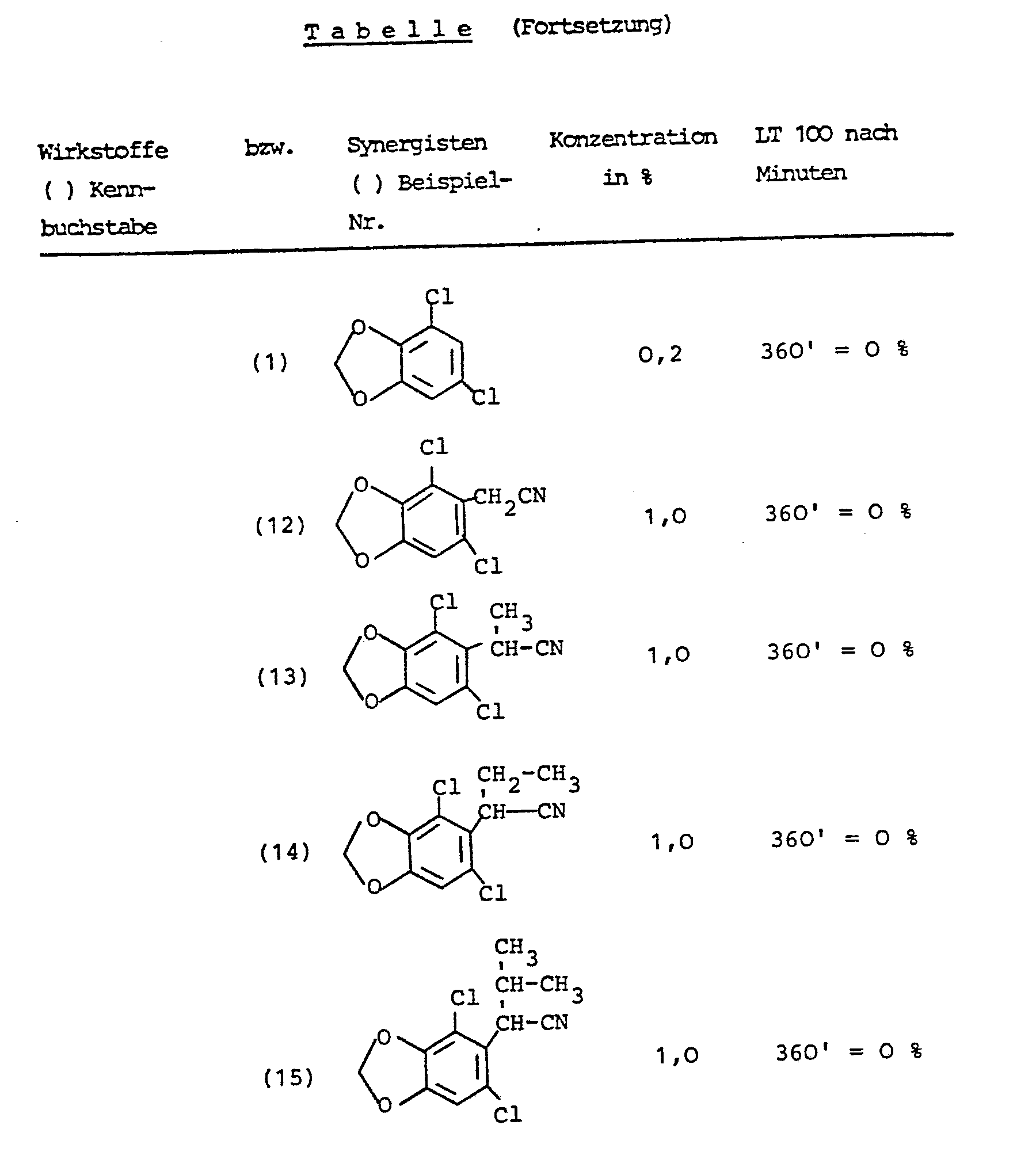
- LT100 - Test
- Testtiere: Musca domestica, Stamm Weymanns (gegen Carbamate und Phosphorsäureester resistent)
- Lösungsmittel: Aceton
- Von den Wirkstoffen, Synergisten und Gemischen aus Wirkstoffen und Synergisten werden Lösungen hergestellt und 2,5 ml davon in Petrischalen auf Filterpapierscheiben von 9,5 cm Durchmesser pipetiert. Das Filterpapier saugt die Lösungen auf. Die Petrischalen bleiben so lange offen stehen, bis das Lösungsmittel vollständig verdunstet ist. Anschließend gibt man 25 Testtiere in die Petrischalen und bedeckt sie mit einem Glasdeckel.
- Der Zustand der Testtiere wird bis zu 6 Stunden laufen kontrolliert. Es wird diejenige Zeit ermittelt, die für eine 100 %ige knock-down-Wirkung erforderlich ist, Wird die LT 100 nach 6 Stunden nicht erreicht, wird der %-Satz der knock-down gegangenen Testtiere festgestellt.
- Konzentrationen der Wirkstoffe, Synergisten und Gemische und ihre Wirkungen gehen aus der nachfolgenden Tabelle hervor.




- Zu einer Lösung von 2,o Mol Brenzcatechinderivat (VII) in 1500 ml Dimethylformamid gibt man unter Rühren 4,4 Mol Kaliumcarbonat, erwärmt die Suspension auf 60-70°C und tropft 2,2 Mol Chlorbrommethan zu. Die Temperatur steigt dabei an und wird durch Kühlen bei 95°C gehalten. Nach dem Abklingen der Reaktion rührt man noch 5 Stunden bei 100°C, filtriert und destilliert vom Filtrat das Lösungsmittel im Vakuum ab. Der Rückstand wird in Toluol aufgenommen, mit Wasser, verdünnter Natronlauge und nochmals mit Wasser gewaschen und über Natriumsulfat getrocknet. Das Lösungsmittel wird abdestilliert und der Rückstand umkristallisiert.
- Nach dieser Verfahrensweise können z.B. die folgenden Produkte der Formel I a hergestellt werden:


- Zu o,1 Mol 3,5-Dihalogen-1,2-methylendioxybenzol (I a), gelöst in loo ml Methylenchlorid, tropft man bei Raumtemperatur o,11 Mol Sulfurylchlorid und erhitzt die Mischung 2 Stunden unter Rühren zum Sieden. Nach dem Abkühlen wäscht man mit Wasser, Natriumbicarbonatlösung und nochmals mit Wasser, trocknet über Calciumchlorid, destilliert das Lösungsmittel im Vakuum ab und kristallisiert den Rückstand um.
- Zu einer Lösung von o,1 Mol 3,5-Dihalogen-1,2-methylen- dioxbenzol (I a) in 15o ml Eisessig tropft man bei Raumtemperatur eine Lösung von o,lo5 Mol Brom in lo ml Eisessig und rührt die Mischung 4 Stunden bei Raumtemperatur. Anschließend wird die Reaktionsmischung in Wasser gegossen, mit Methylenchlorid extrahiert, die organische Phase mit Wasser gewaschen und über Calciumchlorid getrocknet. Nach Abdestillieren des Lösungsmittels im Vakuum wird der Rückstand umkristallisiert.
- Nach (b) bzw. (c) können z.B. die folgenden 3,4,5-Tri- halogen-1,2-methylendioxybenzodioxole der Formel 1 b hergestellt werden:


- 0,5 Mol 3,5-Dihalogen-1,2-methylendioxybenzol (I a) werden mit 7o ml Formalin in 300 ml konzentrierter Salzsäure bei 5o-6coC 24 Stunden lang gerührt. Nach Abkühlen der Reaktionsmischung wird mit Toluol extrahiert, die organische Phase mit Wasser neutral gewaschen und über Natriumsulfat getrocknet. Das Lösungsmittel wird im Vakuum abgezogen und der Rückstand durch Vakunkdestillation gereinigt.
-

- 0,5 Mol 3,5-Dihalogen-4-chlormethyl-1,2-methylendioxy- benzol (I c) werden in looo ml Toluol gelöst, mit 1,0 Mol Triäthylamin versetzt und nach Zugabe von lo g Raney-Nickel bei 80°C unter 65 bar Wasserstoff hydriert. Nach Abkühlen des Gemisches wird von Katalysator und ausgefallenem Triäthylammoniumchlorid abfiltriert, die organische Phase gewaschen und über Natriumsulfat getrocknet. Das Lösungsmittel wird im Vakuum abgezogen und der Rückstand durch Vakuumdestillation gereinigt.
-

- 0,5 Mol 5,5-Dihalogen-4-chlormethyl-methylendioxybenzol (I c) werden in 5oo ml Eisessig gelöst und mit o,6 Mol wasserfreiem Natriumacetat versetzt. Unter Rühren wird die Mischung über Nacht unter Rückfluß zum Sieden erhitzt. Nach Abkühlen wird die Reaktionsmischung auf Eiswasser gegossen. Das dabei ausgefallene Produkt wird mit Wasser, dann mit Petroläther gewaschen und getrocknet.
-

- Zu einer Lösung von 1,05 Mol Natriumcyanid in 500 ml Dimethylformamid gibt man eine Lösung von 5 g Kaliumjodid in 2o ml Wasser und dosiert bei einer Innentemperatur von 60°C 1,0 Mol 3,5-Dihalogen-4-chlormethyl-1,2-methylendioxybenzol (I c) so ein, daß die leicht exotherme Reaktion bei 60°C abläuft. Nach 5 Stunden Rühren bei Raumtemperatur gießt man die Mischung in 3 1 Wasser, extrahiert mit Toluol, wäscht die organische Phase neutral, trocknet über Natriumsulfat, klärt die Lösung mit Aktivkohle/Tonsil und zieht das Lösungsmittel im Vakuum ab. Der kristalline Rückstand wird mit Äther/Petroläther (1:1) aufgeschlämmt, abgesaugt und getrocknet.
-

- Zu einer Suspension von 1,1 Mol Kalium-tert.-butylat in 1,5 1 Toluol gibt man bei 25-3o°C unter leichtem Kühlen 1,0 Mol 3,5-Dihalogen-4-cyanomethyl-1,2-methylen- dioxybenzol (I f), rührt die Mischung 3o Minuten bei 40-50°C und tropft dann bei 50°C 1,1 Mol Halogenalkan, -alken bzw. -alkin zu. Nach 3 Stunden Rühren unter Rückfluß wird abgekühlt, mit Wasser versetzt, die organische Phase neutral gewaschen und über Natriumsulfat getrocknet. Das Lösungsmittel wird im Vakuum abgezogen und der Rückstand durch Destillation bzw. Umkristallisation gereinigt.
- In analoger Weise können folgende Verbindungen hergestellt werden:

- Analog der Vorschrift (b) bzw. (c) wird erhalten

eine besonders hohe insektizide und akarizide Wirkung
Besonders bevorzugt sind Carbamate der Formel II, worin
Weiterhin sind besonders bevorzugt Carbamate der Formel II, worin
besonders erwähnt seien folgende Carbamate der Formel II: 2-Methylphenyl-, 2-Äthylenphenyl-, 2-n-Propylphenyl-, 2-Methylphenyl-, 2-Äthoxyphenyl-, 2-iso-Propoxyphenyl-, 4-Methylphenyl-, 4-Äthylphenyl-, 4-n-Propylphenyl-, 4-Methoxyphenyl-, 4-Äthoxyphenyl-, 4-n-Propoxyphenyl-, 3,4,5-Trimethylphenyl-, 1-Naphthyl-, 2,3-Dihydro-2,2-dimethyl-7-benzofuranyl-, 2-(1,3-Dioxolan(2)yl-phenyl)-, bzw. 2,2-Dimethyl-1,3-benzodioxol(4)yl-N-methyl-carbamat und die entsprechenden -N-methyl-N-acetyl-, -N-methyl-N-trifluormethylthio-, -N-methyl-N-dichlormonofluormethylthio- bzw. -N-methyl-N-dimethylaminothiocarbamate.
Weiter zeigt sich die synergistische Wirkung der Verbindungen der allgemeinen Formel I bevorzugt bei
im einzelnen seien genannt:
Claims (7)


in Gegenwart eines Säureakzeptors und gegebenenfalls in Gegenwart eines Verdünnungsmittels umsetzt,
oder indem man

mit Halogenierungsmitteln oder mit Formaldehyd/HCl zu Verbindungen der Formel (I) umsetzt in der X und Y die oben angegebene Bedeutung haben und R für Halogen oder CH2-C1 steht, oder indem man

durch katalytische Hydrierung in Verbindungen der Formel (I) umwandelt, in der R für Methyl steht bzw. durch Reaktion mit Verbindungen,welche das Acetat- bzw. Cyanidion enthalten, z.B. mit Natriumacetat bzw. -cyanid, in Verbindungen der Formel (I) umwandelt, in der R für Acetoxymethyl bzw. Cyanomethyl steht bzw. durch Umsetzung mit Hexamethylentetramin in Verbindungen der Formel (I) überführt, in der R für Formyl steht,

mit Halogenalkanen-alkenen oder -alkinen zu Verbindungen der Formel (I1)

Applications Claiming Priority (2)
| Application Number | Priority Date | Filing Date | Title |
|---|---|---|---|
| DE2816190 | 1978-04-14 | ||
| DE19782816190 DE2816190A1 (de) | 1978-04-14 | 1978-04-14 | Neue benzodioxolderivate |
Publications (3)
| Publication Number | Publication Date |
|---|---|
| EP0004902A2 true EP0004902A2 (de) | 1979-10-31 |
| EP0004902A3 EP0004902A3 (en) | 1979-11-28 |
| EP0004902B1 EP0004902B1 (de) | 1982-04-21 |
Family
ID=6036963
Family Applications (1)
| Application Number | Title | Priority Date | Filing Date |
|---|---|---|---|
| EP79101016A Expired EP0004902B1 (de) | 1978-04-14 | 1979-04-04 | Benzodioxolderivate, Verfahren zu ihrer Herstellung und ihre Verwendung als Synergisten in Schädlingsbekämpfungsmitteln |
Country Status (27)
| Country | Link |
|---|---|
| US (1) | US4427666A (de) |
| EP (1) | EP0004902B1 (de) |
| JP (1) | JPS54138562A (de) |
| AR (1) | AR220555A1 (de) |
| AT (1) | AT366884B (de) |
| AU (1) | AU522902B2 (de) |
| BR (1) | BR7902211A (de) |
| CA (1) | CA1135709A (de) |
| DD (1) | DD143550A5 (de) |
| DE (2) | DE2816190A1 (de) |
| DK (1) | DK153979A (de) |
| EG (1) | EG13676A (de) |
| ES (5) | ES479472A1 (de) |
| FI (1) | FI791210A7 (de) |
| GR (1) | GR71693B (de) |
| HU (1) | HU182450B (de) |
| IL (1) | IL57057A0 (de) |
| JO (1) | JO998B1 (de) |
| LU (1) | LU81149A1 (de) |
| NO (1) | NO791113L (de) |
| NZ (1) | NZ190161A (de) |
| OA (1) | OA06234A (de) |
| PH (1) | PH14741A (de) |
| PL (1) | PL214856A1 (de) |
| PT (1) | PT69443A (de) |
| TR (1) | TR19874A (de) |
| ZA (1) | ZA791765B (de) |
Families Citing this family (7)
| Publication number | Priority date | Publication date | Assignee | Title |
|---|---|---|---|---|
| US4965254A (en) * | 1985-02-14 | 1990-10-23 | Bayer Aktiengesellschaft | Agents for combating pests |
| US4732906A (en) * | 1985-04-08 | 1988-03-22 | Chugai Seiyaki Kabushiki Kaisha | Dioxolobenzizoxazole derivatives |
| FI874163A7 (fi) * | 1986-09-26 | 1988-03-27 | Mitsui Toatsu Chemicals Incorporated | Katekolijohdannaiset sekä niitä sisältävät keskushermoston taantumasairauksia ehkäisevät ja parantavat valmisteet. |
| FR2609989B1 (fr) * | 1987-01-28 | 1989-04-14 | Rhone Poulenc Chimie | Procede de preparation de methoxy-3 methylenedioxy-4,5 benzaldehyde |
| GB9112697D0 (en) * | 1991-06-13 | 1991-07-31 | Shell Int Research | Biocidal compounds |
| DK174168B1 (da) | 1999-07-19 | 2002-08-05 | Hardi Int As | Bomkonstruktion, samt drejeled til en bomkonstruktion |
| WO2001090099A1 (en) * | 2000-05-24 | 2001-11-29 | Smithkline Beecham Corporation | Fatty acid synthase inhibitors |
Family Cites Families (8)
| Publication number | Priority date | Publication date | Assignee | Title |
|---|---|---|---|---|
| US2734908A (en) | 1956-02-14 | Method of producing aralkyl cyanides | ||
| US2878265A (en) | 1956-09-10 | 1959-03-17 | Fmc Corp | Production of methylenedioxyphenyl derivatives |
| DE1154810B (de) | 1961-04-01 | 1963-09-26 | Knoll Ag | Verfahren zur Herstellung basisch substituierter Phenylacetonitrile |
| GB1046209A (en) | 1964-07-24 | 1966-10-19 | Shell Int Research | Insecticidal compositions |
| DE1543609A1 (de) | 1966-08-13 | 1969-09-18 | Hoechst Ag | Substituierte Phenylessigsaeureamide und Verfahren zu ihrer Herstellung |
| GB1542641A (en) * | 1975-06-30 | 1979-03-21 | Shell Int Research | Wild oat herbicide |
| US4182771A (en) | 1976-12-01 | 1980-01-08 | Bayer Aktiengesellschaft | Synergistic arthropodicidal compositions containing α-substituted-3,4-methylenedioxyph-enylacetonitriles |
| DE2734108A1 (de) | 1977-07-28 | 1979-02-08 | Bayer Ag | Insektizide und akarizide mittel |
-
1978
- 1978-04-14 DE DE19782816190 patent/DE2816190A1/de not_active Withdrawn
-
1979
- 1979-03-22 JO JO1979998A patent/JO998B1/en active
- 1979-04-03 NO NO791113A patent/NO791113L/no unknown
- 1979-04-04 DE DE7979101016T patent/DE2962540D1/de not_active Expired
- 1979-04-04 EP EP79101016A patent/EP0004902B1/de not_active Expired
- 1979-04-06 PT PT69443A patent/PT69443A/pt unknown
- 1979-04-06 GR GR58825A patent/GR71693B/el unknown
- 1979-04-10 BR BR7902211A patent/BR7902211A/pt unknown
- 1979-04-10 DD DD79212119A patent/DD143550A5/de unknown
- 1979-04-10 PH PH22375A patent/PH14741A/en unknown
- 1979-04-10 ES ES479472A patent/ES479472A1/es not_active Expired
- 1979-04-11 NZ NZ190161A patent/NZ190161A/xx unknown
- 1979-04-11 DK DK153979A patent/DK153979A/da unknown
- 1979-04-11 AR AR276156A patent/AR220555A1/es active
- 1979-04-11 EG EG218/79A patent/EG13676A/xx active
- 1979-04-11 IL IL57057A patent/IL57057A0/xx unknown
- 1979-04-12 FI FI791210A patent/FI791210A7/fi not_active Application Discontinuation
- 1979-04-12 PL PL21485679A patent/PL214856A1/xx unknown
- 1979-04-12 JP JP4368779A patent/JPS54138562A/ja active Pending
- 1979-04-12 CA CA000325805A patent/CA1135709A/en not_active Expired
- 1979-04-12 ZA ZA791765A patent/ZA791765B/xx unknown
- 1979-04-12 OA OA56785A patent/OA06234A/xx unknown
- 1979-04-12 TR TR19874A patent/TR19874A/xx unknown
- 1979-04-13 LU LU81149A patent/LU81149A1/de unknown
- 1979-04-13 HU HU79BA3771A patent/HU182450B/hu unknown
- 1979-04-13 AT AT0279979A patent/AT366884B/de active
- 1979-04-17 AU AU46078/79A patent/AU522902B2/en not_active Ceased
- 1979-09-13 ES ES484151A patent/ES484151A1/es not_active Expired
- 1979-09-13 ES ES484152A patent/ES484152A1/es not_active Expired
- 1979-09-13 ES ES484154A patent/ES484154A1/es not_active Expired
- 1979-09-13 ES ES484153A patent/ES484153A1/es not_active Expired
-
1982
- 1982-06-15 US US06/388,566 patent/US4427666A/en not_active Expired - Fee Related
Also Published As
| Publication number | Publication date |
|---|---|
| ES479472A1 (es) | 1979-12-01 |
| JPS54138562A (en) | 1979-10-27 |
| IL57057A0 (en) | 1979-07-25 |
| US4427666A (en) | 1984-01-24 |
| OA06234A (fr) | 1981-06-30 |
| ES484152A1 (es) | 1980-05-16 |
| ES484151A1 (es) | 1980-05-16 |
| EP0004902B1 (de) | 1982-04-21 |
| DK153979A (da) | 1979-10-15 |
| NO791113L (no) | 1979-10-16 |
| ATA279979A (de) | 1981-10-15 |
| CA1135709A (en) | 1982-11-16 |
| DD143550A5 (de) | 1980-09-03 |
| BR7902211A (pt) | 1979-12-04 |
| JO998B1 (en) | 1982-07-10 |
| GR71693B (de) | 1983-06-21 |
| AU4607879A (en) | 1979-10-18 |
| LU81149A1 (de) | 1979-11-07 |
| PH14741A (en) | 1981-11-20 |
| EP0004902A3 (en) | 1979-11-28 |
| EG13676A (en) | 1982-03-31 |
| DE2816190A1 (de) | 1979-10-25 |
| ES484153A1 (es) | 1980-05-16 |
| AU522902B2 (en) | 1982-07-01 |
| HU182450B (en) | 1984-01-30 |
| FI791210A7 (fi) | 1981-01-01 |
| PT69443A (en) | 1979-05-01 |
| AR220555A1 (es) | 1980-11-14 |
| NZ190161A (en) | 1981-01-23 |
| ZA791765B (en) | 1980-05-28 |
| DE2962540D1 (en) | 1982-06-03 |
| AT366884B (de) | 1982-05-10 |
| PL214856A1 (de) | 1980-03-24 |
| ES484154A1 (es) | 1980-05-16 |
| TR19874A (tr) | 1980-04-03 |
Similar Documents
| Publication | Publication Date | Title |
|---|---|---|
| EP0007576B1 (de) | Ester von Stilbenderivaten, Verfahren zu ihrer Herstellung, Stilbenalkohole als Zwischenprodukte, Verwendung der Ester als Insektizide | |
| EP0001064B1 (de) | Fluorsubstituierte Phenoxybenzyl-oxycarbonylderivate,-alkohole und -halogenide, Verfahren zu ihrer Herstellung und ihre Verwendung | |
| EP0017810B1 (de) | Schädlingsbekämpfungsmittel, die substituierte Benzazole enthalten, und deren Verwendung | |
| EP0004022A1 (de) | Pentafluorbenzyloxycarbonylderivate, Verfahren zu ihrer Herstellung und ihre Verwendung als Insektizide und Akarizide | |
| EP0004902B1 (de) | Benzodioxolderivate, Verfahren zu ihrer Herstellung und ihre Verwendung als Synergisten in Schädlingsbekämpfungsmitteln | |
| EP0043492B1 (de) | 1-Aryl-cyclopropan-1-carbonsäureester, Verfahren zu deren Herstellung und deren Verwendung in Schädlingsbekämpfungsmitteln | |
| US4288451A (en) | Combating arthropods with ferrocene-containing synergistic compositions | |
| EP0033160B1 (de) | Substituierte 3-(1,2-Dibrom-alkyl)-2,2-dimethyl-cyclo-propan-1-carbonsäureester, Verfahren sowie Zwischenprodukte zu ihrer Herstellung und ihre Verwendung in Schädlingsbekämpfungsmitteln | |
| EP0061053A1 (de) | 3-Alken-1-yl-2,2-dimethyl-cyclopropancarbonsäure-(4-fluor-3-phenoxy-benzyl)-ester, Verfahren zu ihrer Herstellung und ihre Verwendung in Schädlingsbekämpfungsmitteln | |
| EP0000537B1 (de) | Insektizide und akarizide Mittel, deren Verwendung und Verfahren zu deren Herstellung | |
| EP0029515B1 (de) | Fluor-substituierte 2,2,3,3-Tetramethyl-cyclopropan-1-carbonsäure-benzylester, Verfahren zu ihrer Herstellung und ihre Verwendung in Schädlingsbekämpfungsmitteln | |
| EP0040742B1 (de) | 3-(2-Chlor-3,3,4,4,4-pentafluor-1-butenyl)-2,2-dimethyl-cyclopropancarbonsäureester, Verfahren zu deren Herstellung und deren Verwendung in Schädlingsbekämpfungsmitteln | |
| DE2816474A1 (de) | Dichlorbenzodioxolderivate, verfahren zu ihrer herstellung und ihre verwendung als synergisten in insektiziden und akariziden mitteln | |
| US4199593A (en) | Combating arthropods with 5-(3,4-methylenedioxybenzyl)-dioxolanes and synergistic compositions therewith | |
| EP0004929B1 (de) | Isochroman-derivate enthaltende insektizide und akarizide Mittel, Verfahren zu ihrer Herstellung und ihre Verwendung | |
| DE2919820A1 (de) | Fluor-substituierte oxyalkenyl-cyclopropancarbonsaeureester, verfahren zu ihrer herstellung sowie ihre verwendung als insektizide und akarizide | |
| DE2654348C2 (de) | Insektizide und akarizide Mittel | |
| CH625939A5 (de) | ||
| EP0028752A1 (de) | Neue 2-(Thi)Oxo-1,3,2-oxazaphospholane, Verfahren zu ihrer Herstellung und ihre Verwendung als Synergisten in Schädlingsbekämpfungsmitteln | |
| EP0029543A1 (de) | Fluor-substituierte Spirocarbonsäure-benzylester, Verfahren zu ihrer Herstellung und ihre Verwendung in Schädlingsbekämpfungsmitteln | |
| DE2701586A1 (de) | Insektizide und akarizide mittel | |
| DE2823281A1 (de) | Insektizide und akarizide mittel | |
| EP0030661A2 (de) | Insektizide und akarizide Mittel enthaltend Propargylthionophosphorsäureester |
Legal Events
| Date | Code | Title | Description |
|---|---|---|---|
| PUAI | Public reference made under article 153(3) epc to a published international application that has entered the european phase |
Free format text: ORIGINAL CODE: 0009012 |
|
| PUAL | Search report despatched |
Free format text: ORIGINAL CODE: 0009013 |
|
| 17P | Request for examination filed | ||
| AK | Designated contracting states |
Designated state(s): BE CH DE FR GB IT NL SE |
|
| AK | Designated contracting states |
Designated state(s): BE CH DE FR GB IT NL SE |
|
| ITF | It: translation for a ep patent filed | ||
| GRAA | (expected) grant |
Free format text: ORIGINAL CODE: 0009210 |
|
| AK | Designated contracting states |
Designated state(s): BE CH DE FR GB IT NL SE |
|
| REF | Corresponds to: |
Ref document number: 2962540 Country of ref document: DE Date of ref document: 19820603 |
|
| PGFP | Annual fee paid to national office [announced via postgrant information from national office to epo] |
Ref country code: DE Payment date: 19830323 Year of fee payment: 5 |
|
| PGFP | Annual fee paid to national office [announced via postgrant information from national office to epo] |
Ref country code: SE Payment date: 19830331 Year of fee payment: 5 Ref country code: BE Payment date: 19830331 Year of fee payment: 5 |
|
| PGFP | Annual fee paid to national office [announced via postgrant information from national office to epo] |
Ref country code: FR Payment date: 19830418 Year of fee payment: 5 |
|
| PGFP | Annual fee paid to national office [announced via postgrant information from national office to epo] |
Ref country code: CH Payment date: 19830427 Year of fee payment: 5 |
|
| PGFP | Annual fee paid to national office [announced via postgrant information from national office to epo] |
Ref country code: NL Payment date: 19830430 Year of fee payment: 5 |
|
| PG25 | Lapsed in a contracting state [announced via postgrant information from national office to epo] |
Ref country code: SE Effective date: 19840405 |
|
| PG25 | Lapsed in a contracting state [announced via postgrant information from national office to epo] |
Ref country code: CH Effective date: 19840430 Ref country code: BE Effective date: 19840430 |
|
| BERE | Be: lapsed |
Owner name: BAYER A.G. Effective date: 19840404 |
|
| PG25 | Lapsed in a contracting state [announced via postgrant information from national office to epo] |
Ref country code: NL Effective date: 19841101 |
|
| GBPC | Gb: european patent ceased through non-payment of renewal fee | ||
| NLV4 | Nl: lapsed or anulled due to non-payment of the annual fee | ||
| PG25 | Lapsed in a contracting state [announced via postgrant information from national office to epo] |
Ref country code: FR Free format text: LAPSE BECAUSE OF NON-PAYMENT OF DUE FEES Effective date: 19841228 |
|
| REG | Reference to a national code |
Ref country code: CH Ref legal event code: PL |
|
| PG25 | Lapsed in a contracting state [announced via postgrant information from national office to epo] |
Ref country code: DE Effective date: 19850101 |
|
| REG | Reference to a national code |
Ref country code: FR Ref legal event code: ST |
|
| PG25 | Lapsed in a contracting state [announced via postgrant information from national office to epo] |
Ref country code: GB Effective date: 19881117 |
|
| EUG | Se: european patent has lapsed |
Ref document number: 79101016.8 Effective date: 19850417 |
|
| PLBE | No opposition filed within time limit |
Free format text: ORIGINAL CODE: 0009261 |
|
| STAA | Information on the status of an ep patent application or granted ep patent |
Free format text: STATUS: NO OPPOSITION FILED WITHIN TIME LIMIT |