EP0002519A1 - Oxalkylierte Polysiloxane, deren Herstellung und Verwendung als Wärmesensibilisierungsmittel - Google Patents
Oxalkylierte Polysiloxane, deren Herstellung und Verwendung als Wärmesensibilisierungsmittel Download PDFInfo
- Publication number
- EP0002519A1 EP0002519A1 EP78101655A EP78101655A EP0002519A1 EP 0002519 A1 EP0002519 A1 EP 0002519A1 EP 78101655 A EP78101655 A EP 78101655A EP 78101655 A EP78101655 A EP 78101655A EP 0002519 A1 EP0002519 A1 EP 0002519A1
- Authority
- EP
- European Patent Office
- Prior art keywords
- numbers
- radical
- chr
- alkyl
- atoms
- Prior art date
- Legal status (The legal status is an assumption and is not a legal conclusion. Google has not performed a legal analysis and makes no representation as to the accuracy of the status listed.)
- Granted
Links
- -1 polysiloxanes Polymers 0.000 title claims abstract description 29
- 229920001296 polysiloxane Polymers 0.000 title claims abstract description 18
- 231100000489 sensitizer Toxicity 0.000 title 1
- 239000000203 mixture Substances 0.000 claims abstract description 28
- UFHFLCQGNIYNRP-UHFFFAOYSA-N Hydrogen Chemical compound [H][H] UFHFLCQGNIYNRP-UHFFFAOYSA-N 0.000 claims abstract description 13
- 125000004432 carbon atom Chemical group C* 0.000 claims abstract description 10
- 229910052739 hydrogen Inorganic materials 0.000 claims abstract description 10
- 239000001257 hydrogen Substances 0.000 claims abstract description 10
- 125000000217 alkyl group Chemical group 0.000 claims abstract description 8
- 150000005840 aryl radicals Chemical class 0.000 claims abstract description 6
- 229910052736 halogen Inorganic materials 0.000 claims abstract description 6
- 229920000126 latex Polymers 0.000 claims description 26
- 229920001515 polyalkylene glycol Polymers 0.000 claims description 23
- 125000002496 methyl group Chemical group [H]C([H])([H])* 0.000 claims description 11
- 150000001875 compounds Chemical class 0.000 claims description 8
- 238000000034 method Methods 0.000 claims description 8
- 238000004519 manufacturing process Methods 0.000 claims description 5
- 229920001971 elastomer Polymers 0.000 claims description 4
- 150000002367 halogens Chemical group 0.000 claims description 4
- WCYWZMWISLQXQU-UHFFFAOYSA-N methyl Chemical compound [CH3] WCYWZMWISLQXQU-UHFFFAOYSA-N 0.000 claims description 4
- 239000005060 rubber Substances 0.000 claims description 4
- 230000002378 acidificating effect Effects 0.000 claims description 3
- 125000003710 aryl alkyl group Chemical group 0.000 claims description 3
- 125000003118 aryl group Chemical group 0.000 claims description 3
- 239000003054 catalyst Substances 0.000 claims description 3
- CIUQDSCDWFSTQR-UHFFFAOYSA-N [C]1=CC=CC=C1 Chemical compound [C]1=CC=CC=C1 CIUQDSCDWFSTQR-UHFFFAOYSA-N 0.000 claims 1
- 150000002118 epoxides Chemical class 0.000 claims 1
- 125000001188 haloalkyl group Chemical group 0.000 claims 1
- 150000002431 hydrogen Chemical class 0.000 claims 1
- IAYPIBMASNFSPL-UHFFFAOYSA-N Ethylene oxide Chemical compound C1CO1 IAYPIBMASNFSPL-UHFFFAOYSA-N 0.000 abstract description 13
- GOOHAUXETOMSMM-UHFFFAOYSA-N Propylene oxide Chemical compound CC1CO1 GOOHAUXETOMSMM-UHFFFAOYSA-N 0.000 abstract description 13
- 238000006243 chemical reaction Methods 0.000 abstract description 7
- LFQSCWFLJHTTHZ-UHFFFAOYSA-N Ethanol Chemical compound CCO LFQSCWFLJHTTHZ-UHFFFAOYSA-N 0.000 abstract description 5
- 150000003254 radicals Chemical class 0.000 abstract description 3
- 125000005843 halogen group Chemical group 0.000 abstract 2
- KZMGYPLQYOPHEL-UHFFFAOYSA-N Boron trifluoride etherate Chemical compound FB(F)F.CCOCC KZMGYPLQYOPHEL-UHFFFAOYSA-N 0.000 description 16
- 238000005345 coagulation Methods 0.000 description 16
- 230000015271 coagulation Effects 0.000 description 16
- 239000004816 latex Substances 0.000 description 15
- XLYOFNOQVPJJNP-UHFFFAOYSA-N water Substances O XLYOFNOQVPJJNP-UHFFFAOYSA-N 0.000 description 13
- 239000000178 monomer Substances 0.000 description 10
- KAKZBPTYRLMSJV-UHFFFAOYSA-N Butadiene Chemical compound C=CC=C KAKZBPTYRLMSJV-UHFFFAOYSA-N 0.000 description 9
- 239000003995 emulsifying agent Substances 0.000 description 9
- 229920000642 polymer Polymers 0.000 description 9
- VGGSQFUCUMXWEO-UHFFFAOYSA-N Ethene Chemical compound C=C VGGSQFUCUMXWEO-UHFFFAOYSA-N 0.000 description 8
- 239000005977 Ethylene Substances 0.000 description 8
- LRHPLDYGYMQRHN-UHFFFAOYSA-N N-Butanol Chemical compound CCCCO LRHPLDYGYMQRHN-UHFFFAOYSA-N 0.000 description 8
- 239000000047 product Substances 0.000 description 8
- 239000012230 colorless oil Substances 0.000 description 7
- 239000008346 aqueous phase Substances 0.000 description 6
- 238000006555 catalytic reaction Methods 0.000 description 6
- NLHHRLWOUZZQLW-UHFFFAOYSA-N Acrylonitrile Chemical compound C=CC#N NLHHRLWOUZZQLW-UHFFFAOYSA-N 0.000 description 5
- WSFSSNUMVMOOMR-UHFFFAOYSA-N Formaldehyde Chemical compound O=C WSFSSNUMVMOOMR-UHFFFAOYSA-N 0.000 description 5
- CERQOIWHTDAKMF-UHFFFAOYSA-N Methacrylic acid Chemical compound CC(=C)C(O)=O CERQOIWHTDAKMF-UHFFFAOYSA-N 0.000 description 5
- PPBRXRYQALVLMV-UHFFFAOYSA-N Styrene Chemical compound C=CC1=CC=CC=C1 PPBRXRYQALVLMV-UHFFFAOYSA-N 0.000 description 5
- 238000003756 stirring Methods 0.000 description 5
- 229920001577 copolymer Polymers 0.000 description 4
- 238000006116 polymerization reaction Methods 0.000 description 4
- YXIWHUQXZSMYRE-UHFFFAOYSA-N 1,3-benzothiazole-2-thiol Chemical compound C1=CC=C2SC(S)=NC2=C1 YXIWHUQXZSMYRE-UHFFFAOYSA-N 0.000 description 3
- UHOVQNZJYSORNB-UHFFFAOYSA-N Benzene Chemical compound C1=CC=CC=C1 UHOVQNZJYSORNB-UHFFFAOYSA-N 0.000 description 3
- YMWUJEATGCHHMB-UHFFFAOYSA-N Dichloromethane Chemical compound ClCCl YMWUJEATGCHHMB-UHFFFAOYSA-N 0.000 description 3
- 239000004593 Epoxy Substances 0.000 description 3
- XEKOWRVHYACXOJ-UHFFFAOYSA-N Ethyl acetate Chemical compound CCOC(C)=O XEKOWRVHYACXOJ-UHFFFAOYSA-N 0.000 description 3
- OKKJLVBELUTLKV-UHFFFAOYSA-N Methanol Chemical compound OC OKKJLVBELUTLKV-UHFFFAOYSA-N 0.000 description 3
- ZMXDDKWLCZADIW-UHFFFAOYSA-N N,N-Dimethylformamide Chemical compound CN(C)C=O ZMXDDKWLCZADIW-UHFFFAOYSA-N 0.000 description 3
- GWEVSGVZZGPLCZ-UHFFFAOYSA-N Titan oxide Chemical compound O=[Ti]=O GWEVSGVZZGPLCZ-UHFFFAOYSA-N 0.000 description 3
- YXFVVABEGXRONW-UHFFFAOYSA-N Toluene Chemical compound CC1=CC=CC=C1 YXFVVABEGXRONW-UHFFFAOYSA-N 0.000 description 3
- XLOMVQKBTHCTTD-UHFFFAOYSA-N Zinc monoxide Chemical compound [Zn]=O XLOMVQKBTHCTTD-UHFFFAOYSA-N 0.000 description 3
- 239000000654 additive Substances 0.000 description 3
- 239000007864 aqueous solution Substances 0.000 description 3
- 238000007720 emulsion polymerization reaction Methods 0.000 description 3
- 125000003700 epoxy group Chemical group 0.000 description 3
- FQPSGWSUVKBHSU-UHFFFAOYSA-N methacrylamide Chemical compound CC(=C)C(N)=O FQPSGWSUVKBHSU-UHFFFAOYSA-N 0.000 description 3
- OFBQJSOFQDEBGM-UHFFFAOYSA-N n-pentane Natural products CCCCC OFBQJSOFQDEBGM-UHFFFAOYSA-N 0.000 description 3
- 239000004745 nonwoven fabric Substances 0.000 description 3
- 239000000243 solution Substances 0.000 description 3
- 238000004073 vulcanization Methods 0.000 description 3
- MYRTYDVEIRVNKP-UHFFFAOYSA-N 1,2-Divinylbenzene Chemical compound C=CC1=CC=CC=C1C=C MYRTYDVEIRVNKP-UHFFFAOYSA-N 0.000 description 2
- SMZOUWXMTYCWNB-UHFFFAOYSA-N 2-(2-methoxy-5-methylphenyl)ethanamine Chemical compound COC1=CC=C(C)C=C1CCN SMZOUWXMTYCWNB-UHFFFAOYSA-N 0.000 description 2
- NIXOWILDQLNWCW-UHFFFAOYSA-N 2-Propenoic acid Natural products OC(=O)C=C NIXOWILDQLNWCW-UHFFFAOYSA-N 0.000 description 2
- HRPVXLWXLXDGHG-UHFFFAOYSA-N Acrylamide Chemical compound NC(=O)C=C HRPVXLWXLXDGHG-UHFFFAOYSA-N 0.000 description 2
- NLXLAEXVIDQMFP-UHFFFAOYSA-N Ammonia chloride Chemical compound [NH4+].[Cl-] NLXLAEXVIDQMFP-UHFFFAOYSA-N 0.000 description 2
- WKBOTKDWSSQWDR-UHFFFAOYSA-N Bromine atom Chemical compound [Br] WKBOTKDWSSQWDR-UHFFFAOYSA-N 0.000 description 2
- ZAMOUSCENKQFHK-UHFFFAOYSA-N Chlorine atom Chemical compound [Cl] ZAMOUSCENKQFHK-UHFFFAOYSA-N 0.000 description 2
- HEDRZPFGACZZDS-UHFFFAOYSA-N Chloroform Chemical compound ClC(Cl)Cl HEDRZPFGACZZDS-UHFFFAOYSA-N 0.000 description 2
- RTZKZFJDLAIYFH-UHFFFAOYSA-N Diethyl ether Chemical compound CCOCC RTZKZFJDLAIYFH-UHFFFAOYSA-N 0.000 description 2
- VZCYOOQTPOCHFL-OWOJBTEDSA-N Fumaric acid Chemical compound OC(=O)\C=C\C(O)=O VZCYOOQTPOCHFL-OWOJBTEDSA-N 0.000 description 2
- VEXZGXHMUGYJMC-UHFFFAOYSA-N Hydrochloric acid Chemical compound Cl VEXZGXHMUGYJMC-UHFFFAOYSA-N 0.000 description 2
- RRHGJUQNOFWUDK-UHFFFAOYSA-N Isoprene Chemical compound CC(=C)C=C RRHGJUQNOFWUDK-UHFFFAOYSA-N 0.000 description 2
- NBIIXXVUZAFLBC-UHFFFAOYSA-N Phosphoric acid Chemical compound OP(O)(O)=O NBIIXXVUZAFLBC-UHFFFAOYSA-N 0.000 description 2
- ATUOYWHBWRKTHZ-UHFFFAOYSA-N Propane Chemical compound CCC ATUOYWHBWRKTHZ-UHFFFAOYSA-N 0.000 description 2
- 206010070834 Sensitisation Diseases 0.000 description 2
- QAOWNCQODCNURD-UHFFFAOYSA-N Sulfuric acid Chemical compound OS(O)(=O)=O QAOWNCQODCNURD-UHFFFAOYSA-N 0.000 description 2
- 239000002253 acid Substances 0.000 description 2
- 150000001298 alcohols Chemical class 0.000 description 2
- 125000000129 anionic group Chemical group 0.000 description 2
- GDTBXPJZTBHREO-UHFFFAOYSA-N bromine Substances BrBr GDTBXPJZTBHREO-UHFFFAOYSA-N 0.000 description 2
- CODNYICXDISAEA-UHFFFAOYSA-N bromine monochloride Chemical compound BrCl CODNYICXDISAEA-UHFFFAOYSA-N 0.000 description 2
- 229910052794 bromium Inorganic materials 0.000 description 2
- 239000003795 chemical substances by application Substances 0.000 description 2
- 239000000460 chlorine Substances 0.000 description 2
- 229910052801 chlorine Inorganic materials 0.000 description 2
- MVPPADPHJFYWMZ-UHFFFAOYSA-N chlorobenzene Chemical compound ClC1=CC=CC=C1 MVPPADPHJFYWMZ-UHFFFAOYSA-N 0.000 description 2
- 230000000052 comparative effect Effects 0.000 description 2
- 238000009826 distribution Methods 0.000 description 2
- 125000002887 hydroxy group Chemical group [H]O* 0.000 description 2
- 230000008313 sensitization Effects 0.000 description 2
- 239000000126 substance Substances 0.000 description 2
- VZGDMQKNWNREIO-UHFFFAOYSA-N tetrachloromethane Chemical compound ClC(Cl)(Cl)Cl VZGDMQKNWNREIO-UHFFFAOYSA-N 0.000 description 2
- JOXIMZWYDAKGHI-UHFFFAOYSA-N toluene-4-sulfonic acid Chemical compound CC1=CC=C(S(O)(=O)=O)C=C1 JOXIMZWYDAKGHI-UHFFFAOYSA-N 0.000 description 2
- VZCYOOQTPOCHFL-UHFFFAOYSA-N trans-butenedioic acid Natural products OC(=O)C=CC(O)=O VZCYOOQTPOCHFL-UHFFFAOYSA-N 0.000 description 2
- 210000002268 wool Anatomy 0.000 description 2
- DNIAPMSPPWPWGF-GSVOUGTGSA-N (R)-(-)-Propylene glycol Chemical compound C[C@@H](O)CO DNIAPMSPPWPWGF-GSVOUGTGSA-N 0.000 description 1
- STMDPCBYJCIZOD-UHFFFAOYSA-N 2-(2,4-dinitroanilino)-4-methylpentanoic acid Chemical compound CC(C)CC(C(O)=O)NC1=CC=C([N+]([O-])=O)C=C1[N+]([O-])=O STMDPCBYJCIZOD-UHFFFAOYSA-N 0.000 description 1
- JAHNSTQSQJOJLO-UHFFFAOYSA-N 2-(3-fluorophenyl)-1h-imidazole Chemical compound FC1=CC=CC(C=2NC=CN=2)=C1 JAHNSTQSQJOJLO-UHFFFAOYSA-N 0.000 description 1
- OEPOKWHJYJXUGD-UHFFFAOYSA-N 2-(3-phenylmethoxyphenyl)-1,3-thiazole-4-carbaldehyde Chemical compound O=CC1=CSC(C=2C=C(OCC=3C=CC=CC=3)C=CC=2)=N1 OEPOKWHJYJXUGD-UHFFFAOYSA-N 0.000 description 1
- OSDWBNJEKMUWAV-UHFFFAOYSA-N Allyl chloride Chemical compound ClCC=C OSDWBNJEKMUWAV-UHFFFAOYSA-N 0.000 description 1
- DKPFZGUDAPQIHT-UHFFFAOYSA-N Butyl acetate Natural products CCCCOC(C)=O DKPFZGUDAPQIHT-UHFFFAOYSA-N 0.000 description 1
- QBXXRLRAQKJAAZ-UHFFFAOYSA-N CC(C1)C1(C)[N](C)(C)C Chemical compound CC(C1)C1(C)[N](C)(C)C QBXXRLRAQKJAAZ-UHFFFAOYSA-N 0.000 description 1
- 229920000742 Cotton Polymers 0.000 description 1
- RWSOTUBLDIXVET-UHFFFAOYSA-N Dihydrogen sulfide Chemical class S RWSOTUBLDIXVET-UHFFFAOYSA-N 0.000 description 1
- GXBYFVGCMPJVJX-UHFFFAOYSA-N Epoxybutene Chemical compound C=CC1CO1 GXBYFVGCMPJVJX-UHFFFAOYSA-N 0.000 description 1
- GYCMBHHDWRMZGG-UHFFFAOYSA-N Methylacrylonitrile Chemical compound CC(=C)C#N GYCMBHHDWRMZGG-UHFFFAOYSA-N 0.000 description 1
- CTQNGGLPUBDAKN-UHFFFAOYSA-N O-Xylene Chemical compound CC1=CC=CC=C1C CTQNGGLPUBDAKN-UHFFFAOYSA-N 0.000 description 1
- CYTYCFOTNPOANT-UHFFFAOYSA-N Perchloroethylene Chemical group ClC(Cl)=C(Cl)Cl CYTYCFOTNPOANT-UHFFFAOYSA-N 0.000 description 1
- 239000004952 Polyamide Substances 0.000 description 1
- OFOBLEOULBTSOW-UHFFFAOYSA-N Propanedioic acid Natural products OC(=O)CC(O)=O OFOBLEOULBTSOW-UHFFFAOYSA-N 0.000 description 1
- 229920000297 Rayon Polymers 0.000 description 1
- NINIDFKCEFEMDL-UHFFFAOYSA-N Sulfur Chemical compound [S] NINIDFKCEFEMDL-UHFFFAOYSA-N 0.000 description 1
- XSTXAVWGXDQKEL-UHFFFAOYSA-N Trichloroethylene Chemical group ClC=C(Cl)Cl XSTXAVWGXDQKEL-UHFFFAOYSA-N 0.000 description 1
- XTXRWKRVRITETP-UHFFFAOYSA-N Vinyl acetate Chemical compound CC(=O)OC=C XTXRWKRVRITETP-UHFFFAOYSA-N 0.000 description 1
- BZHJMEDXRYGGRV-UHFFFAOYSA-N Vinyl chloride Chemical compound ClC=C BZHJMEDXRYGGRV-UHFFFAOYSA-N 0.000 description 1
- 238000007792 addition Methods 0.000 description 1
- 150000008055 alkyl aryl sulfonates Chemical class 0.000 description 1
- 150000008051 alkyl sulfates Chemical class 0.000 description 1
- XYLMUPLGERFSHI-UHFFFAOYSA-N alpha-Methylstyrene Chemical compound CC(=C)C1=CC=CC=C1 XYLMUPLGERFSHI-UHFFFAOYSA-N 0.000 description 1
- 229910000147 aluminium phosphate Inorganic materials 0.000 description 1
- 235000019270 ammonium chloride Nutrition 0.000 description 1
- 230000003712 anti-aging effect Effects 0.000 description 1
- 239000010425 asbestos Substances 0.000 description 1
- 125000004429 atom Chemical group 0.000 description 1
- 230000006399 behavior Effects 0.000 description 1
- WTEOIRVLGSZEPR-UHFFFAOYSA-N boron trifluoride Chemical class FB(F)F WTEOIRVLGSZEPR-UHFFFAOYSA-N 0.000 description 1
- 239000001273 butane Substances 0.000 description 1
- YACLQRRMGMJLJV-UHFFFAOYSA-N chloroprene Chemical compound ClC(=C)C=C YACLQRRMGMJLJV-UHFFFAOYSA-N 0.000 description 1
- 239000000701 coagulant Substances 0.000 description 1
- 239000007859 condensation product Substances 0.000 description 1
- 230000007423 decrease Effects 0.000 description 1
- 150000001991 dicarboxylic acids Chemical class 0.000 description 1
- 150000005690 diesters Chemical class 0.000 description 1
- 235000014113 dietary fatty acids Nutrition 0.000 description 1
- KPUWHANPEXNPJT-UHFFFAOYSA-N disiloxane Chemical class [SiH3]O[SiH3] KPUWHANPEXNPJT-UHFFFAOYSA-N 0.000 description 1
- 239000006185 dispersion Substances 0.000 description 1
- 239000000975 dye Substances 0.000 description 1
- 230000000694 effects Effects 0.000 description 1
- 239000003792 electrolyte Substances 0.000 description 1
- 239000000839 emulsion Substances 0.000 description 1
- 150000002148 esters Chemical class 0.000 description 1
- 239000000194 fatty acid Substances 0.000 description 1
- 229930195729 fatty acid Natural products 0.000 description 1
- 239000000835 fiber Substances 0.000 description 1
- 239000000945 filler Substances 0.000 description 1
- 239000001530 fumaric acid Substances 0.000 description 1
- 239000003365 glass fiber Substances 0.000 description 1
- 150000008282 halocarbons Chemical class 0.000 description 1
- ZSIAUFGUXNUGDI-UHFFFAOYSA-N hexan-1-ol Chemical class CCCCCCO ZSIAUFGUXNUGDI-UHFFFAOYSA-N 0.000 description 1
- FUZZWVXGSFPDMH-UHFFFAOYSA-N hexanoic acid Chemical compound CCCCCC(O)=O FUZZWVXGSFPDMH-UHFFFAOYSA-N 0.000 description 1
- 150000002440 hydroxy compounds Chemical class 0.000 description 1
- 238000007654 immersion Methods 0.000 description 1
- 238000005470 impregnation Methods 0.000 description 1
- 239000012442 inert solvent Substances 0.000 description 1
- 239000003999 initiator Substances 0.000 description 1
- VZCYOOQTPOCHFL-UPHRSURJSA-N maleic acid Chemical compound OC(=O)\C=C/C(O)=O VZCYOOQTPOCHFL-UPHRSURJSA-N 0.000 description 1
- 239000011976 maleic acid Substances 0.000 description 1
- 238000005259 measurement Methods 0.000 description 1
- 229910052751 metal Inorganic materials 0.000 description 1
- 239000002184 metal Substances 0.000 description 1
- LVHBHZANLOWSRM-UHFFFAOYSA-N methylenebutanedioic acid Natural products OC(=O)CC(=C)C(O)=O LVHBHZANLOWSRM-UHFFFAOYSA-N 0.000 description 1
- 239000011490 mineral wool Substances 0.000 description 1
- IJDNQMDRQITEOD-UHFFFAOYSA-N n-butane Chemical compound CCCC IJDNQMDRQITEOD-UHFFFAOYSA-N 0.000 description 1
- PSZYNBSKGUBXEH-UHFFFAOYSA-N naphthalene-1-sulfonic acid Chemical compound C1=CC=C2C(S(=O)(=O)O)=CC=CC2=C1 PSZYNBSKGUBXEH-UHFFFAOYSA-N 0.000 description 1
- 150000002924 oxiranes Chemical class 0.000 description 1
- 125000005429 oxyalkyl group Chemical group 0.000 description 1
- 239000012071 phase Substances 0.000 description 1
- 125000001997 phenyl group Chemical group [H]C1=C([H])C([H])=C(*)C([H])=C1[H] 0.000 description 1
- 239000000049 pigment Substances 0.000 description 1
- 229920002239 polyacrylonitrile Polymers 0.000 description 1
- 229920002647 polyamide Polymers 0.000 description 1
- 229920000728 polyester Polymers 0.000 description 1
- 229920005862 polyol Polymers 0.000 description 1
- 150000003077 polyols Chemical class 0.000 description 1
- 230000002035 prolonged effect Effects 0.000 description 1
- 239000001294 propane Substances 0.000 description 1
- 239000002964 rayon Substances 0.000 description 1
- 239000011541 reaction mixture Substances 0.000 description 1
- 229920005989 resin Polymers 0.000 description 1
- 239000011347 resin Substances 0.000 description 1
- 229910052895 riebeckite Inorganic materials 0.000 description 1
- 230000001235 sensitizing effect Effects 0.000 description 1
- 238000000926 separation method Methods 0.000 description 1
- 239000007787 solid Substances 0.000 description 1
- 239000002904 solvent Substances 0.000 description 1
- 238000003860 storage Methods 0.000 description 1
- 229920003051 synthetic elastomer Polymers 0.000 description 1
- 239000005061 synthetic rubber Substances 0.000 description 1
- 229950011008 tetrachloroethylene Drugs 0.000 description 1
- 239000002562 thickening agent Substances 0.000 description 1
- 239000004408 titanium dioxide Substances 0.000 description 1
- 239000008096 xylene Substances 0.000 description 1
- RKQOSDAEEGPRER-UHFFFAOYSA-L zinc diethyldithiocarbamate Chemical compound [Zn+2].CCN(CC)C([S-])=S.CCN(CC)C([S-])=S RKQOSDAEEGPRER-UHFFFAOYSA-L 0.000 description 1
- 239000011787 zinc oxide Substances 0.000 description 1
Classifications
-
- D—TEXTILES; PAPER
- D04—BRAIDING; LACE-MAKING; KNITTING; TRIMMINGS; NON-WOVEN FABRICS
- D04H—MAKING TEXTILE FABRICS, e.g. FROM FIBRES OR FILAMENTARY MATERIAL; FABRICS MADE BY SUCH PROCESSES OR APPARATUS, e.g. FELTS, NON-WOVEN FABRICS; COTTON-WOOL; WADDING ; NON-WOVEN FABRICS FROM STAPLE FIBRES, FILAMENTS OR YARNS, BONDED WITH AT LEAST ONE WEB-LIKE MATERIAL DURING THEIR CONSOLIDATION
- D04H1/00—Non-woven fabrics formed wholly or mainly of staple fibres or like relatively short fibres
- D04H1/40—Non-woven fabrics formed wholly or mainly of staple fibres or like relatively short fibres from fleeces or layers composed of fibres without existing or potential cohesive properties
- D04H1/58—Non-woven fabrics formed wholly or mainly of staple fibres or like relatively short fibres from fleeces or layers composed of fibres without existing or potential cohesive properties by applying, incorporating or activating chemical or thermoplastic bonding agents, e.g. adhesives
- D04H1/587—Non-woven fabrics formed wholly or mainly of staple fibres or like relatively short fibres from fleeces or layers composed of fibres without existing or potential cohesive properties by applying, incorporating or activating chemical or thermoplastic bonding agents, e.g. adhesives characterised by the bonding agents used
-
- C—CHEMISTRY; METALLURGY
- C08—ORGANIC MACROMOLECULAR COMPOUNDS; THEIR PREPARATION OR CHEMICAL WORKING-UP; COMPOSITIONS BASED THEREON
- C08C—TREATMENT OR CHEMICAL MODIFICATION OF RUBBERS
- C08C1/00—Treatment of rubber latex
- C08C1/14—Coagulation
- C08C1/145—Heat-sensitising agents
-
- C—CHEMISTRY; METALLURGY
- C08—ORGANIC MACROMOLECULAR COMPOUNDS; THEIR PREPARATION OR CHEMICAL WORKING-UP; COMPOSITIONS BASED THEREON
- C08G—MACROMOLECULAR COMPOUNDS OBTAINED OTHERWISE THAN BY REACTIONS ONLY INVOLVING UNSATURATED CARBON-TO-CARBON BONDS
- C08G77/00—Macromolecular compounds obtained by reactions forming a linkage containing silicon with or without sulfur, nitrogen, oxygen or carbon in the main chain of the macromolecule
- C08G77/42—Block-or graft-polymers containing polysiloxane sequences
- C08G77/46—Block-or graft-polymers containing polysiloxane sequences containing polyether sequences
Definitions
- Heat-sensitive latex mixtures are known. They are made from heat-sensitive adjustable polymer latices. These latices can be made by emulsion polymerization. Their heat sensitization and suitable means are e.g. in German patents 1,268,828 and 1,494,037.
- German Patent 1,243,394 describes a process for the production of heat-sensitive synthetic rubber latices.
- Heat-sensitive latex mixtures can be used for the impregnation of non-woven fabrics and for the production of hollow bodies (e.g. gloves) by the immersion process.
- Oxalkylated polysiloxanes are described as heat sensitizers in the literature references listed.
- the latex mixtures made with these heat sensitizers are not sufficiently stable.
- the initially observed coagulation temperature decreases with time and leads to coagulated mixtures.
- Non-ionic emulsifiers must be added to produce stable mixtures. Although this improves the stability, it also worsens the heat sensitizability, ie larger amounts of heat sensitizers are required to set a predetermined coagulation temperature.
- the alkoxylated polysiloxanes according to the invention can be prepared by reacting polysiloxanes containing Si-CH 2 -C 1 groups with polyalkylene glycol monoethers. It is also possible to first convert polyalkylene glycol monoethers into unsaturated polyalkylene glycol diethers using alkenyl halides, such as allyl chloride, and then add these to platinum-catalyzed polysiloxanes containing SiH groups.
- the polyalkylene glycol monoethers used to prepare the oxyalkylated polysiloxanes are preferably obtained by polyalkoxylating lower alcohols, such as, for example, methanol, ethanol, propane, butane, pentane or hexanols, with ethylene and propylene oxide.
- lower alcohols such as, for example, methanol, ethanol, propane, butane, pentane or hexanols
- ethylene and propylene oxide block polymers or polymers with a statistical distribution of the oxyalkyl groups, so-called: mixed polymers, or else mixed forms of these two possibilities can be produced.
- Polyalkylene glycol monoethers with molecular weights of 1000-5000, particularly preferably with 1500-3000, are preferably used.
- the hydroxy compounds are preferably reacted in a 10-100% and particularly preferably in a 10-50% molar excess with the epoxy groups. Smaller excesses and stoichiometric or even substoichiometric conversion ratios of hydroxy to epoxy groups are also possible, but often only lead to insoluble, crosslinked products.
- the reaction is carried out without solvents, and inert solvents such as benzene, toluene, xylene, chlorobenzene, ethyl acetate, butyl acetate, methylene chloride, chloroform, carbon tetrachloride, trichlorethylene, perchlorethylene or dimethylformamide can also be used.
- solvents such as benzene, toluene, xylene, chlorobenzene, ethyl acetate, butyl acetate, methylene chloride, chloroform, carbon tetrachloride, trichlorethylene, perchlorethylene or dimethylformamide.
- Products such as p-toluenesulfonic acid, hydrochloric acid, sulfuric acid, phosphoric acid or are used as acidic catalysts preferably boron trifluoride adducts, such as boron trifluoride etherate, are used in a concentration of 0.05-2%, preferably 0.1-1.0%, based on the reaction mixture.
- Suitable reaction temperatures are between 0 and 100 ° C, preferably 10 to 80 ° C.
- the polyalkylene glycol monoethers are preferably initially introduced with the acidic catalysts and the polyepoxypolysiloxanes are metered in, preferably at solvent-free, with stirring at room temperature in such a way that the reaction temperature does not exceed 30 ° C. Then stirring is continued for 1 to 5 hours at room temperature and 1 to 3 hours at 60 ° C.
- the compounds according to the invention are water-soluble, but water-insoluble products can also be used according to the invention. Since the effectiveness of the polyalkylene glycol polysiloxanes as heat sensitization increases with a good distribution of the products, it is appropriate for water-insoluble substances to improve the emulsifiability of common emulsifiers, such as e.g. Add alkyl aryl sulfonates, alkyl sulfates, fatty acid salts or the like.
- common emulsifiers such as e.g. Add alkyl aryl sulfonates, alkyl sulfates, fatty acid salts or the like.
- the compounds of the invention can be used as heat sensitizers for rubber latices.
- customary olefinically unsaturated monomers can be polymerized in an aqueous emulsion.
- Examples of the production of such latices can be found in German patent specification 1 243 394 and in German patent publications 2 232 526 and 2 005 974.
- the monomers used are all radically polymerizable olefinically unsaturated compounds, e.g.
- the polymerization is carried out in the presence of emulsifiers, it being possible for the customary nonionic or anionic emulsifiers to be used alone or in combination with one another.
- the total amount of emulsifier is approximately 0.1-10% by weight, based on the monomers.
- the emulsion polymerization can be initiated with radical formers, preferably with organic peroxide compounds, which are used in amounts of 0.01 to 2% by weight, based on monomers.
- radical formers preferably with organic peroxide compounds
- regulators can be used to lower the molecular weight of the polymer, e.g. Mercaptans, halogenated hydrocarbons.
- Emulsion polymerization is possible in two ways: the total amount of monomers and most of the aqueous phase containing the emulsifiers can be initially charged, the polymerization can be started by adding the initiator, and the remainder of the aqueous phase can be added continuously or batchwise in the course of the polymerization.
- the metered portion of monomers can be pre-emulsified in the aqueous phase. Both methods are known.
- the heat-sensitive adjustable latices can be mixed with additives before or during processing.
- Acid releasers which are added to the sensitizing agent, support the ability to coagulate by lowering the coagulation temperature.
- Other additives are e.g. Dyes, pigments, fillers, thickeners, electrolytes, anti-aging agents, water-soluble resins or vulcanization chemicals.
- the heat-sensitive latices are adjusted to be heat-sensitive by adding the compounds according to the invention in amounts of 0.05-10% by weight, based on the polymer.
- the products can be added in 100% or often more advantageously than an aqueous solution. It has been shown that the heat-sensitive latex mixtures which contain the products according to the invention are stable even after prolonged storage and that no coagulation occurs.
- the heat-sensitive latex mixtures according to the invention can e.g. can be used to bind nonwovens made of synthetic or natural fibers.
- non-woven fabrics made of cotton, rayon, wool, polyamides, polyesters, polyacrylonitrile, glass fibers, rock wool, asbestos wool or metal threads.
- Example 1460 g of the polyalkylene glycol monoether described in Example 1 are catalysed with 2 g of boron trifluoride etherate with 100.5 g of a polyepoxypolysiloxane of the formula implemented with an epoxy content of 20.9 wt .-%.
- a colorless oil which is clearly soluble in cold water is obtained.
- Example 1460 g of the polyalkylene glycol monoether described in Example 1 are catalysed with 2 g of boron trifluoride etherate with 225.6 g of a polyepoxypolysiloxane of the formula implemented with an epoxy content of 9.3 wt .-%.
- a colorless oil which is clearly soluble in cold water is obtained.
- Example 2 Analogously to Example 1, 1700 g of a polyalkylene glycol monoether having an OH number of 22, which is prepared by alkoxylation of butanol with equal parts by weight of ethylene and propylene oxide, initially 80% of the ethylene oxide with the total amount of propylene oxide and then the rest Lichen 20% of the ethylene oxide are reacted, with the catalysis of 2.5 g of boron trifluoride etherate with 105 g of the polyepoxypolysiloxane described in Example 1. A colorless oil which is clearly soluble in cold water is obtained.
- Example 1 Analogously to Example 1, 900 g of a polyalkylene glycol monoether having the OH number 40.5, which is prepared by alkoxylation of butanol with a mixture of 55% by weight of ethylene and 45% by weight of propylene oxide, initially 82% of the ethylene oxide with the total Amount of propylene oxide in the mixture and then the remaining 18% of the ethylene oxide are reacted with catalysis of 1.35 g of boron trifluoride etherate with 105 g of the polyepoxypolysiloxane described in Example 1. A colorless oil which is clearly soluble in cold water is obtained.
- Example 2 Analogously to Example 1, 1050 g of a polyalkylene glycol monoether having an OH number of 35, which is prepared by alkoxylation of butanol with equal parts by weight of ethylene and propylene oxide, 80% of the ethylene oxide being initially mixed with the total amount of propylene oxide and then the remaining 20% of the ethylene oxide are reacted with catalysis of 1.5 g of boron trifluoride etherate with 105 g of the polyepoxypolysiloxane described in Example 1. A colorless oil which is clearly soluble in cold water is obtained.
- Example 2 Analogously to Example 1, 1350 g of a polyalkylene glycol monoether of OH number 27, which is prepared by alkoxylation of a mixture of equal parts by weight of ethylene and propylene oxide, are reacted with 105 g of the polyepoxypolysiloxane described in Example 1 with the catalysis of 2.0 g of boron trifluoride etherate. A colorless oil which was clearly soluble in cold water was obtained.
- Example 8 Analogously to Example 8, the heat sensitizers from Examples 2-7 are used in the mixture and the coagulation points are determined.
- Example 8 40.0 parts by weight of the vulcanization paste described in Example 8, 0.3 parts by weight, are added to 200 g of a 50% strength aqueous dispersion of a copolymer of 62 parts of butadiene, 36 parts of acrylonitrile and 2 parts of methacrylic acid. Parts of the heat sensitizer of Example 1 and 80.0 parts by weight. Given water. The determination of the coagulation points according to the methods described in Example 8 gave the following result.
- a latex mixture is produced analogously to Example 8.
- the siloxane of Example 2 of DAS 1 268 828 is used as the heat sensitizer.
- Example 18 comparative example
- a latex mixture is produced analogously to Example 8.
- the organopolysiloxane A from Example 1 of DAS 1 494 037 is used as the heat sensitizer.
- RT room temperature
Landscapes
- Chemical & Material Sciences (AREA)
- Health & Medical Sciences (AREA)
- Chemical Kinetics & Catalysis (AREA)
- Medicinal Chemistry (AREA)
- Polymers & Plastics (AREA)
- Organic Chemistry (AREA)
- General Chemical & Material Sciences (AREA)
- Engineering & Computer Science (AREA)
- Textile Engineering (AREA)
- Silicon Polymers (AREA)
- Compositions Of Macromolecular Compounds (AREA)
Abstract
Description
- Wärmesensibilisierte Latexmischungen sind bekannt. Sie werden aus wärmesensibel einstellbaren Polymerlatices hergestellt. Diese Latices können durch Emulsionspolymerisation hergestellt werden. Ihre Wärmesensibilisierung und dazu geeignete Mittel ist z.B. in den deutschen Patentschriften 1 268 828 und 1 494 037 beschrieben.
- Ein Verfahren zur Herstellung von wärmesensibilisierbaren Synthesekautschuk-Latices beschreibt die deutsche Patentschrift 1 243 394. Wärmesensibilisierte Latexmischungen können zur Imprägnierung von Faservliesen und zur Herstellung von Hohlkörpern (z.B. Handschuhen) nach dem Tauchverfahren verwendet werden.
- Als Wärmesensibilisierungsmittel sind in den aufgeführten Literaturstellen oxalkylierte Polysiloxane beschrieben. Die mit diesen Wärmesensibilisierungsmitteln hergestellten Latexmischungen sind jedoch nicht ausreichend stabil. Je nach Latextyp und Einsatzmenge des Koaguliermittels fällt die anfangs beobachtete Koagulationstemperatur mit der Zeit ab und führt zu koagulierten Mischungen. Zur Herstellung stabiler Mischungen müssen nichtionogene Emulgatoren zugesetzt werden. Hierduch wird zwar die Stabilität verbessert, andererseits aber die Wärmesensibilisierbarkeit verschlechtert, d.h., man braucht größere Mengen an Wärmesensibilisatoren, um eine vorgegebene Koagulationstemperatur einzustellen.
- Überraschenderweise wurde nun gefunden, daß bestimmte alkoxylierte Polysiloxane auch ohne Emulgatorzusätze zu stabilen wärmesensiblen Latexmischungen führen.
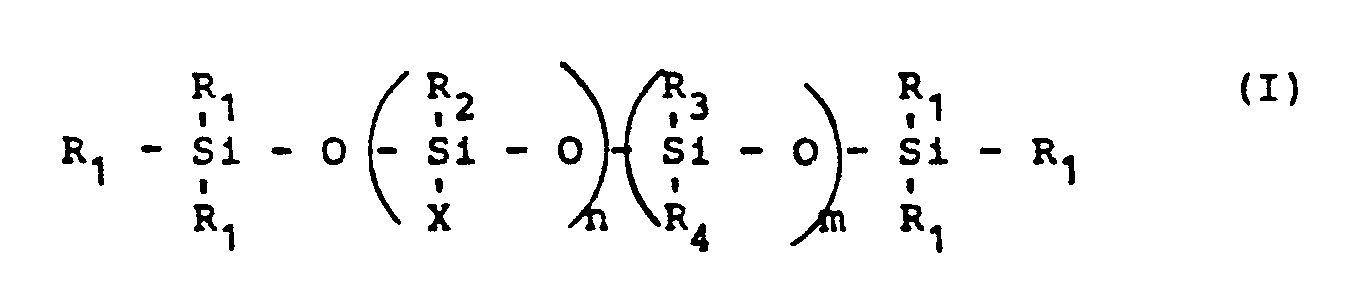
- Gegenstand der Erfindung sind demnach alkoxylierte Polysiloxane der allgemeinen Formel


- R1, R2 und R3 unabhängig voneinander einen gegebenenfalls durch Halogene (Chlor, Brom) substituierten Alkyl- oder Arylrest mit 1-10 C-Atomen bedeuten,
- R 4 für Wasserstoff oder einen gegebenenfalls durch Halogen (Chlor, Brom)substituierten Alkyl- oder Arylrest mit 1-10 C-Atomen steht,
- n eine Zahl von 1 - 50 und
- m eine Zahl von 0 - 50 und
- X für den Rest

- P eine Zahl von 1 - 8 und
- q Null oder die Zahl 1 bedeutet,


- R5, R6, R 7 und R8 unabhängig voneinander Wasserstoff oder Methyl bedeuten,
- R9 einen Alkyl-, Aryl-, Aralkyl oder Alkarylrest mit 1-18 C-Atomen darstellt und
- x und y für die Zahlen 5-100 steht.
- Bevorzugt stehen in den Formel (I) und (la)
- R1, R2 und R3 für die Phenyl- und Methylgruppen und besonders bevorzugt für die Methylgruppe,
- R4 für Wasserstoff und Methylgruppen und besonders bevorzugt für die Methylgruppe
- n für die Zahlen 3 - 20 und besonders bevorzugt für die Zahlen 4 - 10,
- m für die Zahlen o - 20 und besonders bevorzugt für die Zahlen 0 - 10,
- Y für-O-CH2-CHOH-CH2- oder

- P für die Zahlen 1 und 3 und besonders bevorzugt für die Zahl 3,
- q für Null und besonders bevorzugt für die Zahl 1,
- R5, R6 und R7 für Wasserstoff und
- R 8 für den Methylrest,
- R9 für einen 1 bis 6-Atome enthaltenden Alkylrest,
- x für die Zahlen 10 - 50 und besonders bevorzugt für 15 - 35 und
- y für die Zahlen 8 - 40 und besonders bevorzugt für 12 - 25.
- Die erfindungsgemäßen alkoxylierten Polysiloxane können durch Umsetzung von Si-CH2-C1-gruppenhaltigen Polysiloxanen mit Polyalkylenglykolmonoäthern hergestellt werden. Ebenso ist es möglich, Polyalkylenglykolmonoäther zunächst mit Alkenylhalogeniden, wie z.B. Allylchlorid, in ungesättigte Polyalkylenglykoldiäther zu überführen und diese dann platinkatalysiert an SiH-gruppenhaltige Polysiloxane zu addieren.
- Vorzugsweise jedoch werden Epoxide, die eine C=C-Doppelbindung enthalten, wie z.B. Allylglycidäther oder Butadienmonoepoxid, platinkatalysiert mit SiH-gruppenhaltigen Polysiloxanen zu Polyepoxypolysiloxanen umgesetzt, die dann durch vorzugsweise sauer katalysierte Reaktion der Epoxygruppen mit Polyalkylenglykolmonoäthern zu den erfindungsgemäßen Produkten führen.
- Die zur Herstellung der oxalkylierten Polysiloxane verwendeten Polyalkylenglykolmonoäther erhält man vorzugsweise durch Polyalkoxylierung niederer Alkohole, wie z.B. Methanol, Äthanol, Propan-, Butan-, Pentan- oder Hexanole, mit Äthylen- und Propylenoxid. Hierbei können Blockpolymere oder Polymere mit statistischer Verteilung der Oxyalkylgruppen, sog: Mischpolymere, oder auch Mischformen dieser beiden Möglichkeiten hergestellt werden. Bevorzugt sind Mischpolymere und besonders bevorzugt sind solche Produkte, bei denen die Alkohole zunächst mit einer Mischung aus Propylenoxid und 80 - 90 % der gesamten Menge des Äthylenoxids zur Mischpolymeren umgesetzt werden und hierauf die restlichen 10 - 20 % des Äthylenoxids eingebracht werden, so daß die Endgruppen dieser Polyalkylenglykolmonoäther nahezu vollständig primäre OH-Gruppen sind. Bevorzugte Polyalkylenglykolmonoäther enthalten 40 - 60 Gew.-% Äthylenoxid, besonders bevorzugte sind aus gleichen Gewichtsmengen Äthylen- und Propylenoxid aufgebaut. Bevorzugt werden Polyalkylenglykolmonoäther mit Molekulargewichten von 1000 - 5000, besonders bevorzugt mit 1500 bis 3000 eingesetzt.
- Bei der vorzugsweise sauer katalysierten Umsetzung der Polyepoxypolysiloxane mit den Polyalkylenglykolmonoäthern zu den erfindungsgemäßen Polyalkylenglykolpolysiloxanen werden die Hydroxyverbindungen bevorzugt in 10 - 100 %igem und besonders bevorzugt in 10 - 50 %igem molaren Überschuß mit den Epoxygruppen umgesetzt. Geringere Überschüsse, sowie stöchiometrische oder gar unterstöchiometrische Umsetzungsverhältnisse von Hydroxy- zu Epoxygruppen sind zwar ebenfalls möglich, führen jedoch häufig nur zu unlöslichen, vernetzten Produkten.
- In der Regel wird die Umsetzung lösungsmittelfrei durchgeführt, es können auch inerte Lösungsmittel, wie z.B. Benzol, Toluol, Xylol, Chlorbenzol, Äthylacetat, Butylacetat, Methylenchlorid, Chloroform, Tetrachlorkohlenstoff, Trichloräthylen, Perchloräthylen oder Dimethylformamid eingesetzt werden. Dieses ist in den Fällen angebracht, in denen die Polyalkylenglykolmonoäther bei den Reaktionstemperaturen fest oder so hochviskos sind, daß Rühren unmöglich ist. Als saure Katalysatoren werden Produkte wie z.B. p-Toluolsulfonsäure, Salzsäure, Schwefelsäure, Phosphorsäure oder vorzugsweise Bortrifluorid-Addukte, wie z.B. Bortrifluoridätherat, in Konzentration von 0,05 - 2 %, vorzugsweise 0,1 - 1,0 %, bezogen auf das Reaktionsgemisch, angewendet. Geeignete Reaktionstemperaturen liegen zwischen O und 100°C, vorzugsweise 10 bis 80°C. Vorzugsweise werden die Polyalkylenglykolmonoäther mit den sauren Katalysatoren vorgelegt und unter Rühren bei Raumtemperatur die Polyepoxypolysiloxane vorzugsweise lösungsmittelfrei derart zudosiert, daß die Reaktionstemperatur nicht über 30°C steigt. Anschließend rührt man noch 1 bis 5 Stunden bei Raumtemperatur und 1 bis 3 Stunden bei 60°C nach.
- In der Regel sind die erfindungsgemäßen Verbindungen wasserlöslich, aber auch wasserunlösliche Produkte sind erfindungsgemäß verwendbar. Da die Wirksamkeit der Polyalkylenglykolpolysiloxane als Wärmesensibilisierung mit guter Verteilung der Produkte steigt, ist es bei wasserunlöslichen Substanzen angebracht, zur Verbesserung der Emulgierbarkeit den Produkten gängige Emulgatoren, wie z.B. Alkylarylsulfonate, Alkylsulfate, Fettsäuresalze oder dergleichen zuzufügen. Zusätze von 1-10 %, bezogen auf die Polyalkylenglykolpolysiloxane, sind meist ausreichend, größere Mengen sind zu vermeiden, da sich anionenaktive Emulgatoren als solche ungünstig auf die Stabilität der Latexmischungen auswirken können.
- Die erfindungsgemäßen Verbindungen können als Wärmesensibilisierungsmittel für Kautschuklatices eingesetzt werden.
- Zur Herstellung der wärmesensibilisierbaren stabilen Latices selbst können übliche olefinisch ungesättigte Monomere in wäßriger Emulsion polymerisiert werden. Beispiele für die Herstellung derartiger Latices finden sich in der deutschen Patentschrift 1 243 394 und in den deutschen Offenlegungsschriften 2 232 526 und 2 005 974. Als Monomere kommen
alle radikalisch polymerisierbaren olefinisch ungesättigten Verbindungen infrage, z.B. Äthylen, Butadien, Isopren, Acrylnitril, Styrol, Divinylbenzol, α-Methylstyrol, Methacrylnitril, Acrylsäure, Nethacrylsäure, 2-Chlorbutadien-1,3, Ester der Acrylsäure und Methacrylsäure mit C1 - C8-Alkoholen oder Polyolen, Acrylamid, Methacrylamid, N-Methylol(meth)acrylamid, (Meth)acrylamido-N-methylolmethyläther, Itakonsäure, Maleinsäure, Fumarsäure, Diester und Halbester ungesättigter Dicarbonsäuren, Vinylchlorid, Vinylacetat, Vinylidenchlorid, die allein oder in Kombination miteinander eingesetzt werden können. - Die Polymerisation wird in Gegenwart von Emulgatoren durchgeführt, wobei die üblichen nichtionischen oder anionischen Emulgiermittel allein oder in Kombination miteinander verwendet werden können. Die Gesamtmenge an Emulgator beträgt ca. 0,1 - 10 Gew.-%, bezogen auf die Monomeren.
- Die Emulsionspolymerisation kann mit Radikalbildnern, vorzugsweise mit organischen Peroxidverbindungen ausgelöst werden, die in Mengen von 0.01 bis 2 Cew.-%, bezogen auf Monomere, eingesetzt werden. Je nach Monomerkombination können zur Erniedrigung des Molekulargewichtes des Polymerisats geringe Mengen an Reglern mitverwendet werden, z.B. Mercaptane, Halogenkohlenwasserstoffe. Die Emulsionspolymerisation ist auf zwei Wegen möglich: Man kann die Gesamtmenge der Monomeren und den größten Teil der die Emulgatoren enthaltenden wäßrigen Phase vorlegen, die Polymerisation durch Zugabe des Initiators starten und im Verlauf der Polymerisation den Rest der wäßrigen Phase kontinuierlich oder absatzweise zugeben. Man kann auch die Technik des "Monomerenzulaufs" benutzen; dabei wird nur ein Teil der Monomeren und der das Emulgiermittel enthaltenen wäßrigen Phase vorgelegt und nach Starten der Polymerisation der Rest der Monomeren und der wäßrigen Phase gleichmäßig oder absatzweise nach Maßgabe des Umsatzes zugefügt. Der zudosierte Monomerenanteil kann in der wäßrigen Phase voremulgiert sein. Beide Verfahren sind bekannt.
- Die wärmesensibel einstellbaren Latices können vor oder bei der Verarbeitung mit Zusatzstoffen versetzt werden. So unterstützen Säureabspalter, die zusätzlich zum Sensibilisierungsmittel beigefügt werden, die Koagulierfähigkeit, indem sie die Koagulationstemperatur herabsetzen. Andere Zusätze sind z.B. Farbstoffe, Pigmente, Füllstoffe, Verdicker, Elektrolyte, Alterungsschutzmittel, wasserlösliche Harze oder Vulkanisationschemikalien.
- Im Anschluß an die Herstellung werden die wärmesensibilisierbaren Latices durch Zusatz der erfindungsgemäßen Verbindungen in Mengen von 0,05 - 10 Gew.-%, bezogen auf das Polymerisat, wärmesensibel eingestellt. Hierbei kann die Zugabe der Produkte in 100 %iger oder häufig vorteilhafter als wäßrige Lösung erfolgen. Es zeigt sich, daß die wärmesensiblen Latexmischungen, die die erfindungsgemäßen Produkte enthalten, auch bei längerer Lagerung stabil sind und keine Koagulatbildung auftritt.
- Die erfindungsgemäßen wärmesensibel eingestellten Latexmischungen können z.B. zur Bindung von Faservliesen eingesetzt werden, die aus synthetischen oder natürlichen Fasern aufgebaut sind. Beispiele sind Faservliese aus Baumwolle, Zellwolle, Wolle,Polyamiden, Polyestern, Polyacrylnitril, Glasfasern, Steinwolle, Asbestwolle oder Metallfäden.
- Zu einer Mischung aus 1460 g eines Polyalkylenglykolmonoäthers der OH-Zahl 25, der durch Alkoxylierung von Butanol mit gleichen Gewichtsteilen Äthylen- und Propylenoxid hergestellt wird, wobei zunächst 80 % der Äthylenoxidmit der gesamten Propylenoxidmenge im Gemisch und hierauf die restlichen 20 % des Äthylenoxids umgesetzt werden, und 2 g Bortrifluoridätherat werden innerhalb einer Stunde 105 g eines Polyepoxypolysiloxans der Formel


- Analog Beispiel 1 werden 1460 g des in Beispiel 1 beschriebenen Polyalkylenglykolmonoäthers unter Katalyse von 2 g Bortrifluoridätherat mit 100.5 g eines Polyepoxypolysiloxans der Formel

- Analog Beispiel 1 werden 1460 g des in Beispiel 1 beschriebenen Polyalkylenglykolmonoäthers unter Katalyse von 2 g Bortrifluoridätherat mit 225.6 g eines Polyepoxypolysiloxans der Formel

- Analog Beispiel 1 werden 1700 g eines Polyalkylenglykolmonoäthers der OH-Zahl 22, der durch Alkoxylierung von Butanol mit gleichen Gewichtsteilen Äthylen- und Propylenoxid hergestellt wird, wobei zunächst 80 % der Äthylenoxid- mit der gesamten Propylenoxidmenge im Gemisch und hierauf die restlichen 20 % des Äthylenoxids umgesetzt werden, unter Katalyse von 2.5 g Bortrifluoridätherat mit 105 g des im Beispiel 1 beschriebenen Polyepoxypolysiloxans umgesetzt. Man erhält ein farbloses, in kaltem Wasser klar lösliches Öl.
- Analog Beispiel 1 werden 900 g eines Polyalkylenglykolmonoäthers der OH-Zahl 40.5, der durch Alkoxylierung von Butanol mit einer Mischung aus 55 Gew.-% Äthylen- und 45 Gew.-% Propylenoxid hergestellt wird, wobei zunächst 82 % der Äthylenoxid- mit der gesamten Propylenoxidmenge im Gemisch und hierauf die restlichen 18 % des Äthylenoxids umgesetzt werden, unter Katalyse von 1.35 g Bortrifluoridätherat mit 105 g des im Beispiel 1 beschriebenen Polyepoxypolysiloxans umgesetzt. Man erhält ein farbloses in kaltem Wasser klar lösliches öl.
- Analog Beispiel 1 werden 1050 g eines Polyalkylenglykolmonoäthers der OH-Zahl 35, der durch Alkoxylierung von Butanol mit gleichen Gewichtsteilen Äthylen- und Propylenoxid hergestellt wird, wobei zunächst 80 % der Äthylenoxid- mit der gesamten Propylenoxidmenge im Gemisch und hierauf die restlichen 20 % des Äthylenoxids umgesetzt werden, unter Katalyse von 1,5 g Bortrifluoridätherat mit 105 g des in Beispiel 1 beschriebenen Polyepoxypolysiloxans umgesetzt. Man erhält ein farbloses, in kaltem Wasser klar lösliches öl.
- Analog Beispiel 1 werden 1350 g eines Polyalkylenglykolmonoäthers der OH-Zahl 27, der durch Alkoxylierung einer Mischung aus gleichen Gewichtsteilen Äthylen- und Propylenoxid hergestellt wird, unter Katalyse von 2.0 g Bortrifluoridätherat mit 105 g des in Beispiel 1 beschriebenen Polyepoxypolysiloxans umgesetzt. Man erhielt ein farbloses, in kaltem Wasser klar lösliches öl.
- 210.0 Gew.-Teile eines 47.5 %igen Latex des Copolymerisates von 61.0 Gew.-% Butadien, 35,0 Gew.-% Acrylnitril und 4 Gew.-% Methacrylsäure werden mit 40.0 Gew.-Tln. einer Vulkanisationspaste folgender Zusammensetzung:
- 0,2 Gew.-Tle. Kolloidschwefel
- 5,0 " " Zinkoxid
- 1,5 " 2-Mercaptobenzthiazol
- 0,2 " " Zink-diäthyl-dithiocarbamat
- 5,0 " " Titandioxid
- 28,1 " einer 5 %igen wäßrigen Lösung eines Kondensationsproduktes aus Naphthalinsulfonsäure mit Formaldehyd
- 0,2 " " des Wärmesensibilisierungsmittel des Beispiels 1 und
- 70,0 " " Wasser
- vermischt und der Koagulationspunkt der Mischung nach 1/2 h und 7 Tagen Standzeit bestimmt.
- Methode zur Ermittlung des Koagulationspunktes:
- Ca. 10 g der wärmesensibel eingestellten Mischung werden in ein Becherglas eingewogen und in ein Wasserbad mit einer konstanten Temperatur von 80°C gebracht. Unter gleichmäßigem Rühren der Mischung mit einem Thermometer werden das Koagulierverhalten und der Temperaturanstieg verfolgt. Als Koagulationspunkt der Mischung wird die Temperatur angegeben, bei der eine vollständige und endgültige Trennung von Polymerisat und wäßriger Phase eintritt.
- Koagulationspunkt: nach 1/2 h 38°C " 7 Tagen 37°C
- Bei Einsatz von 0,1 Gew.-Tln. des Wärmesensibilisierungsmittels des Beispiels 1 wird ermittelt:
- Koagulationspunkte nach 1/2 h 48°C 7 Tagen 49°C
- Bei Einsatz von 0,4 Gew.-Tln des Wärmesensibilisierungsmittel wird gemessen:
- Koagulationspunkte nach 1/2 h 34°C " 7 Tagen 33°C.
- Analog Beispiel 8 werden die Wärmesensibilisierungsmittel der Beispiele 2 - 7 in die Mischung eingesetzt und die Koagulationspunkte ermittelt.

- Zu 200 g einer in üblicher Weise hergestellten 50 %igen wäßrigen Dispersion eines Copolymerisates aus 62 Tln Butadien, 36 Tln. Acrylnitril und 2 Tln. Methacrylsäure werden 40,0 Gew.-Tle der in Beispiel 8 beschriebenen Vulkanisationspaste, 0,3 Gew.-Tle des Wärmesensibilisierungsmittels des Beispiels 1 und 80.0 Gew.-Tle. Wasser gegeben. Die Bestimmung der Koagulationspunkte nach den unter Beispiel 8 beschriebenen Methoden brachte folgendes Ergebnis.
- Koagulationspunkte: nach 1/2 h 39°C " 7 Tagen 37°C
- Zur Herstellung einer wärmesensibel verarbeitbaren Latexmischung werden folgende Bestandteile zusammengerührt:
- 225.0 Gew.-Tle. eines 45 %igen Latex des Copolymerisates von 60.0 Gew.-% Butadien, 26.0 Gew.-% Styrol, 10,0 Gew.-% Acrylnitril, 3.0 Gew.-% Methacrylsäure und 1,0 Gew.-% Methacrylamid.
- 10,0 Gew.-Tle. einer 20 %igen wäßrigen Lösung eines aliphatischen Alkohols
- 10,0 Gew.-Tle. einer 10 %igen wäßrigen Ammoniumchloridlösung
- 40,0 Gew.-Tle. der in Beispiel 8 beschriebenen Vulkanisationspaste
- 0,8 Gew.-Tle. des Wärmesensibilisierungsmittels des Beispiels 1
- 72,0 Gew.-Tle. Wasser
- Die Messung der Koagulationspunkte der Latexmischung hatte folgendes Ergebnis:
- Koagulationspunkte: nach 1 h 43°C 7 Tagen 43°C
- Es wird eine Latexmischung analog Beispiel 8 hergestellt. Als Wärmesensibilisierungsmittel wird das Siloxan des Beispiels 2 der DAS 1 268 828 eingesetzt.

- Es wird eine Latexmischung analog Beispiel 8 hergestellt. Als Wärmesensibilisierungsmittel wird das Organopolysiloxan A aus Beispiel 1 der DAS 1 494 037 eingesetzt.

Claims (7)
-(CH2)p(Y)q-(O-CHR5-CHR6)x-(O-CHR7-CHR8)y-ORq (Ia)
steht, wobei die Einheiten (O-CHR5-CHR6) und (O-CHR7-CHR8) in Blöcken, statistisch verteilt oder teilweise in Blöcken und teilweise statistisch verteilt im Rest X vorliegen und worin


Applications Claiming Priority (2)
| Application Number | Priority Date | Filing Date | Title |
|---|---|---|---|
| DE19772756770 DE2756770A1 (de) | 1977-12-20 | 1977-12-20 | Oxalkylierte polysiloxane, deren herstellung und verwendung als waermesensibilisierungsmittel |
| DE2756770 | 1977-12-20 |
Publications (2)
| Publication Number | Publication Date |
|---|---|
| EP0002519A1 true EP0002519A1 (de) | 1979-06-27 |
| EP0002519B1 EP0002519B1 (de) | 1980-11-26 |
Family
ID=6026643
Family Applications (1)
| Application Number | Title | Priority Date | Filing Date |
|---|---|---|---|
| EP78101655A Expired EP0002519B1 (de) | 1977-12-20 | 1978-12-13 | Oxalkylierte Polysiloxane, deren Herstellung und Verwendung als Wärmesensibilisierungsmittel |
Country Status (2)
| Country | Link |
|---|---|
| EP (1) | EP0002519B1 (de) |
| DE (2) | DE2756770A1 (de) |
Cited By (5)
| Publication number | Priority date | Publication date | Assignee | Title |
|---|---|---|---|---|
| EP0141585A3 (en) * | 1983-10-21 | 1987-03-04 | The British Petroleum Company P.L.C. | Demulsifying process |
| WO1989003851A1 (en) * | 1987-10-19 | 1989-05-05 | Massachusetts Institute Of Technology | Surface-active polysiloxanes |
| US4910015A (en) * | 1987-10-19 | 1990-03-20 | Massachusetts Institute Of Technology | Surface-active polysiloxanes and drug releasing materials thereof |
| EP0499051A3 (en) * | 1991-02-13 | 1993-04-28 | Th. Goldschmidt Ag | Organopolysiloxanes comprising polyether and ester groups attached to the same spacer group |
| WO2016188994A1 (de) | 2015-05-26 | 2016-12-01 | Rudolf Gmbh | Polyurethan-organopolysiloxane |
Families Citing this family (1)
| Publication number | Priority date | Publication date | Assignee | Title |
|---|---|---|---|---|
| DE3330197A1 (de) * | 1983-08-20 | 1985-02-28 | Bayer Ag, 5090 Leverkusen | Waermesensibilisierungsmittel, ihre herstellung und verwendung |
Citations (4)
| Publication number | Priority date | Publication date | Assignee | Title |
|---|---|---|---|---|
| DE1243394B (de) * | 1966-03-09 | 1967-06-29 | Bayer Ag | Verfahren zur Herstellung eines waermesensibilisierbaren Synthesekautschuk-Latex |
| FR1528304A (fr) * | 1966-06-21 | 1968-06-07 | Uniroyal | Procédé de préparation d'un latex aqueux stable d'un haut polymère |
| DE1494037A1 (de) * | 1962-07-06 | 1969-06-04 | Bayer Ag | Waermesensibilisierungsmittel |
| DE1300290B (de) * | 1962-01-19 | 1969-07-31 | Bayer Ag | Verfahren zur Herstellung von veraetherten Organohydrogenpolysiloxanen |
-
1977
- 1977-12-20 DE DE19772756770 patent/DE2756770A1/de not_active Withdrawn
-
1978
- 1978-12-13 EP EP78101655A patent/EP0002519B1/de not_active Expired
- 1978-12-13 DE DE7878101655T patent/DE2860351D1/de not_active Expired
Patent Citations (4)
| Publication number | Priority date | Publication date | Assignee | Title |
|---|---|---|---|---|
| DE1300290B (de) * | 1962-01-19 | 1969-07-31 | Bayer Ag | Verfahren zur Herstellung von veraetherten Organohydrogenpolysiloxanen |
| DE1494037A1 (de) * | 1962-07-06 | 1969-06-04 | Bayer Ag | Waermesensibilisierungsmittel |
| DE1243394B (de) * | 1966-03-09 | 1967-06-29 | Bayer Ag | Verfahren zur Herstellung eines waermesensibilisierbaren Synthesekautschuk-Latex |
| FR1528304A (fr) * | 1966-06-21 | 1968-06-07 | Uniroyal | Procédé de préparation d'un latex aqueux stable d'un haut polymère |
Cited By (6)
| Publication number | Priority date | Publication date | Assignee | Title |
|---|---|---|---|---|
| EP0141585A3 (en) * | 1983-10-21 | 1987-03-04 | The British Petroleum Company P.L.C. | Demulsifying process |
| WO1989003851A1 (en) * | 1987-10-19 | 1989-05-05 | Massachusetts Institute Of Technology | Surface-active polysiloxanes |
| US4910015A (en) * | 1987-10-19 | 1990-03-20 | Massachusetts Institute Of Technology | Surface-active polysiloxanes and drug releasing materials thereof |
| EP0499051A3 (en) * | 1991-02-13 | 1993-04-28 | Th. Goldschmidt Ag | Organopolysiloxanes comprising polyether and ester groups attached to the same spacer group |
| WO2016188994A1 (de) | 2015-05-26 | 2016-12-01 | Rudolf Gmbh | Polyurethan-organopolysiloxane |
| US10626223B2 (en) | 2015-05-26 | 2020-04-21 | Rudolf Gmbh | Polyurethane-organopolysiloxanes |
Also Published As
| Publication number | Publication date |
|---|---|
| DE2756770A1 (de) | 1979-06-28 |
| EP0002519B1 (de) | 1980-11-26 |
| DE2860351D1 (en) | 1981-02-12 |
Similar Documents
| Publication | Publication Date | Title |
|---|---|---|
| US2296225A (en) | Nitrogenous condensation products and a process of producing same | |
| EP1894961B1 (de) | Silicon-Blockcopolymere gepfropft mit ungesättigten Monomeren | |
| DE1570758A1 (de) | Verfahren zur Herstellung von synthetischen Polymeren | |
| US3444151A (en) | Styrene-maleic anhydride-amine polymers as emulsifiers in polymerization of vinyl monomers | |
| DE2234265A1 (de) | Hydroxylendstaendige polylactone | |
| DE1494037A1 (de) | Waermesensibilisierungsmittel | |
| US2265450A (en) | Polymeric n-vinyl lactams and process of producing same | |
| DE19900810B4 (de) | Photokationisch härtbare Zusammensetzung und Verfahren zu ihrer Herstellung | |
| DE1570446B2 (de) | Verfahren zur Herstellung von Organosiloxanblockmischpolymeren | |
| DE1947268B2 (de) | Siloxan-polyoxyalkylen-blockcopolymerisate und deren verwendung | |
| EP0002519B1 (de) | Oxalkylierte Polysiloxane, deren Herstellung und Verwendung als Wärmesensibilisierungsmittel | |
| DE671378C (de) | Verfahren zur Herstellung von Mischpolymerisaten | |
| DE1300291B (de) | Verfahren zur Herstellung von hochmolekularen, wasserloeslichen Organosiloxanmischpolymerisaten | |
| EP0002720A1 (de) | Mischung aus Ammoniak und oxalkylierten Polysiloxanen, deren Verwendung als Wärmesensibilisierungsmittel und Verfahren zur Herstellung wärmesensibilisierter Kautschuklatices | |
| US4022730A (en) | Oligomeric aqueous finishes | |
| US2928796A (en) | Polymeric product prepared by reacting modified vegetable drying oils and vinyl-containing modifiers | |
| DE1420470A1 (de) | Verfahren zur Herstellung von carbalkoxyalkylhaltigen Organopolysiloxanen | |
| DE1595221C3 (de) | Phosphorhaltige Additionspolymere | |
| DE1595406B2 (de) | Verfahren zur herstellung eines harzes das in wasser das ammoniak oder ein amin enthaelt loeslich ist | |
| DE1251956B (de) | Verfahren zur Herstellung von Homo- oder Copolymerisaten | |
| AT130660B (de) | Verfahren zur Darstellung von harzartigen Polymerisationsprodukten. | |
| JPH0199639A (ja) | 水性樹脂分散体用乳化剤 | |
| DE1444553C (de) | ||
| AT258861B (de) | Verfahren zur Herstellung konzentrierter beständiger wässeriger Emulsionen | |
| DE1495210C (de) | Verfahren zur Herstellung von Poly athern |
Legal Events
| Date | Code | Title | Description |
|---|---|---|---|
| PUAI | Public reference made under article 153(3) epc to a published international application that has entered the european phase |
Free format text: ORIGINAL CODE: 0009012 |
|
| 17P | Request for examination filed | ||
| AK | Designated contracting states |
Designated state(s): BE DE FR GB IT NL |
|
| ITF | It: translation for a ep patent filed | ||
| GRAA | (expected) grant |
Free format text: ORIGINAL CODE: 0009210 |
|
| AK | Designated contracting states |
Designated state(s): BE DE FR GB IT NL |
|
| REF | Corresponds to: |
Ref document number: 2860351 Country of ref document: DE Date of ref document: 19810212 |
|
| ITTA | It: last paid annual fee | ||
| PGFP | Annual fee paid to national office [announced via postgrant information from national office to epo] |
Ref country code: NL Payment date: 19931231 Year of fee payment: 16 |
|
| PGFP | Annual fee paid to national office [announced via postgrant information from national office to epo] |
Ref country code: DE Payment date: 19941114 Year of fee payment: 17 |
|
| PGFP | Annual fee paid to national office [announced via postgrant information from national office to epo] |
Ref country code: FR Payment date: 19941128 Year of fee payment: 17 |
|
| PGFP | Annual fee paid to national office [announced via postgrant information from national office to epo] |
Ref country code: GB Payment date: 19941205 Year of fee payment: 17 |
|
| PGFP | Annual fee paid to national office [announced via postgrant information from national office to epo] |
Ref country code: BE Payment date: 19941221 Year of fee payment: 17 |
|
| PG25 | Lapsed in a contracting state [announced via postgrant information from national office to epo] |
Ref country code: NL Effective date: 19950701 |
|
| NLV4 | Nl: lapsed or anulled due to non-payment of the annual fee |
Effective date: 19950701 |
|
| PG25 | Lapsed in a contracting state [announced via postgrant information from national office to epo] |
Ref country code: GB Effective date: 19951213 |
|
| PG25 | Lapsed in a contracting state [announced via postgrant information from national office to epo] |
Ref country code: BE Effective date: 19951231 |
|
| BERE | Be: lapsed |
Owner name: BAYER A.G. Effective date: 19951231 |
|
| GBPC | Gb: european patent ceased through non-payment of renewal fee |
Effective date: 19951213 |
|
| PG25 | Lapsed in a contracting state [announced via postgrant information from national office to epo] |
Ref country code: FR Effective date: 19960830 |
|
| PG25 | Lapsed in a contracting state [announced via postgrant information from national office to epo] |
Ref country code: DE Effective date: 19960903 |
|
| REG | Reference to a national code |
Ref country code: FR Ref legal event code: ST |
|
| PLBE | No opposition filed within time limit |
Free format text: ORIGINAL CODE: 0009261 |
|
| STAA | Information on the status of an ep patent application or granted ep patent |
Free format text: STATUS: NO OPPOSITION FILED WITHIN TIME LIMIT |