EP0000698B1 - Vorrichtung zur Herstellung von hexagonalem Phosphorpentoxid - Google Patents
Vorrichtung zur Herstellung von hexagonalem Phosphorpentoxid Download PDFInfo
- Publication number
- EP0000698B1 EP0000698B1 EP78100295A EP78100295A EP0000698B1 EP 0000698 B1 EP0000698 B1 EP 0000698B1 EP 78100295 A EP78100295 A EP 78100295A EP 78100295 A EP78100295 A EP 78100295A EP 0000698 B1 EP0000698 B1 EP 0000698B1
- Authority
- EP
- European Patent Office
- Prior art keywords
- phosphorus pentoxide
- combustion chamber
- phosphorus
- cooling
- chamber
- Prior art date
- Legal status (The legal status is an assumption and is not a legal conclusion. Google has not performed a legal analysis and makes no representation as to the accuracy of the status listed.)
- Expired
Links
- DLYUQMMRRRQYAE-UHFFFAOYSA-N tetraphosphorus decaoxide Chemical compound O1P(O2)(=O)OP3(=O)OP1(=O)OP2(=O)O3 DLYUQMMRRRQYAE-UHFFFAOYSA-N 0.000 title claims description 44
- 238000002485 combustion reaction Methods 0.000 claims description 30
- 238000009833 condensation Methods 0.000 claims description 23
- 230000005494 condensation Effects 0.000 claims description 23
- 238000001816 cooling Methods 0.000 claims description 23
- OAICVXFJPJFONN-UHFFFAOYSA-N Phosphorus Chemical compound [P] OAICVXFJPJFONN-UHFFFAOYSA-N 0.000 claims description 14
- 229910052698 phosphorus Inorganic materials 0.000 claims description 12
- 239000011574 phosphorus Substances 0.000 claims description 12
- 229910001220 stainless steel Inorganic materials 0.000 claims description 6
- 239000010935 stainless steel Substances 0.000 claims description 6
- 238000007654 immersion Methods 0.000 claims description 3
- 239000007789 gas Substances 0.000 description 22
- 238000004519 manufacturing process Methods 0.000 description 6
- 239000000047 product Substances 0.000 description 6
- 230000004048 modification Effects 0.000 description 5
- 238000012986 modification Methods 0.000 description 5
- NBIIXXVUZAFLBC-UHFFFAOYSA-N Phosphoric acid Chemical compound OP(O)(O)=O NBIIXXVUZAFLBC-UHFFFAOYSA-N 0.000 description 4
- 239000010410 layer Substances 0.000 description 4
- 238000000034 method Methods 0.000 description 4
- 229910052760 oxygen Inorganic materials 0.000 description 4
- 238000000926 separation method Methods 0.000 description 4
- 229920000137 polyphosphoric acid Polymers 0.000 description 3
- OBSZRRSYVTXPNB-UHFFFAOYSA-N tetraphosphorus Chemical compound P12P3P1P32 OBSZRRSYVTXPNB-UHFFFAOYSA-N 0.000 description 3
- XLYOFNOQVPJJNP-UHFFFAOYSA-N water Substances O XLYOFNOQVPJJNP-UHFFFAOYSA-N 0.000 description 3
- 229910000147 aluminium phosphate Inorganic materials 0.000 description 2
- QVGXLLKOCUKJST-UHFFFAOYSA-N atomic oxygen Chemical compound [O] QVGXLLKOCUKJST-UHFFFAOYSA-N 0.000 description 2
- 238000006243 chemical reaction Methods 0.000 description 2
- 239000011248 coating agent Substances 0.000 description 2
- 238000000576 coating method Methods 0.000 description 2
- 230000008021 deposition Effects 0.000 description 2
- 239000001301 oxygen Substances 0.000 description 2
- 230000005855 radiation Effects 0.000 description 2
- MYMOFIZGZYHOMD-UHFFFAOYSA-N Dioxygen Chemical compound O=O MYMOFIZGZYHOMD-UHFFFAOYSA-N 0.000 description 1
- 238000010521 absorption reaction Methods 0.000 description 1
- 239000002253 acid Substances 0.000 description 1
- 239000007795 chemical reaction product Substances 0.000 description 1
- 239000000567 combustion gas Substances 0.000 description 1
- 239000000498 cooling water Substances 0.000 description 1
- 230000007423 decrease Effects 0.000 description 1
- 238000001704 evaporation Methods 0.000 description 1
- 230000008020 evaporation Effects 0.000 description 1
- 239000012535 impurity Substances 0.000 description 1
- 239000007788 liquid Substances 0.000 description 1
- 239000000463 material Substances 0.000 description 1
- 239000000203 mixture Substances 0.000 description 1
- 230000003647 oxidation Effects 0.000 description 1
- 238000007254 oxidation reaction Methods 0.000 description 1
- 238000002360 preparation method Methods 0.000 description 1
- 230000001681 protective effect Effects 0.000 description 1
- 239000011241 protective layer Substances 0.000 description 1
- 238000010079 rubber tapping Methods 0.000 description 1
- 239000007787 solid Substances 0.000 description 1
- 239000000126 substance Substances 0.000 description 1
- 230000007704 transition Effects 0.000 description 1
- 238000005406 washing Methods 0.000 description 1
Images
Classifications
-
- C—CHEMISTRY; METALLURGY
- C01—INORGANIC CHEMISTRY
- C01B—NON-METALLIC ELEMENTS; COMPOUNDS THEREOF; METALLOIDS OR COMPOUNDS THEREOF NOT COVERED BY SUBCLASS C01C
- C01B25/00—Phosphorus; Compounds thereof
- C01B25/12—Oxides of phosphorus
Definitions
- the present invention relates to a device for producing hexagonal phosphorus pentoxide, consisting of a water-cooled combustion chamber for phosphorus, which is followed by a cooled condensation chamber for the hexagonal phosphorus pentoxide (P 4 O 10 ).
- Phosphorus pentoxide occurs in several solid modifications.
- the hexagonal shape is used almost exclusively for technical purposes.
- the polymeric glass-like modifications are inert and therefore entirely undesirable.
- phosphorus pentoxide is obtained by burning elemental yellow phosphorus.
- the resulting phosphorus pentoxide vapor is condensed on cooled surfaces.
- a disadvantage of this device is, inter alia, that it can only be used if the P 2 O 5 production is coupled with the production of polyphosphoric acid.
- the devices used to carry out the known methods also have the disadvantage in common that direct heat transfer by radiation from the very hot phosphorus flame to material already deposited cannot be prevented. In a short time, this leads to an at least partial conversion of the crystalline P 2 0 1 into glassy products.
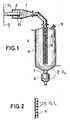
- a device for the production of hexagonal phosphorus pentoxide which consists of a coolable combustion chamber 1 which is equipped with a two-component combustion nozzle 2 for elementary phosphorus and one via a shut-off element 7 with a Collection container 8 for phosphorus pentoxide connected condensation chamber 4 is connected, which carries an exhaust pipe 9.
- This combustion chamber 1 which is preferably arranged horizontally, is provided on its inner wall with cooling tubes 10 and connected to the condensation chamber 4 via a gas cooler 3, the gas cooler 3 consisting of a cooling tube system 5 which ends in the manner of an open immersion tube above the bottom of the condensation chamber 4, whose diameter is a multiple of the diameter of the gas cooler 3, and the walls of which are provided with a cooling device 6.
- the cooling tubes 10 in the combustion chamber 1 and the cooling tube system 5 of the gas cooler 3 advantageously consist of helically wound tube bundles, which are expediently made of stainless steel.
- FIG. 1 A preferred embodiment of the device according to the invention is shown schematically in FIG. 1 below.
- Figure 2 shows an enlarged section showing the deposition of the polymeric phosphor represents pentoxids in the gussets formed by the tubes 5.
- the combustion chamber 1 in which yellow phosphorus is burned in a two-substance nozzle 2 with a gas containing 0 2- , consists of several sections of water-cooled stainless steel tubes 10 with an outer protective jacket.
- the use of a combustion chamber 1 consisting of tube bundles 10 has the advantage that intensive cooling is ensured in all sections of this chamber by the forced guidance of the cooling water polymeric phosphorus pentoxide (P 2 O 5 ) x deposited. This is desirable here because the cooling tubes underneath are protected by this layer.
- the outside wall temperature of the cooled pipes can thus be kept below 100 ° C; however, the surface temperature of the protective layer made of (P 2 O 5 ) x is approximately 650 ° C.
- the temperatures in front of the phosphor nozzle reach up to 2000 ° C.
- the amount of exhaust gas can be further reduced and the degree of separation improved accordingly if the dry air that is usually used for combustion is enriched with pure oxygen to about 40 volume% 0 2 .
- the gaseous P 4 O 10 forms the combustion chamber with a temperature of 800 to 900 ° C.
- this hot gas flows through the spiral-shaped, water-cooled tube bundle 5 made of stainless steel, which is arranged vertically as an "immersion tube”.
- Additional polymeric phosphorus pentoxide is deposited on the cooled pipe surface.
- the 800 to 900 ° C hot gas from the combustion chamber 1 heats this layer up to approx. 650 ° C.
- the (P 2 O 5 ) x starts to evaporate again.
- the layer here on the wall of the first cooling section is in evaporation equilibrium with the hot gas flowing past from the combustion chamber, ie the layer only reaches a certain thickness. Following the course of the temperature, it is only weakly formed in the upper part of the cooling device 3 at the connection to the combustion chamber 1, only weakly with a falling temperature.
- the P 4 O 10 -containing gas is cooled from the combustion chamber 1 to a temperature of 650 to 400 ° C. It has then been cooled down to such an extent that it can be suddenly cooled to ⁇ 300 ° C. when it enters the condensation chamber 4.
- This precooling in which one specifically accepts the deposition of the polymeric phosphorus pentoxide to form the equilibrium state described above, ensures that there are no transition states with condensation from other phosphorus pentoxide modifications in the subsequent condensation chamber 4, but that the P 4 O 10 is only reflected here in the desired hexagonal modification.
- the hexagonal product is then deposited on these cooled surfaces of the condensation chamber 4, which have a wall temperature of 100 ° C. It collects in the lower part of the condensation chamber 4 and is discharged into a collecting container 8 via a lock 7. Based on the phosphorus used, the yield of hexagonal P 4 0 11 is more than 90%.
- the degree of separation can be increased to more than 94%.
- the exhaust gas that emerges from the condensation chamber 4 through the nozzle 9 has a temperature of 100 to 120 ° C.
- the relatively small amounts of exhaust gas which only have a minimal content of P 4 O 10 , can then be cleaned without great effort, if necessary, by washing with water, phosphoric acid or the like before they are passed into the atmosphere.
- the advantage of the device according to the invention is essentially that it prevents the direct heat radiation of the phosphorus flame onto deposited P 2 O 5 and also enables targeted cooling of the reaction product, with a relatively large temperature difference and in a relatively small space in the first cooling phase the second phase in a relatively large room a relatively small temperature difference is achieved.
- the gas containing P 4 0 1 flows into the cooled condensation chamber 4, which surrounds the cooling device 3 over a wide area, which results in a further sudden cooling of the gas. Hexagonal loose P 4 0 1 settles on the cooled walls of the condensation chamber 4 . Pneumatic tapping devices knock the product off the walls. It collects in the lower part of the condensation chamber 4. 355 kg of phosphorus pentoxide are discharged here every hour. The product is free from suboxides, reacts spontaneously with water and is free from glass-like impurities in the polymeric form of P 2 0 3 .
- the yield based on the elemental phosphorus used, is 9196.
Landscapes
- Chemical & Material Sciences (AREA)
- Organic Chemistry (AREA)
- Inorganic Chemistry (AREA)
- Physical Or Chemical Processes And Apparatus (AREA)
- Organic Low-Molecular-Weight Compounds And Preparation Thereof (AREA)
- Treating Waste Gases (AREA)
Description
- Die vorliegende Erfindung betrifft eine Vorrichtung zur Herstellung von hexagonalem Phosphorpentoxid, bestehend aus einer wassergekühlten Verbrennungskammer für Phosphor, der eine gekühlte Kondensationskammer für das hexagonale Phosphorpentoxid (P4O10) nachgeschaltet ist.
- Phosphorpentoxid tritt in mehreren festen Modifikationen auf. Für technische Zwecke kommt fast ausschließlich die hexagonale Form zur Anwendung. Insbesondere die polymeren glasartigen Modifikationen sind reaktionsträge und darum durchweg unerwünscht.
- Man gewinnt Phosphorpentoxid technisch durch Verbrennen von elementarem gelben Phosphor. Der entstehende Phosphorpentoxid-Dampf wird an gekühlten Flächen kondensiert.
- Zur Durchführung dieses Verfahrens benutzte man bislang Vorrichtungen, die aus einer mit einer Phosphorverbrennungsdüse bestückten Brennkammer bestehen, die durch Berieseln mit Wasser von außen gekühlt wird. Diese Brennkammer ist mit einen Kondensationsraum verbunden, der einen Abgasstutzen sowie eine Austragsvorrichtung für Pz03 trägt (US-A 1 700 708). Diese Vorrichtung hat jedoch den Nachteil, daß damit eine gezielte Herstellung von hexagonalem P20, nicht möglich ist, da bereits in der Brennkammer ein Teil des entstandenen P2O5 kondensiert wird. Da diese Kondensation innerhalb eines sehr weiten Temperaturbereiches erfolgt, fallen dabei Produkte an. die aus einem Gemisch der verschiedenen Modifikationen des P20, bestehen.
- Bekannt ist ferner aus der DE-B 1 300 527 zur gleichzeitigen Herstellung von hexagonalem Phosphorpentoxid und Polyphosphorsäure eine Vorrichtung einzusetzen, die aus einer gekühlten Brennkammer besteht, welche gleichzeitig die Kondensationskammer für das P2O5 darstellt, die über eine Abgasleitung mit einem Reaktionsturm im Verbindung steht, in welchem die Abgase der kombinierten Brenn-/Kondensationskammer von im Kreislauf geführter Phosphorsäure unter Bildung von Polyphorphorsäure absorbiert werden.
- Nachteilig an dieser Vorrichtung ist u.a., daß sie nur dann verwendbar ist, wenn die P2O5―Herstellung mit der Gewinnung von Polyphosphorsäure gekoppelt ist.
- Bekanntlich ist die Verbrennungswärme von elementarem Phosphor außerordentlich hoch. Damit an den Wänden der kombinierten Brenn-/Kondensationskammer eine Abscheidung von hexagonalem Phosphorpentoxid überhaupt erreicht werden kann, muß aufgrund der um die Phosphorverbrennungsdüse herum herrschenden hohen Temperaturen, die Kammer sehr groß dimensioniert sein und die Verbrennung des Phosphors mit einem großen Luftüberschuß (20 bis 50 Gewichts%) erfolgen.
- Dies hat zur Folge, daß dabei zwangsläufig große Abgasmengen mit einer relativ hohen Temperatur (380 bis 410°C) anfallen, was aufwendige Absorptionsvorrichtungen notwendig macht, da in der Brenn-/Kondensationskammer nur etwa 43% des entstandenen Phosphorpentoxides abgeschieden und der Rest aus dieser Kammer ausgetragen wird.
- Insbesondere dann, wenn die Herstellung von Phosphorpentoxid nicht unmittelbar mit der Gewinnung von Ortho- oder Polyphosphorsäure gekoppelt ist, stellt dies sowohl verfahrenstechnisch als auch wirtschaftlich einen großen Nachteil dar.
- Die zur Durchführung der bekannten Arbeitsweisen verwendeten Vorrichtungen haben außerdem den Nachteil gemeinsam, daß eine direkte Wärmeübertragung durch Strahlung von der sehr heißen Phosphorflamme auf bereits abgeschiedenes Material nicht verhindert werden kann. Dies führt in kurzer Zeit zu einer zumindest teilweisen Umwandlung des kristallinen P201 in glasige Produkte.
- Überraschenderweise wurde nun gefunden, daß sich diese Nachteile überwinden lassen, wenn man zur Herstellung von hexagonalem Phosphorpentoxid eine Vorrichtung einsetzt, die aus einer kühlbaren Verbrennungskammer 1 besteht, die mit einer Zweistoffverbrennungsdüse 2 für elementaren Phosphor bestückt ist und der eine über ein Absperrorgan 7 mit einem Auffangbehälter 8 für Phosphorpentoxid verbundene Kondensationskammer 4 nachgeschaltet ist, die einen Abgasstutzen 9 trägt. Diese vorsugsweise horizontal angeordnete Verbrennungskammer 1 ist an ihrer Innenwand mit Kühlrohren 10 versehen und über einen Gaskühler 3 mit der Kondensationskammer 4 verbunden, wobei der Gaskühler 3 aus einem Kühlrohrsystem 5 besteht, das in der Art eines offenen Tauchrohres oberhalb des Bodens der Kondensationskammer 4 endet, deren Durchmesser ein Mehrfaches des Durchmessers des Gaskühlers 3 beträgt, und deren Wände mit einer Kühlvorrichtung 6 versehen sind. Die Kühlrohre 10 in der Verbrennungskammer 1 und das Kühlrohrsystem 5 des Gaskühlers 3 bestehen vorteilhafterweise aus spiralformig gewundenen Rohrbündeln, die zweckmäßigerweise aus Edelstahl gefertigt sind.
- Durch die erfindungsgemäße Vorrichtung ergeben sich eine Reihe von Vorteilen:
- 1) das erhaltene Produkt besteht aus der hexagonalen Form des P4O10 und enthält keine polymeren Anteile;
- 2) die Ausbeute beträgt mehr als 90%;
- 3) die Dimensionen der Anlage können relativ klein gehalten werden.
- Eine bevorzugte Ausgestaltung der erfindungsgemäßen Vorrichtung ist in der nachfolgenden Figur 1 schematisch dargestellt.
- Figur 2 zeigt einen vergrößerten Ausschnitt, der die Abscheidung des polymeren Phosphorpentoxids in den von den Rohren 5 gebildeten Zwickeln darstellt.
- Die Verbrennungskammer 1, in der gelber Phosphor in einer Zweistoffdüse 2 mit einem 02-haltigen Gas verbrannt wird, besteht aus mehreren Abschnitten wassergekühlter Edelstahlrohre 10 mit einem äußeren Schutzmantel. Die Verwendung einer aus Rohrbündeln 10 bestehenden Verbrennungskammer 1 hat den Vorteil, daß in allen Abschnitten dieser Kammer durch die Zwangsführung des Kühlwassers eine intensive Kühlung gewährleistet ist An der Innenwand der Rohrbündel 10 wird in den Zwickeln, welche die Rohre miteinander bilden, infolge der Kühlung glasartiges polymeres Phosphorpentoxid (P2O5)x abgeschieden. Dies ist hier erwünscht, weil durch diese Schicht die darunterliegenden Kühlrohre geschützt werden. Die Außenwandtemperatur der gekühlten Rohre läßt sich so unter 100°C halten; hingegen beträgt die Oberflächentemperatur der Schutzschicht aus (P2O5)x etwa 650°C. Die Temperaturen vor der Phosphordüse reichen bis zu 2000°C. Diese hohen Temperaturen gewährleisten eine vollständige Oxidation des P4 zu P4011 und brauchen nicht durch Verwendung eines großen Luft- bzw. Sauerstoffüberschusses herabgesetzt zu werden. Vielmehr kann die Menae des Ölhaltigen Gases - berechnet als 02 und bezogen auf den Phosphor - bis nahe an die - stöchiometrischen Verhältnisse, vorzugsweise bis auf einen geringen Überschuß von etwa 2%, gesenkt werden.
- Dies ist wichtig für die spätere Abscheidung des P4O10 aus dem Gasstrom, weil die Abscheidung umso besser ist, je weniger Abgas die Kondensationskammer 4 wieder verlassen muß.,
- Die Abgasmenge kann weiter verringert, der Abscheidegrad entsprechend verbessert werden, wenn die gewöhnlich zur Verbrennung verwendete trockene Luft mit reinem Sauerstoff auf ca. 40 Volumen% 02 angereichert wird.
- Das gasförmige P4O10 verfaßt die Verbrennungskammer mit einer Temperatur von 800 bis 900°C.
- In der Kühlvorrichtung 3 durchströmt dieses heiße Gas die vertikal als "Tauchrohr" angeordnete spiralförmige gedrehten und wassergekühlten Rohrbündel 5 aus Edelstahl.
- Hier spielt sich folgender Vorgang ab:
- An der gekühlten Rohrfläche scheidet sich weiteres polymeres Phosphorpentoxid ab. Das 800 bis 900°C heiße Gas aus der Verbrennungskammer 1 erhitzt diese Schicht bis auf ca. 650°C. Bei dieser Temperatur beginnt das (P2O5)x wieder zu verdampfen. Die hier an der Wand des ersten Kühlabschnittes befindliche Schicht steht im Verdampfungsgleichgewicht mit dem vorbeistreichenden heißen Gas aus der Brennkammer, d.h. die Schicht erreicht nur eine bestimmte Stärke. Dem Temperaturverlauf folgend ist sie im oberen Teil der Kühlvorrichtung 3 an der Verbindung zur Verbrennungskammer 1, nur schwach, nach unten hin mit fallender Temperatur stärker ausgebildet.
- In dieser Kühlvorrichtung 3 erfolgt die Abkühlung des P4O10-haltigen Gases aus der Verbrennungskammer 1 auf eine Temperatur von 650 bis 400°C. Es ist dann soweit abgekühlt worden, daß es beim Eintritt in die Kondensationskammer 4 schlagartig auf <300°C abgekühlt werden kann. Durch diese Vorkühlung, bei der man die Abscheidung des polymeren Phosphorpentoxides zur Ausbildung des oben beschriebenen Gleichgewichtszustandes gezielt in Kauf nimmt, wird erreicht, daß es in der nachfolgenden Kondensationskammer 4 nicht zu Übergangszuständen mit Kondensationen von anderen Phosphorpentoxidmodifikationen kommt, sondern daß sich das P4O10 hier nur in der gewünschten hexagonalen Modifikation niederschlägt.
- An diesen gekühlten Flächen der Kondensationskammer 4, die einer Wandtemperatur von 100°C haben, schlägt sich dann das hexagonale Produkt nieder. Es sammelt sich im unteren Teil der Kondensationskammer 4 an und wird über eine Schleuse 7 in einen Auffangbehälter 8 ausgetragen. Bezogen auf den eingesetzten Phosphor beträgt die Ausbeute an hexagonalem P4011 mehr als 90% Durch Verwendung eines Verbrennungsgases, das mit Sauerstoff bis ca. 40 Volumen% O2 angereichert ist, läßt sich der Abscheidegrad auf mehr als 94% steigern. Das Abgas, das aus der Kondensationskammer 4 durch den Stutzen 9 austritt, besitzt eine Temperatur von 100 bis 120°C. Die relativ geringen Abgasmengen, die nur noch einen minimalen Gehalt an P4O10 aufweisen, lassen sich dann ohne großen Aufwand, falls erforderlich, durch Waschen mit Wasser, Phosphorsäure oder dergleichen reinigen, bevor sie in die Atmosphäre geleitet werden.
- Der Vorteil der erfindungsgemäßen Vorrichtung besteht also im wesentlichen darin, daß sie die direkte Wärmestrahlung der Phosphorflamme auf abgeschiedenes P2O5 verhindert und außerdem eine gezielte Abkühlung des Reaktionsproduktes ermöglicht, wobei in der ersten Abkühlungsphase in einem relativ kleinen Raum eine relativ große Temperaturdifferenz und in der zweiten Phase in einem relative großen Raum eine relativ geringe Temperaturdifferenz erzielt wird.
- Pro Stunde werden 100 I (170 kg) elementarer, flüssiger, gelber Phosphor von ca. 75°C in einer Brennkammer 1, deren gekühlte Wände aus Edelstahlrohrbündeln 10 bestehen, mit trockener Luft von 5,0 bar verbrannt. Die O2-Bestimmung im Abgas ergibt einen Wert von 2,0% O2, Das P4O10-haltige Gas wird mit einer Temperatur von 900°C in die Gaskühlvorrichtung 3, die ebenfalls aus wassergekühlten Bündeln von Edelstahlrohren 5 besteht, geleitet. An deren Wänden setzt sich polymeres Phosphorpentoxid ab. Dadurch wird der Anfang der Kühlvorrichtung 3 soweit isoliert, daß die Temperatur des glasartigen Belages auf deren Wand auf ca. 650°C steigt. Zum Ende des Kühlrohres nimmt die Temperatur des Belages bis auf 400°C ab.
- Das P401,-haltige Gas strömt in die gekühlte Kondensationskammer 4, welche die Kühlvorrichtung 3 weiträumig umschließt, was eine weitere schlagartige Abkühlung des Gases zur Folge hat. An den gekühlten Wänden der Kondensationskammer 4 setzt sich hexagonales lockeres P401, ab. Mit Hilfe pneumatischer Klopfvorrichtungen wird das Produkt von den Wänden abgeklopft. Es sammelt sich im unteren Teil der Kondensationskammer 4. Stündlich werden hier 355 kg Phosphorpentoxid ausgetragen. Das Produkt ist frei von Suboxiden, reagiert spontan mit Wasser und ist frei von glasartigen Verunreinigungen der polymeren Form des P2 0 3.
- Die Ausbeute, bezogen auf den eingesetzten elementaren Phosphor, beträgt 9196.
Claims (4)
Applications Claiming Priority (2)
| Application Number | Priority Date | Filing Date | Title |
|---|---|---|---|
| DE19772736765 DE2736765A1 (de) | 1977-08-16 | 1977-08-16 | Vorrichtung zur herstellung von hexagonalem phosphorpentoxid |
| DE2736765 | 1977-08-16 |
Publications (2)
| Publication Number | Publication Date |
|---|---|
| EP0000698A1 EP0000698A1 (de) | 1979-02-21 |
| EP0000698B1 true EP0000698B1 (de) | 1981-08-05 |
Family
ID=6016444
Family Applications (1)
| Application Number | Title | Priority Date | Filing Date |
|---|---|---|---|
| EP78100295A Expired EP0000698B1 (de) | 1977-08-16 | 1978-07-03 | Vorrichtung zur Herstellung von hexagonalem Phosphorpentoxid |
Country Status (7)
| Country | Link |
|---|---|
| US (1) | US4219533A (de) |
| EP (1) | EP0000698B1 (de) |
| JP (1) | JPS5443195A (de) |
| AT (1) | AT377957B (de) |
| CA (1) | CA1097034A (de) |
| DE (2) | DE2736765A1 (de) |
| IT (1) | IT1106883B (de) |
Families Citing this family (9)
| Publication number | Priority date | Publication date | Assignee | Title |
|---|---|---|---|---|
| DE3033109A1 (de) * | 1980-09-03 | 1982-04-22 | Hoechst Ag, 6000 Frankfurt | Verfahren zur herstellung von phosphorpentoxid unter ausnutzung der reaktionswaerme |
| DE3315630A1 (de) * | 1983-04-29 | 1984-10-31 | Hoechst Ag, 6230 Frankfurt | Verfahren und vorrichtung zur herstellung von phosphorpentoxid unter ausnutzung der reaktionswaerme |
| US4713228A (en) * | 1983-05-23 | 1987-12-15 | Fmc Corporation | Heat recovery in the manufacture of phosphorus acids |
| DE3614041A1 (de) * | 1986-04-25 | 1987-11-05 | Hoechst Ag | Verfahren zur herstellung von phosphorpentoxid mit verminderter reaktivitaet |
| DE3926105A1 (de) * | 1989-08-08 | 1991-02-14 | Metallgesellschaft Ag | Vorrichtung zum katalytischen umsetzen eines h(pfeil abwaerts)2(pfeil abwaerts)s und so(pfeil abwaerts)2(pfeil abwaerts) enthaltenden gasgemisches nach dem clausverfahren |
| JP5284483B2 (ja) * | 2008-11-12 | 2013-09-11 | ストレイトマーク・ホールディング・アーゲー | 収量向上したp4o6の製造方法 |
| US20130108933A1 (en) * | 2010-07-08 | 2013-05-02 | Solvay Sa | Manufacture of LiPO2F2 and crystalline LiPO2F2 |
| AU2011291580B2 (en) | 2010-08-18 | 2015-08-20 | Monsanto Technology Llc | Early applications of encapsulated acetamides for reduced injury in crops |
| US11312627B2 (en) | 2018-11-19 | 2022-04-26 | Monsanto Technology Llc | Phosphorus oxide and phosphoric acid production processes |
Family Cites Families (8)
| Publication number | Priority date | Publication date | Assignee | Title |
|---|---|---|---|---|
| US1478750A (en) * | 1922-02-09 | 1923-12-25 | Gulf Refining Co | Process of and apparatus for condensation |
| GB197863A (en) * | 1922-07-06 | 1923-05-24 | Richard Threlfall | Improved manufacture of phosphorus pentoxide |
| US1700708A (en) * | 1925-10-22 | 1929-01-29 | Firm I G Farbenindustrie Ag | Production of phosphorus pentoxide and phosphoric acid |
| US2132360A (en) * | 1936-05-19 | 1938-10-04 | American Agricultural Chem Co | Vaporizing and oxidizing phosphorus |
| US2532322A (en) * | 1946-06-01 | 1950-12-05 | Tennessee Valley Authority | Phosphorus combustion furnace |
| FR1305386A (fr) * | 1961-04-11 | 1962-10-05 | Stauffer Chemical Co | Procédé de préparation d'anhydride phosphorique |
| FR1292032A (fr) * | 1961-06-12 | 1962-04-27 | Stauffer Chemical Co | Procédé et appareillage pour le traitement de l'anhydride phosphorique |
| DE2109350A1 (de) * | 1971-02-27 | 1972-10-26 | Metallgesellschaft AG, 6000 Frankfurt; Deutsche Babcock & Wilcox-AG, 4200 Oberhausen | Verfahren zur Gewinnung von Phosphorpentoxid |
-
1977
- 1977-08-16 DE DE19772736765 patent/DE2736765A1/de not_active Withdrawn
-
1978
- 1978-07-03 EP EP78100295A patent/EP0000698B1/de not_active Expired
- 1978-07-03 DE DE7878100295T patent/DE2860894D1/de not_active Expired
- 1978-08-09 CA CA308,985A patent/CA1097034A/en not_active Expired
- 1978-08-11 IT IT50721/78A patent/IT1106883B/it active
- 1978-08-11 US US05/932,804 patent/US4219533A/en not_active Expired - Lifetime
- 1978-08-14 AT AT0590878A patent/AT377957B/de not_active IP Right Cessation
- 1978-08-16 JP JP9993778A patent/JPS5443195A/ja active Granted
Also Published As
| Publication number | Publication date |
|---|---|
| DE2736765A1 (de) | 1979-03-01 |
| EP0000698A1 (de) | 1979-02-21 |
| US4219533A (en) | 1980-08-26 |
| JPS5443195A (en) | 1979-04-05 |
| DE2860894D1 (en) | 1981-11-05 |
| CA1097034A (en) | 1981-03-10 |
| IT7850721A0 (it) | 1978-08-11 |
| IT1106883B (it) | 1985-11-18 |
| AT377957B (de) | 1985-05-28 |
| JPS5510527B2 (de) | 1980-03-17 |
| ATA590878A (de) | 1984-10-15 |
Similar Documents
| Publication | Publication Date | Title |
|---|---|---|
| EP0000698A1 (de) | Vorrichtung zur Herstellung von hexagonalem Phosphorpentoxid | |
| DE3940347A1 (de) | Verfahren zur herstellung von eisenwhiskers | |
| DE1203226B (de) | Vorrichtung zur Abscheidung sublimierbarer Substanzen | |
| EP0021381B1 (de) | Verfahren zur Rückgewinnung von Pyrolyseenergie bei der Herstellung von Vinylchlorid durch thermische Spaltung von 1,2-Dichlorethan | |
| EP0053793B1 (de) | Verfahren zum Herstellen von Keten | |
| EP0242678B1 (de) | Verfahren zur Herstellung von Phosphorpentoxid mit verminderter Reaktivität | |
| DE2132427A1 (de) | Verfahren zur Herstellung von Siliciumtetrafluorid | |
| DE3315630A1 (de) | Verfahren und vorrichtung zur herstellung von phosphorpentoxid unter ausnutzung der reaktionswaerme | |
| DE1442971A1 (de) | Verfahren und Vorrichtung zum Konzentrieren und Reinigen von durch nassen Aufschlussgewonnener Phosphorsaeure | |
| DE1519712A1 (de) | Verfahren und Vorrichtung zur Konzentrierung waessriger Loesungen und Suspensionen | |
| EP1027318B1 (de) | Verfahren zur reinigung von formaldehyd | |
| DE3874163T2 (de) | Verfahren zum kondensieren von aluminiumchlorid. | |
| EP1042267B1 (de) | Verfahren und vorrichtung zur herstellung von reinem formaldehyd | |
| DE1542592C3 (de) | Verfahren zur Herstellung von Superphosphorsäure | |
| DE2264306C3 (de) | Verfahren zur Herstellung von Ammoniumpolyphosphat | |
| DE2813085C2 (de) | Verfahren zur Herstellung von Decaboran durch Pyrolyse von Diboran und Vorrichtung zur Durchführung dieses Verfahrens | |
| DE2617595C2 (de) | Verfahren zum Gewinnen eines Feststoffes aus der Dampfphase eines Dampf-Gas-Gemisches und Vorrichtung zu dessen Durchführung | |
| DE1567941C (de) | Verfahren zur Herstellung von trockenem Natriumsulfat oder trockenem Eisen (II)sulfat | |
| DE2648305A1 (de) | Verfahren zur herstellung von ferromagnetischem chromdioxid | |
| DE1300527B (de) | Verfahren zur gleichzeitigen Herstellung von hexagonalem Phosphor-saeureanhydrid und Polyphosphorsaeure | |
| DE2733738A1 (de) | Verfahren und vorrichtung zur auftrennung von mischgasen | |
| DE4285C (de) | Apparat zur Darstellung von Schwefelsäureanhydrit | |
| DE2230175C2 (de) | Kondensierte Aluminiumphosphate, ein Verfahren zu ihrer Herstellung sowie deren Verwendung | |
| DE1567732C (de) | Verfahren zum kontinuierlichen Um setzen einer nach dem Naßverfahren gewon nenen, hochkonzentrierten Phosphorsaure mit wasserfreiem Ammoniak | |
| DE685427C (de) | Verfahren zur Herstellung von Essigsaeureanhydrid |
Legal Events
| Date | Code | Title | Description |
|---|---|---|---|
| PUAI | Public reference made under article 153(3) epc to a published international application that has entered the european phase |
Free format text: ORIGINAL CODE: 0009012 |
|
| AK | Designated contracting states |
Designated state(s): CH DE FR GB NL |
|
| 17P | Request for examination filed | ||
| GRAA | (expected) grant |
Free format text: ORIGINAL CODE: 0009210 |
|
| AK | Designated contracting states |
Designated state(s): CH DE FR GB NL |
|
| REF | Corresponds to: |
Ref document number: 2860894 Country of ref document: DE Date of ref document: 19811105 |
|
| PGFP | Annual fee paid to national office [announced via postgrant information from national office to epo] |
Ref country code: FR Payment date: 19920611 Year of fee payment: 15 |
|
| PGFP | Annual fee paid to national office [announced via postgrant information from national office to epo] |
Ref country code: GB Payment date: 19920615 Year of fee payment: 15 Ref country code: CH Payment date: 19920615 Year of fee payment: 15 |
|
| PGFP | Annual fee paid to national office [announced via postgrant information from national office to epo] |
Ref country code: NL Payment date: 19920731 Year of fee payment: 15 |
|
| PG25 | Lapsed in a contracting state [announced via postgrant information from national office to epo] |
Ref country code: GB Effective date: 19930703 |
|
| PG25 | Lapsed in a contracting state [announced via postgrant information from national office to epo] |
Ref country code: CH Effective date: 19930731 |
|
| PG25 | Lapsed in a contracting state [announced via postgrant information from national office to epo] |
Ref country code: NL Effective date: 19940201 |
|
| GBPC | Gb: european patent ceased through non-payment of renewal fee |
Effective date: 19930703 |
|
| NLV4 | Nl: lapsed or anulled due to non-payment of the annual fee | ||
| PG25 | Lapsed in a contracting state [announced via postgrant information from national office to epo] |
Ref country code: FR Effective date: 19940331 |
|
| REG | Reference to a national code |
Ref country code: CH Ref legal event code: PL |
|
| REG | Reference to a national code |
Ref country code: FR Ref legal event code: ST |
|
| PGFP | Annual fee paid to national office [announced via postgrant information from national office to epo] |
Ref country code: DE Payment date: 19970922 Year of fee payment: 20 |
|
| PLBE | No opposition filed within time limit |
Free format text: ORIGINAL CODE: 0009261 |
|
| STAA | Information on the status of an ep patent application or granted ep patent |
Free format text: STATUS: NO OPPOSITION FILED WITHIN TIME LIMIT |