DE69918239T2 - Bread making process with the addition of a gliadin-rich fraction, without the addition of yeast food and emulsifiers - Google Patents
Bread making process with the addition of a gliadin-rich fraction, without the addition of yeast food and emulsifiers Download PDFInfo
- Publication number
- DE69918239T2 DE69918239T2 DE69918239T DE69918239T DE69918239T2 DE 69918239 T2 DE69918239 T2 DE 69918239T2 DE 69918239 T DE69918239 T DE 69918239T DE 69918239 T DE69918239 T DE 69918239T DE 69918239 T2 DE69918239 T2 DE 69918239T2
- Authority
- DE
- Germany
- Prior art keywords
- bread
- gliadin
- flour
- rich fraction
- dough
- Prior art date
- Legal status (The legal status is an assumption and is not a legal conclusion. Google has not performed a legal analysis and makes no representation as to the accuracy of the status listed.)
- Expired - Fee Related
Links
- 235000008429 bread Nutrition 0.000 title claims description 73
- 238000000034 method Methods 0.000 title claims description 54
- 240000004808 Saccharomyces cerevisiae Species 0.000 title claims description 30
- 108010061711 Gliadin Proteins 0.000 title claims description 29
- 239000003995 emulsifying agent Substances 0.000 title claims description 21
- 235000013305 food Nutrition 0.000 title claims description 21
- 235000013312 flour Nutrition 0.000 claims description 41
- 241000209140 Triticum Species 0.000 claims description 29
- 235000021307 Triticum Nutrition 0.000 claims description 29
- 239000003531 protein hydrolysate Substances 0.000 claims description 16
- LFQSCWFLJHTTHZ-UHFFFAOYSA-N Ethanol Chemical compound CCO LFQSCWFLJHTTHZ-UHFFFAOYSA-N 0.000 claims description 14
- 108010068370 Glutens Proteins 0.000 claims description 14
- 235000021312 gluten Nutrition 0.000 claims description 14
- 238000004904 shortening Methods 0.000 claims description 12
- 150000001413 amino acids Chemical class 0.000 claims description 9
- 238000002360 preparation method Methods 0.000 claims description 8
- 230000002378 acidificating effect Effects 0.000 claims description 7
- 150000003839 salts Chemical class 0.000 claims description 7
- 238000010348 incorporation Methods 0.000 claims description 6
- 238000002156 mixing Methods 0.000 claims description 5
- 235000018102 proteins Nutrition 0.000 claims description 5
- 102000004169 proteins and genes Human genes 0.000 claims description 5
- 108090000623 proteins and genes Proteins 0.000 claims description 5
- XLYOFNOQVPJJNP-UHFFFAOYSA-N water Substances O XLYOFNOQVPJJNP-UHFFFAOYSA-N 0.000 claims description 5
- 239000000654 additive Substances 0.000 claims description 4
- 239000000284 extract Substances 0.000 claims description 4
- 239000000243 solution Substances 0.000 claims description 4
- 239000003929 acidic solution Substances 0.000 claims description 2
- 239000007788 liquid Substances 0.000 claims description 2
- GXCLVBGFBYZDAG-UHFFFAOYSA-N N-[2-(1H-indol-3-yl)ethyl]-N-methylprop-2-en-1-amine Chemical compound CN(CCC1=CNC2=C1C=CC=C2)CC=C GXCLVBGFBYZDAG-UHFFFAOYSA-N 0.000 claims 2
- 239000004615 ingredient Substances 0.000 claims 1
- 230000000052 comparative effect Effects 0.000 description 15
- 235000019640 taste Nutrition 0.000 description 13
- 238000004519 manufacturing process Methods 0.000 description 12
- 230000032683 aging Effects 0.000 description 10
- QTBSBXVTEAMEQO-UHFFFAOYSA-N Acetic acid Chemical compound CC(O)=O QTBSBXVTEAMEQO-UHFFFAOYSA-N 0.000 description 6
- KRKNYBCHXYNGOX-UHFFFAOYSA-N citric acid Chemical compound OC(=O)CC(O)(C(O)=O)CC(O)=O KRKNYBCHXYNGOX-UHFFFAOYSA-N 0.000 description 6
- 235000014593 oils and fats Nutrition 0.000 description 6
- 230000000704 physical effect Effects 0.000 description 5
- 239000000047 product Substances 0.000 description 5
- 238000000605 extraction Methods 0.000 description 4
- JVTAAEKCZFNVCJ-UHFFFAOYSA-N lactic acid Chemical compound CC(O)C(O)=O JVTAAEKCZFNVCJ-UHFFFAOYSA-N 0.000 description 4
- 239000000463 material Substances 0.000 description 4
- 230000002085 persistent effect Effects 0.000 description 4
- 230000000717 retained effect Effects 0.000 description 4
- 239000007864 aqueous solution Substances 0.000 description 3
- 235000009508 confectionery Nutrition 0.000 description 3
- 150000007524 organic acids Chemical class 0.000 description 3
- 239000000843 powder Substances 0.000 description 3
- BJEPYKJPYRNKOW-REOHCLBHSA-N (S)-malic acid Chemical compound OC(=O)[C@@H](O)CC(O)=O BJEPYKJPYRNKOW-REOHCLBHSA-N 0.000 description 2
- CIWBSHSKHKDKBQ-JLAZNSOCSA-N Ascorbic acid Chemical compound OC[C@H](O)[C@H]1OC(=O)C(O)=C1O CIWBSHSKHKDKBQ-JLAZNSOCSA-N 0.000 description 2
- NBIIXXVUZAFLBC-UHFFFAOYSA-N Phosphoric acid Chemical compound OP(O)(O)=O NBIIXXVUZAFLBC-UHFFFAOYSA-N 0.000 description 2
- 235000011054 acetic acid Nutrition 0.000 description 2
- BJEPYKJPYRNKOW-UHFFFAOYSA-N alpha-hydroxysuccinic acid Natural products OC(=O)C(O)CC(O)=O BJEPYKJPYRNKOW-UHFFFAOYSA-N 0.000 description 2
- 150000001720 carbohydrates Chemical class 0.000 description 2
- 235000015165 citric acid Nutrition 0.000 description 2
- 235000014113 dietary fatty acids Nutrition 0.000 description 2
- 229930195729 fatty acid Natural products 0.000 description 2
- 239000000194 fatty acid Substances 0.000 description 2
- 238000000855 fermentation Methods 0.000 description 2
- 230000004151 fermentation Effects 0.000 description 2
- 239000000796 flavoring agent Substances 0.000 description 2
- 235000019634 flavors Nutrition 0.000 description 2
- -1 glycerin fatty acid esters Chemical class 0.000 description 2
- 238000004898 kneading Methods 0.000 description 2
- 239000004310 lactic acid Substances 0.000 description 2
- 235000014655 lactic acid Nutrition 0.000 description 2
- 239000001630 malic acid Substances 0.000 description 2
- 235000011090 malic acid Nutrition 0.000 description 2
- 235000019643 salty taste Nutrition 0.000 description 2
- IIZPXYDJLKNOIY-JXPKJXOSSA-N 1-palmitoyl-2-arachidonoyl-sn-glycero-3-phosphocholine Chemical compound CCCCCCCCCCCCCCCC(=O)OC[C@H](COP([O-])(=O)OCC[N+](C)(C)C)OC(=O)CCC\C=C/C\C=C/C\C=C/C\C=C/CCCCC IIZPXYDJLKNOIY-JXPKJXOSSA-N 0.000 description 1
- XWNSFEAWWGGSKJ-UHFFFAOYSA-N 4-acetyl-4-methylheptanedinitrile Chemical compound N#CCCC(C)(C(=O)C)CCC#N XWNSFEAWWGGSKJ-UHFFFAOYSA-N 0.000 description 1
- 102000009027 Albumins Human genes 0.000 description 1
- 108010088751 Albumins Proteins 0.000 description 1
- QGZKDVFQNNGYKY-UHFFFAOYSA-O Ammonium Chemical compound [NH4+] QGZKDVFQNNGYKY-UHFFFAOYSA-O 0.000 description 1
- 239000004382 Amylase Substances 0.000 description 1
- 102000013142 Amylases Human genes 0.000 description 1
- 108010065511 Amylases Proteins 0.000 description 1
- OYPRJOBELJOOCE-UHFFFAOYSA-N Calcium Chemical compound [Ca] OYPRJOBELJOOCE-UHFFFAOYSA-N 0.000 description 1
- 108010082495 Dietary Plant Proteins Proteins 0.000 description 1
- PEDCQBHIVMGVHV-UHFFFAOYSA-N Glycerol Natural products OCC(O)CO PEDCQBHIVMGVHV-UHFFFAOYSA-N 0.000 description 1
- DGAQECJNVWCQMB-PUAWFVPOSA-M Ilexoside XXIX Chemical compound C[C@@H]1CC[C@@]2(CC[C@@]3(C(=CC[C@H]4[C@]3(CC[C@@H]5[C@@]4(CC[C@@H](C5(C)C)OS(=O)(=O)[O-])C)C)[C@@H]2[C@]1(C)O)C)C(=O)O[C@H]6[C@@H]([C@H]([C@@H]([C@H](O6)CO)O)O)O.[Na+] DGAQECJNVWCQMB-PUAWFVPOSA-M 0.000 description 1
- 239000002211 L-ascorbic acid Substances 0.000 description 1
- 235000000069 L-ascorbic acid Nutrition 0.000 description 1
- 241000167860 Linaria vulgaris Species 0.000 description 1
- 102000003820 Lipoxygenases Human genes 0.000 description 1
- 108090000128 Lipoxygenases Proteins 0.000 description 1
- FYYHWMGAXLPEAU-UHFFFAOYSA-N Magnesium Chemical compound [Mg] FYYHWMGAXLPEAU-UHFFFAOYSA-N 0.000 description 1
- 108091005804 Peptidases Proteins 0.000 description 1
- ZLMJMSJWJFRBEC-UHFFFAOYSA-N Potassium Chemical compound [K] ZLMJMSJWJFRBEC-UHFFFAOYSA-N 0.000 description 1
- 239000004153 Potassium bromate Substances 0.000 description 1
- 239000004365 Protease Substances 0.000 description 1
- 102100037486 Reverse transcriptase/ribonuclease H Human genes 0.000 description 1
- 241001282153 Scopelogadus mizolepis Species 0.000 description 1
- 239000002253 acid Substances 0.000 description 1
- 229910000147 aluminium phosphate Inorganic materials 0.000 description 1
- 235000019418 amylase Nutrition 0.000 description 1
- 235000021120 animal protein Nutrition 0.000 description 1
- 235000019463 artificial additive Nutrition 0.000 description 1
- 229960005070 ascorbic acid Drugs 0.000 description 1
- SVPXDRXYRYOSEX-UHFFFAOYSA-N bentoquatam Chemical compound O.O=[Si]=O.O=[Al]O[Al]=O SVPXDRXYRYOSEX-UHFFFAOYSA-N 0.000 description 1
- 235000012180 bread and bread product Nutrition 0.000 description 1
- 235000012785 bread rolls Nutrition 0.000 description 1
- 235000014121 butter Nutrition 0.000 description 1
- 239000011575 calcium Substances 0.000 description 1
- 229910052791 calcium Inorganic materials 0.000 description 1
- BDVBODFGENLQOF-UHFFFAOYSA-L calcium;2-hydroxypropanoate;octadecanoate Chemical compound [Ca+2].CC(O)C([O-])=O.CCCCCCCCCCCCCCCCCC([O-])=O BDVBODFGENLQOF-UHFFFAOYSA-L 0.000 description 1
- 229940041514 candida albicans extract Drugs 0.000 description 1
- 238000007796 conventional method Methods 0.000 description 1
- 235000013365 dairy product Nutrition 0.000 description 1
- 230000006866 deterioration Effects 0.000 description 1
- 230000000694 effects Effects 0.000 description 1
- 238000005194 fractionation Methods 0.000 description 1
- 235000011187 glycerol Nutrition 0.000 description 1
- 230000003301 hydrolyzing effect Effects 0.000 description 1
- 238000011835 investigation Methods 0.000 description 1
- 238000011031 large-scale manufacturing process Methods 0.000 description 1
- 230000002045 lasting effect Effects 0.000 description 1
- 239000000787 lecithin Substances 0.000 description 1
- 235000010445 lecithin Nutrition 0.000 description 1
- 229940067606 lecithin Drugs 0.000 description 1
- 239000011777 magnesium Substances 0.000 description 1
- 229910052749 magnesium Inorganic materials 0.000 description 1
- 235000013336 milk Nutrition 0.000 description 1
- 239000008267 milk Substances 0.000 description 1
- 210000004080 milk Anatomy 0.000 description 1
- 239000000203 mixture Substances 0.000 description 1
- 235000015097 nutrients Nutrition 0.000 description 1
- 239000007800 oxidant agent Substances 0.000 description 1
- 239000002245 particle Substances 0.000 description 1
- 235000011007 phosphoric acid Nutrition 0.000 description 1
- 239000011591 potassium Substances 0.000 description 1
- 229910052700 potassium Inorganic materials 0.000 description 1
- 229940094037 potassium bromate Drugs 0.000 description 1
- 235000019396 potassium bromate Nutrition 0.000 description 1
- 239000003380 propellant Substances 0.000 description 1
- 238000000926 separation method Methods 0.000 description 1
- 239000011734 sodium Substances 0.000 description 1
- 229910052708 sodium Inorganic materials 0.000 description 1
- 235000002639 sodium chloride Nutrition 0.000 description 1
- ILWVKYVRVNWXHL-UHFFFAOYSA-M sodium;2-hydroxypropanoate;octadecanoic acid Chemical compound [Na+].CC(O)C([O-])=O.CCCCCCCCCCCCCCCCCC(O)=O ILWVKYVRVNWXHL-UHFFFAOYSA-M 0.000 description 1
- 239000007921 spray Substances 0.000 description 1
- 239000000126 substance Substances 0.000 description 1
- 239000013589 supplement Substances 0.000 description 1
- 235000020985 whole grains Nutrition 0.000 description 1
- 239000012138 yeast extract Substances 0.000 description 1
Classifications
-
- A—HUMAN NECESSITIES
- A21—BAKING; EDIBLE DOUGHS
- A21D—TREATMENT OF FLOUR OR DOUGH FOR BAKING, e.g. BY ADDITION OF MATERIALS; BAKING; BAKERY PRODUCTS
- A21D13/00—Finished or partly finished bakery products
- A21D13/06—Products with modified nutritive value, e.g. with modified starch content
- A21D13/064—Products with modified nutritive value, e.g. with modified starch content with modified protein content
-
- A—HUMAN NECESSITIES
- A21—BAKING; EDIBLE DOUGHS
- A21D—TREATMENT OF FLOUR OR DOUGH FOR BAKING, e.g. BY ADDITION OF MATERIALS; BAKING; BAKERY PRODUCTS
- A21D2/00—Treatment of flour or dough by adding materials thereto before or during baking
- A21D2/08—Treatment of flour or dough by adding materials thereto before or during baking by adding organic substances
- A21D2/24—Organic nitrogen compounds
- A21D2/26—Proteins
- A21D2/264—Vegetable proteins
- A21D2/265—Vegetable proteins from cereals, flour, bran
-
- A—HUMAN NECESSITIES
- A21—BAKING; EDIBLE DOUGHS
- A21D—TREATMENT OF FLOUR OR DOUGH FOR BAKING, e.g. BY ADDITION OF MATERIALS; BAKING; BAKERY PRODUCTS
- A21D2/00—Treatment of flour or dough by adding materials thereto before or during baking
- A21D2/08—Treatment of flour or dough by adding materials thereto before or during baking by adding organic substances
- A21D2/24—Organic nitrogen compounds
- A21D2/26—Proteins
- A21D2/268—Hydrolysates from proteins
-
- A—HUMAN NECESSITIES
- A21—BAKING; EDIBLE DOUGHS
- A21D—TREATMENT OF FLOUR OR DOUGH FOR BAKING, e.g. BY ADDITION OF MATERIALS; BAKING; BAKERY PRODUCTS
- A21D8/00—Methods for preparing or baking dough
- A21D8/02—Methods for preparing dough; Treating dough prior to baking
Landscapes
- Life Sciences & Earth Sciences (AREA)
- Engineering & Computer Science (AREA)
- Food Science & Technology (AREA)
- Health & Medical Sciences (AREA)
- Molecular Biology (AREA)
- General Health & Medical Sciences (AREA)
- Nutrition Science (AREA)
- Bakery Products And Manufacturing Methods Therefor (AREA)
Description
HINTERGRUND DER ERFINDUNGBACKGROUND THE INVENTION
Die vorliegende Erfindung bezieht sich auf ein Verfahren zur Brotherstellung.The The present invention relates to a method of making bread.
Brot, das aus reichhaltigen Materialien hergestellt wurde, z.B. Molkereiprodukten, wie Butter und Eier, wurde als hochqualitativ erkannt. Allerdings haben sich die Werte der Verbraucher im Lauf der Zeit hin zu Brot, das eine magere Präparation umfaßt, und den natürlichen Geschmack von Weizen bewahrt, geändert. Außerdem beseht die Neigung, kein Brot, das synthetische Additive wie z.B. Emulgatoren und Hefelebensmittel enthält, zu mögen, dagegen Brot, das nur aus natürlichen Materialien hergestellt ist, zu schätzen.Loaf, made of rich materials, e.g. Dairy products, like butter and eggs, was recognized as high quality. Indeed Over time, the values of consumers have turned to bread, the a lean preparation comprises and the natural one Taste of wheat preserved, changed. Furthermore there is a tendency, no bread, the synthetic additives such. Emulsifiers and yeast foods, on the other hand, contain bread that only from natural Materials made is appreciated.
Verfahren zur Bereitung von Teig zur Brotherstellung, die in Japan allgemein verwendet werden, sind das Verfahren mit Teig ohne Treibmittel ("Straight-Dough"-Verfahren) und das "Sponge"-Teig-Verfahren. Das erstgenannte ist zur Herstellung von Brot in kleinem Maßstab geeignet; das letztgenannte ist zur Herstellung von Brot in einem großen Maßstab geeignet. Insbesondere zur Herstellung von Brot in einem großen Maßstab werden meistens Hefelebensmittel (bzw. Hefenahrung), Emulgatoren und Shortening verwendet, um die Stabilität des Brotproduktes zu ergänzen. Solche Hefelebensmittel und Emulgatoren verursachen allerdings eine Verschlechterung des Geschmacks und des Aromas von Brot. Öle und Fette, z.B. Shortening, können den Geschmack, der ihnen eigen ist, verleihen, bewirken aber einen Verlust des Geschmacks von Weizen. Ohne diese Materialien kann Brot nicht in großem Maßstab stabil hergestellt werden.method for preparing dough for bread making, generally known in Japan used are the straight-dough dough method and the sponge dough method. The former is suitable for making bread on a small scale; the latter is suitable for making bread on a large scale. In particular, for the production of bread on a large scale mostly yeast food (or yeast food), emulsifiers and shortening used to stability to supplement the bread product. However, such yeast foods and emulsifiers cause deterioration the taste and aroma of bread. Oils and fats, e.g. shortening, can lend the taste that is their own, but effect one Loss of the taste of wheat. Without these materials, bread can be not in big scale be made stable.
Das heißt, durch das übliche "Sponge"-Teig-Verfahren, das bezüglich der Stabilität bei der Produktion in großem Maßstab überlegen ist, ist es fast unmöglich, Brot ohne Hefelebensmittel, Emulgatoren und Shortening herzustellen. Außerdem ist es im Hinblick auf die Verringerung der Kalorien sehr schwer, Brot ohne Shortening herzustellen.The is called, by the usual "sponge" dough method, the re stability in production in large Superior in scale is, it's almost impossible Produce bread without yeast food, emulsifiers and shortening. Furthermore it is very difficult to reduce calories Making bread without shortening.
Andererseits ist auch die Herstellung von Brot ohne Verwendung von Hefelebensmittel, Emulgatoren und Shortening durch das "Straight-Dough"-Verfahren für eine Produktion in großem Maßstab ungeeignet, da dieses Verfahren hoch ausgereifte Techniken, eine spezielle Apparatur, ein lange Fermentationszeit bei niedriger Temperatur usw. erfordert.on the other hand is also the production of bread without the use of yeast food, Emulsifiers and shortening by the straight-dough method are unsuitable for large-scale production, because this method is highly sophisticated techniques, a special apparatus, requires a long fermentation time at low temperature, etc.
Kurz ausgedrückt, es ist sehr schwierig, Brot herzustellen, das den natürlichen Geschmack von Weizen beibehält oder Brot ohne Additive wie z.B. Hefelebensmittel und Emulgatoren durch ein herkömmliches Verfahren, das für eine Massenproduktion geeignet ist, herzustellen.Short expressed It is very difficult to make bread that is natural Maintains taste of wheat or bread without additives such as e.g. Yeast foods and emulsifiers by a conventional method, that for a mass production is suitable to manufacture.
ZUSAMMENFASSUNG DER ERFINDUNGSUMMARY THE INVENTION
Eine Aufgabe der vorliegenden Erfindung besteht in der Bereitstellung eines Verfahrens zur Brotherstellung, das zur Massenproduktion geeignet ist, das es möglich macht, daß Brot ohne Additive, z.B. Hefelebensmittel und Emulgatoren, hergestellt wird.A Object of the present invention is to provide a bread making process suitable for mass production is that possible make that bread without additives, e.g. Yeast foods and emulsifiers becomes.
Eine weitere Aufgabe der vorliegenden Erfindung besteht in der Bereitstellung eines Verfahrens zur Brotherstellung, das zur Massenproduktion geeignet ist, das es möglich macht, Brot mit dem ursprünglichen beibehaltenen Hefegeschmack herzustellen.A Another object of the present invention is to provide a bread making process suitable for mass production is that possible makes bread with the original retained To produce yeast flavor.
Nach ausgedehnten Untersuchungen zur Lösung der obigen Aufgaben haben die Erfinder der vorliegenden Erfindung festgestellt, daß eine Gliadin-reiche Fraktion, die aus Hefe extrahiert und abgetrennt wurde und die vorzugsweise mindestens 55 Gew.-% Gliadin im Protein, bevorzugter mindestens 60 Gew.-%, enthält, die Funktion besitzt, anstelle von Emulgatoren, Shortening und Hefelebensmittel verwendbar zu sein, ohne daß der ursprüngliche Weizengeschmack verschlechtert wird, wobei die Fraktion allein oder mit einem Proteinhydrolysat verwendet wird.To Have extensive investigations to solve the above problems the inventors of the present invention found that a gliadin-rich Fraction extracted from yeast and separated and preferably at least 55% by weight gliadin in the protein, more preferably at least 60 wt .-%, which contains Function possesses, instead of emulsifiers, shortening and yeast foods to be usable without that original Wheat taste is worsened, the fraction alone or with a protein hydrolyzate is used.
Somit besteht die vorliegende Erfindung in der Bereitstellung eines Verfahren zur Brotherstellung, wobei eine Gliadin-reiche Fraktion allein oder mit einem Proteinhydrolysat anstelle von Hefelebensmittel und Emulgatoren verwendet wird.Consequently The present invention is to provide a method for bread making, with a gliadin-rich fraction alone or with a Protein hydrolyzate instead of yeast food and emulsifiers is used.
Die vorliegende Erfindung stellt auch ein Verfahren zur Brotherstellung bereit, wobei eine Gliadin-reiche Fraktion allein oder mit einem Proteinhydrolysat anstelle von Emulgatoren, Shortening und Hefelebensmittel verwendet wird.The The present invention also provides a process for making bread ready, with a gliadin-rich fraction alone or with a Protein hydrolyzate instead of emulsifiers, shortening and yeast foods is used.
Die Erfindung stellt ein Verfahren zur Brotherstellung bereit, umfassend die Schritte: Vermischen von Mehl, Hefe, optionalen Additiven, Wasser und einer Gliadin-reichen Fraktion ohne Einarbeitung von Hefelebensmittel und Emulgator unter Herstellen eines Teigs und Backen desselben. Die Gliadin-reiche Fraktion wird als Extraktprodukt von Weizengluten mit einer wäßrigen, sauren Ethanol-Lösung oder einer wäßrigen sauren Flüssigkeit hergestellt. Die Gliadin-reiche Fraktion wird in einer Menge von 0,5 bis 15 Gew.-% des Mehls in einen Teig eingearbeitet. Der Teig kann ferner Salz, Zucker, Milchprodukt, Verbesserer, usw. enthalten. Brot kann hergestellt werden, indem eine Präparation geknetet wird, mit Hefe versetzt wird und gebacken wird. Es kann durch ein beliebiges herkömmliches Verfahren hergestellt werden.The The invention provides a process for making bread, comprising the steps: mixing flour, yeast, optional additives, water and a gliadin-rich fraction without incorporation of yeast food and emulsifier to make a dough and baking it. The gliadin-rich fraction is used as an extract of wheat gluten with an aqueous, acidic ethanol solution or an aqueous acidic liquid produced. The gliadin rich Fraction is in an amount of 0.5 to 15 wt .-% of the flour in one Incorporated dough. The dough may also contain salt, sugar, milk product, Improvers, etc. included. Bread can be made by a preparation is kneaded, mixed with yeast and baked. It can by any conventional Process are produced.
Das erfindungsgemäße Verfahren kann die Einarbeitung von Shortening durch Verwendung der Gliadin-reichen Fraktion einsparen.The inventive method may involve the incorporation of shortening by use of the gliadin-rich Save fraction.
Außerdem kann ein Proteinhydrolysatprodukt in den Teig eingearbeitet werden. Das Proteinhydrolysatprodukt enthält vorzugsweise mindestens 30 Gew.-% und bevorzugter mindestens 50 Gew.-% oder 30 Gew.-% bis 80 Gew.-% Aminosäuren. Alternativ enthält das Hydrolysatprodukt 30 Gew.-% bis 80 Gew.-% Aminosäuren.In addition, can a protein hydrolyzate product is incorporated into the dough. The Protein hydrolyzate product contains preferably at least 30% by weight and more preferably at least 50% Wt .-% or 30 wt .-% to 80 wt .-% amino acids. Alternatively, the hydrolyzate product contains From 30% to 80% by weight of amino acids.
Das Proteinhydrolysat wird vorzugsweise in einer Menge von 0,02 bis 0,1 Gew.-%, bezogen auf das Mehl, verwendet.The Protein hydrolyzate is preferably in an amount of 0.02 to 0.1 wt .-%, based on the flour used.
Der Teig ist vorzugsweise eine magere Präparation.Of the Dough is preferably a lean preparation.
Die Gliadin-reiche Fraktion kann ein Extrakt von Gluten mit einer organischen Säure sein und 60 Gew.-% oder mehr Gliadin im Protein enthalten.The Gliadin-rich fraction can be an extract of gluten with an organic Be acid and 60 wt.% or more gliadin in the protein.
In einem Verfahren zur Brotherstellung stellt die Erfindung eine Verbesserung dar, die Zugeben einer Gliadin-reichen Fraktion ohne Einarbeitung von Hefelebensmittel und Emulgator zu Teig umfaßt. Mit anderen Worten, sie liefert eine Verbesserung, die die Verwendung einer Gliadin-reichen Fraktion anstelle der Einarbeitung von Hefelebensmittel und Emulgator umfaßt. Alternativ stellt sie die Verwendung einer Gliadin-reichen Fraktion anstelle der Einarbeitung von Hefelebensmittel und Emulgator zur Brotherstellung bereit.In a method for making bread, the invention provides an improvement adding a gliadin-rich fraction without incorporation from yeast food and emulsifier to dough. In other words, they provides an improvement that the use of a gliadin-rich Fraction instead of the incorporation of yeast food and emulsifier includes. Alternatively, it provides the use of a gliadin-rich fraction instead of the incorporation of yeast food and emulsifier for Bread production ready.
DETAILLIERTE BESCHREIBUNG DER ERFINDUNGDETAILED DESCRIPTION OF THE INVENTION
In der vorliegenden Erfindung kann die Gliadin-reiche Fraktion irgendeine sein, die aus Gluten, das in Weizenmehl enthalten ist, extrahiert und abgetrennt wurde. Verfahren zum Abtrennen des Glutens sind nicht begrenzt. Beispielsweise umfaßt das Verfahren zum Abtrennen des Glutens, welches ein Material zur Fraktionierung ist, eine typische Abtrennung durch Teigherstellung. Das abgetrennte Gluten kann ein nasses Gluten sein, so wie es abgetrennt wurde, und aktives pulverförmiges Gluten sein, das mit einem Flash-Trockner, Sprühtrockner oder dgl. getrocknet wurde. Das trockene Gluten ist bevorzugt.In In the present invention, the gliadin-rich fraction can be any one which is extracted from gluten contained in wheat flour and was separated. Methods for separating the gluten are not limited. For example the method for separating the gluten, which is a material for Fractionation is a typical separation by dough preparation. The separated gluten may be a wet gluten as it separates became active and powdery Gluten dried with a flash dryer, spray dryer or the like has been. The dry gluten is preferred.
Das Verfahren zum Auftrennen der Gliadin-reichen Fraktion ist das Extraktionsverfahren mit saurer wäßriger Ethanol-Lösung oder das Extraktionsverfahren mit saurer wäßriger Lösung. Das Extraktionsverfahren mit wäßriger saurer Ethanol-Lösung ist z.B. ein Verfahren des Extrahierens aus Weizengluten mit einer 1 bis 20 Vol.-%igen wäßrigen Ethanol-Lösung, die 0,01 bis 5,0 Gew./Vol.-% mindestens einer organischen Säure, ausgewählt aus der Gruppe, bestehend aus Zitronensäure, Milchsäure, Äpfelsäure und Essigsäure, enthält. Das Extraktionsverfahren mit wäßriger saurer Lösung ist z.B. ein Verfahren des Extrahierens mit einer wäßrigen Lösung mit einem pH von 4,5 oder weniger, die 0,1 bis 10 Gew./Vol.-% mindestens einer organischen Säure, ausgewählt aus der Gruppe bestehend aus Zitronensäure, Milchsäure, Äpfelsäure, Essigsäure und Phosphorsäure und Salzen davon, enthält.The Method for separating the gliadin-rich fraction is the extraction method with acidic aqueous ethanol solution or the extraction process with acidic aqueous solution. The extraction process with aqueous acidic Ethanol solution is e.g. a method of extracting wheat gluten with a 1 to 20 vol .-% aqueous solution of ethanol, the 0.01 to 5.0% w / v of at least one organic acid selected from the group consisting of citric acid, lactic acid, malic acid and acetic acid. The Extraction process with aqueous acidic solution is e.g. a method of extracting with an aqueous solution a pH of 4.5 or less, 0.1 to 10 wt / vol% at least an organic acid, selected from the group consisting of citric acid, lactic acid, malic acid, acetic acid and phosphoric acid and Salts thereof, contains.
Die Gliadin-reiche Fraktion der vorliegenden Erfindung enthält vorzugsweise 55 Gew.-% oder mehr Gliadin im Protein. 60 Gew.-% oder mehr ist bevorzugt.The Gliadin-rich fraction of the present invention preferably contains 55% or more by weight of gliadin in the protein. 60% by weight or more prefers.
In der vorliegenden Erfindung ist das Zugabeverfahren für die Gliadin-reiche Fraktion zu Brot nicht limitiert. Was die zugesetzte Menge angeht so kann die Fraktion bei 0,5 Gew.-%, bezogen auf das Weizenmehl, zu wirken beginnen. Bei 1 Gew.-% kann ein entsprechendes Brot ohne Hefelebensmittel und Emulgatoren erhalten werden. Bei 2 Gew.-% oder mehr kann ein entsprechendes Brot ohne Hefelebensmittel, Emulgatoren und außerdem Shortening erhalten werden.In The present invention is the method of addition of the gliadin-rich Group to bread not limited. As for the amount added so the fraction at 0.5 wt .-%, based on the wheat flour, too start working. At 1 wt .-%, a corresponding bread without Yeast foods and emulsifiers are obtained. At 2 wt .-% or more can a corresponding bread without yeast food, emulsifiers and Furthermore Shortening be obtained.
Das Zugabeverfahren für die Fraktion umfaßt das Verfahren eines Vermischens mit Weizenmehl im voraus, das Verfahren eines Dispergierens in Knetwasser und das Verfahren eines Zusetzens beim Kneten. Das Verfahren eines Vermischens mit Weizenmehl im voraus ist vorteilhaft.The addition process for the fraction comprises the process of mixing with wheat flour in the in advance, the method of dispersing in kneading water and the method of adding in kneading. The method of mixing with wheat flour in advance is advantageous.
Das Proteinhydrolysat der vorliegenden Erfindung kann irgendeins sein, das hydrolysiertes Tierprotein, pflanzliches Albumin, Hefe oder dgl. und das 30 Gew.-% oder mehr Aminosäure umfaßt. Ein pulverförmiges, das 50 Gew.-% oder mehr Aminosäure enthält, ist vorteilhaft.The Protein hydrolyzate of the present invention may be any the hydrolyzed animal protein, vegetable albumin, yeast or Like. And that comprises 30 wt .-% or more amino acid. A powdery, that 50% by weight or more of amino acid contains is advantageous.
Das Zugabeverfahren und die zugesetzte Menge des Proteinhydrolysats sind nicht beschränkt. Es ist wünschenswert, daß die zugesetzte Menge an Proteinhydrolysatpulver, das 50 Gew.-% Aminosäure enthält, 0,1 bis 0,02 Gew.-%, bezogen auf das Mehl ist, um den Brotgeschmack nicht zu beeinflussen. Das bevorzugte Zugabeverfahren besteht darin, es mit Weizenmehl zu vermischen.The Addition method and added amount of protein hydrolyzate are not limited. It is desirable that the added amount of protein hydrolyzate powder containing 50% by weight of amino acid, 0.1 to 0.02% by weight, based on the flour, of the bread flavor not to influence. The preferred method of addition is to mix it with wheat flour.
Eine Verwendung der Gliadin-reichen Fraktion zusammen mit dem Proteinhydrolysat ist im Fall einer Herstellung von Brot ohne Zugabe von Sacchariden wirksam.A Use of the gliadin-rich fraction together with the protein hydrolyzate is in the case of production of bread without addition of saccharides effective.
Im Verfahren zur Brotherstellung gemäß der vorliegenden Erfindung sind die Methoden zur Teigherstellung nicht limitiert. Beispielsweise umfaßt das Verfahren zur Teigherstellung das Verfahren mit Teig ohne Treibmittel ("Straight-Dough"-Verfahren), das "Sponge"-Teig-Verfahren und das Vorgärungsverfahren. Das "Sponge"-Teig-Verfahren ist vorteilhaft.in the Method for making bread according to the present invention the methods for making dough are not limited. For example comprises the process of dough preparation the process with dough without propellant ("Straight-dough" method), the "sponge" dough method and the pre-fermentation process. The "Sponge" dough method is advantageous.
In der vorliegenden Erfindung umfassen Beispiele für Hefelebensmittel anorganische Salze, z.B. Calcium, Magnesium, Kalium, Natrium und Ammonium, die Nährstoffe für Hefe sind, und Chemikalien, die durch Vermischen solcher anorganischen Salze mit mindestens einem Oxidationsmittel, z.B.In In the present invention, examples of yeast food include inorganic Salts, e.g. Calcium, magnesium, potassium, sodium and ammonium, which nutrient for yeast are, and chemicals by mixing such inorganic Salts with at least one oxidizing agent, e.g.
Kaliumbromat und L-Ascorbinsäure, hergestellt werden, und Fermente wie Amylase, Protease und Lipoxygenase. Die Emulgatoren umfassen Glycerinfettsäureester, Sorbitanfettsäureester, Saccharosefettsäureester, Lecithin, Calciumstearatlactat (C.S.L), Natriumstearatlactat (N.S.L) oder dgl. Das Shortening umfaßt Öle und Fette, die hydrierte Öle und Fette enthalten, Gemische davon, Emulgatoren usw. und künstlich Plastizität verleihen. Es umfaßt keine natürlichen Öle und Fette wie z.B. Schweineschmalz und Butter.potassium bromate and L-ascorbic acid, and ferments such as amylase, protease and lipoxygenase. The emulsifiers include glycerin fatty acid esters, sorbitan fatty acid esters, Saccharosefettsäureester, Lecithin, calcium stearate lactate (C.S.L), sodium stearate lactate (N.S.L) or the like. The shortening includes oils and fats, the hydrogenated oils and fats, mixtures thereof, emulsifiers, etc. and artificial plasticity to lend. It includes no natural oils and fats such as. Lard and butter.
In der vorliegenden Erfindung ist die Brotsorte nicht limitiert. Beispiele für das Brot umfassen mager hergestelltes Brot wie z.B. Englisches Brot, französisches Brot, oder reichhaltig hergestellte Brötchen (bzw. süße Teilchen). Das mager hergestellte Brot ist vorteilhaft. Eine magere Präparation besteht im wesentlichen aus Weizenmehl, Hefe, Salz und Wasser. Sie kann außerdem z.B. eine geringe Menge an Zucker, Ölen und Fetten enthalten. Die magere Präparation gemäß der Erfindung besteht z.B. aus Weizenmehl, Hefe, Salz, Wasser, 5 Gew.-% oder weniger, bezogen auf das Mehl, Sacchariden, 1 Gew.-% oder weniger, bezogen auf das Mehl, an Ölen und Fetten. Ein Teil des Mehls oder das gesamte Mehl kann durch Vollkornweizen, Roggenmehl, Graham oder dgl. ersetzt sein.In The bread variety is not limited in the present invention. Examples for the Bread comprises bread made in bulk, e.g. English bread, French Bread, or rich bread rolls (or sweet particles). The lean produced bread is advantageous. A lean preparation consists essentially of wheat flour, yeast, salt and water. she can also e.g. contain a small amount of sugar, oils and fats. The lean preparation according to the invention consists of e.g. from wheat flour, yeast, salt, water, 5% by weight or less, based on the flour, saccharides, 1 wt .-% or less on the flour, on oils and fats. Part of the flour or all the flour can pass through Wholegrain wheat, rye flour, graham or the like.
Erfindungsgemäß kann schmackhaftes Brot ohne Verwendung von Hefelebensmitteln und Emulgatoren, welche ansonsten für ein Verfahren zur Massenproduktion von Brot essentiell sind, hergestellt werden.According tasty and tasty Bread without the use of yeast foods and emulsifiers, which otherwise for a process for the mass production of bread are essential produced become.
BEISPIELEEXAMPLES
Im folgenden werden Beispiele der vorliegenden Erfindung beschrieben. In diesen Beispielen bedeutet "%" Gew.-%, wenn nichts anderes angegeben ist.in the Examples of the present invention will be described below. In these examples, "%" means wt%, if nothing another is indicated.
BEISPIEL 1 UND VERGLEICHSBEISPIEL 1EXAMPLE 1 AND COMPARATIVE EXAMPLE 1
Mehl wurde hergestellt, indem 0,1 kg GLIA-A (Handelsbezeichnung, hergestellt von Asama Chemical Co., Ltd.; ein Pulverprodukt, das 60% oder mehr Gliadin im Protein enthält, das durch Extrahieren aus Weizengluten mit einer organischen Säure erhalten wird) mit 9,9 kg konzentriertem Mehl vermischt wurden. Dieses Mehl wurde in 7 kg und 3 kg aufgeteilt, um einen Brotlaib mit offener Oberseite (Englisches Brot) durch das "Sponge"-Teig-Verfahren unter den folgenden Bedingungen herzustellen. Ein weiterer Laib Englisches Brot wurde in der gleichen Weise mit 10 kg reinen Weizenmehls (Vergleichsbeispiel 1) hergestellt.Flour was prepared by 0.1 kg of GLIA-A (trade name, manufactured from Asama Chemical Co., Ltd .; a powder product that is 60% or more Contains gliadin in the protein, obtained by extracting from wheat gluten with an organic acid is) mixed with 9.9 kg of concentrated flour. This flour was divided into 7 kg and 3 kg to open a loaf of bread Top (English bread) by the "sponge" dough method among the following Conditions. Another loaf of English bread was added in the same way with 10 kg of pure wheat flour (Comparative Example 1).
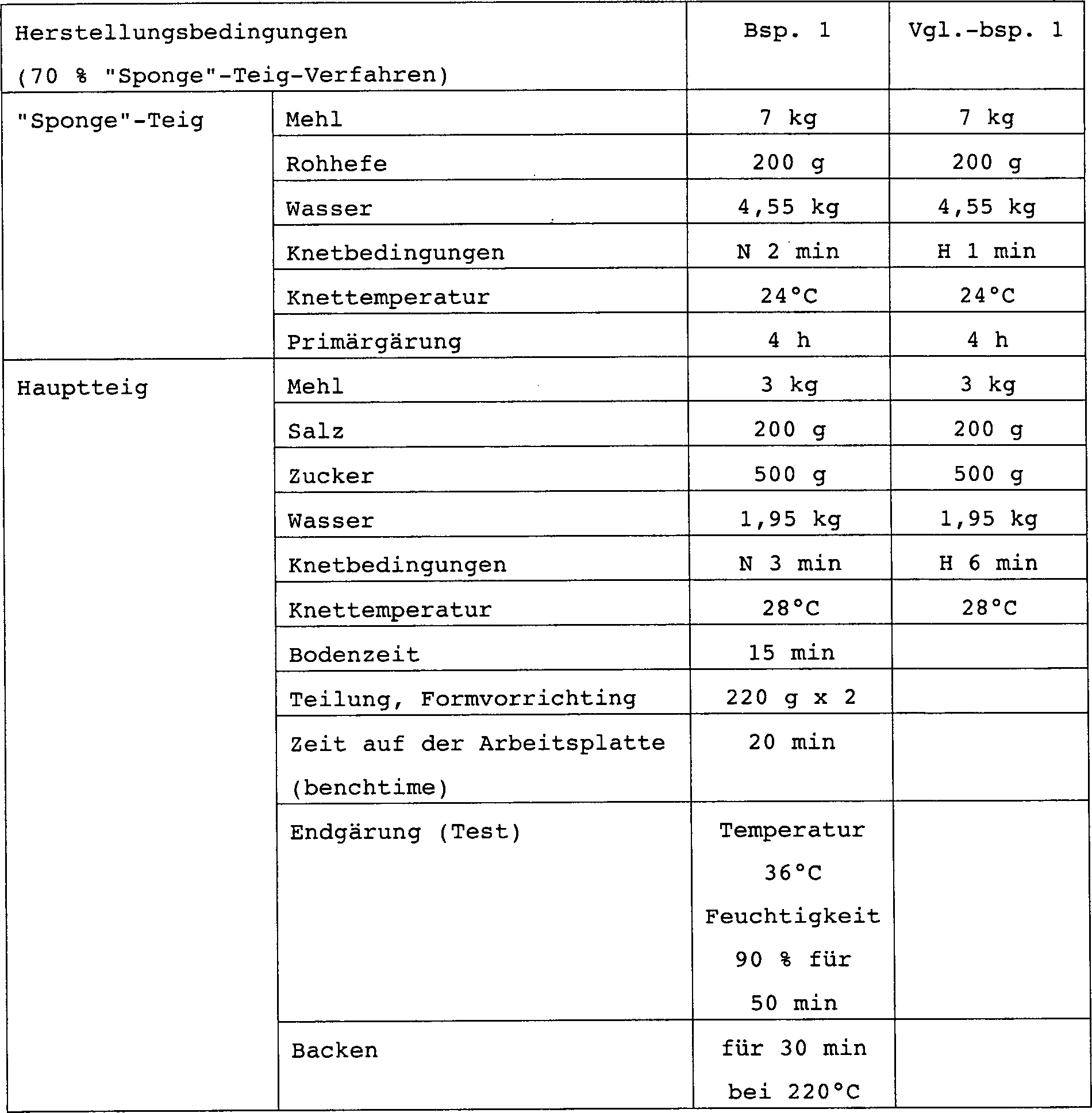
Die physikalischen Eigenschaften des erhaltenen Brots wurden gemessen. Die Resultate sind in Tabelle 1 angegeben. wie aus Tabelle 1 ersichtlich wird, hatte das Brot von Vergleichsbeispiel 1 ein geringeres Volumen und seine Alterung war schnell, so daß es schlechter war. Dagegen war das Brot von Beispiel 1 weich, seine Alterung war langsam und es hatte ein größeres Volumen. Es behielt den Geschmack von Weizen bei und war mit anhaltender Süße köstlich.The Physical properties of the obtained bread were measured. The results are shown in Table 1. as shown in Table 1 is, the bread of Comparative Example 1 had a smaller volume and his aging was fast, so it was worse. On the other hand The bread of Example 1 was soft, its aging was slow and it had a bigger volume. It retained the taste of wheat and was more persistent Sweet delicious.
Tabelle
1 
Die
Backschrumpfung, das spezifische Volumen und die Härte der
Krume wurden nach den folgenden Methoden gemessen und errechnet.
Spezifisches Volumen = Brotvolumen/Brotgewicht.specific Volume = bread volume / bread weight.
Härte der Krume: Brot wird in Stücke mit einer Dicke von 2 cm geschnitten, dann werden mit einem Rheometer die Gramm gemessen, die notwendig sind, um eine Scheibe mit einem Durchmesser von 2 cm um 1 cm in das Brotstück zu treiben.Hardness of Crumb: bread is going to pieces cut with a thickness of 2 cm, then be with a rheometer Measured the grams needed to make a slice with one 2 cm diameter to drive 1 cm into the piece of bread.
BEISPIEL 2 UND VERGLEICHSBEISPIEL 2EXAMPLE 2 AND COMPARATIVE EXAMPLE 2
Mehl wurde hergestellt, indem 0,2 kg GLIA-A mit 9,8 kg konzentriertem Mehl (strong flour) vermischt wurden. Diese Mehl wurde in 7 kg und 3 kg aufgeteilt, um einen Laib Englisches Brot durch das "Sponge"-Teig-Verfahren unter den folgenden Bedingungen herzustellen. Ein weiterer Laib Englisches Brot wurde in der gleichen Weise mit 10 kg Weizenmehl allein hergestellt (Vergleichsbeispiel 2).Flour was prepared by concentrating 0.2 kg of GLIA-A with 9.8 kg Flour (strong flour) were mixed. This flour was in 7 kg and 3 kg divided to a loaf of English bread by the "sponge" dough method below to produce the following conditions. Another loaf of English Bread was made in the same way with 10 kg of wheat flour alone (Comparative Example 2).
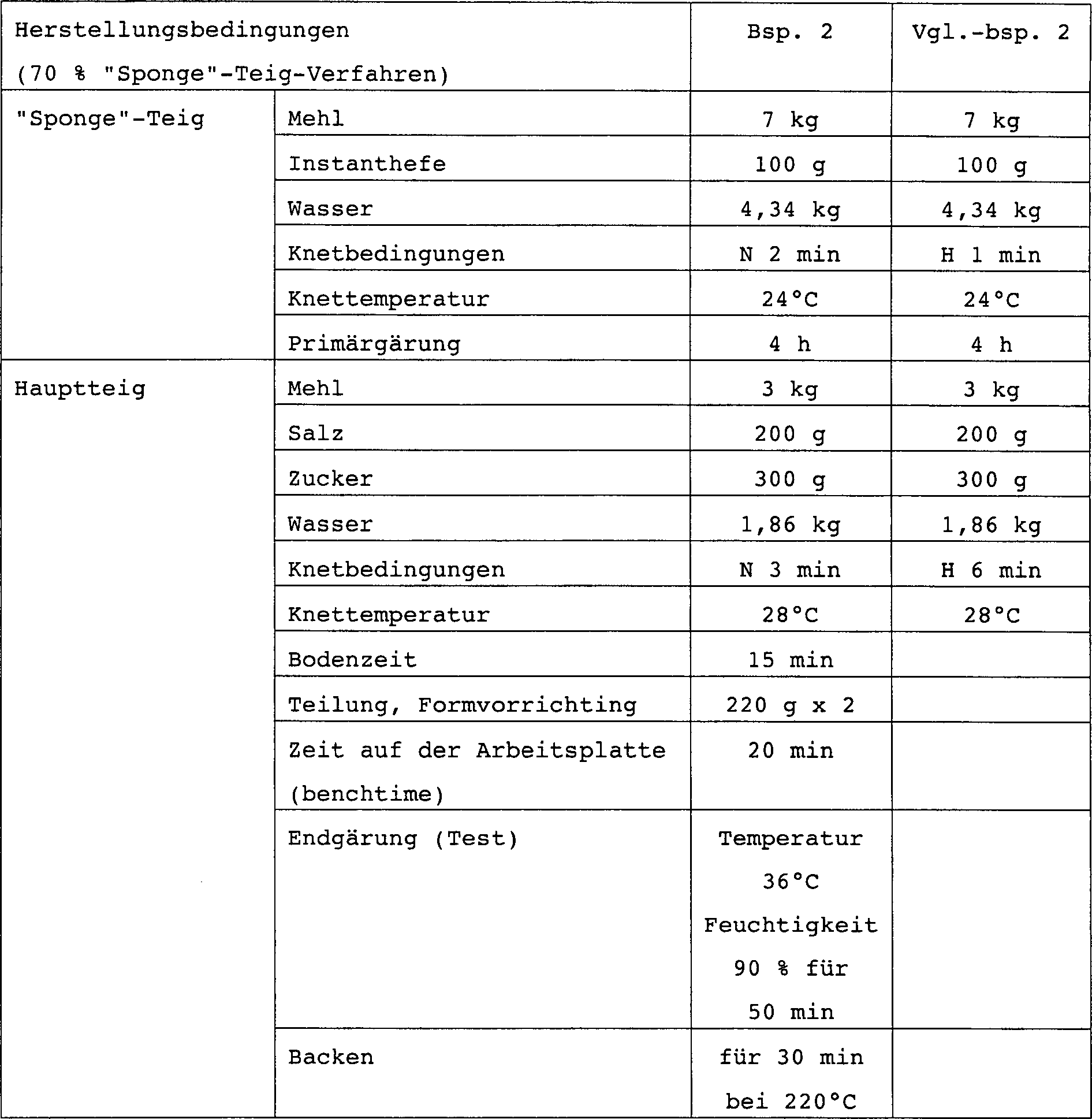
Die physikalischen Eigenschaften des erhaltenen Brots wurden gemessen. Die Resultate sind in Tabelle 2 angegeben. wie aus Tabelle 2 zu ersehen ist, hatte das Brot von Vergleichsbeispiel 2 ein geringeres Volumen und seine Alterung war schnell, so daß es unterlegen war. Dagegen war das Brot von Beispiel 2 weich, seine Alterung war langsam und es hatte ein größeres Volumen. Es behielt den Geschmack von Weizen bei und war mit einem anhaltenden Salzgeschmack delikat.The physical properties of the obtained bread were measured. The results are shown in Table 2. As can be seen from Table 2, the bread of Comparative Example 2 had a smaller volume and its aging was fast, so that it was inferior. In contrast, the bread of Example 2 was soft, its aging was slow and it had a larger volume. It retained the taste of wheat and was delicate with a persistent salty taste.
Tabelle
2 
BEISPIEL 3 UND VERGLEICHSBEISPIEL 3EXAMPLE 3 AND COMPARATIVE EXAMPLE 3
Mehl wurde hergestellt, indem 0,3 kg GLIA-A mit 9,7 kg Weizenmehl für Französisches Brot vermischt wurden. Dieses Mehl wurde in 7 kg und 3 kg aufgeteilt, um einen Laib englisches Brot durch das "Sponge"-Teigverfahren unter den folgenden Bedingungen herzustellen. Ein weiterer Laib englisches Brot wurde in der gleichen Weise mit 10 kg Weizenmehl allein hergestellt (Vergleichsbeispiel 3).Flour was prepared by adding 0.3 kg of GLIA-A with 9.7 kg of wheat flour for French Bread were mixed. This flour was divided into 7 kg and 3 kg, around a loaf of English bread by the "sponge" dough method under the following conditions manufacture. Another loaf of English bread was in the same Were made with 10 kg of wheat flour alone (Comparative Example 3).
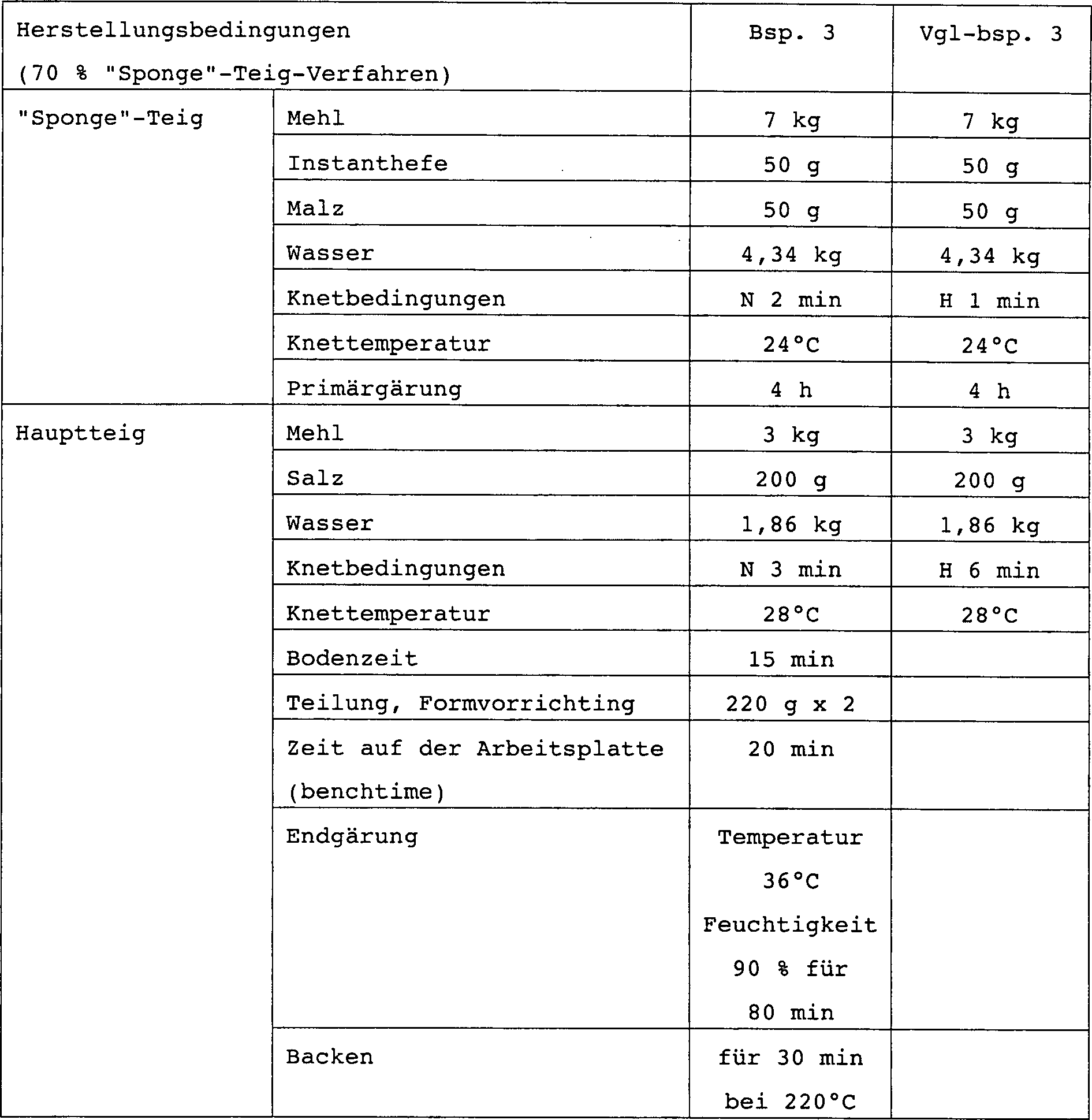
Die physikalischen Eigenschaften des erhaltenen Brots wurden gemessen. Die Resultate sind in Tabelle 3 angegeben. Wie aus Tabelle 3 ersichtlich ist, hatte das Brot von Vergleichsbeispiel 3 ein geringeres Volumen und seine Alterung war schnell, so daß schlechter war. Dagegen war das Brot von Beispiel 3 weich, seine Alterung war langsam, es hatte ein größeres Volumen und seine Kruste war etwas dick. Es hatte einen angenehmen Geruch, behielt den Weizengeschmack bei und hatte einen anhaltenden delikaten Geschmack.The Physical properties of the obtained bread were measured. The results are shown in Table 3. As shown in Table 3 is, the bread of Comparative Example 3 had a smaller volume and his aging was fast, so that was worse. Against it was the bread of Example 3 softened, its aging was slow, it had a larger volume and his crust was a bit thick. It had a nice smell, Maintained the wheat taste and had a lasting delicate Taste.
Tabelle
3 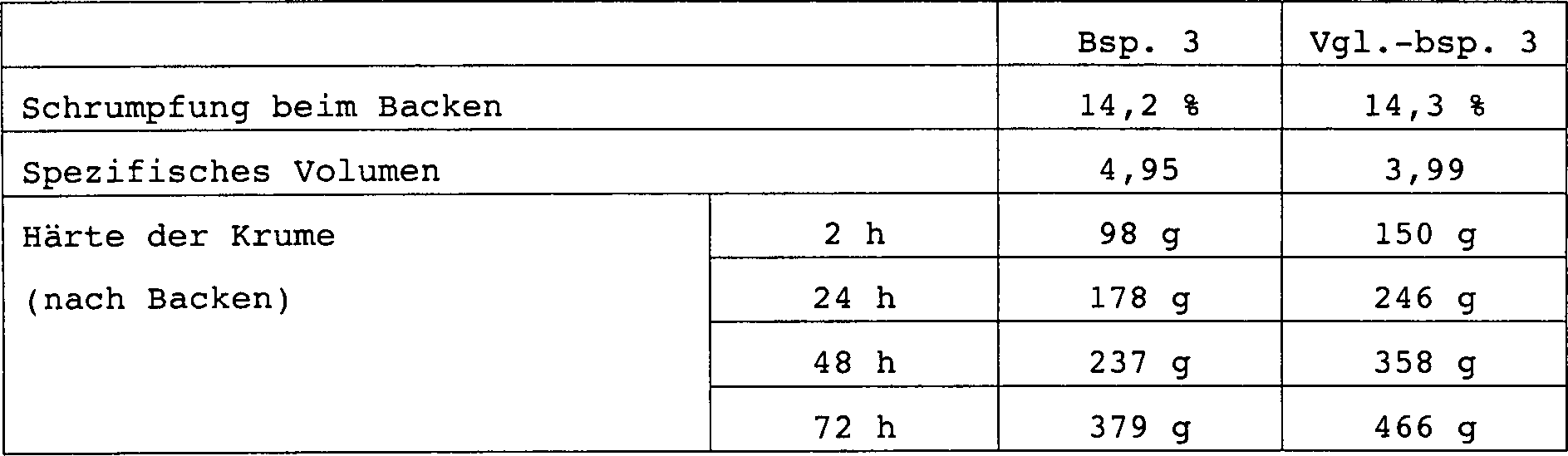
BEISPIEL 4 UND VERGLEICHSBEISPIEL 4EXAMPLE 4 AND COMPARATIVE EXAMPLE 4
Mehl wurde hergestellt, indem 0,3 kg GLIA-A mit 9,7 kg konzentriertem Mehl vermischt wurden. Dieses Mehl wurde in 8 kg und 2 kg aufgeteilt, um einen Laib Englischen Brots unter den folgenden Bedingungen durch das "Sponge"-Teigverfahren herzustellen. Ein weiterer Laib Englisches Brot wurde in der gleichen Weise mit 10 kg Weizenmehl hergestellt (Vergleichsbeispiel 4).Flour was prepared by concentrating 0.3 kg of GLIA-A with 9.7 kg Flour were mixed. This flour was divided into 8 kg and 2 kg, by a loaf of English bread under the following conditions to make the "Sponge" dough method. Another Loaf of English bread was made in the same way with 10 kg of wheat flour prepared (Comparative Example 4).
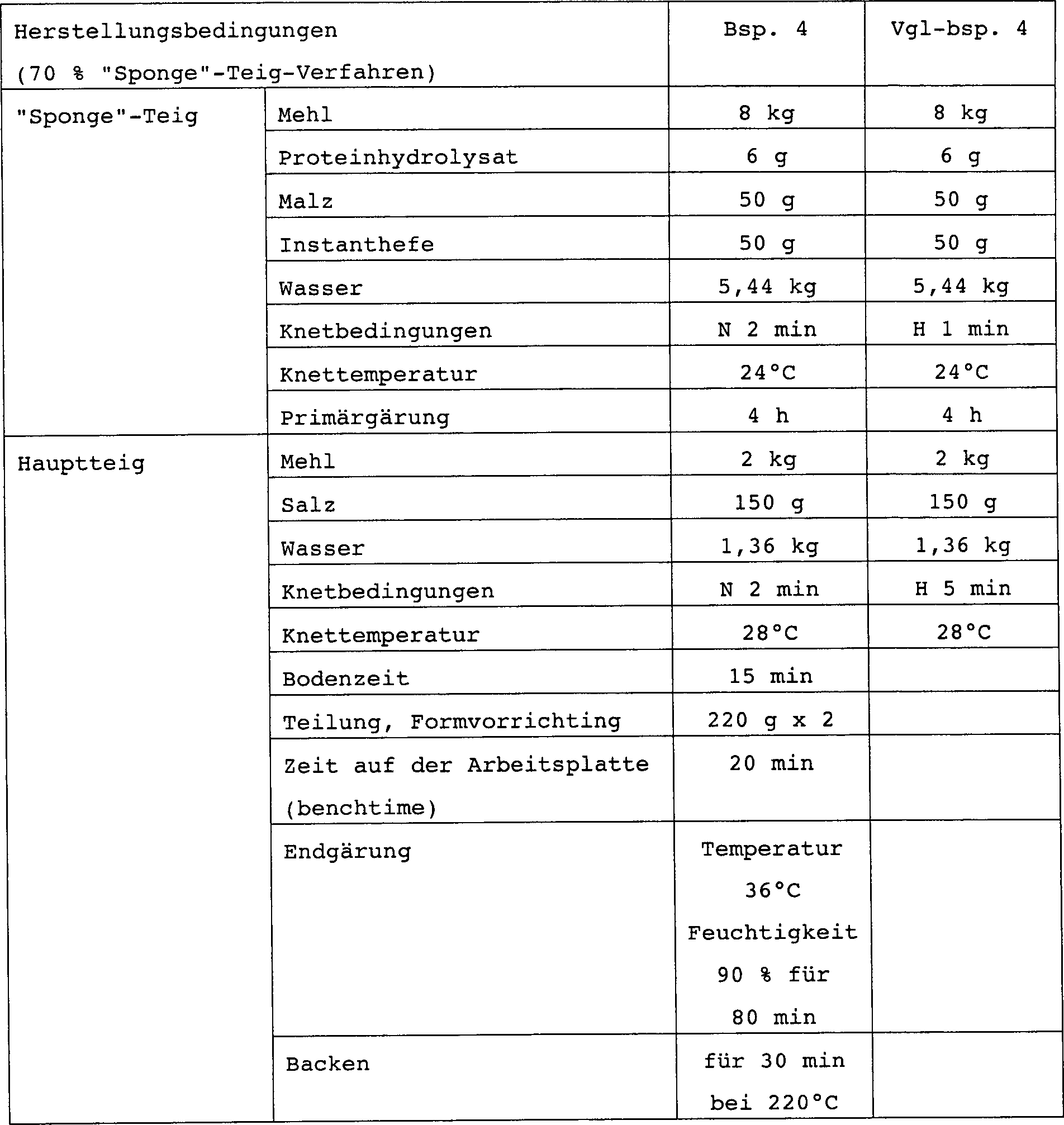
In diesem Fall wurde als Proteinhydrolysat Hydrolysatpulver verwendet, indem Gluten hydrolyisert worden war und die Aminosäuremenge 30 Gew.-% war.In in this case, hydrolyzate powder was used as protein hydrolyzate, by hydrolyzing gluten and the amino acid amount 30% by weight.
Die physikalischen Eigenschaften des erhaltenen Brots wurden gemessen. Die Resultate sind in Tabelle 4 gezeigt. Wie aus Tabelle 4 hervorgeht, hatte das Brot von Vergleichsbeispiel 4 ein geringeres Volumen und seine Alterung war schnell, so daß es schlechter war. Das Brot von Beispiel 4 dagegen war weich, seine Alterung war langsam, es hatte ein größeres Volumen und seine Kruste war dick. Es war knusprig, wohlriechend, behielt den Geschmack von Weizen bei und war mit einem anhaltenden salzigen Geschmack köstlich.The Physical properties of the obtained bread were measured. The results are shown in Table 4. As shown in Table 4, For example, the bread of Comparative Example 4 had a smaller volume and his aging was fast, so it was worse. The bread from Example 4, on the other hand, was soft, its aging was slow, it was had a larger volume and his crust was thick. It was crispy, fragrant, kept added the taste of wheat and was with a persistent salty Taste delicious.
Tabelle
4 
BEISPIEL 5 UND VERGLEICHSBEISPIEL 5EXAMPLE 5 AND COMPARATIVE EXAMPLE 5
7 kg Mehl wurden hergestellt, indem 0,2 kg GLIA-A mit 6,38 kg konzentriertem Mehl vermischt wurden, um einen Laib Englisches Brot durch das "Sponge"-Teigverfahren unter den folgenden Bedingungen herzustellen. Es wurde ein weiterer Laib Englisches Brot in ähnlicher Weise mit 10 kg Weizenmehl und Shortening (Vergleichsbeispiel 5) hergestellt.7 kg of flour were prepared by concentrating 0.2 kg of GLIA-A with 6.38 kg Flour were mixed to a loaf of English bread by the "Sponge" dough method below to produce the following conditions. It became another loaf English bread in similar Way with 10 kg of wheat flour and shortening (Comparative Example 5) produced.
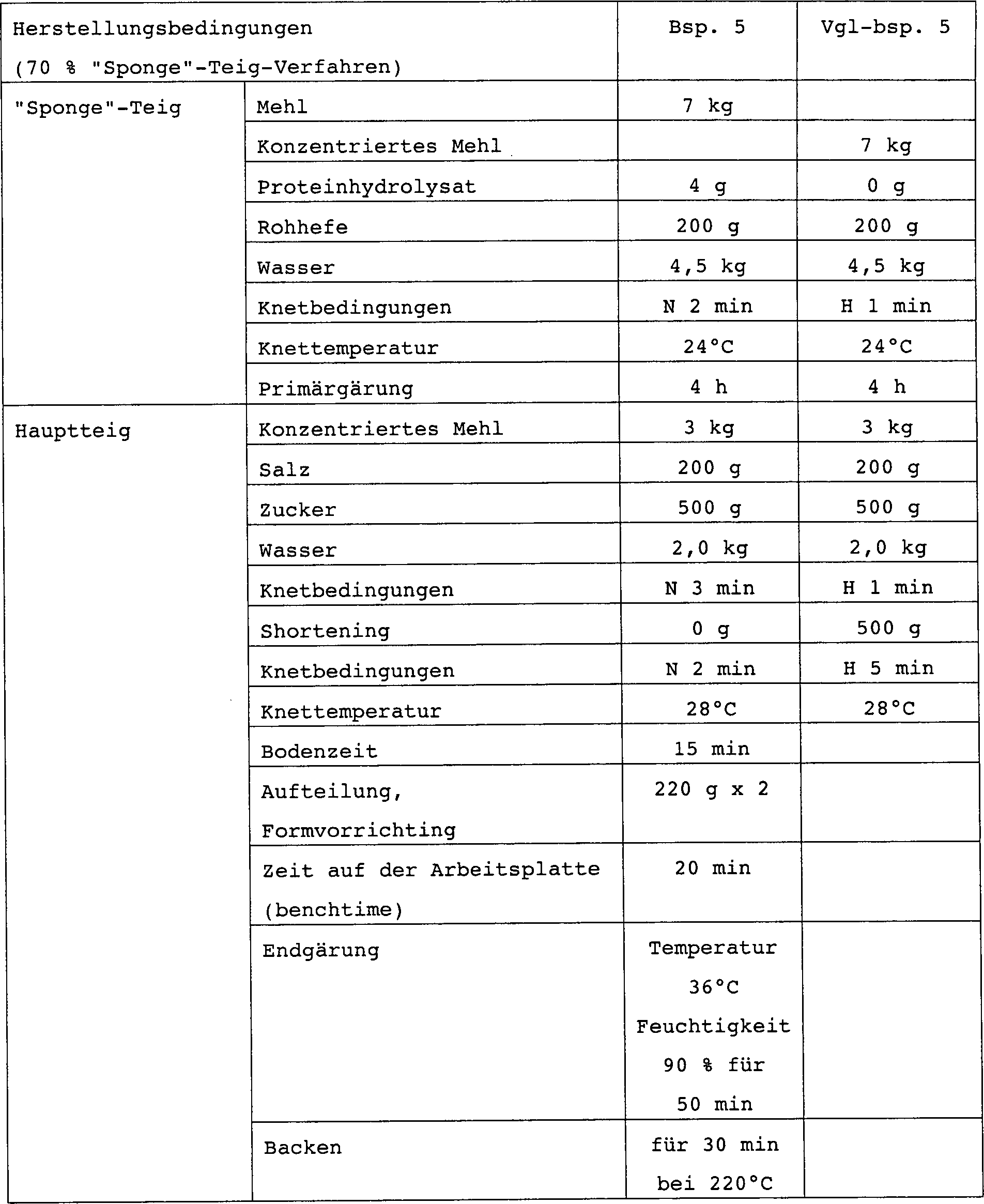
In diesem Fall wurde ein Hefeextrakt, der etwa 50 Gew.-% oder mehr Aminosäure enthielt, als Proteinhydrolysat verwendet.In In this case, a yeast extract was about 50% by weight or more amino acid contained as protein hydrolyzate.
Die physikalischen Eigenschaften des erhaltenen Brots wurden gemessen. Die Resultate sind in Tabelle 5 angegeben. Wie aus Tabelle 5 ersichtlich wird, hatte das Brot von Vergleichsbeispiel 5 ein etwas geringeres Volumen und seine Alterung war etwas eingeschränkt, aber es fehlte ihm der Weizengeschmack, der für Brot essentiell ist. Das Brot von Beispiel 5 war weich, seine Alterung war eingeschränkt und es hatte ein größeres Volumen, insbesondere behielt es den Weizengeschmack bei und war mit anhaltender Süße köstlich.The Physical properties of the obtained bread were measured. The results are shown in Table 5. As shown in Table 5 is, the bread of Comparative Example 5 had a slightly lower Volume and aging was somewhat limited, but he lacked that Wheat taste, for bread is essential. The bread of Example 5 was soft, its aging was restricted and it had a bigger volume, In particular, it retained the wheat taste and was more persistent Sweet delicious.
Tabelle
5 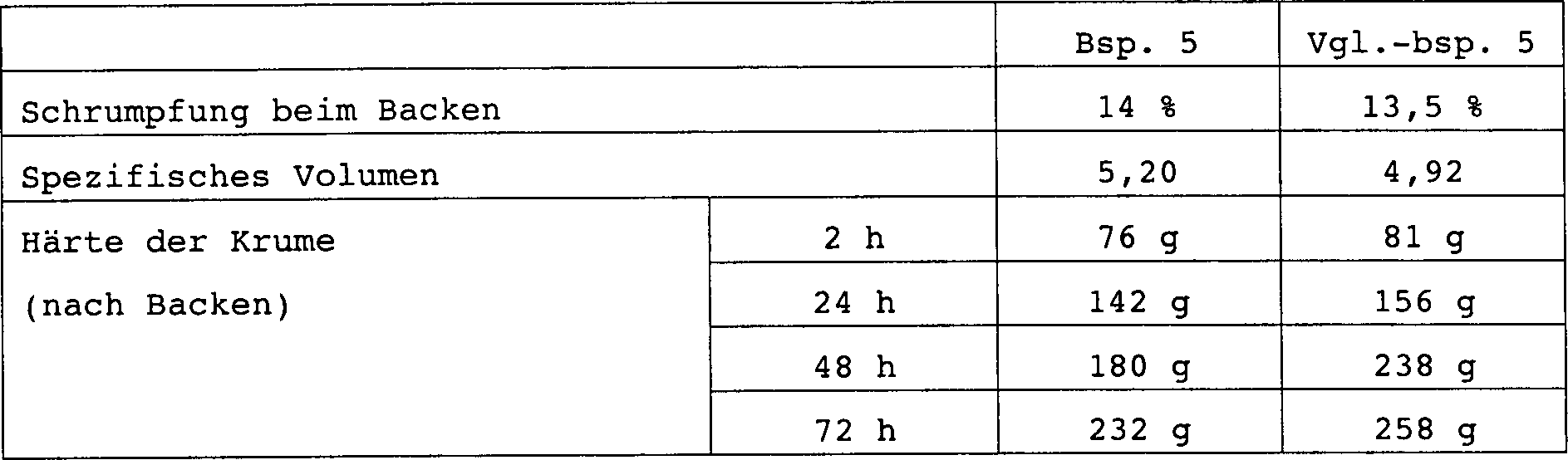
Claims (11)
Applications Claiming Priority (2)
| Application Number | Priority Date | Filing Date | Title |
|---|---|---|---|
| JP29913198A JP4171521B2 (en) | 1998-10-06 | 1998-10-06 | Bread production method |
| JP29913198 | 1998-10-06 |
Publications (2)
| Publication Number | Publication Date |
|---|---|
| DE69918239D1 DE69918239D1 (en) | 2004-07-29 |
| DE69918239T2 true DE69918239T2 (en) | 2005-07-28 |
Family
ID=17868533
Family Applications (1)
| Application Number | Title | Priority Date | Filing Date |
|---|---|---|---|
| DE69918239T Expired - Fee Related DE69918239T2 (en) | 1998-10-06 | 1999-04-26 | Bread making process with the addition of a gliadin-rich fraction, without the addition of yeast food and emulsifiers |
Country Status (3)
| Country | Link |
|---|---|
| EP (1) | EP0992193B1 (en) |
| JP (1) | JP4171521B2 (en) |
| DE (1) | DE69918239T2 (en) |
Families Citing this family (6)
| Publication number | Priority date | Publication date | Assignee | Title |
|---|---|---|---|---|
| BE1014340A3 (en) * | 2001-08-10 | 2003-09-02 | Amylum Europe Nv | METHOD FOR PREPARING AND glutenin gliadin fractions out of gluten in an aqueous MIDDLE AND IN THE PRESENCE OF AN ACID. |
| JP2003116451A (en) * | 2001-10-18 | 2003-04-22 | Oshikiri:Kk | Bread making method and bread making improver |
| JP2005095056A (en) * | 2003-09-24 | 2005-04-14 | Asama Chemical Co Ltd | Method for producing baked food |
| JP4596348B2 (en) * | 2006-12-11 | 2010-12-08 | 山崎製パン株式会社 | Bread production method |
| JP2010022222A (en) * | 2008-07-16 | 2010-02-04 | Ishii Shokuhin Kk | Hard type bread crumb and meat processed product using the same |
| JP5614645B2 (en) * | 2010-10-22 | 2014-10-29 | アサマ化成株式会社 | Method for producing acidic water-soluble protein and acidic water-soluble protein |
Family Cites Families (9)
| Publication number | Priority date | Publication date | Assignee | Title |
|---|---|---|---|---|
| FR2234739A5 (en) * | 1973-06-22 | 1975-01-17 | Leiche Rene | Dietetic bread contg magnesium - of good assimilability and preservability |
| US3897568A (en) * | 1973-08-02 | 1975-07-29 | Univ Kansas State | Process and compositions for manufacture of yeast-raised products without fermentation |
| CH632133A5 (en) * | 1977-08-02 | 1982-09-30 | Aschinger Ag | Process for the preparation of a low-carbohydrate and calorie-reduced dietary bread |
| EP0005977A3 (en) * | 1978-05-30 | 1980-01-09 | The Speywood Laboratory Ltd. | Bread containing gum and its manufacture |
| US4645831A (en) * | 1984-12-10 | 1987-02-24 | The Texas A&M University System | Process for removing undesirable constituents from wheat gluten products |
| EP0298419B1 (en) * | 1987-07-06 | 1992-05-20 | Katayama Chemical Works Co., Ltd. | A protein partial degradation product, process for preparing it and its use |
| US5458902A (en) * | 1991-09-26 | 1995-10-17 | Silvia P. Rudel | High protein content bread product |
| EP0685164A1 (en) * | 1994-06-03 | 1995-12-06 | Asama Chemical Co., Ltd. | Food quality improver |
| DE4427668A1 (en) * | 1994-08-04 | 1996-02-22 | Pfeifer & Langen | Process for the preparation of novel corn gluten fractions and product obtainable by this process |
-
1998
- 1998-10-06 JP JP29913198A patent/JP4171521B2/en not_active Expired - Fee Related
-
1999
- 1999-04-26 DE DE69918239T patent/DE69918239T2/en not_active Expired - Fee Related
- 1999-04-26 EP EP99303207A patent/EP0992193B1/en not_active Expired - Lifetime
Also Published As
| Publication number | Publication date |
|---|---|
| JP4171521B2 (en) | 2008-10-22 |
| DE69918239D1 (en) | 2004-07-29 |
| JP2000106816A (en) | 2000-04-18 |
| EP0992193B1 (en) | 2004-06-23 |
| EP0992193A1 (en) | 2000-04-12 |
Similar Documents
| Publication | Publication Date | Title |
|---|---|---|
| DD230875A1 (en) | ACCOMMODATION HELP FOR TRADITIONAL BACKWARE | |
| DE2415678A1 (en) | CHILLED BISCUIT Dough | |
| DE69530483T2 (en) | MODIFYING PRODUCT AND MODIFYING COMPOSITION FOR PROTEIN CONTAINING SUBSTANCE | |
| DE60024970T2 (en) | BETAIN AND BACKPRODUCTS | |
| DE69825542T2 (en) | New protein complexes | |
| DE69619976T2 (en) | Filling for bakery or biscuit or confectionery products, manufacturing process and composite filling | |
| DE2740245A1 (en) | METHOD OF MANUFACTURING A BAKEDWARE AND BAKEDWARE | |
| DE1693213C3 (en) | ||
| DE1767651A1 (en) | Process for the production of food based on wheat flour, in particular bread | |
| EP0765608A2 (en) | Method for manufacturing food products by using polyglycerol | |
| RU2617336C1 (en) | Butter biscuit of functional purpose | |
| DE69807425T2 (en) | Process for producing flour-containing food products for microwave ovens | |
| EP0992193B1 (en) | Process for making bread with addition of a gliadin-rich fraction, without incorporation of yeast food and emulsifier | |
| DE2427619A1 (en) | PROCESS FOR MANUFACTURING YEAST PRECIOUS PRODUCTS AND FERMENTATION COMPENSATOR FOR PERFORMING THIS PROCESS | |
| DE2648747B2 (en) | Bread and its production | |
| DE69117062T2 (en) | Bread-flavored crackers and process for making them | |
| DE702679C (en) | Process for making baked goods | |
| AT410502B (en) | METHOD FOR PRODUCING EDIBLE WAFFLE PRODUCTS | |
| DE2804634A1 (en) | IMPROVED MEAL SUBSTITUTES | |
| DE102004031647A1 (en) | High-protein, vegetable food and process for its preparation | |
| DE2036803C3 (en) | Process for the manufacture of an intermediate product for the manufacture of bread and other baked goods | |
| DE69519317T2 (en) | Batter | |
| DE60014590T2 (en) | High pressure treated starch containing baked goods | |
| EP1670317A1 (en) | Pre-dough concentrate for wheaten bread and mixed flour bread | |
| DE2654233C2 (en) | Process for the production of a leavening agent for baked goods |
Legal Events
| Date | Code | Title | Description |
|---|---|---|---|
| 8364 | No opposition during term of opposition | ||
| 8339 | Ceased/non-payment of the annual fee |