CN202160552U - Biological control pest-trapping bacterial transmission device - Google Patents
Biological control pest-trapping bacterial transmission device Download PDFInfo
- Publication number
- CN202160552U CN202160552U CN2011202591493U CN201120259149U CN202160552U CN 202160552 U CN202160552 U CN 202160552U CN 2011202591493 U CN2011202591493 U CN 2011202591493U CN 201120259149 U CN201120259149 U CN 201120259149U CN 202160552 U CN202160552 U CN 202160552U
- Authority
- CN
- China
- Prior art keywords
- trapping
- bacteria
- biological control
- spreading
- control pests
- Prior art date
- Legal status (The legal status is an assumption and is not a legal conclusion. Google has not performed a legal analysis and makes no representation as to the accuracy of the status listed.)
- Expired - Fee Related
Links
- 230000001580 bacterial effect Effects 0.000 title claims description 14
- 230000005540 biological transmission Effects 0.000 title abstract description 3
- 241000894006 Bacteria Species 0.000 claims abstract description 32
- 241000607479 Yersinia pestis Species 0.000 claims abstract description 25
- 239000003016 pheromone Substances 0.000 claims abstract description 10
- XEEYBQQBJWHFJM-UHFFFAOYSA-N Iron Chemical compound [Fe] XEEYBQQBJWHFJM-UHFFFAOYSA-N 0.000 claims description 20
- 241000223250 Metarhizium anisopliae Species 0.000 claims description 11
- 229910052742 iron Inorganic materials 0.000 claims description 10
- 231100000331 toxic Toxicity 0.000 claims description 9
- 230000002588 toxic effect Effects 0.000 claims description 9
- 241000244206 Nematoda Species 0.000 claims description 7
- 241000751139 Beauveria bassiana Species 0.000 claims description 6
- 230000001717 pathogenic effect Effects 0.000 claims description 6
- 239000004745 nonwoven fabric Substances 0.000 claims description 5
- 239000000463 material Substances 0.000 claims description 4
- 239000004033 plastic Substances 0.000 claims description 4
- 229920003023 plastic Polymers 0.000 claims description 4
- 241001078693 Rhynchophorus ferrugineus Species 0.000 abstract description 16
- 238000013461 design Methods 0.000 abstract description 3
- 230000002265 prevention Effects 0.000 abstract description 3
- 238000000034 method Methods 0.000 description 6
- 241000233866 Fungi Species 0.000 description 4
- 241000238631 Hexapoda Species 0.000 description 4
- 230000002776 aggregation Effects 0.000 description 4
- 238000004220 aggregation Methods 0.000 description 4
- 235000001674 Agaricus brunnescens Nutrition 0.000 description 2
- 244000052616 bacterial pathogen Species 0.000 description 2
- 230000006399 behavior Effects 0.000 description 2
- 230000009286 beneficial effect Effects 0.000 description 2
- 230000006378 damage Effects 0.000 description 2
- 238000010586 diagram Methods 0.000 description 2
- 230000000694 effects Effects 0.000 description 2
- 208000015181 infectious disease Diseases 0.000 description 2
- 238000012986 modification Methods 0.000 description 2
- 230000004048 modification Effects 0.000 description 2
- 238000005507 spraying Methods 0.000 description 2
- 239000000126 substance Substances 0.000 description 2
- IHGSAQHSAGRWNI-UHFFFAOYSA-N 1-(4-bromophenyl)-2,2,2-trifluoroethanone Chemical compound FC(F)(F)C(=O)C1=CC=C(Br)C=C1 IHGSAQHSAGRWNI-UHFFFAOYSA-N 0.000 description 1
- 241000233788 Arecaceae Species 0.000 description 1
- 241000196324 Embryophyta Species 0.000 description 1
- 241001465754 Metazoa Species 0.000 description 1
- 241000700605 Viruses Species 0.000 description 1
- 239000003124 biologic agent Substances 0.000 description 1
- 230000007547 defect Effects 0.000 description 1
- 230000000967 entomopathogenic effect Effects 0.000 description 1
- 238000003912 environmental pollution Methods 0.000 description 1
- 238000011156 evaluation Methods 0.000 description 1
- 239000004744 fabric Substances 0.000 description 1
- 238000003958 fumigation Methods 0.000 description 1
- 244000053095 fungal pathogen Species 0.000 description 1
- 238000002347 injection Methods 0.000 description 1
- 239000007924 injection Substances 0.000 description 1
- 239000002917 insecticide Substances 0.000 description 1
- 230000007774 longterm Effects 0.000 description 1
- 230000013011 mating Effects 0.000 description 1
- 239000002420 orchard Substances 0.000 description 1
- 230000017448 oviposition Effects 0.000 description 1
- 238000010248 power generation Methods 0.000 description 1
- 230000001681 protective effect Effects 0.000 description 1
- 238000012502 risk assessment Methods 0.000 description 1
- 238000012216 screening Methods 0.000 description 1
- 239000000243 solution Substances 0.000 description 1
- 241000894007 species Species 0.000 description 1
Images

Classifications
-
- Y—GENERAL TAGGING OF NEW TECHNOLOGICAL DEVELOPMENTS; GENERAL TAGGING OF CROSS-SECTIONAL TECHNOLOGIES SPANNING OVER SEVERAL SECTIONS OF THE IPC; TECHNICAL SUBJECTS COVERED BY FORMER USPC CROSS-REFERENCE ART COLLECTIONS [XRACs] AND DIGESTS
- Y02—TECHNOLOGIES OR APPLICATIONS FOR MITIGATION OR ADAPTATION AGAINST CLIMATE CHANGE
- Y02A—TECHNOLOGIES FOR ADAPTATION TO CLIMATE CHANGE
- Y02A50/00—TECHNOLOGIES FOR ADAPTATION TO CLIMATE CHANGE in human health protection, e.g. against extreme weather
- Y02A50/30—Against vector-borne diseases, e.g. mosquito-borne, fly-borne, tick-borne or waterborne diseases whose impact is exacerbated by climate change
Landscapes
- Catching Or Destruction (AREA)
Abstract
本实用新型涉及生物防治害虫技术领域,特别涉及一种生物防治害虫诱集传菌装置。一种生物防治害虫诱集传菌装置,包括悬挂部、诱集部和传菌部,所述悬挂部与诱集部上端相连,诱集部下端与传菌部相连;所述诱集部包括防雨顶和与防雨顶下端相连的诱集板,所述诱集板上悬挂有聚集信息素;所述传菌部包括护菌檐和铁丝网,所述护菌檐通过连接构件与铁丝网相连,所述铁丝网上安放有无纺布菌条。本诱集传菌装置易携带、运输,林间放置不易损坏,可重复使用,结构设计合理,操作简单,防治费用低、耗费人力少,可持续控制红棕象甲,保护生态环境,应用前景非常广阔。
The utility model relates to the technical field of biological control of pests, in particular to a device for trapping and spreading bacteria for biological control of pests. A device for trapping and spreading bacteria for biological control pests, comprising a hanging part, a trapping part and a bacteria spreading part, the hanging part is connected to the upper end of the trapping part, and the lower end of the trapping part is connected to the bacteria spreading part; the trapping part includes The rain-proof roof and the trapping plate connected to the lower end of the rain-proof roof, the gathering pheromone is suspended on the trapping plate; the bacteria transmission part includes the eaves and the barbed wire, and the eaves are connected with the barbed wire through the connecting member , non-woven bacteria strips are placed on the barbed wire. The trapping and spreading device is easy to carry and transport, it is not easy to be damaged when placed in the forest, it can be reused, the structure design is reasonable, the operation is simple, the cost of prevention and control is low, and the manpower is less. It can sustainably control the red palm weevil and protect the ecological environment. very broad.
Description
技术领域 technical field
本实用新型涉及生物防治害虫技术领域,特别涉及一种生物防治害虫诱集传菌装置。The utility model relates to the technical field of biological control of pests, in particular to a device for trapping and spreading bacteria for biological control of pests.
背景技术 Background technique
红棕象甲是近年来入侵我国南方的重大外来有害生物之一,对红棕象甲进行有害生物风险分析结果显示,红棕象甲综合评判值为2.18,属高风险有害生物,在我国很多地区易定殖,对我国的棕榈科植物威胁很大。目前红棕象甲主要危害属于15个属的19种棕榈植物。红棕象甲在国内主要分布于台湾、福建、香港、海南、广东、广西、上海、云南、西藏(墨脱)等地,浙江省丽水市也有该虫的报道。The red palm weevil is one of the major alien pests that have invaded southern my country in recent years. The results of the pest risk analysis of the red palm weevil show that the comprehensive evaluation value of the red palm weevil is 2.18, which is a high-risk pest. The area is easy to colonize and poses a great threat to palm plants in my country. At present, the red palm weevil mainly damages 19 species of palm plants belonging to 15 genera. The red palm weevil is mainly distributed in Taiwan, Fujian, Hong Kong, Hainan, Guangdong, Guangxi, Shanghai, Yunnan, Tibet (Medog) and other places in China. It has also been reported in Lishui City, Zhejiang Province.
目前,对于红棕象甲的林间防治方法,主要集中于化学防治如树干伤口注射、林间喷雾、树干吊瓶、磷化铝密闭熏杀,物理防治如加强感染棕榈的及时砍伐和焚烧,生物防治如绿僵菌、白僵菌和病原线虫的田间喷洒施放、信息素诱集等方法进行。但是这些方法都存在一定的缺陷:化学防治成本高,污染大,对人畜有毒,耗费人力财力;物理防治耗费人力,效果不明显,仅能小面积控制;现有生物防治方法成本高,因为蛀干害虫隐蔽的特点防治效果不明显,易伤害其他林间有益昆虫,受气候影响大;信息素诱集仅能成虫进行诱集,对幼虫不能起到有效防治除虫的目的。所有这些方法均不能既达到除虫,又达到长期控制,同时保证生态友好。At present, the forest control methods for red palm weevil mainly focus on chemical control such as trunk wound injection, forest spraying, tree trunk hanging bottle, aluminum phosphide airtight fumigation, physical control such as timely felling and burning of infected palms, Biological control such as field spraying of Metarhizium anisopliae, Beauveria bassiana and pathogenic nematodes, pheromone trapping and other methods. However, these methods all have certain defects: chemical control costs are high, pollutes a lot, is toxic to humans and animals, and consumes manpower and financial resources; physical control consumes manpower, has no obvious effect, and can only control a small area; Due to the concealment of dry pests, the control effect is not obvious, and it is easy to harm other beneficial insects in the forest, and is greatly affected by the climate; pheromone traps can only trap adults, and cannot effectively control and eliminate insects for larvae. All these methods cannot achieve both deworming and long-term control while ensuring eco-friendliness.
因此,如何有效的杀灭红棕象甲,降低生物防治成本,就成为本领域的技术人员目前需要解决的技术问题。Therefore, how to effectively kill the red palm weevil and reduce the cost of biological control has become a technical problem that those skilled in the art need to solve at present.
实用新型内容 Utility model content
本实用新型的目的在于提供一种生物防治害虫诱集传菌装置,该装置能够提高生物防治效率,减少生物药剂的用量,防止环境污染,降低防治成本。The purpose of the utility model is to provide a biological control pest luring and spreading device, which can improve the efficiency of biological control, reduce the amount of biological agents, prevent environmental pollution, and reduce control costs.
为解决上述技术问题,本实用新型提供一种生物防治害虫诱集传菌装置,包括悬挂部、诱集部和传菌部,所述悬挂部与诱集部上端相连,诱集部下端与传菌部相连;所述诱集部包括防雨顶和与防雨顶下端相连的诱集板,所述诱集板上悬挂有聚集信息素;所述传菌部包括护菌檐和铁丝网,所述护菌檐通过连接构件与铁丝网相连,所述铁丝网上安放有无纺布菌条。In order to solve the above technical problems, the utility model provides a device for trapping and spreading bacteria for biological control pests, including a hanging part, a trapping part and a bacteria spreading part, the hanging part is connected to the upper end of the trapping part, and the lower end of the trapping part is connected to The bacteria parts are connected; the trapping part includes a rainproof top and a trapping plate connected to the lower end of the rainproof top, and the gathering pheromone is suspended on the trapping plate; The protective eaves are connected with the barbed wire through the connecting member, and the barbed wire is placed with non-woven bacterial strips.
优选地,所述无纺布菌条为绿僵菌高毒菌株、白僵菌高毒菌株或病原线虫生产出来的无纺布菌条。Preferably, the non-woven bacterial strip is a non-woven bacterial strip produced by a highly toxic strain of Metarhizium anisopliae, a highly toxic strain of Beauveria bassiana or a pathogenic nematode.
优选地,所述无纺布菌条通过铁甲或铁丝固定在铁丝网上。Preferably, the non-woven bacterial strips are fixed on the wire mesh by iron armor or iron wire.
优选地,所述悬挂部为挂钩。Preferably, the hanging part is a hook.
优选地,所述连接构件为铁丝。Preferably, the connecting member is iron wire.
优选地,所述诱集板成十字形。Preferably, the trapping plate is in the shape of a cross.
优选地,所述护菌檐成裙形。Preferably, the eaves are skirt-shaped.
优选地,所述诱集部和护菌檐均由镀锌板材料或塑料制成。Preferably, both the trapping part and the mushroom protection eaves are made of galvanized sheet material or plastic.
优选地,所述铁丝网的单元网格面积为1CM2。Preferably, the unit grid area of the barbed wire is 1CM 2 .
本实用新型工作原理:红棕象甲为钻蛀害虫,其幼虫发育成成虫后,由蛀道中钻出树干,在林间迁飞,寻找新的寄主树干,并交配繁殖下一代。本实用新型是将红棕象甲聚集信息素与绿僵菌、白僵菌或病原线虫生产出来的无纺布条设计在一起,首先将迁飞的红棕象甲成虫引诱到装置上层,成虫会碰撞诱集板并且落下,落到铁丝网格上,与预先放置的的无纺布菌条接触,使其主动或者被动地沾染上绿僵菌孢子,然后成虫会在无纺布上不断爬行直到铁丝网格边缘飞出;接下来沾染绿僵菌孢子的红棕象甲通过迁飞寻找寄主的行为将成为将绿僵菌孢子不断扩散到林间其他地方,以及红棕象甲的聚集种群地;通过红棕象甲个体间的引诱、聚集、交配、产卵等行为将绿僵菌孢子直接传染给红棕象甲其他个体,造成侵染;最后在林间形成流行病,而感染后的僵虫又成为第二年的绿僵菌治虫提供了菌源,有效的长期降低林间红棕象甲种群数量。The working principle of the utility model: the red palm weevil is a borer pest. After its larvae develop into adults, they drill out of the tree trunk from the borer road, fly among the forests, find new host tree trunks, and mate and reproduce for the next generation. The utility model is to design together the aggregation pheromone of the red palm weevil and the non-woven fabric strips produced by Metarhizium anisopliae, Beauveria bassiana or pathogenic nematodes. It will collide with the trapping plate and fall, and fall on the wire grid, and contact with the pre-placed non-woven fabric strips, so that it is actively or passively contaminated with Metarhizium anisopliae spores, and then the adults will continue to crawl on the non-woven fabric until Flying out from the edge of the wire mesh; next, the behavior of red palm weevils contaminated with Metarhizium anisopliae spores to find hosts by migrating will become the continuous spread of Metarhizium anisopliae spores to other places in the forest and the aggregation of red palm weevils; Metarhizium anisopliae spores are directly transmitted to other individuals of the red palm weevil through the behaviors of luring, gathering, mating, and oviposition among individuals of the red palm weevil, causing infection; finally, an epidemic is formed in the forest, and the infected stiff The insect became the source of bacteria for the Metarhizium anisopliae in the second year, effectively reducing the population of the red palm weevil in the forest for a long time.
本实用新型的有益效果是:将信息素诱集和病原菌3-5天的感染期防治相结合,有效的解决了虫生病原真菌在田间受天气影响大,尤其是南方多雨的天气对菌的影响,能保证最少的用菌量达到最直接的杀虫,本实用新型给菌株提供了一个保护,并且可以使用本装置使用各种对林间钻蛀害虫有效的虫生病原真菌、细菌病毒以及线虫进行防治。诱集害虫使其感染并利用本身的聚集性,放虫回到感染植株,将病菌传染给其他同伴,达到防控目的。本诱集传菌装置易携带、运输,林间放置不易损坏,可重复使用,结构设计合理,操作简单,防治费用低、耗费人力少,可持续控制红棕象甲,保护生态环境,应用前景非常广阔。The beneficial effects of the utility model are: the combination of pheromone trapping and pathogenic bacteria infection period of 3-5 days, effectively solves the problem that the pathogenic fungi of entomosis are greatly affected by the weather in the field, especially the rainy weather in the south. impact, can ensure the least amount of bacteria to achieve the most direct insecticide, the utility model provides a protection for the strains, and can use this device to use a variety of entomopathogenic fungi, bacterial viruses and nematode control. Trap the pests to infect them and use their aggregation, release the insects back to the infected plants, and infect the germs to other companions to achieve the purpose of prevention and control. The trapping and spreading device is easy to carry and transport, it is not easy to be damaged when placed in the forest, it can be reused, the structure design is reasonable, the operation is simple, the cost of prevention and control is low, and the manpower is less. It can sustainably control the red palm weevil and protect the ecological environment. very broad.
附图说明 Description of drawings
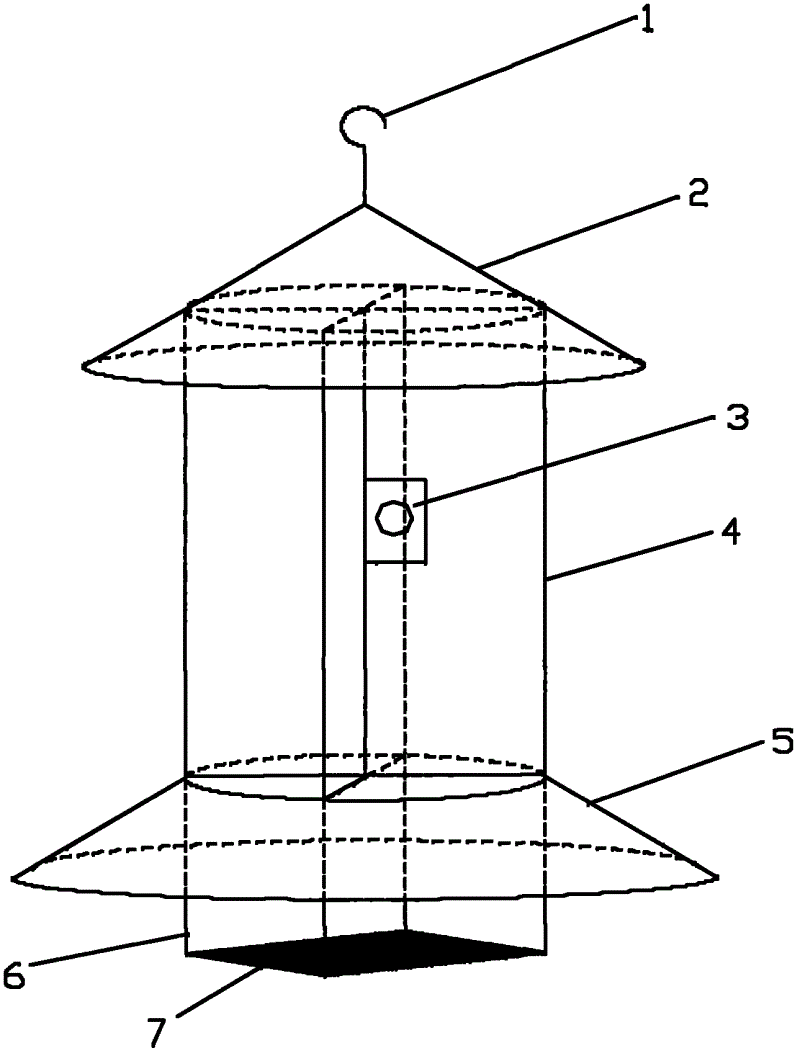
图1为本实用新型所提供的一种生物防治害虫诱集传菌装置的结构示意图。Fig. 1 is a structural schematic diagram of a biological control pest luring and spreading device provided by the utility model.
图中:1挂钩、2防雨顶、3聚集信息素、4诱集板、5护菌檐、6铁丝、7铁丝网。In the figure: 1 hook, 2 rain-proof roof, 3 gathering pheromone, 4 trapping board, 5 protecting eaves, 6 iron wire, 7 barbed wire.
具体实施方式 Detailed ways
为了使本技术领域的人员更好地理解本实用新型的技术方案,下面结合附图和具体实施方式对本实用新型作进一步的详细说明。In order to enable those skilled in the art to better understand the technical solution of the utility model, the utility model will be further described in detail below in conjunction with the accompanying drawings and specific embodiments.
请参考图1,为图1本实用新型所提供的一种生物防治害虫诱集传菌装置的结构示意图。Please refer to FIG. 1 , which is a schematic structural diagram of a biological control pest trapping and spreading device provided by the utility model in FIG. 1 .
在第一种具体实施方式中,本实用新型所提供的一种生物防治害虫诱集传菌装置,该装置包括悬挂部、诱集部和传菌部,所述悬挂部为挂钩,所述悬挂部与诱集部上端相连,诱集部下端与传菌部相连;所述诱集部包括防雨顶2和与防雨顶2下端相连的诱集板4,所述诱集板4成十字形,所述诱集板4上悬挂有聚集信息素3;所述传菌部包括护菌檐5和铁丝网7,所述护菌檐5成裙形,本实用新型中所述诱集部和护菌檐5均由镀锌板材料或塑料制成,由镀锌板材料制成的的诱集部和护菌檐5比较耐用,而由塑料制成的诱集部和护菌檐5的比较轻便,且价格低廉。所述护菌檐5通过连接构件与铁丝网7相连,所述连接构件为铁丝6,所述铁丝7网的单元网格面积为1CM2。所述铁丝网7上安放有无纺布菌条,所述无纺布菌条通过铁甲或铁丝固定在铁丝网上。所述无纺布菌条为绿僵菌高毒菌株、白僵菌高毒菌株或病原线虫生产出来的无纺布菌条,本实用新型优选绿僵菌高毒菌株生产出来的无纺布菌条。In the first specific embodiment, a device for trapping and spreading bacteria for biological control pests provided by the utility model includes a hanging part, a trapping part and a bacteria spreading part, the hanging part is a hook, and the hanging part The upper end of the trapping part is connected with the upper end of the trapping part, and the lower end of the trapping part is connected with the bacteria transmission part; the trapping part includes the
本实用新型使用方法:每年4至11月份,将聚集信息素挂在十字诱集板上,将通过筛选得到的绿僵菌高毒菌株、白僵菌高毒菌株或病原线虫生产出来的无纺布菌条固定在铁丝网上。在受害的棕榈园内悬挂本装置,离地距离为80cm为宜,每隔200m设一个桶,每个星期更换一次无纺布菌条即可。The method of using the utility model: from April to November every year, hang the aggregation pheromone on the cross trapping board, and use the non-woven fabric produced by the highly toxic strains of Metarhizium anisopliae, highly toxic strains of Beauveria bassiana or pathogenic nematodes obtained through screening. Cloth bacteria strips are fixed on the barbed wire. Hang this device in the damaged palm orchard, the distance from the ground is 80cm, a barrel is set every 200m, and the non-woven bacteria strips can be replaced once a week.
以上对本实用新型所提供的一种并网型发电系统进行了详细介绍。本文中应用了具体个例对本实用新型的实施方式进行了阐述,以上实施例的说明只是用于帮助理解本实用新型的核心思想。应当指出,对于本技术领域的普通技术人员来说,在不脱离本实用新型原理的前提下,还可以对本实用新型进行若干改进和修饰,这些改进和修饰也落入本实用新型权利要求的保护范围内。A grid-connected power generation system provided by the utility model has been introduced in detail above. In this paper, specific examples are used to illustrate the implementation of the present utility model, and the descriptions of the above embodiments are only used to help understand the core idea of the present utility model. It should be pointed out that for those of ordinary skill in the art, without departing from the principle of the utility model, some improvements and modifications can also be made to the utility model, and these improvements and modifications also fall into the protection of the claims of the utility model. within range.
Claims (9)
Priority Applications (1)
| Application Number | Priority Date | Filing Date | Title |
|---|---|---|---|
| CN2011202591493U CN202160552U (en) | 2011-07-21 | 2011-07-21 | Biological control pest-trapping bacterial transmission device |
Applications Claiming Priority (1)
| Application Number | Priority Date | Filing Date | Title |
|---|---|---|---|
| CN2011202591493U CN202160552U (en) | 2011-07-21 | 2011-07-21 | Biological control pest-trapping bacterial transmission device |
Publications (1)
| Publication Number | Publication Date |
|---|---|
| CN202160552U true CN202160552U (en) | 2012-03-14 |
Family
ID=45796414
Family Applications (1)
| Application Number | Title | Priority Date | Filing Date |
|---|---|---|---|
| CN2011202591493U Expired - Fee Related CN202160552U (en) | 2011-07-21 | 2011-07-21 | Biological control pest-trapping bacterial transmission device |
Country Status (1)
| Country | Link |
|---|---|
| CN (1) | CN202160552U (en) |
Cited By (7)
| Publication number | Priority date | Publication date | Assignee | Title |
|---|---|---|---|---|
| CN103548798A (en) * | 2013-10-29 | 2014-02-05 | 武汉大学 | Method and device for microbial pest control based on light luring |
| CN103734123A (en) * | 2013-08-23 | 2014-04-23 | 中国热带农业科学院椰子研究所 | Method for monitoring rhynchophorus ferrugineus through pheromones |
| CN106259246A (en) * | 2015-05-11 | 2017-01-04 | 中国科学院动物研究所 | Pesticide applicator |
| CN106305666A (en) * | 2016-09-18 | 2017-01-11 | 广西大学 | Solar insecticidal lamp for preventing and controlling allomyrina dichotoma |
| CN106942177A (en) * | 2017-03-17 | 2017-07-14 | 中国农业科学院植物保护研究所 | A kind of insect traps device, preparation method and application |
| CN113925035A (en) * | 2021-09-02 | 2022-01-14 | 洛阳市绿化管理中心 | Prevention and control device for drosicha corpulenta mature female insects |
| CN115443964A (en) * | 2022-10-08 | 2022-12-09 | 山东省寄生虫病防治研究所 | Fluorescent mosquito trapping and killing device and method |
-
2011
- 2011-07-21 CN CN2011202591493U patent/CN202160552U/en not_active Expired - Fee Related
Cited By (8)
| Publication number | Priority date | Publication date | Assignee | Title |
|---|---|---|---|---|
| CN103734123A (en) * | 2013-08-23 | 2014-04-23 | 中国热带农业科学院椰子研究所 | Method for monitoring rhynchophorus ferrugineus through pheromones |
| CN103548798A (en) * | 2013-10-29 | 2014-02-05 | 武汉大学 | Method and device for microbial pest control based on light luring |
| CN106259246A (en) * | 2015-05-11 | 2017-01-04 | 中国科学院动物研究所 | Pesticide applicator |
| CN106305666A (en) * | 2016-09-18 | 2017-01-11 | 广西大学 | Solar insecticidal lamp for preventing and controlling allomyrina dichotoma |
| CN106942177A (en) * | 2017-03-17 | 2017-07-14 | 中国农业科学院植物保护研究所 | A kind of insect traps device, preparation method and application |
| CN113925035A (en) * | 2021-09-02 | 2022-01-14 | 洛阳市绿化管理中心 | Prevention and control device for drosicha corpulenta mature female insects |
| CN115443964A (en) * | 2022-10-08 | 2022-12-09 | 山东省寄生虫病防治研究所 | Fluorescent mosquito trapping and killing device and method |
| CN115443964B (en) * | 2022-10-08 | 2023-09-05 | 山东省寄生虫病防治研究所 | Fluorescent mosquito-attracting and killing device and method for attracting and killing mosquitoes |
Similar Documents
| Publication | Publication Date | Title |
|---|---|---|
| CN206442989U (en) | A kind of trapping lamp | |
| CN107258704A (en) | Natural enemy proliferation of propagation perches device from release | |
| Hussain et al. | Laboratory and field evaluation of Metarhizium anisopliae var. anisopliae for controlling subterranean termites | |
| CN104996422B (en) | A kind of camphor tree nest snout moth's larva gyplure composition and its application | |
| CN103858843A (en) | Method for trapping chlorophorus caragana | |
| CN211091455U (en) | A forestry insect trapping device | |
| CN102428907A (en) | Treatment method of dead and dead pine wood with pine wilt disease | |
| CN201563523U (en) | Portable device for trapping and releasing bacteria for biological control pests | |
| CN202979963U (en) | Wind blowing type phosgene insect trap | |
| CN203646369U (en) | Lamplight lure based microbial pest control device | |
| CN101664021B (en) | Release method, release casing, release body and release device of forest pest natural enemies | |
| CN107711757A (en) | One kind energy-conservation crop pests killing trapping device | |
| CN207491873U (en) | Winged insect killer | |
| CN201742832U (en) | Multifunctional Coleoptera insect trapper | |
| CN105028364A (en) | Empoasca flavescens trap | |
| Dincă et al. | The health dynamic of forest and vinicultural ecosystems from Romania during the last two decades in the context of current climatic changes | |
| CN205390081U (en) | Tea tree pest trapper | |
| CN101564025A (en) | Monochamus alternatus imago trap | |
| CN203167866U (en) | Sucking-blowing type fly killing lamp | |
| CN206776560U (en) | Large-scale vertical garden pest insects supervising device | |
| CN205161647U (en) | Monochamus alternatus trap | |
| CN216164614U (en) | A convenient triangular trap | |
| CN103430925B (en) | Frequency ventilating type insecticidal lamp and Trap plants is utilized to prevent harnessing the Yellow River the method for wild snout moth's larva | |
| CN204907617U (en) | A wire net trap that can be used for physical pest control | |
| CN105230587A (en) | Energy-efficient and eco-friendly pest trapper |
Legal Events
| Date | Code | Title | Description |
|---|---|---|---|
| C14 | Grant of patent or utility model | ||
| GR01 | Patent grant | ||
| C17 | Cessation of patent right | ||
| CF01 | Termination of patent right due to non-payment of annual fee |
Granted publication date: 20120314 Termination date: 20120721 |