WO2025146708A1 - 線材およびこれを用いた加工品 - Google Patents
線材およびこれを用いた加工品 Download PDFInfo
- Publication number
- WO2025146708A1 WO2025146708A1 PCT/JP2024/000001 JP2024000001W WO2025146708A1 WO 2025146708 A1 WO2025146708 A1 WO 2025146708A1 JP 2024000001 W JP2024000001 W JP 2024000001W WO 2025146708 A1 WO2025146708 A1 WO 2025146708A1
- Authority
- WO
- WIPO (PCT)
- Prior art keywords
- wire
- wires
- deformed
- twist
- twist pitch
- Prior art date
- Legal status (The legal status is an assumption and is not a legal conclusion. Google has not performed a legal analysis and makes no representation as to the accuracy of the status listed.)
- Pending
Links
Images

Classifications
-
- D—TEXTILES; PAPER
- D04—BRAIDING; LACE-MAKING; KNITTING; TRIMMINGS; NON-WOVEN FABRICS
- D04D—TRIMMINGS; RIBBONS, TAPES OR BANDS, NOT OTHERWISE PROVIDED FOR
- D04D9/00—Ribbons, tapes, welts, bands, beadings, or other decorative or ornamental strips, not otherwise provided for
-
- D—TEXTILES; PAPER
- D07—ROPES; CABLES OTHER THAN ELECTRIC
- D07B—ROPES OR CABLES IN GENERAL
- D07B1/00—Constructional features of ropes or cables
- D07B1/06—Ropes or cables built-up from metal wires, e.g. of section wires around a hemp core
Definitions
- the present invention relates to wire rod and processed products using the same.
- Wire rods come in a wide variety of forms and are used in a variety of processed products.
- Wire rods can be made of paper, or metal wires.
- Mizuhiki a type of paper wire, is used, for example, in Mizuhiki crafts.
- Mizuhiki crafts are a traditional Japanese craft that is created by bending, tying (weaving), tying, and binding wire (see Patent Document 1).
- Tying a wire means making one or more knots with one or more wire rods, or tying two wire rods together. Tying means tying a wire rod to another wire rod or another component.
- bending, tying (weaving), and tying wire rods may be simply referred to as deformation or processing of wire rods.
- Paper wire is flexible and can be easily bent, knotted (braided), and tied. However, paper wire is more brittle than metal wire, and can bend or break when deformed. Therefore, when crafters deform paper wire to create products, they must use delicate force.
- metal wire is strong. However, metal wire is easily plastically deformed and cannot be bent, knotted, or tied neatly. Although wire is less susceptible to plastic deformation than wire, it is more difficult to bend, knot, or tie than paper wire, and plastic deformation such as bending can occur. Furthermore, the smaller the bending radius of these metal wires, the more difficult it is to bend, knot, or tie them. Furthermore, the more complicated the knotting method, the more difficult it is to tie these metal wires.
- the paper and metal wires mentioned above have the problem that they are difficult to bend to the intended radius or otherwise deform into the shape intended by the manufacturer. Furthermore, when the paper and metal wires mentioned above undergo plastic deformation such as bending, they lose their original properties, and the bend remains even when both sides of the bent part are pulled.
- the objective of the present invention is to provide a wire rod that is strong, resistant to plastic deformation, capable of small and complex deformations, can be easily deformed into the shape intended by the manufacturer, and is resistant to fraying even when deformed, as well as to provide processed products using the same.
- the wire comprises an intermediate wire in which one or more second wires made of a soft metal are twisted around the outer periphery of a first wire made of a soft metal, and one or more third wires made of a soft metal, and one or more third wires are twisted around the outer periphery of the intermediate wire, with the twist pitch of the second wires being longer than the twist pitch of the third wires.
- the first wire, the second wire and the third wire are preferably made of a precious metal or an alloy containing a precious metal.
- the first wire, second wire and third wire each preferably have a diameter of 0.05 mm to 0.50 mm.
- the twist pitch of the second wire is preferably 1.0 to 5.0 times the twist pitch of the third wire.
- the processed products are made using (processing) the above wire material.
- Wire is strong, resistant to plastic deformation, and capable of small and complex deformations. It can be easily transformed into the shape the maker intends, and even when deformed, the twist is unlikely to fray. Furthermore, products made with wire are stronger and have higher aesthetic appeal and commercial value than those made with paper wire.
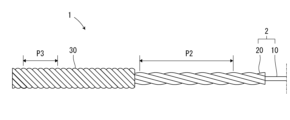
- FIG. 2 is a side view showing the wire of the embodiment.
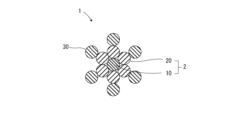
- FIG. 2 is an end view taken along line II-II in FIG.
- FIG. 11 is a side view showing the second wire and the third wire from which a portion has been stripped.
- FIG. 1 is a plan view showing a coaster, which is a processed product using wire.
- FIG. 1 is a plan view showing a basket, which is a processed product made of wire.
- FIG. 1 is a perspective view showing a basket, which is a processed product using wire.
- FIG. 1 is a perspective view showing an ornament that is a processed product using wire.
- the wire 1 comprises an intermediate wire 2 and a third wire 30.
- the first wire 10, the second wire 20, and the third wire 30 are made of a soft metal.
- soft metals include precious metals such as gold, silver, or platinum, aluminum, brass, copper, or alloys of these. All or two of the first wire 10, the second wire 20, and the third wire 30 may be made of the same metal, or each may be made of a different metal.
- the diameters of first wire 10, second wire 20, and third wire 30 are preferably 0.05 mm to 0.50 mm, and more preferably 0.10 mm to 0.30 mm. All or two of the diameters of first wire 10, second wire 20, and third wire 30 may be the same, or may be different from each other.
- the twist pitch P2 of the second wire 20 is preferably 1.0 to 5.0 times the twist pitch P3 of the third wire 30, and more preferably 2.0 to 4.0 times. These numerical ranges make the wire 1 easier to deform (process) by bending, etc., and the twist is less likely to fray when the wire 1 is deformed.
- the intermediate wire 2 has six second wires 20 twisted in a counterclockwise spiral around the outer periphery of the first wire 10.
- six third wires 30 are twisted in a counterclockwise spiral around the outer periphery of the intermediate wire 2 (the outer periphery of the second wire 20).
- the first wire 10, the second wire 20, and the third wire 30 are all linear members with a circular cross section, and are made of silver.
- the diameters of the first wire 10, the second wire 20, and the third wire 30 are all 0.12 m.
- the twist pitch P2 of the second wire 20 is 1.63 mm.
- the twist pitch P3 of the third wire 30 is 0.66 mm.
- the twist pitch P2 of the second wire 20 is 2.50 times the twist pitch P3 of the third wire 30.
- the processed product is made using only the wire rod 1 or the wire rod 1 together with other materials.
- the processed product is not particularly limited, but may be, for example, a craft, an ornament, or tableware.
- the processed product is made by bending, knotting, braiding, or binding the wire rod 1.
- Figure 4 shows an example of a processed product using wire 1, a coaster 100 (rug) made by tying (weaving) multiple aligned wires 1 multiple times.
- This coaster 100 was made using a tying (weaving) method called Ume Musubi, which is a technique used in Mizuhiki crafts.
- FIGS 5 and 6 show an example of a processed product using wire 1, which is a basket 200 made by tying (weaving) multiple wires 1 multiple times.
- This basket 200 is made using a knotting (weaving) method called Awaji knot, which is a technique used in Mizuhiki crafts.
- Figure 7 shows an example of a processed product using wire 1, a turtle figurine 300 made by bending, knotting (braiding), and tying multiple pieces of wire 1. This figurine 300 was also made using the mizuhiki craft technique.
- the deformation of the wire 1 is not limited to bending, knotting (braiding) and binding, but may be other deformations.
- the above-mentioned processed products are made by a craftsman using the Mizuhiki craft technique, but they may be made using techniques other than Mizuhiki craft, or may be made by a machine or device.
- the wire 1 comprises an intermediate wire 2 in which one or more second wires 20 made of a soft metal are twisted around the outer periphery of a first wire 10 made of a soft metal, and one or more third wires 30 made of a soft metal.
- the third wires 30 are twisted around the outer periphery of the intermediate wire 2, and the twist pitch P2 of the second wires 20 is longer than the twist pitch P3 of the third wires 30.
- processed products using this wire 1 are stronger than processed products using paper wire, and their gloss makes them more aesthetically pleasing and increases their commercial value.
- the portion of the processed product made of wire 1 is soft, the portion made of wire 1 can be deformed from its original shape according to preference and use. For example, if the processed product made of wire 1 is a basket 200, it can be freely deformed from the original shape shown in Figures 5 and 6 by applying an external force.
- the wire 1 shines beautifully, coupled with the twisting of the second wire 20 and the third wire 30. Furthermore, processed products using this wire 1 shine beautifully, and are more aesthetically pleasing and have higher commercial value.
- the wire 1 can be deformed more easily into finer or more complex shapes. In addition, the wire 1 can be more easily deformed into the shape intended by the maker.
- the wire 1 can be deformed more easily into finer or more complex shapes. Furthermore, the wire 1 can be deformed more easily into the shape intended by the maker. Furthermore, even when the wire 1 is deformed, the twists of the second wire 20 and the third wire 30 are less likely to fray.
Landscapes
- Engineering & Computer Science (AREA)
- Textile Engineering (AREA)
- Wire Processing (AREA)
- Decoration Of Textiles (AREA)
Priority Applications (2)
| Application Number | Priority Date | Filing Date | Title |
|---|---|---|---|
| JP2024554213A JP7796982B2 (ja) | 2024-01-01 | 2024-01-01 | 線材およびこれを用いた加工品 |
| PCT/JP2024/000001 WO2025146708A1 (ja) | 2024-01-01 | 2024-01-01 | 線材およびこれを用いた加工品 |
Applications Claiming Priority (1)
| Application Number | Priority Date | Filing Date | Title |
|---|---|---|---|
| PCT/JP2024/000001 WO2025146708A1 (ja) | 2024-01-01 | 2024-01-01 | 線材およびこれを用いた加工品 |
Publications (1)
| Publication Number | Publication Date |
|---|---|
| WO2025146708A1 true WO2025146708A1 (ja) | 2025-07-10 |
Family
ID=96300171
Family Applications (1)
| Application Number | Title | Priority Date | Filing Date |
|---|---|---|---|
| PCT/JP2024/000001 Pending WO2025146708A1 (ja) | 2024-01-01 | 2024-01-01 | 線材およびこれを用いた加工品 |
Country Status (2)
| Country | Link |
|---|---|
| JP (1) | JP7796982B2 (https=) |
| WO (1) | WO2025146708A1 (https=) |
Citations (3)
| Publication number | Priority date | Publication date | Assignee | Title |
|---|---|---|---|---|
| JPH08113856A (ja) * | 1994-10-14 | 1996-05-07 | Oike Ind Co Ltd | 水 引 |
| JP2014137876A (ja) * | 2013-01-16 | 2014-07-28 | Sumitomo Wiring Syst Ltd | 撚線導体、被覆電線、および撚線導体の製造方法 |
| WO2017086406A1 (ja) * | 2015-11-17 | 2017-05-26 | 古河電気工業株式会社 | 撚線導体、及び撚線導体の製造方法 |
Family Cites Families (2)
| Publication number | Priority date | Publication date | Assignee | Title |
|---|---|---|---|---|
| JPS5632558Y2 (https=) * | 1978-02-23 | 1981-08-03 | ||
| FR2694306B1 (fr) * | 1992-07-31 | 1994-10-21 | Louyot Comptoir Lyon Alemand | Fils comprenant un élément hélicoïdal, leurs assemblages et l'utilisation desdits assemblages comme catalyseur et/ou pour récupérer des métaux précieux. |
-
2024
- 2024-01-01 JP JP2024554213A patent/JP7796982B2/ja active Active
- 2024-01-01 WO PCT/JP2024/000001 patent/WO2025146708A1/ja active Pending
Patent Citations (3)
| Publication number | Priority date | Publication date | Assignee | Title |
|---|---|---|---|---|
| JPH08113856A (ja) * | 1994-10-14 | 1996-05-07 | Oike Ind Co Ltd | 水 引 |
| JP2014137876A (ja) * | 2013-01-16 | 2014-07-28 | Sumitomo Wiring Syst Ltd | 撚線導体、被覆電線、および撚線導体の製造方法 |
| WO2017086406A1 (ja) * | 2015-11-17 | 2017-05-26 | 古河電気工業株式会社 | 撚線導体、及び撚線導体の製造方法 |
Also Published As
| Publication number | Publication date |
|---|---|
| JPWO2025146708A1 (https=) | 2025-07-10 |
| JP7796982B2 (ja) | 2026-01-13 |
Similar Documents
| Publication | Publication Date | Title |
|---|---|---|
| US6722036B2 (en) | Method of making self-stopping beads | |
| JP2866343B2 (ja) | 模造樹木 | |
| JPH02215403A (ja) | ネックレス、ブレスレット及びその類似物品の実現に適合した製作物品の合成組付方法並びにその方法を使用して得た物品 | |
| JP7796982B2 (ja) | 線材およびこれを用いた加工品 | |
| CN103251159A (zh) | 假睫毛及其制造方法 | |
| JPWO2008102532A1 (ja) | 線状部材、線状部材の製造方法および装身具 | |
| JP4072567B2 (ja) | 装身具用ワイヤの製造方法 | |
| US3614876A (en) | Ear-ring and method of manufacture | |
| JP4692949B2 (ja) | 歯間ブラシ | |
| JP5306763B2 (ja) | 線状部材および装身具 | |
| KR102325960B1 (ko) | 매듭 목걸이 줄의 제조방법 | |
| JP7269616B2 (ja) | 紙袋の持ち手用の組紐およびその製造方法 | |
| KR200388462Y1 (ko) | 장신구용 링 및 이 링을 이용한 체인 | |
| US20040172972A1 (en) | Textured surface rope chain and method for the fabrication thereof | |
| JP7109128B1 (ja) | ネックレス | |
| JP3072328U (ja) | 装飾具用ワイヤ | |
| KR200489047Y1 (ko) | 양모로 형성된 모루 | |
| KR102477048B1 (ko) | 팔찌 제조방법 | |
| JP5626940B1 (ja) | 玉掛索の製造方法、及び、玉掛索 | |
| TWI284517B (en) | Connective terminal of necklace and hand chain | |
| ITVI980023U1 (it) | Catena a scopo ornamentale | |
| JP2015203170A (ja) | ビーズの脱落防止形状 | |
| JP4276850B2 (ja) | 装身具 | |
| US1002488A (en) | Method of making garment-stays. | |
| JP2019007106A (ja) | 伸縮性紐 |
Legal Events
| Date | Code | Title | Description |
|---|---|---|---|
| ENP | Entry into the national phase |
Ref document number: 2024554213 Country of ref document: JP Kind code of ref document: A |
|
| WWE | Wipo information: entry into national phase |
Ref document number: 2024554213 Country of ref document: JP |
|
| 121 | Ep: the epo has been informed by wipo that ep was designated in this application |
Ref document number: 24915632 Country of ref document: EP Kind code of ref document: A1 |