WO2025142747A1 - 方向性電磁鋼板 - Google Patents
方向性電磁鋼板 Download PDFInfo
- Publication number
- WO2025142747A1 WO2025142747A1 PCT/JP2024/045058 JP2024045058W WO2025142747A1 WO 2025142747 A1 WO2025142747 A1 WO 2025142747A1 JP 2024045058 W JP2024045058 W JP 2024045058W WO 2025142747 A1 WO2025142747 A1 WO 2025142747A1
- Authority
- WO
- WIPO (PCT)
- Prior art keywords
- steel sheet
- mass
- grain
- oriented electrical
- electrical steel
- Prior art date
- Legal status (The legal status is an assumption and is not a legal conclusion. Google has not performed a legal analysis and makes no representation as to the accuracy of the status listed.)
- Pending
Links
Images


Classifications
-
- C—CHEMISTRY; METALLURGY
- C22—METALLURGY; FERROUS OR NON-FERROUS ALLOYS; TREATMENT OF ALLOYS OR NON-FERROUS METALS
- C22C—ALLOYS
- C22C38/00—Ferrous alloys, e.g. steel alloys
-
- C—CHEMISTRY; METALLURGY
- C22—METALLURGY; FERROUS OR NON-FERROUS ALLOYS; TREATMENT OF ALLOYS OR NON-FERROUS METALS
- C22C—ALLOYS
- C22C38/00—Ferrous alloys, e.g. steel alloys
- C22C38/14—Ferrous alloys, e.g. steel alloys containing titanium or zirconium
-
- C—CHEMISTRY; METALLURGY
- C22—METALLURGY; FERROUS OR NON-FERROUS ALLOYS; TREATMENT OF ALLOYS OR NON-FERROUS METALS
- C22C—ALLOYS
- C22C38/00—Ferrous alloys, e.g. steel alloys
- C22C38/60—Ferrous alloys, e.g. steel alloys containing lead, selenium, tellurium, or antimony, or more than 0.04% by weight of sulfur
-
- H—ELECTRICITY
- H01—ELECTRIC ELEMENTS
- H01F—MAGNETS; INDUCTANCES; TRANSFORMERS; SELECTION OF MATERIALS FOR THEIR MAGNETIC PROPERTIES
- H01F1/00—Magnets or magnetic bodies characterised by the magnetic materials therefor; Selection of materials for their magnetic properties
- H01F1/01—Magnets or magnetic bodies characterised by the magnetic materials therefor; Selection of materials for their magnetic properties of inorganic materials
- H01F1/03—Magnets or magnetic bodies characterised by the magnetic materials therefor; Selection of materials for their magnetic properties of inorganic materials characterised by their coercivity
- H01F1/12—Magnets or magnetic bodies characterised by the magnetic materials therefor; Selection of materials for their magnetic properties of inorganic materials characterised by their coercivity of soft-magnetic materials
- H01F1/14—Magnets or magnetic bodies characterised by the magnetic materials therefor; Selection of materials for their magnetic properties of inorganic materials characterised by their coercivity of soft-magnetic materials metals or alloys
- H01F1/147—Alloys characterised by their composition
-
- C—CHEMISTRY; METALLURGY
- C21—METALLURGY OF IRON
- C21D—MODIFYING THE PHYSICAL STRUCTURE OF FERROUS METALS; GENERAL DEVICES FOR HEAT TREATMENT OF FERROUS OR NON-FERROUS METALS OR ALLOYS; MAKING METAL MALLEABLE, e.g. BY DECARBURISATION OR TEMPERING
- C21D8/00—Modifying the physical properties of ferrous metals or ferrous alloys by deformation combined with, or followed by, heat treatment
- C21D8/12—Modifying the physical properties of ferrous metals or ferrous alloys by deformation combined with, or followed by, heat treatment during manufacturing of articles with special electromagnetic properties
-
- Y—GENERAL TAGGING OF NEW TECHNOLOGICAL DEVELOPMENTS; GENERAL TAGGING OF CROSS-SECTIONAL TECHNOLOGIES SPANNING OVER SEVERAL SECTIONS OF THE IPC; TECHNICAL SUBJECTS COVERED BY FORMER USPC CROSS-REFERENCE ART COLLECTIONS [XRACs] AND DIGESTS
- Y02—TECHNOLOGIES OR APPLICATIONS FOR MITIGATION OR ADAPTATION AGAINST CLIMATE CHANGE
- Y02P—CLIMATE CHANGE MITIGATION TECHNOLOGIES IN THE PRODUCTION OR PROCESSING OF GOODS
- Y02P10/00—Technologies related to metal processing
- Y02P10/20—Recycling
Definitions
- the present invention relates to grain-oriented electrical steel sheets suitable for use as transformer core materials.
- Grain-oriented electrical steel sheet is a soft magnetic material used as the iron core material of transformers, and has a crystal structure in which the ⁇ 001> orientation, the axis of easy magnetization of iron, is highly aligned in the rolling direction of the steel sheet.
- This type of texture is formed during the manufacturing process of grain-oriented electrical steel sheet through a phenomenon called secondary recrystallization, in which crystal grains with the ⁇ 110 ⁇ 001> orientation, known as the Goss orientation, are preferentially grown to large sizes during purification annealing.
- the commonly used technique for this formation method is to use a precipitate called an inhibitor to cause secondary recrystallization of grains with Goss orientation during purification annealing.
- a precipitate called an inhibitor to cause secondary recrystallization of grains with Goss orientation during purification annealing.
- the method using AlN described in Patent Document 1 and the method using MnS and MnSe described in Patent Document 2 have been put into industrial use.
- the method of using these inhibitors is useful for stably developing secondary recrystallized grains, but in order to finely disperse the inhibitors in the steel, it is necessary to heat the slab at high temperatures of over 1300°C and dissolve the inhibitor components once.
- Grain-oriented electrical steel sheets are mainly used as transformer cores, and are required to have excellent magnetization characteristics, particularly low iron loss. To achieve this, it is important to highly align the secondary recrystallized grains in the steel sheet to the Goss orientation and to reduce impurities in the product sheet.
- a technology has been developed that introduces nonuniformity into the surface of the steel sheet by a physical method, subdivides the width of the magnetic domains, and reduces the iron loss, that is, a magnetic domain subdivision technology.
- Patent Document 4 proposes a technology that irradiates a final product sheet with a laser, introduces a high dislocation density region into the surface layer of the steel sheet, and narrows the magnetic domain width, thereby reducing the iron loss of the steel sheet.
- Patent Document 5 proposes a technology that controls the magnetic domain width by irradiating it with an electron beam.
- hysteresis loss is reduced by aligning the orientation after secondary recrystallization to the Goss orientation and by reducing impurities, while eddy current loss is reduced by applying magnetic domain refinement technology.
- grain-oriented electrical steel sheets are mainly used as the cores of transformers.
- the iron loss value of a transformer core there is a discrepancy between the iron loss value of a transformer core and the iron loss value of the grain-oriented electrical steel sheets that are the material, with the transformer core having a larger iron loss.
- the ratio of the iron losses between the two is called the building factor. In other words, even if the material has good core loss, if the building factor is high, the core loss of the transformer will increase, resulting in the problem of being unable to achieve sufficient performance.
- an object of the present invention is to provide a grain-oriented electrical steel sheet that can sufficiently suppress the building factor when used as an iron core material for a transformer.
- the inventors After extensive research, the inventors have focused on the Ga content in the base steel sheet when forming a base coating mainly composed of forsterite on the base steel sheet, and the Ti content in the entire grain-oriented electrical steel sheet after the base coating has been formed. They have discovered that by controlling the Ga and Ti contents in particular within a specified range and satisfying the specified formula (1), a grain-oriented electrical steel sheet capable of exhibiting a low building factor can be obtained.
- any numerical range expressed using "" means a range that includes the numerical values before and after "" as the lower and upper limits, respectively.
- ⁇ Experiment 1> In order to mainly change the Ga content in the base steel sheet, a steel slab containing, by mass%, 0.0500-0.0810% C, 3.15-3.31% Si, 0.07-0.10% Mn, 0.0200-0.0250% Al, 0.0069-0.0085% N, 0.0011-0.0031% S, 0.025-0.036% Sb, 0.0080-0.0090% Ti, and 0.0000-0.0058% Ga, with the balance being Fe and unavoidable impurities, was produced by continuous casting and used.
- This steel slab was subjected to slab heating by soaking at 1400°C for 20 minutes, and then finished into a hot-rolled sheet with a thickness of 2.4 mm by hot rolling. Then, the hot-rolled sheet was annealed at 1000°C for 30 seconds in a N2 atmosphere. Next, the annealed hot-rolled sheet was cold-rolled to finish it into an intermediate cold-rolled sheet with a thickness of 1.5 mm, and further annealed at 1000°C for 100 seconds in a 25% H2-75 % N2 atmosphere. Then, the intermediate cold-rolled sheet after annealing was cold-rolled to finish it into a cold-rolled sheet with a thickness of 0.23 mm.
- This cold-rolled sheet was decarburized in a moist atmosphere of 50% H2-50 % N2 and a dew point of 50°C at 850°C for 150 seconds. Furthermore, an annealing separator mainly composed of MgO was applied to the surface (both sides) of the obtained decarburized annealed sheet, and purification annealing was performed by holding at 1200°C for 10 hours, to form a base coating mainly composed of forsterite. At that time, the heating rate up to 1200°C was 20°C/h.
- N2 atmosphere was used from room temperature to 700°C
- N2 and H2 mixture ratios were changed from 700°C to 1100°C
- H2 atmosphere was used from 1100°C to 1200°C.
- H2 atmosphere was used during holding
- Ar atmosphere was used during cooling.
- the thus obtained grain-oriented electrical steel sheets having a base coating (forsterite coating) mainly composed of forsterite formed on the surface of the base steel sheet were used as samples.
- the iron losses W17 /50 and W19 /50 iron losses when excited to 1.7 T and 1.9 T, respectively, at 50 Hz
- hysteresis losses Wh17 and Wh19 hysteresis losses when excited to 1.7 T and 1.9 T, respectively
- a three-phase three-legged model transformer was made from the obtained samples, with an external shape simulating a transformer: 500 mm square, with each leg and yoke having a plate width of 100 mm.
- the iron loss WT 17/50 transformer iron loss when excited to 1.7 T at 50 Hz
- the number of sample layers in the model transformer was 50, and they were stacked in pairs.
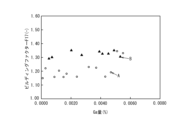
- the building factor F17 of the model transformer was calculated by dividing the model transformer iron loss WT17 /50 by the sample iron loss W17 /50 (WT17 /50 /W17 /50 , no unit). The relationship between this F17 and the Ga content (unit: mass%) in the base steel sheet was then investigated. The results are shown in Figure 1.
- Example 2 A steel slab containing, by mass%, 0.0370% C, 3.05% Si, 0.18% Mn, 0.0090% Al, 0.0036% N, 0.0070% Se, 0.062% Sn, and 0.0030% Ga, with the balance being Fe and unavoidable impurities, was produced by continuous casting and used.
- This steel slab was subjected to slab heating by soaking at 1300 ° C for 30 minutes, and then finished into a hot-rolled sheet with a thickness of 2.2 mm by hot rolling. Then, this hot-rolled sheet was subjected to hot-rolled sheet annealing at 1100 ° C for 30 seconds in an N 2 atmosphere.
- the hot-rolled sheet after annealing was subjected to cold rolling to finish into a cold-rolled sheet with a thickness of 0.23 mm.
- This cold-rolled sheet was subjected to decarburization annealing at 840°C for 120 seconds in a moist atmosphere of 40% H2-60 % N2 , dew point: 40°C.
- an annealing separator in which TiO2 was mixed in various amounts in the range of 0 to 15 parts by mass relative to MgO was applied to the surface of the obtained decarburized annealed sheet, and purification annealing was performed by holding at 1220°C for 5 hours to form a base coating mainly composed of forsterite.
- the heating rate up to 1220°C was 15°C/h, and further, in the heating process, an N2 atmosphere was used from room temperature to 700°C, an atmosphere with variously changed N2 and H2 mixture ratios was used from over 700°C to 1100°C, and an H2 atmosphere was used from over 1100°C to 1200°C. In addition, an H2 atmosphere was used during holding, and an Ar atmosphere was used during cooling.
- the mixture ratio of N2 and H2 in the atmosphere in the temperature range from over 700°C to 1100°C the Ti content in the steel sheet with the undercoat film still on, i.e., in the entire grain-oriented electrical steel sheet constituted by the base steel sheet and the undercoat film, was controlled.
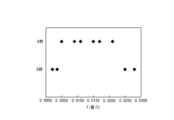
- 1 is a graph showing the relationship between the Ga content in a base steel sheet and the building factor. 1 is a graph showing the relationship between the Ga content in a base steel sheet and group A and group B, and the relationship with their building factors. 1 is a graph showing the Ti content in grain-oriented electrical steel sheets in Group A and Group B. 1 is a graph showing the relationship between the Ti content in a grain-oriented electrical steel sheet and the building factor.
- composition of the base steel sheet of the grain-oriented electrical steel sheet of the present invention contains at least the above-mentioned basic components, with the balance being Fe and unavoidable impurities.
- the base steel sheet may contain the following optional elements as necessary.
- the above-mentioned composition is the composition of the base steel sheet on which no forsterite-based undercoating is formed.
- the Ti content in grain-oriented electrical steel sheet having a forsterite-based undercoating formed on the surface is limited to 0.0050-0.0210% for the reasons mentioned above.
- the Ti content in grain-oriented electrical steel sheet is preferably 0.0060% or more.
- the lower limit of the Ti content in grain-oriented electrical steel sheet having a undercoating is 0.0050% because, as mentioned above, the presence of a certain amount of Ti in the forsterite coating is thought to improve the coating properties, reduce magnetostriction, and improve eddy current loss, but if the amount is less than 0.0050%, this effect is poor.
- the Ti content in grain-oriented electrical steel sheets is 0.0210% or less, and preferably 0.0150% or less. Excessive Ti content is not preferred because it increases costs. Also, too much Ti penetrates into the base steel sheet from the annealing separator used to form the forsterite film.
- the Ti content in grain-oriented electrical steel sheet is the ratio (mass %) of the total amount of Ti present in the base steel sheet and the base coating to the total mass (solid content equivalent) of the base steel sheet and the base coating.
- the Ti content in grain-oriented electrical steel sheet can be measured in accordance with JIS G1223, regardless of whether the base coating is formed on only one side or both sides of the base steel sheet.
- the grain-oriented electrical steel sheet preferably has an insulating coating on the surface of the base coating.
- This insulating coating is preferably a coating capable of applying tension to the grain-oriented electrical steel sheet.
- the core loss can be further improved by applying additional tension to the steel sheet.
- the insulating coating can be well formed, for example, according to the manufacturing method described below.
- a method for manufacturing a general electrical steel sheet can be used.
- a slab may be manufactured from the molten steel adjusted to the above-mentioned predetermined composition by a normal ingot-making method or a continuous casting method.
- a thin cast piece having a thickness of 100 mm or less may be manufactured from the molten steel by a direct casting method.
- the molten steel may be manufactured by a blast furnace method or an electric furnace method. Since it is difficult to add the above-mentioned optional components that are desirably added during the intermediate process, it is desirable to add them at this molten steel stage.
- the slab can be heated and hot rolled in the usual way.
- the slab may be cast and hot rolled immediately without heating.
- high temperature heating to dissolve the inhibitor is not required, so performing the heating at a low temperature of 1300°C or less is effective in reducing costs.
- the heating temperature of the slab is preferably 1250°C or less.
- the hot rolling conditions can be the same as in the usual way. In this way, a hot-rolled sheet can be obtained.
- the hot-rolled sheet annealing temperature is preferably in the range of about 950 to 1150°C. If the hot-rolled sheet annealing temperature is less than 950°C, unrecrystallized parts are likely to remain in the steel. On the other hand, if the hot-rolled sheet annealing temperature exceeds 1150°C, the grain size in the steel after annealing may become too coarse, and the subsequent primary recrystallization texture may become inappropriate.
- the hot-rolled sheet annealing temperature is preferably 950°C or higher, more preferably 1000°C or higher.
- the hot-rolled sheet annealing temperature is preferably 1150°C or lower, more preferably 1100°C or lower. In this manner, a hot-rolled annealed sheet can be obtained.
- the hot-rolled sheet after hot rolling or the hot-rolled annealed sheet after hot-rolled sheet annealing can be made into a cold-rolled sheet having the final sheet thickness by one cold rolling or two or more cold rollings with intermediate annealing in between.
- the annealing temperature of the intermediate annealing is preferably 900°C or higher, preferably 1200°C or lower, and more preferably in the range of 900 to 1200°C. If the intermediate annealing temperature is less than 900°C, the recrystallized grains after intermediate annealing tend to be fine. Furthermore, the number of Goss nuclei in the primary recrystallized structure decreases, and the magnetic properties of the grain-oriented electrical steel sheet, which is the product sheet, may decrease.
- the intermediate annealing temperature exceeds 1200°C, the crystal grains may become too coarse, as in the case of hot-rolled sheet annealing, making it difficult to obtain a uniform primary recrystallized structure. In this way, a cold-rolled sheet can be obtained.
- the cold-rolled sheet having been reduced to the final thickness can then be subjected to primary recrystallization annealing, which also serves as decarburization annealing.
- the annealing temperature in this primary recrystallization annealing is preferably 800°C or higher, and preferably 900°C or lower, more preferably in the range of 800 to 900°C, in order to allow the decarburization reaction to proceed quickly.
- the atmosphere during the primary recrystallization annealing, which also serves as decarburization annealing is a humid atmosphere. In this way, a primary recrystallized sheet (decarburization annealed sheet) can be obtained.
- Ti can be effectively present in the forsterite coating.
- TiO2 and TiN are preferred as Ti compounds, and TiO2 is more preferred.
- the content of the compound in the annealing separator is preferably 2 parts by mass or more and 15 parts by mass or less relative to MgO.
- the above Ti requirement for grain-oriented electrical steel sheets may be met by other methods. For example, when Ti exceeds 30 ppm in the slab, Ti can be concentrated on the surface by annealing in a nitrogen atmosphere in an annealing step before the final annealing, and the Ti concentration in the steel sheet can be controlled by descaling.
- Secondary recrystallization annealing is preferably performed at 800°C or higher to induce secondary recrystallization in the Goss orientation. From the perspective of purification, it is also desirable to raise the temperature to 1100°C or higher. The longer the holding time, the greater the purification, but if it is too long, shape deterioration due to high-temperature creep may occur. Therefore, the holding time for purification annealing is preferably 3 hours or more, and 15 hours or less. After secondary recrystallization annealing, it is preferable to wash with water, brush, or pickle in order to remove any adhering annealing separator.
- flattening annealing to correct the shape is effective in reducing iron loss.
- an insulating coating is preferably one that can impart tension to the grain-oriented electrical steel sheet in order to reduce iron loss. It is preferable to employ a method of forming a coating by depositing an inorganic substance on the surface of the steel sheet using a tension coating application method via a binder, physical vapor deposition method, or chemical vapor deposition method, as this provides excellent coating adhesion and tends to increase the iron loss reduction effect.
- Steel slab A contains C: 0.0700%, Si: 3.55%, Mn: 0.07%, Al: 0.0080%, N: 0.0050%, Ga: 0.0040%, Mo: 0.026%, Ti: 0.0250%, and the balance is Fe and unavoidable impurities.
- Steel slab B which contains 0.025%, 0.0025% Ti, and the balance is Fe and unavoidable impurities
- steel slab C which contains 0.0720%, 3.49%, 0.07%, 0.0090%, 0.0051%, 0.00001%, 0.025%, 0.0240% Ti, and the balance is Fe and unavoidable impurities, were produced by continuous casting.
- Steel slabs A, B, and C were subjected to slab heating at 1200°C for 40 minutes.
- hot-rolled sheets with a thickness of 2.2 mm by hot rolling.
- the hot-rolled sheets were subjected to hot-rolled sheet annealing at 1000°C for 60 seconds in a N2 atmosphere.
- the resulting hot-rolled and annealed sheet was then cold-rolled to a thickness of 0.23 mm, and then subjected to primary recrystallization annealing, which also served as decarburization annealing, at 850°C for 90 seconds in a 60% H2-40 % N2 wet atmosphere with a dew point of 60°C.
- an annealing separator mainly composed of MgO (MgO: 97%) was applied to both surfaces of the base steel sheet (primary recrystallized sheet) after decarburization annealing. After that, the steel was held at 1100°C for 25 hours, and then purified by annealing at 1200°C for 10 hours.
- the atmosphere was N2 from room temperature to 700°C
- the atmosphere was variously changed in the mixture ratio of N2 and H2 from over 700°C to 1100°C
- the atmosphere was H2 from the start of holding over 1100°C to the end of holding at 1200°C.
- the cooling was performed in an Ar atmosphere.
- the annealed intermediate cold-rolled sheet was cold-rolled to be finished into a cold-rolled sheet having a thickness of 0.23 mm.
- This cold-rolled sheet was subjected to decarburization annealing at 825°C for 150 seconds in a moist atmosphere of 40% H2-60 % N2 with a dew point of 45°C.
- an annealing separator mainly composed of MgO (MgO: 88%) was applied to the surfaces (both sides) of the obtained decarburized annealed sheet.
- TiO2 powder was added to hot water at 50 °C, stirred for 24 hours, and then 5 parts by mass of perhydrated TiO2 was added to the powdered MgO.
- the thus obtained grain-oriented electrical steel sheets with a forsterite-based undercoat formed on the surface of the base steel sheet were used as samples.
- the iron losses W 17/50 and W 19/50 (iron losses when excited to 1.7 T and 1.9 T, respectively, at 50 Hz) and hysteresis losses Wh 17 and Wh 19 (hysteresis losses when excited to 1.7 T and 1.9 T, respectively) of these samples were measured according to the method specified in JIS C2550-1.
Landscapes
- Chemical & Material Sciences (AREA)
- Engineering & Computer Science (AREA)
- Materials Engineering (AREA)
- Mechanical Engineering (AREA)
- Metallurgy (AREA)
- Organic Chemistry (AREA)
- Physics & Mathematics (AREA)
- Electromagnetism (AREA)
- Dispersion Chemistry (AREA)
- Power Engineering (AREA)
- Manufacturing Of Steel Electrode Plates (AREA)
- Soft Magnetic Materials (AREA)
Priority Applications (1)
| Application Number | Priority Date | Filing Date | Title |
|---|---|---|---|
| JP2025524375A JP7800777B2 (ja) | 2023-12-27 | 2024-12-19 | 方向性電磁鋼板 |
Applications Claiming Priority (2)
| Application Number | Priority Date | Filing Date | Title |
|---|---|---|---|
| JP2023221730 | 2023-12-27 | ||
| JP2023-221730 | 2023-12-27 |
Publications (1)
| Publication Number | Publication Date |
|---|---|
| WO2025142747A1 true WO2025142747A1 (ja) | 2025-07-03 |
Family
ID=96217847
Family Applications (1)
| Application Number | Title | Priority Date | Filing Date |
|---|---|---|---|
| PCT/JP2024/045058 Pending WO2025142747A1 (ja) | 2023-12-27 | 2024-12-19 | 方向性電磁鋼板 |
Country Status (2)
| Country | Link |
|---|---|
| JP (1) | JP7800777B2 (https=) |
| WO (1) | WO2025142747A1 (https=) |
Citations (5)
| Publication number | Priority date | Publication date | Assignee | Title |
|---|---|---|---|---|
| JPH09291313A (ja) * | 1996-04-25 | 1997-11-11 | Kawasaki Steel Corp | 磁気特性・被膜特性に優れる方向性けい素鋼板の製造方法 |
| JP2017020059A (ja) * | 2015-07-08 | 2017-01-26 | Jfeスチール株式会社 | 方向性電磁鋼板とその製造方法 |
| JP2021123766A (ja) * | 2020-02-06 | 2021-08-30 | 日本製鉄株式会社 | 方向性電磁鋼板、および方向性電磁鋼板の製造方法、ならびに焼鈍分離剤 |
| KR20230094748A (ko) * | 2021-12-21 | 2023-06-28 | 주식회사 포스코 | 방향성 전기강판 및 이의 제조방법 |
| WO2024053608A1 (ja) * | 2022-09-09 | 2024-03-14 | Jfeスチール株式会社 | 方向性電磁鋼板 |
-
2024
- 2024-12-19 JP JP2025524375A patent/JP7800777B2/ja active Active
- 2024-12-19 WO PCT/JP2024/045058 patent/WO2025142747A1/ja active Pending
Patent Citations (5)
| Publication number | Priority date | Publication date | Assignee | Title |
|---|---|---|---|---|
| JPH09291313A (ja) * | 1996-04-25 | 1997-11-11 | Kawasaki Steel Corp | 磁気特性・被膜特性に優れる方向性けい素鋼板の製造方法 |
| JP2017020059A (ja) * | 2015-07-08 | 2017-01-26 | Jfeスチール株式会社 | 方向性電磁鋼板とその製造方法 |
| JP2021123766A (ja) * | 2020-02-06 | 2021-08-30 | 日本製鉄株式会社 | 方向性電磁鋼板、および方向性電磁鋼板の製造方法、ならびに焼鈍分離剤 |
| KR20230094748A (ko) * | 2021-12-21 | 2023-06-28 | 주식회사 포스코 | 방향성 전기강판 및 이의 제조방법 |
| WO2024053608A1 (ja) * | 2022-09-09 | 2024-03-14 | Jfeスチール株式会社 | 方向性電磁鋼板 |
Also Published As
| Publication number | Publication date |
|---|---|
| JP7800777B2 (ja) | 2026-01-16 |
| JPWO2025142747A1 (https=) | 2025-07-03 |
Similar Documents
| Publication | Publication Date | Title |
|---|---|---|
| US6562473B1 (en) | Electrical steel sheet suitable for compact iron core and manufacturing method therefor | |
| JP5754097B2 (ja) | 方向性電磁鋼板およびその製造方法 | |
| US9514868B2 (en) | Grain oriented electrical steel sheet and method for manufacturing the same | |
| JP7601280B2 (ja) | 方向性電磁鋼板 | |
| WO2011115120A1 (ja) | 方向性電磁鋼板の製造方法 | |
| WO2011102456A1 (ja) | 方向性電磁鋼板の製造方法 | |
| JP7517472B2 (ja) | 方向性電磁鋼板の製造方法 | |
| JP7221481B6 (ja) | 方向性電磁鋼板およびその製造方法 | |
| JP7226678B1 (ja) | 方向性電磁鋼板の製造方法 | |
| JP7800777B2 (ja) | 方向性電磁鋼板 | |
| JP7761565B2 (ja) | 方向性電磁鋼板の製造方法 | |
| JP2000034521A (ja) | 磁気特性に優れる方向性電磁鋼板の製造方法 | |
| JP7806973B2 (ja) | 方向性電磁鋼板 | |
| WO2025142748A1 (ja) | 方向性電磁鋼板 | |
| JP5754170B2 (ja) | 方向性電磁鋼板の製造方法 | |
| JPH11323438A (ja) | 磁気特性に優れる方向性電磁鋼板の製造方法 | |
| WO2022210504A1 (ja) | 方向性電磁鋼板の製造方法 | |
| JP7816665B1 (ja) | 方向性電磁鋼板の製造方法 | |
| JP7804241B2 (ja) | 方向性電磁鋼板の製造方法 | |
| JP7816664B1 (ja) | 方向性電磁鋼板の製造方法 | |
| JP7226677B1 (ja) | 方向性電磁鋼板の製造方法 | |
| JP3357615B2 (ja) | 極めて鉄損が低い方向性けい素鋼板の製造方法 | |
| WO2024162442A1 (ja) | 方向性電磁鋼板の製造方法 | |
| WO2026048322A1 (ja) | 方向性電磁鋼板の製造方法 | |
| JP2025541882A (ja) | 方向性電磁鋼板およびその製造方法 |
Legal Events
| Date | Code | Title | Description |
|---|---|---|---|
| ENP | Entry into the national phase |
Ref document number: 2025524375 Country of ref document: JP Kind code of ref document: A |
|
| WWE | Wipo information: entry into national phase |
Ref document number: 2025524375 Country of ref document: JP |
|
| 121 | Ep: the epo has been informed by wipo that ep was designated in this application |
Ref document number: 24912636 Country of ref document: EP Kind code of ref document: A1 |