WO2025134277A1 - 光モジュールおよび光トランシーバ - Google Patents
光モジュールおよび光トランシーバ Download PDFInfo
- Publication number
- WO2025134277A1 WO2025134277A1 PCT/JP2023/045748 JP2023045748W WO2025134277A1 WO 2025134277 A1 WO2025134277 A1 WO 2025134277A1 JP 2023045748 W JP2023045748 W JP 2023045748W WO 2025134277 A1 WO2025134277 A1 WO 2025134277A1
- Authority
- WO
- WIPO (PCT)
- Prior art keywords
- optical
- stem
- semiconductor
- main surface
- capacitor
- Prior art date
- Legal status (The legal status is an assumption and is not a legal conclusion. Google has not performed a legal analysis and makes no representation as to the accuracy of the status listed.)
- Pending
Links
Images





Classifications
-
- H—ELECTRICITY
- H01—ELECTRIC ELEMENTS
- H01S—DEVICES USING THE PROCESS OF LIGHT AMPLIFICATION BY STIMULATED EMISSION OF RADIATION [LASER] TO AMPLIFY OR GENERATE LIGHT; DEVICES USING STIMULATED EMISSION OF ELECTROMAGNETIC RADIATION IN WAVE RANGES OTHER THAN OPTICAL
- H01S5/00—Semiconductor lasers
- H01S5/02—Structural details or components not essential to laser action
- H01S5/022—Mountings; Housings
- H01S5/02208—Mountings; Housings characterised by the shape of the housings
- H01S5/02212—Can-type, e.g. TO-CAN housings with emission along or parallel to symmetry axis
-
- H—ELECTRICITY
- H01—ELECTRIC ELEMENTS
- H01S—DEVICES USING THE PROCESS OF LIGHT AMPLIFICATION BY STIMULATED EMISSION OF RADIATION [LASER] TO AMPLIFY OR GENERATE LIGHT; DEVICES USING STIMULATED EMISSION OF ELECTROMAGNETIC RADIATION IN WAVE RANGES OTHER THAN OPTICAL
- H01S5/00—Semiconductor lasers
- H01S5/02—Structural details or components not essential to laser action
- H01S5/024—Arrangements for thermal management
-
- H—ELECTRICITY
- H01—ELECTRIC ELEMENTS
- H01S—DEVICES USING THE PROCESS OF LIGHT AMPLIFICATION BY STIMULATED EMISSION OF RADIATION [LASER] TO AMPLIFY OR GENERATE LIGHT; DEVICES USING STIMULATED EMISSION OF ELECTROMAGNETIC RADIATION IN WAVE RANGES OTHER THAN OPTICAL
- H01S5/00—Semiconductor lasers
- H01S5/02—Structural details or components not essential to laser action
- H01S5/026—Monolithically integrated components, e.g. waveguides, monitoring photo-detectors, drivers
-
- H—ELECTRICITY
- H01—ELECTRIC ELEMENTS
- H01S—DEVICES USING THE PROCESS OF LIGHT AMPLIFICATION BY STIMULATED EMISSION OF RADIATION [LASER] TO AMPLIFY OR GENERATE LIGHT; DEVICES USING STIMULATED EMISSION OF ELECTROMAGNETIC RADIATION IN WAVE RANGES OTHER THAN OPTICAL
- H01S5/00—Semiconductor lasers
- H01S5/04—Processes or apparatus for excitation, e.g. pumping, e.g. by electron beams
- H01S5/042—Electrical excitation ; Circuits therefor
Definitions
- This disclosure relates to optical modules and optical transceivers.
- Patent Document 1 discloses an optical module having a conductive stem with a first surface and a second surface and a plurality of through holes penetrating between the first surface and the second surface, and a plurality of lead pins.
- the bottom surface of a thermoelectric cooler is fixed to the first surface of the conductive stem.
- a submount substrate having a wiring pattern on the surface opposite the thermoelectric cooler is fixed to the top surface of the thermoelectric cooler.
- a signal wire electrically connects the tip surface of the signal lead pin to the wiring pattern of the submount substrate.
- a photoelectric device is mounted on the submount.
- the photoelectric device is a laser that emits light parallel to the first surface. The emitted light from the photoelectric device is reflected by a mirror in a direction intersecting the first surface.
- a CAN-type optical module such as that in Patent Document 1
- the photoelectric device is not equipped with a function for amplifying modulated light.
- a function for amplifying modulated light As a result, there is a risk that sufficient optical output will not be obtained.
- an amplification function is added, it becomes necessary to secure a mounting area in response to the expansion of the semiconductor optical integrated element, and to add a power supply line, but with the structure in Patent Document 1, it is difficult to secure the mounting area.
- the present disclosure aims to provide an optical module and optical transceiver capable of obtaining high optical output.
- the optical module comprises a stem having a main surface and a surface opposite to the main surface, a lead pin penetrating the stem from the main surface to the surface opposite to the main surface, a temperature control module mounted on the main surface of the stem, a dielectric substrate mounted on the temperature control module on the side opposite to the main surface of the stem, and a semiconductor optical integrated device mounted on the dielectric substrate on the side opposite to the temperature control module, the semiconductor laser and an optical amplifier.
- the optical amplifier can provide high optical output.
- optical modules and optical transceivers according to each embodiment will be described with reference to the drawings.
- the same or corresponding components will be given the same reference numerals, and repeated descriptions may be omitted.
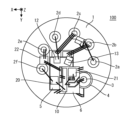
- FIG. 1 is a perspective view of an optical module 100 according to a first embodiment.
- the optical module 100 includes a stem 1 having a main surface and a surface opposite to the main surface.
- the stem 1 is made of metal.
- the stem 1 is a metal material having a surface of a material with high thermal conductivity such as Cu plated with Au, and is also called a stem base.
- the stem 1 is circular in plan view and formed in a plate shape.
- the stem 1 fixes a temperature control module 5 (to be described later) and the like, and releases heat absorbed by the temperature control module 5 to a side surface of the stem 1 and a cooling member (not shown) on the negative side of the Z axis.
- the Z axis is perpendicular to the main surface of the stem 1.
- a raised portion 4 is formed on the main surface of the stem 1.
- the RF power supply lead pin 3 is provided on the raised portion 4 and protrudes from the raised portion 4. Because glass is provided up to near the upper surface of the raised portion 4, the portion of the RF power supply lead pin 3 that protrudes from the glass surface can be shortened. The longer the portion of the RF power supply lead pin 3 that protrudes from the glass surface, the greater the impedance mismatch and the more likely the high frequency characteristics are to deteriorate. In this way, the high frequency characteristics can be improved by the raised portion 4.
- the compression method or the matching method is generally used.
- the stem 1 and the lower substrate 5b of the temperature control module 5 are bonded together.
- the bonding material used may be, for example, solder made of a material such as AuSn, or an adhesive such as resin.
- the oscillation wavelength of the semiconductor optical integrated device 10 changes with changes in temperature. For this reason, it is desirable to keep the temperature of the semiconductor optical integrated device 10 constant.
- the temperature control module 5 cools the semiconductor optical integrated device 10 when the temperature rises, and generates heat when the temperature drops. This makes it possible to keep the temperature of the semiconductor optical integrated device 10 constant.
- a dielectric substrate 6 is mounted on the temperature control module 5 on the side opposite the main surface of the stem 1. Specifically, the dielectric substrate 6 is mounted on the surface of the upper substrate 5a of the temperature control module 5.
- the dielectric substrate 6 is plate-shaped.
- the dielectric substrate 6 is formed by, for example, plating the surface of a ceramic material such as aluminum nitride (AlN) with Au and metalizing it.
- AlN aluminum nitride
- the dielectric substrate 6 fixes the semiconductor optical integrated device 10 and also dissipates heat generated in the semiconductor optical integrated device 10 to the cooling member on the negative Z-axis side of the stem 1. In addition to this heat transfer function, the dielectric substrate 6 also functions as an electrical insulator.
- the dielectric substrate 6 is also located higher in the positive Z-axis direction than the raised portion 4. This makes it possible to avoid interference between the dielectric substrate 6 and the raised portion 4.
- FIG. 2 is a cross-sectional view of a semiconductor optical integrated device 10 according to the first embodiment.
- the semiconductor optical integrated device 10 is mounted on the dielectric substrate 6 on the side opposite the temperature control module 5.
- the semiconductor optical integrated device 10 has a semiconductor laser 7, an optical modulator 8, and an optical amplifier 9.
- the semiconductor laser 7, the optical modulator 8, and the optical amplifier 9 are formed adjacent to each other, but are electrically independent.
- the semiconductor laser 7, the optical modulator 8, and the optical amplifier 9 are electrically insulated from each other by a semi-insulating substrate such as Fe-doped InP, and current can be passed through them independently, providing high current controllability.
- the semiconductor laser 7, the optical modulator 8, and the optical amplifier 9 share a common GND.
- the semiconductor optical integrated element 10 emits laser light parallel to the main surface of the stem 1.
- the main ray of the laser light emitted from the front end face of the semiconductor optical integrated element 10 is emitted at an angle to the main axis of the semiconductor optical integrated element 10.
- the main axis of the semiconductor optical integrated element 10 is the direction along the long side of the semiconductor optical integrated element 10, which is the Y-axis direction in FIG. 1.
- a high-frequency transmission line 6a which is metallized for RF power supply, is formed on the dielectric substrate 6.
- One end of the high-frequency transmission line 6a is connected to the optical modulator 8 by a conductive wire, and the other end is connected to the lead pin 3 for RF power supply by a conductive wire.
- the high-frequency transmission line 6a may be connected to the lead pin 3 for RF power supply by solder or conductive adhesive. The shorter the conductive wire, the lower the inductance component, resulting in better high-frequency characteristics.
- the high-frequency transmission line 6a is a microstrip or coplanar and has an impedance equivalent to the output impedance of the signal generator.
- the electrical signal is applied to the optical modulator 8 via the conductive wire and the high-frequency transmission line 6a.
- the electrical signal input to the RF power supply lead pin 3 is electromagnetically coupled to the stem 1 and the raised portion 4, and the GND electrode pattern of the stem 1, the raised portion 4, and the dielectric substrate 6 acts as an AC ground.
- an optical amplifier 9 is formed in the semiconductor optical integrated device 10. This makes it possible to obtain a high optical output.
- forming the optical amplifier 9 increases the overall length of the semiconductor optical integrated device 10.
- the mounting area in which the thermoelectric cooler is mounted is lower than the reference area in which multiple lead pins are arranged. This results in a small mounting area.
- the submount substrate is enlarged, the area that protrudes from the temperature control module will increase, and the thermal resistance between the submount substrate and the temperature control module will increase. This may make it difficult to apply the optical amplifier 9.
- the surface of the stem 1 from which the lead pins protrude and the surface on which the temperature control module 5 is provided are at the same height. This allows a large mounting space to be secured. Therefore, even when a large semiconductor optical integrated device 10 on which an optical amplifier 9 is formed is provided, the area protruding from the upper substrate 5a of the dielectric substrate 6 can be reduced. This allows the thermal resistance between the dielectric substrate 6 and the temperature control module 5 to be suppressed. Also, in this embodiment, the raised portion 4 allows the portion of the RF power supply lead pin 3 that protrudes from the glass surface to be shortened. Furthermore, the conductive wire connected to the RF power supply lead pin 3 can be shortened. This allows the high frequency characteristics to be improved while ensuring a large mounting space.
- the thermistor 12 indirectly observes the temperature of the semiconductor optical integrated device 10.
- the thermistor 12 is configured to feed back the observed temperature to the temperature control module 5 and to cool the semiconductor optical integrated device 10 if the temperature is higher than the target value, and to generate heat if the temperature is lower. This makes it possible to stabilize the temperature of the semiconductor optical integrated device 10. There is no problem if the thermistor 12 is mounted on the surface of either the upper substrate 5a or the dielectric substrate 6.
- a GND electrode pattern 6b is formed on the surface of the dielectric substrate 6 and is connected to the stem surface via a conductive wire 30.
- a GND electrode pattern 6c which is GND metallization, is formed on the side of the dielectric substrate 6 and is electrically connected to the front and back surfaces of the dielectric substrate 6 and the surface electrode patterns of the upper substrate 5a.
- the GND electrode pattern 6c is connected to the side of the protuberance 4 via a conductive wire 31. This strengthens the GND of the dielectric substrate 6 and stabilizes the potential. This improves the high-frequency characteristics.
- the upper substrate 5a is a substrate made of a ceramic material like the dielectric substrate 6, the potential of the upper substrate 5a becomes unstable and electromagnetic field resonance is likely to occur. For this reason, it is desirable to connect a conductive wire between the surface electrode of the upper substrate 5a and the stem 1.
- the number of conductive wires for GND connection is increased, the amount of heat transferred from the stem 1 through the conductive wires increases when the environmental temperature changes. This increases the amount of heat absorbed by the temperature control module 5, which may increase power consumption. Therefore, it is better to reduce the number of conductive wires if possible.
- the GND of the back surface of the dielectric substrate 6 and the upper substrate 5a is far from the GND of the stem 1, so the potential is likely to become unstable.
- a through via may be provided in the dielectric substrate 6, and the through via may be used to connect the GND electrodes on the front and back surfaces of the dielectric substrate 6.
- An optical element 13 is further mounted on the upper substrate 5a.
- the optical element 13 reflects the laser light perpendicular to the main surface of the stem 1.
- the main ray of the laser light is emitted in an oblique direction relative to the main axis of the semiconductor optical integrated device 10.
- the optical element 13 is oriented obliquely relative to the main axis of the semiconductor optical integrated device 10 so as to receive the main ray of the semiconductor optical integrated device 10.
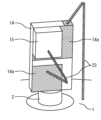
- the optical element 13 reflects a portion of the light intensity of the laser light emitted from the semiconductor optical integrated device 10 in a direction perpendicular to the main surface of the stem 1, and transmits a portion of the light intensity.
- the material of the optical element 13 is, for example, glass made of SiO2.
- the optical element 13 is bonded to the upper substrate 5a.
- an epoxy resin adhesive is used as the bonding material.
- the epoxy resin is temporarily cured by exposure to ultraviolet light immediately after bonding, and then thermally cured through a heat treatment process. This completes the bonding process.
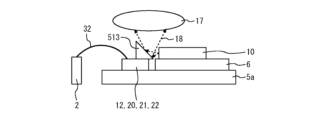
- a support block 14 is mounted on the main surface of the stem 1, on the rear side of the optical element 13. Electrode patterns are formed on the front and side surfaces of the support block 14. A light receiving element 15 that receives the laser light transmitted by the optical element 13 is mounted on the GND surface of the support block 14. In other words, the light receiving element 15 is disposed on the opposite side of the optical element 13 to the semiconductor optical integrated element 10.
- the support block 14 is formed, for example, from a ceramic material such as aluminum nitride (AlN).
- the optical signal received by the light receiving element 15 is O/E converted to an electrical signal.
- the electrical signal is transmitted to the DC power supply lead pin 2 via the conductive wire and the electrode pattern formed on the support block 14. This makes it possible to monitor the intensity of the light emitted by the semiconductor optical integrated element 10. Therefore, the drive current to the semiconductor laser 7 and the optical amplifier 9 can be controlled so that the optical output intensity is constant.
- Patent Document 1 In a structure such as that of Patent Document 1, which has a small mounting area, it is expected that it will be difficult to secure space to mount a light receiving element. Furthermore, in the structure of Patent Document 1, it is necessary to place the lead pins in a reference area, which is a convex portion provided on the conductive stem. Therefore, even if an optical amplifier or light receiving element is to be provided, it may be difficult to secure the area to add the lead pins to be connected to these. In contrast, in the present embodiment, a large mounting space is secured, making it possible to provide an optical module 100 that is equipped with an optical amplifier 9 and a function for monitoring the intensity of the emitted light.
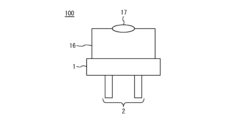
- FIG. 3 is a front view of the optical module 100 according to the first embodiment.
- FIG. 3 shows the state in which the cap 16 is joined to the stem 1.
- the cap 16 has a lens 17.
- the lens 17 is, for example, glass made of SiO2.
- the lens 17 has the function of approximately focusing or parallelizing the laser light emitted from the semiconductor optical integrated element 10 and reflected by the optical element 13 in a direction perpendicular to the main surface of the stem 1.
- the configuration shown in FIG. 3 can ensure the airtightness of the structure mounted on the stem 1, and can improve the moisture resistance and resistance to external disturbances.
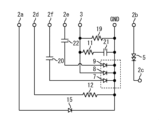
- the optical module 100 may also include a protective resistor 19 connected in parallel with the optical modulator 8.
- the protective resistor 19 has a resistance value greater than that of the matching resistor 11, preferably about 1 k ⁇ , for example. If a capacitor 21 is connected between the matching resistor 11 and GND, the optical modulator 8 may become easily charged, which may make the optical modulator 8 more susceptible to failure. Therefore, the protective resistor 19 may be connected in parallel with the series circuit formed by the capacitor 21 and the matching resistor 11, the optical modulator 8, and the protective resistor 19. Since the resistance value of the protective resistor 19 is greater than that of the matching resistor 11, a current flows through the protective resistor 19 when a surge is input. This makes it possible to prevent failure of the optical modulator 8.
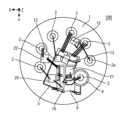
- Embodiment 2. 6 is a plan view of an optical module 200 according to the second embodiment.
- the components are arranged as shown in FIG. 4 taking these factors into consideration.
- the sides of the temperature control module 5 and the sides of the dielectric substrate 6 are aligned in the same direction.
- the part of the dielectric substrate 6 on which the semiconductor optical integrated element 10 is mounted protrudes slightly from the temperature control module 5. This narrows the heat radiation area from the semiconductor optical integrated element 10, increasing the thermal resistance, and there is a possibility that the power consumption of the temperature control module 5 increases.
- FIG. 8 is a cross-sectional view of a semiconductor optical integrated device 410 according to the fourth embodiment.
- a semiconductor laser device has an active layer formed parallel to a substrate, and emits light parallel to the substrate.
- the front end face of the waveguide 40 is formed at an angle of 45 degrees to the substrate 41.
- a mirror 42 that totally reflects light is formed on the front end face. This allows laser light to be emitted in a direction perpendicular to the substrate 41. That is, the mirror 42 reflects the laser light of the semiconductor optical integrated device 410 in a direction perpendicular to the main surface of the stem 1. This makes the optical element 13 unnecessary, and reduces the material cost.
- the configuration in which the waveguide 40 is formed parallel to the upper surface of the substrate 41 is the same in the first to third embodiments.
- a light receiving unit 43 for monitoring the intensity of the laser light reflected by the mirror 42 may be provided directly above the front end face of the semiconductor optical integrated device 410. In this case, there is no need to mount the support block 14 and the light receiving device 15. This reduces material costs and makes it easier to manufacture the optical module 400.
- FIG. 13 is a cross-sectional view showing a state in which an optical module 100 and a receptacle 102 according to the seventh embodiment are connected.
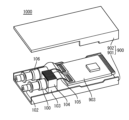
- Fig. 14 is a perspective view of an optical transceiver 1000 according to the seventh embodiment.
- the optical transceiver 1000 of this embodiment may include any of the optical modules according to the first to sixth embodiments.
- the optical transceiver 1000 may include a fixing block 101 that is attached to a side surface of the stem 1 and covers the optical module 100.
- a receptacle 102 for fixing an optical fiber is attached to the fixing block 101.
- the fixing block 101 is joined to the side surface of the stem 1.
Landscapes
- Physics & Mathematics (AREA)
- Condensed Matter Physics & Semiconductors (AREA)
- General Physics & Mathematics (AREA)
- Electromagnetism (AREA)
- Optics & Photonics (AREA)
- Semiconductor Lasers (AREA)
Priority Applications (3)
| Application Number | Priority Date | Filing Date | Title |
|---|---|---|---|
| PCT/JP2023/045748 WO2025134277A1 (ja) | 2023-12-20 | 2023-12-20 | 光モジュールおよび光トランシーバ |
| JP2024518532A JP7544304B1 (ja) | 2023-12-20 | 2023-12-20 | 光モジュールおよび光トランシーバ |
| TW113144624A TW202527408A (zh) | 2023-12-20 | 2024-11-20 | 光模組及光收發器 |
Applications Claiming Priority (1)
| Application Number | Priority Date | Filing Date | Title |
|---|---|---|---|
| PCT/JP2023/045748 WO2025134277A1 (ja) | 2023-12-20 | 2023-12-20 | 光モジュールおよび光トランシーバ |
Publications (1)
| Publication Number | Publication Date |
|---|---|
| WO2025134277A1 true WO2025134277A1 (ja) | 2025-06-26 |
Family
ID=92588297
Family Applications (1)
| Application Number | Title | Priority Date | Filing Date |
|---|---|---|---|
| PCT/JP2023/045748 Pending WO2025134277A1 (ja) | 2023-12-20 | 2023-12-20 | 光モジュールおよび光トランシーバ |
Country Status (3)
| Country | Link |
|---|---|
| JP (1) | JP7544304B1 (https=) |
| TW (1) | TW202527408A (https=) |
| WO (1) | WO2025134277A1 (https=) |
Cited By (1)
| Publication number | Priority date | Publication date | Assignee | Title |
|---|---|---|---|---|
| US20240097399A1 (en) * | 2021-04-27 | 2024-03-21 | Mitsubishi Electric Corporation | Semiconductor laser light source device |
Citations (8)
| Publication number | Priority date | Publication date | Assignee | Title |
|---|---|---|---|---|
| JP2003307603A (ja) * | 2002-02-15 | 2003-10-31 | Omron Corp | 光学素子及び当該素子を用いた光学部品 |
| WO2011065517A1 (ja) * | 2009-11-30 | 2011-06-03 | 株式会社日立製作所 | 表面出射型レーザ |
| JP2017212252A (ja) * | 2016-05-23 | 2017-11-30 | オプト エレクトロニクス ソリューションズ | 光送信機及びこれを含む光モジュール |
| JP2017216470A (ja) * | 2017-07-21 | 2017-12-07 | 京セラ株式会社 | To−can型パッケージ用ヘッダーおよび半導体装置 |
| WO2021014568A1 (ja) * | 2019-07-23 | 2021-01-28 | 三菱電機株式会社 | To-can型光送信モジュール |
| WO2022123719A1 (ja) * | 2020-12-10 | 2022-06-16 | 日本電信電話株式会社 | 波長可変光送信機 |
| JP2022099537A (ja) * | 2020-12-23 | 2022-07-05 | CIG Photonics Japan株式会社 | 光モジュール |
| JP2022143754A (ja) * | 2021-03-18 | 2022-10-03 | CIG Photonics Japan株式会社 | 光モジュール |
-
2023
- 2023-12-20 JP JP2024518532A patent/JP7544304B1/ja active Active
- 2023-12-20 WO PCT/JP2023/045748 patent/WO2025134277A1/ja active Pending
-
2024
- 2024-11-20 TW TW113144624A patent/TW202527408A/zh unknown
Patent Citations (8)
| Publication number | Priority date | Publication date | Assignee | Title |
|---|---|---|---|---|
| JP2003307603A (ja) * | 2002-02-15 | 2003-10-31 | Omron Corp | 光学素子及び当該素子を用いた光学部品 |
| WO2011065517A1 (ja) * | 2009-11-30 | 2011-06-03 | 株式会社日立製作所 | 表面出射型レーザ |
| JP2017212252A (ja) * | 2016-05-23 | 2017-11-30 | オプト エレクトロニクス ソリューションズ | 光送信機及びこれを含む光モジュール |
| JP2017216470A (ja) * | 2017-07-21 | 2017-12-07 | 京セラ株式会社 | To−can型パッケージ用ヘッダーおよび半導体装置 |
| WO2021014568A1 (ja) * | 2019-07-23 | 2021-01-28 | 三菱電機株式会社 | To-can型光送信モジュール |
| WO2022123719A1 (ja) * | 2020-12-10 | 2022-06-16 | 日本電信電話株式会社 | 波長可変光送信機 |
| JP2022099537A (ja) * | 2020-12-23 | 2022-07-05 | CIG Photonics Japan株式会社 | 光モジュール |
| JP2022143754A (ja) * | 2021-03-18 | 2022-10-03 | CIG Photonics Japan株式会社 | 光モジュール |
Cited By (1)
| Publication number | Priority date | Publication date | Assignee | Title |
|---|---|---|---|---|
| US20240097399A1 (en) * | 2021-04-27 | 2024-03-21 | Mitsubishi Electric Corporation | Semiconductor laser light source device |
Also Published As
| Publication number | Publication date |
|---|---|
| JP7544304B1 (ja) | 2024-09-03 |
| JPWO2025134277A1 (https=) | 2025-06-26 |
| TW202527408A (zh) | 2025-07-01 |
Similar Documents
| Publication | Publication Date | Title |
|---|---|---|
| TWI859936B (zh) | 半導體雷射光源裝置 | |
| US20050213882A1 (en) | Optical sub-assembly having a thermo-electric cooler and an optical transceiver using the optical sub-assembly | |
| US6404042B1 (en) | Subcarrier and semiconductor device | |
| CN111293582A (zh) | 一种光信号发射器件 | |
| CN108352679A (zh) | 激光源模块 | |
| JP7734768B2 (ja) | 光モジュール | |
| JP7544304B1 (ja) | 光モジュールおよび光トランシーバ | |
| JP6984801B1 (ja) | 半導体レーザ光源装置 | |
| WO2019232970A1 (zh) | 激光二极体表面安装结构 | |
| WO2022123659A1 (ja) | レーザ光源装置 | |
| TWI863260B (zh) | 半導體雷射光源裝置 | |
| CN211456208U (zh) | 一种光信号发射器件 | |
| CN112997371A (zh) | 光模块 | |
| JPH11186668A (ja) | 光半導体モジュール | |
| JP2004335584A (ja) | 半導体パッケージ | |
| WO2011129183A1 (ja) | 光伝送モジュールおよびこれを用いた光通信装置 | |
| TWI661628B (zh) | 雷射二極體表面安裝結構 | |
| JP7246590B1 (ja) | 半導体レーザ光源装置 | |
| JP2002094170A (ja) | 光モジュール | |
| CN116648835B (zh) | 光模块 | |
| JP7513228B1 (ja) | Can型光モジュールおよび光トランシーバ | |
| US20240267125A1 (en) | Optical transmission module | |
| JP7082418B2 (ja) | 半導体レーザー装置 | |
| JP2000138411A (ja) | 半導体レーザー装置 | |
| TW202545097A (zh) | 光模組 |
Legal Events
| Date | Code | Title | Description |
|---|---|---|---|
| ENP | Entry into the national phase |
Ref document number: 2024518532 Country of ref document: JP Kind code of ref document: A |
|
| WWE | Wipo information: entry into national phase |
Ref document number: 2024518532 Country of ref document: JP |
|
| 121 | Ep: the epo has been informed by wipo that ep was designated in this application |
Ref document number: 23962198 Country of ref document: EP Kind code of ref document: A1 |