WO2025126367A1 - ロータ、モータ、圧縮機および冷凍サイクル装置 - Google Patents
ロータ、モータ、圧縮機および冷凍サイクル装置 Download PDFInfo
- Publication number
- WO2025126367A1 WO2025126367A1 PCT/JP2023/044641 JP2023044641W WO2025126367A1 WO 2025126367 A1 WO2025126367 A1 WO 2025126367A1 JP 2023044641 W JP2023044641 W JP 2023044641W WO 2025126367 A1 WO2025126367 A1 WO 2025126367A1
- Authority
- WO
- WIPO (PCT)
- Prior art keywords
- gaps
- rotor
- gap
- rib
- rotation axis
- Prior art date
- Legal status (The legal status is an assumption and is not a legal conclusion. Google has not performed a legal analysis and makes no representation as to the accuracy of the status listed.)
- Pending
Links
Images



Classifications
-
- H—ELECTRICITY
- H02—GENERATION; CONVERSION OR DISTRIBUTION OF ELECTRIC POWER
- H02K—DYNAMO-ELECTRIC MACHINES
- H02K1/00—Details of the magnetic circuit
- H02K1/06—Details of the magnetic circuit characterised by the shape, form or construction
- H02K1/22—Rotating parts of the magnetic circuit
- H02K1/27—Rotor cores with permanent magnets
- H02K1/2706—Inner rotors
- H02K1/272—Inner rotors the magnetisation axis of the magnets being perpendicular to the rotor axis
- H02K1/274—Inner rotors the magnetisation axis of the magnets being perpendicular to the rotor axis the rotor consisting of two or more circumferentially positioned magnets
- H02K1/2753—Inner rotors the magnetisation axis of the magnets being perpendicular to the rotor axis the rotor consisting of two or more circumferentially positioned magnets the rotor consisting of magnets or groups of magnets arranged with alternating polarity
- H02K1/276—Magnets embedded in the magnetic core, e.g. interior permanent magnets [IPM]
Definitions
- This disclosure relates to a rotor, a motor, a compressor, and a refrigeration cycle device.
- the rotor has a rotor core with a center hole and a magnet insertion hole, and a permanent magnet placed in the magnet insertion hole, and a shaft is fixed to the center hole.
- a rotor core with a center hole and a magnet insertion hole, and a permanent magnet placed in the magnet insertion hole, and a shaft is fixed to the center hole.
- Patent No. 7088229 (see Figure 2)
- This disclosure has been made to solve the above problems, and aims to suppress thermal demagnetization of permanent magnets.
- the rotor of the present disclosure is an annular rotor core extending in the circumferential direction centered on the rotation axis, and has a central hole at the radial center centered on the rotation axis and a magnet insertion hole radially outward from the central hole, and a permanent magnet made of a rare earth magnet arranged in the magnet insertion hole.
- the rotor core In the region between the central hole and the magnet insertion hole, the rotor core has m (m is an integer of 1 or more) first gaps on a first side with respect to a reference plane including the rotation axis, and n (n is an integer of 1 or more) second gaps on a second side with respect to the reference plane. In a plane perpendicular to the rotation axis, the total area of the m first gaps is greater than the total area of the n second gaps.
- m first gaps are provided on the first side of the rotor core, and n second gaps are provided on the second side, making it difficult for heat to be transferred from the central hole to the magnet insertion hole, and thermal demagnetization of the permanent magnet can be suppressed.
- the total area of the m first gaps is greater than the total area of the n second gaps, the amount of eccentricity of the rotor can be adjusted.
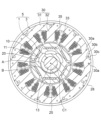
- FIG. 1 is a cross-sectional view showing a motor according to a first embodiment of the present invention
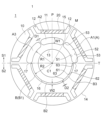
- 1 is a cross-sectional view showing a rotor according to a first embodiment of the present invention
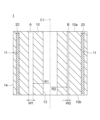
- 1 is a longitudinal sectional view showing a rotor according to a first embodiment of the present invention
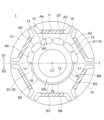
- FIG. 4 is a cross-sectional view showing another example of the configuration of the rotor according to the first embodiment.
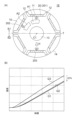
- 4A is a cross-sectional view showing a rotor of a comparative example
- FIG. 4B is a graph showing an analysis result of temperature transition of a permanent magnet.
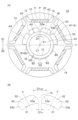
- 13A is a cross-sectional view showing a rotor of embodiment 2
- FIG. 13B is a schematic diagram showing two first gaps of the rotor.
- FIG. 13A is a cross-sectional view showing a rotor of a second embodiment
- FIG. 13B is a graph showing an analysis result of the temperature transition of a permanent magnet.
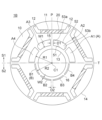
- FIG. 11 is a cross-sectional view showing a rotor according to a third embodiment.
- FIG. 11 is a longitudinal sectional view showing a rotor according to a fourth embodiment.
- 1 is a longitudinal sectional view showing a compressor to which the motors of the first to fourth embodiments can be applied;
- FIG. 11 is a diagram showing a refrigeration cycle device including the compressor shown in FIG.
- Embodiment 1 is a cross-sectional view showing a motor 5 according to a first embodiment.
- the motor 5 includes a shaft 25, a rotor 1 attached to the shaft 25, and an annular stator 3 surrounding the rotor 1.
- An air gap of 0.3 mm to 1.0 mm is provided between the stator 3 and the rotor 1.
- the stator 3 is fixed to the inside of a cylindrical shell 28 of a compressor 300 (FIG. 10), for example.
- the center of rotation of the rotor 1 is referred to as the rotation axis C1.
- the direction of the rotation axis C1 is referred to as the "axial direction”.
- the circumferential direction centered on the rotation axis C1 is referred to as the "circumferential direction”
- the radial direction centered on the rotation axis C1 is referred to as the "radial direction”.
- a cross-sectional view in a plane parallel to the rotation axis C1 is referred to as a "longitudinal cross-sectional view”
- a cross-sectional view in a plane perpendicular to the rotation axis C1 is referred to as a "transverse cross-sectional view”.
- the stator 3 has an annular stator core 30 and a coil 35 wound around the stator core 30.
- the stator core 30 is made up of a plurality of electromagnetic steel plates laminated in the axial direction.
- the thickness of the electromagnetic steel plates is 0.1 mm to 0.7 mm, and is, for example, 0.35 mm.
- the stator core 30 has a yoke 31 extending in the circumferential direction and a number of teeth 32 extending radially inward from the yoke 31. Between adjacent teeth 32, slots 33 are formed, which are spaces for accommodating coils 35.
- nine teeth 32 are provided at equal intervals in the circumferential direction.
- the number of teeth 32 is not limited to nine, and may be two or more.
- an insulating portion is provided between the stator core 30 and the coil 35.
- the insulating portion is, for example, the insulating portion 34 shown in FIG. 10 or an insulating film.
- a groove 30c is formed on the outer periphery of the yoke 31, forming a refrigerant flow path between the shell 28.
- Crimping portions 30a are formed on both circumferential sides of the groove 30c in the yoke 31 for fixing the electromagnetic steel plates that make up the stator core 30 to each other.
- a recess 30b is formed on the radial inside of the groove 30c for fixing an insulating portion to the stator core 30.
- the arrangement of the crimping portions 30a, recesses 30b, and grooves 30c is arbitrary.
- the coil 35 is made of magnet wire.
- the magnet wire is a conductor made of copper or aluminum covered with an insulating coating.
- the coil 35 is wound around the teeth 32 via an insulating section.
- the coil 35 is wound using concentrated winding, in which the magnet wire is wound around each of the teeth 32.
- the wire diameter and number of turns of the coil 35 are determined based on the characteristics required of the motor 5 (e.g., rotation speed, torque, etc.), the voltage specifications, the cross-sectional area of the slot 33, etc. For example, a magnet wire with a wire diameter of 1.0 mm is wound around one tooth 32 about 80 turns.
- the stator core 30 may be constructed by combining split cores, each divided into teeth 32, in the circumferential direction. In this case, the stator core 30 is spread out in a band shape, and coils 35 are wound around each tooth 32 via an insulating section, after which the stator core 30 is folded into a ring shape and both ends are welded to obtain the stator 3.
- ⁇ Configuration of Rotor 1> 2 is a cross-sectional view showing the rotor 1.
- the rotor 1 has a rotor core 10 and permanent magnets 20.
- the rotor core 10 is composed of a plurality of electromagnetic steel plates laminated in the axial direction.
- the thickness of the electromagnetic steel plates is 0.1 mm to 0.7 mm or less, and is, for example, 0.35 mm.
- k magnet insertion holes 11 (k is an integer equal to or greater than 2) are formed.
- the k magnet insertion holes 11 are arranged at equal intervals in the circumferential direction.
- One permanent magnet 20 is inserted into each magnet insertion hole 11.
- the permanent magnet 20 is flat, has a width in the circumferential direction, and a thickness in the radial direction.
- the permanent magnet 20 is magnetized in the thickness direction.
- the permanent magnet 20 is made of a rare earth magnet.
- a neodymium magnet containing neodymium (Nd), iron (Fe), and boron (B) is used as the rare earth magnet.
- the permanent magnet 20 placed in each magnet insertion hole 11 constitutes one magnetic pole.
- the circumferential center of the magnet insertion hole 11 is the pole center.
- An inter-pole section is formed between adjacent magnet insertion holes 11.
- the radial line passing through the pole center is called the magnetic pole center line P.
- the radial line passing through the inter-pole section is called the inter-pole center line M.
- Flux barriers 12 are formed on both circumferential sides of each magnet insertion hole 11 as holes for suppressing leakage flux.
- a thin-walled portion is formed between the flux barrier 12 and the outer periphery 14 of the rotor core 10. The thickness of the thin-walled portion is set to be equal to the thickness of the electromagnetic steel plate, for example, in order to suppress leakage flux between adjacent magnetic poles.
- the number (k) of magnet insertion holes 11 is six, and the number of permanent magnets 20 is also six. Therefore, the number of poles of the rotor 1 is six. However, the number of poles of the rotor 1 is not limited to six, and may be two or more.
- each magnet insertion hole 11 two or more permanent magnets 20 may be placed in each magnet insertion hole 11.
- the magnet insertion hole 11 extends in a straight line here, it may also extend in a V-shape, for example.
- the rotor 1 has m gaps A1 to Am and n gaps B1 to Bn in the radial region between the center hole 13 and the magnet insertion hole 11.
- the gaps A1 to Am are also referred to as first gaps
- the gaps B1 to Bn are also referred to as second gaps.
- n and n are both integers equal to or greater than 1. In the example shown in FIG. 2, m and n are both 3, but are not limited to 3. Furthermore, m and n do not have to be the same number. When there is no particular need to distinguish between gaps A1 to Am, they will be described as gap A. Similarly, when there is no particular need to distinguish between gaps B1 to Bn, they will be described as gap B.
- the plane passing through the rotation axis C1 is called the reference plane T.
- the reference plane T is set taking into consideration the amount of eccentricity to be imparted to the rotor 1.
- One side of the reference plane T is called the first side S1.
- the other side of the reference plane T is called the second side S2.
- the m voids A1 to Am are formed on a first side S1 with respect to the reference plane T.
- the n voids B1 to Bn are formed on a second side S2 with respect to the reference plane T.
- the voids A1, A2, and A3 shown in FIG. 2 are arranged in this order counterclockwise in the figure.
- the voids B1, B2, and B3 shown in FIG. 2 are arranged in this order counterclockwise in the figure.
- the gaps A1 to A3 have the same shape and dimensions.
- the gaps B1 to B3 have the same shape and dimensions.
- the shape or dimensions of at least one of the gaps A1 to Am may be different from the others.
- the shape or dimensions of at least one of the gaps B1 to Bn may be different from the others.
- the gap A has an inner peripheral edge 51 on the side of the central hole 13, an outer peripheral edge 52 on the side of the outer periphery 14, and side edges 53 on both sides in the circumferential direction. Both the inner peripheral edge 51 and the outer peripheral edge 52 extend in an arc shape centered on the rotation axis C1. The side edges 53 extend in the radial direction while curving.
- the rib 15 is sandwiched from both circumferential sides by the side edges 53 of adjacent gaps A.
- the width D1 of the rib 15 is narrowest at its radial center.
- the rib 15 is also called the first rib.
- the gap B has an inner peripheral edge 61 on the central hole 13 side, an outer peripheral edge 62 on the outer periphery 14 side, and side edges 63 on both circumferential sides. Both the inner peripheral edge 61 and the outer peripheral edge 62 extend in an arc shape centered on the rotation axis C1. The side edges 63 extend in a radial direction while curving.
- a rib 16 which is an iron core portion, is formed between adjacent gaps B.
- the rib 16 is sandwiched from both circumferential sides by the side edges 63 of adjacent gaps B.
- the width D2 of the rib 16 is narrowest at its radial center.
- the rib 16 is also called the second rib.
- Rib 17 which is an iron core portion, is also formed. Rib 17 is located on reference plane T. Rib 17 is also called the third rib.
- gap A has a width W1 in the radial direction.
- Width W1 is the distance from inner peripheral edge 51 to outer peripheral edge 52.
- Gap B has a width W2 in the radial direction.
- Width W2 is the distance from inner peripheral edge 61 to outer peripheral edge 62.
- Width W1 of gap A is wider than width W2 of gap B (i.e., W1 > W2).
- each gap A in a plane perpendicular to the rotation axis C1, the area of each gap A is larger than the area of each gap B. Therefore, the total area of gaps A1 to A3 is larger than the total area of gaps B1 to B3.
- the weight of the first side S1 of the rotor core 10 is lighter than the weight of the second side S2. This allows the amount of eccentricity of the rotor 1 to be adjusted.
- R1 the shortest distance from the rotation axis C1 to the gap A
- R2 the shortest distance from the rotation axis C1 to the gap B
- D1 D2
- both widths D1 and D2 are set to be greater than or equal to the thickness of the electromagnetic steel sheets that make up the rotor core 10.
- Figure 3 is a longitudinal cross-sectional view of the rotor 1.
- Gap A extends in the axial direction from a first end face 10a, which is one axial end face of the rotor core 10, to a second end face 10b, which is the other axial end face of the rotor core 10.
- the radial width W1 of gap A is constant.
- gap B extends in the axial direction from the first end face 10a to the second end face 10b of the rotor core 10.
- the radial width W2 of gap B is constant.
- FIG. 4 is a cross-sectional view showing another example configuration of the rotor 1.
- the rotor core 10 has six gaps A1 to A6 on the first side S1, and six gaps B1 to B6 on the second side S2.
- the radial width W1 of gap A is larger than the radial width of gap B. Therefore, the total area of gaps A1 to A6 is larger than the total area of gaps B1 to B6.
- the rare earth magnets used in the permanent magnets 20 have the property that their coercive force decreases with increasing temperature. For example, when the temperature increases by 1°C, the coercive force decreases by 0.5 to 0.6%. Therefore, an increase in temperature of the permanent magnets 20 can lead to demagnetization at high temperatures, i.e., thermal demagnetization.
- FIG. 5(A) is a schematic diagram showing rotor 1E of a comparative example to be compared with embodiment 1.
- rotor 1E of the comparative example in order to adjust the amount of eccentricity, two gaps A are formed on a first side S1 relative to the reference plane T in the region between the central hole 13 and the magnet insertion hole 11. On the other hand, no gaps are formed on a second side S2 relative to the reference plane T.
- the weight of the rotor core 10 is greater on the second side S2 than on the first side S1, and the amount of eccentricity of the rotor 1E can be adjusted. In other words, it can function similarly to a balance weight.
- the permanent magnet 20 located at 90 degrees from the reference plane T with the rotation axis C1 as the center is defined as permanent magnet 201
- the permanent magnet 20 adjacent to this permanent magnet 201 is defined as permanent magnet 202
- the permanent magnet 20 located on the opposite side to permanent magnet 201 is defined as permanent magnet 203.
- Permanent magnets 201 and 202 are arranged on a first side S1 with respect to a reference plane T, and permanent magnet 203 is arranged on a second side S2 with respect to the reference plane T.
- Air gap A1 is formed on the radial inside of permanent magnet 201
- air gap A2 is formed on the radial inside of permanent magnet 202.
- No air gap is formed on the radial inside of permanent magnet 203.
- Figure 5 (A) also shows points Q1, Q2, and Q3 on the surface of the permanent magnet 20 of rotor 1E on the side of the central hole 13.
- Point Q1 is located at the circumferential center of the surface of permanent magnet 201.
- Point Q2 is located at the circumferential center of the surface of permanent magnet 202.
- Point Q3 is located at the circumferential center of the surface of permanent magnet 203.
- Figure 5 (B) is a graph showing the analysis results of the temperature transition at points Q1 to Q3 when a constant amount of heat is continuously applied to the central hole 13. As shown in Figure 5 (B), the temperature is highest at point Q3. This is because there is no gap between the central hole 13 and the magnet insertion hole 11 into which the permanent magnet 203 is inserted, which would prevent heat transfer (indicated by arrow H in Figure 5 (A)).
- the temperatures at points Q1 and Q2 are approximately 20% lower than the temperature at point Q3. This is because there are gaps A1 and A2 between the center hole 13 and the magnet insertion holes 11 into which the permanent magnets 201 and 202 are inserted, which prevent heat transfer.
- the heat transfer from the central hole 13 of the rotor core 10 to the magnet insertion hole 11 can be suppressed by the gaps A1 to Am and the gaps B1 to Bn.
- the temperature rise of all the permanent magnets 20 in the rotor 1 can be suppressed, and thermal demagnetization can be suppressed.
- the weight of the second side S2 of the rotor core 10 is greater than the weight of the first side S1.
- increasing the radial width of the gap is more effective at adjusting the eccentricity of rotor 1 than increasing the circumferential length of the gap.
- the radial width W1 of gap A larger than the radial width W2 of gap B (W1>W2), the effect of adjusting the eccentricity of rotor 1 can be increased.
- the radial width W1 of all of the gaps A1-Am is greater than the radial width W2 of all of the gaps B1-Bm.
- the radial width W1 of at least one gap A is greater than the radial width W2 of at least one gap B, the effect of adjusting the eccentricity of the rotor 1 can be improved.
- the heat applied to the central hole 13 of the rotor core 10 has been described as frictional heat with the bearings of the compression mechanism 301 ( Figure 10), but heat is also applied to expand the inner diameter of the central hole 13 during the shrink fitting process in which the shaft 25 is fixed to the rotor core 10.
- the gaps A1-Am and gaps B1-Bn can suppress the transfer of heat from the central hole 13 to the magnet insertion hole 11, thereby suppressing thermal demagnetization of the permanent magnet 20.
- the rotor 1 of the first embodiment has a rotor core 10 having a central hole 13 and a magnet insertion hole 11, and a permanent magnet 20 made of a rare earth magnet arranged in the magnet insertion hole 11.
- the rotor core 10 has m (m is an integer of 1 or more) gaps A as first gaps on a first side S1 with respect to a reference plane T including the rotation axis C1, and n (n is an integer of 1 or more) gaps B as second gaps on a second side S2 with respect to the reference plane T.
- the total area of the n gaps A is greater than the total area of the m gaps B.
- gap A is provided on the first side S1 and gap B is provided on the second side S2
- the heat transfer from the center hole 13 to the magnet insertion hole 11 is suppressed by gaps A and B, and the temperature rise of the permanent magnet 20 and the associated thermal demagnetization can be suppressed.
- the total area of the m gaps A is larger than the total area of the n gaps B, the amount of eccentricity of the rotor 1 can be adjusted.
- Embodiment 2. 6A is a diagram showing a rotor 1A according to embodiment 2.
- the rotor 1A according to embodiment 2 differs from the rotor 1 according to embodiment 1 in the shape of the gaps A1 to Am serving as first gaps.
- the rotor core 10 of the rotor 1A has gaps A1-Am as first gaps on a first side S1 with respect to a reference plane T in the region between the center hole 13 and the magnet insertion holes 11 in the radial direction, and gaps B1-Bn as second gaps on a second side S2.
- both m and n are 4, but are not limited to 4. Also, m and n do not have to be the same number.
- Figure 6 (B) is a schematic diagram showing an enlarged view of gaps A2 and A3.
- Gap A2 has an inner peripheral edge 51 on the side of center hole 13, an outer peripheral edge 52 on the side of outer periphery 14, a side edge 53a on the side of magnetic pole center line P, and a side edge 53b on the opposite side.
- Gap A2 has an asymmetric shape with respect to line V.
- Line V is a line passing through rotation axis C1 and halves the area of gap A2 in a plane perpendicular to the axial direction.
- the side edge 53a of gap A2 is curved so that the circumferential width of the rib 15 between gap A2 and gap A3 becomes wider as it moves radially outward.
- the side edge 53b of the gap A2 extends radially outward in a straight line from the end of the inner peripheral edge 51, and is curved where it connects to the outer peripheral edge 52. However, the side edge 53b of the gap A2 may extend in a straight line overall, or may extend in a curved line. Both the inner peripheral edge 51 and the outer peripheral edge 52 extend in an arc shape centered on the rotation axis C1.
- Gap A3 has a shape symmetrical to gap A2 across rib 15. In other words, gap A3 has an asymmetric shape with respect to line V.
- Line V is a line that passes through rotation axis C1 and bisects the area of gap A3 in a plane perpendicular to the axial direction.
- the circumferential width D1 of the rib 15 between the gaps A2 and A3 becomes wider toward the radially outer side. That is, the width D1 out of the radially outer end of the rib 15 is wider than the width D1 in of the radially inner end of the rib 15.
- gap A1 has an inner peripheral edge 51 on the central hole 13 side, an outer peripheral edge 52 on the outer periphery 14 side, and side edges 53 on both circumferential sides. Both the inner peripheral edge 51 and the outer peripheral edge 52 extend in an arc shape centered on the rotation axis C1. The side edge 53 extends linearly in the radial direction. Gap A4 has the same shape as gap A1.
- Figure 7 (A) shows points P1, P2, P3, and P4 on the surface of the permanent magnet 20 of rotor 1A on the central hole 13 side.
- Point P1 is located at the center of the surface of the permanent magnet 20 radially outside the rib 15 between gaps A2 and A3.
- Point P2 is located at the center of the surface of the permanent magnet 20 radially outside the gap A4.
- Point P3 is located at the center of the surface of the permanent magnet 20 radially outside the gap B1.
- Point P4 is located at the center of the surface of the permanent magnet 20 radially outside the rib 16 between gaps B2 and B3.
- At least one of the gaps A1 to Am in the rotor core 10 is formed asymmetrically with respect to the line V that is a straight line passing through the rotation axis C1 and that bisects the gap area in a plane perpendicular to the axial direction, so that heat directed toward the magnet insertion hole 11 can be dispersed to both sides in the circumferential direction, suppressing the temperature rise of the permanent magnet 20.
- the circumferential width of the rib 15 between two adjacent gaps A is wider at the radially outer end of the rib 15 than at the radially inner end, the heat traveling from the center hole 13 toward the magnet insertion hole 11 can be dispersed more effectively, and the temperature rise of the permanent magnet 20 can be suppressed.
- Embodiment 3. 8 is a diagram showing a rotor 1B of embodiment 3.
- the rotor 1B of embodiment 3 differs from the rotor 1A of embodiment 2 in the shape of the gaps A1 to Am and the arrangement of the gaps B1 to Bn.
- the rotor core 10 of the rotor 1B has gaps A1 to Am as first gaps on a first side S1 with respect to a reference plane T in the region between the center hole 13 and the magnet insertion holes 11 in the radial direction, and gaps B1 to Bn as second gaps on a second side S2.
- gaps A1 to Am as first gaps on a first side S1 with respect to a reference plane T in the region between the center hole 13 and the magnet insertion holes 11 in the radial direction
- gaps B1 to Bn as second gaps on a second side S2.
- both m and n are 4, but are not limited to 4.
- m and n do not have to be the same number.
- the rib 15 between gaps A2 and A3 is located on the magnetic pole center line P of the permanent magnet 20.
- Gaps A2 and A3 have shapes symmetrical to each other with respect to the magnetic pole center line P.
- Gap A3 is formed symmetrically with gap A2, with a rib 15 sandwiched between them. Since the side edges 53a of gaps A2 and A3 both extend linearly parallel to the magnetic pole center line P, the circumferential width of the rib 15 between gaps A2 and A3 is constant.
- Gaps A1 and A4 have the same shape as gaps A1 and A4 in embodiment 2 ( Figure 6 (A)).
- Gaps B1 to B4 have the same shape as gaps B1 to B4 in embodiment 2 (FIG. 6(A)). However, the shortest distance R2 from the rotation axis C1 to gaps B1 to B4 is shorter than the shortest distance R1 from the rotation axis C1 to gaps A1 to A4. In other words, R1>R2 holds. In other words, gaps B1 to B4 are formed radially inward from gaps A1 to A4.
- gaps B1 to B4 are formed radially inward of gaps A1 to A4, heat transfer from the central hole 13 of the rotor core 10 to the magnet insertion hole 11 can be suppressed further radially inward.
- the circumferential width D2 of the rib 16 between the gaps B1 to B4 is narrower than the circumferential width D1 of the rib 15 between the gaps A1 to A4.
- the radial width of the gap has a greater effect on the eccentricity of rotor 1B than the circumferential length of the gap, so the radial width W1 of gaps A1-A4 is set wider than the radial width W2 of gaps B1-B4.
- the minimum width of rib 15 varies with radial position
- the minimum width is D1.
- the circumferential width of rib 16 varies with radial position
- the minimum width is D2.
- the shapes of the gaps A2 and A3 are not limited to the shapes shown in FIG. 8.
- the gaps A2 and A3 may each have a shape similar to the gaps A1 and A4, or may each have a shape similar to the gaps A1, A2, and A3 (FIG. 2) of embodiment 1.
- the rotor 1B of the third embodiment is configured similarly to the rotor 1 of the first embodiment.
- the shortest distance R2 from the rotation axis C1 to the gap B is shorter than the shortest distance R1 from the rotation axis C1 to the gap A (R1>R2), so the gap B can stop the transfer of heat from the central hole 13 to the magnet insertion hole 11 at a more radially inner side. This makes it possible to make the transfer of heat to the magnet insertion hole 11 more uniform between the first side S1 and the second side S2 of the rotor core 10.
- the width D2 of the rib 16 between at least two of the n gaps B in the rotor core 10 is narrower than the width D1 of the rib 15 between at least two of the m gaps A (D1>D2), the transfer of heat from the central hole 13 to the magnet insertion hole 11 is made more uniform on the first side S1 and the second side S2 of the rotor core 10, and thermal demagnetization of the permanent magnet 20 can be suppressed.
- Embodiment 4. 9 is a longitudinal sectional view showing a rotor 1C of embodiment 4.
- the rotor 1C of embodiment 4 differs from the rotor 1 (FIG. 3) of embodiment 1 in that the rotor core 10 has a first core portion 101 and a second core portion 102, and the arrangements of the gaps A1 to Am and the gaps B1 to Bn are different between the first core portion 101 and the second core portion 102.
- the rotor core 10 has a first core portion 101 and a second core portion 102 in the axial direction.
- the orientation of the electromagnetic steel sheets around the rotation axis C1 differs by 180 degrees between the first core portion 101 and the second core portion 102.
- the gap A of the first core portion 101 and the gap B of the second core portion 102 are continuous in the axial direction.
- the gap B of the first core portion 101 and the gap A of the second core portion 102 are continuous in the axial direction.
- the first side S1 and the second side S2 are reversed in the first core portion 101 and the second core portion 102.
- the radial width W1 of gap A is wider than the radial width W2 of gap B. Therefore, the successive gaps A and B form a flow path whose cross-sectional area changes midway.
- both gaps A and B pass through the rotor core 10 in the axial direction. Since the radial widths W1 and W2 of gaps A and B are different from each other, the rotational balance of the rotor 1C may change depending on the density of the refrigerant used. The rotational balance of the rotor 1C can be adjusted by attaching balance weights or the like to the rotor core 10, but this will result in an increase in the number of parts and costs.
- the orientation of the electromagnetic steel sheets is changed between the first core portion 101 and the second core portion 102 of the rotor core 10, making it possible to adjust the rotational balance of the rotor 1C.
- the rotational balance of the rotor 1C can be adjusted by adjusting the ratio between the axial length of the first core portion 101 of the rotor core 10 (i.e., the number of laminated electromagnetic steel sheets) and the axial length of the second core portion 102.
- the orientation of the electromagnetic steel sheet around the rotation axis C1 is different by 180 degrees between the first core part 101 and the second core part 102, but this is not limited to 180 degrees.
- the position of the magnet insertion hole 11 in the first core part 101 and the position of the magnet insertion hole 11 in the second core part 102 must be aligned.
- the positions of first core portion 101, second core portion 102, and magnet insertion hole 11 can be aligned by rotating the electromagnetic steel plate of second core portion 102 relative to the electromagnetic steel plate of first core portion 101 by an angle equivalent to an integer multiple of 360/k.
- the positions of the magnet insertion holes 11 in first core portion 101 and second core portion 102 can be aligned by rotating the electromagnetic steel plate of second core portion 102 by 60 degrees, 120 degrees, 180 degrees, 240 degrees, or 300 degrees relative to the electromagnetic steel plate of first core portion 101.
- the rotor 1C of the fourth embodiment is configured similarly to the rotor 1 of the first embodiment.
- the rotor core 10 has a first core portion 101 and a second core portion 102, and gap A of the first core portion 101 and gap B of the second core portion 102 are continuous in the axial direction, and gap B of the first core portion 101 and gap A of the second core portion 102 are continuous in the axial direction. Therefore, by adjusting the ratio of the axial lengths of the first core portion 101 and the second core portion 102, etc., the rotational balance of the rotor 1C can be adjusted.
- the compression mechanism 301 has a cylinder 302 with a cylinder chamber 303, a rolling piston 304 fixed to the shaft 25 of the motor 5, a vane that divides the inside of the cylinder chamber 303 into an intake side and a compression side, and an upper frame 305 and a lower frame 306 into which the shaft 25 is inserted and which close the axial end faces of the cylinder chamber 303.
- An upper discharge muffler 308 and a lower discharge muffler 309 are attached to the upper frame 305 and the lower frame 306, respectively.
- the cylinder 302 has a cylinder chamber 303 inside, and the rolling piston 304 rotates eccentrically within the cylinder chamber 303.
- the shaft 25 has an eccentric shaft portion, and the rolling piston 304 is fitted into the eccentric shaft portion.
- An accumulator 310 is attached to the outside of the sealed container 307. Refrigerant gas flows into the accumulator 310 from the refrigerant circuit via a suction pipe 314. When liquid refrigerant flows in together with the refrigerant gas from the suction pipe 314, the liquid refrigerant is stored in the accumulator 310, and the refrigerant gas is supplied to the compressor 300.
- the amount of eccentricity of the rotor 1 described in the first embodiment and the like is adjusted to stabilize the rotation of the rotor 1, taking into consideration various factors such as the amount of eccentricity of the rolling piston 304 in the compression mechanism 301.
- the refrigerant for the compressor 300 may be, for example, R410A, R407C, or R22, but from the perspective of preventing global warming, it is preferable to use a refrigerant with a low GWP (global warming potential).
- GWP global warming potential
- the following refrigerants can be used as refrigerants with a low GWP.
- a mixture containing at least one of a halogenated hydrocarbon having a carbon-carbon double bond in its composition or a hydrocarbon having a carbon-carbon double bond in its composition for example, a mixture of HFO-1234yf and R32 may be used.
- the above-mentioned HFO-1234yf is a low-pressure refrigerant and tends to cause large pressure loss, which may lead to a decrease in the performance of the refrigeration cycle (especially the evaporator). For this reason, it is practically desirable to use a mixture of HFO-1234yf and R32 or R41, which are refrigerants with a higher pressure than HFO-1234yf.
- the operation of the compressor 300 is as follows. Refrigerant gas supplied from the accumulator 310 is supplied through the suction pipe 313 into the cylinder chamber 303 of the cylinder 302. When the motor 5 is driven by supplying current to the coil 35, the shaft 25 rotates together with the rotor 1. Then, the rolling piston 304 fitted to the shaft 25 rotates eccentrically within the cylinder chamber 303, compressing the refrigerant within the cylinder chamber 303.
- this compressor 300 has the motor 5 described in embodiment 1, demagnetization of the permanent magnet 20 is suppressed, allowing stable operation over a long period of time. This improves the reliability of the operation of the compressor 300.
- This is not limited to the motor described in embodiment 1, and a motor equipped with a rotor described in embodiments 2 to 4 may also be used.
- a refrigeration cycle apparatus 400 having the compressor 300 shown in Fig. 10 will be described.
- Fig. 11 is a diagram showing the refrigeration cycle apparatus 400.
- the refrigeration cycle apparatus 400 is, for example, an air conditioner, but is not limited thereto, and may be, for example, a refrigerator.
- the refrigeration cycle device 400 shown in FIG. 11 includes a compressor 401, a condenser 402 that condenses the refrigerant, a pressure reducing device 403 that reduces the pressure of the refrigerant, and an evaporator 404 that evaporates the refrigerant.
- the compressor 401, the condenser 402, and the pressure reducing device 403 are provided in the outdoor unit 410, and the evaporator 404 is provided in the indoor unit 420.
- the compressor 401, condenser 402, pressure reducing device 403, and evaporator 404 are connected by refrigerant piping 407 to form a refrigerant circuit.
- the compressor 401 is formed by the compressor 300 shown in FIG. 10.
- the refrigeration cycle device 400 also includes an outdoor blower 405 facing the condenser 402, and an indoor blower 406 facing the evaporator 404.
- the operation of the refrigeration cycle device 400 is as follows.
- the compressor 401 compresses the sucked refrigerant and sends it out as high-temperature, high-pressure refrigerant gas.
- the condenser 402 exchanges heat between the refrigerant sent out from the compressor 401 and the outdoor air sent by the outdoor blower 405, condenses the refrigerant, and sends it out as liquid refrigerant.
- the pressure reducing device 403 expands the liquid refrigerant sent out from the condenser 402, and sends it out as low-temperature, low-pressure liquid refrigerant.
- the evaporator 404 exchanges heat between the low-temperature, low-pressure liquid refrigerant sent from the pressure reducing device 403 and the indoor air, evaporating the refrigerant and sending it out as refrigerant gas.
- the air from which the heat has been removed by the evaporator 404 is supplied by the indoor blower 406 to the room, which is the space to be air-conditioned.
- the compressor 401 of the refrigeration cycle device 400 has the motor 5 of embodiment 1, and is capable of stable operation over a long period of time. This improves the reliability of the operation of the refrigeration cycle device 400.
- the compressor 401 is not limited to the motor described in embodiment 1, and a motor equipped with a rotor described in embodiments 2 to 4 may also be used.
Landscapes
- Engineering & Computer Science (AREA)
- Power Engineering (AREA)
- Permanent Field Magnets Of Synchronous Machinery (AREA)
- Iron Core Of Rotating Electric Machines (AREA)
Priority Applications (2)
| Application Number | Priority Date | Filing Date | Title |
|---|---|---|---|
| PCT/JP2023/044641 WO2025126367A1 (ja) | 2023-12-13 | 2023-12-13 | ロータ、モータ、圧縮機および冷凍サイクル装置 |
| JP2025563123A JPWO2025126367A1 (https=) | 2023-12-13 | 2023-12-13 |
Applications Claiming Priority (1)
| Application Number | Priority Date | Filing Date | Title |
|---|---|---|---|
| PCT/JP2023/044641 WO2025126367A1 (ja) | 2023-12-13 | 2023-12-13 | ロータ、モータ、圧縮機および冷凍サイクル装置 |
Publications (1)
| Publication Number | Publication Date |
|---|---|
| WO2025126367A1 true WO2025126367A1 (ja) | 2025-06-19 |
Family
ID=96056662
Family Applications (1)
| Application Number | Title | Priority Date | Filing Date |
|---|---|---|---|
| PCT/JP2023/044641 Pending WO2025126367A1 (ja) | 2023-12-13 | 2023-12-13 | ロータ、モータ、圧縮機および冷凍サイクル装置 |
Country Status (2)
| Country | Link |
|---|---|
| JP (1) | JPWO2025126367A1 (https=) |
| WO (1) | WO2025126367A1 (https=) |
Citations (3)
| Publication number | Priority date | Publication date | Assignee | Title |
|---|---|---|---|---|
| JP2002165406A (ja) * | 2000-11-22 | 2002-06-07 | Denso Corp | ロータ重心偏心型モータ |
| JP2006042544A (ja) * | 2004-07-29 | 2006-02-09 | Matsushita Electric Ind Co Ltd | 密閉型電動圧縮機 |
| WO2023119404A1 (ja) * | 2021-12-21 | 2023-06-29 | 三菱電機株式会社 | ロータ、モータ、圧縮機および冷凍サイクル装置 |
-
2023
- 2023-12-13 JP JP2025563123A patent/JPWO2025126367A1/ja active Pending
- 2023-12-13 WO PCT/JP2023/044641 patent/WO2025126367A1/ja active Pending
Patent Citations (3)
| Publication number | Priority date | Publication date | Assignee | Title |
|---|---|---|---|---|
| JP2002165406A (ja) * | 2000-11-22 | 2002-06-07 | Denso Corp | ロータ重心偏心型モータ |
| JP2006042544A (ja) * | 2004-07-29 | 2006-02-09 | Matsushita Electric Ind Co Ltd | 密閉型電動圧縮機 |
| WO2023119404A1 (ja) * | 2021-12-21 | 2023-06-29 | 三菱電機株式会社 | ロータ、モータ、圧縮機および冷凍サイクル装置 |
Also Published As
| Publication number | Publication date |
|---|---|
| JPWO2025126367A1 (https=) | 2025-06-19 |
Similar Documents
| Publication | Publication Date | Title |
|---|---|---|
| US10483816B2 (en) | Motor, rotor, compressor, and refrigeration and air conditioning apparatus | |
| JP7003267B2 (ja) | 電動機、圧縮機および空気調和装置 | |
| KR102010200B1 (ko) | 전동기, 로터, 압축기 및 냉동 공조 장치 | |
| JP6824333B2 (ja) | 電動機、ロータ、圧縮機および冷凍空調装置 | |
| JP7038827B2 (ja) | ステータ、電動機、圧縮機および空気調和装置 | |
| WO2018203364A1 (ja) | ロータ、電動機、圧縮機および空気調和装置 | |
| JP6494871B2 (ja) | 固定子、電動機、圧縮機、及び冷凍空調装置 | |
| JP6956881B2 (ja) | 電動機、圧縮機、及び空気調和機 | |
| WO2023119404A1 (ja) | ロータ、モータ、圧縮機および冷凍サイクル装置 | |
| JP7237178B2 (ja) | ロータ、電動機、圧縮機、及び空気調和機 | |
| JP7450805B2 (ja) | モータ、圧縮機および冷凍サイクル装置 | |
| JP7154373B2 (ja) | 電動機、圧縮機、及び空気調和機 | |
| JP7433419B2 (ja) | ロータ、モータ、圧縮機、空気調和装置およびロータの製造方法 | |
| WO2025126367A1 (ja) | ロータ、モータ、圧縮機および冷凍サイクル装置 | |
| JP7026811B2 (ja) | ステータ、電動機、圧縮機および空気調和装置 | |
| WO2021260882A1 (ja) | 電動機、圧縮機および冷凍サイクル装置 | |
| WO2025191636A1 (ja) | ロータ、モータ、圧縮機および冷凍サイクル装置 | |
| JP7433420B2 (ja) | ロータ、モータ、圧縮機および空気調和装置 | |
| JP7789288B1 (ja) | ロータ、電動機、圧縮機および冷凍サイクル装置 | |
| WO2026033675A1 (ja) | ロータ、モータ、圧縮機および冷凍サイクル装置 | |
| US20250038585A1 (en) | Motor, compressor, and refrigeration cycle apparatus | |
| WO2025057391A1 (ja) | ステータ、電動機、圧縮機および冷凍サイクル装置 | |
| WO2023233629A1 (ja) | ステータ、電動機、圧縮機および冷凍サイクル装置 | |
| WO2022085079A1 (ja) | 回転子、電動機、圧縮機および冷凍サイクル装置 |
Legal Events
| Date | Code | Title | Description |
|---|---|---|---|
| 121 | Ep: the epo has been informed by wipo that ep was designated in this application |
Ref document number: 23961434 Country of ref document: EP Kind code of ref document: A1 |
|
| ENP | Entry into the national phase |
Ref document number: 2025563123 Country of ref document: JP Kind code of ref document: A |