WO2025115772A1 - 透湿防水素材および透湿防水素材の製造方法 - Google Patents
透湿防水素材および透湿防水素材の製造方法 Download PDFInfo
- Publication number
- WO2025115772A1 WO2025115772A1 PCT/JP2024/041418 JP2024041418W WO2025115772A1 WO 2025115772 A1 WO2025115772 A1 WO 2025115772A1 JP 2024041418 W JP2024041418 W JP 2024041418W WO 2025115772 A1 WO2025115772 A1 WO 2025115772A1
- Authority
- WO
- WIPO (PCT)
- Prior art keywords
- fabric
- moisture
- polyurethane layer
- waterproof material
- silicone
- Prior art date
- Legal status (The legal status is an assumption and is not a legal conclusion. Google has not performed a legal analysis and makes no representation as to the accuracy of the status listed.)
- Pending
Links
Classifications
-
- B—PERFORMING OPERATIONS; TRANSPORTING
- B32—LAYERED PRODUCTS
- B32B—LAYERED PRODUCTS, i.e. PRODUCTS BUILT-UP OF STRATA OF FLAT OR NON-FLAT, e.g. CELLULAR OR HONEYCOMB, FORM
- B32B27/00—Layered products comprising a layer of synthetic resin
- B32B27/12—Layered products comprising a layer of synthetic resin next to a fibrous or filamentary layer
-
- B—PERFORMING OPERATIONS; TRANSPORTING
- B32—LAYERED PRODUCTS
- B32B—LAYERED PRODUCTS, i.e. PRODUCTS BUILT-UP OF STRATA OF FLAT OR NON-FLAT, e.g. CELLULAR OR HONEYCOMB, FORM
- B32B27/00—Layered products comprising a layer of synthetic resin
- B32B27/40—Layered products comprising a layer of synthetic resin comprising polyurethanes
-
- B—PERFORMING OPERATIONS; TRANSPORTING
- B32—LAYERED PRODUCTS
- B32B—LAYERED PRODUCTS, i.e. PRODUCTS BUILT-UP OF STRATA OF FLAT OR NON-FLAT, e.g. CELLULAR OR HONEYCOMB, FORM
- B32B5/00—Layered products characterised by the non- homogeneity or physical structure, i.e. comprising a fibrous, filamentary, particulate or foam layer; Layered products characterised by having a layer differing constitutionally or physically in different parts
- B32B5/22—Layered products characterised by the non- homogeneity or physical structure, i.e. comprising a fibrous, filamentary, particulate or foam layer; Layered products characterised by having a layer differing constitutionally or physically in different parts characterised by the presence of two or more layers which are next to each other and are fibrous, filamentary, formed of particles or foamed
- B32B5/24—Layered products characterised by the non- homogeneity or physical structure, i.e. comprising a fibrous, filamentary, particulate or foam layer; Layered products characterised by having a layer differing constitutionally or physically in different parts characterised by the presence of two or more layers which are next to each other and are fibrous, filamentary, formed of particles or foamed one layer being a fibrous or filamentary layer
-
- D—TEXTILES; PAPER
- D06—TREATMENT OF TEXTILES OR THE LIKE; LAUNDERING; FLEXIBLE MATERIALS NOT OTHERWISE PROVIDED FOR
- D06M—TREATMENT, NOT PROVIDED FOR ELSEWHERE IN CLASS D06, OF FIBRES, THREADS, YARNS, FABRICS, FEATHERS OR FIBROUS GOODS MADE FROM SUCH MATERIALS
- D06M15/00—Treating fibres, threads, yarns, fabrics, or fibrous goods made from such materials, with macromolecular compounds; Such treatment combined with mechanical treatment
- D06M15/19—Treating fibres, threads, yarns, fabrics, or fibrous goods made from such materials, with macromolecular compounds; Such treatment combined with mechanical treatment with synthetic macromolecular compounds
- D06M15/37—Macromolecular compounds obtained otherwise than by reactions only involving carbon-to-carbon unsaturated bonds
- D06M15/564—Polyureas, polyurethanes or other polymers having ureide or urethane links; Precondensation products forming them
-
- D—TEXTILES; PAPER
- D06—TREATMENT OF TEXTILES OR THE LIKE; LAUNDERING; FLEXIBLE MATERIALS NOT OTHERWISE PROVIDED FOR
- D06M—TREATMENT, NOT PROVIDED FOR ELSEWHERE IN CLASS D06, OF FIBRES, THREADS, YARNS, FABRICS, FEATHERS OR FIBROUS GOODS MADE FROM SUCH MATERIALS
- D06M15/00—Treating fibres, threads, yarns, fabrics, or fibrous goods made from such materials, with macromolecular compounds; Such treatment combined with mechanical treatment
- D06M15/19—Treating fibres, threads, yarns, fabrics, or fibrous goods made from such materials, with macromolecular compounds; Such treatment combined with mechanical treatment with synthetic macromolecular compounds
- D06M15/37—Macromolecular compounds obtained otherwise than by reactions only involving carbon-to-carbon unsaturated bonds
- D06M15/643—Macromolecular compounds obtained otherwise than by reactions only involving carbon-to-carbon unsaturated bonds containing silicon in the main chain
- D06M15/647—Macromolecular compounds obtained otherwise than by reactions only involving carbon-to-carbon unsaturated bonds containing silicon in the main chain containing polyether sequences
-
- D—TEXTILES; PAPER
- D06—TREATMENT OF TEXTILES OR THE LIKE; LAUNDERING; FLEXIBLE MATERIALS NOT OTHERWISE PROVIDED FOR
- D06N—WALL, FLOOR, OR LIKE COVERING MATERIALS, e.g. LINOLEUM, OILCLOTH, ARTIFICIAL LEATHER, ROOFING FELT, CONSISTING OF A FIBROUS WEB COATED WITH A LAYER OF MACROMOLECULAR MATERIAL; FLEXIBLE SHEET MATERIAL NOT OTHERWISE PROVIDED FOR
- D06N3/00—Artificial leather, oilcloth or other material obtained by covering fibrous webs with macromolecular material, e.g. resins, rubber or derivatives thereof
- D06N3/12—Artificial leather, oilcloth or other material obtained by covering fibrous webs with macromolecular material, e.g. resins, rubber or derivatives thereof with macromolecular compounds obtained otherwise than by reactions only involving carbon-to-carbon unsaturated bonds, e.g. gelatine proteins
- D06N3/14—Artificial leather, oilcloth or other material obtained by covering fibrous webs with macromolecular material, e.g. resins, rubber or derivatives thereof with macromolecular compounds obtained otherwise than by reactions only involving carbon-to-carbon unsaturated bonds, e.g. gelatine proteins with polyurethanes
-
- D—TEXTILES; PAPER
- D06—TREATMENT OF TEXTILES OR THE LIKE; LAUNDERING; FLEXIBLE MATERIALS NOT OTHERWISE PROVIDED FOR
- D06N—WALL, FLOOR, OR LIKE COVERING MATERIALS, e.g. LINOLEUM, OILCLOTH, ARTIFICIAL LEATHER, ROOFING FELT, CONSISTING OF A FIBROUS WEB COATED WITH A LAYER OF MACROMOLECULAR MATERIAL; FLEXIBLE SHEET MATERIAL NOT OTHERWISE PROVIDED FOR
- D06N7/00—Flexible sheet materials not otherwise provided for, e.g. textile threads, filaments, yarns or tow, glued on macromolecular material
Definitions
- the present invention relates to a moisture-permeable, waterproof fabric suitable for use in rainwear for sports, etc., and a method for manufacturing the same.
- moisture-permeable waterproof materials are mainly manufactured by dissolving polyurethane resin in a water-soluble solvent, mixing it with a fluorine-based water repellent, applying it to fabric, and wet gelling it. When the solvent is replaced with water, a porous polyurethane coating containing a fluorine-based water repellent is formed on the fabric, which does not let rain or other water through but does let moisture (water vapor) through.
- Such moisture-permeable waterproof fabrics are described, for example, in Patent Documents 1 and 2.
- the present invention has been made in consideration of the above, and aims to provide a non-fluorine waterproof, breathable textile product that has high waterproofness and washing durability, and further has sufficient adhesive strength even when a film or backing material is attached to the waterproof surface, and has excellent wear durability.
- a moisture-permeable waterproof material comprising a fabric and a porous polyurethane layer laminated together, the porous polyurethane layer having a silicone-based water repellent attached to the inner pore surfaces thereof.
- a method for producing a moisture-permeable waterproof material in which a porous polyurethane layer and a fabric are laminated the method comprising a step of adhering a silicone-based water repellent to a surface of the porous polyurethane layer opposite to the surface on which the fabric is laminated, of a laminate sheet in which the porous polyurethane layer and the fabric are laminated.
- the textile product of the present invention does not use fluorine compounds, yet has high water pressure resistance with high washing durability, and has sufficient peel strength to withstand wear even when a non-porous resin layer or backing material is attached to the porous membrane surface.
- FIG. 1 is a cross-sectional view showing the structure of a moisture-permeable, waterproof fiber material according to one embodiment of the present invention.
- FIG. 2 is a cross-sectional view showing the structure of a moisture-permeable, waterproof fiber material according to one embodiment of the present invention.
- FIG. 3 is a cross-sectional view showing the structure of a moisture-permeable, waterproof fiber material according to one embodiment of the present invention.
- FIG. 4 is a cross-sectional view showing the structure of a moisture-permeable, waterproof fiber material according to one embodiment of the present invention.
- the moisture-permeable waterproof material of the present invention is made by laminating a porous polyurethane layer and a fabric.
- Useful fiber materials constituting the fabric include polyester, nylon, acrylic, polyurethane, and rayon such as acetate and viscose.
- chemical fibers such as polylactic acid, aromatic polyamide, polyimide, and polyphenylene sulfide, natural fibers such as cotton, hemp, silk, and wool, and blends, interspun, interwoven, and interknitted products of these materials can also be used.
- fiber materials containing polyester or nylon are preferred.
- nylon-based materials dyed with acid dyes are preferred.
- polyester-based and olefin-based synthetic fibers, and blends and interspun products with natural fibers may also be used.
- the fibers constituting the fabric may be either long or short fibers.
- the yarn using this fiber may be either raw silk (flat yarn), twisted yarn or processed yarn.
- the fabric (outer fabric) is shown in schematic cross section as a woven fabric, but it may be a knitted fabric or a nonwoven fabric instead.
- the breathable waterproof material of the present invention may also have a water repellent agent that does not contain fluorine compounds, such as a silicone-based water repellent agent, attached to the fabric.
- a water repellent agent that does not contain fluorine compounds, such as a silicone-based water repellent agent, attached to the fabric.
- the timing for applying water-repellent treatment to the fabric (outer fabric) is preferably before laminating the porous polyurethane layer.
- the water-repellent treatment can be performed by using at least one of a water-repellent agent that does not contain fluorine compounds, such as a silicone-based water-repellent agent, a crosslinking agent, a penetrating agent, and a pH adjuster, and then treating, drying, and curing using a pad method or spray method. It is preferable that the performance achieved in the JIS L1092 spray test is grade 4 or higher before washing and grade 3 or higher after 20 washes.
- the moisture-permeable waterproof material shown in Figure 1 is an embodiment in which a porous polyurethane layer that does not contain fluorine compounds is laminated onto the outer surface.
- pores in the polyurethane resin shown in the drawings are merely schematic, and the shape and size are not limited to these.
- the polyurethane that forms the porous polyurethane layer is preferably a polyurethane that can be obtained by reacting a polyol compound (A) having at least two hydroxyl groups reactive with isocyanate groups, an isocyanate compound (B) having an isocyanate structure and having at least two isocyanate groups, and a chain extender (C) added as needed in a reaction solution containing a water-soluble polar solvent (D), and then terminating the polymerization with a reaction terminator (E).
- A polyol compound having at least two hydroxyl groups reactive with isocyanate groups
- an isocyanate compound (B) having an isocyanate structure and having at least two isocyanate groups and a chain extender (C) added as needed in a reaction solution containing a water-soluble polar solvent (D), and then terminating the polymerization with a reaction terminator (E).
- the polyurethane may be a polyurethane consisting of only urethane bonds, or a polyurethane/polyurea resin containing urea bonds.
- polyol compound (A) examples include polyester polyols having ester bonds, polyether polyols having ether bonds, and polycarbonate polyols having carbonate groups.
- isocyanate compound (B) examples include tolylene diisocyanate (TDI), diphenylmethane diisocyanate (MDI), polymeric MDI, hexamethylene diisocyanate (HMDI), xylylene diisocyanate (XDI), tetramethylxylylene diisocyanate (TMXDI), isophorone diisocyanate (IPDI), hydrogenated MDI, etc.
- TDI tolylene diisocyanate
- MDI diphenylmethane diisocyanate
- HMDI hexamethylene diisocyanate
- XDI xylylene diisocyanate
- TMXDI tetramethylxylylene diisocyanate
- IPDI isophorone diisocyanate
- hydrogenated MDI etc.
- chain extender (C) examples include aliphatic diols such as ethylene glycol, 1,4-butanediol, 1,3-butanediol (1,3-butylene glycol), neopentyl glycol, 1,5-pentanediol, methylpentanediol, 1,6-hexanediol, 1,7-heptanediol, 1,8-octanediol, 1,9-nonanediol, and 1,10-decanediol; alicyclic diols such as 1,4-cyclohexanediol and hydrogenated xylylene glycol; and aromatic diols such as xylylene glycol.
- aliphatic diols such as ethylene glycol, 1,4-butanediol, 1,3-butanediol (1,3-butylene glycol), neopentyl glycol
- the polar solvent (D) is not particularly limited, but is preferably one that dissolves easily in the isocyanate compound (B), such as dimethylformamide (DMF) or dimethylsulfoxide (DMSO).
- the reaction terminator (E) is used in the polyurethane polymerization reaction to react with the ends of the chemical structure to terminate the polymerization at the target viscosity.
- the reaction terminator (E) can be monohydric or polyhydric alcohols, monovalent amines, etc. Examples include monohydric or polyhydric alcohols (methanol, ethanol, butanol, propylene glycol, higher alcohols, higher fatty acid esters with hydroxyl groups, etc.) and monovalent amines (methylamine, butylamine, etc.).
- the above components (A) to (E) may be used alone or in combination of two or more.
- the reaction temperature may be the same as that usually used in urethane reactions, and when a polar solvent (D) is used, it is usually 30 to 90°C.
- the method of laminating the porous polyurethane layer onto the fabric may involve directly applying a polyurethane solution containing the polyurethane to the surface of the fabric and allowing it to wet solidify, or it may involve applying the solution to a substrate other than the fabric and then allowing it to wet solidify to produce a sheet of the porous polyurethane layer, which is then bonded to the surface of the fabric.
- the method for applying the polyurethane solution to the fabric or substrate may be any method generally known as a direct coating method, and various coating methods such as knife coating, knife over roll coating, and reverse roll coating can be used.
- the substrate may be anything that allows the sheet to be peeled off, and may be, for example, a fabric other than the fabric, release paper, or the like.
- an adhesive can be applied to the surface of the sheet to bond it to the fabric. After the adhesive has solidified, the substrate can be peeled off to obtain a waterproof fabric.
- the moisture-permeable waterproof material of the present invention has a silicone-based water repellent attached to the inner pore surface of the porous polyurethane layer.
- silicone-based water repellent straight silicone oil and modified silicone oil can be used.
- straight silicone oils examples include dimethyl silicone oil, methylphenyl silicone oil, and methylhydrogen silicone oil.
- modified silicone oils include straight silicone oils modified with alkyl, aralkyl, polyether, higher fatty acid ester, fluoroalkyl, amino, epoxy, carboxyl, alcohol, etc.
- modified silicone oils reactive silicone oils that have reactive groups in the molecule are preferred, and among these, carboxyl-modified silicone oils are preferred from the viewpoint of providing adhesion and water repellency.
- silicone-based compounds used as the silicone-based water repellent include those disclosed in JP 2017-218713 A, JP 2017-226946 A, JP 2017-155095 A, and JP 2017-218713 A.
- silicone compounds used as the silicone water repellent include Gelanex (registered trademark) SH (Matsumoto Yushi Co., Ltd.), Drypon (registered trademark) 600E (Nicca Chemical Co., Ltd.), Rikenparan SG-54 (Miki Riken Kogyo Co., Ltd.), Light Silicone P-290E (Hokuhiro Chemical Co., Ltd.), Poron (registered trademark) MR (Shin-Etsu Chemical Co., Ltd.), and Poron (registered trademark) MF-49 (Shin-Etsu Chemical Co., Ltd.).
- Neoseed registered trademark
- NR8000 Nacca Chemical Co., Ltd.
- KF-96 series Shin-Etsu Chemical Co., Ltd.
- KF8005 Shin-Etsu Chemical Co., Ltd.
- KF8010 Shin-Etsu Chemical Co., Ltd.
- KF4003 Shin-Etsu Chemical Co., Ltd.
- X-22-3701E Shin-Etsu Chemical Co., Ltd.
- SF-8417 Dow Toray Co., Ltd.
- BY16-880 Dow Toray Co., Ltd.
- MQ-1600 Dow Toray Co., Ltd.
- the moisture-permeable waterproof material of the present invention can be efficiently obtained, for example, by attaching a silicone-based water repellent to the surface of a laminate sheet formed by laminating the porous polyurethane layer and the fabric, opposite the surface where the porous polyurethane layer is laminated with the fabric.
- the manufacturing method of the moisture-permeable waterproof material of the present invention is a method for manufacturing a moisture-permeable waterproof material including a porous polyurethane layer and a fabric, and includes a step of attaching a silicone-based water repellent to the surface of a laminate sheet formed by laminating the porous polyurethane layer and the fabric, opposite the surface where the porous polyurethane layer is laminated with the fabric.
- the silicone-based water repellent may be applied directly to the porous polyurethane layer or from the fabric side. In order to efficiently penetrate the silicone-based water repellent, it is preferable to apply it directly to the porous polyurethane layer.
- the silicone-based water repellent can be applied by any method that allows one-sided treatment, such as gravure, cylinder roll, spray, or kiss coater.
- the moisture-permeable waterproof material of the present invention further comprises a nonporous hydrophilic resin layer and/or a second fabric laminated on the surface of the porous polyurethane layer opposite to the surface laminated with the fabric.
- Figure 2 shows an embodiment in which a non-porous hydrophilic resin layer is added to further improve the water pressure resistance of the moisture-permeable waterproof material shown in Figure 1.
- the nonporous hydrophilic resin layer is preferably made of a hydrophilic polyurethane resin in which 20 to 60 mol% of the polyol component is at least one of polyethylene glycol and polypropylene glycol. Particularly preferred is a polyurethane resin in which 20 to 60 mol% of the polyol component is polyethylene glycol.
- a polyurethane resin in which 20 to 60 mol% of the polyol component is polyethylene glycol.
- the polyol components that can be used include polyester glycol, polycarbonate glycol, and other polyether glycols.
- polyisocyanate component that constitutes the hydrophilic polyurethane resin known aliphatic polyisocyanates and aromatic polyisocyanates can be used, such as hexamethylene diisocyanate, toluene diisocyanate, xylene diisocyanate, isophorone diisocyanate, and 4,4'-diphenylmethane diisocyanate.
- the hydrophilic nonporous membrane preferably has heat fusion properties. By having heat fusion properties, the hydrophilic nonporous membrane can be uniformly adhered without dissolving the microporous membrane. Heat fusion properties are imparted by using a low melting point material or a crosslinking agent.
- the thickness of the hydrophilic nonporous membrane is preferably 1 to 10 ⁇ m.
- the non-porous hydrophilic resin layer may be formed by laminating a highly moisture-permeable film with a moisture-curing polyurethane hot melt, or by coating the entire surface with a highly moisture-permeable resin. In addition, it may be partially printed to improve the design and texture of the porous resin layer surface.
- the nonporous hydrophilic resin layer can be formed, for example, by directly coating the porous polyurethane layer, by applying it in advance to release paper or the like, or by forming a film by extrusion.
- Figure 3 shows an embodiment in which a second fabric (backing material) is further laminated to protect the porous polyurethane layer of the moisture-permeable waterproof material shown in Figure 1.
- Figure 4 shows an embodiment in which a fabric layer is further laminated to the surface of the non-porous hydrophilic resin layer of the embodiment shown in Figure 2.
- the second fabric is shown as a knitted fabric, but this is not intended to limit the use of woven or nonwoven fabrics.
- the second fabric can be plain weave fabric (taffeta), twill fabric, satin, or other special woven or knitted fabrics made from various synthetic fibers, as well as various fabrics and nonwoven fabrics made from natural or semi-synthetic fibers.
- taffeta plain weave fabric
- twill fabric satin
- other special woven or knitted fabrics made from various synthetic fibers, as well as various fabrics and nonwoven fabrics made from natural or semi-synthetic fibers.
- nylon tricot knitted fabrics are more preferable in terms of texture, etc.
- the silicone-based water repellent agent may be applied to the porous polyurethane layer before or after bonding the second fabric layer, but from the viewpoint of efficiently applying the silicone-based water repellent agent to the porous polyurethane layer, it is preferable to apply it before bonding.
- peeling refers to the phenomenon in which the nonporous hydrophilic resin layer peels off or floats off from the porous polyurethane layer during washing.
- the moisture-permeable waterproof material of the present invention preferably has a peel strength between the porous polyurethane layer and the fabric of 200 cN/cm or more.
- the peel strength is measured according to the measurement method of JIS L1086 (2020).
- the moisture-permeable waterproof material of the present invention preferably has a water pressure resistance of 5,000 mmH2O or more after 10 washes, and does not get wet in a Suter test in which a water pressure of 2,000 mmH2O is maintained for 10 minutes.
- the water pressure resistance test conforms to the measurement method described in JIS L 1092:2020 Method B (high water pressure method).
- the Suter test is a method of evaluating the waterproofness of a membrane by maintaining a water pressure of 2000 mmH2O for 10 minutes using a simple water pressure resistance measuring device. Waterproofness is determined by the presence or absence of wettability of the membrane after 10 minutes.
- the water pressure resistance after 10 washes is 10,000 mmH2O or more.
- the breathable waterproof material of the present invention has excellent water pressure resistance with washing durability and excellent adhesion at each interface, and can be used as the fabric for various products that require breathable waterproofness and durability, such as clothing such as rain gear, shoes, bags, and outdoor goods such as tents.
- the moisture-permeable waterproof material has a nonporous hydrophilic resin layer, a backing material (second fabric), or a nonporous hydrophilic resin layer and a backing material (second fabric), the nonporous hydrophilic resin layer and/or the backing material (second fabric) are included in the measurement and evaluation.
- silica fine powder (Tokuyama Corporation, "Reoloseal” (registered trademark) MT-10, dimethyldichlorosilane gas phase reaction silica) was added to 80 parts by mass of the obtained polycarbonate-based polyurethane resin solution, and the mixture was thoroughly immersed in 50 parts by mass of DMF, dispersed and stirred for about 15 minutes using a homomixer, and then stirred again to obtain a liquid polyurethane resin composition for coating containing a polycarbonate-based polyurethane resin.
- a silicone water repellent was applied to the porous polyurethane layer side of the moisture permeable waterproof material obtained in (3) above using a gravure roll at a coating amount of 30 g/ m2 , and the silicone water repellent was allowed to penetrate into the porous polyurethane layer. After that, it was dried at 120°C, and then subjected to a dry heat treatment at 150°C for 30 seconds.
- the above polyurethane solution was applied to a release paper (EV130TPD, manufactured by Lintec Corporation) with a clearance of 50 ⁇ m using a knife over roll coater. It was then dried with hot air at 80°C to obtain a non-porous hydrophilic resin film with a thickness of 5 ⁇ m.
- a release paper (EV130TPD, manufactured by Lintec Corporation) with a clearance of 50 ⁇ m using a knife over roll coater. It was then dried with hot air at 80°C to obtain a non-porous hydrophilic resin film with a thickness of 5 ⁇ m.
- the above non-porous hydrophilic resin film was superimposed on the porous polyurethane layer of the moisture-permeable waterproof material after (4) above, and lamination was performed using a hot laminator under conditions of a temperature of 120°C, a pressure of 0.9807 MPa (10 kg/ cm2 ), and a speed of 20 m/min, to obtain a moisture-permeable waterproof material with a non-porous hydrophilic resin layer (represented as "HB" in the table).
- a polyurethane hot melt (product number LA7575UV) was applied with a 30 mesh gravure roll onto the porous polyurethane layer of the moisture-permeable waterproof material after (4) above, or onto the non-porous hydrophilic resin layer of the moisture-permeable waterproof material after (5) above, and after drying with hot air at 100°C, a backing material was attached and aged at 40°C for 24 hours while still pressed, to obtain a moisture-permeable waterproof material with a backing material (second fabric).
- Example 1 A moisture-permeable, waterproof fabric was manufactured by manufacturing steps (1) to (4). However, dimethyl silicone oil (KF-96, Shin-Etsu Chemical Co., Ltd.) was used as the silicone-based water repellent in manufacturing step (4). The distribution of the silicone-based water repellent in the porous polyurethane layer was confirmed to be present on the surface of the porous polyurethane layer side where the coating was performed, and on the inner surfaces of the pores. In other words, it was confirmed that the silicone-based water repellent was attached to the inner surfaces of the pores.
- dimethyl silicone oil KF-96, Shin-Etsu Chemical Co., Ltd.
- Example 2 A moisture-permeable waterproof fabric was manufactured by manufacturing steps (1) to (4). However, a carboxyl-modified silicone oil (X-22-3701E, Shin-Etsu Chemical Co., Ltd.) was used as the silicone-based water repellent in manufacturing step (4). The distribution of the silicone-based water repellent in the porous polyurethane layer was confirmed to be present on the surface of the porous polyurethane layer side where the coating was performed, and on the inner surface of the pores. In other words, it was confirmed that the silicone-based water repellent was attached to the inner surface of the pores.
- a carboxyl-modified silicone oil X-22-3701E, Shin-Etsu Chemical Co., Ltd.
- Example 3 The moisture-permeable waterproof fabric obtained in Example 2 was further processed in the manufacturing process (5) to obtain a moisture-permeable waterproof fabric with a non-porous hydrophilic resin layer.
- the distribution of the silicone-based water repellent agent in the porous polyurethane layer was confirmed to be present on the surface of the porous polyurethane layer side where the coating was performed, and on the inner surface of the pores. In other words, it was confirmed that the silicone-based water repellent agent was attached to the inner surface of the pores.
- Example 4 In the manufacturing process (4), the silicone water repellent was applied to the outer surface at a coating amount of 60 g/ m2 . Otherwise, the moisture-permeable waterproof fabric with a non-porous hydrophilic resin layer was obtained in the same manner as in Example 3. The distribution of the silicone water repellent in the porous polyurethane layer was confirmed to be present on the outer surface where the coating was applied and on the inner surface of the holes. In other words, it was confirmed that the silicone water repellent was attached to the inner surface of the holes.
- Example 5 The moisture-permeable waterproof fabric obtained in Example 1 was further processed in the manufacturing process (5) to obtain a moisture-permeable waterproof fabric with a non-porous hydrophilic resin layer.
- the distribution of the silicone-based water repellent agent in the porous polyurethane layer was confirmed to be present on the surface of the porous polyurethane layer side where the coating was performed, and on the inner surface of the pores. In other words, it was confirmed that the silicone-based water repellent agent was attached to the inner surface of the pores.
- Example 6 A moisture-permeable waterproof fabric with a non-porous hydrophilic resin layer was obtained in the same manner as in Example 5, except that the amount of silicone water repellent applied in the manufacturing process (4) was 250 g/ m2 .
- the distribution of the silicone water repellent in the porous polyurethane layer was confirmed to be present on the surface of the porous polyurethane layer side where the application was performed, and on the inner surface of the pores. In other words, it was confirmed that the silicone water repellent was attached to the inner surface of the pores.
- Example 7 The moisture-permeable waterproof fabric obtained in Example 2 was further processed in the manufacturing process (6) to obtain a moisture-permeable waterproof fabric with a backing material (second fabric).
- the distribution of the silicone-based water repellent agent in the porous polyurethane layer was confirmed to be present on the surface of the porous polyurethane layer side where the coating was performed, and on the inner surface of the pores. In other words, it was confirmed that the silicone-based water repellent agent was attached to the inner surface of the pores.
- Example 8 The moisture-permeable waterproof fabric obtained in Example 2 was further processed in the manufacturing steps (5) and (6) in this order to obtain a moisture-permeable waterproof fabric with a non-porous hydrophilic resin layer and a backing material (second fabric).
- the distribution of the silicone-based water repellent agent in the porous polyurethane layer was confirmed to be present on the surface of the porous polyurethane layer side where coating was performed, and on the inner surface of the pores. In other words, it was confirmed that the silicone-based water repellent agent was attached to the inner surface of the pores.
- Comparative Example 2 A moisture-permeable, waterproof fabric was obtained in the same manner as in Comparative Example 1, except that 1 part by mass of carboxyl-modified silicone oil (X-22-3701E, Shin-Etsu Chemical Co., Ltd.) was added to the coating resin composition in the manufacturing process (2). It was confirmed that the silicone-based water repellent agent was not unevenly distributed on the inner pore surfaces in the porous polyurethane layer, but was present within the polyurethane resin. In other words, the silicone-based water repellent agent was not attached to the inner pore surfaces.
- carboxyl-modified silicone oil X-22-3701E, Shin-Etsu Chemical Co., Ltd.
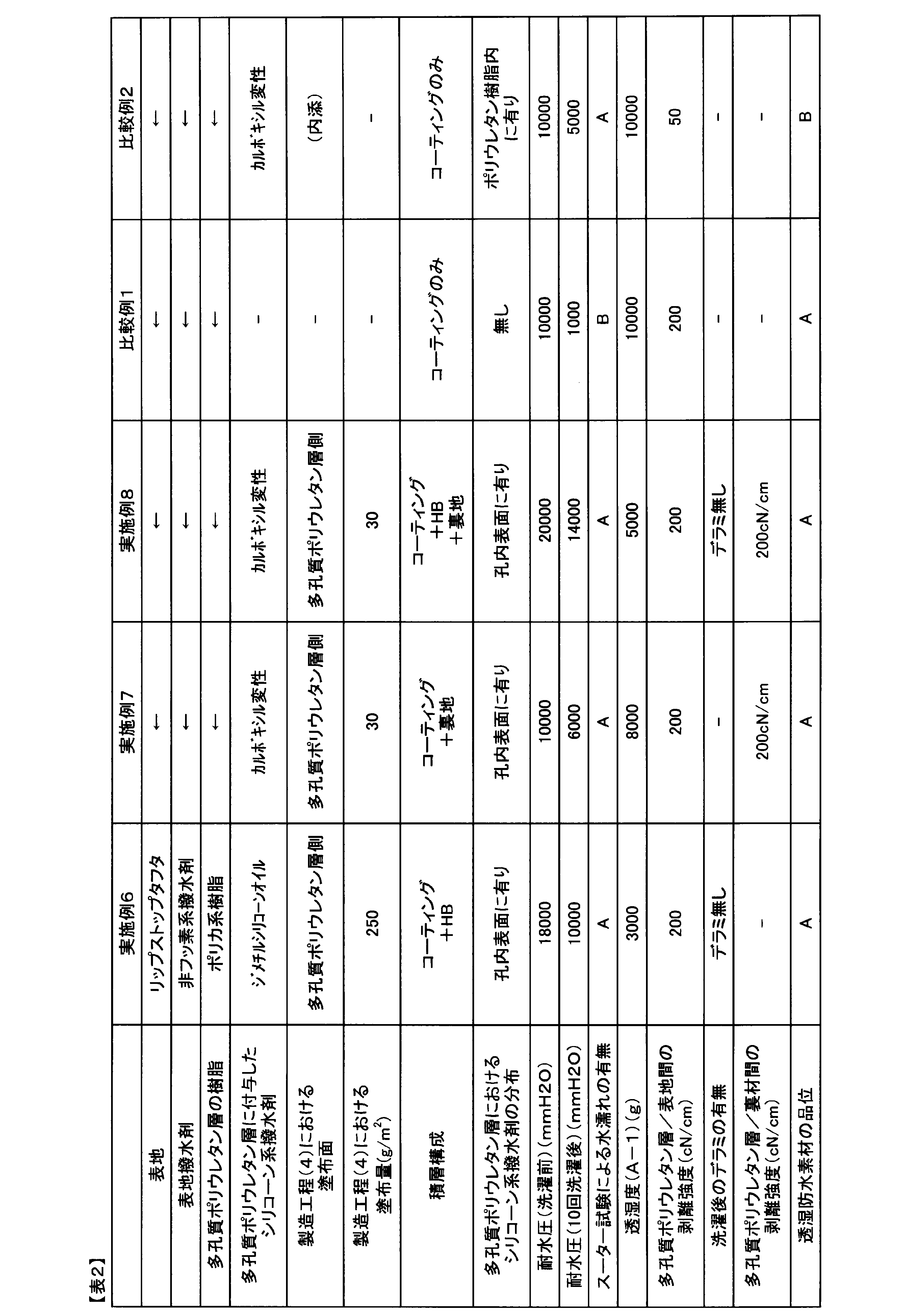
- the moisture-permeable waterproof materials obtained in each Example and Comparative Example were measured and evaluated for the distribution of the silicone-based water repellent in the porous polyurethane layer, water pressure resistance (initial, after 10 washes), Suter test (after 10 washes), moisture permeability (A-1), peel strength, and the presence or absence of delamination and quality after 10 washes. The results are shown in Tables 1 and 2.
Landscapes
- Engineering & Computer Science (AREA)
- Textile Engineering (AREA)
- Chemical & Material Sciences (AREA)
- Chemical Kinetics & Catalysis (AREA)
- Dispersion Chemistry (AREA)
- Laminated Bodies (AREA)
- Treatments For Attaching Organic Compounds To Fibrous Goods (AREA)
Abstract
本発明は、フッ素化合物を使用せず、高い防水性・洗濯耐久性を有するとともに、さらに防水面へのフィルムや裏材貼り合わせにおいても、十分な接着力を得ることができ、着用耐久性に優れた非フッ素防水透湿繊維製品を提供することを課題としてなされたものである。 本発明は、布帛と多孔質ポリウレタン層とが積層された透湿防水素材であって、前記多孔質ポリウレタン層の孔内表面にシリコーン系撥水剤が付着してなる、透湿防水素材である。
Description
本発明は、スポーツ用等の雨衣類に好適に使用される透湿防水加工布およびその製造方法に関する。
従来の湿式コーティング系透湿防水素材は、主としてポリウレタン樹脂を水に可溶な溶媒に溶解させて、さらにフッ素系撥水剤を混合させて布帛に塗工し、これを湿式ゲル化させる製造方法であり、溶媒が水によって置換されるときに布帛上に形成されるフッ素系撥水剤を含む多孔質のポリウレタン被膜が雨やその他の水は通さないが、湿気(水蒸気)は通すというものであった。かかる透湿防水加工布は、例えば、特許文献1,2に記載されている。
昨今の法規制の動向からフッ素化合物の不使用を求められているが、単純にフッ素系撥水剤を非フッ素系撥水剤に置き換えるだけでは、同等レベルの性能を得ることができていなかった。
本発明は、上記に鑑みてなされたものであって、高い防水性・洗濯耐久性を有するとともに、さらに防水面へのフィルムや裏材貼り合わせにおいても、十分な接着力を得ることができ、着用耐久性に優れた非フッ素防水透湿繊維製品を提供することを目的とする。
本発明者らは、上記課題を解決するために鋭意検討の結果、本発明をするに至った。本発明は、以下の構成を有する。
(1) 布帛と多孔質ポリウレタン層とが積層された透湿防水素材であって、前記多孔質ポリウレタン層の孔内表面にシリコーン系撥水剤が付着してなる、透湿防水素材。
(2) 前記シリコーン系撥水剤が変性シリコーンである、(1)に記載の透湿防水素材。
(3) 10回洗濯後の耐水圧が5,000mmH2O以上であり、2,000mmH2Oの水圧で10分保持するスーター試験で水濡れしない、(1)または(2)に記載の透湿防水素材。
(4) 前記多孔質ポリウレタン層と前記布帛との剥離強度が200cN/cm以上である、(1)~(3)のいずれかに記載の透湿防水素材。
(5) 前記多孔質ポリウレタン層の前記布帛と積層している面とは反対側の面に、無孔親水性樹脂層および/または第2の布帛がさらに積層されてなる、(1)~(4)のいずれかに記載の透湿防水素材。
(6) 前記多孔質ポリウレタン層と前記無孔親水性樹脂層との間で剥離のない、(5)に記載の透湿防水素材。
(7) 10回洗濯後の耐水圧が10,000mmH2O以上である、請求項5に記載の透湿防水素材。
(8) 多孔質ポリウレタン層と布帛とが積層された透湿防水素材を製造する方法であって、前記多孔質ポリウレタン層と布帛とが積層されてなる積層シートの、前記多孔質ポリウレタン層の布帛との積層面とは反対側の面に、シリコーン系撥水剤を付着させる工程を含む、透湿防水素材の製造方法。
(9) 前記シリコーン系撥水剤を付着させる工程においてコーティング法を用いる、(8)に記載の透湿防水素材の製造方法。
本発明に係る繊維製品は、フッ素化合物を使用していないにもかかわらず、高い洗濯耐久性を有する耐水圧性能を有するとともに、多孔膜面へ無孔質樹脂層又は裏材貼り合わせ時にも着用に耐えうるだけの十分な剥離強度を得られるものである。
以下、本発明をさらに詳細に説明する。
本発明の透湿防水素材は、多孔質ポリウレタン層と布帛とが積層されてなる。
前記布帛を構成する有用な繊維の素材としては、ポリエステル、ナイロン、アクリル、ポリウレタン、または、アセテートやビスコースなどのレーヨンなどがあり、さらに、これらの他に、ポリ乳酸、芳香族ポリアミド、ポリイミドまたはポリフェニレンサルファイドなどの化学繊維、綿、麻、絹または羊毛などの天然繊維、あるいは、これらの素材の混繊、混紡、交織または交編品を用いることができる。これらの中でも、繊維の素材としては、ポリエステルまたはナイロンを含むものが好ましい。コーティングするポリウレタン樹脂への染料移行昇華の観点からは酸性染料で染色するナイロン系が好ましい。耐水圧や透湿等の性能の観点からは、ポリエステル系やオレフィン系の合成繊維や、天然繊維との混繊、混紡品を用いても良い。
また、前記布帛を構成する繊維は、長繊維および短繊維のいずれであってもよい。また、この繊維を用いた糸は、生糸(フラットヤーン)、撚糸および加工糸のいずれであってもよい。加工糸についても特に限定されるものではなく、仮撚加工糸(ウーリー加工糸、DTY、改良仮撚加工糸など)、押込加工糸、賦型加工糸、擦過加工糸、タスラン加工糸、糸長差引きそろえ加工糸、複合加工糸、毛羽加工糸、交絡集束糸、交絡混繊糸などを用いることができる。繊維表面にシリコーン系撥水剤を多く付着させて撥水性を高めるという観点および引裂強力の向上の観点からは、加工糸を用いることが好ましい。
図面において、前記布帛(表地)は織物の断面図を模式的に示しているが、織物でなくとも編物や不織布であってもよい。
本発明の透湿防水素材は、前記布帛にも、例えばシリコーン系撥水剤などのフッ素化合物を含まない撥水剤が付着していてもよい。
前記布帛(表地)に撥水加工を施すタイミングとしては、前記多孔質ポリウレタン層を積層させる前に行うことが好ましい。具体的には、例えばシリコーン系撥水剤等のフッ素化合物を含まない撥水剤と架橋剤、浸透剤、pH調整剤のうち少なくも1種類を用い、パッド法、スプレー法などで処理、乾燥、キュアすることで撥水加工を施すことができる。そして、JIS L1092スプレー試験で洗濯前4級以上、洗濯20回後3級以上の性能を付与できると好ましい。
図1に示される透湿防水素材は、表地にフッ素化合物を含まない多孔質ポリウレタン層が積層されてなる態様である。
なお、図面に示されるポリウレタン樹脂内の多孔の態様に関しては、あくまでも模式的に示したもので、形状や大きさはこの態様に限られるわけではない。
多孔質ポリウレタン層を形成するポリウレタンとしては、イソシアネート基と反応性のある水酸基を少なくとも2個以上有するポリオール化合物(A)と、イソシアネート構造を有しイソシアネート基を少なくとも2個有するイソシアネート化合物(B)と、必要に応じて添加される鎖長剤(C)を水に可溶な極性溶剤(D)を含む反応溶液中で反応させ、反応停止剤(E)で重合停止することより得られうるポリウレタンが好ましい。
前記ポリウレタンは、単なるウレタン結合のみからなるポリウレタンであってもよいし、尿素結合を含むポリウレタン・ポリ尿素樹脂であってもよい。
前記ポリオール化合物(A)としては例えば、エステル結合を有するポリエステルポリオール、エーテル結合を有するポリエーテルポリオール、カーボネート基を有するポリカーボネートポリオールを挙げることができる。
前記イソシアネート化合物(B)としては例えば、トリレンジイソシアネート(TDI)、ジフェニルメタンジイソシアネート(MDI)、ポリメリックMDI、ヘキサメチレンジイソシアネート(HMDI)、キシリレンジイソシアネート(XDI)、テトラメチルキシリレンジイソシアネート(TMXDI)、イソホロンジイソシアネート(IPDI)、水素添加MDIなどが挙げられる。
前記鎖長剤(C)としては、エチレングリコール、1,4-ブタンジオール、1,3-ブタンジオール(1,3-ブチレングリコール)、ネオペンチルグリコール、1,5-ペンタンジオール、メチルペンタンジオール、1,6-ヘキサンジオール、1,7-ヘプタンジオール、1,8-オクタンジオール、1,9-ノナンジオール、1,10-デカンジオールなどの脂肪族ジオール、1,4-シクロヘキサンジオール、水添キシリレングリコールなどの脂環式ジオール、キシリレングリコールなどの芳香族ジオールなどを挙げることができる。
前記極性溶剤(D)としては、特に限定されないが、イソシアネート化合物(B)と容易に溶けるものが好ましく、例えば、ジメチルホルムアミド(DMF)やジメチルスルホキシド(DMSO)などを挙げることができる。
前記反応停止剤(E)は、ポリウレタン重合反応において、化学構造の末端に反応させて目的粘度で重合停止するために用いられる。反応停止剤(E)には、一価および多価アルコール、一価アミン等を用いることができる。例えば一価および多価のアルコール(メタノール、エタノール、ブタノール、プロピレングリコール、高級アルコール、水酸基を有する高級脂肪酸エステルなど)、一価アミン(メチルアミン、ブチルアミンなど)があげられる。
前記(A)~(E)成分は、それぞれについて単独で使用しても良いが、2種類以上を混合使用しても良い。
前記ポリウレタンの重合に際し、反応温度はウレタン化反応に通常採用される温度と同様でよく、極性溶剤(D)を使用する場合は通常30~90℃である。
前記多孔質ポリウレタン層を前記布帛に積層させる方法としては、前記布帛の表面に前記ポリウレタンを含むポリウレタン溶液を直接塗布して湿式凝固させてもよいし、前記布帛以外の基材に塗布した後に湿式凝固して多孔質ポリウレタン層のシートを作製し、当該シートを前記布帛の表面に接合させてもよい。
前記布帛または前記基材に前記ポリウレタン溶液を塗布する方法としては、一般的にダイレクトコーティング法と呼ばれるものであればよく、ナイフコーティング、ナイフオーバーロールコーティング、リバースロールコーティングなどの各種コーティング方法が使用可能である。
前記多孔質ポリウレタン層のシートを作製する場合、前記基材としては前記シートを剥離可能なものであればよく、例えば、前記布帛とは別の布帛や、離型紙等を用いることができる。前記シートを形成したのち、前記シートの表層に接着剤を塗布して前記布帛に接合させることができる。接着剤が固化したのちに前記基材を剥離することで防水加工布帛を得ることができる。
本発明の透湿防水素材は、前記多孔質ポリウレタン層の孔内表面にシリコーン系撥水剤が付着してなる。
前記シリコーン系撥水剤としては、ストレートシリコーンオイル及び変性シリコーンオイルを用いることができる。
ストレートシリコーンオイルとしては例えば、ジメチルシリコーンオイル、メチルフェニルシリコーンオイル、メチルハイドロジェンシリコーンオイルが挙げられる。
変性シリコーンオイルとしては例えば、ストレートシリコーンオイルを、アルキル、アラルキル、ポリエーテル、高級脂肪酸エステル、フルオロアルキル、アミノ、エポキシ、カルボキシル、アルコールなどにより変性したものが挙げられる。
変性シリコーンオイルの中でも、分子内に反応基を有するものである反応性シリコーンオイルが好ましく、その中でも接着性及び撥水性付与の観点からカルボキシル変性シリコーンオイルが好ましい。
前記シリコーン系撥水剤として用いられるシリコーン系化合物としては例えば、特開2017-218713号公報、特開2017-226946号公報、特開2017-155095号公報、特開2017-218713号公報などに開示されたものが挙げられる。
また、前記シリコーン系撥水剤として用いられるシリコーン系化合物の市販品としては例えば、ゲラネックス(登録商標)SH(松本油脂(株))、ドライポン(登録商標)600E(日華化学(株)製)、リケンパランSG-54(三木理研工業(株))、ライトシリコーンP-290E(北広ケミカル(株))、ポロン(登録商標)MR(信越化学工業(株))、ポロン(登録商標)MF-49(信越化学工業(株))、ネオシード(登録商標)NR8000(日華化学(株))、KF-96シリーズ(信越化学工業(株))、KF8005(信越化学工業(株))、KF8010(信越化学工業(株))、KF4003(信越化学工業(株))、X-22-3701E(信越化学工業(株))、SF-8417(ダウ・東レ(株))、BY16-880(ダウ・東レ(株))、MQ-1600(ダウ・東レ(株))などが挙げられる。
本発明の透湿防水素材は、例えば、前記多孔質ポリウレタン層と前記布帛とが積層されてなる積層シートの、前記多孔質ポリウレタン層の布帛との積層面とは反対側の面に、シリコーン系撥水剤を付着させることで効率良く得ることができる。すなわち本発明の透湿防水素材の製造方法は、多孔質ポリウレタン層と布帛とを含む透湿防水素材を製造する方法であって、前記多孔質ポリウレタン層と前記布帛とが積層されてなる積層シートの、前記多孔質ポリウレタン層の布帛との積層面とは反対側の面に、シリコーン系撥水剤を付着させる工程を含む。
シリコーン系撥水剤を付着させる方法としては、前記多孔質ポリウレタン層に直接塗布してもよいし、布帛側から塗布してもよい。効率的にシリコーン系撥水剤を浸透させる上では、前記多孔質ポリウレタン層に直接塗布することが好ましい。
前記シリコーン系撥水剤を付与する方法としてはグラビア、シリンダーロール、スプレー、キスコーターなど片面処理が可能な各種方法を選ぶことができる。
本発明の透湿防水素材は、前記多孔質ポリウレタン層の前記布帛と積層している面とは反対側の面に、無孔親水性樹脂層および/または第2の布帛がさらに積層されてなることも、耐水性を向上させる上で好ましい。
図2は、図1で示される透湿防水素材の耐水圧をさらに向上させる目的で無孔親水性樹脂層を追加した態様を示している。
前記無孔親水性樹脂層には、ポリオール成分の20~60モル%がポリエチレングリコールおよびポリプロピレングリコールのうち少なくとも一方である親水性ポリウレタン樹脂が、好ましく用いられる。特に好ましいのはポリオール成分の20~60モル%がポリエチレングリコールであるポリウレタン樹脂である。他のポリオール成分としては特に制限はないが、例えばポリエステルグリコール、ポリカーボネートグリコール、および他のポリエーテルグリコールが使用される。親水性ポリウレタン樹脂を構成するポリイソシアネート成分としては、公知の脂肪族ポリイソシアネートおよび芳香族ポリイソシアネートが使用でき、例えば、ヘキサメチレンジイソシアネート、トルエンジイソシアネート、キシレンジイソシアネート、イソホロンジイソシアネート、4,4’-ジフェニルメタンジイソシアネートが挙げられる。
前記親水性無孔質膜は熱融着性を有することが好ましい。熱融着性を有することにより、上記微多孔質膜を溶解することなく親水性無孔質膜を均一に密着させることが出来る。熱融着性は、低融点素材の使用や架橋剤の使用により付与される。
前記親水性無孔質膜の厚みとしては、1~10μmが好ましい。
前記無孔親水性樹脂層は、透湿性の高いフィルムを湿気硬化型ポリウレタン系ホットメルトなどで貼り合わせてもよいし、透湿性の高い樹脂を全面にコーティングしてもよい。また、意匠性や多孔質樹脂層表面の風合い改善のために、部分的なプリントとしてもよい。
前記無孔親水性樹脂層の形成方法としては例えば、前記多孔質ポリウレタン層に直接コーティングして形成する方法や、予め離型紙等に塗布して形成する方法、また、押し出し法によるフィルムの作成等を挙げることができる。
図3は、図1で示される透湿防水素材の多孔質ポリウレタン層を保護する目的で、さらに第2の布帛(裏材)を貼り合わせた態様を示している。また図4は、図2で示される態様の無孔親水性樹脂層の面に、さらに布帛層を貼り合わせた態様を示している。
図3、図4においては第2の布帛は編物として示されているが、織物や不織布の使用を限定するものではない。
前記第2の布帛には、各種合成繊維の平織物(タフタ)、綾織物、サテン等特殊織物または、編物、更には天然繊維や半合成繊維の各種生地、不織布等が使用できる。なかでもナイロントリコット編物が風合い等の点でより好ましい。
前記第2の布帛を有する態様の場合、前記シリコーン系撥水剤を前記多孔質ポリウレタン層に付着させるタイミングとしては、前記第2の布帛層を貼り合わせる前でも後でもよいが、前記多孔質ポリウレタン層に前記シリコーン系撥水剤を効率的に付与する観点からは、貼り合わせる前に付与することが好ましい。
前記無孔親水性樹脂層および/または第2の布帛がさらに積層されてなる態様の透湿防水素材において、前記多孔質ポリウレタン層と前記多孔質ポリウレタン層に接する前記無孔親水性樹脂層または第2の布帛との間で剥離のないことが好ましい。本発明において剥離(デラミ)とは、洗濯時に無孔親水性樹脂層が多孔質ポリウレタン層から剥がれる若しくは浮く事象のことを示す。
本発明の透湿防水素材は、前記多孔質ポリウレタン層と前記布帛との剥離強度が200cN/cm以上であることが好ましい。剥離強度は、JIS L1086(2020)の測定手法に従い測定される。
本発明の透湿防水素材は、10回洗濯後の耐水圧が5,000mmH2O以上であり、2,000mmH2Oの水圧で10分保持するスーター試験で水濡れしないことが好ましい。本発明において耐水圧試験は、JIS L 1092:2020 B法(高水圧法)に記載の測定手法に準ずる。スーター試験とは、簡易耐水圧測定機を用いて、水圧2000mmH2Oを10分間保持し、膜の防水性を評価する手法である。10分後の膜の濡れ性の有無にて防水性が判断される。
前記無孔親水性樹脂層および/または第2の布帛がさらに積層されてなる態様の透湿防水素材において、10回洗濯後の耐水圧が10,000mmH2O以上であることが好ましい。
本発明の透湿防水素材は、洗濯耐久を有する耐水圧性能と各界面の接着性に優れ、例えば雨具等の衣料、靴、鞄、テント等のアウトドア用品など、透湿防水性と耐久性とが要求される各種製品の生地として適用することが可能である。
以下、本発明の実施例を説明する。なお、以下に示す実施例のみに本発明が限定されるものではない。
[測定・評価方法]
以下に測定・評価方法を説明する。なお、透湿防水素材が無孔親水性樹脂層付き、裏材(第2の布帛)付き、または無孔親水性樹脂層および裏材(第2の布帛)付きである場合には、無孔親水性樹脂層および/または裏材(第2の布帛)を含めて測定・評価対象とする。
以下に測定・評価方法を説明する。なお、透湿防水素材が無孔親水性樹脂層付き、裏材(第2の布帛)付き、または無孔親水性樹脂層および裏材(第2の布帛)付きである場合には、無孔親水性樹脂層および/または裏材(第2の布帛)を含めて測定・評価対象とする。
(1)多孔質ポリウレタン層におけるシリコーン系撥水剤の分布
透湿防水素材の断面を走査電子顕微鏡(SEM)にて2000倍で観察し、エネルギー分散型X線分光法(EDX)にて多孔質ポリウレタン層内に対するSi元素の存在を確認し、分布状況を特定した。
透湿防水素材の断面を走査電子顕微鏡(SEM)にて2000倍で観察し、エネルギー分散型X線分光法(EDX)にて多孔質ポリウレタン層内に対するSi元素の存在を確認し、分布状況を特定した。
(2)耐水圧
JIS L1092:2020 B法(高水圧法)に準拠し測定した。測定の際、測定対象の透湿防水素材の伸びを抑えるため、染色堅牢度測定に用いるナイロン添付白布をタフタカバーとして用いた。10回洗濯後の耐水圧を測定する場合は、JIS L1930(実用機試験方法)のC4M法を用い10回洗濯を繰り返し、その後に耐水圧測定を行った。
JIS L1092:2020 B法(高水圧法)に準拠し測定した。測定の際、測定対象の透湿防水素材の伸びを抑えるため、染色堅牢度測定に用いるナイロン添付白布をタフタカバーとして用いた。10回洗濯後の耐水圧を測定する場合は、JIS L1930(実用機試験方法)のC4M法を用い10回洗濯を繰り返し、その後に耐水圧測定を行った。
(3)スーター試験による水濡れの有無
透湿防水素材に対してJIS L1930(実用機試験方法)のC4M法により10回洗濯を繰り返した。簡易耐水圧測定機を用いて、透湿防水素材の表地側から2000mmH2Oの水圧をかけて10分間保持し、10分後の表地と反対側の面における濡れの有無を確認した。膜の濡れが確認されなかったものを「A」、膜の濡れが確認されたものを「B」と評価した。
透湿防水素材に対してJIS L1930(実用機試験方法)のC4M法により10回洗濯を繰り返した。簡易耐水圧測定機を用いて、透湿防水素材の表地側から2000mmH2Oの水圧をかけて10分間保持し、10分後の表地と反対側の面における濡れの有無を確認した。膜の濡れが確認されなかったものを「A」、膜の濡れが確認されたものを「B」と評価した。
(4)透湿度
JIS L1099:2021 A-1法(塩化カルシウム法)に準拠し測定した。
JIS L1099:2021 A-1法(塩化カルシウム法)に準拠し測定した。
(5)剥離強度
JIS L1086:2020 接着芯地および接着布試験方法に準拠し測定した。
JIS L1086:2020 接着芯地および接着布試験方法に準拠し測定した。
(6)剥離(デラミ)の有無
無孔親水性樹脂層付き、裏材(第2の布帛)付き、または無孔親水性樹脂層および裏材(第2の布帛)付きの透湿防水素材に対してJIS L1930(実用機試験方法)のC4M法により10回洗濯を繰り返した後、多孔質ポリウレタン層に接する無孔親水性樹脂層または裏材(第2の布帛)が多孔質ポリウレタン層から剥がれる若しくは浮く事象の有無を目視確認し評価を行った。浮きや剥がれが無ければ、「デラミ無し」と表記した。
無孔親水性樹脂層付き、裏材(第2の布帛)付き、または無孔親水性樹脂層および裏材(第2の布帛)付きの透湿防水素材に対してJIS L1930(実用機試験方法)のC4M法により10回洗濯を繰り返した後、多孔質ポリウレタン層に接する無孔親水性樹脂層または裏材(第2の布帛)が多孔質ポリウレタン層から剥がれる若しくは浮く事象の有無を目視確認し評価を行った。浮きや剥がれが無ければ、「デラミ無し」と表記した。
(7)透湿防水素材の品位
多孔質ポリウレタン層形成に使用するコーティング樹脂が布帛に浸透し裏抜けする、生地品位を損なう(裏通り、メムキ)ものか目視確認し評価を行った。衣料に不適であるかを基準に樹脂の裏抜けが確認されたものを「B」、確認されなかったものを「A」と評価した。
多孔質ポリウレタン層形成に使用するコーティング樹脂が布帛に浸透し裏抜けする、生地品位を損なう(裏通り、メムキ)ものか目視確認し評価を行った。衣料に不適であるかを基準に樹脂の裏抜けが確認されたものを「B」、確認されなかったものを「A」と評価した。
[製造工程]
(1)表地用布帛の準備
繊度50デニール(56dtex)のナイロンフィラメントヤーンで構成されたナイロンリップストップタフタを、常法で精練、染色した。この布帛を、非フッ素系撥水剤(日華化学(株)NR-7200)30g/lの希釈液に浸漬し、絞り率40%となるようにマングルで絞った後、ヒートセッターにて150℃×30秒の乾燥熱処理を施し、表地用布帛とした。
(1)表地用布帛の準備
繊度50デニール(56dtex)のナイロンフィラメントヤーンで構成されたナイロンリップストップタフタを、常法で精練、染色した。この布帛を、非フッ素系撥水剤(日華化学(株)NR-7200)30g/lの希釈液に浸漬し、絞り率40%となるようにマングルで絞った後、ヒートセッターにて150℃×30秒の乾燥熱処理を施し、表地用布帛とした。
(2)コーティング用ポリウレタン樹脂組成物の調製
撹拌機がついた反応容器にポリカーボネートポリオール(ヘキサメチレンカーボネートジオール)、ポリエーテルポリオール(ポリテトラメチレングリコール)、イソシアネート(ジフェニルメタンジイソシアネート)、ジメチルホルムアミド、エチレングリコール、プロピレングリコールモノオレート、プロピレングリコールを加えて撹拌することにより、ウレタン樹脂濃度25.0%、粘度82000mPa・s(30℃)のポリカーボネート系ポリウレタン樹脂溶液を得た。
撹拌機がついた反応容器にポリカーボネートポリオール(ヘキサメチレンカーボネートジオール)、ポリエーテルポリオール(ポリテトラメチレングリコール)、イソシアネート(ジフェニルメタンジイソシアネート)、ジメチルホルムアミド、エチレングリコール、プロピレングリコールモノオレート、プロピレングリコールを加えて撹拌することにより、ウレタン樹脂濃度25.0%、粘度82000mPa・s(30℃)のポリカーボネート系ポリウレタン樹脂溶液を得た。
得られたポリカーボネート系ポリウレタン樹脂溶液80質量部にシリカ微粉末((株)トクヤマ製、“レオロシール”(登録商標)MT-10、ジメチルジクロロシランの気相反応シリカ)5質量部を添加し、DMF 50質量部で充分に浸漬し、ホモミキサーで約15分間分散撹拌した後、撹拌し、ポリカーボネート系ポリウレタン樹脂を含む液状のコーティング用ポリウレタン樹脂組成物を得た。
(3)ポリウレタン樹脂のコーティング
上記の撥水処理布帛に対して上記のコーティング用樹脂組成物を塗布量150g/m2でナイフオーバーロールコーターによりコーティングし、DMFを15質量%含有する水溶液を凝固液とするゲル化浴槽中に30℃で2分間浸漬して、ポリカーボネート系ポリウレタン樹脂の液状組成物を湿式凝固させた。その後、80℃の温湯で10分間水洗し、140℃にて熱風乾燥することによって、布帛に多孔質ポリウレタン層が積層された透湿防水素材を得た。
上記の撥水処理布帛に対して上記のコーティング用樹脂組成物を塗布量150g/m2でナイフオーバーロールコーターによりコーティングし、DMFを15質量%含有する水溶液を凝固液とするゲル化浴槽中に30℃で2分間浸漬して、ポリカーボネート系ポリウレタン樹脂の液状組成物を湿式凝固させた。その後、80℃の温湯で10分間水洗し、140℃にて熱風乾燥することによって、布帛に多孔質ポリウレタン層が積層された透湿防水素材を得た。
(4)シリコーン撥水処理
上記(3)で得た透湿防水素材の多孔質ポリウレタン層側の面に、シリコーン系撥水剤を塗布量30g/m2でグラビアロールを用いて塗布し、シリコーン系撥水剤を多孔質ポリウレタン層に浸透させた。その後120℃で乾燥の後、150℃×30秒の乾燥熱処理を施した。
上記(3)で得た透湿防水素材の多孔質ポリウレタン層側の面に、シリコーン系撥水剤を塗布量30g/m2でグラビアロールを用いて塗布し、シリコーン系撥水剤を多孔質ポリウレタン層に浸透させた。その後120℃で乾燥の後、150℃×30秒の乾燥熱処理を施した。
(5)無孔親水性樹脂膜のラミネート
下記の処方1に示す組成でポリウレタン溶液を調整した。
(処方1)
ポリエーテル系ポリウレタンレオコートU-6285M(東レコーテックス(株)レオコート(登録商標)U-6285M)100質量部
MEK 50質量部
トルエン 50質量部。
下記の処方1に示す組成でポリウレタン溶液を調整した。
(処方1)
ポリエーテル系ポリウレタンレオコートU-6285M(東レコーテックス(株)レオコート(登録商標)U-6285M)100質量部
MEK 50質量部
トルエン 50質量部。
上記のポリウレタン溶液をナイフオーバーロールコーターにて、離型紙(リンテック(株)製EV130TPD)上にクリアランス50μmで塗工した。ついで80℃にて熱風乾燥して、厚み5μmの無孔親水性樹脂膜を得た。
上記(4)の後の透湿防水素材の多孔質ポリウレタン層に上記の無孔親水性樹脂膜を重ね合わせ、ホットラミネーターにて温度120℃、圧力0.9807MPa(10kg/cm2)、速度20m/分の条件でラミネートを行ない、無孔親水性樹脂層(表中、「HB」と表す。)付きの透湿防水素材を得た。
(6)裏材の貼り合わせ
ナイロントリコット(18dハーフトリコット:W×C=36×40)を裏材(第2の布帛)として用いた。
ナイロントリコット(18dハーフトリコット:W×C=36×40)を裏材(第2の布帛)として用いた。
上記(4)の後の透湿防水素材の多孔質ポリウレタン層、または上記(5)の後の透湿防水素材の無孔親水性樹脂層上にポリウレタンホットメルト(品番LA7575UV)を30メッシュのグラビアロールで塗工し、100℃にて熱風乾燥後、裏材を貼り合わせ、圧着したまま24時間40℃で熟成させ、裏材(第2の布帛)付きの透湿防水素材を得た。
[実施例1]
製造工程(1)~(4)により透湿防水加工布を製造した。ただし、製造工程(4)におけるシリコーン系撥水剤としてはジメチルシリコーンオイル(信越化学工業(株)KF-96)を用いた。多孔質ポリウレタン層におけるシリコーン系撥水剤の分布は、塗布を行った多孔質ポリウレタン層側の表面、および孔内表面に存在を確認することができた。すなわち、孔内表面にシリコーン系撥水剤が付着していることが確認できた。
製造工程(1)~(4)により透湿防水加工布を製造した。ただし、製造工程(4)におけるシリコーン系撥水剤としてはジメチルシリコーンオイル(信越化学工業(株)KF-96)を用いた。多孔質ポリウレタン層におけるシリコーン系撥水剤の分布は、塗布を行った多孔質ポリウレタン層側の表面、および孔内表面に存在を確認することができた。すなわち、孔内表面にシリコーン系撥水剤が付着していることが確認できた。
[実施例2]
製造工程(1)~(4)により透湿防水加工布を製造した。ただし、製造工程(4)におけるシリコーン系撥水剤としては、カルボキシル変性シリコーンオイル(信越化学工業(株)X-22-3701E)を用いた。多孔質ポリウレタン層におけるシリコーン系撥水剤の分布は、塗布を行った多孔質ポリウレタン層側の表面、および孔内表面に存在を確認することができた。すなわち、孔内表面にシリコーン系撥水剤が付着していることが確認できた。
製造工程(1)~(4)により透湿防水加工布を製造した。ただし、製造工程(4)におけるシリコーン系撥水剤としては、カルボキシル変性シリコーンオイル(信越化学工業(株)X-22-3701E)を用いた。多孔質ポリウレタン層におけるシリコーン系撥水剤の分布は、塗布を行った多孔質ポリウレタン層側の表面、および孔内表面に存在を確認することができた。すなわち、孔内表面にシリコーン系撥水剤が付着していることが確認できた。
[実施例3]
実施例2で得られた透湿防水加工布にさらに製造工程(5)の加工を施し、無孔親水性樹脂層付きの透湿防水加工布を得た。多孔質ポリウレタン層におけるシリコーン系撥水剤の分布は、塗布を行った多孔質ポリウレタン層側の表面、および孔内表面に存在を確認することができた。すなわち、孔内表面にシリコーン系撥水剤が付着していることが確認できた。
実施例2で得られた透湿防水加工布にさらに製造工程(5)の加工を施し、無孔親水性樹脂層付きの透湿防水加工布を得た。多孔質ポリウレタン層におけるシリコーン系撥水剤の分布は、塗布を行った多孔質ポリウレタン層側の表面、および孔内表面に存在を確認することができた。すなわち、孔内表面にシリコーン系撥水剤が付着していることが確認できた。
[実施例4]
製造工程(4)におけるシリコーン撥水剤の塗布を、表地側の面に塗布量60g/m2で施した。それ以外は実施例3と同様にして、無孔親水性樹脂層付きの透湿防水加工布を得た。多孔質ポリウレタン層におけるシリコーン系撥水剤の分布は、塗布を行った表地側の表面、および孔内表面に存在を確認することができた。すなわち、孔内表面にシリコーン系撥水剤が付着していることが確認できた。
製造工程(4)におけるシリコーン撥水剤の塗布を、表地側の面に塗布量60g/m2で施した。それ以外は実施例3と同様にして、無孔親水性樹脂層付きの透湿防水加工布を得た。多孔質ポリウレタン層におけるシリコーン系撥水剤の分布は、塗布を行った表地側の表面、および孔内表面に存在を確認することができた。すなわち、孔内表面にシリコーン系撥水剤が付着していることが確認できた。
[実施例5]
実施例1で得られた透湿防水加工布にさらに製造工程(5)の加工を施し、無孔親水性樹脂層付きの透湿防水加工布を得た。多孔質ポリウレタン層におけるシリコーン系撥水剤の分布は、塗布を行った多孔質ポリウレタン層側の表面、および孔内表面に存在を確認することができた。すなわち、孔内表面にシリコーン系撥水剤が付着していることが確認できた。
実施例1で得られた透湿防水加工布にさらに製造工程(5)の加工を施し、無孔親水性樹脂層付きの透湿防水加工布を得た。多孔質ポリウレタン層におけるシリコーン系撥水剤の分布は、塗布を行った多孔質ポリウレタン層側の表面、および孔内表面に存在を確認することができた。すなわち、孔内表面にシリコーン系撥水剤が付着していることが確認できた。
[実施例6]
製造工程(4)におけるシリコーン撥水剤の塗布量を250g/m2とした以外は実施例5と同様にして、無孔親水性樹脂層付きの透湿防水加工布を得た。多孔質ポリウレタン層におけるシリコーン系撥水剤の分布は、塗布を行った多孔質ポリウレタン層側の表面、および孔内表面に存在を確認することができた。すなわち、孔内表面にシリコーン系撥水剤が付着していることが確認できた。
製造工程(4)におけるシリコーン撥水剤の塗布量を250g/m2とした以外は実施例5と同様にして、無孔親水性樹脂層付きの透湿防水加工布を得た。多孔質ポリウレタン層におけるシリコーン系撥水剤の分布は、塗布を行った多孔質ポリウレタン層側の表面、および孔内表面に存在を確認することができた。すなわち、孔内表面にシリコーン系撥水剤が付着していることが確認できた。
[実施例7]
実施例2で得られた透湿防水加工布にさらに製造工程(6)の加工を施し、裏材(第2の布帛)付きの透湿防水加工布を得た。多孔質ポリウレタン層におけるシリコーン系撥水剤の分布は、塗布を行った多孔質ポリウレタン層側の表面、および孔内表面に存在を確認することができた。すなわち、孔内表面にシリコーン系撥水剤が付着していることが確認できた。
実施例2で得られた透湿防水加工布にさらに製造工程(6)の加工を施し、裏材(第2の布帛)付きの透湿防水加工布を得た。多孔質ポリウレタン層におけるシリコーン系撥水剤の分布は、塗布を行った多孔質ポリウレタン層側の表面、および孔内表面に存在を確認することができた。すなわち、孔内表面にシリコーン系撥水剤が付着していることが確認できた。
[実施例8]
実施例2で得られた透湿防水加工布にさらに製造工程(5)および(6)の加工をこの順に施し、無孔親水性樹脂層および裏材(第2の布帛)付きの透湿防水加工布を得た。多孔質ポリウレタン層におけるシリコーン系撥水剤の分布は、塗布を行った多孔質ポリウレタン層側の表面、および孔内表面に存在を確認することができた。すなわち、孔内表面にシリコーン系撥水剤が付着していることが確認できた。
実施例2で得られた透湿防水加工布にさらに製造工程(5)および(6)の加工をこの順に施し、無孔親水性樹脂層および裏材(第2の布帛)付きの透湿防水加工布を得た。多孔質ポリウレタン層におけるシリコーン系撥水剤の分布は、塗布を行った多孔質ポリウレタン層側の表面、および孔内表面に存在を確認することができた。すなわち、孔内表面にシリコーン系撥水剤が付着していることが確認できた。
[比較例1]
製造工程(1)~(3)により透湿防水加工布を製造した。
製造工程(1)~(3)により透湿防水加工布を製造した。
[比較例2]
製造工程(2)においてコーティング用樹脂組成物にカルボキシル変性シリコーンオイル(信越化学工業(株)X-22-3701E)を1質量部内添した以外は比較例1と同様にして、透湿防水加工布を得た。多孔質ポリウレタン層におけるシリコーン系撥水剤の分布は、孔内表面への偏在ではなく、ポリウレタン樹脂内に存在を確認した。すなわち、孔内表面にシリコーン系撥水剤は付着していなかった。
製造工程(2)においてコーティング用樹脂組成物にカルボキシル変性シリコーンオイル(信越化学工業(株)X-22-3701E)を1質量部内添した以外は比較例1と同様にして、透湿防水加工布を得た。多孔質ポリウレタン層におけるシリコーン系撥水剤の分布は、孔内表面への偏在ではなく、ポリウレタン樹脂内に存在を確認した。すなわち、孔内表面にシリコーン系撥水剤は付着していなかった。
各実施例・比較例で得られた透湿防水素材について、多孔質ポリウレタン層におけるシリコーン系撥水剤の分布、耐水圧(初期、洗濯10回後)、スーター試験(洗濯10回後)、透湿度(A-1)、剥離強度、10回洗濯後のデラミの有無及び品位を測定・評価した。結果を表1、2に示す。

1:布帛(表地)
2:多孔質ポリウレタン層
3:無孔親水性樹脂層
4:第2の布帛(裏材)
2:多孔質ポリウレタン層
3:無孔親水性樹脂層
4:第2の布帛(裏材)
Claims (9)
- 布帛と多孔質ポリウレタン層とが積層された透湿防水素材であって、前記多孔質ポリウレタン層の孔内表面にシリコーン系撥水剤が付着してなる、透湿防水素材。
- 前記シリコーン系撥水剤が変性シリコーンである、請求項1に記載の透湿防水素材。
- 10回洗濯後の耐水圧が5,000mmH2O以上であり、2,000mmH2Oの水圧で10分保持するスーター試験で水濡れしない、請求項1または2に記載の透湿防水素材。
- 前記多孔質ポリウレタン層と前記布帛との剥離強度が200cN/cm以上である、請求項1または2に記載の透湿防水素材。
- 前記多孔質ポリウレタン層の前記布帛と積層している面とは反対側の面に、無孔親水性樹脂層および/または第2の布帛がさらに積層されてなる、請求項1または2に記載の透湿防水素材。
- 前記多孔質ポリウレタン層と前記多孔質ポリウレタン層に接する前記無孔親水性樹脂層または前記第2の布帛との間で剥離のない、請求項5に記載の透湿防水素材。
- 10回洗濯後の耐水圧が10,000mmH2O以上である、請求項5に記載の透湿防水素材。
- 多孔質ポリウレタン層と布帛とが積層された透湿防水素材を製造する方法であって、前記多孔質ポリウレタン層と前記布帛とが積層されてなる積層シートの、前記多孔質ポリウレタン層の布帛との積層面とは反対側の面に、シリコーン系撥水剤を付着させる工程を含む、透湿防水素材の製造方法。
- 前記シリコーン系撥水剤を付着させる工程においてコーティング法を用いる、請求項8に記載の透湿防水素材の製造方法。
Priority Applications (1)
| Application Number | Priority Date | Filing Date | Title |
|---|---|---|---|
| CN202480072492.7A CN122341484A (zh) | 2023-11-30 | 2024-11-22 | 透湿防水原材料和透湿防水原材料的制造方法 |
Applications Claiming Priority (2)
| Application Number | Priority Date | Filing Date | Title |
|---|---|---|---|
| JP2023202716 | 2023-11-30 | ||
| JP2023-202716 | 2023-11-30 |
Publications (1)
| Publication Number | Publication Date |
|---|---|
| WO2025115772A1 true WO2025115772A1 (ja) | 2025-06-05 |
Family
ID=95896620
Family Applications (1)
| Application Number | Title | Priority Date | Filing Date |
|---|---|---|---|
| PCT/JP2024/041418 Pending WO2025115772A1 (ja) | 2023-11-30 | 2024-11-22 | 透湿防水素材および透湿防水素材の製造方法 |
Country Status (3)
| Country | Link |
|---|---|
| CN (1) | CN122341484A (ja) |
| TW (1) | TW202537822A (ja) |
| WO (1) | WO2025115772A1 (ja) |
Citations (10)
| Publication number | Priority date | Publication date | Assignee | Title |
|---|---|---|---|---|
| JPS6047954A (ja) | 1983-08-26 | 1985-03-15 | Toshiba Corp | 溶存酸素濃度測定装置 |
| JPH01156579A (ja) * | 1987-12-14 | 1989-06-20 | Kanebo Ltd | コーティング織物の製造方法 |
| JPH09228252A (ja) * | 1996-02-20 | 1997-09-02 | Asahi Chem Ind Co Ltd | 複合布帛 |
| JPH11131373A (ja) | 1997-08-13 | 1999-05-18 | Toray Ind Inc | 透湿防水加工布帛およびその製造方法 |
| JP2004068212A (ja) * | 2002-08-07 | 2004-03-04 | Toyobo Co Ltd | 透湿防水布帛 |
| JP2017155095A (ja) | 2016-02-29 | 2017-09-07 | 日華化学株式会社 | 撥水助剤、非フッ素系撥水剤組成物、及び撥水性繊維製品の製造方法 |
| KR20170114227A (ko) * | 2016-04-05 | 2017-10-13 | 주식회사 동우에이엘티 | 균일한 미세기공이 형성된 폴리우레탄 필름 및 이를 이용한 화장용 도포구 제조방법 |
| JP2017218713A (ja) | 2017-04-21 | 2017-12-14 | 明成化学工業株式会社 | フッ素を含まないはっ水剤及びはっ水加工方法、はっ水性繊維製品 |
| JP2017226946A (ja) | 2016-06-24 | 2017-12-28 | 日華化学株式会社 | 撥水剤組成物、及び撥水性繊維製品の製造方法 |
| WO2020080084A1 (ja) * | 2018-10-19 | 2020-04-23 | 小松マテーレ株式会社 | 透湿防水性布帛およびこれを用いた繊維製品 |
-
2024
- 2024-11-22 WO PCT/JP2024/041418 patent/WO2025115772A1/ja active Pending
- 2024-11-22 CN CN202480072492.7A patent/CN122341484A/zh active Pending
- 2024-11-27 TW TW113145648A patent/TW202537822A/zh unknown
Patent Citations (10)
| Publication number | Priority date | Publication date | Assignee | Title |
|---|---|---|---|---|
| JPS6047954A (ja) | 1983-08-26 | 1985-03-15 | Toshiba Corp | 溶存酸素濃度測定装置 |
| JPH01156579A (ja) * | 1987-12-14 | 1989-06-20 | Kanebo Ltd | コーティング織物の製造方法 |
| JPH09228252A (ja) * | 1996-02-20 | 1997-09-02 | Asahi Chem Ind Co Ltd | 複合布帛 |
| JPH11131373A (ja) | 1997-08-13 | 1999-05-18 | Toray Ind Inc | 透湿防水加工布帛およびその製造方法 |
| JP2004068212A (ja) * | 2002-08-07 | 2004-03-04 | Toyobo Co Ltd | 透湿防水布帛 |
| JP2017155095A (ja) | 2016-02-29 | 2017-09-07 | 日華化学株式会社 | 撥水助剤、非フッ素系撥水剤組成物、及び撥水性繊維製品の製造方法 |
| KR20170114227A (ko) * | 2016-04-05 | 2017-10-13 | 주식회사 동우에이엘티 | 균일한 미세기공이 형성된 폴리우레탄 필름 및 이를 이용한 화장용 도포구 제조방법 |
| JP2017226946A (ja) | 2016-06-24 | 2017-12-28 | 日華化学株式会社 | 撥水剤組成物、及び撥水性繊維製品の製造方法 |
| JP2017218713A (ja) | 2017-04-21 | 2017-12-14 | 明成化学工業株式会社 | フッ素を含まないはっ水剤及びはっ水加工方法、はっ水性繊維製品 |
| WO2020080084A1 (ja) * | 2018-10-19 | 2020-04-23 | 小松マテーレ株式会社 | 透湿防水性布帛およびこれを用いた繊維製品 |
Also Published As
| Publication number | Publication date |
|---|---|
| TW202537822A (zh) | 2025-10-01 |
| CN122341484A (zh) | 2026-07-03 |
Similar Documents
| Publication | Publication Date | Title |
|---|---|---|
| CN101137499B (zh) | 层叠物及使用该层叠物的纤维制品 | |
| US9527271B2 (en) | Sealing tape and textile product using the same | |
| JP5463089B2 (ja) | 積層布帛およびその製造方法 | |
| JP4503096B1 (ja) | 透湿防水性布帛およびその製造方法 | |
| CN101588924B (zh) | 透湿性防水片材及其制造方法 | |
| EP2202352B1 (en) | Cloth waterproofed with vegetable component | |
| TWI923831B (zh) | 纖維積層構造體及其製造方法 | |
| GB2039790A (en) | A moisture-permeable waterproof coated fabric and method of making the same | |
| JP4048229B2 (ja) | 防水透湿性繊維製品用積層体 | |
| JP2004256939A (ja) | 撥水性布帛およびそれを用いた衣料 | |
| WO2000036209A1 (fr) | Matiere permeable a la vapeur d'eau et impermeable a l'eau et son procede de fabrication | |
| JP3909264B2 (ja) | 透湿性防水シート及びその製造方法 | |
| WO2015119037A1 (ja) | 防水布帛およびこれを用いた繊維製品 | |
| JP2015206152A (ja) | 透湿防水性布帛 | |
| JP7372257B2 (ja) | 透湿防水性布帛およびこれを用いた繊維製品 | |
| TW202537822A (zh) | 透濕防水素材及透濕防水素材之製造方法 | |
| JP2008307813A (ja) | 透湿性防水布帛およびその製造方法 | |
| JP2003020574A (ja) | 透湿防水性ラミネート布帛の製造方法 | |
| JP6422115B2 (ja) | 布帛及びその製造方法 | |
| JP2003041415A (ja) | 防水衣料及び防水衣料用目止めテープ | |
| HK1116733B (en) | Layered product and textile product comprising the same | |
| HK1113273A (en) | Sealing tape and fiber product making use of the same |
Legal Events
| Date | Code | Title | Description |
|---|---|---|---|
| ENP | Entry into the national phase |
Ref document number: 2024570950 Country of ref document: JP Kind code of ref document: A |
|
| WWE | Wipo information: entry into national phase |
Ref document number: 2024570950 Country of ref document: JP |
|
| 121 | Ep: the epo has been informed by wipo that ep was designated in this application |
Ref document number: 24897458 Country of ref document: EP Kind code of ref document: A1 |
|
| NENP | Non-entry into the national phase |
Ref country code: DE |