WO2025115139A1 - くし - Google Patents
くし Download PDFInfo
- Publication number
- WO2025115139A1 WO2025115139A1 PCT/JP2023/042787 JP2023042787W WO2025115139A1 WO 2025115139 A1 WO2025115139 A1 WO 2025115139A1 JP 2023042787 W JP2023042787 W JP 2023042787W WO 2025115139 A1 WO2025115139 A1 WO 2025115139A1
- Authority
- WO
- WIPO (PCT)
- Prior art keywords
- teeth
- comb
- sub
- main
- hair
- Prior art date
- Legal status (The legal status is an assumption and is not a legal conclusion. Google has not performed a legal analysis and makes no representation as to the accuracy of the status listed.)
- Pending
Links
Images




Classifications
-
- A—HUMAN NECESSITIES
- A46—BRUSHWARE
- A46B—BRUSHES
- A46B9/00—Arrangements of the bristles in the brush body
- A46B9/02—Position or arrangement of bristles in relation to surface of the brush body, e.g. inclined, in rows, in groups
- A46B9/023—Position or arrangement of bristles in relation to surface of the brush body, e.g. inclined, in rows, in groups arranged like in hair brushes, e.g. hair treatment, dyeing, streaking
-
- A—HUMAN NECESSITIES
- A45—HAND OR TRAVELLING ARTICLES
- A45D—HAIRDRESSING OR SHAVING EQUIPMENT; EQUIPMENT FOR COSMETICS OR COSMETIC TREATMENTS, e.g. FOR MANICURING OR PEDICURING
- A45D24/00—Hair combs for care of the hair; Accessories therefor
- A45D24/04—Multi-part combs
-
- A—HUMAN NECESSITIES
- A46—BRUSHWARE
- A46B—BRUSHES
- A46B9/00—Arrangements of the bristles in the brush body
- A46B9/02—Position or arrangement of bristles in relation to surface of the brush body, e.g. inclined, in rows, in groups
- A46B9/026—Position or arrangement of bristles in relation to surface of the brush body, e.g. inclined, in rows, in groups where the surface of the brush body or carrier is not in one plane, e.g. not flat
-
- A—HUMAN NECESSITIES
- A46—BRUSHWARE
- A46B—BRUSHES
- A46B2200/00—Brushes characterized by their functions, uses or applications
- A46B2200/10—For human or animal care
- A46B2200/104—Hair brush
Definitions
- the present invention relates to a comb whose surface is plated.
- Patent Document 1 When the surface of a comb is plated, the surface becomes smooth and contact friction with hair is reduced.
- Such combs have been shown to be effective in discharging static electricity accumulated in the hair by using the human body as an earth (see, for example, Patent Document 1).
- plating results in non-plated areas at the contact points with the electrode parts. There is a problem of peeling starting from the non-plated areas, and if painted, they may dissolve with hair dye, etc., so it is necessary to cover these non-plated areas with plated parts.
- the non-plated areas are covered with lids that fit together. This type of plating makes hair feel smooth and prevents hair from clogging.
- each tooth is made of a flexible material without using plating to prevent hair from clogging (see, for example, Patent Document 2).
- the present invention takes into consideration the above-mentioned conventional technologies, and aims to provide a comb that can smoothly comb hair without tangling, even if it is made of a highly rigid material.
- the present invention provides a comb comprising: a comb body having a plated surface; the comb body including a gripping portion to be gripped by a user, a base portion connected to the gripping portion, and a plurality of comb teeth formed protruding from the base portion; and the comb teeth including at least one row of main teeth arranged at intervals along a central axis in the longitudinal direction of the comb body, and at least one row of sub-teeth arranged parallel to the main teeth on each side thereof, wherein the height of the main teeth is higher than the height of the sub-teeth adjacent thereto in the left-right direction of the comb body, and the number of the main teeth is less than the number of the sub-teeth.
- the base portion has a through hole extending between the main tooth and the sub tooth.
- the main teeth are formed to widen towards the base.
- the base portion is formed wider than the gripping portion, and the sub-teeth are formed along the left and right periphery of the base portion.
- the main teeth and the sub teeth form a curved shape with a concave center when the entire row is viewed from the side.
- the comb has main teeth and sub teeth, and the height of the main teeth arranged along the central axis is higher than the adjacent sub teeth (located to the left and right of the main teeth).
- the number of main teeth is less than the number of sub teeth. Therefore, the main teeth come into contact with the user's head first, and the hair is first combed by the main teeth. Since the number of main teeth is small, the hair is roughly combed first by the main teeth. After this, by tilting the comb body, the sub teeth can comb the part combed by the main teeth. Since the number of sub teeth is large, the hair roughly combed by the main teeth can be combed more finely.
- the hair Since the hair is combed to a certain extent by the main teeth, it is possible to prevent the hair from getting tangled in the sub teeth when combing with the sub teeth with a large number of teeth. As a result, even if the comb body is made of a highly rigid material, it is possible to comb the hair without tangling with only one comb body. In other words, the hair can be roughly combed and then finely combed in one action.
- plating solution can flow through these through holes when plating the comb body, improving the reliability of adhesion of the plating to the comb body. Also, hair passes through these through holes when combing, further preventing hair tangling.
- the main teeth are formed to widen towards the base, ensuring high rigidity, allowing you to roughly comb your hair at first, and also reducing the risk of hair tangling.
- the base part is wider than the grip part and the sub-teeth are formed along the left and right edges of this base part, a fixed distance is formed between the main teeth and the sub-teeth. Therefore, the hair can be combed with the sub-teeth after roughly combing it with the main teeth for a fixed distance. This allows the hair to be roughly combed with the main teeth to a certain extent to form a flow of hair before combing it with the sub-teeth, making it possible to comb hair more smoothly.
- the entire row of main teeth and sub-teeth has a curved shape with a concave center, so the tips of the main teeth and sub-teeth come into contact with the contours of the human head, reducing damage to the scalp and allowing hair to be combed smoothly.
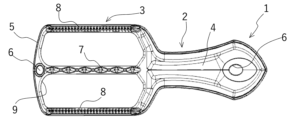
- FIG. 1 is a schematic diagram of a comb according to the present invention.
- FIG. 4 is a schematic view of the comb according to the present invention, seen from a different angle.
- FIG. 4 is a schematic view of the comb according to the present invention, seen from yet another angle.
- FIG. 4 is a schematic view of the comb according to the present invention, seen from yet another angle.
- FIG. 2 is a schematic plan view of a comb according to the present invention.
- FIG. 2 is a schematic bottom view of a comb according to the present invention.
- FIG. 1 is a schematic side view of a comb according to the present invention;
- the comb 1 has a comb body 2.
- the surface of the comb body 2 is plated.
- the comb body 2 is a plated resin molded product (e.g., an ABS resin molded product), which makes the surface smooth and reduces contact friction with the hair.
- the plating process is also known to have the effect of grounding the human body and discharging static electricity accumulated in the hair.
- the electrode and the comb body 2 are in contact, and the comb body 2 is held by the electrode.
- the comb body 2 is formed with an insertion hole 6 through which the electrode is inserted for plating.
- the insertion hole 6 is closed with a cover or the like (not shown).
- the comb body 2 is made up of comb teeth 3, a handle 4, and a base 5.
- the handle 4 is the part that is held by the user when using the comb 1 to comb their hair.
- the base 5 is formed continuously from one end of the handle 4. A number of comb teeth 3 protrude from the base 5.
- the comb teeth 3 have at least one row of main teeth 7 (one row in the figure), and at least one row of sub-teeth 8 on each side of the main teeth 7 (one row on each side in the figure).
- the main teeth 7 are arranged at intervals along the central axis of the comb body 2 in the longitudinal direction (six main teeth 7 in the bare hand).
- the sub-teeth 8 are arranged at intervals on both the left and right sides of the main teeth 7 so as to be parallel to the main teeth 7.
- the number of main teeth 7 per row is less than the number of sub-teeth 8.
- the height of the main teeth 7 is higher than the height of the sub-teeth 8 adjacent to it in the left-right direction of the comb body 2 (the direction perpendicular to the central axis of the comb body 2).
- the comb teeth 3 include main teeth 7 and sub-teeth 8, and the height of the main teeth 7 arranged along the central axis of the comb body 2 is higher than the adjacent sub-teeth 8 (located to the left and right of the main teeth 7).
- the number of main teeth 7 is fewer than the number of sub-teeth 8. Therefore, when a user holds the grip 4 and brings the comb teeth 3 into contact with the user's head, the main teeth 7 come into contact with the user's head first. The main teeth 7 then comb the hair first. Because there are few main teeth 7, the main teeth 7 first roughly comb the hair. After this, by tilting the comb body 2, the sub-teeth 8 can comb the areas combed by the main teeth 7.
- the hair roughly combed by the main teeth 7 can be combed even more finely. Because the hair is combed to a certain extent by the main teeth 7, it is possible to prevent the hair from getting tangled in the sub-teeth 8 when combing with the sub-teeth 8, which have a large number of teeth. This allows you to comb your hair without tangling it with just one comb body 2, even if the comb body 2 is made of a highly rigid material. In other words, in one movement, you can roughly comb your hair with the main teeth 7, and then finely comb your hair with the sub-teeth 8.
- the main teeth 7 are formed to widen towards their bases. This allows the main teeth 7 to ensure high rigidity. Because of their high rigidity, even tangled hair can be roughly untangled at first. This reduces the risk of hair tangling. It is preferable that the tips of the main teeth 7 and sub-teeth 8 are spherical. This is to reduce damage caused by contact with the scalp.
- the base 5 has a through hole 9 penetrating between the main teeth 7 and the sub teeth 8. That is, the main teeth 7 and the sub teeth 8 are separated by a certain fixed distance, and the base 5 is penetrated by the through hole 9 at that distance.
- the through hole 9 allows the plating solution to flow through the through hole 9 when plating the comb body 2, improving the reliability of the adhesion of the plating to the comb body 2.
- hair passes through the through hole 9 when combing hair, which further prevents hair from getting tangled. That is, if the base 5 is simply a plate shape, hair will gather at the bottom of the comb teeth 3 when combing hair with the comb 1, increasing the possibility that the hair will get tangled in the comb teeth 3.
- hair can slip through the through hole 9 of the base 5, preventing hair from gathering at the bottom of the comb teeth 3 and getting tangled.
- the base portion 5 is formed to be wider than the grip portion 4. Furthermore, the sub-teeth 8 are formed along the left and right periphery of the base portion 5. This creates a fixed distance between the main teeth 7 and the sub-teeth 8. Therefore, the hair can be combed with the sub-teeth 8 after roughly combing it with the main teeth 7 for a fixed distance. This allows the hair to be roughly combed with the main teeth 7 to a certain extent to form a hair flow before combing it with the sub-teeth 8, making it possible to comb the hair more smoothly.
- main teeth 7 and sub-teeth 8 are formed in a curved shape with a concave center when the entire row is viewed from the side. This allows the tips of the main teeth 7 and sub-teeth 9 to come into contact with the contours of the human head, reducing damage to the scalp and allowing hair to be combed smoothly.
- Protrusions 10 are formed extending from the surface of the base portion 5 opposite the surface from which the comb teeth 3 protrude. Specifically, the protrusions 10 are formed along the back side of the main teeth 7 and sub-teeth 8 with intervals between them. Using these protrusions 10, the user can massage the scalp or other skin by rubbing them. In particular, if the protrusions 10 are formed so as to be located directly behind the main teeth 7, they can also be used to reinforce the main teeth 7, further increasing the rigidity of the main teeth 7.
Landscapes
- Brushes (AREA)
- Cleaning And Drying Hair (AREA)
Priority Applications (6)
| Application Number | Priority Date | Filing Date | Title |
|---|---|---|---|
| US18/568,822 US20250169598A1 (en) | 2023-11-29 | 2023-11-29 | Comb |
| JP2023575843A JP7769412B2 (ja) | 2023-11-29 | 2023-11-29 | くし |
| EP23817640.8A EP4585100A4 (en) | 2023-11-29 | 2023-11-29 | COMB |
| CN202380012252.3A CN120390604A (zh) | 2023-11-29 | 2023-11-29 | 梳子 |
| PCT/JP2023/042787 WO2025115139A1 (ja) | 2023-11-29 | 2023-11-29 | くし |
| TW113125759A TW202521030A (zh) | 2023-11-29 | 2024-07-10 | 梳子 |
Applications Claiming Priority (1)
| Application Number | Priority Date | Filing Date | Title |
|---|---|---|---|
| PCT/JP2023/042787 WO2025115139A1 (ja) | 2023-11-29 | 2023-11-29 | くし |
Publications (1)
| Publication Number | Publication Date |
|---|---|
| WO2025115139A1 true WO2025115139A1 (ja) | 2025-06-05 |
Family
ID=95823084
Family Applications (1)
| Application Number | Title | Priority Date | Filing Date |
|---|---|---|---|
| PCT/JP2023/042787 Pending WO2025115139A1 (ja) | 2023-11-29 | 2023-11-29 | くし |
Country Status (6)
| Country | Link |
|---|---|
| US (1) | US20250169598A1 (https=) |
| EP (1) | EP4585100A4 (https=) |
| JP (1) | JP7769412B2 (https=) |
| CN (1) | CN120390604A (https=) |
| TW (1) | TW202521030A (https=) |
| WO (1) | WO2025115139A1 (https=) |
Families Citing this family (1)
| Publication number | Priority date | Publication date | Assignee | Title |
|---|---|---|---|---|
| JP1776304S (ja) * | 2024-02-07 | 2024-07-25 | くし |
Citations (4)
| Publication number | Priority date | Publication date | Assignee | Title |
|---|---|---|---|---|
| JP3092847U (ja) | 2002-09-18 | 2003-04-04 | 池本刷子工業株式会社 | ヘアブラシ |
| WO2017123021A1 (ko) | 2016-01-15 | 2017-07-20 | 가톨릭대학교 산학협력단 | 페록시다신을 포함하는 무혈청 배지 첨가제 조성물 및 이의 이용 |
| US20190150583A1 (en) * | 2017-11-21 | 2019-05-23 | Conair Corporation | Hair brush |
| JP3231989U (ja) * | 2021-02-24 | 2021-05-13 | 株式会社サンブライト | 櫛 |
Family Cites Families (12)
| Publication number | Priority date | Publication date | Assignee | Title |
|---|---|---|---|---|
| JPS5011789U (https=) * | 1973-06-05 | 1975-02-06 | ||
| USD253322S (en) * | 1978-01-30 | 1979-11-06 | Saute Robert E | Head for a hair brush |
| NZ531659A (en) * | 2001-09-25 | 2006-09-29 | Faco S | Hair straightening and styling device |
| US7571731B2 (en) * | 2006-07-21 | 2009-08-11 | Doo-Yong Choi | Aspen hair brush for preventing hair-loss |
| GB2447692B (en) * | 2007-03-23 | 2012-03-07 | Shaun Pulfrey | Hair care device |
| TWM429390U (en) * | 2011-07-15 | 2012-05-21 | Kea Fine Company Ltd | Structure of hair comb |
| KR101700853B1 (ko) * | 2014-10-22 | 2017-01-31 | 윤웅태 | 3중 빗살을 갖는 헤어브러시 |
| KR102090943B1 (ko) * | 2016-01-19 | 2020-03-19 | 가부시키가이샤 와이시 푸라이마리 | 빗의 제조방법 |
| CN206043785U (zh) * | 2016-06-30 | 2017-03-29 | 徐家才 | 防静电保健梳子 |
| CN214432487U (zh) * | 2020-11-11 | 2021-10-22 | 朱鹏飞 | 干发梳及干发排梳 |
| KR20240096753A (ko) * | 2021-12-28 | 2024-06-26 | 가부시키가이샤 와이시 푸라이마리 | 빗 |
| JP2025007427A (ja) * | 2023-06-30 | 2025-01-17 | ヤーマン株式会社 | ヘアアイロン |
-
2023
- 2023-11-29 JP JP2023575843A patent/JP7769412B2/ja active Active
- 2023-11-29 CN CN202380012252.3A patent/CN120390604A/zh active Pending
- 2023-11-29 US US18/568,822 patent/US20250169598A1/en active Pending
- 2023-11-29 EP EP23817640.8A patent/EP4585100A4/en active Pending
- 2023-11-29 WO PCT/JP2023/042787 patent/WO2025115139A1/ja active Pending
-
2024
- 2024-07-10 TW TW113125759A patent/TW202521030A/zh unknown
Patent Citations (4)
| Publication number | Priority date | Publication date | Assignee | Title |
|---|---|---|---|---|
| JP3092847U (ja) | 2002-09-18 | 2003-04-04 | 池本刷子工業株式会社 | ヘアブラシ |
| WO2017123021A1 (ko) | 2016-01-15 | 2017-07-20 | 가톨릭대학교 산학협력단 | 페록시다신을 포함하는 무혈청 배지 첨가제 조성물 및 이의 이용 |
| US20190150583A1 (en) * | 2017-11-21 | 2019-05-23 | Conair Corporation | Hair brush |
| JP3231989U (ja) * | 2021-02-24 | 2021-05-13 | 株式会社サンブライト | 櫛 |
Non-Patent Citations (1)
| Title |
|---|
| See also references of EP4585100A4 |
Also Published As
| Publication number | Publication date |
|---|---|
| EP4585100A1 (en) | 2025-07-16 |
| TW202521030A (zh) | 2025-06-01 |
| US20250169598A1 (en) | 2025-05-29 |
| JP7769412B2 (ja) | 2025-11-19 |
| CN120390604A (zh) | 2025-07-29 |
| EP4585100A4 (en) | 2025-07-16 |
| JPWO2025115139A1 (https=) | 2025-06-05 |
Similar Documents
| Publication | Publication Date | Title |
|---|---|---|
| US12342930B2 (en) | Backcombing brush | |
| JP4429471B2 (ja) | 歯ブラシ | |
| KR101478862B1 (ko) | 칫솔 | |
| CN101677664A (zh) | 毛发护理装置 | |
| CN203723608U (zh) | 梳子 | |
| JP4416239B2 (ja) | マッサージ用ブラシ | |
| KR102720748B1 (ko) | 가변형 헤어브러시 | |
| JP7769412B2 (ja) | くし | |
| JP2026042094A (ja) | ヘアーブラシ | |
| US20210235838A1 (en) | Hair care implement for textured ethnic hair styles | |
| TWM516351U (zh) | 可易梳結構 | |
| KR200473794Y1 (ko) | 손톱 소제용 브러시 | |
| EP3881716B1 (en) | Hairbrush | |
| HK40121863A (zh) | 梳子 | |
| TW202002846A (zh) | 牙刷 | |
| KR20090091499A (ko) | 헤어브러시 | |
| JPH09327333A (ja) | ヘアブラシ | |
| KR200436831Y1 (ko) | 빗살형 브러시 모가 구비된 마스카라 도포 브러시 | |
| JPH0744242Y2 (ja) | ヘアーブラシ型櫛 | |
| JP7704717B2 (ja) | 歯ブラシ | |
| JP3042283U (ja) | 毛髪処理具 | |
| KR20240178353A (ko) | 빗살형 브러시 모가 구비된 마스카라 도포 브러시 | |
| JPH10127344A (ja) | ヘアーブラシ | |
| KR200221495Y1 (ko) | 두피 맛사지용 머리빗 | |
| WO2024070512A1 (ja) | ブラシ |
Legal Events
| Date | Code | Title | Description |
|---|---|---|---|
| ENP | Entry into the national phase |
Ref document number: 2023575843 Country of ref document: JP Kind code of ref document: A |
|
| WWE | Wipo information: entry into national phase |
Ref document number: 2023575843 Country of ref document: JP |
|
| WWE | Wipo information: entry into national phase |
Ref document number: CN2023800122523 Country of ref document: CN Ref document number: 202380012252.3 Country of ref document: CN |
|
| ENP | Entry into the national phase |
Ref document number: 2023817640 Country of ref document: EP Effective date: 20240124 |
|
| 121 | Ep: the epo has been informed by wipo that ep was designated in this application |
Ref document number: 23817640 Country of ref document: EP Kind code of ref document: A1 |
|
| WWP | Wipo information: published in national office |
Ref document number: 2023817640 Country of ref document: EP |
|
| WWP | Wipo information: published in national office |
Ref document number: 202380012252.3 Country of ref document: CN |