WO2025109983A1 - 空気入りタイヤ - Google Patents
空気入りタイヤ Download PDFInfo
- Publication number
- WO2025109983A1 WO2025109983A1 PCT/JP2024/039170 JP2024039170W WO2025109983A1 WO 2025109983 A1 WO2025109983 A1 WO 2025109983A1 JP 2024039170 W JP2024039170 W JP 2024039170W WO 2025109983 A1 WO2025109983 A1 WO 2025109983A1
- Authority
- WO
- WIPO (PCT)
- Prior art keywords
- mass
- rubber
- pneumatic tire
- styrene
- parts
- Prior art date
- Legal status (The legal status is an assumption and is not a legal conclusion. Google has not performed a legal analysis and makes no representation as to the accuracy of the status listed.)
- Pending
Links
Images
Classifications
-
- B—PERFORMING OPERATIONS; TRANSPORTING
- B60—VEHICLES IN GENERAL
- B60C—VEHICLE TYRES; TYRE INFLATION; TYRE CHANGING; CONNECTING VALVES TO INFLATABLE ELASTIC BODIES IN GENERAL; DEVICES OR ARRANGEMENTS RELATED TO TYRES
- B60C1/00—Tyres characterised by the chemical composition or the physical arrangement or mixture of the composition
-
- B—PERFORMING OPERATIONS; TRANSPORTING
- B60—VEHICLES IN GENERAL
- B60C—VEHICLE TYRES; TYRE INFLATION; TYRE CHANGING; CONNECTING VALVES TO INFLATABLE ELASTIC BODIES IN GENERAL; DEVICES OR ARRANGEMENTS RELATED TO TYRES
- B60C9/00—Reinforcements or ply arrangement of pneumatic tyres
-
- B—PERFORMING OPERATIONS; TRANSPORTING
- B60—VEHICLES IN GENERAL
- B60C—VEHICLE TYRES; TYRE INFLATION; TYRE CHANGING; CONNECTING VALVES TO INFLATABLE ELASTIC BODIES IN GENERAL; DEVICES OR ARRANGEMENTS RELATED TO TYRES
- B60C9/00—Reinforcements or ply arrangement of pneumatic tyres
- B60C9/02—Carcasses
- B60C9/04—Carcasses the reinforcing cords of each carcass ply arranged in a substantially parallel relationship
-
- C—CHEMISTRY; METALLURGY
- C08—ORGANIC MACROMOLECULAR COMPOUNDS; THEIR PREPARATION OR CHEMICAL WORKING-UP; COMPOSITIONS BASED THEREON
- C08K—Use of inorganic or non-macromolecular organic substances as compounding ingredients
- C08K3/00—Use of inorganic substances as compounding ingredients
- C08K3/01—Use of inorganic substances as compounding ingredients characterized by their specific function
- C08K3/013—Fillers, pigments or reinforcing additives
-
- C—CHEMISTRY; METALLURGY
- C08—ORGANIC MACROMOLECULAR COMPOUNDS; THEIR PREPARATION OR CHEMICAL WORKING-UP; COMPOSITIONS BASED THEREON
- C08K—Use of inorganic or non-macromolecular organic substances as compounding ingredients
- C08K3/00—Use of inorganic substances as compounding ingredients
- C08K3/34—Silicon-containing compounds
- C08K3/36—Silica
-
- C—CHEMISTRY; METALLURGY
- C08—ORGANIC MACROMOLECULAR COMPOUNDS; THEIR PREPARATION OR CHEMICAL WORKING-UP; COMPOSITIONS BASED THEREON
- C08K—Use of inorganic or non-macromolecular organic substances as compounding ingredients
- C08K5/00—Use of organic ingredients
- C08K5/54—Silicon-containing compounds
- C08K5/548—Silicon-containing compounds containing sulfur
-
- C—CHEMISTRY; METALLURGY
- C08—ORGANIC MACROMOLECULAR COMPOUNDS; THEIR PREPARATION OR CHEMICAL WORKING-UP; COMPOSITIONS BASED THEREON
- C08L—COMPOSITIONS OF MACROMOLECULAR COMPOUNDS
- C08L15/00—Compositions of rubber derivatives
-
- C—CHEMISTRY; METALLURGY
- C08—ORGANIC MACROMOLECULAR COMPOUNDS; THEIR PREPARATION OR CHEMICAL WORKING-UP; COMPOSITIONS BASED THEREON
- C08L—COMPOSITIONS OF MACROMOLECULAR COMPOUNDS
- C08L25/00—Compositions of, homopolymers or copolymers of compounds having one or more unsaturated aliphatic radicals, each having only one carbon-to-carbon double bond, and at least one being terminated by an aromatic carbocyclic ring; Compositions of derivatives of such polymers
- C08L25/02—Homopolymers or copolymers of hydrocarbons
- C08L25/04—Homopolymers or copolymers of styrene
- C08L25/08—Copolymers of styrene
- C08L25/10—Copolymers of styrene with conjugated dienes
-
- C—CHEMISTRY; METALLURGY
- C08—ORGANIC MACROMOLECULAR COMPOUNDS; THEIR PREPARATION OR CHEMICAL WORKING-UP; COMPOSITIONS BASED THEREON
- C08L—COMPOSITIONS OF MACROMOLECULAR COMPOUNDS
- C08L9/00—Compositions of homopolymers or copolymers of conjugated diene hydrocarbons
- C08L9/06—Copolymers with styrene
Definitions
- the present invention relates to a pneumatic tire.
- Patent Document 1 listed below discloses that by applying a rubber composition obtained by compounding a rubber component containing 70% by mass or more of natural rubber with a thermoplastic resin and a filler containing silica to the tread rubber of a tire, the braking performance of the tire on both dry and wet road surfaces is improved.
- a rubber composition obtained by compounding a rubber component containing 70% by mass or more of natural rubber with a thermoplastic resin and a filler containing silica to the tread rubber of a tire, the braking performance of the tire on both dry and wet road surfaces is improved.
- fuel efficiency reduction of rolling resistance
- Patent Document 2 discloses a rubber composition that contains emulsion-polymerized styrene-butadiene rubber and solution-polymerized styrene-butadiene rubber, both of which have a glass transition temperature Tg of -25°C or higher, a polymer with a low Tg, and further contains a filler and a specific hydrocarbyloxysilane compound, with the aim of achieving both wet grip performance and rolling resistance in a tire.
- Patent Document 1 shows that while the technology described in Patent Document 1 can improve the wet grip performance of tires, the addition of resin, which is a softening component, reduces the rigidity of the rubber, lowering the plunger level of the tire and resulting in insufficient cut resistance. Furthermore, when attempting to supplement the cut resistance of tires, the amount of resin, which is a softening component, that can be added is limited, which can result in insufficient wet grip performance.
- Patent Document 2 makes it possible to achieve both wet grip performance and rolling resistance of a tire to a certain extent, there is a problem in that rubber compositions containing hydrocarbyloxysilane compounds having thiol groups, etc., which can be used in the tread rubber layer of pneumatic tires, tend to undergo changes in appearance over time, such as becoming shiny black.
- the present invention aims to solve the problems of the conventional technology and provide a pneumatic tire that has excellent resistance to discoloration and achieves a high level of wet grip performance, fuel efficiency, and wear resistance without compromising cut resistance.
- a pneumatic tire comprising a tread rubber layer located on the outermost surface of a tread portion, and a carcass ply located radially inward of the tread rubber layer and formed by coating a PET fiber cord with a coating rubber
- the tread rubber layer includes a rubber component, a filler, and a silane coupling agent
- the rubber component contains a styrene-butadiene rubber (A) modified with a modifier having at least one atom of nitrogen, silicon, and tin and having a glass transition temperature of ⁇ 50° C. or lower, and an unmodified styrene-butadiene rubber (B) having a glass transition temperature 30° C.
- the filler contains at least silica
- the silane coupling agent contains at least a silane coupling agent (A) having a thiol group and a silane coupling agent (B) having a sulfide bond
- the content of the silane coupling agent (A) is 1 to 10 parts by mass relative to 100 parts by mass of the silica
- the total content of the silane coupling agent (A) and the silane coupling agent (B) is 1 to 15 parts by mass relative to 100 parts by mass of the silica
- the total gauge of the carcass ply is 1.2 mm or less
- the carcass ply has the following formula (1): (A/B)/total cord size ⁇ 0.3 (1)
- Fiber occupancy rate cross-sectional area of PET fiber cord (mm 2 )/(total gauge of carcass ply (mm) x (diameter of PET fiber cord (mm) +
- the filler further comprises carbon black,
- the pneumatic tire according to any one of [1] to [4], characterized in that a content ratio of the silica in a total amount of the silica and the carbon black is 80 mass% or more and less than 100 mass%.
- the carcass ply has the following formula (1'): (A/B)/total cord size ⁇ 0.45 (1)'
- the present invention provides a pneumatic tire that has excellent discoloration resistance and achieves a high level of compatibility between wet grip performance, fuel efficiency, and wear resistance without compromising cut resistance.
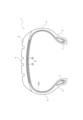
- FIG. 1 is a cross-sectional view of one embodiment of a pneumatic tire of the present invention.
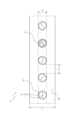
- FIG. 2 is a schematic diagram showing a cross section of a carcass ply coated with a PET fiber cord according to one embodiment of the present invention.
- the compounds described herein may be derived in whole or in part from fossil sources, from biological sources such as plant sources, from recycled sources such as used tires, or from a mixture of two or more of fossil, biological and/or renewable sources.
- the glass transition temperature of styrene-butadiene rubber is determined in accordance with ISO 22768:2006 by recording a DSC curve while increasing the temperature within a specified temperature range, and the peak top (inflection point) of the DSC differential curve is taken as the glass transition temperature.
- the "molecular weight" of the rubber component refers to the standard polystyrene equivalent molecular weight obtained by GPC (gel permeation chromatography).
- the softening point of the resin component is measured in accordance with JIS-K2207-1996 (ring and ball method).
- the weight average molecular weight of the resin component is measured by gel permeation chromatography (GPC) and calculated as a polystyrene equivalent value.
- the tan ⁇ of the coating rubber is a value measured using a spectrometer (manufactured by Ueshima Seisakusho Co., Ltd.) under conditions of a temperature of 24°C, a strain of 1%, and a frequency of 52 Hz.
- Fig. 1 is a cross-sectional view of one embodiment of a pneumatic tire of the present invention.
- the pneumatic tire 1 shown in Fig. 1 has a pair of bead portions 2, a pair of sidewall portions 3, and a tread portion 4 connected to both sidewall portions 3, and includes a carcass 5 extending in a toroidal shape between the pair of bead portions 2 to reinforce these portions 2, 3, and 4, and a belt 6 disposed on the tire radial outside of a crown portion of the carcass 5.
- Fig. 2 is a schematic diagram showing a cross section of a carcass ply formed by covering a PET fiber cord according to one embodiment of the present invention.
- the carcass ply 9 shown in Fig. 2 is formed by covering a PET fiber cord 10 with a coating rubber 20.
- the carcass 5 of the pneumatic tire shown in FIG. 1 is composed of one carcass ply 9 formed by covering a plurality of parallel-arranged cords with a coating rubber, and the carcass 5 also comprises a main body portion extending in a toroidal shape between the bead cores 7 embedded in each of the bead portions 2, and a folded-up portion wound up radially outwardly from the inside in the tire width direction to the outside around each bead core 7, but the number and structure of the ply of the carcass 5 in the pneumatic tire of the present invention are not limited to these.
- the belt layer is usually composed of a rubber-coated layer of metal cords (preferably steel cords) extending at an angle to the tire equatorial plane, and the two belt layers are laminated to constitute the belt 6 such that the metal cords constituting the belt layers cross each other with the tire equatorial plane in between.
- metal cords preferably steel cords
- the pneumatic tire 1 of the present embodiment includes a tread rubber layer 8 located on the outermost surface of the tread portion 4, and a carcass ply 9 located on the inner side in the tire radial direction of the tread rubber layer 8 and formed by coating a PET fiber cord with a coating rubber.
- the tread rubber layer includes a rubber component, a filler, and a silane coupling agent,
- the rubber component contains a styrene-butadiene rubber (A) modified with a modifier having at least one atom of nitrogen, silicon, and tin and having a glass transition temperature of ⁇ 50° C. or lower, and an unmodified styrene-butadiene rubber (B) having a glass transition temperature 30° C.
- the filler contains at least silica
- the silane coupling agent contains at least a silane coupling agent (A) having a thiol group and a silane coupling agent (B) having a sulfide bond
- the content of the silane coupling agent (A) is 1 to 10 parts by mass relative to 100 parts by mass of the silica
- the total content of the silane coupling agent (A) and the silane coupling agent (B) is 1 to 15 parts by mass relative to 100 parts by mass of the silica
- the total gauge of the carcass ply is 1.2 mm or less
- the carcass ply has the following formula (1): (A/B)/total cord size ⁇ 0.3 (1)
- Fiber occupancy rate cross-sectional area of PET fiber cord (mm 2 )/(total gauge of carcass ply (mm) x (diameter of PET fiber cord (mm) +
- the pneumatic tire 1 of the present invention may be modified in various ways as long as it includes a tread rubber layer 8 located on the outermost surface of the tread portion 4 and a carcass ply 9 formed by covering PET fiber cords located on the inner side of the tread rubber layer 8 in the tire radial direction with a coating rubber.
- the tread rubber layer 8 of the pneumatic tire 1 shown in FIG. 1 can be divided into a cap rubber located on the outermost surface side and a base rubber located on the inner side in the tire radial direction.
- the tread rubber layer contains a rubber component, a filler, and a silane coupling agent
- the rubber component contains a styrene-butadiene rubber (A) modified with a modifier having at least one atom of nitrogen, silicon, and tin and having a glass transition temperature of ⁇ 50° C. or lower, and an unmodified styrene-butadiene rubber (B) having a glass transition temperature 30° C.
- the filler contains at least silica
- the silane coupling agent contains at least a silane coupling agent (A) having a thiol group and a silane coupling agent (B) having a sulfide bond
- the content of the silane coupling agent (A) is 1 to 10 parts by mass relative to 100 parts by mass of the silica
- the total content of the silane coupling agent (A) and the silane coupling agent (B) is 1 to 15 parts by mass per 100 parts by mass of the silica, whereby wet grip performance, fuel efficiency and abrasion resistance are highly compatible, and excellent discoloration resistance is realized.
- the total gauge is 1.2 mm or less, and the following formula (1): (A/B)/total cord size ⁇ 0.3 (1)
- A cord strength (N) x fiber occupancy rate; fiber occupancy rate: cross-sectional area of PET fiber cord (mm 2 )/(total gauge of carcass ply (mm) x (diameter of PET fiber cord (mm) + distance between cords of PET fiber cord (mm))
- B tan ⁇ of coating rubber ⁇ rubber occupancy rate
- Rubber occupancy rate 1-fiber occupancy rate
- Total cord fineness the sum of the finenesses of the PET fibers that make up the cord (dtex)
- the tread rubber layer includes a rubber component, a filler, and a silane coupling agent.
- the tread rubber layer can be made of, for example, a rubber composition including the rubber component, the filler, and the silane coupling agent.
- the rubber component contains a styrene-butadiene rubber (A) modified with a modifier having at least one atom of nitrogen, silicon, and tin and having a glass transition temperature of ⁇ 50° C. or lower, and an unmodified styrene-butadiene rubber (B) having a glass transition temperature 30° C. or higher than that of the styrene-butadiene rubber (A). It may further contain other rubber components.
- A styrene-butadiene rubber
- B unmodified styrene-butadiene rubber
- styrene-butadiene rubber (A) and styrene-butadiene rubber (B) in the rubber component can improve the wet grip performance of the pneumatic tire.
- the use of styrene-butadiene rubber (A) modified with a modifier having at least one atom of nitrogen, silicon, and tin as the rubber component can improve the dispersibility of fillers in the rubber composition, such as silica.
- the pneumatic tire of the present invention has significantly improved low heat generation properties and improved dispersibility of fillers, which can improve the reinforcement properties and physical properties such as the fuel efficiency and wear resistance of the pneumatic tire.
- the styrene-butadiene rubber (A) is a styrene-butadiene rubber modified with a modifier having at least one atom of nitrogen, silicon, and tin, and has a glass transition temperature of -50°C or lower.
- the styrene-butadiene rubber (A) has a glass transition temperature of -50°C or lower, preferably -55°C or lower, and preferably higher than -90°C. If the glass transition temperature of the styrene-butadiene rubber (A) is -50°C or lower, the fuel economy and wear resistance of the pneumatic tire can be sufficiently improved. In addition, styrene-butadiene rubber with a glass transition temperature higher than -90°C is easy to synthesize.
- the glass transition temperatures of the styrene-butadiene rubber (A) and the styrene-butadiene rubber (B) described later can be measured, for example, as follows. Using each styrene-butadiene rubber as a sample, a DSC curve is recorded using a TA Instruments DSC250 while heating from -100°C at 20°C/min under a helium flow of 50 mL/min, and the peak top (inflection point) of the DSC differential curve is taken as the glass transition temperature.
- the content ratio of the styrene butadiene rubber (A) in the rubber component is preferably 15% by mass or more and less than 85% by mass, more preferably 20% by mass or more and less than 85% by mass, more preferably 30% by mass or more and less than 80% by mass, and even more preferably 40% by mass or more and less than 80% by mass.
- the content ratio of the styrene butadiene rubber (A) in the rubber component is 15% by mass or more and less than 85% by mass, the fuel economy performance and wet grip performance of the pneumatic tire can be further improved.
- the styrene-butadiene rubber (A) preferably has a bound styrene amount of less than 15% by mass.
- the bound styrene amount of the styrene-butadiene rubber (A) means the ratio of styrene units contained in the styrene-butadiene rubber.
- the bound styrene amount is less than 15% by mass, the glass transition temperature is likely to be low.
- the bound styrene amount is more preferably 14% by mass or less, more preferably 13% by mass or less, and even more preferably 12% by mass or less.
- the bound styrene amount is preferably 5% by mass or more, more preferably 7% by mass or more, and even more preferably 8% by mass or more.
- the amount of bound styrene in the styrene-butadiene rubber (A) can be adjusted by the amount of monomers used in the polymerization of the styrene-butadiene rubber, the degree of polymerization, and the like.
- the bound styrene amount of the styrene-butadiene rubber (A) can be measured as the bound styrene amount (mass%) relative to 100 mass% of the sample using a spectrophotometer "UV-2450" manufactured by Shimadzu Corporation based on the absorption of ultraviolet light at a wavelength (near 254 nm) by the phenyl group of styrene.
- the styrene butadiene rubber (A) is modified with a modifier having at least one atom of nitrogen, silicon, and tin. From the viewpoint of achieving a higher level of fuel economy and wear resistance, as well as wet grip performance, of the pneumatic tire, it is preferable that the rubber is modified with a modifier having a nitrogen atom and a silicon atom, and it is more preferable that the rubber is modified with a modifier having a functional group containing a nitrogen atom and an alkoxy group. When the styrene butadiene rubber (A) is modified with such a modifier, the pneumatic tire of this embodiment achieves a higher level of wet grip performance, fuel economy, and wear resistance.
- the modifying agent having a functional group containing a nitrogen atom and an alkoxy group is a general term for modifying agents having at least one functional group containing a nitrogen atom and at least one alkoxy group.
- the functional group containing a nitrogen atom is preferably selected from the following: The monovalent hydrocarbon group having 1 to 30 carbon atoms and containing a straight-chain, branched, alicyclic or aromatic ring, and having a functional group selected from the group consisting of a primary amino group, a primary amino group protected with a hydrolyzable protecting group, an onium salt residue of a primary amine, an isocyanate group, a thioisocyanate group, an imine group, an imine residue, an amide group, a secondary amino group protected with a hydrolyzable protecting group, a cyclic secondary amino group, an onium salt residue of a cyclic secondary amine, a non-cyclic secondary amino group, an onium salt residue of a non-cyclic secondary amine
- the styrene-butadiene rubber (A) is preferably modified with an aminoalkoxysilane compound, and from the viewpoint of having a high affinity for fillers such as silica, it is even more preferable that the terminals are modified with an aminoalkoxysilane compound.
- the terminals of the styrene-butadiene rubber are modified with an aminoalkoxysilane compound, the interaction between the styrene-butadiene rubber (A) and the filler (particularly silica) becomes particularly strong.
- the modified site of the styrene-butadiene rubber (A) may be the molecular terminal as described above, but may also be the main chain.
- the styrene-butadiene rubber (A) having a modified molecular end can be produced, for example, by reacting various modifiers with the ends of a styrene-butadiene copolymer having active ends according to the methods described in WO 2003/046020 and JP 2007-217562 A.
- the styrene-butadiene rubber (A) having a modified molecular end can be produced by reacting an aminoalkoxysilane compound with an end of a styrene-butadiene copolymer having an active end with a cis-1,4 bond content of 75% or more, and then reacting the resulting mixture with a carboxylic acid partial ester of a polyhydric alcohol for stabilization, according to the methods described in WO 2003/046020 and JP 2007-217562 A.
- the carboxylic acid partial ester of a polyhydric alcohol means an ester of a polyhydric alcohol and a carboxylic acid, which has one or more hydroxyl groups. Specifically, an ester of a sugar or modified sugar having 4 or more carbon atoms and a fatty acid is preferably used.
- this ester include (1) a fatty acid partial ester of a polyhydric alcohol, in particular a partial ester (which may be a monoester, diester, or triester) of a saturated higher fatty acid or an unsaturated higher fatty acid having 10 to 20 carbon atoms and a polyhydric alcohol, and (2) an ester compound in which 1 to 3 partial esters of a polycarboxylic acid and a higher alcohol are bonded to a polyhydric alcohol.
- the polyhydric alcohol used as a raw material for the partial ester is preferably a saccharide having 5 or 6 carbon atoms and at least three hydroxyl groups (which may or may not be hydrogenated), glycol, polyhydroxy compound, etc.
- the raw material fatty acid is preferably a saturated or unsaturated fatty acid having 10 to 20 carbon atoms, such as stearic acid, lauric acid, or palmitic acid.
- fatty acid partial esters of polyhydric alcohols sorbitan fatty acid esters are preferred, and specific examples thereof include sorbitan monolaurate, sorbitan monopalmitate, sorbitan monostearate, sorbitan tristearate, sorbitan monooleate, and sorbitan trioleate.
- the aminoalkoxysilane compound is not particularly limited, but is preferably an aminoalkoxysilane compound represented by the following general formula (i).
- R 11 and R 12 each independently represent a monovalent aliphatic hydrocarbon group having 1 to 20 carbon atoms or a monovalent aromatic hydrocarbon group having 6 to 18 carbon atoms, at least one of R 11 and R 12 is substituted with an amino group, a is an integer of 0 to 2, and when there are multiple OR 12 , each OR 12 may be the same or different, and no active proton is contained in the molecule.
- aminoalkoxysilane compound an aminoalkoxysilane compound represented by the following general formula (ii) is also preferred.
- a 1 is at least one functional group selected from a saturated cyclic tertiary amine compound residue, an unsaturated cyclic tertiary amine compound residue, a ketimine residue, a nitrile group, a (thio)isocyanate group, an isocyanuric acid trihydrocarbyl ester group, a nitrile group, a pyridine group, a (thio)ketone group, an amide group, and a primary or secondary amino group having a hydrolyzable group.
- a 1 When n4 is 2 or more, A 1 may be the same or different, and A 1 may be a divalent group that bonds with Si to form a cyclic structure.
- R 21 is a monovalent aliphatic or alicyclic hydrocarbon group having 1 to 20 carbon atoms or a monovalent aromatic hydrocarbon group having 6 to 18 carbon atoms, and when n1 is 2 or more, R 21 may be the same or different.
- R 22 is a monovalent aliphatic or alicyclic hydrocarbon group having 1 to 20 carbon atoms or a monovalent aromatic hydrocarbon group having 6 to 18 carbon atoms, either of which may contain a nitrogen atom and/or a silicon atom.
- R 22 When n2 is 2 or greater, R 22 may be the same or different from each other, or may be joined together to form a ring.
- R 23 represents a monovalent aliphatic or alicyclic hydrocarbon group having 1 to 20 carbon atoms, a monovalent aromatic hydrocarbon group having 6 to 18 carbon atoms, or a halogen atom, and when n3 is 2 or greater, may be the same or different.
- R 24 is a divalent aliphatic or alicyclic hydrocarbon group having 1 to 20 carbon atoms or a divalent aromatic hydrocarbon group having 6 to 18 carbon atoms, and when n4 is 2 or greater, R 24 may be the same or different.
- the hydrolyzable group in the hydrolyzable group-containing primary or secondary amino group a trimethylsilyl group or a tert-butyldimethylsilyl group is preferred, and a trimethylsilyl group is particularly preferred.
- aminoalkoxysilane compound represented by the above general formula (ii) is preferably an aminoalkoxysilane compound represented by the following general formula (iii).
- p1+p2+p3 2 (wherein p2 is an integer of 1 or 2, and p1 and p3 are integers of 0 or 1).
- A2 is NRa (Ra is a monovalent hydrocarbon group, a hydrolyzable group, or a nitrogen-containing organic group).
- R 25 is a monovalent aliphatic or alicyclic hydrocarbon group having 1 to 20 carbon atoms, or a monovalent aromatic hydrocarbon group having 6 to 18 carbon atoms.
- R 26 is a monovalent aliphatic or alicyclic hydrocarbon group having 1 to 20 carbon atoms, a monovalent aromatic hydrocarbon group having 6 to 18 carbon atoms, or a nitrogen-containing organic group, any of which may contain a nitrogen atom and/or a silicon atom.
- R 26 may be the same or different from each other, or may be joined together to form a ring.
- R 27 is a monovalent aliphatic or alicyclic hydrocarbon group having 1 to 20 carbon atoms, a monovalent aromatic hydrocarbon group having 6 to 18 carbon atoms, or a halogen atom.
- R 28 is a divalent aliphatic or alicyclic hydrocarbon group having 1 to 20 carbon atoms, or a divalent aromatic hydrocarbon group having 6 to 18 carbon atoms.
- a trimethylsilyl group or a tert-butyldimethylsilyl group is preferred, and a trimethylsilyl group is particularly preferred.
- aminoalkoxysilane compound represented by the above general formula (ii) is also preferably an aminoalkoxysilane compound represented by the following general formula (iv) or (v).
- R 31 is a divalent aliphatic or alicyclic hydrocarbon group having 1 to 20 carbon atoms, or a divalent aromatic hydrocarbon group having 6 to 18 carbon atoms.
- R 32 and R 33 each independently represent a hydrolyzable group, a monovalent aliphatic or alicyclic hydrocarbon group having 1 to 20 carbon atoms, or a monovalent aromatic hydrocarbon group having 6 to 18 carbon atoms.
- R 34 is a monovalent aliphatic or alicyclic hydrocarbon group having 1 to 20 carbon atoms or a monovalent aromatic hydrocarbon group having 6 to 18 carbon atoms, and when q1 is 2, may be the same or different.
- R 35 is a monovalent aliphatic or alicyclic hydrocarbon group having 1 to 20 carbon atoms or a monovalent aromatic hydrocarbon group having 6 to 18 carbon atoms, and when q2 is 2 or greater, R 35 may be the same or different.
- R 36 is a divalent aliphatic or alicyclic hydrocarbon group having 1 to 20 carbon atoms, or a divalent aromatic hydrocarbon group having 6 to 18 carbon atoms.
- R 37 is a dimethylaminomethyl group, a dimethylaminoethyl group, a diethylaminomethyl group, a diethylaminoethyl group, a methylsilyl(methyl)aminomethyl group, a methylsilyl(methyl)aminoethyl group, a methylsilyl(ethyl)aminomethyl group, a methylsilyl(ethyl)aminoethyl group, a dimethylsilylaminomethyl group, a dimethylsilylaminoethyl group, a monovalent aliphatic or alicyclic hydrocarbon group having 1 to 20 carbon atoms, or a monovalent aromatic hydrocarbon group having 6 to 18 carbon atoms, and when r1 is 2 or more, they may be the same or different.
- R 38 is a hydrocarbyloxy group having 1 to 20 carbon atoms, a monovalent aliphatic or alicyclic hydrocarbon group having 1 to 20 carbon atoms, or a monovalent aromatic hydrocarbon group having 6 to 18 carbon atoms, and when r2 is 2, they may be the same or different.
- a specific example of the aminoalkoxysilane compound represented by the general formula (v) is N-(1,3-dimethylbutylidene)-3-triethoxysilyl-1-propaneamine.
- aminoalkoxysilane compound represented by the above general formula (ii) is also preferably an aminoalkoxysilane compound represented by the following general formula (vi) or (vii).
- R 40 represents a trimethylsilyl group, a monovalent aliphatic or alicyclic hydrocarbon group having 1 to 20 carbon atoms, or a monovalent aromatic hydrocarbon group having 6 to 18 carbon atoms.
- R 41 is a hydrocarbyloxy group having 1 to 20 carbon atoms, a monovalent aliphatic or alicyclic hydrocarbon group having 1 to 20 carbon atoms, or a monovalent aromatic hydrocarbon group having 6 to 18 carbon atoms.
- R 42 is a divalent aliphatic or alicyclic hydrocarbon group having 1 to 20 carbon atoms, or a divalent aromatic hydrocarbon group having 6 to 18 carbon atoms.
- TMS represents a trimethylsilyl group (hereinafter the same).
- R 43 and R 44 each independently represent a divalent aliphatic or alicyclic hydrocarbon group having 1 to 20 carbon atoms, or a divalent aromatic hydrocarbon group having 6 to 18 carbon atoms.
- R 45 is a monovalent aliphatic or alicyclic hydrocarbon group having 1 to 20 carbon atoms or a monovalent aromatic hydrocarbon group having 6 to 18 carbon atoms, and each R 45 may be the same or different.
- aminoalkoxysilane compound represented by the above general formula (ii) is also preferably an aminoalkoxysilane compound represented by the following general formula (viii) or the following general formula (ix).
- s1+s2 is 3 (wherein s1 is an integer of 0 to 2, and s2 is an integer of 1 to 3).
- R 46 is a divalent aliphatic or alicyclic hydrocarbon group having 1 to 20 carbon atoms, or a divalent aromatic hydrocarbon group having 6 to 18 carbon atoms.
- R 47 and R 48 are each independently a monovalent aliphatic or alicyclic hydrocarbon group having 1 to 20 carbon atoms, or a monovalent aromatic hydrocarbon group having 6 to 18 carbon atoms. Multiple R 47s or R 48s may be the same or different.
- X is a halogen atom.
- R 49 is a divalent aliphatic or alicyclic hydrocarbon group having 1 to 20 carbon atoms, or a divalent aromatic hydrocarbon group having 6 to 18 carbon atoms.
- R 50 and R 51 are each independently a hydrolyzable group, a monovalent aliphatic or alicyclic hydrocarbon group having 1 to 20 carbon atoms, or a monovalent aromatic hydrocarbon group having 6 to 18 carbon atoms, or R 50 and R 51 combine together to form a divalent organic group.
- R 52 and R 53 each independently represent a halogen atom, a hydrocarbyloxy group, a monovalent aliphatic or alicyclic hydrocarbon group having 1 to 20 carbon atoms, or a monovalent aromatic hydrocarbon group having 6 to 18 carbon atoms.
- R 50 and R 51 are preferably a hydrolyzable group, and the hydrolyzable group is preferably a trimethylsilyl group or a tert-butyldimethylsilyl group, and particularly preferably a trimethylsilyl group.
- aminoalkoxysilane compound represented by the above general formula (ii) is also preferably an aminoalkoxysilane compound represented by the following general formula (x), the following general formula (xi), the following general formula (xii), or the following general formula (xiii).
- R 54 to R 92 in general formulas (x) to (xiii) may be the same or different and are a monovalent or divalent aliphatic or alicyclic hydrocarbon group having 1 to 20 carbon atoms, or a monovalent or divalent aromatic hydrocarbon group having 6 to 18 carbon atoms.
- ⁇ and ⁇ are integers of 0 to 5.
- N1,N1,N7,N7-tetramethyl-4-((trimethoxysilyl)methyl)heptane-1,7-diamine 2-((hexyl-dimethoxysilyl)methyl)-N1,N1,N3,N3-2-pentamethylpropane-1,3-diamine, N1-(3-(dimethylamino)propyl)-N3,N3-dimethyl-N1-(3-(trimethoxysilyl)propyl)propane-1,3-diamine, and 4-(3-(dimethylamino)propyl)-N1,N1,N7,N7-tetramethyl-4-((trimethoxysilyl)methyl)heptane-1,7-diamine are particularly preferred.
- the present invention also provides a method for producing the styrene-butadiene rubber (A) by utilizing a modifier containing an aminoalkoxysilane compound represented by the general formula (i) above.
- the method for producing the styrene-butadiene rubber (A) can include a step of: 1) polymerizing styrene-butadiene rubber in a hydrocarbon solvent in the presence of an organic alkali metal compound to produce an activated polymer having an alkali metal bonded to at least one end; and 2) reacting the activated polymer with a modifier containing an aminoalkoxysilane compound represented by the general formula (i).
- the step 1) is a step for producing an activated polymer having an alkali metal bonded to at least one end, and can be carried out by polymerizing a styrene-based monomer and a butadiene-based monomer in a hydrocarbon solvent in the presence of an organic alkali metal compound.
- the hydrocarbon solvent is not particularly limited, but may be, for example, one or more selected from the group consisting of n-pentane, n-hexane, n-heptane, isooctane, cyclohexane, toluene, benzene, and xylene.
- the organic alkali metal compound may be used in an amount of 0.1 to 1.0 mmol based on 100 g of the total monomer.
- the organic alkali metal compound is not particularly limited, and for example, one or more compounds selected from the group consisting of methyl lithium, ethyl lithium, propyl lithium, n-butyl lithium, s-butyl lithium, t-butyl lithium, hexyl lithium, n-decyl lithium, t-octyl lithium, phenyl lithium, 1-naphthyl lithium, n-eicosyl lithium, 4-butylphenyl lithium, 4-tolyl lithium, cyclohexyl lithium, 3,5-di-n-heptylcyclohexyl lithium, 4-cyclopentyl lithium, naphthyl sodium, naphthyl potassium, lithium alkoxide, sodium alkoxide, potassium alkoxide, lithium sulfonate, sodium sulfonate, potassium
- the polymerization in step 1) may be carried out by further adding a polar additive as necessary, and the polar additive may be added in an amount of 0.001 to 1.0 parts by weight based on 100 parts by weight of the total monomers, specifically, 0.005 to 0.5 parts by weight, more specifically, 0.01 to 0.3 parts by weight based on 100 parts by weight of the total monomers.
- polar additive for example, one or more selected from the group consisting of tetrahydrofuran, ditetrahydrofurylpropane, diethyl ether, cycloamyl ether, dipropyl ether, ethylene dimethyl ether, ethylene dimethyl ether, diethyl glycol, dimethyl ether, tert-butoxyethoxyethane, bis(3-dimethylaminoethyl)ether, (dimethylaminoethyl)ethyl ether, trimethylamine, triethylamine, tripropylamine, and tetramethylethylenediamine can be used.
- the polymerization in step 1) can be carried out via adiabatic polymerization or isothermal polymerization.
- the adiabatic polymerization refers to a polymerization method including a step of polymerizing the organic alkali metal compound by self-reaction heat without adding any heat after the organic alkali metal compound is added
- the isothermal polymerization refers to a polymerization method in which the temperature of the polymer is kept constant by adding or removing heat after the organic alkali metal compound is added.
- the polymerization may be carried out in a temperature range of 20°C to 200°C, specifically 0°C to 150°C, more specifically 10°C to 120°C.
- the step 2) is a modification reaction step in which the activated polymer is reacted with a modifier containing an aminoalkoxysilane compound represented by the general formula (i) above to produce styrene-butadiene rubber (A).
- the aminoalkoxysilane compound represented by the above general formula (i) can be used in a ratio of 0.1 to 2.0 moles per mole of the organic alkali metal compound.
- the reaction in step 2) is a modification reaction for introducing a functional group into the polymer, and each reaction can be carried out at a temperature range of 0° C. to 90° C. for 1 minute to 5 hours.
- the above-mentioned manufacturing method may further include, after step 2), one or more steps of recovering the solvent and unreacted monomer and drying, if necessary.
- the content ratio of the styrene butadiene rubber (A) modified with a modifier containing an aminoalkoxysilane compound represented by the above general formula (i) in the rubber component is not particularly limited, but is preferably 15% by mass or more, more preferably 20% by mass or more, and preferably 60% by mass or less, and more preferably 50% by mass or less.
- the content ratio of the styrene butadiene rubber (A) in the rubber component is 15% by mass or more, the fuel efficiency performance and wear resistance of the pneumatic tire can be further improved.
- the content ratio of the styrene butadiene rubber (A) in the rubber component is 60% by mass or less, the styrene butadiene rubber (B) described later can be sufficiently contained, and the wet grip performance of the pneumatic tire can be well maintained.
- the rubber component further contains, in addition to the styrene-butadiene rubber (A), an unmodified styrene-butadiene rubber (B) having a glass transition temperature at least 30° C. higher than that of the styrene-butadiene rubber (A).
- the glass transition temperature of the styrene butadiene rubber (B) must be at least 30°C higher than the glass transition temperature of the styrene butadiene rubber (A), and is preferably at least 35°C higher.
- the content ratio of the styrene butadiene rubber (B) in the rubber component is not particularly limited, but is preferably 15% by mass or more, more preferably 20% by mass or more, and also preferably less than 85% by mass, more preferably 80% by mass or less.
- the content ratio of the styrene butadiene rubber (B) in the rubber component is 15% by mass or more, the wet grip performance of the pneumatic tire can be further improved.
- the content ratio of the styrene butadiene rubber (B) in the rubber component is less than 85% by mass, the fuel economy performance and wear resistance performance of the pneumatic tire can be well maintained.
- the rubber component contains 15% by mass or more and less than 80% by mass of the styrene butadiene rubber (B).
- B styrene butadiene rubber
- the content ratio of the styrene butadiene rubber (B) is greater than the content ratio of the styrene butadiene rubber (A) (i.e., the content ratio of the styrene butadiene rubber (B)/the content ratio of the styrene butadiene rubber (A)>1).
- the rubber component may also contain a rubber (other rubber) different from the styrene-butadiene rubber (A) and the styrene-butadiene rubber (B) as a rubber component.
- the other rubbers can be appropriately selected depending on the required performance.
- diene rubbers such as natural rubber (NR), polybutadiene (BR), polyisoprene (IR), ethylene-propylene copolymer rubber, etc.
- non-diene rubbers such as butyl rubber
- the rubber component consists of only styrene-butadiene rubber (A) and styrene-butadiene rubber (B).
- the tread rubber layer in the pneumatic tire of the present invention contains, in addition to the above-mentioned rubber component, a filler containing at least silica.
- a filler containing at least silica By using the filler together with the rubber component containing the styrene-butadiene rubber (A), the dispersibility of the filler is improved, and improvements in fuel efficiency and wear resistance of the pneumatic tire can be achieved.
- the content of the filler is not particularly limited, but is preferably 20 parts by mass or more, more preferably 30 parts by mass or more, even more preferably 40 parts by mass or more, and preferably 150 parts by mass or less, more preferably 140 parts by mass or less, and even more preferably 120 parts by mass or less, per 100 parts by mass of the rubber component.
- the content of the filler is 20 parts by mass or more per 100 parts by mass of the rubber component, sufficient wet grip performance, fuel efficiency, and wear resistance are obtained, and when the content of the filler is 160 parts by mass or less per 100 parts by mass of the rubber component, deterioration of low heat generation and processability can be suppressed.
- the silica contained in the filler is not particularly limited, and can be appropriately selected according to the required performance.
- wet silica hydrated silicic acid
- dry silica anhydrous silicic acid
- calcium silicate aluminum silicate, etc.
- wet silica is preferred.
- These silicas can be used alone or in combination of two or more kinds.
- the wet silica may be precipitated silica, which is obtained by growing primary silica particles in a reaction solution at a relatively high temperature and in a neutral to alkaline pH range in the early stages of production, and then agglomerating the primary particles by controlling the reaction solution to an acidic pH range.
- silica derived from silicic acid plants is also preferred from the viewpoint of reducing the environmental load.
- the silicic acid plants are present, for example, in mosses, ferns, horsetails, Cucurbitaceae, Urticaceae, and Gramineae plants.
- Gramineae plants are preferred.
- Examples of the Gramineae plants include rice, bamboo, and sugarcane, and among these, rice is preferred. Since rice is widely cultivated for food, it can be procured locally in a wide area, and since rice husks are generated in large quantities as industrial waste, it is easy to secure the amount.
- silica derived from rice husks (hereinafter also referred to as "rice husk silica”) is particularly preferred as silica.
- rice husk silica By using the rice husk silica, rice husks that become industrial waste can be effectively utilized, and since the raw material can be procured locally near the tire manufacturing plant, the energy and cost of transportation and storage can be reduced, which is environmentally preferable from various viewpoints.
- the rice husk silica may be a powder of rice husk charcoal obtained by carbonizing rice husks by heating, or may be precipitated silica produced by a wet method using an aqueous alkali silicate solution, which is prepared by extracting rice husk ash generated when rice husks are burned as fuel in a biomass boiler with an alkali and extracting the rice husk ash with an alkali silicate solution.
- the method for producing the rice husk charcoal is not particularly limited, and various known methods can be used.
- rice husks can be pyrolyzed by steaming them in a kiln to obtain rice husk charcoal.
- the rice husk charcoal thus obtained is pulverized using a known pulverizer (e.g., a ball mill), and then sorted and classified into a predetermined particle size range to obtain rice husk charcoal powder.
- a known pulverizer e.g., a ball mill
- the precipitated silica derived from rice husks can be produced by the method described in JP 2019-38728 A, etc.
- the silica preferably has a CTAB (cetyltrimethylammonium bromide) specific surface area of 50 m 2 /g to 350 m 2 /g.
- CTAB cetyltrimethylammonium bromide
- the silica preferably has a nitrogen adsorption specific surface area (BET method) of 80 m 2 /g or more and less than 330 m 2 /g.
- BET method nitrogen adsorption specific surface area
- the pneumatic tire can be sufficiently reinforced, and the fuel efficiency performance of the tire can be further improved.
- the nitrogen adsorption specific surface area (BET method) of silica is less than 330 m 2 /g, the elastic modulus of the rubber composition that can be used in the tread rubber layer does not become too high, and the wet grip performance of the pneumatic tire is further improved.
- the nitrogen adsorption specific surface area (BET method) of the silica is preferably 130 m 2 /g or more, preferably 150 m 2 /g or more, preferably 170 m 2 /g or more, preferably 180 m 2 /g or more, preferably 190 m 2 /g or more, and more preferably 195 m 2 /g or more.
- the nitrogen adsorption specific surface area (BET method) of the silica is preferably 300 m 2 /g or less, more preferably 280 m 2 /g or less, and even more preferably 270 m 2 /g or less.
- the amount of the silica is preferably 20 parts by mass or more and less than 100 parts by mass per 100 parts by mass of the rubber component.
- wet grip performance, fuel economy and wear resistance can be achieved at a higher level.
- the silica content is 20 parts by mass or more, sufficient wet grip performance, fuel economy and wear resistance can be obtained, and when the silica content is less than 100 parts by mass, deterioration of low heat generation and processability can be suppressed.
- the content of the silica is more preferably 40 parts by mass or more, more preferably 50 parts by mass or more, even more preferably 62 parts by mass or more, even more preferably 65 parts by mass or more, and particularly preferably 68 parts by mass or more, relative to 100 parts by mass of the rubber component.
- the content of the silica is more preferably 90 parts by mass or less, even more preferably 85 parts by mass or less, and particularly preferably 82 parts by mass or less, relative to 100 parts by mass of the rubber component.
- the filler preferably further contains carbon black, which can improve the wear resistance of a pneumatic tire.
- the carbon black is not particularly limited, and examples thereof include GPF, FEF, HAF, ISAF, and SAF grade carbon black. These carbon blacks may be used alone or in combination of two or more. The carbon black may also be recycled carbon black.
- waste carbon black refers to carbon black recovered from raw materials that are waste materials that have been recycled.
- waste materials that have been recycled include rubber products (especially vulcanized rubber products) that contain carbon black, such as used rubber and used tires, and waste oil.
- Recycled carbon black is different from carbon black that is produced directly from raw materials such as hydrocarbons, such as petroleum and natural gas, i.e., carbon black that is not recycled. Note that “used” here does not only include carbon black that has actually been used and then discarded, but also carbon black that has been produced but discarded without actually being used.
- the content of silica in the total amount of the silica and the carbon black is preferably 80% by mass or more and less than 100% by mass, more preferably 85% by mass or more and less than 100% by mass, and even more preferably 90% by mass or more and less than 100% by mass.
- the content of silica in the total amount of the silica and the carbon black be 80% by mass or more, it is possible to suppress a decrease in fuel efficiency performance due to an increase in carbon black, and by having the content be less than 100% by mass, it is possible to reliably ensure the reinforcing effect of carbon black.
- nM ⁇ xSiO y ⁇ zH 2 O... (I) is at least one selected from the group consisting of metals selected from the group consisting of Al, Mg, Ti, Ca, and Zr, oxides or hydroxides of these metals, and hydrates thereof, and carbonates of these metals; n, x, y, and z are integers of 1 to 5, integers of 0 to 10, integers of 2 to 5, and integers of 0 to 10, respectively.
- the filler contains other inorganic compounds, the content thereof is preferably about 5 to 30 parts by mass based on 100 parts by mass of the rubber component.
- Examples of the inorganic compound of the above formula (I) include alumina (Al 2 O 3 ) such as ⁇ -alumina and ⁇ -alumina; alumina monohydrate (Al 2 O 3 .H 2 O) such as boehmite and diaspore; aluminum hydroxide [Al(OH) 3 ] such as gibbsite and bayerite; aluminum carbonate [Al 2 (CO 3 ) 3 ], magnesium hydroxide [Mg(OH) 2 ], magnesium oxide (MgO), magnesium carbonate (MgCO 3 ), talc (3MgO.4SiO 2 .H 2 O), attapulgite (5MgO.8SiO 2 .9H 2 O), titanium white (TiO 2 ), titanium black (TiO 2n-1 ), calcium oxide (CaO), calcium hydroxide [Ca(OH) 2 ], aluminum magnesium oxide (MgO.Al 2 O 3 ), clay (Al 2 O 3.2SiO 2 ), kaolin (Al
- the tread rubber layer in the pneumatic tire of the present invention further contains a silane coupling agent in addition to the rubber component and the filler.
- a silane coupling agent in addition to the rubber component and the filler.
- the silane coupling agent contains at least a silane coupling agent (A) having a thiol group and a silane coupling agent (B) having a sulfide bond.
- the silane coupling agent (A) having thiol group has a high effect of enhancing the dispersibility of the above-mentioned silica, but when the content is large, it may cause discoloration such as black luster on tire with aging.
- the silane coupling agent (B) having sulfide bond as the silane coupling agent and adjusting the content of these silane coupling agents, it is possible to suppress discoloration such as black luster while achieving wet grip performance, low fuel consumption performance and wear resistance (excellent discoloration resistance).
- the total content of the silane coupling agent (A) and the silane coupling agent (B) is preferably 1 to 15 parts by mass relative to 100 parts by mass of the silica.
- the total content of the silane coupling agents is 1 part by mass or more relative to 100 parts by mass of the silica, it is possible to sufficiently achieve both wet grip performance, low fuel consumption performance and wear resistance, and when the total content of the silane coupling agents is 15 parts by mass or less relative to 100 parts by mass of the silica, it is possible to sufficiently ensure discoloration resistance.
- the total content of the silane coupling agent (A) and the silane coupling agent (B) is preferably 2 to 14 parts by mass, more preferably 3 to 13 parts by mass, and even more preferably 5 to 12 parts by mass, relative to 100 parts by mass of the silica.
- the content of the silane coupling agent (A) is 1 to 10 parts by mass relative to 100 parts by mass of the silica.
- the content of the silane coupling agent (A) is 1 part by mass or more relative to 100 parts by mass of the silica, wet grip performance, fuel efficiency performance and wear resistance can be sufficiently achieved, and when the content of the silane coupling agent (A) is 10 parts by mass or less relative to 100 parts by mass of the silica, discoloration resistance can be sufficiently ensured.
- the content of the silane coupling agent (A) is preferably 2 to 9.5 parts by mass, and more preferably 3 to 9 parts by mass, based on 100 parts by mass of the silica.
- the mass ratio (B/A) of the content of the silane coupling agent (B) to the content of the silane coupling agent (A) is preferably 0.3 or more and less than 3.0.
- the content mass ratio (B/A) of the silane coupling agents (A) and (B) is 0.3 or more, the effect of discoloration resistance can be obtained more reliably, and when the content mass ratio (B/A) of the silane coupling agents (A) and (B) is less than 3.0, the wet grip performance, fuel economy and wear resistance can be achieved more reliably.
- the content mass ratio (B/A) of the silane coupling agents (A) and (B) is preferably 0.31 or more and 3.0 or less, and more preferably 0.32 or more and 2.9 or less.
- the silane coupling agent (A) is not particularly limited as long as it has a thiol group.
- the silane coupling agent (A) has a carbon number of 20 to 75. This is because such a silane coupling agent (A) can more reliably achieve a balance between wet grip performance, fuel efficiency, and abrasion resistance of a pneumatic tire, and has better resistance to discoloration.
- the silane coupling agent (B) is not particularly limited as long as it has a sulfide bond.
- bioethanol can also be used as a raw material for the silane coupling agent.
- Bioethanol is produced mainly using sugars and/or cellulose as biological resources, and other biological resources such as proteins, lipids, and amino acids cannot be effectively utilized.
- sugars compete with food, and excessive use of cellulose leads to deforestation. Therefore, it is preferable to use multiple types of monomer components derived from biological resources as the monomer components derived from the biological resources, or to use a combination of monomer components derived from biological resources, monomer components derived from renewable resources, and monomer components derived from fossil resources, depending on the supply situation of various biological resources, the supply situation of renewable resources, the supply situation of fossil resources, and market demands (for example, demand for biomass resources as food).
- This makes it possible to effectively utilize a wide range of biological resources and renewable resources such as sugars, proteins, and lipids without relying on a single type of biological resource, and also to take the environment into consideration depending on the situation at the time of production.
- the tread rubber layer in the pneumatic tire of the present invention further contains a resin.
- a resin By making the tread rubber layer further contain a resin, processability can be improved and the wet grip performance of the pneumatic tire can be further improved.
- the type of the resin is not particularly limited, and examples thereof include C5 resins, C5 - C9 resins, C9 resins, terpene resins, dicyclopentadiene resins, and terpene-aromatic compound resins. These resins may be used alone or in combination of two or more.
- the C5 resin may be an aliphatic petroleum resin obtained by (co)polymerizing a C5 fraction obtained by thermal cracking of naphtha in the petrochemical industry.
- the C5 fraction usually contains olefinic hydrocarbons such as 1-pentene, 2-pentene, 2-methyl-1-butene, 2-methyl-2-butene, and 3-methyl-1-butene, and diolefinic hydrocarbons such as 2-methyl-1,3-butadiene, 1,2-pentadiene, 1,3-pentadiene, and 3-methyl-1,2-butadiene, etc.
- olefinic hydrocarbons such as 1-pentene, 2-pentene, 2-methyl-1-butene, 2-methyl-2-butene, and 3-methyl-1-butene
- diolefinic hydrocarbons such as 2-methyl-1,3-butadiene, 1,2-pentadiene, 1,3-pentadiene, and 3-methyl-1,2-butadiene, etc.
- the C5 - C9 resin refers to a C5 - C9 synthetic petroleum resin.
- the C5 - C9 resin include solid polymers obtained by polymerizing a petroleum-derived C5 - C11 fraction using a Friedel-Crafts catalyst such as AlCl3 or BF3 . More specifically, examples of the C5-C9 resin include copolymers mainly composed of styrene, vinyltoluene, ⁇ -methylstyrene, indene, etc.
- a resin having a small amount of C9 or more components is preferred from the viewpoint of compatibility with the rubber component.
- "having a small amount of C9 or more components” means that the amount of C9 or more components in the total amount of the resin is less than 50 mass%, preferably 40 mass% or less.
- Commercially available C5 - C9 resins can be used.
- the C9 resin refers to a C9 synthetic petroleum resin, for example, a solid polymer obtained by polymerizing a C9 fraction using a Friedel-Crafts type catalyst such as AlCl3 or BF3 .
- Examples of C9 resins include copolymers containing indene, ⁇ -methylstyrene, vinyltoluene, or the like as main components.
- the terpene resin is a solid resin obtained by blending turpentine, which is obtained at the same time as rosin is obtained from pine trees, or a polymerization component separated from this, and polymerizing it using a Friedel-Crafts catalyst, and examples of this include ⁇ -pinene resin and ⁇ -pinene resin.
- a representative example of a terpene-aromatic compound resin is terpene-phenol resin. This terpene-phenol resin can be obtained by reacting terpenes with various phenols using a Friedel-Crafts catalyst, or by further condensing with formalin.
- terpenes used as raw materials there are no particular restrictions on the terpenes used as raw materials, and monoterpene hydrocarbons such as ⁇ -pinene and limonene are preferred, and those containing ⁇ -pinene are more preferred, with ⁇ -pinene being particularly preferred. Styrene, etc. may also be included in the skeleton.
- the dicyclopentadiene-based resin refers to a resin obtained by polymerizing dicyclopentadiene using a Friedel-Crafts type catalyst such as AlCl3 or BF3 .
- the resin is preferably at least partially hydrogenated (hydrogenated resin).
- hydrogenated resin By at least partially hydrogenating the resin, the hysteresis loss (tan ⁇ ) in the low temperature range can be improved, and the wet grip performance of the pneumatic tire is improved.
- the at least partially hydrogenated resin means a resin obtained by reducing and hydrogenating a resin.
- the resin that is the raw material for the hydrogenated resin may include, for example, a resin obtained by copolymerizing a C5 fraction with dicyclopentadiene (DCPD) ( C5 -DCPD-based resin).
- DCPD dicyclopentadiene
- the C5- DCPD-based resin is considered to be included in the dicyclopentadiene-based resin.
- the C5 - DCPD-based resin is considered to be included in the C5- based resin.
- the resin preferably has a softening point higher than 110°C and a weight average molecular weight in terms of polystyrene of 200 to 1600 g/mol.
- the tread rubber layer is sufficiently reinforced, and the wear resistance can be further improved.
- the softening point of the resin is more preferably 116°C or higher, more preferably 120°C or higher, more preferably 123°C or higher, and even more preferably 127°C or higher.
- the softening point of the resin is preferably 160°C or lower, more preferably 150°C or lower, more preferably 145°C or lower, more preferably 141°C or lower, and even more preferably 136°C or lower.
- the polystyrene-equivalent weight average molecular weight of the resin can be calculated by measuring the average molecular weight by gel permeation chromatography (GPC) under the following conditions, for example. Column temperature: 40°C ⁇ Injection volume: 50 ⁇ L Carrier and flow rate: Tetrahydrofuran 0.6 mL/min Sample preparation: Approximately 2.5 mg of the resin component was dissolved in 10 mL of tetrahydrofuran. The softening point of the resin component can be measured, for example, in accordance with JIS-K2207-1996 (ring and ball method).
- the polystyrene-equivalent weight average molecular weight of the resin is preferably 500 g/mol or more, more preferably 550 g/mol or more, more preferably 600 g/mol or more, more preferably 650 g/mol or more, and even more preferably 700 g/mol or more.
- the polystyrene-equivalent weight average molecular weight of the resin is preferably 1350 g/mol or less, more preferably 1330 g/mol or less, more preferably 1300 g/mol or less, more preferably 1200 g/mol or less, more preferably 1100 g/mol or less, more preferably 1000 g/mol or less, and even more preferably 950 g/mol or less.
- the ratio (Ts HR /Mw HR ) of the softening point (Ts HR ) (unit: ° C.) of the resin to the polystyrene-equivalent weight average molecular weight (Mw HR ) (unit: g/mol) of the resin is preferably 0.07 or more, more preferably 0.083 or more, more preferably 0.095 or more, more preferably 0.104 or more, more preferably 0.125 or more, more preferably 0.135 or more, more preferably 0.14 or more, and even more preferably 0.141 or more.
- the ratio (Ts HR /Mw HR ) is preferably 0.25 or less, preferably 0.24 or less, preferably 0.23 or less, preferably 0.19 or less, more preferably 0.18 or less, and even more preferably 0.17 or less.
- the content of the resin is preferably 1 to 50 parts by mass per 100 parts by mass of the rubber component.
- the content of the resin in the tread rubber layer is 1 part by mass or more per 100 parts by mass of the rubber component, the effect of the resin is fully expressed and the wet grip performance is improved, and when it is 50 parts by mass or less, the resin is less likely to precipitate from the tire and the effect of the resin can be fully expressed.
- the content of the resin exceeds 50 parts by mass per 100 parts by mass of the rubber component, the fuel efficiency performance and wear resistance performance of the pneumatic tire deteriorate.
- the content of the resin in the rubber composition is preferably 5 parts by mass or more per 100 parts by mass of the rubber component, more preferably 7 parts by mass or more, and even more preferably 9 parts by mass or more.
- the content of the resin in the rubber composition is more preferably 45 parts by mass or less per 100 parts by mass of the rubber component, more preferably 40 parts by mass or less, and even more preferably 35 parts by mass or less.
- the tread rubber layer in the pneumatic tire of the present invention may contain various components commonly used in the rubber industry, such as antioxidants, waxes, softeners, processing aids, stearic acid, zinc oxide (zinc oxide), vulcanization accelerators, vulcanizing agents, etc., selected appropriately as necessary within ranges that do not impair the object of the present invention.
- Commercially available products can be suitably used as these compounding agents.
- the antioxidants include N-(1,3-dimethylbutyl)-N'-phenyl-p-phenylenediamine (6C), 2,2,4-trimethyl-1,2-dihydroquinoline polymer (TMDQ), 6-ethoxy-2,2,4-trimethyl-1,2-dihydroquinoline (AW), N,N'-diphenyl-p-phenylenediamine (DPPD), etc.
- TMDQ 2,2,4-trimethyl-1,2-dihydroquinoline polymer
- AW 6-ethoxy-2,2,4-trimethyl-1,2-dihydroquinoline
- DPPD N,N'-diphenyl-p-phenylenediamine
- wax examples include paraffin wax and microcrystalline wax.
- amount of the wax is preferably in the range of 0.1 to 5 parts by mass, and more preferably 1 to 4 parts by mass, per 100 parts by mass of the rubber component.
- the amount of zinc oxide (zinc white) is not particularly limited, and is preferably 8 parts by mass or less, more preferably 6 parts by mass or less, and even more preferably less than 4 parts by mass, per 100 parts by mass of the rubber component. If the amount of zinc white is too high (more than 8 parts by mass), it may not disperse and the fracture properties may deteriorate.
- the vulcanization accelerator may be a sulfenamide-based vulcanization accelerator, a guanidine-based vulcanization accelerator, a thiazole-based vulcanization accelerator, a thiuram-based vulcanization accelerator, a dithiocarbamate-based vulcanization accelerator, or the like. These vulcanization accelerators may be used alone or in combination of two or more. There are no particular limitations on the content of the vulcanization accelerator, and the content is preferably in the range of 0.1 to 5 parts by mass, and more preferably in the range of 0.2 to 4 parts by mass, per 100 parts by mass of the rubber component.
- the vulcanizing agent may be sulfur.
- the content of the vulcanizing agent is preferably in the range of 0.1 to 10 parts by mass, more preferably 1 to 4 parts by mass, in terms of sulfur content per 100 parts by mass of the rubber component.
- the method for producing the tread rubber layer is not particularly limited.
- the rubber composition for the tread rubber layer can be produced by blending various components appropriately selected as necessary with the above-mentioned rubber component, filler, silane coupling agent, and resin component, and kneading, heating, extruding, etc.
- the obtained rubber composition can be vulcanized to produce a vulcanized rubber.
- kneading there are no particular limitations on the conditions for the kneading, and the input volume of the kneading device, the rotation speed of the rotor, the ram pressure, etc., as well as the conditions for the kneading temperature, kneading time, type of kneading device, etc., can be appropriately selected according to the purpose.
- kneading devices include Banbury mixers, intermixes, kneaders, rolls, etc., which are typically used for kneading rubber compositions.
- heat-in process temperature heat-in process time
- heat-in process equipment heat-in process equipment
- other conditions can be appropriately selected depending on the purpose.
- the heat-in process equipment include a heat-in process roll machine that is typically used for heat-in process of rubber compositions.
- Typical vulcanization equipment includes a mold vulcanizer that uses a mold used to vulcanize rubber compositions.
- the vulcanization temperature is, for example, about 100 to 190°C.
- the carcass ply 9 is formed by covering a PET fiber cord 10 with a coating rubber 20 as shown in FIG.
- the carcass ply 9 of the pneumatic tire of the present embodiment has a total gauge of 1.2 mm or less and satisfies the following formula (1): (A/B)/total cord size ⁇ 0.3 (1)
- A cord strength (N) x fiber occupancy rate
- Fiber occupancy rate cross-sectional area of PET fiber cord (mm 2 )/(total gauge of carcass ply (mm) x (diameter of PET fiber cord (mm) + distance between cords of PET fiber cord (mm))
- B tan ⁇ of coating rubber ⁇ rubber occupancy rate
- Rubber occupancy rate 1-fiber occupancy rate
- Total cord fineness the sum of the finenesses of the PET fibers that make up the cord (dtex)
- the present invention is characterized in that:
- a in the above formula (1) indicates "cord strength (N) x fiber occupancy".
- the strength of the carcass ply can be increased.
- the fiber occupancy in A is "cross-sectional area of PET fiber cord (mm 2 ) / (total gauge of carcass ply (mm) x (diameter of PET fiber cord (mm) + distance between PET fiber cords (mm))” and by increasing this value, the coating rubber 20 can be made thinner, which can contribute to reducing rolling resistance.
- B in the above formula (1) is "tan ⁇ of coating rubber x rubber occupancy", and by decreasing this value, the volume of the rubber in the carcass ply is reduced, which can contribute to weight reduction and reduction of rolling resistance.
- the total cord fineness in the above formula (1) is the sum of the finenesses of the PET fibers 11, and the larger this is, the thicker the PET fiber cord 10 is, and the stronger it is, but the larger the mass is.
- the ratio of "A/B" to the above-mentioned “total cord fineness” is 0.3 or more, it is possible to increase the strength of the carcass ply even when a low-fineness cord is used (when the mass of the PET fiber cord is small).
- the carcass ply 9 of the pneumatic tire of the present embodiment has a thickness satisfying the following formula (1)′: (A/B)/total cord size ⁇ 0.45 (1)′ It is preferable that the following is satisfied.
- the PET fiber cord is a cord made of polyethylene terephthalate fiber, and has an excellent balance of properties such as strength, modulus, dimensional stability, and production costs.
- the PET fiber cord may be a single-twisted cord or a multi-twisted cord using two or more original yarns. An appropriate selection can be made depending on the performance required for the PET fiber cord.
- the raw materials for the PET fiber cord are not particularly limited, and may be derived from synthetic products, biological resources such as plant resources, animal resources, and microbial resources, mechanically recycled products obtained by crushing, melting, and re-spinning resin products, or chemically recycled products obtained by depolymerizing and repolymerizing resin products.
- the polyethylene terephthalate fiber may be, for example, polyethylene terephthalate obtained by mechanical or chemical recycling of PET products and clothing.
- the cord strength of the PET fiber cord is preferably 160 N or more, and more preferably 165 N or more, so that the strength of the carcass ply can be further increased, and both cut resistance and fuel economy can be effectively achieved.
- the strength of the PET fiber cord can be appropriately controlled by adjusting, for example, the total fineness, twist number, raw yarn strength, etc. of the cord.
- the raw yarn strength of the PET fiber constituting the PET fiber cord is preferably 7.8 cN/dtex or more, and more preferably 8.0 cN/dtex or more.
- the raw yarn strength of the PET fiber can be increased by adjusting the molecular weight, crystallinity, degree of crystal orientation, etc. of the PET resin.
- the total fineness of the PET fiber cord is preferably 1000 to 4800 dtex, and more preferably 2000 to 4000 dtex.
- the total fineness of the PET fiber cord is 1000 dtex or more, the strength of the carcass ply can be further increased.
- the total fineness of the PET fiber cord is 4800 dtex or less, the deterioration of the rolling resistance when applied to a tire as a carcass ply can be more reliably suppressed.
- the total fineness of the PET fiber cord is the sum of the finenesses of the PET fibers constituting the cord, and the total fineness can be controlled by adjusting the fineness, twist number, etc. of the PET fibers.
- the fineness of the PET fiber is preferably 550 to 2200 dtex, and more preferably 1100 to 1670 dtex.
- the strength of the carcass ply can be further increased.
- the fineness of the PET fiber is 2200 dtex or less, the deterioration of rolling resistance when applied to a tire as a carcass ply can be more reliably suppressed.
- the fineness of the PET fibers can be controlled by adjusting the type of fibers, production conditions, and the like.
- the fineness of the PET fiber cord is preferably 1100/2 to 2000/2 dtex. Note that this refers to the fineness when two fibers are twisted together. If the fineness of the PET fiber cord is within the above range, it is possible to effectively achieve both cut resistance and low fuel consumption in a pneumatic tire.
- the diameter of the PET fiber cord is preferably 0.45 mm or more, and more preferably 0.50 mm or more. Also, from the viewpoint of reducing rolling resistance, the diameter is preferably 0.80 mm or less, and more preferably 0.70 mm or less.
- the packing density of the PET fiber cord is preferably 120 cords/10 cm or more, and more preferably 140 cords/10 cm or more, because this can further increase the strength of the carcass ply.
- the placement density of the PET fiber cords is the number of PET fiber cords per 10 cm in the direction in which the cords are arranged side by side in the carcass ply (the horizontal direction in FIG. 1).
- the fiber occupancy rate in the carcass ply is not particularly limited as long as it satisfies the above formula (1), but from the viewpoint of achieving a higher level of both strength and low rolling resistance when applied to a tire, it is preferably 30% or more and 40% or less, and more preferably 35% or more and 40% or less.
- the fiber occupancy rate is calculated by the cross-sectional area of the PET fiber cord (mm 2 )/(total gauge of the carcass ply (mm) ⁇ (diameter of the PET fiber cord (mm)+distance between the PET fiber cords (mm))).
- the diameter of the PET fiber cord is a diameter b in a cross section of the PET fiber cord 10 constituting the carcass ply 9, as shown in FIG.
- the cross-sectional area of the PET fiber cord is an area S of the cross section of the PET fiber cord 10 constituting the carcass ply 9, as shown in FIG.
- the inter-cord distance of the PET fiber cords is the shortest distance a between adjacent cords 10 in the cross section of the PET fiber cords 10 constituting the carcass ply 9, as shown in FIG.
- the PET fiber cord is preferably adhesive-treated with an adhesive composition.
- the adhesive composition may, for example, be an adhesive composition that contains a thermoplastic polymer (A) that has at least one crosslinkable functional group as a pendant group and that does not substantially contain addition-reactive carbon-carbon double bonds in its main chain structure, a heat-reactive water-based urethane resin (B), and an epoxy compound (C), and optionally further contains a rubber latex (D).
- A thermoplastic polymer
- B heat-reactive water-based urethane resin
- C epoxy compound
- D rubber latex
- thermoplastic polymer (A) that has at least one crosslinkable functional group as a pendant group and does not substantially contain addition-reactive carbon-carbon double bonds in its main chain structure, a heat-reactive water-based urethane resin (B), and an epoxy compound (C)
- A thermoplastic polymer
- B heat-reactive water-based urethane resin
- C epoxy compound
- the main chain of the thermoplastic polymer (A) is mainly a linear structure, and examples of the main chain include ethylenic addition polymers such as acrylic polymers, vinyl acetate polymers, and vinyl acetate-ethylene polymers; urethane polymers, etc.
- the thermoplastic polymer (A) is not limited to the above-mentioned ethylenic addition polymers and urethane polymers as long as it has the function of suppressing the resin fluidity at high temperatures and ensuring the fracture strength of the resin by crosslinking the functional groups of the pendant groups.
- the functional group of the pendant group of the thermoplastic polymer (A) is preferably an oxazolin group, a bismaleimide group, a (blocked)isocyanate group, an aziridine group, a carbodiimide group, a hydrazino group, an epoxy group, an epithio group, or the like.
- thermoplastic polymer (A), heat-reactive water-based urethane resin (B), epoxy compound (C), and rubber latex (D) can be those described in Japanese Patent Application No. 2023-040157 and Japanese Patent Application No. 2023-030762, respectively.
- thermoplastic polymer (A), the heat-reactive aqueous urethane resin (B), and the epoxy compound (C) as the first bath treatment liquid
- a normal RFL resin liquid as the second bath treatment liquid
- thermoplastic polymer (A), the heat-reactive aqueous urethane resin (B), the epoxy compound (C), and the rubber latex (D) it is also possible to treat with only one bath using a mixture (adhesive composition) of the thermoplastic polymer (A), the heat-reactive aqueous urethane resin (B), the epoxy compound (C), and the rubber latex (D).
- the proportion (dry mass ratio) of the thermoplastic polymer (A) is preferably 2 to 75%
- the proportion (dry mass ratio) of the heat-reactive aqueous urethane resin (B) is preferably 15 to 87%
- the proportion (dry mass ratio) of the epoxy compound (C) is preferably 11 to 70%
- the proportion (dry mass ratio) of the rubber latex (D) is preferably 20% or less.
- dip treatment liquid that does not contain resorcinol and formalin as an adhesive composition for PET fiber cords.
- dip treatment liquids include a composition that contains a rubber latex (a) having an unsaturated diene, and one or more compounds (b) selected from a compound having a polyether skeleton structure and an amine functional group, a compound having an acrylamide structure, a polypeptide, a polylysine, and a carbodiimide.
- dip treatment liquids include a composition that contains, in addition to the rubber latex (a) having an unsaturated diene and the compound (b), one or more compounds selected from an aqueous compound (c) having a (thermally dissociable blocked) isocyanate group, a polyphenol (d), and a polyvalent metal salt (e).
- compositions may further contain at least one of an isocyanate compound (III) and a rubber latex (IV).
- the adhesive composition used to treat (coat) the PET fiber cord contains polyphenols (I) and aldehydes (II), so that good adhesive properties can be achieved even when resorcin is not used due to environmental considerations.
- the adhesive composition contains polyphenols (I) as a resin component, thereby improving adhesion to the PET fiber cord.
- the polyphenols (I) are typically water-soluble polyphenols, and are not particularly limited as long as they are polyphenols other than resorcin (resorcinol).
- the number of aromatic rings or the number of hydroxyl groups can be appropriately selected.
- the polyphenols (I) preferably have two or more hydroxyl groups, and more preferably have three or more hydroxyl groups.
- the polyphenol or polyphenol condensate is water-soluble in the adhesive composition (dip treatment liquid) containing moisture. This allows the polyphenols to be uniformly distributed in the adhesive composition, thereby realizing better adhesion.
- the polyphenols (I) are polyphenols containing multiple (two or more) aromatic rings, the aromatic rings each have two or three hydroxyl groups at the ortho, meta, or para positions.
- polyphenols (I) for example, those described as polyphenol compounds in WO2022/130879 can be used. These polyphenols (I) may be used alone or in combination of two or more.
- the adhesive composition contains aldehydes (II) as a resin component in addition to the polyphenols (I), and thus can achieve high adhesion together with the polyphenols (I).
- the aldehydes (II) are not particularly limited and can be appropriately selected according to the required performance. In this specification, the aldehydes (II) also include derivatives of aldehydes that are generated from aldehydes.
- the aldehydes (II) include, for example, monoaldehydes such as formaldehyde, acetaldehyde, butylaldehyde, acrolein, propionaldehyde, chloral, butylaldehyde, caproaldehyde, and allylaldehyde, aliphatic dialdehydes such as glyoxal, malonaldehyde, succinaldehyde, glutaraldehyde, and adipaldehyde, aldehydes having an aromatic ring, and dialdehyde starch. These aldehydes (II) may be used alone or in combination of two or more.
- the aldehydes (II) are preferably aldehydes having an aromatic ring or contain aldehydes having an aromatic ring. This is because better adhesion can be obtained.
- the aldehydes (II) are preferably free of formaldehyde.
- "free of formaldehyde” means, for example, that the formaldehyde content in the total mass of the aldehydes is less than 0.5 mass%.
- polyphenols (I) and aldehydes (II) are in a condensed state, and the mass ratio of polyphenols to aldehydes having an aromatic ring (content of aldehydes having an aromatic ring/content of polyphenols) is preferably 0.1 or more and 3 or less.
- the hardness and adhesiveness of the resin which is the product of the condensation reaction between polyphenols and aldehydes having an aromatic ring, become more suitable.
- the mass ratio of polyphenols to aldehydes having an aromatic ring (content of aldehydes having an aromatic ring/content of polyphenols) in the adhesive composition is more preferably 0.25 or more, and more preferably 2.5 or less.
- the above mass ratio is the mass of the dried product (solid content ratio).
- the total content of the polyphenols (I) and the aldehydes (II) in the adhesive composition is preferably 3 to 30% by mass. In this case, better adhesion can be ensured without deteriorating workability, etc. From the same viewpoint, the total content of the polyphenols (I) and the aldehydes (II) in the adhesive composition is more preferably 5% by mass or more and more preferably 25% by mass or less. The total content is the mass of the dry matter (solid content ratio).
- the adhesive composition preferably further contains an isocyanate compound (III) in addition to the polyphenols (I) and aldehydes (II) described above.
- the adhesive composition can have a further improved adhesiveness due to a synergistic effect with the polyphenols (I) and the aldehydes (II).
- the isocyanate compound (III) is a compound that has the effect of promoting adhesion to the resin material (e.g., phenol/aldehyde resin obtained by condensing polyphenols (I) and aldehydes (II)) that is the adherend of the adhesive composition, and is a compound that has an isocyanate group as a polar functional group.
- the resin material e.g., phenol/aldehyde resin obtained by condensing polyphenols (I) and aldehydes (II)
- These isocyanate compounds (III) may be used alone or in combination of two or more types.
- the isocyanate compound (III) is not particularly limited, but from the viewpoint of further improving adhesion, it is preferable that the isocyanate compound (III) contains a (blocked) isocyanate group-containing aromatic compound.
- the adhesive composition contains a (blocked) isocyanate group-containing aromatic compound
- the (blocked) isocyanate group-containing aromatic compound is distributed in a position near the interface between the PET fiber cord and the adhesive composition, resulting in a further adhesion promoting effect, and this effect can further enhance the adhesion of the adhesive composition to the PET fiber cord.
- the content of the isocyanate compound (III) in the adhesive composition is not particularly limited, but from the viewpoint of more reliably ensuring excellent adhesion, it is preferably 5 to 65 mass %. From the same viewpoint, the content of the isocyanate compound (III) in the adhesive composition is more preferably 10 mass % or more and more preferably 45 mass % or less. The above content is the mass of the dry matter (solid content ratio).
- the adhesive composition may further contain substantially a rubber latex (IV) in addition to the polyphenols (I), aldehydes (II) and isocyanate compound (III), which allows the adhesive composition to have higher adhesion to rubber members.
- the rubber latex (IV) is not particularly limited, and examples thereof include natural rubber (NR), as well as synthetic rubbers such as polyisoprene rubber (IR), styrene-butadiene copolymer rubber (SBR), polybutadiene rubber (BR), ethylene-propylene-diene rubber (EPDM), chloroprene rubber (CR), halogenated butyl rubber, acrylonitrile-butadiene rubber (NBR), and vinylpyridine-styrene-butadiene copolymer rubber (Vp). These rubber latexes (IV) may be used alone or in combination of two or more.
- synthetic rubbers such as polyisoprene rubber (IR), styrene-butadiene copolymer rubber (SBR), polybutadiene rubber (BR), ethylene-propylene-diene rubber (EPDM), chloroprene rubber (CR), halogenated butyl rubber, acrylonitrile-butadiene rubber (NBR), and
- the content of rubber latex (IV) in the adhesive composition is preferably 20% by mass or more, more preferably 25% by mass or more, and is preferably 70% by mass or less, more preferably 60% by mass or less.
- the method for producing the adhesive composition is not particularly limited, but examples thereof include a method of mixing raw materials such as polyphenols (I), aldehydes (II), and rubber latex (IV) and maturing the mixture, or a method of mixing polyphenols (I) and aldehydes (II), maturing the mixture, and then adding rubber latex (IV) and maturing the mixture.
- the method for producing the adhesive composition may include a method of adding rubber latex (IV), maturing the mixture, and then adding the isocyanate compound (III).
- the coating rubber is a rubber that covers the PET fiber cord.
- the composition and physical properties of the coating rubber can be appropriately selected depending on the required performance.
- the coating rubber preferably contains a rubber component containing 60 mass % or more of natural rubber and 40 mass % or less of non-oil-extended styrene-butadiene rubber, and 30 to 60 mass parts of carbon black having a nitrogen adsorption specific surface area (N 2 SA) of 60 m 2 /g or less per 100 mass parts of the rubber component.
- N 2 SA nitrogen adsorption specific surface area
- the rubber component of the coating rubber is not particularly limited, but as described above, it is preferable that the coating rubber contains 60% by mass or more of natural rubber and 40% by mass or less of non-oil-extended styrene-butadiene rubber.
- the coating rubber contains 60% by mass or more of natural rubber and 40% by mass or less of non-oil-extended styrene-butadiene rubber in the rubber component of the coating rubber, it can contribute to low rolling resistance when the carcass ply (PET fiber-rubber composite) is applied to a tire.
- the rubber component may contain rubber other than the above-mentioned natural rubber and non-oil-extended SBR, for example, diene rubbers such as various synthetic rubbers such as polyisoprene rubber (IR), polybutadiene rubber (BR), acrylonitrile-butadiene copolymer rubber (NBR), isoprene-isobutylene copolymer rubber (IIR), ethylene-propylene-diene copolymer rubber (EPDM), halogenated butyl rubber (HR), and chloroprene rubber (CR), as well as non-diene rubbers.
- diene rubbers such as various synthetic rubbers such as polyisoprene rubber (IR), polybutadiene rubber (BR), acrylonitrile-butadiene copolymer rubber (NBR), isoprene-isobutylene copolymer rubber (IIR), ethylene-propylene-diene copolymer rubber (EPDM), halogenated butyl rubber (HR), and
- the coating rubber preferably contains 30 to 60 parts by mass of carbon black having a nitrogen adsorption specific surface area (N 2 SA) of 60 m 2 /g or less, based on 100 parts by mass of the rubber component.
- N 2 SA nitrogen adsorption specific surface area
- the content of the carbon black in the coating rubber 30 parts by mass or more per 100 parts by mass of the rubber component By making the strength of the carcass ply (PET fiber-rubber composite) can be increased, and by making the content of the carbon black 60 parts by mass or less per 100 parts by mass of the rubber component, the deterioration of rolling resistance when applied to a tire as a carcass ply can be suppressed. From the same viewpoint, the content of the carbon black is more preferably 35 to 45 parts by mass per 100 parts by mass of the rubber component.
- the carbon black may be recycled carbon black.
- the coating rubber may contain additives that are typically used in the rubber industry, such as fillers such as silica, vulcanizing agents, vulcanization accelerators, bismaleimide compounds, softeners, stearic acid, zinc oxide, resins, waxes, oils, etc., as appropriate, provided that the effects of the present invention are not impaired.
- additives such as silica, vulcanizing agents, vulcanization accelerators, bismaleimide compounds, softeners, stearic acid, zinc oxide, resins, waxes, oils, etc., as appropriate, provided that the effects of the present invention are not impaired.
- the carcass ply 9 of the pneumatic tire of this embodiment is not particularly limited as long as it has a total gauge of 1.2 mm or less and satisfies the above formula (1), but from the viewpoint of obtaining superior strength, it is preferable that the tensile strength (ply strength) exceeds 23,000 N/dm.
- the tensile strength (N/dm) of the carcass ply is calculated by multiplying the tensile strength of one cord measured by ASTM D885 by the number of cords per 10 cm width.
- the distance between the PET fiber cords in the carcass ply is preferably 0.15 mm or more, and more preferably 0.17 mm or more, from the viewpoint of tire high-speed running durability. Also, from the viewpoint of maintaining plunger energy, it is preferably 0.45 mm or less, and more preferably 0.40 mm or less.
- the total gauge of the carcass ply is preferably 1.2 mm or less, and more preferably 1.0 mm or less. By making the total gauge of the carcass ply 1.2 mm or less, the weight of the carcass ply is reduced, and the deterioration of the rolling resistance when applied to a tire can be more reliably suppressed.
- the total gauge of the carcass ply is the thickness T of the carcass ply when cut along a plane perpendicular to the direction in which the cords extend in the carcass ply, as shown in FIG.
- the carcass ply of the pneumatic tire of the present embodiment must satisfy the above formula (1), and preferably satisfies the above formula (1)'.
- a larger A cord strength x fiber occupancy
- a smaller B titanium ⁇ of coating rubber x rubber occupancy
- (A/B)/total cord fineness it is possible to reduce the number of cords and achieve high strength while reducing rolling resistance.
- the tan ⁇ of the coating rubber of the carcass ply measured using a spectrometer (manufactured by Ueshima Seisakusho Co., Ltd.) under conditions of a temperature of 24°C, a strain of 1%, and a frequency of 52 Hz, is preferably 1.5 or less, and more preferably 1.0 or less, from the viewpoint of reducing rolling resistance.
- the method for manufacturing the carcass ply of the pneumatic tire of the present embodiment is not particularly limited, and the carcass ply can be manufactured by a known method.
- the PET fiber cord can be coated with the coating rubber by, for example, the following method. In this method, a predetermined number of PET fiber cords are formed into a blind shape, and then these PET fiber cords are sandwiched from above and below between unvulcanized rubber sheets of any desired thickness made of the coating rubber (rubber composition), and then vulcanized at a temperature of, for example, about 160°C for about 20 minutes to obtain a carcass ply.
- the pneumatic tire of the present embodiment may be obtained by molding and then vulcanizing an unvulcanized rubber composition or an unvulcanized treat (a cord-rubber composite in which a cord is coated with rubber) or the like, depending on the type of tire to which it is applied, or by molding and then vulcanizing a semi-vulcanized rubber that has been subjected to a pre-vulcanization process or the like instead of the unvulcanized rubber composition.
- the components of the pneumatic tire of the present embodiment other than the tread rubber layer and the carcass ply are not particularly limited, and known components can be used.
- As the gas to be filled into the pneumatic tire in addition to normal air or air with an adjusted oxygen partial pressure, inert gases such as nitrogen, argon, and helium can be used.
- a carcass ply was prepared by covering a PET fiber cord with a coating rubber under the conditions shown in Table 1.
- Table 1 shows the specifications of the PET fiber cord, the main composition of the coating rubber, and the conditions and evaluation of the prepared carcass ply.
- Ply Strength The ply strength was calculated by the following formula using the strength per PET fiber cord measured in accordance with ASTM D885 and the number of PET fiber cords per unit area. The larger the value, the higher the ply strength.
- Ply strength (N/dm) strength per PET fiber cord (N) x number of PET fiber cords per unit (cords/10 cm)
- the evaluation results were expressed as an index, with the ply strength of the carcass ply 1 being set at 100. A larger index value indicates a higher ply strength.
- Tan ⁇ of coating rubber The tan ⁇ of the coating rubber was measured using a spectrometer (manufactured by Ueshima Seisakusho Co., Ltd.) under the conditions of a temperature of 24° C., a strain of 1%, and a frequency of 52 Hz.
- SBR1 solution-polymerized SBR, not oil-extended
- SBR2 emulsion-polymerized SBR, 27.3% by mass oil-extended *3
- CB1 GPF-grade carbon black, N2SA 28m2 /g, DBP 89ml/100g
- CB2 HAF grade carbon black, N2SA 71m2 /g, DBP 103ml/100g
- Tg glass transition temperature
- bound styrene content of the styrene-butadiene rubber were measured by the following method.
- Tg Glass transition temperature
- the synthesized styrene-butadiene rubber was used as a sample, and a DSC curve was recorded using a TA Instruments DSC250 while heating from ⁇ 100° C. at 20° C./min under a helium flow of 50 mL/min. The peak top (inflection point) of the DSC differential curve was determined as the glass transition temperature.
- Bound styrene content The synthesized styrene-butadiene rubber was used as a sample, and 100 mg of the sample was dissolved in chloroform to prepare a measurement sample. The bound styrene content (mass%) relative to 100 mass% of the sample was measured based on the amount of absorption of ultraviolet light by the phenyl group of styrene at a wavelength (near 254 nm). A spectrophotometer "UV-2450" manufactured by Shimadzu Corporation was used as the measurement device.
- Rubber compositions of the examples and comparative examples were prepared by blending and kneading each component according to the formulation shown in Tables 2 and 3.
- the blended amounts of the rubber components shown in Tables 2 and 3 are shown as values including the amount of oil extension.
- the blended amount of each component is shown as the amount (parts by mass) per 100 parts by mass of the rubber component.
- the obtained rubber compositions of the Examples and Comparative Examples were vulcanized to obtain vulcanized rubber test pieces.
- the "low Tg modified SBR" in Tables 2 and 3 was prepared under the following conditions. (Synthesis of low Tg modified SBR (*5)) A cyclohexane solution of 1,3-butadiene and a cyclohexane solution of styrene were added to a dried, nitrogen-purged 800 mL pressure-resistant glass vessel so that the amounts of 1,3-butadiene and styrene were 67.5 g and 7.5 g, respectively, and 0.6 mmol of 2,2-ditetrahydrofurylpropane and 0.8 mmol of n-butyllithium were added, followed by polymerization at 50° C. for 1.5 hours.
- Abrasion resistance index ⁇ (amount of wear of test piece of Comparative Example 1)/(amount of wear of each test piece) ⁇ 100
- Tg modified SBR Modified SBR obtained by synthesis of the above low Tg modified SBR, equivalent to styrene butadiene rubber (A) *6
- Medium Tg modified SBR SBR obtained using butyl lithium as an initiator, with a Tg of -38 ° C.
- the present invention provides a pneumatic tire that has excellent discoloration resistance and achieves a high level of compatibility between wet grip performance, fuel efficiency, and wear resistance without compromising cut resistance.
Landscapes
- Chemical & Material Sciences (AREA)
- Health & Medical Sciences (AREA)
- Chemical Kinetics & Catalysis (AREA)
- Medicinal Chemistry (AREA)
- Polymers & Plastics (AREA)
- Organic Chemistry (AREA)
- Engineering & Computer Science (AREA)
- Mechanical Engineering (AREA)
- Compositions Of Macromolecular Compounds (AREA)
Abstract
本発明は、耐カット性を悪化させることなく、タイヤのウェットグリップ性能と、低燃費性能と、耐摩耗性能とを高度に両立し、耐変色性に優れた空気入りタイヤを提供することを目的とし、その解決手段は、トレッドゴム層(8)と、該トレッドゴム層(8)のタイヤ径方向内側に位置し、PET繊維コードをコーティングゴムで被覆してなるカーカスプライ(9)と、を備える空気入りタイヤ(1)であって、トレッドゴム層(8)が、ゴム成分と、充填剤と、シランカップリング剤と、を含み、ゴム成分は、窒素、ケイ素及びスズのうちの少なくとも一種の原子を有する変性剤によって変性された、ガラス転移温度が-50℃以下のスチレンブタジエンゴム(A)、並びに該スチレンブタジエンゴム(A)よりガラス転移温度が30℃以上高い無変性のスチレンブタジエンゴム(B)を含有し、カーカスプライ(9)が、式(1):(A/B)/コード総繊度≧0.3 ・・・ (1)を満たす空気入りタイヤ(1)である。
Description
本発明は、空気入りタイヤに関する。
従来、車両の安全性を向上させる見地から、湿潤路面での制動性能(以下、「ウェットグリップ性能」と略称する。)を向上させるために、種々の検討がなされている。
例えば、下記特許文献1には、天然ゴムを70質量%以上含むゴム成分に対して、熱可塑性樹脂と、シリカを含む充填剤を配合してなるゴム組成物を、タイヤのトレッドゴムに適用することで、乾燥路面及び湿潤路面の双方に対するタイヤの制動性能が向上することが開示されている。
一方、昨今の環境問題への関心の高まりに伴う世界的な二酸化炭素排出規制の動きに関連して、自動車の低燃費化に対する要求が強まりつつある。このような要求に対応するため、タイヤ性能についても、低燃費性能の向上(転がり抵抗の低減)が求められているが、特許文献1に記載の技術では、低燃費性能や耐摩耗性能に改善の余地があることがわかった。
例えば、下記特許文献1には、天然ゴムを70質量%以上含むゴム成分に対して、熱可塑性樹脂と、シリカを含む充填剤を配合してなるゴム組成物を、タイヤのトレッドゴムに適用することで、乾燥路面及び湿潤路面の双方に対するタイヤの制動性能が向上することが開示されている。
一方、昨今の環境問題への関心の高まりに伴う世界的な二酸化炭素排出規制の動きに関連して、自動車の低燃費化に対する要求が強まりつつある。このような要求に対応するため、タイヤ性能についても、低燃費性能の向上(転がり抵抗の低減)が求められているが、特許文献1に記載の技術では、低燃費性能や耐摩耗性能に改善の余地があることがわかった。
そのため、特許文献2には、タイヤのウェットグリップ性能と転がり抵抗の両立を図ることを目的として、ガラス転移温度Tgがいずれも-25℃以上である乳化重合スチレンブタジエンゴム及び溶液重合スチレンブタジエンゴムと、Tgが低いポリマーと、を含み、さらに、充填剤及び特定のヒドロカルビルオキシシラン化合物を含む、ゴム組成物が開示されている。
しかしながら、本発明者らが検討したところ、上記特許文献1に記載の技術によれば、タイヤのウェットグリップ性能を向上させることができるものの、軟化成分である樹脂が添加されることにより、ゴムの剛性が低下することで、タイヤのプランジャーレベルが低下し、耐カット性が十分でなくなる場合があった。また、タイヤの耐カット性を補完しようとすると、軟化成分である樹脂の添加量が限定され、ウェットグリップ性能が十分でなくなる場合があった。
また、上記特許文献2に記載の技術では、タイヤのウェットグリップ性能と転がり抵抗の両立はある程度可能になるものの、空気入りタイヤのトレッドゴム層等に使用され得る、チオール基等を有するヒドロカルビルオキシシラン化合物を含むゴム組成物は、経年によって黒光りが発生する等の外観変化が起こりやすくなるという問題があった。
そこで、本発明は、上記従来技術の問題を解決し、耐カット性を悪化させることなく、タイヤのウェットグリップ性能と、低燃費性能及び耐摩耗性能とを高度に両立し、耐変色性に優れた空気入りタイヤを提供することを目的とする。
上記課題を解決する本発明の空気入りタイヤの要旨構成は、以下のとおりである。
[1] トレッド部の最表面に位置するトレッドゴム層と、該トレッドゴム層のタイヤ径方向内側に位置し、PET繊維コードをコーティングゴムで被覆してなるカーカスプライと、を備える空気入りタイヤであって、
前記トレッドゴム層は、ゴム成分と、充填剤と、シランカップリング剤と、を含み、
前記ゴム成分は、窒素、ケイ素及びスズのうちの少なくとも一種の原子を有する変性剤によって変性された、ガラス転移温度が-50℃以下のスチレンブタジエンゴム(A)、並びに、該スチレンブタジエンゴム(A)よりガラス転移温度が30℃以上高い無変性のスチレンブタジエンゴム(B)を含有し、
前記充填剤は、少なくともシリカを含有し、
前記シランカップリング剤は、少なくとも、チオール基を有するシランカップリング剤(A)及びスルフィド結合を有するシランカップリング剤(B)を含有し、
前記シランカップリング剤(A)の含有量が、前記シリカ100質量部に対して1~10質量部であり、
前記シランカップリング剤(A)及び前記シランカップリング剤(B)の合計含有量が、前記シリカ100質量部に対して1~15質量部であり、
前記カーカスプライのトータルゲージが、1.2mm以下であり、
前記カーカスプライが、下記の式(1):
(A/B)/コード総繊度≧0.3 ・・・ (1)
(A:コード強度(N)×繊維占有率
繊維占有率:PET繊維コードの断面積(mm2)/(カーカスプライのトータルゲージ(mm)×(PET繊維コードの直径(mm)+PET繊維コードのコード間距離(mm)))
B:コーティングゴムのtanδ×ゴム占有率
ゴム占有率:1-繊維占有率
コード総繊度:コードを構成するPET繊維の繊度の合計値(dtex))
を満たすことを特徴とする、空気入りタイヤ。
[2] 前記スチレンブタジエンゴム(A)が、窒素原子及びケイ素原子を有する変性剤で変性されていることを特徴とする、[1]に記載の空気入りタイヤ。
[3] 前記スチレンブタジエンゴム(A)が、窒素原子を含む官能基及びアルコキシ基を有する変性剤で変性されていることを特徴とする、[2]に記載の空気入りタイヤ。
[4] 前記シランカップリング剤(A)の含有量に対する前記シランカップリング剤(B)の含有量の質量比(B/A)が、0.3以上3未満であることを特徴とする、[1]~[3]のいずれか1つに記載の空気入りタイヤ。
[5] 前記充填剤が、カーボンブラックをさらに含み、
前記シリカと前記カーボンブラックの総量中の前記シリカの含有比率が、80質量%以上100質量%未満であることを特徴とする、[1]~[4]のいずれか1つに記載の空気入りタイヤ。
前記シリカと前記カーボンブラックの総量中の前記シリカの含有比率が、80質量%以上100質量%未満であることを特徴とする、[1]~[4]のいずれか1つに記載の空気入りタイヤ。
[6] 前記シリカの含有量が、前記ゴム成分100質量部に対して20質量部以上100質量部未満であることを特徴とする、[1]~[5]のいずれか1つに記載の空気入りタイヤ。
[7] 前記シランカップリング剤(A)は、炭素数が20~75であることを特徴とする、[1]~[6]のいずれか1つに記載の空気入りタイヤ。
[8] 前記ゴム成分は、前記スチレンブタジエンゴム(A)を15質量%以上85質量%未満含有することを特徴とする、[1]~[7]のいずれか1つに記載の空気入りタイヤ。
[9] 前記ゴム成分は、前記スチレンブタジエンゴム(B)を15質量%以上85質量%未満含有することを特徴とする、[1]~[8]のいずれか1つに記載の空気入りタイヤ。
[10] さらに、前記トレッドゴム層が、前記ゴム成分100質量部に対して樹脂を1~50質量部含むことを特徴とする、[1]~[9]のいずれか1つに記載の空気入りタイヤ。
[11] 前記樹脂が、水素添加された樹脂であることを特徴とする、[10]に記載の空気入りタイヤ。
[12] 前記PET繊維コードのコード強度が、160N以上である、[1]~[11]のいずれか1つに記載の空気入りタイヤ。
[13] 前記カーカスプライの引張強度が、23000N/dm超である、[1]~[12]のいずれか1つに記載の空気入りタイヤ。
[14] 前記PET繊維コードの繊度が、1100/2~2000/2dtexである、[1]~[13]のいずれか1つに記載の空気入りタイヤ。
[15] 前記カーカスプライが、下記の式(1)’:
(A/B)/コード総繊度≧0.45 ・・・ (1)’
を満たす、[1]~[14]のいずれか1つに記載の空気入りタイヤ。
(A/B)/コード総繊度≧0.45 ・・・ (1)’
を満たす、[1]~[14]のいずれか1つに記載の空気入りタイヤ。
本発明によれば、耐カット性を悪化させることなく、タイヤのウェットグリップ性能と、低燃費性能及び耐摩耗性能とを高度に両立し、耐変色性に優れた空気入りタイヤを提供することができる。
以下に、本発明の空気入りタイヤをその実施形態に基づき、詳細に例示説明する。
<定義>
本明細書に記載されている化合物は、部分的に、又は全てが化石資源由来であってもよく、植物資源等の生物資源由来であってもよく、使用済タイヤ等の再生資源由来であってもよい。また、化石資源、生物資源、再生資源のいずれか2つ以上の混合物由来であってもよい。
本明細書に記載されている化合物は、部分的に、又は全てが化石資源由来であってもよく、植物資源等の生物資源由来であってもよく、使用済タイヤ等の再生資源由来であってもよい。また、化石資源、生物資源、再生資源のいずれか2つ以上の混合物由来であってもよい。
本明細書において、スチレン-ブタジエンゴムのガラス転移温度については、ISO 22768:2006に従い、所定の温度範囲で昇温しながらDSC曲線を記録し、DSC微分曲線のピークトップ(Inflection point)をガラス転移温度とする。
本明細書において、ゴム成分の「分子量」とは、GPC(ゲルパーミエーションクロマトグラフィー)によって得られる、標準ポリスチレン換算分子量である。
本明細書において、樹脂成分の軟化点は、JIS-K2207-1996(環球法)に準拠して測定する。
本明細書において、樹脂成分の重量平均分子量は、ゲル透過クロマトグラフィー(GPC)により測定し、ポリスチレン換算の値を算出する。
本明細書において、コーティングゴムのtanδは、スペクトロメーター(株式会社上島製作所製)を用いて、温度24℃、歪1%、周波数52Hzの条件下で測定した値である。
<空気入りタイヤ>
図1は、本発明の空気入りタイヤの一実施形態の断面図である。図1に示す空気入りタイヤ1は、一対のビード部2及び一対のサイドウォール部3と、両サイドウォール部3に連なるトレッド部4と、を有し、前記一対のビード部2間にトロイド状に延在して、これら各部2、3、4を補強するカーカス5と、該カーカス5のクラウン部のタイヤ径方向外側に配置されたベルト6と、を備える。また、図2は、本発明の一実施形態に係るPET繊維コードを被覆してなるカーカスプライの断面を模式的に示した図である。図2に示すカーカスプライ9は、PET繊維コード10をコーティングゴム20で被覆してなる。
図1は、本発明の空気入りタイヤの一実施形態の断面図である。図1に示す空気入りタイヤ1は、一対のビード部2及び一対のサイドウォール部3と、両サイドウォール部3に連なるトレッド部4と、を有し、前記一対のビード部2間にトロイド状に延在して、これら各部2、3、4を補強するカーカス5と、該カーカス5のクラウン部のタイヤ径方向外側に配置されたベルト6と、を備える。また、図2は、本発明の一実施形態に係るPET繊維コードを被覆してなるカーカスプライの断面を模式的に示した図である。図2に示すカーカスプライ9は、PET繊維コード10をコーティングゴム20で被覆してなる。
図1に示す空気入りタイヤのカーカス5は、平行に配列された複数のコードをコーティンゴムで被覆してなる1枚のカーカスプライ9から構成され、また、該カーカス5は、上記ビード部2にそれぞれ埋設されたビードコア7間にトロイド状に延びる本体部と、各ビードコア7の周りでタイヤ幅方向内部から外側に向けて径方向外方に巻上げた折り返し部とからなるが、本発明の空気入りタイヤにおいて、カーカス5のプライ数及び構造は、これらに限られるものではない。
また、図1に示す空気入りタイヤのベルト6は、2枚のベルト層6A,6Bからなるが、本発明の空気入りタイヤにおいて、ベルト6を構成するベルト層の枚数はこれに限られるものではなく、ベルト層の枚数は、3枚以上であってもよい。ここで、ベルト層は、通常、タイヤ赤道面に対して傾斜して延びる金属コード(好ましくは、スチールコード)のゴム引き層からなり、2枚のベルト層は、該ベルト層を構成する金属コードが互いにタイヤ赤道面を挟んで交差するように積層されてベルト6を構成する。
また、図1に示す空気入りタイヤのベルト6は、2枚のベルト層6A,6Bからなるが、本発明の空気入りタイヤにおいて、ベルト6を構成するベルト層の枚数はこれに限られるものではなく、ベルト層の枚数は、3枚以上であってもよい。ここで、ベルト層は、通常、タイヤ赤道面に対して傾斜して延びる金属コード(好ましくは、スチールコード)のゴム引き層からなり、2枚のベルト層は、該ベルト層を構成する金属コードが互いにタイヤ赤道面を挟んで交差するように積層されてベルト6を構成する。
そして、本実施形態の空気入りタイヤ1は、トレッド部4の最表面に位置するトレッドゴム層8と、該トレッドゴム層8のタイヤ径方向内側に位置し、PET繊維コードをコーティングゴムで被覆してなるカーカスプライ9と、を備え、
前記トレッドゴム層は、ゴム成分と、充填剤と、シランカップリング剤と、を含み、
前記ゴム成分は、窒素、ケイ素及びスズのうちの少なくとも一種の原子を有する変性剤によって変性された、ガラス転移温度が-50℃以下のスチレンブタジエンゴム(A)、並びに、該スチレンブタジエンゴム(A)よりガラス転移温度が30℃以上高い無変性のスチレンブタジエンゴム(B)を含有し、
前記充填剤は、少なくともシリカを含有し、
前記シランカップリング剤は、少なくとも、チオール基を有するシランカップリング剤(A)及びスルフィド結合を有するシランカップリング剤(B)を含有し、
前記シランカップリング剤(A)の含有量が、前記シリカ100質量部に対して1~10質量部であり、
前記シランカップリング剤(A)及び前記シランカップリング剤(B)の合計含有量が、前記シリカ100質量部に対して1~15質量部であり、
前記カーカスプライのトータルゲージが、1.2mm以下であり、
前記カーカスプライが、下記の式(1):
(A/B)/コード総繊度≧0.3 ・・・ (1)
(A:コード強度(N)×繊維占有率
繊維占有率:PET繊維コードの断面積(mm2)/(カーカスプライのトータルゲージ(mm)×(PET繊維コードの直径(mm)+PET繊維コードのコード間距離(mm)))
B:コーティングゴムのtanδ×ゴム占有率
ゴム占有率:1-繊維占有率
コード総繊度:コードを構成するPET繊維の繊度の合計値(dtex))
を満たすことを特徴とする。
上記空気入りタイヤは、耐カット性を悪化させずに、タイヤのウェットグリップ性能と、低燃費性能及び耐摩耗性能とが高度に両立されており、また、耐変色性に優れている。
なお、本発明の空気入りタイヤ1は、トレッド部4の最表面に位置するトレッドゴム層8と、該トレッドゴム層8のタイヤ径方向内側に位置するPET繊維コードをコーティングゴムで被覆してなるカーカスプライ9と、を備えていればよく、種々の変更を加えることができる。例えば、図1に示す空気入りタイヤ1のトレッドゴム層8を、最表面側に位置するキャップゴムと、そのタイヤ径方向内側に位置するベースゴムに分割することが可能である。
本実施形態の空気入りタイヤ1は、トレッドゴム層が、ゴム成分と、充填剤と、シランカップリング剤と、を含み、
前記ゴム成分は、窒素、ケイ素及びスズのうちの少なくとも一種の原子を有する変性剤によって変性された、ガラス転移温度が-50℃以下のスチレンブタジエンゴム(A)、並びに、該スチレンブタジエンゴム(A)よりガラス転移温度が30℃以上高い無変性のスチレンブタジエンゴム(B)を含有し、
前記充填剤は、少なくともシリカを含有し、
前記シランカップリング剤は、少なくとも、チオール基を有するシランカップリング剤(A)及びスルフィド結合を有するシランカップリング剤(B)を含有し、
前記シランカップリング剤(A)の含有量が、前記シリカ100質量部に対して1~10質量部であり、
前記シランカップリング剤(A)及び前記シランカップリング剤(B)の合計含有量が、前記シリカ100質量部に対して1~15質量部であることで、ウェットグリップ性能と、低燃費性能及び耐摩耗性能とを高度に両立し、優れた耐変色性を実現している。
また、本実施形態の空気入りタイヤ1においては、トータルゲージが、1.2mm以下であり、下記の式(1):
(A/B)/コード総繊度≧0.3 ・・・ (1)
(A:コード強度(N)×繊維占有率
繊維占有率:PET繊維コードの断面積(mm2)/(カーカスプライのトータルゲージ(mm)×(PET繊維コードの直径(mm)+PET繊維コードのコード間距離(mm))
B:コーティングゴムのtanδ×ゴム占有率
ゴム占有率:1-繊維占有率
コード総繊度:コードを構成するPET繊維の繊度の合計値(dtex))
を満たす、PET繊維コード10をコーティングゴム20で被覆してなるカーカスプライ9をカーカス5に用いることで、カーカス5の強度を向上させ、プランジャーレベルを向上させて、空気入りタイヤ1の耐カット性を補う。
したがって、本実施形態のタイヤ1は、耐カット性を悪化させることなく、ウェットグリップ性能と、低燃費性能及び耐摩耗性能とを高度に両立し、優れた耐変色性を実現している。
<<トレッドゴム層>>
本実施形態の空気入りタイヤにおいて、トレッドゴム層は、ゴム成分と、充填剤と、シランカップリング剤と、を含む。該トレッドゴム層は、例えば、ゴム成分と、充填剤と、シランカップリング剤と、を含むゴム組成物から作製することができる。
本実施形態の空気入りタイヤにおいて、トレッドゴム層は、ゴム成分と、充填剤と、シランカップリング剤と、を含む。該トレッドゴム層は、例えば、ゴム成分と、充填剤と、シランカップリング剤と、を含むゴム組成物から作製することができる。
(ゴム成分)
前記ゴム成分は、窒素、ケイ素及びスズのうちの少なくとも一種の原子を有する変性剤によって変性された、ガラス転移温度が-50℃以下のスチレンブタジエンゴム(A)、並びに、該スチレンブタジエンゴム(A)よりガラス転移温度が30℃以上高い無変性のスチレンブタジエンゴム(B)を含有する。更に他のゴム成分を含有してもよい。
前記ゴム成分は、窒素、ケイ素及びスズのうちの少なくとも一種の原子を有する変性剤によって変性された、ガラス転移温度が-50℃以下のスチレンブタジエンゴム(A)、並びに、該スチレンブタジエンゴム(A)よりガラス転移温度が30℃以上高い無変性のスチレンブタジエンゴム(B)を含有する。更に他のゴム成分を含有してもよい。
前記ゴム成分中に、スチレンブタジエンゴム(A)及びスチレンブタジエンゴム(B)を含有することによって、空気入りタイヤのウェットグリップ性能を高めることができる。加えて、本発明では、前記ゴム成分として、窒素、ケイ素及びスズのうちの少なくとも一種の原子を有する変性剤によって変性させたスチレンブタジエンゴム(A)を用いることによって、シリカ等のゴム組成物中の充填剤の分散性を高めることができる。その結果、本発明の空気入りタイヤは、低発熱性が大きく改善され、充填剤の分散性が改善されるため、補強性や、空気入りタイヤの低燃費性能及び耐摩耗性能等の物性についても向上が可能となる。
前記スチレンブタジエンゴム(A)は、上述したように、窒素、ケイ素及びスズのうちの少なくとも一種の原子を有する変性剤によって変性された、ガラス転移温度が-50℃以下のスチレンブタジエンゴムである。
前記スチレンブタジエンゴム(A)は、ガラス転移温度が-50℃以下であり、好ましくは-55℃以下であり、また、好ましくは-90℃より高い。前記スチレンブタジエンゴム(A)のガラス転移温度が-50℃以下であると、空気入りタイヤの低燃費性能と耐摩耗性能とを十分に向上させることができる。また、ガラス転移温度が-90℃より高いスチレン-ブタジエンゴムは、合成し易い。
なお、前記スチレンブタジエンゴム(A)及び後述するスチレンブタジエンゴム(B)のガラス転移温度については、例えば以下の通り測定することが可能である。
各スチレンブタジエンゴムを試料として、TAインスツルメンツ社製DSC250を用い、ヘリウム50mL/分の流通下、-100℃から20℃/分で昇温しながらDSC曲線を記録し、DSC微分曲線のピークトップ(Inflection point)をガラス転移温度とする。
各スチレンブタジエンゴムを試料として、TAインスツルメンツ社製DSC250を用い、ヘリウム50mL/分の流通下、-100℃から20℃/分で昇温しながらDSC曲線を記録し、DSC微分曲線のピークトップ(Inflection point)をガラス転移温度とする。
前記ゴム成分における前記スチレンブタジエンゴム(A)の含有比率は、前記ゴム成分中、15質量%以上85質量%未満であることが好ましく、20質量%以上85質量%未満であることが好ましく、30質量%以上80質量%以下であることがより好ましく、40質量%以上80質量%以下であることがさらに好ましい。前記スチレンブタジエンゴム(A)の含有比率が、前記ゴム成分中、15質量%以上85質量%未満の場合、空気入りタイヤの低燃費性能とウェットグリップ性能とを更に向上させることができる。
また、前記スチレンブタジエンゴム(A)は、結合スチレン量が15質量%未満であることが好ましい。前記スチレンブタジエンゴム(A)の結合スチレン量とは、スチレン-ブタジエンゴムに含まれるスチレン単位の割合を意味する。前記結合スチレン量が15質量%未満である場合、ガラス転移温度が低くなり易い。同様の観点から、前記結合スチレン量は、14質量%以下であることがより好ましく、13質量%以下であることがより好ましく、12質量%以下であることがさらに好ましい。また、前記結合スチレン量は、本発明の空気入りタイヤの耐摩耗性能の観点から、5質量%以上であることが好ましく、7質量%以上であることがより好ましく、8質量%以上であることが更に好ましい。
前記スチレンブタジエンゴム(A)の結合スチレン量は、スチレン-ブタジエンゴムの重合に用いる単量体の量、重合度等により調整することができる。
なお、スチレンブタジエンゴム(A)の結合スチレン量は、島津製作所社製の分光光度計「UV-2450」を用いて、スチレンのフェニル基による紫外線吸収波長(254nm付近)の吸収量により、試料100質量%に対しての結合スチレン量(質量%)を測定できる。
前記スチレンブタジエンゴム(A)の結合スチレン量は、スチレン-ブタジエンゴムの重合に用いる単量体の量、重合度等により調整することができる。
なお、スチレンブタジエンゴム(A)の結合スチレン量は、島津製作所社製の分光光度計「UV-2450」を用いて、スチレンのフェニル基による紫外線吸収波長(254nm付近)の吸収量により、試料100質量%に対しての結合スチレン量(質量%)を測定できる。
また、前記スチレンブタジエンゴム(A)は、上述したように、窒素、ケイ素及びスズのうちの少なくとも一種の原子を有する変性剤によって変性されるが、空気入りタイヤの、低燃費性能及び耐摩耗性能と、ウェットグリップ性能とをさらに高いレベルで両立させる観点からは、窒素原子及びケイ素原子を有する変性剤で変性されていることが好ましく、窒素原子を含む官能基及びアルコキシ基を有する変性剤で変性されていることがより好ましい。このような変性剤でスチレンブタジエンゴム(A)が変性されている場合、本実施形態の空気入りタイヤは、ウェットグリップ性能と、低燃費性能及び耐摩耗性能とがさらに高いレベルで両立されている。
ここで、前記窒素原子を含む官能基とアルコキシ基とを有する変性剤とは、少なくとも1つの窒素原子を含む官能基と少なくとも1つのアルコキシ基を有する変性剤の総称である。
前記窒素原子を含む官能基は、下記から選択されることが好ましい。
第一アミノ基、加水分解可能な保護基で保護された第一アミノ基、第一アミンのオニウム塩残基、イソシアネート基、チオイソシアネート基、イミン基、イミン残基、アミド基、加水分解可能な保護基で保護された第二アミノ基、環状第二アミノ基、環状第二アミンのオニウム塩残基、非環状第二アミノ基、非環状第二アミンのオニウム塩残基、イソシアヌル酸トリエステル残基、環状第三アミノ基、非環状第三アミノ基、ニトリル基、ピリジン残基、環状第三アミンのオニウム塩残基及び非環状第三アミンのオニウム塩残基からなる群から選択される官能基を有し、直鎖、分枝、脂環若しくは芳香族環を含む炭素数1~30の1価の炭化水素基、又は、酸素原子、硫黄原子及びリン原子から選ばれる少なくとも1種のヘテロ原子を含んでいてもよい、直鎖、分枝、脂環又は芳香族環を含む炭素数1~30の1価の炭化水素基である。
さらに、前記スチレンブタジエンゴム(A)は、アミノアルコキシシラン化合物で変性されていることが好ましく、シリカ等の充填剤に対して高い親和性を有する観点から、末端がアミノアルコキシシラン化合物で変性されていることが更に好ましい。スチレン-ブタジエンゴムの末端がアミノアルコキシシラン化合物で変性されている場合、前記スチレンブタジエンゴム(A)と充填剤(特には、シリカ)との相互作用が特に大きくなる。
前記スチレンブタジエンゴム(A)の変性箇所は、上述のように分子末端であってもよいが、主鎖であってもよい。
分子末端が変性された前記スチレンブタジエンゴム(A)は、例えば、国際公開第2003/046020号、特開2007-217562号公報に記載の方法に従って、活性末端を有するスチレン-ブタジエン共重合体の末端に、種々の変性剤を反応させることで製造できる。
一好適態様においては、該分子末端が変性された前記スチレンブタジエンゴム(A)は、国際公開第2003/046020号、特開2007-217562号公報に記載の方法に従って、シス-1,4結合量が75%以上の活性末端を有するスチレン-ブタジエン共重合体の末端に、アミノアルコキシシラン化合物を反応させた後、多価アルコールのカルボン酸部分エステルと反応させて安定化を行うことで製造することができる。
前記多価アルコールのカルボン酸部分エステルとは、多価アルコールとカルボン酸とのエステルであり、かつ水酸基を一つ以上有する部分エステルを意味する。具体的には、炭素数4以上の糖類又は変性糖類と脂肪酸とのエステルが好ましく用いられる。このエステルは、更に好ましくは、(1)多価アルコールの脂肪酸部分エステル、特に炭素数10~20の飽和高級脂肪酸又は不飽和高級脂肪酸と多価アルコールとの部分エステル(モノエステル、ジエステル、トリエステルのいずれでもよい)、(2)多価カルボン酸と高級アルコールの部分エステルを、多価アルコールに1~3個結合させたエステル化合物等が挙げられる。
部分エステルの原料に用いられる多価アルコールとしては、好ましくは少なくとも三つの水酸基を有する炭素数5又は6の糖類(水素添加されていても、水素添加されていなくてもよい)、グリコールやポリヒドロキシ化合物等が用いられる。また、原料脂肪酸としては、好ましくは炭素数10~20の飽和又は不飽和脂肪酸であり、例えば、ステアリン酸、ラウリン酸、パルミチン酸が用いられる。
多価アルコールの脂肪酸部分エステルの中では、ソルビタン脂肪酸エステルが好ましく、具体的には、ソルビタンモノラウリン酸エステル、ソルビタンモノパルミチン酸エステル、ソルビタンモノステアリン酸エステル、ソルビタントリステアリン酸エステル、ソルビタンモノオレイン酸エステル、ソルビタントリオレイン酸エステル等が挙げられる。
上記アミノアルコキシシラン化合物としては、特に限定されないが、下記一般式(i)で表されるアミノアルコキシシラン化合物が好ましい。
R11 a-Si-(OR12)4-a ・・・ (i)
R11 a-Si-(OR12)4-a ・・・ (i)
一般式(i)中、R11及びR12は、それぞれ独立に炭素数1~20の一価の脂肪族炭化水素基又は炭素数6~18の一価の芳香族炭化水素基を示し、R11及びR12の少なくとも1つはアミノ基で置換されており、aは0~2の整数であり、OR12が複数ある場合、各OR12は互いに同一でも異なっていてもよく、また、分子中には活性プロトンは含まれない。
上記アミノアルコキシシラン化合物としては、下記一般式(ii)で表されるアミノアルコキシシラン化合物も好ましい。

一般式(ii)中、n1+n2+n3+n4=4(但し、n2は1~4の整数であり、n1、n3及びn4は0~3の整数である)である。
A1は、飽和環状3級アミン化合物残基、不飽和環状3級アミン化合物残基、ケチミン残基、ニトリル基、(チオ)イソシアナート基、イソシアヌル酸トリヒドロカルビルエステル基、ニトリル基、ピリジン基、(チオ)ケトン基、アミド基、並びに加水分解性基を有する第一若しくは第二アミノ基の中から選択される少なくとも1種の官能基である。n4が2以上の場合には、A1は、同一でも異なっていてもよく、A1は、Siと結合して環状構造を形成する二価の基であってもよい。
R21は、炭素数1~20の一価の脂肪族若しくは脂環式炭化水素基又は炭素数6~18の一価の芳香族炭化水素基であり、n1が2以上の場合には同一でも異なっていてもよい。
R22は、炭素数1~20の一価の脂肪族若しくは脂環式炭化水素基又は炭素数6~18の一価の芳香族炭化水素基であり、いずれも窒素原子及び/又はケイ素原子を含有していてもよい。n2が2以上の場合には、R22は、互いに同一若しくは異なっていてもよいし、或いは、一緒になって環を形成してもよい。
R23は、炭素数1~20の一価の脂肪族若しくは脂環式炭化水素基、炭素数6~18の一価の芳香族炭化水素基又はハロゲン原子であり、n3が2以上の場合には同一でも異なっていてもよい。
R24は、炭素数1~20の二価の脂肪族若しくは脂環式炭化水素基又は炭素数6~18の二価の芳香族炭化水素基であり、n4が2以上の場合には同一でも異なっていてもよい。
加水分解性基を有する第一若しくは第二アミノ基における加水分解性基としては、トリメチルシリル基又はtert-ブチルジメチルシリル基が好ましく、トリメチルシリル基が特に好ましい。
上記一般式(ii)で表されるアミノアルコキシシラン化合物は、下記一般式(iii)で表されるアミノアルコキシシラン化合物であることが好ましい。
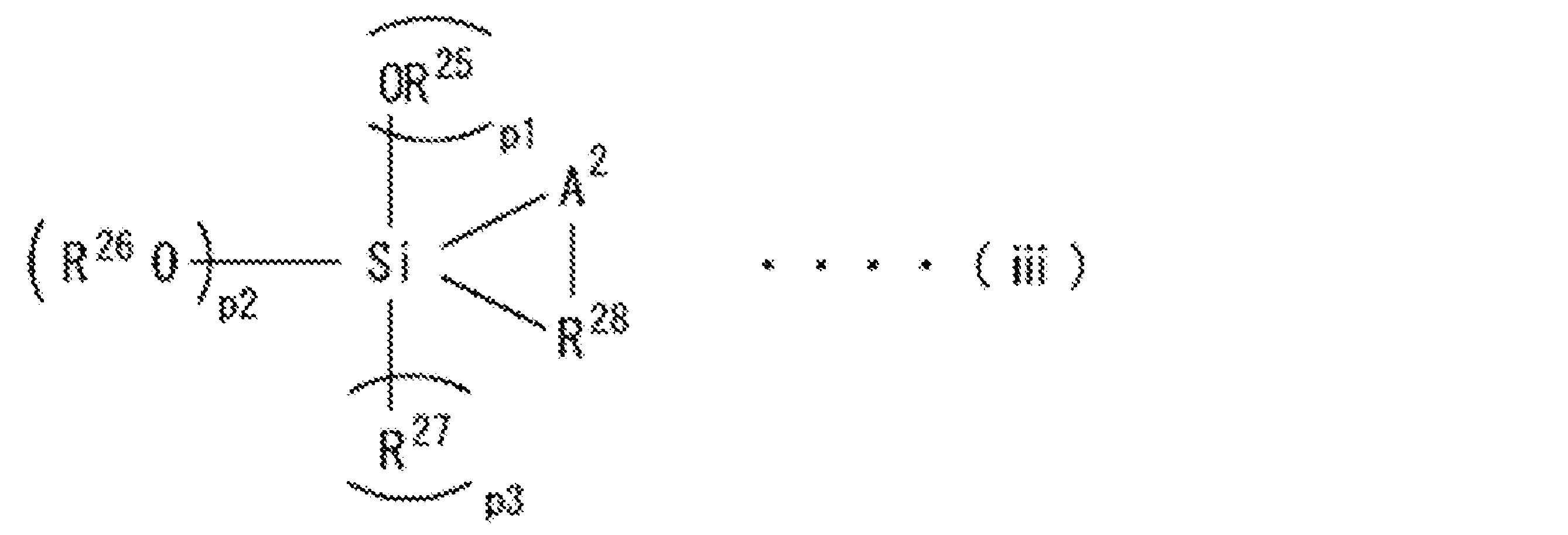
一般式(iii)中、p1+p2+p3=2(但し、p2は1~2の整数であり、p1及びp3は0~1の整数である)である。
A2は、NRa(Raは、一価の炭化水素基、加水分解性基又は含窒素有機基である)である。
R25は、炭素数1~20の一価の脂肪族若しくは脂環式炭化水素基又は炭素数6~18の一価の芳香族炭化水素基である。
R26は、炭素数1~20の一価の脂肪族若しくは脂環式炭化水素基、炭素数6~18の一価の芳香族炭化水素基又は含窒素有機基であり、いずれも窒素原子及び/又はケイ素原子を含有していてもよい。p2が2の場合には、R26は、互いに同一でも異なっていてもよいし、或いは、一緒になって環を形成していてもよい。
R27は、炭素数1~20の一価の脂肪族若しくは脂環式炭化水素基、炭素数6~18の一価の芳香族炭化水素基又はハロゲン原子である。
R28は、炭素数1~20の二価の脂肪族若しくは脂環式炭化水素基又は炭素数6~18の二価の芳香族炭化水素基である。
加水分解性基としては、トリメチルシリル基又はtert-ブチルジメチルシリル基が好ましく、トリメチルシリル基が特に好ましい。
上記一般式(ii)で表されるアミノアルコキシシラン化合物は、下記一般式(iv)又は下記一般式(v)で表されるアミノアルコキシシラン化合物であることも好ましい。
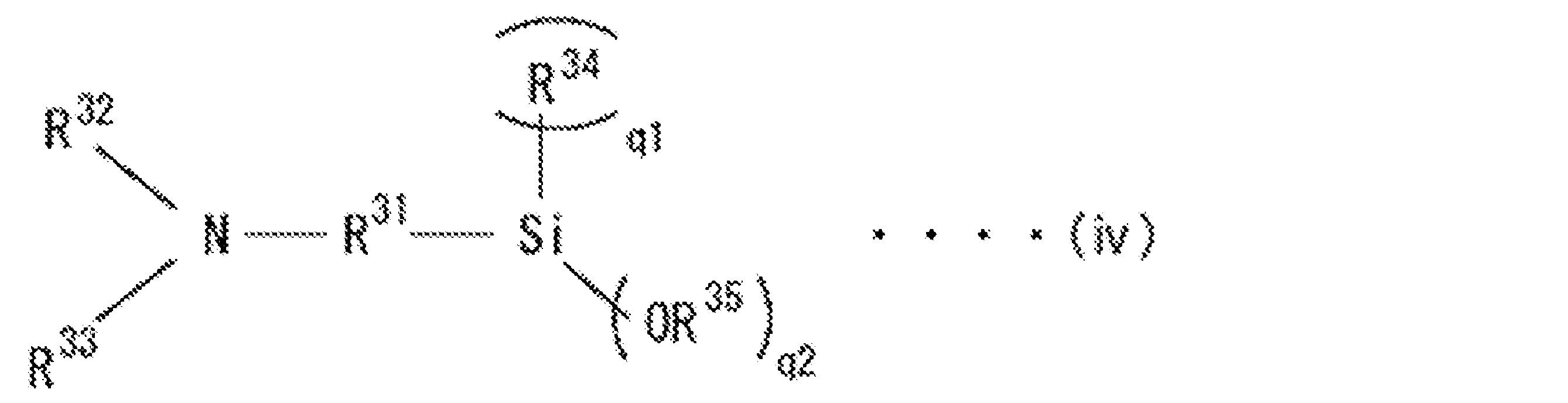
一般式(iv)中、q1+q2=3(但し、q1は0~2の整数であり、q2は1~3の整数である)である。
R31は、炭素数1~20の二価の脂肪族若しくは脂環式炭化水素基又は炭素数6~18の二価の芳香族炭化水素基である。
R32及びR33は、それぞれ独立して、加水分解性基、炭素数1~20の一価の脂肪族若しくは脂環式炭化水素基又は炭素数6~18の一価の芳香族炭化水素基である。
R34は、炭素数1~20の一価の脂肪族若しくは脂環式炭化水素基又は炭素数6~18の一価の芳香族炭化水素基であり、q1が2の場合には同一でも異なっていてもよい。
R35は、炭素数1~20の一価の脂肪族若しくは脂環式炭化水素基又は炭素数6~18の一価の芳香族炭化水素基であり、q2が2以上の場合には同一でも異なっていてもよい。
R31は、炭素数1~20の二価の脂肪族若しくは脂環式炭化水素基又は炭素数6~18の二価の芳香族炭化水素基である。
R32及びR33は、それぞれ独立して、加水分解性基、炭素数1~20の一価の脂肪族若しくは脂環式炭化水素基又は炭素数6~18の一価の芳香族炭化水素基である。
R34は、炭素数1~20の一価の脂肪族若しくは脂環式炭化水素基又は炭素数6~18の一価の芳香族炭化水素基であり、q1が2の場合には同一でも異なっていてもよい。
R35は、炭素数1~20の一価の脂肪族若しくは脂環式炭化水素基又は炭素数6~18の一価の芳香族炭化水素基であり、q2が2以上の場合には同一でも異なっていてもよい。
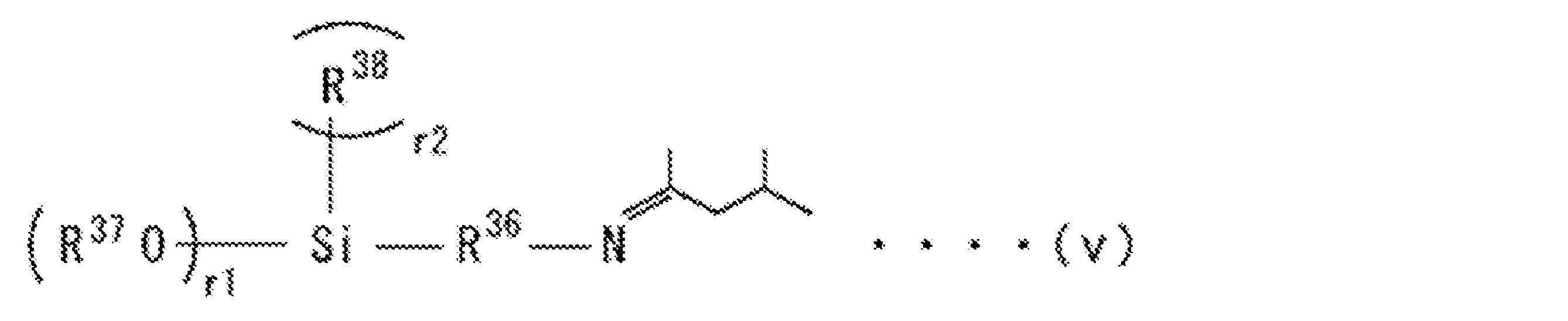
一般式(v)中、r1+r2=3(但し、r1は1~3の整数であり、r2は0~2の整数である)である。
R36は、炭素数1~20の二価の脂肪族若しくは脂環式炭化水素基又は炭素数6~18の二価の芳香族炭化水素基である。
R37は、ジメチルアミノメチル基、ジメチルアミノエチル基、ジエチルアミノメチル基、ジエチルアミノエチル基、メチルシリル(メチル)アミノメチル基、メチルシリル(メチル)アミノエチル基、メチルシリル(エチル)アミノメチル基、メチルシリル(エチル)アミノエチル基、ジメチルシリルアミノメチル基、ジメチルシリルアミノエチル基、炭素数1~20の一価の脂肪族若しくは脂環式炭化水素基又は炭素数6~18の一価の芳香族炭化水素基であり、r1が2以上の場合には同一でも異なっていてもよい。
R38は、炭素数1~20のヒドロカルビルオキシ基、炭素数1~20の一価の脂肪族若しくは脂環式炭化水素基又は炭素数6~18の一価の芳香族炭化水素基であり、r2が2の場合には同一でも異なっていてもよい。
一般式(v)で表されるアミノアルコキシシラン化合物の具体例としては、N-(1,3-ジメチルブチリデン)-3-トリエトキシシリル-1-プロパンアミンが挙げられる。
上記一般式(ii)で表されるアミノアルコキシシラン化合物は、下記一般式(vi)又は下記一般式(vii)で表されるアミノアルコキシシラン化合物であることも好ましい。
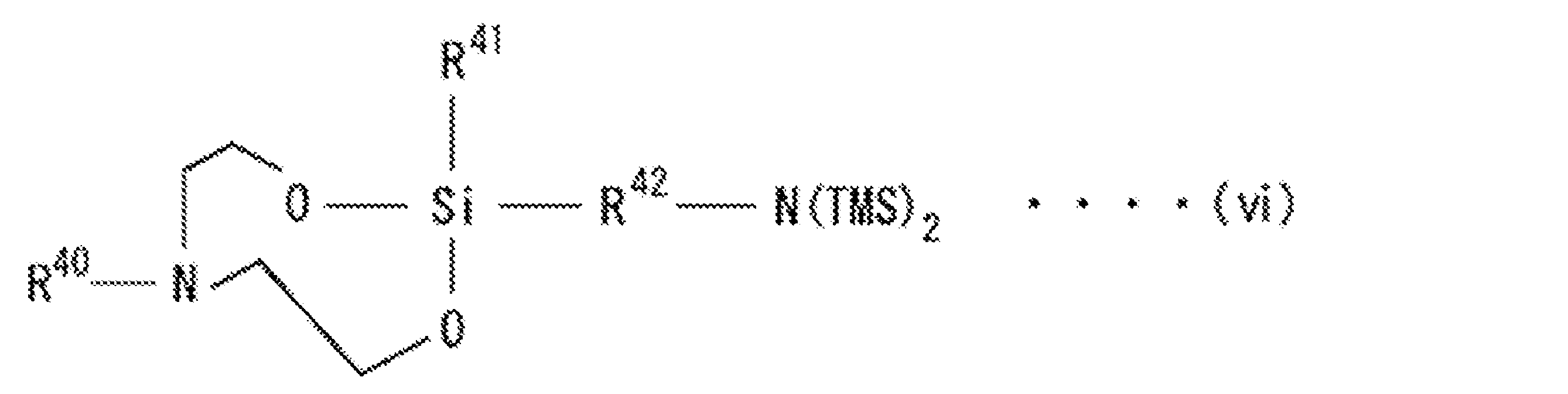
一般式(vi)中、R40は、トリメチルシリル基、炭素数1~20の一価の脂肪族若しくは脂環式炭化水素基又は炭素数6~18の一価の芳香族炭化水素基である。
R41は、炭素数1~20のヒドロカルビルオキシ基、炭素数1~20の一価の脂肪族若しくは脂環式炭化水素基又は炭素数6~18の一価の芳香族炭化水素基である。
R42は、炭素数1~20の二価の脂肪族若しくは脂環式炭化水素基又は炭素数6~18の二価の芳香族炭化水素基である。
ここで、TMSは、トリメチルシリル基を示す(以下、同じ。)。
R41は、炭素数1~20のヒドロカルビルオキシ基、炭素数1~20の一価の脂肪族若しくは脂環式炭化水素基又は炭素数6~18の一価の芳香族炭化水素基である。
R42は、炭素数1~20の二価の脂肪族若しくは脂環式炭化水素基又は炭素数6~18の二価の芳香族炭化水素基である。
ここで、TMSは、トリメチルシリル基を示す(以下、同じ。)。

一般式(vii)中、R43及びR44は、それぞれ独立して炭素数1~20の二価の脂肪族若しくは脂環式炭化水素基又は炭素数6~18の二価の芳香族炭化水素基である。
R45は、炭素数1~20の一価の脂肪族若しくは脂環式炭化水素基又は炭素数6~18の一価の芳香族炭化水素基であり、各R45は、同一でも異なっていてもよい。
R45は、炭素数1~20の一価の脂肪族若しくは脂環式炭化水素基又は炭素数6~18の一価の芳香族炭化水素基であり、各R45は、同一でも異なっていてもよい。
上記一般式(ii)で表されるアミノアルコキシシラン化合物は、下記一般式(viii)又は下記一般式(ix)で表されるアミノアルコキシシラン化合物であることも好ましい。
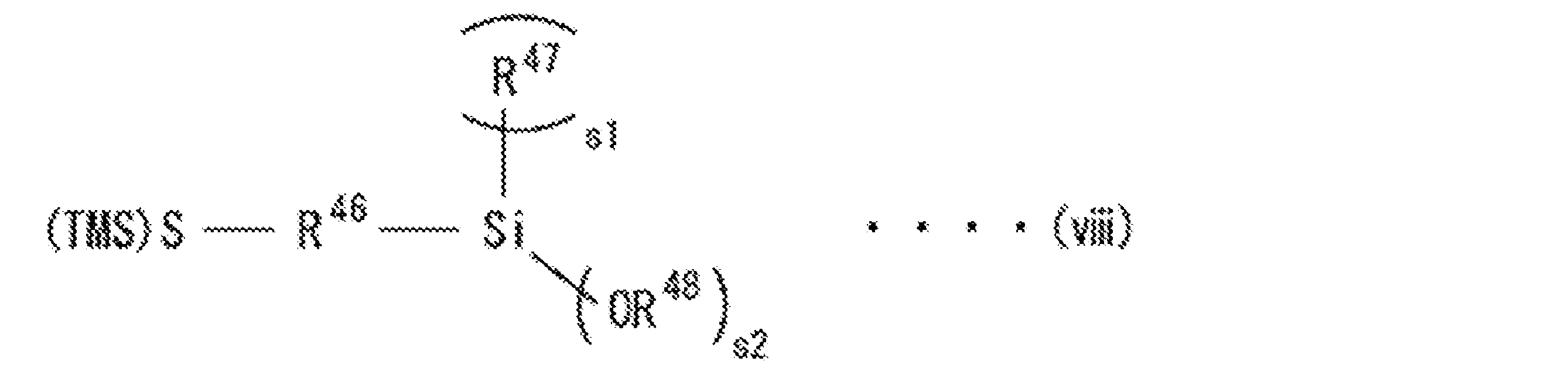
一般式(viii)中、s1+s2は3である(但し、s1は0~2の整数であり、s2は1~3の整数である)。
R46は、炭素数1~20の二価の脂肪族若しくは脂環式炭化水素基又は炭素数6~18の二価の芳香族炭化水素基である。
R47及びR48は、それぞれ独立して炭素数1~20の一価の脂肪族若しくは脂環式炭化水素基又は炭素数6~18の一価の芳香族炭化水素基である。複数のR47又はR48は、同一でも異なっていてもよい。
R46は、炭素数1~20の二価の脂肪族若しくは脂環式炭化水素基又は炭素数6~18の二価の芳香族炭化水素基である。
R47及びR48は、それぞれ独立して炭素数1~20の一価の脂肪族若しくは脂環式炭化水素基又は炭素数6~18の一価の芳香族炭化水素基である。複数のR47又はR48は、同一でも異なっていてもよい。
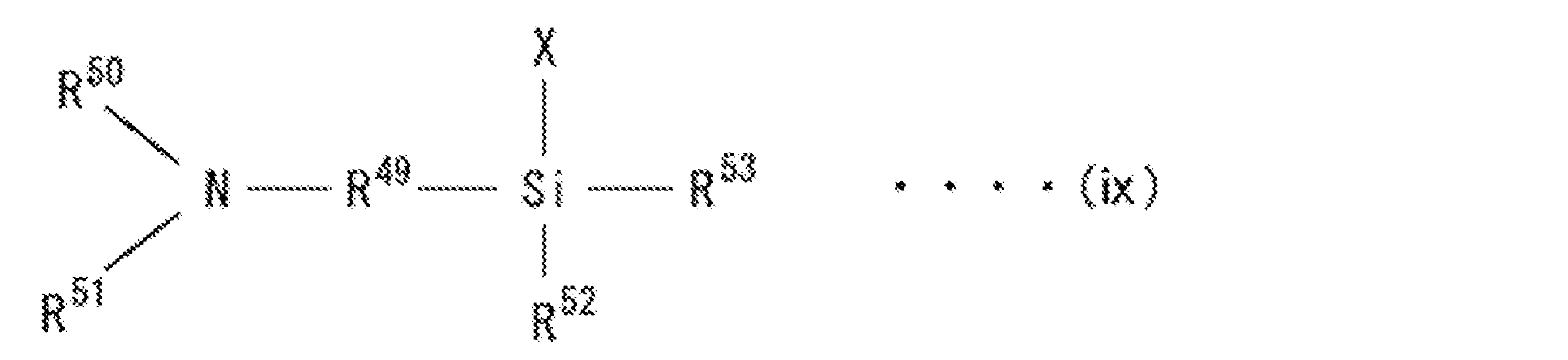
一般式(ix)中、Xは、ハロゲン原子である。
R49は、炭素数1~20の二価の脂肪族若しくは脂環式炭化水素基又は炭素数6~18の二価の芳香族炭化水素基である。
R50及びR51は、それぞれ独立して加水分解性基、炭素数1~20の一価の脂肪族若しくは脂環式炭化水素基又は炭素数6~18の一価の芳香族炭化水素基であるか、或いは、R50及びR51は結合して二価の有機基を形成している。
R52及びR53は、それぞれ独立してハロゲン原子、ヒドロカルビルオキシ基、炭素数1~20の一価の脂肪族若しくは脂環式炭化水素基又は炭素数6~18の一価の芳香族炭化水素基である。
R50及びR51としては、加水分解性基が好ましく、加水分解性基として、トリメチルシリル基、tert-ブチルジメチルシリル基が好ましく、トリメチルシリル基が特に好ましい。
上記一般式(ii)で表されるアミノアルコキシシラン化合物は、下記一般式(x)、下記一般式(xi)、下記一般式(xii)又は下記一般式(xiii)で表されるアミノアルコキシシラン化合物であることも好ましい。

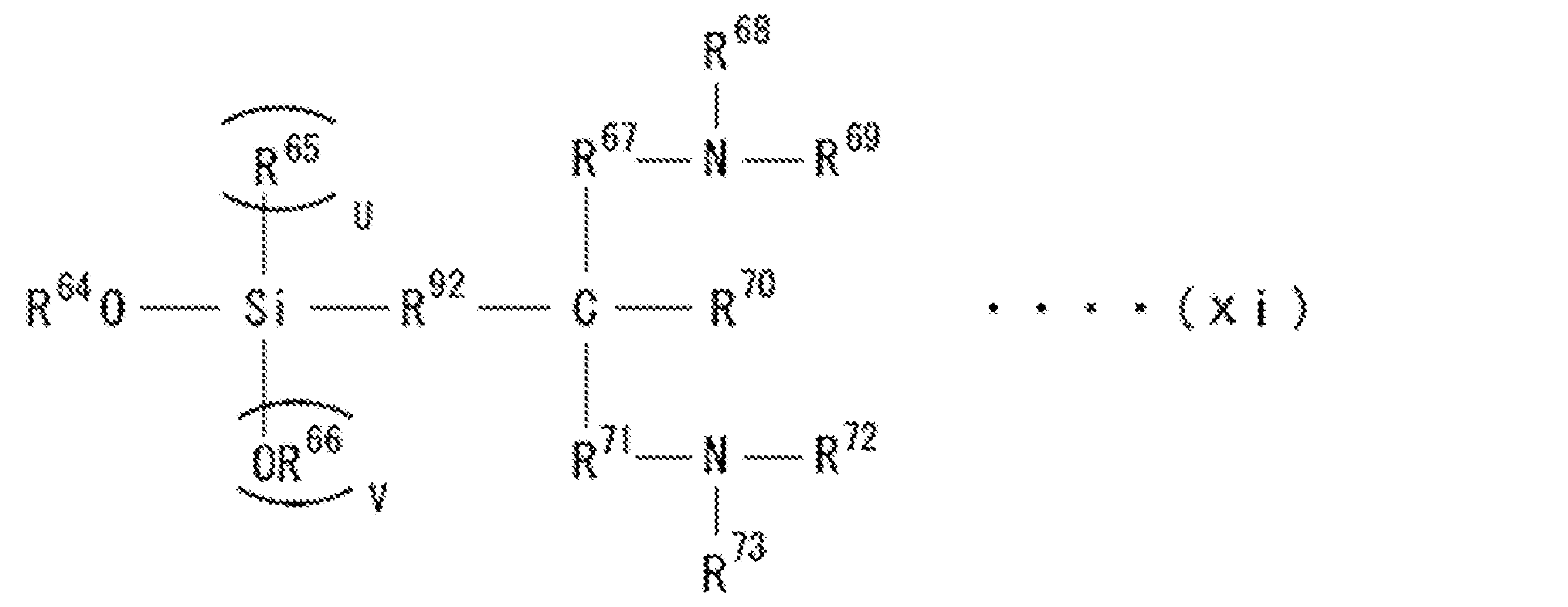
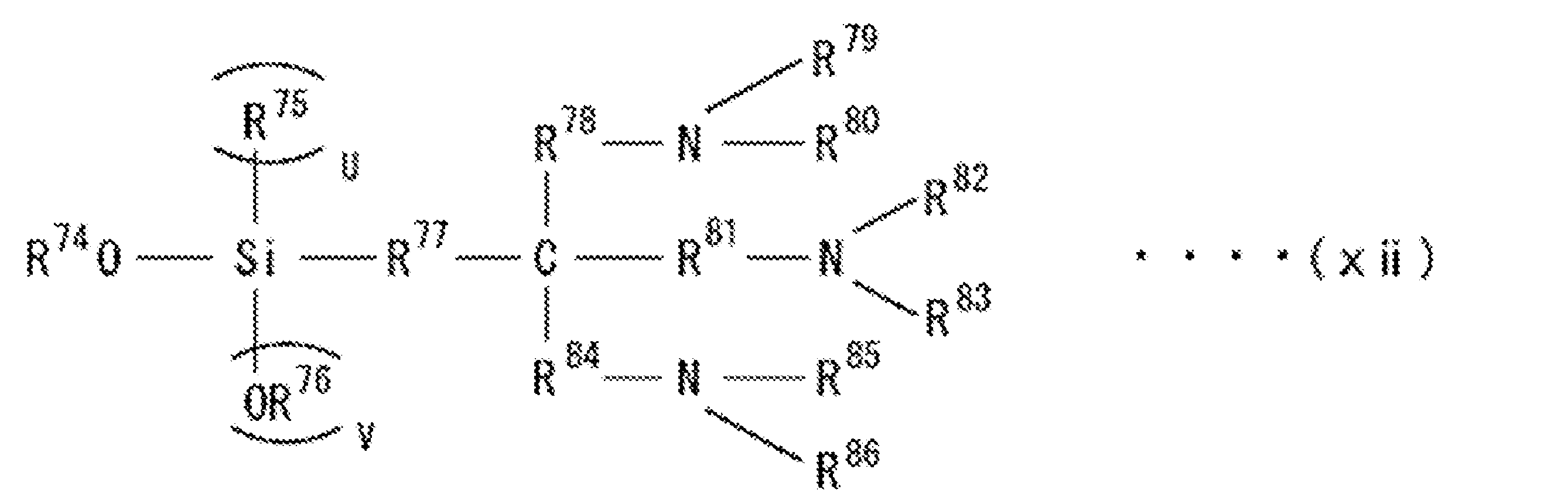
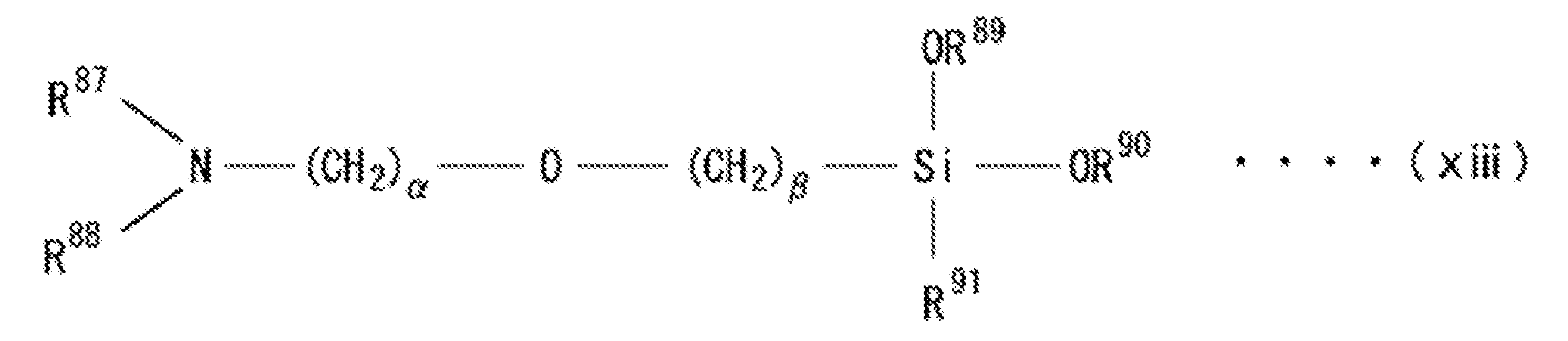
一般式(x)~(xiii)中、記号U、Vは、それぞれ0~2且つU+V=2を満たす整数である。
一般式(x)~(xiii)中のR54~92は、同一でも異なっていてもよく、炭素数1~20の一価若しくは二価の脂肪族又は脂環式炭化水素基、或いは炭素数6~18の一価若しくは二価の芳香族炭化水素基である。
一般式(xiii)中のα及びβは、0~5の整数である。
一般式(x)~(xiii)中のR54~92は、同一でも異なっていてもよく、炭素数1~20の一価若しくは二価の脂肪族又は脂環式炭化水素基、或いは炭素数6~18の一価若しくは二価の芳香族炭化水素基である。
一般式(xiii)中のα及びβは、0~5の整数である。
一般式(x)、一般式(xi)、又は一般式(xii)を満たす化合物の中でも、特に、N1,N1,N7,N7-テトラメチル-4-((トリメトキシシリル)メチル)へプタン-1,7-ジアミン、2-((ヘキシル-ジメトキシシリル)メチル)-N1,N1,N3,N3-2-ペンタメチルプロパン-1,3-ジアミン、N1-(3-(ジメチルアミノ)プロピル)-N3,N3-ジメチル-N1-(3-(トリメトキシシリル)プロピル)プロパン-1,3-ジアミン、4-(3-(ジメチルアミノ)プロピル)-N1,N1,N7,N7-テトラメチル-4-((トリメトキシシリル)メチル)へプタン-1,7-ジアミンが好ましい。
また、一般式(xiii)を満たす化合物の中でも、特に、N,N-ジメチル-2-(3-(ジメトキシメチルシリル)プロポキシ)エタンアミン、N,N-ビス(トリメチルシリル)-2-(3-(トリメトキシシリル)プロポキシ)エタンアミン、N,N-ジメチル-2-(3-(トリメトキシシリル)プロポキシ)エタンアミン、N,N-ジメチル-3-(3-(トリメトキシシリル)プロポキシ)プロパン-1-アミンが好ましい。
また、一般式(xiii)を満たす化合物の中でも、特に、N,N-ジメチル-2-(3-(ジメトキシメチルシリル)プロポキシ)エタンアミン、N,N-ビス(トリメチルシリル)-2-(3-(トリメトキシシリル)プロポキシ)エタンアミン、N,N-ジメチル-2-(3-(トリメトキシシリル)プロポキシ)エタンアミン、N,N-ジメチル-3-(3-(トリメトキシシリル)プロポキシ)プロパン-1-アミンが好ましい。
また、本発明では、上記一般式(i)で表されるアミノアルコキシシラン化合物を含む変性剤を利用した前記スチレンブタジエンゴム(A)の製造方法を提供できる。
前記スチレンブタジエンゴム(A)の製造方法では、具体的には、1)炭化水素溶媒中で、有機アルカリ金属化合物の存在下、スチレンブタジエンゴムを重合して少なくとも一末端にアルカリ金属が結合された活性重合体を製造する段階、及び、2)前記活性重合体を上記一般式(i)で表されるアミノアルコキシシラン化合物を含む変性剤と反応させる段階を含むことができる。
前記スチレンブタジエンゴム(A)の製造方法では、具体的には、1)炭化水素溶媒中で、有機アルカリ金属化合物の存在下、スチレンブタジエンゴムを重合して少なくとも一末端にアルカリ金属が結合された活性重合体を製造する段階、及び、2)前記活性重合体を上記一般式(i)で表されるアミノアルコキシシラン化合物を含む変性剤と反応させる段階を含むことができる。
前記1)の段階は、少なくとも一末端にアルカリ金属が結合された活性重合体を製造するための段階であって、炭化水素溶媒中で、有機アルカリ金属化合物の存在下、スチレン系単量体及びブタジエン系単量体を重合することによって行うことができる。
なお、前記炭化水素溶媒は、特に制限されるものではないが、例えば、n-ペンタン、n-ヘキサン、n-ヘプタン、イソオクタン、シクロヘキサン、トルエン、ベンゼン及びキシレンからなる群から選択された1種以上のものを用いることができる。
前記有機アルカリ金属化合物は、単量体の全体100gを基準に0.1~1.0mmolで用いることができる。
前記有機アルカリ金属化合物は、特に制限されるものではないが、例えば、メチルリチウム、エチルリチウム、プロピルリチウム、n-ブチルリチウム、s-ブチルリチウム、t-ブチルリチウム、ヘキシルリチウム、n-デシルリチウム、t-オクチルリチウム、フェニルリチウム、1-ナフチルリチウム、n-エイコシルリチウム、4-ブチルフェニルリチウム、4-トリルリチウム、シクロヘキシルリチウム、3,5-ジ-n-ヘプチルシクロヘキシルリチウム、4-シクロペンチルリチウム、ナフチルナトリウム、ナフチルカリウム、リチウムアルコキシド、ナトリウムアルコキシド、カリウムアルコキシド、リチウムスルフォネート、ナトリウムスルフォネート、カリウムスルフォネート、リチウムアミド、ナトリウムアミド、カリウムアミド及びリチウムイソプロピルアミドからなる群から選択された1種以上を用いることができる。
前記有機アルカリ金属化合物は、特に制限されるものではないが、例えば、メチルリチウム、エチルリチウム、プロピルリチウム、n-ブチルリチウム、s-ブチルリチウム、t-ブチルリチウム、ヘキシルリチウム、n-デシルリチウム、t-オクチルリチウム、フェニルリチウム、1-ナフチルリチウム、n-エイコシルリチウム、4-ブチルフェニルリチウム、4-トリルリチウム、シクロヘキシルリチウム、3,5-ジ-n-ヘプチルシクロヘキシルリチウム、4-シクロペンチルリチウム、ナフチルナトリウム、ナフチルカリウム、リチウムアルコキシド、ナトリウムアルコキシド、カリウムアルコキシド、リチウムスルフォネート、ナトリウムスルフォネート、カリウムスルフォネート、リチウムアミド、ナトリウムアミド、カリウムアミド及びリチウムイソプロピルアミドからなる群から選択された1種以上を用いることができる。
前記1)の段階の重合は、必要に応じて極性添加剤をさらに添加して行うものであってもよく、前記極性添加剤は、前記単量体の全体100重量部に対して0.001重量部~1.0重量部で添加することができる。具体的には前記単量体の全体100重量部に対して0.005重量部~0.5重量部、より具体的には0.01重量部~0.3重量部で添加することができる。
前記極性添加剤としては、例えば、テトラヒドロフラン、ジテトラヒドロフリルプロパン、ジエチルエーテル、シクロアマルエーテル、ジプロピルエーテル、エチレンジメチルエーテル、エチレンジメチルエーテル、ジエチルグリコール、ジメチルエーテル、3級ブトキシエトキシエタン、ビス(3-ジメチルアミノエチル)エーテル、(ジメチルアミノエチル)エチルエーテル、トリメチルアミン、トリエチルアミン、トリプロピルアミン及びテトラメチルエチレンジアミンからなる群から選択された1種以上を用いることができる。
前記極性添加剤としては、例えば、テトラヒドロフラン、ジテトラヒドロフリルプロパン、ジエチルエーテル、シクロアマルエーテル、ジプロピルエーテル、エチレンジメチルエーテル、エチレンジメチルエーテル、ジエチルグリコール、ジメチルエーテル、3級ブトキシエトキシエタン、ビス(3-ジメチルアミノエチル)エーテル、(ジメチルアミノエチル)エチルエーテル、トリメチルアミン、トリエチルアミン、トリプロピルアミン及びテトラメチルエチレンジアミンからなる群から選択された1種以上を用いることができる。
なお、上述の製造方法では、前記の極性添加剤を用いることによって共役ジエン系単量体及び芳香族ビニル系単量体を共重合させる場合、これらの反応速度の差を補うことによってランダム共重合体を容易に形成することができるように誘導することができる。
また、前記1)の段階における重合は、断熱重合を介して行うか、又は等温重合を介して行うことができる。
ここで、前記断熱重合は、有機アルカリ金属化合物を投入した以後、任意に熱を加えることなく自己反応熱で重合させる段階を含む重合方法を示すものであり、前記等温重合は、前記有機アルカリ金属化合物を投入した以後、任意に熱を加えるか熱を奪って重合物の温度を一定に維持する重合方法を示すものである。
ここで、前記断熱重合は、有機アルカリ金属化合物を投入した以後、任意に熱を加えることなく自己反応熱で重合させる段階を含む重合方法を示すものであり、前記等温重合は、前記有機アルカリ金属化合物を投入した以後、任意に熱を加えるか熱を奪って重合物の温度を一定に維持する重合方法を示すものである。
さらに、前記重合は、20℃~200℃の温度範囲で行うものであってもよく、具体的には0℃~150℃、より具体的には10℃~120℃の温度範囲で行うことができる。
また、前記2)の段階は、スチレンブタジエンゴム(A)を製造するために、前記活性重合体と上記一般式(i)で表されるアミノアルコキシシラン化合物を含む変性剤を反応させる変性反応段階である。
上記一般式(i)で表されるアミノアルコキシシラン化合物は、有機アルカリ金属化合物1モルに対して、0.1~2.0モルになる割合で用いることができる。
さらに、前記2)の段階における反応は、重合体に官能基を導入させるための変性反応であって、前記各反応は、0℃~90℃の温度範囲で1分~5時間の間行うことができる。
さらに、前記2)の段階における反応は、重合体に官能基を導入させるための変性反応であって、前記各反応は、0℃~90℃の温度範囲で1分~5時間の間行うことができる。
なお、上述した製造方法は、前記2)の段階以後、必要に応じて溶媒及び未反応単量体回収及び乾燥のうちの1つ以上の段階をさらに含むこともできる。
また、前記ゴム成分における上記一般式(i)で表されるアミノアルコキシシラン化合物を含む変性剤によって変性されたスチレンブタジエンゴム(A)の含有比率は、特に限定はされないが、15質量%以上であることが好ましく、20質量%以上であることがより好ましく、60質量%以下であることが好ましく、50質量%以下であることがより好ましい。前記ゴム成分における前記スチレンブタジエンゴム(A)の含有比率が15質量%以上の場合、空気入りタイヤの低燃費性能及び耐摩耗性能をより向上できる。一方、前記ゴム成分における前記スチレンブタジエンゴム(A)の含有比率が60質量%以下の場合、後述するスチレンブタジエンゴム(B)を十分に含有でき、空気入りタイヤのウェットグリップ性能を良好に維持できる。
そして、前記ゴム成分は、前記スチレンブタジエンゴム(A)に加えて、該スチレンブタジエンゴム(A)よりガラス転移温度が30℃以上高い無変性のスチレンブタジエンゴム(B)をさらに含有する。
前記ゴム成分として、ガラス転移温度の高いスチレンブタジエンゴム(B)を含有することによって、空気入りタイヤのウェットグリップ性能を高めることができる。
前記ゴム成分として、ガラス転移温度の高いスチレンブタジエンゴム(B)を含有することによって、空気入りタイヤのウェットグリップ性能を高めることができる。
ここで、前記スチレンブタジエンゴム(B)は、そのガラス転移温度がスチレンブタジエンゴム(A)のガラス転移温度より30℃以上高いことを要し、35℃以上高いことが好ましい。トレッドゴム層におけるゴム成分がこのようなスチレンブタジエンゴム(B)を含有することで、ゴムの柔軟性を高め、空気入りタイヤの低燃費性能と耐摩耗性能とを十分に向上させることができる。
また、前記ゴム成分における前記スチレンブタジエンゴム(B)の含有比率は、特に限定はされないが、15質量%以上であることが好ましく、20質量%以上であることがより好ましく、また、85質量%未満であることが好ましく、80質量%以下であることがより好ましい。前記ゴム成分における前記スチレンブタジエンゴム(B)の含有比率が15質量%以上の場合、空気入りタイヤのウェットグリップ性能をより向上できる。一方、前記ゴム成分における前記スチレンブタジエンゴム(B)の含有比率が85質量%未満の場合、空気入りタイヤの低燃費性能及び耐摩耗性能を良好に維持できる。一実施形態においては、ゴム成分における前記スチレンブタジエンゴム(B)を、15質量%以上80質量%未満含有することが好ましい。この場合、空気入りタイヤは、ウェットグリップ性能と、低燃費性能及び耐摩耗性能とがより高いレベルで両立される。
さらにまた、空気入りタイヤのウェットグリップ性能と、低燃費性能及び耐摩耗性能とをより高いレベルで両立する観点からは、前記スチレンブタジエンゴム(B)の含有比率が、前記スチレンブタジエンゴム(A)の含有比率よりも大きいこと(すなわち、スチレンブタジエンゴム(B)の含有比率/スチレンブタジエンゴム(A)の含有比率>1)が好ましい。
なお、前記ゴム成分は、空気入りタイヤの低燃費性能、及び耐摩耗性能等の向上を目的として、前記スチレンブタジエンゴム(A)及び前記スチレンブタジエンゴム(B)とは異なるゴム(その他のゴム)を、ゴム成分として含有することもできる。
前記その他のゴムについては、要求される性能に応じて適宜選択することができるが、例えば、天然ゴム(NR)、ポリブタジエン(BR)、ポリイソプレン(IR)エチレン-プロピレン共重合体ゴム等のようなジエン系ゴムや、ブチルゴム等の非ジエン系ゴムの一種又は二種以上を用いることができる。
前記その他のゴムについては、要求される性能に応じて適宜選択することができるが、例えば、天然ゴム(NR)、ポリブタジエン(BR)、ポリイソプレン(IR)エチレン-プロピレン共重合体ゴム等のようなジエン系ゴムや、ブチルゴム等の非ジエン系ゴムの一種又は二種以上を用いることができる。
ただし、本発明の空気入りタイヤのウェットグリップ性能と、低燃費性能及び耐摩耗性能とをより高いレベルで両立できる観点からは、前記ゴム成分が、スチレンブタジエンゴム(A)及びスチレンブタジエンゴム(B)のみからなることが好ましい。
(充填剤)
本発明の空気入りタイヤにおけるトレッドゴム層は、上述したゴム成分に加えて、少なくともシリカを含有する充填剤を含む。
充填剤を、前記スチレンブタジエンゴム(A)を含有するゴム成分とともに用いることで、充填剤の分散性が高まり、空気入りタイヤの低燃費性能及び耐摩耗性能の向上を実現できる。
本発明の空気入りタイヤにおけるトレッドゴム層は、上述したゴム成分に加えて、少なくともシリカを含有する充填剤を含む。
充填剤を、前記スチレンブタジエンゴム(A)を含有するゴム成分とともに用いることで、充填剤の分散性が高まり、空気入りタイヤの低燃費性能及び耐摩耗性能の向上を実現できる。
ここで、前記充填剤の含有量は、特に限定されるものではないが、前記ゴム成分100質量部に対して20質量部以上であることが好ましく、30質量部以上であることがより好ましく、40質量部以上であることがさらに好ましく、また、150質量部以下であることが好ましく、140質量部以下であることがより好ましく、120質量部以下であることがさらに好ましい。充填剤の量について適正化を図ることで、空気入りタイヤのウェットグリップ性能と、低燃費性能及び耐摩耗性能とをより高いレベルで両立できるためである。充填剤の含有量がゴム成分100質量部に対して20質量部以上の場合には、十分なウェットグリップ性能、低燃費性能及び耐摩耗性能が得られ、充填剤の含有量が前記ゴム成分100質量部に対して160質量部以下の場合には、低発熱性や加工性の悪化を抑えることができる。
前記充填剤中に含まれるシリカは、特に限定はされず、要求される性能に応じて適宜選択することができる。例えば、前記シリカとして、湿式シリカ(含水ケイ酸)、乾式シリカ(無水ケイ酸)、ケイ酸カルシウム、ケイ酸アルミニウム等を用いることができ、これらの中でも、湿式シリカが好ましい。これらシリカは、1種単独で使用してもよいし、2種以上を併用してもよい。
また、前記湿式シリカとしては、沈降シリカを用いることができる。なお、沈降シリカとは、製造初期に、反応溶液を比較的高温、中性~アルカリ性のpH領域で反応を進めてシリカ一次粒子を成長させ、その後酸性側へ制御することで、一次粒子を凝集させる結果得られるシリカのことである。
また、前記湿式シリカとしては、沈降シリカを用いることができる。なお、沈降シリカとは、製造初期に、反応溶液を比較的高温、中性~アルカリ性のpH領域で反応を進めてシリカ一次粒子を成長させ、その後酸性側へ制御することで、一次粒子を凝集させる結果得られるシリカのことである。
前記シリカとしては、環境負荷低減の観点から、ケイ酸植物由来のシリカも好ましい。該ケイ酸植物は、例えば、コケ類、シダ類、トクサ類、ウリ科、イラクサ科、イネ科の植物等に存在する。これら植物の中でも、イネ科植物が好ましい。また、該イネ科植物としては、イネ、笹、サトウキビ等が挙げられ、これらの中でも、イネが好ましい。該イネは、食用に広く栽培されているため、広い地域で現地調達可能であり、また、イネの籾殻は、産業廃棄物として多量に発生することから量を確保し易い。従って、入手容易性の観点から、シリカとしては、籾殻由来のシリカ(以下、「籾殻シリカ」とも呼ぶ。)が特に好ましい。該籾殻シリカを用いることで、産業廃棄物となる籾殻を有効活用でき、また、タイヤ製造工場の近隣で原料を現地調達できるため、輸送や保管のエネルギー及びコストを低減でき、種々の観点から、環境面で好ましい。前記籾殻シリカは、籾殻を加熱により炭化して得られる籾殻炭の粉末でもよいし、籾殻を燃料としてバイオマスボイラーで燃焼させた際に発生する籾殻灰をアルカリで抽出してケイ酸アルカリ水溶液を調製し、該ケイ酸アルカリ水溶液を用いて湿式法で製造した沈降シリカでもよい。前記籾殻炭の製法は、特に限定されず、公知の種々の方法を用いることができ、例えば、窯を用いて籾殻を蒸し焼きにすることで熱分解させて籾殻炭を得ることができる。このようにして得られる籾殻炭を公知の粉砕機(例えば、ボールミル)を用いて粉砕し、所定の粒径範囲に選別し分級することで、籾殻炭の粉末を得ることができる。また、前記籾殻由来の沈降シリカは、特開2019-38728号公報に記載の方法等で製造できる。
また、前記シリカは、CTAB(セチルトリメチルアンモニウムブロミド)比表面積が、好ましくは50m2/g~350m2/gである。シリカのCTAB比表面積が50m2/g以上の場合、空気入りタイヤの耐摩耗性が更に向上し、また、シリカのCTAB比表面積が350m2/g以下の場合、空気入りタイヤの転がり抵抗が小さくなる。
さらに、前記シリカは、窒素吸着比表面積(BET法)が80m2/g以上330m2/g未満であることが好ましい。シリカの窒素吸着比表面積(BET法)が80m2/g以上であると、空気入りタイヤを十分に補強でき、タイヤの低燃費性能をより向上できる。また、シリカの窒素吸着比表面積(BET法)が330m2/g未満であると、トレッドゴム層に使用され得るゴム組成物の弾性率が高くなり過ぎず、空気入りタイヤのウェットグリップ性能が更に向上する。転がり抵抗をより低くし、空気入りタイヤの耐摩耗性能を更に向上させる観点から、シリカの窒素吸着比表面積(BET法)は、130m2/g以上であることが好ましく、150m2/g以上であることが好ましく、170m2/g以上であることが好ましく、180m2/g以上であることが好ましく、190m2/g以上であることが好ましく、195m2/g以上であることが更に好ましい。また、タイヤのウェットグリップ性能をより向上させる観点から、シリカの窒素吸着比表面積(BET法)は、300m2/g以下であることが好ましく、280m2/g以下であることがより好ましく、270m2/g以下であることが更に好ましい。
さらにまた、前記シリカの含有量は、前記ゴム成分100質量部に対して20質量部以上100質量部未満であることが好ましい。
前記シリカの量について適正化を図ることで、ウェットグリップ性能と、低燃費性能及び耐摩耗性能とをより高いレベルで両立できる。シリカの含有量が20質量部以上の場合には、十分なウェットグリップ性能、低燃費性能及び耐摩耗性能が得られ、シリカの含有量が100質量部未満の場合には、低発熱性や加工性の悪化を抑えることができる。
同様の観点から、前記シリカの含有量は、前記ゴム成分100質量部に対して、40質量部以上であることがより好ましく、50質量部以上であることがより好ましく、62質量部以上であることがさらに好ましく、65質量部以上であることがよりさらに好ましく、68質量部以上であることが特に好ましい。加えて、前記シリカの含有量は、前記ゴム成分100質量部に対して、90質量部以下であることがより好ましく、85質量部以下であることがさらに好ましく、82質量部以下であることが特に好ましい。
また、前記充填剤は、前記シリカに加えて、カーボンブラックをさらに含むことが好ましい。該カーボンブラックは、空気入りタイヤの耐摩耗性能を向上させることができる。
カーボンブラックとしては、特に限定されるものではなく、例えば、GPF、FEF、HAF、ISAF、及びSAFグレードのカーボンブラックが挙げられる。これらカーボンブラックは、一種単独で使用してもよいし、二種以上を併用してもよい。また、カーボンブラックは再生カーボンブラックでもよい。
カーボンブラックとしては、特に限定されるものではなく、例えば、GPF、FEF、HAF、ISAF、及びSAFグレードのカーボンブラックが挙げられる。これらカーボンブラックは、一種単独で使用してもよいし、二種以上を併用してもよい。また、カーボンブラックは再生カーボンブラックでもよい。
本明細書において、「再生カーボンブラック」とは、リサイクルに供された廃棄物である原材料から回収して得られるカーボンブラックを指す。上記リサイクルに供された廃棄物としては、使用済ゴム及び使用済タイヤに代表される、カーボンブラックを含むゴム製品(特には、加硫ゴム製品)、廃油等が挙げられる。「再生カーボンブラック」は、石油や天然ガスなどの炭化水素を原材料から直接製造されるカーボンブラック、すなわち、リサイクル品ではないカーボンブラックとは異なる。なお、ここでの「使用済」とは、実際に使用された後で廃棄されたものだけではなく、製造されたものの実際には使用されずに廃棄されたものも含む。
なお、前記充填剤において、前記シリカと前記カーボンブラックの総量中のシリカの含有割合が、80質量%以上100質量%未満であることが好ましく、85質量%以上100質量%未満であることがより好ましく、90質量%以上100%未満であることがさらに好ましい。前記シリカと前記カーボンブラックの総量中のシリカの割合が、80質量%以上であることで、カーボンブラック増加による低燃費性能の低下を抑えることができ、100質量%未満であることで、カーボンブラックによる補強性向上効果を確実に確保できるためである。
前記充填剤は、シリカ、カーボンブラック以外に、例えば下記式(I)で表されるその他の無機化合物を用いることも可能である。
nM・xSiOy・zH2O ・・・ (I)
(式中、Mは、Al、Mg、Ti、Ca及びZrからなる群から選ばれる金属、これらの金属の酸化物又は水酸化物、及びそれらの水和物、並びに、これらの金属の炭酸塩から選ばれる少なくとも一種であり;n、x、y及びzは、それぞれ1~5の整数、0~10の整数、2~5の整数、及び0~10の整数である。)
また、前記充填剤が、その他の無機化合物を含有する場合、その含有量は前記ゴム成分100質量部に対して、5~30質量部程度であることが好ましい。
nM・xSiOy・zH2O ・・・ (I)
(式中、Mは、Al、Mg、Ti、Ca及びZrからなる群から選ばれる金属、これらの金属の酸化物又は水酸化物、及びそれらの水和物、並びに、これらの金属の炭酸塩から選ばれる少なくとも一種であり;n、x、y及びzは、それぞれ1~5の整数、0~10の整数、2~5の整数、及び0~10の整数である。)
また、前記充填剤が、その他の無機化合物を含有する場合、その含有量は前記ゴム成分100質量部に対して、5~30質量部程度であることが好ましい。
上記式(I)の無機化合物としては、γ-アルミナ、α-アルミナ等のアルミナ(Al2O3);ベーマイト、ダイアスポア等のアルミナ一水和物(Al2O3・H2O);ギブサイト、バイヤライト等の水酸化アルミニウム[Al(OH)3];炭酸アルミニウム[Al2(CO3)3]、水酸化マグネシウム[Mg(OH)2]、酸化マグネシウム(MgO)、炭酸マグネシウム(MgCO3)、タルク(3MgO・4SiO2・H2O)、アタパルジャイト(5MgO・8SiO2・9H2O)、チタン白(TiO2)、チタン黒(TiO2n-1)、酸化カルシウム(CaO)、水酸化カルシウム[Ca(OH)2]、酸化アルミニウムマグネシウム(MgO・Al2O3)、クレー(Al2O3・2SiO2)、カオリン(Al2O3・2SiO2・2H2O)、パイロフィライト(Al2O3・4SiO2・H2O)、ベントナイト(Al2O3・4SiO2・2H2O)、ケイ酸アルミニウム(Al2SiO5、Al4・3SiO4・5H2O等)、ケイ酸マグネシウム(Mg2SiO4、MgSiO3等)、ケイ酸カルシウム(Ca2SiO4等)、ケイ酸アルミニウムカルシウム(Al2O3・CaO・2SiO2等)、ケイ酸マグネシウムカルシウム(CaMgSiO4)、炭酸カルシウム(CaCO3)、酸化ジルコニウム(ZrO2)、水酸化ジルコニウム[ZrO(OH)2・nH2O]、炭酸ジルコニウム[Zr(CO3)2]、各種ゼオライトのような電荷を補正する水素、アルカリ金属又はアルカリ土類金属を含む結晶性アルミノケイ酸塩等を挙げることができる。
(シランカップリング剤)
本発明の空気入りタイヤにおけるトレッドゴム層は、前記ゴム成分及び前記充填剤に加えて、シランカップリング剤をさらに含む。
トレッドゴム層が前記シランカップリング剤を含むことで、充填剤として含まれる前記シリカの分散性を高め、ウェットグリップ性能と、低燃費性能及び耐摩耗性能との両立に寄与する。
本発明の空気入りタイヤにおけるトレッドゴム層は、前記ゴム成分及び前記充填剤に加えて、シランカップリング剤をさらに含む。
トレッドゴム層が前記シランカップリング剤を含むことで、充填剤として含まれる前記シリカの分散性を高め、ウェットグリップ性能と、低燃費性能及び耐摩耗性能との両立に寄与する。
そして、本発明では、前記シランカップリング剤は、少なくとも、チオール基を有するシランカップリング剤(A)及びスルフィド結合を有するシランカップリング剤(B)を含有する。
前記チオール基を有するシランカップリング剤(A)は、上述したシリカの分散性を高める効果は高いものの、含有量が多くなると、経年によりタイヤに黒光りが発生する等の変色の原因となる場合がある。そのため、前記シランカップリング剤として、スルフィド結合を有するシランカップリング剤(B)をさらに含有させ、これらのシランカップリング剤の含有量を調整することによって、ウェットグリップ性能と、低燃費性能及び耐摩耗性能との両立を図りつつ、黒光り等の変色を抑えることが可能となる(耐変色性に優れる)。
前記チオール基を有するシランカップリング剤(A)は、上述したシリカの分散性を高める効果は高いものの、含有量が多くなると、経年によりタイヤに黒光りが発生する等の変色の原因となる場合がある。そのため、前記シランカップリング剤として、スルフィド結合を有するシランカップリング剤(B)をさらに含有させ、これらのシランカップリング剤の含有量を調整することによって、ウェットグリップ性能と、低燃費性能及び耐摩耗性能との両立を図りつつ、黒光り等の変色を抑えることが可能となる(耐変色性に優れる)。
ここで、前記シランカップリング剤(A)及び前記シランカップリング剤(B)の合計含有量は、前記シリカ100質量部に対して1~15質量部であることが好ましい。前記シランカップリング剤の合計含有量が、前記シリカ100質量部に対して1質量部以上の場合、ウェットグリップ性能と、低燃費性能及び耐摩耗性能との両立を十分に図ることができ、前記シランカップリング剤の合計含有量が、前記シリカ100質量部に対して15質量部以下の場合、耐変色性を十分に確保できるためである。
同様の観点から、前記シランカップリング剤(A)及び前記シランカップリング剤(B)の合計含有量は、前記シリカ100質量部に対して2~14質量部であることが好ましく、3~13質量部であることがより好ましく、5~12質量部であることがさらに好ましい。
同様の観点から、前記シランカップリング剤(A)及び前記シランカップリング剤(B)の合計含有量は、前記シリカ100質量部に対して2~14質量部であることが好ましく、3~13質量部であることがより好ましく、5~12質量部であることがさらに好ましい。
また、前記シランカップリング剤(A)の含有量が、前記シリカ100質量部に対して1~10質量部である。前記シランカップリング剤(A)の含有量が、前記シリカ100質量部に対して、1質量部以上の場合、ウェットグリップ性能と、低燃費性能及び耐摩耗性能との両立を十分に図ることができ、前記シランカップリング剤(A)の含有量が、前記シリカ100質量部に対して、10質量部以下の場合、耐変色性を十分に確保できるためである。
同様の観点から、前記シランカップリング剤(A)の含有量は、前記シリカ100質量部に対して、2~9.5質量部であることが好ましく、3~9質量部であることがより好ましい。
同様の観点から、前記シランカップリング剤(A)の含有量は、前記シリカ100質量部に対して、2~9.5質量部であることが好ましく、3~9質量部であることがより好ましい。
さらに、ウェットグリップ性能と低燃費性能及び耐摩耗性能との両立、並びに、耐変色性の効果をバランスよく備える観点から、前記シランカップリング剤(A)の含有量に対する前記シランカップリング剤(B)の含有量の質量比(B/A)が、0.3以上3.0未満であることが好ましい。前記シランカップリング剤(A)及び(B)の含有質量比(B/A)が0.3以上である場合には、耐変色性の効果がより確実に得られ、前記シランカップリング剤(A)及び(B)の含有質量比(B/A)が3.0未満の場合には、ウェットグリップ性能と低燃費性能及び耐摩耗性能との両立がより確実に図られるためである。
同様の観点から、前記シランカップリング剤(A)及び(B)の含有質量比(B/A)は、0.31以上3.0以下であることが好ましく、0.32以上2.9以下であることがより好ましい。
同様の観点から、前記シランカップリング剤(A)及び(B)の含有質量比(B/A)は、0.31以上3.0以下であることが好ましく、0.32以上2.9以下であることがより好ましい。
なお、前記シランカップリング剤(A)については、チオール基を有するものであれば特に限定はされない。
例えば、3-(トリメトキシシリル)-1-プロパンチオール、3-(トリエトキシシリル)-1-プロパンチオール、3-(メチルジメトキシシリル)-1-プロパンチオール、2-(トリメトキシシリル)-1-エタンチオール、2-(トリエトキシシリル)-1-エタンチオール、2-(メチルジメトキシシリル)-1-エタンチオール、(トリメトキシシリル)メタンチオール、(トリエトキシシリル)メタンチオール、(メチルジメトキシシリル)メタンチオール、3-[エトキシビス(3,6,9,12,15-ペンタオキサオクタコサン-1-イルオキシ)シリル]-1-プロパンチオール{エボニックデグッサ社製、商品名「Si363」、[C13H27O(CH2CH2O)5]2(CH3CH2O)Si(CH2)3SH}等が挙げられる。
例えば、3-(トリメトキシシリル)-1-プロパンチオール、3-(トリエトキシシリル)-1-プロパンチオール、3-(メチルジメトキシシリル)-1-プロパンチオール、2-(トリメトキシシリル)-1-エタンチオール、2-(トリエトキシシリル)-1-エタンチオール、2-(メチルジメトキシシリル)-1-エタンチオール、(トリメトキシシリル)メタンチオール、(トリエトキシシリル)メタンチオール、(メチルジメトキシシリル)メタンチオール、3-[エトキシビス(3,6,9,12,15-ペンタオキサオクタコサン-1-イルオキシ)シリル]-1-プロパンチオール{エボニックデグッサ社製、商品名「Si363」、[C13H27O(CH2CH2O)5]2(CH3CH2O)Si(CH2)3SH}等が挙げられる。
さらに、前記シランカップリング剤(A)は、上述したものの中でも、炭素数が20~75であることが好ましい。このようなシランカップリング剤(A)であると、空気入りタイヤのウェットグリップ性能と低燃費性能及び耐摩耗性能との両立がより確実に図られ、より優れた耐変色性を有するためである。
また、前記シランカップリング剤(B)については、スルフィド結合を有するものであれば特に限定はされない。
例えば、ビス(3-トリエトキシシリルプロピル)テトラスルフィド、ビス(3-トリエトキシシリルプロピル)トリスルフィド、ビス(3-トリエトキシシリルプロピル)ジスルフィド、ビス(2-トリエトキシシリルエチル)テトラスルフィド、ビス(3-トリメトキシシリルプロピル)テトラスルフィド、ビス(2-トリメトキシシリルエチル)テトラスルフィド、3-トリエトキシシリルプロピル-N,N-ジメチルチオカルバモイルテトラスルフィド、2-トリエトキシシリルエチル-N,N-ジメチルチオカルバモイルテトラスルフィド、3-トリメトキシシリルプロピルベンゾチアゾリルテトラスルフィド、3-トリエトキシシリルプロピルベンゾチアゾリルテトラスルフィド、3-トリエトキシシリルプロピルメタクリレートモノスルフィド、3-トリメトキシシリルプロピルメタクリレートモノスルフィド、ビス(3-ジエトキシメチルシリルプロピル)テトラスルフィド等が挙げられる。
例えば、ビス(3-トリエトキシシリルプロピル)テトラスルフィド、ビス(3-トリエトキシシリルプロピル)トリスルフィド、ビス(3-トリエトキシシリルプロピル)ジスルフィド、ビス(2-トリエトキシシリルエチル)テトラスルフィド、ビス(3-トリメトキシシリルプロピル)テトラスルフィド、ビス(2-トリメトキシシリルエチル)テトラスルフィド、3-トリエトキシシリルプロピル-N,N-ジメチルチオカルバモイルテトラスルフィド、2-トリエトキシシリルエチル-N,N-ジメチルチオカルバモイルテトラスルフィド、3-トリメトキシシリルプロピルベンゾチアゾリルテトラスルフィド、3-トリエトキシシリルプロピルベンゾチアゾリルテトラスルフィド、3-トリエトキシシリルプロピルメタクリレートモノスルフィド、3-トリメトキシシリルプロピルメタクリレートモノスルフィド、ビス(3-ジエトキシメチルシリルプロピル)テトラスルフィド等が挙げられる。
なお、シランカップリング剤の原材料として、バイオエタノールを用いることもできる。バイオエタノールは、生物資源として、主に糖類及び/又はセルロース類を用いて製造され、タンパク質、脂質、アミノ酸等の他の生物資源を有効に活用できない。更に、糖類は、食料と競合し、セルロース類の過度の利用は、森林伐採に繋がる。そのため、種々の生物資源の供給状況の他、再生資源の供給状況、化石資源の供給状況、及び市場の要求(例えば、バイオマス資源の食料としての需要)に応じて、前記生物資源由来のモノマー成分として、生物資源由来のモノマー成分を複数種使用したり、生物資源由来のモノマー成分と再生資源由来のモノマー成分と化石資源由来のモノマー成分とを併用して使用したりすることが好ましい。これにより、1種類の生物資源に頼ることなく、糖、タンパク質、脂質等、幅広い生物資源や、再生資源を有効に活用でき、また、製造時の状況に応じて環境に配慮することもできる。
(樹脂)
本発明の空気入りタイヤにおけるトレッドゴム層は、さらに樹脂を含むことが好ましい。
トレッドゴム層がさらに樹脂を含むことで、加工性を向上できることに加え、空気入りタイヤのウェットグリップ性能をさらに向上させることができる。
本発明の空気入りタイヤにおけるトレッドゴム層は、さらに樹脂を含むことが好ましい。
トレッドゴム層がさらに樹脂を含むことで、加工性を向上できることに加え、空気入りタイヤのウェットグリップ性能をさらに向上させることができる。
なお、前記樹脂の種類については、特に限定はされない。例えば、C5系樹脂、C5-C9系樹脂、C9系樹脂、テルペン系樹脂、ジシクロペンタジエン系樹脂、テルペン-芳香族化合物系樹脂等が挙げられ、これら樹脂は、1種単独で用いてもよいし、2種以上を組み合わせて用いてもよい。
前記C5系樹脂としては、石油化学工業のナフサの熱分解によって得られるC5留分を(共)重合して得られる脂肪族系石油樹脂が挙げられる。
C5留分には、通常1-ペンテン、2-ペンテン、2-メチル-1-ブテン、2-メチル-2-ブテン、3-メチル-1-ブテン等のオレフィン系炭化水素、2-メチル-1,3-ブタジエン、1,2-ペンタジエン、1,3-ペンタジエン、3-メチル-1,2-ブタジエン等のジオレフィン系炭化水素等が含まれる。なお、C5系樹脂は、市販品を利用することができる。
C5留分には、通常1-ペンテン、2-ペンテン、2-メチル-1-ブテン、2-メチル-2-ブテン、3-メチル-1-ブテン等のオレフィン系炭化水素、2-メチル-1,3-ブタジエン、1,2-ペンタジエン、1,3-ペンタジエン、3-メチル-1,2-ブタジエン等のジオレフィン系炭化水素等が含まれる。なお、C5系樹脂は、市販品を利用することができる。
前記C5-C9系樹脂とは、C5-C9系合成石油樹脂を指し、C5-C9系樹脂としては、例えば、石油由来のC5-C11留分を、AlCl3、BF3等のフリーデルクラフツ触媒を用いて重合して得られる固体重合体が挙げられ、より具体的には、スチレン、ビニルトルエン、α-メチルスチレン、インデン等を主成分とする共重合体等が挙げられる。
C5-C9系樹脂としては、C9以上の成分の少ない樹脂が、ゴム成分との相溶性の観点から好ましい。ここで、「C9以上の成分が少ない」とは、樹脂全量中のC9以上の成分が50質量%未満、好ましくは40質量%以下であることを言うものとする。C5-C9系樹脂は、市販品を利用することができる。
C5-C9系樹脂としては、C9以上の成分の少ない樹脂が、ゴム成分との相溶性の観点から好ましい。ここで、「C9以上の成分が少ない」とは、樹脂全量中のC9以上の成分が50質量%未満、好ましくは40質量%以下であることを言うものとする。C5-C9系樹脂は、市販品を利用することができる。
前記C9系樹脂とは、C9系合成石油樹脂を指し、例えばAlCl3やBF3等のフリーデルクラフツ型触媒を用い、C9留分を重合して得られる固体重合体を指す。
C9系樹脂としては、例えば、インデン、α-メチルスチレン、ビニルトルエン等を主成分とする共重合体等が挙げられる。
C9系樹脂としては、例えば、インデン、α-メチルスチレン、ビニルトルエン等を主成分とする共重合体等が挙げられる。
前記テルペン系樹脂は、松属の木からロジンを得る際に同時に得られるテレビン油、或いはこれから分離した重合成分を配合し、フリーデルクラフツ型触媒を用いて重合して得られる固体状の樹脂であり、β-ピネン樹脂、α-ピネン樹脂等がある。また、テルペン-芳香族化合物系樹脂としては、代表例としてテルペン-フェノール樹脂を挙げることができる。このテルペン-フェノール樹脂は、テルペン類と種々のフェノール類とを、フリーデルクラフツ型触媒を用いて反応する方法、或いは更にホルマリンで縮合する方法で得ることができる。原料のテルペン類としては特に制限はなく、α-ピネンやリモネン等のモノテルペン炭化水素が好ましく、α-ピネンを含むものがより好ましく、特にα-ピネンであることが好ましい。なお、骨格中にスチレン等を含んでいてもよい。
前記ジシクロペンタジエン系樹脂は、例えばAlCl3やBF3等のフリーデルクラフツ型触媒等を用い、ジシクロペンタジエンを重合して得られる樹脂を指す。
また、前記樹脂は、少なくとも部分的に水素添加されている樹脂(水素添加された樹脂)であることが好ましい。前記樹脂が、少なくとも部分的に水素添加されていることで、低温領域のヒステリシスロス(tanδ)を向上させることができるため、空気入りタイヤのウェットグリップ性能が向上する。
なお、前記少なくとも部分的に水素添加されている樹脂とは、樹脂を還元水素化して得られる樹脂を意味する。
なお、前記少なくとも部分的に水素添加されている樹脂とは、樹脂を還元水素化して得られる樹脂を意味する。
前記水素添加されている樹脂の原料となる樹脂は、例えば、C5留分とジシクロペンタジエン(DCPD)とを共重合した樹脂(C5-DCPD系樹脂)を含んでいてもよい。
ここで、樹脂全量中のジシクロペンタジエン由来成分が50質量%以上の場合、C5-DCPD系樹脂はジシクロペンタジエン系樹脂に含まれるものとする。樹脂全量中のジシクロペンタジエン由来成分が50質量%未満の場合、C5-DCPD系樹脂はC5系樹脂に含まれるものとする。更に第三成分等が少量含まれる場合でも同様である。
ここで、樹脂全量中のジシクロペンタジエン由来成分が50質量%以上の場合、C5-DCPD系樹脂はジシクロペンタジエン系樹脂に含まれるものとする。樹脂全量中のジシクロペンタジエン由来成分が50質量%未満の場合、C5-DCPD系樹脂はC5系樹脂に含まれるものとする。更に第三成分等が少量含まれる場合でも同様である。
前記樹脂は、軟化点が110℃より高く、ポリスチレン換算の重量平均分子量が200~1600g/molであることが好ましい。この場合、トレッドゴム層が十分に補強され、耐摩耗性能を更に向上させることができる。樹脂の軟化点は、タイヤの耐摩耗性能の観点から、116℃以上であることがより好ましく、120℃以上であることがより好ましく、123℃以上であることがより好ましく、127℃以上であることが更に好ましい。また、樹脂の軟化点は、加工性の観点から、160℃以下であることが好ましく、150℃以下であることがより好ましく、145℃以下であることがより好ましく、141℃以下であることがより好ましく、136℃以下であることがさらに好ましい。
なお、前記樹脂のポリスチレン換算の重量平均分子量は、例えば下記の条件でゲル透過クロマトグラフィー(GPC)により、平均分子量を測定し、ポリスチレン換算の重量平均分子量を算出することができる。
・カラム温度:40℃
・注入量:50μL
・キャリアー及び流速:テトラヒドロフラン 0.6mL/min
・サンプル調製:樹脂成分約2.5mgをテトラヒドロフラン10mLに溶解
また、樹脂成分の軟化点は、例えばJIS-K2207-1996(環球法)に準拠して測定することができる。
なお、前記樹脂のポリスチレン換算の重量平均分子量は、例えば下記の条件でゲル透過クロマトグラフィー(GPC)により、平均分子量を測定し、ポリスチレン換算の重量平均分子量を算出することができる。
・カラム温度:40℃
・注入量:50μL
・キャリアー及び流速:テトラヒドロフラン 0.6mL/min
・サンプル調製:樹脂成分約2.5mgをテトラヒドロフラン10mLに溶解
また、樹脂成分の軟化点は、例えばJIS-K2207-1996(環球法)に準拠して測定することができる。
前記樹脂のポリスチレン換算の重量平均分子量が200g/mol以上であると、タイヤから樹脂が析出し難く、樹脂による効果を十分に発現することができ、また、1600g/mol以下であると、樹脂がゴム成分と相溶し易い。
タイヤからの樹脂の析出を抑制し、タイヤ外観の低下を抑制する観点から、樹脂のポリスチレン換算の重量平均分子量は、500g/mol以上であることが好ましく、550g/mol以上であることがより好ましく、600g/mol以上であることがより好ましく、650g/mol以上であることがより好ましく、700g/mol以上であることが更に好ましい。また、ゴム成分への樹脂の相溶性を高め、樹脂による効果をより高める観点から、樹脂のポリスチレン換算の重量平均分子量は、1350g/mol以下であることが好ましく、1330g/mol以下であることがより好ましく、であることがより好ましく、1300g/mol以下であることがより好ましく、1200g/mol以下であることがより好ましく、1100g/mol以下であることがより好ましく、1000g/mol以下であることがより好ましく、950g/mol以下であることがさらに好ましい。
タイヤからの樹脂の析出を抑制し、タイヤ外観の低下を抑制する観点から、樹脂のポリスチレン換算の重量平均分子量は、500g/mol以上であることが好ましく、550g/mol以上であることがより好ましく、600g/mol以上であることがより好ましく、650g/mol以上であることがより好ましく、700g/mol以上であることが更に好ましい。また、ゴム成分への樹脂の相溶性を高め、樹脂による効果をより高める観点から、樹脂のポリスチレン換算の重量平均分子量は、1350g/mol以下であることが好ましく、1330g/mol以下であることがより好ましく、であることがより好ましく、1300g/mol以下であることがより好ましく、1200g/mol以下であることがより好ましく、1100g/mol以下であることがより好ましく、1000g/mol以下であることがより好ましく、950g/mol以下であることがさらに好ましい。
前記樹脂のポリスチレン換算の重量平均分子量(MwHR)(単位はg/mol)に対する前記樹脂の軟化点(TsHR)(単位は℃)の比(TsHR/MwHR)は、0.07以上であることが好ましく、0.083以上であることがより好ましく、0.095以上であることがより好ましく、0.104以上であることがより好ましく、0.125以上であることがより好ましく、0.135以上であることがより好ましく、0.14以上であることがより好ましく、0.141以上であることがさらに好ましい。また、前記比(TsHR/MwHR)は、0.25以下であることが好ましく、0.24以下であることが好ましく、0.23以下であることが好ましく、0.19以下であることが好ましく、0.18以下であることがより好ましく、0.17以下であることがさらに好ましい。
また、前記樹脂の含有量は、前記ゴム成分100質量部に対して1~50質量部であることが好ましい。トレッドゴム層中の樹脂の含有量が、ゴム成分100質量部に対し1質量部以上であると、樹脂による効果が十分に発現し、ウェットグリップ性能を向上させ、また、50質量部以下であると、タイヤから樹脂が析出し難く、樹脂による効果を十分に発現できる。一方、前記樹脂の含有量が、ゴム成分100質量部に対して50質量部を超えると、空気入りタイヤの低燃費性能と耐摩耗性能が悪化する。ゴム組成物中の樹脂の含有量は、樹脂による効果をより高める観点から、ゴム成分100質量部に対して、5質量部以上であることが好ましく、7質量部以上であることがより好ましく、9質量部以上であることが更に好ましい。また、タイヤからの樹脂の析出を抑制し、タイヤ外観の低下を抑制する観点から、ゴム組成物中の樹脂の含有量は、ゴム成分100質量部に対して、45質量部以下であることがより好ましく、40質量部以下であることがより好ましく、35質量部以下であることが更に好ましい。
(その他成分)
本発明の空気入りタイヤにおけるトレッドゴム層は、上述したゴム成分、充填剤、シランカップリング剤、及び樹脂成分に加えて、必要に応じて、ゴム工業界で通常使用される各種成分、例えば、老化防止剤、ワックス、軟化剤、加工助剤、ステアリン酸、酸化亜鉛(亜鉛華)、加硫促進剤、加硫剤等を、本発明の目的を害しない範囲内で適宜選択して含有していてもよい。これら配合剤としては、市販品を好適に使用することができる。
本発明の空気入りタイヤにおけるトレッドゴム層は、上述したゴム成分、充填剤、シランカップリング剤、及び樹脂成分に加えて、必要に応じて、ゴム工業界で通常使用される各種成分、例えば、老化防止剤、ワックス、軟化剤、加工助剤、ステアリン酸、酸化亜鉛(亜鉛華)、加硫促進剤、加硫剤等を、本発明の目的を害しない範囲内で適宜選択して含有していてもよい。これら配合剤としては、市販品を好適に使用することができる。
前記老化防止剤としては、N-(1,3-ジメチルブチル)-N’-フェニル-p-フェニレンジアミン(6C)、2,2,4-トリメチル-1,2-ジヒドロキノリン重合体(TMDQ)、6-エトキシ-2,2,4-トリメチル-1,2-ジヒドロキノリン(AW)、N,N’-ジフェニル-p-フェニレンジアミン(DPPD)等が挙げられる。該老化防止剤の含有量は、特に制限はなく、前記ゴム成分100質量部に対して、0.1~5質量部の範囲が好ましく、1~4質量部がより好ましい。
前記ワックスとしては、例えば、パラフィンワックス、マイクロクリスタリンワックス等が挙げられる。該ワックスの含有量は、特に制限はなく、前記ゴム成分100質量部に対して、0.1~5質量部の範囲が好ましく、1~4質量部がより好ましい。
前記酸化亜鉛(亜鉛華)の含有量は、特に制限はなく、前記ゴム成分100質量部に対して、8質量部以下であることが好ましく、6質量部以下であることがより好ましく、4質量部未満であることがさらに好ましい。前記亜鉛華の含有量が、多過ぎる(8質量部を超える)場合には、不分散で破壊特性が低下するおそれがある。
前記加硫促進剤としては、スルフェンアミド系加硫促進剤、グアニジン系加硫促進剤、チアゾール系加硫促進剤、チウラム系加硫促進剤、ジチオカルバミン酸塩系加硫促進剤等が挙げられる。これら加硫促進剤は、1種単独で使用してもよく、2種以上を併用してもよい。該加硫促進剤の含有量は、特に制限はなく、前記ゴム成分100質量部に対して、0.1~5質量部の範囲が好ましく、0.2~4質量部の範囲が更に好ましい。
前記加硫剤としては、硫黄等が挙げられる。該加硫剤の含有量は、前記ゴム成分100質量部に対して、硫黄分として0.1~10質量部の範囲が好ましく、1~4質量部の範囲が更に好ましい。
(トレッドゴム層の製造方法)
前記トレッドゴム層の製造方法は、特に限定されるものではない。例えば、既述のゴム成分、充填剤、シランカップリング剤及び樹脂成分に、必要に応じて適宜選択した各種成分を配合して、混練り、熱入れ、押出等することによりトレッドゴム層用のゴム組成物を製造することができる。また、得られたゴム組成物を加硫することで、加硫ゴムとすることができる。
前記トレッドゴム層の製造方法は、特に限定されるものではない。例えば、既述のゴム成分、充填剤、シランカップリング剤及び樹脂成分に、必要に応じて適宜選択した各種成分を配合して、混練り、熱入れ、押出等することによりトレッドゴム層用のゴム組成物を製造することができる。また、得られたゴム組成物を加硫することで、加硫ゴムとすることができる。
前記混練りの条件としては、特に制限はなく、混練り装置の投入体積やローターの回転速度、ラム圧等、及び混練り温度や混練り時間、混練り装置の種類等の諸条件について目的に応じて適宜に選択することができる。混練り装置としては、通常、ゴム組成物の混練りに用いるバンバリーミキサーやインターミックス、ニーダー、ロール等が挙げられる。
前記熱入れの条件についても、特に制限はなく、熱入れ温度や熱入れ時間、熱入れ装置等の諸条件について目的に応じて適宜に選択することができる。該熱入れ装置としては、通常、ゴム組成物の熱入れに用いる熱入れロール機等が挙げられる。
前記押出の条件についても、特に制限はなく、押出時間や押出速度、押出装置、押出温度等の諸条件について目的に応じて適宜に選択することができる。押出装置としては、通常、ゴム組成物の押出に用いる押出機等が挙げられる。押出温度は、適宜に決定することができる。
前記加硫を行う装置や方式、条件等については、特に制限はなく、目的に応じて適宜に選択することができる。加硫を行う装置としては、通常、ゴム組成物の加硫に用いる金型による成形加硫機等が挙げられる。加硫の条件として、その温度は、例えば100~190℃程度である。
<<カーカスプライ>>
本実施形態の空気入りタイヤにおいて、前記カーカスプライ9は、図2に示すように、PET繊維コード10をコーティングゴム20で被覆してなる。
本実施形態の空気入りタイヤにおいて、前記カーカスプライ9は、図2に示すように、PET繊維コード10をコーティングゴム20で被覆してなる。
そして、本実施形態の空気入りタイヤのカーカスプライ9は、トータルゲージが1.2mm以下であり、下記の式(1):
(A/B)/コード総繊度≧0.3 ・・・ (1)
(A:コード強度(N)×繊維占有率
繊維占有率:PET繊維コードの断面積(mm2)/(カーカスプライのトータルゲージ(mm)×(PET繊維コードの直径(mm)+PET繊維コードのコード間距離(mm)))
B:コーティングゴムのtanδ×ゴム占有率
ゴム占有率:1-繊維占有率
コード総繊度:コードを構成するPET繊維の繊度の合計値(dtex))
を満たすことを特徴とする。
ここで、上記式(1)のAは、「コード強度(N)×繊維占有率」を示す。Aの値を大きくすることで、カーカスプライの強度を高めることができる。また、Aにおける繊維占有率は、「PET繊維コードの断面積(mm2)/(カーカスプライのトータルゲージ(mm)×(PET繊維コードの直径(mm)+PET繊維コードのコード間距離(mm)))」であり、この値が大きくなることで、コーティングゴム20の薄厚化が可能となり、転がり抵抗の低減に寄与できる。加えて、上記式(1)のBは、「コーティングゴムのtanδ×ゴム占有率」であり、この値を小さくすることで、カーカスプライ中のゴムのボリュームが小さくなるため、軽量化及び転がり抵抗の低減に寄与できる。さらに、上記式(1)のコード総繊度は、PET繊維11の繊度の合計値であり、これが大きいほどPET繊維コード10が太くなり、強度は高いが、質量が大きくなることを示す。
本発明では、上述した「コード総繊度」に対する「A/B」の割合を、0.3以上とすることによって、低い繊度のコードを用いた場合(PET繊維コードの質量が小さな場合)であっても、カーカスプライの強度を高めることが可能となる。
同様の観点から、本実施形態の空気入りタイヤのカーカスプライ9は、下記の式(1)’:
(A/B)/コード総繊度≧0.45 ・・・ (1)’
を満たすことが好ましい。
(A/B)/コード総繊度≧0.45 ・・・ (1)’
を満たすことが好ましい。
以下、本実施形態の空気入りタイヤのカーカスプライを構成するPET繊維コード及びコーティングゴムについて説明する。
(PET繊維コード)
前記PET繊維コードは、ポリエチレンテレフタレート繊維からなるコードであり、強度、モジュラス、寸法安定性、製造コスト等の特性バランスに優れる。
前記PET繊維コードは、片撚りコードであってもいいし、2本以上の原糸を用いた複数本撚りコードとすることもできる。前記PET繊維コードに要求される性能に応じて適宜選択が可能である。
前記PET繊維コードは、ポリエチレンテレフタレート繊維からなるコードであり、強度、モジュラス、寸法安定性、製造コスト等の特性バランスに優れる。
前記PET繊維コードは、片撚りコードであってもいいし、2本以上の原糸を用いた複数本撚りコードとすることもできる。前記PET繊維コードに要求される性能に応じて適宜選択が可能である。
前記PET繊維コードの原材料は、特に限定されず、例えば、合成品由来でもよいし、植物資源、動物資源、微生物資源等の生物資源由来でもよいし、樹脂製品を粉砕、溶融、再紡糸してなるメカニカルリサイクル由来でもよいし、樹脂製品を解重合し、再重合してなるケミカルリサイクル由来でもよい。
前記ポリエチレンテレフタレート繊維としては、例えば、PET製の製品や衣料品などをメカニカルリサイクル又はケミカルリサイクルして得られるポリエチレンテレフタレートが挙げられる。
また、前記PET繊維コードのコード強度が、160N以上であることが好ましく、165N以上であることがより好ましい。カーカスプライの強度をより高めることができ、耐カット性と低燃費性とが効果的に両立される。
なお、前記PET繊維コードのコード強度の制御は、例えば、コードの総繊度、撚り数、原糸強度等を調整することで適宜行うことができる。
なお、前記PET繊維コードのコード強度の制御は、例えば、コードの総繊度、撚り数、原糸強度等を調整することで適宜行うことができる。
さらに、前記PET繊維コードを構成するPET繊維の原糸強度が、7.8cN/dtex以上であることが好ましく、8.0cN/dtex以上であることがより好ましい。前記PET繊維コードの強度を高めることができる結果、カーカスプライの強度をより高めることができる。
なお、前記PET繊維の原糸強度は、PET樹脂の分子量、結晶化度、結晶の配向度等を調整することによって、高めることができる。
なお、前記PET繊維の原糸強度は、PET樹脂の分子量、結晶化度、結晶の配向度等を調整することによって、高めることができる。
また、前記PET繊維コードの総繊度は、1000~4800dtexであることが好ましく、2000~4000dtexであることがより好ましい。前記PET繊維コードの総繊度が1000dtex以上であることで、カーカスプライの強度をより高めることができる。一方、前記PET繊維コードの総繊度が4800dtex以下であることで、カーカスプライとしてタイヤに適用した際の転がり抵抗の悪化をより確実に抑えることができる。
ここで、前記PET繊維コードの総繊度は、コードを構成するPET繊維の繊度の合計値であり、PET繊維の繊度や、撚り数等を調整することで、総繊度を制御することができる。
ここで、前記PET繊維コードの総繊度は、コードを構成するPET繊維の繊度の合計値であり、PET繊維の繊度や、撚り数等を調整することで、総繊度を制御することができる。
さらに、前記PET繊維の繊度は、550~2200dtexであることが好ましく、1100~1670dtexであることがより好ましい。前記PET繊維の繊度が550dtex以上であることで、カーカスプライの強度をより高めることができる。一方、前記PET繊維の繊度が2200dtex以下であることで、カーカスプライとしてタイヤに適用した際の、転がり抵抗の悪化をより確実に抑えることができる。
なお、前記PET繊維の繊度は、繊維の種類や、製造条件等を調整することで、制御することが可能である。
なお、前記PET繊維の繊度は、繊維の種類や、製造条件等を調整することで、制御することが可能である。
前記PET繊維コードの繊度が、1100/2~2000/2dtexであることが好ましい。なお、これは2本の繊維を撚り合わせたときの繊度を意味する。PET繊維コードの繊度が上記範囲であると、空気入りタイヤの耐カット性と低燃費性とを効果的に両立させることができる。
前記PET繊維コードの直径は、プランジャーエネルギー維持の観点から、0.45mm以上であることが好ましく、0.50mm以上であることがより好ましい。また、転がり抵抗低減の観点から、0.80mm以下であることが好ましく、0.70mm以下であることがより好ましい。
また、前記PET繊維コードの打ち込み密度は、120本/10cm以上であることが好ましく、140本/10cm以上であることがより好ましい。カーカスプライの強度をより高めることができるためである。
なお、前記PET繊維コードの打込密度は、カーカスプライにおいてコードが並んで配設されている方向(図1では横方向)の10cmあたりのPET繊維コードの本数である。
なお、前記PET繊維コードの打込密度は、カーカスプライにおいてコードが並んで配設されている方向(図1では横方向)の10cmあたりのPET繊維コードの本数である。
さらにまた、前記カーカスプライにおける繊維占有率は、上記式(1)を満たすことができれば特に限定はされないが、強度及びタイヤに適用した際の低転がり抵抗性をより高いレベルで両立する点から、30%以上、40%以下であることが好ましく、35%以上40%以下であることがより好ましい。
なお、前記繊維占有率とは、上述したように、PET繊維コードの断面積(mm2)/(カーカスプライのトータルゲージ(mm)×(PET繊維コードの直径(mm)+PET繊維コードのコード間距離(mm)))によって得られるものである。
なお、前記繊維占有率とは、上述したように、PET繊維コードの断面積(mm2)/(カーカスプライのトータルゲージ(mm)×(PET繊維コードの直径(mm)+PET繊維コードのコード間距離(mm)))によって得られるものである。
ここで、前記PET繊維コードの直径は、図2に示すように、カーカスプライ9を構成するPET繊維コード10の断面における直径bである。
加えて、前記PET繊維コードの断面積は、図2に示すように、カーカスプライ9を構成するPET繊維コード10の断面における面積Sである。
また、前記PET繊維コードのコード間距離は、図2に示すように、カーカスプライ9を構成するPET繊維コード10の断面において、各コード10の隣接するコード10との最短間隔aである。
加えて、前記PET繊維コードの断面積は、図2に示すように、カーカスプライ9を構成するPET繊維コード10の断面における面積Sである。
また、前記PET繊維コードのコード間距離は、図2に示すように、カーカスプライ9を構成するPET繊維コード10の断面において、各コード10の隣接するコード10との最短間隔aである。
(接着剤組成物)
前記PET繊維コードは、接着剤組成物を用いて接着剤処理したものであることが好ましい。
前記PET繊維コードは、接着剤組成物を用いて接着剤処理したものであることが好ましい。
前記接着剤組成物としては、例えば、ペンダント基として架橋性を有する官能基を少なくとも1つ有し、付加反応性のある炭素-炭素二重結合を主鎖構造に実質的に含有しない熱可塑性重合体(A)、熱反応型水性ウレタン樹脂(B)及びエポキシ化合物(C)を含み、任意にゴムラテックス(D)を更に含有する接着剤組成物が挙げられる。PET繊維コードをかかる接着剤組成物で接着剤処理することで、高温下での当該PET繊維コードとエラストマー(被覆ゴム)との接着性を向上させることができる。
従来、PET繊維コードの接着剤処理としては、エポキシ又はイソシアネートをコード表面に塗布し、その上にレゾルシンとホルムアルデヒドとラテックスとを混合してなる樹脂(以下、RFL樹脂と称す)で処理する、所謂2浴処理が行われている。しかしながら、このような手段では、1浴に用いる樹脂が非常に固くなり、PET繊維コードヘの歪み入力が増大し、コード疲労性が低下することがある。また、このようなRFL樹脂は、常温では充分なコード-エラストマー間接着力を発現させることができるが、130℃以上の高温下では極端に接着力が低下することがある。これに対し、ペンダント基として架橋性を有する官能基を少なくとも1つ有し、付加反応性のある炭素-炭素二重結合を主鎖構造に実質的に含有しない熱可塑性重合体(A)と、熱反応型水性ウレタン樹脂(B)と、エポキシ化合物(C)とが混在した1浴混合液(接着剤組成物)を用いることで、PET繊維コードを硬化させることなく、且つ180℃以上の高温下でもエラストマー(被覆ゴム)との接着を充分に確保することができる。
前記熱可塑性重合体(A)の主鎖は、直鎖状構造を主体とし、該主鎖としては、例えば、アクリル系重合体、酢酸ビニル系重合体、酢酸ビニル・エチレン系重合体等のエチレン性付加重合体;ウレタン系高分子重合体等が好ましい。但し、熱可塑性重合体(A)は、ペンダント基の官能基が架橋することにより、高温下での樹脂流動性を抑制し、樹脂の破壊強力を確保するという機能を有していればよく、上述したエチレン性付加重合体及びウレタン系高分子重合体に限定されるものではない。
また、前記熱可塑性重合体(A)のペンダント基の官能基としては、オキソザリン基、ビスマレイミド基、(ブロックド)イソシアネート基、アジリジン基、カルボジイミド基、ヒドラジノ基、エポキシ基、エピチオ基等が好ましい。
なお、上述した熱可塑性重合体(A)、熱反応型水性ウレタン樹脂(B)、エポキシ化合物(C)、及びゴムラテックス(D)については、それぞれ、特願2023-040157に記載されたもの、特願2023-030762に記載されたものを用いることができる。
前記PET繊維コードの接着剤処理においては、前記熱可塑性重合体(A)、熱反応型水性ウレタン樹脂(B)、及びエポキシ化合物(C)の3種の混合液(接着剤組成物)を1浴処理液として用い、2浴処理液としては通常のRFL樹脂の液を用いるのが好ましい。また、上記接着剤処理においては、前記熱可塑性重合体(A)、熱反応型水性ウレタン樹脂(B)、エポキシ化合物(C)、及びゴムラテックス(D)の混合液(接着剤組成物)を用いて1浴のみで処理することも可能である。
なお、上記接着剤組成物において、熱可塑性重合体(A)の割合(乾燥質量比率)は、2~75%であることが好ましく、熱反応型水性ウレタン樹脂(B)の割合(乾燥質量比率)は、15~87%であることが好ましく、エポキシ化合物(C)の割合(乾燥質量比率)は、11~70%であることが好ましく、ゴムラテックス(D)の割合(乾燥質量比率)は、20%以下であることが好ましい。
一方で、環境保護の観点からは、PET繊維コードの接着剤組成物として、レゾルシン及びホルマリンを含有しないディップ処理液を用いることが好ましい。このようなディップ処理液としては、例えば、不飽和ジエンを有するゴムラテックス(a)と、ポリエーテルからなる骨格構造及びアミン官能基を含有する化合物、アクリルアミド構造を有する化合物、ポリペプチド、ポリリジン、及びカルボジイミドから選択される1種以上の化合物(b)と、を含有する組成物が挙げられる。また、このようなディップ処理液としては、例えば、上記不飽和ジエンを有するゴムラテックス(a)及び化合物(b)に加えて、更に、(熱解離性ブロックド)イソシアネート基を有する水性化合物(c)、ポリフェノール(d)、及び、多価金属塩(e)から選択される1種以上を含有する組成物が挙げられる。
そのほか、レゾルシン及びホルマリンを含有しないディップ処理液としては、ポリフェノール類(I)及びアルデヒド類(II)を含有する組成物も挙げられる。また、かかる組成物は、ポリフェノール類(I)及びアルデヒド類(II)に加えて、イソシアネート化合物(III)及びゴムラテックス(IV)の少なくともいずれかを更に含有してもよい。
前記PET繊維コードを接着剤処理する(コーティングする)接着剤組成物が、ポリフェノール類(I)及びアルデヒド類(II)を含有することで、環境への負荷を考慮してレゾルシンを用いない場合であっても、良好な接着性を発現することができる。
〔ポリフェノール類(I)〕
前記接着剤組成物が、樹脂成分としてポリフェノール類(I)を含有することで、PET繊維コードとの接着性を高めることができる。ここで、ポリフェノール類(I)は、典型的には水溶性のポリフェノール類であり、レゾルシン(レゾルシノール)以外のポリフェノールであれば、特に限定されない。ポリフェノール類(I)において、芳香環の数、又は水酸基の数は、適宜選択することができる。
前記接着剤組成物が、樹脂成分としてポリフェノール類(I)を含有することで、PET繊維コードとの接着性を高めることができる。ここで、ポリフェノール類(I)は、典型的には水溶性のポリフェノール類であり、レゾルシン(レゾルシノール)以外のポリフェノールであれば、特に限定されない。ポリフェノール類(I)において、芳香環の数、又は水酸基の数は、適宜選択することができる。
前記ポリフェノール類(I)は、より優れた接着性を実現する観点からは、2つ以上の水酸基を有することが好ましく、3つ以上の水酸基を有することがより好ましい。前記ポリフェノール類が3つ以上の水酸基を有することにより、水分を含む接着剤組成物(ディップ処理液)にポリフェノール又はポリフェノールの縮合物が水溶する。これによって、ポリフェノール類は、接着剤組成物内に均一に分布できるので、より優れた接着性を実現できる。更に、ポリフェノール類(I)が、複数個(2個以上)の芳香環を含むポリフェノールである場合、それらの芳香環では、各々、2個又は3個の水酸基がオルト位、メタ位又はパラ位に存在する。
前記ポリフェノール類(I)としては、例えば、WO2022/130879においてポリフェノール化合物として記載されたものを用いることができる。これらポリフェノール類(I)は、1種単独で用いてもよいし、2種以上を組み合わせて用いてもよい。
〔アルデヒド類(II)〕
前記接着剤組成物が、上述したポリフェノール類(I)に加えて、樹脂成分としてアルデヒド類(II)を含有することで、上述したポリフェノール類(I)と共に高い接着性を実現できる。ここで、アルデヒド類(II)は、特に限定されず、要求される性能に応じて、適宜選択することができる。なお、本明細書において、アルデヒド類(II)には、アルデヒド類が発生源であるアルデヒド類の誘導体も含まれる。
前記接着剤組成物が、上述したポリフェノール類(I)に加えて、樹脂成分としてアルデヒド類(II)を含有することで、上述したポリフェノール類(I)と共に高い接着性を実現できる。ここで、アルデヒド類(II)は、特に限定されず、要求される性能に応じて、適宜選択することができる。なお、本明細書において、アルデヒド類(II)には、アルデヒド類が発生源であるアルデヒド類の誘導体も含まれる。
前記アルデヒド類(II)として、例えば、ホルムアルデヒド、アセトアルデヒド、ブチルアルデヒド、アクロレイン、プロピオンアルデヒド、クロラール、ブチルアルデヒド、カプロアルデヒド、アリルアルデヒド等のモノアルデヒド、或いは、グリオキザール、マロンアルデヒド、スクシンアルデヒド、グルタルアルデヒド、アジポアルデヒド等の脂肪族ジアルデヒド類、芳香環を有するアルデヒド、ジアルデヒドデンプン等が挙げられる。これらアルデヒド類(II)は、1種単独で用いてもよいし、2種以上を組み合わせて用いてもよい。
前記アルデヒド類(II)は、芳香環を有するアルデヒド類である又は芳香環を有するアルデヒド類を含むことが好ましい。より優れた接着性を得ることができるためである。また、前記アルデヒド類(II)は、ホルムアルデヒドを含まないことが好ましい。ここで、「ホルムアルデヒドを含まない」とは、例えば、アルデヒド類の総質量中の、ホルムアルデヒドの含有量が0.5質量%未満であることを意味する。
前記接着剤組成物では、ポリフェノール類(I)及びアルデヒド類(II)が縮合された状態であり、ポリフェノール類と芳香環を有するアルデヒド類との質量比(芳香環を有するアルデヒド類の含有量/ポリフェノール類の含有量)が、0.1以上3以下であることが好ましい。この場合、ポリフェノール類と芳香環を有するアルデヒド類との間で起こる縮合反応の生成物である樹脂の硬度、接着性がより適したものになるからである。同様の観点から、前記接着剤組成物における、ポリフェノール類と芳香環を有するアルデヒド類との質量比(芳香環を有するアルデヒド類の含有量/ポリフェノール類の含有量)は、0.25以上であることがより好ましく、また、2.5以下であることがより好ましい。
なお、上記質量比は、乾燥物の質量(固形分比)である。
なお、上記質量比は、乾燥物の質量(固形分比)である。
また、前記接着剤組成物における、ポリフェノール類(I)及びアルデヒド類(II)の合計含有量は、3~30質量%であることが好ましい。この場合、作業性等を悪化させることなく、より優れた接着性を確保できるためである。同様の観点から、前記接着剤組成物における、ポリフェノール類(I)及びアルデヒド類(II)の合計含有量は、5質量%以上であることがより好ましく、また、25質量%以下であることがより好ましい。
なお、上記合計含有量は、乾燥物の質量(固形分比)である。
なお、上記合計含有量は、乾燥物の質量(固形分比)である。
〔イソシアネート化合物(III)〕
前記接着剤組成物は、上述したポリフェノール類(I)及びアルデヒド類(II)に加えて、イソシアネート化合物(III)を更に含有することが好ましい。この場合、ポリフェノール類(I)及びアルデヒド類(II)との相乗効果によって、接着剤組成物の接着性を一層高めることができる。
前記接着剤組成物は、上述したポリフェノール類(I)及びアルデヒド類(II)に加えて、イソシアネート化合物(III)を更に含有することが好ましい。この場合、ポリフェノール類(I)及びアルデヒド類(II)との相乗効果によって、接着剤組成物の接着性を一層高めることができる。
ここで、イソシアネート化合物(III)は、接着剤組成物の被着体である樹脂材料(例えば、ポリフェノール類(I)及びアルデヒド類(II)を縮合させたフェノール/アルデヒド樹脂)への接着を促進させる作用を有する化合物であって、極性官能基としてイソシアネート基を有する化合物である。これらイソシアネート化合物(III)は、1種単独で用いてもよいし、2種以上を組み合わせて用いてもよい。
前記イソシアネート化合物(III)は、特に限定はされないが、接着性をより向上できる観点から、(ブロックド)イソシアネート基含有芳香族化合物を含むことが好ましい。前記接着剤組成物が(ブロックド)イソシアネート基含有芳香族化合物を含有することによって、PET繊維コードと接着剤組成物との界面近傍の位置に(ブロックド)イソシアネート基含有芳香族化合物が分布する結果、一層の接着性促進効果が得られ、この効果により、接着剤組成物の、PET繊維コードとの接着性がより高度化し得る。
前記(ブロックド)イソシアネート基含有芳香族化合物については、特願2023-040157に記載されたもの、特願2023-030762に記載されたものを用いることができる。
前記接着剤組成物における、イソシアネート化合物(III)の含有量は、特に限定はされないが、より確実に優れた接着性を確保する観点から、5~65質量%であることが好ましい。同様の観点から、前記接着剤組成物におけるイソシアネート化合物(III)の含有量は、10質量%以上であることがより好ましく、また、45質量%以下であることがより好ましい。
なお、上記含有量は、乾燥物の質量(固形分比)である。
なお、上記含有量は、乾燥物の質量(固形分比)である。
〔ゴムラテックス(IV)〕
前記接着剤組成物は、上述したポリフェノール類(I)、アルデヒド類(II)及びイソシアネート化合物(III)に加えて、実質的にはゴムラテックス(IV)を更に含有することができる。これによって、接着剤組成物は、ゴム部材との接着性をより高めることができる。
前記接着剤組成物は、上述したポリフェノール類(I)、アルデヒド類(II)及びイソシアネート化合物(III)に加えて、実質的にはゴムラテックス(IV)を更に含有することができる。これによって、接着剤組成物は、ゴム部材との接着性をより高めることができる。
ここで、ゴムラテックス(IV)としては、特に限定はされず、天然ゴム(NR)の他、ポリイソプレンゴム(IR)、スチレン-ブタジエン共重合体ゴム(SBR)、ポリブタジエンゴム(BR)、エチレン-プロピレン-ジエンゴム(EPDM)、クロロプレンゴム(CR)、ハロゲン化ブチルゴム、アクリロニリトル-ブタジエンゴム(NBR)、又はビニルピリジン-スチレン-ブタジエン共重合体ゴム(Vp)等の合成ゴムが挙げられる。これらゴムラテックス(IV)は、1種単独で用いてもよいし、2種以上を組み合わせて用いてもよい。
前記ゴムラテックス(IV)を含有する接着剤組成物を調製するに際しては、イソシアネート化合物(III)を配合する前に、ゴムラテックス(IV)をフェノール類(I)及びアルデヒド類(II)と混合させることが好ましい。
前記接着剤組成物における、ゴムラテックス(IV)の含有量は、20質量%以上であることが好ましく、25質量%以上であることがより好ましく、また、70質量%以下であることが好ましく、60質量%以下であることがより好ましい。
なお、前記接着剤組成物の製造方法は、特に限定はされないが、例えば、ポリフェノール類(I)、アルデヒド類(II)、及びゴムラテックス(IV)等の原材料を混合し、熟成する方法、又は、ポリフェノール類(I)とアルデヒド類(II)とを混合して熟成した後に、ゴムラテックス(IV)を更に加えて熟成する方法等が挙げられる。前記接着剤組成物の製造方法は、原材料にイソシアネート化合物(III)が含まれる場合、ゴムラテックス(IV)を加え、熟成した後に、イソシアネート化合物(III)を加える方法であってもよい。
(コーティングゴム)
前記コーティングゴムは、前記PET繊維コードを被覆するゴムである。
本実施形態の空気入りタイヤのカーカスプライでは、上記式(1)を満たすように、コーティングゴムのゴム占有率を規定すること以外は、特に限定はされず、要求される性能に応じて、コーティングゴムの組成や物性を適宜選択することができる。
前記コーティングゴムは、前記PET繊維コードを被覆するゴムである。
本実施形態の空気入りタイヤのカーカスプライでは、上記式(1)を満たすように、コーティングゴムのゴム占有率を規定すること以外は、特に限定はされず、要求される性能に応じて、コーティングゴムの組成や物性を適宜選択することができる。
例えば、カーカスプライとしてタイヤに適用した際に、低転がり抵抗性をより改善できる観点からは、前記コーティングゴムが、天然ゴム60質量%以上及び非油展スチレンブタジエンゴム40質量%以下を含有するゴム成分と、該ゴム成分100質量部に対して30~60質量部の、窒素吸着比表面積(N2SA)が60m2/g以下のカーボンブラックと、を含むことが好ましい。このような組成のコーティングゴムは、低発熱性に優れ、タイヤに適用した際の転がり抵抗をより低減できる。
前記コーティングゴムのゴム成分については、特に限定はされないが、上述したように、天然ゴム60質量%以上及び非油展スチレンブタジエンゴム40質量%以下を含有することが好ましい。コーティングゴムのゴム成分が天然ゴム60質量%以上及び非油展スチレンブタジエンゴム40質量%以下を含有することで、カーカスプライ(PET繊維-ゴム複合体)をタイヤに適用した際の低転がり抵抗性に寄与できる。
なお、前記ゴム成分は、上述した天然ゴム及び非油展SBR以外のゴム、例えば、ポリイソプレンゴム(IR)、ポリブタジエンゴム(BR)、アクリロニトリル-ブタジエン共重合ゴム(NBR)、イソプレン・イソブチレン共重合ゴム(IIR)、エチレン・プロピレン-ジエン共重合ゴム(EPDM)、ハロゲン化ブチルゴム(HR)、クロロプレンゴム(CR)等の各種合成ゴム等のジエン系ゴムや、非ジエン系ゴムを含有することも可能である。
なお、前記ゴム成分は、上述した天然ゴム及び非油展SBR以外のゴム、例えば、ポリイソプレンゴム(IR)、ポリブタジエンゴム(BR)、アクリロニトリル-ブタジエン共重合ゴム(NBR)、イソプレン・イソブチレン共重合ゴム(IIR)、エチレン・プロピレン-ジエン共重合ゴム(EPDM)、ハロゲン化ブチルゴム(HR)、クロロプレンゴム(CR)等の各種合成ゴム等のジエン系ゴムや、非ジエン系ゴムを含有することも可能である。
また、前記コーティングゴムは、前記ゴム成分100質量部に対して30~60質量部の、窒素吸着比表面積(N2SA)が60m2/g以下のカーボンブラックを含むことが好ましい。
前記コーティングゴム中に、N2SAが60m2/g以下のカーボンブラックを含むことで、カーカスプライの強度を高く維持しつつ、タイヤに適用した際の転がり抵抗の悪化を抑えることができる。同様の観点から、前記カーボンブラックのN2SAは、45m2/g以下であることがより好ましい。
前記コーティングゴムにおける前記カーボンブラックの含有量を前記ゴム成分100質量部に対して30質量部以上とすることで、カーカスプライ(PET繊維-ゴム複合体)の強度を高めることができ、前記カーボンブラックの含有量を前記ゴム成分100質量部に対して60質量部以下とすることで、カーカスプライとしてタイヤに適用した際の転がり抵抗の悪化を抑えることができる。同様の観点から、前記カーボンブラックの含有量は、前記ゴム成分100質量部に対して35~45質量部であることがより好ましい。
前記カーボンブラックは、再生カーボンブラックでもよい。
なお、前記コーティングゴムは、上述したゴム成分及びカーボンブラックの他にも、本発明の効果が損なわれない範囲で、通常ゴム工業界で用いられる添加成分、例えば、シリカ等の充填材、加硫剤、加硫促進剤、ビスマレイミド化合物、軟化剤、ステアリン酸、亜鉛華、樹脂、ワックス、オイル等を、適宜含むことができる。
(カーカスプライの物性等)
本実施形態の空気入りタイヤのカーカスプライ9は、トータルゲージが1.2mm以下であり、且つ上記式(1)を満たすものであれば特に限定はされないが、より優れた強度を得る観点から、その引張強度(プライ強度)が、23000N/dm超であることが好ましい。カーカスプライの引張強度(N/dm)はASTM D885にて測定したコード1本の引張強力×幅10cm当たりの本数で計算される。カーカスプライの引張強度が23000N/dm超であると、空気入りタイヤの耐カット性と低燃費性が効果的に両立される。
本実施形態の空気入りタイヤのカーカスプライ9は、トータルゲージが1.2mm以下であり、且つ上記式(1)を満たすものであれば特に限定はされないが、より優れた強度を得る観点から、その引張強度(プライ強度)が、23000N/dm超であることが好ましい。カーカスプライの引張強度(N/dm)はASTM D885にて測定したコード1本の引張強力×幅10cm当たりの本数で計算される。カーカスプライの引張強度が23000N/dm超であると、空気入りタイヤの耐カット性と低燃費性が効果的に両立される。
前記カーカスプライ中のPET繊維コードのコード間距離は、タイヤ高速走行耐久性の観点から、0.15mm以上であることが好ましく、0.17mm以上であることがより好ましい。また、プランジャーエネルギー維持の観点から、0.45mm以下であることが好ましく、0.40mm以下であることがより好ましい。
また、前記カーカスプライのトータルゲージは、1.2mm以下であり、1.0mm以下であることが特に好ましい。
前記カーカスプライのトータルゲージが1.2mm以下であることで、カーカスプライの軽量化が進み、タイヤに適用した際の転がり抵抗の悪化をより確実に抑えることができるためである。
なお、前記カーカスプライのトータルゲージは、図2に示すように、カーカスプライ中のコード延在方向と直交する面で切断した際のカーカスプライの厚さTのことである。
前記カーカスプライのトータルゲージが1.2mm以下であることで、カーカスプライの軽量化が進み、タイヤに適用した際の転がり抵抗の悪化をより確実に抑えることができるためである。
なお、前記カーカスプライのトータルゲージは、図2に示すように、カーカスプライ中のコード延在方向と直交する面で切断した際のカーカスプライの厚さTのことである。
なお、上述したように、本実施形態の空気入りタイヤのカーカスプライは、上記式(1)を満たす必要があり、上記式(1)’を満たすことが好ましい。
式(1)中のA(コード強度×繊維占有率)は、大きいほどカーカスプライの強度が大きいことを示し、B(コーティングゴムのtanδ×ゴム占有率)は、小さいほど転がり抵抗を低減できることを示す。
そして、上述したように、(A/B)/コード総繊度を、0.3以上とする(式(1)を満たす)ことで、コードを少なくし、転がり抵抗を低減しつつも、高い強度を実現できる。
式(1)中のA(コード強度×繊維占有率)は、大きいほどカーカスプライの強度が大きいことを示し、B(コーティングゴムのtanδ×ゴム占有率)は、小さいほど転がり抵抗を低減できることを示す。
そして、上述したように、(A/B)/コード総繊度を、0.3以上とする(式(1)を満たす)ことで、コードを少なくし、転がり抵抗を低減しつつも、高い強度を実現できる。
また、前記カーカスプライについて、スペクトロメーター(株式会社上島製作所製)を用いて、温度24℃、歪1%、周波数52Hzの条件下で測定したコーティングゴムのtanδは、転がり抵抗低減の観点から、1.5以下であることが好ましく、1.0以下であることがより好ましい。
(カーカスプライの製造方法)
本実施形態の空気入りタイヤのカーカスプライの製造方法は、特に限定はされず、公知の方法によって製造できる。
なお、前記PET繊維コードを前記コーティングゴムによって被覆する方法としては、例えば、以下に示す方法を用いることができる。
所定の本数のPET繊維コードを、すだれ状に作製後、これらのPET繊維コードを上下両側から、前記コーティングゴム(ゴム組成物)からなる任意の厚さを有する未加硫のゴムシートで挟んだ後、例えば160℃程度の温度で、20分間程度加硫処理することで、カーカスプライを得る方法である。
本実施形態の空気入りタイヤのカーカスプライの製造方法は、特に限定はされず、公知の方法によって製造できる。
なお、前記PET繊維コードを前記コーティングゴムによって被覆する方法としては、例えば、以下に示す方法を用いることができる。
所定の本数のPET繊維コードを、すだれ状に作製後、これらのPET繊維コードを上下両側から、前記コーティングゴム(ゴム組成物)からなる任意の厚さを有する未加硫のゴムシートで挟んだ後、例えば160℃程度の温度で、20分間程度加硫処理することで、カーカスプライを得る方法である。
<空気入りタイヤの製造方法>
本実施形態の空気入りタイヤは、適用するタイヤの種類に応じ、未加硫のゴム組成物や、未加硫のトリート(コードをゴムで被覆したコード-ゴム複合体)等を用いて成形後に加硫して得てもよく、或いは、未加硫のゴム組成物の代わりに予備加硫工程等を経た半加硫ゴムを用いて成形後、さらに本加硫して得てもよい。
なお、本実施形態の空気入りタイヤのトレッドゴム層及びカーカスプライ以外の部材は、特に限定されず、公知の部材を使用することができる。
また、空気入りタイヤに充填する気体としては、通常の或いは酸素分圧を調整した空気の他、窒素、アルゴン、ヘリウム等の不活性ガスを用いることができる。
本実施形態の空気入りタイヤは、適用するタイヤの種類に応じ、未加硫のゴム組成物や、未加硫のトリート(コードをゴムで被覆したコード-ゴム複合体)等を用いて成形後に加硫して得てもよく、或いは、未加硫のゴム組成物の代わりに予備加硫工程等を経た半加硫ゴムを用いて成形後、さらに本加硫して得てもよい。
なお、本実施形態の空気入りタイヤのトレッドゴム層及びカーカスプライ以外の部材は、特に限定されず、公知の部材を使用することができる。
また、空気入りタイヤに充填する気体としては、通常の或いは酸素分圧を調整した空気の他、窒素、アルゴン、ヘリウム等の不活性ガスを用いることができる。
以下に、実施例を挙げて本発明を更に詳しく説明するが、本発明は下記の実施例に何ら限定されるものではない。
<カーカスプライの作製及び評価>
表1に示す条件で、PET繊維コードをコーティングゴムで被覆して、カーカスプライを作製した。PET繊維コードの仕様、コーティングゴムの主たる配合、及び作製したカーカスプライの条件及び評価を表1に示す。
(1)プライ強度
プライ強度は、ASTM D885に準拠して測定したPET繊維コードの一本あたりの強度及びPET繊維コードの単位あたり打ち込み数を用いて、下記の式で計算した。数値が大きいほどプライ強度が大きい。
式:プライ強度(N/dm)=PET繊維コードの一本あたりの強度(N)×PET繊維コードの単位あたり打ち込み数(本/10cm)
評価結果は、カーカスプライ1のプライ強度を100として、指数表示した。指数値が大きい程、プライ強度が高いことを示す。
(2)コーティングゴムのtanδ
コーティングゴムのtanδは、スペクトロメーター(株式会社上島製作所製)を用いて、温度24℃、歪1%、周波数52Hzの条件下でコーティングゴムのtanδ(損失正接)を測定した。
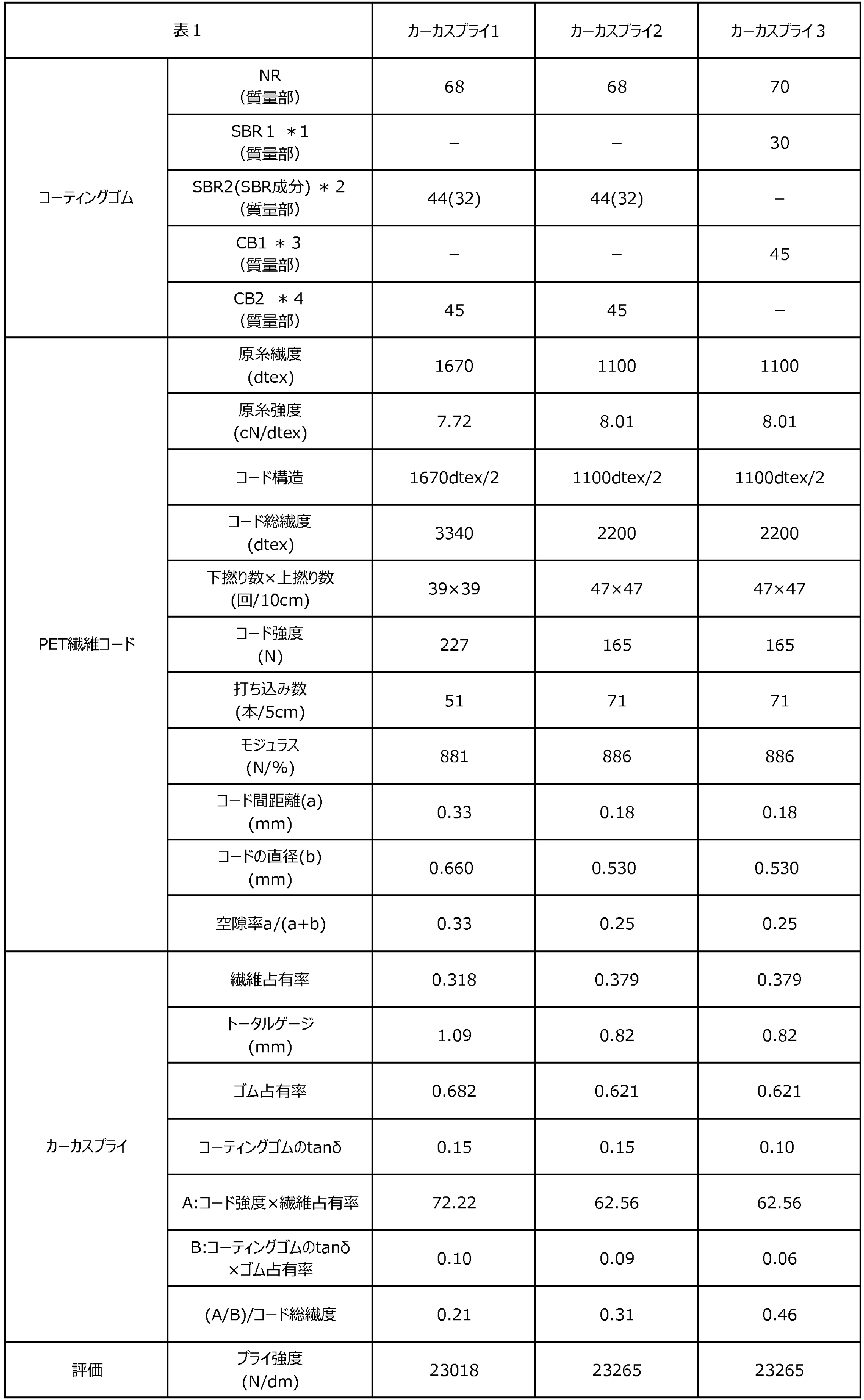
*1 SBR1:溶液重合SBR、非油展
*2 SBR2:乳化重合SBR、27.3質量%油展
*3 CB1:GPF級カーボンブラック、N2SA 28m2/g、DBP 89ml/100g
*4 CB2:HAF級カーボンブラック、N2SA 71m2/g、DBP 103ml/100g
*2 SBR2:乳化重合SBR、27.3質量%油展
*3 CB1:GPF級カーボンブラック、N2SA 28m2/g、DBP 89ml/100g
*4 CB2:HAF級カーボンブラック、N2SA 71m2/g、DBP 103ml/100g
<ゴム成分の分析方法>
スチレン-ブタジエンゴムのガラス転移温度(Tg)及び結合スチレン量は、以下の方法で測定した。
スチレン-ブタジエンゴムのガラス転移温度(Tg)及び結合スチレン量は、以下の方法で測定した。
(1)ガラス転移温度(Tg)
合成したスチレン-ブタジエンゴムを試料として、TAインスツルメンツ社製DSC250を用い、ヘリウム50mL/分の流通下、-100℃から20℃/分で昇温しながらDSC曲線を記録し、DSC微分曲線のピークトップ(Inflection point)をガラス転移温度とした。
合成したスチレン-ブタジエンゴムを試料として、TAインスツルメンツ社製DSC250を用い、ヘリウム50mL/分の流通下、-100℃から20℃/分で昇温しながらDSC曲線を記録し、DSC微分曲線のピークトップ(Inflection point)をガラス転移温度とした。
(2)結合スチレン量
合成したスチレン-ブタジエンゴムを試料として、試料100mgを、クロロホルムで100mLにメスアップし、溶解して測定サンプルとした。スチレンのフェニル基による紫外線吸収波長(254nm付近)の吸収量により、試料100質量%に対しての結合スチレン量(質量%)を測定した。なお、測定装置として、島津製作所社製の分光光度計「UV-2450」を用いた。
合成したスチレン-ブタジエンゴムを試料として、試料100mgを、クロロホルムで100mLにメスアップし、溶解して測定サンプルとした。スチレンのフェニル基による紫外線吸収波長(254nm付近)の吸収量により、試料100質量%に対しての結合スチレン量(質量%)を測定した。なお、測定装置として、島津製作所社製の分光光度計「UV-2450」を用いた。
<ゴム組成物の調製>
表2及び3に示す配合処方に従って、各成分を配合して混練し、実施例及び比較例のゴム組成物を調製した。なお、表2及び3に示したゴム成分の配合量は、油展量を含めた数値で記載した。各成分の配合量は、ゴム成分100質量部に対する量(質量部)で示されている。
得られた実施例及び比較例のゴム組成物を加硫し、加硫ゴム試験片を得た。
表2及び3に示す配合処方に従って、各成分を配合して混練し、実施例及び比較例のゴム組成物を調製した。なお、表2及び3に示したゴム成分の配合量は、油展量を含めた数値で記載した。各成分の配合量は、ゴム成分100質量部に対する量(質量部)で示されている。
得られた実施例及び比較例のゴム組成物を加硫し、加硫ゴム試験片を得た。
なお、表2及び表3中の「低Tg変性SBR」については、以下の条件によって作製した。
(低Tg変性SBR(*5)の合成)
乾燥し、窒素置換した800mLの耐圧ガラス容器に、1,3-ブタジエンのシクロヘキサン溶液及びスチレンのシクロヘキサン溶液を、1,3-ブタジエン67.5g及びスチレン7.5gになるように加え、2,2-ジテトラヒドロフリルプロパン0.6mmolを加え、0.8mmolのn-ブチルリチウムを加えた後、50℃で1.5時間重合を行った。この際の重合転化率がほぼ100%となった重合反応系に対し、変性剤としてN,N-ビス(トリメチルシリル)-3-[ジエトキシ(メチル)シリル]プロピルアミンを0.72mmol添加し、50℃で30分間変性反応を行った。その後、2,6-ジ-t-ブチル-p-クレゾール(BHT)のイソプロパノール5質量%溶液2mLを加えて反応を停止させ、常法に従い乾燥して変性SBRを得た。
得られた変性SBRのミクロ構造を測定した結果、結合スチレン量が10質量%であり、また、ガラス転移温度(Tg)は、-65℃であった。
<ゴム組成物の評価>
以下の方法で、試験片のウェットブリップ性能、低燃費性能、耐摩耗性能、外観の変色、及び弾性率を評価した。結果を表2及び3に示す。
以下の方法で、試験片のウェットブリップ性能、低燃費性能、耐摩耗性能、外観の変色、及び弾性率を評価した。結果を表2及び3に示す。
(1)ウェットグリップ性能
試験片の損失正接(tanδ)を、粘弾性測定装置(GABO社製)を用いて、温度-5℃、歪1%、周波数15Hzの条件で測定した。評価結果は、比較例1のtanδを100として、指数表示し、表2及び表3に示す。指数値が大きい程、tanδが大きく、ウェットグリップ性能に優れることを示す。
試験片の損失正接(tanδ)を、粘弾性測定装置(GABO社製)を用いて、温度-5℃、歪1%、周波数15Hzの条件で測定した。評価結果は、比較例1のtanδを100として、指数表示し、表2及び表3に示す。指数値が大きい程、tanδが大きく、ウェットグリップ性能に優れることを示す。
(2)低燃費性能
試験片の損失正接(tanδ)を、粘弾性測定装置(GABO社製)を用いて、温度50℃、歪1%、周波数15Hzの条件で測定し、測定値の逆数を算出した。評価結果は、比較例1のtanδの逆数を100として、指数表示し、表2及び表3に示す。指数値が大きい程、tanδが小さく、低燃費性能に優れることを示す。
試験片の損失正接(tanδ)を、粘弾性測定装置(GABO社製)を用いて、温度50℃、歪1%、周波数15Hzの条件で測定し、測定値の逆数を算出した。評価結果は、比較例1のtanδの逆数を100として、指数表示し、表2及び表3に示す。指数値が大きい程、tanδが小さく、低燃費性能に優れることを示す。
(3)耐摩耗性能
試験片について、JIS K 6264-2:2005に準拠し、上島製作所製ランボーン摩耗試験機を使用して、研磨輪にサンドペーパーを貼り付け、室温で、スリップ率5%、7%、10%、12%、15%での摩耗量を測定した。比較例1の摩耗量の逆数を100として下記式にて指数にし、算出した。指数値が大きい程、摩耗量が少なく、耐摩耗性能が良好であることを示す。
摩耗量はスリップ率ごとに、実地想定の発生頻度の係数を掛けて積算し、更に、ゴムの弾性率を考慮して、接地面積が一定になるように補正した値を用いた。
耐摩耗性指数={(比較例1の試験片の摩耗量)/(各試験片の摩耗量)}×100
試験片について、JIS K 6264-2:2005に準拠し、上島製作所製ランボーン摩耗試験機を使用して、研磨輪にサンドペーパーを貼り付け、室温で、スリップ率5%、7%、10%、12%、15%での摩耗量を測定した。比較例1の摩耗量の逆数を100として下記式にて指数にし、算出した。指数値が大きい程、摩耗量が少なく、耐摩耗性能が良好であることを示す。
摩耗量はスリップ率ごとに、実地想定の発生頻度の係数を掛けて積算し、更に、ゴムの弾性率を考慮して、接地面積が一定になるように補正した値を用いた。
耐摩耗性指数={(比較例1の試験片の摩耗量)/(各試験片の摩耗量)}×100
(4)外観の変色
試験片を、40℃、オゾン雰囲気下50pphm、の条件で7日間保管した後、目視によって表面の変色の有無を確認した。評価は、以下の基準に沿って行い、評価結果を表2及び3に示す。
良好:黒光りの発生なし
不良:黒光りの発生あり
試験片を、40℃、オゾン雰囲気下50pphm、の条件で7日間保管した後、目視によって表面の変色の有無を確認した。評価は、以下の基準に沿って行い、評価結果を表2及び3に示す。
良好:黒光りの発生なし
不良:黒光りの発生あり
(5)弾性率
試験片の貯蔵弾性率(E’)を、粘弾性測定装置(レオメトリックス社製)を用いて、温度25℃、歪1%、周波数52Hzの条件で測定した。比較例1の弾性率(E’)の値を100として指数表示した。指数値が大きい程、弾性率(E’)の値が大きいことを示す。結果を表2及び3に示す。
試験片の貯蔵弾性率(E’)を、粘弾性測定装置(レオメトリックス社製)を用いて、温度25℃、歪1%、周波数52Hzの条件で測定した。比較例1の弾性率(E’)の値を100として指数表示した。指数値が大きい程、弾性率(E’)の値が大きいことを示す。結果を表2及び3に示す。
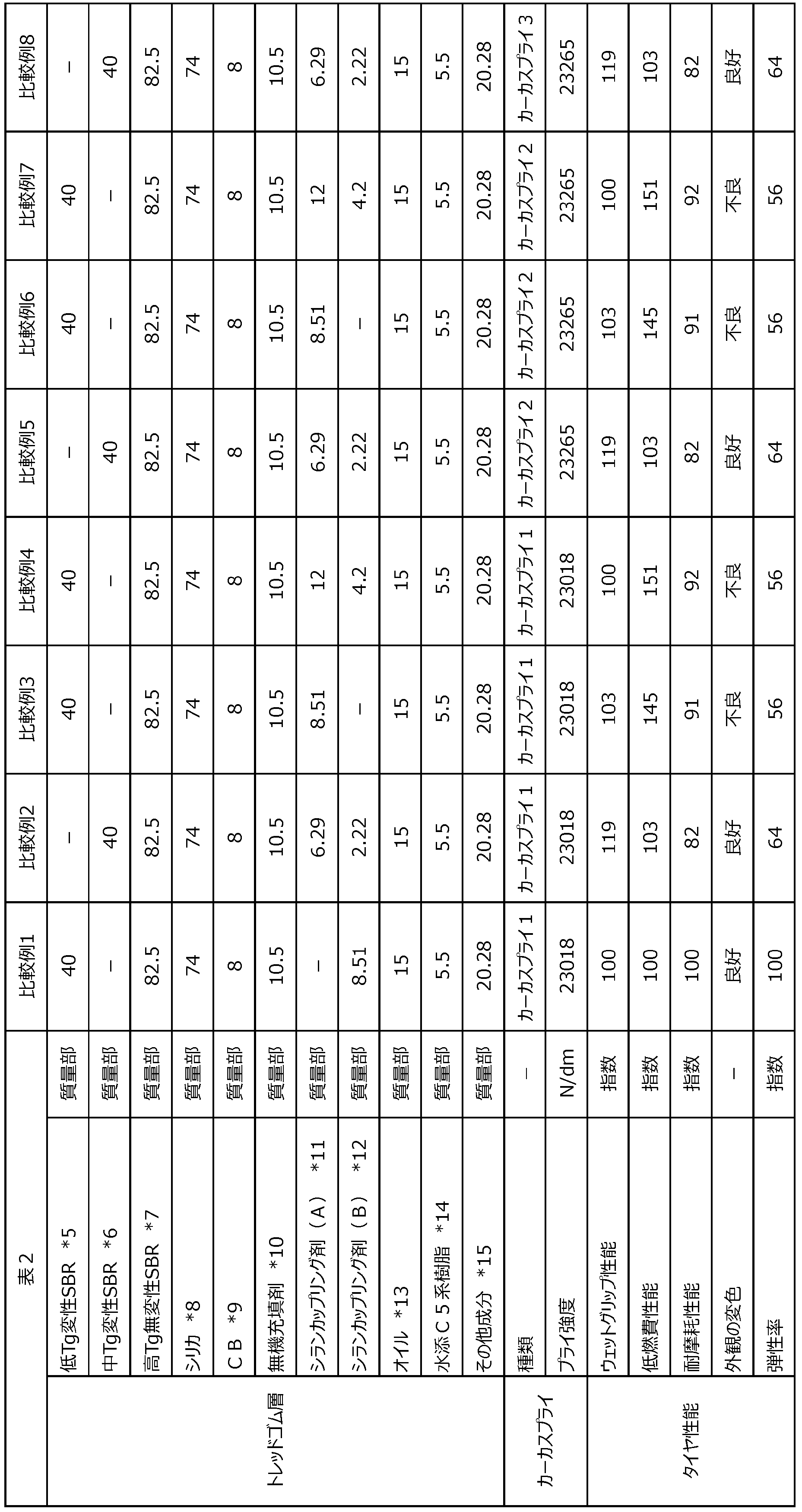
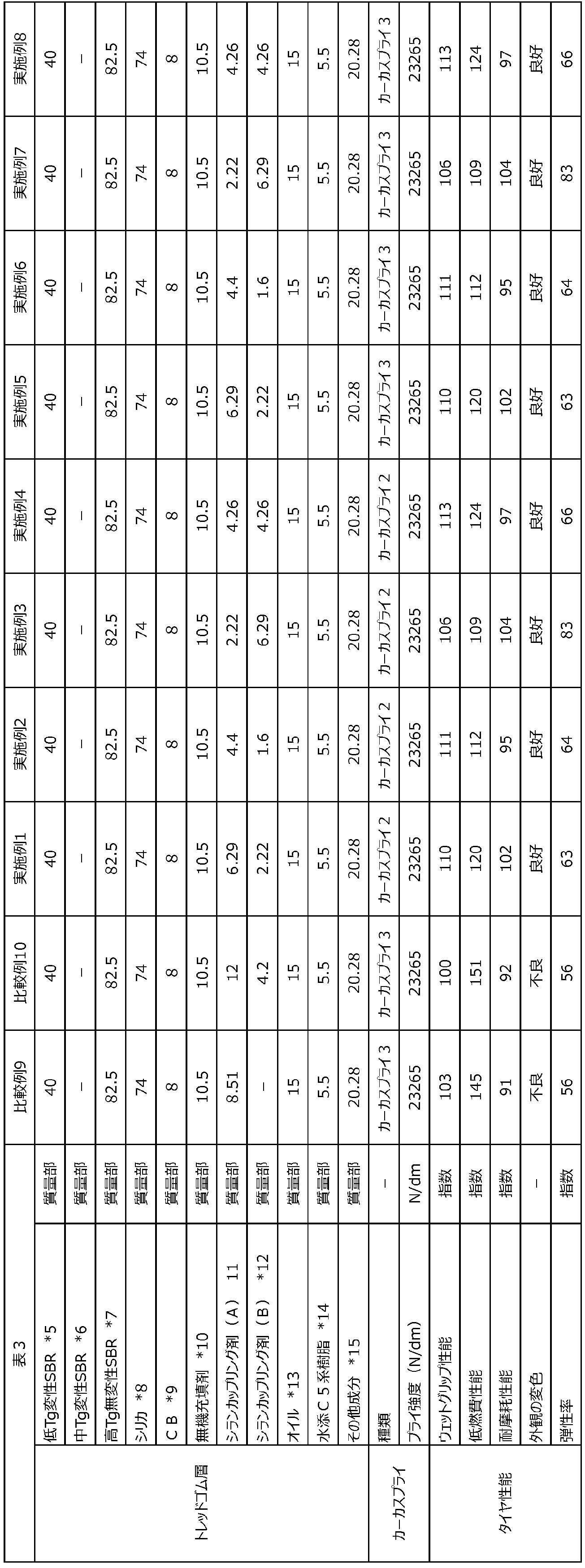
*5 低Tg変性SBR:上記の低Tg変性SBRの合成によって得られた変性SBRであり、スチレンブタジエンゴム(A)に相当
*6 中Tg変性SBR:ブチルリチウムを開始剤として得られるSBRであってTgが-38℃で、末端をN-(1,3-ジメチルブチリデン)-3-トリエトキシシリル-1-プロパンアミンで変性した、スチレン-ブタジエンゴム
*7 高Tg無変性SBR: ENEOSマテリアル社製、商品名「HP755B」、ガラス転移温度-19℃、配合量はSBR100質量部に対する油添量37.5質量部を含んだものであり、スチレンブタジエンゴム(B)に相当
*8 シリカ: 東ソーシリカ株式会社製、商品名「ニップシールAQ」
*9 カーボンブラック(CB): 旭カーボン株式会社製、商品名「#80」
*10 無機充填剤: 昭和電工株式会社製、「ハイジライト(登録商標)」
*11 シランカップリング剤(A): メルカプト系シランカップリング剤、EVONIK社製、商品名「Si 363」
*12 シランカップリング剤(B): スルフィド系シランカップリング剤、EVONIK社製、商品名「S 2.5」
*13 オイル: 出光興産株式会社製、商品名「ダイアナプロセスNH-70S」
*14 水添C5系樹脂: Eastman社製、商品名「登録商標Impera E1780」、軟化点=130℃、重量平均分子量(Mw)=909g/mol
*15 その他成分: ステアリン酸、ワックス、老化防止剤、亜鉛華、加硫促進剤、硫黄、リターダー及び作業性改良剤の合計量
表2及び3から、実施例1~8は、比較例と比べてタイヤのウェットグリップ性能と、低燃費性能及び耐摩耗性能とが高度に両立されており、また、耐変色性に優れることが分かる。これに加えて、弾性率とプライ強度から、トレッドの弾性率が比較例に比べて低下していても、カーカスプライのプライ強度が大きいことで、耐カット性を維持できることが予想される。
本発明によれば、耐カット性を悪化させることなく、タイヤのウェットグリップ性能と、低燃費性能及び耐摩耗性能とを高度に両立し、耐変色性に優れた空気入りタイヤを提供することができる。
1:空気入りタイヤ、 2:ビード部、 3:サイドウォール部、 4:トレッド部、 5:カーカス、 6:ベルト、 6A、6B:ベルト層、 7:ビードコア、 8:トレッドゴム層、 9:カーカスプライ、 10:PET繊維コード、 11:PET繊維、 20:コーティングゴム
Claims (15)
- トレッド部の最表面に位置するトレッドゴム層と、該トレッドゴム層のタイヤ径方向内側に位置し、PET繊維コードをコーティングゴムで被覆してなるカーカスプライと、を備える空気入りタイヤであって、
前記トレッドゴム層は、ゴム成分と、充填剤と、シランカップリング剤と、を含み、
前記ゴム成分は、窒素、ケイ素及びスズのうちの少なくとも一種の原子を有する変性剤によって変性された、ガラス転移温度が-50℃以下のスチレンブタジエンゴム(A)、並びに、該スチレンブタジエンゴム(A)よりガラス転移温度が30℃以上高い無変性のスチレンブタジエンゴム(B)を含有し、
前記充填剤は、少なくともシリカを含有し、
前記シランカップリング剤は、少なくとも、チオール基を有するシランカップリング剤(A)及びスルフィド結合を有するシランカップリング剤(B)を含有し、
前記シランカップリング剤(A)の含有量が、前記シリカ100質量部に対して1~10質量部であり、
前記シランカップリング剤(A)及び前記シランカップリング剤(B)の合計含有量が、前記シリカ100質量部に対して1~15質量部であり、
前記カーカスプライのトータルゲージが、1.2mm以下であり、
前記カーカスプライが、下記の式(1):
(A/B)/コード総繊度≧0.3 ・・・ (1)
(A:コード強度(N)×繊維占有率
繊維占有率:PET繊維コードの断面積(mm2)/(カーカスプライのトータルゲージ(mm)×(PET繊維コードの直径(mm)+PET繊維コードのコード間距離(mm)))
B:コーティングゴムのtanδ×ゴム占有率
ゴム占有率:1-繊維占有率
コード総繊度:コードを構成するPET繊維の繊度の合計値(dtex))
を満たすことを特徴とする、空気入りタイヤ。 - 前記スチレンブタジエンゴム(A)が、窒素原子及びケイ素原子を有する変性剤で変性されていることを特徴とする、請求項1に記載の空気入りタイヤ。
- 前記スチレンブタジエンゴム(A)が、窒素原子を含む官能基及びアルコキシ基を有する変性剤で変性されていることを特徴とする、請求項2に記載の空気入りタイヤ。
- 前記シランカップリング剤(A)の含有量に対する前記シランカップリング剤(B)の含有量の質量比(B/A)が、0.3以上3未満であることを特徴とする、請求項1に記載の空気入りタイヤ。
- 前記充填剤が、カーボンブラックをさらに含み、
前記シリカと前記カーボンブラックの総量中の前記シリカの含有比率が、80質量%以上100質量%未満であることを特徴とする、請求項1に記載の空気入りタイヤ。 - 前記シリカの含有量が、前記ゴム成分100質量部に対して20質量部以上100質量部未満であることを特徴とする、請求項1に記載の空気入りタイヤ。
- 前記シランカップリング剤(A)は、炭素数が20~75であることを特徴とする、請求項1に記載の空気入りタイヤ。
- 前記ゴム成分は、前記スチレンブタジエンゴム(A)を15質量%以上85質量%未満含有することを特徴とする、請求項1に記載の空気入りタイヤ。
- 前記ゴム成分は、前記スチレンブタジエンゴム(B)を15質量%以上85質量%未満含有することを特徴とする、請求項1に記載の空気入りタイヤ。
- さらに、前記トレッドゴム層が、前記ゴム成分100質量部に対して樹脂を1~50質量部含むことを特徴とする、請求項1に記載の空気入りタイヤ。
- 前記樹脂が、水素添加された樹脂であることを特徴とする、請求項10に記載の空気入りタイヤ。
- 前記PET繊維コードのコード強度が、160N以上である、請求項1に記載の空気入りタイヤ。
- 前記カーカスプライの引張強度が、23000N/dm超である、請求項1に記載の空気入りタイヤ。
- 前記PET繊維コードの繊度が、1100/2~2000/2dtexである、請求項1に記載の空気入りタイヤ。
- 前記カーカスプライが、下記の式(1)’:
(A/B)/コード総繊度≧0.45 ・・・ (1)’
を満たす、請求項1に記載の空気入りタイヤ。
Applications Claiming Priority (2)
| Application Number | Priority Date | Filing Date | Title |
|---|---|---|---|
| JP2023199447 | 2023-11-24 | ||
| JP2023-199447 | 2023-11-24 |
Publications (1)
| Publication Number | Publication Date |
|---|---|
| WO2025109983A1 true WO2025109983A1 (ja) | 2025-05-30 |
Family
ID=95826425
Family Applications (1)
| Application Number | Title | Priority Date | Filing Date |
|---|---|---|---|
| PCT/JP2024/039170 Pending WO2025109983A1 (ja) | 2023-11-24 | 2024-11-01 | 空気入りタイヤ |
Country Status (1)
| Country | Link |
|---|---|
| WO (1) | WO2025109983A1 (ja) |
Citations (11)
| Publication number | Priority date | Publication date | Assignee | Title |
|---|---|---|---|---|
| JPH1095207A (ja) * | 1996-09-20 | 1998-04-14 | Bridgestone Corp | 空気入りラジアルタイヤ |
| JPH11334313A (ja) * | 1998-05-28 | 1999-12-07 | Yokohama Rubber Co Ltd:The | 空気入りラジアルタイヤ |
| JP2003054215A (ja) * | 2001-08-08 | 2003-02-26 | Sumitomo Rubber Ind Ltd | 空気入りバイアスタイヤ |
| JP2003089303A (ja) * | 2001-09-19 | 2003-03-25 | Toyo Tire & Rubber Co Ltd | 空気入りラジアルタイヤ |
| JP2010120400A (ja) * | 2008-11-17 | 2010-06-03 | Bridgestone Corp | 空気入りタイヤ |
| JP2020063336A (ja) * | 2018-10-15 | 2020-04-23 | 住友ゴム工業株式会社 | トレッド用ゴム組成物およびタイヤ |
| JP2020070438A (ja) * | 2018-10-29 | 2020-05-07 | ハンコック タイヤ アンド テクノロジー カンパニー リミテッドHankook Tire & Technology Co., Ltd. | タイヤトレッド用ゴム組成物及びそれを用いて製造したタイヤ |
| JP2021004331A (ja) * | 2019-06-27 | 2021-01-14 | 住友ゴム工業株式会社 | タイヤ |
| JP2021024509A (ja) * | 2019-08-08 | 2021-02-22 | 横浜ゴム株式会社 | 空気入りタイヤ |
| JP2021094916A (ja) * | 2019-12-13 | 2021-06-24 | 株式会社ブリヂストン | タイヤ |
| JP2022138139A (ja) * | 2021-03-09 | 2022-09-22 | ザ・グッドイヤー・タイヤ・アンド・ラバー・カンパニー | ゴム組成物およびタイヤ |
-
2024
- 2024-11-01 WO PCT/JP2024/039170 patent/WO2025109983A1/ja active Pending
Patent Citations (11)
| Publication number | Priority date | Publication date | Assignee | Title |
|---|---|---|---|---|
| JPH1095207A (ja) * | 1996-09-20 | 1998-04-14 | Bridgestone Corp | 空気入りラジアルタイヤ |
| JPH11334313A (ja) * | 1998-05-28 | 1999-12-07 | Yokohama Rubber Co Ltd:The | 空気入りラジアルタイヤ |
| JP2003054215A (ja) * | 2001-08-08 | 2003-02-26 | Sumitomo Rubber Ind Ltd | 空気入りバイアスタイヤ |
| JP2003089303A (ja) * | 2001-09-19 | 2003-03-25 | Toyo Tire & Rubber Co Ltd | 空気入りラジアルタイヤ |
| JP2010120400A (ja) * | 2008-11-17 | 2010-06-03 | Bridgestone Corp | 空気入りタイヤ |
| JP2020063336A (ja) * | 2018-10-15 | 2020-04-23 | 住友ゴム工業株式会社 | トレッド用ゴム組成物およびタイヤ |
| JP2020070438A (ja) * | 2018-10-29 | 2020-05-07 | ハンコック タイヤ アンド テクノロジー カンパニー リミテッドHankook Tire & Technology Co., Ltd. | タイヤトレッド用ゴム組成物及びそれを用いて製造したタイヤ |
| JP2021004331A (ja) * | 2019-06-27 | 2021-01-14 | 住友ゴム工業株式会社 | タイヤ |
| JP2021024509A (ja) * | 2019-08-08 | 2021-02-22 | 横浜ゴム株式会社 | 空気入りタイヤ |
| JP2021094916A (ja) * | 2019-12-13 | 2021-06-24 | 株式会社ブリヂストン | タイヤ |
| JP2022138139A (ja) * | 2021-03-09 | 2022-09-22 | ザ・グッドイヤー・タイヤ・アンド・ラバー・カンパニー | ゴム組成物およびタイヤ |
Similar Documents
| Publication | Publication Date | Title |
|---|---|---|
| US10266008B2 (en) | Pneumatic tire | |
| JP4467627B2 (ja) | タイヤ | |
| JP7331332B2 (ja) | タイヤ用ゴム組成物およびタイヤ | |
| JP7422487B2 (ja) | ゴム組成物、及びタイヤ | |
| CN113329891A (zh) | 橡胶组合物和轮胎 | |
| CN113993941A (zh) | 轮胎 | |
| WO2024111634A1 (ja) | タイヤ用ゴム組成物、トレッドゴム及びタイヤ | |
| EP3467017A1 (en) | Rubber composition and tire | |
| EP3677633B1 (en) | Rubber composition for high grip tire | |
| JP7260268B2 (ja) | タイヤ | |
| JP2025063269A (ja) | ゴム組成物およびタイヤ | |
| JP7495200B2 (ja) | ベーストレッド用ゴム組成物 | |
| WO2024111651A1 (ja) | タイヤ | |
| JP7533559B2 (ja) | タイヤ用ゴム組成物およびタイヤ | |
| JP7256192B2 (ja) | タイヤ | |
| JP2019038875A (ja) | タイヤ | |
| JP2023030045A (ja) | タイヤ用ゴム組成物およびタイヤ | |
| JP2023104746A (ja) | タイヤ | |
| JP7447447B2 (ja) | タイヤトレッド及びタイヤ | |
| JP6686488B2 (ja) | 空気入りタイヤ | |
| EP4624198A1 (en) | Pneumatic tire | |
| JPWO2019117093A1 (ja) | ゴム組成物及びタイヤ | |
| EP3888939A1 (en) | Rubber composition for tire | |
| JP2023168930A (ja) | タイヤ | |
| WO2025109840A1 (ja) | タイヤ |
Legal Events
| Date | Code | Title | Description |
|---|---|---|---|
| 121 | Ep: the epo has been informed by wipo that ep was designated in this application |
Ref document number: 24893975 Country of ref document: EP Kind code of ref document: A1 |
|
| ENP | Entry into the national phase |
Ref document number: 2025559131 Country of ref document: JP Kind code of ref document: A |
|
| WWE | Wipo information: entry into national phase |
Ref document number: 2025559131 Country of ref document: JP |
|
| NENP | Non-entry into the national phase |
Ref country code: DE |