WO2025100334A1 - 有価金属の回収方法 - Google Patents
有価金属の回収方法 Download PDFInfo
- Publication number
- WO2025100334A1 WO2025100334A1 PCT/JP2024/038885 JP2024038885W WO2025100334A1 WO 2025100334 A1 WO2025100334 A1 WO 2025100334A1 JP 2024038885 W JP2024038885 W JP 2024038885W WO 2025100334 A1 WO2025100334 A1 WO 2025100334A1
- Authority
- WO
- WIPO (PCT)
- Prior art keywords
- group
- lithium
- acid
- aqueous solution
- solvent extraction
- Prior art date
- Legal status (The legal status is an assumption and is not a legal conclusion. Google has not performed a legal analysis and makes no representation as to the accuracy of the status listed.)
- Pending
Links
Images

Classifications
-
- C—CHEMISTRY; METALLURGY
- C22—METALLURGY; FERROUS OR NON-FERROUS ALLOYS; TREATMENT OF ALLOYS OR NON-FERROUS METALS
- C22B—PRODUCTION AND REFINING OF METALS; PRETREATMENT OF RAW MATERIALS
- C22B21/00—Obtaining aluminium
-
- C—CHEMISTRY; METALLURGY
- C22—METALLURGY; FERROUS OR NON-FERROUS ALLOYS; TREATMENT OF ALLOYS OR NON-FERROUS METALS
- C22B—PRODUCTION AND REFINING OF METALS; PRETREATMENT OF RAW MATERIALS
- C22B23/00—Obtaining nickel or cobalt
-
- C—CHEMISTRY; METALLURGY
- C22—METALLURGY; FERROUS OR NON-FERROUS ALLOYS; TREATMENT OF ALLOYS OR NON-FERROUS METALS
- C22B—PRODUCTION AND REFINING OF METALS; PRETREATMENT OF RAW MATERIALS
- C22B26/00—Obtaining alkali, alkaline earth metals or magnesium
- C22B26/20—Obtaining alkaline earth metals or magnesium
-
- C—CHEMISTRY; METALLURGY
- C22—METALLURGY; FERROUS OR NON-FERROUS ALLOYS; TREATMENT OF ALLOYS OR NON-FERROUS METALS
- C22B—PRODUCTION AND REFINING OF METALS; PRETREATMENT OF RAW MATERIALS
- C22B3/00—Extraction of metal compounds from ores or concentrates by wet processes
- C22B3/04—Extraction of metal compounds from ores or concentrates by wet processes by leaching
- C22B3/06—Extraction of metal compounds from ores or concentrates by wet processes by leaching in inorganic acid solutions, e.g. with acids generated in situ; in inorganic salt solutions other than ammonium salt solutions
-
- C—CHEMISTRY; METALLURGY
- C22—METALLURGY; FERROUS OR NON-FERROUS ALLOYS; TREATMENT OF ALLOYS OR NON-FERROUS METALS
- C22B—PRODUCTION AND REFINING OF METALS; PRETREATMENT OF RAW MATERIALS
- C22B3/00—Extraction of metal compounds from ores or concentrates by wet processes
- C22B3/04—Extraction of metal compounds from ores or concentrates by wet processes by leaching
- C22B3/06—Extraction of metal compounds from ores or concentrates by wet processes by leaching in inorganic acid solutions, e.g. with acids generated in situ; in inorganic salt solutions other than ammonium salt solutions
- C22B3/08—Sulfuric acid, other sulfurated acids or salts thereof
-
- C—CHEMISTRY; METALLURGY
- C22—METALLURGY; FERROUS OR NON-FERROUS ALLOYS; TREATMENT OF ALLOYS OR NON-FERROUS METALS
- C22B—PRODUCTION AND REFINING OF METALS; PRETREATMENT OF RAW MATERIALS
- C22B3/00—Extraction of metal compounds from ores or concentrates by wet processes
- C22B3/04—Extraction of metal compounds from ores or concentrates by wet processes by leaching
- C22B3/06—Extraction of metal compounds from ores or concentrates by wet processes by leaching in inorganic acid solutions, e.g. with acids generated in situ; in inorganic salt solutions other than ammonium salt solutions
- C22B3/10—Hydrochloric acid, other halogenated acids or salts thereof
-
- C—CHEMISTRY; METALLURGY
- C22—METALLURGY; FERROUS OR NON-FERROUS ALLOYS; TREATMENT OF ALLOYS OR NON-FERROUS METALS
- C22B—PRODUCTION AND REFINING OF METALS; PRETREATMENT OF RAW MATERIALS
- C22B3/00—Extraction of metal compounds from ores or concentrates by wet processes
- C22B3/20—Treatment or purification of solutions, e.g. obtained by leaching
-
- C—CHEMISTRY; METALLURGY
- C22—METALLURGY; FERROUS OR NON-FERROUS ALLOYS; TREATMENT OF ALLOYS OR NON-FERROUS METALS
- C22B—PRODUCTION AND REFINING OF METALS; PRETREATMENT OF RAW MATERIALS
- C22B3/00—Extraction of metal compounds from ores or concentrates by wet processes
- C22B3/20—Treatment or purification of solutions, e.g. obtained by leaching
- C22B3/26—Treatment or purification of solutions, e.g. obtained by leaching by liquid-liquid extraction using organic compounds
-
- C—CHEMISTRY; METALLURGY
- C22—METALLURGY; FERROUS OR NON-FERROUS ALLOYS; TREATMENT OF ALLOYS OR NON-FERROUS METALS
- C22B—PRODUCTION AND REFINING OF METALS; PRETREATMENT OF RAW MATERIALS
- C22B3/00—Extraction of metal compounds from ores or concentrates by wet processes
- C22B3/20—Treatment or purification of solutions, e.g. obtained by leaching
- C22B3/44—Treatment or purification of solutions, e.g. obtained by leaching by chemical processes
-
- C—CHEMISTRY; METALLURGY
- C22—METALLURGY; FERROUS OR NON-FERROUS ALLOYS; TREATMENT OF ALLOYS OR NON-FERROUS METALS
- C22B—PRODUCTION AND REFINING OF METALS; PRETREATMENT OF RAW MATERIALS
- C22B47/00—Obtaining manganese
-
- C—CHEMISTRY; METALLURGY
- C22—METALLURGY; FERROUS OR NON-FERROUS ALLOYS; TREATMENT OF ALLOYS OR NON-FERROUS METALS
- C22B—PRODUCTION AND REFINING OF METALS; PRETREATMENT OF RAW MATERIALS
- C22B7/00—Working up raw materials other than ores, e.g. scrap, to produce non-ferrous metals and compounds thereof; Methods of a general interest or applied to the winning of more than two metals
-
- C—CHEMISTRY; METALLURGY
- C25—ELECTROLYTIC OR ELECTROPHORETIC PROCESSES; APPARATUS THEREFOR
- C25B—ELECTROLYTIC OR ELECTROPHORETIC PROCESSES FOR THE PRODUCTION OF COMPOUNDS OR NON-METALS; APPARATUS THEREFOR
- C25B1/00—Electrolytic production of inorganic compounds or non-metals
- C25B1/01—Products
- C25B1/34—Simultaneous production of alkali metal hydroxides and chlorine, oxyacids or salts of chlorine, e.g. by chlor-alkali electrolysis
-
- C—CHEMISTRY; METALLURGY
- C25—ELECTROLYTIC OR ELECTROPHORETIC PROCESSES; APPARATUS THEREFOR
- C25B—ELECTROLYTIC OR ELECTROPHORETIC PROCESSES FOR THE PRODUCTION OF COMPOUNDS OR NON-METALS; APPARATUS THEREFOR
- C25B9/00—Cells or assemblies of cells; Constructional parts of cells; Assemblies of constructional parts, e.g. electrode-diaphragm assemblies; Process-related cell features
-
- H—ELECTRICITY
- H01—ELECTRIC ELEMENTS
- H01M—PROCESSES OR MEANS, e.g. BATTERIES, FOR THE DIRECT CONVERSION OF CHEMICAL ENERGY INTO ELECTRICAL ENERGY
- H01M10/00—Secondary cells; Manufacture thereof
- H01M10/54—Reclaiming serviceable parts of waste accumulators
-
- Y—GENERAL TAGGING OF NEW TECHNOLOGICAL DEVELOPMENTS; GENERAL TAGGING OF CROSS-SECTIONAL TECHNOLOGIES SPANNING OVER SEVERAL SECTIONS OF THE IPC; TECHNICAL SUBJECTS COVERED BY FORMER USPC CROSS-REFERENCE ART COLLECTIONS [XRACs] AND DIGESTS
- Y02—TECHNOLOGIES OR APPLICATIONS FOR MITIGATION OR ADAPTATION AGAINST CLIMATE CHANGE
- Y02P—CLIMATE CHANGE MITIGATION TECHNOLOGIES IN THE PRODUCTION OR PROCESSING OF GOODS
- Y02P10/00—Technologies related to metal processing
- Y02P10/20—Recycling
-
- Y—GENERAL TAGGING OF NEW TECHNOLOGICAL DEVELOPMENTS; GENERAL TAGGING OF CROSS-SECTIONAL TECHNOLOGIES SPANNING OVER SEVERAL SECTIONS OF THE IPC; TECHNICAL SUBJECTS COVERED BY FORMER USPC CROSS-REFERENCE ART COLLECTIONS [XRACs] AND DIGESTS
- Y02—TECHNOLOGIES OR APPLICATIONS FOR MITIGATION OR ADAPTATION AGAINST CLIMATE CHANGE
- Y02W—CLIMATE CHANGE MITIGATION TECHNOLOGIES RELATED TO WASTEWATER TREATMENT OR WASTE MANAGEMENT
- Y02W30/00—Technologies for solid waste management
- Y02W30/50—Reuse, recycling or recovery technologies
- Y02W30/84—Recycling of batteries or fuel cells
Definitions
- the present invention relates to a method for recovering valuable metals.
- the waste lithium-ion batteries are subjected to a heat treatment (roasting), or are not subjected to a heat treatment, and are crushed, classified, etc. to obtain a powder containing the valuable metals, from which cobalt, nickel, manganese, and lithium are separated and refined by a wet process (see, for example, Patent Document 1).
- the term "waste lithium ion batteries” refers to used lithium ion batteries that have reached the end of their life as battery products, lithium ion batteries that have been discarded as defective products during the manufacturing process, and the remaining positive electrode materials and negative electrode materials used in the manufacturing process.
- the powder containing the positive and negative electrodes obtained from the waste lithium ion batteries is referred to as the active material powder.
- impurities refers to metals contained in the active material powder that do not require recovery.
- transition metals other than manganese, cobalt, and nickel, magnesium, strontium, etc. are selected according to the purpose with a precise distribution ratio. If the elements such as the transition metals, magnesium, and strontium are mixed into the lithium-ion battery, they have a negative effect on the separation and purification of manganese, cobalt, and nickel. In particular, in a wet process using solvent extraction, the elements accumulate in the organic solvent, inhibiting the extraction of valuable metals such as manganese, cobalt, and nickel, which are the original targets of recovery. As a result, there is the inconvenience of a decrease in the recovery rate of valuable metals.
- the problem to be solved by the present invention is to provide a method for recovering cobalt, nickel, manganese, and lithium from waste lithium-ion batteries with a very high recovery rate by a wet process.
- the inventors conducted extensive research in light of the above problems and discovered that it is possible to separate lithium from at least one valuable metal selected from the group consisting of transition metals other than manganese, cobalt, and nickel, magnesium, strontium, and aluminum, by adding a specific organic solvent to a solution containing lithium.
- the present invention was completed based on these findings.
- the present invention relates to a method for recovering valuable metals, comprising a first solvent extraction step of adding an organic solvent to a solution containing at least one valuable metal selected from the group consisting of transition metals excluding manganese, cobalt, and nickel, alkaline earth metals, and aluminum, and lithium, to extract the valuable metal, wherein the organic solvent contains at least one selected from the group consisting of a compound represented by the following formula (1), a phosphonic acid ester, a phosphoric acid ester, phosphinic acid, methyl isobutyl ketone, and trioctylamine, wherein in formula (1), R 1 and R 2 each independently represent a hydrocarbon group having 6 to 20 carbon atoms.
- the valuable metal recovery method preferably further includes a dissolving step of dissolving the active material powder obtained by pretreating the waste lithium ion batteries in a mineral acid to obtain a dissolving solution, a neutralizing step of neutralizing the dissolving solution with an alkali, a second solvent extraction step of separating at least one selected from the group consisting of manganese, cobalt, and nickel from the residual solution of the first solvent extraction step by organic solvent extraction to obtain a first lithium salt aqueous solution as the residual solution of the solvent extraction, and a membrane electrolysis step of membrane electrolysis of the first lithium salt aqueous solution using an ion exchange membrane to obtain a lithium hydroxide aqueous solution, an acid, and a second lithium salt aqueous solution that is more dilute than the first lithium salt aqueous solution, and the lithium hydroxide aqueous solution obtained in the membrane electrolysis step is reused in at least one selected from the group consisting of the neutralizing step, the first solvent extraction step, and the second solvent extraction step,
- the mineral acid preferably includes at least one selected from the group consisting of hydrochloric acid, sulfuric acid, and nitric acid, and more preferably includes hydrochloric acid.
- the alkali used in the neutralization step preferably comprises lithium hydroxide.
- the concentration of at least one selected from the group consisting of the compound represented by formula (1), phosphonic acid ester, phosphoric acid ester, phosphinic acid, methyl isobutyl ketone, and trioctylamine in the organic solvent is preferably in the range of 0.001 M to 1.5 M.
- the electric power used in the membrane electrolysis step preferably includes electric power obtained from renewable energy, and more preferably includes electric power obtained from at least one selected from the group consisting of solar power generation, wind power generation, geothermal power generation, hydroelectric power generation, and biomass power generation.
- the valuable metal recovery method of the present invention provides a method for recovering cobalt, nickel, manganese, and lithium from waste lithium-ion batteries with a very high recovery rate by a wet process.
- FIG. 1 is an explanatory diagram showing the configuration of one embodiment of a valuable metal recovery method of the present invention.
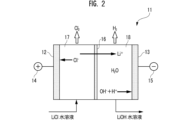
- FIG. 2 is an explanatory cross-sectional view showing the structure of an ion exchange membrane electrolytic cell used in the method for recovering valuable metals of the present invention.
- the valuable metal recovery method of the present invention includes a first solvent extraction step in which an organic solvent is added to a solution containing at least one valuable metal selected from the group consisting of (1) transition metals excluding manganese, cobalt, and nickel, (2) alkaline earth metals, and (3) aluminum, and lithium, to extract the valuable metal, i.e., at least one valuable metal selected from the group consisting of the valuable metals (1) to (3).
- the (2) alkaline earth metal recovered by the valuable metal recovery method of the present invention preferably includes at least one selected from the group consisting of beryllium, magnesium, calcium, strontium, and barium, more preferably includes at least one selected from the group consisting of magnesium, calcium, and strontium, and even more preferably is magnesium, calcium, or strontium.
- the organic solvent contains at least one selected from the group consisting of a compound represented by the following formula (1), a phosphonic acid ester, a phosphoric acid ester, a phosphinic acid, methyl isobutyl ketone, and trioctylamine.
- the organic solvent is preferably at least one selected from the group consisting of these compounds.
- R 1 and R 2 each independently represent a hydrocarbon group having 6 to 20 carbon atoms.
- the hydrocarbon group is not particularly limited, but is preferably an alkyl group, a cycloalkyl group, an alkenyl group, an alkynyl group, an aryl group, a heteroaryl group (aromatic heterocyclic group), or an aliphatic heterocyclic group.
- the alkyl group preferably has a carbon number of 6 to 15, and more preferably has a carbon number of 10 to 15. It is further preferable that R 1 and R 2 are dodecyl groups.
- the alkenyl group preferably has 6 to 15 carbon atoms, and more preferably has 10 to 15 carbon atoms.
- the alkynyl group preferably has 6 to 15 carbon atoms, and more preferably has 10 to 15 carbon atoms.
- the aryl group is preferably an aryl group having 6 to 18 carbon atoms, and more preferably an aryl group having 6 to 10 carbon atoms.
- An example of an aryl group is a phenyl group.
- the aromatic heterocycle When the aromatic heterocycle is a condensed ring, it includes a group consisting of a monocyclic aromatic heterocycle, as well as a group consisting of a condensed heterocycle in which another ring, for example, an aromatic hydrocarbon ring, an aliphatic hydrocarbon ring, or a heterocycle, is condensed to the monocyclic aromatic heterocycle.
- the number of ring-constituting heteroatoms constituting the aromatic heterocycle may be one or more, and the heteroatom is preferably a nitrogen atom, an oxygen atom, or a sulfur atom.
- the number of ring members of the aromatic heterocycle is preferably a 3- to 8-membered ring, and more preferably a 5- or 6-membered ring.
- Examples of 5-membered aromatic heterocycles and condensed heterocycles containing 5-membered aromatic heterocycles include pyrrole rings, imidazole rings, pyrazole rings, oxazole rings, thiazole rings, triazole rings, furan rings, thiophene rings, benzimidazole rings, benzoxazole rings, benzothiazole rings, indoline rings, and indazole rings.
- examples of 6-membered aromatic heterocycles and fused heterocycles containing 6-membered aromatic heterocycles include pyridine rings, pyrimidine rings, pyrazine rings, triazine rings, quinoline rings, and quinazoline rings.
- the aliphatic heterocyclic group includes a monocyclic group consisting of only an aliphatic heterocycle, and a group consisting of an aliphatic condensed heterocycle in which another ring (e.g., an aliphatic ring) is condensed to an aliphatic heterocycle.
- the number of heteroatoms constituting the ring of the aliphatic heterocycle may be one or more, and the heteroatom is preferably a nitrogen atom, an oxygen atom, or a sulfur atom.
- the number of ring members of the aliphatic heterocycle is preferably a 3- to 8-membered ring, and more preferably a 5- or 6-membered ring.
- preferred aliphatic heterocycles include a pyrrolidine ring, an oxolane ring, a thiolane ring, a piperidine ring, a tetrahydrofuran ring, an oxane ring (tetrahydropyran ring), a thiane ring, a piperazine ring, a morpholine ring, a quinuclidine ring, a pyrrolidine ring, an azetidine ring, an oxetane ring, an aziridine ring, a dioxane ring, a pentamethylene sulfide ring, and ⁇ -butyrolactone.
- the above-mentioned hydrocarbon group also includes the following groups. Alkoxy groups, Aryloxy groups, Heterocyclic oxy group (a group in which the above heterocyclic group is bonded to an —O— group), Alkoxycarbonyl groups, Aryloxycarbonyl groups, Amino group (having 6 to 20 carbon atoms), Sulfamoyl group, acyl groups (including alkylcarbonyl groups, alkenylcarbonyl groups, alkynylcarbonyl groups, arylcarbonyl groups, and heterocyclic carbonyl groups, and having 6 to 20 carbon atoms, such as octanoyl, hexadecanoyl, benzoyl, naphthoyl, and nicotinoyl); acyloxy groups (including alkylcarbonyloxy groups, alkenylcarbonyloxy groups, alkynylcarbonyloxy groups, arylcarbonyloxy groups, and heterocyclic carbonyloxy groups
- a specific example of the compound represented by formula (1) above is N,N-didodecyl-2-hydroxyacetamide.
- An example of a commercially available product of the phosphonic acid ester is PC-88A manufactured by Daihachi Chemical Industry Co., Ltd.
- Examples of the phosphate ester include tributyl phosphate (TBP) and di(2-ethylhexyl)phosphate (D2EHPA).
- An example of a commercially available product of the phosphinic acid is CYANEX272 manufactured by Solvay.
- the concentration of at least one selected from the group consisting of the compound represented by formula (1), phosphonic acid ester, phosphoric acid ester, phosphinic acid, methyl isobutyl ketone, and trioctylamine in the organic solvent is preferably in the range of 0.001 M to 1.5 M, and more preferably in the range of 0.005 M to 1 M.
- concentration is in the above range, the valuable metal extracted by the organic solvent in the first solvent extraction step is more stably back-extracted from the organic solvent, and the organic solvent is repeatedly used.
- the method for recovering valuable metals of the present invention may start with an active material powder 1 as a starting material.
- the active material powder 1 is dissolved in a mineral acid to obtain an acid solution of the active material powder 1 containing at least lithium.
- the mineral acid preferably contains at least one acid selected from the group consisting of hydrochloric acid, sulfuric acid, and nitric acid, more preferably contains hydrochloric acid, and even more preferably is hydrochloric acid.
- the active material powder 1 contains valuable metals such as iron, transition metals, magnesium, strontium, and aluminum.
- an alkali is then added to the acid dissolution solution in STEP 2 to neutralize the mineral acid.
- the alkali may be added in at least one form selected from the group consisting of an aqueous solution and a solid form.
- the alkali preferably includes at least one selected from the group consisting of an alkali metal hydroxide and ammonia.
- the alkali metal constituting the alkali metal hydroxide preferably includes at least one selected from the group consisting of lithium, sodium, potassium, rubidium, cesium, and francium, more preferably includes lithium, sodium, and potassium, even more preferably is lithium, sodium, or potassium, and particularly preferably is lithium.
- the neutralized acid solution is then subjected to the first solvent extraction process in STEP 3A.
- the residual liquid from the first solvent extraction process contains valuable metals such as lithium, manganese, cobalt, and nickel.
- the extract 2A from the first solvent extraction process contains at least one valuable metal selected from the group consisting of the valuable metals (1) to (3).
- a typical example of the valuable metal (1) contained in the extract from the first solvent extraction process is zirconium.
- the valuable metals (1) to (3) cause the recovery of lithium, manganese, cobalt, and nickel contained in the acid solution to be hindered.
- the extraction residue from the first solvent extraction step is then subjected to a second organic solvent extraction in STEP 3B.
- the second organic solvent extraction manganese, cobalt, and nickel, excluding lithium, among the valuable metals are each extracted with an organic solvent, or iron is separated and removed as a metal sulfate aqueous solution 2B.
- the alkali is lithium hydroxide
- a first lithium salt aqueous solution can be obtained.
- the alkali is at least one selected from the group consisting of sodium hydroxide and potassium hydroxide
- the first lithium salt aqueous solution and at least one salt of sodium and potassium are each separated from the alkali mixed salt aqueous solution obtained in the first solvent extraction step by the method disclosed in Japanese Patent No. 7084669.
- the organic solvent is at least one selected from the group consisting of the phosphate ester, the phosphonate ester, the phosphinic acid, organic phosphorus compounds such as phosphine oxide, hydroxime, and organic amine compounds.
- phosphine oxide is tri-n-octylphosphine (TOPO).
- hydroxime examples include 7-hydroxy-5,8-diethyl-6-dodecanone oxime (LIX-63), 5-dodecyl-2-hydroxybenzaldehyde oxime (LIX 860), 2-hydroxy-5-nonylbenzophenone oxime (LIX 65N), 2-hydroxy-5-nonylacetophenone oxime (SME 529), and 2-hydroxy-5-nonylphenylbenzyl ketone oxime (Acorga P-17).
- organic amine compound examples include a primary amine such as Primene (registered trademark) JM-T manufactured by Dow Chemical Company, a secondary amine such as Amberlite (registered trademark) LA-2 manufactured by Sigma-Aldrich, a tertiary amine such as Alamine 336 (trioctylamine) manufactured by Sigma-Aldrich, and a quaternary ammonium salt such as Aliquat (registered trademark) 336 manufactured by Sigma-Aldrich.
- a primary amine such as Primene (registered trademark) JM-T manufactured by Dow Chemical Company
- secondary amine such as Amberlite (registered trademark) LA-2 manufactured by Sigma-Aldrich
- a tertiary amine such as Alamine 336 (trioctylamine) manufactured by Sigma-Aldrich
- quaternary ammonium salt such as Aliquat (registered trademark) 336 manufactured by Sigma-Aldrich.
- the first lithium salt aqueous solution is then subjected to membrane electrolysis using an ion exchange membrane in STEP 4.
- the membrane electrolysis in STEP 4 can be performed, for example, using an electrolytic cell 11 shown in FIG. 2.
- the electrolytic cell 11 has an anode plate 12 on one of its inner surfaces and a cathode plate 13 on the inner surface opposite the anode plate 12, with the anode plate 12 connected to the anode 14 of a power source and the cathode plate 13 connected to the cathode 15 of the power source.
- the electrolytic cell 11 is also partitioned by an ion exchange membrane 16 into an anode chamber 17 containing the anode plate 12 and a cathode chamber 18 containing the cathode plate 13.
- chloride ions generate chlorine gas (Cl 2 ) on the anode plate 12, while lithium ions move to the cathode chamber 18 through the ion exchange membrane 16.
- water (H 2 O) is ionized into hydroxide ions (OH ⁇ ) and hydrogen ions (H + ), and the hydrogen ions generate hydrogen gas (H 2 ) on the cathode plate 13, while the hydroxide ions combine with lithium to generate a lithium hydroxide aqueous solution 3.
- the electricity used in the membrane electrolysis process preferably includes electricity obtained from renewable energy, and more preferably includes electricity obtained from at least one selected from the group consisting of solar power generation, wind power generation, geothermal power generation, hydroelectric power generation, and biomass power generation.
- Hydrogen gas (H 2 ) produced by the membrane electrolysis is reacted with chlorine gas (Cl 2 ) to obtain hydrochloric acid as mineral acid 4 , which can be used to dissolve active material powder 1 in STEP 1 .
- the lithium hydroxide aqueous solution 3 obtained by the membrane electrolysis can be recovered as lithium hydroxide monohydrate (LiOH.H 2 O) by crystallization in STEP 5, or can be recovered as lithium carbonate (Li 2 CO 3 ) by carbonation in STEP 6.
- the carbonation can be performed by reacting the lithium hydroxide aqueous solution 3 with carbon dioxide gas (CO 2 ).
- the lithium hydroxide aqueous solution 3 is used for solvent extraction in at least one selected from the group consisting of STEPs 3A and 3B
- the lithium hydroxide aqueous solution 3 is added to the extraction solvent.
- the extraction solvent used for solvent extraction in at least one selected from the group consisting of STEPs 3A and 3B is a cation exchange extractant, so if it is used continuously, the liquid tends to become acidic and the extraction rate decreases, but by adding the lithium hydroxide aqueous solution 3, the decrease in the extraction rate can be suppressed.
- the lithium hydroxide aqueous solution 3 when used for solvent extraction in STEP 3B, the lithium hydroxide aqueous solution 3 can be used for at least one of the solvent extractions of manganese, cobalt, and nickel, which are carried out separately.
- the valuable metal recovery method of the present invention can separate lithium, manganese, cobalt, and nickel from valuable metals that inhibit the recovery of these valuable metals, and therefore can improve the recovery rate of lithium, manganese, cobalt, and nickel from waste lithium-ion batteries.
- no alkaline source other than lithium is supplied, so a high-concentration lithium salt aqueous solution can be obtained.
- lithium hydroxide can be obtained by membrane electrolysis of the high-concentration lithium salt aqueous solution, so the lithium recovery rate can be improved.
- the valuable metal recovery method of the present invention since there is no unnecessary alkaline source other than lithium, the lithium hydroxide obtained by membrane electrolysis can be returned to the process as it is, making it possible to recycle resources.
- the content of valuable metals in each solution was measured using an inductively coupled plasma optical emission spectrometer (ICP-OES) using a PerkinElmer Optima 8300.
- ICP-OES inductively coupled plasma optical emission spectrometer
- Example 1 10 kg of positive electrode powder obtained from waste lithium ion batteries was dissolved in hydrochloric acid adjusted to a hydrochloric acid concentration of 9 to 10 mol/L to obtain 50 L of a solution having a cobalt concentration of 13 g/L, a manganese concentration of 13 g/L, a nickel concentration of 39 g/L, a zirconium concentration of 100 mg/L, a calcium concentration of 7 mg/L, a magnesium concentration of 3 mg/L, and a tungsten concentration of 0.1 mg/L.
- a kerosene solution of 1M-di(2-ethylhexyl)phosphate (D2EHPA) was added as an extractant to the solution, and the equilibrium pH was adjusted to 3 with a 6 mol/L lithium hydroxide aqueous solution to separate lithium and the valuable metals in the solution.
- the extraction rates of each valuable metal are shown in Table 1.
- Example 2 instead of the 1M di(2-ethylhexyl)phosphate (D2EHPA) kerosene solution, a 0.1M di(2-ethylhexyl)phosphate (D2EHPA) kerosene solution (Example 2), a 1M 2-ethylhexylphosphonic acid mono-2-ethylhexyl ester (PC-88A manufactured by Daihachi Chemical Industry Co., Ltd.) kerosene solution (Example 3), a 0.1M 2-ethylhexylphosphonic acid mono-2-ethylhexyl ester kerosene solution (Example 4), a 1M phosphinic acid (CYANEX272 manufactured by Solvay) decane solution (Example 5), and a 0.1M phosphinic acid decane solution (Example 6) were used as the extractant, and lithium and the valuable metals in the solution were
Landscapes
- Chemical & Material Sciences (AREA)
- Engineering & Computer Science (AREA)
- Metallurgy (AREA)
- Organic Chemistry (AREA)
- Materials Engineering (AREA)
- Manufacturing & Machinery (AREA)
- Mechanical Engineering (AREA)
- Environmental & Geological Engineering (AREA)
- Life Sciences & Earth Sciences (AREA)
- General Life Sciences & Earth Sciences (AREA)
- Geology (AREA)
- Geochemistry & Mineralogy (AREA)
- Inorganic Chemistry (AREA)
- Chemical Kinetics & Catalysis (AREA)
- Electrochemistry (AREA)
- General Chemical & Material Sciences (AREA)
- Manufacture And Refinement Of Metals (AREA)
Priority Applications (1)
| Application Number | Priority Date | Filing Date | Title |
|---|---|---|---|
| JP2025537174A JPWO2025100334A1 (https=) | 2023-11-08 | 2024-10-31 |
Applications Claiming Priority (2)
| Application Number | Priority Date | Filing Date | Title |
|---|---|---|---|
| JP2023190621 | 2023-11-08 | ||
| JP2023-190621 | 2023-11-08 |
Publications (1)
| Publication Number | Publication Date |
|---|---|
| WO2025100334A1 true WO2025100334A1 (ja) | 2025-05-15 |
Family
ID=95695777
Family Applications (1)
| Application Number | Title | Priority Date | Filing Date |
|---|---|---|---|
| PCT/JP2024/038885 Pending WO2025100334A1 (ja) | 2023-11-08 | 2024-10-31 | 有価金属の回収方法 |
Country Status (2)
| Country | Link |
|---|---|
| JP (1) | JPWO2025100334A1 (https=) |
| WO (1) | WO2025100334A1 (https=) |
Citations (7)
| Publication number | Priority date | Publication date | Assignee | Title |
|---|---|---|---|---|
| JP2014162982A (ja) * | 2013-02-27 | 2014-09-08 | Jx Nippon Mining & Metals Corp | 金属混合溶液からの金属の分離回収方法 |
| JP2019157188A (ja) * | 2018-03-12 | 2019-09-19 | 住友金属鉱山株式会社 | 溶媒抽出方法 |
| JP2021172856A (ja) * | 2020-04-24 | 2021-11-01 | Jx金属株式会社 | 金属含有溶液中のマグネシウムイオン除去方法及び、金属回収方法 |
| JP7060899B1 (ja) | 2021-09-30 | 2022-04-27 | 株式会社アサカ理研 | 廃リチウムイオン電池からのリチウム回収システム |
| JP7084669B1 (ja) | 2022-01-14 | 2022-06-15 | 株式会社アサカ理研 | 廃リチウムイオン電池からリチウムを回収する方法 |
| WO2023054667A1 (ja) * | 2021-09-30 | 2023-04-06 | 株式会社アサカ理研 | 廃リチウムイオン電池からリチウムを回収する方法 |
| WO2023079834A1 (ja) * | 2021-11-08 | 2023-05-11 | Jx金属株式会社 | コバルト溶液の製造方法、コバルト塩の製造方法、ニッケル溶液の製造方法、及びニッケル塩の製造方法 |
Family Cites Families (5)
| Publication number | Priority date | Publication date | Assignee | Title |
|---|---|---|---|---|
| JP5902601B2 (ja) * | 2012-12-13 | 2016-04-13 | Jx金属株式会社 | 金属混合溶液中の金属の分離方法 |
| KR101513135B1 (ko) * | 2013-08-14 | 2015-04-17 | 한국과학기술연구원 | 지르코늄과 하프늄의 분리방법 및 하프늄이 제거된 지르코늄의 제조방법 |
| JP6410969B2 (ja) * | 2016-05-16 | 2018-10-24 | Jx金属株式会社 | レアメタル回収方法 |
| JP7300115B2 (ja) * | 2019-03-26 | 2023-06-29 | 住友金属鉱山株式会社 | ニッケルおよびコバルトを含有する水酸化物からのニッケルおよびコバルト含有溶液の製造方法 |
| JP2023066461A (ja) * | 2021-10-29 | 2023-05-16 | 住友金属鉱山株式会社 | 低マグネシウム濃度の塩化コバルト水溶液の製造方法 |
-
2024
- 2024-10-31 JP JP2025537174A patent/JPWO2025100334A1/ja active Pending
- 2024-10-31 WO PCT/JP2024/038885 patent/WO2025100334A1/ja active Pending
Patent Citations (7)
| Publication number | Priority date | Publication date | Assignee | Title |
|---|---|---|---|---|
| JP2014162982A (ja) * | 2013-02-27 | 2014-09-08 | Jx Nippon Mining & Metals Corp | 金属混合溶液からの金属の分離回収方法 |
| JP2019157188A (ja) * | 2018-03-12 | 2019-09-19 | 住友金属鉱山株式会社 | 溶媒抽出方法 |
| JP2021172856A (ja) * | 2020-04-24 | 2021-11-01 | Jx金属株式会社 | 金属含有溶液中のマグネシウムイオン除去方法及び、金属回収方法 |
| JP7060899B1 (ja) | 2021-09-30 | 2022-04-27 | 株式会社アサカ理研 | 廃リチウムイオン電池からのリチウム回収システム |
| WO2023054667A1 (ja) * | 2021-09-30 | 2023-04-06 | 株式会社アサカ理研 | 廃リチウムイオン電池からリチウムを回収する方法 |
| WO2023079834A1 (ja) * | 2021-11-08 | 2023-05-11 | Jx金属株式会社 | コバルト溶液の製造方法、コバルト塩の製造方法、ニッケル溶液の製造方法、及びニッケル塩の製造方法 |
| JP7084669B1 (ja) | 2022-01-14 | 2022-06-15 | 株式会社アサカ理研 | 廃リチウムイオン電池からリチウムを回収する方法 |
Also Published As
| Publication number | Publication date |
|---|---|
| JPWO2025100334A1 (https=) | 2025-05-15 |
Similar Documents
| Publication | Publication Date | Title |
|---|---|---|
| JP7668538B2 (ja) | 廃リチウムイオン電池からリチウムを回収する方法 | |
| JP7588864B2 (ja) | 廃リチウムイオン電池からリチウムを回収する方法 | |
| WO2023054667A1 (ja) | 廃リチウムイオン電池からリチウムを回収する方法 | |
| US12091326B2 (en) | Method for producing manganese(II) sulfate monohydrate from by-product of zinc refining process | |
| KR20130094978A (ko) | 리튬 용액으로부터 리튬의 회수 방법 | |
| CN117897508A (zh) | 从废旧锂离子电池中回收锂的方法 | |
| WO2025100334A1 (ja) | 有価金属の回収方法 | |
| KR20260057546A (ko) | 유가 금속의 회수 방법 | |
| JP2025078210A (ja) | マグネシウムを分離する方法 | |
| WO2025100311A1 (ja) | 有価金属の回収方法 | |
| WO2026009825A1 (ja) | マンガン及びカルシウムを含有する液からマンガンを分離する方法 | |
| RU2851469C2 (ru) | Способ получения водного раствора сульфата марганца |
Legal Events
| Date | Code | Title | Description |
|---|---|---|---|
| ENP | Entry into the national phase |
Ref document number: 2025537174 Country of ref document: JP Kind code of ref document: A |
|
| WWE | Wipo information: entry into national phase |
Ref document number: 2025537174 Country of ref document: JP |
|
| 121 | Ep: the epo has been informed by wipo that ep was designated in this application |
Ref document number: 24888631 Country of ref document: EP Kind code of ref document: A1 |
|
| WWE | Wipo information: entry into national phase |
Ref document number: 2024888631 Country of ref document: EP |