WO2025089322A1 - パイロクロア型酸化物の製造方法 - Google Patents
パイロクロア型酸化物の製造方法 Download PDFInfo
- Publication number
- WO2025089322A1 WO2025089322A1 PCT/JP2024/037864 JP2024037864W WO2025089322A1 WO 2025089322 A1 WO2025089322 A1 WO 2025089322A1 JP 2024037864 W JP2024037864 W JP 2024037864W WO 2025089322 A1 WO2025089322 A1 WO 2025089322A1
- Authority
- WO
- WIPO (PCT)
- Prior art keywords
- pyrochlore
- producing
- type oxide
- heating step
- heating
- Prior art date
- Legal status (The legal status is an assumption and is not a legal conclusion. Google has not performed a legal analysis and makes no representation as to the accuracy of the status listed.)
- Pending
Links
Images



Classifications
-
- C—CHEMISTRY; METALLURGY
- C01—INORGANIC CHEMISTRY
- C01G—COMPOUNDS CONTAINING METALS NOT COVERED BY SUBCLASSES C01D OR C01F
- C01G35/00—Compounds of tantalum
-
- C—CHEMISTRY; METALLURGY
- C01—INORGANIC CHEMISTRY
- C01G—COMPOUNDS CONTAINING METALS NOT COVERED BY SUBCLASSES C01D OR C01F
- C01G35/00—Compounds of tantalum
- C01G35/02—Halides
-
- H—ELECTRICITY
- H01—ELECTRIC ELEMENTS
- H01B—CABLES; CONDUCTORS; INSULATORS; SELECTION OF MATERIALS FOR THEIR CONDUCTIVE, INSULATING OR DIELECTRIC PROPERTIES
- H01B1/00—Conductors or conductive bodies characterised by the conductive materials; Selection of materials as conductors
- H01B1/06—Conductors or conductive bodies characterised by the conductive materials; Selection of materials as conductors mainly consisting of other non-metallic substances
-
- Y—GENERAL TAGGING OF NEW TECHNOLOGICAL DEVELOPMENTS; GENERAL TAGGING OF CROSS-SECTIONAL TECHNOLOGIES SPANNING OVER SEVERAL SECTIONS OF THE IPC; TECHNICAL SUBJECTS COVERED BY FORMER USPC CROSS-REFERENCE ART COLLECTIONS [XRACs] AND DIGESTS
- Y02—TECHNOLOGIES OR APPLICATIONS FOR MITIGATION OR ADAPTATION AGAINST CLIMATE CHANGE
- Y02E—REDUCTION OF GREENHOUSE GAS [GHG] EMISSIONS, RELATED TO ENERGY GENERATION, TRANSMISSION OR DISTRIBUTION
- Y02E60/00—Enabling technologies; Technologies with a potential or indirect contribution to GHG emissions mitigation
- Y02E60/10—Energy storage using batteries
Definitions
- This disclosure relates to a method for producing pyrochlore oxides.
- Non-Patent Document 1 describes a method for producing a pyrochlore type oxide in which a precursor made of a composite oxide containing Li is mixed with raw materials made of LiF and LaF3 , and when the precursor contains Ta, the mixture is fired at 1200 °C.
- the firing temperature is high, so the particles of the pyrochlore oxide that are produced grow together and become coarse.
- the present disclosure aims to provide a method for producing pyrochlore-type oxides that can reduce the size of pyrochlore-type oxide particles.
- one aspect of the present disclosure is a method for producing a pyrochlore oxide containing multiple cations, including alkali metal cations, in its composition, comprising a mixing step and a heating step.
- a mixing step multiple raw materials each containing multiple cations are mixed.
- the heating step the mixture containing the multiple raw materials is heated at a predetermined temperature by a liquid phase method to produce a composite oxide with a corundum structure containing at least alkali metal cations in its composition.
- the corundum-structured composite oxide produced by the liquid-phase method reacts further to produce pyrochlore-type oxide.
- pyrochlore-type oxide can be produced at a lower temperature than in the solid-phase reaction, and by lowering the heating temperature, the particles of the pyrochlore-type oxide can be made finer.
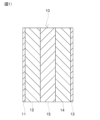
- FIG. 1 is a cross-sectional view showing a configuration of a secondary battery according to a first embodiment.
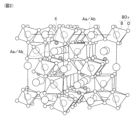
- FIG. 1 is a diagram showing the crystal structure of a pyrochlore-type oxide.
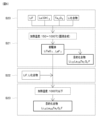
- 1A to 1C are diagrams illustrating a manufacturing process of a pyrochlore type oxide according to a first embodiment.
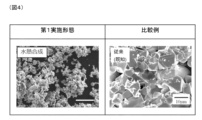
- 1 is a SEM image of the pyrochlore type oxide of the first embodiment.
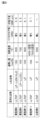
- 1 is a table showing particle sizes of the pyrochlore type oxide of the first embodiment using examples and comparative examples.
- 1A to 1C are diagrams illustrating a manufacturing process of a pyrochlore type oxide according to a second embodiment.
- 11 is a SEM image of a pyrochlore type oxide according to a second embodiment.
- 11 is a table showing particle sizes of the pyrochlore type oxide according to the second embodiment using examples and comparative examples.
- the secondary battery 10 of the first embodiment is a lithium ion battery in which charging and discharging are performed by the movement of lithium ions between the negative electrode 12 and the positive electrode 14.
- the secondary battery 10 includes a negative electrode current collector 11, a negative electrode 12, a positive electrode current collector 13, a positive electrode 14, and a solid electrolyte 15.
- the solid electrolyte 15 corresponds to the solid electrolyte for the secondary battery.
- a solid electrolyte 15 is sandwiched between the positive electrode 14 and the negative electrode 12.
- the negative electrode 12 and the solid electrolyte 15 are in contact.
- the positive electrode 14 and the solid electrolyte 15 are in contact.
- the negative electrode 12 and the positive electrode 14 are connected via the solid electrolyte 15.
- the secondary battery 10 of this first embodiment is a lithium ion battery that is charged and discharged by lithium ions moving between the negative electrode 12 and the positive electrode 14 via the solid electrolyte 15.
- a laminate including the negative electrode 12, the positive electrode 14, and the solid electrolyte 15 is provided between the negative electrode collector 11 and the positive electrode collector 13.
- the negative electrode collector 11 and the negative electrode 12 are in contact.
- the positive electrode collector 13 and the positive electrode 14 are in contact.
- the negative electrode collector 11 and the positive electrode collector 13 are connected via the laminate.
- the negative electrode collector 11 and the positive electrode collector 13 can be made of any material that can be used as a collector for a lithium-ion battery.
- Cu is used as the negative electrode collector 11
- Al is used as the positive electrode collector 13.
- the negative electrode material constituting the negative electrode 12 can be any material that can be used as a negative electrode active material for lithium ion batteries, such as a carbon-based negative electrode material, an oxide-based negative electrode material, or a metal-based negative electrode material. In this first embodiment, a lithium-based negative electrode material or a Si-based negative electrode material is used.
- any material that can be used as a positive electrode active material for a lithium ion battery can be used as the positive electrode material constituting the positive electrode 14.
- the positive electrode 14 for example, a cobalt-based positive electrode material (LiCoO 2 ), a nickel-based positive electrode material (LiNiO 2 ), a manganese-based positive electrode material (LiMn 2 O 4 ), an iron phosphate-based positive electrode material (LiFePO 4 ), a ternary positive electrode material (NMC) mainly composed of nickel, manganese, and cobalt, etc. can be used.
- the solid electrolyte 15 has ionic conductivity and is capable of moving lithium ions between the negative electrode 12 and the positive electrode 14. It is desirable that the solid electrolyte 15 be formed as thin as possible in order to reduce the resistance of the secondary battery 10.
- the solid electrolyte 15 is an oxide-based solid electrolyte, and is a pyrochlore-type oxide having a pyrochlore structure represented by the composition formula "Aa 2- ⁇ Ab (1+ ⁇ )/3 B 2 O 7- ⁇ X ⁇ ".
- the particle diameter of the pyrochlore-type oxide constituting the solid electrolyte 15 it is desirable for the particle diameter of the pyrochlore-type oxide constituting the solid electrolyte 15 to be as small as possible.
- the pyrochlore-type oxide in the first embodiment has a primary particle diameter of the nano-order to micron-order, specifically within the range of 20 nm to 10 ⁇ m.
- the particle diameter of the pyrochlore oxide is the length of the part of the particle that has the largest diameter, and can also be called the maximum diameter or the long diameter.
- the mode (peak value) of the particle diameter distribution is taken as the particle diameter.
- the particle diameter of the pyrochlore oxide can be obtained as follows.
- the geometric shape of the particles is observed using an electron microscope (SEM, TEM) or an atomic force microscope (AFM), and the maximum diameter of the particles being measured is measured.
- the number of measurement samples N is set to, for example, 30 or more. The most frequent value estimated by assuming that the distribution of the maximum diameters of the measured particles follows a log-normal distribution is obtained as the particle diameter.
- O is an oxygen atom
- Aa, Ab, B, and X represent any element or group.
- Aa, Ab, and B are each different types of cations
- O and X are each different types of anion.
- Aa is an alkali metal cation.
- Pyrochlore-type oxides contain multiple cations in their composition, consisting of the alkali metal cation Aa and multiple cations Ab and B other than the alkali metal cation Aa. In other words, pyrochlore-type oxides contain multiple cations in their composition, including the alkali metal cation Aa.
- the solid electrolyte 15 with the pyrochlore structure has a crystal structure in which a three-dimensional network of octahedra made of BO6 is formed.
- BO6 is arranged with cation B at the center and O at the vertices, and shares the vertices with adjacent BO6 .
- a hexagonal tunnel structure in which cation A and anion X are arranged is formed.
- the cation Aa is an alkali metal cation.
- the alkali metal represented by Aa can be any of Li, Na, K, Rb, and Cs.
- the cation Aa can also be Mg or H, which is not an alkali metal.
- the cation Aa contains at least one selected from Li, Na, K, Rb, Cs, Mg, and H.
- Li is used as Aa.
- the composition ratio (2- ⁇ ) of Aa is within the range of 0 ⁇ (2- ⁇ ) ⁇ 1.4.
- the cation Ab contains at least a lanthanoid. At least one of La, Ce, Nd, and Sm can be used as the lanthanoid represented by Ab. In this first embodiment, La is used as Ab.
- the composition ratio of Ab (1+ ⁇ )/3 is within the range of 0.53 ⁇ (1+ ⁇ )/3 ⁇ 1.
- the basic composition of the cation Ab is lanthanoid, and some of the lanthanoids constituting Ab may be replaced with alkaline earth metals (Ca, Mg, Sr, etc.).
- alkaline earth metals Ca, Mg, Sr, etc.
- the pyrochlore structure in the above composition formula, where 0.6 ⁇ 2.0 and 0 ⁇ 1 contains lanthanoids, which creates defects in the crystal structure and is thought to improve the ionic conductivity.
- La is used as Ab.
- the cation A in the composition formula "A 2 B 2 O 7 " of a general pyrochlore structure is a composite cation using lithium metal and a lanthanoid. This is thought to contribute to the improvement of the ionic conductivity of the solid electrolyte 15.
- Cation B is a metal cation different from Aa and Ab, and is a transition metal or a metal selected from Groups 13 to 15 elements. B forms an octahedron surrounded by six O atoms in the crystal.
- a Group 4 transition metal or a Group 5 transition metal can be used, and more specifically, at least one of Nb, Ta, Ti, Zr, Hf, and V can be used.
- the Group 13 element represented by B Al, Ga, and In can be used, as the Group 14 element, Ge and Sn can be used, and as the Group 15 element, Sb and Bi can be used.
- Ta is used as B.
- the anion X is an anion that can be substituted for the O atoms that constitute the pyrochlore structure.
- X has a different electronegativity and polarizability from the O atoms.
- At least one of O, F, Cl, Br, I, S, OH, and P can be used as the anion represented by X.
- the composition ratio ⁇ of X is within the range of 0 ⁇ 1, and at least a part of the O atoms that constitute the pyrochlore structure is substituted with X.
- F is used as X.
- the solid electrolyte 15 of the first embodiment has a defect structure in which the crystal contains lattice defects due to some of the O atoms constituting the pyrochlore structure being replaced with anions that have different electronegativity and polarizability from the O atoms. It is believed that the solid electrolyte 15 of the first embodiment has improved ionic conductivity due to the defect structure being included in the pyrochlore structure.
- the composition formula of a general pyrochlore structure is "A 2 B 2 O 7 ", and the composition ratio of the cation A is 2.
- the composition ratios of Aa and Ab are "2- ⁇ " and "(1+ ⁇ )/3", respectively, and 0.6 ⁇ 2.0, so that the sum of the composition ratios of Aa and Ab is less than 2. That is, in the crystal structure of the solid electrolyte 15 of the first embodiment, at least one part of Aa and Ab is missing.
- the composition ratio corresponding to the missing parts of Aa and Ab is (2 ⁇ -1)/3.
- a defect structure can also be formed by making the sum of the valences of the cations Aa, Ab, and B and the anions O and X in the above composition formula negative.
- the solid electrolyte 15 of the first embodiment is a composite anion compound having a pyrochlore structure containing a plurality of anions such as O and X, and since the BO 6- coordinated octahedral structure has an anion represented by X, the alkali metal Aa can be positioned in the center of the space with the BO 6- coordinated octahedron without approaching the BO 6- coordinated octahedron. Therefore, it is believed that the solid electrolyte 15 of the first embodiment has high ionic conductivity when used with an electric field applied such as in a battery.
- ⁇ , ⁇ , and ⁇ in the above composition formula affect lattice defects and ionic conductivity, it is desirable to use them within appropriate ranges.
- Large values of ⁇ , ⁇ , and ⁇ increase the defect concentration in the crystal lattice, but if they exceed a certain amount, the concentration of the alkali metal represented by Aa decreases, and ionic conductivity decreases. For this reason, it is desirable to control ⁇ within the range of 0.6 ⁇ 2.0, ⁇ within the range of 0 ⁇ 1, and ⁇ within the range of 0 ⁇ 1.
- Li1.25La0.58Ta2O6F is also referred to as “ LLTOF”
- Li1.25La0.58Nb2O6F is also referred to as " LLNOF ".
- FIG. 3 shows the manufacturing method of the LLTOF.
- a first mixing step S10, a first heating step S11, a second mixing step S12, and a second heating step S13 are carried out in this order.
- the first mixing step S10 and the first heating step S11 correspond to the mixing step and the heating step.
- the first mixing step S10 a mixture is obtained by mixing a plurality of raw materials each containing a plurality of cations contained in the target compound LLTOF.
- the plurality of raw materials mixed in the first mixing step S10 include a lithium source, a lanthanum source, and a tantalum source.
- the lithium source is a raw material for the cation Aa and is an alkali metal compound.
- the lanthanum source is a raw material for the cation Ab
- the tantalum source is a raw material for the cation B.
- the lithium source As the lithium source, the lanthanum source, and the tantalum source, at least one selected from the group consisting of fluorides, acetates, chlorides, hydroxides, carbonates, and oxides can be used.
- LiF is used as the lithium source
- La(OH) 3 is used as the lanthanum source
- Ta 2 O 5 is used as the tantalum source.
- fluorides are used as the alkali metal compounds
- LiF is also a fluorine source.
- a niobium source Nb 2 O 5 may be used instead of the tantalum source Ta 2 O 5 .
- the alkali metal compound used in the first embodiment is water-soluble, and LiF is used in the state of an aqueous solution (dissolved liquid).
- the dissolved LiF is ionized in the aqueous solution.
- the entire amount of LiF does not necessarily have to be dissolved in the LiF aqueous solution, as long as at least a part of LiF is dissolved.
- La(OH) 3 and Ta 2 O 5 particles are mixed in a predetermined ratio with the LiF aqueous solution.
- the mixture is obtained in the state of a mixed solution.
- the mixed solution is adjusted to be alkaline by dissolving LiF.
- the amount of Li supplied as LiF is an excess amount that exceeds the stoichiometric amount for the target compound LLTOF.
- the mixture contains an excess amount of Li relative to the target compound.
- the excess amount of Li can be, for example, 50 to 100 mol %.
- a first heating step S11 is performed in which the mixed solution obtained by mixing La(OH) 3 and Ta2O5 with the LiF aqueous solution is heated.
- the mixed solution is heated to a predetermined temperature by a liquid phase method in an air atmosphere or an inert atmosphere to generate a precursor.
- the liquid phase method is a synthesis method that uses a liquid to produce crystals.
- the liquid used in the liquid phase method may be a solution in which the raw material is dissolved in a solvent, or it may be a molten liquid phase raw material.
- Examples of liquid phase methods that can be used include hydrothermal synthesis, solid-liquid synthesis, flux method, sol-gel method, and co-precipitation.
- a low-melting-point alkali metal compound (Li compound in this first embodiment) that can melt into a liquid phase dissolves a high-melting-point stable transition metal compound (Ta compound in this first embodiment), and a precursor of a corundum structure can be generated. Therefore, in the liquid phase method, the synthesis reaction can be carried out at a lower temperature than in the solid phase method, in which the synthesis reaction is carried out in a solid state, and the particle size of the product can be made smaller.
- hydrothermal synthesis is used as the liquid phase method.
- compounds are synthesized by a hydrothermal reaction involving water used as a solvent at a temperature higher than the boiling point of water and at a pressure higher than atmospheric pressure.
- the hydrothermal synthesis apparatus used for hydrothermal synthesis may be an autoclave or a flow-through (continuous) hydrothermal synthesis apparatus.
- an autoclave which is a heat-resistant and pressure-resistant sealed container, is used.
- the mixed solution is placed in the autoclave, which is sealed, and the autoclave is heated in a heating furnace to perform hydrothermal synthesis.
- the pressure of the mixed solution becomes higher than atmospheric pressure.
- the heating time of the first heating step S11 is preferably several seconds to several tens of hours.
- the heating temperature when performing hydrothermal synthesis in the first heating step S11 is preferably within the range of 150°C to 1000°C, and is preferably 500°C or less from the viewpoint of the heat resistance of the hydrothermal synthesis apparatus.
- the heating temperature in the hydrothermal synthesis is more preferably within the range of 200°C to 400°C.
- a lower heating temperature in the hydrothermal synthesis can reduce the particle size of the precursor and the target product.
- Hydrothermal synthesis may be carried out in a subcritical water state, where the temperature and pressure of the mixed solution are lower than the critical point of water (374°C, 22.1 MPa), or in a supercritical water state, where the temperature and pressure of the mixed solution are higher than the critical point.
- LiTaO3 having a corundum structure and LaF3 having a tysonite structure are generated as precursors.
- the precursor LiTaO3 is a composite oxide containing multiple cations and contains at least an alkali metal cation in its composition.
- the mixed solution is heated to dissolve La(OH) 3 and Ta 2 O 5 in the solution, and the precursor production reaction proceeds.
- the dissolved La(OH) 3 and Ta 2 O 5 are ionized in the solution.
- the entire amount of La(OH) 3 and Ta 2 O 5 does not necessarily have to be dissolved in the solution, and it is sufficient that at least a portion of them is dissolved.
- a reaction for generating a precursor proceeds by hydrothermal synthesis, and the precursor further reacts to generate a reaction for generating a pyrochlore oxide, which is the target compound. That is, in the first heating step S11, the precursors LiTaO 3 and LaF 3 generated by the hydrothermal synthesis react to generate the target compound LLTOF, so that the hydrothermal synthesis product contains the precursors LiTaO 3 and LaF 3 and the target compound LLTOF. In the first heating step S11, by performing hydrothermal synthesis, the reaction can proceed at a lower temperature than the solid-phase reaction, and the particle size of LLTOF can be made fine.
- the hydrothermal synthesis product containing the precursor and the target compound is washed with water or an organic solvent (e.g., alcohol, acetone, etc.) as necessary, and then dried. This allows the precursor and target compound to be obtained in particulate form.
- an organic solvent e.g., alcohol, acetone, etc.
- the target compound LLTOF is obtained in the first heating step S11, so the following second mixing step S12 and second heating step S13 may be performed as necessary.
- a second mixing step S12 is performed in which LiF is mixed with the hydrothermal synthesis product obtained in the first heating step to obtain a mixture.
- the mixing of LiF with the precursor may be performed as necessary.
- a second heating step S13 is performed in which the mixture of the precursor and LiF is heated and sintered.
- the mixture is heated at a predetermined temperature in, for example, an air atmosphere or an inert atmosphere to sinter the target compound LLTOF.
- the target compound LLTOF can be produced by any method using, for example, a solid-phase reaction, a liquid-phase reaction, or a solid-liquid reaction.
- the heating temperature is set to a range of 500°C to 1000°C.
- the heating temperature in the second heating step S13 is preferably set to 700°C or lower.
- the second heating step can generate the target compound LLTOF from the precursors LiTaO 3 and LaF 3.
- heating is performed at a temperature higher than the first heating step S11, so that the particle size of the target compound LLTOF can be increased. The higher the heating temperature in the second heating step S13, the larger the particle size of the target product LLTOF.
- FIG. 4 shows SEM images of the pyrochlore oxide in the first embodiment and the comparative example.
- a precursor produced by a hydrothermal reaction is heated to produce the pyrochlore oxide
- a precursor produced by a solid-state reaction is heated to produce the pyrochlore oxide.
- the pyrochlore oxide in the first embodiment and the comparative example is LLTOF.
- the scale of the SEM images in the first embodiment and the comparative example is 10 ⁇ m.
- a precursor Li0.5La0.5Ta2O6 obtained by firing a mixture of La2O3 , Li2CO3 , and Ta2O5 was mixed with LiF and LaF3 , and fired at 1200°C to generate LLTOF by a solid -state reaction.
- the particle diameter of the pyrochlore-type oxide is significantly greater than 10 ⁇ m, whereas in the first embodiment, a pyrochlore-type oxide with a particle diameter of a few ⁇ m or less is obtained. In this way, in the first embodiment, the particles of the pyrochlore-type oxide can be made fine.
- the solid electrolyte 15 of the secondary battery 10 By using the pyrochlore-type oxide of the first embodiment as the solid electrolyte 15 of the secondary battery 10, the solid electrolyte 15 can be made thinner, and the resistance of the secondary battery 10 can be reduced.
- the Li compound in Examples 1 to 5, 7, and Comparative Example 1 is LiF
- the Li compounds in Example 6 are LiF and LiOH.
- the amount of excess Li relative to the target compound is 50 mol% in Examples 1 and 7, and 100 mol% in Examples 2 to 6 and Comparative Example 1.
- the hydrothermal synthesis temperature for Examples 1, 2, and 7 is 200°C
- the hydrothermal synthesis temperature for Example 3 is 240°C
- the hydrothermal synthesis temperature for Example 4 is 300°C
- the hydrothermal synthesis temperature for Examples 5 and 6 is 400°C
- the hydrothermal synthesis temperature for Comparative Example 1 is 130°C.
- the phases of the compounds obtained in Examples 1 to 7 and Comparative Example 1 were evaluated by X-ray diffraction (XRD) to confirm whether or not the pyrochlore phase, the target compound, was formed. As a result, it was confirmed that the pyrochlore phase, the target compound, was at least partially formed in Examples 1 to 6. On the other hand, in Comparative Example 1, the formation of the pyrochlore phase, the target compound, could not be confirmed at all. In other words, a pyrochlore-type oxide was not obtained at a hydrothermal synthesis temperature of 130°C.
- the primary particle diameter of the obtained pyrochlore type oxide was 0.3 ⁇ m in Example 1, 0.5 ⁇ m in Example 2, 0.6 ⁇ m in Example 3, 0.9 ⁇ m in Example 4, 2.2 ⁇ m in Example 5, 3.0 ⁇ m in Example 6, and 2.0 ⁇ m in Example 7. Note that the measurement of the primary particle diameter in Examples 1 to 7 was performed using SEM-EDX in order to distinguish between the precursor and the target compound.
- Example 1 to 7 pyrochlore-type oxides with particle sizes of 3.0 ⁇ m or less were obtained.
- the particle size of the pyrochlore-type oxide was smaller when the hydrothermal synthesis temperature was lower.
- Example 2 where the hydrothermal synthesis temperature was the same, the particle size of the pyrochlore-type oxide was larger in Example 2, which had a greater amount of excess Li than in Example 1. This is thought to be because the greater the amount of excess Li, the more improved the reactivity and the larger the particle size.
- a precursor that is a complex oxide with a corundum structure is generated by hydrothermal synthesis.
- the generated precursor reacts to generate a pyrochlore-type oxide.
- the pyrochlore-type oxide can be generated at a lower temperature than in a solid-phase reaction, and the particles of the pyrochlore-type oxide can be made fine by lowering the heating temperature.
- the finely divided pyrochlore-type oxide as the solid electrolyte 15 of the secondary battery 10
- the solid electrolyte 15 can be made thinner and the resistance of the secondary battery 10 can be reduced.
- the corundum structure composite oxide generated as a precursor in the first heating step S11 is fired in the second heating step S13 to generate a pyrochlore type oxide.
- a pyrochlore type oxide can be obtained from the precursor obtained by hydrothermal synthesis.
- the heating temperature in the second heating step S13 is set to a higher temperature than the hydrothermal synthesis in the first heating step, and the particle size of the pyrochlore type oxide can be increased as necessary.
- hydrothermal synthesis is performed using an alkaline mixed solution. This can improve the reactivity of the hydrothermal synthesis and increase the yield of the precursor.
- FIG. 6 shows the method for producing the solid electrolyte 15 of the second embodiment.
- FIG. 6 shows the method for producing the LLTOF.
- the first mixing step S20, the first heating step S21, the second mixing step S21, and the second heating step S23 are carried out in this order.
- the first mixing step S20 and the first heating step S21 correspond to the mixing step and the heating step.
- a solid-liquid synthesis method is used as the liquid phase method.
- a low-melting-point alkali metal compound (Li compound in the second embodiment) melts to become a molten liquid, and the liquid phase Li compound reacts with a solid phase transition metal compound (Ta compound in the second embodiment), producing a precursor of a corundum structure.
- the first mixing step S20 In the first mixing step S20, the starting materials LiF, La(OH) 3 , Ta 2 O 5 , and a Li compound are mixed to obtain a mixture.
- the Li compound may be, for example, LiF, LiOH, or Li 2 CO 3.
- the amount of Li supplied as the Li compound is an excess amount that exceeds the stoichiometric amount with respect to the target compound LLTOF.
- La oxide or fluoride, or a raw material via them may be added to the starting materials, or hydroxide may be replaced with them.
- first heating step S21 the mixture produced in the first mixing step S20 is heated in a first heating step S21.
- the mixture is heated to a predetermined temperature by a solid-liquid synthesis method in an air atmosphere or an inert atmosphere to generate a precursor.
- the Li compound including LiF melts and becomes a liquid phase.
- the heating temperature during solid-liquid synthesis in the first heating step S21 is equal to or higher than the melting point of the Li compound, and is preferably within the range of 500°C to 1000°C. It is more preferable that the heating temperature during solid-liquid synthesis is within the range of 600°C to 900°C, for example.
- the Li compound does not necessarily have to be completely melted, as long as at least a portion of it is melted.
- LiTaO3 having a corundum structure and LaF3 having a tysonite structure are generated as precursors.
- a reaction for generating a precursor proceeds by solid-liquid synthesis, and the precursor further reacts to generate a reaction for generating a pyrochlore oxide, which is the target compound. That is, in the first heating step S21, the precursors LiTaO 3 and LaF 3 generated by the solid-liquid synthesis react to generate the target compound LLTOF, so that the solid-liquid synthesis product contains the precursors LiTaO 3 and LaF 3 and the target compound LLTOF.
- the solid-liquid synthesis product may contain residual Li compounds, which are starting materials.
- the reaction can proceed at a lower temperature than the solid-phase reaction, and the particle size of LLTOF can be made fine.
- heating may be performed only once, or heating may be performed two or more times. If heating is performed twice in the first heating step S21, the first heating temperature can be lower than the second heating temperature.
- the product of the first heating is crushed and then the second heating is performed.
- the product of the first heating includes precursors LiTaO 3 and LaF 3 and a Li compound as a starting material. If necessary, a Li compound may be added during the second heating.
- the Li compound melts and becomes liquid.
- the precursors By crushing the precursors produced in the first heating, the precursors can be mixed uniformly, and the second heating can promote the reaction to produce the target compound LLTOF.
- the second mixing step S22 and the second heating step S23 may be performed as necessary.
- the solid-liquid synthesis product obtained in the first heating step S21 is mixed with LiF and a Li compound to obtain a mixture, in the second mixing step S22.
- the second mixing step S22 only LiF may be mixed, or only Li compounds other than LiF may be mixed.
- the second heating step S23 is the same as in the first embodiment, and therefore a description thereof will be omitted.
- FIG. 7 shows an SEM image of the pyrochlore oxide of the second embodiment.
- the precursor produced by the solid-liquid reaction is heated to produce the pyrochlore oxide.
- the pyrochlore oxide of the second embodiment is LLTOF.
- the scale of the SEM image of the second embodiment is 10 ⁇ m.
- the manufacturing method of the second embodiment produces pyrochlore oxide with particle diameters of several ⁇ m or less.
- the second embodiment makes it possible to refine the particles of the pyrochlore oxide.
- Example 2 the precursor produced by solid-liquid synthesis was calcined to produce the target compound LLTOF. In Comparative Example 2, no Li compound was added.
- the Li compound in Examples 10 and 11 and Comparative Example 2 was LiF
- the Li compounds in Example 8 were LiF and LiOH
- the Li compounds in Example 9 were LiF and Li 2 CO 3.
- the amount of excess Li relative to the target compound was 100 mol % in Examples 8 to 11 and 0 mol % in Comparative Example 2.
- the solid-liquid synthesis temperature in Example 8 and Comparative Example 2 is 600°C
- the solid-liquid synthesis temperature in Example 9 is 700°C
- the solid-liquid synthesis temperature in Example 10 is 900°C.
- heating in the solid-liquid synthesis is performed twice, the first solid-liquid synthesis temperature is 400°C, and the second solid-liquid synthesis temperature is 700°C.
- the phases of the compounds obtained in Examples 8 to 11 and Comparative Example 2 were evaluated by X-ray diffraction (XRD) to confirm whether or not the pyrochlore phase, the target compound, was formed. As a result, it was confirmed that the pyrochlore phase, the target compound, was at least partially formed in Examples 8 to 11. On the other hand, in Comparative Example 2, the formation of the pyrochlore phase, the target compound, could not be confirmed at all. In other words, when the amount of excess Li was 0 mol%, no pyrochlore-type oxide was obtained.
- XRD X-ray diffraction
- the primary particle diameter of the obtained pyrochlore-type oxide was 0.9 ⁇ m in Example 8, 2.5 ⁇ m in Example 9, 6.1 ⁇ m in Example 10, and 3.1 ⁇ m in Example 11. Note that the measurement of the primary particle diameter in Examples 8 to 11 was performed using SEM-EDX in order to distinguish between the precursor and the target compound.
- Examples 8 to 11 pyrochlore-type oxides with particle sizes of 6.1 ⁇ m or less were obtained.
- the solid-liquid synthesis temperature was 700°C or less
- pyrochlore-type oxides with particle sizes of 3.1 ⁇ m or less were obtained.
- the lower the solid-liquid synthesis temperature the smaller the particle size of the pyrochlore-type oxide.
- a precursor that is a complex oxide with a corundum structure is generated by solid-liquid synthesis.
- the generated precursor reacts to generate a pyrochlore-type oxide.
- the pyrochlore-type oxide can be generated at a lower temperature than in the solid-phase reaction, and the particles of the pyrochlore-type oxide can be made finer by lowering the heating temperature.
- the pyrochlore oxide of the present disclosure is applied to a solid electrolyte for a lithium ion battery, but the pyrochlore oxide of the present disclosure may also be applied to other secondary batteries.
- K is used as the alkali metal represented by Aa in the composition formula of the pyrochlore oxide
- Na is used as the alkali metal represented by Aa in the composition formula
- it can be used as a solid electrolyte for a sodium ion battery.
- the hydrothermal synthesis in the first heating step S11 was performed using an alkali metal fluoride (specifically LiF), but the hydrothermal synthesis may be performed using an alkali metal compound other than a fluoride (e.g., hydroxide, etc.).
- an alkali metal compound other than a fluoride e.g., hydroxide, etc.
- a compound containing the element F can be mixed with the precursor in the second mixing step S12 and then calcined in the second heating step S13 to obtain a pyrochlore-type oxide containing the element F as the anion X.
- the method for producing a pyrochlore type oxide disclosed in this specification has the following features.
- a method for producing a pyrochlore type oxide containing a plurality of cations including an alkali metal cation in its composition comprising the steps of: A mixing step (S10, S20) of mixing a plurality of raw materials each containing the plurality of cations; A heating step (S11, S21) of heating the mixture containing the plurality of raw materials at a predetermined temperature by a liquid phase method to generate a composite oxide having a corundum structure containing at least the alkali metal cation in its composition;
- a method for producing a pyrochlore type oxide comprising the steps of: (Item 2) 2.
- (Item 3) 3.
- (Item 4) 3.
- (Item 9) 9. The method for producing a pyrochlore type oxide according to item 8, wherein the heating temperature in the second heating step is higher than the heating temperature in the first heating step.
- (Item 10) 10.
- (Item 11) 11. The method for producing a pyrochlore type oxide according to any one of items 1 to 10, wherein the pyrochlore type oxide is an electrolyte for a secondary battery (15).
Landscapes
- Chemical & Material Sciences (AREA)
- Organic Chemistry (AREA)
- Inorganic Chemistry (AREA)
- Inorganic Compounds Of Heavy Metals (AREA)
Priority Applications (2)
| Application Number | Priority Date | Filing Date | Title |
|---|---|---|---|
| JP2025553399A JPWO2025089322A1 (https=) | 2023-10-25 | 2024-10-24 | |
| CN202480044589.7A CN121443556A (zh) | 2023-10-25 | 2024-10-24 | 烧绿石型氧化物的制造方法 |
Applications Claiming Priority (2)
| Application Number | Priority Date | Filing Date | Title |
|---|---|---|---|
| JP2023183092 | 2023-10-25 | ||
| JP2023-183092 | 2023-10-25 |
Related Child Applications (1)
| Application Number | Title | Priority Date | Filing Date |
|---|---|---|---|
| US19/435,012 Continuation US20260125274A1 (en) | 2023-10-25 | 2025-12-29 | Method for producing pyrochlore-type oxide |
Publications (1)
| Publication Number | Publication Date |
|---|---|
| WO2025089322A1 true WO2025089322A1 (ja) | 2025-05-01 |
Family
ID=95515899
Family Applications (1)
| Application Number | Title | Priority Date | Filing Date |
|---|---|---|---|
| PCT/JP2024/037864 Pending WO2025089322A1 (ja) | 2023-10-25 | 2024-10-24 | パイロクロア型酸化物の製造方法 |
Country Status (3)
| Country | Link |
|---|---|
| JP (1) | JPWO2025089322A1 (https=) |
| CN (1) | CN121443556A (https=) |
| WO (1) | WO2025089322A1 (https=) |
Cited By (3)
| Publication number | Priority date | Publication date | Assignee | Title |
|---|---|---|---|---|
| CN120432628A (zh) * | 2025-06-19 | 2025-08-05 | 固邦聚能科技(佛山)有限公司 | 一步固相法制备烧绿石型氟氧化物固态电解质的方法 |
| CN121506921A (zh) * | 2026-01-09 | 2026-02-10 | 合肥国轩高科动力能源有限公司 | 改性正极材料、其制备方法及包含该材料的正极极片、二次电池及电子装置 |
| CN121506921B (en) * | 2026-01-09 | 2026-05-05 | 合肥国轩高科动力能源有限公司 | Modified positive electrode material, preparation method thereof, positive electrode plate containing modified positive electrode material, secondary battery and electronic device |
Citations (5)
| Publication number | Priority date | Publication date | Assignee | Title |
|---|---|---|---|---|
| JP2015153628A (ja) * | 2014-02-14 | 2015-08-24 | 古河電気工業株式会社 | 全固体二次電池 |
| WO2019194290A1 (ja) * | 2018-04-04 | 2019-10-10 | 国立研究開発法人産業技術総合研究所 | 複合酸化物、並びにそれを電解質材料に使用した電気化学デバイス |
| WO2020050896A1 (en) * | 2018-09-06 | 2020-03-12 | Nanotek Instruments, Inc. | Lithium metal secondary battery containing a protected lithium anode |
| WO2020174785A1 (ja) * | 2019-02-26 | 2020-09-03 | セイコーエプソン株式会社 | 固体電解質の前駆体組成物、二次電池の製造方法 |
| CN111792672A (zh) * | 2020-06-10 | 2020-10-20 | 浙江锋锂新能源科技有限公司 | 一种枝杈交联的珊瑚状微米结构的含锂氧化物粉体材料及制备方法 |
-
2024
- 2024-10-24 JP JP2025553399A patent/JPWO2025089322A1/ja active Pending
- 2024-10-24 CN CN202480044589.7A patent/CN121443556A/zh active Pending
- 2024-10-24 WO PCT/JP2024/037864 patent/WO2025089322A1/ja active Pending
Patent Citations (5)
| Publication number | Priority date | Publication date | Assignee | Title |
|---|---|---|---|---|
| JP2015153628A (ja) * | 2014-02-14 | 2015-08-24 | 古河電気工業株式会社 | 全固体二次電池 |
| WO2019194290A1 (ja) * | 2018-04-04 | 2019-10-10 | 国立研究開発法人産業技術総合研究所 | 複合酸化物、並びにそれを電解質材料に使用した電気化学デバイス |
| WO2020050896A1 (en) * | 2018-09-06 | 2020-03-12 | Nanotek Instruments, Inc. | Lithium metal secondary battery containing a protected lithium anode |
| WO2020174785A1 (ja) * | 2019-02-26 | 2020-09-03 | セイコーエプソン株式会社 | 固体電解質の前駆体組成物、二次電池の製造方法 |
| CN111792672A (zh) * | 2020-06-10 | 2020-10-20 | 浙江锋锂新能源科技有限公司 | 一种枝杈交联的珊瑚状微米结构的含锂氧化物粉体材料及制备方法 |
Non-Patent Citations (4)
| Title |
|---|
| AIMI AKIHISA, ONODERA HITOSHI, SHIMONISHI YUTA, FUJIMOTO KENJIRO, YOSHIDA SHUHEI: "High Li-Ion Conductivity in Pyrochlore-Type Solid Electrolyte Li 2– x La (1+ x )/3 M 2 O 6 F (M = Nb, Ta)", CHEMISTRY OF MATERIALS, AMERICAN CHEMICAL SOCIETY, US, vol. 36, no. 8, 23 April 2024 (2024-04-23), US , pages 3717 - 3725, XP093309395, ISSN: 0897-4756, DOI: 10.1021/acs.chemmater.3c03288 * |
| CYRILLE GALVEN ET AL.: "New Oxyfluoride Pyrochlores Li2-xLa(1+x)/3o(2x-1)/3B2O6F (B=Nb, Ta): Average and Local Structure Characterization by XRD, TEM and 19F Solid-State NMR Spectroscopy", EUROPEAN JOURNAL OF INORGANIC CHEMISTRY, no. 33, 11 October 2010 (2010-10-11), pages 5272 - 5283 |
| CYRILLE GALVEN; CHRISTOPHE LEGEIN; MONIQUE BODY; JEAN‐LOUIS FOURQUET; JEAN‐YVES BUZARÉ; FRANÇOISE LE BERRE; MARIE‐PIERRE CROSNIER‐: "New Oxyfluoride Pyrochlores Li2–xLa(1+x)/3□(2x–1)/3B2O6F (B = Nb, Ta): Average and Local Structure Characterization by XRD, TEM and 19F Solid‐State NMR Spectroscopy", EUROPEAN JOURNAL OF INORGANIC CHEMISTRY, WILEY-VCH VERLAG , WENHEIM, DE, vol. 2010, no. 33, 11 October 2010 (2010-10-11), DE , pages 5272 - 5283, XP072126714, ISSN: 1434-1948, DOI: 10.1002/ejic.201000599 * |
| PHRAEWPHIPHAT THANYA, IQBAL MUHAMMAD, SUZUKI KOTA, HIRAYAMA MASAAKI, KANNO RYOJI: "Synthesis and Lithium-Ion Conductivity of LiSrB2O6F (B = Nb5+, Ta5+) with a Pyrochlore Structure", JOURNAL OF THE JAPAN SOCIETY OF POWDER AND POWDER METALLURGY,19810101FUNTAI FUNMATSU YAKIN KYOKAI, JP, vol. 65, no. 1, 3 February 2018 (2018-02-03), pages 26 - 33, XP009531967, ISSN: 0532-8799, DOI: 10.2497/jjspm.65.26 * |
Cited By (3)
| Publication number | Priority date | Publication date | Assignee | Title |
|---|---|---|---|---|
| CN120432628A (zh) * | 2025-06-19 | 2025-08-05 | 固邦聚能科技(佛山)有限公司 | 一步固相法制备烧绿石型氟氧化物固态电解质的方法 |
| CN121506921A (zh) * | 2026-01-09 | 2026-02-10 | 合肥国轩高科动力能源有限公司 | 改性正极材料、其制备方法及包含该材料的正极极片、二次电池及电子装置 |
| CN121506921B (en) * | 2026-01-09 | 2026-05-05 | 合肥国轩高科动力能源有限公司 | Modified positive electrode material, preparation method thereof, positive electrode plate containing modified positive electrode material, secondary battery and electronic device |
Also Published As
| Publication number | Publication date |
|---|---|
| JPWO2025089322A1 (https=) | 2025-05-01 |
| CN121443556A (zh) | 2026-01-30 |
Similar Documents
| Publication | Publication Date | Title |
|---|---|---|
| JP7349109B2 (ja) | リチウムニッケル含有複合酸化物の製造方法 | |
| JP7504195B2 (ja) | リチウム遷移金属酸化物及び前駆体粒状物質並びに方法 | |
| JP6323117B2 (ja) | 非水電解質二次電池用正極活物質の前駆体の製造方法、及び非水電解質二次電池用正極活物質の製造方法 | |
| JP2021520333A (ja) | O3/p2混合相ナトリウム含有ドープ層状酸化物材料 | |
| CN103094576B (zh) | 一种镍基正极材料及其制备方法和电池 | |
| JP2011521881A (ja) | チタン酸リチウムスピネルの製造方法および使用方法 | |
| JP2013503102A (ja) | 流動床技術を用いるリチウム金属酸化物の調製方法 | |
| WO2011161652A1 (de) | Verfahren zur herstellung von lithium-mischmetalloxiden und ihre verwendung als kathodenmaterial | |
| GB2553263A (en) | Spinel-type lithium metal composite oxide | |
| US20230174380A1 (en) | Method for the Manufacture of Cathode Materials | |
| WO2024179036A1 (zh) | 一种单晶锰基锂电池正极材料及其制备方法 | |
| US20250263307A1 (en) | Methods for preparing lithium nickel manganese cobalt oxide particulate | |
| WO2025089322A1 (ja) | パイロクロア型酸化物の製造方法 | |
| WO2015133348A1 (ja) | リチウム複合酸化物 | |
| JP2000260432A (ja) | 正極活物質およびその製造方法並びに上記正極活物質を用いたリチウムイオン二次電池 | |
| KR20260041140A (ko) | 피복 입자 및 그의 제조 방법, 비수 전해질 이차 전지용 양극 활물질, 및 비수 전해질 이차 전지 | |
| CN117790735A (zh) | 一种高结晶性钠离子电池正极材料及其制备方法 | |
| CN113912128A (zh) | 一种储能设备、锂锰氧化物及其制备方法和应用 | |
| US20260125274A1 (en) | Method for producing pyrochlore-type oxide | |
| WO2025088916A1 (ja) | パイロクロア型酸化物の製造方法 | |
| CN119894829A (zh) | 从元素金属原料制备锂过渡金属氧化物的方法及其产物 | |
| JP2018085339A (ja) | 非水電解質二次電池用正極活物質の前駆体とその製造方法、及び非水電解質二次電池用正極活物質とその製造方法 | |
| JP7831710B2 (ja) | リチウムイオン二次電池用正極活物質の前駆体の製造方法、及びリチウムイオン二次電池用正極活物質の製造方法 | |
| RU2776156C1 (ru) | Катодный материал с высокой объемной плотностью энергии для литий-ионных аккумуляторов | |
| JP7473713B2 (ja) | リチウムコバルト系複合酸化物粒子及びその製造方法、リチウムコバルト系複合酸化物粒子組成物及びそれらの製造方法 |
Legal Events
| Date | Code | Title | Description |
|---|---|---|---|
| 121 | Ep: the epo has been informed by wipo that ep was designated in this application |
Ref document number: 24882433 Country of ref document: EP Kind code of ref document: A1 |
|
| ENP | Entry into the national phase |
Ref document number: 2025553399 Country of ref document: JP Kind code of ref document: A |
|
| WWE | Wipo information: entry into national phase |
Ref document number: 2025553399 Country of ref document: JP |