WO2025088913A1 - ギア付きシャフト、およびギア付きシャフトの製造方法 - Google Patents
ギア付きシャフト、およびギア付きシャフトの製造方法 Download PDFInfo
- Publication number
- WO2025088913A1 WO2025088913A1 PCT/JP2024/031876 JP2024031876W WO2025088913A1 WO 2025088913 A1 WO2025088913 A1 WO 2025088913A1 JP 2024031876 W JP2024031876 W JP 2024031876W WO 2025088913 A1 WO2025088913 A1 WO 2025088913A1
- Authority
- WO
- WIPO (PCT)
- Prior art keywords
- sintered gear
- shaft
- spline
- teeth
- tooth
- Prior art date
- Legal status (The legal status is an assumption and is not a legal conclusion. Google has not performed a legal analysis and makes no representation as to the accuracy of the status listed.)
- Pending
Links
Images



Classifications
-
- B—PERFORMING OPERATIONS; TRANSPORTING
- B22—CASTING; POWDER METALLURGY
- B22F—WORKING METALLIC POWDER; MANUFACTURE OF ARTICLES FROM METALLIC POWDER; MAKING METALLIC POWDER; APPARATUS OR DEVICES SPECIALLY ADAPTED FOR METALLIC POWDER
- B22F5/00—Manufacture of workpieces or articles from metallic powder characterised by the special shape of the product
- B22F5/08—Manufacture of workpieces or articles from metallic powder characterised by the special shape of the product of toothed articles, e.g. gear wheels; of cam discs
-
- C—CHEMISTRY; METALLURGY
- C22—METALLURGY; FERROUS OR NON-FERROUS ALLOYS; TREATMENT OF ALLOYS OR NON-FERROUS METALS
- C22C—ALLOYS
- C22C37/00—Cast-iron alloys
-
- C—CHEMISTRY; METALLURGY
- C22—METALLURGY; FERROUS OR NON-FERROUS ALLOYS; TREATMENT OF ALLOYS OR NON-FERROUS METALS
- C22C—ALLOYS
- C22C38/00—Ferrous alloys, e.g. steel alloys
-
- F—MECHANICAL ENGINEERING; LIGHTING; HEATING; WEAPONS; BLASTING
- F16—ENGINEERING ELEMENTS AND UNITS; GENERAL MEASURES FOR PRODUCING AND MAINTAINING EFFECTIVE FUNCTIONING OF MACHINES OR INSTALLATIONS; THERMAL INSULATION IN GENERAL
- F16H—GEARING
- F16H55/00—Elements with teeth or friction surfaces for conveying motion; Worms, pulleys or sheaves for gearing mechanisms
- F16H55/02—Toothed members; Worms
- F16H55/17—Toothed wheels
Definitions
- This disclosure relates to a geared shaft and a method for manufacturing a geared shaft.
- Patent Document 1 discloses a method for manufacturing a sintered body having an outer circumferential surface provided with multiple helical teeth.
- the method for manufacturing a sintered body in Patent Document 1 includes the steps of preparing a raw material powder, uniaxially pressing the raw material powder using a die to produce a cylindrical pressed compact, machining the outer circumferential surface of the pressed compact to produce a processed compact having an outer circumferential surface provided with multiple helical teeth, and sintering the processed compact.
- the geared shaft of the present disclosure comprises a first sintered gear having an outer peripheral surface on which a plurality of first teeth are provided and an inner peripheral surface on which a first internal spline is provided, a second sintered gear having an outer peripheral surface on which a plurality of second teeth are provided and an inner peripheral surface on which a second internal spline is provided, and a shaft having an outer peripheral surface on which a first external spline and a second external spline are provided.
- the first sintered gear and the shaft are coupled together by a press-fit structure between the first internal spline and the first external spline.
- the second sintered gear and the shaft are coupled together by a press-fit structure between the second internal spline and the second external spline.
- the distance between the center of the meshing pitch circle of the first teeth and the center of the meshing pitch circle of the second teeth is 50 ⁇ m or less.
- FIG. 1 is a schematic perspective view showing a geared shaft according to an embodiment.
- FIG. 2 is a vertical cross-sectional view showing a geared shaft according to the embodiment.
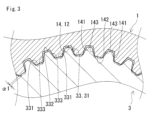
- FIG. 3 is a partial cross-sectional view showing a geared shaft according to an embodiment.
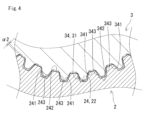
- FIG. 4 is another partial cross-sectional view showing a geared shaft of the embodiment.
- FIG. 5 is a schematic diagram showing the center of a meshing pitch circle of a first helical tooth of a first sintered gear and the center of a meshing pitch circle of a second helical tooth of a second sintered gear in a geared shaft of an embodiment.
- Patent Document 1 The helical gear of Patent Document 1 is sometimes used in combination with a shaft.
- Patent Document 1 does not disclose how to combine the helical gear with the shaft. Therefore, there is a need to combine the helical gear with the shaft efficiently. In particular, when combining a plurality of helical gears with one shaft, there is a need to combine them more efficiently.
- One of the objects of the present disclosure is to provide a geared shaft with excellent productivity.
- the geared shaft of the present disclosure has excellent productivity.
- a geared shaft includes a first sintered gear having an outer peripheral surface on which a plurality of first teeth are provided and an inner peripheral surface on which a first internal spline is provided, a second sintered gear having an outer peripheral surface on which a plurality of second teeth are provided and an inner peripheral surface on which a second internal spline is provided, and a shaft having an outer peripheral surface on which a first external spline and a second external spline are provided.
- the first sintered gear and the shaft are coupled together by a press-fit structure between the first internal spline and the first external spline.
- the second sintered gear and the shaft are coupled together by a press-fit structure between the second internal spline and the second external spline.
- the distance between the center of the meshing pitch circle of the first teeth and the center of the meshing pitch circle of the second teeth is 50 ⁇ m or less. This means that the coaxiality of the first sintered gear and the second sintered gear is 50 ⁇ m or less.
- the geared shaft of (1) above can be manufactured simply by pressing the shaft into the first sintered gear and then pressing the shaft into the second sintered gear, and is therefore highly productive.
- the geared shaft of (1) above, which is highly productive, is low cost.
- the geared shaft of (1) above is used in a traction motor system (eAxle) installed in a vehicle that is primarily powered by a motor, such as an electric vehicle (BEV: Battery Electric Vehicle) or a fuel cell vehicle (FCEV: Fuel Cell Electric Vehicle).
- a motor such as an electric vehicle (BEV: Battery Electric Vehicle) or a fuel cell vehicle (FCEV: Fuel Cell Electric Vehicle).
- BEV Battery Electric Vehicle
- FCEV Fuel Cell Electric Vehicle
- high torque acts on the geared shaft of (1) above.
- the geared shaft of (1) above is able to withstand high torque because the first sintered gear and the shaft are connected by a press-fit structure between the first inner spline and the first outer spline, and the second sintered gear and the shaft are connected by a press-fit structure between the second inner spline and the second outer spline.
- the geared shaft of (1) above is unlikely to experience large runout of the first sintered gear and the second sintered gear even under conditions where high torque acts, because the coaxiality of the first sintered gear and the second sintered gear is 50 ⁇ m or less. Therefore, the geared shaft of (1) above is easy to suppress vibration and noise. Furthermore, the geared shaft of (1) above can suppress uneven load on either the first sintered gear or the second sintered gear, so it is easy to suppress deformation of either the first sintered gear or the second sintered gear, and it has excellent durability. Therefore, the geared shaft of (1) above is suitable for applications where high torque is applied.
- the first teeth and the second teeth are both helical teeth.
- the geared shaft described above in (2) has excellent productivity even when it has helical teeth.
- each tooth tip of the first internal spline may be press-fitted into each tooth bottom of the first external spline
- each tooth tip of the second internal spline may be press-fitted into each tooth bottom of the second external spline.
- the press-fit allowance between each tooth tip of the first internal spline and each tooth bottom of the first external spline may be 5 ⁇ m or more and 50 ⁇ m or less
- the press-fit allowance between each tooth tip of the second internal spline and each tooth bottom of the second external spline may be 5 ⁇ m or more and 50 ⁇ m or less.
- the geared shaft of (3) above has a press-fit allowance of 5 ⁇ m or more, so that the first sintered gear and the second sintered gear are unlikely to shift position relative to the shaft even under conditions of high torque. Therefore, the geared shaft of (3) above is unlikely to have large runout of the first sintered gear and the second sintered gear.
- the geared shaft of (3) above has a press-fit allowance of 50 ⁇ m or less, so that the distance between the centers, i.e., the concentricity of the first sintered gear and the second sintered gear, is easily kept to 50 ⁇ m or less. Furthermore, the geared shaft of (3) above has a press-fit allowance of 50 ⁇ m or less, so that deformation of the first and second teeth due to the press-fitting of the shaft into the first and second sintered gears can be suppressed.
- the number of teeth of the first internal spline may be a multiple or a submultiple of the number of the first teeth
- the number of teeth of the second internal spline may be a multiple or a submultiple of the number of the second teeth
- the geared shaft of (4) above is less likely to experience uneven loads on the first internal spline, the first external spline, the second internal spline, and the second external spline due to the first teeth and second teeth meshing with the teeth of the mating gear. Therefore, the geared shaft of (4) above can suppress uneven deformation of the first internal spline, the first external spline, the second internal spline, and the second external spline, improving durability.
- the length of the shaft may be 100 mm or more.
- Sintered parts in which the first sintered gear and the second sintered gear are integrally formed on a long shaft cannot be manufactured by near-net-shape molding.
- the geared shaft of (5) above can be manufactured simply by pressing the shaft into the first sintered gear and then pressing the shaft into the second sintered gear. Therefore, even the geared shaft of (5) above, which has a shaft length of 100 mm or more, can be easily manufactured. Therefore, the geared shaft of (5) above has excellent productivity.
- the shortest distance between the first sintered gear and the second sintered gear may be 1 mm or more and 150 mm or less.
- Sintered parts in which the first sintered gear and the second sintered gear are integrally formed on a long shaft and the shortest distance between the first sintered gear and the second sintered gear is long cannot be manufactured by near net shape molding.
- the geared shaft of (6) above can be manufactured simply by pressing the shaft into the first sintered gear and then pressing the shaft into the second sintered gear. Therefore, even the geared shaft of (6) above, in which the shortest distance is 1 mm or more, can be easily manufactured. Therefore, the geared shaft of (6) above, in which the shortest distance is 1 mm or more, is excellent in productivity. Furthermore, the geared shaft of (6) above, in which the shortest distance is 1 mm or more, is suitable for a wide range of applications.
- the geared shaft of (5) above, in which the shortest distance is 150 mm or less, does not become too large and is therefore excellent in productivity.
- the thickness of the first sintered gear may be 3 mm or more and 150 mm or less
- the thickness of the second sintered gear may be 3 mm or more and 150 mm or less.
- the geared shaft of (7) above has a thickness of 3 mm or more for the first sintered gear and the second sintered gear, which makes the tooth trace longer and increases the strength of the first and second teeth.
- the geared shaft of (7) above has a thickness of 150 mm or less for the first sintered gear and the second sintered gear, which makes the tooth trace not too long, and therefore has excellent productivity.
- the outer diameter of the first sintered gear may be 30 mm or more and 150 mm or less
- the outer diameter of the second sintered gear may be 30 mm or more and 150 mm or less.
- the geared shaft of (8) above has an outer diameter of the first sintered gear and the second sintered gear of 30 mm or more, which makes it easy to reduce the load acting on the first teeth and the second teeth.
- the geared shaft of (8) above has an outer diameter of the first sintered gear and the second sintered gear of 150 mm or less, which makes the first sintered gear and the second sintered gear not too large, making it highly manufacturable.
- a method for manufacturing a geared shaft includes a step A for producing a first sintered gear having an outer peripheral surface on which a plurality of first teeth are provided and an inner peripheral surface on which a first internal spline is provided, and a second sintered gear having an outer peripheral surface on which a plurality of second teeth are provided and an inner peripheral surface on which a second internal spline is provided, a step B for preparing a shaft having an outer peripheral surface on which a first external spline and a second external spline are provided, and a step C for joining the first sintered gear to the shaft by pressing the first internal spline and the first external spline, and joining the second sintered gear to the shaft by pressing the second internal spline and the second external spline.
- the step A includes a step of cutting or grinding each tooth tip of the first internal spline and each tooth tip of the second internal spline.
- the step B includes a step of cutting or grinding each tooth bottom of the first external spline and each tooth bottom of the second external spline.
- step A includes a step of cutting or grinding each tooth tip of the first internal spline and each tooth tip of the second internal spline
- step B includes a step of cutting or grinding each tooth bottom of the first external spline and each tooth bottom of the second external spline. Therefore, the manufacturing method of the geared shaft of (9) above can manufacture a shaft in which the distance between the center of the tooth bottom circle of the first external spline and the center of the tooth bottom circle of the second external spline is 50 ⁇ m or less.
- the manufacturing method of the geared shaft of (9) above can manufacture a geared shaft in which the distance between the center of the meshing pitch circle of the first teeth and the center of the meshing pitch circle of the second teeth is 50 ⁇ m or less.
- the manufacturing method of the geared shaft of (9) above can connect the first sintered gear and the shaft by pressing the shaft into the first sintered gear and pressing the shaft into the second sintered gear, and can connect the second sintered gear and the shaft. Therefore, the manufacturing method of the geared shaft of (9) above can manufacture a geared shaft with good productivity.
- the first tooth and the second tooth are both helical teeth.
- the above-mentioned (10) manufacturing method for a geared shaft allows for the production of geared shafts with helical teeth with good productivity.
- each tooth tip of the first internal spline is press-fitted into each tooth bottom of the first external spline
- each tooth tip of the second internal spline is press-fitted into each tooth bottom of the second external spline.
- a press-fit allowance between each tooth tip of the first internal spline and each tooth bottom of the first external spline is 5 ⁇ m or more and 50 ⁇ m or less
- a press-fit allowance between each tooth tip of the second internal spline and each tooth bottom of the second external spline is 5 ⁇ m or more and 50 ⁇ m or less.
- the manufacturing method of the geared shaft of (11) above by setting the press-fit allowance to 5 ⁇ m or more, it is possible to manufacture a geared shaft in which the first sintered gear and the second sintered gear are less likely to have large runout.
- the manufacturing method of the geared shaft of (11) above by setting the press-fit allowance to 50 ⁇ m or less, it is easy to make the concentricity of the first sintered gear and the second sintered gear 50 ⁇ m or less, and deformation of the first and second teeth due to the press-fitting of the shaft into the first and second sintered gears can be suppressed.
- the number of teeth of the first internal spline is a multiple or a divisor of the number of the first teeth
- the number of teeth of the second internal spline is a multiple or a divisor of the number of the second teeth.
- the manufacturing method of the geared shaft described above in (12) can suppress uneven deformation of the first internal spline, the first external spline, the second internal spline, and the second external spline, and can manufacture a geared shaft with improved durability.
- the geared shaft 100 according to an embodiment will be described with reference to Figs. 1 to 5.
- the gear teeth are helical teeth
- the geared shaft 100 according to the embodiment includes a first sintered gear 1, a second sintered gear 2, and a shaft 3.
- One of the features of the geared shaft 100 according to the embodiment is that the first sintered gear 1 and the second sintered gear 2 are joined to the shaft 3 by a specific press-fit structure.
- the longitudinal cross-sectional view of Fig. 2 is a cross-sectional view of the geared shaft 100 cut along a plane along the central axis of the shaft 3.
- the partial cross-sectional view of Fig. 3 is a part of a cross-sectional view of the first sintered gear 1 and the shaft 3 cut along a plane perpendicular to the central axis of the shaft 3.
- the partial cross-sectional view of Fig. 4 is a part of a cross-sectional view of the second sintered gear 2 and the shaft 3 cut along a plane perpendicular to the central axis of the shaft 3.
- Fig. 5 shows, in a simplified manner, a center C1 of a meshing pitch circle P1 of the first helical tooth 13 of the first sintered gear 1 shown in Fig. 1 and a center C2 of a meshing pitch circle P2 of the second helical tooth 23 of the second sintered gear 2 shown in Fig. 1.
- the centers C1 and C2 are shown spaced apart.
- the first sintered gear 1 has an outer peripheral surface 11 provided with a plurality of first helical teeth 13 as shown in FIG. 1, and an inner peripheral surface 12 provided with a first internal spline 14 as shown in FIG.
- the second sintered gear 2 has an outer peripheral surface 21 on which a plurality of second helical teeth 23 are provided as shown in Fig. 1, and an inner peripheral surface 22 on which a second internal spline 24 is provided as shown in Fig. 4.
- a sintered gear in the common description of the first sintered gear 1 and the second sintered gear 2 they will be simply referred to as a sintered gear.
- the sintered gear is made of a plurality of metal particles bonded together.
- the metal is, for example, an iron-based material or a non-ferrous metal.
- the iron-based material is, for example, pure iron or an iron alloy.
- the non-ferrous metal is, for example, copper, a copper alloy, titanium, a titanium alloy, aluminum, an aluminum alloy, magnesium, a magnesium alloy, or pure tungsten.
- the iron-based material is suitable for the material of the sintered gear.
- pure iron means iron with a purity of 99% or more.
- pure iron means iron with an iron (Fe) content of 99% or more by mass.
- An iron alloy contains additive elements, with the remainder being iron (Fe) and unavoidable impurities. Iron alloys contain the most Fe.
- the additive elements contained in iron alloys are, for example, one or more elements selected from the group consisting of copper (Cu), nickel (Ni), tin (Sn), chromium (Cr), molybdenum (Mo), manganese (Mn), and carbon (C).
- the content ratio of Cu, Ni, Sn, Cr, Mo, and Mn is, for example, 0.5% to 5.0% by mass, or 1.0% to 3.0% by mass, in total, when the entire sintered gear is taken as 100% by mass.
- the content ratio of C is, for example, 0.2% to 2.0% by mass, or 0.4% to 1.0% by mass, when the entire sintered gear is taken as 100% by mass.
- the composition of sintered gears can be confirmed by component analysis using ICP optical emission spectrometry (ICP-OES).
- the relative density of the sintered gear is, for example, 95% or more.
- a sintered gear with a relative density of 95% or more has excellent mechanical properties such as strength.
- the relative density of the sintered gear may be further 96% or more, particularly 97% or more.
- the upper limit of the relative density of the sintered gear is not particularly limited and can be appropriately selected within the range that can be manufactured.
- the relative density of the sintered gear may be, for example, 99.9% or less.
- the relative density of the sintered gear may be 95% or more and 99.9% or less, further 96% or more and 99.9% or less, particularly 97% or more and 99.9% or less.
- the relative density of a sintered gear is the ratio (%) of the actual density of the sintered gear to the true density of the sintered gear.
- the relative density of a sintered gear is calculated by [(actual density of sintered gear/true density of sintered gear) x 100].
- the actual density of a sintered gear can be calculated by immersing the sintered gear in oil to impregnate the sintered gear with oil, and then calculating [oil-impregnated density x (mass of sintered gear before oil-impregnation/mass of sintered gear after oil-impregnation)].
- the oil-impregnated density is (mass of sintered gear after oil-impregnation/volume of sintered gear after oil-impregnation).
- the actual density of a sintered gear can be calculated by (mass of sintered gear before oil-impregnation/volume of sintered gear after oil-impregnation).
- the volume of a sintered gear after oil-impregnation can typically be measured by the liquid displacement method.
- the true density of a sintered gear is the theoretical density calculated from the composition of the sintered gear when it is assumed that there are no voids inside.
- the first helical teeth 13 of the first sintered gear 1 are arranged in parallel on the outer circumferential surface 11 of the first sintered gear 1 around the central axis of the first sintered gear 1.
- Each of the first helical teeth 13 is a tooth inclined at a predetermined helix angle with respect to the central axis of the first sintered gear 1.
- the tooth trace of each of the first helical teeth 13 intersects with the central axis of the first sintered gear 1.
- the second helical teeth 23 of the second sintered gear 2 are arranged in parallel on the outer circumferential surface 21 of the second sintered gear 2 around the central axis of the second sintered gear 2.
- Each of the second helical teeth 23 is a tooth inclined at a predetermined helix angle with respect to the central axis of the second sintered gear 2.
- the tooth trace of each of the second helical teeth 23 intersects with the central axis of the second sintered gear 2.
- the helix angle of the first helical teeth 13 and the helix angle of the second helical teeth 23 are different from each other.
- the first internal spline 14 of the first sintered member is provided on the inner peripheral surface 12 of the first sintered gear 1.
- the first internal spline 14 has teeth and tooth spaces alternately arranged around the central axis of the first sintered gear 1.
- the number of teeth of the first internal spline 14 may be the same as the number of the first helical teeth 13 shown in Fig. 1, or may be more or less than the number of the first helical teeth 13.
- the number of teeth of the first internal spline 14 may be a multiple or a divisor of the number of the first helical teeth 13.
- a multiple is a number obtained by multiplying a positive integer by a positive integer.
- a divisor is a positive integer that divides a positive integer.
- the second internal spline 24 of the second sintered member is provided on the inner peripheral surface 22 of the second sintered gear 2.
- the second internal spline 24 has teeth and tooth spaces alternately arranged around the central axis of the second sintered gear 2.
- the number of teeth of the second internal spline 24 may be the same as the number of the second helical teeth 23 shown in FIG. 1, or may be more or less than the number of the second helical teeth 23.
- the number of teeth of the second internal spline 24 may be a multiple or a divisor of the number of the second helical teeth 23.
- the first internal spline 14 and the second internal spline 24 are mainly composed of multiple tooth bottoms 141, 241, multiple tooth tips 142, 242, and multiple tooth surfaces 143, 243.
- Each tooth bottom 141, 241 is a surface that forms the space between adjacent teeth, i.e., the bottom of the tooth groove.
- Each tooth tip 142, 242 is a surface that forms the tip area of each tooth.
- Each tooth surface 143, 243 is a surface that connects each tooth bottom 141, 241 and each tooth tip 142, 242.
- Each tooth trace of the first internal spline 14 is aligned along the central axis of the first sintered gear 1.
- Each tooth trace of the second internal spline 24 is aligned along the central axis of the second sintered gear 2.
- the thickness T1 of the first sintered gear 1 and the thickness T2 of the second sintered gear 2 shown in FIG. 2 can be appropriately selected.
- the thickness T1 is the length along the central axis of the first sintered gear 1
- the thickness T2 is the length along the central axis of the second sintered gear 2.
- the thicknesses T1 and T2 may be the same as each other or different from each other.
- the thicknesses T1 and T2 are, for example, 3 mm or more and 150 mm or less.
- the thicknesses T1 and T2 may be 5 mm or more and 100 mm or less, or 10 mm or more and 70 mm or less.
- the outer diameter D1 of the first sintered gear 1 and the outer diameter D2 of the second sintered gear 2 can be appropriately selected.
- the outer diameters D1 and D2 are tip circle diameters.
- the outer diameters D1 and D2 may be the same as each other or different from each other. In this example, the outer diameter D1 is larger than the outer diameter D2.
- the outer diameters D1 and D2 are, for example, 30 mm or more and 150 mm or less.
- the outer diameters D1 and D2 may be 40 mm or more and 120 mm or less, or 50 mm or more and 100 mm or less.
- the shaft 3 has an outer circumferential surface 31 on which a first external spline 33 and a second external spline 34 are provided.
- the shaft 3 may be a sintered material or a melt-cast material.
- the material of the shaft 3 is, for example, the material described in the section on the material of the first sintered gear 1 and the second sintered gear 2.
- the material of the shaft 3 may be the same as or different from the material of the first sintered gear 1 and the second sintered gear 2, as long as it is the material described in the section on the material of the first sintered gear 1 and the second sintered gear 2.
- the shaft 3 in this example has a first small diameter portion 35, a large diameter portion 36, and a second small diameter portion 37 arranged in that order from the first end to the second end.
- a first step is provided at the connection point between the first small diameter portion 35 and the large diameter portion 36.
- a second step is provided at the connection point between the large diameter portion 36 and the second small diameter portion 37.
- a first external spline 33 is provided on the outer circumferential surface of the first small diameter portion 35.
- the first external spline 33 has teeth and tooth grooves arranged alternately around the central axis of the shaft 3 on the outer circumferential surface of the first small diameter portion 35.
- a second external spline 34 is provided on the outer circumferential surface of the second small diameter portion 37.
- the second external spline 34 has teeth and tooth grooves arranged alternately around the central axis of the shaft 3 on the outer circumferential surface of the second small diameter portion 37.
- the first internal spline 14 is pressed into the first external spline 33.
- the shaft 3 and the first sintered gear 1 are connected by the press-fit structure of the first external spline 33 and the first internal spline 14.
- the first step restricts the first sintered gear 1 from approaching the second sintered gear 2.
- the second internal spline 24 is pressed into the second external spline 34.
- the shaft 3 and the second sintered gear 2 are connected by the press-fit structure of the second external spline 34 and the second internal spline 24.
- the second step restricts the second sintered gear 2 from approaching the first sintered gear 1.
- the geared shaft 100 can withstand high torque because the first sintered gear 1 and the shaft 3 are connected by the press-fit structure of the first internal spline 14 and the first external spline 33, and the second sintered gear 2 and the shaft 3 are connected by the press-fit structure of the second internal spline 24 and the second external spline 34.
- the number of first external splines 33 is the same as the number of first internal splines 14.
- the number of second external splines 34 is the same as the number of second internal splines 24.
- the first external spline 33 and the second external spline 34 are mainly composed of multiple tooth bottoms 331, 341, multiple tooth tips 332, 342, and multiple tooth surfaces 333, 343.
- Each tooth bottom 331, 341 is a surface that forms the space provided between adjacent teeth, i.e., the bottom of the tooth groove.
- Each tooth tip 332, 342 is a surface that forms the tip area of each tooth.
- Each tooth surface 333, 343 is a surface that connects each tooth bottom 331, 341 and each tooth tip 332, 342.
- each tooth bottom 331 of the first external spline 33 and each tooth tip 142 of the first internal spline 14 are pressed in, and as shown in FIG. 4, each tooth bottom 341 of the second external spline 34 and each tooth tip 242 of the second internal spline 24 are pressed in.
- the first press-fit allowance ⁇ 1 between each tooth bottom 331 of the first external spline 33 and each tooth tip 142 of the first internal spline 14 shown in FIG. 3 is, for example, 5 ⁇ m or more and 50 ⁇ m or less.
- the first press-fit allowance ⁇ 1 and the second press-fit allowance ⁇ 2 shown in FIG. 3 and FIG. 4 are not limited to 5 ⁇ m or more and 50 ⁇ m or less, and may be 0 (zero) ⁇ m or more and 80 ⁇ m or less, or 10 ⁇ m or more and 50 ⁇ m or less.
- the first press-fit allowance ⁇ 1 can be calculated from the materials of the first sintered gear 1 and shaft 3, the specifications of the first internal spline 14 and first external spline 33, and the pull-out load of the first sintered gear 1 from the shaft 3.
- the second press-fit allowance ⁇ 2 can be calculated from the materials of the second sintered gear 2 and shaft 3, the specifications of the second internal spline 24 and second external spline 34, and the pull-out load of the second sintered gear 2 from the shaft 3.
- the distance Dc between the center C1 of the meshing pitch circle P1 of the first helical tooth 13 and the center C2 of the meshing pitch circle P2 of the second helical tooth 23 is 50 ⁇ m or less.
- the centers C1 and C2 of the meshing pitch circles P1 and P2 can be derived by measuring the dimensions of the first external spline 33 and the second external spline 34. In this example, each tooth tip 142 of the first internal spline 14 and each tooth root 331 of the first external spline 33 are pressed in, and each tooth tip 242 of the second internal spline 24 and each tooth root 341 of the second external spline 34 are pressed in.
- the distance between the center of the tooth root circle of the first external spline 33 and the center of the tooth root circle of the second external spline 34 is 50 ⁇ m or less.
- the distance Dc be 50 ⁇ m or less, the runout of the first sintered gear 1 and the second sintered gear 2 is less likely to become large even under conditions where high torque is applied to the geared shaft 100. Therefore, the geared shaft 100 is easy to suppress vibration and noise.
- the geared shaft 100 can suppress the load from being biased to either the first sintered gear 1 or the second sintered gear 2, it is easy to suppress deformation of either the first sintered gear 1 or the second sintered gear 2, and it has excellent durability. Therefore, the geared shaft 100 is suitable for applications where high torque is applied. If the distance Dc is 30 ⁇ m or less, the above-mentioned vibration is even more easily suppressed.
- the length L of the shaft 3 shown in FIG. 2 can be appropriately selected depending on the application of the geared shaft 100.
- the length L of the shaft 3 is the length along the central axis of the shaft 3.
- the length L is, for example, 100 mm or more.
- the length L may be 110 mm or more, or 120 mm or more.
- the length L is, for example, 150 mm or less.
- the length L may be 100 mm or more and 150 mm or less, 110 mm or more and 150 mm or less, or 120 mm or more and 150 mm or less.
- the shortest length between the first external spline 33 and the second external spline 34 of the shaft 3 can be appropriately selected depending on the application of the geared shaft 100.
- the shortest length is the shortest length along the central axis of the shaft 3 between the first external spline 33 and the second external spline 34.
- the shortest length determines the shortest distance Dm between the first sintered gear 1 and the second sintered gear 2.
- the shortest distance Dm is the shortest distance along the central axis of the shaft 3 between the first sintered gear 1 and the second sintered gear 2.
- the shortest distance Dm is, for example, 1 mm or more and 150 mm or less.
- the shortest distance Dm may be 3 mm or more and 100 mm or less, or 5 mm or more and 80 mm or less.
- the manufacturing method of the geared shaft of the embodiment includes steps A to C.
- step A a first sintered gear 1 and a second sintered gear 2 are produced.
- step B the shaft 3 is prepared.
- step C the shaft 3 is press-fitted into the first sintered gear 1 and the second sintered gear 2 to join the first sintered gear 1 and the second sintered gear 2 to the shaft 3.
- the method for manufacturing the geared shaft of the embodiment can manufacture the geared shaft 100 of the embodiment described above.
- Step A Preparation of sintered gear
- the first sintered gear 1 and the second sintered gear 2 are produced, for example, by carrying out steps a1 to a8 in order.
- a raw material powder is prepared.
- the raw material powder is pressure-molded to produce a powder compact having an outer peripheral surface that is a cylindrical surface without helical teeth and an inner peripheral surface provided with an internal spline.
- the powder compact is subjected to gear cutting to produce a first processed body having an outer circumferential surface provided with a plurality of helical teeth.
- the first processed body is sintered to produce a sintered body.
- each bevel tooth of the sintered body is chamfered to prepare a second workpiece.
- the second processed body is heat-treated to produce a heat-treated body.
- the internal splines and end faces of the heat-treated body are machined or polished.
- each bevel tooth of the heat-treated body is machined or polished. The order of steps a7 and a8 may be reversed.
- Step a1 Preparation of raw material powder
- a raw material powder containing an iron-based powder or a non-iron-based powder is prepared.
- the raw material powder may further contain a lubricant.
- the raw material powder may not contain a lubricant.
- the raw material powder does not contain an organic binder.
- the iron-based powder is one type of powder selected from the group consisting of pure iron powder, iron alloy powder, first mixed powder, second mixed powder, third mixed powder, and fourth mixed powder.
- the pure iron constituting the pure iron powder is iron with a purity of 99% or more as described above.
- the type of iron alloy constituting the iron alloy powder is the iron alloy described above.
- the first mixed powder is composed of pure iron powder and powder of an alloying element.
- the powder of the alloying element is a powder of an element that diffuses into the pure iron powder to produce the above-mentioned iron alloy when step a4 is performed.
- the alloying element is an additive element of the above-mentioned iron alloy.
- the powder of the alloying element contains powder of the plurality of additive elements.
- the second mixed powder is made of an iron second alloy powder and a carbon powder.
- An example of the iron second alloy constituting the iron second alloy powder is an Fe-Cu alloy, an Fe-Ni-Mo-Cu alloy, an Fe-Ni-Mo alloy, an Fe-Cr alloy, an Fe-Ni alloy, or an Fe-Mo-Mn-Cr alloy.
- the third mixed powder is made of a pure iron powder, a powder of the above-mentioned alloying element, and an iron first alloy powder.
- the fourth mixed powder is made of a pure iron powder, a powder of the above-mentioned alloying element, an iron second alloy powder, and a carbon powder.
- Non-ferrous powder is a powder of the non-ferrous metals described above.
- the lubricant enhances the moldability by increasing the lubricity when the raw material powder is pressed in step a2.
- the type of lubricant is, for example, higher fatty acid, metal soap, fatty acid amide, or higher fatty acid amide. These lubricants can be known.
- the lubricant may be in any form, such as solid, powder, or liquid. At least one of these lubricants can be used alone or in combination.
- the content of the lubricant in the raw material powder is, for example, 0.1% by mass to 2.0% by mass, 0.3% by mass to 1.5% by mass, or 0.5% by mass to 1.0% by mass.
- step a2 If the content is within the above range, a dense powder compact is easily produced in step a2.
- the volume shrinkage caused by the disappearance of the lubricant when the processed body is sintered in step a4 can be reduced, and a sintered gear with high dimensional accuracy and high density can be easily produced.
- Step a2 Pressurizing of raw material powder
- the raw material powder is pressure-molded to produce a powder compact having an outer peripheral surface that is a cylindrical surface without helical teeth and an inner peripheral surface provided with an internal spline.
- the powder compact is produced using an appropriate die capable of producing the outer peripheral surface and the inner peripheral surface. That is, the internal spline on the inner peripheral surface is formed by transferring the shape of the die.
- the above-mentioned lubricant may be applied to the inner peripheral surface of the die and the pressing surface of the punch.
- the molding pressure is, for example, 1560 MPa or more.
- a molding pressure of 1560 MPa or more makes it easier to produce a green compact with a relative density of 95% or more.
- the relative density of the green compact is calculated by [(density of actual green compact/true density of green compact) x 100].
- the method for calculating the density of an actual green compact is the same as the method for calculating the density of an actual sintered gear described above.
- the method for calculating the true density of a green compact is the same as the method for calculating the true density of a sintered gear described above.
- the molding pressure may further be 1660 MPa or more, 1760 MPa or more, particularly 1860 MPa or more, or 1960 MPa or more. There is no particular upper limit to the molding pressure.
- Step a3 Gear cutting
- the outer peripheral surface of the powder compact is subjected to gear cutting to produce a first processed body having an outer peripheral surface provided with a plurality of helical teeth.
- the gear cutting tool is, for example, a hob, a broach, or a pinion cutter.
- the outer peripheral surface of the powder compact may be coated or immersed in a volatile solution or a plastic solution in which an organic binder is dissolved. This coating or immersion tends to reduce cracking or chipping of the surface layer of the powder compact during gear cutting.
- Step a4 Sintering
- the first processed body is sintered to produce a sintered body.
- the first processed body shrinks due to sintering. Therefore, the relative density of the sintered body is equal to or higher than the relative density of the first processed body. If the relative density of the powder compact is 95% or higher, the relative density of the sintered body is 95% or higher.
- the sintering conditions can be appropriately selected according to the composition of the raw material powder.
- the sintering temperature may be, for example, 1100°C to 1400°C, or 1200°C to 1300°C.
- the sintering time may be, for example, 15 minutes to 150 minutes, or 20 minutes to 60 minutes. Known conditions can be applied as the sintering conditions.
- each bevel tooth is chamfered to produce a second workpiece.
- the chamfering is performed, for example, on the root edge, the tooth flank edge, and the tooth tip edge of the bevel tooth.
- the root edge is the ridgeline between the end face and the tooth root of the sintered gear.
- the tooth flank edge is the ridgeline between the end face and the tooth flank of the sintered gear.
- the tooth tip edge is the ridgeline between the end face and the tooth tip of the sintered gear.
- the chamfering tool is, for example, a brush.
- Step a7 Cutting or polishing of the internal spline and end surface
- each internal spline and end face of the heat-treated body are cut or polished.
- the target of machining of each internal spline is the tooth tip. This cutting or polishing makes it easy for the distance Dc between the center C1 of the meshing pitch circle P1 of the first helical tooth 13 and the center C2 of the meshing pitch circle P2 of the second helical tooth 23 to become 50 ⁇ m or less.
- the first press-fit allowance ⁇ 1 and the second press-fit allowance ⁇ 2 can be set within the above range.
- Step a8 Cutting or grinding of bevel teeth
- each bevel tooth is cut or polished.
- the tip of each bevel tooth is cut or polished.
- the shaft 3 can be prepared by, for example, performing steps b1 to b4 in order.
- a bar is prepared.
- the material of the bar is the same as that of the shaft 3 described above.
- the bar material is subjected to gear cutting to produce a workpiece having an outer circumferential surface on which a first external spline and a second external spline are provided.
- the processed body is heat-treated to produce a heat-treated body.
- the heat treatment conditions are the same as those in step a6.
- the first external spline and the second external spline of the heat-treated body are cut or polished.
- each tooth bottom of the first external spline and each tooth bottom of the second external spline are cut or polished.
- This cutting or polishing process tends to make the distance between the center of the bottom circle of the first external spline 33 and the center of the bottom circle of the second external spline 34 50 ⁇ m or less. Therefore, the distance Dc between the center C1 of the meshing pitch circle P1 of the first helical teeth 13 and the center C2 of the meshing pitch circle P2 of the second helical teeth 23 tends to be 50 ⁇ m or less.
- the first press-fit allowance ⁇ 1 and the second press-fit allowance ⁇ 2 can be set to the above range.
- Step C In process C, the first sintered gear 1 and the shaft 3 are joined by press-fitting the first external spline 33 into the first internal spline 14, and the second sintered gear 2 and the shaft 3 are joined by press-fitting the second external spline 34 into the second internal spline 24.
- each tooth bottom 331 of the first external spline 33 is press-fitted into each tooth tip 142 of the first internal spline 14, and each tooth bottom 341 of the second external spline 34 is press-fitted into each tooth tip 242 of the second internal spline 24.
- each tooth tip 142 of the first internal spline 14 and each tooth tip 242 of the second internal spline 24 are cut or polished, and in step b4, each tooth bottom 331 of the first external spline 33 and each tooth bottom 341 of the second external spline 34 are cut or polished. Therefore, the manufacturing method of the geared shaft of the embodiment can manufacture the geared shaft 100 of the above-mentioned embodiment.
- the manufacturing method of the geared shaft of the embodiment can connect the first sintered gear 1 and the shaft 3 by pressing the shaft 3 into the first sintered gear 1 and the shaft 3 into the second sintered gear 2, and can connect the second sintered gear 2 and the shaft 3, so that the geared shaft 100 can be manufactured with good productivity.
Landscapes
- Engineering & Computer Science (AREA)
- Mechanical Engineering (AREA)
- Chemical & Material Sciences (AREA)
- General Engineering & Computer Science (AREA)
- Materials Engineering (AREA)
- Metallurgy (AREA)
- Organic Chemistry (AREA)
- Manufacturing & Machinery (AREA)
- Gears, Cams (AREA)
- Powder Metallurgy (AREA)
Priority Applications (1)
| Application Number | Priority Date | Filing Date | Title |
|---|---|---|---|
| JP2024571222A JPWO2025088913A1 (https=) | 2023-10-27 | 2024-09-05 |
Applications Claiming Priority (2)
| Application Number | Priority Date | Filing Date | Title |
|---|---|---|---|
| JP2023184997 | 2023-10-27 | ||
| JP2023-184997 | 2023-10-27 |
Publications (1)
| Publication Number | Publication Date |
|---|---|
| WO2025088913A1 true WO2025088913A1 (ja) | 2025-05-01 |
Family
ID=95515342
Family Applications (1)
| Application Number | Title | Priority Date | Filing Date |
|---|---|---|---|
| PCT/JP2024/031876 Pending WO2025088913A1 (ja) | 2023-10-27 | 2024-09-05 | ギア付きシャフト、およびギア付きシャフトの製造方法 |
Country Status (2)
| Country | Link |
|---|---|
| JP (1) | JPWO2025088913A1 (https=) |
| WO (1) | WO2025088913A1 (https=) |
Citations (6)
| Publication number | Priority date | Publication date | Assignee | Title |
|---|---|---|---|---|
| JPS63183107A (ja) * | 1987-01-24 | 1988-07-28 | Mitsubishi Metal Corp | 焼結ヘリカルギヤの成形装置 |
| JP2002221269A (ja) * | 2001-01-25 | 2002-08-09 | Isuzu Motors Ltd | トランスミッションのシャフト構造 |
| JP2013029030A (ja) * | 2011-07-27 | 2013-02-07 | Denso Corp | スタータ |
| JP2014077474A (ja) * | 2012-10-10 | 2014-05-01 | Aisin Ai Co Ltd | スプライン連結構造 |
| JP2017094798A (ja) * | 2015-11-19 | 2017-06-01 | Ntn株式会社 | 2モータ車両駆動装置 |
| JP2017154168A (ja) * | 2016-03-04 | 2017-09-07 | 武蔵精密工業株式会社 | 鍛造ドライブシャフトの製造方法および鍛造ドライブシャフト |
Family Cites Families (1)
| Publication number | Priority date | Publication date | Assignee | Title |
|---|---|---|---|---|
| JP2003072308A (ja) * | 2001-08-31 | 2003-03-12 | Ntn Corp | 駆動車輪用軸受装置及びその製造方法 |
-
2024
- 2024-09-05 WO PCT/JP2024/031876 patent/WO2025088913A1/ja active Pending
- 2024-09-05 JP JP2024571222A patent/JPWO2025088913A1/ja active Pending
Patent Citations (6)
| Publication number | Priority date | Publication date | Assignee | Title |
|---|---|---|---|---|
| JPS63183107A (ja) * | 1987-01-24 | 1988-07-28 | Mitsubishi Metal Corp | 焼結ヘリカルギヤの成形装置 |
| JP2002221269A (ja) * | 2001-01-25 | 2002-08-09 | Isuzu Motors Ltd | トランスミッションのシャフト構造 |
| JP2013029030A (ja) * | 2011-07-27 | 2013-02-07 | Denso Corp | スタータ |
| JP2014077474A (ja) * | 2012-10-10 | 2014-05-01 | Aisin Ai Co Ltd | スプライン連結構造 |
| JP2017094798A (ja) * | 2015-11-19 | 2017-06-01 | Ntn株式会社 | 2モータ車両駆動装置 |
| JP2017154168A (ja) * | 2016-03-04 | 2017-09-07 | 武蔵精密工業株式会社 | 鍛造ドライブシャフトの製造方法および鍛造ドライブシャフト |
Also Published As
| Publication number | Publication date |
|---|---|
| JPWO2025088913A1 (https=) | 2025-05-01 |
Similar Documents
| Publication | Publication Date | Title |
|---|---|---|
| CN1323785C (zh) | 烧结齿轮 | |
| CN107921535B (zh) | 制作烧结体的方法及烧结体 | |
| CN1305615C (zh) | 机油泵内外转子的粉末冶金制造方法 | |
| EP1023960A2 (en) | Method and apparatus for improvement of involute and lead error in powder metal gears | |
| DE102010009317A1 (de) | Ausgleichsring für eine elektrische Maschine eines Fahrzeugs | |
| CN102691772A (zh) | 一种汽车发动机启动电机齿轮及其制备方法 | |
| KR102375656B1 (ko) | 소결 부품의 제조 방법 및 소결 부품 | |
| CN102825255B (zh) | 粉末冶金行星齿轮传动轴的制造方法 | |
| CN104728389A (zh) | 一种烧结接合的减振轻量化齿轮 | |
| WO2025088913A1 (ja) | ギア付きシャフト、およびギア付きシャフトの製造方法 | |
| US20190145461A1 (en) | Method for producing a toothed sintered component | |
| CN101827674B (zh) | 复合粉末金属可变边界的齿轮及其方法 | |
| JP3408644B2 (ja) | 部品圧入カムシャフト | |
| CN112628379B (zh) | 一种汽车发动机电动vvt链轮及其粉末冶金制备方法 | |
| JP7403525B2 (ja) | 焼結体の製造方法 | |
| US12013022B2 (en) | Method for producing a sintered component with a toothing | |
| JP7179269B2 (ja) | 焼結部材、及び電磁カップリング | |
| CN114508550A (zh) | 用于将第一构件与第二构件连接成组件的方法 | |
| JP4979086B2 (ja) | ギアポンプ用ロータの製造方法 | |
| DE10227314A1 (de) | Pumpe | |
| CN221188737U (zh) | 蜗轮结构及汽车电动转向系统 | |
| CN209026148U (zh) | 一种粉末冶金油泵驱动齿轮 | |
| CN120421515A (zh) | 用于制造齿部的方法 | |
| JP4661705B2 (ja) | 機械部品用制振素材、その製造方法、及びそれを用いた機械部品 | |
| JP2007113675A (ja) | ウォーム歯車 |
Legal Events
| Date | Code | Title | Description |
|---|---|---|---|
| ENP | Entry into the national phase |
Ref document number: 2024571222 Country of ref document: JP Kind code of ref document: A |
|
| WWE | Wipo information: entry into national phase |
Ref document number: 2024571222 Country of ref document: JP |
|
| 121 | Ep: the epo has been informed by wipo that ep was designated in this application |
Ref document number: 24882030 Country of ref document: EP Kind code of ref document: A1 |