WO2025063262A1 - 粘着シート、積層体およびデバイス - Google Patents
粘着シート、積層体およびデバイス Download PDFInfo
- Publication number
- WO2025063262A1 WO2025063262A1 PCT/JP2024/033583 JP2024033583W WO2025063262A1 WO 2025063262 A1 WO2025063262 A1 WO 2025063262A1 JP 2024033583 W JP2024033583 W JP 2024033583W WO 2025063262 A1 WO2025063262 A1 WO 2025063262A1
- Authority
- WO
- WIPO (PCT)
- Prior art keywords
- adhesive layer
- adhesive
- meth
- pressure
- acrylate
- Prior art date
- Legal status (The legal status is an assumption and is not a legal conclusion. Google has not performed a legal analysis and makes no representation as to the accuracy of the status listed.)
- Ceased
Links
Images



Classifications
-
- C—CHEMISTRY; METALLURGY
- C09—DYES; PAINTS; POLISHES; NATURAL RESINS; ADHESIVES; COMPOSITIONS NOT OTHERWISE PROVIDED FOR; APPLICATIONS OF MATERIALS NOT OTHERWISE PROVIDED FOR
- C09J—ADHESIVES; NON-MECHANICAL ASPECTS OF ADHESIVE PROCESSES IN GENERAL; ADHESIVE PROCESSES NOT PROVIDED FOR ELSEWHERE; USE OF MATERIALS AS ADHESIVES
- C09J7/00—Adhesives in the form of films or foils
- C09J7/30—Adhesives in the form of films or foils characterised by the adhesive composition
- C09J7/38—Pressure-sensitive adhesives [PSA]
- C09J7/381—Pressure-sensitive adhesives [PSA] based on macromolecular compounds obtained by reactions involving only carbon-to-carbon unsaturated bonds
- C09J7/385—Acrylic polymers
-
- B—PERFORMING OPERATIONS; TRANSPORTING
- B32—LAYERED PRODUCTS
- B32B—LAYERED PRODUCTS, i.e. PRODUCTS BUILT-UP OF STRATA OF FLAT OR NON-FLAT, e.g. CELLULAR OR HONEYCOMB, FORM
- B32B27/00—Layered products comprising a layer of synthetic resin
-
- B—PERFORMING OPERATIONS; TRANSPORTING
- B32—LAYERED PRODUCTS
- B32B—LAYERED PRODUCTS, i.e. PRODUCTS BUILT-UP OF STRATA OF FLAT OR NON-FLAT, e.g. CELLULAR OR HONEYCOMB, FORM
- B32B27/00—Layered products comprising a layer of synthetic resin
- B32B27/30—Layered products comprising a layer of synthetic resin comprising vinyl (co)polymers; comprising acrylic (co)polymers
-
- C—CHEMISTRY; METALLURGY
- C09—DYES; PAINTS; POLISHES; NATURAL RESINS; ADHESIVES; COMPOSITIONS NOT OTHERWISE PROVIDED FOR; APPLICATIONS OF MATERIALS NOT OTHERWISE PROVIDED FOR
- C09J—ADHESIVES; NON-MECHANICAL ASPECTS OF ADHESIVE PROCESSES IN GENERAL; ADHESIVE PROCESSES NOT PROVIDED FOR ELSEWHERE; USE OF MATERIALS AS ADHESIVES
- C09J133/00—Adhesives based on homopolymers or copolymers of compounds having one or more unsaturated aliphatic radicals, each having only one carbon-to-carbon double bond, and at least one being terminated by only one carboxyl radical, or of salts, anhydrides, esters, amides, imides, or nitriles thereof; Adhesives based on derivatives of such polymers
-
- C—CHEMISTRY; METALLURGY
- C09—DYES; PAINTS; POLISHES; NATURAL RESINS; ADHESIVES; COMPOSITIONS NOT OTHERWISE PROVIDED FOR; APPLICATIONS OF MATERIALS NOT OTHERWISE PROVIDED FOR
- C09J—ADHESIVES; NON-MECHANICAL ASPECTS OF ADHESIVE PROCESSES IN GENERAL; ADHESIVE PROCESSES NOT PROVIDED FOR ELSEWHERE; USE OF MATERIALS AS ADHESIVES
- C09J133/00—Adhesives based on homopolymers or copolymers of compounds having one or more unsaturated aliphatic radicals, each having only one carbon-to-carbon double bond, and at least one being terminated by only one carboxyl radical, or of salts, anhydrides, esters, amides, imides, or nitriles thereof; Adhesives based on derivatives of such polymers
- C09J133/04—Homopolymers or copolymers of esters
- C09J133/06—Homopolymers or copolymers of esters of esters containing only carbon, hydrogen and oxygen, the oxygen atom being present only as part of the carboxyl radical
- C09J133/062—Copolymers with monomers not covered by C09J133/06
- C09J133/066—Copolymers with monomers not covered by C09J133/06 containing -OH groups
-
- C—CHEMISTRY; METALLURGY
- C09—DYES; PAINTS; POLISHES; NATURAL RESINS; ADHESIVES; COMPOSITIONS NOT OTHERWISE PROVIDED FOR; APPLICATIONS OF MATERIALS NOT OTHERWISE PROVIDED FOR
- C09J—ADHESIVES; NON-MECHANICAL ASPECTS OF ADHESIVE PROCESSES IN GENERAL; ADHESIVE PROCESSES NOT PROVIDED FOR ELSEWHERE; USE OF MATERIALS AS ADHESIVES
- C09J133/00—Adhesives based on homopolymers or copolymers of compounds having one or more unsaturated aliphatic radicals, each having only one carbon-to-carbon double bond, and at least one being terminated by only one carboxyl radical, or of salts, anhydrides, esters, amides, imides, or nitriles thereof; Adhesives based on derivatives of such polymers
- C09J133/04—Homopolymers or copolymers of esters
- C09J133/14—Homopolymers or copolymers of esters of esters containing halogen, nitrogen, sulfur or oxygen atoms in addition to the carboxy oxygen
-
- C—CHEMISTRY; METALLURGY
- C09—DYES; PAINTS; POLISHES; NATURAL RESINS; ADHESIVES; COMPOSITIONS NOT OTHERWISE PROVIDED FOR; APPLICATIONS OF MATERIALS NOT OTHERWISE PROVIDED FOR
- C09J—ADHESIVES; NON-MECHANICAL ASPECTS OF ADHESIVE PROCESSES IN GENERAL; ADHESIVE PROCESSES NOT PROVIDED FOR ELSEWHERE; USE OF MATERIALS AS ADHESIVES
- C09J201/00—Adhesives based on unspecified macromolecular compounds
-
- C—CHEMISTRY; METALLURGY
- C09—DYES; PAINTS; POLISHES; NATURAL RESINS; ADHESIVES; COMPOSITIONS NOT OTHERWISE PROVIDED FOR; APPLICATIONS OF MATERIALS NOT OTHERWISE PROVIDED FOR
- C09J—ADHESIVES; NON-MECHANICAL ASPECTS OF ADHESIVE PROCESSES IN GENERAL; ADHESIVE PROCESSES NOT PROVIDED FOR ELSEWHERE; USE OF MATERIALS AS ADHESIVES
- C09J7/00—Adhesives in the form of films or foils
- C09J7/10—Adhesives in the form of films or foils without carriers
-
- C—CHEMISTRY; METALLURGY
- C09—DYES; PAINTS; POLISHES; NATURAL RESINS; ADHESIVES; COMPOSITIONS NOT OTHERWISE PROVIDED FOR; APPLICATIONS OF MATERIALS NOT OTHERWISE PROVIDED FOR
- C09J—ADHESIVES; NON-MECHANICAL ASPECTS OF ADHESIVE PROCESSES IN GENERAL; ADHESIVE PROCESSES NOT PROVIDED FOR ELSEWHERE; USE OF MATERIALS AS ADHESIVES
- C09J7/00—Adhesives in the form of films or foils
- C09J7/20—Adhesives in the form of films or foils characterised by their carriers
- C09J7/29—Laminated material
-
- C—CHEMISTRY; METALLURGY
- C09—DYES; PAINTS; POLISHES; NATURAL RESINS; ADHESIVES; COMPOSITIONS NOT OTHERWISE PROVIDED FOR; APPLICATIONS OF MATERIALS NOT OTHERWISE PROVIDED FOR
- C09J—ADHESIVES; NON-MECHANICAL ASPECTS OF ADHESIVE PROCESSES IN GENERAL; ADHESIVE PROCESSES NOT PROVIDED FOR ELSEWHERE; USE OF MATERIALS AS ADHESIVES
- C09J7/00—Adhesives in the form of films or foils
- C09J7/30—Adhesives in the form of films or foils characterised by the adhesive composition
- C09J7/38—Pressure-sensitive adhesives [PSA]
-
- G—PHYSICS
- G06—COMPUTING OR CALCULATING; COUNTING
- G06F—ELECTRIC DIGITAL DATA PROCESSING
- G06F3/00—Input arrangements for transferring data to be processed into a form capable of being handled by the computer; Output arrangements for transferring data from processing unit to output unit, e.g. interface arrangements
- G06F3/01—Input arrangements or combined input and output arrangements for interaction between user and computer
- G06F3/03—Arrangements for converting the position or the displacement of a member into a coded form
- G06F3/041—Digitisers, e.g. for touch screens or touch pads, characterised by the transducing means
- G06F3/0414—Digitisers, e.g. for touch screens or touch pads, characterised by the transducing means using force sensing means to determine a position
-
- C—CHEMISTRY; METALLURGY
- C09—DYES; PAINTS; POLISHES; NATURAL RESINS; ADHESIVES; COMPOSITIONS NOT OTHERWISE PROVIDED FOR; APPLICATIONS OF MATERIALS NOT OTHERWISE PROVIDED FOR
- C09J—ADHESIVES; NON-MECHANICAL ASPECTS OF ADHESIVE PROCESSES IN GENERAL; ADHESIVE PROCESSES NOT PROVIDED FOR ELSEWHERE; USE OF MATERIALS AS ADHESIVES
- C09J2301/00—Additional features of adhesives in the form of films or foils
- C09J2301/30—Additional features of adhesives in the form of films or foils characterized by the chemical, physicochemical or physical properties of the adhesive or the carrier
- C09J2301/312—Additional features of adhesives in the form of films or foils characterized by the chemical, physicochemical or physical properties of the adhesive or the carrier parameters being the characterizing feature
Definitions
- the present invention relates to adhesive sheets, laminates and devices.
- Input devices using touch panels are used as input interfaces for electronic devices such as information devices. These input devices detect the position pressed by a finger or the like (pressed position), acquire position information, and based on this position information, a predetermined process is executed in the information device, and the results are output to a display or the like. Methods used to detect the pressed position include resistive film methods and capacitive methods.
- touch panels have been required to detect not only the pressure position but also the pressure force. Detecting the pressure force and performing processing based on the pressure force information can realize a richer input interface.
- One example of a method for detecting pressure is to use a piezoelectric element that can convert between mechanical and electrical displacement. When a piezoelectric element is pressed, it deforms and distorts. This distortion (mechanical displacement) is converted into electrical displacement, and a voltage corresponding to the distortion is generated in the piezoelectric element. By detecting this voltage, pressure information can be obtained.
- Touch panels are constructed by laminating a piezoelectric body and other components (electrodes, protective panels, etc.). Furthermore, since touch panels are often integrated with a display, the components of the touch panel, including the piezoelectric body, are laminated with the components that make up the display (display components such as liquid crystal elements and organic EL elements, electrodes, optical components, etc.). Such laminates of a piezoelectric body and other components are generally formed by bonding the piezoelectric body and other components together using an adhesive layer of an adhesive sheet.
- the piezoelectric material deforms. Therefore, the adhesive layer that bonds the piezoelectric material to other components must also have a degree of flexibility that does not hinder the deformation of the piezoelectric material and does not peel off from other components.
- touch panels or displays that do not contain piezoelectric materials may also be required to be bendable.
- flexible displays have been proposed, such as stationary displays that are curved and installed on a cylindrical pillar, and mobile displays that can be folded or rolled up for easy carrying.
- the adhesive layer that constitutes such flexible displays must also be flexible enough to allow bending without being impeded and to prevent peeling from other components.
- Patent Document 1 discloses a touch panel that includes a piezoelectric sheet. Patent Document 1 describes that this touch panel can detect position information and pressure information by pressing the piezoelectric sheet.
- the flexibility of the adhesive layer used to bond components together is highly dependent on temperature changes.
- the flexibility of the adhesive layer tends to decrease. In other words, it is necessary to ensure the flexibility of the adhesive layer at low temperatures.
- the touch panel disclosed in Patent Document 1 is made by bonding a piezoelectric sheet and a surface protection film, etc., via an adhesive or pressure-sensitive adhesive.
- an adhesive or pressure-sensitive adhesive there is a problem in that no consideration is given to the flexibility of the adhesive layer at low temperatures, nor to the degree of deformation of the adhesive or pressure-sensitive adhesive within a specified temperature range.
- the present invention has been made in consideration of these circumstances, and aims to provide an adhesive sheet that ensures the flexibility of the adhesive layer at low temperatures and suppresses variation in the degree of deformation, even when deformation of the adhesive layer occurs within a specified temperature range.
- a laminate comprising a first member, a second member, and a pressure-sensitive adhesive layer that bonds the first member and the second member to each other,
- the pressure-sensitive adhesive layer is a pressure-sensitive adhesive layer of the pressure-sensitive adhesive sheet according to any one of [1] to [8].
- a device comprising a laminate according to any one of [9] to [11].
- the present invention provides an adhesive sheet that ensures the flexibility of the adhesive layer at low temperatures and suppresses variation in the degree of deformation, even when the adhesive layer is deformed within a specified temperature range.
- FIG. 1 is a cross-sectional view of a pressure-sensitive adhesive sheet according to one embodiment of the present invention.
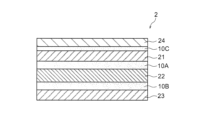
- FIG. 2 is a cross-sectional view of a laminate according to one embodiment of the present invention.
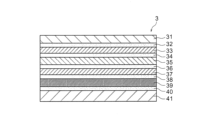
- FIG. 3 is a cross-sectional view of a device according to one embodiment of the present invention.
- FIG. 4 is a schematic diagram for explaining the static bending test in the examples.
- FIG. 5 is a schematic diagram for explaining the amount of deformation of a test piece in a static bending test in the examples.
- the adhesive sheet 1 As shown in FIG. 1, the adhesive sheet 1 according to the present embodiment has an adhesive layer 10, a first release sheet 11, and a second release sheet 12.
- the adhesive constituting the adhesive layer 10 will be described later.
- the two release sheets (the first release sheet 11 and the second release sheet 12) support the adhesive layer 10, and are arranged so that their release surfaces are in contact with both main surfaces 10a and 10b of the adhesive layer, and are peelable from the adhesive layer.
- the adhesive layer 10 is sandwiched between the two release sheets (the first release sheet 11 and the second release sheet 12) so as to be peelable.
- the release surface of the release sheet refers to the surface of the release sheet that has peelability, and includes both the surface that has been subjected to a release treatment and the surface that exhibits peelability even without the release treatment.
- the release sheet will be described later.
- the adhesive sheet according to this embodiment is used to bond a first member and a second member. It is preferable that at least one member selected from the first member and the second member is a member containing a piezoelectric body. It is also preferable that at least one member selected from the first member and the second member is a bendable member (flexible member). Furthermore, at least one member selected from the first member and the second member may be a flexible member containing a piezoelectric body.
- a member containing a piezoelectric material is a member in which a distortion occurs in the piezoelectric material when the piezoelectric material is pressed, etc., and a voltage is generated in the piezoelectric material due to this distortion.
- Examples of members containing a piezoelectric material include film-like members that have piezoelectric properties.
- a flexible member is a member that maintains its functionality even when it is bent, such as folded, or deformed by being pressed.
- Examples of flexible members include members that are molded to bend during the manufacture of a device that includes the flexible member and that maintain a bent state, and members that are repeatedly bent when the device that includes the flexible member is in use.
- the adhesive layer that bonds the piezoelectric member or flexible member is also deformed.
- the device that includes the piezoelectric member and/or the flexible member is a portable device or a device that is installed in an external environment, such a device is exposed to temperature changes during use. For example, in an environment where the air temperature is around -20°C, or where the air temperature is 40°C or higher and the temperature of the device rises to around 70°C due to heat generation, the adhesive layer is also exposed to such temperature changes.
- the physical properties of the adhesive that constitutes the adhesive layer may change.
- the flexibility of the adhesive tends to decrease.
- the flexibility of the adhesive decreases, the adhesive becomes less likely to deform.
- the input sensitivity of the touch panel may decrease, and the force required to bend the display may increase, creating a sense of incongruity compared to operation at normal temperatures.
- the hardness of the adhesive layer at low temperatures is kept low, and the physical properties of the adhesive layer are controlled so that even if the adhesive layer is repeatedly deformed, the adhesive layer recovers to a large extent, thereby suppressing variation in the degree of deformation of the adhesive layer within a specified temperature range.
- the pressure-sensitive adhesive layer bonds the first member and the second member.
- the first member and the second member are preferably bonded to a member including a piezoelectric body and/or a flexible member.
- the adhesive layer may be composed of one layer (single layer), or may be composed of two or more layers. When the adhesive layer has multiple layers, these multiple layers may be the same or different, and there are no particular limitations on the combination of layers that make up these multiple layers.
- the thickness of the adhesive layer 10 is preferably 1 to 1000 ⁇ m, more preferably 5 to 500 ⁇ m, even more preferably 10 to 250 ⁇ m, particularly preferably 20 to 100 ⁇ m, and most preferably 30 to 70 ⁇ m. This provides adhesion that allows the first and second members to be bonded well, and, even if deformation occurs due to bending or pressing, it is possible to provide a laminate that has good pressing properties and is unlikely to leave pressing marks, in combination with physical properties such as Shore hardness and recovery properties, which will be described later.
- the pressure-sensitive adhesive layer 10 has the following physical properties.
- “Shore hardness (Shore E) measured on the surface of the adhesive layer at temperature T (°C) using an E-type durometer” may be expressed as “Shore E (T).” Specifically, when the temperature T (°C) is -20°C, it may be expressed as “Shore E (-20),” when it is 23°C, it may be expressed as “Shore E (23),” and when it is 70°C, it may be expressed as “Shore E (70).”
- the "restoration rate of the adhesive layer at temperature T (°C)” may be expressed as “restoration rate R(T).” Specifically, when the temperature T (°C) is -20°C, it may be expressed as “restoration rate R(-20),” when it is 23°C, it may be expressed as “restoration rate R(23),” and when it is 70°C, it may be expressed as “restoration rate R(70).”
- the "distortion rate of the adhesive layer after 10 seconds at temperature T (°C)” may be expressed as “distortion rate (T).” Specifically, when the temperature T (°C) is -20°C, it may be expressed as “distortion rate (-20),” when it is 23°C, it may be expressed as “distortion rate (23),” and when it is 70°C, it may be expressed as “distortion rate (70).”
- the Shore E (-20°C) is preferably 70HS or less. This makes it easier to ensure the flexibility of the adhesive layer even at low temperatures.
- the Shore hardness of the adhesive layer at room temperature (e.g., 23°C) and at high temperature (e.g., 70°C) tends to be lower than the Shore hardness of the adhesive layer at low temperature (-20°C). Therefore, the adhesive layer can be kept flexible over a wide temperature range, and for example, a laminate having such an adhesive layer exhibits good pressing properties even at low temperatures, similar to those at room temperature.
- Shore E (-20) is preferably 1 to 67 HS, more preferably 15 to 64 HS, and from the viewpoint of compatibility with the recovery rate and blister resistance described below, it is preferably 25 to 60 HS, even more preferably 30 to 55 HS, particularly preferably 36 to 50 HS, and of these, 41 to 46 HS is preferable.
- Shore E (23) is 70HS or less.
- Shore E (-20) being within the above range
- Shore E (23) it is easy to ensure the flexibility of the adhesive layer at room temperature.
- the adhesive layer can be kept flexible over a wide temperature range, and for example, a laminate having such an adhesive layer exhibits good pressing properties.
- Shore E (23) is preferably 1 to 65 HS, more preferably 10 to 60 HS, and even more preferably 16 to 55 HS. From the viewpoint of compatibility with the recovery rate and blister resistance described below, it is preferably 22 to 50 HS, particularly preferably 28 to 45 HS, and of these, 31 to 40 HS is preferable.
- Shore E(70) is 70HS or less.
- Shore E(-20) being within the above range
- Shore E(70) being within the above range
- the adhesive layer can be kept flexible over a wide temperature range, and for example, a laminate having such an adhesive layer exhibits good pressing properties.
- Shore E (70) is preferably 1 to 55 HS, more preferably 8 to 40 HS, and even more preferably 16 to 35 HS. From the viewpoint of compatibility with the recovery rate and blister resistance described below, it is particularly preferable that it is 20 to 30 HS, and of these, 23 to 26 HS is preferable.
- the Shore hardness of the adhesive layer can be adjusted, for example, by changing the composition of the adhesive (the type and amount of reactive functional groups, the molecular structure and glass transition temperature of the monomer composition used, etc.), the molecular weight of the material that constitutes the adhesive, etc. Specific methods for measuring Shore hardness are described in detail in the examples below. In this specification, when the adhesive layer is active energy ray curable, the Shore hardness of the adhesive layer is the Shore hardness after irradiation with active energy rays.
- the recovery rate R(23) is preferably 70% or more.
- the recovery rate indicates the percentage of recovery of the state of the adhesive layer 60 seconds after the adhesive layer is released in a bent and deformed state, relative to the state of the adhesive layer before deformation and not bent. In other words, when the state of the adhesive layer 60 seconds after the adhesive layer is released in a bent and deformed state is the same as the state of the adhesive layer before deformation and not bent, the recovery rate is 100%.
- the recovery rate is an index of the degree of recovery from deformation.
- the recovery rate R(23) When the recovery rate R(23) is within the above range, the deformed and undeformed states of the adhesive layer at 23°C are close to each other, and the deformation of the adhesive layer is sufficiently restored. Therefore, for example, when the surface of a laminate created through the adhesive layer is pressed with a finger or a touch pen, the deformation of the adhesive layer at the pressed location is restored after pressing, and a pressing mark is unlikely to remain.
- Such an adhesive layer is suitable for laminates that are subject to deformation such as bending or pressing.
- the recovery rate R(23) when the recovery rate R(23) is within the above range, the recovery rate of the adhesive layer at low temperatures (e.g., -20°C) and high temperatures (e.g., 70°C) tends to show values equivalent to the recovery rate R(23). Therefore, it is possible to suppress variation in the degree of deformation of the adhesive layer over a wide temperature range.
- the recovery rate R(-20) is 70% or more.
- the recovery rate R(-20) being within the above range reliably suppresses the variation in the degree of deformation of the adhesive layer at low temperatures. As a result, it is possible to suppress the variation in the degree of deformation of the adhesive layer over a wide temperature range.
- the restoration rate R(-20) is preferably 80% or more, more preferably 84% or more, even more preferably 88% or more, and particularly preferably 90% or more, and of these, preferably 91% or more.
- the lower limit of the restoration rate R(-20) is preferably 100% or less.
- the recovery rate R(70) is 70% or more.
- the recovery rate R(70) being within the above range reliably suppresses the variation in the degree of deformation of the adhesive layer at high temperatures. As a result, it is possible to suppress the variation in the degree of deformation of the adhesive layer over a wide temperature range.
- the restoration rate R(70) is preferably 75% or more, more preferably 80% or more, even more preferably 85% or more, particularly preferably 90% or more, and most preferably 93% or more.
- the lower limit of the restoration rate R(70) is preferably 100% or less.
- the recovery rate of the adhesive layer be within the above range at -20°C and 70°C in addition to 23°C.
- the recovery rate of the adhesive layer can be adjusted, for example, by changing the composition of the adhesive (the type and amount of reactive functional groups, the molecular structure and glass transition temperature of the monomer composition used, etc.), the molecular weight of the material that constitutes the adhesive, etc. Specific methods for measuring the recovery rate are described in detail in the examples below. In this specification, when the adhesive layer is active energy ray curable, the recovery rate of the adhesive layer is the recovery rate after irradiation with active energy rays.
- the distortion rate (-20) is preferably 10% or more. This makes it easier to satisfy the above-mentioned Shore E (-20) in the desired range, and the flexibility of the adhesive layer is easily ensured even at low temperatures.
- the distortion rate of the adhesive layer at room temperature and high temperature for example, 70°C
- the adhesive layer can be kept flexible in a wide temperature range, and for example, a laminate including such an adhesive layer exhibits good pressing properties at low temperatures similar to those at room temperature.
- the distortion rate after 10 seconds in this specification is the distortion rate of the adhesive layer 10 seconds after the start of applying a certain stress to the adhesive layer by a viscoelasticity measuring device at a temperature of -20°C. A specific measurement method will be described later.
- the distortion rate (-20) is preferably 12 to 200%, and more preferably 13 to 120%. From the viewpoints of making it easier to achieve the above-mentioned Shore E (-20) within the desired range and of achieving both the recovery rate and blister resistance, it is preferably 14 to 60%, more preferably 15 to 50%, and particularly preferably 16 to 40%, and of these, 17 to 30% is preferable.
- the distortion rate (23) is 10% or more. This makes it easier for the above-mentioned Shore E (23) to fall within the desired range, and makes it easier to ensure the flexibility of the adhesive layer at room temperature.
- the distortion rate (23) is preferably 20 to 300%, more preferably 30 to 200%, and from the viewpoints of making it easier for the above-mentioned Shore E (23) to satisfy the desired range and of achieving compatibility with the recovery rate and blister resistance, it is even more preferably 35 to 170%, preferably 40 to 130%, particularly preferably 45 to 100%, and of these, 50 to 80% is preferable.
- the distortion rate (70) is 10% or more. This makes it easier for the above-mentioned Shore E (70) to satisfy the desired range, and also makes it easier to ensure that the adhesive layer has both cohesive strength and flexibility at high temperatures.
- the distortion rate (70) is preferably 20 to 600%, more preferably 30 to 400%, and from the viewpoints of making it easier for the above-mentioned Shore E (70) to satisfy the desired range and of achieving compatibility with the recovery rate and blister resistance, it is even more preferable that it is 35 to 300%, preferably 40 to 200%, particularly preferably 45 to 150%, and of these, preferably 50 to 120%.
- the distortion rate of the adhesive layer can be adjusted, for example, by changing the composition of the adhesive (the type and amount of reactive functional groups, the molecular structure and glass transition temperature of the monomer composition used, etc.), the molecular weight of the material that constitutes the adhesive, etc. Specific methods for measuring the distortion rate are described in detail in the examples below. In this specification, when the adhesive layer is active energy ray curable, the distortion rate of the adhesive layer is the distortion rate after irradiation with active energy rays.
- the gel fraction of the pressure-sensitive adhesive layer is preferably 40 to 100%, more preferably 50 to 95%, even more preferably 60 to 90%, particularly preferably 70 to 86%, and of these, preferably 73 to 82%. This results in a pressure-sensitive adhesive having suitable cohesive properties, and makes it easier to adjust the above-mentioned physical properties and the below-mentioned adhesive strength, etc., to desired ranges. In addition, good blister resistance is easily exhibited.
- the gel fraction before active energy ray irradiation is preferably 40-90%, more preferably 48-85%, even more preferably 56-80%, and particularly preferably 60-75%.
- the gel fraction after active energy ray irradiation is preferably 50-100%, more preferably 60-95%, even more preferably 70-90%, and particularly preferably 75-85%. This results in an adhesive with suitable cohesive properties, making it easier to adjust the physical properties described above and the adhesive strength described below to the desired range. It also tends to exhibit good blister resistance.
- the adhesive strength of the adhesive to soda-lime glass is preferably 0.1 to 60 N/25 mm, more preferably 0.5 to 40 N/25 mm, even more preferably 1 to 20 N/25 mm, particularly preferably 3 to 15 N/25 mm, and of these, preferably 6 to 10 N/25 mm. This improves the adhesion to adherends such as optical members, and, together with the above-mentioned gel fraction range, makes it easy to exhibit good blister resistance.
- the adhesive strength of the adhesive to soda lime glass before exposure to active energy rays is preferably 0.1 to 60 N/25 mm, more preferably 1 to 40 N/25 mm, even more preferably 5 to 20 N/25 mm, and particularly preferably 10 to 15 N/25 mm.
- the adhesive strength of the adhesive to soda lime glass after exposure to active energy rays is preferably 1 to 100 N/25 mm, more preferably 5 to 75 N/25 mm, even more preferably 10 to 50 N/25 mm, and particularly preferably 15 to 40 N/25 mm, and of these, 20 to 30 N/25 mm is preferred. This improves adhesion to adherends such as optical members, and makes it easier to achieve good blister resistance together with the above-mentioned gel fraction range.
- the above adhesive strength may be measured using the 180-degree peeling method in accordance with JIS Z0237:2009.
- the specific measurement method is as shown in the test example described below.
- the total light transmittance of the pressure-sensitive adhesive layer is preferably 80% or more, more preferably 90% or more, even more preferably 95% or more, and particularly preferably 98% or more. This is suitable when the pressure-sensitive adhesive layer is required to be transparent for optical applications.
- the upper limit of the total light transmittance is usually 100% or less.
- the total light transmittance of the pressure-sensitive adhesive layer is the total light transmittance after irradiation with active energy rays.
- the total light transmittance in this specification is a value measured in accordance with JIS K7361-1:1997.
- the haze value of the pressure-sensitive adhesive layer is preferably 10% or less, more preferably 1% or less, even more preferably 0.5% or less, and particularly preferably 0.2% or less. This is suitable when the transparency of the pressure-sensitive adhesive layer is required for optical applications.
- the lower limit of the haze value is usually 0% or more.
- the haze value of the pressure-sensitive adhesive layer is the haze value after exposure to active energy rays.
- the haze value in this specification is a value measured in accordance with JIS K7136:2000.
- the composition of the adhesive constituting the adhesive layer is not particularly limited.
- it may be any of an acrylic adhesive, a polyester adhesive, a polyurethane adhesive, a rubber adhesive, a silicone adhesive, etc.
- the adhesive may be any of an emulsion type, a solvent type, or a solventless type.
- the adhesive may have a crosslinked structure or may not have a crosslinked structure.
- the adhesive may be active energy ray curable or may not be active energy ray curable.
- an acrylic adhesive is preferred as the adhesive, and an acrylic adhesive having a crosslinked structure is more preferred.
- the adhesive is preferably an adhesive obtained by crosslinking an adhesive composition (hereinafter sometimes referred to as "adhesive composition P") containing a (meth)acrylic acid ester polymer (A) and a crosslinking agent (B).
- adhesive composition P an adhesive obtained by crosslinking an adhesive composition
- A a (meth)acrylic acid ester polymer
- B a crosslinking agent
- the adhesive may be made of a material with a high biomass content, may be made of a material that can be recycled or reused, or may be made of a recycled or reused material.
- (meth)acrylic acid means both acrylic acid and methacrylic acid. The same applies to other similar terms.
- copolymer is also included in "polymer”.
- the (meth)acrylic acid ester polymer (A) preferably contains, as monomer units constituting the polymer, a (meth)acrylic acid alkyl ester and a monomer having a reactive functional group in the molecule (a reactive functional group-containing monomer), which makes it easier to obtain a pressure-sensitive adhesive having a crosslinked structure and good adhesion.
- the (meth)acrylic acid ester polymer (A) contains an aromatic ring-containing monomer as a monomer unit constituting the polymer. This makes it easier to obtain the above-mentioned physical properties.
- the (meth)acrylic acid ester polymer (A) contains a nitrogen atom-containing monomer as a monomer unit constituting the polymer. This makes it easier to obtain the above-mentioned physical properties.
- the (meth)acrylic acid ester polymer (A) preferably contains, as monomer units constituting the polymer, an alkyl (meth)acrylic acid ester, a reactive functional group-containing monomer, and an aromatic ring-containing monomer, and also preferably contains an alkyl (meth)acrylic acid ester, a reactive functional group-containing monomer, an aromatic ring-containing monomer, and a nitrogen atom-containing monomer.
- the resulting adhesive can exhibit desirable adhesiveness.
- a (meth)acrylic acid alkyl ester having an alkyl group with 1 to 20 carbon atoms is preferred.
- the alkyl group may be linear or branched, or may have a cyclic structure.
- Examples of (meth)acrylic acid alkyl esters having an alkyl group with 1 to 20 carbon atoms include methyl (meth)acrylate, ethyl (meth)acrylate, propyl (meth)acrylate, n-butyl (meth)acrylate, n-pentyl (meth)acrylate, n-hexyl (meth)acrylate, 2-ethylhexyl (meth)acrylate, n-octyl (meth)acrylate, isooctyl (meth)acrylate, n-decyl (meth)acrylate, n-dodecyl (meth)acrylate, myristyl (meth)acrylate, palmityl (meth)acrylate, and stearyl (meth)acrylate.
- (meth)acrylic acid esters in which the alkyl group has 1 to 8 carbon atoms are preferred, and (meth)acrylic acid esters in which the alkyl group has 4 to 8 carbon atoms are particularly preferred.
- n-butyl (meth)acrylate, 2-ethylhexyl (meth)acrylate, and n-octyl (meth)acrylate are preferred, and n-butyl acrylate, 2-ethylhexyl acrylate, and n-octyl acrylate are particularly preferred. These may be used alone or in combination of two or more.
- the (meth)acrylic acid ester polymer (A) preferably contains 60 to 99.9 mass % of (meth)acrylic acid alkyl esters having an alkyl group with 1 to 20 carbon atoms as monomer units constituting the polymer, more preferably 70 to 99 mass %, even more preferably 80 to 98.5 mass %, and particularly preferably 90 to 98 mass %. This allows the resulting adhesive layer to be endowed with suitable restoring properties and adhesiveness.
- other monomer components can be introduced into the (meth)acrylic acid ester polymer (A) in desired amounts, making it easier to design an adhesive that exhibits the desired performance.
- the (meth)acrylic acid ester polymer (A) contains a reactive functional group-containing monomer as a monomer unit constituting the polymer, and the (meth)acrylic acid ester polymer (A) reacts with the crosslinking agent (B) described below via the reactive functional group derived from the reactive functional group-containing monomer, forming a crosslinked structure (three-dimensional network structure) in the adhesive.
- the crosslinking agent (B) described below the reactive functional group derived from the reactive functional group-containing monomer
- Preferred reactive functional group-containing monomers include monomers having a hydroxyl group in the molecule (hydroxyl group-containing monomers), monomers having a carboxyl group in the molecule (carboxyl group-containing monomers), and monomers having an amino group in the molecule (amino group-containing monomers). These reactive functional group-containing monomers may be used alone or in combination of two or more. Among these, hydroxyl group-containing monomers or carboxyl group-containing monomers are preferred, and hydroxyl group-containing monomers are particularly preferred.
- hydroxyl group-containing monomers examples include (meth)acrylic acid hydroxyalkyl esters such as 2-hydroxyethyl (meth)acrylate, 2-hydroxypropyl (meth)acrylate, 3-hydroxypropyl (meth)acrylate, 2-hydroxybutyl (meth)acrylate, 3-hydroxybutyl (meth)acrylate, and 4-hydroxybutyl (meth)acrylate.
- (meth)acrylic acid hydroxyalkyl esters having a hydroxyalkyl group with 1 to 4 carbon atoms are preferred.
- 2-hydroxyethyl (meth)acrylate and 4-hydroxybutyl (meth)acrylate are preferred, and 2-hydroxyethyl acrylate or 4-hydroxybutyl acrylate are particularly preferred. These may be used alone or in combination of two or more.
- carboxyl group-containing monomers examples include ethylenically unsaturated carboxylic acids such as acrylic acid, methacrylic acid, crotonic acid, maleic acid, itaconic acid, and citraconic acid.
- acrylic acid is preferred from the viewpoint of the adhesive strength of the resulting (meth)acrylic acid ester polymer (A). These may be used alone or in combination of two or more.
- the (meth)acrylic acid ester polymer (A) preferably contains 0.1 to 30 mass% of reactive functional group-containing monomer as a monomer unit constituting the polymer, more preferably 0.3 to 20 mass%.
- reactive functional group-containing monomer As a monomer unit constituting the polymer, more preferably 0.3 to 20 mass%.
- no aromatic ring-containing monomer it is preferable to contain 1 to 18 mass%, even more preferably 5 to 16 mass%, and of these, 10 to 15 mass% is particularly preferable. This makes the cohesive force of the adhesive obtained by the crosslinking reaction with the crosslinking agent (B) appropriate, making it easier to satisfy the above-mentioned physical properties.
- the (meth)acrylic acid ester polymer (A) does not contain a carboxy group-containing monomer as a monomer unit constituting the polymer. Since a carboxy group is an acid component, by not containing a carboxy group-containing monomer, even if the object to which the adhesive is applied contains something that may be damaged by acid, such as a transparent conductive film such as tin-doped indium oxide (ITO), a metal film, or a metal mesh, such damage caused by acid (corrosion, change in resistance, etc.) can be suppressed.
- a transparent conductive film such as tin-doped indium oxide (ITO), a metal film, or a metal mesh
- not containing a carboxyl group-containing monomer means that the carboxyl group-containing monomer is not substantially contained, and includes the case where the carboxyl group-containing monomer is contained to an extent that the carboxyl group does not cause corrosion of the transparent conductive film, metal wiring, etc., in addition to the case where the carboxyl group-containing monomer is not contained at all.
- the (meth)acrylic acid ester polymer (A) may contain the carboxyl group-containing monomer as a monomer unit in an amount of 0.1 mass % or less, preferably 0.01 mass % or less, and more preferably 0.001 mass % or less.
- aromatic ring-containing monomers examples include phenyl (meth)acrylate, 2-phenylethyl (meth)acrylate, benzyl (meth)acrylate, naphthyl (meth)acrylate, 2-phenoxyethyl (meth)acrylate, phenoxybutyl (meth)acrylate, ethoxylated-o-phenylphenol acrylate, phenoxydiethylene glycol (meth)acrylate, phenoxypolyethylene glycol (meth)acrylate, biphenyl di(meth)acrylate, pentafluorobenzyl (meth)acrylate, etc.
- phenyl (meth)acrylate, 2-phenylethyl (meth)acrylate, benzyl (meth)acrylate, naphthyl (meth)acrylate, 2-phenoxyethyl (meth)acrylate, and phenoxybutyl (meth)acrylate are preferred, and from the viewpoint of easily achieving favorable Shore hardness and recovery, 2-phenoxyethyl (meth)acrylate is more preferred, and 2-phenoxyethyl acrylate is particularly preferred. These may be used alone or in combination of two or more.
- the (meth)acrylic acid ester copolymer (A) preferably contains 0.1 to 20 mass% of an aromatic ring-containing monomer as a monomer unit constituting the polymer, more preferably 0.4 to 10 mass%, even more preferably 0.8 to 5 mass%, particularly preferably 1.0 to 3 mass%, and most preferably 1.2 to 2 mass%. This makes it easier to satisfy the above-mentioned physical properties. If the inclusion of an aromatic ring-containing monomer causes the resulting adhesive to emit an odor, it is preferable to adjust the content ratio to a level at which no odor is emitted. For example, when 2-phenoxyethyl acrylate is included as the aromatic ring-containing monomer, it is preferable to adjust the content ratio so that the adhesive does not emit an odor.
- Nitrogen atom-containing monomers include monomers having an amino group, monomers having an amide group, and monomers having a nitrogen-containing heterocycle, among which monomers having a nitrogen-containing heterocycle are preferred. From the viewpoint of increasing the degree of freedom of the nitrogen atom-containing monomer-derived portion in the higher-order structure of the adhesive, it is preferred that the nitrogen atom-containing monomer does not contain a reactive unsaturated double bond group other than one polymerizable group used in polymerization to form the (meth)acrylic acid ester polymer (A).
- the nitrogen atom-containing monomer may be used alone or in combination of two or more kinds.
- Examples of monomers having an amino group include monomethylaminoethyl (meth)acrylate, monoethylaminoethyl (meth)acrylate, monomethylaminopropyl (meth)acrylate, monoethylaminopropyl (meth)acrylate, dimethylaminoethyl (meth)acrylate, etc.
- Examples of monomers having an amide group include (meth)acrylamide, N-methyl(meth)acrylamide, N-methylol(meth)acrylamide, N-tert-butyl(meth)acrylamide, N,N-dimethyl(meth)acrylamide, N-ethyl(meth)acrylamide, N,N-dimethylaminopropyl(meth)acrylamide, N-isopropyl(meth)acrylamide, N-phenyl(meth)acrylamide, N-(n-butoxymethyl)(meth)acrylamide, dimethylaminopropyl(meth)acrylamide, and N-vinylcaprolactam.
- Examples of monomers having a nitrogen-containing heterocycle include N-(meth)acryloylmorpholine, N-vinyl-2-pyrrolidone, N-(meth)acryloylpyrrolidone, N-(meth)acryloylpiperidine, N-(meth)acryloylpyrrolidine, N-(meth)acryloylaziridine, aziridinylethyl (meth)acrylate, 2-vinylpyridine, 4-vinylpyridine, 2-vinylpyrazine, 1-vinylimidazole, N-vinylcarbazole, and N-vinylphthalimide.
- N-(meth)acryloylmorpholine is preferred, and N-acryloylmorpholine is particularly preferred.
- the (meth)acrylic acid ester polymer (A) preferably contains 0.1 to 20 mass %, more preferably 0.5 to 12 mass %, and even more preferably 1 to 6 mass % of a nitrogen atom-containing monomer as a monomer unit constituting the polymer. This makes it easier to satisfy the above-mentioned physical properties.
- the (meth)acrylic acid ester polymer (A) contains a monomer having an alicyclic structure in the molecule (alicyclic structure-containing monomer) as a monomer unit constituting the polymer. Since the alicyclic structure-containing monomer is bulky, it is presumed that the presence of this in the polymer increases the distance between the polymers, and the resulting adhesive can be an adhesive with excellent flexibility. This improves the physical properties described above.
- the carbon ring of the alicyclic structure in the alicyclic structure-containing monomer may be a saturated structure or may have an unsaturated bond in part.
- the alicyclic structure may be a monocyclic alicyclic structure or a polycyclic alicyclic structure (polycyclic structure) such as a bicyclic or tricyclic structure. From the viewpoint of appropriately adjusting the distance between the resulting (meth)acrylic acid ester polymer (A) and imparting high stress relaxation and recovery properties to the adhesive, the alicyclic structure is preferably a polycyclic structure.
- the polycyclic structure is particularly preferably a bicyclic to tetracyclic structure.
- the number of carbon atoms in the alicyclic structure is preferably 5 to 15, more preferably 7 to 10.
- alicyclic structure-containing monomers include cyclohexyl (meth)acrylate, dicyclopentanyl (meth)acrylate, adamantyl (meth)acrylate, isobornyl (meth)acrylate, dicyclopentenyl (meth)acrylate, dicyclopentenyloxyethyl (meth)acrylate, etc.
- dicyclopentanyl (meth)acrylate (alicyclic structure carbon number: 10), adamantyl (meth)acrylate (alicyclic structure carbon number: 10), or isobornyl (meth)acrylate (alicyclic structure carbon number: 7) are preferred, as they exhibit superior adhesion, and isobornyl (meth)acrylate is more preferred, and isobornyl acrylate is particularly preferred, from the viewpoint of easily satisfying the above-mentioned physical properties.
- dicyclopentanyl (meth)acrylate (alicyclic structure carbon number: 10)
- adamantyl (meth)acrylate (alicyclic structure carbon number: 10)
- isobornyl (meth)acrylate (alicyclic structure carbon number: 7) are preferred, as they exhibit superior adhesion, and isobornyl (meth)acrylate is more preferred, and isobornyl acrylate is particularly preferred, from the viewpoint of easily satisfying the above-mentioned physical properties.
- These may be
- the (meth)acrylic acid ester polymer (A) preferably contains 1 to 30 mass % of an alicyclic structure-containing monomer as a monomer unit constituting the polymer, more preferably 4 to 24 mass %, even more preferably 8 to 18 mass %, and particularly preferably 11 to 16 mass %. This makes it easier to satisfy the above-mentioned physical properties.
- the (meth)acrylic acid ester polymer (A) may contain other monomers as monomer units constituting the polymer, if desired.
- monomers that do not contain reactive functional groups are preferred so as not to inhibit the above-mentioned action of the reactive functional group-containing monomer.
- monomers include (meth)acrylic acid alkoxyalkyl esters such as methoxyethyl (meth)acrylate and ethoxyethyl (meth)acrylate, vinyl acetate, and styrene. These may be used alone or in combination of two or more.
- the polymerization form of the (meth)acrylic acid ester polymer (A) may be a random copolymer or a block copolymer.
- the weight average molecular weight of the (meth)acrylic acid ester polymer (A) is preferably 200,000 to 3,000,000, more preferably 300,000 to 2,500,000, and when an aromatic ring-containing monomer is included, it is preferably 500,000 to 2,000,000, even more preferably 700,000 to 1,800,000, and particularly preferably 900,000 to 1,600,000, and among these, 1,000,000 to 1,300,000 is preferred, and when an aromatic ring-containing monomer is not included, it is preferably 350,000 to 1,600,000, more preferably 400,000 to 1,200,000, and particularly preferably 450,000 to 800,000. This makes it easier for the adhesive obtained to satisfy the above-mentioned physical properties.
- the weight average molecular weight in this specification is a value measured by gel permeation chromatography (GPC) in terms of standard polystyrene.
- the (meth)acrylic acid ester polymer (A) may be used alone or in combination of two or more kinds.
- crosslinker (B) The crosslinking agent (B) crosslinks the (meth)acrylic acid ester polymer (A) and forms a crosslinked structure (three-dimensional network structure) when the pressure-sensitive adhesive composition P containing the crosslinking agent (B) is heated, etc. As a result, the cohesive strength of the resulting pressure-sensitive adhesive is improved, and the above-mentioned physical properties are easily satisfied.
- the crosslinking agent (B) may be any that reacts with the reactive group possessed by the (meth)acrylic acid ester polymer (A). Examples include isocyanate-based crosslinking agents, epoxy-based crosslinking agents, amine-based crosslinking agents, melamine-based crosslinking agents, aziridine-based crosslinking agents, hydrazine-based crosslinking agents, aldehyde-based crosslinking agents, oxazoline-based crosslinking agents, metal alkoxide-based crosslinking agents, metal chelate-based crosslinking agents, metal salt-based crosslinking agents, and ammonium salt-based crosslinking agents. Among these, it is preferable to use an isocyanate-based crosslinking agent that has excellent reactivity with the reactive functional group-containing monomer.
- the crosslinking agent (B) may be used alone or in combination of two or more.
- the isocyanate-based crosslinking agent contains at least a polyisocyanate compound.
- polyisocyanate compounds include aromatic polyisocyanates such as tolylene diisocyanate, diphenylmethane diisocyanate, and xylylene diisocyanate, aliphatic polyisocyanates such as hexamethylene diisocyanate, alicyclic polyisocyanates such as isophorone diisocyanate and hydrogenated diphenylmethane diisocyanate, and their biurets and isocyanurates, as well as adducts which are reaction products with low-molecular-weight active hydrogen-containing compounds such as ethylene glycol, propylene glycol, neopentyl glycol, trimethylolpropane, and castor oil.
- the content of the crosslinking agent (B) in the adhesive composition P is preferably 0.01 to 2 parts by mass, more preferably 0.10 to 1 part by mass or more, even more preferably 0.15 to 0.8 parts by mass, particularly preferably 0.20 to 0.6 parts by mass, and of these, preferably 0.25 to 0.4 parts by mass, relative to 100 parts by mass of the (meth)acrylic acid ester polymer (A). This makes it easier to satisfy the above-mentioned physical properties.
- the content of the crosslinking agent (B) in the adhesive composition P is preferably 0.01 to 2 parts by mass, more preferably 0.05 to 1 part by mass or more, even more preferably 0.08 to 0.6 parts by mass, particularly preferably 0.10 to 0.3 parts by mass, and of these, preferably 0.12 to 0.2 parts by mass, relative to 100 parts by mass of the (meth)acrylic acid ester polymer (A). This makes it easier to satisfy the above-mentioned physical properties.
- the pressure-sensitive adhesive composition P according to the present embodiment preferably contains a silane coupling agent (C), which improves adhesion to an adherend.
- Examples of such compounds include amino group-containing silicon compounds such as 3-aminopropyltrimethoxysilane, N-(2-aminoethyl)-3-aminopropyltrimethoxysilane, and N-(2-aminoethyl)-3-aminopropylmethyldimethoxysilane; 3-chloropropyltrimethoxysilane, 3-isocyanatopropyltriethoxysilane, and condensates of at least one of these compounds with alkyl group-containing silicon compounds such as methyltriethoxysilane, ethyltriethoxysilane, methyltrimethoxysilane, and ethyltrimethoxysilane. These compounds may be used alone or in combination of two or more.
- the content of the silane coupling agent (C) is preferably 0.01 to 2 parts by mass, more preferably 0.1 to 1 part by mass, even more preferably 0.15 to 0.5 parts by mass, and particularly preferably 0.18 to 0.25 parts by mass, per 100 parts by mass of the (meth)acrylic acid ester polymer (A). This makes it easier to achieve the above-mentioned characteristics.
- the adhesive composition P preferably contains an active energy ray curable component (D).
- active energy ray curable component (D) By curing the adhesive obtained by crosslinking the adhesive composition P with active energy rays, it is presumed that the active energy ray curable components (D) polymerize with each other, and the polymerized active energy ray curable components (D) become entangled with the crosslinked structure (three-dimensional network structure) of the (meth)acrylic acid ester polymer (A).
- An adhesive having such a high-order structure can exhibit excellent properties.
- the active energy ray curable component (D) is not particularly limited as long as it is a component that cures by irradiation with active energy rays and provides the above-mentioned effects and the optical and adhesive properties described above, and may be any of a monomer, oligomer, or polymer, or a mixture thereof.
- monofunctional acrylate monomers and polyfunctional acrylate monomers are preferred, and polyfunctional acrylate monomers are preferred from the viewpoint that the resulting adhesive exhibits excellent adhesiveness and durability while maintaining the optical and adhesive properties described above.
- Polyfunctional acrylate monomers with a molecular weight of less than 1000 are preferred from the viewpoint of compatibility with adhesive components, especially the (meth)acrylic acid ester polymer (A), and from the viewpoint that the resulting adhesive easily satisfies the above-mentioned physical properties.
- polyfunctional acrylate monomer bifunctional, trifunctional, tetrafunctional, pentafunctional, and hexafunctional acrylate monomers are preferred.
- polyfunctional acrylate monomers containing an isocyanurate structure in the molecule such as di(acryloxyethyl)isocyanurate, tris(acryloxyethyl)isocyanurate, and ⁇ -caprolactone-modified tris-(2-(meth)acryloxyethyl)isocyanurate, or polyfunctional acrylate monomers containing a cyclic structure (particularly a cycloalkane structure) in the molecule, such as tricyclodecane dimethanol (meth)acrylate, are preferred. These may be used alone or in combination of two or more.
- the content of the active energy ray-curable component (D) in the adhesive composition P is preferably 0.1 to 50 parts by mass, more preferably 0.5 to 35 parts by mass, and even more preferably 1 to 20 parts by mass, per 100 parts by mass of the (meth)acrylic acid ester polymer (A), from the viewpoint of the adhesiveness of the adhesive before curing with active energy rays. From the viewpoint of making it easier to satisfy the above-mentioned physical properties, the content is preferably 1 to 10 parts by mass, more preferably 2 to 8 parts by mass, and even more preferably 3 to 6 parts by mass.
- the adhesive composition P preferably contains a photopolymerization initiator (E) in addition to the active energy ray curable component (D), which allows the active energy ray curable component (D) to be polymerized efficiently and reduces the polymerization and curing time and the amount of active energy rays irradiated.
- Examples of the photopolymerization initiator (E) include benzoin, benzoin methyl ether, benzoin ethyl ether, benzoin isopropyl ether, benzoin-n-butyl ether, benzoin isobutyl ether, acetophenone, dimethylaminoacetophenone, 2,2-dimethoxy-2-phenylacetophenone, 2,2-diethoxy-2-phenylacetophenone, 2-hydroxy-2-methyl-1-phenylpropan-1-one, 1-hydroxycyclohexyl phenyl ketone, 2-methyl-1-[4-(methylthio)phenyl]-2-morpholino-propan-1-one, 4-(2-hydroxyethoxy)phenyl-2-(hydroxy-2-propyl)ketone, benzophenone, p-phenylbenzophenone, 4,
- Examples of the benzoxanthone include 4'-diethylaminobenzophenone, dichlorobenzophenone, 2-methylan
- phosphine oxide-based photopolymerization initiators are preferred from the viewpoint of being easily cleaved when irradiated with ultraviolet light and easily and reliably curing the adhesive.
- 2,4,6-trimethylbenzoyl-diphenyl-phosphine oxide, bis(2,4,6-trimethylbenzoyl)-phenylphosphine oxide, etc. are preferred.
- Some optical components that serve as adherends have ultraviolet light shielding properties, but even when ultraviolet light is irradiated through such ultraviolet light shielding components that are difficult for ultraviolet light to pass through, the above-mentioned phosphine oxide-based photopolymerization initiators can promote the curing of the active energy ray-curable component (D).
- the content of the photopolymerization initiator (E) in the adhesive composition P is preferably 1 to 30 parts by mass, more preferably 4 to 22 parts by mass, and even more preferably 8 to 16 parts by mass, per 100 parts by mass of the active energy ray-curable component (D).
- the adhesive composition P may contain additives that are commonly used in acrylic adhesives, if necessary.
- additives include ultraviolet absorbers, infrared absorbers, antistatic agents, tackifiers, antioxidants, light stabilizers, softeners, rust inhibitors, fillers, colorants, and refractive index adjusters. Note that the polymerization solvent and dilution solvent described below are not included in the additives that constitute the adhesive composition P.
- the release sheets 11 and 12 protect the adhesive layer 10 until the adhesive sheet 1 is used, and are peeled off when the adhesive sheet 1 (adhesive layer 10) is used.
- the adhesive sheet 1 according to this embodiment, one or both of the release sheets 11 and 12 are not necessarily required.
- the release sheets 11 and 12 may be, for example, polyethylene films, polypropylene films, polybutene films, polybutadiene films, polymethylpentene films, polyvinyl chloride films, vinyl chloride copolymer films, polyethylene terephthalate films, polyethylene naphthalate films, polybutylene terephthalate films, polyurethane films, ethylene vinyl acetate films, ionomer resin films, ethylene-(meth)acrylic acid copolymer films, ethylene-(meth)acrylic acid ester copolymer films, polystyrene films, polycarbonate films, polyimide films, fluororesin films, etc. Crosslinked films of these may also be used. Furthermore, laminated films of these may also be used. From the perspective of the SDGs, the material constituting the release sheets may be a material with a high biomass content, a material that can be recycled or reused, or a recycled or reused material.
- the release surfaces of the release sheets 11, 12 are preferably subjected to a release treatment.
- release agents used in the release treatment include alkyd-based, silicone-based, fluorine-based, unsaturated polyester-based, polyolefin-based, and wax-based release agents. It is preferable that one of the release sheets 11, 12 is a heavy release type release sheet with a high release strength, and the other is a light release type release sheet with a low release strength.
- the thickness of the release sheets 11 and 12 is usually about 20 to 150 ⁇ m.
- the pressure-sensitive adhesive composition P can be produced, for example, by first producing a (meth)acrylic acid ester polymer (A) and then mixing the resulting (meth)acrylic acid ester polymer (A) with a crosslinking agent (B). If necessary, a silane coupling agent (C), an active energy ray-curable component (D), a photopolymerization initiator (E), and other additives may be added.
- the (meth)acrylic acid ester polymer (A) can be produced, for example, by polymerizing a mixture of monomers that constitute the polymer using a normal radical polymerization method.
- the polymerization of the (meth)acrylic acid ester polymer (A) can be carried out by a solution polymerization method, using a polymerization initiator as necessary.
- a solution polymerization method By polymerizing the (meth)acrylic acid ester polymer (A) using a solution polymerization method, it becomes easy to increase the molecular weight of the resulting polymer and adjust the molecular weight distribution, and it becomes possible to reduce the production of low molecular weight substances. As a result, it is easy to obtain an adhesive that has excellent recovery from deformation caused by bending or pressing.
- polymerization solvents used in the solution polymerization method include ethyl acetate, n-butyl acetate, isobutyl acetate, toluene, acetone, hexane, and methyl ethyl ketone.
- One type of polymerization solvent may be used, or two or more types may be used in combination.
- polymerization initiators include azo compounds and organic peroxides, and two or more types may be used in combination.
- a chain transfer agent such as 2-mercaptoethanol in the above polymerization process, the weight average molecular weight of the resulting polymer can be adjusted.
- the crosslinking agent (B) and, if necessary, the silane coupling agent (C), the active energy ray curable component (D), the photopolymerization initiator (E), other additives, the dilution solvent, etc. are added to the solution of the (meth)acrylic acid ester polymer (A) and mixed thoroughly to obtain the adhesive composition P (coating solution) diluted with the solvent.
- the adhesive composition P coating solution
- the component may be dissolved or diluted alone in a dilution solvent before mixing with the other components.
- dilution solvents examples include aliphatic hydrocarbons such as hexane, heptane, and cyclohexane; aromatic hydrocarbons such as toluene and xylene; halogenated hydrocarbons such as methylene chloride and ethylene chloride; alcohols such as methanol, ethanol, propanol, butanol, and 1-methoxy-2-propanol; ketones such as acetone, methyl ethyl ketone, 2-pentanone, isophorone, and cyclohexanone; esters such as ethyl acetate and butyl acetate; and cellosolve-based solvents such as ethyl cellosolve.
- aliphatic hydrocarbons such as hexane, heptane, and cyclohexane
- aromatic hydrocarbons such as toluene and xylene
- halogenated hydrocarbons such as methylene chloride and
- the concentration and viscosity of the coating solution prepared in this manner may be within the range that allows coating, and may be appropriately selected depending on the situation.
- the adhesive composition P is diluted so that its concentration is 10 to 60% by mass. Note that the addition of a dilution solvent or the like is not a necessary condition for obtaining the coating solution, and if the adhesive composition P has a viscosity that allows coating, it is not necessary to add a dilution solvent. In this case, the adhesive composition P becomes a coating solution in which the polymerization solvent for the (meth)acrylic acid ester polymer (A) itself serves as the dilution solvent.
- the adhesive constituting the adhesive layer is preferably obtained by crosslinking the above-mentioned adhesive composition P.
- the crosslinking of the adhesive composition P can usually be carried out by a heat treatment. This heat treatment can also serve as a drying treatment for volatilizing a diluting solvent or the like from a coating film of the adhesive composition P applied to a desired object.
- such an adhesive layer can also be preferably formed by applying the adhesive composition P to a desired object, subjecting it to a heat treatment, and then curing the adhesive composition P by irradiating it with active energy rays.
- the heating temperature for the heat treatment is preferably 50 to 150°C, and more preferably 70 to 120°C.
- the heating time is preferably 10 seconds to 10 minutes, and more preferably 50 seconds to 2 minutes.
- a curing period of about 1 to 2 weeks may be provided at room temperature (e.g., 23°C, relative humidity 50%) as necessary. If curing is required, an adhesive having a cross-linked structure is obtained after the curing period has elapsed. If curing is not required, an adhesive having a cross-linked structure is obtained after the heat treatment has been completed.
- “relative humidity ⁇ %” may be expressed as “ ⁇ % RH” (RH; Relative humidity).
- active energy rays refer to electromagnetic waves or charged particle beams that have an energy quantum, and specific examples include ultraviolet rays and electron beams. Among active energy rays, ultraviolet rays are particularly preferred because they are easy to handle.
- the irradiation with ultraviolet rays can be carried out by a high pressure mercury lamp, a Heraeus H lamp, a xenon lamp, or the like, and the irradiation amount of the ultraviolet rays is preferably an illuminance of 50 to 1000 mW/cm 2.
- the light amount is preferably 50 to 10000 mJ/cm 2 , more preferably 80 to 5000 mJ/cm 2 , and particularly preferably 300 to 2000 mJ/cm 2.
- the irradiation with electron beams can be carried out by an electron beam accelerator, or the like, and the irradiation amount of the electron beams is preferably about 10 to 1000 krad.
- the adhesive after curing by irradiation with active energy rays may contain photopolymerization initiator (E) that has not been cleaved by irradiation with active energy rays.
- the remaining amount of photopolymerization initiator (E) in the adhesive after curing is preferably 0.1 mass% or less, and more preferably 0.01 mass% or less.
- the method for producing the adhesive sheet 1 is not particularly limited, and it may be produced by a known method.
- the above-mentioned coating solution of the adhesive composition P is applied to the release surface of one of the first release sheets 11 (or the second release sheet 12), and the adhesive composition P is crosslinked by heat treatment to form a coating layer having a predetermined thickness.
- the release surface of the other second release sheet 12 (or the first release sheet 11) is superimposed on the formed coating layer. If curing is required, the coating layer becomes the adhesive layer 10 after a predetermined curing period. Also, if curing is not required, the coating layer becomes the adhesive layer 10 as it is. In this way, the adhesive sheet 1 is obtained.
- the above-mentioned coating liquid of the adhesive composition P is applied to the release surface of the first release sheet 11, and a heat treatment is performed to crosslink the adhesive composition P and form a coating layer, thereby obtaining the first release sheet 11 with the coating layer.
- the above-mentioned coating liquid of the adhesive composition P is applied to the release surface of the other second release sheet 12, and a heat treatment is performed to crosslink the adhesive composition P and form a coating layer, thereby obtaining the second release sheet 12 with the coating layer.
- the first release sheet 11 with the coating layer and the second release sheet 12 with the coating layer are bonded together so that both coating layers are in contact with each other.
- the coating layer becomes the adhesive layer 10 after a predetermined curing period. Also, if curing is not required, the coating layer becomes the adhesive layer 10 as it is. In this way, the adhesive sheet 1 is obtained. According to this manufacturing method, it is possible to stably manufacture the adhesive layer 10 even if the adhesive layer 10 is thick.
- Examples of methods for applying the adhesive composition P coating solution include bar coating, knife coating, roll coating, blade coating, die coating, and gravure coating.
- the laminate 2 As shown in FIG. 2 , the laminate 2 according to this embodiment is configured to include a first member 21, a second member 22, a third member 23, a fourth member 24, an adhesive layer 10A located between them and bonding the first member 21 and the second member 22 to each other, an adhesive layer 10B that bonds the second member 22 and the third member 23 to each other, and an adhesive layer 10C that bonds the first member 21 and the fourth member 24 to each other.
- the adhesive layers 10A, 10B, and 10C in the laminate 2 are the adhesive layer 10 of the adhesive sheet 1 described above.
- the laminate 2 An example of manufacturing the laminate 2 is shown below. First, the second release sheet on one side of the adhesive sheet is peeled off, and the exposed adhesive layer 10A of the adhesive sheet is attached to one side of the first member 21.
- the other first release sheet is peeled off from the adhesive layer 10A of the adhesive sheet, and the exposed adhesive layer 10A of the adhesive sheet 1 is bonded to the second member 22.
- the second member 22 is bonded to the third member 23 using the adhesive layer 10B of another adhesive sheet, and the first member 21 is bonded to the fourth member 24 using the adhesive layer 10C of another adhesive sheet to obtain the laminate 2.
- the order of bonding the first member 21, the second member 22, the third member 23, and the fourth member 24 may be reversed.
- the laminate 2 is described as being a touch panel that includes a piezoelectric material.
- the first member 21 is a member that includes a piezoelectric material
- the second member 22 and the third member 23 are electrodes
- the fourth member 24 is a cover material.
- the member containing the piezoelectric body is not limited as long as it exhibits piezoelectricity, but is preferably a film-like piezoelectric film.
- An example of a piezoelectric film is a film made of a polymeric piezoelectric material. Films made of polymeric piezoelectric materials are highly transparent and flexible, making them suitable as components for touch panels. Examples of polymeric piezoelectric materials include fluorine-based polyolefins and polylactic acid.
- the electrodes detect the distortion generated in the piezoelectric body as a voltage. They may be electrodes for detecting the pressing position, electrodes for detecting pressing force information, or electrodes for detecting the pressing position and pressing force information.
- the electrodes are preferably made of a material with high transparency, and examples of such materials include ITO (indium tin oxide) and conductive polymers.
- cover materials include highly transparent glass materials and resin materials.
- the cover material may be in the form of a film.
- the adhesive layer used to bond the components that make up the laminate is the adhesive layer described above, even if the piezoelectric sensor is exposed to an external environment with large temperature changes, the adhesive layer remains flexible even at low temperatures and fully recovers from its deformed state to its original state. Therefore, variation in the degree of deformation of the adhesive layer can be suppressed over a wide temperature range.
- each member of the laminate 2 is made of a flexible material.
- a laminate 2 is preferably a flexible device itself, or a member that constitutes a part of a flexible device.
- the flexible device may be a device including a member that is bent once during manufacture and maintains the bent state, or may be a device including a member that can be repeatedly bent (including folded).
- the flexible device is preferably a display, but is not limited to this. Examples of flexible devices include organic electroluminescence (organic EL) displays, electrophoretic displays (electronic paper), liquid crystal displays that use a plastic substrate (film) as a substrate, light-emitting diode (LED) displays, foldable displays, stretchable displays, rollable displays, etc. These may include touch panels.
- Examples of flexible materials include cover films, barrier films, hard coat films, polarizing films (polarizing plates), polarizers, retardation films (retardation plates), viewing angle compensation films, brightness enhancement films, contrast enhancement films, diffusion films, semi-transmissive reflective films, electrode films, transparent conductive films, metal mesh films, film sensors (touch sensor films), liquid crystal polymer films, light-emitting polymer films, film-like liquid crystal modules, organic EL modules (organic EL films, organic EL elements), electronic paper modules (film-like electronic paper), TFT (Thin Film Transistor) substrates, etc.
- the Young's modulus of each flexible member is preferably 0.1 to 10 GPa, more preferably 0.5 to 7 GPa, and even more preferably 1 to 5 GPa. This makes it easy to repeatedly deform each flexible member by bending, pressing, etc.
- each flexible member is preferably 10 to 3000 ⁇ m, more preferably 25 to 1000 ⁇ m, and even more preferably 50 to 500 ⁇ m. This makes it easy to repeatedly deform each flexible member by bending, pressing, etc.
- the interlayer adhesion (adhesive strength) between flexible members is preferably 1 to 30 N/25 mm, more preferably 2 to 25 N/25 mm, and even more preferably 5 to 20 N/25 mm. This makes it possible to suppress peeling between members even when the members are repeatedly deformed by bending or pressing, and also provides excellent reworkability, so that even if a bonding error occurs between flexible members, the two can be easily peeled off, making it possible to reuse flexible members (especially expensive flexible members).
- the interlayer adhesion basically refers to the adhesive strength measured by the 180-degree peel method in accordance with JIS Z0237:2009.
- the measurement sample is 25 mm wide and 100 mm long, and the flexible members to be measured are bonded together with an adhesive layer to produce a laminate, which is then pressurized at 0.5 MPa and 50°C for 20 minutes and left to stand for 24 hours under normal pressure, 23°C, and 50% RH before being measured at a peel speed of 300 mm/min.
- the device according to the present embodiment includes the above-mentioned laminate 2, and may be composed of only the laminate 2, or may include one or more laminates 2 and other members. When one laminate 2 is laminated with another laminate 2, or when the laminate 2 is laminated with other members, it is preferable to laminate them via the pressure-sensitive adhesive layer 10 of the pressure-sensitive adhesive sheet 1 described above.
- the device according to this embodiment has each component bonded together by the adhesive layer described above, so even if it is used in an environment with large temperature changes and the adhesive layer is repeatedly deformed, the adhesive layer maintains its flexibility and variation in the degree of deformation is suppressed.
- FIG. 3 shows an example of a device in this embodiment. Note that the device according to the present invention is not limited to this device.
- the device 3 is configured by laminating, from the top, a cover film 31, a first adhesive layer 32, a first electrode 33, a second adhesive layer 34, a piezoelectric film 35, a third adhesive layer 36, a second electrode 37, a fourth adhesive layer 38, an organic EL element 39, a fifth adhesive layer 40, and a TFT substrate 41. That is, the device 3 has a configuration in which a touch panel including a piezoelectric body as the laminate 2 and a flexible display as the laminate 2 are bonded together via the fourth adhesive layer.
- the touch panel including a piezoelectric body is configured from a flexible material
- the device shown in FIG. 3 is a flexible device equipped with an input device and a display device.
- first adhesive layer 32, the second adhesive layer 34, the third adhesive layer 36, the fourth adhesive layer 38 and the fifth adhesive layer 40 is the adhesive layer 10 of the adhesive sheet 1 described above. It is preferable that two or more of the first adhesive layer 32, the second adhesive layer 34, the third adhesive layer 36, the fourth adhesive layer 38 and the fifth adhesive layer 40 are the adhesive layer 10 of the adhesive sheet 1 described above, and it is most preferable that all of the adhesive layers 32, 34, 36, 38 and 40 are the adhesive layer 10 of the adhesive sheet 1.
- Example 1 Preparation of (meth)acrylic acid ester polymer 48.6 parts by mass of n-butyl acrylate, 48.6 parts by mass of 2-ethylhexyl acrylate, 1.8 parts by mass of 2-phenoxyethyl acrylate, and 1 part by mass of 4-hydroxybutyl acrylate were copolymerized to prepare a (meth)acrylic acid ester polymer (A).
- the molecular weight of the obtained (meth)acrylic acid ester polymer (A) was measured by the method described below, and the weight average molecular weight (Mw) was 1.2 million.
- the weight average molecular weight (Mw) is a polystyrene-equivalent weight average molecular weight measured by gel permeation chromatography (GPC) under the following conditions (GPC measurement).
- GPC measuring device Tosoh Corporation, HLC-8020 GPC columns (passed in the following order): TSK guard column HXL-H manufactured by Tosoh Corporation TSK gel GMHXL (x2) TSK gel G2000HXL Measurement solvent: tetrahydrofuran Measurement temperature: 40°C
- the coating layer on the release sheet R1 obtained above was attached to a light release type release sheet R2, one side of which was a polyethylene terephthalate film treated with a silicone-based release agent, so that the release-treated surface was in contact with the coating layer, and cured for 7 days under conditions of 23°C and 50% RH to produce an adhesive sheet with an adhesive layer 50 ⁇ m thick.
- This adhesive sheet had a configuration of release sheet R1/adhesive layer (thickness: 50 ⁇ m)/release sheet R2.
- the thickness of the adhesive layer was measured in accordance with JIS K7130 using a constant pressure thickness gauge (manufactured by Techclock, product name "PG-02"). It was also confirmed that in the obtained adhesive sheet, release sheet R1 had a greater peel force from the adhesive layer than release sheet R2.
- Examples 2 to 7, Comparative Examples 1 to 3 Except for changing the composition and molecular weight of the (meth)acrylic acid ester polymer (A), the type and amount of the crosslinking agent (B), the amount of the silane coupling agent (C), the type and amount of the active energy ray curable component (D), and the amount of the photopolymerization initiator (E) as shown in Table 1, the pressure-sensitive adhesive sheets were manufactured by the same method as in Example 1.
- the amounts of the crosslinking agent (B), the silane coupling agent (C), the active energy ray curable component (D), and the photopolymerization initiator (E) are amounts (solid content equivalent) relative to 100 parts by mass (solid content equivalent) of the (meth)acrylic acid ester polymer (A).
- the pressure-sensitive adhesive layers of the pressure-sensitive adhesive sheets of Example 5 and Comparative Example 2 were active energy ray curable.
- the adhesive layer produced in each of the examples and comparative examples was cut to a size of 80 mm x 80 mm, the adhesive layer was wrapped in a polyester mesh (product name: Tetron mesh #200), and the mass was weighed using a precision balance. The mass of the adhesive alone was calculated by subtracting the mass of the mesh alone from the weighed value. The mass at this time was designated as M1.
- Example 5 the gel fraction before and after irradiation with active energy rays (ultraviolet rays; UV) was measured by the same method as above.
- the active energy ray irradiation condition was set to the following irradiation condition A.
- Irradiation Condition A Uses high pressure mercury lamp - Illuminance 200mW/ cm2 , light quantity 2000mJ/ cm2 ⁇ UV illuminance/light intensity meter used is "UVPF-A1" manufactured by iGraphics Co., Ltd.
- the release sheet R2 was peeled off from the adhesive sheet obtained in the Examples and Comparative Examples, and the exposed adhesive layer was attached to an easy-adhesion layer of a polyethylene terephthalate (PET) film (manufactured by Toyobo Co., Ltd., product name "Cosmoshine A4160", thickness: 100 ⁇ m) having an easy-adhesion layer, to obtain a release sheet R1/adhesive layer/PET film laminate. The obtained laminate was cut into a width of 25 mm and a length of 100 mm, and this was used as a sample.
- PET polyethylene terephthalate
- the release sheet R1 was peeled off from the above sample, and the exposed adhesive layer was attached to soda lime glass (manufactured by Nippon Sheet Glass Co., Ltd.), and then pressure was applied in an autoclave (manufactured by Kurihara Manufacturing Co., Ltd.) at 0.5 MPa and 50°C for 20 minutes.
- the adhesive strength (N/25 mm) was measured using a tensile tester (manufactured by Orientec Co., Ltd., product name "Tensilon”) at a peel speed of 300 mm/min and a peel angle of 180 degrees.
- Example 5 the adhesive strength was measured before and after irradiation with active energy rays (ultraviolet rays; UV) using the same method as above.
- the active energy ray irradiation conditions were the above-mentioned irradiation conditions A.
- the pressure-sensitive adhesive layer of the pressure-sensitive adhesive sheet obtained in each of the Examples and Comparative Examples was attached to glass to prepare a measurement sample. After background measurement was performed on the glass, the measurement sample was measured for total light transmittance (%) using a haze meter (manufactured by Nippon Denshoku Industries Co., Ltd., product name "NDH-5000") in accordance with JIS K7361-1:1997. The results are shown in Table 2. Note that, for the pressure-sensitive adhesive layers of Example 5 and Comparative Example 2, the total light transmittance was measured by the same method as above after irradiation with active energy rays (ultraviolet rays; UV). The active energy ray irradiation conditions were the above-mentioned irradiation conditions A.
- the Shore hardness (HS) of the surface of the pressure-sensitive adhesive layer was measured in an environment of 23°C and 50% RH using an E-type durometer (manufactured by Muratec KDS, product name "Rubber Hardness Meter DM-207E"). The results are shown in Table 2. Furthermore, the Shore hardness of the surface of the pressure-sensitive adhesive layer was measured in an environment of -20°C and an environment of 70°C and 50% RH. The results are shown in Table 2.
- the Shore hardness of the surface of the pressure-sensitive adhesive layer was measured by the same method as above after irradiation with active energy rays (ultraviolet rays; UV).
- the active energy ray irradiation conditions were the above-mentioned irradiation condition A.
- the pressure-sensitive adhesive layers of the pressure-sensitive adhesive sheets obtained in the Examples and Comparative Examples were laminated together to form a laminate having a thickness of 0.8 mm.
- a cylindrical body having a diameter of 8 mm (height of 0.8 mm) was punched out from the resulting laminate to form a sample.
- Example 5 The above samples were subjected to a constant stress at a measurement temperature of 23°C and a shear stress of 10 kPa using a viscoelasticity measuring device (Anton Paar, product name "MCR302") in accordance with JIS K7244-1, and the strain rate (%) was measured 10 seconds after the stress started to be applied. The strain rate (%) was also measured in the same manner as above when the measurement temperatures were -20°C and 70°C. The results are shown in Table 2.
- the adhesive layers of Example 5 and Comparative Example 2 the laminate obtained was irradiated with active energy rays (ultraviolet rays; UV) and then the strain rate (%) was measured using the same method as above.
- the active energy ray irradiation conditions were the above-mentioned irradiation condition A.
- the recovery rate of the adhesive layer was measured as follows. In an environment of 23°C and 50% RH, the release sheet R2 was peeled off from the adhesive sheet obtained in the examples and comparative examples, and the exposed adhesive layer was attached to one side of a polyimide (PI) film (manufactured by Toray DuPont, product name "Kapton 100PI", thickness: 25 ⁇ m, Young's modulus: 3.4 GPa). Next, the release sheet R1 was peeled off, and the exposed adhesive layer was attached to the gas barrier layer surface of a gas barrier film (Young's modulus: 4.2 GPa) prepared by the method shown below.
- PI polyimide
- the laminate consisting of the PI film/adhesive layer/gas barrier film obtained in this way was cut into a width of 50 mm and a length of 200 mm, which was used as a test piece S.
- the pressure-sensitive adhesive layers of Example 5 and Comparative Example 2 were irradiated with active energy rays (ultraviolet rays; UV) from the gas barrier film side of the obtained laminate, and the resulting laminate was used as a test piece S.
- the active energy ray irradiation conditions were the above-mentioned irradiation conditions A.
- test piece S was held in a bent state between two holding plates P (distance between each plate: 4 mm) made of two standing glass plates as shown in Figure 4, in an environment of 23°C and 50% RH, for 24 hours. At this time, the test piece S was bent so that the gas barrier film sides faced each other, and a static bending test was performed.
- a polyethylene terephthalate (PET) film manufactured by Toyobo Co., Ltd., product name "Cosmoshine A4160", thickness: 50 ⁇ m
- a composition containing an ultraviolet (UV) curable resin and reactive silica manufactured by Arakawa Chemical Industries Co., Ltd., product name "Opstar Z7530" was applied to one side (smooth surface not treated for easy adhesion) of the substrate with a Mayer bar to form a coating film, which was then dried for 1 minute at 70° C.
- UV lamp high pressure mercury lamp
- Line speed 20m/min
- Illuminance 200mW/ cm2 ⁇ Lamp height: 104mm
- a coating material containing perhydropolysilazane as the main component (Merck Performance Materials, product name "AZ-110a-20") was applied to the surface of the anchor coat layer by spin coating. It was then heated at 120°C for 1 minute to form a polysilazane layer containing perhydropolysilazane. The thickness of the formed polysilazane layer was 200 nm.
- a plasma ion implantation device was used to implant argon (Ar) plasma ions into the surface of the polysilazane layer to form a gas barrier layer made of modified polysilazane.
- argon (Ar) plasma ions into the surface of the polysilazane layer to form a gas barrier layer made of modified polysilazane.
- a gas barrier film was obtained having a gas barrier layer made of modified polysilazane on one side of the substrate (PET film). Note that the modification of polysilazane progresses from the surface of the polysilazane layer. Therefore, the degree of modification does not affect the surface condition of the gas barrier layer, and therefore does not affect the restoration rate.
- the release sheet R2 was peeled off from the adhesive sheet obtained in the examples and comparative examples, and the exposed adhesive layer was attached to an easy-adhesion layer of a polyethylene terephthalate (PET) film (thickness: 25 ⁇ m) having an easy-adhesion layer, and then the release sheet R1 was peeled off. Next, the release sheet R2 was peeled off from another adhesive sheet, and the exposed adhesive layer was attached to the adhesive layer on the PET film, to obtain a laminate having a configuration of release sheet R1/adhesive layer (thickness: 100 ⁇ m)/PET film.
- PET polyethylene terephthalate
- the release sheet R1 was peeled off from the obtained laminate, and the exposed adhesive layer was attached to soda lime glass (manufactured by Nippon Sheet Glass Co., Ltd.) to obtain a sample having a structure of soda lime glass/adhesive layer (thickness: 100 ⁇ m)/PET film.
- soda lime glass manufactured by Nippon Sheet Glass Co., Ltd.
- the adhesive layers of Example 5 and Comparative Example 2 were further irradiated with active energy rays (ultraviolet rays; UV) from the PET film side to obtain the sample.
- the active energy ray irradiation conditions were the above-mentioned irradiation condition A.
- the release sheet R2 was peeled off from the pressure-sensitive adhesive sheets obtained in the Examples and Comparative Examples, and the odor of the exposed pressure-sensitive adhesive layer was evaluated by 10 evaluators according to the following criteria. The results are shown in Table 2. A: 3 or fewer evaluators felt the odor of the adhesive layer. B: 4 or more evaluators felt the odor of the adhesive layer.
- the release sheet R2 was peeled off from the adhesive sheets obtained in the Examples and Comparative Examples, and the exposed adhesive layer was attached to an ITO vapor-deposited film (manufactured by Oike Industrial Co., Ltd., product name "Tetlite TCFKH150NMH2-125-U6/T2"). Furthermore, the release sheet R1 was peeled off from the adhesive sheet, and the exposed adhesive layer was attached to the polycarbonate side of a resin plate (manufactured by Mitsubishi Gas Chemical Company, product name "Iupilon Sheet MR58U", containing ultraviolet absorber, thickness: 1 mm) in which a polymethyl methacrylate resin layer was laminated on a polycarbonate resin plate, thereby obtaining an evaluation sample. Thereafter, the evaluation sample was autoclaved for 20 minutes under conditions of 50°C and 0.5 MPa.
- Example 5 the pressure-sensitive adhesive layer after autoclaving was irradiated with ultraviolet light as active energy rays at an illuminance of 200 mW/ cm2 and a light amount of 1000 mJ/ cm2 to cure the pressure-sensitive adhesive layer, and then the blister resistance was evaluated by the same method as above.
- the adhesive sheet of the present invention can be suitably used to bond a first member and a second member.
- it is suitable for bonding members that constitute a display body, and is suitable for a configuration in which the adhesive layer is repeatedly deformed.
Landscapes
- Chemical & Material Sciences (AREA)
- Organic Chemistry (AREA)
- Engineering & Computer Science (AREA)
- General Engineering & Computer Science (AREA)
- Theoretical Computer Science (AREA)
- Human Computer Interaction (AREA)
- Physics & Mathematics (AREA)
- General Physics & Mathematics (AREA)
- Chemical Kinetics & Catalysis (AREA)
- Adhesives Or Adhesive Processes (AREA)
Priority Applications (3)
| Application Number | Priority Date | Filing Date | Title |
|---|---|---|---|
| KR1020267007483A KR20260070411A (ko) | 2023-09-20 | 2024-09-20 | 점착 시트, 적층체, 및 디바이스 |
| CN202480060218.8A CN121889477A (zh) | 2023-09-20 | 2024-09-20 | 粘着片、层叠体及器件 |
| JP2025546773A JPWO2025063262A1 (cg-RX-API-DMAC7.html) | 2023-09-20 | 2024-09-20 |
Applications Claiming Priority (2)
| Application Number | Priority Date | Filing Date | Title |
|---|---|---|---|
| JP2023-152534 | 2023-09-20 | ||
| JP2023152534 | 2023-09-20 |
Publications (1)
| Publication Number | Publication Date |
|---|---|
| WO2025063262A1 true WO2025063262A1 (ja) | 2025-03-27 |
Family
ID=95071483
Family Applications (1)
| Application Number | Title | Priority Date | Filing Date |
|---|---|---|---|
| PCT/JP2024/033583 Ceased WO2025063262A1 (ja) | 2023-09-20 | 2024-09-20 | 粘着シート、積層体およびデバイス |
Country Status (4)
| Country | Link |
|---|---|
| JP (1) | JPWO2025063262A1 (cg-RX-API-DMAC7.html) |
| KR (1) | KR20260070411A (cg-RX-API-DMAC7.html) |
| CN (1) | CN121889477A (cg-RX-API-DMAC7.html) |
| WO (1) | WO2025063262A1 (cg-RX-API-DMAC7.html) |
Citations (5)
| Publication number | Priority date | Publication date | Assignee | Title |
|---|---|---|---|---|
| JP2018044134A (ja) * | 2016-09-16 | 2018-03-22 | リンテック株式会社 | 粘着シート、表示体およびそれらの製造方法 |
| JP2020139037A (ja) * | 2019-02-27 | 2020-09-03 | リンテック株式会社 | 繰り返し屈曲デバイス用粘着剤、粘着シート、繰り返し屈曲積層部材および繰り返し屈曲デバイス |
| JP2021102708A (ja) * | 2019-12-25 | 2021-07-15 | リンテック株式会社 | 粘着シート、繰り返し屈曲積層部材および繰り返し屈曲デバイス |
| JP2023015428A (ja) * | 2021-07-05 | 2023-02-01 | 東洋インキScホールディングス株式会社 | フレキシブル画像表示装置用粘着シート、フレキシブル画像表示装置用積層体及び、フレキシブル画像表示装置。 |
| JP7282288B1 (ja) * | 2021-10-18 | 2023-05-26 | 大塚化学株式会社 | 粘着材および粘着シート |
Family Cites Families (1)
| Publication number | Priority date | Publication date | Assignee | Title |
|---|---|---|---|---|
| JP5355515B2 (ja) | 2010-05-06 | 2013-11-27 | 株式会社村田製作所 | タッチパネル、ならびにタッチ式入力装置およびその制御方法 |
-
2024
- 2024-09-20 JP JP2025546773A patent/JPWO2025063262A1/ja active Pending
- 2024-09-20 KR KR1020267007483A patent/KR20260070411A/ko active Pending
- 2024-09-20 WO PCT/JP2024/033583 patent/WO2025063262A1/ja not_active Ceased
- 2024-09-20 CN CN202480060218.8A patent/CN121889477A/zh active Pending
Patent Citations (5)
| Publication number | Priority date | Publication date | Assignee | Title |
|---|---|---|---|---|
| JP2018044134A (ja) * | 2016-09-16 | 2018-03-22 | リンテック株式会社 | 粘着シート、表示体およびそれらの製造方法 |
| JP2020139037A (ja) * | 2019-02-27 | 2020-09-03 | リンテック株式会社 | 繰り返し屈曲デバイス用粘着剤、粘着シート、繰り返し屈曲積層部材および繰り返し屈曲デバイス |
| JP2021102708A (ja) * | 2019-12-25 | 2021-07-15 | リンテック株式会社 | 粘着シート、繰り返し屈曲積層部材および繰り返し屈曲デバイス |
| JP2023015428A (ja) * | 2021-07-05 | 2023-02-01 | 東洋インキScホールディングス株式会社 | フレキシブル画像表示装置用粘着シート、フレキシブル画像表示装置用積層体及び、フレキシブル画像表示装置。 |
| JP7282288B1 (ja) * | 2021-10-18 | 2023-05-26 | 大塚化学株式会社 | 粘着材および粘着シート |
Also Published As
| Publication number | Publication date |
|---|---|
| CN121889477A (zh) | 2026-04-17 |
| KR20260070411A (ko) | 2026-05-19 |
| JPWO2025063262A1 (cg-RX-API-DMAC7.html) | 2025-03-27 |
Similar Documents
| Publication | Publication Date | Title |
|---|---|---|
| JP7004564B2 (ja) | 粘着シート、繰り返し屈曲積層部材および繰り返し屈曲デバイス | |
| JP7069066B2 (ja) | 繰り返し屈曲ディスプレイ | |
| JP7069065B2 (ja) | 繰り返し屈曲ディスプレイ | |
| JP7069068B2 (ja) | 繰り返し屈曲ディスプレイ | |
| JP7170387B2 (ja) | 粘着シートおよび表示体 | |
| JP6356786B2 (ja) | 粘着シートおよび積層体 | |
| JP2017075281A (ja) | 粘着シートおよび表示体 | |
| JP7602858B2 (ja) | 粘着シートおよび光学積層体 | |
| KR102690106B1 (ko) | 점착 시트, 구성체 및 그 제조 방법 | |
| JP2018044134A (ja) | 粘着シート、表示体およびそれらの製造方法 | |
| JP2017036393A (ja) | 粘着性組成物、粘着剤、粘着シートおよび表示体 | |
| JP2016216624A (ja) | 粘着シートおよび表示体 | |
| JP2018173549A (ja) | 粘着性組成物、粘着剤、粘着シートおよび表示体 | |
| JP2019044023A (ja) | 粘着シート、表示体および表示体の製造方法 | |
| JP2024040443A (ja) | 粘着シート、繰り返し屈曲積層部材および繰り返し屈曲デバイス | |
| JP7340998B2 (ja) | バックライトユニットおよび表示装置 | |
| JP2018172536A (ja) | 粘着シートおよび表示体 | |
| KR20260005856A (ko) | 반복 굴곡 디바이스용 점착제, 점착시트, 반복 굴곡 적층부재 및 반복 굴곡 디바이스 | |
| JP6325481B2 (ja) | 粘着シート | |
| JP7579669B2 (ja) | 粘着シート | |
| JP2020139038A (ja) | 繰り返し屈曲デバイス用粘着剤、粘着シート、繰り返し屈曲積層部材および繰り返し屈曲デバイス | |
| JP7148369B2 (ja) | 構成体の製造方法 | |
| WO2024181519A1 (ja) | 光学積層体およびデバイス | |
| JP2020114903A (ja) | 粘着性組成物、粘着剤、粘着シートおよび表示体 | |
| JP2020105360A (ja) | 粘着性組成物、粘着剤、粘着シート、構成体および構成体の製造方法 |
Legal Events
| Date | Code | Title | Description |
|---|---|---|---|
| 121 | Ep: the epo has been informed by wipo that ep was designated in this application |
Ref document number: 24868339 Country of ref document: EP Kind code of ref document: A1 |
|
| ENP | Entry into the national phase |
Ref document number: 2025546773 Country of ref document: JP Kind code of ref document: A |
|
| WWE | Wipo information: entry into national phase |
Ref document number: 2025546773 Country of ref document: JP |
|
| NENP | Non-entry into the national phase |
Ref country code: DE |