WO2025058073A1 - サンプリング装置 - Google Patents
サンプリング装置 Download PDFInfo
- Publication number
- WO2025058073A1 WO2025058073A1 PCT/JP2024/032964 JP2024032964W WO2025058073A1 WO 2025058073 A1 WO2025058073 A1 WO 2025058073A1 JP 2024032964 W JP2024032964 W JP 2024032964W WO 2025058073 A1 WO2025058073 A1 WO 2025058073A1
- Authority
- WO
- WIPO (PCT)
- Prior art keywords
- ring
- sampling
- sampling device
- cylindrical body
- groove
- Prior art date
- Legal status (The legal status is an assumption and is not a legal conclusion. Google has not performed a legal analysis and makes no representation as to the accuracy of the status listed.)
- Pending
Links
Images





Classifications
-
- F—MECHANICAL ENGINEERING; LIGHTING; HEATING; WEAPONS; BLASTING
- F16—ENGINEERING ELEMENTS AND UNITS; GENERAL MEASURES FOR PRODUCING AND MAINTAINING EFFECTIVE FUNCTIONING OF MACHINES OR INSTALLATIONS; THERMAL INSULATION IN GENERAL
- F16J—PISTONS; CYLINDERS; SEALINGS
- F16J15/00—Sealings
- F16J15/16—Sealings between relatively-moving surfaces
- F16J15/18—Sealings between relatively-moving surfaces with stuffing-boxes for elastic or plastic packings
-
- G—PHYSICS
- G01—MEASURING; TESTING
- G01N—INVESTIGATING OR ANALYSING MATERIALS BY DETERMINING THEIR CHEMICAL OR PHYSICAL PROPERTIES
- G01N1/00—Sampling; Preparing specimens for investigation
- G01N1/02—Devices for withdrawing samples
- G01N1/10—Devices for withdrawing samples in the liquid or fluent state
- G01N1/12—Dippers; Dredgers
Definitions
- This specification discloses technology related to sampling devices.
- a technology is known for producing liquid chemicals by stirring liquid in a reaction vessel.
- a sampling device may be used to extract a portion of the liquid during production in order to check the reaction state.
- the sampling device moves an operating part arranged in a cylinder and stores the liquid (sample) in a storage part.
- an O-ring is used in the operating part as a sealant.
- the O-ring is placed in a ring groove (housing) provided in the operating part and contacts the inner wall of the cylinder. When the operating part operates, the operating part (actually the O-ring) slides against the inner wall of the cylinder.
- Non-Patent Document 1 specifies the relationship between the size (linearity) of the O-ring and the width of the ring groove for an O-ring (moving O-ring) used in a sliding operating part.
- Japan Industrial Standards 2401-2:2012 discloses an example in which an O-ring is placed in a ring groove so that a gap is generated between the O-ring and the side wall of the ring groove when the O-ring and the mating member are in contact with each other.
- a gap is provided between the O-ring and the side wall of the ring groove so that the O-ring can move (change shape) within the ring groove when the operating part is operated.
- Non-Patent Document 1 a gap is provided between the O-ring and the side wall of the ring groove so that the O-ring can move in the ring groove.
- a lubricant is often applied to the O-ring to improve the sliding property between the O-ring and the mating member. If a lubricant is applied to the O-ring, damage to the O-ring can be suppressed even if the O-ring moves in the ring groove.
- the surface of the O-ring is coated with a material having a low friction coefficient such as PTFE to ensure sliding properties with the mating member.
- PTFE a material having a low friction coefficient
- the coating may be torn as the operating part operates, and the sealing property may be reduced.
- a problem may occur in which the torn coating is mixed into the chemical substances. Therefore, new measures are needed to prevent malfunctions of the O-ring even when the use of lubricants is restricted.
- the purpose of this specification is to provide a new sampling device characterized by the arrangement of the O-ring.
- the first technology disclosed in this specification may be a sampling device for sampling liquid in a reaction vessel.
- This sampling device has a first groove in which a first O-ring is placed, in an operating part that operates during sampling, and when the linearity of the first O-ring is taken as 100%, the width of the first groove may be 93% or more and 108% or less, and the filling rate of the first O-ring in the space in the first groove may be 70% or more and 95% or less.
- the second technology disclosed in this specification is the sampling device of the first technology
- the operating part may include a first part that reciprocates in the axial direction of the cylinder inside the cylinder and contacts the inner surface of the cylinder via a first O-ring, and a second part that is connected to the first part and closes the opening of the cylinder.
- the first and second parts may be provided at positions spaced apart in the axial direction, and a storage part in which a liquid sample is stored may be formed by the first and second parts and the inner wall of the cylinder.
- the third technology disclosed in this specification is a sampling device according to the second technology, in which the inner surface of the cylinder, the surface of the first portion, and the surface of the second portion may be formed with a glass lining.
- the fourth technology disclosed in this specification is a sampling device according to the second or third technology, in which a second groove portion in which a second O-ring is disposed may be formed on the outer peripheral surface of the second portion.
- the diameter of the side wall of the second groove portion on the first portion side may be larger than the inner diameter of the second O-ring and smaller than the outer diameter of the second O-ring.
- the diameter of the side wall of the second groove portion opposite the first portion side may be larger than the outer diameter of the second O-ring.
- the second portion may contact the opening portion via the second O-ring.
- the fifth technique disclosed in this specification is a sampling device according to any one of the second to fourth techniques, which may include a drive unit for reciprocating the operating unit in the axial direction of the cylinder.
- the sixth technology disclosed in this specification is a sampling device according to any one of the first to fourth technologies, and the sampling device may have the function of a baffle body that disturbs the flow of liquid inside the reaction vessel.
- FIG. 1 shows a cross-sectional view of a main part of a reactor.
- FIG. 1 shows a diagram for explaining an outline of a sampling device.
- FIG. 2 shows an enlarged view of the area surrounded by dashed line III in FIG.
- FIG. 13 is a diagram for explaining the arrangement of an O-ring.
- FIG. 2 is a diagram for explaining features of a first O-ring.
- 11A and 11B are diagrams for explaining the relationship between a first O-ring and a first groove portion.
- 1A and 1B are diagrams for explaining features of the second O-ring. The results of the experimental example are shown.
- 13A and 13B are diagrams for explaining modified examples of the sealing structure between the cylindrical body and the lid portion.
- the sampling device disclosed in this specification can be suitably used, for example, to extract a portion of the liquid chemicals being mixed (produced) in a reaction vessel.
- the sampling device may be fixed to the reaction vessel and may enter the inside of the reaction vessel from the outside. This makes it possible to omit removing the lid of the reaction vessel when sampling the liquid (chemicals) in the reaction vessel. As a result, it is possible to prevent impurities from being mixed into the reaction vessel (chemicals).
- the sampling device disclosed in this specification is suitably used in a glass-lined reaction vessel.
- the portion of the sampling device located inside the reaction vessel may be glass-lined.
- the surface of the first portion and the surface of the second portion may be glass-lined.
- the sampling device may include a cylinder and an operating part that reciprocates inside the cylinder in the axial direction of the cylinder.
- the operating part may include a first part that contacts the inner surface of the cylinder via a first O-ring, and a second part that is located away from the first part and blocks the opening of the cylinder.
- the first and second parts may be connected by a column part with a smaller diameter than the first part.
- a storage part for storing a sample of liquid (chemical substance) inside the cylinder is formed by the first and second parts and the inner wall of the cylinder.
- the first and second parts and the column part may be integrally molded.
- the second part and the opening of the cylinder may be sealed by a second O-ring.
- the first and second O-rings may be made of FFKM (perfluoroelastomer).
- FFKM O-rings are characterized by excellent chemical resistance and heat resistance.
- the first and second O-rings are prevented from deteriorating due to the raw materials used in the reaction vessel.
- FFKM O-rings it is not necessary to coat the surfaces of the first and second O-rings with a material such as PTFE. It is possible to prevent the surfaces of the first and second O-rings (the coating layer when coated with a material such as PTFE) from being torn.
- a FFKM first O-ring it is possible to ensure the sliding properties between the first O-ring and the inner surface of the cylinder.
- the sampling device may be attached to the reaction vessel so that the cylinder does not interfere with the stirring blades of the reaction vessel.
- the cylinder extends from the top to the bottom of the reaction vessel and may have a circular cross-sectional shape or an irregular cross-sectional shape such as an ellipse. This allows the cylinder to function as a baffle that disturbs the flow of liquid inside the reaction vessel. By generating turbulence inside the reaction vessel, a uniform reaction product (chemical substance) can be produced.
- the sampling device may include a drive unit for reciprocating the operating part in the axial direction of the cylinder.
- the drive unit may include, for example, a motor for driving the operating part and a supply device for supplying air or the like to the storage part.
- a first groove in which a first O-ring is disposed may be formed in the first portion of the actuation part.
- the first groove may be provided on the outer peripheral surface of the first portion.
- the width of the first groove may be 93% or more and 108% or less (Condition 1).
- the filling rate of the first O-ring in the space within the first groove may be 70% or more and 95% or less (Condition 2).
- the relationship between the O-ring and the ring groove is significantly different from that described in the JIS standard (Japanese Industrial Standards). Specifically, by satisfying the above conditions (1) and (2), the movement of the first O-ring in the first groove is restricted when the operating part is operated. That is, even if the operating part is operated, the deformation of the first O-ring is significantly suppressed. This makes it possible to suppress deterioration (breakage, etc.) of the first O-ring. In addition, by satisfying conditions (1) and (2), the sealing performance between the operating part and the cylindrical body is sufficiently ensured.
- the width of the first groove with respect to the first O-ring may be 96% or more, 100% or more, 102% or more, or 105% or more.
- the width of the first groove with respect to the first O-ring may be 105% or less, 102% or less, 100% or less, or 96% or less.
- the filling rate of the first O-ring may be 78% or more, 80% or more, 85% or more, or 90% or more. Also, the filling rate of the first O-ring may be 90% or less, 85% or less, 80% or less, or 78% or less.
- a second groove in which a second O-ring is disposed may be formed on the outer peripheral surface of the second part.
- the relationship between the second O-ring and the second groove may be the same as the relationship between the first O-ring and the first groove described above.
- the second groove may have a different height (length from the bottom surface of the second groove) between the side wall (walls on both sides in the axial direction of the actuation part) on the first part side (first side wall) and the side wall (second side wall) opposite the first part.
- the diameter of the first side wall (diameter in a direction perpendicular to the axial direction of the actuation part) may be larger than the inner diameter of the second O-ring and smaller than the outer diameter of the second O-ring.
- the diameter of the second side wall may be larger than the outer diameter of the second O-ring.
- the second O-ring seals the second part and the end (opening) inside the cylinder. Therefore, when the second part blocks the opening of the cylinder, the second part comes into contact with the opening of the cylinder via the second O-ring, and the inside and outside of the storage part are blocked off.
- the second groove is provided on the outer circumferential surface of the second part, the second O-ring does not come into contact with the end face (bottom face) of the cylinder.
- the second part closes the opening of the cylinder the second O-ring comes into contact with the part between the side face and the end face of the cylinder (the curved part connecting the side face and the end face).
- the reactor 100 includes a tank 40, a raw material inlet 60, a raw material outlet 72, a motor 50, and an agitating blade 52.
- the sampling device 10 is attached to the tank 40.
- the sampling device 10 includes a sampling unit 14 and a driving unit 12 that drives the sampling unit 14.
- the sampling unit 14 extends from the outside to the inside of the tank 40, and is attached to the tank 40 so that the sampling unit 14 does not interfere with the agitating blade 52.
- the tank 40 and the sampling unit 14 are glass-lined.
- the glass lining is a composite of metal and glass, and is characterized by excellent corrosion resistance.
- the reactor 100 is used to mix liquid raw materials and produce liquid chemicals.
- the raw materials are supplied to the inside of the reactor 54 through the raw material inlet 60.
- the raw materials supplied to the inside of the reactor 54 are stirred by the stirring blade 52.
- the stirring blade 52 is connected to the motor 50, and by driving the motor 50, the stirring blade 52 rotates and the raw materials are stirred. By stirring the raw materials, a reaction progresses and the desired chemical substance can be produced.
- the inside of the reactor 100 may also be equipped with a heater (not shown) to adjust the temperature of the raw materials, a thermometer (both not shown) to measure the raw material temperature, etc.
- the sampling device 10 comprises a long, thin, cylindrical sampling section 14 and a drive section 12 that drives the components inside the sampling section 14.
- the sampling section 14 disrupts the flow of the liquid (raw material) inside the can 54, generating turbulence inside the can 54. This promotes the reaction of the raw material inside the can 54 and makes it possible to distribute the raw material more uniformly.
- the sampling section 14 (sampling device 10) can also be considered as a sampling baffle. Details of the sampling section 14 will be described later.
- the manufactured chemical substance is discharged from the raw material discharge port 72.
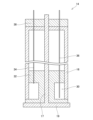
- the sampling unit 14 will be described with reference to Figures 2 and 3.
- the sampling unit 14 includes a cylindrical body 16 with an open tip, an operating unit 32 provided in the cylindrical body 16, a shaft 17 that operates the operating unit 32 in the axial direction of the cylindrical body 16, and a support unit 19 that supports the operating unit 32.
- the cylindrical body 16 and the operating unit 32 form a storage unit 30 that stores a liquid sample.
- the support unit 19 is fixed to the shaft 17.
- a drive device 38 that drives (reciprocates) the shaft 17 is provided on the outside of the cylindrical body 16.
- Two pipes (a supply pipe 34 and a discharge pipe 36) extend from the outside of the cylindrical body 16 toward the inside of the storage unit 30.
- the supply pipe 34 can supply a gas or liquid fluid into the storage unit 30.
- the discharge pipe 36 can discharge a gas or liquid fluid from the storage unit 30.
- FIG. 3 shows an enlarged cross-sectional view of the tip portion of the sampling portion 14. Note that some parts (O-rings) are omitted from Figure 3. The O-rings will be described later.
- an operating portion 32 is provided inside the cylindrical body 16.
- the operating portion 32 includes a first portion 24 that contacts the inner surface of the cylindrical body 16 via the O-ring, a second portion 28 that closes the opening portion 16a of the cylindrical body 16, and a column portion 26 that connects the first portion 24 and the second portion 28.
- the first portion 24, the second portion 28, and the column portion 26 are each cylindrical.
- the first portion 24, the second portion 28, and the column portion 26 are integrally molded.
- the shaft 17 is fitted inside the first portion 24, the second portion 28, and the column portion 26.
- the support portion 19 supports the outer surface of the second portion 28.
- the support part 19 and the second part 28 form the lid part 20 that opens and closes the opening part 16a.
- the actuator part 32 and the shaft 17 are fixed and driven by the drive unit 38 (see also FIG
- the first portion 24 is provided at a position away from the second portion 28.
- the lid portion 20 covers the opening portion 16a, the first portion 24, the second portion 28, the column portion 26, and the cylinder 16 form a storage portion 30 for storing a sample of a chemical substance.
- the inner surface of the cylinder 16 and the first portion 24 are sealed by a first O-ring, which will be described later.
- the opening portion 16a of the lid portion 20 and the second portion 28 are sealed by a second O-ring, which will be described later. Therefore, the storage portion 30 is sealed from the external space of the storage portion 30.
- the supply pipe 34 penetrates the first portion 24 and extends into the storage portion 30.
- the supply pipe 34 penetrates slightly into the storage portion 30 and opens near the first portion 24 (upper side of the storage portion 30).
- the discharge pipe 36 extends to the vicinity of the first portion 24 (lower side of the storage portion 30).
- the sampling device 10 is arranged so that the sampling section 14 is located inside the can 54.
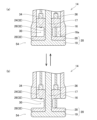
- the lid 20 (second section 28) closes the opening 16a of the cylinder 16 (FIG. 2(a)).
- air is sealed in the storage section 30.
- the inner surface and first section 24 of the cylinder 16, and the opening 16a and second section 28 of the lid 20 are sealed by O-rings. Therefore, while the lid 20 closes the opening 16a, it is possible to prevent chemical substances from entering the storage section 30 from outside the sampling device 10.
- the supply pipe 34 and the discharge pipe 36 are closed by valves (not shown).
- the piston in the drive device 38 When sampling the inside of the can 54, the piston in the drive device 38 is extended, the shaft 17 is moved downward, and the opening 16a of the cylinder 16 is opened (FIG. 2(b)).
- the storage section 30 When the shaft 17 is moved downward, the storage section 30 is exposed to the inside of the can 54. At this time, the air sealed in the storage section 30 is discharged into the inside of the can 54. Then, the chemical substance in the inside of the can 54 enters the storage section 30. That is, when sampling is performed, the sampling device 10 can discharge the air in the storage section 30 and allow the sampling substance (chemical substance) to enter the storage section 30 by moving the shaft 17 downward with the piston in the drive device 38. After the chemical substance enters the storage section 30, the shaft 17 is moved upward with the piston in the drive device 38, closing the opening 16a of the cylinder 16, and sealing the chemical substance in the storage section 30 (FIG. 2(a)).
- the opening 16a and the second part 28 are sealed by an O-ring. This prevents the sampled chemical from leaking outside the storage part 30 (inside the can 54).
- the inner surface of the cylinder 16 and the first part 24 are sealed by an O-ring, it is also possible to prevent the chemical from leaking outside the storage part 30 (above the first part 24) during sampling.
- gas e.g., nitrogen gas
- the sampling substance inside the storage part 30 is discharged from the discharge pipe 36 to the outside of the sampling part 14, and the sampling substance is sent to a sampling substance storage part (e.g., a bottle container).
- a sampling substance storage part e.g., a bottle container
- the supply pipe 34 and the discharge pipe 36 are used to supply and discharge a cleaning liquid into the storage part 30, or to supply and discharge a gas, thereby cleaning the inside of the storage part 30.
- This makes it possible to suppress the influence of the previously sampled sampled substance when sampling the chemical substance inside the can 54.
- It is also possible to create a vacuum inside the storage unit 30 by sucking the inside of the storage unit 30 with the exhaust pipe 36 while the valve of the supply pipe 34 is closed.
- a first O-ring 70 is disposed between the cylindrical body 16 and the first part 24
- a second O-ring 80 is disposed between the cylindrical body 16 and the second part 28
- a third O-ring 90 is disposed between the operating part 32 (first part 24, second part 28) and the shaft 17.
- Each of the O-rings 70, 80, 90 is made of FFKM (perfluoroelastomer).
- first O-rings 70 are arranged side by side in the axial direction of the cylindrical body 16.
- Three first grooves 25 are formed on the outer circumferential surface of the first portion 24.
- a first O-ring 70 (O-ring 70a, O-ring 70b, O-ring 70c) is fitted into each of the first grooves 25.
- Each of the first O-rings 70 is in contact with the inner surface of the cylindrical body 16.
- the first O-rings 70 provide a seal between the cylindrical body 16 and the first portion 24.
- FIG. 6 shows a schematic diagram of the first O-ring 70 and the first groove portion 25.
- the width 25w of the first groove portion 25 is adjusted to be 93% or more and 108% or less of the linear dimension (diameter) 70R of the first O-ring 70.
- the linear dimension 70R of the first O-ring 70 and the width 25w of the first groove portion 25 are adjusted to be almost equal. Therefore, when the first O-ring 70 is fitted into the first groove portion 25 and the first O-ring 70 is brought into contact with the inner surface of the cylindrical body 16, the filling rate of the first O-ring 70 in the space within the first groove portion 25 is high.
- the first O-ring 70 occupies 70% or more and 95% or less of the cross-sectional area (depth 25h x width 25w) of the first groove portion 25 (see also FIG. 5). Furthermore, by placing the first O-ring 70 in the first groove portion 25 with such a filling rate, the movement of the first O-ring 70 in the first groove portion 25 (deformation of the first O-ring 70) is significantly limited when the first portion 24 (operating portion 32) reciprocates relative to the cylindrical body 16.
- FIG. 7(a) shows the state in which the cylindrical body 16 is open
- FIG. 7(b) shows the state in which the cylindrical body 16 is closed.
- the second O-ring 80 is disposed in the second groove portion 29 provided on the outer peripheral surface of the second portion 28.
- the height of the first side wall 29a on the first portion 24 side is different from the height of the second side wall 29b on the opposite side to the first portion 24 side.
- the first side wall 29a is located inside the cylindrical body when the cylindrical body 16 is closed.
- the second side wall 29b is specifically the second portion 28, and faces the end face of the cylindrical body when the cylindrical body 16 is closed. Therefore, the height of the first side wall 29a is lower than the height of the second side wall 29b.
- the diameter of the first side wall 29a is smaller than the inner diameter of the cylindrical body 16. Additionally, the diameter of the first side wall 29a is larger than the inner diameter of the second O-ring 80 and smaller than the outer diameter of the second O-ring 80. The diameter of the second side wall 29b is larger than the outer diameter of the second O-ring 80 and larger than the inner diameter of the cylindrical body 16. Because the diameters of the side walls 29a, 29b are larger than the inner diameter of the second O-ring 80, the second O-ring 80 is held in the second groove portion 29 without coming off from the second groove portion 29.
- FIG. 7(a) when the storage section 30 is exposed to the can interior 54 (see also FIG. 2(b)), the cylindrical body 16 is not in contact with the second O-ring 80. At this time, the second O-ring 80 is not subjected to compression force and has a substantially circular cross section.
- the first side wall 29a functions to position the second O-ring 80 (preventing the second O-ring 80 from moving toward the storage section 30).
- FIG. 7(b) when the storage section 30 is sealed (see also FIG. 2(a)), the cylindrical body 16 is in contact with the second O-ring 80, and the second O-ring 80 is subjected to compression force and deforms.
- the gap between the cylindrical body 16 and the second part 28 is sealed, and the storage section 30 is sealed.
- the second O-ring 80 is in contact with the curved portion connecting the inner circumferential surface and the end surface of the cylindrical body 16.
- the gap between the cylindrical body 16 and the second part 28 is sealed by the close contact of the second O-ring 80, there is no need to polish or smooth the part of the cylindrical body 16 that the second O-ring 80 comes into contact with (there is no need to smooth the surface that the O-ring comes into contact with).
- the sampling device 10 was evaluated for durability by changing the linear 70R of the first O-ring 70, the width 25w of the first groove 25, and the filling rate of the first O-ring 70 in the space in the first groove 25. Specifically, a sampling device was manufactured in which the ratio of the width 25w to the linear 70R (linear ratio) and the filling rate of the first O-ring 70 in the first groove 25 were changed as shown in FIG. 8, and a durability test was performed.
- the O-ring was made of FFKM and had an inner diameter of about 50 mm and a linear 3.5 mm. In the durability test, the operation (opening and closing of the lid 20) from the state in FIG. 2(a) through the state in FIG.
- FIG. 2(b) and back to the state in FIG. 2(a) was defined as one cycle, and the airtightness in the storage section 30 was evaluated after 300 cycles, 2000 cycles, and 4000 cycles of opening and closing.
- the airtightness was evaluated by applying a pressure (air pressure) of 0.3 MPa to the storage section 30 and evaluating the presence or absence of air leakage (pressure drop).
- the results of the durability test are shown in Fig. 8.
- the crush width of the O-ring and the operating pressure when the lid portion 20 is operated are also shown in Fig. 8.
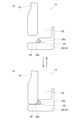
- Example 2 A durability test similar to that of Experimental Example 1 was conducted using a second O-ring 80 with an inner diameter of about 80 mm and a linear shape of 6 mm. In addition, a durability test was also conducted on a sampling device (sampling unit 114) having a general seal structure of the lid unit shown in FIG. 9 as a comparative example.
- the sampling unit 114 in FIG. 9 will be briefly described.
- the sampling unit 114 differs from the sampling unit 14 in the seal structure between the cylindrical body 16 and the lid unit 120.
- the sampling unit 114 includes a cylindrical body 16 and a lid unit 120 that advances and retreats relative to the cylindrical body 16.
- a storage unit 30 that stores a sampling substance (chemical substance) is formed between the cylindrical body 16 and the lid unit 120.
- a ring-shaped seal material 180 with a triangular cross section is disposed on the surface of the lid unit 120 on the cylindrical body 16 side.
- the seal material 180 is made of PTFE resin.
- the seal material 180 has a triangular cross section.
- FIG. 9B when the lid portion 120 is closed, the sealant 180 is crushed between the cylindrical body 16 and the lid portion 120 to seal the gap between the cylindrical body 16 and the lid portion 120 .
- the sampling part 14 maintained its sealing property even after 4000 cycles of opening and closing, and air leakage was confirmed in the sampling part 114 after 300 cycles of opening and closing.
- the sampling part 14 maintained its sealing property even after 4000 cycles of opening and closing with the wire in place, but when the sampling part 114 was opened and closed with the wire in place, the sealing material 180 was deformed and no longer functioned as a sealing material.
- the sealing material 180 is made of PTFE resin. PTFE resin has a high hardness and a low elastic recovery force compared to an O-ring made of FFKM.
- the contact part of the sealing material 180 with the cylinder 16 (the apex part of the triangle of the sealing material 180) is deformed and does not immediately recover to its original shape.
- a defect is formed in the contact part (circumferential part) with the cylinder 16 formed by the apex part of the triangle of the sealing material 180, and it no longer functions as a sealing material.
- first O-rings 70 are arranged in the first part 24 of the operating part 32.
- the number of first O-rings 70 arranged in the first part 24 is arbitrary, and it is sufficient that at least one first O-ring 70 is arranged in the first part 24.
- all of the O-rings do not have to be first O-rings 70.
- At least one first O-ring 70 is arranged in the first part 24, and the other O-rings may be O-rings different from the first O-ring 70 (for example, O-rings coated with a material with a low friction coefficient such as PTFE).
- a lubricant may be applied to the first O-ring 70.
- the sampling device 10 disclosed in the above embodiment provides good durability even without applying a lubricant to the first O-ring 70, and applying a lubricant to the first O-ring 70 is not prohibited.
- an O-ring substantially the same as the first O-ring 70 disposed in the first part 24 of the actuation part 32 may be disposed on the upper side of the sampling part 14 between the shaft 17 and the cylindrical body 16 and/or between the shaft 17 and the drive device 38.
- the seal between the second portion 28 and the cylinder 16 does not necessarily have to have the structure described in the embodiment.
- the seal between the second portion 28 and the cylinder 16 may be made with a ring-shaped seal material with a triangular cross section on the cylinder-side surface of the lid portion described in Figure 9.
- the seal between the second portion 28 and the cylinder 16 may have the same structure as the seal between the first portion 24 and the cylinder 16.
Landscapes
- Life Sciences & Earth Sciences (AREA)
- General Engineering & Computer Science (AREA)
- Engineering & Computer Science (AREA)
- Biochemistry (AREA)
- Chemical & Material Sciences (AREA)
- Analytical Chemistry (AREA)
- Health & Medical Sciences (AREA)
- General Health & Medical Sciences (AREA)
- General Physics & Mathematics (AREA)
- Immunology (AREA)
- Pathology (AREA)
- Physics & Mathematics (AREA)
- Hydrology & Water Resources (AREA)
- Mechanical Engineering (AREA)
- Gasket Seals (AREA)
Priority Applications (2)
| Application Number | Priority Date | Filing Date | Title |
|---|---|---|---|
| CN202480049472.8A CN121605301A (zh) | 2023-09-15 | 2024-09-13 | 采样装置 |
| JP2025545765A JPWO2025058073A1 (https=) | 2023-09-15 | 2024-09-13 |
Applications Claiming Priority (2)
| Application Number | Priority Date | Filing Date | Title |
|---|---|---|---|
| JP2023-150568 | 2023-09-15 | ||
| JP2023150568 | 2023-09-15 |
Publications (1)
| Publication Number | Publication Date |
|---|---|
| WO2025058073A1 true WO2025058073A1 (ja) | 2025-03-20 |
Family
ID=95021524
Family Applications (1)
| Application Number | Title | Priority Date | Filing Date |
|---|---|---|---|
| PCT/JP2024/032964 Pending WO2025058073A1 (ja) | 2023-09-15 | 2024-09-13 | サンプリング装置 |
Country Status (3)
| Country | Link |
|---|---|
| JP (1) | JPWO2025058073A1 (https=) |
| CN (1) | CN121605301A (https=) |
| WO (1) | WO2025058073A1 (https=) |
Citations (8)
| Publication number | Priority date | Publication date | Assignee | Title |
|---|---|---|---|---|
| JPS48114109U (https=) * | 1972-03-31 | 1973-12-27 | ||
| JPS4984052U (https=) * | 1972-11-08 | 1974-07-20 | ||
| JPH01227041A (ja) * | 1988-03-07 | 1989-09-11 | Asahi Eng Co Ltd | 移動槽等のサンプリング方法及び装置 |
| JPH07198560A (ja) * | 1993-12-28 | 1995-08-01 | Bridgestone Corp | サンプリング装置 |
| JP2000193566A (ja) * | 1998-12-25 | 2000-07-14 | Shinko Pantec Co Ltd | 吸引管およびサンプリング装置ならびに反応槽 |
| JP2005147262A (ja) * | 2003-11-14 | 2005-06-09 | Koyo Seiko Co Ltd | 自在継手 |
| JP2012145233A (ja) * | 2012-05-07 | 2012-08-02 | Toyota Motor Corp | シール機構 |
| WO2017056713A1 (ja) * | 2015-10-02 | 2017-04-06 | 三菱重工オートモーティブサーマルシステムズ株式会社 | 密閉容器のシール構造、これを備えた車両用冷媒圧縮機 |
-
2024
- 2024-09-13 JP JP2025545765A patent/JPWO2025058073A1/ja active Pending
- 2024-09-13 WO PCT/JP2024/032964 patent/WO2025058073A1/ja active Pending
- 2024-09-13 CN CN202480049472.8A patent/CN121605301A/zh active Pending
Patent Citations (8)
| Publication number | Priority date | Publication date | Assignee | Title |
|---|---|---|---|---|
| JPS48114109U (https=) * | 1972-03-31 | 1973-12-27 | ||
| JPS4984052U (https=) * | 1972-11-08 | 1974-07-20 | ||
| JPH01227041A (ja) * | 1988-03-07 | 1989-09-11 | Asahi Eng Co Ltd | 移動槽等のサンプリング方法及び装置 |
| JPH07198560A (ja) * | 1993-12-28 | 1995-08-01 | Bridgestone Corp | サンプリング装置 |
| JP2000193566A (ja) * | 1998-12-25 | 2000-07-14 | Shinko Pantec Co Ltd | 吸引管およびサンプリング装置ならびに反応槽 |
| JP2005147262A (ja) * | 2003-11-14 | 2005-06-09 | Koyo Seiko Co Ltd | 自在継手 |
| JP2012145233A (ja) * | 2012-05-07 | 2012-08-02 | Toyota Motor Corp | シール機構 |
| WO2017056713A1 (ja) * | 2015-10-02 | 2017-04-06 | 三菱重工オートモーティブサーマルシステムズ株式会社 | 密閉容器のシール構造、これを備えた車両用冷媒圧縮機 |
Also Published As
| Publication number | Publication date |
|---|---|
| CN121605301A (zh) | 2026-03-03 |
| JPWO2025058073A1 (https=) | 2025-03-20 |
Similar Documents
| Publication | Publication Date | Title |
|---|---|---|
| MX2014008026A (es) | Valvulas rotativas accionadas por translo-rotacion para compresores reciprocos relacionados. | |
| JP7262280B2 (ja) | ダイヤフラムバルブ | |
| US20070057214A1 (en) | Valve for essentially gastight closing a flow path | |
| TWI799595B (zh) | 球形止回閥及隔膜泵 | |
| WO2025058073A1 (ja) | サンプリング装置 | |
| CN206682338U (zh) | 一种斜背式式陶瓷双闸板阀 | |
| JP7021085B2 (ja) | スライドガイド式駆動部を備える真空アングル弁 | |
| WO2007142395A1 (en) | Vacuum gate valve | |
| KR20200123970A (ko) | 진공 게이트 밸브 | |
| US4085952A (en) | Flexible stem valve | |
| KR20230133872A (ko) | 밸브, 특히 진공 밸브 | |
| JP4237032B2 (ja) | 開閉弁及びこれを用いた半導体製造設備用排気装置 | |
| CN115560085A (zh) | 阀瓣及应用其的阀门 | |
| JP3820088B2 (ja) | 軸封装置 | |
| CN114776810A (zh) | 一种管道在线多重安全密封里衬取样阀 | |
| CN100401462C (zh) | 用于在洁净室内封闭容器的高压设备 | |
| CN203906816U (zh) | 气动海底阀 | |
| JP5061045B2 (ja) | シールパッキンおよびこれを用いたシール構造 | |
| CN116877715A (zh) | 多重密封零泄漏卸料气密阀 | |
| KR20140083576A (ko) | 밸브 | |
| CN115451183A (zh) | 一种分体式波纹管轨道球阀 | |
| KR102701820B1 (ko) | 밸브 본체 및 이를 포함한 플러그 밸브 | |
| CN101451625A (zh) | 一种双密封阀门结构 | |
| CN115298467B (zh) | 阀的泄漏阻断装置 | |
| JP3234992U (ja) | バルブ装置 |
Legal Events
| Date | Code | Title | Description |
|---|---|---|---|
| 121 | Ep: the epo has been informed by wipo that ep was designated in this application |
Ref document number: 24865572 Country of ref document: EP Kind code of ref document: A1 |
|
| ENP | Entry into the national phase |
Ref document number: 2025545765 Country of ref document: JP Kind code of ref document: A |
|
| WWE | Wipo information: entry into national phase |
Ref document number: 2025545765 Country of ref document: JP |