WO2025052919A1 - 受動電子部品 - Google Patents
受動電子部品 Download PDFInfo
- Publication number
- WO2025052919A1 WO2025052919A1 PCT/JP2024/029565 JP2024029565W WO2025052919A1 WO 2025052919 A1 WO2025052919 A1 WO 2025052919A1 JP 2024029565 W JP2024029565 W JP 2024029565W WO 2025052919 A1 WO2025052919 A1 WO 2025052919A1
- Authority
- WO
- WIPO (PCT)
- Prior art keywords
- internal electrode
- electrode layer
- group
- electronic component
- passive electronic
- Prior art date
- Legal status (The legal status is an assumption and is not a legal conclusion. Google has not performed a legal analysis and makes no representation as to the accuracy of the status listed.)
- Pending
Links
Images



















Classifications
-
- H—ELECTRICITY
- H01—ELECTRIC ELEMENTS
- H01G—CAPACITORS; CAPACITORS, RECTIFIERS, DETECTORS, SWITCHING DEVICES, LIGHT-SENSITIVE OR TEMPERATURE-SENSITIVE DEVICES OF THE ELECTROLYTIC TYPE
- H01G4/00—Fixed capacitors; Processes of their manufacture
- H01G4/30—Stacked capacitors
-
- H—ELECTRICITY
- H01—ELECTRIC ELEMENTS
- H01G—CAPACITORS; CAPACITORS, RECTIFIERS, DETECTORS, SWITCHING DEVICES, LIGHT-SENSITIVE OR TEMPERATURE-SENSITIVE DEVICES OF THE ELECTROLYTIC TYPE
- H01G4/00—Fixed capacitors; Processes of their manufacture
- H01G4/33—Thin- or thick-film capacitors (thin- or thick-film circuits; capacitors without a potential-jump or surface barrier specially adapted for integrated circuits, details thereof, multistep manufacturing processes therefor)
Definitions
- the present invention relates to passive electronic components.
- Patent Document 1 discloses a stacked thin film capacitor in which electrodes belonging to one group, a dielectric layer, and electrodes belonging to the other group are alternately stacked on one main surface of a substrate so that the electrodes belonging to one group and the electrodes belonging to the other group face each other across a dielectric layer, and the stacked thin film capacitor has a first connection part at one end of an opposing region where the electrodes belonging to one group and the electrodes belonging to the other group face each other across the dielectric layer, where the first connection part has a first connection part at which the electrodes belonging to the one group are stacked on top of each other, and a second connection part at the other end of the opposing region has a second connection part at which the electrodes belonging to the other group are stacked on top of each other, and the first connection part and the second connection part are each further stacked with a conductor layer for adjusting the thickness to reduce the step with the opposing region.
- the electrodes belonging to one group, the dielectric layer, and the electrodes belonging to the other group are alternately stacked on one main surface of the substrate so that the electrodes belonging to one group face the electrodes belonging to the other group with the dielectric layer in between, forming the element body.
- the stacked thin film capacitor described in Patent Document 1 for example, the configuration shown in FIG. 1 of Patent Document 1, when a voltage is applied to the element body, the electric field generated between the electrode of one group closest to the substrate and the electrode of the other group closest to the substrate tends to penetrate into the substrate. Therefore, in the stacked thin film capacitor described in Patent Document 1, power loss is likely to occur in the substrate when a voltage is applied to the element body, and as a result, the Q value (quality factor) of the stacked thin film capacitor tends to decrease.
- the present invention has been made to solve the above problems, and aims to provide a passive electronic component that can suppress the decrease in Q value caused by the electric field penetrating into the substrate.
- the passive electronic component of the present invention comprises a substrate having a first main surface and a second main surface facing each other in a first direction, and a capacitor provided on the first main surface side of the substrate, the capacitor having a capacitance forming portion in which internal electrode layers and dielectric layers are alternately stacked in the first direction, the capacitance forming portion having three or more internal electrode layers, and when all of the internal electrode layers are counted in order from the substrate side in the first direction, a first group to which the internal electrode layers located odd-numbered belong and a second group to which the internal electrode layers located even-numbered belong, and all of the internal electrode layers are counted in order from the substrate side in the first direction.
- an Nth internal electrode layer that is located Nth and belongs to the first group, and an N-1th internal electrode layer that is located N-1st and belongs to the second group are defined, and a second direction that is perpendicular to the average direction of the current that flows in the capacitance forming section when a voltage is applied to the capacitance forming section in a plan view from the first direction is defined.
- both ends of the Nth internal electrode layer of the first group in the second direction are located outside in the second direction relative to both ends of the N-1th internal electrode layer of the second group in the second direction.
- the passive electronic component of the present invention comprises a substrate having a first main surface and a second main surface facing each other in a first direction, and a capacitor provided on the first main surface side of the substrate, the capacitor having a capacitance forming portion in which internal electrode layers and dielectric layers are alternately stacked in the first direction, the capacitance forming portion having four or more internal electrode layers, and when all of the internal electrode layers are counted in order from the substrate side in the first direction, a first group to which the internal electrode layers located odd-numbered belong and a second group to which the internal electrode layers located even-numbered belong, and all of the internal electrode layers are counted in order from the substrate side in the first direction.
- an Nth internal electrode layer that is located Nth and belongs to the second group, and an N-1th internal electrode layer that is located N-1st and belongs to the first group are defined, and a second direction that is perpendicular to the average direction of the current that flows in the capacitance forming section when a voltage is applied to the capacitance forming section in a plan view from the first direction is defined.
- both ends of the Nth internal electrode layer of the second group in the second direction are located outside in the second direction compared to both ends of the N-1th internal electrode layer of the first group in the second direction.
- the passive electronic component of the present invention comprises a substrate having a first main surface and a second main surface facing each other in a first direction, and a capacitor provided on the first main surface side of the substrate, the capacitor having a capacitance forming portion in which internal electrode layers and dielectric layers are alternately stacked in the first direction, the capacitance forming portion having three or more layers of the internal electrode layers, and when all the internal electrode layers are counted in order from the substrate side in the first direction, a first group to which the odd-numbered internal electrode layers belong and a second group to which the even-numbered internal electrode layers belong are defined, and in a plan view from the first direction, the peripheries of all the internal electrode layers of the second group are located inside the periphery of the first internal electrode layer of the first group that is located closest to the substrate.
- the present invention provides a passive electronic component that can suppress the decrease in Q value caused by the electric field penetrating into the substrate.
- FIG. 1 is a plan view showing an example of a passive electronic component according to a first embodiment of the present invention.
- FIG. 2 is a schematic cross-sectional view showing an example of a cross section of the passive electronic component shown in FIG. 1 taken along line a1-a2.
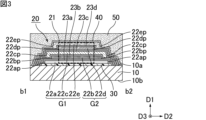
- FIG. 3 is a schematic cross-sectional view showing an example of a cross section of the passive electronic component shown in FIG. 1 taken along line segment b1-b2 (excluding the first external electrode).
- FIG. 4 is a schematic cross-sectional view showing a step of preparing a substrate in an example of the method for manufacturing a passive electronic component according to the first embodiment of the present invention.
- FIG. 1 is a plan view showing an example of a passive electronic component according to a first embodiment of the present invention.
- FIG. 2 is a schematic cross-sectional view showing an example of a cross section of the passive electronic component shown in FIG. 1 taken along line a1-a2.
- FIG. 3 is a schematic cross-sectional view showing an example of
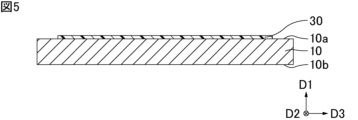
- FIG. 5 is a schematic cross-sectional view showing a step of forming an insulating layer in an example of a method for manufacturing a passive electronic component according to the first embodiment of the present invention.
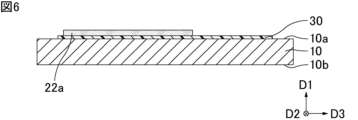
- FIG. 6 is a schematic cross-sectional view showing a step of forming a first internal electrode layer in an example of a method for manufacturing a passive electronic component according to the first embodiment of the present invention.
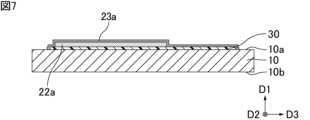
- FIG. 7 is a schematic cross-sectional view showing a step of forming a first dielectric layer in an example of a method for manufacturing a passive electronic component according to the first embodiment of the present invention.
- FIG. 8 is a schematic cross-sectional view showing a step of forming a second internal electrode layer in an example of a method for manufacturing a passive electronic component according to the first embodiment of the present invention.
- FIG. 9 is a schematic cross-sectional view showing a step of forming a second dielectric layer in an example of a method for manufacturing a passive electronic component according to the first embodiment of the present invention.
- FIG. 10 is a schematic cross-sectional view showing a step of forming a third internal electrode layer in an example of a method for manufacturing a passive electronic component according to the first embodiment of the present invention.
- FIG. 11 is a schematic cross-sectional view showing a step of forming a third dielectric layer in an example of a method for manufacturing a passive electronic component according to the first embodiment of the present invention.
- FIG. 12 is a schematic cross-sectional view showing a step of forming a fourth internal electrode layer in an example of a method for manufacturing a passive electronic component according to the first embodiment of the present invention.
- FIG. 13 is a schematic cross-sectional view showing a step of forming a fourth dielectric layer in an example of a method for manufacturing a passive electronic component according to the first embodiment of the present invention.
- FIG. 12 is a schematic cross-sectional view showing a step of forming a fourth internal electrode layer in an example of a method for manufacturing a passive electronic component according to the first embodiment of the present invention.
- FIG. 13 is a schematic cross-sectional view showing a step of forming a fourth dielectric layer in an example of a method for manufacturing a passive electronic component according to the first embodiment of the present invention.
- FIG. 14 is a schematic cross-sectional view showing a step of forming a fifth internal electrode layer in an example of a method for manufacturing a passive electronic component according to the first embodiment of the present invention.
- FIG. 15 is a schematic cross-sectional view showing a step of forming a moisture-resistant protective layer in an example of a method for manufacturing a passive electronic component according to the first embodiment of the present invention.
- FIG. 16 is a schematic cross-sectional view showing a step of forming a resin protective layer in an example of a method for manufacturing a passive electronic component according to the first embodiment of the present invention.
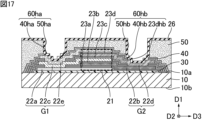
- FIG. 17 is a schematic cross-sectional view showing a step of forming a first external electrode and a second external electrode in an example of a method for manufacturing a passive electronic component according to the first embodiment of the present invention.
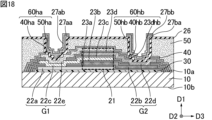
- FIG. 18 is a schematic cross-sectional view showing a step of forming a first external electrode and a second external electrode in an example of a method for manufacturing a passive electronic component according to the first embodiment of the present invention.
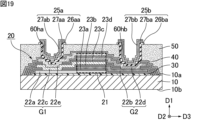
- FIG. 19 is a schematic cross-sectional view showing a step of forming a first external electrode and a second external electrode in an example of a method for manufacturing a passive electronic component according to the first embodiment of the present invention.
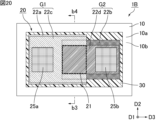
- FIG. 20 is a schematic plan view showing another example of the passive electronic component according to the first embodiment of the present invention.
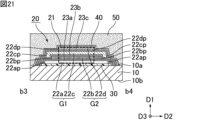
- FIG. 21 is a schematic cross-sectional view showing an example of a cross section along line segment b3-b4 of the passive electronic component shown in FIG. 20 (excluding the first external electrode).
- FIG. 22 is a schematic cross-sectional view showing another example of a cross section taken along line segment b3-b4 of the passive electronic component shown in FIG. 20 (excluding the first external electrode).
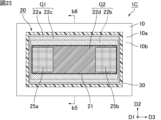
- FIG. 23 is a schematic plan view showing yet another example of the passive electronic component according to the first embodiment of the present invention.
- FIG. 24 is a schematic cross-sectional view showing an example of a cross section of the passive electronic component shown in FIG. 23 taken along line segment b5-b6 (excluding the first external electrode).
- FIG. 25 is a schematic cross-sectional view showing another example of a cross section taken along line segment b5-b6 of the passive electronic component shown in FIG. 23 (excluding the first external electrode).
- FIG. 26 is a plan view schematic diagram showing an example of a passive electronic component according to the second embodiment of the present invention.
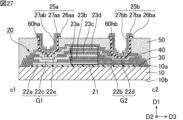
- FIG. 27 is a schematic cross-sectional view showing an example of a cross section of the passive electronic component shown in FIG. 26 taken along line c1-c2.
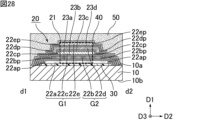
- FIG. 28 is a schematic cross-sectional view showing an example of a cross section along line segment d1-d2 of the passive electronic component shown in FIG. 26 (excluding the first external electrode).
- FIG. 29 is a schematic plan view showing another example of the passive electronic component according to the second embodiment of the present invention.
- FIG. 29 is a schematic plan view showing another example of the passive electronic component according to the second embodiment of the present invention.
- the capacitance forming section 21 is formed by stacking the first internal electrode layer 22a, the first dielectric layer 23a, the second internal electrode layer 22b, the second dielectric layer 23b, the third internal electrode layer 22c, the third dielectric layer 23c, the fourth internal electrode layer 22d, the fourth dielectric layer 23d, and the fifth internal electrode layer 22e in this order from the substrate 10 side in the first direction D1. That is, in the example shown in Figures 2 and 3, the capacitance forming section 21 has five internal electrode layers.
- each internal electrode layer may be the same as each other, may be different from each other, or may be partially different.
- each dielectric layer examples include oxides such as silicon dioxide, aluminum oxide, hafnium oxide, and tantalum oxide, and nitrides such as silicon nitride.
- each dielectric layer may be the same as each other, may be different from each other, or may be partially different.
- a first group G1 is defined to which the odd-numbered internal electrode layers belong
- a second group G2 is defined to which the even-numbered internal electrode layers belong.
- the first group G1 includes the first internal electrode layer 22a, the third internal electrode layer 22c, and the fifth internal electrode layer 22e.
- the second group G2 includes the second internal electrode layer 22b and the fourth internal electrode layer 22d.
- an Nth internal electrode layer is defined as the Nth internal electrode layer that is located Nth and belongs to the first group G1
- an N-1th internal electrode layer is defined as the N-1th internal electrode layer that is located N-1th and belongs to the second group G2, where N is an odd number equal to or greater than 3.
- the average direction of the current flowing through the capacitance forming portion 21 when a voltage is applied to the capacitance forming portion 21 refers to the actual direction of the current when the direction of the current flowing through the capacitance forming portion 21 is averaged when a voltage is applied to the capacitance forming portion 21 as described above. In the example shown in FIG.
- the actual current direction when the flow directions of these current components are averaged is the average direction of the current flowing through the capacitance forming portion 21.
- the average direction of the current flowing through the capacitance forming portion 21 when a voltage is applied to the capacitance forming portion 21 corresponds to the third direction D3 passing through the first external electrode 25a and the second external electrode 25b described later.
- the first direction D1, the second direction D2, and the third direction D3 are perpendicular to each other.
- the second direction D2 corresponds to the short side direction of the passive electronic component 1A
- the third direction D3 corresponds to the long side direction of the passive electronic component 1A
- the second direction D2 may correspond to the long side direction of the passive electronic component 1A
- the third direction D3 may correspond to the short side direction of the passive electronic component 1A.
- both ends of the Nth internal electrode layer of the first group G1 in the second direction D2 are located outside in the second direction D2 relative to both ends of the N-1th internal electrode layer of the second group G2 in the second direction D2.
- this feature will be referred to as the first feature.
- the first feature is as follows in FIG. 3, which shows an example of a cross section of passive electronic component 1A along first direction D1 and second direction D2.
- both end portions 22cp in the second direction D2 of the third internal electrode layer 22c of the first group G1 are located outward in the second direction D2 than both end portions 22bp in the second direction D2 of the second internal electrode layer 22b of the second group G2.
- both end portions 22ep in the second direction D2 of the fifth internal electrode layer 22e of the first group G1 are located outward in the second direction D2 than both end portions 22dp in the second direction D2 of the fourth internal electrode layer 22d of the second group G2.
- the Nth internal electrode layer of the first group G1, at both end sides in the second direction D2 covers at least a part of each side surface (facing the second direction D2) of the N-1th internal electrode layer of the second group G2 at both end sides in the second direction D2.
- the Nth internal electrode layer of the first group G1, at both end sides in the second direction D2 covers a part or the whole of each side surface of the N-1th internal electrode layer of the second group G2 at both end sides in the second direction D2.
- the Nth internal electrode layer is provided so as to cover the N-1th internal electrode layer over the entire area in the second direction D2.
- FIG. 3 which shows an example of a cross section of a passive electronic component 1A along the first direction D1 and the second direction D2, it is preferable that:
- the third internal electrode layer 22c of the first group G1 preferably covers, in the second direction D2, at least a part of each side surface of the second internal electrode layer 22b of the second group G2 on the side of both ends 22bp in the second direction D2 at both ends 22cp in the second direction D2. That is, in the example shown in Fig. 3, the third internal electrode layer 22c is preferably provided so as to cover the second internal electrode layer 22b over the entire area in the second direction D2.
- the fifth internal electrode layer 22e of the first group G1 preferably covers, in the second direction D2, at least a part of each side surface of the fourth internal electrode layer 22d of the second group G2 at both end portions 22dp in the second direction D2 on the side of both end portions 22ep in the second direction D2. That is, in the example shown in Fig. 3, the fifth internal electrode layer 22e is preferably provided so as to cover the fourth internal electrode layer 22d over the entire area in the second direction D2.
- passive electronic component 1A because the first characteristic is established, when a voltage is applied to capacitance forming portion 21, the electric field generated between the internal electrode layer of first group G1 and the internal electrode layer of second group G2 is less likely to penetrate into substrate 10.
- end 22cp in the second direction D2 of third internal electrode layer 22c of first group G1 is positioned further outward in the second direction D2 than end 22bp in the second direction D2 of second internal electrode layer 22b of second group G2.
- the passive electronic component 1A when a voltage is applied to the capacitance forming portion 21, the electric field generated between the end 22ap side in the second direction D2 of the first internal electrode layer 22a located closest to the substrate 10 in the first group G1 and the end 22bp side in the second direction D2 of the second internal electrode layer 22b located closest to the substrate 10 in the second group G2 is easily shielded by the end 22cp side in the second direction D2 of the third internal electrode layer 22c. Therefore, in the passive electronic component 1A, when a voltage is applied to the capacitance forming portion 21, the electric field generated between the first internal electrode layer 22a and the second internal electrode layer 22b is less likely to wrap around the substrate 10.
- the passive electronic component 1A when a voltage is applied to the capacitance forming portion 21, the electric field generated between the internal electrode layer of the first group G1 and the internal electrode layer of the second group G2 is less likely to penetrate into the substrate 10. Therefore, in the passive electronic component 1A, when a voltage is applied to the capacitance forming portion 21, power loss is less likely to occur in the substrate 10, and as a result, the Q value of the passive electronic component 1A is less likely to decrease.
- the capacitor 20 further has a first external electrode 25a electrically connected to all the internal electrode layers of the first group G1.
- Examples of materials for the first external electrode 25a include conductive materials such as metals such as copper, nickel, silver, gold, aluminum, palladium, titanium, and tin, and alloys containing at least one of these metals.
- the first external electrode 25a may have a single-layer structure or a multi-layer structure.
- the first external electrode 25a may have, in order from the substrate 10 side, a seed layer 26aa, a first plating layer 27aa, and a second plating layer 27ab.
- Examples of the seed layer 26aa include a laminate in which a conductor layer made of titanium and a conductor layer made of copper are stacked in this order from the substrate 10 side.
- Examples of the second plating layer 27ab include a gold plating layer, a tin plating layer, etc.
- the capacitor 20 further has a second external electrode 25b electrically connected to all the internal electrode layers of the second group G2.
- the second external electrode 25b is electrically connected to all of the second internal electrode layers 22b and the fourth internal electrode layers 22d that belong to the second group G2.
- the second external electrode 25b is separated from the first external electrode 25a in a direction perpendicular to the first direction D1, here, the third direction D3.
- Examples of materials for the second external electrode 25b include conductive materials such as metals such as copper, nickel, silver, gold, aluminum, palladium, titanium, and tin, and alloys containing at least one of these metals.
- the second external electrode 25b may have a single-layer structure or a multi-layer structure.
- the second external electrode 25b may have, in order from the substrate 10 side, a seed layer 26ba, a first plating layer 27ba, and a second plating layer 27bb.
- Examples of the seed layer 26ba include a laminate in which a conductor layer made of titanium and a conductor layer made of copper are stacked in this order from the substrate 10 side.
- the first plating layer 27ba may be, for example, a nickel plating layer.
- Examples of the second plating layer 27bb include a gold plating layer, a tin plating layer, etc.
- the capacitor 20 When the capacitor 20 has a first external electrode 25a and a second external electrode 25b, the capacitor 20 constitutes a two-terminal capacitor. When the capacitor 20 has a first external electrode 25a and a second external electrode 25b, the passive electronic component 1A can function alone.
- the materials of the first external electrode 25a and the second external electrode 25b may be the same or different.
- the layer structures of the first external electrode 25a and the second external electrode 25b may be the same as each other or may be different from each other.
- the passive electronic component 1A further includes an insulating layer 30 provided between the substrate 10 and the capacitor 20 in the first direction D1.
- the insulating layer 30 contacts the substrate 10 in the first direction D1.
- the insulating layer 30 contacts the capacitor 20 in the first direction D1.
- the insulating layer 30 may be provided so as to cover the entire first main surface 10a of the substrate 10, or may be provided so as to cover only a portion of the first main surface 10a of the substrate 10.
- the substrate 10 is a semiconductor substrate, providing the insulating layer 30 reduces the parasitic capacitance between the substrate 10 and the capacitor 20, making it easier to increase the Q value of the passive electronic component 1A.
- the insulating layer 30 may not be provided. If the insulating layer 30 is not provided, it is preferable that the substrate 10 and the capacitor 20 are in contact in the first direction D1.
- the periphery of the insulating layer 30 is located outside the periphery of all of the internal electrode layers included in the capacitor 20.
- Examples of materials for the insulating layer 30 include insulating materials such as oxides, such as silicon dioxide and aluminum oxide, and nitrides, such as silicon nitride.
- the passive electronic component 1A preferably further has a moisture-resistant protective layer 40 that covers the capacitance forming portion 21.
- a moisture-resistant protective layer 40 that covers the capacitance forming portion 21.
- the moisture resistance of the capacitance forming portion 21 is improved.
- the provision of the moisture-resistant protective layer 40 prevents moisture from penetrating the internal electrode layer of the capacitance forming portion 21, thereby preventing corrosion of the internal electrode layer.
- the moisture-resistant protective layer 40 covers the entire internal electrode layer and dielectric layer of the capacitor 20 except for the area where the first external electrode 25a and the second external electrode 25b are provided.
- Examples of materials for the moisture-resistant protective layer 40 include moisture-resistant materials such as oxides such as silicon dioxide, and nitrides such as silicon nitride.
- moisture-resistant protective layer 40 is not shown in FIG. 1.
- the passive electronic component 1A preferably further includes a resin protective layer 50 that covers the substrate 10 and the capacitance forming portion 21. In this case, the substrate 10 and the capacitance forming portion 21 are protected from moisture.
- the resin protective layer 50 covers the entire internal electrode layer and dielectric layer of the capacitor 20 except for the area where the first external electrode 25a and the second external electrode 25b are provided.
- Examples of materials for the resin protective layer 50 include resin materials such as polyimide resin and resin in solder resist.
- the passive electronic component 1A has a moisture-resistant protective layer 40 and a resin protective layer 50, it is preferable that the resin protective layer 50 covers the entire moisture-resistant protective layer 40.
- the first external electrode 25a is preferably provided inside a through hole 60ha that penetrates at least the moisture-resistant protective layer 40 and the resin protective layer 50 in the first direction D1.
- the first external electrode 25a is preferably connected to the fifth internal electrode layer 22e via the through hole 60ha.
- the second external electrode 25b is preferably provided inside a through hole 60hb that penetrates at least the moisture-resistant protective layer 40 and the resin protective layer 50 in the first direction D1.
- the second external electrode 25b is preferably connected to the fourth internal electrode layer 22d via the through hole 60hb.
- the passive electronic component 1A When the passive electronic component 1A has a moisture-resistant protective layer 40 and a resin protective layer 50, the first feature is established in the passive electronic component 1A, so that when a voltage is applied to the capacitance forming portion 21, the electric field generated between the internal electrode layer of the first group G1 and the internal electrode layer of the second group G2 is unlikely to penetrate not only into the substrate 10 but also into the moisture-resistant protective layer 40 and the resin protective layer 50.
- the passive electronic component 1A when a voltage is applied to the capacitance forming portion 21, the electric field generated between the portion of the first internal electrode layer 22a of the first group G1 on the side of the end 22ap in the second direction D2 and the portion of the second internal electrode layer 22b of the second group G2 on the side of the end 22bp in the second direction D2 is likely to be shielded by the portion of the third internal electrode layer 22c on the side of the end 22cp in the second direction D2. Therefore, in the passive electronic component 1A, when a voltage is applied to the capacitance forming portion 21, the electric field generated between the first internal electrode layer 22a and the second internal electrode layer 22b is less likely to penetrate into the moisture-resistant protective layer 40 and the resin protective layer 50.
- the passive electronic component 1A when a voltage is applied to the capacitance forming portion 21, the electric field generated between the internal electrode layer of the first group G1 and the internal electrode layer of the second group G2 is less likely to penetrate the moisture-resistant protective layer 40 and the resin protective layer 50. Therefore, in the passive electronic component 1A, when a voltage is applied to the capacitance forming portion 21, the electric field is less likely to deviate from the path that passes through the internal electrode layer of the first group G1, the moisture-resistant protective layer 40, the resin protective layer 50, the moisture-resistant protective layer 40, and the internal electrode layer of the second group G2 in that order, causing a shift in the capacitance of the capacitance forming portion 21.
- the passive electronic component 1A when a voltage is applied to the capacitance forming portion 21, power loss due to the dielectric tangent (tan ⁇ ) in the resin protective layer 50 is less likely to occur, and as a result, the Q value of the passive electronic component 1A is less likely to decrease.
- the passive electronic component 1A is manufactured, for example, by the following method.
- FIG. 4 is a schematic cross-sectional view showing a step of preparing a substrate in an example of the method for manufacturing a passive electronic component according to the first embodiment of the present invention.
- FIG. 5 is a schematic cross-sectional view showing a step of forming an insulating layer in an example of a method for manufacturing a passive electronic component according to the first embodiment of the present invention.
- An insulating layer made of an insulating material is formed on the first main surface 10a of the substrate 10 by a method such as CVD (Chemical Vapor Deposition) or PVD (Physical Vapor Deposition).
- the insulating layer is then patterned using a combination of photolithography and etching to form the insulating layer 30 shown in FIG. 5.
- FIG. 6 is a schematic cross-sectional view showing a step of forming a first internal electrode layer in an example of a method for manufacturing a passive electronic component according to the first embodiment of the present invention.
- An electrode layer made of a conductive material is formed by CVD, PVD, or the like so as to cover the structure shown in FIG. 5 from the first main surface 10a side of the substrate 10. This electrode layer is then patterned by a combination of photolithography and etching to form the first internal electrode layer 22a as shown in FIG. 6.
- FIG. 7 is a schematic cross-sectional view showing a step of forming a first dielectric layer in an example of a method for manufacturing a passive electronic component according to the first embodiment of the present invention.
- a dielectric layer made of a dielectric material is formed by CVD, PVD, or the like so as to cover the structure shown in FIG. 6 from the first main surface 10a side of the substrate 10.
- This dielectric layer is then patterned by a combination of photolithography and etching to form the first dielectric layer 23a as shown in FIG. 7.
- the first dielectric layer 23a is formed so as to cover the first internal electrode layer 22a and the insulating layer 30 from the first main surface 10a side of the substrate 10.
- FIG. 8 is a schematic cross-sectional view showing a step of forming a second internal electrode layer in an example of a method for manufacturing a passive electronic component according to the first embodiment of the present invention.
- An electrode layer made of a conductive material is formed by CVD, PVD, or the like so as to cover the structure shown in FIG. 7 from the first main surface 10a side of the substrate 10.
- This electrode layer is then patterned by a combination of photolithography and etching to form the second internal electrode layer 22b as shown in FIG. 8.
- the second internal electrode layer 22b is formed so as to be adjacent to the first internal electrode layer 22a in the first direction D1, with the first dielectric layer 23a sandwiched between them.
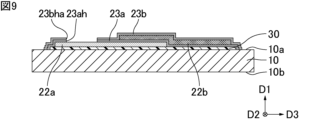
- FIG. 9 is a schematic cross-sectional view showing a step of forming a second dielectric layer in an example of a method for manufacturing a passive electronic component according to the first embodiment of the present invention.
- a dielectric layer made of a dielectric material is formed by CVD, PVD, or the like so as to cover the structure shown in FIG. 8 from the first main surface 10a side of the substrate 10. Then, the dielectric layer is patterned by a combination of photolithography and etching to form the second dielectric layer 23b as shown in FIG. 9. Specifically, the second dielectric layer 23b is formed so as to cover the second internal electrode layer 22b and the first dielectric layer 23a from the first main surface 10a side of the substrate 10. At this time, a through hole 23ah is provided that penetrates the first dielectric layer 23a in the first direction D1 so that a part of the first internal electrode layer 22a is exposed. Furthermore, a through hole 23bha is provided that penetrates the second dielectric layer 23b in the first direction D1 at a position that overlaps with the through hole 23ah in the first direction D1 so that a part of the first internal electrode layer 22a is exposed.
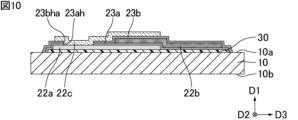
- FIG. 10 is a schematic cross-sectional view showing a step of forming a third internal electrode layer in an example of a method for manufacturing a passive electronic component according to the first embodiment of the present invention.
- An electrode layer made of a conductive material is formed by CVD, PVD, or the like so as to cover the structure shown in FIG. 9 from the first main surface 10a side of the substrate 10.
- This electrode layer is then patterned by a combination of photolithography and etching to form the third internal electrode layer 22c as shown in FIG. 10.
- the third internal electrode layer 22c is formed so as to be adjacent to the second internal electrode layer 22b in the first direction D1, sandwiching the second dielectric layer 23b therebetween.
- the third internal electrode layer 22c is formed inside the through holes 23ah and 23bha so as to connect to the first internal electrode layer 22a exposed from the through holes 23ah and 23bha.
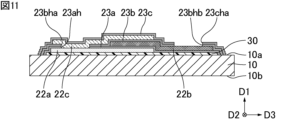
- FIG. 11 is a schematic cross-sectional view showing a step of forming a third dielectric layer in an example of a method for manufacturing a passive electronic component according to the first embodiment of the present invention.
- a dielectric layer made of a dielectric material is formed by CVD, PVD, or the like so as to cover the structure shown in FIG. 10 from the first main surface 10a side of the substrate 10. Then, the dielectric layer is patterned by a combination of photolithography and etching to form the third dielectric layer 23c as shown in FIG. 11. Specifically, the third dielectric layer 23c is formed so as to cover the third internal electrode layer 22c and the second dielectric layer 23b from the first main surface 10a side of the substrate 10. At this time, a through hole 23bhb is provided that penetrates the second dielectric layer 23b in the first direction D1 so that a part of the second internal electrode layer 22b is exposed. Furthermore, a through hole 23cha is provided that penetrates the third dielectric layer 23c in the first direction D1 at a position that overlaps with the through hole 23bhb in the first direction D1 so that a part of the second internal electrode layer 22b is exposed.
- FIG. 12 is a schematic cross-sectional view showing a step of forming a fourth internal electrode layer in an example of a method for manufacturing a passive electronic component according to the first embodiment of the present invention.
- An electrode layer made of a conductive material is formed by CVD, PVD, or the like so as to cover the structure shown in FIG. 11 from the first main surface 10a side of the substrate 10.
- This electrode layer is then patterned by a combination of photolithography and etching to form the fourth internal electrode layer 22d as shown in FIG. 12.
- the fourth internal electrode layer 22d is formed so as to be adjacent to the third internal electrode layer 22c in the first direction D1, sandwiching the third dielectric layer 23c therebetween.
- the fourth internal electrode layer 22d is formed inside the through hole 23bhb and the through hole 23cha so as to connect to the second internal electrode layer 22b exposed from the through hole 23bhb and the through hole 23cha.
- FIG. 13 is a schematic cross-sectional view showing a step of forming a fourth dielectric layer in an example of a method for manufacturing a passive electronic component according to the first embodiment of the present invention.
- a dielectric layer made of a dielectric material is formed by CVD, PVD, or the like so as to cover the structure shown in FIG. 12 from the first main surface 10a side of the substrate 10. Then, the dielectric layer is patterned by a combination of photolithography and etching to form the fourth dielectric layer 23d as shown in FIG. 13. Specifically, the fourth dielectric layer 23d is formed so as to cover the fourth internal electrode layer 22d and the third dielectric layer 23c from the first main surface 10a side of the substrate 10. At this time, a through hole 23chb is provided that penetrates the third dielectric layer 23c in the first direction D1 so that a part of the third internal electrode layer 22c is exposed.
- a through hole 23dha is provided that penetrates the fourth dielectric layer 23d in the first direction D1 at a position that overlaps with the through hole 23chb in the first direction D1 so that a part of the third internal electrode layer 22c is exposed. It is preferable to provide through holes 23chb and 23dha at positions that overlap through holes 23ah and 23bha in the first direction D1.
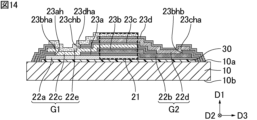
- FIG. 14 is a schematic cross-sectional view showing a step of forming a fifth internal electrode layer in an example of a method for manufacturing a passive electronic component according to the first embodiment of the present invention.
- An electrode layer made of a conductive material is formed by CVD, PVD, or the like so as to cover the structure shown in FIG. 13 from the first main surface 10a side of the substrate 10.
- This electrode layer is then patterned by a combination of photolithography and etching to form the fifth internal electrode layer 22e as shown in FIG. 14.
- the fifth internal electrode layer 22e is formed so as to be adjacent to the fourth internal electrode layer 22d across the fourth dielectric layer 23d in the first direction D1.
- the fifth internal electrode layer 22e is formed inside the through holes 23chb and 23dha so as to connect to the third internal electrode layer 22c exposed from the through holes 23chb and 23dha.
- the capacitance forming portion 21 is formed, in which the first internal electrode layer 22a, the first dielectric layer 23a, the second internal electrode layer 22b, the second dielectric layer 23b, the third internal electrode layer 22c, the third dielectric layer 23c, the fourth internal electrode layer 22d, the fourth dielectric layer 23d, and the fifth internal electrode layer 22e are stacked in order from the substrate 10 side in the first direction D1.
- FIG. 15 is a schematic cross-sectional view showing a step of forming a moisture-resistant protective layer in an example of a method for manufacturing a passive electronic component according to the first embodiment of the present invention.
- a moisture-resistant layer made of a moisture-resistant material is formed by CVD, PVD, or the like so as to cover the structure shown in FIG. 14 from the first main surface 10a side of the substrate 10. Then, the moisture-resistant layer is patterned by a combination of photolithography and etching to form a moisture-resistant protective layer 40 as shown in FIG. 15. Specifically, the moisture-resistant protective layer 40 is formed so as to cover the fifth internal electrode layer 22e and the fourth dielectric layer 23d from the first main surface 10a side of the substrate 10. At this time, a through hole 40ha is provided that penetrates the moisture-resistant protective layer 40 in the first direction D1 so that a portion of the fifth internal electrode layer 22e is exposed.
- a through hole 40ha is provided at a position that overlaps with the through hole 23ah, the through hole 23bha, the through hole 23chb, and the through hole 23dha in the first direction D1.
- a through hole 23dhb is provided through the fourth dielectric layer 23d in the first direction D1 so that a portion of the fourth internal electrode layer 22d is exposed.
- a through hole 40hb is provided through the moisture-resistant protective layer 40 in the first direction D1 at a position overlapping the through hole 23dhb in the first direction D1 so that a portion of the fourth internal electrode layer 22d is exposed. It is preferable to provide the through hole 23dhb and the through hole 40hb at a position overlapping the through hole 23bhb and the through hole 23cha in the first direction D1.
- FIG. 16 is a schematic cross-sectional view showing a step of forming a resin protective layer in an example of a method for manufacturing a passive electronic component according to the first embodiment of the present invention.
- a resin layer made of a resin material is formed by spin coating or the like so as to cover the structure shown in FIG. 15 from the first main surface 10a side of the substrate 10. Thereafter, the resin layer is patterned using only photolithography if the resin material of the resin layer is photosensitive, or using a combination of photolithography and etching if the resin material of the resin layer is non-photosensitive, to form a resin protective layer 50 as shown in FIG. 16. Specifically, the resin protective layer 50 is formed so as to cover the substrate 10 and the moisture-resistant protective layer 40 from the first main surface 10a side of the substrate 10.
- a through hole 50ha penetrating the resin protective layer 50 in the first direction D1 is provided at a position overlapping the through hole 40ha in the first direction D1 so as to expose a portion of the fifth internal electrode layer 22e. Furthermore, a through hole 50hb that penetrates the resin protective layer 50 in the first direction D1 is provided at a position that overlaps with the through hole 23dhb and the through hole 40hb in the first direction D1 so that a portion of the fourth internal electrode layer 22d is exposed.
- through hole 60ha is formed by connecting through hole 40ha and through hole 50ha in the first direction D1 so that a portion of the fifth internal electrode layer 22e is exposed. Furthermore, through hole 60hb is formed by connecting through hole 23dhb, through hole 40hb, and through hole 50hb in the first direction D1 so that a portion of the fourth internal electrode layer 22d is exposed.
- ⁇ Step of forming first external electrode and second external electrode> 17, 18, and 19 are schematic cross-sectional views showing steps of forming a first external electrode and a second external electrode in an example of a method for manufacturing a passive electronic component according to the first embodiment of the present invention.
- a seed layer 26 is formed to cover the structure shown in FIG. 16 from the first main surface 10a side of the substrate 10.
- a first plating layer 27aa and a second plating layer 27ab are sequentially formed as shown in FIG. 18 at positions overlapping with the through hole 60ha in the first direction D1 by combining plating and photolithography. Also, a first plating layer 27ba and a second plating layer 27bb are sequentially formed as shown in FIG. 18 at positions overlapping with the through hole 60hb in the first direction D1 by combining plating and photolithography.
- a portion of the seed layer 26 is removed by etching or the like to form a seed layer 26aa at a position overlapping the through hole 60ha in the first direction D1, and a seed layer 26ba at a position overlapping the through hole 60hb in the first direction D1.
- the first external electrode 25a is formed, which has, in order from the substrate 10 side, the seed layer 26aa, the first plating layer 27aa, and the second plating layer 27ab. Specifically, the first external electrode 25a is formed so as to connect to the fifth internal electrode layer 22e via the through hole 60ha.
- the second external electrode 25b is formed having, in order from the substrate 10 side, a seed layer 26ba, a first plating layer 27ba, and a second plating layer 27bb. Specifically, the second external electrode 25b is formed so as to connect to the fourth internal electrode layer 22d via the through hole 60hb.
- a capacitor 20 is formed having a capacitance forming portion 21, a first external electrode 25a, and a second external electrode 25b.
- FIGS. 4 to 19 show an example in which one capacitor is formed on a substrate
- multiple capacitors may be formed on a substrate.
- the multiple capacitors may be formed at the same timing or at different timings.
- a passive electronic component having multiple capacitors may be singulated into passive electronic components having a single capacitor.
- Figs. 1, 2, and 3 show an example in which the capacitance forming portion has five internal electrode layers, but the capacitance forming portion may have three or more internal electrode layers.
- the number of internal electrode layers included in the capacitance forming portion is not limited to the five layers mentioned above, so long as it is three or more layers.
- the capacitance forming portion has four internal electrode layers.
- FIG. 20 is a plan view schematic diagram showing another example of a passive electronic component according to embodiment 1 of the present invention.
- FIG. 21 is a cross-sectional schematic diagram showing an example of a cross-section along line segment b3-b4 of the passive electronic component shown in FIG. 20 (excluding the first external electrode).
- the capacitance forming portion 21 is formed by stacking the first internal electrode layer 22a, the first dielectric layer 23a, the second internal electrode layer 22b, the second dielectric layer 23b, the third internal electrode layer 22c, the third dielectric layer 23c, and the fourth internal electrode layer 22d in this order from the substrate 10 side in the first direction D1. That is, in the passive electronic component 1B, the capacitance forming portion 21 has four internal electrode layers.
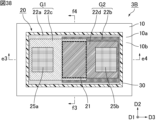
- the capacitance forming portion 21 is provided in approximately the center region in the third direction D3 when the capacitor 20 is viewed in a plan view from the first direction D1.
- FIG. 22 is a schematic cross-sectional view showing another example of a cross section along line segment b3-b4 of the passive electronic component shown in FIG. 20 (excluding the first external electrode).
- the Nth internal electrode layer and the N-2th internal electrode layer of the first group G1 are connected to each other at both ends in the second direction D2.
- a portion of the third internal electrode layer 22c of the first group G1 on one end 22cp side in the second direction D2 and a portion of the first internal electrode layer 22a of the first group G1 on one end 22ap side in the second direction D2 are connected to each other. Also, in the example shown in FIG.
- a portion of the third internal electrode layer 22c of the first group G1 on the other end 22cp side in the second direction D2 and a portion of the first internal electrode layer 22a of the first group G1 on the other end 22ap side in the second direction D2 are connected to each other.
- FIG. 23 is a schematic plan view showing yet another example of a passive electronic component according to embodiment 1 of the present invention.
- FIG. 24 is a schematic cross-sectional view showing an example of a cross-section along line segment b5-b6 of the passive electronic component shown in FIG. 23 (excluding the first external electrode).
- the capacitance forming portion 21 has four internal electrode layers.
- capacitance forming portion 21 is provided over substantially the entire area (excluding the area overlapping with first external electrode 25a and second external electrode 25b) in second direction D2 and third direction D3 when capacitor 20 is viewed in a plane from first direction D1.
- the area of the internal electrode layer in capacitance forming portion 21 is larger when capacitor 20 is viewed in a plane from first direction D1 than in passive electronic component 1B, and therefore the electrostatic capacitance of capacitance forming portion 21 is larger.
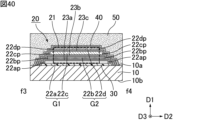
- the passive electronic component 1C unlike the passive electronic component 1B, in a plan view from the first direction D1, the peripheries of all the internal electrode layers of the second group G2 are located inside the periphery of the first internal electrode layer 22a of the first group G1, which is located closest to the substrate 10. Specifically, in the passive electronic component 1C, in a plan view from the first direction D1, the peripheries of the second internal electrode layer 22b and the fourth internal electrode layer 22d of the second group G2 are both located inside the periphery of the first internal electrode layer 22a.
- the passive electronic component 1C when a voltage is applied to the capacitance forming portion 21, the electric field generated between the internal electrode layer of the first group G1 and the internal electrode layer of the second group G2 is less likely to penetrate into the substrate 10. Therefore, in the passive electronic component 1C, when a voltage is applied to the capacitance forming portion 21, power loss in the substrate 10 is less likely to occur, and as a result, the Q value of the passive electronic component 1C is less likely to decrease.
- the periphery of the internal electrode layers in the first group G1, except for the first internal electrode layer 22a, is located inside the periphery of the first internal electrode layer 22a.
- the periphery of the third internal electrode layer 22c in the first group G1 is located inside the periphery of the first internal electrode layer 22a.
- the periphery of the Nth internal electrode layer of the first group G1 when viewed in a plan view from the first direction D1, the periphery of the Nth internal electrode layer of the first group G1, where N is an odd number equal to or greater than 3, is located outside the periphery of the N-1th internal electrode layer of the second group G2.
- the periphery of the third internal electrode layer 22c of the first group G1 is located outside the periphery of the second internal electrode layer 22b of the second group G2.
- both ends of the Nth internal electrode layer of the first group G1 in the second direction D2 are located outward in the second direction D2 than both ends of the N-1th internal electrode layer of the second group G2 in the second direction D2. Furthermore, in a cross section (e.g., FIG. 24) along the first direction D1 and the second direction D2 for the passive electronic component 1C, when N is an odd number equal to or greater than 3, both ends of the Nth internal electrode layer of the first group G1 in the second direction D2 are located outward in the second direction D2 than both ends of the N-1th internal electrode layer of the second group G2 in the second direction D2. Furthermore, in a cross section (e.g., FIG. 24) along the first direction D1 and the second direction D2 for the passive electronic component 1C, when N is an odd number equal to or greater than 3, both ends of the Nth internal electrode layer of the first group G1 in the second direction D2 are located outward in the second direction D2 than both ends of the N-1th internal electrode layer of the second group G2
- both ends of the Nth internal electrode layer of the first group G1 in the third direction D3 are located outward in the third direction D3 than both ends of the N-1th internal electrode layer of the second group G2 in the third direction D3.
- FIG. 25 is a schematic cross-sectional view showing another example of a cross section along line segment b5-b6 of the passive electronic component shown in FIG. 23 (excluding the first external electrode).
- the Nth internal electrode layer and the N-2th internal electrode layer of the first group G1 are connected to each other at both ends in the second direction D2 in the cross section along the first direction D1 and the second direction D2.
- the portion of the third internal electrode layer 22c of the first group G1 on one end 22cp side in the second direction D2 and the portion of the first internal electrode layer 22a of the first group G1 on one end 22ap side in the second direction D2 are connected to each other. Also, in the example shown in FIG.
- the electric field generated between the first internal electrode layer 22a and the second internal electrode layer 22b is less likely to penetrate the moisture-resistant protective layer 40 and the resin protective layer 50 when a voltage is applied to the capacitance forming portion 21, as compared to the example shown in FIG. 24, in which the third internal electrode layer 22c and the first internal electrode layer 22a are not connected to each other at both ends in the second direction D2. Therefore, in the example shown in FIG.
- a passive electronic component of the present invention comprises a substrate having a first main surface and a second main surface opposed to each other in a first direction, and a capacitor provided on the first main surface side of the substrate, the capacitor having a capacitance forming portion formed by stacking internal electrode layers and dielectric layers alternately in the first direction, the capacitance forming portion having four or more internal electrode layers, and defining a first group to which the internal electrode layers located odd-numbered when counting all of the internal electrode layers from the substrate side in the first direction belong and a second group to which the internal electrode layers located even-numbered belong, and defining all of the internal electrode layers from the substrate side in the first direction
- N is an even number greater than or equal to 4
- an Nth internal electrode layer that is located Nth and belongs to the second group and an N-1th internal electrode layer that is located N-1st and belongs to the first group are defined, and a second direction that is perpendicular to an average direction of a current that
- FIG. 26 is a schematic plan view showing an example of a passive electronic component according to embodiment 2 of the present invention.
- FIG. 27 is a schematic cross-sectional view showing an example of a cross-section along line segment c1-c2 of the passive electronic component shown in FIG. 26.
- FIG. 28 is a schematic cross-sectional view showing an example of a cross-section along line segment d1-d2 of the passive electronic component shown in FIG. 26 (excluding the first external electrode).
- the passive electronic component 2A shown in Figures 26, 27, and 28 is similar to the passive electronic component 1A (see Figures 1, 2, and 3) except for the following configuration.
- the capacitance forming portion 21 has four or more internal electrode layers.
- the capacitance forming portion 21 is formed by stacking the first internal electrode layer 22a, the first dielectric layer 23a, the second internal electrode layer 22b, the second dielectric layer 23b, the third internal electrode layer 22c, the third dielectric layer 23c, the fourth internal electrode layer 22d, the fourth dielectric layer 23d, and the fifth internal electrode layer 22e in this order from the substrate 10 side in the first direction D1. That is, in the example shown in Figures 27 and 28, the capacitance forming portion 21 has five internal electrode layers.
- a first group G1 is defined to which the odd-numbered internal electrode layers belong
- a second group G2 is defined to which the even-numbered internal electrode layers belong.
- the first group G1 includes the first internal electrode layer 22a, the third internal electrode layer 22c, and the fifth internal electrode layer 22e.
- the second group G2 includes the second internal electrode layer 22b and the fourth internal electrode layer 22d.
- the Nth internal electrode layer is located Nth and belongs to the second group G2
- the N-1th internal electrode layer is located N-1th and belongs to the first group G1, where N is an even number equal to or greater than 4.
- a second direction D2 is defined that is perpendicular to the average direction of the current that flows through the capacitance forming portion 21 when a voltage is applied to the capacitance forming portion 21 in a plan view from the first direction D1.
- the second direction D2 is a direction perpendicular to the first direction D1, that is perpendicular to the direction passing through the first external electrode 25a and the second external electrode 25b.
- the average direction of the current flowing through the capacitance forming portion 21 when a voltage is applied to the capacitance forming portion 21 corresponds to the third direction D3 passing through the first external electrode 25a and the second external electrode 25b.
- both ends of the Nth internal electrode layer of the second group G2 in the second direction D2 are located further outward in the second direction D2 than both ends of the N-1th internal electrode layer of the first group G1 in the second direction D2.
- this feature will be referred to as the second feature.
- the second feature is as follows in FIG. 28, which shows an example of a cross section of a passive electronic component 2A along the first direction D1 and the second direction D2.
- both ends 22dp in the second direction D2 of the fourth internal electrode layer 22d of the second group G2 are located outward in the second direction D2 than both ends 22cp in the second direction D2 of the third internal electrode layer 22c of the first group G1.
- the Nth internal electrode layer of the second group G2 preferably covers, in the second direction D2, at least a portion of each side surface (facing the second direction D2) of the N-1th internal electrode layer of the first group G1 at both end sides in the second direction D2.
- the Nth internal electrode layer of the second group G2 preferably covers, in the second direction D2, at both end sides in the second direction D2, a portion or the entirety of each side surface of the N-1th internal electrode layer of the first group G1 at both end sides in the second direction D2.
- the Nth internal electrode layer is preferably provided so as to cover the N-1th internal electrode layer over the entire area in the second direction D2.
- FIG. 28 which shows an example of a cross section of a passive electronic component 2A along the first direction D1 and the second direction D2, it is preferable that:
- the fourth internal electrode layer 22d of the second group G2 preferably covers, in the second direction D2, at least a part of each side surface of the third internal electrode layer 22c of the first group G1 on the side of both end portions 22cp in the second direction D2 at both end portions 22dp in the second direction D2. That is, in the example shown in Fig. 28, the fourth internal electrode layer 22d is preferably provided so as to cover the third internal electrode layer 22c over the entire area in the second direction D2.
- the passive electronic component 2A since the second feature is established, when a voltage is applied to the capacitance forming portion 21, the electric field generated between the internal electrode layer of the first group G1 and the internal electrode layer of the second group G2 is less likely to penetrate into the substrate 10.
- the end 22dp in the second direction D2 of the fourth internal electrode layer 22d of the second group G2 is located outside in the second direction D2 than the end 22cp in the second direction D2 of the third internal electrode layer 22c of the first group G1.
- the passive electronic component 2A when a voltage is applied to the capacitance forming portion 21, the electric field generated between the part of the end 22cp side in the second direction D2 of the third internal electrode layer 22c of the first group G1 and the part of the end 22bp side in the second direction D2 of the second internal electrode layer 22b of the second group G2 is easily shielded by the part of the end 22dp side in the second direction D2 of the fourth internal electrode layer 22d. Therefore, in the passive electronic component 2A, when a voltage is applied to the capacitance forming portion 21, the electric field generated between the third internal electrode layer 22c and the second internal electrode layer 22b is less likely to flow into the substrate 10.
- the passive electronic component 2A when a voltage is applied to the capacitance forming portion 21, the electric field generated between the internal electrode layer of the first group G1 and the internal electrode layer of the second group G2 is less likely to penetrate into the substrate 10. Therefore, in the passive electronic component 2A, when a voltage is applied to the capacitance forming portion 21, power loss is less likely to occur in the substrate 10, and as a result, the Q value of the passive electronic component 2A is less likely to decrease.
- the second characteristic is satisfied when N is at least one even number greater than or equal to 4. It is particularly preferable that the second characteristic is satisfied when N is all even numbers greater than or equal to 4.
- the passive electronic component 2A When the passive electronic component 2A has a moisture-resistant protective layer 40 and a resin protective layer 50, the passive electronic component 2A has the second characteristic, so that when a voltage is applied to the capacitance forming portion 21, the electric field generated between the internal electrode layer of the first group G1 and the internal electrode layer of the second group G2 is unlikely to penetrate not only into the substrate 10 but also into the moisture-resistant protective layer 40 and the resin protective layer 50.
- the passive electronic component 2A when a voltage is applied to the capacitance forming portion 21, the electric field generated between the portion of the third internal electrode layer 22c of the first group G1 on the side of the end 22cp in the second direction D2 and the portion of the second internal electrode layer 22b of the second group G2 on the side of the end 22bp in the second direction D2 is likely to be shielded by the portion of the fourth internal electrode layer 22d on the side of the end 22dp in the second direction D2. Therefore, in the passive electronic component 2A, when a voltage is applied to the capacitance forming portion 21, the electric field generated between the third internal electrode layer 22c and the second internal electrode layer 22b is less likely to penetrate into the moisture-resistant protective layer 40 and the resin protective layer 50.
- the passive electronic component 2A when a voltage is applied to the capacitance forming portion 21, the electric field generated between the internal electrode layer of the first group G1 and the internal electrode layer of the second group G2 is less likely to penetrate the moisture-resistant protective layer 40 and the resin protective layer 50. Therefore, in the passive electronic component 2A, when a voltage is applied to the capacitance forming portion 21, the deviation in the electrostatic capacitance of the capacitance forming portion 21 is suppressed, and further, the power loss due to the dielectric tangent in the resin protective layer 50 is suppressed.
- the passive electronic component 2A when a voltage is applied to the capacitance forming portion 21, the electric field generated between the portion of the first internal electrode layer 22a on the end 22ap side in the second direction D2 and the portion of the second internal electrode layer 22b on the end 22bp side in the second direction D2 may penetrate to some extent into the moisture-resistant protective layer 40 and the resin protective layer 50, as compared to the passive electronic component 1A.
- the passive electronic component 2A when a voltage is applied to the capacitance forming portion 21, the electric field generated between the portion of the fifth internal electrode layer 22e on the end 22ep side in the second direction D2 and the portion of the fourth internal electrode layer 22d on the end 22dp side in the second direction D2 may penetrate to some extent into the moisture-resistant protective layer 40 and the resin protective layer 50, as compared to the passive electronic component 1A.
- the passive electronic component 2A may be less effective than the passive electronic component 1A, it can still achieve some effect.
- Passive electronic component 2A is manufactured in the same manner as passive electronic component 1A, except that, for example, the arrangement of the internal electrode layers is changed.
- Figs. 26, 27, and 28 show an example in which the capacitance forming portion has five internal electrode layers, but the capacitance forming portion may have four or more internal electrode layers.
- the number of internal electrode layers included in the capacitance forming portion is not limited to the five layers mentioned above, so long as it is four or more layers. Below, an example is shown in which the capacitance forming portion has four internal electrode layers.
- FIG. 29 is a schematic plan view showing another example of a passive electronic component according to embodiment 2 of the present invention.
- FIG. 30 is a schematic cross-sectional view showing an example of a cross-section along line segment d3-d4 of the passive electronic component shown in FIG. 29 (excluding the first external electrode).
- the capacitance forming portion 21 is formed by stacking the first internal electrode layer 22a, the first dielectric layer 23a, the second internal electrode layer 22b, the second dielectric layer 23b, the third internal electrode layer 22c, the third dielectric layer 23c, and the fourth internal electrode layer 22d in this order from the substrate 10 side in the first direction D1. That is, in the passive electronic component 2B, the capacitance forming portion 21 has four internal electrode layers.
- the capacitance forming portion 21 is provided in approximately the center region in the third direction D3 when the capacitor 20 is viewed in a plan view from the first direction D1.
- FIG. 31 is a schematic cross-sectional view showing another example of a cross section along line segment d3-d4 of the passive electronic component shown in FIG. 29 (excluding the first external electrode).
- the Nth internal electrode layer and the N-2th internal electrode layer of the second group G2 are connected to each other at both end sides in the second direction D2.
- a portion of the fourth internal electrode layer 22d of the second group G2 on one end 22dp side in the second direction D2 and a portion of the second internal electrode layer 22b of the second group G2 on one end 22bp side in the second direction D2 are connected to each other. Also, in the example shown in FIG.
- a portion of the fourth internal electrode layer 22d of the second group G2 on the other end 22dp side in the second direction D2 and a portion of the second internal electrode layer 22b of the second group G2 on the other end 22bp side in the second direction D2 are connected to each other.
- the second dielectric layer 23b and the third dielectric layer 23c are not provided between the portion of the fourth internal electrode layer 22d on one end 22dp side in the second direction D2 and the portion of the second internal electrode layer 22b on one end 22bp side in the second direction D2. Also, in the example shown in FIG. 31, unlike the example shown in FIG. 30, the second dielectric layer 23b and the third dielectric layer 23c are not provided between the portion of the fourth internal electrode layer 22d on the other end 22dp side in the second direction D2 and the portion of the second internal electrode layer 22b on the other end 22bp side in the second direction D2.
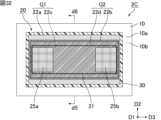
- Fig. 32 is a plan view schematic diagram showing yet another example of a passive electronic component according to embodiment 2 of the present invention.
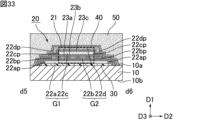
- Fig. 33 is a cross-sectional schematic diagram showing an example of a cross-section along line segment d5-d6 of the passive electronic component shown in Fig. 32 (excluding the first external electrode).
- the capacitance forming portion 21 has four internal electrode layers.
- the capacitance forming portion 21 is provided over substantially the entire area (excluding the area overlapping with the first external electrode 25a and the second external electrode 25b) in the second direction D2 and the third direction D3 when the capacitor 20 is viewed in a plane from the first direction D1.
- the area of the internal electrode layer in the capacitance forming portion 21 is larger when the capacitor 20 is viewed in a plane from the first direction D1 compared to the passive electronic component 2B, and therefore the electrostatic capacitance of the capacitance forming portion 21 is larger.
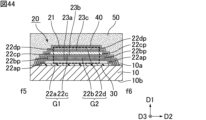
- the peripheries of all the internal electrode layers of the second group G2 are located inside the periphery of the first internal electrode layer 22a of the first group G1, which is located closest to the substrate 10.
- the peripheries of the second internal electrode layer 22b and the fourth internal electrode layer 22d of the second group G2 are both located inside the periphery of the first internal electrode layer 22a.
- the passive electronic component 2C when a voltage is applied to the capacitance forming portion 21, the electric field generated between the internal electrode layer of the first group G1 and the internal electrode layer of the second group G2 is less likely to penetrate into the substrate 10. Therefore, in the passive electronic component 2C, when a voltage is applied to the capacitance forming portion 21, power loss in the substrate 10 is less likely to occur, and as a result, the Q value of the passive electronic component 2C is less likely to decrease.
- the periphery of the internal electrode layers in the first group G1, except for the first internal electrode layer 22a, is located inside the periphery of the first internal electrode layer 22a.
- the periphery of the third internal electrode layer 22c in the first group G1 is located inside the periphery of the first internal electrode layer 22a.
- the periphery of the Nth internal electrode layer of the second group G2 when viewed in a plan view from the first direction D1, the periphery of the Nth internal electrode layer of the second group G2, where N is an even number equal to or greater than 4, is located outside the periphery of the N-1th internal electrode layer of the first group G1.
- the periphery of the fourth internal electrode layer 22d of the second group G2 is located outside the periphery of the third internal electrode layer 22c of the first group G1.
- both ends of the Nth internal electrode layer of the second group G2 in the second direction D2 are located outward in the second direction D2 than both ends of the N-1th internal electrode layer of the first group G1 in the second direction D2. Furthermore, in a cross section (e.g., FIG. 33) along the first direction D1 and the second direction D2 for the passive electronic component 2C, when N is an even number equal to or greater than 4, both ends of the Nth internal electrode layer of the second group G2 in the second direction D2 are located outward in the second direction D2 than both ends of the N-1th internal electrode layer of the first group G1 in the second direction D2. Furthermore, in a cross section (e.g., FIG. 33) along the first direction D1 and the second direction D2 for the passive electronic component 2C, when N is an even number equal to or greater than 4, both ends of the Nth internal electrode layer of the second group G2 in the second direction D2 are located outward in the second direction D2 than both ends of the N-1th internal electrode layer of the first group G1
- both ends of the Nth internal electrode layer of the second group G2 in the third direction D3 are located outward in the third direction D3 than both ends of the N-1th internal electrode layer of the first group G1 in the third direction D3.
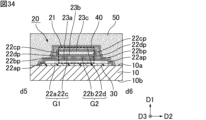
- FIG. 34 is a schematic cross-sectional view showing another example of a cross section along line segment d5-d6 of the passive electronic component shown in FIG. 32 (excluding the first external electrode).
- the Nth internal electrode layer and the N-2th internal electrode layer of the second group G2 are connected to each other at both end sides in the second direction D2.
- the portion of the fourth internal electrode layer 22d of the second group G2 on one end 22dp side in the second direction D2 and the portion of the second internal electrode layer 22b of the second group G2 on one end 22bp side in the second direction D2 are connected to each other. Also, in the example shown in FIG.
- the portion of the fourth internal electrode layer 22d of the second group G2 on the other end 22dp side in the second direction D2 and the portion of the second internal electrode layer 22b of the second group G2 on the other end 22bp side in the second direction D2 are connected to each other.
- the electric field generated between the third internal electrode layer 22c and the second internal electrode layer 22b is less likely to penetrate the moisture-resistant protective layer 40 and the resin protective layer 50 when a voltage is applied to the capacitance forming portion 21, as compared to the example shown in FIG. 33, in which the fourth internal electrode layer 22d and the second internal electrode layer 22b are not connected to each other at both ends in the second direction D2. Therefore, in the example shown in FIG. 34, in which the fourth internal electrode layer 22d and the second internal electrode layer 22b are connected to each other at both ends in the second direction D2.
- a passive electronic component of the present invention comprises a substrate having a first main surface and a second main surface facing each other in a first direction, and a capacitor provided on the first main surface side of the substrate, wherein the capacitor has a capacitance forming portion formed by internal electrode layers and dielectric layers alternately stacked in the first direction, the capacitance forming portion having three or more internal electrode layers, and when all of the internal electrode layers are counted in order from the substrate side in the first direction, a first group to which the internal electrode layers located odd-numbered belong and a second group to which the internal electrode layers located even-numbered belong are defined, and in a planar view from the first direction, the peripheries of all of the internal electrode layers in the second group are located inside the periphery of a first internal electrode layer in the first group that is located closest to the substrate.
- FIG. 35 is a schematic plan view showing an example of a passive electronic component according to embodiment 3 of the present invention.
- FIG. 36 is a schematic cross-sectional view showing an example of a cross-section along line segment e1-e2 of the passive electronic component shown in FIG. 35.
- FIG. 37 is a schematic cross-sectional view showing an example of a cross-section along line segment f1-f2 of the passive electronic component shown in FIG. 35 (excluding the first external electrode).
- the passive electronic component 3A shown in Figures 35, 36, and 37 is similar to the passive electronic component 1A (see Figures 1, 2, and 3) except for the following configuration.
- a first group G1 is defined to which the odd-numbered internal electrode layers belong
- a second group G2 is defined to which the even-numbered internal electrode layers belong.
- the first group G1 includes the first internal electrode layer 22a, the third internal electrode layer 22c, and the fifth internal electrode layer 22e.
- the second group G2 includes the second internal electrode layer 22b and the fourth internal electrode layer 22d.
- the edges of all the internal electrode layers of the second group G2 are located inside the edges of the first internal electrode layer 22a of the first group G1 that is located closest to the substrate 10.
- this feature will be referred to as the third feature.
- the third feature is as follows in FIG. 35, which shows the passive electronic component 3A viewed in a plan view from the first direction D1.
- the peripheries of the second internal electrode layer 22b and the fourth internal electrode layer 22d of the second group G2 are both located inside the periphery of the first internal electrode layer 22a.
- the passive electronic component 3A because the third characteristic is established, when a voltage is applied to the capacitance forming portion 21, the electric field generated between the internal electrode layer of the first group G1 and the internal electrode layer of the second group G2 is less likely to penetrate into the substrate 10.
- the passive electronic component 3A when a voltage is applied to the capacitance forming portion 21, the electric field generated between the portion of the end 22ap side in the second direction D2 of the first internal electrode layer 22a located closest to the substrate 10 in the first group G1 and the portion of the end 22bp side in the second direction D2 of the second internal electrode layer 22b located closest to the substrate 10 in the second group G2 is less likely to wrap around into the substrate 10.
- the passive electronic component 3A when a voltage is applied to the capacitance forming portion 21, the electric field generated between the internal electrode layer of the first group G1 and the internal electrode layer of the second group G2 is less likely to penetrate into the substrate 10. Therefore, in the passive electronic component 3A, when a voltage is applied to the capacitance forming portion 21, power loss is less likely to occur in the substrate 10, and as a result, the Q value of the passive electronic component 1C is less likely to decrease.
- the periphery of the internal electrode layers in the first group G1, except for the first internal electrode layer 22a, is located inside the periphery of the first internal electrode layer 22a.
- the periphery of the third internal electrode layer 22c in the first group G1 is located inside the periphery of the first internal electrode layer 22a.
- Passive electronic component 3A is manufactured in the same manner as passive electronic component 1A, except that, for example, the arrangement of the internal electrode layers is changed.
- Figs. 35, 36, and 37 show an example in which the capacitance forming portion has five internal electrode layers, but the capacitance forming portion may have three or more internal electrode layers.
- the number of internal electrode layers included in the capacitance forming portion is not limited to the five layers mentioned above, so long as it is three or more layers.
- the capacitance forming portion has four internal electrode layers.
- FIG. 38 is a schematic plan view showing another example of a passive electronic component according to embodiment 3 of the present invention.
- FIG. 39 is a schematic cross-sectional view showing an example of a cross-section along line segment e3-e4 of the passive electronic component shown in FIG. 38.
- FIG. 40 is a schematic cross-sectional view showing an example of a cross-section along line segment f3-f4 of the passive electronic component shown in FIG. 38 (excluding the first external electrode).
- the capacitance forming portion 21 is formed by stacking the first internal electrode layer 22a, the first dielectric layer 23a, the second internal electrode layer 22b, the second dielectric layer 23b, the third internal electrode layer 22c, the third dielectric layer 23c, and the fourth internal electrode layer 22d in this order from the substrate 10 side in the first direction D1. That is, in the passive electronic component 3B, the capacitance forming portion 21 has four internal electrode layers.
- the capacitance forming portion 21 is provided in approximately the center region in the third direction D3 when the capacitor 20 is viewed in a plan view from the first direction D1.
- FIG. 41 is a schematic cross-sectional view showing another example of a cross section along line f3-f4 of the passive electronic component shown in FIG. 38 (excluding the first external electrode).
- the protrusion contains the same material as the internal electrode layer of the second group G2 that is adjacent to the internal electrode layer of the first group G1 on the side opposite the substrate 10 in which the protrusion is provided. Specifically, it is as follows.
- the first internal electrode layer 22a is provided with protrusions 22as that protrude in the first direction D1 from the portions on both end portions 22ap sides in the second direction D2. Furthermore, in the example shown in FIG. 41, the protrusions 22as of the first internal electrode layer 22a contain the same material as the second internal electrode layer 22b that is adjacent to the first internal electrode layer 22a on the side opposite the substrate 10.
- the protrusion 22as of the first internal electrode layer 22a functions as an antenna with respect to the electric field generated between the portion of the first internal electrode layer 22a on the end 22ap side in the second direction D2 and the portion of the second internal electrode layer 22b on the end 22bp side in the second direction D2.
- the electric field generated between the first internal electrode layer 22a and the second internal electrode layer 22b is less likely to penetrate into the substrate 10 when a voltage is applied to the capacitance forming portion 21, as compared to the example shown in FIG. 40 in which the protrusion 22as is not provided on the first internal electrode layer 22a. Therefore, in the example shown in FIG. 41, power loss is less likely to occur in the substrate 10 when a voltage is applied to the capacitance forming portion 21, as compared to the example shown in FIG. 40, and as a result, the Q value of the passive electronic component 3B is less likely to decrease.
- the passive electronic component 3B has a moisture-resistant protective layer 40 and a resin protective layer 50
- the electric field generated between the first internal electrode layer 22a and the second internal electrode layer 22b is less likely to penetrate the moisture-resistant protective layer 40 and the resin protective layer 50. Therefore, in the example shown in FIG. 41, compared to the example shown in FIG. 40, when a voltage is applied to the capacitance forming portion 21, the shift in the electrostatic capacitance of the capacitance forming portion 21 is suppressed, and further, the power loss due to the dielectric tangent in the resin protective layer 50 is suppressed.
- the protrusion 22as of the first internal electrode layer 22a contains the same material as the second internal electrode layer 22b, so it can be formed at the same time as the second internal electrode layer 22b.
- the third internal electrode layer 22c has protrusions 22cs that protrude in the first direction D1 from the portions on both end portions 22cp in the second direction D2. Furthermore, in the example shown in FIG. 41, the protrusions 22cs of the third internal electrode layer 22c contain the same material as the fourth internal electrode layer 22d that is adjacent to the third internal electrode layer 22c on the side opposite the substrate 10.
- the protrusion 22cs of the third internal electrode layer 22c functions as an antenna for the electric field generated between the portion of the third internal electrode layer 22c on the end 22cp side in the second direction D2 and the portion of the second internal electrode layer 22b on the end 22bp side in the second direction D2. Also, in the example shown in FIG. 41, when a voltage is applied to the capacitance forming portion 21, the protrusion 22cs of the third internal electrode layer 22c functions as an antenna for the electric field generated between the portion of the third internal electrode layer 22c on the end 22cp side in the second direction D2 and the portion of the second internal electrode layer 22b on the end 22bp side in the second direction D2. Also, in the example shown in FIG.
- the protrusion 22cs of the third internal electrode layer 22c functions as an antenna for the electric field generated between the portion of the third internal electrode layer 22c on the end 22cp side in the second direction D2 and the portion of the fourth internal electrode layer 22d on the end 22dp side in the second direction D2.
- the electric field generated between the third internal electrode layer 22c and the second internal electrode layer 22b and the electric field generated between the third internal electrode layer 22c and the fourth internal electrode layer 22d are less likely to penetrate into the substrate 10, as compared to the example shown in FIG. 40 in which the third internal electrode layer 22c does not have a protrusion 22cs. Therefore, in the example shown in FIG. 41, when a voltage is applied to the capacitance forming portion 21, power loss is less likely to occur in the substrate 10, as compared to the example shown in FIG. 40, and as a result, the Q value of the passive electronic component 3B is less likely to decrease.
- the passive electronic component 3B has a moisture-resistant protective layer 40 and a resin protective layer 50
- the electric field generated between the third internal electrode layer 22c and the second internal electrode layer 22b and the electric field generated between the third internal electrode layer 22c and the fourth internal electrode layer 22d are less likely to penetrate the moisture-resistant protective layer 40 and the resin protective layer 50. Therefore, in the example shown in FIG. 41, compared to the example shown in FIG.
- the protrusion 22cs of the third internal electrode layer 22c contains the same material as the fourth internal electrode layer 22d, so it can be formed at the same time as the fourth internal electrode layer 22d.
- all of the internal electrode layers of the first group G1 may be provided with protrusions, or some of the internal electrode layers of the first group G1 (in the example shown in FIG. 41, one of the first internal electrode layer 22a and the third internal electrode layer 22c) may be provided with protrusions. Of these, it is preferable that all of the internal electrode layers of the first group G1 are provided with protrusions.
- the protrusion contains the same material as the internal electrode layer of the first group G1 that is adjacent to the internal electrode layer of the second group G2 on the side opposite the substrate 10 in which the protrusion is provided. Specifically, it is as follows.
- the second internal electrode layer 22b is provided with protrusions 22bs that protrude in the first direction D1 from the portions on both end portions 22bp in the second direction D2. Furthermore, in the example shown in FIG. 41, the protrusions 22bs of the second internal electrode layer 22b contain the same material as the third internal electrode layer 22c that is adjacent to the second internal electrode layer 22b on the side opposite the substrate 10.
- the protrusion 22bs of the second internal electrode layer 22b functions as an antenna for the electric field generated between the portion of the second internal electrode layer 22b on the end 22bp side in the second direction D2 and the portion of the first internal electrode layer 22a on the end 22ap side in the second direction D2. Also, in the example shown in FIG. 41, in the example shown in FIG. 41, when a voltage is applied to the capacitance forming portion 21, the protrusion 22bs of the second internal electrode layer 22b functions as an antenna for the electric field generated between the portion of the second internal electrode layer 22b on the end 22bp side in the second direction D2 and the portion of the first internal electrode layer 22a on the end 22ap side in the second direction D2. Also, in the example shown in FIG.
- the protrusion 22bs of the second internal electrode layer 22b functions as an antenna for the electric field generated between the portion of the second internal electrode layer 22b on the end 22bp side in the second direction D2 and the portion of the third internal electrode layer 22c on the end 22cp side in the second direction D2.
- the passive electronic component 3B has a moisture-resistant protective layer 40 and a resin protective layer 50
- the electric field generated between the second internal electrode layer 22b and the first internal electrode layer 22a, and the electric field generated between the second internal electrode layer 22b and the third internal electrode layer 22c are less likely to penetrate the moisture-resistant protective layer 40 and the resin protective layer 50. Therefore, in the example shown in FIG. 41, compared to the example shown in FIG.
- the protrusion 22bs of the second internal electrode layer 22b contains the same material as the third internal electrode layer 22c, and therefore can be formed at the same time as the third internal electrode layer 22c.
- all of the internal electrode layers of the second group G2 may be provided with protrusions, or some of the internal electrode layers of the second group G2 may be provided with protrusions. Of these, it is preferable that all of the internal electrode layers of the second group G2 are provided with protrusions.
- FIG. 42 is a schematic plan view showing yet another example of a passive electronic component according to embodiment 3 of the present invention.
- FIG. 43 is a schematic cross-sectional view showing an example of a cross-section along line segment e5-e6 of the passive electronic component shown in FIG. 42.
- FIG. 44 is a schematic cross-sectional view showing an example of a cross-section along line segment f5-f6 of the passive electronic component shown in FIG. 42 (excluding the first external electrode).
- the protrusion contains the same material as the internal electrode layer of the second group G2 that is adjacent to the internal electrode layer of the first group G1 on the side opposite the substrate 10 in which the protrusion is provided.
- a protrusion is provided on the internal electrode layer in the third embodiment of the passive electronic component of the present invention, but a protrusion may be provided on the internal electrode layer in the first embodiment of the passive electronic component of the present invention, and a protrusion may be provided on the internal electrode layer in the second embodiment of the passive electronic component of the present invention.
- a substrate having a first main surface and a second main surface facing each other in a first direction; a capacitor provided on the first main surface side of the substrate, the capacitor has a capacitance forming portion formed by alternately stacking internal electrode layers and dielectric layers in the first direction, the capacitance forming portion has three or more of the internal electrode layers,
- a first group is defined to which the internal electrode layers located at odd numbers belong
- a second group is defined to which the internal electrode layers located at even numbers belong;
- an N-th internal electrode layer is defined as an N-th internal electrode layer that is located N-th and belongs to the first group
- an N-1-th internal electrode layer is defined as an N-th internal electrode layer that is located N-1th and belongs to the second group, where N is an odd number of 3 or more;
- a second direction is defined as being perpendicular
- ⁇ 2> A passive electronic component described in ⁇ 1>, wherein, in the cross section, the Nth internal electrode layer of the first group covers, in the second direction, at least a portion of each side surface of the N-1th internal electrode layer of the second group at both end sides in the second direction.
- a substrate having a first main surface and a second main surface facing each other in a first direction; a capacitor provided on the first main surface side of the substrate, the capacitor has a capacitance forming portion formed by alternately stacking internal electrode layers and dielectric layers in the first direction, the capacitance forming portion has three or more of the internal electrode layers,
- a first group to which the internal electrode layers located in odd numbers belong and a second group to which the internal electrode layers located in even numbers belong are defined,
- a passive electronic component characterized in that, when viewed in a plan view from the first direction, the peripheries of all of the internal electrode layers of the second group are located more inward than the periphery of a first internal electrode layer of the first group that is located closest to the substrate.
- the passive electronic component according to any one of ⁇ 1> to ⁇ 9>, wherein the capacitor further comprises a first external electrode electrically connected to all of the internal electrode layers of the first group.
- ⁇ 11> The passive electronic component according to any one of ⁇ 1> to ⁇ 10>, wherein the capacitor further comprises a second external electrode electrically connected to all of the internal electrode layers of the second group.
Landscapes
- Engineering & Computer Science (AREA)
- Power Engineering (AREA)
- Microelectronics & Electronic Packaging (AREA)
- Manufacturing & Machinery (AREA)
- Fixed Capacitors And Capacitor Manufacturing Machines (AREA)
Priority Applications (2)
| Application Number | Priority Date | Filing Date | Title |
|---|---|---|---|
| JP2025544236A JPWO2025052919A1 (https=) | 2023-09-08 | 2024-08-21 | |
| CN202480056849.2A CN121794778A (zh) | 2023-09-08 | 2024-08-21 | 无源电子部件 |
Applications Claiming Priority (2)
| Application Number | Priority Date | Filing Date | Title |
|---|---|---|---|
| JP2023-146225 | 2023-09-08 | ||
| JP2023146225 | 2023-09-08 |
Publications (1)
| Publication Number | Publication Date |
|---|---|
| WO2025052919A1 true WO2025052919A1 (ja) | 2025-03-13 |
Family
ID=94923519
Family Applications (1)
| Application Number | Title | Priority Date | Filing Date |
|---|---|---|---|
| PCT/JP2024/029565 Pending WO2025052919A1 (ja) | 2023-09-08 | 2024-08-21 | 受動電子部品 |
Country Status (3)
| Country | Link |
|---|---|
| JP (1) | JPWO2025052919A1 (https=) |
| CN (1) | CN121794778A (https=) |
| WO (1) | WO2025052919A1 (https=) |
Citations (3)
| Publication number | Priority date | Publication date | Assignee | Title |
|---|---|---|---|---|
| JPS5591112A (en) * | 1978-12-28 | 1980-07-10 | Fujitsu Ltd | Multilayer thin film capacitor |
| JP2008153497A (ja) * | 2006-12-19 | 2008-07-03 | Murata Mfg Co Ltd | 誘電体薄膜キャパシタの製造方法 |
| JP2010232304A (ja) * | 2009-03-26 | 2010-10-14 | Tdk Corp | 薄膜コンデンサ及びその製造方法 |
-
2024
- 2024-08-21 WO PCT/JP2024/029565 patent/WO2025052919A1/ja active Pending
- 2024-08-21 JP JP2025544236A patent/JPWO2025052919A1/ja active Pending
- 2024-08-21 CN CN202480056849.2A patent/CN121794778A/zh active Pending
Patent Citations (3)
| Publication number | Priority date | Publication date | Assignee | Title |
|---|---|---|---|---|
| JPS5591112A (en) * | 1978-12-28 | 1980-07-10 | Fujitsu Ltd | Multilayer thin film capacitor |
| JP2008153497A (ja) * | 2006-12-19 | 2008-07-03 | Murata Mfg Co Ltd | 誘電体薄膜キャパシタの製造方法 |
| JP2010232304A (ja) * | 2009-03-26 | 2010-10-14 | Tdk Corp | 薄膜コンデンサ及びその製造方法 |
Also Published As
| Publication number | Publication date |
|---|---|
| JPWO2025052919A1 (https=) | 2025-03-13 |
| CN121794778A (zh) | 2026-04-03 |
Similar Documents
| Publication | Publication Date | Title |
|---|---|---|
| US7683740B2 (en) | Electronic component and method for manufacturing same | |
| JP6856095B2 (ja) | キャパシタ | |
| JP4610226B2 (ja) | コイル部品 | |
| JP7505629B2 (ja) | キャパシタ | |
| US11521800B2 (en) | Capacitor | |
| US20130271251A1 (en) | Substrate-Less Electronic Component | |
| CN110098054B (zh) | 电容器组件 | |
| JP7677224B2 (ja) | コイル部品 | |
| WO2025052920A1 (ja) | 受動電子部品 | |
| JP2021048419A (ja) | 積層型インダクタ部品 | |
| WO2025052919A1 (ja) | 受動電子部品 | |
| US20210027951A1 (en) | Capacitor cluster | |
| WO2024014212A1 (ja) | 電子部品 | |
| JPH02123706A (ja) | 高周波コイルの製造方法 | |
| JP2002359115A (ja) | チップ型コモンモードチョークコイル | |
| JP2008053754A (ja) | コイル部品 | |
| US20260082686A1 (en) | Semiconductor device | |
| US20240071691A1 (en) | Semiconductor device | |
| JP2018073888A (ja) | 電子部品およびその製造方法 | |
| WO2025205407A1 (ja) | 受動電子部品及び受動電子部品の実装構造体 | |
| JP4206293B2 (ja) | 薄膜コンデンサおよびそれを用いたコンデンサ基板 | |
| JP7776023B2 (ja) | 集積化受動部品 | |
| WO2025263314A1 (ja) | 受動電子部品及び受動電子部品の製造方法 | |
| JP7690935B2 (ja) | 電子部品 | |
| US12362096B2 (en) | Chip parts |
Legal Events
| Date | Code | Title | Description |
|---|---|---|---|
| 121 | Ep: the epo has been informed by wipo that ep was designated in this application |
Ref document number: 24862573 Country of ref document: EP Kind code of ref document: A1 |
|
| ENP | Entry into the national phase |
Ref document number: 2025544236 Country of ref document: JP Kind code of ref document: A |
|
| WWE | Wipo information: entry into national phase |
Ref document number: 2025544236 Country of ref document: JP |