WO2025052586A1 - モータコアの製造方法及びステータの製造方法 - Google Patents
モータコアの製造方法及びステータの製造方法 Download PDFInfo
- Publication number
- WO2025052586A1 WO2025052586A1 PCT/JP2023/032539 JP2023032539W WO2025052586A1 WO 2025052586 A1 WO2025052586 A1 WO 2025052586A1 JP 2023032539 W JP2023032539 W JP 2023032539W WO 2025052586 A1 WO2025052586 A1 WO 2025052586A1
- Authority
- WO
- WIPO (PCT)
- Prior art keywords
- back yoke
- split cores
- manufacturing
- winding
- motor core
- Prior art date
- Legal status (The legal status is an assumption and is not a legal conclusion. Google has not performed a legal analysis and makes no representation as to the accuracy of the status listed.)
- Pending
Links
Images




Classifications
-
- H—ELECTRICITY
- H02—GENERATION; CONVERSION OR DISTRIBUTION OF ELECTRIC POWER
- H02K—DYNAMO-ELECTRIC MACHINES
- H02K1/00—Details of the magnetic circuit
- H02K1/06—Details of the magnetic circuit characterised by the shape, form or construction
- H02K1/12—Stationary parts of the magnetic circuit
-
- H—ELECTRICITY
- H02—GENERATION; CONVERSION OR DISTRIBUTION OF ELECTRIC POWER
- H02K—DYNAMO-ELECTRIC MACHINES
- H02K15/00—Processes or apparatus specially adapted for manufacturing, assembling, maintaining or repairing of dynamo-electric machines
- H02K15/02—Processes or apparatus specially adapted for manufacturing, assembling, maintaining or repairing of dynamo-electric machines of stator or rotor bodies
Definitions
- the present invention relates to a method for manufacturing a motor core and a method for manufacturing a stator.
- Radial gap motors use a motor core (stator core) with multiple teeth extending from an annular back yoke. In such motor cores, windings are wound around each tooth to generate a magnetic field.
- the split core is composed of an arc-shaped back yoke portion and one tooth extending from the back yoke portion. With a split core, there are no obstacles around the teeth, so the windings can be wound around the teeth at high density. Therefore, by winding the windings around the teeth of each split core and then joining multiple split cores, the windings are wound at high density, resulting in a high magnetic flux density.
- powder compacts are sometimes used as motor cores, but it is difficult to cut powder compacts with a high degree of precision, so if multiple split cores made of powder compacts are joined using the method described above, it is difficult to subsequently cut the inner and outer circumferential surfaces of the back yoke to improve its roundness.
- the objective of this disclosure is to provide a method for manufacturing a motor core and a method for manufacturing a stator that can obtain a high magnetic flux density and easily improve the roundness of the back yoke.
- the manufacturing method of a motor core is a manufacturing method of a motor core for a radial gap motor, which manufactures a motor core for a radial gap motor having an annular back yoke and a plurality of teeth extending from the back yoke, and includes a preparation process for preparing a plurality of split cores having an arc-shaped back yoke portion and teeth extending from the back yoke portion, an insertion process for inserting the back yoke portions of the plurality of split cores into a back yoke mold that forms the outer peripheral surface and inner peripheral surface of the back yoke, and a pressurization process for pressurizing the back yoke portions of the plurality of split cores within the back yoke mold after the insertion process.
- the motor core is manufactured using multiple split cores having back yoke portions and teeth, so that the windings can be wound around the teeth of each of the multiple split cores. This allows the windings to be wound around the teeth at high density, resulting in a high magnetic flux density. Then, by inserting the back yoke portions of the multiple split cores into a back yoke mold and applying pressure to the back yoke portions of the multiple split cores in the back yoke mold, the back yoke portions of the multiple split cores inserted into the back yoke mold are stretched in a direction different from the pressure direction and pressed against the back yoke mold.
- the back yoke portions of the multiple split cores are molded by the back yoke mold, so that the roundness of the back yoke consisting of the back yoke portions of the multiple split cores can be easily improved.
- adjacent back yoke portions can be joined or the multiple back yoke portions can be restrained with cable ties to obtain a back yoke in which the back yoke portions of the multiple split cores are connected.
- connection end surface of the back yoke portion that is connected to the adjacent split core may be formed in a flat shape.
- the connection end surface of the back yoke portion is formed in a flat shape, so that the split core can be easily manufactured.
- connection end surface of the back yoke portion that is connected to the adjacent split core may be curved in an arc.
- the connection end surface of the back yoke portion is curved in an arc, it becomes easier to align the multiple split cores when the back yoke portions of the multiple split cores are inserted into the back yoke mold.
- connection end face on one side of the back yoke portion may be curved convexly, and the connection end face on the other side of the back yoke portion may be curved concavely.
- connection end face on one side of the back yoke portion is curved convexly, and the connection end face on the other side of the back yoke portion is curved concavely, so that the multiple split cores can have the same shape, while the connection end face of the back yoke portion is curved in an arc shape.
- the motor core manufacturing method described in any one of [1] to [4] may further include a connection step of joining adjacent back yoke portions of the multiple split cores after the pressurizing step.
- a connection step of joining adjacent back yoke portions of the multiple split cores after the pressurizing step by joining adjacent back yoke portions of the multiple split cores after the pressurizing step, a back yoke in which the back yoke portions of the multiple split cores are connected can be obtained.
- the motor core manufacturing method may further include a connection step of binding the multiple split cores with cable ties after the pressurizing step.
- a connection step of binding the multiple split cores with cable ties after the pressurizing step by binding the multiple split cores with cable ties after the pressurizing step, a back yoke in which the back yoke portions of the multiple split cores are connected can be obtained.
- each of the multiple split cores may be a powder compact.
- each of the multiple split cores is a powder compact, it is difficult to cut them with high precision.
- the method for manufacturing a stator according to the present disclosure is a method for manufacturing a stator for a radial gap motor, which manufactures a stator for a radial gap motor having an annular back yoke, a plurality of teeth extending from the back yoke, and a winding wound around each of the plurality of teeth, and includes a preparation process for preparing a plurality of split cores having an arc-shaped back yoke portion and teeth extending from the back yoke portion, a winding process for winding windings around each tooth of the plurality of split cores, an insertion process for inserting the back yoke portions of the plurality of split cores into a back yoke mold that forms the outer and inner surfaces of the back yoke, and a pressurizing process for pressurizing the back yoke portions of the plurality of split cores within the back yoke mold after the insertion process.
- a winding is wound around each tooth of the multiple split cores. This allows the winding to be wound around the teeth at a high density, resulting in a high magnetic flux density.
- the back yoke parts of the multiple split cores are then inserted into a back yoke mold, and pressure is applied to the back yoke parts of the multiple split cores within the back yoke mold, causing the back yoke parts of the multiple split cores inserted into the back yoke mold to expand in a direction different from the direction of pressure application and be pressed against the back yoke mold.
- the back yoke parts of the multiple split cores are molded by the back yoke mold, making it easy to increase the roundness of the back yoke consisting of the back yoke parts of the multiple split cores.
- a back yoke in which multiple split cores are connected can be obtained by joining adjacent back yoke parts or binding the multiple back yoke parts with cable ties.
- the method for manufacturing a stator described in [8] may further include a connection step of joining adjacent back yoke portions of the multiple split cores after the pressurizing step.
- a connection step of joining adjacent back yoke portions of the multiple split cores after the pressurizing step by joining adjacent back yoke portions of the multiple split cores after the pressurizing step, a back yoke in which the back yoke portions of the multiple split cores are connected can be obtained.
- each of the multiple split cores may be a powder compact.
- each of the multiple split cores since each of the multiple split cores is a powder compact, it is difficult to cut them with high precision.
- a high magnetic flux density can be obtained and the roundness of the back yoke can be easily improved.
- FIG. 1 is a schematic cross-sectional view of a radial gap motor according to an embodiment.
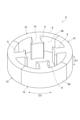
- FIG. 2 is a perspective view of the motor core according to the present embodiment.
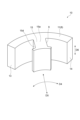
- FIG. 3 is a perspective view of a split core prepared in the preparation step.
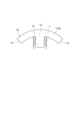
- FIG. 4 is a cross-sectional view of the tooth shown in FIG.
- FIG. 5 is a front view for explaining the winding step.
- FIG. 6 is a front view for explaining the insertion step.
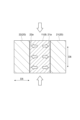
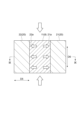
- FIG. 7 is a cross-sectional view for explaining the pressurizing step.
- FIG. 8 is a cross-sectional view for explaining the pressurizing step.
- FIG. 9 is a cross-sectional view for explaining the pressurizing step.
- FIG. 10 is a cross-sectional view for explaining the connection process.
- FIG. 10 is a cross-sectional view for explaining the connection process.
- FIG. 11 is a plan view of a plurality of split cores according to a modified example.
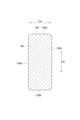
- FIG. 12 is a cross-sectional view of a tooth according to a modified example.
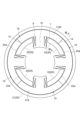
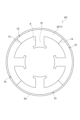
- FIG. 13 is a plan view of a motor core according to a modified example.
- Fig. 1 is a schematic cross-sectional view of a radial gap motor according to an embodiment.
- a radial gap motor 1 according to this embodiment includes a stator 2, a rotor 3 arranged rotatably relative to the stator 2, and a shaft 4 fixed to the rotor 3.
- the stator 2 and the rotor 3 are arranged to be spaced apart in the radial direction of the shaft 4.
- a shaft hole 5 through which the shaft 4 is inserted is formed in the center of the rotor 3.
- the stator 2 is a stator for a radial gap motor 1.
- the stator 2 includes a motor core 6 and a winding 7 wound around the motor core 6.
- the motor core 6 is the portion of the stator 2 excluding the winding 7, and is also called a stator core.
- [Motor core] 2 is a perspective view of the motor core according to the present embodiment.
- the motor core 6 according to the present embodiment includes an annular back yoke 8 and a plurality of teeth 9 extending from the back yoke 8.
- the axial direction of the back yoke 8 is referred to as the axial direction D1
- the radial direction of the back yoke 8 is referred to as the radial direction D2
- the circumferential direction of the back yoke 8 is referred to as the circumferential direction D3.
- the axial direction D1 is also the thickness direction of the back yoke 8 (the rotation axis direction of the rotor 3 in the radial gap motor 1).
- the radial direction D2 is also the radial direction of the ring formed by the back yoke 8 (the radial direction of the rotor 3 in the radial gap motor 1).
- the circumferential direction D3 is also the circumferential direction of the ring formed by the back yoke 8 (the rotation direction of the rotor 3 in the radial gap motor 1).
- the multiple teeth 9 extend radially inward in the direction D2 from the back yoke 8.
- the motor core 6 is described as having four teeth 9, but the number of teeth 9 is not particularly limited as long as it is two or more.
- the outer peripheral surface 8a of the back yoke 8 is formed in a perfect circle.
- a perfect circle includes not only a completely perfect circle shape, but also an approximately perfect circle shape that has been deformed due to manufacturing errors, etc.
- the inner peripheral surface 8b of the back yoke 8 may be formed in an arc shape, a flat shape, or a polygonal shape.
- the first winding surface portion 15a and the second winding surface portion 15b are adjacent to the third winding surface portion 15c on one side in the arc direction D4, and the first winding surface portion 15a and the second winding surface portion 15b are adjacent to the fourth winding surface portion 15d on the other side in the arc direction D4.
- the third winding surface portion 15c and the fourth winding surface portion 15d are adjacent to the first winding surface portion 15a on one side in the thickness direction D6, and the third winding surface portion 15c and the fourth winding surface portion 15d are adjacent to the second winding surface portion 15b on the other side in the thickness direction D6.
- the winding surface 15 of the tooth 9 is formed into a rectangle by the first winding surface portion 15a, the second winding surface portion 15b, the third winding surface portion 15c, and the fourth winding surface portion 15d.
- the outer mold part 21 and the inner mold part 22 may be one mold or different molds.
- the outer mold part 21 may be formed, for example, in a ring shape with the outer mold molding surface 21a as the inner peripheral surface.
- the inner mold part 22 may be, for example, one mold with multiple inner mold molding surfaces 22a, or multiple arc-shaped molds each having multiple inner mold molding surfaces 22a.
- the multiple split cores 10 are inserted into the back yoke mold 20 so that the teeth 9 of each of the multiple split cores 10 are positioned between the multiple inner mold molding surfaces 22a.
- the back yoke portions 11 of the multiple split cores 10 are arranged in a ring shape, similar to the back yoke 8 of the motor core 6. Note that, since the windings 7 are wound around the teeth 9 in the winding process carried out before the insertion process, the back yoke mold 20 (inner mold portion 22) is formed so as not to interfere with the windings 7 wound around the teeth 9 in the winding process.
- FIGS 7 to 9 are cross-sectional views for explaining the pressurizing process. Note that Figures 7 and 8 are cross-sectional views taken along line VII-VII in Figure 6, and Figure 9 is a cross-sectional view taken along line IX-IX in Figure 8.
- the back yoke portions 11 of the multiple split cores 10 are pressurized within the back yoke mold 20. That is, the back yoke portions 11 of the multiple split cores 10 are pressurized in the thickness direction D6.
- the thickness direction D6 is also the central axis direction of the back yoke portions 11 of the multiple split cores 10 arranged in an annular shape, and is also the axial direction D1 of the motor core 6. Then, the back yoke portions 11 of the multiple split cores 10 inserted into the back yoke mold 20 shrink in the pressurizing direction and expand in a direction different from the pressurizing direction. Then, the back yoke parts 11 of the multiple split cores 10 are pressurized in the thickness direction D6 until the back yoke parts 11 of the multiple split cores 10 are expanded and pressed against the outer mold part 21 (outer mold molding surface 21a) and the inner mold part 22 (inner mold molding surface 22a) of the back yoke mold 20.
- the back yoke parts 11 of the multiple split cores 10 are molded by the outer mold part 21 (outer mold molding surface 21a) and the inner mold part 22 (inner mold molding surface 22a) of the back yoke mold 20. Therefore, even if the back yoke parts 11 of the multiple split cores 10 are not aligned with high precision, the back yoke parts 11 of the multiple split cores 10 are pressurized in the back yoke mold 20 and the back yoke parts 11 of the multiple split cores 10 are pressed against the back yoke mold 20, so that the back yoke parts 11 of the multiple split cores 10 are aligned with high precision.
- each of the multiple split cores 10 is a powder compact
- the pressurizing process involves recompressing the powder compact.
- the amount of elongation of the back yoke portions 11 of the multiple split cores 10 in a direction different from the recompression direction during recompression is likely to be greater when compared to when each of the multiple split cores 10 is a laminate in which multiple electromagnetic steel sheets are stacked.
- FIG. 10 is a cross-sectional view for explaining the connection process.
- the back yoke parts 11 of the multiple split cores 10 are connected.
- the connection process is performed, for example, in a state in which the back yoke parts 11 of the multiple split cores 10 are inserted into the back yoke mold 20.
- the connection of the back yoke parts 11 of the multiple split cores 10 is performed by joining the adjacent back yoke parts 11 of the multiple split cores 10.
- the first connection end surface 13 of one adjacent back yoke part 11 is joined to the second connection end surface 14 of the other adjacent back yoke part 11.
- the joining of the adjacent back yoke parts 11 of the multiple split cores 10 can be performed by welding, adhesive, or the like.
- the back yoke parts 11 of the multiple split cores 10 are removed from the back yoke mold 20.
- the back yoke portions 11 of the multiple split cores 10 are connected together to form an annular back yoke 8, and the teeth 9 of the multiple split cores 10 form multiple teeth 9 extending from the back yoke 8.
- the motor core 6 is manufactured using multiple split cores 10 each having a back yoke portion 11 and teeth 9, so that the windings 7 can be wound around the teeth 9 of each of the multiple split cores 10. This allows the windings 7 to be wound around the teeth 9 at high density, so that a high magnetic flux density can be obtained.
- the back yoke portions 11 of the multiple split cores 10 are stretched in a direction different from the pressure direction and pressed against the back yoke mold 20.
- the back yoke portions 11 of the multiple split cores 10 are molded by the back yoke mold 20, so that the roundness of the back yoke 8 consisting of the back yoke portions 11 of the multiple split cores 10 can be easily improved.
- the back yoke parts 11 of the multiple split cores 10 are molded by the back yoke mold 20, making it easy to improve the roundness of the back yoke 8 consisting of the back yoke parts 11 of the multiple split cores 10.
- the first connection end face 13 and the second connection end face 14 of the back yoke portion 11 are formed flat, so the split core 10 can be manufactured easily.
- each of the multiple split cores 10 is a powder compact, so it is difficult to cut them with high precision.
- the insertion process and pressure application process as described above, it is possible to easily improve the roundness of the back yoke 8 consisting of the back yoke portions 11 of the multiple split cores 10.
- connection end surface of the back yoke portion that connects to the adjacent split core is described as being flat, but as shown in FIG. 11, the connection end surface of the back yoke portion that connects to the adjacent split core may be curved in an arc.
- FIG. 11 is a plan view of multiple split cores of a modified example.
- each of the multiple split cores 10A of the modified example has a first connection end face 13A and a second connection end face 14A of the back yoke portion 11A that are curved in an arc shape.
- the first connection end face 13A is the connection end face on one side of the back yoke portion 11A and is curved, for example, in a convex shape.
- the second connection end face 14A is the connection end face on the other side of the back yoke portion 11A and is curved, for example, in a concave shape.
- first connecting end surface 13A and the second connecting end surface 14A of the back yoke portion 11A are curved in an arc shape, it becomes easier to align the multiple split cores 10A when the back yoke portions 11A of the multiple split cores 10A are inserted into the back yoke mold 20.
- first connection end face 13A on one side of the back yoke portion 11A is curved convexly
- the second connection end face 14A on the other side of the back yoke portion 11A is curved concavely, so that the multiple split cores 10A have the same shape, while the first connection end face 13A and the second connection end face 14A of the back yoke portion 11A are curved in an arc shape.
- the winding surface of the teeth is described as being rectangular and made up of a first winding surface portion, a second winding surface portion, a third winding surface portion, and a fourth winding surface portion.
- at least one corner of the winding surface of the teeth may be curved.
- Figure 12 is a cross-sectional view of a modified tooth.
- the winding surface 15B of the modified tooth 9B shown in Figure 12 has a first winding surface portion 15Ba and a second winding surface portion 15Bb facing in the thickness direction D6, and a third winding surface portion 15Bc and a fourth winding surface portion 15Bd facing in the arc direction D4.
- the first winding surface portion 15Ba and the second winding surface portion 15Bb are adjacent to the third winding surface portion 15Bc on one side in the arc direction D4, and the first winding surface portion 15Ba and the second winding surface portion 15Bb are adjacent to the fourth winding surface portion 15Bd on the other side in the arc direction D4.
- the third winding surface portion 15Bc and the fourth winding surface portion 15Bd are adjacent to the first winding surface portion 15Ba on one side in the thickness direction D6, and the third winding surface portion 15Bc and the fourth winding surface portion 15Bd are adjacent to the second winding surface portion 15Bb on the other side in the thickness direction D6.
- first winding surface portion 15Ba and the third winding surface portion 15Bc, the first winding surface portion 15Ba and the fourth winding surface portion 15Bd, the second winding surface portion 15Bb and the third winding surface portion 15Bc, and the second winding surface portion 15Bb and the fourth winding surface portion 15Bd is connected in a curved shape.
- all of the first winding surface portion 15Ba and the third winding surface portion 15Bc, the first winding surface portion 15Ba and the fourth winding surface portion 15Bd, the second winding surface portion 15Bb and the third winding surface portion 15Bc, and the second winding surface portion 15Bb and the fourth winding surface portion 15Bd are connected in a curved shape.
- At least one of the first winding surface portion 15Ba and the third winding surface portion 15Bc, the first winding surface portion 15Ba and the fourth winding surface portion 15Bd, the second winding surface portion 15Bb and the third winding surface portion 15Bc, and the second winding surface portion 15Bb and the fourth winding surface portion 15Bd is connected in a curved shape on the winding surface 15B of the teeth, so that when the winding 7 is wound around the winding surface 15B of the teeth, the winding 7 can be easily aligned along the winding surface 15B. This makes it possible to suppress the winding 7 from floating off the winding surface 15B, thereby increasing the magnetic flux density.
- connection process is described as joining adjacent back yoke portions of multiple split cores, but as shown in FIG. 13, adjacent back yoke portions of multiple split cores may be connected by constraining the multiple split cores with cable ties, or by both joining adjacent back yoke portions of multiple split cores and constraining the multiple split cores with cable ties.
- FIG. 13 is a plan view of a modified motor core.
- multiple split cores 10 are connected by being bound with cable ties 30.
- the cable ties 30 may be made of resin or metal, for example.
- the back yoke portions 11 of the multiple split cores 10 are connected by binding the multiple split cores 10 with cable ties 30.
- This disclosure can be used as a method for manufacturing a motor core and a method for manufacturing a stator.
Landscapes
- Engineering & Computer Science (AREA)
- Power Engineering (AREA)
- Manufacturing & Machinery (AREA)
- Iron Core Of Rotating Electric Machines (AREA)
- Manufacture Of Motors, Generators (AREA)
Priority Applications (3)
| Application Number | Priority Date | Filing Date | Title |
|---|---|---|---|
| JP2025544033A JPWO2025052586A1 (https=) | 2023-09-06 | 2023-09-06 | |
| CN202380096285.0A CN120937223A (zh) | 2023-09-06 | 2023-09-06 | 电机芯的制造方法及定子的制造方法 |
| PCT/JP2023/032539 WO2025052586A1 (ja) | 2023-09-06 | 2023-09-06 | モータコアの製造方法及びステータの製造方法 |
Applications Claiming Priority (1)
| Application Number | Priority Date | Filing Date | Title |
|---|---|---|---|
| PCT/JP2023/032539 WO2025052586A1 (ja) | 2023-09-06 | 2023-09-06 | モータコアの製造方法及びステータの製造方法 |
Publications (1)
| Publication Number | Publication Date |
|---|---|
| WO2025052586A1 true WO2025052586A1 (ja) | 2025-03-13 |
Family
ID=94923088
Family Applications (1)
| Application Number | Title | Priority Date | Filing Date |
|---|---|---|---|
| PCT/JP2023/032539 Pending WO2025052586A1 (ja) | 2023-09-06 | 2023-09-06 | モータコアの製造方法及びステータの製造方法 |
Country Status (3)
| Country | Link |
|---|---|
| JP (1) | JPWO2025052586A1 (https=) |
| CN (1) | CN120937223A (https=) |
| WO (1) | WO2025052586A1 (https=) |
Citations (5)
| Publication number | Priority date | Publication date | Assignee | Title |
|---|---|---|---|---|
| JP2007135328A (ja) * | 2005-11-11 | 2007-05-31 | Sumitomo Electric Ind Ltd | ステータ、モータ及びステータの製造方法 |
| JP2008278603A (ja) * | 2007-04-26 | 2008-11-13 | Sumitomo Electric Ind Ltd | モータ用分割コア |
| JP2014093794A (ja) * | 2012-10-31 | 2014-05-19 | Nippon Piston Ring Co Ltd | 回転電機 |
| WO2022230704A1 (ja) * | 2021-04-26 | 2022-11-03 | 三菱電機株式会社 | 回転電機の固定子、回転電機、回転電機の固定子の製造方法、および回転電機の製造方法 |
| JP2023069429A (ja) * | 2021-11-05 | 2023-05-18 | 日産自動車株式会社 | 圧縮成形体、ステータ、モータ、圧縮成形体の製造方法及びステータの製造方法 |
-
2023
- 2023-09-06 CN CN202380096285.0A patent/CN120937223A/zh active Pending
- 2023-09-06 JP JP2025544033A patent/JPWO2025052586A1/ja active Pending
- 2023-09-06 WO PCT/JP2023/032539 patent/WO2025052586A1/ja active Pending
Patent Citations (5)
| Publication number | Priority date | Publication date | Assignee | Title |
|---|---|---|---|---|
| JP2007135328A (ja) * | 2005-11-11 | 2007-05-31 | Sumitomo Electric Ind Ltd | ステータ、モータ及びステータの製造方法 |
| JP2008278603A (ja) * | 2007-04-26 | 2008-11-13 | Sumitomo Electric Ind Ltd | モータ用分割コア |
| JP2014093794A (ja) * | 2012-10-31 | 2014-05-19 | Nippon Piston Ring Co Ltd | 回転電機 |
| WO2022230704A1 (ja) * | 2021-04-26 | 2022-11-03 | 三菱電機株式会社 | 回転電機の固定子、回転電機、回転電機の固定子の製造方法、および回転電機の製造方法 |
| JP2023069429A (ja) * | 2021-11-05 | 2023-05-18 | 日産自動車株式会社 | 圧縮成形体、ステータ、モータ、圧縮成形体の製造方法及びステータの製造方法 |
Also Published As
| Publication number | Publication date |
|---|---|
| JPWO2025052586A1 (https=) | 2025-03-13 |
| CN120937223A (zh) | 2025-11-11 |
Similar Documents
| Publication | Publication Date | Title |
|---|---|---|
| JP3355700B2 (ja) | 回転電機の固定子 | |
| KR100465591B1 (ko) | 회전전기의코어제조방법과코어 | |
| JP3430521B2 (ja) | 回転電機の固定子 | |
| US9553495B2 (en) | Wound core, electromagnetic component and manufacturing method therefor, and electromagnetic equipment | |
| WO2020129938A1 (ja) | 積層コア、コアブロック、回転電機およびコアブロックの製造方法 | |
| KR100402384B1 (ko) | 회전전기의 철심 및 그의 제조방법 | |
| JP2003180044A (ja) | ステータ及びその製造方法 | |
| JP2012005338A (ja) | 回転電機、回転電機の製造方法、および風力発電システム | |
| JPH08149725A (ja) | 回転電機の固定子 | |
| WO2012007984A1 (ja) | アモルファスコア、及びそれを用いた電磁部材と回転電機、並びにその製造方法 | |
| WO2018164277A1 (ja) | 回転電機用部材の製造方法 | |
| JP2009254109A (ja) | ステータとそのステータの製造方法 | |
| WO2025052586A1 (ja) | モータコアの製造方法及びステータの製造方法 | |
| WO2024212291A1 (zh) | 定子铁芯制作方法和外转子电机 | |
| JP5309674B2 (ja) | 固定子コイルの製造方法 | |
| JP2014187856A (ja) | ステータコアの絶縁構造及びステータの組付方法 | |
| JP2012023805A (ja) | 電動機の固定子とその製造方法 | |
| TWI819151B (zh) | 電樞模具構造 | |
| JP2010193678A (ja) | 回転電機の電機子およびその製造方法 | |
| JPS58207834A (ja) | 電動機の固定子鉄心 | |
| TWI376862B (https=) | ||
| WO2025041223A1 (ja) | モータコア、ステータ、ティース片、ラジアルギャップモータ、モータコアの製造方法、及びステータの製造方法 | |
| JP5907833B2 (ja) | 回転電機の固定子 | |
| JPS58212337A (ja) | 電動機固定子 | |
| JPH0334295B2 (https=) |
Legal Events
| Date | Code | Title | Description |
|---|---|---|---|
| 121 | Ep: the epo has been informed by wipo that ep was designated in this application |
Ref document number: 23951484 Country of ref document: EP Kind code of ref document: A1 |
|
| ENP | Entry into the national phase |
Ref document number: 2025544033 Country of ref document: JP Kind code of ref document: A |
|
| WWE | Wipo information: entry into national phase |
Ref document number: 2025544033 Country of ref document: JP |