WO2025052557A1 - 端面加工装置、圧延設備、及び端面加工方法 - Google Patents
端面加工装置、圧延設備、及び端面加工方法 Download PDFInfo
- Publication number
- WO2025052557A1 WO2025052557A1 PCT/JP2023/032435 JP2023032435W WO2025052557A1 WO 2025052557 A1 WO2025052557 A1 WO 2025052557A1 JP 2023032435 W JP2023032435 W JP 2023032435W WO 2025052557 A1 WO2025052557 A1 WO 2025052557A1
- Authority
- WO
- WIPO (PCT)
- Prior art keywords
- slab
- end surface
- rotating drum
- burrs
- processing device
- Prior art date
- Legal status (The legal status is an assumption and is not a legal conclusion. Google has not performed a legal analysis and makes no representation as to the accuracy of the status listed.)
- Pending
Links
Images










Classifications
-
- B—PERFORMING OPERATIONS; TRANSPORTING
- B21—MECHANICAL METAL-WORKING WITHOUT ESSENTIALLY REMOVING MATERIAL; PUNCHING METAL
- B21B—ROLLING OF METAL
- B21B15/00—Arrangements for performing additional metal-working operations specially combined with or arranged in, or specially adapted for use in connection with, metal-rolling mills
-
- B—PERFORMING OPERATIONS; TRANSPORTING
- B22—CASTING; POWDER METALLURGY
- B22D—CASTING OF METALS; CASTING OF OTHER SUBSTANCES BY THE SAME PROCESSES OR DEVICES
- B22D11/00—Continuous casting of metals, i.e. casting in indefinite lengths
- B22D11/12—Accessories for subsequent treating or working cast stock in situ
- B22D11/126—Accessories for subsequent treating or working cast stock in situ for cutting
Definitions
- the present invention relates to an end surface processing device, rolling equipment, and an end surface processing method for processing the end surfaces of rolled material.
- Patent Document 1 describes a cutting tool that uses a front milling cutter with multiple cutting blades arranged on the top circular surface of a truncated cone-shaped tool body, and a flat milling cutter with multiple cutting blades arranged on the conical surface, and supports the cutting tool so that it can be moved freely in the front-back, left-right, and up-down directions. With the rotation axis of the cutting tool held horizontal, a front milling process is performed on the front of the slab end face, and then a flat milling process is performed to simultaneously remove the deposit and the new cutting burr from at least one of the upper corners or lower corners where new cutting burrs generated by the process are attached.
- the continuously cast pieces are cut to a specified length by a cutting machine to produce continuous cast slabs (hereinafter simply referred to as "slabs" unless otherwise specified), or they are left as is and subjected to the specified processing before being sent to the hot rolling line for the next process.
- slabs continuous cast slabs
- continuously cast pieces are cut to a specified length by a cutting machine to produce continuous cast slabs, which are then subjected to the specified processing before being sent to the hot rolling line for the next process.
- deposits known as welding burrs, slag, and molten slops may form on the cut end surface of the slab.
- the cause of the formation of such deposits is that when cutting a piece using a gas cutting machine, molten steel solidifies around the cut surface.
- molten steel drips onto the surface of the slab end and solidifies in the area from the top corner to the bottom corner of the slab end surface.
- Patent Document 1 describes a conventional technique for removing such burrs, which involves providing milling cutters on the rounded and conical surfaces of a truncated cone-shaped tool body, and while keeping the rotation axis of the tool horizontal, first cutting the front of the slab end face with the rounded surface of the tool, and then cutting the upper and lower corners of the end face in sequence with the conical surface of the tool, thereby removing the burrs that have formed.
- the present invention provides an end surface processing device and an end surface processing method that can remove burrs from end surfaces in a shorter time than conventional methods.
- the present invention includes multiple means for solving the above problems, and one example is an end surface processing device for removing burrs from the end surface of a slab, comprising a cylindrical rotating drum that rotates around its rotation axis, and a processing unit that is provided on the outer circumferential surface of the rotating drum and configured to remove the burrs, the rotation axis of the rotating drum is arranged in a horizontal or vertical direction, the length of the processing unit in the direction of the rotation axis is longer than the length of the opposing end surface of the slab in the direction of the rotation axis, and the rotating drum is configured to move relatively vertically when the rotation axis is arranged horizontally, and to move relatively horizontally when the rotation axis is arranged vertically.
- burrs on end faces can be removed in a shorter time than with conventional methods.
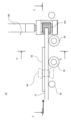
- FIG. 2 is a side view showing a schematic configuration of the end surface processing device according to the first embodiment. 2 is a view taken along the line AA in FIG. 1 .
- FIG. 2 is a diagram showing an example of an operating state of the end face processing device according to the first embodiment.
- FIG. 2 is a diagram showing an example of an operating state of the end face processing device according to the first embodiment.
- FIG. 2 is a diagram showing an example of an operating state of the end face processing device according to the first embodiment.
- FIG. 2 is a diagram showing an example of an operating state of the end face processing device according to the first embodiment.
- FIG. 2 is a diagram showing an example of an operating state of the end face processing device according to the first embodiment.
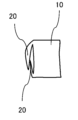
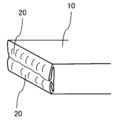
- a side view of the burrs A top-down view of a burr.
- FIG. 15 is a side view showing the schematic configuration of the end face processing device of the second embodiment, taken along the line DD in FIG. 14 .
- 15 is a view taken along the line CC in FIG. 14 .
- 13 is a view taken along the line B-B in FIG. 12 .
- 13A to 13C are diagrams showing an outline of an end face processing method according to a third embodiment.
- 13A to 13C are diagrams showing an outline of an end face processing method according to a third embodiment.
- 13A to 13C are diagrams showing an outline of an end face processing method according to a third embodiment.
- 13A to 13C are diagrams showing an outline of an end face processing method according to a third embodiment.
- FIGS. 13A to 13C are diagrams showing an outline of an end face processing method according to a third embodiment.
- 13A to 13C are diagrams showing an outline of an end face processing method according to a third embodiment.
- 13A to 13C are diagrams showing an outline of an end face processing method according to a fourth embodiment.
- 13A to 13C are diagrams showing an outline of an end face processing method according to a fourth embodiment.
- 13A to 13C are diagrams showing an outline of an end face processing method according to a fourth embodiment.
- 13A to 13C are diagrams showing an outline of an end face processing method according to a fourth embodiment.
- 13A to 13C are diagrams showing an outline of an end face processing method according to a fourth embodiment.
- FIG. 13 is a diagram showing an overview of a rotating drum in an end surface processing device according to a fifth embodiment.
- FIG. 13 is a diagram showing an outline of a rolling facility according to a sixth embodiment.
- the main hot-rolled steel materials that are the subject of manufacture in this invention are hot-rolled steel strips and thick plates, but the objects of manufacture are not limited to these and include various types of hot-rolled steel materials.
- Example 1 A first embodiment of an end face processing apparatus and an end face processing method according to the present invention will be described with reference to FIGS.
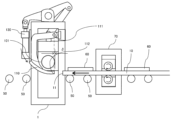
- Figure 1 is a side view showing the general configuration of the end face processing device of the first embodiment
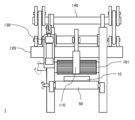
- Figure 2 is a view taken along the line A-A in Figure 1.
- the end surface processing device 1 shown in Figures 1 and 2 is a device for removing burrs 20 (see Figure 8, etc.) formed on end surfaces such as the rear end 11 of a slab 10, and is equipped with a first rotating drum 101, a cutting blade 102, a hydraulic cylinder 130, a first stopper 110, a support stand 120, a bearing housing 150, a lever 160, etc.
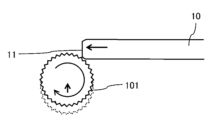
- the first rotating drum 101 is a cylindrical member that rotates around its horizontally-positioned axis and is supported by bearing housings 150 at both axial ends.
- the first rotating drum 101 has a plurality of cutting blades 102 on its outer circumferential surface configured to remove burrs 20, and the slab rear end 11 of the slab 10 can be machined by the rotation of the first rotating drum 101 and the raising and lowering of the first rotating drum 101.
- the length of the cutting blades 102 in the direction of the rotation axis is longer than the length of the slab rear end 11 of the opposing slab 10 in the direction of the rotation axis.
- a grindstone can be provided on the outer periphery of the first rotating drum 101 instead of or in addition to the cutting blade 102.
- the bearing box 150 is connected to the support base 120. Although the details of the connection between the bearing box 150 and the support base 120 are not described, methods such as connecting with bolts or lifting the bearing box 150 to apply a balancing force to the support base 120 side to hold it in place are used.
- the support base 120 is connected to the rotating shaft 140 via a lever 160.
- the rotating shaft 140 also has a portion that connects to a hydraulic cylinder 130, and the first rotating drum 101 and its support base 120 are raised and lowered by the stroke of the hydraulic cylinder 130.
- the first rotating drum 101 is configured to move relatively in the vertical direction, and to move relatively in the horizontal direction when the rotating shaft is arranged vertically.
- the hydraulic cylinder 130 is configured such that, when the rear end 11 of the slab is being processed, the relative vertical movement distance between the first rotating drum 101 and the rear end 11 of the slab exceeds the vertical length of the rear end 11 of the slab.
- one hydraulic cylinder 130 is shown in FIG. 2, but it is possible to provide one on the other side of the width of the slab 10.
- the first moving unit and the second moving unit are mechanisms that move the slab 10.
- measuring processing in this invention refers to the timing when the grinding or cutting operation is actually being performed when grinding or cutting the target portion such as the rear end 11 of the slab, excluding movement to the initial processing start position.
- “during processing” in this invention refers to the timing when the grinding or cutting operation is actually being performed when grinding or cutting the target portion such as the rear end 11 of the slab, excluding movement to the initial processing start position.
- the first stopper 110 is located in the center of the width of the slab 10, facing the rear end 11 of the slab.
- the position of the first stopper 110 shown in FIG. 1 indicates a retracted state, and the rotation of the first stopper 110 can be performed by an actuator such as a hydraulic cylinder 130, but the configuration is not limited to this. Further details are omitted.
- FIG. 27 shows a case where rough rolling and finish rolling are performed continuously without cutting the slab, but here we will explain a case where the slab is cut to a predetermined length at the exit side of the continuous casting machine 300.
- the pinch roller 70 is provided on the exit side of the end surface processing device 1 (right side in Figure 1), and has the function of determining the position of the rear end 11 of the slab to be processed by the end surface processing device 1 and preventing the slab 10 from moving during end surface processing.
- the side guide 60 has the function of determining the center position of the slab 10 in the width direction.
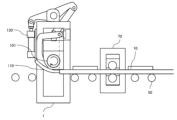
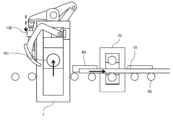
- FIGS 3 to 7 are diagrams showing an example of the operating state of the edge processing device of embodiment 1
- Figure 8 is a diagram of the swarf cutting burr seen from the side
- Figure 9 is a diagram of the swarf cutting burr seen from diagonally above
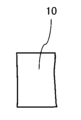
- Figure 10 is a diagram of the slab seen from the side after the swarf cutting burr has been removed by the edge processing device
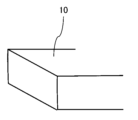
- Figure 11 is a diagram of the slab seen from diagonally above after the swarf cutting burr has been removed by the edge processing device.
- Figure 3 shows the state in which the first stopper 110 in Figure 1 has rotated.
- the first stopper 110 rotates after the slab 10 has passed through the end surface processing device 1, and has the function of positioning the slab 10 when it is transported in the direction of the arrow (the direction opposite to the direction of the rolling equipment) by the pinch rollers 70 and the transport table rollers 50.
- the end surface processing device 1 has a stopping device that has the function of stopping the movement of the first stopper 110.
- the configuration can adopt various known configurations for fixing the first stopper 110, and the details are omitted.
- the first stopper tip 112 determined by this stopping device is located ⁇ in front of the cutting blade 102 on the outer periphery of the first rotating drum 101. This ⁇ is the amount of the slab rear end 11 that is removed by the first rotating drum 101.
- the first stopper tip 112 is positioned in the direction of travel of the slab 10 at approximately the same position as the fulcrum 111 of rotation of the first stopper 110. As a result, the position of the first stopper tip 112 is adjusted by the stopping device, and even if the value of ⁇ changes slightly, there is almost no change in the perpendicularity of the first stopper tip 112, allowing the slab rear end 11 to be positioned with high precision.
- FIG. 4 shows the state in which the rear end 11 of the slab comes into contact with the first stopper tip 112 of the first stopper 110 in FIG. 1 etc., causing the slab 10 to stop and the first rotating drum 101 to start rotating.
- the first rotating drum 101 is rotating at the desired rotation speed when the rear end of the slab 10 abuts against the first stopper 110.
- the pinch roller 70 and the transport table roller 50 stop transporting the slab 10.
- the pinch roller 70 is in a state where it is pressing the slab 10 with a given force, while the drive system of the pinch roller 70 is in a state where it is braked.
- FIG. 5 shows the state in FIG. 4 where the first stopper 110 has been moved to the standby position. In this state, the conditions for lowering the first rotating drum 101 are met.
- Figure 6 shows the state in Figure 5 where the hydraulic cylinder 130 has been extended to lower the first rotating drum 101 toward the rear end 11 of the slab.
- the descending speed of the first rotating drum 101 is about 0.5 m/sec, and the first rotating drum 101 reaches the descending end in about 2 seconds.
- the cut-off portion becomes hot cutting chips, so it is preferable to cool it with water, and the cutting chips and the cooled water are collected vertically below and discharged outside the line.
- FIG. 7 shows the state in which the slab 10 is transported from the end surface processing device 1 by the transport table rollers 50 after the rear end 11 of the slab in FIG. 6 has been processed.
- the first rotating drum 101 is raised to the standby position by the hydraulic cylinder 130.
- the first rotating drum 101 takes about 2 seconds to descend, and end surface processing can be completed in this short time.
- FIGS. 8 and 9 are a side view and a perspective view showing the scarf burr at the rear end 11 of the slab.
- FIGS. 10 and 11 are a side view and a perspective view after the cutting burr has been removed by the end face processing device 1.
- processing may also be performed by raising it.
- the end surface processing device 1 for removing burrs 20 from the rear end 11 of the slab 10 of the above-mentioned embodiment 1 of the present invention comprises a cylindrical first rotating drum 101 that rotates around its rotation axis, and a cutting blade 102 that is provided on the outer circumferential surface of the first rotating drum 101 and configured to remove burrs 20, the rotation axis of the first rotating drum 101 is arranged horizontally, the length of the cutting blade 102 in the direction of the rotation axis is longer than the length of the cutting blade 102 in the direction of the rotation axis at the slab rear end 11 of the opposing slab 10, and the first rotating drum 101 is configured to move relatively vertically when the rotation axis is arranged horizontally, and to move relatively horizontally when the rotation axis is arranged vertically.
- the front and back surfaces are melted and the molten parts are blown away, so the scarf burrs do not only wrap around the rear end 11 of the slab in the cutting direction, but also around the front end of the slab 10, and after cutting, they are removed perpendicular to the direction of travel by high-pressure water sprayed from the high-pressure water spray nozzle, so they wrap around the side surface 13 of the slab 10.
- the grinding of the rear end 11 of the slab is performed by making the first rotating drum 101 extend in the width direction of the slab 10, and completing the cutting by lowering or raising the first rotating drum 101.
- roller with little energy loss means direct rolling or rolling in which the amount of reheating is suppressed during reheat rolling.
- the first rotating drum 101 also includes a hydraulic cylinder 130 whose rotation axis is arranged horizontally and configured so that when the rear end 11 of the slab is processed, the relative vertical movement distance between the first rotating drum 101 and the rear end 11 of the slab exceeds the vertical length of the rear end 11 of the slab.
- grinding and cutting can be performed by moving the hydraulic cylinder 130 back and forth once, thereby enabling processing to be completed in a short time.
- the positioning accuracy of the rear end 11 of the slab can be further improved, thereby achieving extremely high processing accuracy.
- pinch rollers 70 are used to fix the slab 10 so that it does not move when processing the rear end of the slab 10 in Figure 6, the use of other methods is also within the scope of the present invention.
- one method is to restrain the slab 10 in the width direction with side guides 60 on the operating side and driving side, but other methods of fixing the slab 10 are also within the scope of the present invention.
- leading edge and trailing edge 11 of the slab 10 similar to the processing of the slab side surface 13 described in Example 2 below, it is also possible to position the first rotating drum 101 vertically in the plate thickness direction and move the first rotating drum 101 in the width direction of the slab 10 while rotating to process the leading edge and trailing edge 11 of the slab 10.
- Example 2 The end face processing device and the end face processing method according to the second embodiment of the present invention will be described with reference to Figs. 12 to 14.
- Fig. 12 is a side view showing the schematic configuration of the end face processing device according to the second embodiment, and is a view taken along the line D-D in Fig. 14.
- Fig. 13 is a view taken along the line C-C in Fig. 14, and
- Fig. 14 is a view taken along the line B-B in Fig. 12.
- the second rotating drum 103 further includes a conveying table roller 50 whose rotation axis is arranged vertically and configured so that the relative horizontal movement distance between the second rotating drum 103 and the slab side surface 13 exceeds the horizontal length of the slab side surface 13 when processing the slab side surface 13.
- the end surface processing device 1A is composed of a second rotating drum 103 and its bearing housing (not shown for convenience of illustration), a moving frame 170 to which they are attached, a hydraulic cylinder 135 that moves the moving frame 170, a first side guide 62 and a second side guide 64 that are arranged to face the slab side surface 13, etc.
- the second rotating drum 103 is provided with cutting blades 104 on its outer periphery, and the rotation of the second rotating drum 103 and the movement of the slab 10 allow the slab side surface 13 to be machined.
- a grinding wheel can be provided instead of or in addition to the cutting blades 104.
- a drive shaft 190 is connected to the shaft end of the second rotating drum 103.
- This drive shaft 190 is also connected to a motor, so that the second rotating drum 103 can be rotated at a desired rotation speed.
- the moving frame 170 is supported by guide wheels 180, and the hydraulic cylinder 135 allows the second rotating drum 103 to be brought into contact with the slab side surface 13, or to be moved away.
- the length of the body of the conveying table roller 50 that comes into contact with the slab 10 is narrower than the width of the slab 10. This makes it easier for the cutting chips produced by the second rotating drum 103 to fly downward when cutting, which can prevent them from becoming a cause of defects.
- the first side guide 62 is provided on the side perpendicular to the conveying direction of the slab 10 where there are no or few swarf cutting fins.
- the second side guide 64 is provided on the side perpendicular to the conveying direction of the slab 10 where there are swarf cutting fins.
- the second side guide 64 is composed of vertical rollers and is configured to be movable in a direction perpendicular to the transport direction of the slab 10.
- first side guide 62 is described as being on the drive side, but the same applies when the first side guide 62 is on the operation side.
- first side guide 62 can also move to match the width Ws of the slab 10.
- the width of slab 10, Ws, is set by measuring the width of slab 10 or obtaining it as higher-level information.
- the second rotating drum 103 on the operating side is set so that the distance ⁇ w between the position of the second side guide 64 on the slab side surface 13 side in the width direction of the slab 10 and the cutting blade 104 on the outer periphery of the second rotating drum 103 is the same as the distance ⁇ d between the position of the first side guide 62 on the slab side surface 13 side in the width direction of the slab 10 and the cutting blade 104 on the outer periphery of the second rotating drum 103.
- ⁇ d and ⁇ w correspond to the amount of cutting on each side surface when the cutting fins are ignored and there are no cutting fins.
- ⁇ d and ⁇ w may be set to 0 or negative values.
- the end surface processing device and end surface processing method of the second embodiment of the present invention also provide substantially the same effects as those of the end surface processing device and end surface processing method of the first embodiment described above.
- the transport table roller 50 is configured as a second moving part configured so that the relative horizontal movement distance between the second rotating drum 103 and the slab side surface 13 during processing of the slab side surface 13 exceeds the horizontal length of the slab side surface 13.
- the second moving part can be an actuator that reciprocates the second rotating drum 103 in the direction of travel of the slab 10.
- the second rotating drum 103 can also be used to process the rear end 11 or the leading edge of the slab.
- the second moving part is configured so that the relative horizontal movement distance between the second rotating drum 103 and the rear end 11 or leading edge of the slab exceeds the horizontal length of the rear end 11 or leading edge of the slab.
- This second moving part can be either the transport table rollers 50 or an actuator that moves the second rotating drum 103 in the width direction of the slab 10.
- the second rotating drum 103 can be positioned perpendicular to the thickness direction, just like the slab side surface 13, and the second rotating drum 103 can be moved in the width direction of the slab 10 while rotating to perform end face grinding.
- Example 3 An end face processing device and an end face processing method according to a third embodiment of the present invention will be described with reference to Figures 15 to 20.
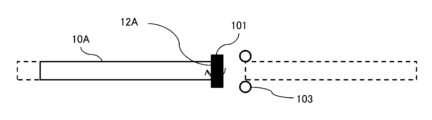
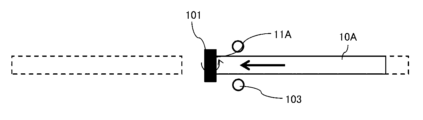
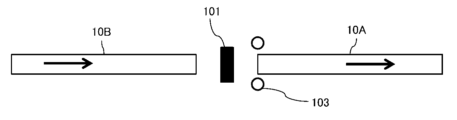
- Figures 15 to 20 are diagrams showing an outline of the end face processing method according to the third embodiment.
- the rotating drum includes a first rotating drum 101 (Example 1) whose rotating shaft is arranged horizontally, and a second rotating drum 103 (Example 2) whose rotating shaft is arranged vertically.
- first rotating drum 101 Example 1
- second rotating drum 103 Example 2
- descriptions of the pinch roller 70, side guides 60, 62, 64, etc. are omitted.
- the cutting blade 102 provided on the first rotating drum 101 is configured to remove burrs 20 from the end face of the first slab leading end 12A or the first slab trailing end 11A in the conveying direction of the slab 10
- the processing section provided on the second rotating drum 103 is configured to remove burrs 20 from the end face of the first slab side 13A in the width direction of the slab 10.
- the second rotating drum 103 is located downstream of the first rotating drum 101 in the conveying direction of the slab 10.
- Figure 15 shows the state in which the first slab 10A has moved in the direction of the arrow (towards the rolling equipment) and stopped. This is the waiting position of the slab 10 before the end face processing starts, and it is from this position that the end face processing flow begins.
- Figure 16 shows the state in which the first slab 10A has advanced in the forward direction by a distance L1, and the tip of the first slab 10A has come into contact with a stopper provided around the first rotating drum 101 and stopped. In this state, the first rotating drum 101 rotates and descends to process the tip of the first slab 10A.
- Figure 17 shows the state when, after the processing of the tip of the first slab 10A is completed, the first slab 10A advances by Ld1 + L2 and the tip of the first slab 10A advances to the position of the second rotating drum 103. In the state shown in Figure 17, the processing of the first slab side surface 13A by the second rotating drum 103 begins.
- Figure 18 shows the position of the first slab 10A when side processing up to the rear end 11A of the first slab is completed by the second rotating drum 103.
- Figure 19 shows the state in which the first slab 10A moves further in the direction of the arrow (the direction opposite to the direction of the rolling equipment) and the rear end 11A of the first slab abuts against a stopper provided around the first rotating drum 101, stopping the first slab.
- the first rotating drum 101 rotates and descends, processing the rear end 11A of the first slab.
- the burrs 20 are removed from the first slab front end 12A of the slab 10, the slab side surface 13, and the first slab rear end 11A in that order.
- stopper at the leading end of the first slab 10A in FIG. 16 and the stopper at the rear end 11A of the first slab in FIG. 19 are each assumed to be provided as separate devices within the end surface processing device 1.
- Figure 20 shows the state when the first slab 10A moves in the direction of the arrow (towards the rolling equipment) and the rear end 11A of the first slab passes the center position of the second rotating drum 103.
- This timing is also the timing when the next material, the second slab 10B, can move to the processing position of the leading end surface by the first rotating drum 101.
- the second slab 10B can move when the end surface processing device 1 is ready to process the second slab 10B.
- the cast first slab 10A has a thickness of 165 mm and a length of 17 m (equivalent to a weight per unit width of 22 kg/mm).
- the end face processing device and end face processing method of the third embodiment of the present invention also provide substantially the same effects as those of the end face processing device and end face processing method of the first and second embodiments described above.
- the rotating drum includes a first rotating drum 101 with a horizontally arranged rotation axis and a second rotating drum 103 with a vertically arranged rotation axis.
- the cutting blade 102 provided on the first rotating drum 101 is configured to remove burrs 20 from the end face of the first slab leading edge 12A or the first slab trailing edge 11A in the conveying direction of the slab 10
- the processing section provided on the second rotating drum 103 is configured to remove burrs 20 from the end face of the first slab side surface 13A in the width direction of the slab 10.
- This allows for both a rotating drum arrangement suitable for processing the first slab leading edge 12A or the first slab trailing edge 11A and a rotating drum arrangement suitable for processing the first slab side surface 13A. This allows all end faces of the slab 10 to be processed with extremely high efficiency, thereby further improving processing efficiency and quality.
- the second rotating drum 103 is located downstream of the first rotating drum 101 in the transport direction of the slab 10, so that the end surface can be processed without the slab 10 traveling in the opposite direction, thereby further improving processing efficiency.
- the end surface can be machined without running the slab 10 in the opposite direction.
- one first rotating drum 101 is used to cut the end faces of both the first slab leading end 12A and the first slab trailing end 11A of the slab 10, but it is also possible to install another first rotating drum 101 and use separate first rotating drums 101 for the leading end and trailing end of the slab 10, or more preferably, to process them simultaneously.
- the second rotating drums 103 on both sides of the slab 10 are one pair, but it is also possible to have multiple pairs, such as two pairs. Furthermore, if it is necessary to remove burrs from only one of the two sides of the slab 10, they may not be paired.
- rotation directions indicated by the arrows on the first rotating drum 101 and the second rotating drum 103 are not limited to the directions shown in the figure.
- the rotation directions are set taking into consideration factors such as whether reliable burr removal can be achieved and how easily chips can be collected.
- Example 4 An end face processing device and an end face processing method according to a fourth embodiment of the present invention will be described with reference to Figures 21 to 24.
- Figures 21 to 24 are diagrams showing an outline of the end face processing method according to the fourth embodiment.
- the end surface processing device of this embodiment further includes a drive device that changes the relative positional relationship between the cutting blade 102 and the slab 10.
- This drive device makes the distance ⁇ 2 between the first rotating drum 101 and the rear end 11 of the slab 10 larger than ⁇ in FIG. 3, thereby removing the upper corner burrs 22 and the lower corner burrs 24.
- the drive device can be, for example, a mechanism that adjusts the drive amount of the conveyor table roller 50 or the hydraulic cylinder 130, but is not limited to this configuration and can take other forms, the details of which will be omitted.
- Figure 21 shows the state of the slab 10 before the rear end 11 of the slab is machined. As shown in Figure 21, there are upper corner burrs 22 and lower corner burrs 24 on part of the rear end 11 of the slab.
- FIG. 22 shows the state in which the first rotating drum 101 is lowered an arbitrary amount to remove the upper corner burr 22.
- the drive device moves the cutting blade 102 to the upper end side of the rear end 11 of the slab to remove the corresponding upper corner burr 22.
- Figure 23 shows the state where the slab 10 is moved in the direction of the arrow and then the first rotating drum 101 is lowered
- Figure 24 shows the state where the slab 10 is moved in the direction of the arrow
- a distance ⁇ 2 is set between the first rotating drum 101 and the rear end 11 of the slab 10
- the first rotating drum 101 is raised to remove the bottom corner burr 24.
- the drive device moves the cutting blade 102 to the lower end side of the rear end 11 of the slab to remove the corresponding bottom corner burr 24.
- the distance ⁇ between the first rotating drum 101 and the rear end 11 of the slab 10 can be set as in Figure 3, and the first rotating drum 101 can be lowered or raised while rotating before or after removing the upper corner burrs 22 and lower corner burrs 24.
- the end surface processing device and end surface processing method of the fourth embodiment of the present invention also provide substantially the same effects as those of the end surface processing device and end surface processing method of the first embodiment described above.
- the present invention is not limited to a configuration in which the cutting blade 102 is moved to the upper end side of the rear end 11 of the slab to remove the corresponding upper corner burr 22, and then the cutting blade 102 is moved to the lower end side of the rear end 11 of the slab to remove the corresponding lower corner burr 24. It is also possible to move the cutting blade 102 to the lower end side of the rear end 11 of the slab to remove the corresponding lower corner burr 24, and then the cutting blade 102 is moved to the upper end side of the rear end 11 of the slab to remove the corresponding upper corner burr 22.
- Example 5 The end face processing device and the end face processing method according to the fifth embodiment of the present invention will be described with reference to Fig. 25 and Fig. 26.
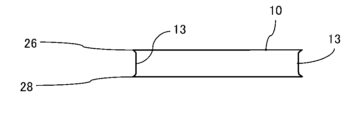
- Fig. 25 is a side view of a burr
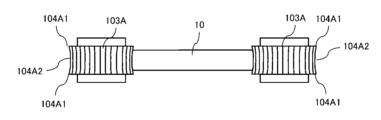
- Fig. 26 is a diagram showing an outline of a rotating drum in the end face processing device according to the fifth embodiment.
- Figure 25 shows the state of the slab 10 before the slab side surface 13 is processed.
- An upper corner burr 26 and a lower corner burr 28 are present as part of the slab side surface 13.
- the second rotating drum 103A has a hand drum shape as shown in Figure 26, and the outer diameter of the cutting blades 104A1 and 104A2 is larger at the end (cutting blade 104A1) than on the inside (cutting blade 104A2) in the direction of the rotation axis.
- the upper side corner burrs 26 and the lower side corner burrs 28 can be located at the corners of the slab side surface 13 of the slab 10, so by making the second rotating drum 103A into a hand drum shape, it is possible to reliably remove the upper side corner burrs 26 and the lower side corner burrs 28.
- the end surface processing device and end surface processing method of the fifth embodiment of the present invention also provide substantially the same effects as those of the end surface processing device and end surface processing method of the second embodiment described above.
- the outer diameter of the cutting blades 104A1 and 104A2 is larger at the end (cutting blade 104A1) than on the inside (cutting blade 104A2) in the direction of the rotation axis, the upper corner burrs 26 and the lower corner burrs 28 on the side of the slab 10 on the operation side and drive side can be removed simultaneously, further improving processing efficiency.
- Example 6 A rolling facility according to a sixth embodiment of the present invention will be described with reference to Fig. 27.
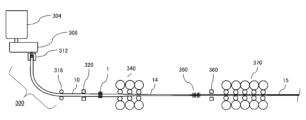
- Fig. 27 is a diagram showing an outline of the rolling facility according to the sixth embodiment.
- This embodiment shown in Figure 27 is equipped with a continuous casting machine 300, a surface machining device 320, a roughing mill 340, an induction heating bar heater 350, a descaling device 360, a finishing rolling mill train 370, and the end face processing device 1A of the second embodiment.
- the surface machining device 320, the end face processing device 1A, the continuous casting machine 300, and the rolling line are directly connected.
- the end face processing device 1A of the second embodiment instead of or in addition to the end face processing device 1A of the second embodiment, the end face processing device 1 or 1B of any of the first, third, fourth, or fifth embodiments can be provided.
- the molten steel in the ladle 304 is poured into the mold 312 of the continuous casting machine 300 via the tundish 308, and solidifies completely at the outlet 316 of the continuous casting machine, becoming a slab 10, which is then transported to the rough rolling mill 340.
- the slabs 10 produced here are relatively thin, and undergo rough rolling and finish rolling without being cut.
- a surface machining device 320 and an end face processing device 1A are placed between the continuous casting machine 300 and the rough rolling machine 340. Since the slab 10 is in a continuous state, there is no leading or trailing end of the slab 10.
- the end face processing device 1A is equipped with a second rotating drum 103, which allows the slab side surface 13 of the slab 10 to be processed.
- the surface cutting device 320 is described as an example of a method for removing scratches and impurities on the surface of a steel piece by heating the required parts with a preheating flame of oxygen or acetylene (propane), and then blowing away the iron oxide formed by the heat of the oxidation reaction by spraying oxygen, but the method is not limited to this surface cutting device 320.
- a method of melting the surface with a laser and blowing off the melted portion can be considered as one type of surface cutting device 320.
- Other means of melting the surface are also included in surface cutting device 320. Burrs are generated when performing such surface cutting, but removing the burrs with an end face processing device falls within the scope of the present invention.
- the surface cutting device 320 may also be a surface polishing device using a grinder. Scratches and impurities on the surface may be removed with a grinder (grinding wheel). Even in this case, burrs may form on the corners of the slab 10.
- the end surface processing device of the present invention is equipped with cutting blades 102, 104, 104A1, 104A2 or grindstones on the outer periphery of the first rotating drum 101 and the second rotating drum 103, making it possible to remove the burrs.
- the end face processing device of the present invention has been described as a means of removing burrs after surface machining, but if burrs are formed on end faces using grinders (grinding wheels) or other methods, the device is also effective in removing the burrs, and the scope of the present invention extends to this.
- the slab 10 is heated by a reheating furnace or induction heating when returning the offline slab 10 to the rolling line, other methods are also possible for this reheating means.
- induction heating or heating by an electric furnace which is not described, direct CO2 emissions can be suppressed, leading to the production of green steel.
- the configuration and operation of the end surface processing device and end surface processing method are substantially the same as those of any of the end surface processing devices and end surface processing methods of the first to fifth embodiments described above, and details are omitted.
- the reduced iron obtained by direct reduction upstream is melted in an electric furnace, fed to a continuous casting machine downstream, and then sent to rolling equipment to produce plate materials and other products.
- These downstream steel production methods are required to be able to produce plate materials in the same way as the blast furnace production method.
- Some of the steel types produced require strict surface quality requirements.
- continuous casting and rolling lines are compact facilities that can produce green steel with reduced CO2 emissions and little energy loss, so there is high demand for such facilities even if they cannot produce materials with strict surface quality or some steel types.
- a relatively thin slab 10 is roughly rolled in one direction to produce a bar 14, which is then rolled in one direction in a finishing rolling mill train 370 to produce a strip 15.
- This relatively thin slab 10 is cut to a specified length at the outlet side of the continuous casting machine 300.
- rolling is possible by cutting the front, rear and side ends of the slab 10 with an end processing device to remove scarf burrs, as in Example 3.
- At least one strand of the continuous casting machine 300 and the downstream hot rolling equipment are substantially on the same line, if they are on the completely same line, or if there is some misalignment and the slab 10 can be moved to the same line relative to the rolling line by, for example, traversing the slab 10 with a slab 10 transport device, this also falls within the scope of the present invention, including cases where the continuous casting machine 300 has multiple strands.
- the surface cutting device 320 and end face processing devices 1, 1A, 1B are installed on the outlet side of the continuous casting machine 300, and the cast slab 10 can be transported to the hot rolling equipment without moving it outside the line, and directly rolled.
- an offline transport device is installed on the inlet side of the rough rolling mill 340, and the slab 10 can be discharged offline.
- the slab 10 is transported offline.
- the slab 10 is also transported offline when it is determined that the slab 10 cannot be rolled as it is after passing through the surface cutting device 320 and end face processing devices 1, 1A, 1B due to remaining quality problems, for example.
- a thick slab refers to a slab 10 whose thickness exceeds about 150 mm. This is intended to be a slab 10 thickness that requires reverse rolling in rough rolling), there is a large temperature drop especially around the edges during the process of transporting the slab 10 from continuous casting to the rolling line. Therefore, an induction heating means is provided between the casting area and the rolling area, and the end faces and near the surface of the slab 10 can be heated before rough rolling.
- At least one roughing mill 340 is used, which performs reverse rolling.
- reverse rolling By using reverse rolling in this way, the number of rolling mills can be reduced.
- the multiple finishing mills 370 perform unidirectional rolling.
- the surface cutting device 320 and end face processing device can be installed offline. This makes it possible to eliminate manual work, and eliminates heavy physical labor under high temperatures. Furthermore, since surface cutting and end face grinding can be performed offline at higher temperatures, it is possible to prevent the temperature of the slab 10 from dropping, reducing the energy required for reheating, and contributing to the production of green steel.
- a surface machining device 320 is installed between the continuous casting machine 300 and the rolling machine to perform surface machining, and at the same time, an end face processing device is provided to process the end face of the first slab side face 13A to remove scarf burrs. This makes it possible to produce materials with strict surface quality even in thin slab production.
- the present invention is not limited to the above-mentioned embodiment, but includes various modified examples.
- the above-mentioned embodiment has been described in detail to explain the present invention in an easily understandable manner, and the present invention is not necessarily limited to the embodiment having all of the described configurations.
- the leading and trailing ends of the slab 10 are cut off by a torch cutter at the outlet side of the continuous casting machine 300, and the sagging that occurs during this process is also a type of burr, and can be removed by the end surface processing device of the present invention, and is within the scope of the present invention.
- the cut when cutting with a torch cutter, the cut may not be perpendicular to the direction of travel, but may be slightly tilted. In such cases, the method of Example 4 is more effective in terms of removing burrs.
- Examples 1 and 2 If it is necessary to combine Examples 1 and 2, the methods of Examples 1 and 2 are selected to be performed multiple times depending on the inclination.
- Cutting blade (processing portion) 103, 103A... Second rotating drum 110 First stopper (positioning portion) 111... fulcrum 112... first stopper tip 120... support base 130... hydraulic cylinder (driving device, first moving part) 135... Hydraulic cylinder 140... Rotating shaft 150... Bearing housing 160... Lever 170... Moving frame 180... Guide wheel 190... Drive shaft 300... Continuous casting machine 304... Ladle 308... Tundish 312... Mold 316... Continuous casting machine outlet 320... Surface scraping device 340... Roughing mill 350... Induction heating bar heater 360... Descaling device 370... Finishing rolling mill train
Landscapes
- Engineering & Computer Science (AREA)
- Mechanical Engineering (AREA)
- Milling Processes (AREA)
Priority Applications (2)
| Application Number | Priority Date | Filing Date | Title |
|---|---|---|---|
| PCT/JP2023/032435 WO2025052557A1 (ja) | 2023-09-05 | 2023-09-05 | 端面加工装置、圧延設備、及び端面加工方法 |
| JP2025544005A JPWO2025052557A1 (https=) | 2023-09-05 | 2023-09-05 |
Applications Claiming Priority (1)
| Application Number | Priority Date | Filing Date | Title |
|---|---|---|---|
| PCT/JP2023/032435 WO2025052557A1 (ja) | 2023-09-05 | 2023-09-05 | 端面加工装置、圧延設備、及び端面加工方法 |
Publications (1)
| Publication Number | Publication Date |
|---|---|
| WO2025052557A1 true WO2025052557A1 (ja) | 2025-03-13 |
Family
ID=94923034
Family Applications (1)
| Application Number | Title | Priority Date | Filing Date |
|---|---|---|---|
| PCT/JP2023/032435 Pending WO2025052557A1 (ja) | 2023-09-05 | 2023-09-05 | 端面加工装置、圧延設備、及び端面加工方法 |
Country Status (2)
| Country | Link |
|---|---|
| JP (1) | JPWO2025052557A1 (https=) |
| WO (1) | WO2025052557A1 (https=) |
Citations (6)
| Publication number | Priority date | Publication date | Assignee | Title |
|---|---|---|---|---|
| JPS6037156Y2 (ja) * | 1980-09-17 | 1985-11-05 | 川崎製鉄株式会社 | 鋼片の溶断スラグ除去装置 |
| JPH04270046A (ja) * | 1991-02-25 | 1992-09-25 | Nkk Corp | 鋳片バリ取り装置 |
| JPH1190601A (ja) * | 1997-09-26 | 1999-04-06 | Kawasaki Steel Corp | ローラテーブル上鋼片の位置決め固定装置 |
| JPH11129160A (ja) * | 1997-10-30 | 1999-05-18 | Nisshin Steel Co Ltd | バリ除去用ブラシ |
| JP2002045954A (ja) * | 2000-07-15 | 2002-02-12 | Aute Ag G Fuer Autogene Technik | スラブ、ブルームおよびビレットのような鋼鉄製工作物を熱化学的に横方向切断または縦方向切断した後のガス切断ばりとガス切断スラグを除去するための機械的な剥ぎ取り式ばり取り機 |
| CN105964963A (zh) * | 2016-07-25 | 2016-09-28 | 唐山市润捷机械设备制造有限公司 | 一种方坯连铸机上应用的铸坯去毛刺装置 |
-
2023
- 2023-09-05 JP JP2025544005A patent/JPWO2025052557A1/ja active Pending
- 2023-09-05 WO PCT/JP2023/032435 patent/WO2025052557A1/ja active Pending
Patent Citations (6)
| Publication number | Priority date | Publication date | Assignee | Title |
|---|---|---|---|---|
| JPS6037156Y2 (ja) * | 1980-09-17 | 1985-11-05 | 川崎製鉄株式会社 | 鋼片の溶断スラグ除去装置 |
| JPH04270046A (ja) * | 1991-02-25 | 1992-09-25 | Nkk Corp | 鋳片バリ取り装置 |
| JPH1190601A (ja) * | 1997-09-26 | 1999-04-06 | Kawasaki Steel Corp | ローラテーブル上鋼片の位置決め固定装置 |
| JPH11129160A (ja) * | 1997-10-30 | 1999-05-18 | Nisshin Steel Co Ltd | バリ除去用ブラシ |
| JP2002045954A (ja) * | 2000-07-15 | 2002-02-12 | Aute Ag G Fuer Autogene Technik | スラブ、ブルームおよびビレットのような鋼鉄製工作物を熱化学的に横方向切断または縦方向切断した後のガス切断ばりとガス切断スラグを除去するための機械的な剥ぎ取り式ばり取り機 |
| CN105964963A (zh) * | 2016-07-25 | 2016-09-28 | 唐山市润捷机械设备制造有限公司 | 一种方坯连铸机上应用的铸坯去毛刺装置 |
Also Published As
| Publication number | Publication date |
|---|---|
| JPWO2025052557A1 (https=) | 2025-03-13 |
Similar Documents
| Publication | Publication Date | Title |
|---|---|---|
| JP4745495B2 (ja) | 連続鋳造された鋼製品の表面を処理するための方法および装置 | |
| CN1047110C (zh) | 与连续铸造机联机的热轧设备及其轧制方法 | |
| EP1002590B1 (en) | Continuous hot rolling method and apparatus | |
| JP3951889B2 (ja) | 熱延鋼材の製造方法及び製造設備 | |
| CA2651739C (en) | Method and device for producing a metal strip by continuous casting | |
| JP4867789B2 (ja) | 熱間スラブの表層部手入れ方法及び熱延鋼材の製造方法 | |
| WO2025052557A1 (ja) | 端面加工装置、圧延設備、及び端面加工方法 | |
| JP5258530B2 (ja) | 熱間スラブの表面手入れ方法 | |
| JP2004181561A (ja) | 熱延鋼材の製造方法 | |
| WO2024204437A1 (ja) | 熱間圧延設備、及び熱間圧延方法 | |
| US12515252B2 (en) | Device and method for producing hot-rolled metal strips | |
| CN112893467B (zh) | 一种控制宽厚钢板边部折叠的方法 | |
| EP4691659A1 (en) | Hot-rolling equipment and hot-rolling method | |
| KR101751280B1 (ko) | 주편처리장치 | |
| JPH0550202A (ja) | 鋼片の研削方法 | |
| JPS6018248Y2 (ja) | 鋼材の溶断地金除去装置 | |
| KR101060123B1 (ko) | 연속 주조에 의해 금속 스트립을 제조하기 위한 제조 장치 | |
| JP7410369B2 (ja) | 鋳片の内部欠陥低減方法及び鋳片製造設備 | |
| JP2009248270A (ja) | 鋼材の切断方法及び切断装置 | |
| JP2024142252A (ja) | 溶削装置、及び溶削方法 | |
| JPH04283064A (ja) | バリ除去方法および装置 | |
| JPH0885062A (ja) | 金属片の偏在した疵の除去方法および装置 | |
| JP2002192308A (ja) | 薄帯連続鋳造用冷却ドラム周面加工方法およびその装置 | |
| JPH04300059A (ja) | トーチ下鋳片支持装置及び鋳片切断方法 | |
| JP2016083702A (ja) | 連続鋳造鋳片の切断方法 |
Legal Events
| Date | Code | Title | Description |
|---|---|---|---|
| 121 | Ep: the epo has been informed by wipo that ep was designated in this application |
Ref document number: 23951460 Country of ref document: EP Kind code of ref document: A1 |
|
| ENP | Entry into the national phase |
Ref document number: 2025544005 Country of ref document: JP Kind code of ref document: A |
|
| WWE | Wipo information: entry into national phase |
Ref document number: 2025544005 Country of ref document: JP |