WO2025028228A1 - 非水電解質二次電池 - Google Patents
非水電解質二次電池 Download PDFInfo
- Publication number
- WO2025028228A1 WO2025028228A1 PCT/JP2024/025268 JP2024025268W WO2025028228A1 WO 2025028228 A1 WO2025028228 A1 WO 2025028228A1 JP 2024025268 W JP2024025268 W JP 2024025268W WO 2025028228 A1 WO2025028228 A1 WO 2025028228A1
- Authority
- WO
- WIPO (PCT)
- Prior art keywords
- negative electrode
- region
- mass
- secondary battery
- current collector
- Prior art date
- Legal status (The legal status is an assumption and is not a legal conclusion. Google has not performed a legal analysis and makes no representation as to the accuracy of the status listed.)
- Pending
Links
Images

Classifications
-
- H—ELECTRICITY
- H01—ELECTRIC ELEMENTS
- H01M—PROCESSES OR MEANS, e.g. BATTERIES, FOR THE DIRECT CONVERSION OF CHEMICAL ENERGY INTO ELECTRICAL ENERGY
- H01M4/00—Electrodes
- H01M4/02—Electrodes composed of, or comprising, active material
- H01M4/13—Electrodes for accumulators with non-aqueous electrolyte, e.g. for lithium-accumulators; Processes of manufacture thereof
-
- H—ELECTRICITY
- H01—ELECTRIC ELEMENTS
- H01M—PROCESSES OR MEANS, e.g. BATTERIES, FOR THE DIRECT CONVERSION OF CHEMICAL ENERGY INTO ELECTRICAL ENERGY
- H01M10/00—Secondary cells; Manufacture thereof
- H01M10/05—Accumulators with non-aqueous electrolyte
- H01M10/052—Li-accumulators
- H01M10/0525—Rocking-chair batteries, i.e. batteries with lithium insertion or intercalation in both electrodes; Lithium-ion batteries
-
- H—ELECTRICITY
- H01—ELECTRIC ELEMENTS
- H01M—PROCESSES OR MEANS, e.g. BATTERIES, FOR THE DIRECT CONVERSION OF CHEMICAL ENERGY INTO ELECTRICAL ENERGY
- H01M4/00—Electrodes
- H01M4/02—Electrodes composed of, or comprising, active material
- H01M4/13—Electrodes for accumulators with non-aqueous electrolyte, e.g. for lithium-accumulators; Processes of manufacture thereof
- H01M4/133—Electrodes based on carbonaceous material, e.g. graphite-intercalation compounds or CFx
-
- H—ELECTRICITY
- H01—ELECTRIC ELEMENTS
- H01M—PROCESSES OR MEANS, e.g. BATTERIES, FOR THE DIRECT CONVERSION OF CHEMICAL ENERGY INTO ELECTRICAL ENERGY
- H01M4/00—Electrodes
- H01M4/02—Electrodes composed of, or comprising, active material
- H01M4/36—Selection of substances as active materials, active masses, active liquids
- H01M4/362—Composites
- H01M4/366—Composites as layered products
-
- H—ELECTRICITY
- H01—ELECTRIC ELEMENTS
- H01M—PROCESSES OR MEANS, e.g. BATTERIES, FOR THE DIRECT CONVERSION OF CHEMICAL ENERGY INTO ELECTRICAL ENERGY
- H01M4/00—Electrodes
- H01M4/02—Electrodes composed of, or comprising, active material
- H01M4/62—Selection of inactive substances as ingredients for active masses, e.g. binders, fillers
-
- H—ELECTRICITY
- H01—ELECTRIC ELEMENTS
- H01M—PROCESSES OR MEANS, e.g. BATTERIES, FOR THE DIRECT CONVERSION OF CHEMICAL ENERGY INTO ELECTRICAL ENERGY
- H01M4/00—Electrodes
- H01M4/02—Electrodes composed of, or comprising, active material
- H01M4/62—Selection of inactive substances as ingredients for active masses, e.g. binders, fillers
- H01M4/624—Electric conductive fillers
- H01M4/625—Carbon or graphite
-
- H—ELECTRICITY
- H01—ELECTRIC ELEMENTS
- H01M—PROCESSES OR MEANS, e.g. BATTERIES, FOR THE DIRECT CONVERSION OF CHEMICAL ENERGY INTO ELECTRICAL ENERGY
- H01M4/00—Electrodes
- H01M4/02—Electrodes composed of, or comprising, active material
- H01M2004/026—Electrodes composed of, or comprising, active material characterised by the polarity
- H01M2004/027—Negative electrodes
-
- Y—GENERAL TAGGING OF NEW TECHNOLOGICAL DEVELOPMENTS; GENERAL TAGGING OF CROSS-SECTIONAL TECHNOLOGIES SPANNING OVER SEVERAL SECTIONS OF THE IPC; TECHNICAL SUBJECTS COVERED BY FORMER USPC CROSS-REFERENCE ART COLLECTIONS [XRACs] AND DIGESTS
- Y02—TECHNOLOGIES OR APPLICATIONS FOR MITIGATION OR ADAPTATION AGAINST CLIMATE CHANGE
- Y02E—REDUCTION OF GREENHOUSE GAS [GHG] EMISSIONS, RELATED TO ENERGY GENERATION, TRANSMISSION OR DISTRIBUTION
- Y02E60/00—Enabling technologies; Technologies with a potential or indirect contribution to GHG emissions mitigation
- Y02E60/10—Energy storage using batteries
Definitions
- This disclosure relates to a non-aqueous electrolyte secondary battery.
- the electrolyte that has penetrated into the negative electrode composite layer may react with the negative electrode active material particles, causing a charge/discharge reaction inside the negative electrode composite layer.
- the expansion or contraction of the negative electrode active material particles during charging and discharging also causes the negative electrode composite layer to expand or contract.
- the electrolyte that has penetrated into the negative electrode composite layer is expelled to the outside of the negative electrode composite layer, causing the distribution of the electrolyte in the negative electrode composite layer to become uneven, resulting in an increase in resistance.
- the volume change of the negative electrode active material particles becomes large and the electrolyte expands due to Joule heat, resulting in a significant increase in resistance.
- Patent Document 1 describes a negative electrode that includes a negative electrode composite layer containing composite particles and a binder, the composite particles having negative electrode active material particles and a coating, and the coating covering at least a portion of the surface of the negative electrode active material particles.
- the nanofibers contained in the binder and the silicate mineral in the coating form a complex that suppresses the expansion of the negative electrode active material particles. This is said to result in a small increase in the resistance of the battery during high-rate cycling.
- Patent Document 2 describes a negative electrode in which a negative electrode composite layer is formed on a negative electrode current collector, the negative electrode composite layer comprising a first layer formed on the negative electrode current collector and a second layer formed on the first layer.
- the first layer contains a first carbon-based active material, a Si-based active material, polyacrylic acid or a salt thereof, and fibrous carbon.
- the second layer contains a second carbon-based active material having a tap density greater than that of the first carbon-based active material. This is said to facilitate smooth movement of lithium ions in the second layer, improving the input characteristics of the battery.
- the nonaqueous electrolyte secondary battery is a nonaqueous electrolyte secondary battery that includes a negative electrode current collector and a negative electrode composite layer formed on the negative electrode current collector, the negative electrode composite layer including a negative electrode active material capable of absorbing and releasing lithium ions and a silicate compound, the negative electrode composite layer having a first region disposed on the negative electrode current collector side in the thickness direction and a second region disposed on the opposite side to the negative electrode current collector side, and the content of the silicate compound in the first region is greater than the content of the silicate compound in the second region.
- the nonaqueous electrolyte secondary battery according to the present disclosure can facilitate the transport of lithium ions in the negative electrode and reduce unevenness in the lithium ion concentration in the thickness direction of the negative electrode composite layer. This can improve the charge/discharge characteristics of the secondary battery during high-rate cycles.
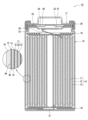
- FIG. 1 is a longitudinal sectional view of a nonaqueous electrolyte secondary battery according to an embodiment of the present invention
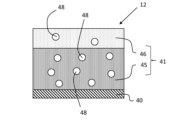
- 2 is a schematic cross-sectional view showing one side in the thickness direction of a negative electrode included in the nonaqueous electrolyte secondary battery of FIG. 1
- FIG. 3 is a schematic diagram of montmorillonite, which is a silicate compound contained in the negative electrode shown in FIG. 2.
- the content of the silicate compound in the first region on the negative electrode current collector side greater than that in the second region on the opposite side to the negative electrode current collector side, the transport of lithium ions in the negative electrode is promoted, and the concentration unevenness of lithium ions in the thickness direction in the negative electrode composite layer is reduced. As a result, the charge/discharge characteristics during high-rate cycles in the secondary battery can be improved.
- a cylindrical battery in which a wound electrode body is housed in a cylindrical battery case will be exemplified, but the electrode body is not limited to the wound type and may be a laminated type in which multiple positive electrodes and multiple negative electrodes are alternately stacked one by one with separators interposed between them.
- the battery case is not limited to a cylindrical shape and may be, for example, a square or coin shape, or may be a battery case made of a laminate sheet including a metal layer and a resin layer.
- FIG. 1 is a longitudinal cross-sectional view of a lithium-ion secondary battery 10 (hereinafter referred to as secondary battery 10) that is an example of an embodiment.
- secondary battery 10 a lithium-ion secondary battery 10
- an electrode body 14 and a non-aqueous electrolyte (not shown) are housed in an outer can 16.
- the sealing body 17 side will be referred to as the "top” and the bottom side of the outer can 16 as the "bottom”.
- the electrode body 14 has a wound structure in which the positive electrode 11 and the negative electrode 12 are wound with the separator 13 interposed therebetween.
- the positive electrode 11, the negative electrode 12, and the separator 13 are all long strip-shaped bodies, and are alternately stacked in the radial direction of the electrode body 14 by being wound in a spiral shape.
- the separator 13 is formed with dimensions slightly larger than the positive electrode 11 and the negative electrode 12, and two of them are arranged to sandwich the positive electrode 11.
- the sealing body 17 seals the opening at the top of the outer can 16, sealing the inside of the secondary battery 10.
- An upper insulating plate 18 and a lower insulating plate 19 are provided above and below the electrode body 14.
- the positive electrode tab 20 extends vertically through the through hole of the upper insulating plate 18, connecting the terminal plate 23, which is the bottom plate of the sealing body 17, and the positive electrode 11 included in the electrode body 14. This connects the positive electrode 11 and the sealing body 17, and in the secondary battery 10, the cap 27, which is the top plate of the sealing body 17 electrically connected to the terminal plate 23, becomes the positive electrode terminal.
- the positive electrode tab 20 is, for example, an aluminum tab.
- the negative electrode tab 21 extends through the through hole of the lower insulating plate 19 to the bottom side of the outer can 16 and is welded to the inner surface of the bottom of the outer can 16. This connects the negative electrode 12 and the outer can 16, and in the secondary battery 10, the outer can 16 becomes the negative electrode terminal.
- the negative electrode tab 21 is, for example, a nickel tab.
- the positive electrode tab 20 is located in the longitudinal center of the positive electrode 11, away from the winding start end and winding end end of the electrode body 14.
- the negative electrode tab 21 is provided at one longitudinal end of the negative electrode 12 located at the winding start side of the negative electrode 12.
- the negative electrode 12 has a first negative electrode exposed portion (not shown) that is provided at the winding start end and exposes the negative electrode current collector 40.
- the negative electrode tab 21 is joined to the first negative electrode exposed portion.
- the negative electrode 12 is disposed on the outermost surface of the electrode body 14, and a second negative electrode exposed portion 44 is provided where the surface of the negative electrode collector 40 is exposed.
- the negative electrode exposed portion 44 abuts against the inner surface of the outer can 16.
- the negative electrode exposed portion 44 abuts against the inner surface of the outer can 16, which is the negative electrode terminal, electrically connecting both longitudinal ends of the negative electrode 12 to the outer can 16, ensuring good current collection.
- the negative electrode exposed portion 44 may be provided on a part of the outermost surface of the electrode body 14, but is preferably provided over the entire outermost surface.
- the negative electrode exposed portion is provided on both sides of the negative electrode collector 40 over a length of at least one revolution of the electrode body 14 from the winding end of the negative electrode 12.
- the position of the negative electrode tab is not limited to the example shown in FIG. 1, and the negative electrode tab may be provided only near the end of the winding of the negative electrode 12, or may be provided both near the end of the winding of the negative electrode 12 and near the end of the winding of the negative electrode 12.
- the outer can 16 is a cylindrical metal container with a bottom and an opening on one axial side.
- a gasket 28 is provided between the outer can 16 and the sealing body 17, ensuring airtightness inside the secondary battery 10.
- the outer can 16 has a grooved portion 22 that supports the sealing body 17, formed, for example, by pressing the side portion from the outside.
- the grooved portion 22 is preferably formed in an annular shape along the circumferential direction of the outer can 16, and supports the sealing body 17 on its upper surface.
- the positive electrode 11, negative electrode 12, separator 13, and non-aqueous electrolyte that constitute the secondary battery 10 will be described in detail, in particular the negative electrode composite layer 41 that constitutes the negative electrode 12.
- the positive electrode 11 includes a positive electrode current collector 30 and a positive electrode composite layer 31 formed on the positive electrode current collector 30, i.e., on both sides of the positive electrode current collector 30.
- a foil of a metal stable in the potential range of the positive electrode such as aluminum or an aluminum alloy, or a film having the metal disposed on the surface layer, can be used.
- the positive electrode composite layer 31 includes, for example, a positive electrode active material, a binder, and a conductive material.
- the positive electrode composite layer 31 can be formed on only one side of the positive electrode current collector 30, but is preferably formed on both sides of the positive electrode current collector 30.
- the positive electrode 11 can be manufactured by, for example, applying a positive electrode composite layer slurry including a positive electrode active material, a binder, a conductive material, and the like onto the positive electrode current collector 30, drying and rolling the coating, and forming the positive electrode composite layer 31 on both sides of the positive electrode current collector 30.
- the positive electrode active material contained in the positive electrode composite layer 31 is composed mainly of a lithium-containing metal composite oxide.
- metal elements contained in the lithium-containing metal composite oxide include Ni, Co, Mn, Al, B, Mg, Ti, V, Cr, Fe, Cu, Zn, Ga, Sr, Zr, Nb, In, Sn, Ta, W, Ca, Sb, Pb, Bi, and Ge.
- An example of a suitable lithium-containing metal composite oxide is a composite oxide containing at least one of Ni, Co, Mn, and Al.
- the negative electrode 12 includes a negative electrode current collector 40 and a negative electrode composite layer 41 formed on the negative electrode current collector 40, i.e., on both sides of the negative electrode current collector 40.
- a foil of a metal stable in the potential range of the negative electrode such as copper or a copper alloy, or a film having the metal disposed on the surface layer, can be used.
- the negative electrode composite layer 41 can be formed on only one side of the negative electrode current collector 40, but is preferably formed on both sides of the negative electrode current collector 40.
- the negative electrode 12 can be manufactured by applying a negative electrode composite layer slurry containing a negative electrode active material, a silicate compound, and a binder onto the negative electrode current collector, drying and rolling the coating, and forming the negative electrode composite layer 41 on both sides of the negative electrode current collector 40, for example.
- the negative electrode active material contained in the negative electrode composite layer 41 may be any material capable of reversibly absorbing and releasing lithium ions, and carbon-based active materials such as graphite can be used as described below.
- Binders contained in the negative electrode composite layer 41 include, for example, styrene butadiene rubber (SBR), nitrile butadiene rubber (NBR), carboxymethyl cellulose (CMC) or a salt thereof, polyacrylic acid (PAA) or a salt thereof (PAA-Na, PAA-K, etc., or a partially neutralized salt), polyvinyl alcohol (PVA), etc. These may be used alone or in combination of two or more types.
- SBR styrene butadiene rubber
- NBR nitrile butadiene rubber
- CMC carboxymethyl cellulose
- PAA polyacrylic acid
- PAA-Na polyacrylic acid
- PAA-K polyvinyl alcohol
- PVA polyvinyl alcohol
- the negative electrode composite layer 41 has a two-layer structure consisting of a first region 45 arranged on the negative electrode current collector 40 side in the thickness direction and a second region 46 arranged on the opposite side to the negative electrode current collector 40 side. Of the first region 45 and the second region 46, only the first region 45 or both the first region 45 and the second region 46 contain silicate compounds 48. Furthermore, the content of silicate compounds 48 in the first region 45 is greater than the content of silicate compounds 48 in the second region 46. Note that, although only the negative electrode composite layer 41 on one side in the thickness direction of the negative electrode 12 is shown in FIG.
- the first region 45 and the second region 46 are layers containing, for example, a carbon-based active material, a Si-based active material, polyacrylic acid or its salt, and fibrous carbon, with the first region 45 being the lower layer and the second region 46 being the upper layer.
- a carbon-based active material with high density ensures capacity
- a carbon-based active material with high porosity carbon-based active material B improves liquid circulation.
- carbon-based active material A for the carbon-based active material in the first region 45
- carbon-based active material B for the carbon-based active material in the second region 46 in order to improve liquid circulation
- the mass of the first region 45 is 50% by mass or more and less than 90% by mass, and preferably 60% by mass or more and 80% by mass or less, relative to the mass of the negative electrode composite layer 41.
- the mass of the second region 46 is 10% by mass or more and 50% by mass or less, and preferably 20% by mass or more and 40% by mass or less, relative to the mass of the negative electrode composite layer 41.
- the mass ratio of the first region 45 to the second region 46 is 0.1 to 1, and preferably 0.3 to 0.7.
- the mass of the first region 45 relative to the mass of the negative electrode composite layer 41 is 90% by mass or more, and the mass of the second region 46 relative to the mass of the negative electrode composite layer 41 is 10% by mass or less, for example, the proportion of the second region 46 that contributes to improving the input characteristics will be small, and the input characteristics of the battery will be reduced. Also, if the mass of the first region 45 relative to the mass of the negative electrode composite layer 41 is less than 50% by mass, and the mass of the second region 46 relative to the mass of the negative electrode composite layer 41 is more than 50% by mass, the proportion of the first region 45 will be small, making it difficult to increase the capacity of the battery.
- the packing density of the negative electrode mixture layer 41 is preferably 1.65 g/cm 3 or more in terms of improving the battery capacity.
- the packing density of the negative electrode mixture layer 41 is, for example, 1.65 g/cm 3 or more and 1.75 g/cm 3 or less.
- the packing densities of the first region 45 and the second region 46 may be the same as each other or may be different.
- the packing density of the second region 46 is, for example, lower than the packing density of the first region 45.
- An example of the packing density of the second region 46 is 1.40 g/cm 3 or more and 1.55 g/cm 3 or less.
- An example of the packing density of the first region 45 is 1.70 g/cm 3 or more and 1.95 g/cm 3 or less.
- the thickness of the negative electrode composite layer 41 is, for example, 30 ⁇ m or more and 100 ⁇ m or less on one side of the negative electrode current collector 40.
- the thicknesses of the first region 45 and the second region 46 may be the same or different as long as the above mass ratio is satisfied.
- the thickness of the first region 45 may be greater than or less than the thickness of the second region 46.
- the ratio of the thickness of the first region 45 to the thickness of the negative electrode composite layer 41 may be 50% or more and 80% or less, and the ratio of the thickness of the second region 46 to the thickness of the negative electrode composite layer 41 may be 20% or more and 50% or less.
- the negative electrode composite layer 41 may include layers other than the first region 45 and the second region 46 as long as the purpose of this disclosure is not impaired.
- the carbon-based active material may be, for example, graphite or amorphous carbon, with graphite being preferred.
- graphite include natural graphite such as flake graphite, lump artificial graphite, and artificial graphite such as graphitized mesophase carbon microbeads, and natural graphite and artificial graphite may be used in combination.
- a conductive coating layer such as amorphous carbon may also be formed on the surface of the graphite particles.
- the first region 45 contains, in addition to the carbon-based active material, a Si-based active material, polyacrylic acid (PAA) or its salt, and fibrous carbon.
- PAA or its salt strongly bonds the particles of the negative electrode active material (Si-based active material and carbon-based active material) together, and therefore suppresses an increase in the number of negative electrode active material particles that are isolated from the conductive path in the first region 45, even if the volume of the Si-based active material changes significantly with charging and discharging. For this reason, the addition of PAA or its salt to the first region 45 suppresses a decrease in cycle characteristics.
- the fibrous carbon forms a good conductive path in the first region 45, just like PAA or its salt.
- the Si-based active material is at least one of Si and a Si-containing compound, but is preferably a Si-containing compound that has a smaller volume change during charging and discharging than Si.
- the Si-containing compound is not particularly limited as long as it is a compound containing Si, but is preferably a compound represented by SiOx (0.5 ⁇ x ⁇ 1.5) as described above.
- the Si-containing compound may be used alone or in combination of two or more types. It is preferable that a conductive coating composed of a material having a higher conductivity than the compound is formed on the particle surface of the Si-containing compound.
- the average particle size (Dv50) of the Si-containing compound is, for example, 1 ⁇ m or more and 15 ⁇ m or less.
- SiOx has a structure in which Si is dispersed in an amorphous SiO2 matrix, for example.
- SiOx may contain lithium silicate (for example, lithium silicate represented by Li2zSiO (2+z) (0 ⁇ z ⁇ 2)) in the particles, or may have a structure in which Si is dispersed in a lithium silicate phase.
- lithium silicate for example, lithium silicate represented by Li2zSiO (2+z) (0 ⁇ z ⁇ 2)
- the conductive coating is preferably a carbon coating.
- the carbon coating is formed, for example, in an amount of 0.5% by mass to 10% by mass relative to the mass of the SiOx particles.
- methods for forming the carbon coating include a method in which coal tar or the like is mixed with Si-containing compound particles and heat-treated, and a chemical vapor deposition method (CVD method) using a hydrocarbon gas or the like.
- the carbon coating may also be formed by adhering carbon black, ketjen black, or the like to the surface of the Si-containing compound particles using a binder.
- the mass ratio of the carbon-based active material to the Si-based active material contained in the first region 45 is, for example, 97:3 or more and 50:50 or less, and preferably 95:5 or more and 80:20 or less. If the mass ratio is within this range, the carbon-based active material can mitigate the volume change of the Si-based active material while increasing the capacity of the battery, making it easier to suppress deterioration of the cycle characteristics.
- the proportion of the Si-based active material in the negative electrode active material is preferably 5% by mass or more and 20% by mass or less, and more preferably 5% by mass or more and 15% by mass or less.
- the PAA or its salt contained in the first region 45 and the second region 46 functions as a binder.
- the salt of PAA is, for example, a lithium salt, a sodium salt, a potassium salt, or an ammonium salt.
- the first region 45 and the second region 46 preferably contain a second binder.
- the second binder include CMC or its salt, styrene-butadiene copolymer (SBR), polyvinyl alcohol (PVA), PEO, etc. Among these, CMC or its salt, and SBR are preferred.
- the content of the binder contained in the first region 45 is, for example, preferably 0.5% by mass or more and 10% by mass or less, and more preferably 1% by mass or more and 5% by mass or less, relative to the mass of the first region 45.
- the fibrous carbon contained in the first region 45 and the second region 46 is a conductive additive, and forms a good conductive path in the first region 45 and the second region 46.
- the fibrous carbon is, for example, a carbon material with an aspect ratio of 60 or more, and has a size that allows it to be added to the first region 45 and the second region 46.
- the second region 46 is a layer with a higher fibrous carbon content than the first region 45.
- the second region 46 has a low density of the active material, and therefore contains a relatively large amount of fibrous carbon to ensure a conductive path.
- fibrous carbon examples include carbon nanotubes (CNTs) and carbon nanofibers.
- CNTs carbon nanotubes
- CNTs are preferred.
- the expansion or contraction of the negative electrode active material particles during charging and discharging may cause cracks in the negative electrode composite layer, which may result in a loss of conductivity and a decrease in the amount of active material that can contribute to charging and discharging.
- CNTs may be not only single-walled CNTs, but also double-walled CNTs, multi-walled CNTs, and mixtures thereof.
- the CNTs may also be vapor-grown carbon fibers called VGCF (registered trademark).
- the fibrous carbon has a diameter of, for example, 2 nm to 20 ⁇ m and a total length of 0.03 ⁇ m to 500 ⁇ m.
- the content of the fibrous carbon is, for example, preferably 0.01% by mass to 5% by mass, and more preferably 0.5% by mass to 3% by mass, relative to the mass of the first region 45 and the second region 46.
- the silicate compound 48 has a lithophilic property and a high lithium diffusivity.
- the silicate compound 48 includes a layered silicate compound 48 such as a layered silicate mineral.
- the layered silicate mineral has a structure in which a plurality of silicate layers are stacked.
- the layered silicate mineral may be, for example, particulate.
- the layered silicate mineral may be, for example, plate-like particles, spherical particles, clump particles, rod-like particles, etc.
- the layered silicate mineral is, for example, montmorillonite (MMT).
- MMT montmorillonite
- the layered silicate mineral such as montmorillonite has water swelling properties, cation adsorption capacity, and cation diffusion capacity.
- Montmorillonite is a silicate compound 48 contained in the negative electrode .
- Montmorillonite has a composition represented by (Na,Ca) 0.33 (Al,Mg)x( Si4O10 )( OH ) 2.nH2O .
- the layers are expanded by water molecules entering between the two basic layers 50.
- a layer of exchangeable cations such as Na + , Ca 2+ , and K + is formed between the two basic layers 50.
- the silicate compound 48 containing montmorillonite has high adsorption properties for lithium ions, which are cations. It has also been found that the energy consumption of the diffusion of lithium ions inside the crystal is reduced in the silicate compound 48. As a result, it is considered that the silicate compound 48 has high diffusivity for lithium ions.
- the content of silicate compound 48 in first region 45 is greater than the content of silicate compound 48 in second region 46.
- silicate compound 48 has high adsorption and diffusibility of lithium ions. This promotes the transport of lithium ions in negative electrode 12, and reduces unevenness in the concentration of lithium ions in the thickness direction of negative electrode composite layer 41. As a result, the charge/discharge characteristics of secondary battery 10 during high-rate cycles can be improved.
- the content of silicate compound 48 in the negative electrode mixture layer 41 in the first region 45 is preferably 0.1% by mass or more and 3% by mass or less.
- the content of silicate compound 48 in the negative electrode mixture layer 41 in the second region 46 is preferably 0% by mass or more and 1% by mass or less.
- the content of silicate compound 48 in the negative electrode mixture layer 41 in the first region 45 is preferably 0.1% by mass or more and 3% by mass or less, and the second region 46 may be configured not to contain silicate compound 48.
- the negative electrode 12 is manufactured, for example, by the following method.
- a first negative electrode composite layer slurry for the first region 45 is prepared, which contains a carbon-based active material, a Si-based active material, a binder, fibrous carbon, a silicate compound 48, etc.
- a second negative electrode composite layer slurry for the second region 46 is prepared, which contains a carbon-based active material, a Si-based active material, a binder, fibrous carbon, etc.
- the second negative electrode composite layer slurry may contain a silicate compound 48.
- the first negative electrode composite layer slurry is then applied onto the negative electrode current collector 40, and the coating is dried to form the first region 45 on the negative electrode current collector 40.
- the second negative electrode composite layer slurry is applied onto the first region 45, and the coating is dried to form the second region 46 on the first region 45, and the first region 45 and the second region 46 are then compressed.
- a negative electrode 12 is obtained in which a negative electrode mixture layer 41 including a first region 45 and a second region 46 is formed on the negative electrode current collector 40.
- the non-aqueous electrolyte has ion conductivity (e.g., lithium ion conductivity).
- the non-aqueous electrolyte includes a non-aqueous solvent and an electrolyte salt dissolved in the non-aqueous solvent.
- the non-aqueous electrolyte is not limited to a liquid electrolyte (nonaqueous electrolyte), and may be a solid electrolyte using a gel-like polymer or the like.
- the electrolyte salt for example, lithium salts such as LiBF4 and LiPF6 are used.
- non-aqueous solvent for example, esters such as ethylene carbonate (EC), propylene carbonate (PC), dimethyl carbonate (DMC), ethyl methyl carbonate (EMC), diethyl carbonate (DEC), methyl propionate (MP), ethers, nitriles, amides, and mixed solvents of two or more of these are used.
- the non-aqueous solvent may contain a halogen-substituted product in which at least a part of the hydrogen of the above-mentioned solvents is replaced with a halogen atom such as fluorine.
- halogen-substituted compounds include fluorinated cyclic carbonates such as fluoroethylene carbonate (FEC), fluorinated chain carbonates, and fluorinated chain carboxylates such as methyl fluoropropionate (FMP).
- FEC fluoroethylene carbonate
- FMP fluorinated chain carboxylates
- the nonaqueous electrolyte preferably contains 5% by mass or more of FEC, and more preferably 5% by mass or more and 15% by mass or less of FEC, based on the mass of the nonaqueous electrolyte.
- the solid electrolyte for example, a solid or gel-like polymer electrolyte, an inorganic solid electrolyte, etc. are used.
- the polymer electrolyte includes, for example, a lithium salt and a matrix polymer, or a non-aqueous solvent, a lithium salt, and a matrix polymer.
- the matrix polymer for example, a polymer material that absorbs the non-aqueous solvent and gels is used.
- the polymer material for example, a fluororesin, an acrylic resin, a polyether resin, etc. are used.
- the inorganic solid electrolyte for example, a material known in all-solid-state lithium ion secondary batteries, etc. (for example, an oxide-based solid electrolyte, a sulfide-based solid electrolyte, a halide-based solid electrolyte, etc.) is used.
- Example 1 [Positive electrode] As the positive electrode active material, a lithium transition metal oxide represented by LiNiCoAlO 2 was used. 99.0 parts by mass of the positive electrode active material, 0.4 parts by mass of carbon nanotubes (CNT), and 0.6 parts by mass of polyvinylidene fluoride (PVDF) were mixed, and an appropriate amount of N-methyl-2-pyrrolidone (NMP) was added to prepare a positive electrode mixture layer slurry. Next, the positive electrode mixture layer slurry was applied to the positive electrode collector made of aluminum foil, leaving a portion where the positive electrode tab was connected, and the coating was dried. The coating was rolled using a roller, and then cut to a predetermined electrode size, and a positive electrode 11 in which a positive electrode mixture layer was formed on both sides of the positive electrode collector was produced.
- NMP N-methyl-2-pyrrolidone
- the first negative electrode composite layer slurry was applied to both sides of the negative electrode collector 40 made of copper foil, leaving only the portion where the negative electrode tab was connected, and the coating was dried to form the first region 45 on both sides of the negative electrode collector 40.
- the second negative electrode composite layer slurry was applied to the first region 45 formed on both sides of the negative electrode collector 40, and the coating was dried to form the second region 46.
- the coating was rolled using a roller and cut to a predetermined electrode size, and the negative electrode 12 was produced in which the negative electrode composite layer 41 including the first region 45 and the second region 46 was formed on both sides of the negative electrode collector.
- the montmorillonite content of 0.45 mass% in the first region 45 is greater than the montmorillonite content of 0% in the second region 46.
- the masses of the first region 45 and the second region 46 of the negative electrode composite layer 41 were measured, and the mass ratio of the second region 46/the first region 45 was 0.33.
- Non-aqueous electrolyte A non-aqueous electrolyte was prepared by adding 4 mass% of vinylene carbonate (VC) to a mixed solvent obtained by mixing ethylene carbonate (EC), fluorinated ethylene carbonate (FEC), ethyl methyl carbonate (EMC), and dimethyl carbonate (DMC) in a volume ratio of 10:10:5:75, and dissolving LiPF6 at a ratio of 1.35 mol/L.
- VC vinylene carbonate
- EC ethylene carbonate
- FEC fluorinated ethylene carbonate
- EMC ethyl methyl carbonate
- DMC dimethyl carbonate
- Test cell A negative electrode tab and a positive electrode tab were attached to the negative electrode 12 and the positive electrode 11, respectively, and the negative electrodes 12 and the positive electrodes 11 were alternately laminated and wound one by one through a separator 13 to prepare an electrode body.
- a single-layer polypropylene separator was used for the separator 13.
- the prepared electrode body was inserted into an exterior body made of an aluminum laminate sheet, and the opening of the exterior body was sealed to prepare a test cell (laminate cell).
- the design capacity of the test cell was 440 mAh.
- Example 2 graphite, a Si-containing compound, a lithium salt of polyacrylic acid (PAA), a sodium salt of carboxymethyl cellulose (CMC), a styrene-butadiene copolymer (SBR), carbon nanotubes (CNT), and montmorillonite were mixed in a solid content mass ratio of 89.57:7.31:0.58:1.07:1.16:0.03:0.27.
- the other conditions of Example 2 were the same as those of Example 1, and a test cell was prepared. Therefore, in Example 2, the content of montmorillonite in the first region 45, which is 0.45 mass%, is greater than the content of montmorillonite in the second region 46, which is 0.27 mass%.
- Table 1 shows the configuration of the negative electrode composite layer in the test cells of Examples 1-2 and Comparative Examples 1-5, and the amount of montmorillonite (MMT) added in the second region and first region, or in the single layer, in mass %.
- MMT montmorillonite
- Table 1 above shows the test results for the capacity retention rate and cell resistance increase rate of the test cells of Examples 1-2 and Comparative Examples 1-5.
- Comparative Example 1-5 From the results shown in Table 1, in Comparative Example 1-5, the content of montmorillonite in the first region 45 of the negative electrode mixture layer was equal to or less than the content of montmorillonite in the second region 46, and in all cases the capacity retention rate after 100 cycles was low at 95.6% or less. In addition, in Comparative Example 1-5, the cell resistance increase rate after 100 cycles was high at 104.8% or more. On the other hand, in Example 1-2, the capacity retention rate after 100 cycles was high at 96.8% or more. In addition, in Example 1-2, the cell resistance increase rate after 100 cycles was low at 104.4% or less.
- Configuration 1 a negative electrode current collector; and a negative electrode mixture layer formed on the negative electrode current collector,
- the negative electrode mixture layer includes a negative electrode active material capable of absorbing and releasing lithium ions and a silicate compound, the negative electrode mixture layer has a first region disposed on the negative electrode current collector side with respect to a thickness direction, and a second region disposed on an opposite side to the negative electrode current collector side, The content of the silicate compound in the first region is greater than the content of the silicate compound in the second region.
- Configuration 2 2.
- Configuration 3 3.
- Configuration 4 The content of the silicate compound in the negative electrode mixture layer in the first region is 0.1 mass% or more and 3 mass% or less, 4.
- Configuration 5 5.
- Configuration 6 The negative electrode mixture layer further contains a conductive assistant, The nonaqueous electrolyte secondary battery according to any one of claims 1 to 5, wherein the conductive assistant comprises carbon nanotubes.
Landscapes
- Chemical & Material Sciences (AREA)
- Chemical Kinetics & Catalysis (AREA)
- Electrochemistry (AREA)
- General Chemical & Material Sciences (AREA)
- Engineering & Computer Science (AREA)
- Materials Engineering (AREA)
- Composite Materials (AREA)
- Manufacturing & Machinery (AREA)
- Battery Electrode And Active Subsutance (AREA)
Priority Applications (2)
| Application Number | Priority Date | Filing Date | Title |
|---|---|---|---|
| JP2025537812A JPWO2025028228A1 (https=) | 2023-07-31 | 2024-07-12 | |
| CN202480049838.1A CN121586945A (zh) | 2023-07-31 | 2024-07-12 | 非水电解质二次电池 |
Applications Claiming Priority (2)
| Application Number | Priority Date | Filing Date | Title |
|---|---|---|---|
| JP2023124828 | 2023-07-31 | ||
| JP2023-124828 | 2023-07-31 |
Publications (1)
| Publication Number | Publication Date |
|---|---|
| WO2025028228A1 true WO2025028228A1 (ja) | 2025-02-06 |
Family
ID=94395171
Family Applications (1)
| Application Number | Title | Priority Date | Filing Date |
|---|---|---|---|
| PCT/JP2024/025268 Pending WO2025028228A1 (ja) | 2023-07-31 | 2024-07-12 | 非水電解質二次電池 |
Country Status (3)
| Country | Link |
|---|---|
| JP (1) | JPWO2025028228A1 (https=) |
| CN (1) | CN121586945A (https=) |
| WO (1) | WO2025028228A1 (https=) |
Citations (4)
| Publication number | Priority date | Publication date | Assignee | Title |
|---|---|---|---|---|
| JPH09306494A (ja) * | 1996-05-16 | 1997-11-28 | Tdk Corp | リチウム二次電池 |
| JP2008071757A (ja) * | 2006-09-11 | 2008-03-27 | Lg Chem Ltd | 粘土鉱物を含む電極合剤及びこれを用いた電気化学セル |
| JP2020057500A (ja) | 2018-10-01 | 2020-04-09 | トヨタ自動車株式会社 | 負極、電池、および負極の製造方法 |
| WO2022181266A1 (ja) * | 2021-02-26 | 2022-09-01 | パナソニックIpマネジメント株式会社 | 電池用電極合剤および非水電解質二次電池 |
-
2024
- 2024-07-12 JP JP2025537812A patent/JPWO2025028228A1/ja active Pending
- 2024-07-12 WO PCT/JP2024/025268 patent/WO2025028228A1/ja active Pending
- 2024-07-12 CN CN202480049838.1A patent/CN121586945A/zh active Pending
Patent Citations (4)
| Publication number | Priority date | Publication date | Assignee | Title |
|---|---|---|---|---|
| JPH09306494A (ja) * | 1996-05-16 | 1997-11-28 | Tdk Corp | リチウム二次電池 |
| JP2008071757A (ja) * | 2006-09-11 | 2008-03-27 | Lg Chem Ltd | 粘土鉱物を含む電極合剤及びこれを用いた電気化学セル |
| JP2020057500A (ja) | 2018-10-01 | 2020-04-09 | トヨタ自動車株式会社 | 負極、電池、および負極の製造方法 |
| WO2022181266A1 (ja) * | 2021-02-26 | 2022-09-01 | パナソニックIpマネジメント株式会社 | 電池用電極合剤および非水電解質二次電池 |
Also Published As
| Publication number | Publication date |
|---|---|
| CN121586945A (zh) | 2026-02-27 |
| JPWO2025028228A1 (https=) | 2025-02-06 |
Similar Documents
| Publication | Publication Date | Title |
|---|---|---|
| JP7531165B2 (ja) | リチウムイオン二次電池用負極及びリチウムイオン二次電池 | |
| JP7716670B2 (ja) | リチウムイオン二次電池用負極およびリチウムイオン二次電池 | |
| JP7394324B2 (ja) | 非水電解質二次電池 | |
| JP7228786B2 (ja) | 非水電解質二次電池用負極および非水電解質二次電池 | |
| JP7738268B2 (ja) | 二次電池用負極及び二次電池 | |
| JP7349347B2 (ja) | 非水電解質二次電池用負極、及び非水電解質二次電池 | |
| WO2023100498A1 (ja) | リチウムイオン二次電池 | |
| US20250105288A1 (en) | Negative electrode for secondary battery and secondary battery | |
| WO2023053773A1 (ja) | リチウムイオン二次電池 | |
| WO2023162766A1 (ja) | 二次電池用電極および二次電池 | |
| WO2023054146A1 (ja) | 二次電池 | |
| JP7372146B2 (ja) | 非水電解質二次電池用負極、及び非水電解質二次電池 | |
| US20240128448A1 (en) | Electrode mixture for batteries and nonaqueous electrolyte secondary battery | |
| WO2024042897A1 (ja) | 二次電池用負極および非水電解質二次電池 | |
| WO2023054096A1 (ja) | 二次電池用電極および二次電池 | |
| WO2023054098A1 (ja) | 二次電池用負極および二次電池 | |
| JP7349349B2 (ja) | 非水電解質二次電池用負極、及び非水電解質二次電池 | |
| WO2022163512A1 (ja) | 非水電解質二次電池 | |
| WO2023149529A1 (ja) | 非水電解質二次電池 | |
| WO2025028228A1 (ja) | 非水電解質二次電池 | |
| WO2023140163A1 (ja) | 非水電解質二次電池および非水電解質二次電池の製造方法 | |
| JP7349346B2 (ja) | 非水電解質二次電池用負極、及び非水電解質二次電池 | |
| WO2024247945A1 (ja) | 非水電解質二次電池 | |
| WO2025143011A1 (ja) | 非水電解質二次電池 | |
| WO2026094464A1 (ja) | 非水電解質二次電池 |
Legal Events
| Date | Code | Title | Description |
|---|---|---|---|
| 121 | Ep: the epo has been informed by wipo that ep was designated in this application |
Ref document number: 24848884 Country of ref document: EP Kind code of ref document: A1 |
|
| ENP | Entry into the national phase |
Ref document number: 2025537812 Country of ref document: JP Kind code of ref document: A |
|
| WWE | Wipo information: entry into national phase |
Ref document number: 2025537812 Country of ref document: JP |
|
| WWE | Wipo information: entry into national phase |
Ref document number: 202647008511 Country of ref document: IN |
|
| WWP | Wipo information: published in national office |
Ref document number: 202647008511 Country of ref document: IN |
|
| WWE | Wipo information: entry into national phase |
Ref document number: 2024848884 Country of ref document: EP |
|
| NENP | Non-entry into the national phase |
Ref country code: DE |