WO2025027894A1 - Iii族窒化物半導体エピタキシャルウエハ及びデバイス - Google Patents
Iii族窒化物半導体エピタキシャルウエハ及びデバイス Download PDFInfo
- Publication number
- WO2025027894A1 WO2025027894A1 PCT/JP2024/005738 JP2024005738W WO2025027894A1 WO 2025027894 A1 WO2025027894 A1 WO 2025027894A1 JP 2024005738 W JP2024005738 W JP 2024005738W WO 2025027894 A1 WO2025027894 A1 WO 2025027894A1
- Authority
- WO
- WIPO (PCT)
- Prior art keywords
- nitride semiconductor
- group iii
- iii nitride
- semiconductor substrate
- degrees
- Prior art date
- Legal status (The legal status is an assumption and is not a legal conclusion. Google has not performed a legal analysis and makes no representation as to the accuracy of the status listed.)
- Pending
Links
Images





Classifications
-
- C—CHEMISTRY; METALLURGY
- C30—CRYSTAL GROWTH
- C30B—SINGLE-CRYSTAL GROWTH; UNIDIRECTIONAL SOLIDIFICATION OF EUTECTIC MATERIAL OR UNIDIRECTIONAL DEMIXING OF EUTECTOID MATERIAL; REFINING BY ZONE-MELTING OF MATERIAL; PRODUCTION OF A HOMOGENEOUS POLYCRYSTALLINE MATERIAL WITH DEFINED STRUCTURE; SINGLE CRYSTALS OR HOMOGENEOUS POLYCRYSTALLINE MATERIAL WITH DEFINED STRUCTURE; AFTER-TREATMENT OF SINGLE CRYSTALS OR A HOMOGENEOUS POLYCRYSTALLINE MATERIAL WITH DEFINED STRUCTURE; APPARATUS THEREFOR
- C30B25/00—Single-crystal growth by chemical reaction of reactive gases, e.g. chemical vapour-deposition growth
- C30B25/02—Epitaxial-layer growth
- C30B25/18—Epitaxial-layer growth characterised by the substrate
- C30B25/20—Epitaxial-layer growth characterised by the substrate the substrate being of the same materials as the epitaxial layer
-
- C—CHEMISTRY; METALLURGY
- C30—CRYSTAL GROWTH
- C30B—SINGLE-CRYSTAL GROWTH; UNIDIRECTIONAL SOLIDIFICATION OF EUTECTIC MATERIAL OR UNIDIRECTIONAL DEMIXING OF EUTECTOID MATERIAL; REFINING BY ZONE-MELTING OF MATERIAL; PRODUCTION OF A HOMOGENEOUS POLYCRYSTALLINE MATERIAL WITH DEFINED STRUCTURE; SINGLE CRYSTALS OR HOMOGENEOUS POLYCRYSTALLINE MATERIAL WITH DEFINED STRUCTURE; AFTER-TREATMENT OF SINGLE CRYSTALS OR A HOMOGENEOUS POLYCRYSTALLINE MATERIAL WITH DEFINED STRUCTURE; APPARATUS THEREFOR
- C30B29/00—Single crystals or homogeneous polycrystalline material with defined structure characterised by the material or by their shape
- C30B29/10—Inorganic compounds or compositions
- C30B29/38—Nitrides
Definitions
- This disclosure relates to a Group III nitride semiconductor epitaxial wafer having a Group III nitride semiconductor substrate and a Group III nitride semiconductor film epitaxially grown thereon, and to a device using the Group III nitride semiconductor epitaxial wafer.
- III-nitride semiconductors are used in fields such as optical devices, such as semiconductor lasers and light-emitting diodes, as well as high-frequency or high-power electronic devices. These semiconductors have attracted particular attention in recent years because they are expected to reduce switching losses during power conversion compared to silicon-based devices. In order to fabricate high-frequency or high-power electronic devices, it is necessary to fabricate the devices on high-quality III-nitride substrates that can suppress crystal defects that occur in the device layer.
- Methods for producing Group III nitride crystals include, for example, hydride vapor phase epitaxy (hereinafter also referred to as HVPE), ammonothermal, sodium flux, and oxide vapor phase epitaxy (hereinafter also referred to as OVPE).
- HVPE hydride vapor phase epitaxy
- OVPE oxide vapor phase epitaxy
- HVPE method which is most often used as a substrate manufacturing method
- hydrogen halide gas is introduced onto a single group III raw material to generate a halide gas
- the generated halide gas of the group III element is used as a raw material gas for crystal growth.
- HCl gas is introduced into Ga metal to produce gallium chloride (e.g., GaCl 2 ) gas
- gallium chloride-containing gas is used as a group III source to perform high-speed growth at 1 mm/h or more.
- the group III nitride crystal having N-type conductivity can be obtained mainly by adding silicon element to the group III nitride crystal.
- an oxide source gas is used to add a high concentration of oxygen element to a Group III nitride crystal to produce the crystal (see, for example, Patent Document 1).
- a Group III oxide gas is reacted with a nitrogen-containing gas to produce a Group III nitride crystal.
- the substrate obtained by this method has a low dislocation density of the order of 10 4 cm -2 , and the OVPE method is one of the means for obtaining high-quality Group III nitride crystal.
- the Group III nitride crystals produced by the above-mentioned method can be processed to obtain Group III nitride substrates.
- Devices can be fabricated by forming epitaxial films of Group III nitride semiconductors on these substrates. It is known that the epitaxial films produced inherit dislocations, among other crystal defects, from the substrate. However, dislocations have been considered to be a cause of leaks during device operation, and so efforts have been made to develop methods to prevent the inheritance of dislocations from the substrate (see, for example, Patent Document 2).
- vertical power devices generally have a structure in which current also flows through the substrate. Therefore, in order to reduce the resistance during device operation, it is necessary to reduce the resistance of the substrate as well.
- the OVPE method makes it easy to dope high concentrations of oxygen atoms, which act as donors in the crystal, and is known as a method for manufacturing low-resistance substrates.
- the present inventors have developed a method for easily adding oxygen atoms at a high concentration to obtain a gallium nitride crystal with oxygen atoms added at a composition level with an oxygen concentration of 4.4 ⁇ 10 20 atoms ⁇ cm ⁇ 3 or more.
- group III nitride crystals for example, the molecular density in a gallium nitride crystal is 4.4 ⁇ 10 22 cm ⁇ 3 .
- oxygen atoms are said to be incorporated into the crystal by replacing nitrogen atoms, and an oxygen concentration of 4.4 ⁇ 10 20 atoms ⁇ cm ⁇ 3 can be made 1 atm.%, which can be said to be added at a composition level.
- impurities are added to the crystal to control the electrical properties, but generally, the amount is at most about 10 19 atoms cm -3 , and impurities are rarely added at the composition level. The reason for this is that if impurities are added at a high concentration, the crystal quality will deteriorate and the generation of polycrystals will increase due to the segregation of the impurities, making it difficult to obtain a high-quality thick single crystal.
- the objective of this disclosure is to provide a Group III nitride semiconductor epitaxial wafer in which a Group III nitride semiconductor film with a very flat surface is formed on a Group III nitride semiconductor doped with a high concentration of impurities.
- a Group III nitride semiconductor epitaxial wafer comprises a Group III nitride semiconductor substrate exhibiting n-type conductivity and having a carrier concentration of 10 cm -3 or more, and a Group III nitride semiconductor film including an epitaxial layer epitaxially grown on the Group III nitride semiconductor substrate, wherein the thickness of the Group III nitride semiconductor film is 1 ⁇ m or more and 30 ⁇ m or less, and the off angle between a normal to a surface of the Group III nitride semiconductor substrate on which the Group III nitride semiconductor film is formed and a c-axis of the Group III nitride semiconductor substrate is 0.38 degrees or more and 0.6 degrees or less.
- the Group III nitride semiconductor epitaxial wafer disclosed herein enables the formation of devices with reduced leakage and low operating loss.
- 1 is a schematic cross-sectional view showing an example of a nitride semiconductor epitaxial wafer according to a first embodiment of the present invention.
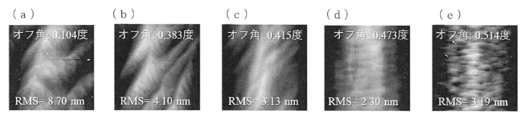
- 1 shows differential interference microscope images of the surfaces of gallium nitride films obtained using Group III nitride semiconductor substrates having different off-angles in examples.
- 1 is an atomic force microscope image (AFM image) with a viewing angle of 90 ⁇ m in an example.
- 11A and 11B are differential interference microscope images of the surfaces of gallium nitride films obtained using Group III nitride semiconductor substrates having different off-angles in comparative examples.
- 1 is an atomic force microscope image (AFM image) with a viewing angle of 90 ⁇ m in a comparative example.
- FIG. 4 is a diagram showing the relationship between surface roughness and off-angle of a substrate in Examples and Comparative Examples.
- a Group III nitride semiconductor epitaxial wafer comprises a Group III nitride semiconductor substrate exhibiting n-type conductivity and having a carrier concentration of 10 cm -3 or more, and a Group III nitride semiconductor film including an epitaxial layer epitaxially grown on the Group III nitride semiconductor substrate, wherein the thickness of the Group III nitride semiconductor film is 1 ⁇ m or more and 30 ⁇ m or less, and the off-angle between a normal to a surface of the Group III nitride semiconductor substrate on which the Group III nitride semiconductor film is formed and a c-axis of the Group III nitride semiconductor substrate is 0.38 degrees or more and 0.6 degrees or less.
- the Group III nitride semiconductor epitaxial wafer according to the second aspect may be the first aspect described above, in which the root mean square roughness (RMS) value of the surface of the Group III nitride semiconductor film over a 50 ⁇ m square area is 10 nm or less.
- RMS root mean square roughness
- the Group III nitride semiconductor epitaxial wafer according to the third aspect may be the second aspect described above, in which the root mean square roughness RMS value of the surface of the Group III nitride semiconductor film over a 50 ⁇ m square area is 5 nm or less, and the off-angle between the normal to the surface of the Group III nitride semiconductor substrate and the c-axis of the Group III nitride semiconductor substrate is 0.4 degrees or more and 0.55 degrees or less.
- the Group III nitride semiconductor epitaxial wafer according to the fourth aspect may be any one of the first to third aspects, in which the n-type dopant element of the Group III nitride semiconductor substrate is oxygen.
- the Group III nitride semiconductor epitaxial wafer according to the fifth aspect may be any one of the first to fourth aspects, in which the main Group III element of the Group III nitride semiconductor substrate is gallium.
- a Group III nitride semiconductor epitaxial wafer according to a sixth aspect is the Group III nitride semiconductor epitaxial wafer according to the fifth aspect, wherein an oxygen concentration in the Group III nitride semiconductor substrate is 4.4 ⁇ 10 20 atoms ⁇ cm ⁇ 3 or more.
- the Group III nitride semiconductor epitaxial wafer according to the seventh aspect may be any of the first to sixth aspects, in which the Group III nitride semiconductor film includes an epitaxial layer having a carrier concentration lower than that of the Group III nitride semiconductor substrate.
- a Group III nitride semiconductor epitaxial wafer according to an eighth aspect is any one of the first to seventh aspects, wherein the Group III nitride semiconductor film includes an epitaxial layer having a carrier concentration of 5 ⁇ 10 16 cm ⁇ 3 or less.
- the Group III nitride semiconductor epitaxial wafer according to the ninth aspect may be any one of the first to eighth aspects, in which the thickness of the Group III nitride semiconductor film is 1 ⁇ m or more and 8 ⁇ m or less.
- the device according to the tenth aspect uses a Group III nitride semiconductor epitaxial wafer according to any one of the first to ninth aspects.
- a method for producing a Group III nitride semiconductor epitaxial wafer includes the steps of: forming, by OVPE, a Group III nitride semiconductor substrate exhibiting n-type conductivity and a carrier concentration of 10 cm -3 or more; polishing the surface of the obtained Group III nitride semiconductor substrate to obtain a Group III nitride semiconductor substrate having a surface in which an off-angle between a normal to the c-axis of the Group III nitride semiconductor substrate is 0.38 degrees or more and 0.6 degrees or less; and epitaxially growing a Group III nitride semiconductor film on the surface of the Group III nitride semiconductor substrate with an off-angle of 0.38 degrees or more and 0.6 degrees or less.
- the method for producing a Group III nitride semiconductor epitaxial wafer according to the twelfth aspect may be the eleventh aspect described above, in which in the step of polishing the Group III nitride semiconductor substrate, the Group III nitride semiconductor substrate is placed so that the angle between the normal to a virtual polishing surface, which is a flat surface obtained by polishing, and the c-axis of the Group III nitride semiconductor substrate has a tilt of 0.38 degrees or more and 0.6 degrees or less, and the surface of the Group III nitride semiconductor substrate is polished so as to be parallel to the polishing surface, thereby obtaining a Group III nitride semiconductor substrate having an off-angle between the normal to the surface and the c-axis of 0.38 degrees or more and 0.6 degrees or less.
- FIG. 1 is a schematic cross-sectional view showing an example of a nitride semiconductor epitaxial wafer according to the first embodiment.
- a Group III nitride semiconductor epitaxial wafer according to the present disclosure comprises at least two layers: a Group III nitride semiconductor substrate and a Group III nitride semiconductor film including an epitaxial layer epitaxially grown thereon.
- the Group III nitride semiconductor substrate is preferably doped with an impurity that serves as an n-type dopant, exhibits n-type conductivity, and has a carrier concentration of 10 20 cm ⁇ 3 or more.
- the normal to the surface of the Group III nitride semiconductor substrate is preferably inclined at 0.38 degrees or more and 0.6 degrees or less from the c-axis of the Group III nitride semiconductor crystal having a hexagonal wurtzite crystal structure, and more preferably at 0.4 degrees or more and 0.55 degrees or less.
- this inclination angle may be simply referred to as the "off angle.” This makes it easier to maintain the flatness of the surface when a Group III nitride semiconductor film including an epitaxial layer is formed on the Group III nitride semiconductor substrate.
- the n-type dopant element of the Group III nitride semiconductor substrate preferably includes at least one element selected from the group consisting of silicon element, germanium element, and oxygen element.
- the n-type dopant element of the Group III nitride semiconductor substrate more preferably contains an oxygen element, in which case the oxygen element can be easily added to the Group III nitride semiconductor crystal, particularly when the Group III nitride semiconductor crystal used for the substrate is produced by OVPE.
- oxygen is the main n-type dopant element in the Group III nitride semiconductor substrate
- the oxygen is preferably added at a composition level of 4.4 ⁇ 10 atoms ⁇ cm ⁇ 3 or more, which makes it easy to achieve a carrier concentration of 10 20 cm ⁇ 3 or more in the Group III nitride semiconductor substrate.
- the III-nitride semiconductor film includes an epitaxial layer epitaxially grown on a III-nitride semiconductor substrate. Its electrical characteristics are determined by the performance required for the device, and are not limited to specific ones such as carrier concentration and polarity, p-type or n-type. However, with regard to the flatness of the surface, in order to reduce leakage current when the device is formed, the root mean square roughness (RMS) measured in a randomly selected 50 ⁇ m square area from the surface is preferably 10 nm or less, and more preferably 5 nm or less.
- the epitaxial layer constituting the Group III nitride semiconductor film may be a single layer, but may also have a structure of two or more layers.
- the Group III nitride semiconductor film preferably includes at least one epitaxial layer having a carrier concentration of 5 ⁇ 10 16 cm ⁇ 3 or less.
- the Group III nitride semiconductor film has a thickness of 1 ⁇ m or more and 30 ⁇ m or less.
- the thickness of the Group III nitride semiconductor film is preferably 1 ⁇ m or more. If the Group III nitride semiconductor film is thinner than 1 ⁇ m, a sufficiently stable surface is not formed when forming an epitaxial layer on a substrate, and the surface is likely to become rough depending on the flatness of the substrate.
- the thickness of the Group III nitride semiconductor film is preferably 30 ⁇ m or less. If it exceeds 30 ⁇ m, it may be difficult to maintain the flatness of the surface due to the effects of lattice mismatch. If it is 30 ⁇ m or less, it is easy to maintain the flatness of the epitaxial layer, and since the substrate of the present disclosure has a very high carrier concentration and is doped with a large amount of impurities, it is possible to maintain the flatness of the surface even though the lattice constant of the crystal deviates from that of a pure Group III nitride semiconductor crystal.
- the thickness of the Group III nitride semiconductor film is preferably 1 ⁇ m or more and 8 ⁇ m or less. If the thickness is 1 ⁇ m or more and 8 ⁇ m or less, a film with a sufficiently stable surface can be formed, and sufficient flatness can be maintained even if there is a large lattice mismatch between the substrate and the epitaxial layer.
- This Group III nitride semiconductor epitaxial wafer has a root mean square roughness (RMS) of 10 nm or less when measured over a 50 ⁇ m square area, and when used in electronic devices, it can realize devices with low resistance during operation and low leakage current.
- RMS root mean square roughness
- the method for manufacturing a Group III nitride semiconductor epitaxial wafer according to the first embodiment includes the following steps.
- a Group III nitride semiconductor substrate exhibiting n-type conductivity and a carrier concentration of 10 20 cm ⁇ 3 or more is formed by OVPE. Note that the manufacturing method of the Group III nitride semiconductor substrate by OVPE may be carried out under normal conditions.
- the surface of the obtained Group III nitride semiconductor substrate is polished to obtain a Group III nitride semiconductor substrate having a surface with an off-angle of 0.38 degrees or more and 0.6 degrees or less between the normal and the c-axis of the Group III nitride semiconductor substrate.
- the process of obtaining a Group III nitride semiconductor substrate having a surface with an off-angle of 0.38 degrees or more and 0.6 degrees or less will be described later.
- a Group III nitride semiconductor film is epitaxially grown on a surface of a Group III nitride semiconductor substrate having an off-angle of 0.38 degrees or more and 0.6 degrees or less.
- the Group III nitride semiconductor film may be epitaxially grown by, for example, metal-organic vapor phase epitaxy (MOVPE). Note that the epitaxial growth method is not limited to metal-organic vapor phase epitaxy (MOVPE). In this manner, a Group III nitride semiconductor epitaxial wafer can be obtained.
- MOVPE metal-organic vapor phase epitaxy
- the Group III nitride semiconductor substrate is placed so that an angle between a normal to a virtual polished surface, which is a flat surface obtained by polishing, and a c-axis of the Group III nitride semiconductor substrate has a gradient of 0.38 degrees or more and 0.6 degrees or less.
- the virtual polished surface may be a horizontal surface. Alternatively, it is not limited to a horizontal surface and may be a vertical surface.
- the c-plane In a typical Group III nitride semiconductor substrate, the c-plane, the normal of which is the c-axis, appears on the surface. Therefore, when a virtual polishing surface is a horizontal plane, the c-plane, which is the surface of the placed Group III nitride semiconductor substrate, is inclined with respect to the horizontal plane.
- the Group III nitride semiconductor substrate may be placed on a jig whose surface has a normal line that is inclined at an angle of 0.38 degrees or more and 0.6 degrees or less with respect to the vertical direction.
- the surface of the Group III nitride semiconductor substrate is polished so as to be parallel to the polished surface, thereby obtaining a Group III nitride semiconductor substrate having an off angle between the normal to the surface and the c-axis of 0.38 degrees or more and 0.6 degrees or less.
- the above-mentioned Group III nitride semiconductor epitaxial wafer may be used in electronic devices, thereby realizing devices with low resistance during operation and low leakage current.
- Example 2 a gallium nitride substrate manufactured by OVPE was used as the Group III nitride semiconductor substrate, and a gallium nitride film, which is a Group III nitride semiconductor film, was formed by metalorganic vapor phase epitaxy (MOVPE).
- the gallium nitride substrate used had an oxygen concentration of 1 ⁇ 10 21 atoms ⁇ cm ⁇ 3 , an n-type carrier concentration of 2 ⁇ 10 20 cm ⁇ 3 , and a thickness of 400 ⁇ m.
- the off-angle was changed from 0.383 degrees to 0.584 degrees.
- the gallium nitride film was doped with silicon as a dopant element, had an n-type carrier concentration of 2 ⁇ 10 16 cm ⁇ 3 , and was 8 ⁇ m thick. After the gallium nitride film was formed, the surface condition was evaluated with an atomic force microscope (AFM), and the RMS value of a 50 ⁇ m square area was also measured.
- AFM atomic force microscope
- FIGS. 3(a) to (f) are atomic force microscope images (AFM images) with a viewing angle of 90 ⁇ m in this example.
- AFM images atomic force microscope images
- a gallium nitride substrate manufactured by HVPE was used as the group III nitride semiconductor substrate, and a gallium nitride film was formed by MOVPE in the same manner as in the example.
- the gallium nitride substrate used was n-type, had a carrier concentration of 2 ⁇ 10 18 cm ⁇ 3 , and was 400 ⁇ m thick. The off-angle was changed from 0.355 degrees to 0.611 degrees.
- the gallium nitride film was n-type, had a carrier concentration of 2 ⁇ 10 16 cm ⁇ 3 , and was 8 ⁇ m thick, with silicon introduced as a dopant element.
- the surface condition was evaluated with an atomic force microscope (AFM) as in the example, and the RMS value of a 50 ⁇ m square area was also measured.
- AFM atomic force microscope
- FIGS. 4(a) to (e) are differential interference contrast microscope images of the surfaces of gallium nitride films obtained using Group III nitride semiconductor substrates having different off-angles in the comparative example
- FIGS. 5(a) to (e) are atomic force microscope images (AFM images) with a viewing angle of 90 ⁇ m in the comparative example.
- the Group III nitride film formed on the substrate with low impurity concentration is relatively flat in the surface images taken with a differential interference microscope at any off-angle, and furthermore, it can be confirmed from the atomic force microscope images (AFM images) that a flat film with RMS suppressed to 5 nm or less can be formed over a wide range of off-angles of 0.4 degrees or more.
- AFM images atomic force microscope images
- Fig. 6 is a diagram showing the relationship between the surface roughness and the off-angle of the substrate in the examples and the comparative examples.
- the off-angle needs to be 0.4 degrees or more in order to make the RMS value 5 nm or less.
- the off-angle is in the range of 0.38 to 0.6 degrees to make the RMS value 10 nm or less, and that the off-angle needs to be limited to a narrow range of 0.4 to 0.55 degrees in order to make the RMS value 5 nm or less. It was confirmed that in substrates with high impurity concentrations, the off-angle has a significant effect on improving flatness in a limited narrow region.
- the Group III nitride semiconductor epitaxial wafer according to the present disclosure makes it possible to form a flat Group III nitride semiconductor epitaxial film, which is expected to reduce leakage current in low on-resistance electronic devices and improve reliability.
Landscapes
- Chemical & Material Sciences (AREA)
- Engineering & Computer Science (AREA)
- Crystallography & Structural Chemistry (AREA)
- Materials Engineering (AREA)
- Metallurgy (AREA)
- Organic Chemistry (AREA)
- Inorganic Chemistry (AREA)
- Chemical Kinetics & Catalysis (AREA)
- General Chemical & Material Sciences (AREA)
- Crystals, And After-Treatments Of Crystals (AREA)
Priority Applications (2)
| Application Number | Priority Date | Filing Date | Title |
|---|---|---|---|
| JP2025538187A JPWO2025027894A1 (https=) | 2023-07-28 | 2024-02-19 | |
| CN202480046395.0A CN121488073A (zh) | 2023-07-28 | 2024-02-19 | Iii族氮化物半导体外延晶片及器件 |
Applications Claiming Priority (2)
| Application Number | Priority Date | Filing Date | Title |
|---|---|---|---|
| JP2023123380 | 2023-07-28 | ||
| JP2023-123380 | 2023-07-28 |
Publications (1)
| Publication Number | Publication Date |
|---|---|
| WO2025027894A1 true WO2025027894A1 (ja) | 2025-02-06 |
Family
ID=94394994
Family Applications (1)
| Application Number | Title | Priority Date | Filing Date |
|---|---|---|---|
| PCT/JP2024/005738 Pending WO2025027894A1 (ja) | 2023-07-28 | 2024-02-19 | Iii族窒化物半導体エピタキシャルウエハ及びデバイス |
Country Status (3)
| Country | Link |
|---|---|
| JP (1) | JPWO2025027894A1 (https=) |
| CN (1) | CN121488073A (https=) |
| WO (1) | WO2025027894A1 (https=) |
Citations (4)
| Publication number | Priority date | Publication date | Assignee | Title |
|---|---|---|---|---|
| JP2015127298A (ja) * | 2010-08-31 | 2015-07-09 | 株式会社リコー | 窒化ガリウム結晶、結晶基板および窒化物結晶 |
| JP2019197857A (ja) * | 2018-05-11 | 2019-11-14 | パナソニックIpマネジメント株式会社 | 発光ダイオード素子、及び発光ダイオード素子の製造方法 |
| JP2020007202A (ja) * | 2018-07-11 | 2020-01-16 | 国立大学法人大阪大学 | Iii族窒化物基板およびiii族窒化物結晶の製造方法 |
| JP2020033253A (ja) * | 2019-09-20 | 2020-03-05 | 株式会社サイオクス | 窒化物半導体基板 |
-
2024
- 2024-02-19 JP JP2025538187A patent/JPWO2025027894A1/ja active Pending
- 2024-02-19 WO PCT/JP2024/005738 patent/WO2025027894A1/ja active Pending
- 2024-02-19 CN CN202480046395.0A patent/CN121488073A/zh active Pending
Patent Citations (4)
| Publication number | Priority date | Publication date | Assignee | Title |
|---|---|---|---|---|
| JP2015127298A (ja) * | 2010-08-31 | 2015-07-09 | 株式会社リコー | 窒化ガリウム結晶、結晶基板および窒化物結晶 |
| JP2019197857A (ja) * | 2018-05-11 | 2019-11-14 | パナソニックIpマネジメント株式会社 | 発光ダイオード素子、及び発光ダイオード素子の製造方法 |
| JP2020007202A (ja) * | 2018-07-11 | 2020-01-16 | 国立大学法人大阪大学 | Iii族窒化物基板およびiii族窒化物結晶の製造方法 |
| JP2020033253A (ja) * | 2019-09-20 | 2020-03-05 | 株式会社サイオクス | 窒化物半導体基板 |
Also Published As
| Publication number | Publication date |
|---|---|
| CN121488073A (zh) | 2026-02-06 |
| JPWO2025027894A1 (https=) | 2025-02-06 |
Similar Documents
| Publication | Publication Date | Title |
|---|---|---|
| JP5818853B2 (ja) | n型窒化アルミニウム単結晶基板を用いた縦型窒化物半導体デバイス | |
| JP5792209B2 (ja) | 有機金属化学気相成長法による、高品質のN面GaN、InNおよびAlNならびにそれらの合金のヘテロエピタキシャル成長の方法 | |
| CN102844474B (zh) | 外延碳化硅单晶基板及其制造方法 | |
| KR102201924B1 (ko) | 도펀트 활성화 기술을 이용한 전력반도체용 갈륨옥사이드 박막 제조 방법 | |
| US20070138505A1 (en) | Low defect group III nitride films useful for electronic and optoelectronic devices and methods for making the same | |
| JP7647791B2 (ja) | SiCエピタキシャルウェハ | |
| WO2016152536A1 (ja) | 高耐圧ショットキーバリアダイオード | |
| CN102162134A (zh) | 碳化硅衬底的制造方法 | |
| CN110637109A (zh) | SiC外延晶片及其制造方法 | |
| CN106471163B (zh) | 半导体衬底、外延片及其制造方法 | |
| KR20200103578A (ko) | 도펀트 활성화 기술을 이용한 전력반도체용 갈륨옥사이드 박막 제조 방법 | |
| US10483351B2 (en) | Method of manufacturing a substrate with reduced threading dislocation density | |
| JP2006062931A (ja) | サファイア基板とその熱処理方法、及び結晶成長方法 | |
| WO2023013696A1 (ja) | 半導体基板、半導体ウエハ、及び半導体ウエハの製造方法 | |
| KR100714629B1 (ko) | 질화물 반도체 단결정 기판, 그 제조방법 및 이를 이용한수직구조 질화물 발광소자 제조방법 | |
| WO2025027894A1 (ja) | Iii族窒化物半導体エピタキシャルウエハ及びデバイス | |
| JP7487726B2 (ja) | 窒化物半導体基板及びその製造方法 | |
| CN113078205B (zh) | 基于Al-N共掺的SiC外延结构及其制备方法 | |
| KR20040063171A (ko) | Ⅲ족 질화물 반도체 기판 및 그 제조방법 | |
| CN114784089A (zh) | 一种氮化镓半导体外延及其制备方法与功率及射频器件 | |
| Kang et al. | Optical study of phase-separated thick InGaN layers grown on a compliant substrate | |
| JP2015207618A (ja) | 窒化物半導体基板、窒化物半導体デバイス、窒化物半導体基板の製造方法、及び、窒化物半導体デバイスの製造方法 | |
| JP2024172832A (ja) | Iii族窒化物半導体基板 | |
| JP2014192246A (ja) | 半導体基板およびそれを用いた半導体素子 | |
| WO2025188374A2 (en) | N-polar iii-nitride semiconductors on silicon carbide |
Legal Events
| Date | Code | Title | Description |
|---|---|---|---|
| 121 | Ep: the epo has been informed by wipo that ep was designated in this application |
Ref document number: 24848557 Country of ref document: EP Kind code of ref document: A1 |
|
| ENP | Entry into the national phase |
Ref document number: 2025538187 Country of ref document: JP Kind code of ref document: A |
|
| WWE | Wipo information: entry into national phase |
Ref document number: 2025538187 Country of ref document: JP |
|
| NENP | Non-entry into the national phase |
Ref country code: DE |