WO2025027700A1 - 香味成分含有液の製造方法およびたばこ香味液の製造方法 - Google Patents
香味成分含有液の製造方法およびたばこ香味液の製造方法 Download PDFInfo
- Publication number
- WO2025027700A1 WO2025027700A1 PCT/JP2023/027818 JP2023027818W WO2025027700A1 WO 2025027700 A1 WO2025027700 A1 WO 2025027700A1 JP 2023027818 W JP2023027818 W JP 2023027818W WO 2025027700 A1 WO2025027700 A1 WO 2025027700A1
- Authority
- WO
- WIPO (PCT)
- Prior art keywords
- flavor
- liquid
- tobacco material
- tobacco
- heating
- Prior art date
- Legal status (The legal status is an assumption and is not a legal conclusion. Google has not performed a legal analysis and makes no representation as to the accuracy of the status listed.)
- Pending
Links
Images








Classifications
-
- A—HUMAN NECESSITIES
- A24—TOBACCO; CIGARS; CIGARETTES; SIMULATED SMOKING DEVICES; SMOKERS' REQUISITES
- A24B—MANUFACTURE OR PREPARATION OF TOBACCO FOR SMOKING OR CHEWING; TOBACCO; SNUFF
- A24B15/00—Chemical features or treatment of tobacco; Tobacco substitutes, e.g. in liquid form
- A24B15/10—Chemical features of tobacco products or tobacco substitutes
- A24B15/16—Chemical features of tobacco products or tobacco substitutes of tobacco substitutes
-
- A—HUMAN NECESSITIES
- A24—TOBACCO; CIGARS; CIGARETTES; SIMULATED SMOKING DEVICES; SMOKERS' REQUISITES
- A24B—MANUFACTURE OR PREPARATION OF TOBACCO FOR SMOKING OR CHEWING; TOBACCO; SNUFF
- A24B15/00—Chemical features or treatment of tobacco; Tobacco substitutes, e.g. in liquid form
- A24B15/18—Treatment of tobacco products or tobacco substitutes
- A24B15/24—Treatment of tobacco products or tobacco substitutes by extraction; Tobacco extracts
-
- A—HUMAN NECESSITIES
- A24—TOBACCO; CIGARS; CIGARETTES; SIMULATED SMOKING DEVICES; SMOKERS' REQUISITES
- A24F—SMOKERS' REQUISITES; MATCH BOXES; SIMULATED SMOKING DEVICES
- A24F40/00—Electrically operated smoking devices; Component parts thereof; Manufacture thereof; Maintenance or testing thereof; Charging means specially adapted therefor
- A24F40/10—Devices using liquid inhalable precursors
Definitions
- the present invention relates to a method for producing a flavor component-containing liquid and a method for producing a tobacco flavor liquid.
- the present invention aims to provide a technology for obtaining a flavor component-containing liquid with a low moisture content for use in a flavor inhaler that generates an aerosol.
- a method for producing a flavour ingredient-containing liquid for use in a flavour inhaler generating an aerosol comprising: heating the tobacco material to a temperature of the tobacco material in the range of 80-100°C, thereby reducing the moisture content of the tobacco material; heating the tobacco material with the reduced moisture content to a temperature of the tobacco material greater than 100° C., thereby vaporizing high-boiling flavor components from the tobacco material; and dissolving the vaporized high boiling flavor component in a liquid that is at least a part of the aerosol source, thereby obtaining a high boiling flavor component-containing liquid.
- a flavor component-containing liquid produced by the method according to the first aspect.
- a flavor component is selected based on the content or flavor type of the flavor component. (a) selecting one type of flavor component-containing liquid as a tobacco flavor liquid; or (b) selecting two or more flavor ingredient-containing liquids and mixing them, thereby preparing a tobacco flavor liquid.
- a tobacco flavor liquid produced by the method according to the third aspect.
- a flavor inhaler containing the tobacco flavor liquid according to the fourth aspect is provided.
- a tobacco flavor liquid produced by the method according to the third aspect There is provided a regenerated tobacco material comprising: a heated tobacco material obtained after obtaining the multiple types of flavor component-containing liquid in the method according to the third aspect.
- flavour inhaler containing the regenerated tobacco material according to the sixth aspect.
- the present invention provides a technology for obtaining a flavor component-containing liquid with a low moisture content for use in a flavor inhaler that generates an aerosol.
- FIG. 1 is a flow chart showing an example of a method for producing a flavor component-containing liquid.
- FIG. 2 is a schematic diagram showing an example of a flavor component recovery system.
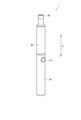
- FIG. 3 is a perspective view showing an example of a heating type flavor inhaler.
- FIG. 4 is a perspective view of a power supply unit in the heating type flavor inhaler of FIG.
- FIG. 5 is a cross-sectional view of the heated flavor inhaler of FIG.
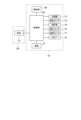
- FIG. 6 is a block diagram showing the configuration of a main part of the power supply unit in the heating type flavor inhaler of FIG.
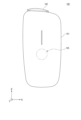
- FIG. 7A is a schematic front view showing an example of an aerosol generating device.
- FIG. 7B is a schematic top view of the aerosol generating device shown in FIG. 7A.
- FIG. 7C is a schematic bottom view of the aerosol generating device shown in FIG. 7A.
- FIG. 8 is a schematic cross-sectional side view showing an example of a flavor generating article.
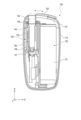
- FIG. 9 is a cross-sectional view taken along line III-III of the aerosol generating device shown in FIG. 7B.
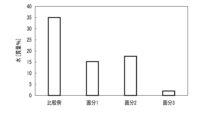
- FIG. 10 is a graph showing the amount of water contained in the flavor component-containing liquid.
- FIG. 11 is a graph showing the amount of nicotine contained in the flavor component-containing liquid.
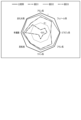
- FIG. 12 is a radar chart showing the amounts of aroma components contained in the flavor component-containing liquid.
- FIG. 13 is a triangular graph showing the relationship between the solvent composition and the solubility of menthol.
- tobacco flavor liquid refers to a liquid used as a tobacco flavor source in a flavor inhaler that generates an aerosol.
- tobacco flavor liquid includes a liquid as an aerosol source and various flavor components derived from tobacco materials.
- tobacco flavor liquid is atomized in a flavor inhaler, the liquid as an aerosol source becomes vapor, and the flavor components are transferred into the vapor, resulting in the generation of an aerosol (tobacco vapor).
- aerosol source refers to a source (liquid) for generating vapor (gas) when tobacco flavor liquid is atomized in a flavor inhaler.
- aerosol source refers to a source (liquid) for generating a dispersion medium (gas) for an aerosol (tobacco vapor), and does not include fine particles (such as flavor components) in the aerosol.
- flavor component-containing liquid refers to a liquid used as a raw material for tobacco flavor liquid.
- the "flavor component-containing liquid” may be used as a tobacco flavor liquid as is, or a tobacco flavor liquid may be prepared by mixing multiple types of flavor component-containing liquids.
- the "flavor component-containing liquid” is a liquid for use in a flavor inhaler that generates an aerosol. Similar to tobacco flavor liquid, the “flavor component-containing liquid” contains a liquid as an aerosol source and various flavor components derived from the tobacco material.
- flavor component-containing liquid when differentiating between different types of flavor component-containing liquids, the specific names "low-boiling-point flavor component-containing liquid,” “high-boiling-point flavor component-containing liquid,” “first high-boiling-point flavor component-containing liquid,” and “second high-boiling-point flavor component-containing liquid” are used.
- flavor component-containing liquid is intended as a general term for these specific flavor component-containing liquids.
- the heating temperature when heating tobacco material refers to the temperature of the tobacco material itself.
- the "temperature of the tobacco material” can be obtained by measuring the temperature of the surface of the tobacco material. In the technical field, the "temperature of the tobacco material” is also called the product temperature.
- a method for producing a flavor-containing liquid for use in an aerosol-generating flavor inhaler comprises the steps of: heating the tobacco material to a temperature of the tobacco material in the range of 80-100°C, thereby reducing the moisture content of the tobacco material; heating the tobacco material with the reduced moisture content to a temperature of the tobacco material greater than 100° C., thereby vaporizing high-boiling flavor components from the tobacco material; and dissolving the vaporized high-boiling flavor component in a liquid that is at least a part of the aerosol source, thereby obtaining a high-boiling flavor component-containing liquid.
- the flavor component-containing liquid produced by this method contains the aerosol source and the flavor components derived from the tobacco material, and is converted into an aerosol in a flavor inhaler.
- one type of high-boiling flavor component-containing liquid may be obtained as the high-boiling flavor component-containing liquid, or multiple types of high-boiling flavor component-containing liquid may be obtained.
- the high-boiling flavor components are vaporized while increasing the temperature of the tobacco material, and the high-boiling flavor components vaporized in different temperature ranges are dissolved in separate liquids, thereby obtaining multiple types of high-boiling flavor component-containing liquid.
- the number of high-boiling flavor component-containing liquids is not particularly limited, but for example, 2 to 5 types of high-boiling flavor component-containing liquids can be obtained.
- a method for producing a flavor component-containing liquid for use in a flavor inhaler generating an aerosol comprises the steps of: (S1) heating a tobacco material to a first temperature of the tobacco material in a range of 80 to 100°C, thereby vaporizing low-boiling point flavor components from the tobacco material and reducing the moisture content of the tobacco material; (S2) dissolving the vaporized low boiling point flavor component in a liquid as a part of the aerosol source, thereby obtaining a low boiling point flavor component-containing liquid; (S3) after heating at the first temperature, heating the tobacco material to a second temperature of the tobacco material that is greater than 100°C, thereby vaporizing a first high boiling point flavor component from the tobacco material; (S4) dissolving the vaporized first high boiling point flavor component in a liquid as another part of the aerosol source, thereby
- the "first temperature,” “second temperature,” and “third temperature” all refer to the temperature of the tobacco material itself.
- the heating temperature and heating temperature range of the tobacco material are described, but these all refer to the temperature of the tobacco material itself.
- First heating step (S1) In the first heating step (S1), the tobacco material is heated to a first temperature in the range of 80 to 100° C. In the first heating step (S1), the "first temperature in the range of 80 to 100° C.” refers to the temperature of the tobacco material. The first heating step (S1) vaporizes low-boiling point flavor components from the tobacco material and reduces the moisture content of the tobacco material (see FIG. 1 ).
- tobacco material can be tobacco shreds that are ready to be incorporated into tobacco products, such as combustion-type or heat-type flavor inhalers.
- tobacco shreds ready to be incorporated into tobacco products refers to tobacco shreds that have been through a drying process on the farm, a long-term aging process of one to several years at a raw material factory, and various other processing steps, such as blending and cutting at a manufacturing factory, and are ready to be incorporated into tobacco products.
- Tobacco shreds are cut tobacco leaves.
- Tobacco shreds may be shredded leaves, shredded backbones, shredded reconstituted tobacco (i.e., tobacco material made by processing leaf waste, shredded waste, backbone waste, fine powder, etc. generated during factory operations into a reusable shape), or a mixture of these.
- Tobacco shreds may be pulverized, and the resulting pulverized material may be used for the heating step (S1).
- pulverized tobacco shreds as the tobacco material can increase the efficiency of recovery of flavor components from the tobacco material. This can increase the content of flavor components in the flavor component-containing liquid and tobacco flavor liquid.
- the tobacco shreds may be of any variety, such as flue-cured, burley, or oriental, etc.
- the tobacco shreds may be of a single variety or a mixture of different varieties.
- the first heating step (S1) can be performed by supplying heated gas to the tobacco material.
- the heated gas has a temperature of, for example, 105 to 250°C.
- the heated gas contains an inert gas and has an oxygen concentration of 10% by volume or less.
- a mixed gas of nitrogen and air with an oxygen concentration of 10% by volume or less can be used as the heated gas.
- a gas with such a low oxygen concentration it is possible to reduce the exothermic reaction due to oxidation and prevent a sudden increase in the temperature of the tobacco material.
- a gas with a low oxygen concentration it is possible to reliably control the temperature of the tobacco material, and therefore it is possible to stably produce a flavor component-containing liquid of the desired quality.
- the tobacco material is heated to a first temperature in the range of 80 to 100°C.
- the "first temperature in the range of 80 to 100°C” refers to the temperature of the tobacco material.
- the temperature of the tobacco material can be obtained, for example, by measuring the temperature of the surface of the tobacco material with a contact thermometer.
- the first heating step (S1) can be performed by heating the tobacco material at a temperature range of 80 to 100°C.
- the heating including the first heating step (S1) can be performed by heating the tobacco material from room temperature (e.g., about 20°C) to 100°C while increasing the temperature of the tobacco material.
- the first heating step (S1) can vaporize the moisture contained in the tobacco material and reduce the moisture content of the tobacco material.
- the first heating step (S1) is preferably performed so that the moisture content of the tobacco material immediately after heating (hereinafter also referred to as moisture content WC2) is 20% or less compared to the moisture content of the tobacco material immediately before heating (hereinafter also referred to as moisture content WC1).
- the first heating step (S1) is preferably performed so that the ratio of the moisture content WC2 to the moisture content WC1 is 20% or less. It is more preferable that the first heating step (S1) is performed so that the ratio of the moisture content WC2 to the moisture content WC1 is 8% or less.
- Immediately before heating refers to, for example, within 2 hours before the start of the first heating step (S1), preferably within 1 hour before the start of the first heating step (S1).
- immediately after heating refers to, for example, within 2 hours after the end of the first heating step (S1), preferably within 1 hour after the end of the first heating step (S1).
- the "moisture content WC1" of the tobacco material immediately before heating in the first heating step (S1) can be obtained by the procedure described below.
- the tobacco material immediately prior to heating in the first heating step (S1) is dried under open conditions at 100° C. for 1 hour.
- the mass of the dried sample is measured, and the difference between the mass of the dried sample and the mass of the sample before and after drying is calculated, and the obtained difference is designated as the "moisture content.”
- the "moisture content WC2" of the tobacco material immediately after heating in the first heating step (S1) can be obtained in the same manner as the “moisture content WC1", except that the tobacco material immediately before heating in the first heating step (S1) is replaced with the tobacco material immediately after heating in the first heating step (S1).
- the first heating step (S1) By reducing the moisture content of the tobacco material by the first heating step (S1), it is possible to reduce the moisture content of the high-boiling-point flavor component-containing liquid (in this embodiment, the first high-boiling-point flavor component-containing liquid and the second high-boiling-point flavor component-containing liquid) obtained by further heating the tobacco material after the first heating step (S1).
- the high-boiling-point flavor component-containing liquid in this embodiment, the first high-boiling-point flavor component-containing liquid and the second high-boiling-point flavor component-containing liquid
- the first heating step (S1) can be carried out for, for example, 0.5 to 60 minutes, preferably 1 to 20 minutes. This allows the moisture contained in the tobacco material to evaporate, reducing the moisture content of the tobacco material.
- the method according to the embodiment may further include adding a humectant to the tobacco material prior to heating the tobacco material in the first heating step (S1).
- a humectant for example, glycerin, propylene glycol, 1-3 propanediol, or triacetin can be used.
- the humectant can be added in an amount of, for example, 1 to 20 parts by mass per 100 parts by mass of the tobacco material.
- Dissolving step (S2) of low boiling point flavor components In the dissolving step (S2) of the low-boiling flavor component, the low-boiling flavor component vaporized in the first heating step (S1) is dissolved in a liquid (hereinafter referred to as a first trap liquid) as a part of the aerosol source, thereby obtaining a liquid containing the low-boiling flavor component (see FIG. 1).
- a liquid hereinafter referred to as a first trap liquid
- the first trap liquid may be a liquid that can be used as an aerosol source in a flavor inhaler.
- propylene glycol, glycerin, 1,3-propanediol, diacetin, polyethylene glycol, or a mixture of these may be used as the first trap liquid.
- the first trap liquid is preferably propylene glycol, glycerin, or a mixture of propylene glycol and glycerin.
- the first trap liquid is more preferably propylene glycol, or a mixture of propylene glycol and glycerin. In the case of a mixture of propylene glycol and glycerin, it is preferable that the proportion of propylene glycol is large.
- the mass ratio of propylene glycol to glycerin may be, for example, 9:1 to 1:9, preferably 7:3 to 5:5.
- the illustrated first trap liquid has a low polarity compared to water. Since flavor components have a relatively low polarity, the illustrated first trap liquid is suitable as a liquid for dissolving flavor components.
- the dissolving step (S2) can be carried out by bubbling the gas containing the low-boiling flavor components obtained in the first heating step (S1) into the first trap liquid.
- the dissolving step (S2) for example, 0.5 to 20 mL, preferably 2 to 10 mL, and more preferably 3 to 5 mL of the first trap liquid can be used per 10 g of tobacco material. If the first trap liquid is used in an amount within the above range, the obtained flavor component-containing liquid can be used as a raw material for tobacco flavor liquid without concentrating it.
- a low-boiling flavor component-containing liquid is obtained by the dissolving step (S2).
- the low-boiling flavor component-containing liquid preferably has a water content of less than 25% by mass, more preferably a water content of 20% by mass or less.
- the water content of the low-boiling flavor component-containing liquid is, for example, 0.1% by mass or more.
- the water content of the flavor component-containing liquid refers to a value measured by GC-TCD (gas chromatograph-thermal conductivity detector). Specifically, a sample obtained by diluting the flavor component-containing liquid with methanol is injected into a GC, and after column separation, the water is measured using a TCD.
- the water is quantified from the obtained measured value, and the water content of the flavor component-containing liquid is calculated. Examples of measurement conditions are shown below.
- Equipment Agilent 7890A
- Column DB-WAX (Agilent 122-7032)
- Carrier gas Helium Flow rate: 30 mL/min
- Inlet temperature 250°C
- Injection mode splitless Injection volume: 1 ⁇ L
- Oven temperature 60°C ⁇ 130°C (5°C/min) ⁇ 250°C (10°C/min)
- TCD temperature 250°C.
- the dissolving step (S2) may be omitted.
- the above-mentioned first heating step (S1) and dissolving step (S2) can be carried out, for example, by using a flavor component recovery system 2 shown in Fig. 2.
- the flavor component recovery system 2 includes a heating device 3, a dissolving device 4, and a gas flow path 5 connecting these two devices.
- the heating device 3 shown in FIG. 2 includes a heating container 3B for containing tobacco material 3A, a sintered filter 3C installed on the bottom surface of the heating container 3B, a thermocouple 3D for measuring the temperature of the tobacco material 3A, a gas supply source 3E containing gas to be sent to the heating container 3B, a preheater 3F for heating the gas sent from the gas supply source 3E to the heating container 3B, and a gas flow path 3G for sending gas to the heating container 3B.
- the dissolving device 4 shown in FIG. 2 is connected to the heating device 3 shown in FIG. 2 via a gas flow path 5.
- the dissolving device 4 is equipped with a cooling container 4B for containing the trap liquid 4A.
- the tobacco material 3A is placed in the heating container 3B.
- Gas is sent from the gas supply source 3E to the preheater 3F and heated by the preheater 3F.
- the high-temperature gas is then sent through the gas flow path 3G to the gas inlet hole provided on the bottom of the heating container 3B.
- the sintered filter 3C installed on the bottom of the heating container 3B is a porous body. Therefore, the high-temperature gas that enters the heating container 3B from the gas inlet hole is supplied to the entire tobacco material 3A via the sintered filter 3C.
- the tobacco material 3A is heated by the supplied high-temperature gas.
- the temperature of the tobacco material 3A is measured by the thermocouple 3D.
- the gas sent to the heating container 2B preferably contains an inert gas and has an oxygen concentration of 10% by volume or less.
- the heating container 3B may be housed in an oven (not shown). This allows the tobacco material 3A to be further heated from the outside of the heating container 3B.
- the first heating step (S1) is not limited to being performed using the heating device 3 shown in FIG. 2, as long as it is possible to vaporize the flavor components from the tobacco material.
- the flavor components vaporize from the tobacco material 3A, and the gas containing the flavor components is discharged through the gas flow path 5 from the gas discharge hole provided on the upper surface of the heating container 3B.
- the gas containing the flavor components is sent to the dissolving device 4 through the gas flow path 5.
- the gas containing the flavor components may be sent to the dissolving device 4 by the action of a pump.
- the gas containing the flavor components is bubbled into the trap liquid 4A in the cooling vessel 4B. This causes the flavor components to dissolve in the trap liquid 4A, and a flavor component-containing liquid is obtained.
- the dissolving device 4 may further include an outer container (not shown) for storing ice water in order to cool the cooling container 4B from the outside.
- the dissolving device 4 may further include a spiral cooling pipe (not shown) connected to the tip of the gas flow path 5.
- the cooling pipe is, for example, a stainless steel spiral pipe. The gas is cooled while passing through the cooling pipe.
- the dissolving step (S2) is not limited to being performed using the dissolving device 4 shown in FIG. 2, as long as the gas containing the flavor components obtained in the first heating step (S1) can be dissolved in the trap liquid 4A.
- the "second temperature higher than 100°C” refers to the temperature of the tobacco material, as described above.
- the temperature of the tobacco material can be obtained, for example, by measuring the temperature of the surface of the tobacco material with a contact thermometer.
- the tobacco material after the first heating step (S1) can be heated to a temperature in the range of higher than 100°C to 200°C.
- the second heating step (S3) can be carried out by heating the tobacco material after the first heating step (S1) in a temperature range higher than 100°C and lower than 200°C.
- the second heating step (S3) can be carried out by heating the tobacco material after the first heating step (S1) while increasing the temperature of the tobacco material from the final heating temperature of the first heating step (S1) (e.g., 100°C) to 200°C.
- the second heating step (S3) can be performed following the first heating step (S1) in the same manner as the first heating step (S1).
- the second heating step (S3) can be performed by supplying a heated gas to the tobacco material.
- the heated gas has a temperature of, for example, 105 to 250°C.
- the heated gas preferably contains an inert gas and has an oxygen concentration of 10% by volume or less.
- a mixed gas of nitrogen and air with an oxygen concentration of 10% by volume or less can be used as the heated gas.
- using a gas with a low oxygen concentration can reduce the exothermic reaction due to oxidation and prevent the temperature of the tobacco material from rising rapidly.
- Using a gas with a low oxygen concentration can reliably control the temperature of the tobacco material, so that a flavor component-containing liquid of the desired quality can be stably produced.
- the second heating step (S3) can be carried out for, for example, 0.5 to 60 minutes, preferably 1 to 30 minutes.
- the second heating step (S3) can vaporize the various flavor components contained in the tobacco material (see Figures 11 and 12).
- the dissolving step (S4) of the first high-boiling-point flavor component a flavor component-containing liquid containing various flavor components can be obtained.
- the second trap liquid a liquid having the same composition as the first trap liquid can be used.
- the dissolving step (S4) can be performed by bubbling the gas containing the first high boiling point flavor component obtained in the second heating step (S3) into the second trap liquid.
- the dissolving step (S4) for example, 0.5 to 20 mL, preferably 2 to 10 mL, more preferably 3 to 5 mL of the second trap liquid can be used per 10 g of tobacco material. It is preferable to use the second trap liquid in the same amount as the first trap liquid.
- the obtained flavor component-containing liquid can be used as a raw material for tobacco flavor liquid without concentrating it.
- the dissolving step (S4) produces a first high boiling flavor component-containing liquid.
- the first high boiling flavor component-containing liquid preferably has a water content of less than 25% by mass, more preferably a water content of 20% by mass or less.
- the water content of the first high boiling flavor component-containing liquid is, for example, 0.1% by mass or more.
- the water content of the flavor component-containing liquid refers to the value measured by GC-TCD (gas chromatograph-thermal conductivity detector) as described above.
- the second heating step (S3) and the first high-boiling flavor component dissolving step (S4) can be carried out using the flavor component recovery system shown in Figure 2.
- new trap liquid i.e., second trap liquid
- the tobacco material after the first heating step (S1) is continuously heated, thereby starting the second heating step (S3).
- the "third temperature higher than the second temperature” refers to the temperature of the tobacco material, as described above.
- the temperature of the tobacco material can be obtained, for example, by measuring the surface temperature of the tobacco material with a contact thermometer.
- the tobacco material after the second heating step (S4) can be heated to a temperature in the range of more than 200°C and less than or equal to 250°C.
- the third heating step (S5) can be carried out by heating the tobacco material after the second heating step (S3) in a temperature range higher than 200°C and lower than 250°C.
- the third heating step (S5) can be carried out by heating the tobacco material after the second heating step (S3) while increasing the temperature of the tobacco material from the final heating temperature of the second heating step (S3) (e.g., 200°C) to 250°C.
- the third heating step (S5) can be carried out following the second heating step (S3) by the same method as the second heating step (S3).
- the third heating step (S5) can be carried out by supplying heated gas to the tobacco material.
- the heated gas has a temperature of, for example, 105 to 250°C.
- the heated gas preferably contains an inert gas and has an oxygen concentration of 10% by volume or less.
- a mixed gas of nitrogen and air with an oxygen concentration of 10% by volume or less can be used as the heated gas.
- using a gas with a low oxygen concentration can reduce the exothermic reaction due to oxidation and prevent the temperature of the tobacco material from rising rapidly.
- Using a gas with a low oxygen concentration can reliably control the temperature of the tobacco material, so that a flavor component-containing liquid of the desired quality can be stably produced.
- the third heating step (S5) can be carried out for, for example, 0.5 to 60 minutes, preferably 1 to 30 minutes.
- the third heating step (S5) can vaporize the various flavor components contained in the tobacco material (see Figures 11 and 12).
- the dissolving step (S6) of the second high boiling point flavor component a flavor component-containing liquid containing various flavor components can be obtained.
- the tobacco material remaining after the third heating step (S5) can be used to manufacture regenerated tobacco material. Regenerated tobacco material will be described later.
- the third trap liquid a liquid having the same composition as the first trap liquid and the second trap liquid can be used.
- the dissolving step (S6) can be performed by bubbling the gas containing the second high boiling point flavor component obtained in the third heating step (S5) into the third trap liquid.
- the dissolving step (S6) for example, 0.5 to 20 mL, preferably 2 to 10 mL, more preferably 3 to 5 mL of the third trap liquid can be used per 10 g of tobacco material. It is preferable to use the third trap liquid in the same amount as the first trap liquid and the second trap liquid.
- the obtained flavor component-containing liquid can be used as a raw material for tobacco flavor liquid without concentrating it.
- the dissolving step (S6) produces a second high boiling flavor component-containing liquid.
- the second high boiling flavor component-containing liquid preferably has a water content of less than 25% by mass, more preferably a water content of 20% by mass or less.
- the water content of the second high boiling flavor component-containing liquid is, for example, 0.1% by mass or more.
- the water content of the flavor component-containing liquid refers to the value measured by GC-TCD (gas chromatograph-thermal conductivity detector) as described above.
- the third heating step (S5) and the second high boiling point flavor component dissolving step (S6) can be carried out using the flavor component recovery system shown in Figure 2.
- new trap liquid i.e., the third trap liquid
- the tobacco material after the second heating step (S3) is continuously heated, thereby starting the third heating step (S5).
- the third heating step (S5) and the second high boiling point flavor component dissolving step (S6) may be omitted.
- flavor component-containing liquid According to the above-mentioned "method for producing a flavor component-containing liquid", a low-boiling point flavor component-containing liquid and a high-boiling point flavor component-containing liquid can be obtained. According to the method according to the above-mentioned embodiment, a low-boiling point flavor component-containing liquid, a first high-boiling point flavor component-containing liquid, and a second high-boiling point flavor component-containing liquid can be obtained. In this manner, according to the above-mentioned "method for producing a flavor component-containing liquid", a plurality of types of flavor component-containing liquids can be obtained. In this specification, the above flavor component-containing liquids are collectively referred to as "flavor component-containing liquids”.
- a flavor component-containing liquid produced by the above-mentioned "method for producing a flavor component-containing liquid.”
- the flavor component-containing liquid can have a low water content (see FIG. 10).
- the tobacco material after the first heating step (S1) is heated in two temperature ranges, and the vaporized flavor components are dissolved in separate traps to obtain two types of high-boiling-point flavor component-containing liquids.
- This embodiment is not limited to this, and the tobacco material after the first heating step (S1) may be heated in three or more temperature ranges, and the vaporized flavor components may be dissolved in separate trap liquids to obtain three or more types of high-boiling-point flavor component-containing liquids.
- the tobacco material after the first heating step (S1) may be heated in one temperature range, and the vaporized flavor components may be dissolved in the trap liquid to obtain one type of high-boiling-point flavor component-containing liquid.
- the “flavor component-containing liquid” can be used as a raw material for a tobacco flavor liquid to be used in a flavor inhaler that generates an aerosol. Therefore, the method for producing a tobacco flavor liquid includes the following steps: Producing a plurality of types of flavor component-containing liquids according to the above-mentioned "method for producing flavor component-containing liquid”; Among the plurality of flavor component-containing liquids, a flavor component is selected based on the content or flavor type of the flavor component. (a) selecting one type of flavor component-containing liquid as a tobacco flavor liquid; or (b) selecting two or more types of flavor component-containing liquids and mixing them, thereby preparing a tobacco flavor liquid.
- a liquid containing a low-boiling flavor component and a liquid containing a high-boiling flavor component may be prepared as the liquid containing multiple types of flavor components, or a liquid containing multiple types of high-boiling flavor components may be prepared.
- a flavor component-containing liquid with a high content of flavor components e.g., nicotine
- a flavor component-containing liquid with a high content of flavor components e.g., nicotine
- one or more flavor component-containing liquids with a preferred flavor type can be selected from the remaining flavor component-containing liquids and mixed together.
- the first high boiling flavor component-containing liquid may be selected as a tobacco flavor liquid
- a tobacco flavor liquid may be prepared by selecting a first high boiling point flavor component-containing liquid and a second high boiling point flavor component-containing liquid, and mixing them so that the blending ratio (utilization rate) of the first high boiling point flavor component-containing liquid is greater than that of the second high boiling point flavor component-containing liquid, thereby preparing a tobacco flavor liquid with a low moisture content and a high flavor component content (see Figures 10 to 12).
- the moisture originally contained in the tobacco material (about 10 to 12 [% W.B.] of moisture) volatilizes and is recovered as a vapor component, but when the product temperature of the tobacco material exceeds 100° C., a dehydration reaction occurs within the tobacco material due to heating, and the moisture generated by this reaction volatilizes and is recovered as a vapor component.
- the inventor has been able to obtain a flavor component-containing liquid with a low moisture content.
- the low-boiling flavor component-containing liquid and the high-boiling flavor component-containing liquid obtained by the above-mentioned "method for producing a flavor component-containing liquid” both have a low moisture content (see Figure 10).
- the flavor component-containing liquid has a low water content, it can stably vaporize when used as a tobacco flavor liquid (i.e., atomized liquid) in a flavor inhaler, thereby enabling the stable generation of an aerosol (tobacco vapor).
- a tobacco flavor liquid i.e., atomized liquid
- flavor component-containing liquid with a low water content makes it easier for flavorings such as menthol to dissolve. It is common for flavorings such as menthol to be added to the atomized liquid of flavor inhalers. Flavorings are mainly low-polarity components, and as the polarity of the atomized liquid increases, their solubility decreases. Even if the flavoring is dissolved immediately after the atomized liquid is produced, low polarity components may precipitate if exposed to low temperatures during transportation or storage.
- the flavor component-containing liquid it is desirable for the flavor component-containing liquid to have a low water content.
- the flavor component-containing liquid contains a large amount of moisture.
- a concentration process is required to volatilize the moisture.
- a flavor component-containing liquid with a low moisture content can be obtained without performing a concentration process.
- the above-mentioned "method for producing flavor component-containing liquid” is advantageous in that a flavor component-containing liquid with a low moisture content can be obtained by a simple method.
- flavor component content In addition, in the conventional method, when a concentration step is performed to volatilize the moisture of the flavor component-containing liquid, the flavor components may volatilize from the flavor component-containing liquid, resulting in a weaker flavor (nicotine and flavor components).
- the above-mentioned "method for producing a flavor component-containing liquid” can obtain a flavor component-containing liquid without performing a concentration step, thereby preventing the flavor components from volatilizing due to the concentration step. Therefore, the above-mentioned "method for producing a flavor component-containing liquid” can obtain a flavor component-containing liquid that has a low moisture content and contains a large amount of flavor components (nicotine and flavor components).
- the tobacco flavor liquid may be used as an atomized liquid in an atomized flavor inhaler, or may be used in combination with the tobacco material remaining after obtaining the flavor component-containing liquid in the above-mentioned "method for producing tobacco flavor liquid".
- the tobacco flavor liquid may be used in combination with the tobacco material remaining after the third heating step (S5).
- the reconstituted tobacco material may be a product obtained by drying a mixture of tobacco flavor liquid and the tobacco material remaining after obtaining a flavor component-containing liquid, which product can be used as a tobacco flavor source in a flavor inhaler.
- the regenerated tobacco material may be a tobacco molded product obtained by molding a mixture of tobacco flavor liquid and the tobacco material remaining after obtaining the flavor component-containing liquid into a specific shape, such as a sheet shape or a granular shape.
- the tobacco molded product can be used as a tobacco flavor source for a flavor inhaler.
- the regenerated tobacco material may be tobacco powder obtained by drying a mixture of tobacco flavor liquid and the tobacco material remaining after obtaining the flavor component-containing liquid, and grinding it into a powder form.
- the tobacco powder can be added to tobacco materials (e.g., deboned leaves or tobacco leaves) to enhance the flavor of the tobacco material.
- the flavor-enhanced tobacco material can be used as a tobacco flavor source in a flavor inhaler.
- the regenerated tobacco material may be a tobacco slurry obtained by drying a mixture of tobacco flavor liquid and the tobacco material remaining after obtaining the flavor component-containing liquid, grinding it into a powder, and suspending the resulting powder in water.
- the tobacco slurry can be added to tobacco material (e.g., deboned leaves or tobacco leaves) to enhance the flavor of the tobacco material.
- the flavor-enhanced tobacco material can be used as a tobacco flavor source in a flavor inhaler.
- the reconstituted tobacco material may contain additives such as binders, pH adjusters, preservatives, and antioxidants, as necessary.
- tobacco flavor liquid has a low moisture content and can contain large amounts of flavor components (nicotine and aroma components). Therefore, when regenerated tobacco material is produced using tobacco flavor liquid and the regenerated tobacco material is incorporated into a flavor inhaler, an excellent flavor can be provided to the user.
- Flavor Inhaler The above-mentioned "tobacco flavor liquid” or the above-mentioned “reconstituted tobacco material” can be incorporated into any flavor inhaler that generates an aerosol. That is, according to another aspect, a flavor inhaler containing the above-mentioned "tobacco flavor liquid” is provided. According to yet another aspect, a flavor inhaler containing the above-mentioned "reconstituted tobacco material” is provided. Flavor inhalers include a combustion type flavor inhaler, a heating type flavor inhaler, and a non-heating type flavor inhaler.
- a flavor inhaler in a preferred embodiment, includes the above-mentioned "tobacco flavor liquid” and an atomization unit that atomizes the tobacco flavor liquid.
- the flavor inhaler is more preferably a heating type flavor inhaler.
- a flavor inhaler is provided that includes the above-mentioned "tobacco flavor liquid” and an atomization unit that heats and atomizes the tobacco flavor liquid.
- a flavor inhaler in a preferred embodiment, includes the above-mentioned "regenerated tobacco material” and an atomization unit that atomizes the liquid components contained in the regenerated tobacco material.
- the flavor inhaler is more preferably a heated flavor inhaler.
- a flavor inhaler is provided that includes the above-mentioned "regenerated tobacco material” and an atomization unit that heats the regenerated tobacco material and atomizes the liquid components contained in the regenerated tobacco material.
- combustion-type flavor inhaler is a flavor inhaler that provides the user with tobacco flavor by burning tobacco filler (such as tobacco shreds or molded tobacco).
- tobacco filler such as tobacco shreds or molded tobacco.
- Examples of combustion-type flavor inhalers include cigarettes, pipes, kiseru, cigars, and cigarillos.
- a "heated flavor inhaler” is a flavor inhaler that provides a tobacco flavor to a user by heating a tobacco flavor source such as a tobacco filler or a tobacco flavor liquid without burning it.
- heated flavor inhalers include: A carbon heat source type flavor inhaler that heats a tobacco filler with the combustion heat of a carbon heat source (see, for example, WO2006/073065); An electrically heated flavor inhaler including a tobacco stick containing a tobacco filler and a heating device for electrically heating the tobacco stick (see, for example, WO2010/110226); or a liquid atomization flavor inhaler that generates an aerosol by heating a liquid aerosol source with a heater and inhales a flavor derived from the tobacco filler together with the aerosol (see, for example, WO2015/046385). etc.
- non-heating flavor inhaler is a flavor inhaler that provides a tobacco flavor to a user without burning or heating a tobacco flavor source such as a tobacco filler or a tobacco flavor liquid.
- non-heating flavor inhalers include: A liquid atomization type flavor inhaler including a tobacco flavor liquid and an atomization unit that atomizes the tobacco flavor liquid using surface acoustic waves (see, for example, WO2017/167521) Examples include:
- FIG. 3 is a perspective view showing an example of a heated flavor inhaler.
- Figure 4 is a perspective view of a power supply unit in the heated flavor inhaler of Figure 3.
- Figure 5 is a cross-sectional view of the heated flavor inhaler of Figure 3.
- Figure 6 is a block diagram showing the main configuration of the power supply unit in the heated flavor inhaler of Figure 3.
- the heated flavor inhaler 1 shown in Figures 3 to 6 has a rod shape extending along a predetermined direction (hereinafter referred to as the longitudinal direction A).
- the heated flavor inhaler 1 has a power supply unit 10, a first cartridge 20, and a second cartridge 30 arranged in this order along the longitudinal direction A.
- the first cartridge 20 is detachable from the power supply unit 10
- the second cartridge 30 is detachable from the first cartridge 20.
- the first cartridge 20 and the second cartridge 30 are each replaceable.
- the power supply unit 10 accommodates a power supply 12, a charger 13, a control unit 50, various sensors, etc. inside a cylindrical power supply unit case 11.
- the power supply 12 is a rechargeable secondary battery, and is preferably a lithium ion secondary battery.
- a discharge terminal 41 is provided on the top portion 11a located at one end side (first cartridge 20 side) of the power supply unit case 11 in the longitudinal direction A.
- the discharge terminal 41 is provided so as to protrude from the upper surface of the top portion 11a toward the first cartridge 20, and is configured to be electrically connectable to the load 21 of the first cartridge 20.
- an air supply section 42 that supplies air to the load 21 of the first cartridge 20 is provided on the upper surface of the top section 11a, near the discharge terminal 41.
- the bottom portion 11b located at the other end of the power supply unit case 11 in the longitudinal direction A (opposite the first cartridge 20), is provided with a charging terminal (not shown) that can be electrically connected to an external power source that can charge the power supply 12.
- an operation unit 14 that can be operated by the user is provided on the side of the top part 11a of the power supply unit case 11.
- the operation unit 14 is composed of a button-type switch, a touch panel, etc., and is used to start/shut off the control unit 50 and various sensors, reflecting the user's intention to use the device.
- the control unit 50 is connected to various sensor devices such as the charger 13, the operation unit 14, an inhalation sensor 15 that detects a puffing (inhalation) action, a voltage sensor 16 that measures the voltage of the power source 12, a temperature sensor 17 that detects the temperature, and a memory 18 that stores the number of puffing actions or the time that electricity is applied to the load 21, and performs various controls of the heated flavor inhaler 1.
- the inhalation sensor 15 may be composed of a condenser microphone, a pressure sensor, or the like.
- the control unit 50 is specifically a processor (MCU: microcontroller unit). More specifically, the structure of this processor is an electric circuit that combines circuit elements such as semiconductor elements.
- the first cartridge 20 is provided with a cylindrical cartridge case 27, inside which are a reservoir 23 that stores the above-mentioned "tobacco flavor liquid” 22, an electrical load 21 that atomizes the tobacco flavor liquid 22, a wick 24 that draws the tobacco flavor liquid from the reservoir 23 to the load 21, an aerosol flow path 25 through which the aerosol generated by atomizing the tobacco flavor liquid 22 flows toward the second cartridge 30, and an end cap 26 that accommodates part of the second cartridge 30.
- the reservoir 23 is partitioned and formed so as to surround the periphery of the aerosol flow path 25, and stores the tobacco flavor liquid 22.
- the reservoir 23 may contain a porous body such as a resin web or cotton, and the porous body may be impregnated with the tobacco flavor liquid 22.
- the reservoir 23 may not contain a porous body such as a resin web or cotton, and may store only the tobacco flavor liquid 22.
- the wick 24 is a liquid retention member that draws the tobacco flavor liquid 22 from the reservoir 23 into the load 21 using capillary action, and is made of, for example, glass fiber or porous ceramic.
- the load 21 atomizes the tobacco flavor liquid 22 without combustion by using power supplied from the power source 12 via the discharge terminal 41.
- the load 21 is composed of an electric heating wire (coil) wound at a predetermined pitch.
- the load 21 may be any element capable of atomizing the tobacco flavor liquid 22 to generate an aerosol, such as a heating element or an ultrasonic generator. Examples of heating elements include a heating resistor, a ceramic heater, and an induction heating heater.
- the aerosol flow path 25 is located downstream of the load 21 and on the center line L of the power supply unit 10.
- the end cap 26 includes a cartridge storage section 26a that stores a portion of the second cartridge 30, and a communication passage 26b that connects the aerosol flow path 25 to the cartridge storage section 26a.
- the second cartridge 30 stores a flavor source 31.
- the second cartridge 30 is removably housed in a cartridge housing portion 26a provided in the end cap 26 of the first cartridge 20.
- the end of the second cartridge 30 opposite to the first cartridge 20 side is a mouthpiece 32 for the user.
- the mouthpiece 32 is not limited to being integrally and inseparably formed with the second cartridge 30, but may be configured to be removably attached to the second cartridge 30. By configuring the mouthpiece 32 separately from the power supply unit 10 and the first cartridge 20 in this way, the mouthpiece 32 can be kept hygienic.
- the second cartridge 30 imparts additional flavor to the aerosol generated by atomizing the tobacco flavor liquid 22 by the load 21 by passing the aerosol through the flavor source 31.
- the flavor source 31 may be a tobacco filler such as a tobacco sheet or tobacco granules.
- the flavor source 31 may incorporate the above-mentioned "recycled tobacco material.”
- the flavor source 31 may also be imparted with a flavoring such as menthol.
- an aerosol with added flavor can be generated by the tobacco flavor liquid 22, the flavor source 31, and the load 21.
- the tobacco flavor liquid 22 and the flavor source 31 can be said to be an aerosol generation source that generates an aerosol.
- the heated flavor inhaler 1 has a configuration in which the tobacco flavor liquid 22 and the flavor source 31 are separate entities, but may also have a configuration in which the tobacco flavor liquid 22 and the flavor source 31 are integrally formed. Alternatively, the heated flavor inhaler 1 may not have the second cartridge 30. In this way, when the second cartridge 30 is omitted in the heated flavor inhaler 1, only the aerosol generated by atomizing the tobacco flavor liquid 22 is supplied to the mouthpiece.
- air flowing in from an air intake (not shown) provided in the power supply unit case 11 passes through the air supply section 42 and near the load 21 of the first cartridge 20.
- the load 21 atomizes the tobacco flavor liquid 22 drawn or moved from the reservoir 23 by the wick 24.
- the aerosol generated by atomization flows through the aerosol flow path 25 together with the air flowing in from the air intake, and is supplied to the second cartridge 30 via the communication passage 26b.
- the aerosol supplied to the second cartridge 30 is given additional flavor by passing through the flavor source 31, and is then supplied to the mouthpiece 32.
- the heated flavor inhaler 1 is also provided with an alarm unit 45 that notifies various pieces of information.
- the alarm unit 45 may be composed of a light-emitting element, a vibration element, or a sound output element.
- the alarm unit 45 may also be a combination of two or more elements selected from the light-emitting element, the vibration element, and the sound output element.
- the alarm unit 45 may be provided in any of the power supply unit 10, the first cartridge 20, and the second cartridge 30, but is preferably provided in the power supply unit 10 in order to shorten the wire from the power supply 12.
- the alarm unit 45 may be provided around the operation unit 14, and the periphery of the operation unit 14 may be configured to be translucent and to emit light using a light-emitting element such as an LED.
- FIG. 7A is a schematic front view of an example of the aerosol generating device.
- Figure 7B is a schematic top view of the aerosol generating device shown in Figure 7A.
- Figure 7C is a schematic bottom view of the aerosol generating device shown in Figure 7A.
- Figure 8 is a schematic side cross-sectional view of an example of the flavor generating article.
- Figure 9 is a cross-sectional view taken along line III-III of the aerosol generating device shown in Figure 7B.
- the drawings may include an X-Y-Z Cartesian coordinate system.
- the Z axis faces vertically upward
- the X-Y plane is arranged to cut the aerosol generating device 100 horizontally
- the Y axis is arranged to extend from the front to the back of the aerosol generating device 100.
- the Z axis can also be referred to as the insertion direction of the flavor generating article contained in the chamber 150 of the atomizing unit 130 described below, or the axial direction of the chamber 150.
- the X axis is a direction perpendicular to the Y axis and the Z axis, and the X axis and the Y axis can also be referred to as the radial direction perpendicular to the axial direction of the chamber 150, or the radial direction of the chamber 150.
- the aerosol generating device 100 is configured to generate an aerosol containing a flavor by heating a stick-shaped flavor generating product having a flavor source containing the above-mentioned "recycled tobacco material.”
- the aerosol generating device 100 has an outer housing 101 (corresponding to an example of a housing), a slide cover 102, and a switch unit 103.
- the outer housing 101 constitutes the outermost housing of the aerosol generating device 100 and has a size that fits in the user's hand. When the user uses the flavor inhaler, the user can hold the aerosol generating device 100 in his/her hand and inhale the aerosol.
- the outer housing 101 may be formed by assembling multiple members.
- the outer housing 101 is made of resin, for example, and in particular, may be formed of polycarbonate (PC), ABS (Acrylonitrile-Butadiene-Styrene) resin, PEEK (Polyetheretherketone) or a polymer alloy containing multiple types of polymers, or a metal such as aluminum.
- PC polycarbonate
- ABS Acrylonitrile-Butadiene-Styrene
- PEEK Polyetheretherketone
- a polymer alloy containing multiple types of polymers or a metal such as aluminum.
- the outer housing 101 has an opening (not shown) for receiving a flavor-generating article, and the slide cover 102 is slidably attached to the outer housing 101 to close this opening.
- the slide cover 102 is configured to be movable along the outer surface of the outer housing 101 between a closed position (position shown in Figures 7A and 7B) in which the opening of the outer housing 101 is closed, and an open position (position shown in Figure 9) in which the opening is open.
- a user can manually operate the slide cover 102 to move the slide cover 102 between the closed position and the open position. This makes it possible to permit or restrict access of the flavor-generating article to the inside of the aerosol generating device 100.
- the switch unit 103 is used to switch the operation of the aerosol generating device 100 on and off.
- a user can insert a flavor generating article into the aerosol generating device 100 and operate the switch unit 103 to supply power from a power source (see reference numeral 121 in FIG. 9) to a heater (see reference numeral 140 in FIG. 9) and heat the flavor generating article without burning it.
- the switch unit 103 may be a switch provided outside the outer housing 101 or may be a switch located inside the outer housing 101. When the switch is located inside the outer housing 101, the switch is indirectly pressed by pressing the switch unit 103 on the surface of the outer housing 101. In this example, an example in which the switch of the switch unit 103 is located inside the outer housing 101 will be described.
- the aerosol generating device 100 may further have a terminal (not shown).
- the terminal may be an interface that connects the aerosol generating device 100 to, for example, an external power source. If the power source provided in the aerosol generating device 100 is a rechargeable battery, connecting the external power source to the terminal allows the external power source to pass current through the power source and charge the power source. Also, connecting a data transmission cable to the terminal may enable data related to the operation of the aerosol generating device 100 to be transmitted to an external device.
- FIG. 8 is a schematic side cross-sectional view of an example of a flavor generating article 200.
- the aerosol generating device 100 and the flavor generating article 200 form a flavor inhaler.
- the flavor generating article 200 has a smokable article 201, a tubular member 204, a hollow filter portion 206, and a filter portion 205.
- the smokable article 201 is wrapped in a first wrapping paper 202.
- the tubular member 204, hollow filter portion 206, and filter portion 205 are wrapped in a second wrapping paper 203 that is different from the first wrapping paper 202.
- the second wrapping paper 203 also wraps a portion of the first wrapping paper 202 that wraps the smokable article 201. This connects the tubular member 204, hollow filter portion 206, and filter portion 205 to the smokable article 201.
- the second wrapping paper 203 may be omitted, and the tubular member 204, hollow filter portion 206, and filter portion 205 may be connected to the smokable article 201 using the first wrapping paper 202.
- a lip release agent 207 is applied to the outer surface of the second wrapping paper 203 near the end on the filter portion 205 side to make it easier for the user to separate their lips from the second wrapping paper 203.
- the portion of the flavor generating article 200 to which the lip release agent 207 is applied functions as the mouthpiece of the flavor generating article 200.
- the smokable article 201 contains the above-mentioned "recycled tobacco material" as a tobacco flavor source. Furthermore, the first wrapping paper 202 that wraps the smokable article 201 may be a breathable sheet member.
- the tubular member 204 may be a paper tube or a hollow filter.
- the flavor-generating article 200 includes the smokable article 201, the tubular member 204, the hollow filter portion 206, and the filter portion 205, but the configuration of the flavor-generating article 200 is not limited to this.
- the hollow filter portion 206 may be omitted, and the tubular member 204 and the filter portion 205 may be disposed adjacent to each other.
- FIG. 9 is a cross-sectional view taken along line III-III of the aerosol generating device 100 shown in FIG. 7B.
- an inner housing 110 (corresponding to an example of a housing) is provided inside the outer housing 101 of the aerosol generating device 100.
- the inner housing 110 is made of resin, for example, and may be formed of polycarbonate (PC), ABS (Acrylonitrile-Butadiene-Styrene) resin, PEEK (Polyetheretherketone), or a polymer alloy containing multiple types of polymers, or a metal such as aluminum. From the viewpoint of heat resistance and strength, the inner housing 110 is preferably made of PEEK.
- a power supply unit 120 and an atomization unit 130 are provided in the internal space of the inner housing 110.
- the power supply unit 120 has a power supply 121.
- the power supply 121 can be, for example, a rechargeable battery or a non-rechargeable battery.
- the power supply 121 is electrically connected to the atomization unit 130. This allows the power supply 121 to supply power to the atomization unit 130 so as to appropriately heat the flavor generating article 200.
- the atomization section 130 has a metallic chamber 150 (corresponding to an example of a cylindrical section) that extends in the insertion direction (Z-axis direction) of the flavor generating article 200, a heater 140 that covers part of the chamber 150, a heat insulating section 132, and a roughly cylindrical insertion guide member 134 (corresponding to an example of a guide section) that abuts against the opening of the chamber 150.
- the chamber 150 is configured to surround the periphery of the flavor generating article 200.
- the heater 140 is configured to include a heating section that contacts the outer peripheral surface of the chamber 150 and heats the flavor generating article 200 inserted into the chamber 150.
- a bottom member 136 (corresponding to an example of an abutment portion) is provided at the bottom of the chamber 150.
- the bottom member 136 abuts against the flavor generating article 200 inserted into the chamber 150 in the insertion direction of the flavor generating article 200, and can function as a stopper to position the flavor generating article 200.
- the chamber 150 and the bottom member 136 form a storage portion that stores at least a portion of the flavor generating article 200.
- the bottom member 136 can be formed, for example, from a resin material.
- the bottom member 136 has an uneven surface with which the flavor generating article 200 abuts, and can define a first air flow path that can supply air to the air intake of the flavor generating article 200 (i.e., communicates with the flavor generating article 200 stored in the storage portion).
- the bottom member 136 is made of resin, for example, and may be made of polycarbonate (PC), ABS (Acrylonitrile-Butadiene-Styrene) resin, PEEK (Polyether Ether Ketone), a polymer alloy containing multiple types of polymers, or a metal such as aluminum. Note that the bottom member 136 is preferably made of a material with low thermal conductivity to prevent heat from being transferred to the insulating portion 132, etc.
- the insulating section 132 is generally cylindrical and is arranged to cover the chamber 150.
- the insulating section 132 may include, for example, an aerogel sheet.
- the insertion guide member 134 is provided between the slide cover 102 in the closed position and the chamber 150.
- the insertion guide member 134 may be made of, for example, a resin, and may be formed in particular from polycarbonate (PC), ABS (Acrylonitrile-Butadiene-Styrene) resin, PEEK (Polyether Ether Ketone), or a polymer alloy containing multiple types of polymers.
- the insertion guide member 134 may be formed from metal, glass, ceramic, or the like. From the viewpoint of heat resistance, it is preferable that the insertion guide member 134 is PEEK.
- the insertion guide member 134 communicates with the outside of the aerosol generating device 100, and guides the insertion of the flavor generating article 200 into the chamber 150 by inserting the flavor generating article 200 into the insertion guide member 134.
- the flavor generating article 200 can be easily inserted into the chamber 150.
- the aerosol generating device 100 further has a first holding part 137 and a second holding part 138 that hold both ends of the chamber 150 and the insulating part 132.
- the first holding part 137 is positioned so as to hold the ends of the chamber 150 and the insulating part 132 on the negative Z-axis side.
- the second holding part 138 is positioned so as to hold the ends of the chamber 150 and the insulating part 132 on the slide cover 102 side (positive Z-axis side).
- [A2] The method according to [A1], wherein the heating for reducing the moisture content of the tobacco material is carried out such that the moisture content of the tobacco material immediately after heating is 20% or less compared to the moisture content of the tobacco material immediately before heating.
- [A3] The method according to [A1] or [A2], wherein the heating to reduce the moisture content of the tobacco material is carried out such that the moisture content of the tobacco material immediately after heating is 8% or less compared to the moisture content of the tobacco material immediately before heating.
- [A4] The method according to any one of [A1] to [A3], wherein the high-boiling flavor component-containing liquid has a water content of less than 25% by mass.
- [A5] The method according to any one of [A1] to [A4], wherein the high-boiling flavor component-containing liquid has a water content of 20% by mass or less.
- [A6] The method according to any one of [A1] to [A5], wherein the heating for vaporizing the high-boiling flavor components from the tobacco material is heating the tobacco material with the reduced moisture content to a temperature of the tobacco material in the range of more than 100°C to 200°C.
- [A7] The method according to any one of [A1] to [A6], wherein the heating for vaporizing the high-boiling flavor components from the tobacco material is performed by heating the tobacco material, the moisture content of which has been reduced, from 100°C to 200°C while increasing the temperature of the tobacco material.
- [A8] The method according to any one of [A1] to [A7], further comprising adding a humectant to the tobacco material prior to heating the tobacco material to a temperature of the tobacco material in the range of 80 to 100°C.
- the moisturizer is glycerin, propylene glycol, 1-3 propanediol, or triacetin.
- the humectant is added in an amount of 1 to 20 parts by mass per 100 parts by mass of the tobacco material.
- liquid for dissolving the high-boiling flavor component is propylene glycol, glycerin, 1,3-propanediol, diacetin, polyethylene glycol, or a mixture thereof; preferably, propylene glycol, glycerin, or a mixture of propylene glycol and glycerin; more preferably, propylene glycol, or a mixture of propylene glycol and glycerin.
- [A14] The method according to any one of [A1] to [A13], wherein the liquid for dissolving the high-boiling point flavor component is 0.5 to 20 mL, preferably 2 to 10 mL, and more preferably 3 to 5 mL of liquid per 10 g of the tobacco material.
- [A15] The method according to any one of [A1] to [A14], wherein the heating to reduce the moisture content of the tobacco material is carried out by heating the tobacco material from room temperature (e.g., 20°C) to 100°C while increasing the temperature of the tobacco material.
- [A16] The method according to any one of [A1] to [A15], wherein the heating to reduce the moisture content of the tobacco material is carried out by supplying a heated gas to the tobacco material.
- [A17] The method according to [A16], wherein the heated gas contains an inert gas and has an oxygen concentration of 10% by volume or less.
- [A18] The method according to any one of [A1] to [A17], further comprising dissolving a low-boiling flavor component vaporized from the tobacco material by heating the tobacco material to a temperature of the tobacco material in the range of 80 to 100°C in a liquid as another part of the aerosol source, thereby obtaining a low-boiling flavor component-containing liquid.
- [A19] The method according to [A18], wherein the low-boiling flavor component-containing liquid has a water content of less than 25% by mass.
- [A20] The method according to [A18] or [A19], wherein the low-boiling flavor component-containing liquid has a water content of 20% by mass or less.
- liquid for dissolving the low-boiling flavor component is propylene glycol, glycerin, 1,3-propanediol, diacetin, polyethylene glycol, or a mixture thereof; preferably, propylene glycol, glycerin, or a mixture of propylene glycol and glycerin; more preferably, propylene glycol, or a mixture of propylene glycol and glycerin.
- [A23] The method according to any one of [A1] to [A22], wherein the high-boiling flavor component is vaporized while increasing the temperature of the tobacco material, and the high-boiling flavor component vaporized in different temperature ranges is dissolved in separate liquids, thereby obtaining a plurality of types of high-boiling flavor component-containing liquids.
- [A24] The method according to any one of [A1] to [A23], wherein the high-boiling flavor component is vaporized while increasing the temperature of the tobacco material, and the high-boiling flavor component vaporized in 2 to 5 different temperature ranges is dissolved in separate liquids, thereby obtaining 2 to 5 types of high-boiling flavor component-containing liquids.
- [B2] The method according to [B1], wherein the heating at the first temperature is performed such that the moisture content of the tobacco material immediately after heating is 20% or less compared to the moisture content of the tobacco material immediately before heating.
- [B3] The method according to [B1] or [B2], wherein the heating at the first temperature is performed such that the moisture content of the tobacco material immediately after heating is 8% or less compared to the moisture content of the tobacco material immediately before heating.
- [B4] The method according to any one of [B1] to [B3], wherein the first high-boiling flavor component-containing liquid has a water content of less than 25% by mass.
- [B5] The method according to any one of [B1] to [B4], wherein the first high-boiling flavor component-containing liquid has a water content of 20% by mass or less.
- [B6] The method according to any one of [B1] to [B5], wherein the heating at the second temperature is heating the tobacco material whose moisture content has been reduced to a temperature of the tobacco material in the range of more than 100°C to 200°C.
- [B7] The method according to any one of [B1] to [B6], wherein the heating at the second temperature is carried out by heating the tobacco material, the moisture content of which has been reduced, from 100°C to 200°C while increasing the temperature of the tobacco material.
- [B8] The method according to any one of [B1] to [B7], further comprising adding a humectant to the tobacco material prior to heating the tobacco material to the first temperature.
- the moisturizer is glycerin, propylene glycol, 1-3 propanediol, or triacetin.
- the humectant is added in an amount of 1 to 20 parts by mass per 100 parts by mass of the tobacco material.
- the heating at the second temperature is carried out by supplying a heated gas to the tobacco material.
- the heated gas contains an inert gas and has an oxygen concentration of 10% by volume or less.
- liquid for dissolving the first high-boiling flavor component is propylene glycol, glycerin, 1,3-propanediol, diacetin, polyethylene glycol, or a mixture thereof; preferably, propylene glycol, glycerin, or a mixture of propylene glycol and glycerin; more preferably, propylene glycol, or a mixture of propylene glycol and glycerin.
- [B14] The method according to any one of [B1] to [B13], wherein the liquid for dissolving the first high boiling point flavor component is 0.5 to 20 mL, preferably 2 to 10 mL, and more preferably 3 to 5 mL of liquid per 10 g of the tobacco material.
- [B15] The method according to any one of [B1] to [B14], wherein the heating at the first temperature is carried out by heating the tobacco material from room temperature (e.g., 20°C) to 100°C while increasing the temperature of the tobacco material.
- [B16] The method according to any one of [B1] to [B15], wherein the heating at the first temperature is carried out by supplying a heated gas to the tobacco material.
- the heated gas contains an inert gas and has an oxygen concentration of 10% by volume or less.
- liquid for dissolving the low-boiling flavor component is propylene glycol, glycerin, 1,3-propanediol, diacetin, polyethylene glycol, or a mixture thereof; preferably, propylene glycol, glycerin, or a mixture of propylene glycol and glycerin; more preferably, propylene glycol, or a mixture of propylene glycol and glycerin.
- [B22] The method according to any one of [B1] to [B21], wherein the heating at the third temperature is heating the tobacco material to a temperature of the tobacco material in the range of more than 200°C to 250°C.
- the heating at the third temperature is carried out by heating the tobacco material from 200°C to 250°C while increasing the temperature of the tobacco material.
- the heating at the third temperature is carried out by supplying a heated gas to the tobacco material.
- the heated gas contains an inert gas and has an oxygen concentration of 10% by volume or less.
- liquid for dissolving the second high-boiling flavor component is propylene glycol, glycerin, 1,3-propanediol, diacetin, polyethylene glycol, or a mixture thereof; preferably, propylene glycol, glycerin, or a mixture of propylene glycol and glycerin; more preferably, propylene glycol, or a mixture of propylene glycol and glycerin.
- [C1] A flavor component-containing liquid produced by any one of the methods described in [A1] to [A26] and [B1] to [B29].
- [D1] Producing a plurality of flavor component-containing liquids according to any one of the methods described in [A18] to [A26] and [B1] to [B29]; Among the plurality of flavor component-containing liquids, a flavor component is selected based on the content or flavor type of the flavor component. (a) selecting one type of flavor component-containing liquid as a tobacco flavor liquid; or (b) selecting two or more types of flavor component-containing liquids and mixing them to thereby prepare a tobacco flavor liquid. [D2] The method according to [D1], wherein the method does not include concentrating the flavor component-containing liquid. [D3] A tobacco flavor liquid produced by the method according to [D1] or [D2]. [D4] A flavor inhaler containing the tobacco flavor liquid according to [D3]. [D5] A flavor inhaler comprising the tobacco flavor liquid according to [D3] and an atomization unit for atomizing the tobacco flavor liquid.
- [E1] A tobacco flavor liquid produced by the method according to [D1] or [D2]; A regenerated tobacco material comprising: a heated tobacco material obtained after obtaining the liquid containing the multiple flavor components by the method according to [D1] or [D2].
- [E2] A flavor inhaler comprising the regenerated tobacco material according to [E1].
- Example 1 In Example 1, a low-boiling flavor component-containing liquid and two types of high-boiling flavor component-containing liquids were prepared according to the method of the above-described embodiment, and the water content, nicotine content, and amount of aroma components of each flavor component-containing liquid were measured.
- the product temperature of the tobacco material was measured using a thermocouple 3D, and the first trap liquid was replaced when the product temperature of the tobacco material reached 100°C. Specifically, when the product temperature of the tobacco material reached 100°C, the first trap liquid was collected, and new trap liquid (second trap liquid) was placed in cooling container 4B. 5 g of propylene glycol was used as the second trap liquid.
- the collected first trap liquid i.e., the liquid containing low-boiling point flavor components
- the "moisture content WC2" of the tobacco material immediately after the product temperature of the tobacco material reached 100°C was 20% or less compared to the "moisture content WC1" of the tobacco material immediately before heating.
- the product temperature of the tobacco material was measured using a 3D thermocouple. When the product temperature of the tobacco material reached 250°C, it was maintained for 10 minutes and then heating was stopped. The trapped liquid was recovered when heating was stopped. The recovered trapped liquid is referred to as the "recovered liquid of the comparative example.”
- Figure 12 is a radar chart showing the amount of aroma components contained in the aroma component-containing liquid.
- the amounts of aroma components in "Fraction 1," “Fraction 2,” and “Fraction 3" are shown as relative values when the amount of aroma components in the "Comparative Example Recovered Liquid" is set to 1.
- the amount of aroma components is shown on a logarithmic scale.
- the "Comparative Example Recovered Liquid” had a high water content and nicotine content, and exhibited a complex aroma (complex tobacco aroma derived from tobacco leaves) obtained when tobacco leaves are heated at high temperatures, but also had a burnt smell.
- “Fraction 1” had a lower water content and a significantly lower nicotine content than the “Comparative Example Recovered Liquid”, and exhibited a green aroma with a slightly strong acidic smell.
- “Fraction 2” had a lower water content than the “Comparative Example Recovered Liquid”, but a higher nicotine content, and exhibited a complex aroma (complex tobacco aroma derived from tobacco leaves) obtained when tobacco leaves are heated at high temperatures, but with a weak burnt smell.
- “Fraction 3” had a low water content and nicotine content, and exhibited a strong burnt smell and fragrant aroma.
- Fraction 2 As the tobacco flavor liquid, it is possible to obtain a tobacco flavor liquid with a low moisture content and a complex tobacco flavor derived from tobacco leaves.
- “Fraction 3" By selecting “Fraction 3" as the main component, it is possible to prepare a tobacco flavor liquid with a low moisture content and a complex tobacco flavor derived from tobacco leaves.
- Example 2 In Example 2, the relationship between the solvent composition of the flavor component-containing liquid and the solubility of menthol was examined.
- Example 2 the "Comparative Example Recovery Solution” and “Fraction 2" were prepared.
- water, propylene glycol (PG), and glycerin (G) were mixed in various ratios to prepare mixed solvents.
- the ratios of water, propylene glycol (PG), and glycerin (G) were changed at 5% by mass intervals. Specifically, the water ratio was changed from 0% by mass to 100% by mass at 5% by mass intervals, and when the water ratio was x% by mass, the propylene glycol ratio was changed from 0% by mass to (100-x)% by mass at 5% by mass intervals, and the total was 100% by mass with glycerin. In this way, 231 types of mixed solvents were prepared.
- FIG. 13 is a triangular graph showing the relationship between the composition of the solvent and the solubility of menthol.
- the left hypotenuse of the triangle indicates a solvent containing 0% water by mass
- the right apex of the triangle indicates a solvent containing 100% water by mass.
- the right hypotenuse of the triangle indicates a solvent containing 0% propylene glycol (PG) by mass
- the left apex of the triangle indicates a solvent containing 100% propylene glycol (PG) by mass.
- FIG. 13 is a triangular graph showing the relationship between the composition of the solvent and the solubility of menthol.
- the left hypotenuse of the triangle indicates a solvent containing 0% water by mass
- the right apex of the triangle indicates a solvent containing 100% water by mass.
- PG propylene glycol
- the base of the triangle indicates a solvent containing 0% glycerin (G) by mass
- the top apex of the triangle indicates a solvent containing 100% glycerin (G) by mass.
- the solvent compositions in which menthol was dissolved are marked with " ⁇ ”
- the solvent compositions in which menthol was not dissolved are marked with " ⁇ ”.
- the solvent composition of the "Comparative Example Recovered Liquid” was 35% by mass water, 55% by mass propylene glycol, and 10% by mass glycerin.
- 2 flavor component recovery system, 3... heating device, 3A... tobacco material, 3B... heating container, 3C... sintered filter, 3D... thermocouple, 3E... gas supply source, 3F... preheater, 3G... gas flow path, 4... dissolving device, 4A... trap liquid, 4B... cooling container, 5...
Landscapes
- Chemical & Material Sciences (AREA)
- Chemical Kinetics & Catalysis (AREA)
- General Chemical & Material Sciences (AREA)
- Manufacture Of Tobacco Products (AREA)
Priority Applications (4)
| Application Number | Priority Date | Filing Date | Title |
|---|---|---|---|
| CN202380100565.4A CN121532078A (zh) | 2023-07-28 | 2023-07-28 | 用于生产含有风味组分的液体的方法、以及用于生产烟草风味液体的方法 |
| PCT/JP2023/027818 WO2025027700A1 (ja) | 2023-07-28 | 2023-07-28 | 香味成分含有液の製造方法およびたばこ香味液の製造方法 |
| KR1020267001749A KR20260026544A (ko) | 2023-07-28 | 2023-07-28 | 향미 성분 함유액의 제조 방법, 및 담배 향미액의 제조 방법 |
| JP2025537321A JPWO2025027700A1 (https=) | 2023-07-28 | 2023-07-28 |
Applications Claiming Priority (1)
| Application Number | Priority Date | Filing Date | Title |
|---|---|---|---|
| PCT/JP2023/027818 WO2025027700A1 (ja) | 2023-07-28 | 2023-07-28 | 香味成分含有液の製造方法およびたばこ香味液の製造方法 |
Publications (1)
| Publication Number | Publication Date |
|---|---|
| WO2025027700A1 true WO2025027700A1 (ja) | 2025-02-06 |
Family
ID=94394341
Family Applications (1)
| Application Number | Title | Priority Date | Filing Date |
|---|---|---|---|
| PCT/JP2023/027818 Pending WO2025027700A1 (ja) | 2023-07-28 | 2023-07-28 | 香味成分含有液の製造方法およびたばこ香味液の製造方法 |
Country Status (4)
| Country | Link |
|---|---|
| JP (1) | JPWO2025027700A1 (https=) |
| KR (1) | KR20260026544A (https=) |
| CN (1) | CN121532078A (https=) |
| WO (1) | WO2025027700A1 (https=) |
Citations (11)
| Publication number | Priority date | Publication date | Assignee | Title |
|---|---|---|---|---|
| JPH05184675A (ja) * | 1991-06-28 | 1993-07-27 | R J Reynolds Tobacco Co | 電気化学的熱源を備えた喫煙物品 |
| WO2006073065A1 (ja) | 2005-01-06 | 2006-07-13 | Japan Tobacco Inc. | 非燃焼型喫煙物品用炭素質熱源組成物 |
| WO2010110226A1 (ja) | 2009-03-23 | 2010-09-30 | 日本たばこ産業株式会社 | 非燃焼タイプ香味吸引物品 |
| WO2015046385A1 (ja) | 2013-09-30 | 2015-04-02 | 日本たばこ産業株式会社 | 非燃焼型香味吸引器及びカプセルユニット |
| WO2017144705A1 (en) | 2016-02-25 | 2017-08-31 | Philip Morris Products S.A. | Method of manufacturing a pre-vapor formulation including volatiles |
| WO2017167521A1 (en) | 2016-03-30 | 2017-10-05 | Philip Morris Products S.A. | Smoking device and method for aerosol-generation |
| WO2022024307A1 (ja) * | 2020-07-30 | 2022-02-03 | 日本たばこ産業株式会社 | 香味成分の抽出方法及び加工済たばこ葉の構成要素の製造方法 |
| CN114504119A (zh) * | 2022-03-29 | 2022-05-17 | 南京林业大学 | 一种烟草香料提取方法 |
| JP2022535507A (ja) * | 2019-06-05 | 2022-08-09 | フィリップ・モーリス・プロダクツ・ソシエテ・アノニム | 改善された液体タバコ抽出物の生産方法 |
| CN115005486A (zh) * | 2022-06-13 | 2022-09-06 | 湖北中烟工业有限责任公司 | 一种热化学分级提取烟草中尼古丁和香味物质的方法 |
| JP2023055027A (ja) * | 2021-10-05 | 2023-04-17 | 日本たばこ産業株式会社 | 香味組成物およびその製造方法 |
-
2023
- 2023-07-28 JP JP2025537321A patent/JPWO2025027700A1/ja active Pending
- 2023-07-28 WO PCT/JP2023/027818 patent/WO2025027700A1/ja active Pending
- 2023-07-28 KR KR1020267001749A patent/KR20260026544A/ko active Pending
- 2023-07-28 CN CN202380100565.4A patent/CN121532078A/zh active Pending
Patent Citations (12)
| Publication number | Priority date | Publication date | Assignee | Title |
|---|---|---|---|---|
| JPH05184675A (ja) * | 1991-06-28 | 1993-07-27 | R J Reynolds Tobacco Co | 電気化学的熱源を備えた喫煙物品 |
| WO2006073065A1 (ja) | 2005-01-06 | 2006-07-13 | Japan Tobacco Inc. | 非燃焼型喫煙物品用炭素質熱源組成物 |
| WO2010110226A1 (ja) | 2009-03-23 | 2010-09-30 | 日本たばこ産業株式会社 | 非燃焼タイプ香味吸引物品 |
| WO2015046385A1 (ja) | 2013-09-30 | 2015-04-02 | 日本たばこ産業株式会社 | 非燃焼型香味吸引器及びカプセルユニット |
| WO2017144705A1 (en) | 2016-02-25 | 2017-08-31 | Philip Morris Products S.A. | Method of manufacturing a pre-vapor formulation including volatiles |
| JP2019507592A (ja) * | 2016-02-25 | 2019-03-22 | フィリップ・モーリス・プロダクツ・ソシエテ・アノニム | 揮発分を含むプレベイパー製剤を製造する方法 |
| WO2017167521A1 (en) | 2016-03-30 | 2017-10-05 | Philip Morris Products S.A. | Smoking device and method for aerosol-generation |
| JP2022535507A (ja) * | 2019-06-05 | 2022-08-09 | フィリップ・モーリス・プロダクツ・ソシエテ・アノニム | 改善された液体タバコ抽出物の生産方法 |
| WO2022024307A1 (ja) * | 2020-07-30 | 2022-02-03 | 日本たばこ産業株式会社 | 香味成分の抽出方法及び加工済たばこ葉の構成要素の製造方法 |
| JP2023055027A (ja) * | 2021-10-05 | 2023-04-17 | 日本たばこ産業株式会社 | 香味組成物およびその製造方法 |
| CN114504119A (zh) * | 2022-03-29 | 2022-05-17 | 南京林业大学 | 一种烟草香料提取方法 |
| CN115005486A (zh) * | 2022-06-13 | 2022-09-06 | 湖北中烟工业有限责任公司 | 一种热化学分级提取烟草中尼古丁和香味物质的方法 |
Also Published As
| Publication number | Publication date |
|---|---|
| CN121532078A (zh) | 2026-02-13 |
| JPWO2025027700A1 (https=) | 2025-02-06 |
| KR20260026544A (ko) | 2026-02-26 |
Similar Documents
| Publication | Publication Date | Title |
|---|---|---|
| KR102560563B1 (ko) | 향미 전달 디바이스 | |
| EP3720309B1 (en) | Component for an aerosol-generating apparatus | |
| CN109952035B (zh) | 气溶胶供应制品 | |
| RU2766077C1 (ru) | Составы табачного продукта и система доставки | |
| CN106714589B (zh) | 电子吸烟器具的液体气溶胶制剂 | |
| JP6368867B2 (ja) | 電子タバコ喫煙機能を有する電気加熱式タバコ喫煙装置及び喫煙方法 | |
| CA3080264A1 (en) | Method for formulating aerosol precursor for aerosol delivery device | |
| EP3139776A2 (en) | Method of preparing an aerosol delivery device | |
| JP2024105384A (ja) | ハイブリッドエアロゾル供給システム | |
| UA128525C2 (uk) | Виріб надання аерозолю | |
| US20240225127A1 (en) | Aerosol generating apparatus having a plurality of cartridges | |
| WO2020161307A1 (en) | Smoking substitute apparatus | |
| WO2025027700A1 (ja) | 香味成分含有液の製造方法およびたばこ香味液の製造方法 | |
| US20240358059A1 (en) | Production method for tobacco flavored liquid, tobacco flavored liquid, reconstituted tobacco material, and flavor inhaler | |
| JP7733212B2 (ja) | 香味成分吸着体およびその製造方法、香味成型体およびその製造方法、非燃焼加熱型香味吸引器、並びに香味発生物品 | |
| US20260101922A1 (en) | Tobacco filler and heat-not-burn flavor inhaler | |
| KR102716768B1 (ko) | 에어로졸 발생 물품 | |
| EP4585068A1 (en) | Smoking article including lyocell tow | |
| WO2024095398A1 (ja) | 香味成分吸着体およびその製造方法、香味成型体およびその製造方法、並びに非燃焼加熱型香味吸引器 | |
| WO2023145009A1 (ja) | たばこ充填材および非燃焼加熱型香味吸引器 | |
| WO2024134895A1 (ja) | 香味発生物品の香料担持構成部材およびその製造方法、香味発生物品、並びに塗工液およびその製造方法 | |
| KR20230063985A (ko) | 멘솔과 향미제가 첨가된 카트리지 및 이를 포함하는 에어로졸 생성 시스템 | |
| HK1234966A1 (en) | Method of preparing an aerosol delivery device | |
| HK1234966B (en) | Method of preparing an aerosol delivery device |
Legal Events
| Date | Code | Title | Description |
|---|---|---|---|
| 121 | Ep: the epo has been informed by wipo that ep was designated in this application |
Ref document number: 23947499 Country of ref document: EP Kind code of ref document: A1 |
|
| ENP | Entry into the national phase |
Ref document number: 2025537321 Country of ref document: JP Kind code of ref document: A |
|
| WWE | Wipo information: entry into national phase |
Ref document number: 2025537321 Country of ref document: JP |
|
| ENP | Entry into the national phase |
Ref document number: 1020267001749 Country of ref document: KR Free format text: ST27 STATUS EVENT CODE: A-0-1-A10-A15-NAP-PA0105 (AS PROVIDED BY THE NATIONAL OFFICE) |
|
| WWE | Wipo information: entry into national phase |
Ref document number: 1020267001749 Country of ref document: KR |
|
| WWP | Wipo information: published in national office |
Ref document number: 1020267001749 Country of ref document: KR |
|
| WWE | Wipo information: entry into national phase |
Ref document number: 2023947499 Country of ref document: EP |
|
| NENP | Non-entry into the national phase |
Ref country code: DE |