WO2025023317A1 - 光学積層体および該光学積層体を用いた画像表示装置 - Google Patents
光学積層体および該光学積層体を用いた画像表示装置 Download PDFInfo
- Publication number
- WO2025023317A1 WO2025023317A1 PCT/JP2024/026758 JP2024026758W WO2025023317A1 WO 2025023317 A1 WO2025023317 A1 WO 2025023317A1 JP 2024026758 W JP2024026758 W JP 2024026758W WO 2025023317 A1 WO2025023317 A1 WO 2025023317A1
- Authority
- WO
- WIPO (PCT)
- Prior art keywords
- liquid crystal
- layer
- adhesive layer
- crystal alignment
- thickness
- Prior art date
- Legal status (The legal status is an assumption and is not a legal conclusion. Google has not performed a legal analysis and makes no representation as to the accuracy of the status listed.)
- Pending
Links
Images
Classifications
-
- G—PHYSICS
- G02—OPTICS
- G02B—OPTICAL ELEMENTS, SYSTEMS OR APPARATUS
- G02B5/00—Optical elements other than lenses
- G02B5/30—Polarising elements
-
- B—PERFORMING OPERATIONS; TRANSPORTING
- B32—LAYERED PRODUCTS
- B32B—LAYERED PRODUCTS, i.e. PRODUCTS BUILT-UP OF STRATA OF FLAT OR NON-FLAT, e.g. CELLULAR OR HONEYCOMB, FORM
- B32B27/00—Layered products comprising a layer of synthetic resin
-
- B—PERFORMING OPERATIONS; TRANSPORTING
- B32—LAYERED PRODUCTS
- B32B—LAYERED PRODUCTS, i.e. PRODUCTS BUILT-UP OF STRATA OF FLAT OR NON-FLAT, e.g. CELLULAR OR HONEYCOMB, FORM
- B32B7/00—Layered products characterised by the relation between layers; Layered products characterised by the relative orientation of features between layers, or by the relative values of a measurable parameter between layers, i.e. products comprising layers having different physical, chemical or physicochemical properties; Layered products characterised by the interconnection of layers
- B32B7/02—Physical, chemical or physicochemical properties
- B32B7/023—Optical properties
-
- B—PERFORMING OPERATIONS; TRANSPORTING
- B32—LAYERED PRODUCTS
- B32B—LAYERED PRODUCTS, i.e. PRODUCTS BUILT-UP OF STRATA OF FLAT OR NON-FLAT, e.g. CELLULAR OR HONEYCOMB, FORM
- B32B7/00—Layered products characterised by the relation between layers; Layered products characterised by the relative orientation of features between layers, or by the relative values of a measurable parameter between layers, i.e. products comprising layers having different physical, chemical or physicochemical properties; Layered products characterised by the interconnection of layers
- B32B7/04—Interconnection of layers
- B32B7/12—Interconnection of layers using interposed adhesives or interposed materials with bonding properties
-
- G—PHYSICS
- G02—OPTICS
- G02B—OPTICAL ELEMENTS, SYSTEMS OR APPARATUS
- G02B5/00—Optical elements other than lenses
- G02B5/30—Polarising elements
- G02B5/3016—Polarising elements involving passive liquid crystal elements
-
- G—PHYSICS
- G02—OPTICS
- G02B—OPTICAL ELEMENTS, SYSTEMS OR APPARATUS
- G02B5/00—Optical elements other than lenses
- G02B5/30—Polarising elements
- G02B5/3025—Polarisers, i.e. arrangements capable of producing a definite output polarisation state from an unpolarised input state
- G02B5/3033—Polarisers, i.e. arrangements capable of producing a definite output polarisation state from an unpolarised input state in the form of a thin sheet or foil, e.g. Polaroid
- G02B5/3041—Polarisers, i.e. arrangements capable of producing a definite output polarisation state from an unpolarised input state in the form of a thin sheet or foil, e.g. Polaroid comprising multiple thin layers, e.g. multilayer stacks
-
- G—PHYSICS
- G02—OPTICS
- G02B—OPTICAL ELEMENTS, SYSTEMS OR APPARATUS
- G02B5/00—Optical elements other than lenses
- G02B5/30—Polarising elements
- G02B5/3083—Birefringent or phase retarding elements
-
- G—PHYSICS
- G02—OPTICS
- G02F—OPTICAL DEVICES OR ARRANGEMENTS FOR THE CONTROL OF LIGHT BY MODIFICATION OF THE OPTICAL PROPERTIES OF THE MEDIA OF THE ELEMENTS INVOLVED THEREIN; NON-LINEAR OPTICS; FREQUENCY-CHANGING OF LIGHT; OPTICAL LOGIC ELEMENTS; OPTICAL ANALOGUE/DIGITAL CONVERTERS
- G02F1/00—Devices or arrangements for the control of the intensity, colour, phase, polarisation or direction of light arriving from an independent light source, e.g. switching, gating or modulating; Non-linear optics
- G02F1/01—Devices or arrangements for the control of the intensity, colour, phase, polarisation or direction of light arriving from an independent light source, e.g. switching, gating or modulating; Non-linear optics for the control of the intensity, phase, polarisation or colour
- G02F1/13—Devices or arrangements for the control of the intensity, colour, phase, polarisation or direction of light arriving from an independent light source, e.g. switching, gating or modulating; Non-linear optics for the control of the intensity, phase, polarisation or colour based on liquid crystals, e.g. single liquid crystal display cells
- G02F1/133—Constructional arrangements; Operation of liquid crystal cells; Circuit arrangements
- G02F1/1333—Constructional arrangements; Manufacturing methods
-
- G—PHYSICS
- G02—OPTICS
- G02F—OPTICAL DEVICES OR ARRANGEMENTS FOR THE CONTROL OF LIGHT BY MODIFICATION OF THE OPTICAL PROPERTIES OF THE MEDIA OF THE ELEMENTS INVOLVED THEREIN; NON-LINEAR OPTICS; FREQUENCY-CHANGING OF LIGHT; OPTICAL LOGIC ELEMENTS; OPTICAL ANALOGUE/DIGITAL CONVERTERS
- G02F1/00—Devices or arrangements for the control of the intensity, colour, phase, polarisation or direction of light arriving from an independent light source, e.g. switching, gating or modulating; Non-linear optics
- G02F1/01—Devices or arrangements for the control of the intensity, colour, phase, polarisation or direction of light arriving from an independent light source, e.g. switching, gating or modulating; Non-linear optics for the control of the intensity, phase, polarisation or colour
- G02F1/13—Devices or arrangements for the control of the intensity, colour, phase, polarisation or direction of light arriving from an independent light source, e.g. switching, gating or modulating; Non-linear optics for the control of the intensity, phase, polarisation or colour based on liquid crystals, e.g. single liquid crystal display cells
- G02F1/133—Constructional arrangements; Operation of liquid crystal cells; Circuit arrangements
- G02F1/1333—Constructional arrangements; Manufacturing methods
- G02F1/1335—Structural association of cells with optical devices, e.g. polarisers or reflectors
-
- G—PHYSICS
- G02—OPTICS
- G02F—OPTICAL DEVICES OR ARRANGEMENTS FOR THE CONTROL OF LIGHT BY MODIFICATION OF THE OPTICAL PROPERTIES OF THE MEDIA OF THE ELEMENTS INVOLVED THEREIN; NON-LINEAR OPTICS; FREQUENCY-CHANGING OF LIGHT; OPTICAL LOGIC ELEMENTS; OPTICAL ANALOGUE/DIGITAL CONVERTERS
- G02F1/00—Devices or arrangements for the control of the intensity, colour, phase, polarisation or direction of light arriving from an independent light source, e.g. switching, gating or modulating; Non-linear optics
- G02F1/01—Devices or arrangements for the control of the intensity, colour, phase, polarisation or direction of light arriving from an independent light source, e.g. switching, gating or modulating; Non-linear optics for the control of the intensity, phase, polarisation or colour
- G02F1/13—Devices or arrangements for the control of the intensity, colour, phase, polarisation or direction of light arriving from an independent light source, e.g. switching, gating or modulating; Non-linear optics for the control of the intensity, phase, polarisation or colour based on liquid crystals, e.g. single liquid crystal display cells
- G02F1/133—Constructional arrangements; Operation of liquid crystal cells; Circuit arrangements
- G02F1/1333—Constructional arrangements; Manufacturing methods
- G02F1/1335—Structural association of cells with optical devices, e.g. polarisers or reflectors
- G02F1/133528—Polarisers
-
- G—PHYSICS
- G02—OPTICS
- G02F—OPTICAL DEVICES OR ARRANGEMENTS FOR THE CONTROL OF LIGHT BY MODIFICATION OF THE OPTICAL PROPERTIES OF THE MEDIA OF THE ELEMENTS INVOLVED THEREIN; NON-LINEAR OPTICS; FREQUENCY-CHANGING OF LIGHT; OPTICAL LOGIC ELEMENTS; OPTICAL ANALOGUE/DIGITAL CONVERTERS
- G02F1/00—Devices or arrangements for the control of the intensity, colour, phase, polarisation or direction of light arriving from an independent light source, e.g. switching, gating or modulating; Non-linear optics
- G02F1/01—Devices or arrangements for the control of the intensity, colour, phase, polarisation or direction of light arriving from an independent light source, e.g. switching, gating or modulating; Non-linear optics for the control of the intensity, phase, polarisation or colour
- G02F1/13—Devices or arrangements for the control of the intensity, colour, phase, polarisation or direction of light arriving from an independent light source, e.g. switching, gating or modulating; Non-linear optics for the control of the intensity, phase, polarisation or colour based on liquid crystals, e.g. single liquid crystal display cells
- G02F1/133—Constructional arrangements; Operation of liquid crystal cells; Circuit arrangements
- G02F1/1333—Constructional arrangements; Manufacturing methods
- G02F1/1335—Structural association of cells with optical devices, e.g. polarisers or reflectors
- G02F1/13363—Birefringent elements, e.g. for optical compensation
-
- G—PHYSICS
- G02—OPTICS
- G02F—OPTICAL DEVICES OR ARRANGEMENTS FOR THE CONTROL OF LIGHT BY MODIFICATION OF THE OPTICAL PROPERTIES OF THE MEDIA OF THE ELEMENTS INVOLVED THEREIN; NON-LINEAR OPTICS; FREQUENCY-CHANGING OF LIGHT; OPTICAL LOGIC ELEMENTS; OPTICAL ANALOGUE/DIGITAL CONVERTERS
- G02F1/00—Devices or arrangements for the control of the intensity, colour, phase, polarisation or direction of light arriving from an independent light source, e.g. switching, gating or modulating; Non-linear optics
- G02F1/01—Devices or arrangements for the control of the intensity, colour, phase, polarisation or direction of light arriving from an independent light source, e.g. switching, gating or modulating; Non-linear optics for the control of the intensity, phase, polarisation or colour
- G02F1/13—Devices or arrangements for the control of the intensity, colour, phase, polarisation or direction of light arriving from an independent light source, e.g. switching, gating or modulating; Non-linear optics for the control of the intensity, phase, polarisation or colour based on liquid crystals, e.g. single liquid crystal display cells
- G02F1/133—Constructional arrangements; Operation of liquid crystal cells; Circuit arrangements
- G02F1/1333—Constructional arrangements; Manufacturing methods
- G02F1/1335—Structural association of cells with optical devices, e.g. polarisers or reflectors
- G02F1/13363—Birefringent elements, e.g. for optical compensation
- G02F1/133631—Birefringent elements, e.g. for optical compensation with a spatial distribution of the retardation value
-
- G—PHYSICS
- G02—OPTICS
- G02F—OPTICAL DEVICES OR ARRANGEMENTS FOR THE CONTROL OF LIGHT BY MODIFICATION OF THE OPTICAL PROPERTIES OF THE MEDIA OF THE ELEMENTS INVOLVED THEREIN; NON-LINEAR OPTICS; FREQUENCY-CHANGING OF LIGHT; OPTICAL LOGIC ELEMENTS; OPTICAL ANALOGUE/DIGITAL CONVERTERS
- G02F1/00—Devices or arrangements for the control of the intensity, colour, phase, polarisation or direction of light arriving from an independent light source, e.g. switching, gating or modulating; Non-linear optics
- G02F1/01—Devices or arrangements for the control of the intensity, colour, phase, polarisation or direction of light arriving from an independent light source, e.g. switching, gating or modulating; Non-linear optics for the control of the intensity, phase, polarisation or colour
- G02F1/13—Devices or arrangements for the control of the intensity, colour, phase, polarisation or direction of light arriving from an independent light source, e.g. switching, gating or modulating; Non-linear optics for the control of the intensity, phase, polarisation or colour based on liquid crystals, e.g. single liquid crystal display cells
- G02F1/133—Constructional arrangements; Operation of liquid crystal cells; Circuit arrangements
- G02F1/1333—Constructional arrangements; Manufacturing methods
- G02F1/1337—Surface-induced orientation of the liquid crystal molecules, e.g. by alignment layers
-
- G—PHYSICS
- G09—EDUCATION; CRYPTOGRAPHY; DISPLAY; ADVERTISING; SEALS
- G09F—DISPLAYING; ADVERTISING; SIGNS; LABELS OR NAME-PLATES; SEALS
- G09F9/00—Indicating arrangements for variable information in which the information is built-up on a support by selection or combination of individual elements
-
- G—PHYSICS
- G09—EDUCATION; CRYPTOGRAPHY; DISPLAY; ADVERTISING; SEALS
- G09F—DISPLAYING; ADVERTISING; SIGNS; LABELS OR NAME-PLATES; SEALS
- G09F9/00—Indicating arrangements for variable information in which the information is built-up on a support by selection or combination of individual elements
- G09F9/30—Indicating arrangements for variable information in which the information is built-up on a support by selection or combination of individual elements in which the desired character or characters are formed by combining individual elements
- G09F9/35—Indicating arrangements for variable information in which the information is built-up on a support by selection or combination of individual elements in which the desired character or characters are formed by combining individual elements being liquid crystals
-
- H—ELECTRICITY
- H10—SEMICONDUCTOR DEVICES; ELECTRIC SOLID-STATE DEVICES NOT OTHERWISE PROVIDED FOR
- H10K—ORGANIC ELECTRIC SOLID-STATE DEVICES
- H10K50/00—Organic light-emitting devices
- H10K50/80—Constructional details
-
- H—ELECTRICITY
- H10—SEMICONDUCTOR DEVICES; ELECTRIC SOLID-STATE DEVICES NOT OTHERWISE PROVIDED FOR
- H10K—ORGANIC ELECTRIC SOLID-STATE DEVICES
- H10K50/00—Organic light-emitting devices
- H10K50/80—Constructional details
- H10K50/86—Arrangements for improving contrast, e.g. preventing reflection of ambient light
-
- H—ELECTRICITY
- H10—SEMICONDUCTOR DEVICES; ELECTRIC SOLID-STATE DEVICES NOT OTHERWISE PROVIDED FOR
- H10K—ORGANIC ELECTRIC SOLID-STATE DEVICES
- H10K50/00—Organic light-emitting devices
- H10K50/80—Constructional details
- H10K50/868—Arrangements for polarized light emission
-
- H—ELECTRICITY
- H10—SEMICONDUCTOR DEVICES; ELECTRIC SOLID-STATE DEVICES NOT OTHERWISE PROVIDED FOR
- H10K—ORGANIC ELECTRIC SOLID-STATE DEVICES
- H10K59/00—Integrated devices, or assemblies of multiple devices, comprising at least one organic light-emitting element covered by group H10K50/00
- H10K59/10—OLED displays
-
- H—ELECTRICITY
- H10—SEMICONDUCTOR DEVICES; ELECTRIC SOLID-STATE DEVICES NOT OTHERWISE PROVIDED FOR
- H10K—ORGANIC ELECTRIC SOLID-STATE DEVICES
- H10K59/00—Integrated devices, or assemblies of multiple devices, comprising at least one organic light-emitting element covered by group H10K50/00
- H10K59/80—Constructional details
- H10K59/8791—Arrangements for improving contrast, e.g. preventing reflection of ambient light
-
- B—PERFORMING OPERATIONS; TRANSPORTING
- B32—LAYERED PRODUCTS
- B32B—LAYERED PRODUCTS, i.e. PRODUCTS BUILT-UP OF STRATA OF FLAT OR NON-FLAT, e.g. CELLULAR OR HONEYCOMB, FORM
- B32B2309/00—Parameters for the laminating or treatment process; Apparatus details
- B32B2309/08—Dimensions, e.g. volume
- B32B2309/10—Dimensions, e.g. volume linear, e.g. length, distance, width
- B32B2309/105—Thickness
-
- B—PERFORMING OPERATIONS; TRANSPORTING
- B32—LAYERED PRODUCTS
- B32B—LAYERED PRODUCTS, i.e. PRODUCTS BUILT-UP OF STRATA OF FLAT OR NON-FLAT, e.g. CELLULAR OR HONEYCOMB, FORM
- B32B2457/00—Electrical equipment
- B32B2457/20—Displays, e.g. liquid crystal displays, plasma displays
Definitions
- the present invention relates to an optical laminate and an image display device using the optical laminate.
- image display devices such as liquid crystal display devices and electroluminescence (EL) display devices (e.g., organic EL display devices, inorganic EL display devices) have rapidly become widespread.
- an optical laminate including a retardation film e.g., an anti-reflection film in which a polarizing plate and a retardation film are integrated
- the retardation layer which contributes greatly to the thickness, has been made thinner.
- a representative example of a thin retardation film is a film in which liquid crystal compounds are oriented and the orientation state is fixed (hereinafter referred to as a liquid crystal film). Since the birefringence ( ⁇ n) of liquid crystal compounds is significantly larger than that of resins, the thickness of the liquid crystal film to obtain the desired in-plane retardation can be made significantly smaller than that of a stretched resin film.
- image display devices using optical laminates containing liquid crystal films may exhibit display unevenness (specifically, a phenomenon in which thin lines with a particularly noticeable pink color are visible in the direction of the absorption axis of the polarizer) depending on the viewing environment.
- the present invention has been made to solve the above-mentioned problems of the conventional art, and its main objective is to provide an optical laminate that includes a liquid crystal alignment solidification layer and that can suppress certain display unevenness when applied to an image display device.
- An optical laminate comprises a polarizing plate including a polarizer, and a retardation layer laminated to the polarizing plate via a first adhesive layer; the retardation layer comprises, in order from the polarizing plate side, a first liquid crystal alignment solidified layer and a second liquid crystal alignment solidified layer laminated to the first liquid crystal alignment solidified layer via a second adhesive layer; the retardation layer as a whole has a circular polarization function or an elliptical polarization function and has a relationship of Re(450) ⁇ Re(550) ⁇ Re(650); and at least one of the first adhesive layer and the second adhesive layer has a thickness of 300 nm or less.
- the first adhesive layer and the second adhesive layer each have a thickness of 200 nm or less.
- at least one of the first adhesive layer and the second adhesive layer has a thickness of 100 nm or less.
- at least one of the first adhesive layer and the second adhesive layer has a thickness of 50 nm or less.
- the adhesive layer having a thickness of 300 nm or less is made of a water-based adhesive.
- an optical laminate that includes a liquid crystal alignment solidification layer and that can suppress certain display irregularities when applied to an image display device.
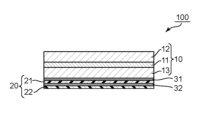
- FIG. 1 is a schematic cross-sectional view of an optical laminate according to one embodiment of the present invention.
- Refractive index (nx, ny, nz) "nx" is the refractive index in the direction in which the in-plane refractive index is maximum (i.e., the slow axis direction)
- ny is the refractive index in the direction perpendicular to the slow axis in the plane (i.e., the fast axis direction)
- nz is the refractive index in the thickness direction.
- In-plane phase difference (Re) "Re( ⁇ )” is the in-plane retardation of a film measured with light having a wavelength of ⁇ nm at 23° C.
- Re(550) is the in-plane retardation of a film measured with light having a wavelength of 550 nm at 23° C.
- Retardation in the thickness direction (Rth) is the retardation in the thickness direction of the film measured with light having a wavelength of ⁇ nm at 23° C.
- Rth(550) is the retardation in the thickness direction of the film measured with light having a wavelength of 550 nm at 23° C.
- FIG. 1 is a schematic cross-sectional view of an optical laminate according to one embodiment of the present invention.
- the optical laminate 100 of the illustrated example has a polarizing plate 10 and a retardation layer 20 laminated to the polarizing plate 10 via a first adhesive layer 31.
- the polarizing plate 10 typically includes a polarizer 11 and protective layers 12 and 13 arranged on both sides of the polarizer 11. Depending on the purpose, at least one of the protective layers 12 and 13 may be omitted. Therefore, the polarizing plate may be a so-called double-protected polarizing plate, a so-called single-protected polarizing plate, or may be composed of a polarizer alone. In one embodiment, the polarizing plate may be a single-protected polarizing plate in which the protective layer 13 is omitted.
- the retardation layer 20 includes, in order from the polarizing plate 10 side, a first liquid crystal alignment solidified layer 21 and a second liquid crystal alignment solidified layer 22 laminated to the first liquid crystal alignment solidified layer 21 via a second adhesive layer 32. Therefore, the retardation layer 20 has the first liquid crystal alignment solidified layer 21 laminated to the polarizing plate 10 via the first adhesive layer 31.
- the liquid crystal alignment solidified layer as the retardation layer, a desired in-plane retardation can be achieved with a thickness that is significantly thinner than that of a stretched film of a resin film. As a result, the optical laminate can be significantly thinner.
- the retardation layer 20 as a whole (as a laminate of the first liquid crystal alignment solidified layer 21 and the second liquid crystal alignment solidified layer 22) has a circular polarization function or an elliptical polarization function, and has a relationship of Re(450) ⁇ Re(550) ⁇ Re(650).
- the retardation layer as a whole may have an Nz coefficient of, for example, 0.30 to 0.70.
- liquid crystal alignment solidified layer refers to a layer in which liquid crystal compounds are aligned in a specific direction within the layer and the alignment state is fixed.
- liquid crystal alignment solidified layer is a concept that includes an alignment hardened layer obtained by hardening a liquid crystal monomer.
- the thickness of at least one of the first adhesive layer 31 and the second adhesive layer 32 is 300 nm or less. That is, in an embodiment of the present invention, the thickness of the first adhesive layer 31 may be 300 nm or less, the thickness of the second adhesive layer 32 may be 300 nm or less, and the thickness of each of the first adhesive layer 31 and the second adhesive layer 32 may be 300 nm or less. Also, if the thickness of either the first adhesive layer 31 or the second adhesive layer 32 is 300 nm or less, the thickness of the other may be greater than 300 nm.
- the thicknesses of the first adhesive layer 31 and the second adhesive layer 32 may each independently be, for example, 250 nm or less, or, for example, 200 nm or less, or, for example, 180 nm or less, or, for example, 150 nm or less, or, for example, 100 nm or less, or, for example, 70 nm or less, or, for example, 50 nm or less.
- the thickness of the first adhesive layer 31 and the second adhesive layer 32 may each independently be, for example, 5 nm or more, for example, 10 nm or more, or for example, 20 nm or more.
- the upper limit of the thickness of the adhesive layer having a thickness of more than 300 nm may be, for example, 2000 nm, for example, 1000 nm, for example, 800 nm, or for example, 500 nm.
- the present inventors found a new problem that an image display device using an optical laminate including the liquid crystal alignment solidified layer as the retardation layer may cause a specific display unevenness depending on the viewing environment. Specifically, they found that a phenomenon (sometimes called linear unevenness) may occur in which a thin line with a particularly noticeable pink color in the absorption axis direction of the polarizer is visible throughout the reflection under a three-wavelength light source. Furthermore, as a result of intensively studying the suppression of such linear unevenness, the present inventors found that linear unevenness can be suppressed by suppressing the interference of the optical laminate.
- the present inventors found that the interference of the optical laminate can be suppressed by setting the thickness of at least one of the adhesive layer that laminates the polarizing plate and the retardation layer and the adhesive layer that laminates the first liquid crystal alignment solidified layer and the second liquid crystal alignment solidified layer constituting the retardation layer to 300 nm or less, and as a result, linear unevenness can be suppressed well, and thus completed the present invention.
- the inventors have also discovered the critical significance of the thickness, that is, by making the thickness of at least one of the layers about 200 nm or less, linear unevenness can be significantly suppressed, and by making the thickness of at least one of the layers about 100 nm or less, linear unevenness can be significantly suppressed.
- the first adhesive layer 31 and the second adhesive layer 32 that have a thickness of 300 nm or less may be made of a water-based adhesive or may be made of another adhesive (e.g., an active energy ray-curable adhesive).
- the adhesive layer that has a thickness of more than 300 nm may also be made of a water-based adhesive or may be made of another adhesive (e.g., an active energy ray-curable adhesive).
- the total thickness from the first liquid crystal alignment solidified layer to the second liquid crystal alignment solidified layer is preferably 20 ⁇ m or less, and more preferably 3 ⁇ m to 10 ⁇ m. According to an embodiment of the present invention, it is possible to solve the problem of linear unevenness that has been newly found in optical laminates containing very thin liquid crystal alignment solidified layers.
- the total thickness from the first liquid crystal alignment solidified layer to the second liquid crystal alignment solidified layer is in the above-mentioned range
- the total thickness from the polarizing plate to the second liquid crystal alignment solidified layer can be, for example, 100 ⁇ m or less, or, for example, 30 ⁇ m to 80 ⁇ m.
- the optical laminate has an adhesive layer (not shown) as the outermost layer on the second liquid crystal alignment solidified layer side (image display panel side), and can be attached to the image display panel.
- a release liner is temporarily attached to the surface of the adhesive layer until the optical laminate is used. By temporarily attaching the release liner, the adhesive layer is protected and the optical laminate can be formed into a roll.
- optical laminate The components of the optical laminate are explained in detail below.
- the polarizer 11 is typically made of a polyvinyl alcohol (PVA)-based resin film containing a dichroic material (e.g., iodine).
- PVA-based resins include polyvinyl alcohol, partially formalized polyvinyl alcohol, ethylene-vinyl alcohol copolymer, and partially saponified ethylene-vinyl acetate copolymer.
- the PVA-based resin preferably contains an acetoacetyl-modified PVA-based resin. With this configuration, a polarizer having the desired mechanical strength can be obtained.
- the amount of the acetoacetyl-modified PVA-based resin is preferably 5% by weight to 20% by weight, and more preferably 8% by weight to 12% by weight, when the total amount of the PVA-based resin is taken as 100% by weight. If the amount is within this range, a polarizer having superior mechanical strength can be obtained.
- the polarizer preferably contains iodide or sodium chloride (sometimes collectively referred to as a halide).
- iodides include potassium iodide, sodium iodide, and lithium iodide.
- the content of the halide in the polarizer is preferably 5 to 20 parts by weight, and more preferably 10 to 15 parts by weight, per 100 parts by weight of the PVA-based resin.
- the halide is blended into a coating liquid that forms a PVA-based resin layer, which is a precursor of the polarizer, and can be finally introduced into the polarizer.
- the orientation of the PVA molecules in the polarizer can be increased, and a polarizer with excellent optical properties (typically, a combination of a high degree of polarization and a high single transmittance) can be realized.
- the polarizer preferably exhibits absorptive dichroism at any wavelength between 380 nm and 780 nm.
- the single transmittance of the polarizer is preferably 41.0% to 46.0%, and more preferably 42.0% to 45.0%.
- the degree of polarization of the polarizer is preferably 97.0% or more, more preferably 99.0% or more, and even more preferably 99.9% or more. According to an embodiment of the present invention, even if the single transmittance is in the above range, the degree of polarization can be maintained within such a range.
- the thickness of the polarizer is, for example, 12 ⁇ m or less, preferably 10 ⁇ m or less, more preferably 1 ⁇ m to 8 ⁇ m, and even more preferably 3 ⁇ m to 7 ⁇ m.
- the polarizer can be produced by any suitable method.
- the resin film forming the polarizer may be a single-layer resin film or a laminate of two or more layers.
- polarizers made of a single-layer resin film include hydrophilic polymer films such as PVA-based films, partially formalized PVA-based films, and partially saponified ethylene-vinyl acetate copolymer films that have been dyed with iodine or a dichroic substance such as a dichroic dye and stretched, and polyene-based oriented films such as dehydrated PVA and dehydrochlorinated polyvinyl chloride.
- a polarizer obtained by dyeing a PVA-based film with iodine and stretching it uniaxially is used because of its excellent optical properties.
- the dyeing with iodine is carried out, for example, by immersing the PVA-based film in an aqueous iodine solution.
- the stretching ratio of the uniaxial stretching is preferably 3 to 7 times. The stretching may be carried out after the dyeing process, or may be carried out while dyeing. Alternatively, the film may be stretched and then dyed. If necessary, the PVA-based film may be subjected to a swelling process, a crosslinking process, a washing process, a drying process, or the like.
- polarizers obtained using a laminate include a laminate of a resin substrate and a PVA-based resin layer (PVA-based resin film) laminated on the resin substrate, or a polarizer obtained using a laminate of a resin substrate and a PVA-based resin layer applied to the resin substrate.
- a polarizer obtained using a laminate of a resin substrate and a PVA-based resin layer applied to the resin substrate can be produced, for example, by applying a PVA-based resin solution to the resin substrate and drying the resin substrate to form a PVA-based resin layer on the resin substrate to obtain a laminate of the resin substrate and the PVA-based resin layer; and stretching and dyeing the laminate to make the PVA-based resin layer into a polarizer.
- a polyvinyl alcohol-based resin layer containing a halide and a polyvinyl alcohol-based resin is preferably formed on one side of the resin substrate.
- Stretching typically involves immersing the laminate in an aqueous boric acid solution and stretching it. Furthermore, the stretching may further include air-stretching the laminate at a high temperature (e.g., 95°C or higher) before stretching in the boric acid aqueous solution, as necessary.
- the laminate is preferably subjected to a drying shrinkage treatment in which the laminate is heated while being conveyed in the longitudinal direction, thereby shrinking the laminate by 2% or more in the width direction.
- the manufacturing method of this embodiment includes subjecting the laminate to an air-assisted stretching treatment, a dyeing treatment, an underwater stretching treatment, and a drying shrinkage treatment in this order.
- an air-assisted stretching treatment By introducing the auxiliary stretching, it is possible to increase the crystallinity of PVA even when PVA is applied onto a thermoplastic resin, and it is possible to achieve high optical properties.
- problems such as a decrease in the orientation of PVA or dissolution can be prevented when the PVA is immersed in water in the subsequent dyeing step or stretching step, and it is possible to achieve high optical properties.
- the disorder of the orientation of polyvinyl alcohol molecules and the decrease in orientation can be suppressed compared to when the PVA-based resin layer does not contain a halide.
- This can improve the optical properties of the polarizer obtained by immersing the laminate in a liquid in a treatment process such as a dyeing process and an underwater stretching process.
- the optical properties can be improved by shrinking the laminate in the width direction by a drying shrinkage process.
- the obtained resin substrate/polarizer laminate may be used as it is (i.e., the resin substrate may be used as a protective layer for the polarizer), or any suitable protective layer may be laminated on the peeled surface obtained by peeling the resin substrate from the resin substrate/polarizer laminate, or on the surface opposite to the peeled surface. Details of the manufacturing method of such a polarizer are described in, for example, JP-A-2012-73580 and JP-A-6470455. The entire disclosures of these publications are incorporated herein by reference.
- the protective layers 12 and 13 are made of any suitable resin film.
- Representative materials for the resin film include cellulose resins such as triacetyl cellulose (TAC), cycloolefin resins such as polynorbornene, (meth)acrylic resins, polyester resins such as polyethylene terephthalate (PET) and polyethylene naphthalate (PEN), polyolefin resins such as polyethylene, and polycarbonate resins.
- TAC triacetyl cellulose
- cycloolefin resins such as polynorbornene
- (meth)acrylic resins polyester resins such as polyethylene terephthalate (PET) and polyethylene naphthalate (PEN), polyolefin resins such as polyethylene, and polycarbonate resins.
- PET polyethylene terephthalate
- PEN polyethylene naphthalate
- polyolefin resins such as polyethylene
- polycarbonate resins and polycarbonate resins.
- (Meth)acrylic resins having a lactone ring structure are described in, for example, JP-A-2000-230016, JP-A-2001-151814, JP-A-2002-120326, JP-A-2002-254544, and JP-A-2005-146084. These publications are incorporated herein by reference. From the viewpoint of ease of processing into a modified shape, a cellulose-based resin is preferred, and TAC is more preferred. From the viewpoint of obtaining a polarizing plate having low moisture permeability and excellent durability, a cycloolefin-based resin and a (meth)acrylic resin are preferred.
- the optical laminate is typically placed on the viewing side of an image display device, and the protective layer 12 is typically placed on the viewing side. Therefore, the protective layer 12 may be subjected to a surface treatment as necessary. Examples of surface treatments include hard coat treatment, anti-reflection treatment, anti-sticking treatment, and anti-glare treatment. Additionally/alternatively, the protective layer 12 may be subjected to a treatment for improving visibility when viewed through polarized sunglasses (typically, imparting an (elliptical) polarization function or imparting an ultra-high phase difference) as necessary. By performing such treatments, excellent visibility can be achieved even when the display screen is viewed through polarized lenses such as polarized sunglasses. Therefore, the optical laminate can be suitably applied to image display devices that can be used outdoors.
- polarized sunglasses typically, imparting an (elliptical) polarization function or imparting an ultra-high phase difference
- the protective layer 13 is preferably optically isotropic.
- optically isotropic means that the in-plane retardation Re(550) is 0 nm to 10 nm, and the retardation in the thickness direction Rth(550) is -10 nm to +10 nm.
- each of the protective layers 12 and 13 is preferably 10 ⁇ m to 80 ⁇ m, more preferably 12 ⁇ m to 40 ⁇ m, and even more preferably 15 ⁇ m to 35 ⁇ m. If the protective layer 12 has been subjected to a surface treatment, the thickness of the protective layer 12 includes the thickness of the surface treatment layer.
- the retardation layer 20 includes the first liquid crystal alignment solidified layer 21 and the second liquid crystal alignment solidified layer 22 in order from the polarizing plate side. Furthermore, as described above, the retardation layer 20 as a whole (as a laminate of the first liquid crystal alignment solidified layer 21 and the second liquid crystal alignment solidified layer 22) has a circular polarization function or an elliptical polarization function, and has a relationship of Re(450) ⁇ Re(550) ⁇ Re(650).
- retardation layer when it is simply referred to as a "retardation layer”, it means that the retardation layer is described as a whole, and when it is simply referred to as a "liquid crystal alignment solidified layer”, it means that the first liquid crystal alignment solidified layer and the second liquid crystal alignment solidified layer are described together.
- the retardation layer 20 preferably has an Re(550) of 100 nm to 200 nm, more preferably 110 nm to 180 nm, even more preferably 120 nm to 170 nm, and particularly preferably 130 nm to 150 nm. If the Re(550) of the retardation layer is within this range, the retardation layer can exhibit good circular polarization or elliptical polarization function in combination with a polarizer.
- the retardation layer 20 has a relationship of Re(450) ⁇ Re(550) ⁇ Re(650). That is, the retardation layer 20 preferably exhibits wavelength dependency of inverse dispersion, in which the retardation value increases according to the wavelength of the measurement light. With such a configuration, good anti-reflection function can be realized in a very wide wavelength band.
- Re(450)/Re(550) is, for example, greater than 0.5 and less than 1.0, preferably 0.7 to 0.95, more preferably 0.75 to 0.92, and even more preferably 0.8 to 0.9.
- Re(650)/Re(550) is preferably 1.0 or more and less than 1.15, and more preferably 1.03 to 1.1.
- the retardation layer 20 may have an Nz coefficient of, for example, 0.30 to 0.70 as described above. Therefore, the retardation layer 20 exhibits a refractive index characteristic of nx>nz>ny. With such a configuration, it is possible to effectively prevent reflections in oblique directions, and it is possible to achieve a wide viewing angle of the anti-reflection function.
- the Nz coefficient is preferably 0.35 to 0.65, more preferably 0.40 to 0.60, and even more preferably 0.45 to 0.55.
- liquid crystal compound used in the liquid crystal alignment solidified layer examples include liquid crystal polymers and liquid crystal monomers.
- the liquid crystal compound is preferably polymerizable (i.e., liquid crystal monomer). If the liquid crystal compound is polymerizable, the alignment state of the liquid crystal compound can be fixed by aligning the liquid crystal compound and then polymerizing it. Here, the polymer formed by polymerization is non-liquid crystal. Therefore, the formed liquid crystal alignment solidified layer does not undergo transition to a liquid crystal phase, glass phase, or crystalline phase due to temperature changes, which are specific to liquid crystal compounds. As a result, the liquid crystal alignment solidified layer becomes a retardation layer that is not affected by temperature changes and has extremely excellent stability.
- the liquid crystal alignment solidification layer may be formed using a composition containing a polymerizable liquid crystal compound (polymerizable liquid crystal compound, i.e., liquid crystal monomer).
- a polymerizable liquid crystal compound i.e., liquid crystal monomer
- the polymerizable liquid crystal compound contained in the composition refers to a compound that has a polymerizable group and has liquid crystal properties.
- the polymerizable group means a group that participates in a polymerization reaction, and is preferably a photopolymerizable group.
- the photopolymerizable group refers to a group that can participate in a polymerization reaction by active radicals or acids generated from a photopolymerization initiator.
- liquid crystal monomer for example, polymerizable mesogen compounds described in JP-A-2002-533742 (WO00/37585), EP358208 (US5211877), EP66137 (US4388453), WO93/22397, EP0261712, DE19504224, DE4408171, and GB2280445, etc., can be used.
- polymerizable mesogenic compounds include BASF's product name LC242, Merck's product name E7, and Wacker-Chem's product name LC-Silicon-CC3767.
- liquid crystallinity may be thermotropic or lyotropic.
- the liquid crystal phase may be nematic or smectic. From the standpoint of ease of production, the liquid crystallinity is preferably thermotropic nematic liquid crystal.
- the temperature range in which the liquid crystal monomer exhibits liquid crystallinity varies depending on the type of the monomer. Specifically, the temperature range is preferably 40°C to 120°C, more preferably 50°C to 100°C, and most preferably 60°C to 90°C.
- the birefringence ⁇ n of the liquid crystal alignment solidified layer is preferably 0.06 or more, more preferably 0.08 or more, even more preferably 0.09 or more, and particularly preferably 0.10 or more.
- the upper limit of ⁇ n may be, for example, 0.13, or may be, for example, 0.12. If ⁇ n is in this range, the desired in-plane retardation can be achieved with a very thin thickness. As a result, it becomes possible to make the liquid crystal alignment solidified layer and the optical laminate even thinner, which can ultimately contribute to significantly reducing the thickness of image display devices.
- the liquid crystal alignment solidified layer may exhibit an inverse dispersion wavelength characteristic in which the phase difference value increases according to the wavelength of the measurement light, may exhibit a positive wavelength dispersion characteristic in which the phase difference value decreases according to the wavelength of the measurement light, or may exhibit a flat wavelength dispersion characteristic in which the phase difference value changes very little depending on the wavelength of the measurement light.
- the first liquid crystal alignment solidified layer 21 can typically function as a ⁇ /2 plate
- the second liquid crystal alignment solidified layer 22 can typically function as a ⁇ /4 plate.
- the Re(550) of the first liquid crystal alignment solidified layer is preferably 150 nm to 300 nm, more preferably 200 nm to 270 nm, and even more preferably 220 nm to 260 nm
- the Re(550) of the second liquid crystal alignment solidified layer is preferably 100 nm to 200 nm, more preferably 110 nm to 160 nm, and even more preferably 120 nm to 140 nm.
- the thickness of the first liquid crystal alignment solidified layer can be adjusted to obtain the desired in-plane retardation of the ⁇ /2 plate.
- the thickness of the first liquid crystal alignment solidified layer can be, for example, 2.0 ⁇ m to 4.0 ⁇ m. In another embodiment, the thickness of the first liquid crystal alignment solidified layer is preferably 1.7 ⁇ m or less, more preferably 1.6 ⁇ m or less, and even more preferably 1.5 ⁇ m or less. In this case, the thickness of the first liquid crystal alignment solidified layer can be, for example, 1.3 ⁇ m or more. Thus, according to the embodiment of the present invention, the thickness of the first liquid crystal alignment solidified layer can be made thinner than before while suppressing linear unevenness. The thickness of the second liquid crystal alignment solidified layer can be adjusted so as to obtain a desired in-plane retardation of the ⁇ /4 plate.
- the thickness can be, for example, 0.8 ⁇ m to 2.5 ⁇ m.
- the angle between the slow axis of the first liquid crystal alignment solidified layer and the transmission axis of the polarizer is preferably 10° to 20°, more preferably 12° to 18°, and even more preferably 14° to 16°; the angle between the slow axis of the second liquid crystal alignment solidified layer and the transmission axis of the polarizer is preferably 70° to 80°, more preferably 72° to 78°, and even more preferably 74° to 76°.
- the order of arrangement of the first liquid crystal alignment solidified layer and the second liquid crystal alignment solidified layer may be reversed, and the angle between the slow axis of the first liquid crystal alignment solidified layer and the transmission axis of the polarizer and the angle between the slow axis of the second liquid crystal alignment solidified layer and the transmission axis of the polarizer may be reversed.
- the refractive index of the liquid crystal alignment solidified layer may vary depending on the composition forming the liquid crystal alignment solidified layer (substantially the type of liquid crystal compound, the type, number, combination, amount of additives, etc.).
- the refractive index of the first liquid crystal alignment solidified layer and the refractive index of the second liquid crystal alignment solidified layer may be the same or different from each other (the refractive index of the first liquid crystal alignment solidified layer may be higher, and the refractive index of the second liquid crystal alignment solidified layer may be higher).
- the refractive index of the first liquid crystal alignment solidified layer is preferably 1.55 to 1.75, more preferably 1.60 to 1.70.
- the refractive index of the second liquid crystal alignment solidified layer is preferably 1.45 to 1.65, more preferably 1.50 to 1.60.
- the refractive index of the first liquid crystal alignment solidified layer and the refractive index of the second liquid crystal alignment solidified layer may be reversed.
- the absolute value of the difference between the refractive index of the first liquid crystal alignment solidified layer and the refractive index of the second liquid crystal alignment solidified layer may be, for example, 0.00 to 0.20.
- the refractive index of the liquid crystal alignment solidified layer typically conforms to the composition of the composition that forms the liquid crystal alignment solidified layer to obtain the desired optical characteristics. As a result, linear unevenness may occur.
- the thickness of at least one of the adhesive layer that laminates the polarizing plate and the retardation layer and the adhesive layer that laminates the first liquid crystal alignment solidified layer and the second liquid crystal alignment solidified layer that constitute the retardation layer is set to a predetermined value or less, thereby suppressing linear unevenness.
- a side-chain thermotropic liquid crystal polymer may be introduced into the first liquid crystal alignment solidified layer and/or the second liquid crystal alignment solidified layer (essentially the liquid crystal composition that forms these).
- the introduction of a side-chain thermotropic liquid crystal polymer can have the effect of homeotropically aligning (vertically aligning) the liquid crystal monomer.
- the nz of the first liquid crystal alignment solidified layer and/or the second liquid crystal alignment solidified layer can be increased, and as a result, the Nz coefficient of the first liquid crystal alignment solidified layer and/or the second liquid crystal alignment solidified layer can be set to the desired range.
- the Nz coefficient of the retardation layer can be set to the desired range without providing a positive C plate, which will be described later.
- thermotropic liquid crystal polymer typically used is a copolymer having a monomer unit containing a thermotropic liquid crystal fragment side chain and a monomer unit containing a non-liquid crystal fragment side chain.
- the side-chain liquid crystal polymer can be oriented when the liquid crystal composition is heated to a predetermined temperature.
- the non-liquid crystal fragment can interact with the photopolymerizable liquid crystal monomer to homeotropically align the photopolymerizable liquid crystal monomer.
- thermotropic liquid crystal polymer a copolymer having a liquid crystalline monomer unit represented by general formula (I) and a non-liquid crystalline monomer unit represented by general formula (II) is preferably used.
- R 1 is a hydrogen atom or a methyl group
- R 2 is a cyano group, a fluoro group, an alkyl group having 1 to 6 carbon atoms, or an alkoxy group having 1 to 6 carbon atoms
- X 1 is -CO 2 - or -OCO-.
- a is an integer of 1 to 6
- b and c are each independently 1 or 2.
- R 3 is a hydrogen atom or a methyl group
- R 4 is an alkyl group having 7 to 22 carbon atoms, a fluoroalkyl group having 1 to 22 carbon atoms, or a group represented by the following general formula (III).
- R 5 is an alkyl group having 1 to 5 carbon atoms
- d is an integer of 1 to 6.
- the ratio of the liquid crystal monomer unit and the non-liquid crystal monomer unit in the side chain type liquid crystal monomer can be appropriately set depending on the purpose.
- the ratio (molar ratio) of the non-liquid crystal monomer to the total of the liquid crystal monomer unit and the non-liquid crystal monomer unit is preferably 0.05 to 0.8, more preferably 0.1 to 0.6, and even more preferably 0.15 to 0.5. With such a configuration, a liquid crystal alignment solidified layer exhibiting the desired refractive index characteristics (Nz coefficient) can be obtained.
- the ratio of liquid crystal monomer to side-chain liquid crystal polymer in the liquid crystal composition can be appropriately set depending on the purpose.
- the Nz coefficient tends to be small; when the content of liquid crystal monomer is high, the Nz coefficient tends to be small.
- the content of liquid crystal monomer is preferably 1.2 to 20 times, more preferably 1.3 to 10 times, even more preferably 1.4 to 9 times, and particularly preferably 1.5 to 8 times, the content of side-chain liquid crystal polymer. With such a configuration, a liquid crystal alignment solidified layer exhibiting the desired refractive index characteristics (Nz coefficient) can be obtained.
- the retardation layer 20 may further include a positive C plate.
- the retardation Rth(550) in the thickness direction of the positive C plate is preferably -20 nm to -300 nm, more preferably -30 nm to -250 nm, even more preferably -40 nm to -200 nm, and particularly preferably -50 nm to -150 nm.
- the in-plane retardation Re(550) of the positive C plate may be less than 10 nm.
- the positive C plate can be formed, for example, using a composition containing the above-mentioned side-chain liquid crystal polymer.
- Specific examples of methods for forming a positive C plate include the methods described in [0020] to [0028] of JP 2002-333642 A.
- the thickness of the positive C plate is preferably 0.5 ⁇ m to 10 ⁇ m, more preferably 0.5 ⁇ m to 8 ⁇ m, and even more preferably 0.5 ⁇ m to 5 ⁇ m.
- the first adhesive layer 31 and the second adhesive layer 32 which have a thickness of 300 nm or less, may be composed of a water-based adhesive or may be composed of other adhesives (e.g., active energy ray curable adhesives).
- the adhesive layer having a thickness of more than 300 nm may also be composed of a water-based adhesive or may be composed of other adhesives (e.g., active energy ray curable adhesives) as described above.
- the adhesive constituting the adhesive layer having a thickness of more than 300 nm may also contain a pressure-sensitive adhesive for convenience.
- both the first adhesive layer 31 and the second adhesive layer 32 may be composed of a water-based adhesive.
- the water-based adhesive is formed by applying and drying an aqueous solution as described later, it shrinks less than the curable adhesive. As a result, the thickness variation of the adhesive layer is reduced, thereby suppressing interference and linear unevenness.
- the water-based adhesive will be described. Since other adhesives (e.g., active energy ray curable adhesives) may be configured as known in the industry, specific descriptions will be omitted. In this section, unless otherwise specified, the first adhesive layer and the second adhesive layer will be collectively referred to as the adhesive layer.
- the aqueous adhesive typically contains a polyvinyl alcohol (PVA) resin.
- the adhesive layer can typically be formed by applying and drying an aqueous solution of a PVA resin.
- the average degree of polymerization of the PVA resin contained in the aqueous solution is preferably about 100 to 5000, more preferably 1000 to 4000.
- the average degree of saponification is preferably about 85 mol% to 100 mol%, more preferably 90 mol% to 100 mol%. If the average degree of polymerization and the average degree of saponification are within these ranges, an adhesive layer (effectively a first adhesive layer) with excellent adhesion to the polarizer can be formed.
- the PVA-based resin preferably contains acetoacetyl groups. This is because an optical laminate having excellent adhesion to the polarizer and protective layer and excellent durability can be obtained.
- the acetoacetyl-containing PVA-based resin can be obtained, for example, by reacting a PVA-based resin with diketene by any method.
- the degree of acetoacetyl group modification of the acetoacetyl-containing PVA-based resin is typically 0.1 mol% or more, preferably about 0.1 mol% to 40 mol%, more preferably 1 mol% to 20 mol%, and particularly preferably 2 mol% to 7 mol%.
- the degree of acetoacetyl group modification is a value measured by NMR.
- the resin concentration in the aqueous PVA-based resin solution is preferably 0.1% by weight to 15% by weight, and more preferably 0.5% by weight to 10% by weight.
- the viscosity of the aqueous solution is preferably 1 to 50 mPa ⁇ s.
- the pH of the aqueous solution is preferably 2 to 6, more preferably 2.5 to 5, even more preferably 3 to 5, and particularly preferably 3.5 to 4.5. If the resin concentration and viscosity of the aqueous PVA-based resin solution are within these ranges, an adhesive layer having the desired thickness can be formed in the embodiments of the present invention.
- the PVA-based resin aqueous solution may contain a metal compound colloid.
- a metal compound colloid is a dispersion of metal compound microparticles in a dispersion medium, which is electrostatically stabilized due to mutual repulsion of like-charged particles of the microparticles, and may have permanent stability.
- the average particle size of the microparticles forming the metal compound colloid can be set to any appropriate value as long as it does not adversely affect optical properties such as transparency and polarization characteristics. It is preferably 1 nm to 100 nm, and more preferably 1 nm to 50 nm. This is because the microparticles can be uniformly dispersed in the adhesive layer.
- metal compound any suitable compound can be used as the metal compound.
- suitable compound examples include metal oxides such as alumina, silica, zirconia, and titania; metal salts such as aluminum silicate, calcium carbonate, magnesium silicate, zinc carbonate, barium carbonate, and calcium phosphate; and minerals such as celite, talc, clay, and kaolin.
- metal oxides such as alumina, silica, zirconia, and titania
- metal salts such as aluminum silicate, calcium carbonate, magnesium silicate, zinc carbonate, barium carbonate, and calcium phosphate
- minerals such as celite, talc, clay, and kaolin.
- a colloidal metal compound having a positive charge is preferably used.
- the metal compound include alumina and titania, with alumina being particularly preferred.
- Image display device The optical laminate described in the above items A to D can be applied to an image display device. Therefore, the embodiment of the present invention also includes an image display device using such an optical laminate. Representative examples of image display devices include liquid crystal display devices and organic EL display devices. The image display device according to the embodiment of the present invention typically includes the optical laminate described in the above items A to D on the viewing side.
- Thickness Measured with an interference thickness meter (manufactured by Otsuka Electronics Co., Ltd., "MCPD9800").
- aqueous adhesive was obtained by mixing 6.02 parts of acetoacetyl-modified PVA (degree of polymerization 1200, degree of acetoacetyl modification 4.6%, degree of saponification 99.0 mol% or more, solids concentration 4%, manufactured by Mitsubishi Chemical Corporation, product name "Gosenex Z-200”), 25 parts of an aqueous solution containing positively charged alumina colloid (average particle size 15 nm) at a solids concentration of 3.2%, and 18.98 parts of pure water.
- PVA degree of polymerization 1200, degree of acetoacetyl modification 4.6%, degree of saponification 99.0 mol% or more, solids concentration 4%, manufactured by Mitsubishi Chemical Corporation, product name "Gosenex Z-200”
- Example 1 Preparation of Polarizing Plate 1-1.
- a thermoplastic resin substrate a long amorphous isophthalic copolymerized polyethylene terephthalate film (thickness: 100 ⁇ m) having a Tg of about 75° C. was used, and one side of the resin substrate was subjected to a corona treatment.
- a PVA aqueous solution (coating solution) was prepared by adding 13 parts by weight of potassium iodide to 100 parts by weight of a PVA-based resin prepared by mixing polyvinyl alcohol (polymerization degree 4,200, saponification degree 99.2 mol%) and acetoacetyl-modified PVA (manufactured by Nippon Synthetic Chemical Industry Co., Ltd., product name "GOHSEFFIMER”) in a ratio of 9:1, and dissolving the resultant in water.
- the above PVA aqueous solution was applied to the corona-treated surface of a resin substrate and dried at 60° C. to form a PVA-based resin layer having a thickness of 13 ⁇ m, thereby producing a laminate.
- the obtained laminate was uniaxially stretched 2.4 times in the longitudinal direction (machine direction) in an oven at 130° C. (auxiliary in-air stretching treatment).
- the laminate was immersed in an insolubilizing bath (a boric acid aqueous solution obtained by mixing 4 parts by weight of boric acid with 100 parts by weight of water) at a liquid temperature of 40° C. for 30 seconds (insolubilizing treatment).
- the film was immersed in a dye bath (an aqueous iodine solution obtained by mixing iodine and potassium iodide in a weight ratio of 1:7 with 100 parts by weight of water) having a liquid temperature of 30° C.
- the plate was immersed in a crosslinking bath (a boric acid aqueous solution obtained by mixing 3 parts by weight of potassium iodide and 5 parts by weight of boric acid with 100 parts by weight of water) at a liquid temperature of 40° C. for 30 seconds (crosslinking treatment).
- a crosslinking bath a boric acid aqueous solution obtained by mixing 3 parts by weight of potassium iodide and 5 parts by weight of boric acid with 100 parts by weight of water
- the laminate was immersed in an aqueous boric acid solution (boric acid concentration: 4 wt %, potassium iodide concentration: 5 wt %) at a liquid temperature of 70° C., and uniaxially stretched in the longitudinal direction (longitudinal direction) between rolls with different peripheral speeds to a total stretch ratio of 5.5 times (underwater stretching treatment). Thereafter, the laminate was immersed in a cleaning bath (an aqueous solution obtained by mixing 4 parts by weight of potassium iodide with 100 parts by weight of water) at a liquid temperature of 20° C. (cleaning treatment).
- a cleaning bath an aqueous solution obtained by mixing 4 parts by weight of potassium iodide with 100 parts by weight of water
- the film was dried in an oven maintained at about 90° C., while being brought into contact with a SUS heated roll whose surface temperature was maintained at about 75° C. (drying shrinkage treatment).
- a polarizer having a thickness of about 5 ⁇ m was formed on the resin substrate, and a polarizing plate having a resin substrate/polarizer structure was obtained.
- the single transmittance Ts of the polarizer was 43.3%.
- HC-COP film was attached to the surface of the obtained polarizer (the surface opposite to the resin substrate) via an ultraviolet-curable adhesive.
- the HC-COP film was a film in which a HC layer (thickness 4 ⁇ m) was formed on a cycloolefin resin (COP) film (thickness 25 ⁇ m), and the COP film was attached to the polarizer side.
- the COP film had an Re (550) of 135 nm.
- the resin substrate was peeled off to obtain a polarizing plate having a configuration of HC layer/COP film (protective layer)/polarizer.
- a photopolymerizable liquid crystal compound exhibiting a nematic liquid crystal phase (BASF's "Paliocolor LC242", chemical formula below) was dissolved in cyclopentanone to prepare a solution with a solid content concentration of 30% by weight.
- a surfactant (BYK-Chemie's "BYK-360") and a photopolymerization initiator (IGM Resins'"Omnirad907") were added to this solution to prepare a liquid crystal composition solution.
- the amounts of the surfactant and polymerization initiator added were 0.01 parts by weight and 3 parts by weight, respectively, relative to 100 parts by weight of the photopolymerizable liquid crystal compound.
- the liquid crystal composition was applied to the substrate by a bar coater so that the Re (550) was 240 nm, and the liquid crystal was aligned by heating at 100° C. for 3 minutes.
- the substrate was irradiated with ultraviolet light with an integrated light quantity of 400 mJ/cm 2 under a nitrogen atmosphere to perform photocuring, and a laminate having a substrate/first liquid crystal alignment solidified layer structure was obtained.
- the first liquid crystal alignment solidified layer was homogeneously aligned and had a thickness of 1.7 ⁇ m.
- the first liquid crystal alignment solidified layer was bonded to the polarizer surface of the polarizing plate via the adhesive of Production Example 1 (thickness after drying: 50 nm), and then the substrate was peeled off.
- the second liquid crystal alignment solidified layer was bonded to the first liquid crystal alignment solidified layer surface via the adhesive of Production Example 1 (thickness after drying: 50 nm), and the substrate was peeled off to obtain an optical laminate having a configuration of polarizing plate/first adhesive layer/first liquid crystal alignment solidified layer/second adhesive layer/second liquid crystal alignment solidified layer.
- the angle between the transmission axis of the polarizer of the polarizing plate and the slow axis of the first liquid crystal alignment solidified layer was 15°, and the angle between the transmission axis of the polarizer of the polarizing plate and the slow axis of the second liquid crystal alignment solidified layer was 75°.
- the obtained optical laminate was subjected to the evaluation of the above-mentioned "linear unevenness". The results are shown in Table 1.
- Examples 2 to 17 and Comparative Examples 1 to 5 An optical laminate was obtained in the same manner as in Example 1, except that the thicknesses of the first adhesive layer and the second adhesive layer were changed as shown in Table 1. The obtained optical laminate was subjected to the same evaluation as in Example 1. The results are shown in Table 1. Note that the notation "(UV)" in Examples 9 and 10 in Table 1 means that an active energy ray (ultraviolet ray) curable adhesive was used instead of a water-based adhesive.
- optical laminate according to the embodiment of the present invention can be suitably used in image display devices (typically, liquid crystal display devices and organic EL display devices).
Landscapes
- Physics & Mathematics (AREA)
- Nonlinear Science (AREA)
- Optics & Photonics (AREA)
- General Physics & Mathematics (AREA)
- Chemical & Material Sciences (AREA)
- Crystallography & Structural Chemistry (AREA)
- Mathematical Physics (AREA)
- Spectroscopy & Molecular Physics (AREA)
- Theoretical Computer Science (AREA)
- Engineering & Computer Science (AREA)
- Polarising Elements (AREA)
- Laminated Bodies (AREA)
- Adhesive Tapes (AREA)
- Devices For Indicating Variable Information By Combining Individual Elements (AREA)
Priority Applications (4)
| Application Number | Priority Date | Filing Date | Title |
|---|---|---|---|
| CN202480046928.5A CN121511421A (zh) | 2023-07-26 | 2024-07-26 | 光学层叠体和使用该光学层叠体的图像显示装置 |
| KR1020257038705A KR20250168696A (ko) | 2023-07-26 | 2024-07-26 | 광학 적층체 및 상기 광학 적층체를 이용한 화상 표시 장치 |
| JP2024574522A JPWO2025023317A1 (https=) | 2023-07-26 | 2024-07-26 | |
| JP2025144331A JP2025164931A (ja) | 2023-07-26 | 2025-09-01 | 光学積層体および該光学積層体を用いた画像表示装置 |
Applications Claiming Priority (2)
| Application Number | Priority Date | Filing Date | Title |
|---|---|---|---|
| JP2023-121923 | 2023-07-26 | ||
| JP2023121923 | 2023-07-26 |
Publications (1)
| Publication Number | Publication Date |
|---|---|
| WO2025023317A1 true WO2025023317A1 (ja) | 2025-01-30 |
Family
ID=94324096
Family Applications (1)
| Application Number | Title | Priority Date | Filing Date |
|---|---|---|---|
| PCT/JP2024/026758 Pending WO2025023317A1 (ja) | 2023-07-26 | 2024-07-26 | 光学積層体および該光学積層体を用いた画像表示装置 |
Country Status (5)
| Country | Link |
|---|---|
| JP (2) | JPWO2025023317A1 (https=) |
| KR (2) | KR20250017145A (https=) |
| CN (2) | CN119376002A (https=) |
| TW (1) | TW202509539A (https=) |
| WO (1) | WO2025023317A1 (https=) |
Citations (3)
| Publication number | Priority date | Publication date | Assignee | Title |
|---|---|---|---|---|
| JP2021047245A (ja) * | 2019-09-17 | 2021-03-25 | 住友化学株式会社 | 積層体およびこれを含む楕円偏光板 |
| JP2022040566A (ja) * | 2020-08-31 | 2022-03-11 | 日東電工株式会社 | 偏光板、位相差層付偏光板および画像表示装置 |
| JP2022167759A (ja) * | 2021-04-22 | 2022-11-04 | 住友化学株式会社 | 積層体およびその製造方法 |
Family Cites Families (5)
| Publication number | Priority date | Publication date | Assignee | Title |
|---|---|---|---|---|
| JP2008018543A (ja) * | 2006-07-10 | 2008-01-31 | Nof Corp | ハードコートフィルム、それを用いた反射防止性フィルム及び反射防止性近赤外線遮蔽フィルム |
| JP2010250036A (ja) * | 2009-04-15 | 2010-11-04 | Bridgestone Corp | 反射防止フィルム |
| JP2014222282A (ja) | 2013-05-13 | 2014-11-27 | 大日本印刷株式会社 | 光学フィルム用転写体、光学フィルム、画像表示装置、光学フィルム用転写体の製造方法及び光学フィルムの製造方法 |
| JP2018017996A (ja) * | 2016-07-29 | 2018-02-01 | 日東電工株式会社 | 位相差層付偏光板および有機el表示装置 |
| JP2020052365A (ja) * | 2018-09-28 | 2020-04-02 | 住友化学株式会社 | 偏光板複合体、及び画像表示装置 |
-
2024
- 2024-06-14 TW TW113122115A patent/TW202509539A/zh unknown
- 2024-07-15 KR KR1020240093180A patent/KR20250017145A/ko active Pending
- 2024-07-25 CN CN202411005688.2A patent/CN119376002A/zh active Pending
- 2024-07-26 KR KR1020257038705A patent/KR20250168696A/ko active Pending
- 2024-07-26 CN CN202480046928.5A patent/CN121511421A/zh active Pending
- 2024-07-26 JP JP2024574522A patent/JPWO2025023317A1/ja active Pending
- 2024-07-26 WO PCT/JP2024/026758 patent/WO2025023317A1/ja active Pending
-
2025
- 2025-09-01 JP JP2025144331A patent/JP2025164931A/ja active Pending
Patent Citations (3)
| Publication number | Priority date | Publication date | Assignee | Title |
|---|---|---|---|---|
| JP2021047245A (ja) * | 2019-09-17 | 2021-03-25 | 住友化学株式会社 | 積層体およびこれを含む楕円偏光板 |
| JP2022040566A (ja) * | 2020-08-31 | 2022-03-11 | 日東電工株式会社 | 偏光板、位相差層付偏光板および画像表示装置 |
| JP2022167759A (ja) * | 2021-04-22 | 2022-11-04 | 住友化学株式会社 | 積層体およびその製造方法 |
Also Published As
| Publication number | Publication date |
|---|---|
| JP2025164931A (ja) | 2025-10-30 |
| KR20250168696A (ko) | 2025-12-02 |
| TW202509539A (zh) | 2025-03-01 |
| CN121511421A (zh) | 2026-02-10 |
| KR20250017145A (ko) | 2025-02-04 |
| CN119376002A (zh) | 2025-01-28 |
| JPWO2025023317A1 (https=) | 2025-01-30 |
Similar Documents
| Publication | Publication Date | Title |
|---|---|---|
| JP4827226B2 (ja) | 偏光板の製造方法、偏光板およびそれを用いた画像表示装置 | |
| WO2008059721A1 (en) | Elliptic polarizing plate and vertically aligned liquid crystal display using the same | |
| JP2018060152A (ja) | Ipsモード用の偏光板のセット及びそれを用いたipsモード液晶表示装置 | |
| JP2024149527A (ja) | 光学フィルム、円偏光板、有機エレクトロルミネッセンス表示装置 | |
| WO2017170019A1 (ja) | 偏光板のセット及びそれを用いたipsモード液晶表示装置 | |
| JP2018060150A (ja) | Ipsモード用の偏光板のセット及びそれを用いたipsモード液晶表示装置 | |
| JP2018054887A (ja) | 偏光板のセット及びそれを用いたipsモード液晶表示装置 | |
| JP6699514B2 (ja) | Ipsモード用の偏光板のセット及びそれを用いたipsモード液晶表示装置 | |
| WO2025023317A1 (ja) | 光学積層体および該光学積層体を用いた画像表示装置 | |
| WO2018061959A1 (ja) | 偏光板のセット及びそれを用いたipsモード液晶表示装置 | |
| WO2008062624A1 (en) | Multilayer optical film, liquid crystal panel employing multilayer optical film and liquid crystal display | |
| JP6724729B2 (ja) | 偏光板のセット及びそれを用いたipsモード液晶表示装置 | |
| KR20230056666A (ko) | 편광판, 위상차층 부착 편광판 및 화상 표시 장치 | |
| JP2025022386A (ja) | 光学積層体 | |
| JP2018060149A (ja) | 偏光板のセット及びそれを用いたipsモード液晶表示装置 | |
| JP6699513B2 (ja) | 偏光板のセット及びそれを用いたipsモード液晶表示装置 | |
| JP2024101531A (ja) | 光学積層体および該光学積層体を用いた画像表示装置 | |
| JP2024128629A (ja) | 光学積層体および該光学積層体を用いた画像表示装置 | |
| JP2025129627A (ja) | 光学積層体 | |
| JP2017215560A (ja) | Ipsモード用の偏光板のセット及びそれを用いたipsモード液晶表示装置 | |
| JP2024128716A (ja) | 光学積層体および該光学積層体を用いた画像表示装置 | |
| JP2024128921A (ja) | 光学積層体および該光学積層体を用いた画像表示装置 | |
| JP2025143892A (ja) | 光学積層体の製造方法 | |
| JP2024128717A (ja) | 光学積層体および該光学積層体を用いた画像表示装置 | |
| JP2026063412A (ja) | 位相差層付偏光板およびそれを用いた画像表示装置 |
Legal Events
| Date | Code | Title | Description |
|---|---|---|---|
| WWE | Wipo information: entry into national phase |
Ref document number: 2024574522 Country of ref document: JP |
|
| 121 | Ep: the epo has been informed by wipo that ep was designated in this application |
Ref document number: 24845691 Country of ref document: EP Kind code of ref document: A1 |
|
| ENP | Entry into the national phase |
Ref document number: 1020257038705 Country of ref document: KR Free format text: ST27 STATUS EVENT CODE: A-0-1-A10-A15-NAP-PA0105 (AS PROVIDED BY THE NATIONAL OFFICE) |
|
| WWE | Wipo information: entry into national phase |
Ref document number: KR1020257038705 Country of ref document: KR |
|
| NENP | Non-entry into the national phase |
Ref country code: DE |