WO2025023220A1 - 伝熱部材及び電子装置 - Google Patents
伝熱部材及び電子装置 Download PDFInfo
- Publication number
- WO2025023220A1 WO2025023220A1 PCT/JP2024/026178 JP2024026178W WO2025023220A1 WO 2025023220 A1 WO2025023220 A1 WO 2025023220A1 JP 2024026178 W JP2024026178 W JP 2024026178W WO 2025023220 A1 WO2025023220 A1 WO 2025023220A1
- Authority
- WO
- WIPO (PCT)
- Prior art keywords
- heat transfer
- transfer member
- heat
- connection portion
- protective film
- Prior art date
- Legal status (The legal status is an assumption and is not a legal conclusion. Google has not performed a legal analysis and makes no representation as to the accuracy of the status listed.)
- Pending
Links
Images








Classifications
-
- H—ELECTRICITY
- H05—ELECTRIC TECHNIQUES NOT OTHERWISE PROVIDED FOR
- H05K—PRINTED CIRCUITS; CASINGS OR CONSTRUCTIONAL DETAILS OF ELECTRIC APPARATUS; MANUFACTURE OF ASSEMBLAGES OF ELECTRICAL COMPONENTS
- H05K7/00—Constructional details common to different types of electric apparatus
- H05K7/20—Modifications to facilitate cooling, ventilating, or heating
-
- H—ELECTRICITY
- H10—SEMICONDUCTOR DEVICES; ELECTRIC SOLID-STATE DEVICES NOT OTHERWISE PROVIDED FOR
- H10W—GENERIC PACKAGES, INTERCONNECTIONS, CONNECTORS OR OTHER CONSTRUCTIONAL DETAILS OF DEVICES COVERED BY CLASS H10
- H10W40/00—Arrangements for thermal protection or thermal control
- H10W40/10—Arrangements for heating
-
- H—ELECTRICITY
- H10—SEMICONDUCTOR DEVICES; ELECTRIC SOLID-STATE DEVICES NOT OTHERWISE PROVIDED FOR
- H10W—GENERIC PACKAGES, INTERCONNECTIONS, CONNECTORS OR OTHER CONSTRUCTIONAL DETAILS OF DEVICES COVERED BY CLASS H10
- H10W40/00—Arrangements for thermal protection or thermal control
- H10W40/20—Arrangements for cooling
- H10W40/25—Arrangements for cooling characterised by their materials
Definitions
- This disclosure relates to a heat transfer member and an electronic device.
- Patent document 1 describes a heat pipe that holds a working fluid inside as a heat transfer member.
- the heat transfer member comprises:
- the substrate has an elongated shape extending in the X direction,
- the substrate is A graphite material having a higher thermal conductivity in the X direction than in a Y direction intersecting the X direction,
- a first connection portion is provided on one side in the X direction, the first connection portion being a region to which a heat generating component is connected,
- On the other side in the X direction there is a second connection portion which is a region to which a cooling component is connected.
- the heat transfer member according to the present disclosure is The substrate has an elongated shape extending in the X direction,
- the substrate is A graphite material having a higher thermal conductivity in a Z direction intersecting the X direction and the Y direction than in a Y direction intersecting the X direction,
- a first connection portion is provided on one side in the Z direction, which is a region to which a heat generating component is connected,
- On the other side in the Z direction there is a second connection portion which is an area to which a cooling component is connected.
- the electronic device comprises: The heat transfer member, A heat generating component connected to the first connection portion; A cooling component connected to the second connection portion; Equipped with.
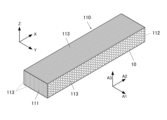
- FIG. 2 is a perspective view showing a heat transfer member according to the first embodiment of the present disclosure.
- FIG. 2 is a perspective view showing a heat transfer member according to the first embodiment of the present disclosure, and is a perspective view of a configuration excluding a protective film.
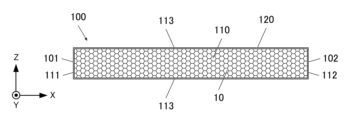
- 1B is a cross-sectional view taken along line AA in FIG. 1A.
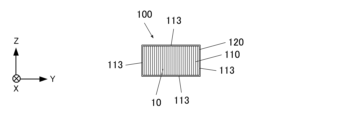
- 1B is a cross-sectional view taken along line BB in FIG. 1A.
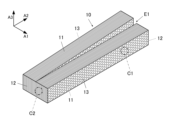
- FIG. 2 is a diagram illustrating the properties of a graphite material.
- FIG. 13 is a cross-sectional view showing a third surface of the graphite material.
- FIG. 4 is a cross-sectional view showing a second surface of the graphite block.
- FIG. 1 is a perspective view showing an electronic device incorporating a heat transfer member.
- FIG. 1 is a front view showing an electronic device incorporating a heat transfer member.
- FIG. 11 is a front view showing another example of use of the heat transfer member.
- 13A and 13B are diagrams showing another example of use of the heat transfer member, and are plan views for explaining the relationship between the heat transfer member and a heat generating component.
- FIG. 11 is a perspective view illustrating an example of a heat transfer member according to a second embodiment of the present disclosure.
- FIG. 11 is a perspective view showing an example of a heat transfer member according to a second embodiment of the present disclosure, in which a protective film is removed.
- FIG. 11 is a perspective view illustrating another example of a heat transfer member according to the second embodiment of the present disclosure.
- FIG. 11 is a perspective view showing another example of a heat transfer member according to the second embodiment of the present disclosure, in which a protective film is removed.
- FIG. 11 is a perspective view showing a heat transfer member according to a third embodiment of the present disclosure.
- FIG. 11 is a perspective view showing a heat transfer member according to a third embodiment of the present disclosure, in which a protective film is removed.
- FIG. 2 is a perspective view showing a check valve.
- FIG. 2 is an exploded perspective view showing a check valve.
- 1A to 1C are diagrams illustrating an example of a manufacturing method for a heat transfer member according to the present disclosure.
- a heat transfer member such as a heat pipe is used in a state where it is disposed in the vicinity of an electronic component, and therefore a heat transfer member that does not leak liquid is required.
- An object of the present disclosure is to provide a heat transfer member and an electronic device that do not use liquid.
- FIG. 1A and Fig. 1B are diagrams showing an example of a heat transfer member 100 according to the first embodiment of the present disclosure, Fig. 1A being a perspective view of the heat transfer member 100, and Fig. 1B being a perspective view of a substrate 110 (a perspective view of a configuration excluding a protective film 120).
- Fig. 2A is a cross-sectional view taken along line A-A in Fig. 1A
- Fig. 2B is a cross-sectional view taken along line B-B in Fig. 1A.
- Fig. 3 is a diagram for explaining properties of a graphite material 10.
- the heat transfer member 100 of the embodiment has high thermal conductivity and can rapidly transfer heat received at one end 101 to the other end 102 .
- the heat transfer member 100 may include an elongated substrate 110 extending in the X direction.
- the substrate 110 may have a first surface 111 intersecting the X direction, a second surface 112 located on the opposite side of the first surface 111, and a side surface 113 located between the first surface 111 and the second surface 112 and extending along the X direction.
- the heat transfer member 100 may further include a protective film 120 that covers the first surface 111 , the second surface 112 and the side surface 113 .
- the dimension of the base material 110 in the X direction may be longer than the dimension in the Y direction intersecting (e.g., perpendicular to) the X direction. Also, the dimension of the base material 110 in the X direction may be longer than the dimension in the Z direction intersecting (e.g., perpendicular to) the X and Y directions.
- "Elongated shape extending in the X direction" i.e., "elongated in the X direction” may mean that the dimension in the X direction is longer than the dimension in a direction intersecting (for example, perpendicular to) the X direction.
- the substrate 110 may include a graphite material 10 in the shape of a rectangular pillar.
- the graphite material 10 may have a structure in which a plurality of graphenes are stacked in the first direction A1.
- the graphene may be a sheet-like substance in which a honeycomb structure formed by bonding carbon atoms spreads in a two-dimensional direction. Adjacent graphenes may be bonded to each other by intermolecular forces, which are van der Waals forces.
- the surface of graphite material 10 may have a surface on which graphene spreads in two-dimensional directions and a surface on which a plurality of graphene layers appear.
- the surface on which graphene spreads in a two-dimensional direction is called a "crystal plane”
- the surface on which a graphene layer appears is called a “crystal layer plane.”
- the "crystal plane” is represented by a honeycomb pattern
- the "crystal layer plane” is represented by a striped pattern.
- a first direction A1 in the graphite material 10, i.e., a stacking direction of the graphene, may be parallel to the Y direction.
- a second direction A2 in the graphite material 10, i.e., one of the two-dimensional directions in which the graphene extends, may be parallel to the X direction.
- a third direction A3 in the graphite material 10, i.e., the other of the two-dimensional directions in which the graphene extends, may be parallel to the Z direction.
- Graphite material 10 may have anisotropy in its brittleness. As an example of anisotropy in its brittleness, graphite material 10 may have a tendency to cleave along a plane in which graphene extends, that is, a plane that intersects with first direction A1, as shown in FIG. 3. Cleavage means to break along a certain plane. FIG. 3 shows a state in which crack E1 has occurred due to cleavage.
- graphite material 10 may have a property that when stress is generated along the surface direction of the crystal plane, the graphene located on the crystal plane is easily peeled off. Furthermore, graphite material 10 may have a property that the edge portion E2 of the graphene (see Figures 4 and 5) is weak and is easily broken from the edge portion E2.
- the graphite material 10 may be a material whose main component is pyrolytic graphite, which may mean a volume ratio of 80% or more.
- Pyrolytic graphite may be produced as follows: First, a resin material such as polyimide is carbonized and decomposed into hydrocarbon gases. Next, the decomposed hydrocarbons are deposited and laminated. After that, a pressure annealing process is performed to produce pyrolytic graphite.
- the substrate 110 may be of a single composition, ie, including only the graphite material 10 .
- Fig. 4 is a cross-sectional view showing the third surface 13 of the graphite material 10.
- Fig. 5 is a cross-sectional view showing the second surface 12 of the graphite material 10.
- Fig. 4 shows the C1 portion of Fig. 3, and
- Fig. 5 shows the C2 portion of Fig. 3.
- the graphite material 10 may be in the shape of a rectangular parallelepiped, with two opposing faces being crystal planes and the remaining four faces being crystal layer planes.
- the surface of the graphite material 10 may include a pair of first surfaces 11 extending along a first direction A1 and a second direction A2 that intersect (e.g., perpendicular) with each other, a pair of second surfaces 12 extending along the first direction A1 and a third direction A3 that intersect (e.g., perpendicular) with each other, and a pair of third surfaces 13 extending along the second direction A2 and the third direction A3 that intersect (e.g., perpendicular) with each other.
- the two third surfaces 13 located opposite each other may be crystal planes
- the two first surfaces 11 located opposite each other and the two second surfaces 12 located opposite each other may be crystal layer planes. That is, the side surface of the graphite material 10 may include the third surfaces 13 which are crystal planes and the second surfaces 12 which are crystal layer planes.
- the third surface 13, which is a crystal plane, may be a plane extending in two directions intersecting the first direction A1.
- the two directions may be a second direction A2 and a third direction A3 that are perpendicular to the first direction A1 and perpendicular to each other.
- the second surface 12, which is a crystal layer surface may be a surface extending in the first direction A1 and the third direction A3.
- third surface 13 is a crystal plane where peeling of graphene is likely to occur, and edge portions E2 of graphene that are likely to be broken may appear.
- second surface 12 has edge portions E2 of graphene that are likely to be broken.
- first surface 11 has edge portions E2 of graphene that are likely to be broken.
- the graphite material 10 may have very high thermal conductivity in a direction along a crystal plane.
- the thermal conductivity of the graphite material 10 in the second direction A2 and the third direction A3 may be 200 W/m ⁇ K or more, while the thermal conductivity in the first direction A1 may be a value lower than the thermal conductivity in the second direction A2 or the third direction A3, such as 7 W/m ⁇ K.
- the graphite material 10 may have anisotropy in thermal conductivity.
- the thermal conductivity in the second direction A2 and the third direction A3 may be preferably 370 W/m ⁇ K or more, more preferably 450 W/m ⁇ K or more, and even more preferably 800 W/m ⁇ K or more.
- the thermal conductivity in the second direction A2 and the third direction A3 of the graphite material 10 may be 1200 W/m ⁇ K or more, more specifically, about 1700 W/m ⁇ K.
- the surface roughness of third surface 13 which is a crystal plane may be smaller than the surface roughness of first surface 11 which is a crystal layer plane.
- the surface roughness of first surface 11 may be 20 times or more, 10 times or more and less than 20 times, or 5 times or more and less than 10 times, of the surface roughness of third surface 13.
- the surface roughness refers to the arithmetic mean roughness Ra defined in JIS (Japanese Industrial Standards)_B_0601:2001. 4, the edge portion E2 of the graphene appearing on the third surface 13 is reduced. Therefore, the fragility of the third surface 13 can be reduced.
- the surface roughness of second surface 12, which is a crystal layer surface may be greater than the surface roughness of third surface 13, which is a crystal surface.
- the surface roughness of second surface 12 may be 20 times or more, 10 times or more and less than 20 times, or 5 times or more and less than 10 times, of the surface roughness of third surface 13.
- Surface roughness refers to the arithmetic mean roughness Ra described above.
- the second surface 12 includes relatively large irregularities due to the surface roughness.
- the irregularities may be fine irregularities.
- a part of the protective film 120 is located within the concave portion F1 of the irregularities of the second surface 12. Therefore, an anchor effect is produced, and the adhesion of the protective film 120 to the second surface 12 can be improved.
- the first surface 11 is also a crystal layer surface like the second surface 12, an anchor effect is produced, and the adhesion of the protective film 120 to the first surface 11 can be improved. This makes it possible to prevent the protective film 120 from peeling off from the substrate 110.
- the protective film 120 is located within the concave portion F1 of the irregularities, the thermal resistance between the protective film 120 and the graphite material 10 can be reduced compared to a configuration in which a gap is generated in the concave portion F1.
- the linear expansion coefficient of the graphite material 10 may be highly anisotropic at the first surface 11 and the second surface 12. Specifically, the linear expansion coefficient of the graphite material 10 may be 20 [10 ⁇ -6/K] or more in the first direction A1 and 0.050 [10 ⁇ -6/K] or less in the second direction A2 and the third direction A3. Furthermore, the linear expansion coefficient of the graphite material 10 may be 24 [10 ⁇ -6/K] or more in the first direction A1. Also, the linear expansion coefficient of the graphite material 10 may be a value in the range of 27 [10 ⁇ -6/K] or less in the first direction A1.
- the linear expansion coefficient of the graphite material 10 in the second direction A2 and the third direction A3 may be a negative value, specifically, may be ⁇ 0.001 [10 ⁇ -6/K] or less.
- the linear expansion coefficient of the graphite material 10 in the second direction A2 and the third direction A3 may be ⁇ 0.01 [10 ⁇ -6/K] or more.
- the protective film 120 may be a metal film, a ceramic film, or a resin film.
- the protective film 120 may be formed by thermal spraying or plating.
- the surface of the substrate 110 may be covered with a base film (e.g., a titanium film) having a thickness of 1 ⁇ m or more, and then a metal film such as aluminum or stainless steel (SUS) or a ceramic film such as alumina may be formed by thermal spraying as the protective film 120.
- a base film e.g., a titanium film
- a metal film such as aluminum or stainless steel (SUS) or a ceramic film such as alumina
- the surface of the base material 110 may be covered with a base film (e.g., a nickel film) having a thickness of 1 ⁇ m or more, and then a metal film such as copper or gold may be formed by plating as the protective film 120.
- the protective film 120 may include a base film.
- the metal film By using the metal film, it is possible to realize the protective film 120 having high thermal conductivity, which can contribute to efficient heat transfer performance of the heat transfer member 100. Furthermore, when the heat transfer member 100 is required to have electrical conductivity, this requirement can be met. By employing a ceramic film or a resin film, when the heat transfer member 100 is required to have insulating properties, this requirement can be met.
- the thermal conductivity of the protective film 120 may be highly isotropic compared to the graphite material 10.
- the thermal conductivity of the protective film 120 may be higher than the thermal conductivity of the graphite material 10 in the first direction A1. This configuration provides an effect of dispersing heat in the first direction A1 via the protective film 120 at the first surface 11 and the second surface 12. Therefore, by adding this dispersion effect, it is possible to achieve more efficient heat transfer performance of the heat transfer member 100.
- the surface of the substrate 110 may have one first surface 111 , one second surface 112 , and four side surfaces 113 .
- one second surface 12 may correspond to first face 111 of substrate 110
- the other second surface 12 may correspond to second face 112 of substrate 110.
- the pair of first surfaces 11 and the pair of third surfaces 13 in graphite material 10 may correspond to side faces 113 of substrate 110.
- the entire surface of the substrate 110 may be covered with the protective film 120.
- This configuration can prevent the protective film 120 from peeling off.
- the edges of the protective film 120 are more likely to peel off than other parts. Therefore, by covering the entire surface of the substrate 110 with the protective film 120 and reducing (e.g. eliminating) the edges of the protective film 120, peeling of the protective film 120 can be prevented. Furthermore, by covering the entire surface of the substrate 110 with the protective film 120, the complexity of the process of forming the protective film 120 can be reduced.
- the protective film 120 covering a portion of the surface of the base material 110 and the protective film 120 covering the remaining portion may be made of the same material or different materials. Specifically, a metal film may be used as the protective film 120 that covers the entire surface of the base material 110 . Alternatively, a metal film may be used as protective film 120 covering a portion of the surface of base material 110, and a ceramic film or resin film may be used as protective film 120 covering the remaining portion.
- 6A and 6B are diagrams showing an example of an electronic device 300 incorporating the heat transfer member 100, where Fig. 6A is a perspective view and Fig. 6B is a front view.
- the heat transfer member 100 may be replaced with the heat transfer members 100A, 100B, and 100C of the second and third embodiments described later.
- the electronic device 300 may include a heat transfer member 100, a heat generating component 310 thermally connected to a first connection portion 160 of the heat transfer member 100, and a cooling component 320 thermally connected to a second connection portion 170 of the heat transfer member 100.
- the cooling component 320 is shown by a dashed line
- the first connection portion 160 is shown by a thick dashed line
- the second connection portion 170 is hatched.
- the first connection portion 160 may be provided on one side in the X direction of the heat transfer member 100 (for example, the side of one end portion 101).
- the first connection portion 160 may be a region of the base material 110 to which a heat generating component 310 such as an electronic element is connected.
- the first connection portion 160 may be connected to the heat generating component 310 such as an electronic element via the protective film 120.
- the second connection portion 170 may be provided on the other side in the X direction (e.g., the other end portion 102 side) of the first connection portion 160.
- the second connection portion 170 may be a region of the base material 110 to which a cooling component 320 such as a cooling fin is connected.
- the second connection portion 170 may be connected to the cooling component 320 such as a cooling fin via the protective film 120.
- "connected" may include a state of contact.
- a material with high thermal conductivity such as a metal film, may be applied to the protective film 120 covering the first connection portion 160.
- a material having high thermal conductivity such as a metal film, may be applied to the protective film 120 that covers the second connection portion 170.
- the protective film 120 (first protective film) that protects the first connecting portion 160 and the second connecting portion 170 may be a metal film.
- the protective film 120 (second protective film) that protects the area other than the first connecting portion 160 and the second connecting portion 170 may be a ceramic film or a resin film. Since the first connection portion 160 and the second connection portion 170 contact the heat-generating component 310 and the cooling component 320, respectively, the protective film 120 (first protective film) covering the first connection portion 160 and the second connection portion 170 is not exposed within the electronic device 300.
- the areas of the base material 110 other than the first connection portion 160 and the second connection portion 170 do not come into contact with the heat generating component 310 or the cooling component 320. Therefore, the protective film 120 (second protective film) covering the areas other than the first connection portion 160 and the second connection portion 170 is exposed in the electronic device 300 and may come into contact with other electronic components. Therefore, even in a usage state where electrical insulation between other electronic components and the heat transfer member 100 is required, by using a ceramic film or a resin film as the protective film 120 (second protective film) covering the areas other than the first connection portion 160 and the second connection portion 170, it is possible to avoid problems such as malfunction of the other electronic components even if they come into contact with the other electronic components.
- the heat transfer member 100 may have one first connection portion 160, or may have a plurality of first connection portions 160. When the heat transfer member 100 has a plurality of first connection portions 160, all of the plurality of first connection portions 160 may be located on one side (e.g., the one end portion 101 side) of the second connection portion 170 in the X direction. 6A and 6B , the heat transfer member 100 may have one second connection portion 170, or may have a plurality of second connection portions 170. When the heat transfer member 100 has a plurality of second connection portions 170, all of the plurality of second connection portions 170 may be located on the other side in the X direction (e.g., the other end portion 102 side) of the first connection portion 160.
- the electronic device 300 may include a fan 330 for ventilating the inside of the electronic device 300 .
- the electronic device 300 may include a heat transfer plate 340 located between the heat generating component 310 and the heat transfer member 100.
- the heat transfer plate 340 may be made of a metal material such as copper or aluminum. With this configuration, the heat of the heat generating component 310 can be quickly conducted to the heat transfer member 100 via the heat transfer plate 340.
- the heat transfer member 100 may be in direct contact with the heat generating component 310.
- the heat of the heat-generating component 310 is first transferred to the first connection portion 160 of the heat transfer member 100 via the heat transfer plate 340.
- the heat transferred to the first connection portion 160 is transferred to the second connection portion 170 of the heat transfer member 100 via the base material 110 of the heat transfer member 100 (specifically, the portion of the base material 110 between the first connection portion 160 and the second connection portion 170).
- the heat transferred to the second connection portion 170 is then transferred to the cooling component 320 in contact with the second connection portion 170, and is released from the cooling component 320.
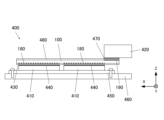
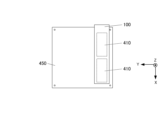
- FIGS. 7A and 7B are diagrams showing another example of use of the heat transfer member 100, where Fig. 7A is a front view and Fig. 7B is a plan view for explaining the relationship between the heat transfer member 100 and a heat generating component 410.
- the heat transfer member 100 may be replaced with the heat transfer members 100A and 100B of the second embodiment described later.
- the graphite material 10 may have a lower thermal conductivity in the first direction A1 than the thermal conductivity in the second direction A2 or the third direction A3. That is, the heat transfer member 100 may have a lower thermal conductivity in the Y direction than the thermal conductivity in the X direction or the Z direction.
- the heat transfer member 100 may be a member that can quickly transfer heat received at one side in the X direction (e.g., one end 101 side) to the other side in the X direction (e.g., the other end 102 side).
- the heat transfer member 100 may be a member that can quickly transfer heat received at one side in the Z direction (e.g., the lower surface) to the other side in the Z direction (e.g., the upper surface).
- the electronic device 300 shown in FIGS. 6A and 6B is a device that utilizes the ability of the heat transfer member 100 to quickly transfer heat received on one side in the X direction to the other side in the X direction.
- the electronic device 400 shown in FIGS. 7A and 7B is a device that utilizes the ability of the heat transfer member 100 to quickly transfer heat received on one side in the Z direction to the other side in the Z direction.
- the 7A and 7B may include a heat transfer member 100, a heat generating component 410 thermally connected to a first connecting portion 180 of the heat transfer member 100, and a cooling component 420 thermally connected to a second connecting portion 190 of the heat transfer member 100.
- the first connecting portion 180 is indicated by a thick dashed line
- the second connecting portion 190 is indicated by a thick line.
- the electronic device 400 may include a plurality of heat-generating components 410. That is, the heat-transfer member 100 may have a plurality of first connection portions 180.
- the first connection portion 180 may be provided on one side (e.g., the lower surface) in the Z direction of the heat transfer member 100.
- the first connection portion 180 may be a region of the base material 110 to which a heat generating component 410 such as an electronic element is connected (contacted).
- the first connection portion 180 may be connected (contacted) to the heat generating component 410 such as an electronic element via the protective film 120.
- the second connection portion 190 may be provided on the other side in the Z direction than the first connection portion 180 (for example, on the upper surface of the heat transfer member 100).
- the second connection portion 190 may be a region of the base material 110 to which the cooling component 420 is connected (contacted).
- the second connection portion 190 may be connected (contacted) with the cooling component 420 via the protective film 120.
- a material with high thermal conductivity such as a metal film
- a material with high thermal conductivity may be applied to the protective film 120 covering the first connection portion 180.
- the protective film 120 that protects the first connecting portion 180 and the second connecting portion 190 may be a metal film.
- the protective film 120 (second protective film) that protects the region other than the first connecting portion 180 and the second connecting portion 190 may be a ceramic film or a resin film.
- the heat transfer member 100 may have one first connection portion 180, or may have a plurality of first connection portions 180. When the heat transfer member 100 has a plurality of first connection portions 180, all of the plurality of first connection portions 180 may be located on one side (e.g., the lower surface side) of the second connection portion 190 in the Z direction. 7A and 7B , the heat transfer member 100 may have one second connection portion 190, or may have a plurality of second connection portions 190. When the heat transfer member 100 has a plurality of second connection portions 190, all of the plurality of second connection portions 190 may be located on the other side (e.g., the upper surface side) of the first connection portion 180 in the Z direction.
- the electronic device 400 may include a first heat transfer plate 430 located between the heat generating component 410 and the heat transfer member 100.
- the first heat transfer plate 430 may be made of a metal material such as copper or aluminum. This configuration allows the heat of the heat generating component 410 to be rapidly transferred to the heat transfer member 100 via the first heat transfer plate 430. Furthermore, this configuration allows the heat, when applied to a part of the first heat transfer plate 430, to be isotropically dispersed by the first heat transfer plate 430 and then transferred to the heat transfer member 100.
- the heat transfer member 100 may be in direct contact with the heat generating component 410 (without going through the first heat transfer plate 430).
- the heat generating component 410 may be connected to the first connection portion 180 via a bonding material 440.
- the bonding material 440 may be solder. This configuration can reduce the inhibition of heat conduction caused by the bonding material 440.
- the bonding material 440 may be a thermally conductive adhesive, a thermally conductive filler (grease, etc.), or the like.
- the bonding material 440 may be a silicon-based adhesive. This configuration can ensure insulation between the heat generating component 410, such as an electronic element, and the heat transfer member 100.
- Heat generating components 410 such as electronic elements may be mounted on a printed circuit board 450.
- the printed circuit board 450 may be screwed to a housing 460 such as a metal housing.
- the cooling component 420 may be connected to the second connection portion 190 via a bonding material 470.
- the bonding material 470 may be solder. With this configuration, it is possible to reduce the inhibition of heat conduction caused by the bonding material 470.
- the bonding material 470 may be a thermally conductive adhesive, a thermally conductive filler (grease, etc.), or the like.
- the bonding material 470 may be the same as the bonding material 440, or may be different from the bonding material 440.
- the electronic device 400 may include a second heat transfer plate 480 located between the cooling component 420 and the heat transfer member 100.
- the second heat transfer plate 480 may be made of a metal material such as copper or aluminum. With this configuration, the heat of the heat transfer member 100 can be quickly conducted to the cooling component 420 via the second heat transfer plate 480.
- the heat transfer member 100 may be in direct contact with the cooling component 420 (without going through the second heat transfer plate 480).
- heat from the heat-generating component 410 is first transferred to the first connection portion 180 of the heat transfer member 100 via the first heat transfer plate 430.
- the heat transferred to the first connection portion 180 is transferred to the second connection portion 190 of the heat transfer member 100 via the base material 110 of the heat transfer member 100 (specifically, a portion of the base material 110 between the first connection portion 180 and the second connection portion 190).
- the heat transferred to the second connection portion 190 is then transferred to the cooling component 420 in contact with the second connection portion 190 via the second heat transfer plate 480, and is released from the cooling component 420.
- the electronic device 400 may include a heat transfer material such as a heat transfer sheet located between the cooling component 420 and the second heat transfer plate 480.
- the heat transfer member 100 may be in contact with the cooling component 420 via the second heat transfer plate 480 and the heat transfer material.
- the heat transfer member 100 may be in contact with the heat transfer material without the second heat transfer plate 480.
- the bonding material 470 may be omitted.
- the cooling of the electronic device 300 does not have to be forced air cooling by the fan 330, and may be natural air cooling, for example. Furthermore, the cooling of the electronic device 400 does not have to be by cooling the housing, and may be forced cooling using, for example, a Peltier element. Further, as the heat source (heat generating components 310, 410), various heat sources such as heat dissipation members, heaters for heating, etc., in addition to electronic elements such as semiconductor elements can be used. In this way, the heat transfer member 100 can be used as a substitute for a heat pipe. Moreover, unlike a heat pipe, the heat transfer member 100 does not use liquid.
- the heat transfer member 100 does not use liquid, so it is possible to suppress the cooling effect from decreasing due to the influence of inertia force. Furthermore, the heat transfer member 100 is lighter than a heat pipe that uses liquid (working fluid), so it is also suitable for mounting on airplanes, rockets, electric cars, etc.
- FIGS. 8A and 8B are diagrams showing an example of a heat transfer member 100A according to embodiment 2 of the present disclosure, where FIG. 8A is an oblique view of the heat transfer member 100A and FIG. 8B is an oblique view of the substrate 110A (a perspective view of the configuration excluding the protective film 120).
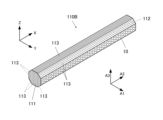
- FIG. 9A and 9B are diagrams showing an example of a heat transfer member 100B according to embodiment 2 of the present disclosure, where FIG. 9A is an oblique view of the heat transfer member 100B and FIG. 9B is an oblique view of the substrate 110B (a perspective view of the configuration excluding the protective film 120).
- Heat transfer members 100A and 100B of the second embodiment differ from those of the first embodiment in the configurations of base materials 110A and 110B (specifically, the shape of graphite material 10), but may have other configurations similar to those of the first embodiment. The differences will be described in detail below.
- the heat transfer member 100A may include a long substrate 110A extending in the X direction.
- the substrate 110A may include a cylindrical graphite material 10 instead of the quadrangular columnar graphite material 10.
- heat transfer member 100B may include elongated substrate 110B extending in the X direction.
- Substrate 110B may include graphite material 10 in the shape of a polygonal column other than a quadrangular column, instead of graphite material 10 in the shape of a quadrangular column.
- Substrate 110B shown in FIG. 9B includes graphite material 10 in the shape of an octagonal column.
- the substrates 110A, 110B may be of a single composition, i.e., comprise only the graphite material 10.
- the shape of the bottom surface may be changed as appropriate. That is, the heat transfer members 100, 100A, and 100B may be columnar (rod-shaped) members whose bottom surfaces are in a direction intersecting (for example, perpendicular to) the X direction.
- FIG. 10A and 10B are diagrams showing an example of a heat transfer member 100C according to embodiment 3 of the present disclosure, where FIG. 10A is an oblique view of the heat transfer member 100C and FIG. 10B is an oblique view of the substrate 110C (a perspective view of the configuration excluding the protective film 120).
- the heat transfer member 100C of the third embodiment differs from the first and second embodiments in the configuration of the base material 110C (specifically, in that it is provided with the backflow heat prevention structure 20), but the other configurations may be the same as those of the first and second embodiments. The differences will be described in detail below.
- the heat transfer member 100C may include an elongated substrate 110C extending in the X direction.
- the substrate 110C may include a plurality of graphite materials 10C and a backflow heat prevention structure 20 located between the graphite materials 10C.
- the substrate 110C may include a plurality of (e.g., two) backflow heat prevention structures 20.
- the multiple graphite materials 10C may be arranged in parallel in the X direction with one of the second direction A2 and the third direction A3, in which the thermal conductivity is high (for example, the second direction A2), being parallel to the X direction.
- the graphite material 10C adjacent to the backflow heat prevention structure 20 on the other end 102 side may have a groove portion 16 on the second surface 12 on the other end 102 side extending along one of the two directions intersecting the second direction A2 (e.g., the third direction A3).
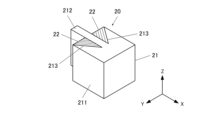
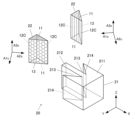
- FIG. 11A and 11B are diagrams showing an example of a backflow heat prevention structure 20, where FIG. 11A is a perspective view of the backflow heat prevention structure 20 and FIG. 11B is an exploded perspective view of the backflow heat prevention structure 20.
- the backflow heat prevention structure 20 is a member for preventing the backflow of heat in the heat transfer member 100C.
- the heat transfer member 100C is a member that can quickly transfer heat received at one end 101 to the other end 102.
- the backflow of heat refers to the movement of heat from the other end 102 side to the one end 101 side.
- the backflow heat prevention structure 20 may include a first member 21 that stores heat from the adjacent graphite material 10C on the one end 101 side, and a second member 22 that prevents heat from returning to the adjacent graphite material 10C on the one end 101 side.
- the first member 21 may be made of a metal material, such as copper or aluminum, that has a larger heat capacity than the graphite material 10. With this configuration, the heat from the adjacent graphite material 10C on the one end 101 side can be efficiently stored. First member 21 may have protrusion 212 that fits into groove 16 of adjacent graphite material 10C on the one end 101 side. With this configuration, heat from adjacent graphite material 10C on the one end 101 side can be efficiently guided to main body 211 of first member 21.
- the first member 21 may have a groove 213 extending along one of two directions intersecting with the X direction (for example, the Z direction) on the surface of the main body 211 on the side of the one end 101 .
- a plurality of (for example, two) grooves 213 may be provided.
- the protrusions 212 may protrude from between the grooves 213.
- the groove portion 213 may be defined by a groove wall surface formed from the one end portion 101 side toward the other end portion 102 side.
- the groove wall surface may include an inclined surface 214 inclined in two directions (e.g., the X direction and the Y direction) intersecting the extension direction of the groove portion 213.
- the groove portion 213 may have a triangular shape in a plan view.
- the second member 22 may have a structure similar to that of the graphite materials 10 and 10C. That is, the second member 22 may have a structure in which a plurality of graphenes are stacked in the first direction A1c. In other words, the second member 22 may have a lower thermal conductivity in the first direction A1c than the thermal conductivity in the second direction A2c or the third direction A3c.
- the surface of the second member 22 may include a first surface 11 (crystal layer surface) that intersects with the third direction A3c having high thermal conductivity, a second surface 12C (crystal layer surface) that intersects with the second direction A2c having high thermal conductivity, and a third surface 13 (crystal surface) that intersects with the first direction A1c having low thermal conductivity.
- the second member 22 may have a shape that fits into the groove portion 213 of the first member 21 .
- third surface 13 (crystal face) of second member 22 may be in contact with first member 21.
- the configuration in which third surface 13 is in contact with first member 21 can suppress heat transfer from first member 21 to second member 22 compared to the configuration in which only surfaces other than third surface 13 (first surface 11, second surface 12C) are in contact with first member 21. As a result, it is possible to efficiently suppress heat from returning to adjacent graphite material 10C on the one end 101 side.
- the third surface 13 of the second member 22 may be in contact with the inclined surface 214 of the first member 21.
- the surface with the largest area among these multiple surfaces may be the third surface 13. This configuration can more efficiently prevent heat from returning to the adjacent graphite material 10C on the one end 101 side.
- the surface of the second member 22 may include two second surfaces 12C. Furthermore, one of the two second surfaces 12C may be in contact with the adjacent graphite material 10C on the one end 101 side, and the other second surface 12C may be in contact with the first member 21. With this configuration, heat moves from the adjacent graphite material 10C on the one end 101 side to the first member 21 via the second member 22, i.e., along the second direction A2c in which the thermal conductivity is high, so that the heat of the adjacent graphite material 10C on the one end 101 side can be efficiently guided to the first member 21. Further, second surface 12C in contact with first member 21 may be in contact with the heat conduction path from protruding portion 212 to main body portion 211. With this configuration, heat can be concentrated in the heat conduction path from protruding portion 212 to main body portion 211, so that heat of adjacent graphite material 10C on the one end portion 101 side can be efficiently guided to main body portion 211.
- the bonding material for bonding the first member 21 and the second member 22 may be a brazing material or a solder. This configuration can reduce the inhibition of heat conduction caused by the bonding material. In addition, when a brazing material or a solder is used as the bonding material, the thickness can be made thinner than when a resin bonding material is used.
- the bonding material for bonding the first member 21 and the second member 22 may be a thermally conductive adhesive, a thermally conductive filler (grease, etc.), or the like.
- a brazing material or solder may be used as a bonding material for bonding the graphite material 10C and the backflow heat prevention structure 20. This configuration can reduce the inhibition of heat conduction caused by the bonding material.
- the bonding material for bonding the graphite material 10C and the backflow heat prevention structure 20 may be a thermally conductive adhesive, a thermally conductive filler (grease, etc.), or the like.
- the heat is transferred from the graphite material 10C located closest to the one end 101 to the backflow heat prevention structure 20 adjacent to the graphite material 10C, and accumulates in the first member 21 of the backflow heat prevention structure 20.
- the heat accumulated in the backflow heat prevention structure 20 is absorbed by the next graphite material 10C, transferred to the next backflow heat prevention structure 20, and accumulates in the first member 21 of the next backflow heat prevention structure 20.
- the heat accumulated in the next backflow heat prevention structure 20 is then absorbed by the graphite material 10C located closest to the other end 102, and released from the graphite material 10C.
- the first connection portion 160 may be set so that the graphite material 10C located closest to the one end portion 101 is thermally connected to the heat generating component 310.
- the second connection portion 170 may be set so that the graphite material 10C located closest to the other end portion 102 is thermally connected to the cooling component 320.
- the base material 110C in one embodiment has a rectangular prism shape, but is not limited thereto.
- the shape of the bottom surface (first surface 111 and second surface 112) may be changed as appropriate.
- the shapes of the graphite material 10 and the backflow heat prevention structure 20 may be changed appropriately and arbitrarily in accordance with the shape of the base material 110C. That is, the heat transfer member 100C may be a columnar (rod-shaped) member whose bottom surface is in a direction intersecting (for example, perpendicular to) the X direction.
- ⁇ Production Method> 12A and 12B are diagrams illustrating an example of a method for manufacturing a heat transfer member. The following describes a method for manufacturing a heat transfer member 100A according to embodiment 2. The method includes a cutting step J1, a grinding step J2, and a plating step J3.
- graphite unit 501 is cut using a processing machine such as a wire saw to produce multiple graphite materials 501u.
- Graphite unit 501 generally has two crystal planes, and the dimensions of the crystal planes are greater than the dimensions in the direction perpendicular to the crystal planes. Cut graphite material 501u may be cut so that the minimum width of the crystal planes is smaller than the minimum width of the cut surface (i.e., the crystal layer surface).
- the quadrangular columnar graphite material 501u is ground into a cylindrical shape using a grindstone or the like to produce the base material 110A of the heat transfer member 100A.
- plating is applied to the surface of the base material 110A.
- the plating layer becomes the protective film 120.
- a thermal spraying step may be performed to form the protective film 120.
- the heat transfer member 100A is manufactured by the above-mentioned steps J1 to J3.
- the heat transfer member and electronic device of the present disclosure are not limited to the heat transfer members 100, 100A, 100B, and 100C and the electronic devices 300 and 400 of the above-described embodiments.
- the details shown in the embodiments can be appropriately changed without departing from the spirit of the invention. According to the present disclosure, a heat transfer member and an electronic device that do not use liquid are provided.
- the heat transfer member is The substrate has an elongated shape extending in the X direction,
- the substrate is A graphite material having a higher thermal conductivity in the X direction than in a Y direction intersecting the X direction,
- a first connection portion is provided on one side in the X direction, the first connection portion being a region to which a heat generating component is connected,
- On the other side in the X direction there is a second connection portion which is a region to which a cooling component is connected.
- the heat transfer member is The substrate has an elongated shape extending in the X direction,
- the substrate is A graphite material having a higher thermal conductivity in a Z direction intersecting the X direction and the Y direction than in a Y direction intersecting the X direction,
- a first connection portion is provided on one side in the Z direction, which is a region to which a heat generating component is connected,
- On the other side in the Z direction there is a second connection portion which is an area to which a cooling component is connected.
- the heat transfer member according to (1) or (2) above The substrate has a plurality of the first connection portions.
- a protective film is provided to cover the surface of the base material.
- the heat transfer member of (4) above is
- the protective film is a metal film.
- the protective film includes a first protective film that protects the first connection portion and the second connection portion, and a second protective film that protects a region of a surface of the base material other than the first connection portion and the second connection portion, the first protective film is a metal film, The second protective film is a ceramic film or a resin film.
- the substrate is A plurality of the graphite materials arranged in parallel in the X direction; and a check valve located between the graphite members to prevent a backflow of heat.
- the electronic device is A heat transfer member according to any one of (1) to (7), A heat generating component connected to the first connection portion; A cooling component connected to the second connection portion; Equipped with.
- This disclosure can be used as a heat transfer member and electronic device.
- Backflow heat prevention structure (backflow prevention valve) 100, 100A, 100B, 100C Heat transfer member 110, 110A, 110B, 110C Substrate 120 Protective film 160, 180 First connection portion 170, 190 Second connection portion 300, 400 Electronic device 310, 410 Heat generating component 320, 420 Cooling component
Landscapes
- Physics & Mathematics (AREA)
- Thermal Sciences (AREA)
- Engineering & Computer Science (AREA)
- Microelectronics & Electronic Packaging (AREA)
- Cooling Or The Like Of Semiconductors Or Solid State Devices (AREA)
- Cooling Or The Like Of Electrical Apparatus (AREA)
Priority Applications (1)
| Application Number | Priority Date | Filing Date | Title |
|---|---|---|---|
| JP2025535821A JPWO2025023220A1 (https=) | 2023-07-25 | 2024-07-22 |
Applications Claiming Priority (2)
| Application Number | Priority Date | Filing Date | Title |
|---|---|---|---|
| JP2023120383 | 2023-07-25 | ||
| JP2023-120383 | 2023-07-25 |
Publications (1)
| Publication Number | Publication Date |
|---|---|
| WO2025023220A1 true WO2025023220A1 (ja) | 2025-01-30 |
Family
ID=94375292
Family Applications (1)
| Application Number | Title | Priority Date | Filing Date |
|---|---|---|---|
| PCT/JP2024/026178 Pending WO2025023220A1 (ja) | 2023-07-25 | 2024-07-22 | 伝熱部材及び電子装置 |
Country Status (3)
| Country | Link |
|---|---|
| JP (1) | JPWO2025023220A1 (https=) |
| TW (1) | TW202527296A (https=) |
| WO (1) | WO2025023220A1 (https=) |
Citations (5)
| Publication number | Priority date | Publication date | Assignee | Title |
|---|---|---|---|---|
| WO2008087373A2 (en) * | 2007-01-17 | 2008-07-24 | Queen Mary & Westfield College | Structures with improved properties |
| JP2012141093A (ja) * | 2010-12-28 | 2012-07-26 | Orbital Engineering Inc | 中熱伝導デバイス |
| JP2014022479A (ja) * | 2012-07-16 | 2014-02-03 | Nippon Soken Inc | 熱拡散装置 |
| WO2016098890A1 (ja) * | 2014-12-18 | 2016-06-23 | 株式会社カネカ | グラファイト積層体、グラファイト積層体の製造方法、熱輸送用構造物およびロッド状の熱輸送体 |
| WO2018074493A1 (ja) * | 2016-10-19 | 2018-04-26 | 株式会社インキュベーション・アライアンス | 黒鉛/グラフェン複合材、集熱体、伝熱体、放熱体および放熱システム |
-
2024
- 2024-07-22 WO PCT/JP2024/026178 patent/WO2025023220A1/ja active Pending
- 2024-07-22 JP JP2025535821A patent/JPWO2025023220A1/ja active Pending
- 2024-07-23 TW TW113127585A patent/TW202527296A/zh unknown
Patent Citations (5)
| Publication number | Priority date | Publication date | Assignee | Title |
|---|---|---|---|---|
| WO2008087373A2 (en) * | 2007-01-17 | 2008-07-24 | Queen Mary & Westfield College | Structures with improved properties |
| JP2012141093A (ja) * | 2010-12-28 | 2012-07-26 | Orbital Engineering Inc | 中熱伝導デバイス |
| JP2014022479A (ja) * | 2012-07-16 | 2014-02-03 | Nippon Soken Inc | 熱拡散装置 |
| WO2016098890A1 (ja) * | 2014-12-18 | 2016-06-23 | 株式会社カネカ | グラファイト積層体、グラファイト積層体の製造方法、熱輸送用構造物およびロッド状の熱輸送体 |
| WO2018074493A1 (ja) * | 2016-10-19 | 2018-04-26 | 株式会社インキュベーション・アライアンス | 黒鉛/グラフェン複合材、集熱体、伝熱体、放熱体および放熱システム |
Also Published As
| Publication number | Publication date |
|---|---|
| JPWO2025023220A1 (https=) | 2025-01-30 |
| TW202527296A (zh) | 2025-07-01 |
Similar Documents
| Publication | Publication Date | Title |
|---|---|---|
| CN103547441B (zh) | 高导热性/低热膨胀系数的复合物 | |
| US20100326645A1 (en) | Thermal pyrolytic graphite laminates with vias | |
| EP2196075B1 (en) | Layered heat spreader and method of making the same | |
| JP5384522B2 (ja) | ヒートシンク、および楔係止システムを用いたヒートシンク形成方法 | |
| US20070053168A1 (en) | Advanced heat sinks and thermal spreaders | |
| JP2010511289A (ja) | 一体型熱バイアを有する発光ダイオード | |
| US7859848B1 (en) | Heat spreader and method of making the same | |
| US11495519B2 (en) | Apparatus for thermal management of electronic components | |
| WO2024203810A1 (ja) | 伝熱部材及び電子装置 | |
| JP2005210035A (ja) | グラファイト複合材 | |
| JP7231921B2 (ja) | 熱伝導構造体、熱拡散装置 | |
| WO2025023220A1 (ja) | 伝熱部材及び電子装置 | |
| JP5367287B2 (ja) | 伝熱部品および電子機器 | |
| JP2006261505A (ja) | 絶縁伝熱シート | |
| WO2025023237A1 (ja) | 放熱部材及び電子装置 | |
| JP7442043B2 (ja) | 熱伝導シートおよびこれを用いた電子機器 | |
| CN113889442A (zh) | 导热件、单板、计算设备及制造方法 | |
| WO2025023225A1 (ja) | 基板ユニット及び電子装置 | |
| JP7574585B2 (ja) | 放熱構造体 | |
| WO2025023230A1 (ja) | 放熱構造及び基板ユニット | |
| JP2025118118A (ja) | 伝熱部材および電子装置 | |
| WO2025146813A1 (ja) | 伝熱部材および電子装置 | |
| JPWO2025023225A5 (https=) | ||
| JP2025106792A (ja) | 伝熱部材および電子装置 | |
| CN119486042A (zh) | 电子设备及导热垫片 |
Legal Events
| Date | Code | Title | Description |
|---|---|---|---|
| 121 | Ep: the epo has been informed by wipo that ep was designated in this application |
Ref document number: 24845596 Country of ref document: EP Kind code of ref document: A1 |
|
| ENP | Entry into the national phase |
Ref document number: 2025535821 Country of ref document: JP Kind code of ref document: A |
|
| WWE | Wipo information: entry into national phase |
Ref document number: 2025535821 Country of ref document: JP |
|
| NENP | Non-entry into the national phase |
Ref country code: DE |