WO2025022710A1 - Acdcコンバータ - Google Patents
Acdcコンバータ Download PDFInfo
- Publication number
- WO2025022710A1 WO2025022710A1 PCT/JP2024/009446 JP2024009446W WO2025022710A1 WO 2025022710 A1 WO2025022710 A1 WO 2025022710A1 JP 2024009446 W JP2024009446 W JP 2024009446W WO 2025022710 A1 WO2025022710 A1 WO 2025022710A1
- Authority
- WO
- WIPO (PCT)
- Prior art keywords
- rectifier circuit
- coil
- inductor
- transformer
- circuit
- Prior art date
- Legal status (The legal status is an assumption and is not a legal conclusion. Google has not performed a legal analysis and makes no representation as to the accuracy of the status listed.)
- Pending
Links
Images



Classifications
-
- H—ELECTRICITY
- H02—GENERATION; CONVERSION OR DISTRIBUTION OF ELECTRIC POWER
- H02M—APPARATUS FOR CONVERSION BETWEEN AC AND AC, BETWEEN AC AND DC, OR BETWEEN DC AND DC, AND FOR USE WITH MAINS OR SIMILAR POWER SUPPLY SYSTEMS; CONVERSION OF DC OR AC INPUT POWER INTO SURGE OUTPUT POWER; CONTROL OR REGULATION THEREOF
- H02M7/00—Conversion of AC power input into DC power output; Conversion of DC power input into AC power output
- H02M7/02—Conversion of AC power input into DC power output without possibility of reversal
- H02M7/04—Conversion of AC power input into DC power output without possibility of reversal by static converters
- H02M7/12—Conversion of AC power input into DC power output without possibility of reversal by static converters using discharge tubes with control electrode or semiconductor devices with control electrode
Definitions
- the present invention relates to an AC-DC converter.
- Patent document 1 describes a charging device.
- the charging device in patent document 1 includes a non-isolated converter with a power factor correction function and an isolated converter.
- the input terminal of the non-isolated converter with power factor correction is connected to the AC power source.
- the output terminal of the non-isolated converter with power factor correction is connected to the isolated converter.
- the output of the isolated converter is connected to the battery.
- Non-isolated converters with power factor correction function generate a specified output voltage while improving the power factor of the input current.
- Isolation transformer isolated converters receive DC power from the non-isolated converter and convert the voltage using a transformer.
- a rectifier circuit is connected to the secondary winding of the transformer.
- the rectifier circuit is made up of multiple diodes and rectifies the output of the secondary winding of the transformer.
- Patent Document 1 when a three-phase AC input power source is used, the output current becomes large, and the loss occurring in the rectifier element of the rectifier circuit in the secondary circuit of the transformer of the isolated converter can become large.
- the present invention aims to realize an AC-DC converter that can suppress losses even when the output current is large.
- the AC-DC converter of the present invention comprises a power conversion circuit, an isolation transformer, a first rectifier circuit, and a second rectifier circuit.
- the power conversion circuit is connected to a three-phase AC power supply and outputs a primary current.
- the isolation transformer comprises a primary coil connected to the output side of the power conversion circuit, and a first secondary coil and a second secondary coil coupled to the primary coil.
- the isolation transformer receives the primary current as input and outputs a first secondary current and a second secondary current.
- the first rectifier circuit is connected to the first secondary coil and rectifies the first secondary current.
- the second rectifier circuit is connected to the second secondary coil and rectifies the second secondary current.
- the first rectifier circuit and the second rectifier circuit are connected in parallel.
- the output current is the sum of the first secondary side current and the second secondary side current. Therefore, the first secondary side current and the second secondary side current are smaller to obtain the desired output current than when only one rectifier circuit is provided. This suppresses losses in the rectifier circuit.
- a large output current is required, such as when a three-phase AC power supply is used as input, the current flowing through the rectifier circuit becomes large. Therefore, losses in the rectifier circuit tend to be large, but this configuration effectively suppresses these losses.
- the AC-DC converter of this invention can suppress losses even when the output current is large.
- FIG. 1 is a circuit diagram of an AC-DC converter according to a first embodiment.
- FIG. 2 is a circuit diagram of an AC-DC converter according to the second embodiment.
- FIG. 3 is a circuit diagram of a rectifier circuit on the secondary side of an isolation transformer of an AC-DC converter according to the second embodiment.
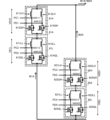
- 4A and 4B are diagrams showing the configuration of a circuit module that realizes a circuit from an isolation transformer to an output terminal side in an AC-DC converter according to the second embodiment.
- FIG. 5 is a diagram showing an example of a wiring pattern of each rectifier circuit.
- FIG. 6 is a circuit diagram of an AC-DC converter according to the third embodiment.
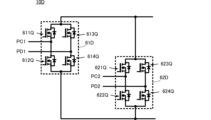
- FIG. 7 is a circuit diagram of a rectifier circuit portion of an AC-DC converter according to the fourth embodiment.
- FIG. 8 is a circuit diagram of a rectifier circuit portion of an AC-DC converter according to the fifth embodiment.
- FIG. 9 is a circuit diagram of an AC-DC converter according to the sixth embodiment.
- Fig. 1 is a circuit diagram of the AC-DC converter according to the first embodiment.
- “same” includes manufacturing errors and characteristic errors.
- the ACDC converter 10 includes an input filter circuit 20, a power conversion circuit 30, a resonant inductor 40, an isolation transformer 50, a rectifier circuit 61, a rectifier circuit 62, and a smoothing capacitor Co.
- the rectifier circuit 61 corresponds to the "first rectifier circuit”
- the rectifier circuit 62 corresponds to the "second rectifier circuit.”
- An input terminal of the input filter circuit 20 is connected to an output terminal of the three-phase AC power supply.
- An output terminal of the input filter circuit 20 is connected to an input terminal of the power conversion circuit 30.
- An output terminal of the power conversion circuit 30 is connected to a series circuit of a resonant inductor 40 and a primary coil 51 of an isolation transformer 50.
- the isolation transformer 50 includes a secondary coil 521 and a secondary coil 522.
- the secondary coil 521 and the secondary coil 522 are coupled to the primary coil 51 with the same degree of coupling and the same turns ratio.
- the secondary coil 521 corresponds to the "secondary first coil” and the secondary coil 522 corresponds to the "secondary second coil.”
- the output terminal of the secondary coil 521 is connected to the rectifier circuit 61.
- the output terminal of the secondary coil 522 is connected to the rectifier circuit 62.
- the rectifier circuits 61 and 62 are connected in parallel.
- the rectifier circuit 61 corresponds to the "first rectifier circuit” and the rectifier circuit 62 corresponds to the "second rectifier circuit.”
- the output terminals of the rectifier circuit 61 and the rectifier circuit 62 are connected to the smoothing capacitor Co.
- One terminal of the smoothing capacitor Co is the high-side output terminal PoH of the ACDC converter 10
- the other terminal of the smoothing capacitor Co is the low-side output terminal PoL of the ACDC converter 10.
- the load LD is connected between the high-side output terminal PoH and the low-side output terminal PoL.
- the input filter circuit 20 includes an inductor 211 , an inductor 221 , an inductor 231 , a capacitor 212 , a capacitor 222 , and a capacitor 232 .
- One terminal of the inductor 211 is connected to the first output terminal of the three-phase AC power supply 80.
- One terminal of the capacitor 212 is connected to the other terminal of the inductor 211. This node becomes the first output terminal of the input filter circuit 20.
- One terminal of the inductor 221 is connected to the second output terminal of the three-phase AC power supply 80.
- One terminal of the capacitor 222 is connected to the other terminal of the inductor 221. This node becomes the second output terminal of the input filter circuit 20.
- One terminal of the inductor 231 is connected to the third output terminal of the three-phase AC power supply 80.
- One terminal of the capacitor 232 is connected to the other terminal of the inductor 231. This node becomes the third output terminal of the input filter circuit 20.
- the other terminal of capacitor 212, the other terminal of capacitor 222, and the other terminal of capacitor 232 are connected.
- the multiple capacitors 212, 222, and 232 are star-connected, as shown in FIG. 1 for example.
- the multiple capacitors 212, 222, and 232 may also be ⁇ (delta) connected.
- inductor 211 and capacitor 212 form a low-pass filter circuit for the output current of the first phase of the three-phase AC.
- Inductor 221 and capacitor 222 form a low-pass filter circuit for the output current of the second phase of the three-phase AC.
- Inductor 231 and capacitor 232 form a low-pass filter circuit for the output current of the third phase of the three-phase AC.
- the power conversion circuit 30 includes a switching circuit 311, a switching circuit 312, a switching circuit 321, a switching circuit 322, a switching circuit 331, and a switching circuit 332.
- Each of the switching circuits 311, 312, 321, 322, 331, and 332 is configured with a plurality of power switching elements and has the same electrical characteristics.
- Switching circuit 311 and switching circuit 312 are connected in series. The node between switching circuit 311 and switching circuit 312 is connected to the first output terminal of input filter circuit 20.
- Switching circuit 321 and switching circuit 322 are connected in series. The node between switching circuit 321 and switching circuit 322 is connected to the second output terminal of input filter circuit 20.
- Switching circuit 331 and switching circuit 332 are connected in series. The node between switching circuit 331 and switching circuit 332 is connected to the third output terminal of input filter circuit 20.
- the terminal of switching circuit 311 opposite the node side relative to switching circuit 312, the terminal of switching circuit 321 opposite the node side relative to switching circuit 322, and the terminal of switching circuit 331 opposite the node side relative to switching circuit 332 are connected. This node becomes the first output terminal of the power conversion circuit 30.
- the terminal of switching circuit 312 opposite the node side relative to switching circuit 311, the terminal of switching circuit 322 opposite the node side relative to switching circuit 321, and the terminal of switching circuit 332 opposite the node side relative to switching circuit 331 are connected. This node becomes the second output terminal of the power conversion circuit 30.
- the isolation transformer 50 includes a primary coil 51, a secondary coil 521, and a secondary coil 522.
- the secondary coil 521 and the secondary coil 522 are magnetically coupled to the primary coil 51.
- the first transformer is formed by the primary coil 51 and the secondary coil 521.
- the second transformer may be formed by the primary coil 51 and the secondary coil 522.
- the first transformer and the second transformer are configured so that magnetic coupling between them is suppressed.
- a configuration in which magnetic coupling is suppressed refers to, for example, a configuration in which each transformer is configured to include a separate magnetic core, and each magnetic core is positioned apart.
- the degree of coupling between the primary coil 51 and the secondary coil 521 is the same as the degree of coupling between the primary coil 51 and the secondary coil 522 (degree of coupling of the second transformer).
- the turns ratio between the primary coil 51 and the secondary coil 521 is the same as the turns ratio between the primary coil 51 and the secondary coil 522 (turns ratio of the second transformer).
- the first terminal PA of the primary coil 51 is connected to the first output terminal of the power conversion circuit 30 through the resonant inductor 40.
- the second terminal PB of the primary coil 51 is connected to the second output terminal of the power conversion circuit 30.
- the resonant inductor 40 is provided separately from the isolation transformer 50, but the leakage inductance of the isolation transformer 50 may be used as the resonant inductor 40.
- the first terminal PC1 and the second terminal PD1 of the secondary coil 521 are connected to the rectifier circuit 61.
- the first terminal PC2 and the second terminal PD2 of the secondary coil 522 are connected to the rectifier circuit 62.
- the rectifier circuit 61 and the rectifier circuit 62 are current doubler rectifier circuits (current doubler rectifier circuits) and are connected in parallel.
- Rectifier circuit 61 includes inductor 611L, inductor 613L, switching element 612Q, and switching element 614Q.
- Switching element 612Q and switching element 614Q are power semiconductor switching elements.
- Inductor 611L and inductor 613L have the same characteristics.
- Switching element 612Q and switching element 614Q have the same characteristics.
- Inductor 611L and switching element 612Q are connected in series. Inductor 613L and switching element 614Q are connected in series. The series circuit of inductor 611L and switching element 612Q and the series circuit of inductor 613L and switching element 614Q are connected in parallel.
- a node ND611 between the inductor 611L and the switching element 612Q (drain terminal) is connected to a first terminal PC1 of the secondary coil 521.
- a node ND612 between the inductor 613L and the switching element 614Q (drain terminal) is connected to a second terminal PD1 of the secondary coil 521.
- Rectifier circuit 62 includes inductor 621L, inductor 623L, switching element 622Q, and switching element 624Q.
- Switching element 622Q and switching element 624Q are power semiconductor switching elements.
- Inductor 621L and inductor 623L have the same characteristics, and have the same characteristics as inductor 611L and inductor 613L of rectifier circuit 61.
- Switching element 622Q and switching element 624Q have the same characteristics, and have the same characteristics as switching element 612Q and switching element 614Q of rectifier circuit 62.
- Inductor 621L and switching element 622Q are connected in series. Inductor 623L and switching element 624Q are connected in series. The series circuit of inductor 621L and switching element 622Q and the series circuit of inductor 623L and switching element 624Q are connected in parallel.
- the node ND621 between the inductor 621L and the switching element 622Q (drain terminal) is connected to the first terminal PC2 of the secondary coil 522.
- the node ND622 between the inductor 623L and the switching element 624Q (drain terminal) is connected to the second terminal PD2 of the secondary coil 522.
- inductor 611L opposite node ND611, the terminal of inductor 613L opposite node ND612, the terminal of inductor 621L opposite node ND621, and the terminal of inductor 622L opposite node ND622 are connected to each other and to the Hi-side output terminal PoH of ACDC converter 10.
- the terminal (source terminal) of switching element 612Q opposite node ND611, the terminal (source terminal) of switching element 614Q opposite node ND612, the terminal (source terminal) of switching element 622Q opposite node ND621, and the terminal (source terminal) of switching element 624Q opposite node ND622 are connected to each other and to the low-side output terminal PoL of ACDC converter 10.
- the smoothing capacitor Co is connected between the high-side output terminal PoH and the low-side output terminal PoL.
- the input filter circuit 20 filters the three-phase AC current input from the three-phase AC power supply 80 and outputs the filtered current to the power conversion circuit 30. This removes high-frequency noise and the like contained in the three-phase AC current.
- the power conversion circuit 30 converts the three-phase AC current into a single-phase AC current (primary current) of a specific frequency and outputs it.
- the single-phase AC current is supplied to the primary coil 51 of the isolation transformer 50 through the resonant inductor 40.
- the secondary coil 521 of the isolation transformer 50 excites and outputs a secondary first current of a predetermined frequency (the same frequency as the primary current) by the single-phase AC current (primary current) flowing through the primary coil 51.
- the secondary coil 522 of the isolation transformer 50 excites and outputs a secondary second current of a predetermined frequency (same frequency as the primary current) by the single-phase AC current (primary current) flowing through the primary coil 51.
- the isolation transformer 50 performs voltage conversion according to the turns ratio.
- the current value of the first secondary current and the current value of the second secondary current are determined by the current value of the primary current and the degree of coupling.
- the polarity of the first secondary current and the second secondary current are the same, and the respective current values are approximately the same.
- the rectifier circuit 61 rectifies the first secondary current to generate a first rectified current I61 that is approximately DC.
- the rectifier circuit 62 rectifies the second secondary current to generate a second rectified current I62 that is approximately DC.
- rectifier circuit 61 and rectifier circuit 62 are connected in parallel, a combined current (I61+I62) of the first rectified current I61 and the second rectified current I62 flows through the load LD connected between the high-side output terminal PoH and the low-side output terminal PoL.
- the AC-DC converter 10 has two secondary coils 521 and 522 that are independently coupled to the primary coil 51 of the isolation transformer 50.
- it has a rectifier circuit 61 for the output current of the secondary coil 521 and a rectifier circuit 62 for the output current of the secondary coil 522, and the rectifier circuits 61 and 62 are connected in parallel.
- the ACDC converter 10 can reduce losses in the rectifier circuit 61 and the rectifier circuit 62.
- the ACDC converter 10 is an ACDC converter for large currents that receives power from a three-phase AC power source, and in such ACDC converters for large currents, the current value flowing through the secondary side of the isolation transformer 50 is large, and losses are likely to be large.
- the ACDC converter 10 is compatible with large currents, it can suppress the current flowing through the rectifier circuits 61 and 62. In other words, the ACDC converter 10 can suppress losses in the output current of large currents, achieving high efficiency.
- a large current is, as an example, when the current value of the output of the ACDC converter 10 (the current supplied to the load ZD) is 100 A or more.
- the configuration of the ACDC converter 10 is applicable even when the output current is less than 100 A, but the configuration of the ACDC converter 10 works more effectively when the output current is 100 A.
- the output voltage is 100 V or less, for example, 12 V, or it may be 48 V. However, for voltages of 48 V or more, the configuration according to the second embodiment shown below is more effective.
- the ACDC converter 10 also uses current doubler rectifier circuits as the rectifier circuits 61 and 62. This makes it easier to handle larger currents and suppresses losses.
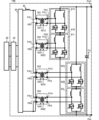
- Fig. 2 is a circuit diagram of the AC-DC converter according to the second embodiment.
- Fig. 3 is a circuit diagram of a rectifier circuit on the secondary side of an isolation transformer of the AC-DC converter according to the second embodiment.
- the ACDC converter 10A according to the second embodiment differs from the ACDC converter 10 according to the first embodiment in that it includes multiple isolation transformers 501-504 and a rectifier circuit 61A and a rectifier circuit 62A.
- the rest of the configuration of the ACDC converter 10A is the same as that of the ACDC converter 10, and descriptions of similar parts will be omitted as appropriate.
- the ACDC converter 10A includes an input filter circuit 20, a power conversion circuit 30, a resonant inductor 40, multiple isolation transformers 501-504, a rectifier circuit 61A, a rectifier circuit 62A, and a smoothing capacitor Co.
- the isolation transformer 501 includes a primary coil 5011 and a secondary coil 5012.
- the primary coil 5011 and the secondary coil 5012 are coupled with a predetermined degree of coupling and turns ratio.
- the primary coil 5011 corresponds to a "primary first coil” and the secondary coil 5012 corresponds to a "secondary third coil.”
- the isolation transformer 502 includes a primary coil 5021 and a secondary coil 5022.
- the primary coil 5021 and the secondary coil 5022 are coupled with a predetermined degree of coupling and turns ratio.
- the primary coil 5021 corresponds to the "primary second coil” and the secondary coil 5022 corresponds to the "secondary fourth coil.”
- the isolation transformer 503 includes a primary coil 5031 and a secondary coil 5032.
- the primary coil 5031 and the secondary coil 5032 are coupled with a predetermined degree of coupling and turns ratio.
- the primary coil 5031 corresponds to the "primary third coil” and the secondary coil 5032 corresponds to the "secondary fifth coil.”
- the isolation transformer 504 includes a primary coil 5041 and a secondary coil 5042.
- the primary coil 5041 and the secondary coil 5042 are coupled with a predetermined degree of coupling and turns ratio.
- the primary coil 5041 corresponds to the "primary fourth coil” and the secondary coil 5042 corresponds to the "secondary sixth coil.”
- the multiple isolation transformers 501-504 have the same degree of coupling.
- the multiple isolation transformers 501-504 have the same turns ratio.
- the multiple isolation transformers 501-504 have the same coupling polarity.
- Isolation transformer 501, isolation transformer 502, isolation transformer 503, and isolation transformer 504 each have one primary coil and one secondary coil, and are formed using independent magnetic cores. Isolation transformer 501, isolation transformer 502, isolation transformer 503, and isolation transformer 504 are arranged so as not to be coupled to each other. Isolation transformer 501 corresponds to the "first transformer,” isolation transformer 502 corresponds to the “second transformer,” isolation transformer 503 corresponds to the "third transformer,” and isolation transformer 504 corresponds to the "fourth transformer.”
- the primary coil 5011 of the insulating transformer 501, the primary coil 5021 of the insulating transformer 502, the primary coil 5031 of the insulating transformer 503, and the primary coil 5041 of the insulating transformer 504 are connected in series. More specifically, the first terminal PA1 of the primary coil 5011 is connected to the first output terminal of the power conversion circuit 30 through the resonant inductor 40. The second terminal PB1 of the primary coil 5011 is connected to the first terminal PA2 of the primary coil 5021. The second terminal PB2 of the primary coil 5021 is connected to the first terminal PA3 of the primary coil 5031. The second terminal PB3 of the primary coil 5031 is connected to the first terminal PA4 of the primary coil 5041. The second terminal PB4 of the primary coil 5041 is connected to the second output terminal of the power conversion circuit 30.
- the rectifier circuit 61A includes a high-side rectifier circuit 61H and a low-side rectifier circuit 61L.
- the high-side rectifier circuit 61H and the low-side rectifier circuit 61L are connected in series.
- the high-side rectifier circuit 61H and the low-side rectifier circuit 61L are both current doubler rectifier circuits and have the same circuit configuration. This corresponds to "circuit".
- the high-side rectifier circuit 61H includes an inductor 611LH, an inductor 613LH, a switching element 612QH, and a switching element 614QH.
- the switching elements 612QH and 614QH are power semiconductor switching elements.
- the inductor 611LH and the inductor 613LH are The switching element 612QH and the switching element 614QH have the same characteristics.
- the inductor 611LH and the inductor 613LH correspond to a "third inductor," and the switching element 612QH and the switching element 614QH correspond to a "third switching element.” handle.
- Inductor 611LH and switching element 612QH are connected in series. Inductor 613LH and switching element 614QH are connected in series. The series circuit of inductor 611LH and switching element 612QH and the series circuit of inductor 613LH and switching element 614QH are connected in parallel.
- the node ND6111 between the inductor 611LH and the switching element 612QH (drain terminal) is connected to the first terminal PC1 of the secondary coil 5012.
- the node ND6121 between the inductor 613LH and the switching element 614QH (drain terminal) is connected to the second terminal PD1 of the secondary coil 5012.
- smoothing capacitors may be provided between inductor 611LH and the source terminals of inductor 613LH and switching element 612QH and switching element 614QH.
- the low-side rectifier circuit 61L includes an inductor 611LL, an inductor 613LL, a switching element 612QL, and a switching element 614QL.
- the switching elements 612QL and 614QL are power semiconductor switching elements.
- the inductor 611LL and the inductor 613LL have the same characteristics.
- the switching elements 612QL and the switching elements 614QL have the same characteristics.
- the inductor 611LL and the inductor 613LL correspond to a "fourth inductor”
- the switching elements 612QL and the switching elements 614QL correspond to a "fourth switching element”.
- Inductor 611LL and switching element 612QL are connected in series. Inductor 613LL and switching element 614QL are connected in series. The series circuit of inductor 611LL and switching element 612QL and the series circuit of inductor 613LL and switching element 614QL are connected in parallel.
- the node ND6112 between the inductor 611LL and the switching element 612QL (drain terminal) is connected to the first terminal PC2 of the secondary coil 5022.
- the node ND6122 between the inductor 613LL and the switching element 614QL (drain terminal) is connected to the second terminal PD2 of the secondary coil 5022.
- smoothing capacitors may be provided between inductor 611LL and the source terminal of inductor 613LL and between inductor 612QL and the source terminal of switching element 614QL.
- the rectifier circuit 62A includes a high-side rectifier circuit 62H and a low-side rectifier circuit 62L.
- the high-side rectifier circuit 62H and the low-side rectifier circuit 62L are connected in series.
- the high-side rectifier circuit 62H and the low-side rectifier circuit 62L are both current doubler rectifier circuits and have the same circuit configuration as the high-side rectifier circuit 61H and the low-side rectifier circuit 62L.
- the high-side rectifier circuit 62H corresponds to the "fifth rectifier circuit” and the low-side rectifier circuit 62L corresponds to the "sixth rectifier circuit”.
- the high-side rectifier circuit 62H includes an inductor 621LH, an inductor 623LH, a switching element 622QH, and a switching element 624QH.
- the switching elements 622QH and 624QH are power semiconductor switching elements.
- the inductor 621LH and the inductor 623LH are The switching element 622QH and the switching element 624QH have the same characteristics.
- the inductor 621LH and the inductor 623LH correspond to a "fifth inductor," and the switching element 622QH and the switching element 624QH correspond to a "fifth switching element.” handle.
- Inductor 621LH and switching element 622QH are connected in series. Inductor 623LH and switching element 624QH are connected in series. The series circuit of inductor 621LH and switching element 622QH and the series circuit of inductor 623LH and switching element 624QH are connected in parallel.
- the node ND6211 between the inductor 621LH and the switching element 622QH (drain terminal) is connected to the first terminal PC3 of the secondary coil 5032.
- the node ND6221 between the inductor 623LH and the switching element 624QH (drain terminal) is connected to the second terminal PD3 of the secondary coil 5032.
- smoothing capacitors may be provided between inductor 621LH and the source terminals of inductor 623LH and switching element 622QH and switching element 624QH.
- the low-side rectifier circuit 62L includes an inductor 621LL, an inductor 623LL, a switching element 622QL, and a switching element 624QL.
- the switching elements 622QL and 624QL are power semiconductor switching elements.
- the inductor 621LL and the inductor 623LL have the same characteristics.
- the switching elements 622QL and the switching elements 624QL have the same characteristics.
- the inductor 621LL and the inductor 623LL correspond to a "sixth inductor”
- the switching elements 622QL and the switching elements 624QL correspond to a "sixth switching element”.
- Inductor 621LL and switching element 622QL are connected in series. Inductor 623LL and switching element 624QL are connected in series. The series circuit of inductor 621LL and switching element 622QL and the series circuit of inductor 623LL and switching element 624QL are connected in parallel.
- the node ND6212 between the inductor 621LL and the switching element 622QL (drain terminal) is connected to the first terminal PC4 of the secondary coil 5042.
- the node ND6222 between the inductor 623LL and the switching element 624QL (drain terminal) is connected to the second terminal PD4 of the secondary coil 5042.
- smoothing capacitors may be provided between inductor 621LL and the source terminal of inductor 623LL and the source terminal of switching element 622QL and switching element 624QL.
- the rectifier circuit 61A and the rectifier circuit 62A are connected in parallel. Specifically, one terminal (terminal opposite to the node ND6111) of the inductor 611LH of the Hi-side rectifier circuit 61H of the rectifier circuit 61A, one terminal (terminal opposite to the node ND6121) of the inductor 613LH of the Hi-side rectifier circuit 61H of the rectifier circuit 61A, one terminal (terminal opposite to the node ND6211) of the inductor 621LH of the Hi-side rectifier circuit 62H of the rectifier circuit 62A, and one terminal (terminal opposite to the node ND6221) of the inductor 623LH of the Hi-side rectifier circuit 62H of the rectifier circuit 62A are connected to each other and to the Hi-side output terminal PoH of the ACDC converter 10A.
- the terminal (source terminal) of the switching element 612QL of the low-side rectifier circuit 61L of the rectifier circuit 61A opposite the node ND6112, the terminal (source terminal) of the switching element 614QL of the low-side rectifier circuit 61L of the rectifier circuit 61A opposite the node ND6122, the terminal (source terminal) of the switching element 622QL of the low-side rectifier circuit 62L of the rectifier circuit 62A opposite the node ND6212, and the terminal (source terminal) of the switching element 624QL of the low-side rectifier circuit 62L of the rectifier circuit 62A opposite the node ND6222 are connected to each other and to the low-side output terminal PoL of the ACDC converter 10A.
- the ACDC converter 10A can reduce losses in the rectifier circuit 61A and the rectifier circuit 62A.
- the voltage V61A applied to the rectifier circuit 61A is a composite voltage obtained by adding the voltage V61H applied to the high-side rectifier circuit 61H and the voltage V61L applied to the low-side rectifier circuit 61L. Therefore, the voltages applied to the switching elements 612QL and 614QL of the low-side rectifier circuit 61L and the voltages applied to the switching elements 612QH and 614QH of the high-side rectifier circuit 61H can be lowered relative to the desired output voltage in the ACDC converter 10A.
- a low voltage refers to a voltage of 100V or less, for example.
- the voltage V62A applied to the rectifier circuit 62A is a composite voltage obtained by adding the voltage V62H applied to the high-side rectifier circuit 62H and the voltage V62L applied to the low-side rectifier circuit 62L. Therefore, the voltages applied to the switching elements 622QL and 624QL of the low-side rectifier circuit 62L and the voltages applied to the switching elements 622QH and 624QH of the high-side rectifier circuit 62H can be reduced relative to the desired output voltage in the ACDC converter 10A.
- the ACDC converter 10A can suppress losses even when the output current is large, and can also suppress losses even when the output voltage is large, achieving even higher efficiency.
- the high voltage is, as an example, a case in which the output voltage of the AC-DC converter 10 is approximately 48 V.
- the primary coil and secondary coil are coupled 1:1, and multiple transformers are used, each of which is formed separately. This makes it possible to suppress the difference in the degree of coupling between the multiple secondary coils and the primary coil, as occurs with a transformer that couples multiple secondary coils to one primary coil. This makes it possible to suppress the difference in current flowing through the multiple rectifier circuits 61A, 62A, and suppress losses in the rectifier circuits through which a relatively large current flows.
- Individually formed refers to a configuration in which, for example, multiple transformers are arranged separately from each other.
- the multiple isolation transformers 501-504 are formed using separate, independent magnetic cores. However, it is also possible to form multiple isolation transformers with reduced magnetic coupling using a single magnetic core, for example, by using an EI core.
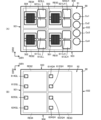
- FIGS. 4A and 4B are diagrams showing the configuration of a circuit module that realizes a circuit from an isolation transformer to an output terminal side in an AC-DC converter according to a second embodiment, where Fig. 4A is a plan view looking at the first surface side, and Fig. 4B is a plan view looking at the second surface side.
- the ACDC converter 10A includes a circuit board 90.
- the circuit board 90 includes a first surface 91, a second surface 92, and multiple side surfaces 931, 932, 933, and 934.
- the first surface 91 is a surface at one end of the circuit board 90 in the thickness direction
- the second surface 92 is a surface at the other end of the circuit board 90 in the thickness direction.
- the side surfaces 931 and 932 are disposed at both ends of the first surface 91 and the second surface 92 in the first direction (DIR1) and run parallel to each other.
- the side surfaces 933 and 934 are disposed at both ends of the first surface 91 and the second surface 92 in the second direction (DIR2) and run parallel to each other.
- the multiple isolation transformers 501, 502, 503, and 504, the multiple inductors 611LH, 613LH, 611LL, 613LL, 621LH, 623LH, 621LL, and 623LL, and the multiple capacitors Co1, Co2, Co3, and Co4 are mounted on the first surface 91.
- the multiple capacitors Co1, Co2, Co3, and Co4 are capacitors that configure the smoothing capacitor Co.
- the first surface 91 has a first region RE61, a second region RE62, a third region RE63, and a fourth region RE64.
- the first region RE61 and the second region RE62 are arranged side by side in a first direction (DIR1), and the third region RE63 and the fourth region RE64 are arranged side by side in the first direction (DIR1).
- the first region RE61 and the third region RE63 are arranged side by side in a second direction (DIR2), and the second region RE62 and the fourth region RE64 are arranged side by side in the second direction (DIR2).
- the first region RE61, the second region RE62, the third region RE63, and the fourth region RE64 are arranged in a two-dimensional matrix on the first surface 91.
- first region RE61 and the second region RE62 are adjacent in the first direction (DIR1), and are arranged in the order of the second region RE62 and the first region RE61 from the side surface 931 toward the side surface 932.
- the third region RE63 and the fourth region RE64 are adjacent in the first direction (DIR1), and are arranged in the order of the fourth region RE64 and the third region RE63 from the side surface 931 toward the side surface 932.
- the first region RE61 and the third region RE63 are adjacent in the second direction (DIR2), and are arranged in the order of first region RE61 and third region RE63 from the side surface 933 toward the side surface 934.
- the second region RE62 and the fourth region RE64 are adjacent in the second direction (DIR2), and are arranged in the order of second region RE62 and fourth region RE64 from the side surface 933 toward the side surface 934.
- the smoothing capacitor Co (multiple capacitors Co1, Co2, Co3, Co4) are arranged between the first region RE61 and the third region RE63 and the side surface 932 in the first direction DIR1.
- an isolation transformer 501, an inductor 611LH, and an inductor 613LH are mounted.
- the isolation transformer 501, the inductor 611LH, and the inductor 613LH are mounted side by side in the first direction.
- the isolation transformer 501 is mounted closer to the side surface 931 than the inductor 611LH and the inductor 613LH.
- the inductor 611LH and the inductor 613LH are mounted side by side in the second direction.
- the inductor 613LH is mounted closer to the side surface 933 than the inductor 611LH.
- the isolation transformer 502, inductor 611LL, and inductor 613LL are mounted in the second region RE62.
- the isolation transformer 502, inductor 611LL, and inductor 613LL are mounted side by side in the first direction.
- the isolation transformer 502 is mounted closer to the side surface 931 than the inductors 611LL and 613LL.
- the inductors 611LL and 613LL are mounted side by side in the second direction.
- the inductor 613LL is mounted closer to the side surface 933 than the inductor 611LL.
- an isolation transformer 503, an inductor 621LH, and an inductor 623LH are mounted.
- the isolation transformer 503, the inductor 621LH, and the inductor 623LH are mounted side by side in the first direction.
- the isolation transformer 503 is mounted closer to the side surface 931 than the inductor 621LH and the inductor 623LH.
- the inductor 621LH and the inductor 623LH are mounted side by side in the second direction.
- the inductor 623LH is mounted closer to the side surface 934 than the inductor 621LH.
- an isolation transformer 504, an inductor 621LL, and an inductor 623LL are mounted.
- the isolation transformer 504, the inductor 621LL, and the inductor 623LL are mounted side by side in the first direction.
- the isolation transformer 504 is mounted closer to the side surface 931 than the inductors 621LL and 623LL.
- the inductors 621LL and 623LL are mounted side by side in the second direction.
- the inductor 623LL is mounted closer to the side surface 934 than the inductor 621LL.
- Switching element 612QH and switching element 614QH are mounted in an area corresponding to first region RE61 on second surface 92. Switching element 614QH is mounted closer to side surface 933 than switching element 612QH.
- Switching element 612QL and switching element 614QL are mounted in an area corresponding to second region RE62 on second surface 92. Switching element 614QL is mounted closer to side surface 933 than switching element 612QL.
- Switching element 622QH and switching element 624QH are mounted in a region on second surface 92 that corresponds to third region RE63. Switching element 624QH is mounted closer to side surface 934 than switching element 622QH.
- Switching element 622QL and switching element 624QL are mounted in a region corresponding to fourth region RE64 on second surface 92. Switching element 624QL is mounted closer to side surface 934 than switching element 622QL.
- the ACDC converter 10A forms a circuit consisting of the isolation transformer 501 and the high-side rectifier circuit 61H in the first region RE61, and a circuit consisting of the isolation transformer 502 and the low-side rectifier circuit 61L in the second region RE62.
- the ACDC converter 10A forms a circuit consisting of the isolation transformer 503 and the high-side rectifier circuit 62H in the third region RE63, and a circuit consisting of the isolation transformer 504 and the low-side rectifier circuit 62L in the fourth region RE64.
- the ACDC converter 10A can form the circuit consisting of the isolation transformer 501 and the high-side rectifier circuit 61H, the circuit consisting of the isolation transformer 502 and the low-side rectifier circuit 61L, the circuit consisting of the isolation transformer 503 and the high-side rectifier circuit 62H, and the circuit consisting of the isolation transformer 504 and the low-side rectifier circuit 62L with shorter, simpler wiring patterns. Therefore, the ACDC converter 10A can suppress losses due to the wiring patterns.
- each isolation transformer and the inductor in each rectifier circuit are mounted on the first surface 91, and the switching element of each rectifier circuit is mounted on the second surface 92.
- the multiple high-side rectifier circuits 61H, 62H and low-side rectifier circuits 61L, 62L are each formed together in a separate area on the circuit board 90. Therefore, the ACDC converter 10A can suppress undesirable coupling of the high-side rectifier circuits 61H, 62H and low-side rectifier circuits 61L, 62L.
- the high side rectifier circuit 61H and the low side rectifier circuit 61L constituting the rectifier circuit 61A are aligned in the first direction DIR1 of the circuit board 90, and the high side rectifier circuit 62H and the low side rectifier circuit 62L constituting the rectifier circuit 62A are aligned in the first direction of the circuit board 90. This allows the wiring pattern of the circuit conductor pattern of the rectifier circuit 61A formed on the circuit board 90 to be separated from the wiring pattern of the rectifier circuit 62A.
- the low side rectifier circuit 61L is arranged followed by the high side rectifier circuit 61H in the first direction DIR1
- the low side rectifier circuit 62L is arranged followed by the high side rectifier circuit 62H in the first direction DIR1.
- multiple capacitors Co1, Co2, Co3, and Co4 are mounted in a position closest to the side surface 932 in this first direction DIR1. This makes it easier to make the wiring pattern shorter and simpler, including the smoothing capacitor Co (multiple capacitors Co1, Co2, Co3, and Co4).
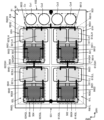
- FIG. 5 is a diagram showing an example of the wiring pattern of each rectifier circuit.
- FIG. 5 is a diagram viewed from the first surface 91 side.
- the thick solid lines in FIG. 5 indicate the wiring pattern (conductor pattern), and the wiring pattern is formed by a linear conductor pattern formed on the first surface 91 or the second surface 92, or an interlayer connection conductor having a shape extending in the thickness direction of the circuit board 90.
- the low-side rectifier circuit 61L and the high-side rectifier circuit 61H are arranged on the first surface 91 of the circuit board 90 in the first direction DIR1 in the following order: isolation transformer 502, inductor 611LL and inductor 613LL, isolation transformer 501, inductor 611LH and inductor 613LH, and smoothing capacitor Co (multiple capacitors Co1, Co2, Co3, Co4).
- the inductor 611LH and the drain terminal of the switching element 612QH are connected by a wiring pattern 9911.
- the inductor 613LH and the drain terminal of the switching element 614QH are connected by a wiring pattern 9912.
- the isolation transformer 501 is disposed between the wiring patterns 9911 and 9912, with the first terminal PC1 connected to the wiring pattern 9911 and the second terminal PD1 connected to the wiring pattern 9912.
- Inductor 611LH and inductor 613LH are connected by wiring pattern 9913.
- the source terminal of switching element 612QH and the source terminal of switching element 614QH are connected by wiring pattern 9914.
- the positive electrode of the smoothing capacitor Co is connected to the wiring pattern 9913.
- the wiring pattern 9914 is connected to the wiring pattern 9923 that constitutes the low-side rectifier circuit 61L.
- the inductor 611LL and the drain terminal of the switching element 612QL are connected by a wiring pattern 9921.
- the inductor 613LL and the drain terminal of the switching element 614QL are connected by a wiring pattern 9922.
- the isolation transformer 502 is disposed between the wiring patterns 9921 and 9922, with the first terminal PC2 connected to the wiring pattern 9921 and the second terminal PD2 connected to the wiring pattern 9922.
- Inductor 611LL and inductor 613LL are connected by wiring pattern 9923.
- the source terminal of switching element 612QL and the source terminal of switching element 614QL are connected by wiring pattern 9924.
- the negative electrode of the smoothing capacitor Co is connected to the wiring pattern 9924 via an inner layer of the board.
- the wiring pattern 9923 is connected to the wiring pattern 9914 that constitutes the Hi-side rectifier circuit 61H.
- the wiring pattern consisting of multiple wiring patterns 9911, 9912, 9913, and 9914 in the high-side rectifier circuit 61H is the same as the wiring pattern consisting of multiple wiring patterns 9921, 9922, 9923, and 9924 in the low-side rectifier circuit 61L.
- the line lengths of the current loops Ri61L and Ri61H of the low-side rectifier circuit 61L and the high-side rectifier circuit 61H can be made the same.
- the parasitic inductance formed in each current loop can be made to be approximately the same, so that the surge voltages generated in the switching elements can be made to be approximately the same.
- the low-side rectifier circuit 62L and the high-side rectifier circuit 62H are arranged on the first surface 91 of the circuit board 90 in the first direction DIR1 in the following order: isolation transformer 504, inductor 621LL and inductor 623LL, isolation transformer 503, inductor 621LH and inductor 623LH, and smoothing capacitor Co (multiple capacitors Co1, Co2, Co3, Co4).
- the inductor 621LH and the drain terminal of the switching element 622QH are connected by a wiring pattern 9931.
- the inductor 623LH and the drain terminal of the switching element 624QH are connected by a wiring pattern 9932.
- the isolation transformer 503 is disposed between the wiring patterns 9931 and 9932, with the first terminal PC3 connected to the wiring pattern 9931 and the second terminal PD3 connected to the wiring pattern 9932.
- Inductor 621LH and inductor 623LH are connected by wiring pattern 9933.
- the source terminal of switching element 622QH and the source terminal of switching element 624QH are connected by wiring pattern 9934.
- the positive electrode of the smoothing capacitor Co is connected to the wiring pattern 9933.
- the wiring pattern 9934 is connected to the wiring pattern 9943 that constitutes the low-side rectifier circuit 62L.
- the inductor 621LL and the drain terminal of the switching element 622QL are connected by a wiring pattern 9941.
- the inductor 623LL and the drain terminal of the switching element 624QL are connected by a wiring pattern 9942.
- the isolation transformer 504 is disposed between the wiring patterns 9941 and 9942, with the first terminal PC4 connected to the wiring pattern 9941 and the second terminal PD4 connected to the wiring pattern 9942.
- Inductor 621LL and inductor 623LL are connected by wiring pattern 9943.
- the source terminal of switching element 622QL and the source terminal of switching element 624QL are connected by wiring pattern 9944.
- the negative electrode of the smoothing capacitor Co is connected to wiring pattern 9944 via an inner layer of the board.
- Wiring pattern 9943 is connected to wiring pattern 9934 that constitutes the Hi-side rectifier circuit 62H.
- the wiring pattern consisting of multiple wiring patterns 9931, 9932, 9933, and 9934 in the high-side rectifier circuit 62H is the same as the wiring pattern consisting of multiple wiring patterns 9941, 9942, 9943, and 9944 in the low-side rectifier circuit 62L.
- the line lengths of the current loops Ri62L and Ri62H of the low-side rectifier circuit 62L and the high-side rectifier circuit 62H can be made the same.
- the parasitic inductance formed in each current loop can be made to be approximately the same, so that the surge voltages generated in the switching elements can be made to be approximately the same.
- the line length of the current loop Ri61L of the low-side rectifier circuit 61L, the line length of the current loop Ri61H of the high-side rectifier circuit 61H, the line length of the current loop Ri62L of the low-side rectifier circuit 62L, and the line length of the current loop Ri62H of the high-side rectifier circuit 62H are the same. This makes it possible to make the surge voltages generated in the switching elements in all matching circuits approximately the same.
- the multiple isolation transformers 501-504 are arranged at a distance from each other. This makes it possible to prevent undesirable mutual coupling between the multiple isolation transformers 501-504.
- the isolation transformers, inductors, and switching elements are distributed across multiple components, the power loss per component is reduced, and heat dispersion is achieved.
- the tall components such as the isolation transformers, inductors, and capacitors
- the low-profile components such as the switching elements
- FIG. 6 is a circuit diagram of the AC-DC converter according to the third embodiment.
- the ACDC converter 10B according to the third embodiment differs from the ACDC converter 10A according to the second embodiment in the connection pattern of the multiple isolation transformers 501-504.
- the other configuration of the ACDC converter 10B is the same as that of the ACDC converter 10A, and a description of the similar parts will be omitted.
- Isolation transformer 501 and isolation transformer 502 are connected in series.
- Isolation transformer 503 and isolation transformer 504 are connected in series.
- the series circuit of isolation transformer 501 and isolation transformer 502 and the series circuit of isolation transformer 503 and isolation transformer 504 are connected in parallel.
- the ACDC converter 10B can achieve the same effects as the ACDC converter 10A. Furthermore, in the ACDC converter 10B, the current flowing through the primary coils of the multiple isolation transformers 501-504 is reduced. As a result, when the primary current is large in particular, the ACDC converter 10B can suppress the iron loss that occurs in the isolation transformers 501-504, achieving even higher efficiency.
- FIG. 7 is a circuit diagram of a rectifier circuit portion of the AC-DC converter according to the fourth embodiment.
- the ACDC converter 10C according to the fourth embodiment differs from the ACDC converter 10A according to the second embodiment in that the intermediate potential between the rectifier circuit 61C and the rectifier circuit 62C is short-circuited.
- the other configuration of the ACDC converter 10C is the same as that of the ACDC converter 10A, and a description of the similar parts will be omitted.
- Rectifier circuit 61C has a similar configuration to rectifier circuit 61A
- rectifier circuit 62C has a similar configuration to rectifier circuit 62A.
- the node ND61C between the high-side rectifier circuit 61H and the low-side rectifier circuit 61L in the rectifier circuit 61C and the node ND62C between the high-side rectifier circuit 62H and the low-side rectifier circuit 62L in the rectifier circuit 62C are electrically connected.
- the ACDC converter 10C can achieve the same effect as the ACDC converter 10A, while matching the source potential of the switching element that constitutes the Hi-side rectifier circuit 61H with the source potential of the switching element that constitutes the Hi-side rectifier circuit 62H. This allows the ACDC converter 10C to simplify the drive circuits for the switching elements of the Hi-side rectifier circuit 61H and the Hi-side rectifier circuit 62H.
- FIG. 8 is a circuit diagram of a rectifier circuit portion of the AC-DC converter according to the fifth embodiment.
- the ACDC converter 10D according to the fifth embodiment differs from the ACDC converter 10 according to the first embodiment in that it includes a rectifier circuit 61D and a rectifier circuit 62D.
- the other configuration of the ACDC converter 10D is the same as that of the ACDC converter 10, and a description of the similar parts will be omitted.
- the ACDC converter 10D includes a rectifier circuit 61D and a rectifier circuit 62D.
- the rectifier circuit 61D is a full-wave rectifier circuit that uses four switching elements 611Q, 612Q, 613Q, and 614Q.
- Rectifier circuit 62D is a full-wave rectifier circuit that uses four switching elements 621Q, 622Q, 623Q, and 624Q.
- the ACDC converter 10D can achieve the same effects as the ACDC converter 10.
- Fig. 9 is a circuit diagram of the AC-DC converter according to the sixth embodiment.
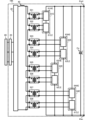
- the ACDC converter 10E according to the sixth embodiment differs from the ACDC converter 10 according to the first embodiment in that it includes eight isolation transformers 501-508 and four rectifier circuits 61E-64E.
- the rest of the configuration of the ACDC converter 10E is the same as that of the ACDC converter 10, and a description of similar parts will be omitted.
- the ACDC converter 10E includes multiple (eight) isolation transformers 501-508 and multiple (four) rectifier circuits 61E-64E.
- Each of the multiple isolation transformers 501-508 has one primary coil and one secondary coil, and is formed using an independent magnetic core.
- the primary coils of the multiple isolation transformers 501-504 are connected in series.
- the primary coils of the multiple isolation transformers 505-508 are connected in series.
- the series circuit of the primary coils of the multiple isolation transformers 501-504 and the series circuit of the primary coils of the multiple isolation transformers 505-508 are connected in parallel. Note that the primary coils of the multiple isolation transformers 501-508 may be connected in series, or the primary coils of two isolation transformers may be connected in series, and the four series circuits may be connected in parallel.
- the multiple rectifier circuits 61E-64E are connected in parallel.
- the rectifier circuit 61E is composed of a series circuit of a high-side rectifier circuit 61HE and a low-side rectifier circuit 61LE.
- the rectifier circuit 62E is composed of a series circuit of a high-side rectifier circuit 62HE and a low-side rectifier circuit 62LE.
- the rectifier circuit 63E is composed of a series circuit of a high-side rectifier circuit 63HE and a low-side rectifier circuit 63LE.
- the rectifier circuit 64E is composed of a series circuit of a high-side rectifier circuit 64HE and a low-side rectifier circuit 64LE.
- the multiple high-side rectifier circuits 61HE, 62HE, 63HE, and 64HE have the same circuit configuration as the high-side rectifier circuit 61H according to the second embodiment.
- the multiple low-side rectifier circuits 61LE, 62LE, 63LE, and 64LE have the same circuit configuration as the low-side rectifier circuit 61L according to the second embodiment.
- the ACDC converter 10E can reduce the current flowing through each rectifier circuit 61E-64E to 1/4 of the output current value to obtain the desired output current.
- the ACDC converter 10E can reduce the voltage applied to the switching elements of the high-side rectifier circuit and the low-side rectifier circuit that make up each rectifier circuit 61E-64E to 1/2 of the output voltage value.
- the ACDC converter 10E can suppress losses even with even larger currents. Furthermore, the ACDC converter 10E can suppress losses even when the voltage becomes relatively high.
- the number of rectifier circuits connected in parallel is not limited to four.
- the number of rectifier circuits connected in series that make up each rectifier circuit connected in parallel is also not limited to two. These can be set appropriately based on the electrical specifications (output current value, output voltage value) required by the ACDC converter.
- a power conversion circuit connected to a three-phase AC power source and outputting a primary side current; an isolation transformer including a primary coil connected to an output side of the power conversion circuit, and a first secondary coil and a second secondary coil coupled to the primary coil, the isolation transformer receiving the primary current as an input and outputting a first secondary current and a second secondary current; a first rectifier circuit connected to the secondary first coil and configured to rectify the secondary first current; a second rectifier circuit connected to the secondary second coil and configured to rectify the secondary second current; a smoothing capacitor connected to an output terminal of the first rectifier circuit and the second rectifier circuit; Equipped with The first rectifier circuit and the second rectifier circuit are connected in parallel.
- ACDC converter ACDC converter.
- the primary coil is a primary side first coil, a primary side second coil, a primary side third coil, and a primary side fourth coil; Equipped with The secondary side first coil is a third secondary coil and a fourth secondary coil; Equipped with The secondary side second coil is a fifth secondary coil and a sixth secondary coil; Equipped with the secondary side third coil is coupled to the primary side first coil, the secondary side fourth coil is coupled to the primary side second coil, the secondary side fifth coil is coupled to the primary side third coil, the sixth secondary coil is coupled to the fourth primary coil,
- the first rectifier circuit is a third rectifier circuit connected to the secondary side third coil; a fourth rectifier circuit connected to the fourth secondary coil; Equipped with the third rectifier circuit and the fourth rectifier circuit are connected in series,
- the second rectifier circuit is a fifth rectifier circuit connected to the fifth secondary coil; a sixth rectifier circuit connected to the sixth secondary coil;
- the AC-DC converter of ⁇ 1> comprising:
- the isolation transformer includes a first transformer, a second transformer, a third transformer, and a fourth transformer that are disposed separately from each other, the first transformer is composed of the primary side first coil and the secondary side third coil, the second transformer is composed of the primary side second coil and the secondary side fourth coil, the third transformer is composed of the primary side third coil and the secondary side fifth coil,
- ⁇ 5> An AC-DC converter according to any one of ⁇ 2> to ⁇ 4>, in which the third rectifier circuit, the fourth rectifier circuit, the fifth rectifier circuit, and the sixth rectifier circuit are each configured as a current doubler rectifier circuit.
- ⁇ 6> An AC-DC converter according to any one of ⁇ 2> to ⁇ 5>, in which a first node between the third rectifier circuit and the fourth rectifier circuit and a second node between the fifth rectifier circuit and the sixth rectifier circuit are electrically connected.
- ⁇ 7> An AC-DC converter according to any one of ⁇ 2> to ⁇ 6>, in which the first primary coil, the second primary coil, the third primary coil, and the fourth primary coil are connected in series.
- ⁇ 8> The primary side first coil and the primary side second coil are connected in series, the primary side third coil and the primary side fourth coil are connected in series,
- a circuit board having a first surface at one end in a thickness direction and a second surface at the other end in the thickness direction, the first transformer, the second transformer, the third transformer, the fourth transformer, the third inductor of the third rectifier circuit, the fourth inductor of the fourth rectifier circuit, the fifth inductor of the fifth rectifier circuit, and the sixth inductor of the sixth rectifier circuit are mounted on the first surface,
- the AC-DC converter according to any one of ⁇ 2> to ⁇ 8>, wherein a third switching element of the third rectifier circuit, a fourth switching element of the fourth rectifier circuit, a fifth switching element of the fifth rectifier circuit, and a sixth switching element of the sixth rectifier circuit are mounted on the second surface.
- Regions located on the circuit board side by side in a first direction parallel to the first surface are defined as a first region and a second region;
- a region located on the substrate alongside the first region is defined as a third region, and a region located on the substrate alongside the second region is defined as a fourth region
- the first transformer and the third inductor are mounted in a first region of the first surface
- the second transformer and the fourth inductor are mounted in a second region of the first surface
- the third transformer and the fifth inductor are mounted in a third region of the first surface
- the fourth transformer and the sixth inductor are mounted in a fourth region of the first surface
- the third switching element is mounted in a region of the second surface overlapping the first region
- the fourth switching element is mounted in a region of the second surface overlapping the second region
- the fifth switching element is mounted in a region of the second surface overlapping the third region
- the second transformer, the fourth inductor, the first transformer, and the third inductor are mounted on the first surface in this order in the first direction,
- ⁇ 12> Further comprising one or more smoothing capacitors, the second transformer, the fourth inductor, the first transformer, the third inductor, and the smoothing capacitor are arranged in this order on the first surface of the substrate in the first direction; or The AC-DC converter of ⁇ 11>, wherein the fourth transformer, the sixth inductor, the third transformer, the fifth inductor, and the smoothing capacitor are arranged in this order on the first surface of the substrate in the first direction.
Landscapes
- Engineering & Computer Science (AREA)
- Power Engineering (AREA)
- Dc-Dc Converters (AREA)
Priority Applications (2)
| Application Number | Priority Date | Filing Date | Title |
|---|---|---|---|
| JP2025535848A JPWO2025023264A1 (https=) | 2023-07-26 | 2024-07-24 | |
| PCT/JP2024/026388 WO2025023264A1 (ja) | 2023-07-26 | 2024-07-24 | Acdcコンバータ |
Applications Claiming Priority (2)
| Application Number | Priority Date | Filing Date | Title |
|---|---|---|---|
| JP2023121757 | 2023-07-26 | ||
| JP2023-121757 | 2023-07-26 |
Publications (1)
| Publication Number | Publication Date |
|---|---|
| WO2025022710A1 true WO2025022710A1 (ja) | 2025-01-30 |
Family
ID=94374218
Family Applications (2)
| Application Number | Title | Priority Date | Filing Date |
|---|---|---|---|
| PCT/JP2024/009446 Pending WO2025022710A1 (ja) | 2023-07-26 | 2024-03-11 | Acdcコンバータ |
| PCT/JP2024/026388 Pending WO2025023264A1 (ja) | 2023-07-26 | 2024-07-24 | Acdcコンバータ |
Family Applications After (1)
| Application Number | Title | Priority Date | Filing Date |
|---|---|---|---|
| PCT/JP2024/026388 Pending WO2025023264A1 (ja) | 2023-07-26 | 2024-07-24 | Acdcコンバータ |
Country Status (2)
| Country | Link |
|---|---|
| JP (1) | JPWO2025023264A1 (https=) |
| WO (2) | WO2025022710A1 (https=) |
Citations (7)
| Publication number | Priority date | Publication date | Assignee | Title |
|---|---|---|---|---|
| JPS5566284A (en) * | 1978-11-14 | 1980-05-19 | Fuji Electric Co Ltd | Power converter |
| JPS61244265A (ja) * | 1985-04-19 | 1986-10-30 | Hitachi Ltd | 多出力スイツチング電源回路 |
| JPH05121885A (ja) * | 1991-10-30 | 1993-05-18 | Yokogawa Electric Corp | スイツチング電源装置 |
| JP2001268906A (ja) * | 2000-03-01 | 2001-09-28 | Delphi Technol Inc | サブ共振dc−dcコンバータを有するデュアル電圧自動車両電気システム |
| JP2002315341A (ja) * | 2001-04-04 | 2002-10-25 | Sanken Electric Co Ltd | 3相交流―直流変換装置 |
| JP2013150412A (ja) * | 2012-01-18 | 2013-08-01 | Kyushu Electric Power Co Inc | 可変出力充電装置 |
| WO2021049297A1 (ja) * | 2019-09-09 | 2021-03-18 | 三菱電機株式会社 | 電力変換装置および電力変換装置の製造方法 |
Family Cites Families (6)
| Publication number | Priority date | Publication date | Assignee | Title |
|---|---|---|---|---|
| JP4828044B2 (ja) * | 2001-05-31 | 2011-11-30 | Necトーキン株式会社 | 電源回路 |
| JP2003204678A (ja) * | 2002-01-09 | 2003-07-18 | Sanken Electric Co Ltd | 3相交流‐直流変換装置 |
| JP2010166733A (ja) * | 2009-01-16 | 2010-07-29 | Fujitsu Telecom Networks Ltd | 直流電源装置 |
| JP2014017281A (ja) * | 2012-07-05 | 2014-01-30 | Shindengen Electric Mfg Co Ltd | トランス及び該トランスを用いた絶縁型スイッチング電源 |
| JP2015015829A (ja) * | 2013-07-04 | 2015-01-22 | 住友電気工業株式会社 | 双方向ac/dc変換装置、突入電流防止方法及びコンピュータプログラム |
| JP2020123648A (ja) * | 2019-01-30 | 2020-08-13 | 株式会社豊田中央研究所 | 磁気部品 |
-
2024
- 2024-03-11 WO PCT/JP2024/009446 patent/WO2025022710A1/ja active Pending
- 2024-07-24 WO PCT/JP2024/026388 patent/WO2025023264A1/ja active Pending
- 2024-07-24 JP JP2025535848A patent/JPWO2025023264A1/ja active Pending
Patent Citations (7)
| Publication number | Priority date | Publication date | Assignee | Title |
|---|---|---|---|---|
| JPS5566284A (en) * | 1978-11-14 | 1980-05-19 | Fuji Electric Co Ltd | Power converter |
| JPS61244265A (ja) * | 1985-04-19 | 1986-10-30 | Hitachi Ltd | 多出力スイツチング電源回路 |
| JPH05121885A (ja) * | 1991-10-30 | 1993-05-18 | Yokogawa Electric Corp | スイツチング電源装置 |
| JP2001268906A (ja) * | 2000-03-01 | 2001-09-28 | Delphi Technol Inc | サブ共振dc−dcコンバータを有するデュアル電圧自動車両電気システム |
| JP2002315341A (ja) * | 2001-04-04 | 2002-10-25 | Sanken Electric Co Ltd | 3相交流―直流変換装置 |
| JP2013150412A (ja) * | 2012-01-18 | 2013-08-01 | Kyushu Electric Power Co Inc | 可変出力充電装置 |
| WO2021049297A1 (ja) * | 2019-09-09 | 2021-03-18 | 三菱電機株式会社 | 電力変換装置および電力変換装置の製造方法 |
Also Published As
| Publication number | Publication date |
|---|---|
| JPWO2025023264A1 (https=) | 2025-01-30 |
| WO2025023264A1 (ja) | 2025-01-30 |
Similar Documents
| Publication | Publication Date | Title |
|---|---|---|
| CN108364761B (zh) | 集成磁性组件和切换模式功率转换器 | |
| CN109390118B (zh) | 磁性组件及其适用的电源转换装置 | |
| EP1760867B1 (en) | Switching power supply unit | |
| US8072305B2 (en) | DC/DC converter | |
| US7199569B1 (en) | Switching power supply unit | |
| US8004867B2 (en) | Switching power supply unit | |
| CN110310815A (zh) | 平面变压器、电源转换电路以及适配器 | |
| KR102131866B1 (ko) | 단일전력단 ac-dc 컨버터 | |
| WO2019108071A1 (en) | A misalignment tolerant hybrid wireless power transfer system | |
| TWI747508B (zh) | 平板繞組變壓器 | |
| EP3700074B1 (en) | Dc-dc converter | |
| KR20230014953A (ko) | 충전 장치 | |
| JP2009142088A (ja) | 表示装置用dc−dcコンバータ | |
| US11615915B2 (en) | Low-height coupled inductors | |
| US20240128008A1 (en) | Transformer of an electrical system for dc voltage conversion and for charging of batteries of a vehicle | |
| CN110323837A (zh) | 线圈单元、无线供电装置、无线受电装置、无线电力传输系统 | |
| CN114373613A (zh) | 一种平面变压器、电源转换电路以及适配器 | |
| WO2025022710A1 (ja) | Acdcコンバータ | |
| WO2024174027A1 (en) | Integrated wireless and onboard charging systems | |
| CN118539757A (zh) | 多相直流/直流转换器 | |
| US11736024B1 (en) | Current balancing in coupled transformers | |
| JP6965294B2 (ja) | 電力変換装置、及びトランス | |
| JP7674290B2 (ja) | トランス | |
| JP2025120703A (ja) | コンバータ回路 | |
| CN112106287B (zh) | 谐振回路电路和用于配置谐振回路电路的方法 |
Legal Events
| Date | Code | Title | Description |
|---|---|---|---|
| 121 | Ep: the epo has been informed by wipo that ep was designated in this application |
Ref document number: 24845095 Country of ref document: EP Kind code of ref document: A1 |
|
| NENP | Non-entry into the national phase |
Ref country code: DE |