WO2025022600A1 - 固定子および電動機 - Google Patents
固定子および電動機 Download PDFInfo
- Publication number
- WO2025022600A1 WO2025022600A1 PCT/JP2023/027356 JP2023027356W WO2025022600A1 WO 2025022600 A1 WO2025022600 A1 WO 2025022600A1 JP 2023027356 W JP2023027356 W JP 2023027356W WO 2025022600 A1 WO2025022600 A1 WO 2025022600A1
- Authority
- WO
- WIPO (PCT)
- Prior art keywords
- coil
- stator
- axial direction
- protruding wall
- wall portion
- Prior art date
- Legal status (The legal status is an assumption and is not a legal conclusion. Google has not performed a legal analysis and makes no representation as to the accuracy of the status listed.)
- Pending
Links
Images




Classifications
-
- H—ELECTRICITY
- H02—GENERATION; CONVERSION OR DISTRIBUTION OF ELECTRIC POWER
- H02K—DYNAMO-ELECTRIC MACHINES
- H02K3/00—Details of windings
- H02K3/04—Windings characterised by the conductor shape, form or construction, e.g. with bar conductors
- H02K3/18—Windings for salient poles
-
- H—ELECTRICITY
- H02—GENERATION; CONVERSION OR DISTRIBUTION OF ELECTRIC POWER
- H02K—DYNAMO-ELECTRIC MACHINES
- H02K3/00—Details of windings
- H02K3/30—Windings characterised by the insulating material
-
- H—ELECTRICITY
- H02—GENERATION; CONVERSION OR DISTRIBUTION OF ELECTRIC POWER
- H02K—DYNAMO-ELECTRIC MACHINES
- H02K3/00—Details of windings
- H02K3/32—Windings characterised by the shape, form or construction of the insulation
- H02K3/38—Windings characterised by the shape, form or construction of the insulation around winding heads, equalising connectors, or connections thereto
Definitions
- This disclosure relates to a stator and an electric motor.
- Japanese Patent Publication No. 50-124102 discloses a stator for use in an electric motor.
- the stator is provided with a coil section having coil ends and multiple protective insulating materials (adhesive tapes).
- the multiple protective insulating materials are layered on the surface of the coil ends.
- JP 50-124102 A When making electric motors smaller, the configuration shown in JP 50-124102 A is not necessarily preferable.
- the first aspect of the present disclosure is a stator provided in an electric motor, comprising a coil section formed in an annular shape so as to surround a rotor provided in the electric motor and having coil ends, and a shrink tube that covers the coil ends without covering the inner periphery of the coil ends, and in which the lead wires of the coil section are drawn out from the radially inner side of the coil section.
- the second aspect of the present disclosure is an electric motor having the stator.
- FIG. 1 is an exploded view of an electric motor according to a first embodiment.
- FIG. 2 is an exploded view showing the housing member and the coil bobbin.
- FIG. 3 is a plan view of the stator.
- FIG. 4 is a cross-sectional view showing a portion of the stator.
- FIG. 5 is a plan view of the stator according to the second embodiment.
- FIG. 6 is a cross-sectional view showing a part of the stator.
- FIG. 7 is a plan view of a stator according to the first modified example.
- FIG. 8 is a cross-sectional view showing a part of the stator.
- the prior art including that disclosed in JP 50-124102 A, has at least the following problems. That is, by laminating multiple coating materials on the surface of the coil end, the end of the stator in the axial direction of the stator becomes enlarged. From the perspective of miniaturizing electric motors, it is undesirable for the stator to become enlarged.
- FIG. 1 is an exploded view of an electric motor 10 according to a first embodiment.
- the electric motor 10 includes a rotating shaft 12, a rotor 14, and a stator 16 (161).
- the axial direction DA which is the extension direction of the rotating shaft 12, includes a first direction DA1 and a second direction DA2, which is the opposite direction to the first direction DA1.
- the rotating shaft 12 is attached to the rotor 14.
- the stator 161 is formed in a cylindrical shape so as to surround the rotor 14.
- the rotor 14 and the rotating shaft 12 are rotatably arranged inside the stator 161.
- the stator 161 includes a housing member 18, a coil bobbin 20, a coil portion 22, and a pair of shrink tubes 24.
- the lead wire 26 shown in FIG. 1 is pulled out from the coil portion 22.
- the housing member 18 is a cylindrical member that can surround the rotor 14.
- the housing member 18 extends along the axial direction DA.
- the housing member 18 has ends 18t (18t1, 18t2) in the axial direction DA.
- the ends 18t include a first end 18t1 in the first direction DA1 and a second end 18t2 in the second direction DA2.
- the housing member 18 (181) may be a magnetic material made of electromagnetic steel or the like, or an insulating material made of resin or the like. In this embodiment, a case where the housing member 181 is a magnetic material will be described.
- the housing member 181 comprises, for example, a plurality of electromagnetic steel plates (not shown) stacked along the axial direction DA, but is not limited to this. It is preferable that an insulating layer 28 is provided on the inside of the housing member 181 (inner wall portion 181i) (see also Figures 2 to 4).
- FIG. 2 is an exploded view showing the housing member 181 and the coil bobbin 20.
- the coil bobbin 20 is a member that supports the coil portion 22 (see also FIG. 1).
- the coil bobbin 20 is insulating.
- the coil bobbin 20 is provided inside the housing member 181. More specifically, the coil bobbin 20 is provided inside the housing member 181 in which the insulating layer 28 is formed on the inner wall portion 181i.
- the coil bobbin 20 includes a bobbin core portion 30 and a plurality of partition portions 32.
- the bobbin core 30 is a cylindrical member.
- the bobbin core 30 extends along the axial direction DA.
- the rotor 14 and the rotating shaft 12 described above are provided inside the bobbin core 30.
- the maximum dimension L30 of the bobbin core 30 in the axial direction DA is longer than the dimension L181 of the accommodating member 181 in the axial direction DA (L30>L181). Therefore, the bobbin core 30 protrudes from the accommodating member 181 (see also FIG. 1). More specifically, the bobbin core 30 has a protruding wall portion 34, which is a portion that protrudes from the accommodating member 181.
- the protruding wall portion 34 may be formed in an annular (cylindrical) shape around the entire circumference of the bobbin core 30.
- the protruding wall portion 34 includes a first protruding wall portion 341 in the first direction DA1 and a second protruding wall portion 342 in the second direction DA2.
- the first protruding wall portion 341 protrudes in the first direction DA1 from the first end portion 18t1 of the accommodating member 181.
- the second protruding wall portion 342 protrudes in the second direction DA2 from the second end portion 18t2 of the accommodating member 181. Note that one of the first protruding wall portion 341 and the second protruding wall portion 342 may be omitted.
- the partition 32 extends along the axial direction DA.
- the dimension L32 of the partition 32 in the axial direction DA is not limited, but is, for example, substantially the same as the dimension L181 in the axial direction DA of the accommodating member 181 (L32 ⁇ L181).
- the error between the dimension L32 and the dimension L181 may be within a predetermined error range.
- the dimension L32 and the dimension L181 may be equal, or may differ within the above-mentioned error range.
- FIG. 3 is a plan view of the stator 161. A plan view of the stator 161 viewed in the axial direction is shown in FIG. 3.
- the multiple partitions 32 protrude from the outer peripheral wall 30p of the bobbin core 30 outward in the radial direction DR of the bobbin core 30 (coil portion 22).
- the multiple partitions 32 are arranged at intervals from one another along the circumferential direction DC of the bobbin core 30 (coil portion 22).
- the multiple partitions 32 may be arranged point-symmetrically with respect to the center point C of the stator 161 when viewed in the axial direction.
- the number of partitions 32 that may be provided on the coil bobbin 20 is not limited to six.
- the shape of the coil portion 22 when viewed in the axial direction is annular, capable of surrounding the rotor 14 and the rotating shaft 12.
- the coil portion 22 is formed by a conductor wound around a plurality of partitions 32.
- An insulating material (not shown) is filled between the wires of the conductor that form the coil portion 22.
- the insulating material is, for example, a hardened impregnating agent.
- the impregnating agent is, for example, a thermosetting impregnating agent such as varnish.
- the coil portion 22 has a coil end 36.
- the shape of the coil portion 22 when viewed in the axial direction is annular. Therefore, the shape of the coil end 36 when viewed in the axial direction is also annular.
- the annular coil end 36 has an outer peripheral portion 36p on the outside in the radial direction DR, an inner peripheral portion 36i on the inside in the radial direction DR, and a tip portion 36t in the axial direction DA (see also FIG. 4).
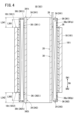
- FIG. 4 is a cross-sectional view showing a portion of the stator 161. A portion of the cross section taken along line IV-IV shown in FIG. 3 is shown in FIG. 4.
- the coil ends 36 include a first coil end 361 and a second coil end 362.
- the first coil end 361 protrudes in a first direction DA1 from a first end 18t1 of the housing member 181.
- the second coil end 362 protrudes in a second direction DA2 from a second end 18t2 of the housing member 181.
- the dimension in the axial direction DA of the above-mentioned protruding wall portion 34 is equal to or greater than the dimension in the axial direction DA of the portion of the coil end 36 that protrudes from the end portion 18t.
- dimensions L341 and L361 are shown in FIG. 4.
- Dimension L341 is the length from the first end 18t1 of the housing member 181 to the tip 341t of the first protruding wall portion 341 in the axial direction DA.
- Dimension L361 is the length from the first end 18t1 to the tip 36t (361t) of the first coil end 361 in the axial direction DA.
- Dimension L341 is preferably equal to or greater than dimension L361 (L341 ⁇ L361). As shown in FIG. 4, dimension L341 is more preferably longer than dimension L361 (L341>L361). However, dimension L341 may be shorter than dimension L361.
- the dimensions L342 and L362 are also shown in FIG. 4.
- the dimension L342 is the dimension in the axial direction DA from the second end 18t2 of the housing member 181 to the tip 342t of the second protruding wall portion 342.
- the dimension L362 is the length in the axial direction DA from the second end 18t2 to the tip 36t (362t) of the second coil end 362. It is preferable that the dimension L342 is equal to or greater than the dimension L362 (L342 ⁇ L362). As shown in FIG. 4, it is more preferable that the dimension L342 is longer than the dimension L362 (L342>L362). However, the dimension L342 may be shorter than the dimension L362.
- the above-mentioned dimensions L341 and L342 may be equal to or different from each other.
- Each of the pair of shrink tubes 24 is formed, for example, from a tubular film material (resin material) that is insulating and heat-shrinkable.
- the pair of shrink tubes 24 are attached to the coil end 36 so as to cover the outer periphery 36p of the coil end 36 and the tip end 36t in the axial direction DA of the coil end 36. More specifically, the pair of shrink tubes 24 includes a first shrink tube 241 attached to the first coil end 361 and a second shrink tube 242 attached to the second coil end 362.
- the first shrink tube 241 covers the outer periphery 36p (361p) of the first coil end 361. It is preferable that the first shrink tube 241 covers the entire outer periphery 361p.
- the first shrink tube 241 also extends from the outer periphery 361p of the first coil end 361 toward the inner periphery 36i (361i) of the first coil end 361, and further covers at least a portion of the tip 361t of the first coil end 361. It is preferable that the first shrink tube 241 covers the entire tip 361t, but is not limited to this.
- the second shrink tube 242 covers the outer periphery 36p (362p) of the second coil end 362. It is preferable that the second shrink tube 242 covers the entire outer periphery 362p.
- the second shrink tube 242 also extends from the outer periphery 362p of the second coil end 362 toward the inner periphery 36i (362i) of the second coil end 362, and further covers at least a portion of the tip 362t of the second coil end 362. It is preferable that the second shrink tube 242 covers the entire tip 362t, but is not limited to this.
- the inner circumference 36i of the coil end 36 is not covered by the shrink tube 24.
- the lead wire 26 of the coil portion 22 described above is drawn out from the inside of the coil portion 22 in the radial direction DR through the gap between the coil portion 22 and the bobbin core portion 30. More specifically, the lead wire 26 is drawn out from the inner circumference 36i of the coil end 36 through the gap between the coil portion 22 and the bobbin core portion 30.
- the lead wire 26 is part of the conductor that forms the coil portion 22.
- the coil portion 22 can be connected to a power source (not shown) for supplying current to the coil portion 22 through the lead wire 26.
- stator 161 and the electric motor 10 equipped with it can achieve the effects described below, for example.
- the outer periphery 36p and the tip 36t (at least a part of the tip 36t) of the coil end 36 are covered by the shrink tube 24.
- the outer periphery 36p and the tip 36t are more likely to come into contact with, for example, the housing member 181 containing electromagnetic steel, or with external foreign matter (dust, water, oil, etc.).
- the shrink tube 24 By covering the outer periphery 36p and the tip 36t with the shrink tube 24, it is possible to effectively prevent contact between the coil end 36 and the housing member 181, foreign matter, etc.
- the entire outer periphery 36p is covered by the shrink tube 24, it is possible to more effectively prevent contact between the outer periphery 36p and foreign matter, etc.
- the entire tip 36t is covered by the shrink tube 24, it is possible to more effectively prevent contact between the tip 36t and foreign matter, etc.
- the shrunk shrink tube 24 can secure the coil end 36 well. Therefore, the shrink tube 24 can prevent the shape of the coil end 36 from collapsing due to, for example, the weight of the coil end 36. By preventing the shape of the coil end 36 from collapsing, for example, contact between the coil end 36 and the housing member 181 can be more effectively prevented.
- the coil end 36 can be well protected by the shrink tube 24 having a minimum thickness. That is, for example, if the coil end 36 is covered with an adhesive tape, there is a risk that the adhesive tape will peel off from the coil end 36 when the coil end 36 to which the adhesive tape is attached is heated during the manufacturing process of the stator 16. Therefore, the coil end 36 cannot necessarily be well protected by the adhesive tape alone. Also, if a cloth is wrapped around the coil end 36 to which the adhesive tape is attached in order to prevent the adhesive tape from peeling off from the coil end 36, the end of the stator 16 will be enlarged by the adhesive tape, cloth, etc. provided on the coil end 36.
- the shrink tube 24 covering the coil end 36 can maintain its close contact with the coil end 36 even when heated. Therefore, even if the shrink tube 24 has a minimum thickness, the coil ends 36 can be well protected. Because the coil ends 36 can be protected by the shrink tube 24, which is a relatively thin member, it is possible to suppress enlargement of the stator 161 without reducing the amount of conductor wire included in the coil portion 22. In other words, the stator 161 according to this embodiment is suitable for miniaturizing the electric motor 10 while suppressing a decrease in the output of the electric motor 10.
- the shrink tube 24 does not cover the inner periphery 36i of the coil end 36, and the lead wire 26 is pulled out from the inside of the coil portion 22 in the radial direction DR (the inner periphery 36i). This reduces the risk of interference between the shrink tube 24 and the lead wire 26.
- the lead wire 26 is pulled out from the inside of the coil portion 22 in the radial direction DR (the inner peripheral portion 36i). Therefore, for example, there is no need to provide a hole in the shrink tube 24 to allow the lead wire 26 to be pulled out from the outer peripheral portion 36p of the coil end 36. This ensures that the entire outer peripheral portion 36p is covered by the shrink tube 24.
- the bobbin core 30 is provided with a protruding wall portion 34 interposed between the coil end 36 (coil portion 22) and the rotating shaft 12, rotor 14, etc.
- the protruding wall portion 34 includes at least one of a first protruding wall portion 341 protruding in a first direction DA1 from the accommodating member 181 and a second protruding wall portion 342 protruding in a second direction DA2 from the accommodating member 181. This reduces the risk of contact between the coil end 36 (coil portion 22) and the rotating shaft 12, rotor 14, etc.
- the dimension in the axial direction DA of the protruding wall portion 34 provided on the bobbin core 30 is equal to or greater than the dimension in the axial direction DA of the portion of the coil end 36 that protrudes from the end portion 18t of the accommodating member 181 (L341 ⁇ L361; L342 ⁇ L362).
- the bobbin core 30, including the protruding wall 34 blocks the coil 22 from the rotating shaft 12, the rotor 14, etc.
- the dimension L341 of the first protruding wall 341 and the dimension L342 of the second protruding wall 342 may be equal or different.
- the stator 161 allows, to a certain extent, appropriate design changes to the dimensions L341 and L342 according to the convenience of the manufacturer of the stator 161.
- the dimension in the axial direction DA of the protruding wall portion 34 provided on the bobbin core portion 30 is longer than the dimension in the axial direction DA of the portion of the coil end 36 that protrudes from the end portion 18t of the housing member 181 (L341>L361; L342>L362). This further reduces the risk of contact between the coil end 36 (coil portion 22) and the rotating shaft 12, rotor 14, etc.
- the protruding wall portion 34 is formed around the entire circumference of the bobbin core portion 30. This allows the bobbin core portion 30, including the protruding wall portion 34, to more reliably shield the coil portion 22 from the rotating shaft 12, the rotor 14, etc. This further reduces the risk of contact between the coil end 36 (coil portion 22) and the rotating shaft 12, the rotor 14, etc.
- the housing member 181 is made of electromagnetic steel. This makes it possible to suppress iron loss occurring in the electric motor 10. Furthermore, the housing member 181 made of electromagnetic steel can be made of materials commonly used for stator cores (such as electromagnetic steel sheets). This makes it possible to suppress increases in procurement costs for the materials used for the housing member 181, for example.
- An insulating layer 28 is formed on the inner wall portion 181i of the housing member 181, which is made of an alloy (electromagnetic steel). This can prevent a short circuit between the housing member 181 and the coil portion 22. If the housing member 181 is made of an insulator such as resin, it can prevent a short circuit between the housing member 181 and the coil portion 22 without the insulating layer 28.
- the shrink tube 24 has heat shrinkability. Therefore, the shrink tube 24 easily shrinks when heated. In this case, for example, a pressing member to prevent the adhesive tape attached to the coil end from lifting up is not necessary. Therefore, the manufacturing method of the stator 161 is simpler than the conventional technology disclosed in, for example, JP 50-124102 A.
- the electric motor 10 equipped with the stator 161 can be realized in a relatively small size while suppressing a decrease in output.
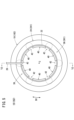
- FIG. 5 is a plan view of the stator 16 (162) according to the second embodiment.
- a plan view of the stator 162 as viewed in the axial direction is shown in FIG. 5.
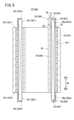
- FIG. 6 is a cross-sectional view showing a portion of the stator 162. A portion of the cross section taken along line VI-VI shown in FIG. 5 is shown in FIG. 6.
- the stator 162 includes a housing member 18 (182), a coil portion 22, and a shrink tube 24.
- the housing member 182 is cylindrical in shape.
- the rotating shaft 12 and rotor 14 of the electric motor 10 can be provided inside the housing member 182.
- the housing member 182 is a stator core (magnetic material) including electromagnetic steel, etc.
- the housing member 182 includes, for example, but is not limited to, a plurality of electromagnetic steel plates (not shown) stacked along the axial direction DA.
- the housing member 182 has a teeth portion 38.
- the teeth portion 38 includes a plurality of teeth 40. Although six teeth 40 are shown in FIG. 5, the number of teeth 40 is not limited to this.
- the plurality of teeth 40 are arranged to surround the rotor 14 when viewed in the axial direction.
- the plurality of teeth 40 can be arranged point symmetrically with the center point C of the stator 162 when viewed in the axial direction as the axis of symmetry.
- Slots 42 are formed between adjacent teeth 40 in the circumferential direction DC of the housing member 182 (coil portion 22).
- the housing member 182 has a plurality of slots 42 formed by the teeth portions 38.
- an insulating layer is provided on the surface of the slots 42.
- the coil portion 22 is formed by a conductor wound around a number of teeth 40. As shown in FIG. 6, a portion of the coil portion 22 (conductor) is located within a number of slots 42. An insulating material (not shown) is filled between the wires of the conductor that form the coil portion 22.
- the insulating material is, for example, a hardened impregnating agent.
- the coil ends 36 of the coil portion 22 protrude from the housing member 182 along the axial direction DA.
- the coil ends 36 include a first coil end 361 in the first direction DA1 and a second coil end 362 in the second direction DA2.
- the stator 162 is provided with a pair of shrink tubes 24 including a first shrink tube 241 and a second shrink tube 242.
- the first shrink tube 241 covers the outer periphery 361p of the first coil end 361 and the tip end 361t in the first direction DA1 of the first coil end 361.
- the second shrink tube 242 covers the outer periphery 362p of the second coil end 362 and the tip end 362t in the second direction DA2 of the second coil end 362.
- Each of the pair of shrink tubes 24 has, for example, insulating properties and heat shrinkability.
- the inner circumference 36i of the coil end 36 is not covered by the shrink tube 24.
- the lead wire 26 of the coil portion 22 is drawn out from the inside of the coil portion 22 in the radial direction DR (the inner circumference 36i).
- the stator 162 can be provided in the electric motor 10 (see also FIG. 1).
- the stator 162 and the electric motor 10 provided with it can achieve the effects described below, for example.
- the outer periphery 36p and the tip 36t (at least a part of the tip 36t) of the coil end 36 are covered by the shrink tube 24. This effectively prevents the coil end 36 from coming into contact with the housing member 182, foreign objects, etc., as in the first embodiment.
- the shrink tube 24 can effectively fix the coil end 36.
- the coil end 36 can be protected by the shrink tube 24, which is a relatively thin member, it is possible to suppress the enlargement of the stator 162 without reducing the amount of conductor wire included in the coil portion 22.
- the shrink tube 24 does not cover the inner periphery 36i of the coil end 36, and the lead wire 26 is pulled out from the inside of the coil portion 22 in the radial direction DR (inner periphery 36i). This makes it possible to prevent interference between the shrink tube 24 and the lead wire 26, as in the first embodiment. Also, there is no need to provide a hole in the shrink tube 24 to allow the lead wire 26 to be pulled out from the outer periphery 36p of the coil end 36. Therefore, the entire outer periphery 36p can be reliably covered by the shrink tube 24.
- the housing member 182 is a cylindrical stator core that includes an alloy such as electromagnetic steel. This makes it possible to suppress iron loss that occurs in the electric motor 10. Furthermore, the housing member 182, which is made of electromagnetic steel, can use materials that are commonly used for stator cores (such as electromagnetic steel sheets). This makes it possible to suppress, for example, increases in procurement costs for the materials of the housing member 182.
- the housing member (stator core) 182 has teeth 38.
- the coil 22 is provided on the teeth 38. In this case, the coil bobbin 20 (see the first embodiment) is not required.
- the surface of the slot 42 is provided with an insulating layer (not shown). This can reduce the risk of a short circuit between the coil portion 22 and the housing member 182.
- the shrink tube 24 has heat shrinkability. Therefore, the shrink tube 24 easily shrinks when heated, for example. In this case, for example, a pressing member to prevent the adhesive tape attached to the coil end from lifting up is not necessary. Therefore, the manufacturing method of the stator 162 is simpler than the conventional technology disclosed in, for example, JP 50-124102 A.
- the electric motor 10 equipped with the stator 162 can be realized in a relatively small size while suppressing a decrease in output.
- Fig. 7 is a plan view of the stator 16 (16A) according to the modified example 1.
- Fig. 7 shows a plan view of the stator 16A as viewed in the axial direction.
- Fig. 8 is a cross-sectional view showing a part of the stator 16A.
- Fig. 8 shows a part of the cross section taken along line VIII-VIII shown in Fig. 7.
- the protruding wall portion 34 of the coil bobbin 20 may be formed only in a portion of the bobbin core portion 30 in the circumferential direction DC. This can reduce the amount of material consumed by the coil bobbin 20.
- a bobbin core portion 30 (bobbin core portion 30A) having a protruding wall portion 34 (protruding wall portion 34A) according to this modified example is shown in Figures 7 and 8.
- the protruding wall portion 34A protrudes in the axial direction DA from a portion of the bobbin core portion 30A in the circumferential direction DC. More specifically, the protruding wall portion 34A shown in Figures 7 and 8 protrudes along the first direction DA1 from a portion of the bobbin core portion 30A located between the partition portion 322 and the partition portion 323 in the circumferential direction DC.
- the lead wire 26 is drawn out at a portion corresponding to the protruding wall portion 34. That is, the coil portion 22 has a lead wire 44, which is a portion from which the lead wire 26 is drawn out.
- the position of the lead wire 44 in the circumferential direction DC preferably corresponds to the position of the protruding wall portion 34A in the circumferential direction DC.
- the lead wire 44 is included in a portion of the coil portion 22 that is located between the partition portion 322 and the partition portion 323 in the circumferential direction DC. In this way, it is preferable that the position of the lead wire 44 and the position of the protruding wall portion 34A overlap in the circumferential direction DC.
- the coil unit 22 may include a plurality of coils, for example, a coil for use as a U-phase coil, a coil for use as a V-phase coil, and a coil for use as a W-phase coil.
- the coil end 36 may be formed by the multiple coils.
- the multiple coils included in the coil section 22 may collectively form a single annular first coil end 361.
- the multiple coils included in the coil section 22 may collectively form a single annular second coil end 362.
- the coil section 22 including multiple coils may have multiple lead wires 26 corresponding to the number of coils.
- the coil section 22 may have a lead wire 26 drawn from the U-phase coil, a lead wire 26 drawn from the V-phase coil, and a lead wire 26 drawn from the W-phase coil.
- the coil bobbin 20 may have multiple protruding wall portions 34A corresponding to multiple lead wires 26 (multiple lead-out portions 44).
- the lead-out portion 44 of the U-phase coil, the lead-out portion 44 of the V-phase coil, and the lead-out portion 44 of the W-phase coil may differ from one another in the circumferential direction DC of the bobbin core portion 30A.
- the coil bobbin 20 may have a protruding wall portion 34A corresponding to the lead-out portion 44 of the U-phase coil, a protruding wall portion 34A corresponding to the lead-out portion 44 of the V-phase coil, and a protruding wall portion 34A corresponding to the lead-out portion 44 of the W-phase coil.
- the positions of the multiple lead-out portions 44 and the position of one protruding wall portion 34A may overlap in the circumferential direction DC. That is, the multiple lead-out wires 26 may be drawn out at locations corresponding to the same protruding wall portion 34A. For example, the multiple lead-out wires 26 may be drawn out from a position between the partition portion 322 and the partition portion 323 in the circumferential direction DC of the coil portion 22 (see also FIG. 7). In this case, not only is the risk of contact between the rotating shaft 12, the rotor 14, etc. and the multiple lead-out wires 26 reduced, but the number of protruding wall portions 34A can be kept to a minimum (one).
- the inner wall portion 181i of the housing member 181 is provided with the insulating layer 28.
- an insulating material (not shown) is filled between the wires of the conductor forming the coil portion 22.
- the insulating material and the insulating layer 28 may be made of the same material (impregnating agent). This can prevent an increase in the number of materials.
- the electric motor 10 may further include a housing (not shown) that covers the space inside the housing member 18, as necessary. This makes it possible to prevent foreign matter present outside the electric motor 10 from entering the inside of the housing member 18.
- the foreign matter is not limited to, but may be, for example, dust, water, oil, etc.
- the electric motor 10 may be provided with a housing that can cover the entire stator 16.
- the accommodating member 18 has a first end 18t1 and a second end 18t2 (see also Figures 1 and 6).
- the electric motor 10 may be provided with a first housing attached to the first end 18t1 and a second housing attached to the second end 18t2.
- the first housing and the second housing sandwich the accommodating member 18 in the axial direction DA.
- At least one of the first housing and the second housing may have one or more holes through which the rotating shaft 12, the lead wires 26, etc. are inserted.
- the shape of the housing member 18 or the bobbin core portion 30 is not limited to a cylinder and may be a square tube. Also, the shape of the coil portion 22 (coil end 36) as viewed in the axial direction is not limited to a ring and may have, for example, a square portion.
- the stator 16 is suitable for miniaturizing the electric motor 10 while suppressing a decrease in the output of the electric motor 10.
- the stator (16) is a stator provided in an electric motor (10), and includes a coil portion (22) formed in an annular shape so as to surround a rotor (14) provided in the electric motor and having coil ends (36), and a shrink tube (24) that covers the coil ends without covering inner peripheries (36i) of the coil ends, and a lead wire (26) of the coil portion is drawn out from the radially inner side (DR) of the coil portion.
- the stator described in Appendix 1 may include a coil bobbin (20) supporting the coil portion, the coil bobbin including a cylindrical bobbin core portion (30) extending along an axial direction (DA) and a plurality of partition portions (32) protruding radially outward from the bobbin core portion, the coil portion being formed by a conductor wound around the plurality of partition portions, and the maximum dimension (L30) of the bobbin core portion in the axial direction being longer than the dimension (L32) of the partition portions in the axial direction.
- the stator described in Appendix 2 may further include a cylindrical accommodating member (181) extending along the axial direction so as to surround the coil bobbin, the coil end protruding from an end (18t) of the accommodating member in the axial direction, and the bobbin core portion having a protruding wall portion (34) protruding from the end.
- the stator may be as described in Appendix 3, wherein the protruding wall portion has a first protruding wall portion (341) protruding from the accommodating member toward a first direction (DA1) that is one side in the axial direction, and a second protruding wall portion (342) protruding from the accommodating member toward a second direction (DA2) that is the other side in the axial direction, and the dimension (L341) of the first protruding wall portion in the axial direction is different from the dimension (L342) of the second protruding wall portion in the axial direction.
- the stator may be as described in Appendix 3, wherein the protruding wall portion has a first protruding wall portion (341) protruding from the accommodating member toward a first direction (DA1) which is one side in the axial direction, the coil portion has a first coil end (361) which is the coil end formed at an end of the coil portion in the first direction, and the dimension (L341) of the first protruding wall portion in the axial direction is greater than or equal to the dimension (L361) of the portion of the first coil end protruding from the accommodating member in the axial direction.
- the stator may be as described in Appendix 5, wherein the protruding wall portion has a second protruding wall portion (342) protruding from the accommodating member toward a second direction (DA2), which is the other side in the axial direction, the coil portion has a second coil end (362) which is the coil end formed at an end of the coil portion in the second direction, and the dimension (L342) of the second protruding wall portion in the axial direction is greater than or equal to the dimension (L362) of the portion of the second coil end protruding from the accommodating member in the axial direction.
- the stator according to Supplementary Note 3 may be a stator in which, on at least one side in the axial direction of the bobbin core portion, the protruding wall portion is formed around the entire circumference of the bobbin core portion.
- the stator may be the one described in Appendix 3, wherein, on at least one side of the bobbin core portion in the axial direction, the protruding wall portion is formed in a part of the bobbin core portion when viewed in the axial direction, and the lead-out wire is pulled out at a portion corresponding to the protruding wall portion.
- the stator according to Supplementary Note 8 may be such that the coil portion has a plurality of the lead wires, and the plurality of lead wires are led out at positions corresponding to the same protruding wall portion.
- the stator described in Supplementary Note 10 may be a stator further including an insulating layer (28) formed on an inner wall portion (181i) of the housing member.
- the stator may be the stator described in Appendix 1, further comprising a cylindrical stator core (182) having teeth portions (38), and the coil portions are formed by conductive wires wound around the teeth portions.
- the stator may be the stator according to any one of appendices 1 to 13, wherein the shrink tube is a heat-shrinkable tube.
- An electric motor (10) according to the present disclosure is an electric motor including a stator according to any one of appendices 1 to 14.
Landscapes
- Engineering & Computer Science (AREA)
- Power Engineering (AREA)
- Insulation, Fastening Of Motor, Generator Windings (AREA)
Priority Applications (5)
| Application Number | Priority Date | Filing Date | Title |
|---|---|---|---|
| DE112023006383.4T DE112023006383T5 (de) | 2023-07-26 | 2023-07-26 | Stator und Elektromotor |
| JP2025535488A JPWO2025022600A1 (https=) | 2023-07-26 | 2023-07-26 | |
| CN202380100521.1A CN121532931A (zh) | 2023-07-26 | 2023-07-26 | 定子以及电动机 |
| PCT/JP2023/027356 WO2025022600A1 (ja) | 2023-07-26 | 2023-07-26 | 固定子および電動機 |
| TW113127763A TW202505846A (zh) | 2023-07-26 | 2024-07-26 | 定子及電動機 |
Applications Claiming Priority (1)
| Application Number | Priority Date | Filing Date | Title |
|---|---|---|---|
| PCT/JP2023/027356 WO2025022600A1 (ja) | 2023-07-26 | 2023-07-26 | 固定子および電動機 |
Publications (1)
| Publication Number | Publication Date |
|---|---|
| WO2025022600A1 true WO2025022600A1 (ja) | 2025-01-30 |
Family
ID=94374631
Family Applications (1)
| Application Number | Title | Priority Date | Filing Date |
|---|---|---|---|
| PCT/JP2023/027356 Pending WO2025022600A1 (ja) | 2023-07-26 | 2023-07-26 | 固定子および電動機 |
Country Status (5)
| Country | Link |
|---|---|
| JP (1) | JPWO2025022600A1 (https=) |
| CN (1) | CN121532931A (https=) |
| DE (1) | DE112023006383T5 (https=) |
| TW (1) | TW202505846A (https=) |
| WO (1) | WO2025022600A1 (https=) |
Citations (3)
| Publication number | Priority date | Publication date | Assignee | Title |
|---|---|---|---|---|
| JPS4959004U (https=) * | 1972-08-30 | 1974-05-24 | ||
| JPS5666151A (en) * | 1979-11-02 | 1981-06-04 | Mitsubishi Electric Corp | Manufacture of electric rotary machine |
| JPS57101569U (https=) * | 1980-12-15 | 1982-06-22 |
Family Cites Families (1)
| Publication number | Priority date | Publication date | Assignee | Title |
|---|---|---|---|---|
| JPS50124102A (https=) | 1974-03-20 | 1975-09-30 |
-
2023
- 2023-07-26 WO PCT/JP2023/027356 patent/WO2025022600A1/ja active Pending
- 2023-07-26 DE DE112023006383.4T patent/DE112023006383T5/de active Pending
- 2023-07-26 JP JP2025535488A patent/JPWO2025022600A1/ja active Pending
- 2023-07-26 CN CN202380100521.1A patent/CN121532931A/zh active Pending
-
2024
- 2024-07-26 TW TW113127763A patent/TW202505846A/zh unknown
Patent Citations (3)
| Publication number | Priority date | Publication date | Assignee | Title |
|---|---|---|---|---|
| JPS4959004U (https=) * | 1972-08-30 | 1974-05-24 | ||
| JPS5666151A (en) * | 1979-11-02 | 1981-06-04 | Mitsubishi Electric Corp | Manufacture of electric rotary machine |
| JPS57101569U (https=) * | 1980-12-15 | 1982-06-22 |
Also Published As
| Publication number | Publication date |
|---|---|
| CN121532931A (zh) | 2026-02-13 |
| TW202505846A (zh) | 2025-02-01 |
| DE112023006383T5 (de) | 2026-03-12 |
| JPWO2025022600A1 (https=) | 2025-01-30 |
Similar Documents
| Publication | Publication Date | Title |
|---|---|---|
| JP6208333B2 (ja) | アキシャルギャップ型回転電機 | |
| JP4710047B2 (ja) | バリアブルリラクタンス型角度検出器 | |
| US20090134737A1 (en) | Stator of electric rotating machine and electric rotating machine | |
| EP2896115B1 (en) | Stator of rotating electric machine | |
| JP2019075873A (ja) | 回転電機 | |
| WO2019073724A1 (ja) | 回転電機の固定子 | |
| JP2019193471A (ja) | 回転電機のステータ | |
| JP2012095488A (ja) | 回転電機用ロータ、およびこれを用いた回転電機 | |
| JP5359463B2 (ja) | ステータおよび回転電機 | |
| JPWO2018138853A1 (ja) | アキシャルギャップ型回転電機 | |
| WO2025022600A1 (ja) | 固定子および電動機 | |
| JP6746019B1 (ja) | 固定子コイルおよびこの固定子コイルを備えた固定子、並びに回転電機、固定子コイルの製造方法 | |
| JPWO2021240851A5 (https=) | ||
| WO2019059228A1 (ja) | ステータおよびステータコイル | |
| WO2020044428A1 (ja) | 固定子 | |
| CN115995906A (zh) | 马达 | |
| JP7172809B2 (ja) | 回転電機 | |
| JP5271991B2 (ja) | 回転電機の固定子 | |
| JP2010136597A (ja) | モータ及びその巻線方法 | |
| US20250233471A1 (en) | Stator of rotating electrical machine | |
| US20250373104A1 (en) | Stator, motor, and method of manufacturing stator | |
| JP2020202634A (ja) | 回転電機に用いられる固定子 | |
| US20250088062A1 (en) | Stator and rotatary electrical machine | |
| JP7275211B2 (ja) | インシュレータ、固定子、及びそれらを用いた回転電機 | |
| JP2023150105A (ja) | ステータ |
Legal Events
| Date | Code | Title | Description |
|---|---|---|---|
| 121 | Ep: the epo has been informed by wipo that ep was designated in this application |
Ref document number: 23946683 Country of ref document: EP Kind code of ref document: A1 |
|
| ENP | Entry into the national phase |
Ref document number: 2025535488 Country of ref document: JP Kind code of ref document: A |
|
| WWE | Wipo information: entry into national phase |
Ref document number: 2025535488 Country of ref document: JP |
|
| WWE | Wipo information: entry into national phase |
Ref document number: 112023006383 Country of ref document: DE |
|
| WWP | Wipo information: published in national office |
Ref document number: 112023006383 Country of ref document: DE |