WO2025017944A1 - 測定セルおよび光学分析装置 - Google Patents
測定セルおよび光学分析装置 Download PDFInfo
- Publication number
- WO2025017944A1 WO2025017944A1 PCT/JP2024/001792 JP2024001792W WO2025017944A1 WO 2025017944 A1 WO2025017944 A1 WO 2025017944A1 JP 2024001792 W JP2024001792 W JP 2024001792W WO 2025017944 A1 WO2025017944 A1 WO 2025017944A1
- Authority
- WO
- WIPO (PCT)
- Prior art keywords
- light
- cell
- cell flange
- flange
- window portion
- Prior art date
- Legal status (The legal status is an assumption and is not a legal conclusion. Google has not performed a legal analysis and makes no representation as to the accuracy of the status listed.)
- Pending
Links
Images

Classifications
-
- G—PHYSICS
- G01—MEASURING; TESTING
- G01N—INVESTIGATING OR ANALYSING MATERIALS BY DETERMINING THEIR CHEMICAL OR PHYSICAL PROPERTIES
- G01N21/00—Investigating or analysing materials by the use of optical means, i.e. using sub-millimetre waves, infrared, visible or ultraviolet light
- G01N21/01—Arrangements or apparatus for facilitating the optical investigation
- G01N21/03—Cuvette constructions
- G01N21/05—Flow-through cuvettes
-
- G—PHYSICS
- G01—MEASURING; TESTING
- G01N—INVESTIGATING OR ANALYSING MATERIALS BY DETERMINING THEIR CHEMICAL OR PHYSICAL PROPERTIES
- G01N21/00—Investigating or analysing materials by the use of optical means, i.e. using sub-millimetre waves, infrared, visible or ultraviolet light
- G01N21/01—Arrangements or apparatus for facilitating the optical investigation
- G01N21/03—Cuvette constructions
- G01N21/09—Cuvette constructions adapted to resist hostile environments or corrosive or abrasive materials
Definitions
- the present invention relates to a measurement cell and optical analysis device that uses a light-emitting element to optically analyze the concentration of a substance to be measured in a measurement cell by absorptiometry.
- this type of optical analyzer is known to be connected to a gas supply device and the main gas line of a semiconductor manufacturing device, and is arranged so that the substance to be measured flows in-line into the measurement cell from an inlet and an outlet provided at both ends of the measurement cell that constitutes the optical analyzer, allowing the concentration to be measured (see Patent Document 1).
- the optical detectors of optical analyzers In semiconductor manufacturing equipment, durability of the parts used is required for a long period of time, and the optical detectors of optical analyzers also require a sealing method that is corrosion-resistant and can maintain the airtight performance of the measurement cell for a long period of time, and has low particle properties. Furthermore, since the semiconductor manufacturing process places the utmost importance on quality and production efficiency, a sealing method with high airtight performance is also required for the optical detectors of optical analyzers.
- the cell flange and brittle breakable light-transmitting window that make up the measurement cell are made airtight by using sealing materials such as gaskets to maintain an airtight state.
- sealing materials such as gaskets to maintain an airtight state.
- this sealing material it is structurally difficult to maintain airtight performance over the long term due to the risk of damage to the brittle breakable light-transmitting window material, deformation and deterioration of the sealing material, and difficulty in managing gaps in the sealing parts.
- the present invention aims to provide a measurement cell and optical analysis device that can suppress the generation of particles due to corrosion and deterioration and improve the ability to maintain an airtight state.
- a measurement cell has a flow path through which a substance to be measured flows, and includes a first cell flange arranged on the incident side of light from a light source (light-emitting element), a second cell flange arranged adjacent to the first cell flange and having a flow path, a cylindrical light entrance window portion joined to at least a part of the first cell flange through which light enters, and a cylindrical light exit window portion joined to at least a part of the second cell flange through which light exits, and a thin film layer made of metal atoms is applied to the joining surface between the light entrance window portion and the first cell flange.
- a measurement cell for achieving the above object is a measurement cell having a flow path through which a substance to be measured flows, comprising a first cell flange arranged on the incident side of light from a light-emitting element, a second cell flange arranged adjacent to the first cell flange and having a flow path, a third cell flange arranged on the detection side of light from the light-emitting element, a cylindrical light entrance window portion joined to at least a part of the first cell flange through which light enters, and a cylindrical light exit window portion joined to at least a part of the third cell flange through which light exits, characterized in that a thin film layer made of metal atoms is applied to the joint surface between the light entrance window portion and the first cell flange and the joint surface between the light exit window portion and the third cell flange.
- a thin film layer made of metal atoms is applied to the joint surface between the light exit window portion and the second cell flange.
- a thin film layer made of metal atoms is applied to the joining surfaces of the first cell flange and the second cell flange.
- the end face of the light entrance window portion in the optical axis direction facing the light exit window portion is flat, and that a gap is formed between the end face of the light entrance window portion in the optical axis direction and the end face of the light exit window portion facing the light entrance window portion.
- a recess may be formed on the light exit window side of the light entrance window, and a gap may be formed between the recess and the end face of the light exit window facing the light entrance window.
- the end face in the optical axis direction of the light entrance window portion may be flat, and a convex portion may be formed on the light entrance window portion side of the light exit window portion, so that a gap is formed between the end face and the top of the convex portion.
- an integral window portion may be formed by integrally bonding an end face of the light entrance window portion in the optical axis direction and an end face of the light exit window portion on the light emitting element side, and a gap may be formed within the integral window portion.
- the materials constituting the light entrance window and the light exit window are preferably sapphire glass, quartz glass, diamond glass, CaF2 glass, BaF2 glass, MgF2 glass, LiF glass, AlF3 glass, SrF2 glass, or KBr glass. Note that the material constituting the light transmission window is selected depending on the absorbed light of the substance to be measured, and is not limited to the embodiment.
- An optical analysis device having a measurement cell having a flow path through which a substance to be measured flows, and a transmitted light detector that detects the transmitted light in the measurement cell as light passes through a light entrance window, wherein the measurement cell has a first cell flange arranged on the incident side of light from a light-emitting element (light source), a second cell flange arranged adjacent to the first cell flange and having a flow path, a cylindrical light entrance window joined to at least a part of the first cell flange through which light enters, and a cylindrical light exit window joined to at least a part of the second cell flange through which light exits, and a thin film layer made of metal atoms is applied to the joining surface between the light entrance window and the first cell flange.
- a light-emitting element light source
- second cell flange arranged adjacent to the first cell flange and having a flow path
- a cylindrical light entrance window joined to at least a part of the first cell flange through which light enters
- the present invention provides a measurement cell and optical analysis device that can suppress the generation of particles due to corrosion and deterioration and improve the ability to maintain an airtight state.
- FIG. 1 is a diagram showing the overall configuration of a concentration detection system including an optical analysis device used in an embodiment of the present invention.
- FIG. 2 is an exploded perspective view showing a configuration of a measurement cell used in an embodiment of the present invention.
- 3 is a cross-sectional view taken along line AA in FIG. 2.
- 3 is a cross-sectional view taken along line BB in FIG. 2.
- FIG. 2 is a partially transparent view showing the configuration of a measurement cell used in an embodiment of the present invention.
- FIG. 2A is a diagram for explaining the structure of a measurement cell used in the embodiment
- FIG. 2B is a diagram for explaining the structure of an optical cell according to Modification 1.
- 1A is a cross-sectional view for explaining the structure of a measurement cell relating to variant example 2, FIG.
- FIG. 1B is a diagram for explaining the structure of the light entrance window portion
- FIG. 1C is a longitudinal cross-sectional view in the optical axis direction of FIG. 1B
- FIG. 8 is a diagram for explaining a method for joining the first cell flange 7a and the light incident window portion 2a, where (a) shows the state before joining and (b) shows the state after joining.
- 1A is a cross-sectional view illustrating the structure of a measurement cell according to modified example 3
- FIG. 1B is a view illustrating the structure of a light exit window portion
- FIG. 1C is a longitudinal cross-sectional view of the measurement cell in the gas flow path direction.
- FIG. 13 is a diagram to explain an example of joining a diaphragm to a second cell flange 7b, where the circle shows an enlarged view of the joining portion
- (b) is a diagram to explain the structure of the light entrance window portion of modified example 4.
- 13 is a diagram for explaining an example of beam welding of a first cell flange 7a to a second cell flange 57b.
- FIG. 13 is a diagram for explaining another example of beam welding of the first cell flange 7a to the second cell flange 67b.
- FIG. FIG. 23 is a cross-sectional view for explaining the structure of a measurement cell according to Modification 7.
- Measurement cell 2a Light entrance window 2b, 2c: Light exit window 3: Light emitting element (light source) 4 Detection unit 6 Gap 7a First cell flange 7b, 57b, 67b Second cell flange 7c Third cell flange 20 Optical analysis device 28a, 28b, 28c Bonding surface
- FIG. 1 is a diagram showing the overall configuration of a concentration detection system including an optical analysis device 20.
- FIG. 2 is an exploded perspective view showing the configuration of a measurement cell 1.
- FIG. 3 is a cross-sectional view taken along line A-A in FIG. 2.
- FIG. 4 is a cross-sectional view taken along line B-B in FIG. 2.
- FIG. 5 is a partially transparent view showing the configuration of a measurement cell 1.
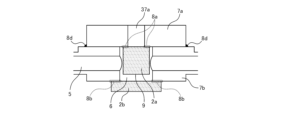
- FIG. 6(a) is a diagram for explaining the structure of a measurement cell used in the embodiment, showing an enlarged view of the joint between flanges in part, and (b) is a diagram for explaining the structure of an optical cell relating to modified example 1.
- FIG. 6(a) is a diagram for explaining the structure of a measurement cell used in the embodiment, showing an enlarged view of the joint between flanges in part
- (b) is a diagram for explaining the structure of an optical cell relating to modified example 1.
- FIG. 7(a) is a vertical cross-sectional view for explaining the structure of a measurement cell relating to modified example 2
- (b) is a diagram for explaining the structure of a light entrance window portion
- (c) is a vertical cross-sectional view in the optical axis direction of the light entrance window portion.
- FIG. 8 is a diagram for explaining a method of joining a first cell flange 7a and a light entrance window portion 2a, showing (a) the state before joining and (b) the state after joining.
- 9(a) is a cross-sectional view for explaining the structure of the measurement cell according to the third modification
- (b) is a view for explaining the structure of the light exit window
- (c) is a vertical cross-sectional view in the gas flow direction of the measurement cell.
- FIG. 10(a) is a view for explaining an example of joining the diaphragm to the second cell flange 7b, and the inside of the circle is an enlarged view of the joining portion, and (b) is a view for explaining the structure of the light entrance window of the fourth modification.
- FIG. 11 is a view for explaining an example of beam welding the first cell flange 7a to the second cell flange 57b.
- FIG. 12 is a view for explaining another example of beam welding the first cell flange 7a to the second cell flange 67b.
- FIG. 13 is a cross-sectional view for explaining the structure of the measurement cell according to the seventh modification.
- the optical analysis device 20 is connected to a gas supply device 22 and a main gas line 23 of a semiconductor manufacturing device 21, and is arranged so that the substance to be measured (a substance flowing in the direction of the arrow in Figure 1) flows in-line into the measurement cell 1 from an inlet 20a and an outlet 20b provided at both ends of the measurement cell 1 that constitutes the optical analysis device 20, allowing the concentration of the substance to be measured to be measured.
- the substance to be measured a substance flowing in the direction of the arrow in Figure 1
- the optical analysis device 20 comprises a measurement cell 1, a light-emitting element that emits light (note that the term "light-emitting element” is a broader concept than a light source, and includes, but is not limited to, light sources such as lamps and semiconductor light sources equipped with a light-emitting element that emits ultraviolet light of a specified wavelength), and a detection unit 4 that detects the transmitted light.
- a light-emitting element that emits light
- the term "light-emitting element” is a broader concept than a light source, and includes, but is not limited to, light sources such as lamps and semiconductor light sources equipped with a light-emitting element that emits ultraviolet light of a specified wavelength
- a detection unit 4 that detects the transmitted light.
- the parts that come into contact with the substance to be measured are made of a material that is resistant to corrosion (intergranular corrosion) at the contact points, such as non-magnetic austenitic stainless steel (SUS316L) or titanium, to enhance corrosion resistance.
- a material that is resistant to corrosion such as non-magnetic austenitic stainless steel (SUS316L) or titanium, to enhance corrosion resistance.
- the measurement cell 1 has a first cell flange 7a, a second cell flange 7b, a light entrance window 2a, and a light exit window 2b, as shown in Fig. 2.
- the material of the first cell flange 7a and the second cell flange 7b is, for example, SUS316L or titanium.
- the material of the light entrance window 2a and the light exit window 2b is, for example, sapphire glass, quartz glass, diamond glass, CaF2 glass, BaF2 glass, MgF2 glass, LiF glass, AlF3 glass, SrF2 glass, or KBr glass.
- the first cell flange 7a has a through hole 37a that passes light emitted from a light-emitting element (hereinafter referred to as a "light source") 3.
- the through hole 37a is formed extending in the light traveling direction (the direction of the solid line arrow in FIG. 3).
- the second cell flange 7b is disposed adjacent to the first cell flange 7a.
- the second cell flange 7b is formed with a through hole 37b that passes light that has passed through the through hole 37a, and a through hole 37c that passes gas.
- the through hole 37b is formed extending in the light traveling direction, and the through hole 37c is formed extending in the gas traveling direction (the direction of the dashed line arrow in FIG. 3).
- the through hole 37a and the through hole 37b constitute an optical path (solid line arrow in FIG. 3) that passes light.
- the through hole 37c constitutes a gas flow path 5 that passes gas.
- the light entrance window 2a is a cylindrical brittle, breakable light-transmitting window that transmits the light that has passed through the through hole 37a.
- the material of the light entrance window 2a is preferably sapphire, which has resistance and high transmittance to detection light used in concentration measurement such as ultraviolet light and is mechanically and chemically stable, but other stable materials such as quartz glass can also be used.
- diamond glass, CaF2 glass, BaF2 glass, MgF2 glass, LiF glass, AlF3 glass, SrF2 glass, and KBr glass may also be used.
- light includes not only ultraviolet light, but also at least infrared light and visible light, and may include electromagnetic waves of any wavelength. Translucency means that the internal transmittance of the light irradiated to the measurement cell 1 is high enough to perform concentration measurement.
- the light entrance window 2a is joined to a part (joint surface 28a) of the light exit end surface 47a of the first cell flange 7a so as to cover the through hole 37a, as shown in Figures 2, 5 and 6.
- the joining method will be described later.
- the light exit window 2b is a cylindrical brittle breakable light transmission window that transmits the light that has passed through the through hole 37b.
- the material of the light exit window 2b is preferably sapphire, which has resistance and high transmittance to detection light used for concentration measurement such as ultraviolet light and is mechanically and chemically stable, but other stable materials such as quartz glass can also be used.
- diamond glass, CaF2 glass, BaF2 glass, MgF2 glass, LiF glass, AlF3 glass, SrF2 glass, and KBr glass may also be used.
- the light exit window 2b is joined to a part (joint surface 28b) of the light exit side end surface 47b of the second cell flange 7b so as to cover the through hole 37b.
- the joining method will be described later.
- the first cell flange 7a and the second cell flange 7b are joined at a part of the light exit end surface 47a of the first cell flange 7a (joint surface 28a in Fig. 6(a)) and a part of the light entrance end surface 47c of the second cell flange 7b (joint surface 28c).
- a gap 6 exists between the light entrance window 2a and the light exit window 2b to allow the flow of gas.
- This gap is appropriately designed (for example, between 20 ⁇ and 100 mm) by changing the thicknesses of the light entrance window 2a, the light exit window 2b, the first cell flange 7a, and the second cell flange 7b according to the substance to be measured.
- the light entrance window 2a and the light exit window 2b have been described as being cylindrical, they are not limited to being cylindrical as long as they are shaped so as to be joined as described below, and may be cylindrical, for example.
- thin film layers 38aX, 38aY, and 38aZ are formed between the joining surface 28b of the light entrance window 2a and the joining surface 28a of the first cell flange 7a to form the joining portion 8a.
- the thin film layers 38aX, 38aY, and 38aZ are made of metal atoms (e.g., gold, silver, nickel, copper, titanium, and aluminum).
- the joining between the first cell flange 7a and the light entrance window 2a is performed by bonding the metal atoms together using solid-state bonding, which bonds the two in a solid state.
- a metal underlayer e.g., titanium, 38aX1 in FIG. 8(a)
- metal atoms e.g., gold, 38aX2 in FIG. 8(a)
- underlayer thin film layer
- first cell flange 7a and second cell flange 7b ⁇ Joining of first cell flange 7a and second cell flange 7b> As shown in FIG. 6(a), in the bonding of the first cell flange 7a and the second cell flange 7b, thin film layers 28aX, 28aY, and 28aZ are formed between the bonding surface 28a of the first cell flange 7a and the bonding surface 28c of the second cell flange 7b to form a bonding portion 8c.
- the thin film layers 28aX, 28aY, and 28aZ are made of metal atoms (e.g., gold, silver, nickel, copper, titanium, and aluminum).
- the bonding of the first cell flange 7a and the second cell flange 7b is performed by bonding metal atoms together in a solid-state bonding process in which the metal atoms are bonded together in a solid state. Therefore, by bonding the metal atoms together, intermolecular bonds are formed, and the airtightness of the bonding surfaces 28a and 28c is ensured by direct bonding. In this way, by bonding the metal atoms together, intermolecular bonds are formed, and the airtightness of the first cell flange 7a and the second cell flange 7b is ensured by direct bonding.
- the cell flange is made of a metal material such as SUS material, or if a hollow (doughnut-shaped) diaphragm is used instead of the first cell flange, beam welding or the like can also be used instead of joining.
- the diaphragm will be described later.
- the present embodiment provides the following effects. (1) Because this is a room-temperature bonding process, any materials can be bonded as long as the surface roughness and flatness are ensured. In addition, by using a bonding area, it is also possible to bond different materials with different linear expansion coefficients. (2) The number of parts can be significantly reduced because no adhesives, O-rings, screws, metal seals, gasket seals, etc. are used. This allows for much greater freedom in design, and allows for simpler and more compact designs. In addition, the use of metal atoms (gold, titanium, etc.) that are more chemically stable than adhesives or brazing materials provides excellent corrosion resistance. This also reduces the loss of airtightness due to deterioration of sealing materials and corrosion associated with sealing materials.
- the structure does not use any synthetic resin sealant for sealing the brittle, breakable light-transmitting window material, so there is no loss of airtightness due to gas permeation.
- the bonding interface is integrated and has no voids, providing excellent airtightness.
- organic solvents can be used for cleaning after bonding.
- the light entrance window 2a and the light exit window 2b are shaped as shown in FIG. 6(b) so as to form a gap 6 in the line of the gas flow path 5.
- the light exit window 2b is configured by integrally molding a base portion 52 and a convex portion 53.
- a gap 6 is formed between the end face of the light entrance window 2a on the light exit window 2b side and the top of the convex portion 53 of the light exit window 2b.
- the joining points (8a to 8c) and joining method are the same as those in the above embodiment, so a description thereof will be omitted.
- the line of the gap 6 and the line of the gas flow path 5 are straight, so that the gas flows out smoothly.
- the light entrance window 2a constituting the measurement cell according to the second modification is substantially cylindrical, and is formed by integrally molding the body 13 and the ends 10, 10 at both ends of the body 13 as shown in Figs. 7(a) to 7(c).
- a groove (recess) 15 of a predetermined width is formed along the circumferential direction by making the radial thickness of the body 13 smaller than the radial thickness of the ends 10.
- a gap 16 for measuring absorbance is formed in the body 13.
- the light exit window 2b is cylindrical in shape, and the end face of the light entrance window 2a on the detection unit 4 side is joined to the end face of the light exit window 2b on the light entrance window 2a side to form a joint 8d (see Fig. 7(a)).
- the joining method for the joints 8a to 8c is the same as in the above embodiment, so the explanation will be omitted.
- the inflowing gas flows out through the groove 15 and the gap 16.
- the inflowing gas flows out through the groove 15 and the gap 16, so that the outflow of the gas is smooth.
- the effect of this modification 2 is that, since the window portion is integrally formed, gap management is easy and dimensional accuracy is improved.
- the measurement cell according to the third modification is configured by joining a hollow (donut-shaped) diaphragm 18 to a light exit window 2b without providing a light entrance window as shown in Figs. 9(a) to 9(c).
- Light from the light source passes through the hollow of the diaphragm 18 to reach the detection unit side.
- This light exit window 2b is formed by integrally molding a base 62 and a protruding portion 63 as shown in Fig. 9(b).
- the radial thickness of the protruding portion 63 By making the radial thickness of the protruding portion 63 smaller than the radial thickness of the base 62, it becomes a path for gas to flow out along the circumferential direction.
- a gap 26 for measuring absorbance is formed in the protruding portion 63.
- the end surface of the base 62 on the light source 3 side is joined to the second cell flange 7b to form a joint 8b.
- the diaphragm 18 is joined to the end surface of the protruding portion 63 on the light source 3 side to form a thin film layer 38a2 (joint: see Fig. 9(c)).
- This joining is performed by replacing the cell flange, which is the joining object of the joining method at the joining portion 8a described above, with a diaphragm, and the joining method is the same as that at the joining portion 8a, so the explanation will be omitted.
- the first cell flange 7a that appears in the above-mentioned embodiment does not exist.
- the inflowing gas flows out along the circumferential direction of the convex portion 63.
- the inflowing gas flows out along the circumferential direction of the convex portion 63, so that the outflow of the gas becomes smooth.
- the reference numeral 26 denotes a gap for measuring absorbance.
- the diaphragm 18 replaces the first cell flange in the above-mentioned embodiment, the thickness of the measurement cell in the light source direction becomes thin and compact.
- modified example 3 for convenience, it has been described that the light entrance window portion is not provided and the light exit window portion 2b functions as the window portion, but this light exit window portion 2b is formed integrally with the light entrance window portion and the light exit window portion in the above-mentioned embodiment to function as an integrated window portion.
- the effect of this modified example 3 is that since the window portion is integrally formed, the gap can be easily managed and the dimensional accuracy is improved.
- the measurement cell according to the fourth modification is configured by joining a hollow (doughnut-shaped) diaphragm 19 to a light entrance window 2a without providing a light exit window as shown in Fig. 10(a) and Fig. 10(b). Light from the light source passes through the hollow part of the diaphragm 19 to reach the detection unit side.
- the light entrance window 2a is formed by integrally molding a base part 72 and a convex part 73 as shown in Fig. 10(a).
- the radial thickness of the convex part 73 is made smaller than the radial thickness of the base part 72 to form a path for gas to flow out along the circumferential direction.
- a gap 76 for passing gas is formed in the convex part 73.
- the end face of the base part 72 on the detection unit 4 side is joined to the second cell flange 7b to form a joint part 8f.
- the diaphragm 19 is joined to the second cell flange 7b to form a thin film layer (joint part: see Fig. 8(a)) 38a.
- These joining methods are the same as those described above, so their explanations are omitted.
- the first cell flange 7a that appears in the above-mentioned embodiment does not exist in this modified example 4.
- the inflowing gas flows out along the circumferential direction of the convex portion 73 and also flows out through the gap 76.
- the inflowing gas flows out along the circumferential direction of the convex portion 73 and also flows out through the gap 76, so that the outflow of the gas becomes smooth.
- the reference numeral 76 denotes a gap for measuring absorbance.
- the diaphragm 19 replaces the first cell flange of the above-mentioned embodiment, the thickness of the measurement cell in the light source direction becomes thin and compact.
- the light exit window portion is not provided and the light entrance window portion 2a functions as the window portion, but this light entrance window portion 2a is formed integrally with the light entrance window portion and the light exit window portion of the above-mentioned embodiment to function as an integrated window portion.
- the effect of this modified example 4 is that the gap can be easily managed and the dimensional accuracy is improved because the window portion is integrally formed.
- the measurement cell according to the modification 5 is the same as the modification 1 except for the joining method of the first cell flange 7a and the second cell flange 57b (corresponding to the symbol 7b in the modification 1) and the structure (shape) of the second cell flange 57b. Therefore, the same symbols are used for the similar parts, and the description of the similar points is omitted.
- the second cell flange 57b has a step portion 57c along the circumferential direction on the first cell flange 7a side, and the outer periphery of the first cell flange 7a and the step portion 57c of the second cell flange 57b are beam welded.
- the joining of the lower surface of the first cell flange 7a and the upper surface of the second cell flange 57b (joining at the joint 8c in FIG. 6(a)) as in the modification 1 can be omitted, so that the manufacturing cost can be reduced.
- the above-mentioned beam joining may be performed while maintaining the joining state of the lower surface of the first cell flange 7a and the upper surface of the second cell flange 57b (joining state at the joint 8c in FIG. 6(a)) as in the modification 1. In this case, since the joints 8c and 8d are double-jointed, a stronger joint is realized.
- the measurement cell according to the modification 6 is the same as the modification 2 except for the joining method of the first cell flange 7a and the second cell flange 67b (corresponding to the symbol 7b in the modification 2) and the structure (shape) of the second cell flange 67b. Therefore, the same symbols are used for the similar parts, and the description of the similar points is omitted.
- the second cell flange 67b has a step portion 67c along the circumferential direction on the first cell flange 7a side, and the outer periphery of the first cell flange 7a and the step portion 67c of the second cell flange 67b are beam welded.
- the joining of the lower surface of the first cell flange 7a and the upper surface of the second cell flange 57b (joining at the joint 8c in FIG. 7(a)) as in the modification 1 can be omitted, so that the manufacturing cost can be reduced.
- the above-mentioned beam joining may be performed while maintaining the joining state of the lower surface of the first cell flange 7a and the upper surface of the second cell flange 67b (joining state at the joint 8c in FIG. 7(a)) as in the modification 1. In this case, since the joints 8c and 8d are double-jointed, a stronger joint is realized.
- the shapes of the first cell flange and the second cell flange in the above-described modified examples 5 and 6 are not limited to those shown in Figs. 11 and 12, as long as there are areas where they can be joined to each other.
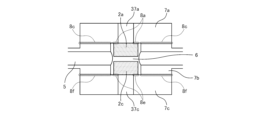
- the measurement cell of variant 7 has a third cell flange 7c having the same shape as the first cell flange 7a, and a light exit window 2c having the same shape as the light entrance window 2a, and is the same as variant 1 except for the exclusion of the light exit window 2b. Therefore, similar parts are given the same symbols and descriptions of similar points are omitted.
- the measurement cell according to the seventh modification has a first cell flange 7a, a second cell flange 7b, a third cell flange 7c, a light entrance window 2a, and a light exit window 2c, as shown in FIG. 13.
- the first cell flange 7a has a through hole 37a for passing light emitted from a light-emitting element (hereinafter referred to as a "light source") 3.
- the second cell flange 7b is disposed adjacent to the first cell flange 7a.
- the second cell flange 7b has a through hole 37b (see FIG. 3) for passing light that has passed through the through hole 37a, and a through hole 37c (see FIG. 3) for passing gas.
- the third cell flange 7c has a through hole (reference numeral omitted) for passing light that has passed through the through hole 37b.
- the light entrance window 2a is joined to a part (joint surface 28a) of the light exit side end surface 47a of the first cell flange 7a so as to cover the through hole 37a, as shown in FIG. 2, FIG. 5, and FIG. 6.
- the light exit window 2c is a cylindrical light exit window that passes through the through hole 37b and transmits light that passes through a through hole formed in the third cell flange 7c, and is joined at the joining points 8e and 8f.
- the joining method at the joining points 8e and 8f is the same as the joining method at the joining points 8a and 8c, so a description thereof will be omitted.
- the second cell flange 7b is disposed between the first cell flange 7a and the third cell flange 7c, so that the second cell flange 7b is fixed more firmly.
- the first cell flange and the second cell flange, and the third cell flange and the second cell flange may be beam-joined.
Landscapes
- Physics & Mathematics (AREA)
- General Health & Medical Sciences (AREA)
- Life Sciences & Earth Sciences (AREA)
- Chemical & Material Sciences (AREA)
- Analytical Chemistry (AREA)
- Biochemistry (AREA)
- Health & Medical Sciences (AREA)
- General Physics & Mathematics (AREA)
- Immunology (AREA)
- Pathology (AREA)
- Optical Measuring Cells (AREA)
- Spectroscopy & Molecular Physics (AREA)
- Investigating Or Analysing Materials By Optical Means (AREA)
Priority Applications (3)
| Application Number | Priority Date | Filing Date | Title |
|---|---|---|---|
| DE112024003040.8T DE112024003040T5 (de) | 2023-07-20 | 2024-01-23 | Messzelle und optische analysevorrichtung |
| JP2025533855A JPWO2025017944A1 (https=) | 2023-07-20 | 2024-01-23 | |
| KR1020267002096A KR20260036284A (ko) | 2023-07-20 | 2024-01-23 | 측정 셀 및 광학 분석 장치 |
Applications Claiming Priority (2)
| Application Number | Priority Date | Filing Date | Title |
|---|---|---|---|
| JP2023118525 | 2023-07-20 | ||
| JP2023-118525 | 2023-07-20 |
Publications (1)
| Publication Number | Publication Date |
|---|---|
| WO2025017944A1 true WO2025017944A1 (ja) | 2025-01-23 |
Family
ID=94281750
Family Applications (1)
| Application Number | Title | Priority Date | Filing Date |
|---|---|---|---|
| PCT/JP2024/001792 Pending WO2025017944A1 (ja) | 2023-07-20 | 2024-01-23 | 測定セルおよび光学分析装置 |
Country Status (5)
| Country | Link |
|---|---|
| JP (1) | JPWO2025017944A1 (https=) |
| KR (1) | KR20260036284A (https=) |
| DE (1) | DE112024003040T5 (https=) |
| TW (1) | TW202505181A (https=) |
| WO (1) | WO2025017944A1 (https=) |
Citations (5)
| Publication number | Priority date | Publication date | Assignee | Title |
|---|---|---|---|---|
| JPS5929747U (ja) * | 1982-08-19 | 1984-02-24 | 株式会社山武 | ガス分析計のサンプルセル |
| US5326973A (en) * | 1992-01-03 | 1994-07-05 | Artema Medical Ab | Device for gas analysis |
| JP2003166935A (ja) * | 2001-12-04 | 2003-06-13 | Apurikusu:Kk | 光学的分析方法及び光学的分析装置 |
| WO2020170377A1 (ja) * | 2019-02-21 | 2020-08-27 | 株式会社島津製作所 | クロマトグラフ用検出器 |
| CN116448673A (zh) * | 2022-01-14 | 2023-07-18 | 株式会社堀场Stec | 光学测定用池及其制造方法、光学分析装置、窗形成部件 |
Family Cites Families (1)
| Publication number | Priority date | Publication date | Assignee | Title |
|---|---|---|---|---|
| KR102535963B1 (ko) | 2019-01-31 | 2023-05-26 | 가부시키가이샤 후지킨 | 농도 측정 장치 |
-
2024
- 2024-01-23 KR KR1020267002096A patent/KR20260036284A/ko active Pending
- 2024-01-23 DE DE112024003040.8T patent/DE112024003040T5/de active Pending
- 2024-01-23 JP JP2025533855A patent/JPWO2025017944A1/ja active Pending
- 2024-01-23 WO PCT/JP2024/001792 patent/WO2025017944A1/ja active Pending
- 2024-01-30 TW TW113103546A patent/TW202505181A/zh unknown
Patent Citations (5)
| Publication number | Priority date | Publication date | Assignee | Title |
|---|---|---|---|---|
| JPS5929747U (ja) * | 1982-08-19 | 1984-02-24 | 株式会社山武 | ガス分析計のサンプルセル |
| US5326973A (en) * | 1992-01-03 | 1994-07-05 | Artema Medical Ab | Device for gas analysis |
| JP2003166935A (ja) * | 2001-12-04 | 2003-06-13 | Apurikusu:Kk | 光学的分析方法及び光学的分析装置 |
| WO2020170377A1 (ja) * | 2019-02-21 | 2020-08-27 | 株式会社島津製作所 | クロマトグラフ用検出器 |
| CN116448673A (zh) * | 2022-01-14 | 2023-07-18 | 株式会社堀场Stec | 光学测定用池及其制造方法、光学分析装置、窗形成部件 |
Also Published As
| Publication number | Publication date |
|---|---|
| TW202505181A (zh) | 2025-02-01 |
| KR20260036284A (ko) | 2026-03-16 |
| DE112024003040T5 (de) | 2026-05-07 |
| JPWO2025017944A1 (https=) | 2025-01-23 |
Similar Documents
| Publication | Publication Date | Title |
|---|---|---|
| JP5585138B2 (ja) | 流路チップ及び治具 | |
| EP0266769B1 (en) | Flow cell for photometer | |
| JP5586595B2 (ja) | 光学干渉方式の圧力センサ | |
| KR101852802B1 (ko) | 취성 파괴성 판재의 고정 구조 및 이것을 사용한 취성 파괴성 판재로 이루어지는 광 투과 창판의 고정 방법 | |
| FI2803961T3 (fi) | Hermeettisesti kaasutiivis optoelektroninen tai sähköoptinen komponentti sekä menetelmä sen valmistamiseksi | |
| JPH10239235A (ja) | 赤外線ガス分析計 | |
| JP2012515441A (ja) | オプトエレクトロニクス素子の製造方法およびオプトエレクトロニクス素子 | |
| US20040196576A1 (en) | Roof mirror assembly | |
| JPS61130855A (ja) | フローセル | |
| WO2025017944A1 (ja) | 測定セルおよび光学分析装置 | |
| JP3176770B2 (ja) | 流体検査装置 | |
| JP2013500461A (ja) | 光学式の隔膜圧力測定セルを備えた圧力測定セル構造 | |
| JP5553014B2 (ja) | 分析チップのプリズム部、このプリズム部を含む分析チップ、及び分析チップのプリズム部の製造方法 | |
| JP2023103725A (ja) | 光学測定用セル、光学分析装置、窓形成部材、及び光学測定用セルの製造方法 | |
| WO2023281816A1 (ja) | 光学測定用セル、光学分析装置、窓形成部材、及び光学測定用セルの製造方法 | |
| JP2006300738A (ja) | ガスセンサ | |
| JPWO2025017944A5 (https=) | ||
| JP2012225778A (ja) | 検査チップ及び計測装置 | |
| JP2010247056A (ja) | マイクロチップ | |
| JPH0749392Y2 (ja) | 赤外線検出器 | |
| CN108982338B (zh) | 一种粒子成像室及粒子成像室的制作方法 | |
| JP4476718B2 (ja) | ライトガイド | |
| JP2003130794A (ja) | 赤外線ガス分析計 | |
| CN121655632A (zh) | 一种量子纳升流量传感器及其标定方法 | |
| JPH0579464U (ja) | 赤外線分析計の赤外線透過窓接合構造 |
Legal Events
| Date | Code | Title | Description |
|---|---|---|---|
| 121 | Ep: the epo has been informed by wipo that ep was designated in this application |
Ref document number: 24842745 Country of ref document: EP Kind code of ref document: A1 |
|
| ENP | Entry into the national phase |
Ref document number: 2025533855 Country of ref document: JP Kind code of ref document: A |
|
| WWE | Wipo information: entry into national phase |
Ref document number: 2025533855 Country of ref document: JP |
|
| WWE | Wipo information: entry into national phase |
Ref document number: 112024003040 Country of ref document: DE |