WO2025017849A1 - マウント部材、および室外機 - Google Patents
マウント部材、および室外機 Download PDFInfo
- Publication number
- WO2025017849A1 WO2025017849A1 PCT/JP2023/026335 JP2023026335W WO2025017849A1 WO 2025017849 A1 WO2025017849 A1 WO 2025017849A1 JP 2023026335 W JP2023026335 W JP 2023026335W WO 2025017849 A1 WO2025017849 A1 WO 2025017849A1
- Authority
- WO
- WIPO (PCT)
- Prior art keywords
- pipe
- opening
- mounting member
- holding
- outdoor unit
- Prior art date
- Legal status (The legal status is an assumption and is not a legal conclusion. Google has not performed a legal analysis and makes no representation as to the accuracy of the status listed.)
- Pending
Links
Images

Classifications
-
- F—MECHANICAL ENGINEERING; LIGHTING; HEATING; WEAPONS; BLASTING
- F16—ENGINEERING ELEMENTS AND UNITS; GENERAL MEASURES FOR PRODUCING AND MAINTAINING EFFECTIVE FUNCTIONING OF MACHINES OR INSTALLATIONS; THERMAL INSULATION IN GENERAL
- F16B—DEVICES FOR FASTENING OR SECURING CONSTRUCTIONAL ELEMENTS OR MACHINE PARTS TOGETHER, e.g. NAILS, BOLTS, CIRCLIPS, CLAMPS, CLIPS OR WEDGES; JOINTS OR JOINTING
- F16B2/00—Friction-grip releasable fastenings
- F16B2/20—Clips, i.e. with gripping action effected solely by the inherent resistance to deformation of the material of the fastening
- F16B2/22—Clips, i.e. with gripping action effected solely by the inherent resistance to deformation of the material of the fastening of resilient material, e.g. rubbery material
-
- F—MECHANICAL ENGINEERING; LIGHTING; HEATING; WEAPONS; BLASTING
- F16—ENGINEERING ELEMENTS AND UNITS; GENERAL MEASURES FOR PRODUCING AND MAINTAINING EFFECTIVE FUNCTIONING OF MACHINES OR INSTALLATIONS; THERMAL INSULATION IN GENERAL
- F16B—DEVICES FOR FASTENING OR SECURING CONSTRUCTIONAL ELEMENTS OR MACHINE PARTS TOGETHER, e.g. NAILS, BOLTS, CIRCLIPS, CLAMPS, CLIPS OR WEDGES; JOINTS OR JOINTING
- F16B7/00—Connections of rods or tubes, e.g. of non-circular section, mutually, including resilient connections
- F16B7/04—Clamping or clipping connections
-
- F—MECHANICAL ENGINEERING; LIGHTING; HEATING; WEAPONS; BLASTING
- F16—ENGINEERING ELEMENTS AND UNITS; GENERAL MEASURES FOR PRODUCING AND MAINTAINING EFFECTIVE FUNCTIONING OF MACHINES OR INSTALLATIONS; THERMAL INSULATION IN GENERAL
- F16L—PIPES; JOINTS OR FITTINGS FOR PIPES; SUPPORTS FOR PIPES, CABLES OR PROTECTIVE TUBING; MEANS FOR THERMAL INSULATION IN GENERAL
- F16L3/00—Supports for pipes, cables or protective tubing, e.g. hangers, holders, clamps, cleats, clips, brackets
-
- F—MECHANICAL ENGINEERING; LIGHTING; HEATING; WEAPONS; BLASTING
- F24—HEATING; RANGES; VENTILATING
- F24F—AIR-CONDITIONING; AIR-HUMIDIFICATION; VENTILATION; USE OF AIR CURRENTS FOR SCREENING
- F24F1/00—Room units for air-conditioning, e.g. separate or self-contained units or units receiving primary air from a central station
- F24F1/06—Separate outdoor units, e.g. outdoor unit to be linked to a separate room comprising a compressor and a heat exchanger
- F24F1/26—Refrigerant piping
- F24F1/30—Refrigerant piping for use inside the separate outdoor units
-
- F—MECHANICAL ENGINEERING; LIGHTING; HEATING; WEAPONS; BLASTING
- F25—REFRIGERATION OR COOLING; COMBINED HEATING AND REFRIGERATION SYSTEMS; HEAT PUMP SYSTEMS; MANUFACTURE OR STORAGE OF ICE; LIQUEFACTION SOLIDIFICATION OF GASES
- F25B—REFRIGERATION MACHINES, PLANTS OR SYSTEMS; COMBINED HEATING AND REFRIGERATION SYSTEMS; HEAT PUMP SYSTEMS
- F25B41/00—Fluid-circulation arrangements
- F25B41/40—Fluid line arrangements
Definitions
- This disclosure relates to a mounting member and an outdoor unit.
- Patent Document 1 also discloses a joint that holds two intersecting pipes.
- one of the objectives of this disclosure is to provide a mounting member that can hold the pipes together with a simple structure while preventing the pipes from colliding with each other, and an outdoor unit equipped with such a mounting member.
- One aspect of the mounting member disclosed herein is a mounting member that holds a first pipe and a second pipe that extend crossing each other, and has a first part having a first holding part that holds the first pipe, a second part having a second holding part that holds the first pipe, and a hinge part that connects the first part and the second part so that they can rotate relatively to each other around a rotation axis, the first part having a first wall part that is disposed between the first pipe and the second pipe, and the second part having a second wall part that sandwiches the second pipe between the first wall part and the second part.
- One aspect of the outdoor unit according to the present disclosure is an outdoor unit for a refrigeration cycle device equipped with the above-mentioned mounting member, and includes the first pipe through which the refrigerant flows, the second pipe branching off from the first pipe, and a cap member that closes the opening of the second pipe.
- the present disclosure provides a mounting member that can hold intersecting pipes with a simple structure while preventing them from colliding with each other, and an outdoor unit equipped with such a mounting member.
- FIG. 1 is a schematic diagram showing a schematic configuration of a refrigeration cycle device according to an embodiment
- FIG. 2 is a perspective view of the outdoor unit according to the embodiment. 2 is a perspective view showing a first pipe, a second pipe, and a mounting member in an attached state according to an embodiment of the present invention
- FIG. 2 is a perspective view showing a first pipe, a second pipe, and a mount member in a standby state according to an embodiment of the present invention
- FIG. FIG. 2 is a perspective view of the mounting member in an attached state according to the embodiment.
- FIG. 2 is a perspective view of a mount member in a standby state according to an embodiment.
- the drawings also show the X-axis, Y-axis, and Z-axis as appropriate.
- the X-axis shows the front-rear direction of the outdoor unit in the following embodiment.
- the Y-axis shows the width direction of the outdoor unit, which is perpendicular to the front-rear direction.
- the Z-axis shows the vertical direction.
- the front-rear direction, width direction, and vertical direction are perpendicular to each other.
- the width direction is the left-right direction of the outdoor unit.
- the left-right direction is the left-right direction when the outdoor unit in the following embodiment is viewed from the front (+X side).
- the side of the left-right direction toward which the Y-axis arrow points (+Y side) is the right side
- the side of the left-right direction opposite to the side of the Y-axis arrow (-Y side) is the left side.
- the side of the vertical direction toward which the Z-axis arrow points (the +Z side) is the top side
- the side opposite the side of the vertical direction toward which the Z-axis arrow points (the -Z side) is the bottom side.
- FIG. 1 is a schematic diagram showing the general configuration of a refrigeration cycle device 100 in an embodiment.
- the refrigeration cycle device 100 is an air conditioner.
- the refrigeration cycle device 100 includes an outdoor unit 10, an indoor unit 20, and a circulation path section 18.
- the outdoor unit 10 is disposed outside the room.
- the indoor unit 20 is disposed inside the room.
- the outdoor unit 10 and the indoor unit 20 are connected to each other by the circulation path section 18 through which a refrigerant 19 circulates.
- the refrigeration cycle device 100 can adjust the temperature of the air in the room by exchanging heat between the refrigerant 19 flowing in the circulation path section 18 and the air in the room in which the indoor unit 20 is located.
- the refrigerant 19 include fluorine-based refrigerants or hydrocarbon-based refrigerants with low global warming potential (GWP).
- GWP global warming potential
- Examples of the refrigerant 19 include a single refrigerant selected from R1234yf, R1234ze, R32, and R290, or a mixture of two or more of these, or a mixture of any of these with another refrigerant.
- Examples of the refrigerant 19 include a mixed refrigerant containing R1132(E), or a mixed refrigerant containing R1123.
- refrigerant 19 examples include mixed refrigerants of R516A, R445A, R444A, R454C, R444B, R454A, R455A, R457A, R459B, R452B, R454B, R447B, R447A, R446A, and R459A. These refrigerants include refrigerants that are flammable or slightly flammable.
- the outdoor unit 10 has a housing 11, a compressor 12, a heat exchanger 13, a flow control valve 14, a blower fan 15, a four-way valve 16, a control unit 17, and a mounting member 30.
- the housing 11 houses the compressor 12, the heat exchanger 13, the flow control valve 14, the blower fan 15, the four-way valve 16, and the control unit 17.
- the compressor 12, heat exchanger 13, flow rate control valve 14, and four-way valve 16 are provided in a portion of the circulation path 18 that is located inside the housing 11.
- the compressor 12, heat exchanger 13, flow rate control valve 14, and four-way valve 16 are connected by a portion of the circulation path 18 that is located inside the housing 11.
- the four-way valve 16 is provided in a portion of the circulation path section 18 that is connected to the discharge side of the compressor 12.
- the four-way valve 16 can reverse the direction of the refrigerant 19 flowing through the circulation path section 18 by switching a portion of the path of the circulation path section 18.
- the path connected by the four-way valve 16 is the path shown by the solid line on the four-way valve 16 in FIG. 1
- the refrigerant 19 flows through the circulation path section 18 in the direction shown by the solid arrow in FIG. 1.
- the path connected by the four-way valve 16 is the path shown by the dashed line on the four-way valve 16 in FIG. 1, the refrigerant 19 flows through the circulation path section 18 in the direction shown by the dashed arrow in FIG. 1.
- the indoor unit 20 has a housing 21, a heat exchanger 22, and a blower fan 23.
- the heat exchanger 22 and the blower fan 23 are housed inside the housing 21.
- the indoor unit 20 is capable of cooling operation to cool the air in the room in which the indoor unit 20 is located, and heating operation to warm the air in the room in which the indoor unit 20 is located.
- the refrigerant 19 flowing in the circulation path portion 18 flows in the direction shown by the dashed line in Figure 1.
- the refrigerant 19 flowing in the circulation path portion 18 circulates through the compressor 12, the heat exchanger 22 of the indoor unit 20, the flow control valve 14, and the heat exchanger 13 of the outdoor unit 10, in that order, before returning to the compressor 12.
- the heat exchanger 13 in the outdoor unit 10 functions as an evaporator
- the heat exchanger 22 in the indoor unit 20 functions as a condenser.
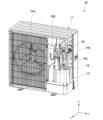
- Fig. 2 is a perspective view of the outdoor unit 10 of this embodiment. Inside the housing 11 of the outdoor unit 10, there are provided a fan chamber 10A in which the blower fan 15 and the like are arranged, and a machine chamber 10B in which the compressor 12 and piping constituting the circulation path section 18 and the like are accommodated.
- the machine chamber 10B is arranged on the right side (+Y side) of the fan chamber 10A. Note that in Fig. 2, of the multiple panels constituting the housing 11, a panel that covers the machine chamber 10B from the front side is omitted from the illustration.
- the first pipe 18a extends in the vertical direction (Z-axis direction). Refrigerant 19 flows through the first pipe 18a. As shown in FIG. 2, the lower end of the first pipe 18a is connected to the compressor 12. The first pipe 18a and the second pipe 18b are exposed to the front side by removing the front panel of the housing 11.
- the front end of the second horizontal extension portion 18d is located forward (+X) of the first pipe 18a.
- An opening 18k is provided at the front end of the second horizontal extension portion 18d.
- a cap member 18e is attached to the opening 18k. The cap member 18e closes the opening 18k of the second pipe 18b.
- the second pipe 18b is a charge plug provided for filling the circulation path portion 18 with refrigerant.
- a worker or a robot, the same applies below performing the assembly process of the outdoor unit 10 removes the cap member 18e to open the opening 18k of the second pipe 18b, and injects the refrigerant through the opening 18k. In this way, the worker fills the circulation path portion 18 with refrigerant.
- the cap member 18e is attached to the second pipe 18b to close the opening 18k.
- the second horizontal extension portion 18d extends in the front-rear direction, so that the opening 18k can be directed to the front side (+X).
- the refrigerant can be injected into the opening 18k from the front side of the outdoor unit 10, improving the workability of the filling operation.
- the first pipe 18a and the second horizontal extension portion 18d extend and cross each other.
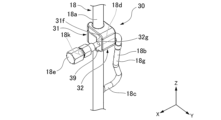
- the first pipe 18a and the second pipe 18b are held by a mounting member 30.
- the mounting member 30 is a single member made of a rubber material.
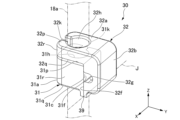
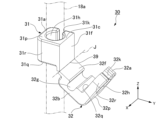
- FIGS. 5 and 6 are perspective views of the mounting member 30.
- FIG. 5 corresponds to FIG. 3 and shows the state in which the mounting member 30 holds the first pipe 18a and the second pipe 18b.
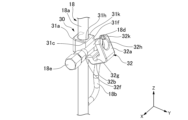
- FIG. 6 corresponds to FIG. 4 and shows the temporary state when the mounting member 30 is attached.
- the state shown in FIGS. 3 and 5 is called the attached state
- the state shown in FIGS. 4 and 6 is called the preliminary state.
- the mount member 30 has a first portion 31, a second portion 32, and a hinge portion 39.
- the first portion 31 and the second portion 32 are block-shaped.
- the hinge portion 39 connects the first portion 31 and the second portion 32. More specifically, it connects one side of the first portion 31 extending in the front-rear direction to one side of the second portion 32 extending in the front-rear direction.
- the hinge portion 39 is a thin portion along a virtual rotation axis J extending in the front-rear direction (X-axis direction).
- the hinge portion 39 allows the first portion 31 and the second portion 32 to rotate relatively around the rotation axis J.
- the hinge portion 39 rotates the first portion 31 and the second portion 32 relatively around the rotation axis J, thereby transitioning the mount member 30 from the preliminary state shown in FIG. 6 to the attached state shown in FIG. 5.
- each part of the mounting member 30 when describing each part of the mounting member 30, each part will be described using the up-down, left-right, and front-back directions based mainly on the arrangement of each part in the attached state. Note that the position of the mounting member 30 in the attached state in this embodiment is one example, and the position of the mounting member 30 when in use is not limited.
- the first retaining portion 31a has an upper surface 31p, a lower surface 31q, and an outer surface 31r connecting the upper surface 31p and the lower surface 31q.
- the first retaining portion 31a is also provided with a first retaining hole 31h and a first opening 31k. With the first retaining hole 31h and the first opening 31k provided, the first retaining portion 31a is formed in a roughly C-shape.
- the first retaining hole 31h extends in the vertical direction (Z-axis direction) and penetrates the first retaining portion 31a.
- the first retaining hole 31h opens to the upper surface 31p and the lower surface 31q of the first retaining portion 31a.
- the first retaining hole 31h is circular when viewed in the vertical direction.
- the diameter of the first retaining hole 31h is approximately equal to the pipe diameter of the first piping 18a.
- the first opening 31k opens from the first retaining hole 31h to the radially outer side of the first retaining hole 31h.
- the first opening 31k is provided over the entire vertical length of the first retaining portion 31a.
- the first opening 31k opens to the rear side (-X). Therefore, the first opening 31k opens in the same direction as the extension direction of the rotation axis J of the hinge portion 39.
- the opening width of the first opening 31k is smaller than the pipe diameter of the first piping 18a.
- the first holding portion 31a holds the first pipe 18a.
- a worker performing the assembly process of the outdoor unit 10 inserts the first pipe 18a from the first opening 31k into the first holding hole 31h, thereby placing the first pipe 18a inside the first holding hole 31h.
- the mounting member 30 in this embodiment is made of a rubber material, the worker inserts the first pipe 18a into the first holding hole 31h while elastically deforming the first holding portion 31a and expanding the opening width of the first opening 31k.
- the diameter of the first holding hole 31h is approximately equal to the pipe diameter of the first pipe 18a, the mounting member 30 is held in place by the tension of the first holding portion 31a while attached to the first pipe 18a without slipping off.
- the outer surface 31r of the first retaining portion 31a faces radially outward of the first pipe 18a.
- the outer surface 31r includes four faces facing the front, rear, left and right directions. Of these four faces, one face connected to the hinge portion 39 is the first wall surface 31f.
- the wall portion between the first retaining portion 31a and the first wall surface 31f is the first wall portion 31c.
- the first wall surface 31f is a surface facing to the right (+Y). In the mounting state shown in FIG. 5, the first wall surface 31f faces and contacts the second portion 32.
- the second portion 32 has a second holding portion 32a and a second wall portion 32b.
- the second holding portion 32a and the second wall portion 32b are plate-shaped portions that are connected to each other and arranged in a substantially L-shape when viewed from the front-rear direction (X-axis direction).
- the second wall portion 32b is connected to the hinge portion 39.
- the second wall portion 32b extends in the radial direction of the rotation axis J.
- the second wall portion 32b is connected to the second retaining portion 32a at an end portion on the radial outer side of the rotation axis J.
- the second retaining portion 32a extends in a direction perpendicular to the radial direction of the rotation axis J.
- the second wall portion 32b has a second wall surface 32f that is connected to the hinge portion 39.
- the second wall surface 32f is a surface that faces the left side (-Y) in the mounting state shown in FIG. 5. Therefore, the second wall surface 32f faces the same direction as the opening direction of the second opening 32k in the mounting state.
- the second wall surface 32f faces and contacts the first portion 31 in the mounting state shown in FIG. 5.
- the second wall surface 32f is provided with a groove portion 32g extending in the front-rear direction (X-axis direction).
- the worker places the second pipe 18b along the first wall surface 31f.
- the second pipe 18b is accommodated in the groove portion 32g.
- the second pipe 18b is placed in the groove portion 32g in the mounting member 30 in the mounting state.
- the opening of the groove portion 32g is covered by the first wall surface 31f.
- the second pipe 18b is sandwiched between the first wall surface 31f and the bottom of the groove portion 32g of the second wall surface 32f and held by the mounting member 30. That is, the first wall portion 31c and the second wall portion 32b sandwich and hold the second pipe 18b.
- the first wall portion 31c is placed between the first pipe 18a and the second pipe 18b.
- the second retaining portion 32a has an upper surface 32p, a lower surface 32q, and an outer surface 32r connecting the upper surface 32p and the lower surface 32q.
- the upper surface 32p is a surface that faces upward in the attached state
- the lower surface 32q is a surface that faces downward in the attached state.
- the second retaining portion 32a is also provided with a second retaining hole 32h and a second opening 32k. With the second retaining hole 32h and the second opening 32k provided, the second retaining portion 32a is formed in a roughly C-shape.
- the second retaining hole 32h penetrates the second retaining portion 32a and opens to the upper surface 32p and the lower surface 32q of the second retaining portion 32a.
- the second retaining hole 32h is circular when viewed vertically.
- the diameter of the second retaining hole 32h is approximately equal to the pipe diameter of the first piping 18a.
- the second opening 32k opens from the second retaining hole 32h to the radially outer side of the second retaining hole 32h.
- the second opening 32k opens to the left side (-Y) in the attached state. Therefore, the second opening 32k opens in a direction perpendicular to the extension direction of the rotation axis J of the hinge portion 39.
- the opening width of the second opening 32k is smaller than the pipe diameter of the first piping 18a.
- the second holding portion 32a holds the first pipe 18a.
- the worker inserts the first pipe 18a from the second opening 32k into the second holding hole 32h to place the first pipe 18a inside the second holding hole 32h.
- the worker inserts the first pipe 18a into the second holding hole 32h while elastically deforming the second holding portion 32a to expand the opening width of the second opening 32k.
- the opening direction of the second opening 32k coincides with the rotation direction of the second part 32 when transitioning from the preliminary state to the attached state. Therefore, by rotating the second part 32 during the transition, the first pipe 18a can be smoothly inserted from the second opening 32k into the second holding hole 32h.
- the lower surface 32q of the second retaining portion 32a contacts the upper surface 31p of the first retaining portion 31a.
- the first retaining hole 31h and the second retaining hole 32h overlap each other when viewed from the axial direction of the first pipe 18a.
- the first opening 31k and the second opening 32k open in directions perpendicular to each other when viewed from the axial direction of the first pipe 18a. Therefore, even if a force acts on the mounting member 30 to move it away from the first pipe 18a, the first pipe 18a does not pass through the first opening 31k and the second opening 32k at the same time, and detachment of the mounting member 30 from the first pipe 18a is suppressed.
- the mount member 30 of this embodiment holds the first pipe 18a and the second pipe 18b that extend crossing each other.
- the mount member 30 has a first part 31, a second part 32, and a hinge part 39.
- the first part 31 has a first holding part 31a that holds the first pipe 18a.
- the second part 32 has a second holding part 32a that holds the first pipe 18a.
- the hinge part 39 connects the first part 31 and the second part 32 so that they can rotate relatively to each other around the rotation axis J.
- the first part 31 has a first wall part 31c arranged between the first pipe 18a and the second pipe 18b.
- the second part 32 has a second wall part 32b that sandwiches the second pipe 18b between the first wall part 31c and the second part 32.
- the first part 31 and the second part 32 of the mount member 30 each hold the first pipe 18a. This makes it possible to suppress the relative movement of the first part 31 and the second part 32 with the first pipe 18a as a reference. Furthermore, according to the above-mentioned configuration, the second pipe 18b is sandwiched and held between the first wall part 31c of the first part 31 and the second wall part 32b of the second part 32. This makes it possible for the mount member 30 to maintain the relative positional relationship between the first pipe 18a and the second pipe 18b even if the outdoor unit 10 is subjected to impact or vibration.
- the first wall part 31c which is a part of the first part 31, is interposed between the first pipe 18a and the second pipe 18b, suppressing direct contact between the first pipe 18a and the second pipe 18b.
- This can prevent the first pipe 18a and the second pipe 18b from colliding with each other even if the outdoor unit 10 is subjected to vibration or impact.
- it is possible to prevent the generation of noise caused by the collision between the first pipe 18a and the second pipe 18b and to prevent damage to the first pipe 18a and the second pipe 18b.
- the mount member 30 of this embodiment holds not a simple rod body but pipes (the first pipe 18a and the second pipe 18b) with a diameter of about 5 mm to 22 mm and a wall thickness of about 0.5 mm to 1.2 mm.
- the first pipe 18a and the second pipe 18b are made of copper, aluminum, or an alloy thereof from the viewpoint of thermal conductivity. For this reason, the first pipe 18a and the second pipe 18b are easily damaged by impact.
- examples of cases where an impact is applied to the first pipe 18a and the second pipe 18b include cases where an impact is applied due to vibration during operation of a compressor or a fan motor, and cases where an impact is applied due to vibration during transportation and installation of a product.
- the mount member 30 suppresses the first pipe 18a and the second pipe 18b from colliding with each other, thereby suppressing the first pipe 18a and the second pipe 18b from impacting each other, thereby suppressing damage to these pipes and suppressing leakage of the fluid (refrigerant in this embodiment) flowing inside. If the refrigerant leaks into the atmosphere, there is a risk of some impact on global warming. Furthermore, if the refrigerant is flammable or slightly flammable, if there is a combustible material at the destination of the leaked refrigerant, the refrigerant may promote combustion and cause a fire to become larger, so sufficient measures are required to prevent the leakage of the refrigerant.
- the first part 31 and the second part 32 are connected via the hinge part 39. Therefore, there is no need to attach the first part 31 and the second part 32 separately to the outdoor unit 10, and the assembly process of the outdoor unit 10 can be simplified. Furthermore, because the first part 31 and the second part 32 are connected, the process of assembling the first holding part 31a and the second holding part 32a in order to the first pipe 18a can be performed with one hand. This simplifies the assembly process of the outdoor unit 10.
- the first holding portion 31a has a first holding hole 31h through which the first pipe 18a passes, and a first opening 31k that is connected to the inside of the first holding hole 31h and opens in a direction perpendicular to the direction in which the first pipe 18a passes through the first holding hole 31h.
- the second holding portion 32a has a second holding hole 32h through which the first pipe 18a passes, and a second opening 32k that is connected to the inside of the second holding hole 32h and opens in a direction perpendicular to the direction in which the first pipe 18a passes through the second holding hole 32h.
- the first opening 31k and the second opening 32k open in different directions.
- the worker can insert the first pipe 18a from the first opening 31k to hold the first pipe 18a in the first holding portion 31a.
- the worker can insert the first pipe 18a through the second opening 32k and hold the first pipe 18a in the second holding portion 32a.
- the first opening 31k and the second opening 32k open in different directions, it is difficult for the first pipe 18a to pass through both the first opening 31k and the second opening 32k at the same time, and it is possible to prevent the mounting member 30 from coming off the first pipe 18a.
- the second opening 32k opens in a direction perpendicular to the extension direction of the rotation axis J.
- the opening direction of the second opening 32k can be made to coincide with the rotation direction of the second part 32 around the rotation axis J. This allows the first pipe 18a to pass smoothly through the second opening 32k during the process of transitioning from the preliminary state shown in FIG. 4 to the attached state shown in FIG. 5.
- the assembly process of the mounting member 30 to the first pipe 18a can be simplified.
- the first opening 31k opens in the same direction as the extension direction of the rotation axis J.
- the opening widths of both the first opening 31k and the second opening 32k are smaller than the pipe diameter of the first pipe 18a.
- the first pipe 18a is less likely to come off the first holding portion 31a and the second holding portion 32a. This effect can be obtained at least for the holding portion when the opening width of at least one of the first opening 31k and the second opening 32k is smaller than the pipe diameter of the first pipe 18a.
- the opening direction of the second opening 32k coincides with the rotation axis J.
- the opening width of the second opening 32k smaller to make it difficult for the second holding portion 32a to come off the first pipe 18a, it is possible to suppress the second part 32 from rotating in the reverse direction around the hinge portion 39. Therefore, according to this embodiment, the reliability of the holding of the first pipe 18a and the second pipe 18b by the mount member 30 can be improved.
- the second wall portion 32b is provided with a groove portion 32g that accommodates the second pipe 18b.
- the groove portion 32g may be provided in the first wall portion 31c, or the first wall portion 31c and the second wall portion 32b may have overlapping groove portions. In other words, the groove portion 32g may be provided in either one or both of the first wall portion 31c and the second wall portion 32b.
- the mounting member 30 of this embodiment is made of a rubber material. With this configuration, even if the outdoor unit 10 is subjected to an impact or vibration, the elasticity of the rubber material can suppress the load applied to the first pipe 18a and the second pipe 18b. In addition, the tension of the rubber material can stably hold the first pipe 18a and the second pipe 18b on the mounting member 30.
- the outdoor unit 10 of this embodiment is an outdoor unit 10 of a refrigeration cycle device 100 equipped with the above-mentioned mount member 30, and has a first pipe 18a through which the refrigerant 19 flows, a second pipe 18b branching off from the first pipe 18a, and a cap member 18e that closes the opening of the second pipe 18b.
- the first pipe 18a through which the refrigerant 19 flows and the second pipe 18b as a charge plug for filling the first pipe 18a with the refrigerant 19 can be held by the mount member 30.
- the mounting member is described as holding the refrigerant circulating pipe (first pipe) and the refrigerant charging pipe (second pipe) of the outdoor unit, but the use of the mounting member is not limited to this embodiment.
- the first holding portion and the second holding portion hold the refrigerant circulating pipe, and the first wall portion and the second wall portion sandwich the refrigerant charging pipe.
- a configuration in which the first holding portion and the second holding portion hold the refrigerant charging pipe, and the first wall portion and the second wall portion sandwich the refrigerant circulating pipe may also be adopted.
- the refrigeration cycle device provided with the mounting member is an air conditioner.
- the refrigeration cycle device provided with the above-mentioned mounting member 30 is not limited to the above-mentioned configuration, and may be, for example, a heat pump water heater.
Landscapes
- Engineering & Computer Science (AREA)
- General Engineering & Computer Science (AREA)
- Mechanical Engineering (AREA)
- Chemical & Material Sciences (AREA)
- Combustion & Propulsion (AREA)
- Physics & Mathematics (AREA)
- Thermal Sciences (AREA)
- Other Air-Conditioning Systems (AREA)
Priority Applications (2)
| Application Number | Priority Date | Filing Date | Title |
|---|---|---|---|
| JP2025533781A JPWO2025017849A1 (https=) | 2023-07-19 | 2023-07-19 | |
| PCT/JP2023/026335 WO2025017849A1 (ja) | 2023-07-19 | 2023-07-19 | マウント部材、および室外機 |
Applications Claiming Priority (1)
| Application Number | Priority Date | Filing Date | Title |
|---|---|---|---|
| PCT/JP2023/026335 WO2025017849A1 (ja) | 2023-07-19 | 2023-07-19 | マウント部材、および室外機 |
Publications (1)
| Publication Number | Publication Date |
|---|---|
| WO2025017849A1 true WO2025017849A1 (ja) | 2025-01-23 |
Family
ID=94282023
Family Applications (1)
| Application Number | Title | Priority Date | Filing Date |
|---|---|---|---|
| PCT/JP2023/026335 Pending WO2025017849A1 (ja) | 2023-07-19 | 2023-07-19 | マウント部材、および室外機 |
Country Status (2)
| Country | Link |
|---|---|
| JP (1) | JPWO2025017849A1 (https=) |
| WO (1) | WO2025017849A1 (https=) |
Citations (4)
| Publication number | Priority date | Publication date | Assignee | Title |
|---|---|---|---|---|
| US4619545A (en) * | 1982-04-22 | 1986-10-28 | Kuettenbaum Valentin | Frame assembly |
| JPH0893968A (ja) * | 1994-09-22 | 1996-04-12 | Hiromi Sakamoto | パイプ固定具 |
| KR100786686B1 (ko) * | 2007-03-02 | 2007-12-21 | 삼성전자주식회사 | 배관 홀더와 이를 구비한 공기조화기 |
| WO2021149222A1 (ja) * | 2020-01-23 | 2021-07-29 | 三菱電機株式会社 | 冷凍サイクル装置の室外機 |
-
2023
- 2023-07-19 JP JP2025533781A patent/JPWO2025017849A1/ja active Pending
- 2023-07-19 WO PCT/JP2023/026335 patent/WO2025017849A1/ja active Pending
Patent Citations (4)
| Publication number | Priority date | Publication date | Assignee | Title |
|---|---|---|---|---|
| US4619545A (en) * | 1982-04-22 | 1986-10-28 | Kuettenbaum Valentin | Frame assembly |
| JPH0893968A (ja) * | 1994-09-22 | 1996-04-12 | Hiromi Sakamoto | パイプ固定具 |
| KR100786686B1 (ko) * | 2007-03-02 | 2007-12-21 | 삼성전자주식회사 | 배관 홀더와 이를 구비한 공기조화기 |
| WO2021149222A1 (ja) * | 2020-01-23 | 2021-07-29 | 三菱電機株式会社 | 冷凍サイクル装置の室外機 |
Also Published As
| Publication number | Publication date |
|---|---|
| JPWO2025017849A1 (https=) | 2025-01-23 |
Similar Documents
| Publication | Publication Date | Title |
|---|---|---|
| JP6448981B2 (ja) | 空気調和機の室内機 | |
| CN104395664B (zh) | 配管连接装置及具有该配管连接装置的热泵循环装置 | |
| JP6105256B2 (ja) | 車両用空調装置 | |
| JP2022112061A (ja) | 空気調和機 | |
| WO2025017849A1 (ja) | マウント部材、および室外機 | |
| CN107405984B (zh) | 车辆用空调装置 | |
| WO2004005805A1 (ja) | 空気調和装置の室外ユニット | |
| JP2021160680A (ja) | 膨張弁の取付構造 | |
| JP5139019B2 (ja) | 冷却装置 | |
| CN107588476B (zh) | 换热机构及具有该换热机构的空调室外机 | |
| JP2007127388A (ja) | 一体型空気調和機 | |
| CN219693460U (zh) | 空调室外机 | |
| EP4279824A1 (en) | Air conditioner | |
| JP6088186B2 (ja) | 車両用空調装置 | |
| JP2001248950A (ja) | 冷凍装置 | |
| WO2018138899A1 (ja) | 天井埋込形空気調和機の室内機、および、それを備えた天井埋込形空気調和機 | |
| CN223768963U (zh) | 水力装置及热泵系统 | |
| US20250109882A1 (en) | Indoor unit of hvac apparatus, and hvac apparatus | |
| US20260103051A1 (en) | In-vehicle air conditioning device | |
| JP6092566B2 (ja) | 室外機 | |
| KR101619538B1 (ko) | 차량용 공조시스템 | |
| WO2022269894A1 (ja) | 室外機 | |
| JP2025020848A (ja) | 空気調和機 | |
| JP2003048417A (ja) | 空調装置 | |
| WO2024189701A1 (ja) | 熱源機及び冷凍サイクル装置 |
Legal Events
| Date | Code | Title | Description |
|---|---|---|---|
| 121 | Ep: the epo has been informed by wipo that ep was designated in this application |
Ref document number: 23945852 Country of ref document: EP Kind code of ref document: A1 |
|
| WWE | Wipo information: entry into national phase |
Ref document number: 2025533781 Country of ref document: JP |
|
| NENP | Non-entry into the national phase |
Ref country code: DE |