WO2025013731A1 - 吸収体、吸収性物品、及び吸収体を製造する方法 - Google Patents
吸収体、吸収性物品、及び吸収体を製造する方法 Download PDFInfo
- Publication number
- WO2025013731A1 WO2025013731A1 PCT/JP2024/024125 JP2024024125W WO2025013731A1 WO 2025013731 A1 WO2025013731 A1 WO 2025013731A1 JP 2024024125 W JP2024024125 W JP 2024024125W WO 2025013731 A1 WO2025013731 A1 WO 2025013731A1
- Authority
- WO
- WIPO (PCT)
- Prior art keywords
- water
- resin particles
- absorbent resin
- less
- absorbent
- Prior art date
- Legal status (The legal status is an assumption and is not a legal conclusion. Google has not performed a legal analysis and makes no representation as to the accuracy of the status listed.)
- Ceased
Links
Images



Classifications
-
- A—HUMAN NECESSITIES
- A61—MEDICAL OR VETERINARY SCIENCE; HYGIENE
- A61F—FILTERS IMPLANTABLE INTO BLOOD VESSELS; PROSTHESES; DEVICES PROVIDING PATENCY TO, OR PREVENTING COLLAPSING OF, TUBULAR STRUCTURES OF THE BODY, e.g. STENTS; ORTHOPAEDIC, NURSING OR CONTRACEPTIVE DEVICES; FOMENTATION; TREATMENT OR PROTECTION OF EYES OR EARS; BANDAGES, DRESSINGS OR ABSORBENT PADS; FIRST-AID KITS
- A61F13/00—Bandages or dressings; Absorbent pads
- A61F13/15—Absorbent pads, e.g. sanitary towels, swabs or tampons for external or internal application to the body; Supporting or fastening means therefor; Tampon applicators
- A61F13/53—Absorbent pads, e.g. sanitary towels, swabs or tampons for external or internal application to the body; Supporting or fastening means therefor; Tampon applicators characterised by the absorbing medium
-
- A—HUMAN NECESSITIES
- A61—MEDICAL OR VETERINARY SCIENCE; HYGIENE
- A61F—FILTERS IMPLANTABLE INTO BLOOD VESSELS; PROSTHESES; DEVICES PROVIDING PATENCY TO, OR PREVENTING COLLAPSING OF, TUBULAR STRUCTURES OF THE BODY, e.g. STENTS; ORTHOPAEDIC, NURSING OR CONTRACEPTIVE DEVICES; FOMENTATION; TREATMENT OR PROTECTION OF EYES OR EARS; BANDAGES, DRESSINGS OR ABSORBENT PADS; FIRST-AID KITS
- A61F13/00—Bandages or dressings; Absorbent pads
- A61F13/15—Absorbent pads, e.g. sanitary towels, swabs or tampons for external or internal application to the body; Supporting or fastening means therefor; Tampon applicators
- A61F13/53—Absorbent pads, e.g. sanitary towels, swabs or tampons for external or internal application to the body; Supporting or fastening means therefor; Tampon applicators characterised by the absorbing medium
- A61F13/534—Absorbent pads, e.g. sanitary towels, swabs or tampons for external or internal application to the body; Supporting or fastening means therefor; Tampon applicators characterised by the absorbing medium having an inhomogeneous composition through the thickness of the pad
-
- A—HUMAN NECESSITIES
- A61—MEDICAL OR VETERINARY SCIENCE; HYGIENE
- A61F—FILTERS IMPLANTABLE INTO BLOOD VESSELS; PROSTHESES; DEVICES PROVIDING PATENCY TO, OR PREVENTING COLLAPSING OF, TUBULAR STRUCTURES OF THE BODY, e.g. STENTS; ORTHOPAEDIC, NURSING OR CONTRACEPTIVE DEVICES; FOMENTATION; TREATMENT OR PROTECTION OF EYES OR EARS; BANDAGES, DRESSINGS OR ABSORBENT PADS; FIRST-AID KITS
- A61F5/00—Orthopaedic methods or devices for non-surgical treatment of bones or joints; Nursing devices ; Anti-rape devices
- A61F5/44—Devices worn by the patient for reception of urine, faeces, catamenial or other discharge; Colostomy devices
- A61F5/451—Genital or anal receptacles
- A61F5/455—Genital or anal receptacles for collecting urine or discharge from female member
-
- B—PERFORMING OPERATIONS; TRANSPORTING
- B32—LAYERED PRODUCTS
- B32B—LAYERED PRODUCTS, i.e. PRODUCTS BUILT-UP OF STRATA OF FLAT OR NON-FLAT, e.g. CELLULAR OR HONEYCOMB, FORM
- B32B5/00—Layered products characterised by the non- homogeneity or physical structure, i.e. comprising a fibrous, filamentary, particulate or foam layer; Layered products characterised by having a layer differing constitutionally or physically in different parts
- B32B5/22—Layered products characterised by the non- homogeneity or physical structure, i.e. comprising a fibrous, filamentary, particulate or foam layer; Layered products characterised by having a layer differing constitutionally or physically in different parts characterised by the presence of two or more layers which are next to each other and are fibrous, filamentary, formed of particles or foamed
- B32B5/30—Layered products characterised by the non- homogeneity or physical structure, i.e. comprising a fibrous, filamentary, particulate or foam layer; Layered products characterised by having a layer differing constitutionally or physically in different parts characterised by the presence of two or more layers which are next to each other and are fibrous, filamentary, formed of particles or foamed one layer being formed of particles, e.g. chips, granules, powder
-
- C—CHEMISTRY; METALLURGY
- C08—ORGANIC MACROMOLECULAR COMPOUNDS; THEIR PREPARATION OR CHEMICAL WORKING-UP; COMPOSITIONS BASED THEREON
- C08J—WORKING-UP; GENERAL PROCESSES OF COMPOUNDING; AFTER-TREATMENT NOT COVERED BY SUBCLASSES C08B, C08C, C08F, C08G or C08H
- C08J3/00—Processes of treating or compounding macromolecular substances
- C08J3/12—Powdering or granulating
- C08J3/16—Powdering or granulating by coagulating dispersions
Definitions
- This disclosure relates to absorbents, absorbent articles, and methods for manufacturing absorbents.
- Patent Document 1 discloses an absorbent composite sheet that is an absorbent article for nursing care and has a substrate and substantially spherical absorbent resin particles intermittently fixed to the substrate.
- an absorbent article When an absorbent article absorbs a liquid containing moisture, it is desirable for the area over which the liquid spreads within the absorbent article to be small. It is also often desirable for the absorbed liquid to return to the surface of the absorbent article, i.e., to be small, and for a dry surface to be formed quickly. However, if the liquid diffusion area in an absorbent article is small, there is a tendency for the liquid to return more, and for it to take longer to form a dry surface.
- the present disclosure relates to an absorbent article that has a small area over which absorbed liquid can spread and can quickly form a dry surface with minimal backflow, and an absorbent body therefor.
- a sheet-like absorbent body comprising: a fiber layer including hydrophilic fibers; and a particle layer including first water-absorbent resin particles formed on one or both sides of the fiber layer, the fiber layer optionally including second water-absorbent resin particles, the weight per unit area of the first water absorbent resin particles in one of the particle layers is 40 g/ m2 or more;
- the first water-absorbent resin particles have a water-absorption speed for physiological saline of 20 seconds or less;
- the weight of the hydrophilic fiber in the fiber layer is 20 g/m2 or more and 180 g/m2 or less,
- the ratio of the amount of the first water absorbent resin particles is 60 mass% or more and 100 mass% or less based on the total mass of the first water absorbent resin particles and the second water absorbent resin particles.
- a method for producing a sheet-shaped absorbent body comprising: the fibrous layer optionally comprises second water-absorbent resin particles; a ratio of the first water absorbent resin particles is 60% by mass or more and 100% by mass or less based on a total mass of the first water absorbent resin particles and the second water absorbent resin particles, the weight per unit area of the first water absorbent resin particles in one of the particle layers is 40 g/ m2 or more; The weight of the hydrophilic fiber in the fiber layer is 20 g/m2 or more and 180 g/m2 or less, The water absorption speed of the first water absorbent resin particles is 20 seconds or less. method.
- an absorbent article can be provided that has a small area over which absorbed liquid spreads and can quickly form a dry surface with minimal backflow.
- the absorbent article of the present disclosure is useful, for example, as a waterproof sheet for nursing care.
- FIG. 2 is a partial cross-sectional view showing an example of an absorbent article.
- FIG. 2 is a partial cross-sectional view showing an example of an absorbent article.
- FIG. 2 is a partial cross-sectional view showing an example of an absorbent article.
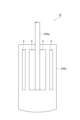
- FIG. 2 is a plan view showing an example of an agitating blade.
- FIG. 2 is a schematic diagram showing an apparatus for measuring water absorption under load for physiological saline.
- FIG. 2 is a plan view showing an example of a state in which a test liquid is diffused through an absorbent article in the measurement of the diffusion area.
- 1 is a photograph showing an example of an absorbent article onto which a test liquid is dropped in order to measure whitening time.
- room temperature means 25 ⁇ 2°C.
- Layer is used as a term that includes not only a structure with a shape that is continuously formed in the in-plane direction, but also a structure with a shape that is partially formed in the in-plane direction.
- Saline means an aqueous sodium chloride solution with a concentration of 0.9% by mass, containing 9 g of sodium chloride per 1000 mL of water at room temperature.
- the absorbent article 50 shown in FIG. 1 includes a sheet-like absorbent body 10, a first shape-retaining member 21, a second shape-retaining member 22, a liquid-permeable sheet 30, and an adhesive 35.
- the absorbent body 10 is a laminate composed of one particle layer 11 containing a plurality of first water-absorbent resin particles 11a and one fiber layer 12 containing hydrophilic fibers, and is provided on the inside of the liquid-permeable sheet 30.
- the absorbent body 10 is disposed between the sheet-like first shape-retaining member 21 and the sheet-like second shape-retaining member 22. The entire absorbent body 10 may be wrapped by the first shape-retaining member 21 and the second shape-retaining member 22.
- the first shape-retaining member 21 and the second shape-retaining member 22 may be one sheet, or may be two separate sheets.
- the first shape-retaining member 21 and the second shape-retaining member 22 may be, for example, tissue.
- the adhesive 35 is interposed between the liquid permeable sheet 30 and the second shape-retaining member 22, and bonds them together.
- the adhesive 35 may be, for example, a hot melt adhesive.
- the absorbent body 10 is provided so that the particle layer 11 is located between the liquid permeable sheet 30 and the fiber layer 12.
- the absorbent article may further include a liquid impermeable sheet provided on the outside of the first shape-retaining member 21.
- FIG. 2 and 3 are partial cross-sectional views showing another example of an absorbent article.
- the absorbent article 51 shown in FIG. 2 differs from the absorbent article 50 in FIG. 1 in that the fiber layer 12 further contains second water-absorbing resin particles 11b.
- the second water-absorbing resin particles 11b may be the same as or different from the first water-absorbing resin particles 11a.
- the absorbent article 52 shown in FIG. 3 differs from the absorbent article 50 in FIG. 1 in that the particle layer 11 is located on the side of the fiber layer 12 opposite to the side on which the liquid-permeable sheet 30 is located.
- the particle layer 11 is provided only on one side of the fiber layer 12.
- the configuration of the absorbent article according to the present disclosure is not limited to this, and for example, the particle layer 11 may be provided on both sides of the fiber layer 12.
- the particle layer 11 does not necessarily need to cover the entire one or both sides of the fiber layer 12.
- the area ratio of the particle layer 11 to the area of the fiber layer may be 70% or more and 100% or less, 80% or more and 100% or less, or 95% or more and 100% or less. When multiple particle layers are provided, the area ratio of one or more of them may be within these ranges.
- the basis weight of the first water absorbent resin particles 11a in one particle layer 11 may be 40 g/m 2 or more.
- the basis weight of the first water absorbent resin particles 11a When the basis weight of the first water absorbent resin particles 11a is large, the diffusion area of the liquid in the absorbent article tends to be small, and the backflow of the liquid from the absorbent article tends to be suppressed.
- the water absorption speed of the first water absorbent resin particles 11a is high, a particularly remarkable effect in terms of the diffusion area and backflow is likely to be exhibited when the basis weight is large.
- the basis weight of the first water absorbent resin particles 11a in one particle layer 11 may be 45 g/m 2 or more or 50 g/m 2 or more.
- the basis weight of the first water absorbent resin particles 11a in one particle layer 11 may be 40 g / m 2 or more, 45 g / m 2 or more, 50 g / m 2 or more, 55 g / m 2 or more, 60 g / m 2 or more, 65 g / m 2 or more, 70 g / m 2 or more, or 75 g / m 2 or more, and 300 g / m 2 or less.
- the basis weight of the first water absorbent resin particles 11a in one particle layer 11 may be 40 g / m 2 or more, 45 g / m 2 or more, 50 g / m 2 or more, 55 g / m 2 or more, 60 g / m 2 or more, 65 g / m 2 or more, 70 g / m 2 or more, or 75 g / m 2 or more, and 250 g / m 2 or less.
- the basis weight of the first water absorbent resin particles 11a in one particle layer 11 may be 40 g/m 2 or more, 45 g/m 2 or more, 50 g/m 2 or more, 55 g/m 2 or more, 60 g/m 2 or more, 65 g/m 2 or more, 70 g/m 2 or more, or 75 g/m 2 or more, and 230 g/m 2 or less.
- the basis weight of the first water absorbent resin particles 11a in each particle layer may be within these ranges.
- the absorbent may further have a particle layer in which the basis weight of the first water absorbent resin particles is less than 40 g/m 2 , in addition to the particle layer in which the basis weight of the first water absorbent resin particles is 40 g/m 2 or more.
- the basis weight means the mass per unit area of the absorbent when viewed from the thickness direction of the absorbent.
- the first absorbent resin particles 11a forming the particle layer 11 are the absorbent resin particles contained in the absorbent 10 that are not held in the fiber layer 12. In this specification, the absorbent resin particles that fall off from the absorbent 10 in the shedding test are considered to be the first absorbent resin particles 11a.
- the shedding test includes holding the absorbent 10 horizontally at a position 50 cm above the bottom surface of the container with the particle layer 11 at the bottom, raising the absorbent 10 upward at a speed of 30 cm per second to a height of 55 cm above the bottom surface of the container, and then lowering the absorbent 10 downward at a speed of 30 cm per second to a height of 45 cm above the bottom surface of the container, and then repeating the steps of raising the absorbent 10 upward at a speed of 30 cm per second to a height of 55 cm above the bottom surface of the container, and then lowering the absorbent 10 downward at a speed of 30 cm per second to a height of 45 cm above the bottom surface of the container nine times.
- the basis weight of the first water-absorbent resin particles 11a can be calculated from the mass Wa (g) of the water-absorbent resin particles (first water-absorbent resin particles 11a) that have fallen off the absorbent 10 and been collected on the bottom surface of the container, and the area of the absorbent 10 when viewed in the thickness direction of the absorbent.
- the container for collecting the fallen water-absorbent resin particles may be one that is sufficiently larger than the absorbent 10.
- the area of the bottom surface of the container may be about 50 times or more the area of the absorbent.
- the ratio of the first water-absorbent resin particles 11a forming the particle layer 11 among the water-absorbent resin particles contained in the absorbent body 10 is large, the time until the absorbent article to which liquid is applied forms a dry surface (whitening time) tends to be shortened while maintaining the high water retention capacity of the fiber layer 12. This is considered to be because there are relatively many voids between the multiple first water-absorbent resin particles 11a constituting the particle layer 11, so that gel blocking is unlikely to occur when the first water-absorbent resin particles 11a absorb water.
- a large ratio of the first water-absorbent resin particles 11a can also contribute to the diffusion area of the liquid in the absorbent article and the suppression of backflow.
- the ratio of the amount of the first water absorbent resin particles 11a may be 60% by mass or more and 100% by mass or less, 65% by mass or more and 100% by mass or less, 70% by mass or more and 100% by mass or less, 75% by mass or more and 100% by mass or less, 80% by mass or more and 100% by mass or less, 85% by mass or more and 100% by mass or less, or 90% by mass or more and 100% by mass or less based on the total mass of the first water absorbent resin particles 11a and the second water absorbent resin particles 11b.
- the ratio of the amount of the first water absorbent resin particles 11a being 100% by mass means that the fiber layer 12 does not substantially contain water absorbent resin particles as in the examples of Figures 1 and 3.
- the ratio X/Y may be 0.25 or more and 7.0 or less.
- the ratio X/Y may be 0.25 or more and 6.0 or less, 5.5 or less, 5.0 or less, 4.5 or less, 4.0 or less, 3.5 or less, 3.0 or less, or 2.5 or less.
- the ratio X/Y may be 0.35 or more and 6.0 or less, 5.5 or less, 5.0 or less, 4.5 or less, 4.0 or less, 3.5 or less, 3.0 or less, or 2.5 or less.
- the ratio X/Y may be 0.45 or more and 6.0 or less, 5.5 or less, 5.0 or less, 4.5 or less, 4.0 or less, 3.5 or less, 3.0 or less, or 2.5 or less.
- the ratio X/Y may be 0.55 or more and 6.0 or less, 5.5 or less, 5.0 or less, 4.5 or less, 4.0 or less, 3.5 or less, 3.0 or less, or 2.5 or less.
- the ratio X/Y may be 0.65 or more and 6.0 or less, 5.5 or less, 5.0 or less, 4.5 or less, 4.0 or less, 3.5 or less, 3.0 or less, or 2.5 or less.
- the ratio X/Y may be 0.75 or more and 6.0 or less, 5.5 or less, 5.0 or less, 4.5 or less, 4.0 or less, 3.5 or less, 3.0 or less, or 2.5 or less.
- the ratio X/Y may be 1.5 or more and 6.0 or less, 5.5 or less, 5.0 or less, 4.5 or less, 4.0 or less, 3.5 or less, 3.0 or less, or 2.5 or less.
- the ratio X/Y may be 2.0 or more and 6.0 or less, 5.5 or less, 5.0 or less, 4.5 or less, 4.0 or less, 3.5 or less, 3.0 or less, or 2.5 or less.
- the total basis weight (Xg/ m2 ) of the first water absorbent resin particles 11a and the second water absorbent resin particles 11b is calculated based on the area of the particle layer 11 or the fiber layer 12, whichever is larger.
- the water absorption speed of the first water absorbent resin particles 11a for physiological saline may be 20 seconds or less.
- the combination of the water absorption speed of the first water absorbent resin particles 11a being 20 seconds or less and the basis weight of the first water absorbent resin particles 11a in one particle layer 11 being 40 g/m 2 or more can exert a particularly remarkable effect in terms of suppressing the liquid diffusion area in the absorbent article and suppressing the backflow of liquid from the absorbent article.
- the water absorption speed of the first water absorbent resin particles 11a for physiological saline may be 18 seconds or less, 16 seconds or less, 14 seconds or less, 12 seconds or less, 10 seconds or less, 9 seconds or less, 8 seconds or less, 7 seconds or less, 6 seconds or less, 5 seconds or less, or 4 seconds or less.
- the water absorption speed of the first water absorbent resin particles 11a to physiological saline may be 0.5 seconds or more and 20 seconds or less, 18 seconds or less, 16 seconds or less, 14 seconds or less, 12 seconds or less, 10 seconds or less, 9 seconds or less, 8 seconds or less, 7 seconds or less, 6 seconds or less, 5 seconds or less, or 4 seconds or less.
- the water absorption speed of the first water absorbent resin particles 11a to physiological saline may be 1 second or more and 20 seconds or less, 18 seconds or less, 16 seconds or less, 14 seconds or less, 12 seconds or less, 10 seconds or less, 9 seconds or less, 8 seconds or less, 7 seconds or less, 6 seconds or less, 5 seconds or less, or 4 seconds or less.
- the water absorption speed of the first water absorbent resin particles 11a and the second water absorbent resin particles 11b to physiological saline may be within these numerical ranges.
- the water absorption speed of the water absorbent resin particles to physiological saline here is a value measured by the Vortex method as described in the examples described later.
- the first water-absorbing resin particles 11a may have a median particle diameter of 150 ⁇ m or more and 600 ⁇ m or less. If the median particle diameter of the first water-absorbing resin particles 11a is appropriately large, gel blocking is less likely to occur, and the time until the water-absorbing article to which a liquid is supplied forms a dry surface can be further shortened.
- the median particle diameter of the first water-absorbing resin particles 11a may be 180 ⁇ m or more, 200 ⁇ m or more, 220 ⁇ m or more, 250 ⁇ m or more, 270 ⁇ m or more, 280 ⁇ m or more, 290 ⁇ m or more, 300 ⁇ m or more, 310 ⁇ m or more, 320 ⁇ m or more, 330 ⁇ m or more, or 340 ⁇ m or more and 600 ⁇ m or less.
- the first water absorbent resin particles 11a may have a median particle diameter of 150 ⁇ m or more, 180 ⁇ m or more, 200 ⁇ m or more, 220 ⁇ m or more, 250 ⁇ m or more, 270 ⁇ m or more, 280 ⁇ m or more, 290 ⁇ m or more, 300 ⁇ m or more, 310 ⁇ m or more, 320 ⁇ m or more, 330 ⁇ m or more, or 340 ⁇ m or more and 500 ⁇ m or less.
- the first water absorbent resin particles 11a may have a median particle diameter of 150 ⁇ m or more, 180 ⁇ m or more, 200 ⁇ m or more, 220 ⁇ m or more, 250 ⁇ m or more, 270 ⁇ m or more, 280 ⁇ m or more, 290 ⁇ m or more, 300 ⁇ m or more, 310 ⁇ m or more, 320 ⁇ m or more, 330 ⁇ m or more, or 340 ⁇ m or more and 400 ⁇ m or less.
- the median particle diameter of the first water absorbent resin particles 11a may be 150 ⁇ m or more, 180 ⁇ m or more, 200 ⁇ m or more, 220 ⁇ m or more, 250 ⁇ m or more, 270 ⁇ m or more, 280 ⁇ m or more, 290 ⁇ m or more, 300 ⁇ m or more, 310 ⁇ m or more, 320 ⁇ m or more, 330 ⁇ m or more, or 340 ⁇ m or more and 390 ⁇ m or less.
- the median particle diameter of the first water absorbent resin particles 11a may be 150 ⁇ m or more, 180 ⁇ m or more, 200 ⁇ m or more, 220 ⁇ m or more, 250 ⁇ m or more, 270 ⁇ m or more, 280 ⁇ m or more, 290 ⁇ m or more, 300 ⁇ m or more, 310 ⁇ m or more, 320 ⁇ m or more, 330 ⁇ m or more, or 340 ⁇ m or more and 380 ⁇ m or less.
- the median particle diameter of the first water absorbent resin particles 11a may be 150 ⁇ m or more, 180 ⁇ m or more, 200 ⁇ m or more, 220 ⁇ m or more, 250 ⁇ m or more, 270 ⁇ m or more, 280 ⁇ m or more, 290 ⁇ m or more, 300 ⁇ m or more, 310 ⁇ m or more, 320 ⁇ m or more, 330 ⁇ m or more, or 340 ⁇ m or more and 370 ⁇ m or less.
- the median particle diameters of the first water absorbent resin particles 11a and the second water absorbent resin particles 11b may be within these numerical ranges.
- the method for measuring the median particle diameter of the water absorbent resin particles is as described in the examples described later.
- the first water absorbent resin particles 11a may have a water retention capacity of 30 g/g or more in physiological saline. If the first water absorbent resin particles 11a have a large water retention capacity, backflow of liquid from the absorbent article can be further suppressed. From a similar perspective, the water retention capacity of the first water absorbent resin particles 11a in physiological saline may be 31 g/g or more, 32 g/g or more, 33 g/g or more, 34 g/g or more, 35 g/g or more, 36 g/g or more, 37 g/g or more, 38 g/g or more, 39 g/g or more, or 40 g/g or more.
- the water retention capacity of the first water absorbent resin particles 11a in physiological saline may be 30 g/g or more, 31 g/g or more, 32 g/g or more, 33 g/g or more, 34 g/g or more, 35 g/g or more, 36 g/g or more, 37 g/g or more, 38 g/g or more, 39 g/g or more, or 40 g/g or more, and 60 g/g or less.
- the water retention capacity of the first water absorbent resin particles 11a in physiological saline may be 30 g/g or more, 31 g/g or more, 32 g/g or more, 33 g/g or more, 34 g/g or more, 35 g/g or more, 36 g/g or more, 37 g/g or more, 38 g/g or more, 39 g/g or more, or 40 g/g or more, and 55 g/g or less.
- the water retention capacity of the first water absorbent resin particles 11a in physiological saline may be 30 g/g or more, 31 g/g or more, 32 g/g or more, 33 g/g or more, 34 g/g or more, 35 g/g or more, 36 g/g or more, 37 g/g or more, 38 g/g or more, 39 g/g or more, or 40 g/g or more and 50 g/g or less.
- the method for measuring the water retention capacity of the water absorbent resin particles in physiological saline is as described in the examples described later.
- the first water absorbent resin particles 11a may have a water absorption under load of 5 mL/g or more for physiological saline.
- the water absorption under load of the first water absorbent resin particles 11a is large, the time until the absorbent article to which the liquid is supplied forms a dry surface may be further shortened.
- the water absorption under load of the first water absorbent resin particles 11a for physiological saline may be 5 mL/g or more, 10 mL/g or more, 15 mL/g or more, or 20 mL/g or more.
- the water absorption under load of the first water absorbent resin particles 11a for physiological saline may be 5 mL/g or more, 10 mL/g or more, 15 mL/g or more, or 20 mL/g or more and 40 mL/g or less.
- the water absorption under load of the first water absorbent resin particles 11a for physiological saline may be 5 mL/g or more, 10 mL/g or more, 15 mL/g or more, or 20 mL/g or more and 35 mL/g or less.
- the water absorption amount under load of the first water absorbent resin particles 11a for physiological saline may be 5 mL/g or more, 10 mL/g or more, 15 mL/g or more, or 20 mL/g or more and 30 mL/g or less.
- the water absorption amount under load of the first water absorbent resin particles 11a for physiological saline may be 5 mL/g or more, 10 mL/g or more, 15 mL/g or more, or 20 mL/g or more and 25 mL/g or less.
- the method for measuring the water absorption amount under load of the water absorbent resin particles for physiological saline is as described in the examples described later.
- the basis weight (Yg/ m2 ) of the hydrophilic fibers in the fiber layer 12 may be 20 g/m2 or more and 180 g/m2 or less .
- the basis weight of the hydrophilic fibers in the fiber layer 12 is within this range, the diffusion area of the liquid in the absorbent article can be suppressed while maintaining an appropriate water retention ability of the absorbent 10.
- the basis weight of the hydrophilic fibers in the fiber layer 12 may be 20 g/m2 or more and 160 g/m2 or less , 140 g/m2 or less , 120 g/m2 or less, 100 g/m2 or less, 90 g/m2 or less , 80 g/m2 or less , 70 g/m2 or less, 60 g/m2 or less , 55 g/m2 or less , or 50 g/m2 or less .
- the basis weight of the hydrophilic fibers in the fiber layer 12 may be 25 g/m2 or more and 160 g/ m2 or less , 140 g/m2 or less , 120 g/m2 or less , 100 g/m2 or less, 90 g/m2 or less, 80 g/m2 or less, 70 g/m2 or less , 60 g/m2 or less , 55 g/m2 or less , or 50 g/ m2 or less.
- the basis weight of the hydrophilic fibers in the fiber layer 12 may be 30 g/m2 or more and 160 g/m2 or less , 140 g/m2 or less , 120 g/m2 or less , 100 g/m2 or less , 90 g/m2 or less , 80 g/ m2 or less, 70 g/m2 or less , 60 g/m2 or less , 55 g/m2 or less , or 50 g/ m2 or less.
- the basis weight of the hydrophilic fibers in the fiber layer 12 may be 35 g/m2 or more and 160 g/ m2 or less , 140 g/m2 or less , 120 g/m2 or less , 100 g/m2 or less, 90 g/m2 or less, 80 g/m2 or less, 70 g/m2 or less , 60 g/m2 or less , 55 g/m2 or less , or 50 g/ m2 or less.
- the basis weight of the hydrophilic fibers in the fiber layer 12 may be 40 g/m2 or more and 160 g/m2 or less , 140 g/m2 or less , 120 g/m2 or less , 100 g/m2 or less , 90 g/m2 or less , 80 g/ m2 or less, 70 g/m2 or less , 60 g/m2 or less , 55 g/m2 or less , or 50 g/ m2 or less.
- the basis weight of the hydrophilic fibers in the fiber layer 12 may be 45 g/m2 or more and 160 g/ m2 or less , 140 g/m2 or less , 120 g/m2 or less , 100 g/m2 or less, 90 g/m2 or less, 80 g/m2 or less, 70 g/m2 or less , 60 g/m2 or less , 55 g/m2 or less , or 50 g/ m2 or less.
- hydrophilic fibers include cellulose fibers such as cotton-like pulp and chemical pulp, and artificial cellulose fibers such as rayon and acetate.
- the absorbent may further contain hydrophobic fibers made of synthetic resins such as polyamide, polyester, and polyolefin as a reinforcing agent.
- the liquid-permeable sheet 30 may be, for example, a nonwoven fabric, a porous resin sheet, tissue, or a combination of these.
- the nonwoven fabric may contain resin fibers such as polyethylene, polypropylene, polyester, polyamide, etc.
- the absorbent 10 can be manufactured, for example, by a method including forming a fiber layer 12 containing hydrophilic fibers, and forming a particle layer 11 containing first water-absorbent resin particles 11a on one or both sides of the fiber layer 12.
- the fiber layer 12 further contains second water-absorbent resin particles 11b as in the absorbent article 51 of FIG. 2, for example, the fiber layer 12 can be formed by mixing and depositing the hydrophilic fibers and the second water-absorbent resin particles 11b.
- the first water-absorbing resin particles 11a and the second water-absorbing resin particles 11b can be obtained, for example, by a conventional method including polymerizing a water-soluble ethylenically unsaturated monomer.
- the polymerization method may be, for example, reverse phase suspension polymerization in a reaction liquid including an aqueous liquid and an oily liquid, or aqueous solution polymerization in an aqueous solution including a water-soluble ethylenically unsaturated monomer.
- the method using reversed-phase suspension polymerization includes, for example, forming a particulate hydrogel polymer containing a polymer of the water-soluble ethylenically unsaturated monomer and water by polymerizing the water-soluble ethylenically unsaturated monomer by reversed-phase suspension polymerization in a reaction liquid containing the water-soluble ethylenically unsaturated monomer, a radical polymerization initiator, water, a dispersion medium, and a surfactant, forming a concentrate by extracting a portion of the water from the reaction liquid, and surface-crosslinking the aggregated particles in a mixture containing the concentrate and a surface-crosslinking agent.
- the hydrogel polymer Prior to surface-crosslinking, may be aggregated in the reaction liquid to form aggregated particles containing a plurality of hydrogel polymers.
- the reaction liquid for polymerization may contain an internal crosslinking agent that crosslinks the polymer.
- the aqueous solution polymerization method includes, for example, polymerizing an ethylenically unsaturated monomer in an aqueous monomer solution containing the ethylenically unsaturated monomer, a radical polymerization initiator, and water to form a bulk hydrogel polymer containing the polymer and water, crushing the hydrogel polymer to form a coarse crushed material, drying the coarse crushed material to obtain a dried material, pulverizing the dried material to obtain polymer particles, and surface cross-linking the polymer particles in a mixture containing the polymer particles and a surface cross-linking agent.
- the aqueous monomer solution for polymerization may contain an internal cross-linking agent.
- the water absorption properties of the water-absorbent resin particles can be adjusted by the amount of the internal crosslinking agent, the amount of the surface crosslinking agent, the stirring conditions of the reaction solution, the particle size, etc.
- water-soluble ethylenically unsaturated monomer examples include ethylenically unsaturated monomers having at least one functional group selected from the group consisting of a carboxyl group, a sulfo group, an amide group, an amino group, etc.
- the amino group may be quaternized.
- the water-soluble ethylenically unsaturated monomer may include, for example, at least one selected from the group consisting of (meth)acrylic acid (hereinafter, "acrylic” and “methacrylic” will be collectively referred to as “(meth)acrylic”) and its alkali salts, 2-(meth)acrylamido-2-methylpropanesulfonic acid and its alkali salts, (meth)acrylamide, N,N-dimethyl(meth)acrylamide, 2-hydroxyethyl(meth)acrylate, N-methylol(meth)acrylamide, polyethylene glycol mono(meth)acrylate, N,N-diethylaminoethyl(meth)acrylate, N,N-diethylaminopropyl(meth)acrylate, and diethylaminopropyl(meth)acrylamide.
- (meth)acrylic acid hereinafter, "acrylic” and “methacrylic” will be collectively referred to as
- the water-soluble ethylenically unsaturated monomer may include (meth)acrylic acid and its alkali metal salts, or may include acrylic acid and its alkali metal salts.
- the proportion of (meth)acrylic acid and its alkali metal salts may be 60 mol% or more, 70 mol% or more, 80 mol% or more, 90 mol% or more, or 95 mol% or more, or may be substantially 100 mol%.
- the proportion of monomer units derived from (meth)acrylic acid or its alkali metal salts may be within the above range.
- the amount of backflow after dripping of the absorbent article may be 8.5 g or less, or may be 0.1 g or more and 8.5 g or less.
- the amount of backflow after dripping is measured by placing the absorbent article on a horizontal table with the liquid-permeable sheet facing up, dripping 30 mL of test liquid adjusted to 25 ⁇ 1 ° C from an inlet with an inner diameter of 0.4 mm from 1 cm above the absorbent article toward the center of the absorbent article over a period of 10 seconds, immediately after dripping of the test liquid is completed, placing a filter paper with a size of 100 mm x 100 mm whose mass has been measured in advance at the position where the test liquid was dripped, and applying a weight of 0.7 psi from above it for 3 seconds, removing the weight and the filter paper, and the weight of the test liquid absorbed by the filter paper is the amount of backflow after dripping [g].
- test liquid is prepared by dissolving 45.0 g of NaCl in 4955.0 g of ion-exchanged water and further mixing a small amount of Blue No. 1. The amount of backflow after 1 minute, the diffusion area and the whitening time described below are also measured using the same test liquid.
- the diffusion area of the test liquid when dropped onto the liquid permeable sheet side of the absorbent article may be 150 cm 2 or less, or may be 10 cm 2 or more and 150 cm 2 or less.
- the whitening time when the test liquid is dropped onto the liquid-permeable sheet side of the absorbent article may be 55 seconds or less, or may be 5 seconds or more and 55 seconds or less.
- the whitening time is the time it takes for the absorbent article to form a dry surface again after the test liquid has been dropped.
- the whitening time is measured by placing the absorbent article on a horizontal table with the liquid-permeable sheet facing up, dropping 30 mL of test liquid adjusted to 25 ⁇ 1°C from an inlet with an inner diameter of 0.4 mm toward the center of the absorbent article from 1 cm above the absorbent article over a period of 10 seconds, and recording the time from the completion of dropping the test liquid until the color of the liquid-permeable sheet changes to a color close to its original color as the whitening time. Since the color of the liquid-permeable sheet is often white, the term "whitening time" is used here, but the whitening time can be measured in a similar manner even when the liquid-permeable sheet has a different color.
- the absorbent article may be, for example, a waterproof nursing sheet, or it may be a disposable diaper, a sanitary napkin, a tampon, or a pet sheet.
- the present invention is not limited to the following examples.
- n-heptane and 1.10 g of sorbitan monolaurate surfactant, Nonion LP-20R, HLB: 8.6, manufactured by NOF Corporation
- surfactant Nonion LP-20R, HLB: 8.6, manufactured by NOF Corporation
- the mixture in the separable flask was heated to 50 ° C. while being stirred with a stirrer at a rotation speed of 300 rpm, thereby dissolving sorbitan monolaurate in n-heptane.
- the mixture was then cooled to 45 ° C.
- the formed monomer aqueous solution was added to the mixture in the separable flask described above, and the system containing the formed reaction solution was thoroughly replaced with nitrogen.
- the reaction solution was then stirred with a stirrer at 700 rpm while the separable flask was immersed in a water bath at 70°C and held in that state for 60 minutes to allow the polymerization reaction to proceed.
- particulate hydrous gel-like polymer was formed in the reaction solution.
- a dispersion containing 0.014 g of amorphous silica particles (agglomerant, Oriental Silicas Corporation, Toxil NP-S) and 100 g of n-heptane was added to the reaction solution containing the generated hydrogel polymer, n-heptane, and a surfactant while stirring at a rotation speed of 1000 rpm. The reaction solution was then stirred for 10 minutes. The hydrogel polymer was agglomerated in the reaction solution to form aggregated particles.
- the reaction liquid in the separable flask was heated in an oil bath at 125° C., and 106.1 g of water was extracted from the system by azeotropic distillation of n-heptane and water while refluxing n-heptane.
- the flat plate portion 200b has four slits S extending along the axial direction of the shaft 200a.
- the four slits S are arranged in the width direction of the flat plate portion 200b.
- the width of the two inner slits S is 1 cm.
- the width of the two outer slits S is 0.5 cm.
- the length of the flat plate portion 200b is about 10 cm, and the width of the flat plate portion 200b is about 6 cm.
- n-heptane 472.3 g of n-heptane and 0.74 g of sorbitan monolaurate (surfactant, Nonion LP-20R, HLB: 8.6, NOF Corporation) were placed in the prepared separable flask.
- the mixture in the separable flask was heated to 50°C while being stirred with a stirrer at 300 rpm, dissolving the sorbitan monolaurate in the n-heptane.
- the mixture was then cooled to 45°C.
- the formed monomer aqueous solution was added to the mixture in the separable flask described above, and the system containing the formed reaction solution was thoroughly replaced with nitrogen.
- the reaction solution was then stirred with a stirrer at 300 rpm while the separable flask was immersed in a water bath at 70°C and held in that state for 60 minutes to allow the polymerization reaction to proceed.
- particulate hydrous gel-like polymer was formed in the reaction solution.
- the agitator blade B was changed to an agitator blade A having two stages of four inclined paddle blades with a blade diameter of 5 cm, and a dispersion containing 0.0138 g of amorphous silica particles (aggregant, Oriental Silicas Corporation, Toxil NP-S) and 100 g of n-heptane was added to the reaction liquid containing the generated hydrous gel polymer, n-heptane and surfactant while stirring at a rotation speed of 1000 rpm. The reaction liquid was then stirred for 10 minutes. Aggregated particles were formed by aggregation of the hydrous gel polymer in the reaction liquid.
- amorphous silica particles aggregant, Oriental Silicas Corporation, Toxil NP-S
- the reaction liquid in the separable flask was heated in an oil bath at 125° C., and 110.7 g of water was extracted outside the system by azeotropic distillation of n-heptane and water while refluxing n-heptane.
- the mixture in the separable flask was heated to 80°C while being stirred with a stirrer at a rotation speed of 300 rpm, thereby dissolving the hydrophobic polymer dispersant in n-heptane.
- the mixture was then cooled to 50°C.
- hydroxyethyl cellulose thickener, Sumitomo Seika Chemicals Co., Ltd., HECAW-15F
- 0.0736 g of potassium persulfate water-soluble radical polymerization initiator, 0.272 mmol
- ethylene glycol diglycidyl ether internal cross-linking agent, 0.057 mmol
- the first-stage monomer aqueous solution was added to the mixture in the separable flask, and the reaction solution formed was stirred for 10 minutes with a stirrer at 300 rpm. Then, a surfactant solution containing 6.62 g of n-heptane and 0.736 g of sucrose stearate (surfactant, HLB: 3, Mitsubishi Chemical Foods Corporation, Ryoto Sugar Ester S-370) was further added. The reaction solution was stirred with a stirrer at 550 rpm while the system was thoroughly replaced with nitrogen. The separable flask was then immersed in a water bath at 70°C and kept in that state for 60 minutes to allow the polymerization reaction to proceed. The polymerization reaction formed a first-stage polymerization slurry.
- a surfactant solution containing 6.62 g of n-heptane and 0.736 g of sucrose stearate (surfactant, HLB: 3, Mitsubishi Chemical Foods Corporation, Ryoto Sugar Ester S-
- ⁇ Second-stage polymerization reaction> In a 500 mL beaker, 128.8 g of an 80.5 mass% aqueous acrylic acid solution (1.44 mol of acrylic acid) was placed. 159.0 g of a 27 mass% aqueous sodium hydroxide solution was added dropwise while cooling with ice from the outside, thereby neutralizing 75 mol% of the acrylic acid. 0.090 g (0.333 mmol) of potassium persulfate and 0.0116 g of ethylene glycol diglycidyl ether (internal crosslinking agent, 0.067 mmol) were dissolved in the partially neutralized acrylic acid aqueous solution formed by neutralization to prepare a second stage monomer aqueous solution.
- the separable flask was cooled to 25°C while the first-stage polymerization slurry was stirred with a stirrer at 1000 rpm. The entire amount of the second-stage monomer aqueous solution was then added to the first-stage polymerization slurry, and the system was replaced with nitrogen over 30 minutes. The separable flask was again immersed in a 70°C water bath and kept in that state for 60 minutes to allow the polymerization reaction to proceed. A reaction liquid containing particulate hydrous gel-like polymer was obtained from the polymerization reaction.
- Production Example 4 77.2 g of water absorbent resin particles of Production Example 4 was obtained under the same conditions as those of Production Example 1, except that the stirring blade for stirring the reaction liquid during the polymerization reaction was changed to the stirring blade B, the rotation speed of the stirrer during the polymerization reaction was changed to 300 rpm, amorphous silica particles for forming aggregated particles were not added after the polymerization reaction, and 107.9 g of water was extracted out of the system while refluxing n-heptane by azeotropic distillation of n-heptane and water.
- the water absorption rate of the water-absorbent resin particles was measured by the Vortex method. 50 ⁇ 0.1 g of physiological saline and a magnetic stirrer bar (8 mm ⁇ 30 mm without ring) were placed in a beaker with a capacity of 100 mL. The beaker was immersed in a thermostatic water bath to adjust the liquid temperature to 25 ⁇ 0.2°C. Next, the beaker was placed on a magnetic stirrer, and the physiological saline was stirred at a rotation speed of 600 rpm to generate a vortex, and 2.0 g of water-absorbent resin particles were quickly added thereto.
- a cotton bag (membrane broad 60, 100 mm wide x 200 mm long) containing 2.0 g of water-absorbent resin particles was placed in a 500 mL beaker. 500 g of saline was poured into the cotton bag containing the water-absorbent resin particles at once so as not to cause any lumps, and the top of the cotton bag was tied with a rubber band. The cotton bag was left to stand for 30 minutes to swell the water-absorbent resin particles in the cotton bag.
- the swollen gel in the cotton bag was dehydrated for 1 minute using a dehydrator (manufactured by Kokusan Co., Ltd., product number: H-122) set to a centrifugal force of 167 G.
- the mass Wa (g) of the cotton bag containing the swollen gel after dehydration was measured.
- the same operation was performed on a cotton bag not containing water-absorbent resin particles, and the empty mass Wb (g) of the cotton bag when wet was measured.
- the water absorption under load of the water-absorbent resin particles for physiological saline was measured using a measuring device Y shown in FIG. 5.
- the measuring device Y is composed of a burette part 61, a conduit 62, a measuring table 63, and a measuring part 64 placed on the measuring table 63.
- the burette part 61 has a burette 61a extending vertically, a rubber stopper 61b arranged at the upper end of the burette 61a, a cock 61c arranged at the lower end of the burette 61a, an air introduction tube 61d, one end of which extends into the burette 61a near the cock 61c, and a cock 61e arranged at the other end of the air introduction tube 61d.
- the conduit 62 is attached between the burette part 61 and the measuring table 63.
- the inner diameter of the conduit 62 is 6 mm.
- a hole with a diameter of 2 mm is opened in the center of the measuring table 63, and the conduit 62 is connected to the hole.
- the measuring section 64 has a cylinder 64a (made of acrylic resin (Plexiglas)), a nylon mesh 64b bonded to the bottom of the cylinder 64a, and a weight 64c.
- the inner diameter of the cylinder 64a is 20 mm.
- the opening of the nylon mesh 64b is 75 ⁇ m (200 mesh).
- the water-absorbent resin particles 11a to be measured are uniformly spread on the nylon mesh 64b.
- the diameter of the weight 64c is 19 mm, and the mass of the weight 64c is 59.8 g.
- the weight 64c is placed on the water-absorbent resin particles 11a, and can apply a load of 2.07 kPa to the water-absorbent resin particles 11a.
- the scale of the burette 61a was engraved from top to bottom in increments of 0 mL to 0.5 mL, and the scale Va of the burette 61a before the start of water absorption and the scale Vb of the burette 61a 60 minutes after the start of water absorption were read as the water level of the physiological saline, and the water absorption amount under load was calculated according to the following formula.
- Water absorption under load [mL/g] (Vb - Va) / 0.1
- Median particle diameter The water-absorbent resin particles were passed through a JIS Z 8801-1 standard sieve having an opening of 250 ⁇ m. When the amount remaining on the sieve was 50% by mass or more relative to the total amount, the median particle diameter was measured using the following combination of sieves (A); when the amount remaining on the sieve was less than 50% by mass, the median particle diameter was measured using the following combination of sieves (B).
- (A) JIS standard sieves were assembled from top to bottom in the following order: a sieve with a mesh size of 710 ⁇ m, a sieve with a mesh size of 600 ⁇ m, a sieve with a mesh size of 500 ⁇ m, a sieve with a mesh size of 425 ⁇ m, a sieve with a mesh size of 300 ⁇ m, a sieve with a mesh size of 250 ⁇ m, a sieve with a mesh size of 150 ⁇ m, and a receiving tray.
- (B) JIS standard sieves were assembled from top to bottom in the following order: a sieve with a mesh size of 425 ⁇ m, a sieve with a mesh size of 250 ⁇ m, a sieve with a mesh size of 180 ⁇ m, a sieve with a mesh size of 150 ⁇ m, a sieve with a mesh size of 106 ⁇ m, a sieve with a mesh size of 75 ⁇ m, a sieve with a mesh size of 45 ⁇ m, and a receiving tray.
- the water-absorbent resin particles were placed in the sieve located at the top stage, and the particles were classified by shaking for 10 minutes using a continuous fully automatic ultrasonic vibration sieving measuring device (Robot Sifter RPS-205, manufactured by Seishin Enterprise Co., Ltd.). After classification, the ratio (mass percentage) of the mass of the water-absorbent resin particles remaining on each sieve to the total mass was calculated. By accumulating the ratios of the fractions with the largest particle diameters, the relationship between the sieve openings and the accumulated value of the ratio of the water-absorbent resin particles remaining on the sieve was plotted on logarithmic probability paper. The particle diameter equivalent to an accumulated mass percentage of 50% by mass was determined by connecting the plots on the probability paper with a straight line, and this value was taken as the median particle diameter.
- Example 1 of the preparation of absorbent articles A first shape-retaining member (tissue) having a size of 20 cm x 60 cm and a basis weight of 16 g/ m2 was prepared. 5.4 g of hydrophilic fiber (ground pulp) was deposited on this first shape-retaining member by air papermaking using an airflow type mixer (Autech Co., Ltd., pad former) to form a fiber layer covering the entire upper surface of the first shape-retaining member. From the laminate of the first shape-retaining member and the fiber layer, 10 cm portions were cut off from both ends in the longitudinal direction. The remaining laminate was divided into two equal parts to obtain two laminates having a size of 20 cm x 20 cm.
- Each of the two laminates was sprayed with 1.0 g of water evenly using a sprayer, and then a load of 500 kPa was applied for 30 seconds. Then, the water-absorbing resin particles (3.0 g, first water-absorbing resin particles) of Production Example 1 were evenly spread on the fiber layer to form a particle layer.
- a second shape-retaining member (tissue) having a size of 20 cm x 20 cm and a basis weight of 16 g/ m2 was laminated on the particle layer to obtain a laminate having, from the bottom, the first shape-retaining member, the fiber layer, the particle layer, and the second shape-retaining member.
- An air-through nonwoven fabric (KNH Enterprise Co., Ltd., basis weight: 25 g/m 2 ) having a size of 20 cm x 20 cm and coated with a hot melt adhesive (Henkel Japan Co., Ltd., ME- 765E ) was laminated on the second shape-retaining member of this laminate in a direction in which the hot melt adhesive contacts the second shape-retaining member, thereby obtaining an absorbent article.
- 0.1 g of hot melt adhesive was applied to the air-through nonwoven fabric so as to form a spiral stripe pattern of 20 stripes arranged at 10 mm intervals.
- the basis weight of the water-absorbent resin particles was 75 g/m 2 and the basis weight of the hydrophilic fiber (crushed pulp) was 45 g/m 2 .
- Example 2 An absorbent article was produced in the same manner as in Example 1, except that the amount of the water-absorbent resin particles (first water-absorbent resin particles) in Production Example 1 was changed to 4.0 g.
- the basis weight of the water-absorbent resin particles was 100 g/ m2
- the basis weight of the hydrophilic fiber (ground pulp) was 45 g/ m2 .
- Example 3 An absorbent article was produced in the same manner as in Example 1, except that the amount of the water-absorbent resin particles (first water-absorbent resin particles) in Production Example 1 was changed to 8.0 g.
- the basis weight of the water-absorbent resin particles was 200 g/ m2
- the basis weight of the hydrophilic fiber (ground pulp) was 45 g/ m2 .
- Example 4 Except for changing the amount of hydrophilic fiber (ground pulp) to 3.6 g, an absorbent article was produced in the same manner as in Example 1.
- the basis weight of the water-absorbent resin particles was 75 g/ m2
- the basis weight of the hydrophilic fiber (ground pulp) was 30 g/ m2 .
- Example 5 A first shape-retaining member (tissue) having a size of 20 cm x 60 cm and a basis weight of 16 g/ m2 was prepared. 5.4 g of hydrophilic fiber (ground pulp) was deposited on this first shape-retaining member by air papermaking using an airflow type mixer (Autech Co., Ltd., pad former), to form a fiber layer covering the entire upper surface of the first shape-retaining member. From the laminate of the first shape-retaining member and the fiber layer, 10 cm portions were cut off from both ends in the longitudinal direction. The remaining laminate was divided into two equal parts to obtain two laminates each having a size of 20 cm x 20 cm. The fiber layers of each of the two laminates were carefully removed from the first shape-retaining member.
- An air-through nonwoven fabric (KNH Enterprise Co., Ltd., basis weight: 25 g/m 2 ) having a size of 20 cm x 20 cm and coated with a hot melt adhesive (Henkel Japan Co., Ltd., ME- 765E ) was laminated on the second shape-retaining member of this laminate in a direction in which the hot melt adhesive contacts the second shape-retaining member, thereby obtaining an absorbent article.
- 0.1 g of hot melt adhesive was applied to the air-through nonwoven fabric so as to form a spiral stripe pattern of 20 stripes arranged at 10 mm intervals.
- the basis weight of the water-absorbent resin particles was 75 g/m 2 and the basis weight of the hydrophilic fiber (crushed pulp) was 45 g/m 2 .
- Example 6 Except for changing the amount of hydrophilic fiber (ground pulp) to 12.0 g, an absorbent article was produced in the same manner as in Example 1.
- the basis weight of the water-absorbent resin particles was 75 g/ m2
- the basis weight of the hydrophilic fiber (ground pulp) was 100 g/ m2 .
- Example 7 An absorbent article was produced in the same manner as in Example 1, except that the water-absorbent resin particles (first water-absorbent resin particles) were changed to the water-absorbent resin particles of Production Example 2.
- the basis weight of the water-absorbent resin particles was 75 g/ m2
- the basis weight of the hydrophilic fiber (crushed pulp) was 45 g/ m2 .
- Example 8 A first shape-retaining member (tissue) having a size of 20 cm x 60 cm and a basis weight of 16 g/ m2 was prepared. 5.4 g of hydrophilic fiber (ground pulp) and the water-absorbent resin particles (0.9 g, second water-absorbent resin particles) of Production Example 1 were deposited on this first shape-retaining member by air papermaking using an airflow type mixer (Autech Co., Ltd., pad former), to form a fiber layer covering the entire upper surface of the first shape-retaining member and in which the water-absorbent resin particles were uniformly mixed in the hydrophilic fiber. A portion of 10 cm was cut off from both ends of the laminate of the first shape-retaining member and the fiber layer in the longitudinal direction. The remaining laminate was divided into two equal parts to obtain two laminates having a size of 20 cm x 20 cm.
- Each of the two laminates was sprayed with 1.0 g of water evenly using a sprayer, and then a load of 500 kPa was applied for 30 seconds. Then, the water-absorbing resin particles (2.7 g, first water-absorbing resin particles) of Production Example 1 were evenly spread on the fiber layer to form a particle layer.
- a second shape-retaining member (tissue) having a size of 20 cm x 20 cm and a basis weight of 16 g/ m2 was laminated on the particle layer to obtain a laminate having, from the bottom, the first shape-retaining member, the mixed layer, the particle layer, and the second shape-retaining member.
- An air-through nonwoven fabric (KNH Enterprise Co., Ltd., basis weight: 25 g/m 2 ) having a size of 20 cm x 20 cm and coated with a hot melt adhesive (Henkel Japan Co., Ltd., ME- 765E ) was laminated on the second shape-retaining member of this laminate in a direction in which the hot melt adhesive was in contact with the second shape-retaining member, thereby obtaining an absorbent article.
- 0.1 g of hot melt adhesive was applied to the air-through nonwoven fabric so as to form a spiral stripe pattern of 20 stripes arranged at 10 mm intervals.
- the total basis weight of the water-absorbent resin particles was 75 g/m 2
- the basis weight of the hydrophilic fiber (crushed pulp) was 45 g/m 2 .
- Example 9 An absorbent article was obtained in the same manner as in Example 8, except that the amount of water-absorbent resin particles (second water-absorbent resin particles) mixed in the fiber layer was changed to 2.7 g, and the amount of water-absorbent resin particles (first water-absorbent resin particles) for forming the particle layer was changed to 2.1 g.
- the total basis weight of the water-absorbent resin particles was 75 g/ m2
- the basis weight of the hydrophilic fiber (crushed pulp) was 45 g/ m2 .
- Example 10 An absorbent article was produced in the same manner as in Example 1, except that the water-absorbent resin particles (first water-absorbent resin particles) were changed to the water-absorbent resin particles of Production Example 4.
- the basis weight of the water-absorbent resin particles was 75 g/ m2
- the basis weight of the hydrophilic fiber (crushed pulp) was 45 g/ m2 .
- Example 11 An absorbent article was produced in the same manner as in Example 1, except that the water-absorbent resin particles (first water-absorbent resin particles) were changed to the water-absorbent resin particles of Production Example 5.
- the basis weight of the water-absorbent resin particles was 75 g/ m2
- the basis weight of the hydrophilic fiber (ground pulp) was 45 g/ m2 .
- Example 12 An absorbent article was produced in the same manner as in Example 1, except that the water-absorbent resin particles (first water-absorbent resin particles) were changed to the water-absorbent resin particles of Production Example 6.
- the basis weight of the water-absorbent resin particles was 75 g/ m2
- the basis weight of the hydrophilic fiber (crushed pulp) was 45 g/ m2 .
- Comparative Example 1 An absorbent article was produced in the same manner as in Example 1, except that the water-absorbent resin particles (first water-absorbent resin particles) were changed to the water-absorbent resin particles of Production Example 3.
- the basis weight of the water-absorbent resin particles was 75 g/ m2
- the basis weight of the hydrophilic fiber (crushed pulp) was 45 g/ m2 .
- Comparative Example 2 An absorbent article was produced in the same manner as in Example 1, except that the amount of the water-absorbent resin particles (first water-absorbent resin particles) in Production Example 1 was changed to 1.2 g.
- the basis weight of the water-absorbent resin particles was 30 g/ m2
- the basis weight of the hydrophilic fiber (crushed pulp) was 45 g/ m2 .
- Comparative Example 3 An absorbent article was produced in the same manner as in Example 1, except that the water-absorbent resin particles (first water-absorbent resin particles) were changed to the water-absorbent resin particles of Production Example 3, and the amount of the water-absorbent resin particles was changed to 4.0 g.
- the basis weight of the water-absorbent resin particles was 100 g/ m2
- the basis weight of the hydrophilic fiber (crushed pulp) was 45 g/ m2 .
- Comparative Example 4 An absorbent article was produced in the same manner as in Example 1, except that the water-absorbent resin particles (first water-absorbent resin particles) were changed to the water-absorbent resin particles of Production Example 3, and the amount of the water-absorbent resin particles was changed to 8.0 g.
- the basis weight of the water-absorbent resin particles was 200 g/ m2
- the basis weight of the hydrophilic fiber (crushed pulp) was 45 g/ m2 .
- Comparative Example 5 Except for changing the amount of hydrophilic fiber (ground pulp) to 24.0 g, an absorbent article was produced in the same manner as in Example 1. In the absorbent body in the obtained absorbent article, the basis weight of the water-absorbent resin particles was 75 g/ m2 , and the basis weight of the hydrophilic fiber (ground pulp) was 200 g/ m2 .
- Comparative Example 6 An absorbent article was produced in the same manner as in Example 8, except that the amount of water-absorbent resin particles (second water-absorbent resin particles) mixed in the fiber layer was changed to 9.0 g, and no particle layer was formed.
- the basis weight of the water-absorbent resin particles was 75 g/ m2
- the basis weight of the hydrophilic fiber (crushed pulp) was 45 g/ m2 .
- Comparative Example 7 An absorbent article was obtained in the same manner as in Example 8, except that the amount of water-absorbent resin particles (second water-absorbent resin particles) mixed in the fiber layer was changed to 8.1 g, and the amount of water-absorbent resin particles (first water-absorbent resin particles) for forming the particle layer was changed to 0.3 g.
- the total basis weight of the water-absorbent resin particles was 75 g/ m2
- the basis weight of the hydrophilic fiber (crushed pulp) was 45 g/ m2 .
- Comparative Example 8 An absorbent article was obtained in the same manner as in Example 8, except that the amount of water-absorbent resin particles (second water-absorbent resin particles) mixed in the fiber layer was changed to 4.5 g, and the amount of water-absorbent resin particles (first water-absorbent resin particles) for forming the particle layer was changed to 1.5 g.
- the total basis weight of the water-absorbent resin particles was 75 g/ m2
- the basis weight of the hydrophilic fiber (crushed pulp) was 45 g/ m2 .
- Test solution for evaluating absorbent articles A test solution was prepared by dissolving 45.0 g of NaCl in 4955.0 g of ion-exchanged water and further mixing in a small amount of Blue No. 1. This test solution was used for the following evaluations.
- Amount of backflow after dropping The absorbent article was placed on a horizontal table with the air-through nonwoven fabric facing upward. 30 mL of the test liquid adjusted to 25 ⁇ 1°C was dropped from 1 cm above the absorbent article toward the center of the absorbent article over 10 seconds using a pump (INTEGRA Biosciences, DOSE IT P910) connected to an inlet with an inner diameter of 0.4 mm. Immediately after the dropping of the test liquid was completed, a filter paper (ADVANTEC No.
- the absorbent article was placed on a horizontal table with the air-through nonwoven fabric facing upward. 30 mL of test liquid adjusted to 25 ⁇ 1° C. was dripped from 1 cm above the absorbent article toward the center of the absorbent article over 10 seconds using a pump (INTEGRA Biosciences, DOSE IT P910) connected to an inlet with an inner diameter of 0.4 mm. A part of the test liquid was temporarily retained in the air-through nonwoven fabric immediately after dripping, and then absorbed into the absorbent body. With the transfer to the absorbent body, the color of the surface of the air-through nonwoven fabric of the absorbent article changed from the dark blue color of the test liquid to the original white color.
- FIG. 6 is a plan view showing an example of a state in which the test liquid has diffused in the absorbent article.
- X is the total basis weight of the first water absorbent resin particles and the second water absorbent resin particles
- Y is the basis weight of the hydrophilic fibers.
- the basis weight of the first water absorbent resin particles is shown in parentheses in the X column.
- the particle layer the relative position with respect to the fiber layer and the proportion of the amount of the first water absorbent resin particles based on the total mass of the first water absorbent resin particles and the second water absorbent resin particles are also shown.
- the absorbent articles of each embodiment which include a particle layer made of water-absorbent resin particles that exhibit a water absorption speed of 20 seconds or less, exhibit a narrow diffusion area when absorbing water and a short whitening time, that is, they can quickly form a dry surface with little backflow.
- the absorbent body of the present disclosure can provide an absorbent article that has a small area over which absorbed liquid spreads and can quickly form a dry surface with little backflow, thereby reducing the frequency of replacing absorbent articles (e.g., pet sheets or waterproof sheets for nursing care).
- absorbent articles e.g., pet sheets or waterproof sheets for nursing care.
- the amount of water-absorbent resin particles and materials other than the water-absorbent resin particles contained in the absorbent article e.g., natural raw materials (biomass resources) such as pulp and nonwoven fabric
- natural raw materials such as pulp and nonwoven fabric
- 10 ...absorbent body, 11...particle layer, 11a...first water-absorbent resin particles, 11b...second water-absorbent resin particles, 12...fiber layer, 21...first shape-retaining member, 22...second shape-retaining member, 30...liquid-permeable sheet, 35...adhesive, 50, 51, 52...absorbent article.
Landscapes
- Health & Medical Sciences (AREA)
- Epidemiology (AREA)
- Engineering & Computer Science (AREA)
- Biomedical Technology (AREA)
- Heart & Thoracic Surgery (AREA)
- Vascular Medicine (AREA)
- Life Sciences & Earth Sciences (AREA)
- Animal Behavior & Ethology (AREA)
- General Health & Medical Sciences (AREA)
- Public Health (AREA)
- Veterinary Medicine (AREA)
- Chemical & Material Sciences (AREA)
- Dispersion Chemistry (AREA)
- Chemical Kinetics & Catalysis (AREA)
- Medicinal Chemistry (AREA)
- Polymers & Plastics (AREA)
- Organic Chemistry (AREA)
- Nursing (AREA)
- Orthopedic Medicine & Surgery (AREA)
- Absorbent Articles And Supports Therefor (AREA)
Priority Applications (2)
| Application Number | Priority Date | Filing Date | Title |
|---|---|---|---|
| JP2025532722A JPWO2025013731A1 (https=) | 2023-07-07 | 2024-07-03 | |
| CN202480043000.1A CN121398959A (zh) | 2023-07-07 | 2024-07-03 | 吸收体、吸收性物品及制造吸收体的方法 |
Applications Claiming Priority (2)
| Application Number | Priority Date | Filing Date | Title |
|---|---|---|---|
| JP2023112037 | 2023-07-07 | ||
| JP2023-112037 | 2023-07-07 |
Publications (1)
| Publication Number | Publication Date |
|---|---|
| WO2025013731A1 true WO2025013731A1 (ja) | 2025-01-16 |
Family
ID=94215487
Family Applications (1)
| Application Number | Title | Priority Date | Filing Date |
|---|---|---|---|
| PCT/JP2024/024125 Ceased WO2025013731A1 (ja) | 2023-07-07 | 2024-07-03 | 吸収体、吸収性物品、及び吸収体を製造する方法 |
Country Status (3)
| Country | Link |
|---|---|
| JP (1) | JPWO2025013731A1 (https=) |
| CN (1) | CN121398959A (https=) |
| WO (1) | WO2025013731A1 (https=) |
Citations (5)
| Publication number | Priority date | Publication date | Assignee | Title |
|---|---|---|---|---|
| JP2000301644A (ja) * | 1999-02-15 | 2000-10-31 | Mitsubishi Chemicals Corp | 吸水性物品 |
| JP2004358797A (ja) * | 2003-06-04 | 2004-12-24 | Daio Paper Corp | 吸水性複合シート及びその製造方法 |
| JP2017112859A (ja) * | 2015-12-21 | 2017-06-29 | ユニ・チャーム株式会社 | 動物用排泄物処理シート |
| WO2021039715A1 (ja) * | 2019-08-26 | 2021-03-04 | 住友精化株式会社 | 吸水シート及び吸収性物品 |
| WO2023100845A1 (ja) * | 2021-11-30 | 2023-06-08 | 住友精化株式会社 | 吸収性物品 |
-
2024
- 2024-07-03 JP JP2025532722A patent/JPWO2025013731A1/ja active Pending
- 2024-07-03 CN CN202480043000.1A patent/CN121398959A/zh active Pending
- 2024-07-03 WO PCT/JP2024/024125 patent/WO2025013731A1/ja not_active Ceased
Patent Citations (5)
| Publication number | Priority date | Publication date | Assignee | Title |
|---|---|---|---|---|
| JP2000301644A (ja) * | 1999-02-15 | 2000-10-31 | Mitsubishi Chemicals Corp | 吸水性物品 |
| JP2004358797A (ja) * | 2003-06-04 | 2004-12-24 | Daio Paper Corp | 吸水性複合シート及びその製造方法 |
| JP2017112859A (ja) * | 2015-12-21 | 2017-06-29 | ユニ・チャーム株式会社 | 動物用排泄物処理シート |
| WO2021039715A1 (ja) * | 2019-08-26 | 2021-03-04 | 住友精化株式会社 | 吸水シート及び吸収性物品 |
| WO2023100845A1 (ja) * | 2021-11-30 | 2023-06-08 | 住友精化株式会社 | 吸収性物品 |
Also Published As
| Publication number | Publication date |
|---|---|
| JPWO2025013731A1 (https=) | 2025-01-16 |
| CN121398959A (zh) | 2026-01-23 |
Similar Documents
| Publication | Publication Date | Title |
|---|---|---|
| US10881555B2 (en) | Fluid-absorbent article | |
| JP5289955B2 (ja) | 吸水性樹脂粒子、その製造方法、およびそれを用いた吸収体 | |
| CN102170849B (zh) | 流体吸收制品 | |
| JP5571215B2 (ja) | 吸収性複合体の製造方法 | |
| JP6549841B2 (ja) | 吸収性複合体及びその製造方法 | |
| JP7811844B2 (ja) | 吸水性樹脂粒子、吸収性物品、吸水性樹脂粒子を製造する方法、及び吸収体への生理食塩水の浸透速度を速める方法 | |
| JP7129490B2 (ja) | 吸水性樹脂粒子、吸収体、吸収性物品、及び液吸引力測定方法 | |
| WO2021132266A1 (ja) | 吸水性樹脂粒子、吸収体、吸水シート、吸収性物品、吸水性樹脂粒子の製造方法 | |
| US20240253015A1 (en) | Water-absorbing resin particle, absorber, and absorbent article | |
| WO2022244566A1 (ja) | 被覆樹脂粒子及び被覆樹脂粒子を製造する方法 | |
| CN110325845A (zh) | 吸水性树脂结构的非破坏评价方法 | |
| WO2025013731A1 (ja) | 吸収体、吸収性物品、及び吸収体を製造する方法 | |
| CN113166307A (zh) | 吸水性树脂颗粒、吸收体及吸收性物品 | |
| WO2020122203A1 (ja) | 吸水性樹脂粒子、吸水性樹脂粒子の液体漏れ性の評価方法、及び吸水性樹脂粒子の製造方法並びに吸収性物品 | |
| US12357966B2 (en) | Superabsorbent polymer and method of producing the same | |
| JP7733572B2 (ja) | 吸水性樹脂粒子 | |
| US20250177953A1 (en) | Water absorbent resin particles and absorbent article | |
| WO2025013729A1 (ja) | 吸水性樹脂粒子を製造する方法、吸水性樹脂粒子、吸収体及び吸収性物品 | |
| EP4442735A1 (en) | Water absorbent resin particles and absorbent | |
| EP4480462A1 (en) | Water absorbent resin particles and absorbent article | |
| WO2025013730A1 (ja) | 吸水性樹脂粒子を製造する方法、吸水性樹脂粒子、吸収体及び吸収性物品 | |
| JP7818352B2 (ja) | 吸水性樹脂 | |
| JP2020121298A (ja) | 吸水性樹脂粒子、吸収体及び吸収性物品 | |
| JP7091556B2 (ja) | 吸水性樹脂粒子、及び吸水シート | |
| WO2025204969A1 (ja) | 吸水性樹脂粒子、吸収体及び吸収性物品 |
Legal Events
| Date | Code | Title | Description |
|---|---|---|---|
| 121 | Ep: the epo has been informed by wipo that ep was designated in this application |
Ref document number: 24839623 Country of ref document: EP Kind code of ref document: A1 |
|
| ENP | Entry into the national phase |
Ref document number: 2025532722 Country of ref document: JP Kind code of ref document: A |
|
| WWE | Wipo information: entry into national phase |
Ref document number: 2025532722 Country of ref document: JP |
|
| NENP | Non-entry into the national phase |
Ref country code: DE |