WO2025013630A1 - 高圧ガス容器の洗浄方法 - Google Patents
高圧ガス容器の洗浄方法 Download PDFInfo
- Publication number
- WO2025013630A1 WO2025013630A1 PCT/JP2024/023172 JP2024023172W WO2025013630A1 WO 2025013630 A1 WO2025013630 A1 WO 2025013630A1 JP 2024023172 W JP2024023172 W JP 2024023172W WO 2025013630 A1 WO2025013630 A1 WO 2025013630A1
- Authority
- WO
- WIPO (PCT)
- Prior art keywords
- pressure gas
- gas container
- hydrogen halide
- cleaning
- hydrogen
- Prior art date
- Legal status (The legal status is an assumption and is not a legal conclusion. Google has not performed a legal analysis and makes no representation as to the accuracy of the status listed.)
- Pending
Links
Images



Classifications
-
- Y—GENERAL TAGGING OF NEW TECHNOLOGICAL DEVELOPMENTS; GENERAL TAGGING OF CROSS-SECTIONAL TECHNOLOGIES SPANNING OVER SEVERAL SECTIONS OF THE IPC; TECHNICAL SUBJECTS COVERED BY FORMER USPC CROSS-REFERENCE ART COLLECTIONS [XRACs] AND DIGESTS
- Y02—TECHNOLOGIES OR APPLICATIONS FOR MITIGATION OR ADAPTATION AGAINST CLIMATE CHANGE
- Y02E—REDUCTION OF GREENHOUSE GAS [GHG] EMISSIONS, RELATED TO ENERGY GENERATION, TRANSMISSION OR DISTRIBUTION
- Y02E60/00—Enabling technologies; Technologies with a potential or indirect contribution to GHG emissions mitigation
- Y02E60/30—Hydrogen technology
- Y02E60/32—Hydrogen storage
Definitions
- This disclosure relates to a method for cleaning high-pressure gas cylinders.
- Hydrogen halide (HX) used in the semiconductor manufacturing process is preferably anhydrous, and the moisture concentration must be, for example, 1.0 ppm by volume or less.
- a metal oxide e.g., ferrous oxide (FeO)
- FeO ferrous oxide
- the hydrogen halide reacts with the metal oxide to generate a metal halide (e.g., ferrous chloride (FeCl 2 )) and water (H 2 O).
- the presence of metal oxide on the inner surface of a high-pressure gas container may be due to, for example, the oxidation of metal contained in the material of the high-pressure gas container by the atmosphere during an open inspection performed when purchasing a high-pressure gas container or during a pressure resistance inspection.
- Patent Document 1 discloses a method in which liquefied hydrogen chloride is supplied to a high-pressure gas container, the metal oxide on the inner surface of the container reacts with the liquefied hydrogen chloride at a temperature of 30°C to 50°C to produce water, and then the liquefied hydrogen chloride containing the produced water is discharged from the high-pressure gas container.
- Patent Document 1 had room for improvement because, depending on the temperature at which the metal oxide on the inner surface of the high-pressure gas container is reacted with liquefied hydrogen chloride, it may not be possible to sufficiently suppress the generation of water.
- An object of the present disclosure is to provide a method for cleaning a high-pressure gas cylinder that can suppress the generation of water inside the high-pressure gas cylinder.
- a method for cleaning a high-pressure gas container comprising: a depressurizing step of depressurizing the inside of the high-pressure gas container until the internal pressure is 5 Pa or less; and a cleaning step of cleaning the inside of the high-pressure gas container after the depressurizing step;
- the washing step comprises: a hydrogen halide supply step of supplying hydrogen halide to the high-pressure gas container after the decompression step; a metal oxide removal step of reacting the metal oxide present on the inner surface of the high-pressure gas container with the hydrogen halide supplied by the hydrogen halide supply step in the high-pressure gas container to generate water; a discharge step of discharging the water generated in the metal oxide removing step and the hydrogen halide supplied in the hydrogen halide supplying step from the high pressure gas container;
- a method for cleaning a high-pressure gas cylinder comprising:
- [6] The method for cleaning a high-pressure gas cylinder according to any one of [1] to [5], wherein the metal oxide removal step is a step of leaving the high-pressure gas cylinder, to which the hydrogen halide has been supplied in the hydrogen halide supply step, at a temperature of less than 30° C. for one day or more.
- the discharge step is a process of discharging the water and the hydrogen halide from the high-pressure gas cylinder by turning the high-pressure gas cylinder upside down.
- [8] A method for cleaning a high-pressure gas container according to any one of [1] to [6], in which, when the volume of the high-pressure gas container is more than 50 L and not more than 1000 L, the discharge step is a process of inserting an internal tube into the high-pressure gas container and discharging the liquid phase water and the hydrogen halide from the high-pressure gas container using the internal tube.
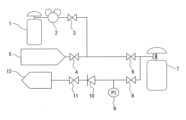
- FIG. 2 is a schematic diagram showing an example of an apparatus for performing the hydrogen halide supply step and the discharge step in the method for cleaning a high-pressure gas container according to an embodiment of the present disclosure.
- FIG. 2 is a schematic diagram showing an example of an apparatus for performing a decompression step in a method for cleaning a high-pressure gas container according to an embodiment of the present disclosure.
- FIG. 1 is a cross-sectional view showing an example of a high-pressure gas container that can be used in a high-pressure gas container cleaning method according to an embodiment of the present disclosure.
- FIG. 1 is a cross-sectional view showing an example of a high-pressure gas container that can be used in a high-pressure gas container cleaning method according to an embodiment of the present disclosure.
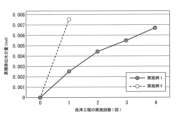
- 11 is a graph showing the relationship between the number of times the cleaning process is performed and the amount of water discharged in the discharge stage. 1 is a graph showing the relationship between the number of days elapsed since hydrogen chloride was filled and the water concentration of hydrogen chloride.
- the method for cleaning a high-pressure gas container includes a depressurization step of depressurizing the inside of the high-pressure gas container until the internal pressure is 5 Pa or less, and a cleaning step of cleaning the inside of the high-pressure gas container after the depressurization step.
- the cleaning step includes a hydrogen halide supplying step of supplying hydrogen halide to the high-pressure gas container after the depressurization step, a metal oxide removing step of reacting metal oxides present on the inner surface of the high-pressure gas container with the hydrogen halide supplied by the hydrogen halide supplying step inside the high-pressure gas container after the hydrogen halide supplying step to generate water, and a discharge step of discharging the water generated by the metal oxide removing step and the hydrogen halide supplied by the hydrogen halide supplying step from the high-pressure gas container.
- the method for cleaning a high-pressure gas container includes a depressurization process for depressurizing the inside of the high-pressure gas container until the internal pressure is 5 Pa or less, and a cleaning process for cleaning the inside of the high-pressure gas container after the depressurization process.
- the cleaning process includes a hydrogen halide supplying step, a metal oxide removing step, and a discharging step.
- the hydrogen halide supplying step is a step of supplying hydrogen halide to the high-pressure gas container which has been subjected to the depressurizing step.
- the metal oxide removing step is a step of generating water inside the high-pressure gas container which has been subjected to the hydrogen halide supplying step by reacting the metal oxide present on the inner surface of the high-pressure gas container with the hydrogen halide supplied by the hydrogen halide supplying step.
- the discharging step is a step of discharging the water generated in the metal oxide removing step and the hydrogen halide supplied by the hydrogen halide supplying step from the high-pressure gas container.
- the method for cleaning a high-pressure gas container according to this embodiment includes the above-mentioned decompression process and cleaning process, so by cleaning the inside of a high-pressure gas container using the method for cleaning a high-pressure gas container according to this embodiment, metal oxides, which are a source of water generation, can be removed, and water generation inside the high-pressure gas container can be suppressed.
- the method for cleaning a high-pressure gas container according to this embodiment is suitable as a method for cleaning a high-pressure gas container that is filled with and stored hydrogen halide for use in semiconductor manufacturing processes.
- a high-pressure gas container cleaned with the method for cleaning a high-pressure gas container according to this embodiment is less likely to produce water inside, so the moisture concentration of the hydrogen halide filled therein can be kept low (for example, 1.0 ppm by volume or less).
- high-quality hydrogen halide can be obtained by using a high-pressure gas container cleaned with the method for cleaning a high-pressure gas container according to this embodiment.
- the method for cleaning a high-pressure gas cylinder according to this embodiment does not require heating the high-pressure gas cylinder to which hydrogen halide is supplied, and therefore the generation of hydrogen molecules is suppressed. This makes it possible to suppress the deterioration of the hydrogen molecule concentration in the hydrogen halide, and to maintain it at 10 ppm by volume or less. As high-pressure gas containers become larger, it becomes more difficult to perform heat treatment of the high-pressure gas container. However, the method for cleaning a high-pressure gas container according to this embodiment does not require heat treatment of the high-pressure gas container and can remove metal oxides from the inside of the high-pressure gas container under mild conditions.
- phosphorus atoms (P) in hydrogen halides used in semiconductor manufacturing processes, and it is required to reduce the concentration to, for example, 2 ppb by volume or less.
- a method for suppressing the reaction between the hydrogen halides and metal oxides mentioned above a method of coating the inner surface of a high-pressure gas container with a coating material is known.
- a method of plating the inner surface of a high-pressure gas container with a nickel-phosphorus alloy is known, but there is a concern that when a high-pressure gas container is filled with hydrogen halide, phosphorus atoms derived from the nickel-phosphorus alloy may be mixed into the hydrogen halide.
- the high pressure gas container used in the method for cleaning a high pressure gas container according to this embodiment is a container in which gas is discharged and filled through a gas flow path.
- the type of the high pressure gas container used in the method for cleaning a high pressure gas container according to this embodiment is not particularly limited, and for example, the size and shape are not particularly limited.
- the material of the high pressure gas container is also not particularly limited, and examples include metal materials containing at least one of iron (Fe), chromium (Cr), molybdenum (Mo), and manganese (Mn).
- the high-pressure gas container used in the high-pressure gas container cleaning method according to this embodiment may be a new (unused) high-pressure gas container, or a used high-pressure gas container. Furthermore, it may be a high-pressure gas container that is open to the atmosphere, or a high-pressure gas container that is not open to the atmosphere.
- the condition of the inner surface of the high-pressure gas cylinder is not particularly limited, and the inner surface of the high-pressure gas cylinder may or may not be coated with a coating material.
- coating materials that may be applied to the inner surface of a high-pressure gas cylinder include nickel (Ni) plating, nickel-phosphorus alloy (Ni-P) plating, zinc (Zn) plating, gold (Au) plating, and silver (Ag) plating.
- the surface roughness of the inner surface of the high-pressure gas container is not particularly limited, but it is preferable that the maximum height Rz of the inner surface of the body of the high-pressure gas container is 5 ⁇ m or less.
- the inner surface of the high-pressure gas container may not be coated with a coating material, and the maximum height Rz of the inner surface of the body of the high-pressure gas container may be 5 ⁇ m or less.
- the maximum height Rz of the inner surface of the body of the high-pressure gas container is 1 ⁇ m or more and 5 ⁇ m or less and the maximum height Rz of the inner surface of the part other than the body of the high-pressure gas container is 15 ⁇ m or more and 20 ⁇ m or less, it is even more preferable that the maximum height Rz of the inner surface of the body of the high-pressure gas container is 1 ⁇ m or less and the maximum height Rz of the inner surface of the part other than the body of the high-pressure gas container is 15 ⁇ m or more and 20 ⁇ m or less, it is particularly preferable that the maximum height Rz of the inner surface of the body of the high-pressure gas container is 1 ⁇ m or less and the maximum height Rz of the inner surface of the part other than the body of the high-pressure gas container is 1 ⁇ m or less.
- the "body" of a high-pressure gas container refers to the central portion of the container in the longitudinal direction, excluding both ends in the longitudinal direction.
- the ends are portions having a volume of 5% of the volume of the container.
- the body when the high pressure gas container is cylindrical or rectangular, the body means the center of the cylinder or rectangular in the height direction (length direction) excluding both ends, and when the high pressure gas container is spherical, the body means the center of the sphere in the radial direction excluding both ends.
- the method for reducing the maximum height Rz of the inner surface of the body of the high-pressure gas container is not particularly limited, but examples include a method for polishing the inner surface of the body of the high-pressure gas container.
- methods for polishing the inner surface of the body of the high-pressure gas container include shot blast polishing, barrel polishing, and electrolytic polishing.
- the method for measuring the maximum height Rz of the inner surface of the body of a high-pressure gas container is not particularly limited, but for example, the method described in Japanese Industrial Standard JIS B0601-2013 can be adopted.
- the measuring device for measuring the maximum height Rz of the inner surface of the body of the high-pressure gas container is not particularly limited, but for example, a stylus-type surface roughness measuring device such as the SURFTEST SJ-210 series small surface roughness measuring device manufactured by Mitutoyo Corporation can be used.
- the high-pressure gas cylinder cleaning method according to this embodiment can be applied to cleaning any high-pressure gas cylinder, but is particularly suitable for cleaning high-pressure gas cylinders whose inner surfaces are not coated with a coating material and whose maximum height Rz of the inner surface of the barrel is 5 ⁇ m or less.
- FIG. 2 is a diagram showing an example of an apparatus that performs the depressurization process on a high-pressure gas container with a volume of 10 L to 50 L. The depressurization process will be described with reference to Fig. 2.
- the depressurization process places the inside of the high-pressure gas container 19, which has a volume of, for example, 47 L, in a depressurized state. That is, the water and other gases inside the high-pressure gas container 19 are exhausted using a vacuum pump 17.
- the depressurization process is preferably performed while keeping the high-pressure gas container 19 at a temperature of 50°C or higher and 200°C or lower, and exhausting until the internal pressure is 5 Pa or lower, more preferably while keeping the high-pressure gas container 19 at a temperature of 100°C or higher and 200°C or lower, and even more preferably while keeping the high-pressure gas container 19 at a temperature of 150°C or higher and 200°C or lower.
- the temperature of the high-pressure gas container 19 can be adjusted, for example, by heating the high-pressure gas container 19 with a heater 20 provided to cover the high-pressure gas container 19.
- the fusible plug When the high-pressure gas cylinder 19 is heated, it is preferable to cool the fusible plug by blowing air from the fusible plug cooling air supply source 23 onto the fusible plug so that the fusible plug attached to the valve of the high-pressure gas cylinder 19 does not operate. Furthermore, the ultimate pressure inside the high-pressure gas container 19 after the depressurization step must be 5 Pa or less, preferably 1 Pa or less, more preferably 0.01 Pa or less, and even more preferably less than 0.01 Pa.
- the vacuum pump 17 is preferably a dry type vacuum pump.
- inert gas is not particularly limited, but examples include nitrogen gas (N 2 ), helium (He), argon (Ar), and xenon (Xe).
- Fig. 2 shows an example in which nitrogen gas is used as the inert gas, and the inert gas can be circulated from a nitrogen gas supply source 13 to the piping.
- the moisture concentration of the inert gas used here is preferably 1 ppm by volume or less, more preferably 0.1 ppm by volume or less, and even more preferably 0.05 ppm by volume or less.
- a cleaning step is carried out to clean the inside of the high pressure gas container.
- Fig. 1 is a diagram showing an example of an apparatus for carrying out the cleaning step. The cleaning step will be described with reference to Fig. 1.
- the high-pressure gas container 19 the inside of which has been placed in a vacuum state by the depressurization process, is removed from the apparatus shown in FIG. 2 and attached to the apparatus shown in FIG. 1.
- the "high-pressure gas container 19" is shown as the "high-pressure gas container 7.”
- a hydrogen halide supply step is performed in which hydrogen halide is supplied to the high-pressure gas container 7.
- the hydrogen halide supply stage is carried out.
- the mass of hydrogen halide supplied to the high-pressure gas container 7 may be measured by a weighing scale. It is preferable that the mass of hydrogen halide supplied to the high-pressure gas container 7 having a volume of 47 L is 5 kg or more and 30 kg or less.
- the type of hydrogen halide is not particularly limited, and may be at least one of hydrogen fluoride (HF), hydrogen chloride (HCl), hydrogen bromide (HBr), and hydrogen iodide (HI).
- Figure 1 shows an example in which hydrogen chloride is used as the hydrogen halide.
- the water concentration of the hydrogen halide supplied from the hydrogen halide supply source 5 to the high-pressure gas container 7 is preferably 0.2 ppm by volume or less, more preferably 0.1 ppm by volume or less, and even more preferably 0.05 ppm by volume or less.
- the purity of the hydrogen halide supplied from the hydrogen halide supply source 5 to the high-pressure gas container 7 is preferably 3N or more (99.9% by volume or more), more preferably 4N or more (99.99% by volume or more), and even more preferably 5N or more (99.999% by volume or more).
- the high-pressure gas container 7 is removed from the apparatus shown in Fig. 1, and the metal oxide removal step is carried out. That is, inside the high-pressure gas container 7 where the hydrogen halide supply step has been carried out, the metal oxide present on the inner surface of the high-pressure gas container 7 is reacted with the hydrogen halide supplied in the hydrogen halide supply step to produce water.
- the type of metal oxide is not particularly limited, but examples include at least one of iron oxide, chromium oxide, molybdenum oxide, and manganese oxide.
- the metal oxide removal stage can be carried out by leaving the high-pressure gas container 7, which has been subjected to the hydrogen halide supply stage, at a predetermined temperature for a predetermined time.
- the temperature in the metal oxide removal stage is preferably less than 30°C.
- the time in the metal oxide removal stage is preferably one day or more, more preferably ten days or more, and even more preferably 60 days or more.
- the metal oxide removal stage may be carried out by leaving the high-pressure gas container, into which hydrogen halide has been supplied by the hydrogen halide supply stage, at a temperature of less than 30°C for one day or more.
- the method of setting the high pressure gas container 7 to a temperature of less than 30°C is not particularly limited, but one example is to use an air conditioning device such as an air conditioner. It is believed that in the metal oxide removal stage, the room temperature and outside air temperature in the environment in which the high pressure gas container 7 is placed will have some effect on the reaction rate between the metal oxide and hydrogen halide, but in the temperature range of less than 30°C, this effect is negligible. Therefore, in the temperature range of less than 30°C, the number of cleaning steps to achieve the required cleaning effect does not increase depending on the temperature. In addition, in the metal oxide removal stage, the inside of the high pressure gas container 7 is an enclosed space, so the high pressure gas container 7 is hardly affected by the humidity or air pressure outside of the high pressure gas container 7.
- the water produced by the reaction of the metal oxide with the hydrogen halide in the metal oxide removal stage is discharged from the high-pressure gas container 7 in the discharge stage together with the excess hydrogen halide that was supplied in the hydrogen halide supply stage and was not consumed in the reaction in the metal oxide removal stage.
- the metal halide produced by the reaction of the metal oxide with the hydrogen halide in the metal oxide removal stage may also be discharged from the high-pressure gas container 7.
- the device shown in Figure 1 is used to discharge water and hydrogen halide from the high-pressure gas container 7.
- water can be discharged more efficiently outside the high-pressure gas container 7 by discharging the hydrogen halide containing water from the liquid phase side rather than discharging it from the gas phase side.
- the discharge step preferably involves discharging the water and the hydrogen halide from the high-pressure gas container by turning the high-pressure gas container upside down. That is, in the case of a small high-pressure gas container with a volume between 10 L and 50 L, which has only one container valve, it is preferable to install the high-pressure gas container so that the container valve faces vertically downward in order to discharge the hydrogen halide from the liquid phase side, and then discharge the liquefied hydrogen halide from the high-pressure gas container.
- small high-pressure gas containers with a volume of 10 L or more and 50 L or less are preferably installed so that the container valve faces vertically downward, but they do not need to be upright and may be tilted as long as the container valve faces vertically downward.
- angle of inclination it is preferable that it be between 45° and 90°, for example.
- the discharge step inserts an internal tube into the high pressure gas container and uses the internal tube to discharge the liquid phase water and hydrogen halide from the high pressure gas container.
- the 440L high pressure gas container 124 shown in FIG. 3 and the 900L high pressure gas container 132 shown in FIG. 4 have gas phase side siphon tubes 121, 128 and liquid phase side siphon tubes 122, 129 inserted inside the high pressure gas container (the gas phase side siphon tubes 121, 128 and the liquid phase side siphon tubes 122, 129 correspond to the internal tubes, which are the constituent elements of this disclosure).
- the liquid phase side siphon tubes 122, 129 facing downward can be used to discharge the liquefied hydrogen halide from the liquid phase side to the outside of the high pressure gas containers 124, 132, so that the water contained in the hydrogen halide can be efficiently discharged to the outside of the high pressure gas containers 124, 132.
- Such a washing step may be carried out once after the depressurization step, or may be repeatedly carried out two or more times after the depressurization step.
- the moisture concentration, hydrogen molecule concentration, and phosphorus atom concentration of the hydrogen halide discharged in the discharge step may be measured.
- the moisture concentration of the hydrogen halide may be measured using a moisture meter.
- a cavity ring-down spectroscopy (CRDS) type analyzer may be used.
- the hydrogen molecule concentration of the hydrogen halide may be measured, for example, by gas chromatography (GC).
- a pulse discharge type photoionization detector may be used.
- the phosphorus atom concentration of the hydrogen halide may be measured, for example, by inductively coupled plasma atomic emission spectrometry (ICP-AES).
- the high-pressure gas container cleaned as described above can be used as a high-pressure gas container for filling and storing hydrogen halide.
- the moisture concentration of the filled hydrogen halide can be kept low (for example, 1.0 ppm by volume or less).
- the type of hydrogen halide to be filled is not particularly limited, and can be at least one of hydrogen fluoride, hydrogen chloride, hydrogen bromide, and hydrogen iodide.
- Example 1 A metal high-pressure gas cylinder with a volume of 47 L was prepared. The inner surface of this high-pressure gas cylinder was polished to a maximum height Rz of the inner surface of the body of 1 ⁇ m, and the maximum height Rz of the inner surface of the portion other than the body of 20 ⁇ m. The inner surface of this high-pressure gas cylinder was not coated with a coating material.
- This high-pressure gas container was attached to the device shown in Fig. 2, and a depressurization step was carried out. That is, a depressurization step was carried out in which the internal pressure of the high-pressure gas container was reduced to 0.01 Pa or less while maintaining the temperature at 145°C or more and 155°C or less.
- the high-pressure gas container was removed from the apparatus shown in Fig. 2 and attached to the apparatus shown in Fig. 1. Then, with the container valve of the high-pressure gas container in a closed state, hydrogen chloride was supplied into the apparatus shown in Fig. 1 until the pressure reached 1.80 MPaG, and then the pressure was released until the residual pressure reached 0.1 MPaG. This operation was repeated five times in total.
- a cleaning process was carried out on the high-pressure gas container. That is, with the container valve of the high-pressure gas container open, 25 kg of hydrogen chloride with a moisture concentration of 0.2 volume ppm or less was filled into the high-pressure gas container (hydrogen halide supply stage), and then the container was left to stand for 24 hours while maintaining the temperature within the range of 15°C to 25°C (metal oxide removal stage). After that, the container valve of the high-pressure gas container was closed, and the high-pressure gas container was removed from the device shown in Figure 1, and the container valve was opened to discharge hydrogen chloride from the high-pressure gas container until the residual pressure was 0.11 MPa (discharge stage). The above cleaning process was repeated a total of four times.
- the high-pressure gas cylinder that had undergone the cleaning process was refilled with 25 kg of hydrogen chloride with a moisture concentration of 0.2 volume ppm or less.
- the moisture concentration of the hydrogen chloride filled into the high-pressure gas cylinder was then measured using a cavity ring-down spectroscopy (CRDS) type analyzer, while the hydrogen molecule concentration was measured by gas chromatography (GC) and the phosphorus atom concentration was measured by inductively coupled plasma atomic emission spectrometry (ICP-AES).
- ICP-AES inductively coupled plasma atomic emission spectrometry
- a pulse discharge type photoionization detector was used as the detector for gas chromatography.
- the moisture concentration of the hydrogen chloride was 0.6 volume ppm
- the hydrogen molecule concentration was 0.1 volume ppm or less
- the phosphorus atom concentration was 0.5 volume ppb.
- Table 1 The results are shown in Table 1.
- Example 2 The high-pressure gas cylinder was cleaned in the same manner as in Example 1, except that the maximum height Rz of the inner surface of the body and the inner surface of the part other than the body was both 1 ⁇ m, and the cleaning process was carried out once.
- the high-pressure gas cylinder that had undergone the cleaning process was refilled with 25 kg of hydrogen chloride with a moisture concentration of 0.2 volume ppm or less.
- the moisture concentration, hydrogen molecule concentration, and phosphorus atom concentration of the hydrogen chloride filled into the high-pressure gas cylinder were then measured in the same manner as in Example 1.
- the moisture concentration of the hydrogen chloride was 0.4 volume ppm
- the hydrogen molecule concentration was 0.1 volume ppm or less
- the phosphorus atom concentration was 0.9 volume ppb.
- Table 1 The results are shown in Table 1.
- Example 3 The high-pressure gas cylinder was cleaned in the same manner as in Example 1, except that the maximum height Rz of the inner surface of the body and the inner surface of the part other than the body was both 5 ⁇ m, and the cleaning process was carried out twice.
- the high-pressure gas container that had undergone the cleaning process was refilled with 25 kg of hydrogen chloride with a moisture concentration of 0.2 volume ppm or less.
- the moisture concentration, hydrogen molecule concentration, and phosphorus atom concentration of the hydrogen chloride filled into the high-pressure gas container were then measured in the same manner as in Example 1.
- the moisture concentration of the hydrogen chloride was 0.8 volume ppm
- the hydrogen molecule concentration was 1.0 volume ppm
- the phosphorus atom concentration was 0.7 volume ppb.
- Table 1 The results are shown in Table 1.
- Example 4 The high-pressure gas cylinder was cleaned in the same manner as in Example 1, except that the hydrogen halide used in the cleaning step was changed from hydrogen chloride having a water concentration of 0.2 volume ppm or less to hydrogen bromide having a water concentration of 0.2 volume ppm or less, and the amount of hydrogen bromide supplied in the hydrogen halide supply stage was changed to 20 kg.
- the high-pressure gas container that had undergone the cleaning process was refilled with 20 kg of hydrogen bromide with a moisture concentration of 0.2 volume ppm or less.
- the moisture concentration, hydrogen molecule concentration, and phosphorus atom concentration of the hydrogen bromide filled into the high-pressure gas container were then measured in the same manner as in Example 1.
- the moisture concentration of the hydrogen bromide was 0.9 volume ppm
- the hydrogen molecule concentration was 0.1 volume ppm or less
- the phosphorus atom concentration was 0.9 volume ppb.
- Table 1 The results are shown in Table 1.
- Example 5 The high-pressure gas cylinder was cleaned in the same manner as in Example 1, except that the cleaning step was carried out once and the temperature in the metal oxide removal stage was changed to 35°C or higher and 40°C or lower.
- the high-pressure gas container that had been subjected to the cleaning process was again filled with 25 kg of hydrogen chloride with a moisture concentration of 0.2 volume ppm or less.
- the moisture concentration, hydrogen molecule concentration, and phosphorus atom concentration of the hydrogen chloride filled in the high-pressure gas container were then measured in the same manner as in Example 1.
- the moisture concentration of the hydrogen chloride was 0.2 volume ppm
- the hydrogen molecule concentration was 12 volume ppm
- the phosphorus atom concentration was 0.5 volume ppb.
- Table 1 The results are shown in Table 1.
- Example 6 The high-pressure gas cylinder was cleaned in the same manner as in Example 1, except that in the depressurization step, the internal pressure of the high-pressure gas cylinder was reduced to 5 Pa.
- the high-pressure gas container that had been subjected to the cleaning process was again filled with 25 kg of hydrogen chloride with a moisture concentration of 0.2 volume ppm or less.
- the moisture concentration, hydrogen molecule concentration, and phosphorus atom concentration of the hydrogen chloride filled in the high-pressure gas container were then measured in the same manner as in Example 1.
- the moisture concentration of the hydrogen chloride was 0.9 volume ppm
- the hydrogen molecule concentration was 0.1 volume ppm or less
- the phosphorus atom concentration was 0.6 volume ppb.
- Table 1 The results are shown in Table 1.
- Example 7 The high-pressure gas cylinder was cleaned in the same manner as in Example 1, except that the temperature in the depressurization step was changed to 50°C or higher and 55°C or lower.
- the high-pressure gas container that had been subjected to the cleaning process was again filled with 25 kg of hydrogen chloride with a moisture concentration of 0.2 volume ppm or less.
- the moisture concentration, hydrogen molecule concentration, and phosphorus atom concentration of the hydrogen chloride filled in the high-pressure gas container were then measured in the same manner as in Example 1.
- the moisture concentration of the hydrogen chloride was 0.5 volume ppm
- the hydrogen molecule concentration was 0.1 volume ppm or less
- the phosphorus atom concentration was 0.5 volume ppb.
- Table 1 The results are shown in Table 1.
- Example 8 The high-pressure gas cylinder was cleaned in the same manner as in Example 1, except that the temperature in the depressurization step was changed to 190°C or higher and 200°C or lower.
- the high-pressure gas container that had been subjected to the cleaning process was again filled with 25 kg of hydrogen chloride with a moisture concentration of 0.2 volume ppm or less.
- the moisture concentration, hydrogen molecule concentration, and phosphorus atom concentration of the hydrogen chloride filled in the high-pressure gas container were then measured in the same manner as in Example 1.
- the moisture concentration of the hydrogen chloride was 0.2 volume ppm
- the hydrogen molecule concentration was 0.1 volume ppm or less
- the phosphorus atom concentration was 0.8 volume ppb.
- Table 1 The results are shown in Table 1.
- Example 9 A metal high-pressure gas cylinder with a volume of 440 L was prepared (see FIG. 3). The inner surface of this high-pressure gas cylinder was polished to a maximum height Rz of the inner surface of the body of 1 ⁇ m, and a maximum height Rz of the inner surface of the portion other than the body of 20 ⁇ m. The inner surface of this high-pressure gas cylinder was not coated with a coating material.
- the high-pressure gas container was cleaned in the same manner as in Example 1, except that the high-pressure gas container was changed from a container with a volume of 47 L to a container with a volume of 440 L, the temperature in the depressurization process was changed to 50°C or higher and 55°C or lower, the internal pressure of the high-pressure gas container was reduced to 3 Pa in the depressurization process, the amount of hydrogen chloride supplied in the hydrogen halide supply stage was changed to 250 kg, and the number of cleaning processes was changed to one.
- the high-pressure gas container that had undergone the cleaning process was refilled with 250 kg of hydrogen chloride with a moisture concentration of 0.2 ppm by volume or less.
- the moisture concentration, hydrogen molecule concentration, and phosphorus atom concentration of the hydrogen chloride filled into the high-pressure gas container were then measured in the same manner as in Example 1.
- the moisture concentration of the hydrogen chloride was 0.6 ppm by volume
- the hydrogen molecule concentration was 0.1 ppm by volume or less
- the phosphorus atom concentration was 0.4 ppb by volume.
- Table 1 The results are shown in Table 1.
- Example 10 A metal high-pressure gas cylinder with a volume of 900 L was prepared (see FIG. 4). The inner surface of this high-pressure gas cylinder was polished to a maximum height Rz of the inner surface of the body of 1 ⁇ m, and a maximum height Rz of the inner surface of the portion other than the body of 20 ⁇ m. The inner surface of this high-pressure gas cylinder was not coated with a coating material.
- the high-pressure gas container was cleaned in the same manner as in Example 1, except that the high-pressure gas container was changed from a container with a volume of 47 L to a container with a volume of 900 L, the temperature in the depressurization process was changed to 50°C or higher and 55°C or lower, the internal pressure of the high-pressure gas container was reduced to 3 Pa in the depressurization process, the amount of hydrogen chloride supplied in the hydrogen halide supply stage was changed to 500 kg, and the number of cleaning processes was changed to two.
- the high-pressure gas container that had undergone the cleaning process was refilled with 500 kg of hydrogen chloride with a moisture concentration of 0.2 volume ppm or less.
- the moisture concentration, hydrogen molecule concentration, and phosphorus atom concentration of the hydrogen chloride filled into the high-pressure gas container were then measured in the same manner as in Example 1.
- the moisture concentration of the hydrogen chloride was 0.3 volume ppm
- the hydrogen molecule concentration was 0.1 volume ppm or less
- the phosphorus atom concentration was 0.7 volume ppb.
- Table 1 The results are shown in Table 1.
- Example 11 The high-pressure gas cylinder was cleaned in the same manner as in Example 1, except that the maximum height Rz of the inner surface of the body and parts other than the body of the high-pressure gas cylinder was set to 20 ⁇ m, and the cleaning process was carried out five times.
- the high-pressure gas container that had undergone the cleaning process was refilled with 25 kg of hydrogen chloride with a moisture concentration of 0.2 ppm by volume or less.
- the moisture concentration, hydrogen molecule concentration, and phosphorus atom concentration of the hydrogen chloride filled into the high-pressure gas container were then measured in the same manner as in Example 1.
- the moisture concentration of the hydrogen chloride was 0.8 ppm by volume
- the hydrogen molecule concentration was 0.2 ppm by volume
- the phosphorus atom concentration was 1.0 ppb by volume.
- Table 1 The results are shown in Table 1.
- Example 12 The high-pressure gas cylinder was cleaned in the same manner as in Example 1, except that the amount of hydrogen chloride supplied in the hydrogen halide supply stage was 2 kg and the cleaning step was carried out 20 times.
- the high-pressure gas container that had been subjected to the cleaning process was again filled with 25 kg of hydrogen chloride with a moisture concentration of 0.2 volume ppm or less.
- the moisture concentration, hydrogen molecule concentration, and phosphorus atom concentration of the hydrogen chloride filled in the high-pressure gas container were then measured in the same manner as in Example 1.
- the moisture concentration of the hydrogen chloride was 1.2 volume ppm
- the hydrogen molecule concentration was 0.1 volume ppm or less
- the phosphorus atom concentration was 0.4 volume ppb.
- Table 1 The results are shown in Table 1.
- Comparative Example 1 The same treatment as in Example 1 was carried out on the same high-pressure gas cylinder as in Example 1, except that the cleaning step was not carried out.
- the high-pressure gas container that had been subjected to the decompression step was filled with 25 kg of hydrogen chloride having a moisture concentration of 0.2 volume ppm or less.
- the moisture concentration, hydrogen molecule concentration, and phosphorus atom concentration of the hydrogen chloride filled in the high-pressure gas container were then measured in the same manner as in Example 1.
- the moisture concentration of the hydrogen chloride was 3.6 volume ppm
- the hydrogen molecule concentration was 0.5 volume ppm
- the phosphorus atom concentration was 0.9 volume ppb.
- Table 1 The results are shown in Table 1.
- Comparative Example 2 The high-pressure gas cylinder was cleaned in the same manner as in Example 1, except that the temperature and pressure conditions in the depressurization step were different.
- the high-pressure gas container that had been subjected to the cleaning process was again filled with 25 kg of hydrogen chloride with a moisture concentration of 0.2 volume ppm or less.
- the moisture concentration, hydrogen molecule concentration, and phosphorus atom concentration of the hydrogen chloride filled in the high-pressure gas container were then measured in the same manner as in Example 1.
- the moisture concentration of the hydrogen chloride was 2.5 volume ppm
- the hydrogen molecule concentration was 1.0 volume ppm
- the phosphorus atom concentration was 0.8 volume ppb.
- Table 1 The results are shown in Table 1.
- Comparative Example 3 The high-pressure gas cylinder was cleaned in the same manner as in Example 1, except that the pressure conditions in the depressurization step were different.
- the high-pressure gas container that had been subjected to the cleaning process was again filled with 25 kg of hydrogen chloride with a moisture concentration of 0.2 volume ppm or less.
- the moisture concentration, hydrogen molecule concentration, and phosphorus atom concentration of the hydrogen chloride filled in the high-pressure gas container were then measured in the same manner as in Example 1.
- the moisture concentration of the hydrogen chloride was 1.6 volume ppm
- the hydrogen molecule concentration was 2.0 volume ppm
- the phosphorus atom concentration was 0.3 volume ppb.
- Table 1 The results are shown in Table 1.
- the high-pressure gas container that had undergone the decompression process was filled with 25 kg of hydrogen chloride with a moisture concentration of 0.2 volume ppm or less.
- the moisture concentration, hydrogen molecule concentration, and phosphorus atom concentration of the hydrogen chloride filled in the high-pressure gas container were then measured in the same manner as in Example 1.
- the moisture concentration of the hydrogen chloride was 0.8 volume ppm
- the hydrogen molecule concentration was 0.2 volume ppm
- the phosphorus atom concentration was 2.1 volume ppb.
- Table 1 The results are shown in Table 1.
- Example 1 the water concentration of the hydrogen chloride discharged in the discharge stage was measured every time the cleaning step was performed in the same manner as in Example 1. Then, the amount (mol) of water discharged in one cleaning step was calculated from the measured water concentration value. The results are shown in the graph of Figure 5.
- the graph of Figure 5 shows the cumulative value of the amount of water discharged. 5, the total amount of water discharged was similar in Example 1 and Example 5. This result shows that the temperature in the metal oxide removal step does not need to be high, and water can be removed even at temperatures below 30° C.
- Example 1 the high-pressure gas container filled again with 25 kg of hydrogen chloride after the cleaning process was carried out was left to stand in a room whose temperature was adjusted to 20°C or higher and 25°C or lower. After a predetermined time had passed, the moisture concentration of the hydrogen chloride filled in the high-pressure gas container was measured in the same manner as in Example 1. The results are shown in the graph in Figure 6.
- Comparative Example 1 after the decompression process, the high-pressure gas container filled with 25 kg of hydrogen chloride was left to stand in a room whose temperature was adjusted to 20°C or higher and 25°C or lower. After a predetermined time had elapsed, the moisture concentration of the hydrogen chloride filled in the high-pressure gas container was measured in the same manner as in Example 1. The results are shown in the graph in Figure 6. Note that for the test of Comparative Example 1, three high-pressure gas containers were prepared (shown in the graph in Figure 6 as Comparative Example 1A, Comparative Example 1B, and Comparative Example 1C), and the same test was carried out on each of them.
Landscapes
- Filling Or Discharging Of Gas Storage Vessels (AREA)
- Engineering & Computer Science (AREA)
- Cleaning And De-Greasing Of Metallic Materials By Chemical Methods (AREA)
- Mechanical Engineering (AREA)
- General Engineering & Computer Science (AREA)
Priority Applications (3)
| Application Number | Priority Date | Filing Date | Title |
|---|---|---|---|
| JP2025532666A JPWO2025013630A1 (https=) | 2023-07-13 | 2024-06-26 | |
| CN202480029082.4A CN121079538A (zh) | 2023-07-13 | 2024-06-26 | 高压气体容器的清洗方法 |
| KR1020257031018A KR20260041004A (ko) | 2023-07-13 | 2024-06-26 | 고압 가스 용기의 세정 방법 |
Applications Claiming Priority (2)
| Application Number | Priority Date | Filing Date | Title |
|---|---|---|---|
| JP2023115374 | 2023-07-13 | ||
| JP2023-115374 | 2023-07-13 |
Publications (1)
| Publication Number | Publication Date |
|---|---|
| WO2025013630A1 true WO2025013630A1 (ja) | 2025-01-16 |
Family
ID=94215387
Family Applications (1)
| Application Number | Title | Priority Date | Filing Date |
|---|---|---|---|
| PCT/JP2024/023172 Pending WO2025013630A1 (ja) | 2023-07-13 | 2024-06-26 | 高圧ガス容器の洗浄方法 |
Country Status (5)
| Country | Link |
|---|---|
| JP (1) | JPWO2025013630A1 (https=) |
| KR (1) | KR20260041004A (https=) |
| CN (1) | CN121079538A (https=) |
| TW (1) | TW202526215A (https=) |
| WO (1) | WO2025013630A1 (https=) |
Citations (3)
| Publication number | Priority date | Publication date | Assignee | Title |
|---|---|---|---|---|
| JP2002054799A (ja) * | 2000-08-09 | 2002-02-20 | Tsurumi Soda Co Ltd | 高圧ガス容器の不純物除去方法 |
| JP2003532034A (ja) * | 2000-05-03 | 2003-10-28 | アドバンスド.テクノロジー.マテリアルス.インコーポレイテッド | 収着剤ベースのガス貯蔵及び供給システムを備えるガスキャビネットアセンブリ |
| JP2016109171A (ja) * | 2014-12-03 | 2016-06-20 | 住友精化株式会社 | 高圧ガス容器の洗浄方法、および高圧ガス容器 |
-
2024
- 2024-06-26 JP JP2025532666A patent/JPWO2025013630A1/ja active Pending
- 2024-06-26 KR KR1020257031018A patent/KR20260041004A/ko active Pending
- 2024-06-26 WO PCT/JP2024/023172 patent/WO2025013630A1/ja active Pending
- 2024-06-26 CN CN202480029082.4A patent/CN121079538A/zh active Pending
- 2024-07-10 TW TW113125784A patent/TW202526215A/zh unknown
Patent Citations (3)
| Publication number | Priority date | Publication date | Assignee | Title |
|---|---|---|---|---|
| JP2003532034A (ja) * | 2000-05-03 | 2003-10-28 | アドバンスド.テクノロジー.マテリアルス.インコーポレイテッド | 収着剤ベースのガス貯蔵及び供給システムを備えるガスキャビネットアセンブリ |
| JP2002054799A (ja) * | 2000-08-09 | 2002-02-20 | Tsurumi Soda Co Ltd | 高圧ガス容器の不純物除去方法 |
| JP2016109171A (ja) * | 2014-12-03 | 2016-06-20 | 住友精化株式会社 | 高圧ガス容器の洗浄方法、および高圧ガス容器 |
Also Published As
| Publication number | Publication date |
|---|---|
| JPWO2025013630A1 (https=) | 2025-01-16 |
| TW202526215A (zh) | 2025-07-01 |
| KR20260041004A (ko) | 2026-03-26 |
| CN121079538A (zh) | 2025-12-05 |
Similar Documents
| Publication | Publication Date | Title |
|---|---|---|
| JP5231155B2 (ja) | 液相状態の化合物の精製装置 | |
| KR102613123B1 (ko) | 반도체 기판 프로세싱 장치의 진공 챔버 컨디셔닝 방법 | |
| JP6914918B2 (ja) | 材料、この材料を用いた保存容器、この保存容器に取り付けられるバルブ、並びに、ClFの保存方法、ClFの保存容器の使用方法 | |
| CN110832106B (zh) | 已完成填充的容器的制造方法以及已完成填充的容器 | |
| CN111247268B (zh) | 工艺腔室和用于吹扫其的方法 | |
| WO2025013630A1 (ja) | 高圧ガス容器の洗浄方法 | |
| TW201811730A (zh) | 用於半導體應用的高純度伸乙基二胺 | |
| JP5498640B2 (ja) | 窒化物半導体製造装置部品の洗浄方法と洗浄装置 | |
| KR20190022873A (ko) | 기판 처리 장치, 금속 부재 및 반도체 장치의 제조 방법 | |
| WO2025013629A1 (ja) | 高圧ガス容器の洗浄方法 | |
| CN107002947B (zh) | 高压气体容器的清洗方法和高压气体容器 | |
| JP2002054799A (ja) | 高圧ガス容器の不純物除去方法 | |
| WO2024127901A1 (ja) | 液化ガス入り容器および液化ガス入り容器の製造方法 | |
| JP7117000B2 (ja) | 容器の製造方法、硫化水素収容体の製造方法、及び、硫化水素の充填方法 | |
| JP2003232495A (ja) | 充填高純度高圧ガス | |
| TWI798872B (zh) | 已填充氣體之填充容器及(e)-1,1,1,4,4,4-六氟-2-丁烯之保管方法 | |
| JP2000309890A (ja) | 腐食性ガス供給系での腐食低減方法 | |
| JP2709792B2 (ja) | 水素吸蔵金属材の高活性化及び安定化処理法 | |
| JPH04187705A (ja) | アルミニウム粉末加圧成形品の製法 | |
| CN119325541A (zh) | 二氧化硫混合物填充容器及二氧化硫组合物 | |
| TW202513463A (zh) | 氟化磷之保管方法、保管容器及已填充氣體之保管容器 | |
| CN118339401A (zh) | 腐蚀性气体混合物填充容器及腐蚀性气体组合物 | |
| JP2004245249A (ja) | 高純度高圧ガス用容器およびその製造方法 | |
| JP2001233316A (ja) | 飲食物用缶およびその製法 | |
| JPWO2016147605A1 (ja) | 金属製部材の腐食低減方法 |
Legal Events
| Date | Code | Title | Description |
|---|---|---|---|
| 121 | Ep: the epo has been informed by wipo that ep was designated in this application |
Ref document number: 24839523 Country of ref document: EP Kind code of ref document: A1 |
|
| ENP | Entry into the national phase |
Ref document number: 2025532666 Country of ref document: JP Kind code of ref document: A |
|
| WWE | Wipo information: entry into national phase |
Ref document number: 2025532666 Country of ref document: JP |
|
| NENP | Non-entry into the national phase |
Ref country code: DE |