WO2025009482A1 - 塩化ビニル樹脂組成物、塩化ビニル樹脂組成物の製造方法、塩化ビニル樹脂成形体、および積層体 - Google Patents
塩化ビニル樹脂組成物、塩化ビニル樹脂組成物の製造方法、塩化ビニル樹脂成形体、および積層体 Download PDFInfo
- Publication number
- WO2025009482A1 WO2025009482A1 PCT/JP2024/023629 JP2024023629W WO2025009482A1 WO 2025009482 A1 WO2025009482 A1 WO 2025009482A1 JP 2024023629 W JP2024023629 W JP 2024023629W WO 2025009482 A1 WO2025009482 A1 WO 2025009482A1
- Authority
- WO
- WIPO (PCT)
- Prior art keywords
- chloride resin
- vinyl chloride
- powder
- resin composition
- mass
- Prior art date
- Legal status (The legal status is an assumption and is not a legal conclusion. Google has not performed a legal analysis and makes no representation as to the accuracy of the status listed.)
- Ceased
Links
Classifications
-
- B—PERFORMING OPERATIONS; TRANSPORTING
- B29—WORKING OF PLASTICS; WORKING OF SUBSTANCES IN A PLASTIC STATE IN GENERAL
- B29C—SHAPING OR JOINING OF PLASTICS; SHAPING OF MATERIAL IN A PLASTIC STATE, NOT OTHERWISE PROVIDED FOR; AFTER-TREATMENT OF THE SHAPED PRODUCTS, e.g. REPAIRING
- B29C41/00—Shaping by coating a mould, core or other substrate, i.e. by depositing material and stripping-off the shaped article; Apparatus therefor
- B29C41/02—Shaping by coating a mould, core or other substrate, i.e. by depositing material and stripping-off the shaped article; Apparatus therefor for making articles of definite length, i.e. discrete articles
- B29C41/18—Slush casting, i.e. pouring moulding material into a hollow mould with excess material being poured off
-
- B—PERFORMING OPERATIONS; TRANSPORTING
- B29—WORKING OF PLASTICS; WORKING OF SUBSTANCES IN A PLASTIC STATE IN GENERAL
- B29C—SHAPING OR JOINING OF PLASTICS; SHAPING OF MATERIAL IN A PLASTIC STATE, NOT OTHERWISE PROVIDED FOR; AFTER-TREATMENT OF THE SHAPED PRODUCTS, e.g. REPAIRING
- B29C41/00—Shaping by coating a mould, core or other substrate, i.e. by depositing material and stripping-off the shaped article; Apparatus therefor
- B29C41/34—Component parts, details or accessories; Auxiliary operations
- B29C41/36—Feeding the material on to the mould, core or other substrate
-
- B—PERFORMING OPERATIONS; TRANSPORTING
- B32—LAYERED PRODUCTS
- B32B—LAYERED PRODUCTS, i.e. PRODUCTS BUILT-UP OF STRATA OF FLAT OR NON-FLAT, e.g. CELLULAR OR HONEYCOMB, FORM
- B32B27/00—Layered products comprising a layer of synthetic resin
- B32B27/30—Layered products comprising a layer of synthetic resin comprising vinyl (co)polymers; comprising acrylic (co)polymers
-
- B—PERFORMING OPERATIONS; TRANSPORTING
- B32—LAYERED PRODUCTS
- B32B—LAYERED PRODUCTS, i.e. PRODUCTS BUILT-UP OF STRATA OF FLAT OR NON-FLAT, e.g. CELLULAR OR HONEYCOMB, FORM
- B32B27/00—Layered products comprising a layer of synthetic resin
- B32B27/40—Layered products comprising a layer of synthetic resin comprising polyurethanes
-
- B—PERFORMING OPERATIONS; TRANSPORTING
- B32—LAYERED PRODUCTS
- B32B—LAYERED PRODUCTS, i.e. PRODUCTS BUILT-UP OF STRATA OF FLAT OR NON-FLAT, e.g. CELLULAR OR HONEYCOMB, FORM
- B32B5/00—Layered products characterised by the non- homogeneity or physical structure, i.e. comprising a fibrous, filamentary, particulate or foam layer; Layered products characterised by having a layer differing constitutionally or physically in different parts
- B32B5/18—Layered products characterised by the non- homogeneity or physical structure, i.e. comprising a fibrous, filamentary, particulate or foam layer; Layered products characterised by having a layer differing constitutionally or physically in different parts characterised by features of a layer of foamed material
-
- C—CHEMISTRY; METALLURGY
- C08—ORGANIC MACROMOLECULAR COMPOUNDS; THEIR PREPARATION OR CHEMICAL WORKING-UP; COMPOSITIONS BASED THEREON
- C08L—COMPOSITIONS OF MACROMOLECULAR COMPOUNDS
- C08L27/00—Compositions of homopolymers or copolymers of compounds having one or more unsaturated aliphatic radicals, each having only one carbon-to-carbon double bond, and at least one being terminated by a halogen; Compositions of derivatives of such polymers
- C08L27/02—Compositions of homopolymers or copolymers of compounds having one or more unsaturated aliphatic radicals, each having only one carbon-to-carbon double bond, and at least one being terminated by a halogen; Compositions of derivatives of such polymers not modified by chemical after-treatment
- C08L27/04—Compositions of homopolymers or copolymers of compounds having one or more unsaturated aliphatic radicals, each having only one carbon-to-carbon double bond, and at least one being terminated by a halogen; Compositions of derivatives of such polymers not modified by chemical after-treatment containing chlorine atoms
- C08L27/06—Homopolymers or copolymers of vinyl chloride
Definitions
- the present invention relates to a vinyl chloride resin composition, a method for producing a vinyl chloride resin composition, a vinyl chloride resin molded body, and a laminate.
- Polyvinyl chloride resins are generally used in a variety of applications due to their excellent properties such as cold resistance, heat resistance, and oil resistance.
- automobile interior parts such as automobile instrument panels and door trims are formed using automobile interior materials such as a skin made of a polyvinyl chloride resin molded product and a laminate in which a skin made of a polyvinyl chloride resin molded product is backed with a foam such as polyurethane foam.
- Patent Document 1 discloses a method for recycling polyvinyl chloride resin skin materials, which is characterized by using powder obtained by pulverizing used polyvinyl chloride resin skin materials as the raw material for the second layer in a method for manufacturing a two-layer molded product using a double slush molding method in which powder slush molding is performed in succession as the first step and as the second step.
- vinyl chloride resin skin materials used for automobile interior parts and the like are usually cut to fit the shape of the automobile interior parts and the like, resulting in cutting residues such as burrs and ears.
- the present inventors have investigated recycling by crushing waste such as used vinyl chloride resin skin materials and cutting residues of vinyl chloride resin skin materials, and mixing the resulting finely crushed product with a raw vinyl chloride resin composition (hereinafter also referred to as "virgin material") containing vinyl chloride resin particles and a plasticizer, etc.
- a raw vinyl chloride resin composition hereinafter also referred to as "virgin material”
- the powder flowability of the resulting polyvinyl chloride resin composition deteriorates and good molding cannot be achieved.
- an object of the present invention is to provide a vinyl chloride resin composition which is capable of suppressing a decrease in powder flowability even when it contains a finely pulverized vinyl chloride resin skin material, and a method for producing the same.
- Another object of the present invention is to provide a vinyl chloride resin molded article obtained by molding the above vinyl chloride resin composition.
- a further object of the present invention is to provide a laminate comprising the above vinyl chloride resin molded article.
- the present inventors have conducted extensive research with the aim of solving the above problems.
- the inventors have newly discovered that when vinyl chloride resin and a plasticizer are mixed with finely ground vinyl chloride resin skin material to produce a vinyl chloride resin composition, the powder fluidity of the resulting vinyl chloride resin composition can be improved by adding vinyl chloride resin fine particles as a dusting agent (powder flow improver), and have completed the present invention.
- the object of the present invention is to advantageously solve the above problems, and [1] the present invention is a vinyl chloride resin composition containing (a) vinyl chloride resin particles, (b) vinyl chloride resin fine particles A, (c) a plasticizer, and (d) a powder composition containing a powder of a vinyl chloride resin skin material.
- the vinyl chloride resin composition containing the vinyl chloride resin fine particles A can suppress a decrease in powder flowability even when it contains a powder of a vinyl chloride resin skin material.
- the "volume average particle size" of the vinyl chloride resin particles and vinyl chloride resin fine particles can be measured by a laser diffraction method in accordance with JIS Z8825.
- the amount of the powder of the vinyl chloride resin skin material is preferably 1 part by mass or more and 40 parts by mass or less per 100 parts by mass of the vinyl chloride resin composition. In this way, if the amount of the powder of the vinyl chloride resin skin material per 100 parts by mass of the vinyl chloride resin composition is equal to or more than the above lower limit, waste of the vinyl chloride resin skin material can be efficiently recycled, the environmental load can be reduced, and the tensile elongation evaluated at low temperature (hereinafter also referred to as "low-temperature tensile elongation") of the vinyl chloride resin molded body produced using the obtained vinyl chloride resin composition can be improved. In addition, if the amount of the powder of the vinyl chloride resin skin material per 100 parts by mass of the vinyl chloride resin composition is equal to or less than the above upper limit, the powder flowability of the vinyl chloride resin composition can be further improved.
- the volume average particle diameter of the powder of the vinyl chloride resin skin material (d) is preferably 50 ⁇ m or more and 500 ⁇ m or less. In this way, if the volume average particle diameter of the powder of the vinyl chloride resin skin material is within the above-mentioned predetermined range, the powder flowability of the vinyl chloride resin composition can be further improved.
- the "volume average particle size" of the powder of the polyvinyl chloride resin skin material can be measured by a laser diffraction method in accordance with JIS Z8825.
- the powder composition further contains (b-1) vinyl chloride resin fine particles B.
- the powder composition containing the vinyl chloride resin skin material powder further contains vinyl chloride resin fine particles B, the powder flowability of the resulting vinyl chloride resin composition can be further improved.
- the total amount of vinyl chloride resin fine particles is preferably 3 parts by mass or more and 40 parts by mass or less per 100 parts by mass of the powder of the vinyl chloride resin skin material. If the total amount of vinyl chloride resin fine particles per 100 parts by mass of the powder of the vinyl chloride resin skin material is equal to or more than the above lower limit, the powder flowability of the obtained vinyl chloride resin composition can be further improved. Also, if the total amount of vinyl chloride resin fine particles per 100 parts by mass of the powder of the vinyl chloride resin skin material is equal to or less than the above upper limit, a decrease in the strength of the obtained vinyl chloride resin molded body can be suppressed.
- the amount of all vinyl chloride resin fine particles is preferably 15 to 35 parts by mass per 100 parts by mass of the vinyl chloride resin particles (a) and the powder of the vinyl chloride resin skin material. If the amount of all vinyl chloride resin fine particles per 100 parts by mass of the vinyl chloride resin particles and the powder of the vinyl chloride resin skin material is equal to or greater than the lower limit, the powder flowability of the resulting vinyl chloride resin composition can be further improved.
- the amount of all vinyl chloride resin fine particles per 100 parts by mass of the vinyl chloride resin particles and the powder of the vinyl chloride resin skin material is equal to or less than the upper limit, a decrease in the strength of the resulting vinyl chloride resin molded body can be suppressed.
- the content of the vinyl chloride resin fine particles B (b-1) in the powder composition is preferably 2.0% by mass or more and 25% by mass or less. If the content of the vinyl chloride resin fine particles B in the powder composition containing the vinyl chloride resin skin material powder is equal to or more than the above lower limit, the powder flowability of the vinyl chloride resin composition containing the powder composition can be further improved. In addition, if the content of the vinyl chloride resin fine particles B in the powder composition containing the vinyl chloride resin skin material powder is equal to or less than the above upper limit, a decrease in the strength of the obtained vinyl chloride resin molded body can be suppressed.
- the falling time of the powder composition is preferably 35 seconds or less. In this way, if the falling time of the powder composition containing the vinyl chloride resin skin material powder is equal to or less than the upper limit, the powder flowability of the vinyl chloride resin composition containing the powder composition can be further improved. In the present invention, the falling time of the powder composition can be measured by the method described in the examples.
- the powder composition is preferably contained in a proportion of 3 to 30 parts by mass per 100 parts by mass of the vinyl chloride resin particles (a). If the content ratio of the powder composition containing the vinyl chloride resin skin powder per 100 parts by mass of the vinyl chloride resin particles is equal to or greater than the lower limit, the low-temperature tensile elongation of the vinyl chloride resin molded body produced using the obtained vinyl chloride resin composition can be improved, and waste vinyl chloride resin skin materials can be efficiently recycled, reducing the environmental load. In addition, if the content ratio of the powder composition containing the vinyl chloride resin skin powder per 100 parts by mass of the vinyl chloride resin particles is equal to or less than the upper limit, the powder flowability of the obtained vinyl chloride resin composition can be further improved.
- the plasticizer (c) contains at least one of a trimellitic acid ester and a polyester. If the vinyl chloride resin composition contains a trimellitic acid ester, the heat shrinkage resistance of the vinyl chloride resin molded body formed using the vinyl chloride resin composition can be improved. In addition, if the vinyl chloride resin composition contains a polyester, the flowability of the vinyl chloride resin composition can be further improved, and the flexibility at low temperatures of the vinyl chloride resin molded body formed using the vinyl chloride resin composition can be increased.
- any of the vinyl chloride resin compositions [1] to [10] above is used for powder molding.
- the vinyl chloride resin composition for powder molding it is possible to easily obtain a vinyl chloride resin molded article that can be used well as an automobile interior material, such as the skin for an automobile instrument panel.
- the vinyl chloride resin composition according to any one of [1] to [11] above is preferably used in powder slush molding. In this way, by using the vinyl chloride resin composition in powder slush molding, it is possible to more easily obtain a vinyl chloride resin molded article that can be used effectively as an automobile interior material, such as the skin for an automobile instrument panel.
- the present invention aims to advantageously solve the above problems, and [13] the present invention is a method for producing a vinyl chloride resin composition, comprising the steps of: preparing a raw vinyl chloride resin composition containing (a) vinyl chloride resin particles, (b) vinyl chloride resin fine particles A, and (c) a plasticizer; preparing a powder composition containing a powder of a vinyl chloride resin skin material; and adding and mixing the powder composition to the raw vinyl chloride resin composition.
- a vinyl chloride resin composition that can suppress a decrease in powder fluidity can be easily obtained.
- the step of preparing a powder composition containing the vinyl chloride resin skin powder preferably includes a step of adding and mixing (b-1) vinyl chloride resin fine particles B to the vinyl chloride resin skin powder.
- a vinyl chloride resin composition having even better powder fluidity can be easily obtained.
- the present invention aims to advantageously solve the above problems, and [15] the present invention is a vinyl chloride resin molded article obtained by molding any of the vinyl chloride resin compositions [1] to [12] above. By molding the vinyl chloride resin composition, a vinyl chloride resin molded article can be easily obtained.
- the vinyl chloride resin molded article of [15] above is preferably for use as the skin of an automobile instrument panel.
- the vinyl chloride resin molded article can be used satisfactorily as the skin of an automobile instrument panel.
- the present invention aims to advantageously solve the above problems, and [17] the present invention is a laminate having a polyurethane foam molded body and the vinyl chloride resin molded body of [15] or [16] above.
- the vinyl chloride resin molded body By using the vinyl chloride resin molded body, a laminate having a polyurethane foam molded body and a vinyl chloride resin molded body can be easily obtained.
- the laminate of [17] above is preferably for use in an automobile instrument panel.
- the laminate can be used satisfactorily as an automobile instrument panel.
- a vinyl chloride resin composition that can suppress a decrease in powder flowability even when it contains a finely pulverized vinyl chloride resin skin material, and a method for producing the same.
- a vinyl chloride resin molded article obtained by molding the vinyl chloride resin composition.
- a laminate comprising the above-mentioned vinyl chloride resin molded article.
- the vinyl chloride resin composition of the present invention can be used, for example, when forming the vinyl chloride resin molded article of the present invention.
- the vinyl chloride resin composition of the present invention can be produced, for example, by the method for producing the vinyl chloride resin composition of the present invention.
- the vinyl chloride resin molded article formed using the vinyl chloride resin composition of the present invention can be suitably used, for example, as an automobile interior material, such as the skin of an automobile interior part, such as an automobile instrument panel and a door trim.
- the vinyl chloride resin molded article of the present invention can be used, for example, when forming the laminate of the present invention.
- the laminate formed using the vinyl chloride resin molded article of the present invention can be suitably used, for example, as an automobile interior material used when producing automobile interior parts such as automobile instrument panels and door trims.
- the vinyl chloride resin composition of the present invention is characterized by comprising (a) vinyl chloride resin particles, (b) vinyl chloride resin fine particles A, (c) a plasticizer, and (d) a powder composition containing a powder of a vinyl chloride resin skin material.
- the vinyl chloride resin composition of the present invention may further comprise additives other than the (a) vinyl chloride resin particles, (b) vinyl chloride resin fine particles A, (c) the plasticizer, and (d) the powder composition containing a powder of a vinyl chloride resin skin material.
- the vinyl chloride resin composition of the present invention contains vinyl chloride resin fine particles, it is possible to suppress a decrease in powder flowability even though it contains a powder of a vinyl chloride resin skin material. Therefore, by using the vinyl chloride resin composition of the present invention, it is possible to satisfactorily obtain a vinyl chloride resin molded article suitable for automobile interior materials, such as, for example, an automobile instrument panel skin and a door trim skin. From the viewpoint of easily obtaining a vinyl chloride resin molded article that can be used favorably, for example, as an automobile interior material, using the vinyl chloride resin composition of the present invention, the vinyl chloride resin composition of the present invention is preferably used for powder molding, and more preferably for powder slush molding.
- the vinyl chloride resin that can be used to form the (a) vinyl chloride resin particles and (b) vinyl chloride resin fine particles A includes, in addition to vinyl chloride homopolymers, vinyl chloride copolymers that contain preferably 50% by mass or more, more preferably 70% by mass or more, of vinyl chloride units.
- the comonomer of the vinyl chloride copolymer is not particularly limited, and can be, for example, one of those described in International Publication No. 2016/098344, or two or more of them can be used in any ratio.
- the vinyl chloride resin can be produced by any of the conventionally known production methods, such as suspension polymerization, emulsion polymerization, solution polymerization, and bulk polymerization.
- vinyl chloride resin particles usually function as a matrix resin, and (b) vinyl chloride resin fine particles A function as a dusting agent (powder flow improver) described later.
- Vinyl chloride resin particles are preferably produced by a suspension polymerization method, and (b) vinyl chloride resin fine particles A are preferably produced by an emulsion polymerization method.
- the term "resin particles” refers to particles having a particle diameter of 30 ⁇ m or more, and the term “resin fine particles” refers to particles having a particle diameter of less than 30 ⁇ m.
- the volume average particle diameter of the vinyl chloride resin particles (a) is usually 30 ⁇ m or more, preferably 50 ⁇ m or more, more preferably 100 ⁇ m or more, and preferably 500 ⁇ m or less, more preferably 200 ⁇ m or less. If the volume average particle diameter of the vinyl chloride resin particles (a) is the above lower limit or more, the powder flowability of the vinyl chloride resin composition can be further improved. If the volume average particle diameter of the vinyl chloride resin particles (a) is the above upper limit or less, the meltability of the vinyl chloride resin composition can be improved, and the surface smoothness of the vinyl chloride resin molded body formed using the composition can be improved.
- the average degree of polymerization of the vinyl chloride resin constituting the vinyl chloride resin particles (a) is preferably 1000 or more, more preferably 1300 or more, and more preferably 5000 or less, more preferably 4000 or less, and even more preferably 3500 or less.
- the average degree of polymerization of the vinyl chloride resin constituting the vinyl chloride resin particles (a) is within the above range, the physical strength of the vinyl chloride resin molded body formed using the vinyl chloride resin composition can be sufficiently ensured, while, for example, the tensile properties, particularly the tensile elongation, can be improved.
- a vinyl chloride resin molded body with good tensile elongation can be suitably used as an automobile interior material such as the skin of an automobile instrument panel, which has excellent ductility and breaks as designed without scattering fragments when an airbag is inflated and deployed.
- the meltability of the vinyl chloride resin composition can be improved.
- the average degree of polymerization is measured in accordance with JIS K6720-2.
- the vinyl chloride resin fine particles A function as a dusting agent (powder flow improver) that improves the powder flowability of the vinyl chloride resin composition, and are a component distinct from the above-mentioned (a) vinyl chloride resin particles.
- the volume average particle diameter of the vinyl chloride resin fine particles A (b) is usually 30 ⁇ m or less, preferably 10 ⁇ m or less, more preferably 5 ⁇ m or less, and preferably 0.1 ⁇ m or more, more preferably 1 ⁇ m or more. If the volume average particle diameter of the vinyl chloride resin fine particles A (b) is equal to or greater than the lower limit, the powder fluidity of the vinyl chloride resin composition can be further improved, for example, without excessively reducing the size of the dusting agent. Furthermore, if the volume average particle diameter of the vinyl chloride resin fine particles A (b) is equal to or less than the upper limit, the meltability of the vinyl chloride resin composition is increased, and the surface smoothness of the vinyl chloride resin molded body formed can be improved.
- the average degree of polymerization of the vinyl chloride resin constituting the (b) vinyl chloride resin fine particles A is preferably 500 or more, more preferably 700 or more, and preferably 2600 or less, and more preferably 2400 or less. If the average degree of polymerization of the vinyl chloride resin constituting the (b) vinyl chloride resin fine particles A as a dusting agent is equal to or higher than the lower limit, the powder fluidity of the vinyl chloride resin composition can be further improved, and the low-temperature tensile elongation of the molded body obtained using the composition can be improved.
- the meltability of the vinyl chloride resin composition can be improved, and the surface smoothness of the vinyl chloride resin molded body formed using the composition can be improved.
- the content of the (b) vinyl chloride resin fine particles A is preferably 10 parts by mass or more, more preferably 20 parts by mass or more, and preferably 40 parts by mass or less, more preferably 30 parts by mass or less, per 100 parts by mass of the (a) vinyl chloride resin particles.
- the vinyl chloride resin composition of the present invention contains a plasticizer (c).
- the plasticizer (c) in the vinyl chloride resin composition, the vinyl chloride resin molded article formed can exhibit sufficient flexibility, and can be suitably used, for example, as an automobile interior material.
- the content of the (c) plasticizer in the vinyl chloride resin composition is preferably 60 parts by mass or more, more preferably 70 parts by mass or more, and preferably 130 parts by mass or less, more preferably 120 parts by mass or less, per 100 parts by mass of vinyl chloride resin (i.e., vinyl chloride resin constituting (a) vinyl chloride resin particles, (b) vinyl chloride resin fine particles A, and (b-1) vinyl chloride resin fine particles B described below; the same applies below).
- the content of the (c) plasticizer in the vinyl chloride resin composition is equal to or more than the above lower limit per 100 parts by mass of vinyl chloride resin, the flexibility of the vinyl chloride resin molded body formed can be increased.
- the content of the (c) plasticizer in the vinyl chloride resin composition is equal to or less than the above upper limit per 100 parts by mass of vinyl chloride resin, the powder fluidity of the vinyl chloride resin composition can be further improved.
- the (c) plasticizer contained in the vinyl chloride resin composition of the present invention is not particularly limited, but it is preferable to use, for example, at least one of (c1) polyester and (c2) trimellitic acid ester.
- plasticizers other than (c1) polyester and (c2) trimellitic acid ester hereinafter sometimes referred to as "(c3) other plasticizers" may also be used.
- the (c) plasticizer preferably contains the (c1) polyester. If the (c) plasticizer contains the (c1) polyester, the heat shrinkage resistance of the resulting vinyl chloride resin molded article can be improved.
- the (c1) polyester a polyester containing a structural unit derived from adipic acid
- the content of the (c1) polyester in the vinyl chloride resin composition is preferably 30 parts by mass or more, more preferably 40 parts by mass or more, even more preferably 50 parts by mass or more, even more preferably 60 parts by mass or more, and preferably 120 parts by mass or less, and more preferably 110 parts by mass or less, relative to 100 parts by mass of the vinyl chloride resin. If the content of the (c1) polyester in the vinyl chloride resin composition is equal to or more than the above lower limit, the heat shrinkage resistance of the vinyl chloride resin molded article formed can be further improved. On the other hand, if the content of the (c1) polyester in the vinyl chloride resin composition is equal to or less than the above upper limit, the powder fluidity of the vinyl chloride resin composition can be further improved.
- the (c) plasticizer preferably contains (c2) trimellitic acid ester.
- the (c2) trimellitic acid ester is well absorbed into the vinyl chloride resin ((a) vinyl chloride resin particles, (b) vinyl chloride resin fine particles A, (b-1) vinyl chloride resin fine particles B), and therefore the powder fluidity of the vinyl chloride resin composition can be increased.
- the (c) plasticizer contains (c2) trimellitic acid ester, the flexibility of the vinyl chloride resin molded article at low temperatures can be increased.
- the trimellitic acid ester (c2) contained in the plasticizer (c) is preferably an ester compound of trimellitic acid and a monohydric alcohol.
- the monohydric alcohol include, but are not limited to, aliphatic alcohols such as 1-hexanol, 1-heptanol, 1-octanol, 2-ethylhexanol, 1-nonanol, 1-decanol, 1-undecanol, and 1-dodecanol.
- aliphatic alcohols having 6 to 18 carbon atoms are preferred as the monohydric alcohol, and linear aliphatic alcohols having 6 to 18 carbon atoms are more preferred.
- the trimellitic acid ester (c2) is preferably a triester product in which substantially all of the carboxy groups of trimellitic acid are esterified with the above-mentioned monohydric alcohol.
- the alcohol residue portions in the triester product may be derived from the same alcohol or from different alcohols.
- the trimellitic acid ester (c2) may be composed of a single compound or may be a mixture of different compounds.
- suitable (c2) trimellitic acid esters include tri-n-hexyl trimellitate, tri-n-heptyl trimellitate, tri-n-octyl trimellitate, tri-(2-ethylhexyl) trimellitate, tri-n-nonyl trimellitate, tri-n-decyl trimellitate, triisodecyl trimellitate, tri-n-undecyl trimellitate, tri-n-dodecyl trimellitate, trialkyl trimellitate (esters having two or more alkyl groups with different carbon numbers [however, the number of carbon atoms is 6 to 18] in the molecule), tri-n-alkyl trimellitate (esters having two or more alkyl groups with different carbon numbers [however, the number of carbon atoms is 6 to 18] in the molecule), and mixtures thereof.
- the content of the trimellitic acid ester (c2) in the vinyl chloride resin composition is preferably 5 parts by mass or more, preferably 80 parts by mass or less, more preferably 60 parts by mass or less, and even more preferably 50 parts by mass or less, relative to 100 parts by mass of the vinyl chloride resin. If the content of the trimellitic acid ester (c2) in the vinyl chloride resin composition is equal to or more than the above lower limit, the powder fluidity of the vinyl chloride resin composition can be further increased, and the flexibility of the vinyl chloride resin molded body at low temperatures can be further increased. On the other hand, if the content of the trimellitic acid ester (c2) in the vinyl chloride resin composition is equal to or less than the above upper limit, the heat shrinkage resistance of the vinyl chloride resin molded body can be increased.
- the content of the above-mentioned (c3) other plasticizer in the (c) plasticizer is not particularly limited, but is preferably 0% by mass or more and 15% by mass or less. If the content of the (c3) other plasticizer in the (c) plasticizer is within the above range, the flexibility of the formed vinyl chloride resin molded body at low temperatures after heating can be increased.
- the content of the (c3) other plasticizer in the vinyl chloride resin composition is not particularly limited, but can be 0 parts by mass or more and 15 parts by mass or less per 100 parts by mass of the vinyl chloride resin. From the viewpoint of further enhancing the flexibility of the vinyl chloride resin molded article at low temperatures, it is preferable to use, as the (c3) other plasticizer, an epoxidized vegetable oil such as epoxidized soybean oil in an amount of 2 parts by mass or more and 7 parts by mass or less per 100 parts by mass of the vinyl chloride resin.
- an epoxidized vegetable oil such as epoxidized soybean oil in an amount of 2 parts by mass or more and 7 parts by mass or less per 100 parts by mass of the vinyl chloride resin.
- the vinyl chloride resin composition of the present invention includes (d) a powder composition containing a powder of a vinyl chloride resin skin material.
- the powder of the vinyl chloride resin skin material is obtained by pulverizing waste vinyl chloride resin skin materials (vinyl chloride resin molded bodies).
- the vinyl chloride resin skin material may be a used vinyl chloride resin skin material separated and recovered from an automobile instrument panel or the like, or may be a cutting residue such as a burr or an edge portion generated when a vinyl chloride resin skin material is manufactured and then processed.
- the vinyl chloride resin skin material may be an unused vinyl chloride resin skin material such as an excess inventory item.
- the powder of the vinyl chloride resin skin material is obtained by pulverizing a skin material containing vinyl chloride resin and a plasticizer, and optionally further containing additives. Therefore, the powder of the vinyl chloride resin skin material is usually made of particles containing vinyl chloride resin and a plasticizer, and optionally further containing additives.
- the vinyl chloride resin, plasticizer, and additives may be the same as those described above and below.
- the size of the powder of the polyvinyl chloride resin skin material is not particularly limited, but from the viewpoint of further improving the powder flowability of the polyvinyl chloride resin composition, the powder of the polyvinyl chloride resin skin material preferably has a volume average particle size of 50 ⁇ m or more, more preferably 80 ⁇ m or more, and preferably 500 ⁇ m or less, more preferably 300 ⁇ m or less.
- the powder of the polyvinyl chloride resin skin material is not particularly limited, and can be obtained, for example, by cutting waste polyvinyl chloride resin skin material using a sheet pelletizer or the like to obtain a coarsely pulverized product, and then finely pulverizing the coarsely pulverized product using a freeze-pulverizing method.
- the amount of the polyvinyl chloride resin skin powder is preferably 1 part by mass or more, more preferably 3 parts by mass or more, and preferably 40 parts by mass or less, more preferably 30 parts by mass or less, per 100 parts by mass of the polyvinyl chloride resin composition. If the amount of the polyvinyl chloride resin skin powder per 100 parts by mass of the polyvinyl chloride resin composition is equal to or more than the lower limit, waste polyvinyl chloride resin skin materials can be efficiently recycled, reducing the environmental load, and improving the low-temperature tensile elongation of a polyvinyl chloride resin molded article produced using the resulting polyvinyl chloride resin composition. If the amount of the polyvinyl chloride resin skin powder per 100 parts by mass of the polyvinyl chloride resin composition is equal to or less than the upper limit, the powder flowability of the polyvinyl chloride resin composition can be further improved.
- the amount of the powder of the polyvinyl chloride resin skin material is preferably 1 part by mass or more, more preferably 3 parts by mass or more, and is preferably 50 parts by mass or less, more preferably 40 parts by mass or less per 100 parts by mass of the polyvinyl chloride resin particles (a).
- the powder composition preferably further contains (b-1) vinyl chloride resin fine particles B. If the powder composition further contains (b-1) vinyl chloride resin fine particles B, the powder fluidity of the vinyl chloride resin composition can be further improved. Note that as the (b-1) vinyl chloride resin fine particles B, the same ones as the above-mentioned (b) vinyl chloride resin fine particles A can be used. In addition, a method for obtaining a powder composition further containing (b-1) vinyl chloride resin fine particles B will be described later in the section "Method for producing vinyl chloride resin composition.”
- the content of (b-1) vinyl chloride resin fine particles B in the powder composition is not particularly limited, and is preferably 2.0% by mass or more, more preferably 3.0% by mass or more, and is preferably 25% by mass or less, and more preferably 20% by mass or less, when the powder composition is taken as 100% by mass. If the content of (b-1) vinyl chloride resin fine particles B in the powder composition is equal to or greater than the lower limit, the powder fluidity of the vinyl chloride resin composition can be further improved. In addition, if the content of (b-1) vinyl chloride resin fine particles B in the powder composition is equal to or less than the upper limit, a decrease in the strength of the resulting vinyl chloride resin molded body can be suppressed.
- the content of the powder composition in the vinyl chloride resin composition is preferably 1 part by mass or more, more preferably 3 parts by mass or more, and more preferably 40 parts by mass or less, more preferably 30 parts by mass or less per 100 parts by mass of (a) vinyl chloride resin particles. If the content of the powder composition in the vinyl chloride resin composition is equal to or more than the lower limit, the low-temperature tensile elongation of the vinyl chloride resin molded body produced using the obtained vinyl chloride resin composition can be improved, and waste vinyl chloride resin skin materials can be efficiently recycled, thereby reducing the environmental load. In addition, if the content of the powder composition containing the powder of the vinyl chloride resin skin material per 100 parts by mass of the vinyl chloride resin particles is equal to or less than the upper limit, the powder flowability of the obtained vinyl chloride resin composition can be further improved.
- the falling time of the powder composition is preferably 35 seconds or less, more preferably 30 seconds or less, and even more preferably 25 seconds or less.
- the bulk density of the powder composition is preferably 0.40 g/cm3 or more , and more preferably 0.45 g/ cm3 or more, and is preferably 0.60 g/cm3 or less , and more preferably 0.55 g/cm3 or less .
- the bulk density of the powder composition can be measured by the method described in the Examples.
- the vinyl chloride resin composition of the present invention may further contain various additives in addition to the above-mentioned components.
- the additives are not particularly limited, and examples thereof include lubricants, stabilizers such as perchloric acid-treated hydrotalcite, zeolite, ⁇ -diketone, and fatty acid metal salts, release agents, dusting agents other than the above-mentioned vinyl chloride resin fine particles A and B, impact resistance improvers, perchloric acid compounds other than perchloric acid-treated hydrotalcite (sodium perchlorate, potassium perchlorate, and the like), antioxidants, antifungal agents, flame retardants, antistatic agents, fillers, light stabilizers, foaming agents, and pigments.
- the additives that may be contained in the vinyl chloride resin composition of the present invention include, for example, those described in WO 2016/098344, and the preferred content thereof may be the same as that described in WO 2016/098344.
- the amount of all vinyl chloride resin fine particles in the vinyl chloride resin composition of the present invention is preferably 3 parts by mass or more, more preferably 4 parts by mass or more, and preferably 40 parts by mass or less, more preferably 20 parts by mass or less, per 100 parts by mass of the vinyl chloride resin skin powder.
- the amount of all vinyl chloride resin fine particles per 100 parts by mass of the vinyl chloride resin skin powder is equal to or more than the above lower limit, the powder flowability of the resulting vinyl chloride resin composition can be further improved.
- the amount of all vinyl chloride resin fine particles per 100 parts by mass of the vinyl chloride resin skin powder is equal to or less than the above upper limit, a decrease in strength of the resulting vinyl chloride resin molded article can be suppressed.
- the amount of all the vinyl chloride resin fine particles in the vinyl chloride resin composition of the present invention is preferably 3 parts by mass or more, more preferably 5 parts by mass or more, and even more preferably 15 parts by mass or more, per 100 parts by mass of the total of (a) the vinyl chloride resin particles and the powder of the vinyl chloride resin skin material, and is preferably 40 parts by mass or less, more preferably 35 parts by mass or less, and even more preferably 30 parts by mass or less.
- the amount of all the vinyl chloride resin fine particles in the vinyl chloride resin composition of the present invention is preferably 7% by mass or more, more preferably 8% by mass or more, and is preferably 15% by mass or less, more preferably 12% by mass or less, based on 100% by mass of the vinyl chloride resin composition.
- the dropping time of the vinyl chloride resin composition is preferably 20 seconds or less, more preferably 19 seconds or less, and even more preferably 18 seconds or less.
- the powder flowability is further improved.
- the bulk density of the vinyl chloride resin composition is preferably 0.50 g/cm3 or more , and more preferably 0.52 g/cm3 or more , and is preferably 0.70 g/cm3 or less , and more preferably 0.65 g/cm3 or less .
- the bulk density of the vinyl chloride resin composition can be measured by the method described in the Examples.
- the vinyl chloride resin composition of the present invention can be produced by mixing the above-mentioned components.
- the vinyl chloride resin composition of the present invention can be suitably produced by a method for producing a vinyl chloride resin composition of the present invention, which includes, but is not limited to, a step of preparing a raw vinyl chloride resin composition containing (a) vinyl chloride resin particles, (b) vinyl chloride resin fine particles A, and (c) a plasticizer (a step of preparing a raw vinyl chloride resin composition), a step of preparing a powder composition containing a powder of a vinyl chloride resin skin material (a step of preparing a powder composition), and a step of adding and mixing the powder composition with the raw vinyl chloride resin composition (a mixing step).
- a method for producing a vinyl chloride resin composition of the present invention which includes, but is not limited to, a step of preparing a raw vinyl chloride resin composition containing (a) vinyl chloride resin particles, (b) vinyl chloride resin fine particles A, and (c)
- a raw vinyl chloride resin composition which contains (a) vinyl chloride resin particles, (b) vinyl chloride resin fine particles A, (c) plasticizer, and various additives that are further blended as necessary.
- the raw vinyl chloride resin composition may be a commercially available one, or may be prepared by mixing the above components.
- the (a) vinyl chloride resin particles, (b) vinyl chloride resin fine particles A, (c) plasticizer, and various additives may be those described above in the section "vinyl chloride resin composition".
- the method for mixing (a) the vinyl chloride resin particles, (b) the vinyl chloride resin fine particles A, (c) the plasticizer, and various additives that are further blended as necessary is not particularly limited, and an example of such a method includes mixing the above components except for the vinyl chloride resin fine particles A by dry blending, and then adding and mixing the vinyl chloride resin fine particles A.
- the dry blending is preferably carried out using a Henschel mixer.
- the temperature during the dry blending is not particularly limited, but is preferably 50° C. or higher, more preferably 70° C. or higher, and is preferably 200° C. or lower.
- a powder composition is prepared that contains a powder of a vinyl chloride resin skin material and, optionally, (b-1) vinyl chloride resin fine particles B.
- the powder composition may be a commercially available one, or may be obtained by pulverizing a vinyl chloride resin skin material to obtain a powder, and optionally adding and mixing (b-1) vinyl chloride resin fine particles B to the obtained pulverized product.
- the powder of vinyl chloride resin skin material is not particularly limited, and can be obtained by pulverizing vinyl chloride resin skin material by the method described above in the section "(d) Powder composition containing vinyl chloride resin skin material powder".
- the preferred properties of the powder of vinyl chloride resin skin material are also the same as those described above in the section "(d) Powder composition containing vinyl chloride resin skin material powder".
- the (b-1) vinyl chloride resin fine particles B the (b) vinyl chloride resin fine particles A described above in the section "Vinyl chloride resin composition” can be used.
- the step of preparing the powder composition preferably includes a step of adding and mixing (b-1) vinyl chloride resin fine particles B to a powder of a vinyl chloride resin skin material.
- a step of adding and mixing (b-1) vinyl chloride resin fine particles B By mixing (b-1) vinyl chloride resin fine particles B with a powder of a vinyl chloride resin skin material to obtain a powder composition further containing (b-1) vinyl chloride resin fine particles B, it is possible to easily obtain a vinyl chloride resin composition having even more excellent powder fluidity using the powder composition.
- the method for mixing the (b-1) vinyl chloride resin fine particles B with the powder of the vinyl chloride resin skin material is not particularly limited, and a known mixing device such as a cooler mixer can be used.
- the polyvinyl chloride resin skin material powder it is preferable to heat the polyvinyl chloride resin skin material powder to a temperature of 70° C. or more and 120° C. or less before adding the (b-1) polyvinyl chloride resin fine particles B.
- the addition temperature (temperature of the vinyl chloride resin skin powder) when (b-1) the vinyl chloride resin fine particles B are added to and mixed with the vinyl chloride resin skin powder is preferably 70° C. or higher and 90° C. or lower.
- the amount of (b-1) vinyl chloride resin fine particles B added is preferably 3 parts by mass or more, more preferably 5 parts by mass or more, even more preferably 10 parts by mass or more, even more preferably 15 parts by mass or more, and preferably 30 parts by mass or less, per 100 parts by mass of the vinyl chloride resin skin material powder.
- ⁇ Mixing step> In the mixing step, the raw material vinyl chloride resin composition obtained in the raw material vinyl chloride resin composition preparation step and the powder composition obtained in the powder composition preparation step are mixed to obtain a vinyl chloride resin composition.
- the mixing method is not particularly limited, and a known mixing device such as a cooler mixer can be used.
- the mixing temperature is not particularly limited, and can be, for example, room temperature.
- the mixing ratio of the powder composition is preferably 5 parts by mass or more, more preferably 10 parts by mass or more, and is preferably 30 parts by mass or less, more preferably 25 parts by mass or less, per 100 parts by mass of the raw polyvinyl chloride resin composition.
- the vinyl chloride resin molded article of the present invention can be obtained by molding the above-mentioned vinyl chloride resin composition of the present invention by any method. Among them, the vinyl chloride resin molded article of the present invention is preferably obtained by powder molding the above-mentioned vinyl chloride resin composition of the present invention, and more preferably by powder slush molding.
- the vinyl chloride resin molded article of the present invention can be suitably used as an automobile interior material such as the surface of an automobile instrument panel.
- the mold temperature during powder slush molding is not particularly limited, but is preferably 200°C or higher, more preferably 220°C or higher, and is preferably 300°C or lower, and more preferably 280°C or lower.
- the following method can be used, for example, without any particular limitations. That is, the vinyl chloride resin composition of the present invention is sprinkled onto a mold having a temperature in the above range, and left for 5 to 30 seconds, after which the excess vinyl chloride resin composition is shaken off, and the product is further left for 30 seconds to 3 minutes at any temperature. The mold is then cooled to 10°C to 60°C, and the obtained vinyl chloride resin molded article of the present invention is demolded from the mold. Then, a sheet-like molded article having the shape of the mold is obtained.
- ⁇ Tensile test> The tensile properties at low temperatures of the vinyl chloride resin molded articles obtained in the Examples and Comparative Examples were evaluated by measuring the tensile elongation (%) and tensile stress (MPa) as follows.
- the obtained vinyl chloride resin molded body (sheet) was punched out with a No. 1 dumbbell as described in JIS K6251, and the tensile elongation (%) and tensile stress (MPa) were measured at a pulling speed of 200 mm/min at ⁇ 25° C. in accordance with JIS K7113.
- the larger the tensile elongation value the more excellent the ductility of the initial (unheated) vinyl chloride resin molded body.
- the polyvinyl chloride resin molded sheet was cut into approximately 5 mm squares using a sheet pelletizer to obtain a coarsely pulverized product, which was then pulverized at -90°C by a freeze pulverization method to obtain a finely pulverized product (polyvinyl chloride resin skin material powder) as powder composition A having a volume average particle size of 110 ⁇ m.
- the polyvinyl chloride resin molded sheet was cut into approximately 5 mm squares using a sheet pelletizer to obtain a coarsely pulverized product, which was then pulverized at ⁇ 90° C. by a freeze pulverization method to obtain a finely pulverized product (polyvinyl chloride resin skin material powder) having a volume average particle size of 110 ⁇ m.
- the resulting finely pulverized product was heated to 100° C. using an oven.
- Powder composition C was produced in the same manner as in Production Example 3, except that the amount of vinyl chloride resin fine particles B (manufactured by Shin-Dai-Ichi Vinyl Corporation, product name "ZEST PQLTX") used as a dusting agent was changed from 5 parts to 10 parts, and various measurements were carried out. The results are shown in Table 2.
- Powder composition D was produced in the same manner as in Production Example 3, except that the amount of vinyl chloride resin fine particles B (manufactured by Shin-Dai-Ichi Vinyl Corporation, product name "ZEST PQLTX") used as a dusting agent was changed from 5 parts to 15 parts, and various measurements were carried out. The results are shown in Table 2.
- Powder composition E was produced in the same manner as in Production Example 3, except that the amount of vinyl chloride resin fine particles B (manufactured by Shin-Dai-Ichi Vinyl Corporation, product name "ZEST PQLTX") used as a dusting agent was changed from 5 parts to 30 parts, and various measurements were carried out. The results are shown in Table 2.
- Powder composition F was produced in the same manner as in Production Example 3, except that in Production Example 3, raw material vinyl chloride resin composition B produced in Production Example 2 was used instead of raw material vinyl chloride resin composition A produced in Production Example 1, and the amount of vinyl chloride resin fine particles B (manufactured by Shin-Dai-Ichi Vinyl Corporation, product name "ZEST PQLTX") used as a dusting agent was changed from 5 parts to 10 parts. Various measurements were then performed on the powder composition F. The results are shown in Table 2.
- Powder composition G was produced in the same manner as in Production Example 3, except that in Production Example 3, raw material vinyl chloride resin composition B produced in Production Example 2 was used instead of raw material vinyl chloride resin composition A produced in Production Example 1, and the blending amount of vinyl chloride resin fine particles B (manufactured by Shin-Dai-Ichi Vinyl Corporation, product name "ZEST PQLTX") as a dusting agent was changed from 5 parts to 15 parts, and various measurements were performed. The results are shown in Table 2.
- Powder composition H was produced in the same manner as in Production Example 3, except that in Production Example 3, raw material vinyl chloride resin composition B produced in Production Example 2 was used instead of raw material vinyl chloride resin composition A produced in Production Example 1, and the amount of vinyl chloride resin fine particles B (manufactured by Shin-Dai-Ichi Vinyl Co., Ltd., product name "ZEST PQLTX") used as a dusting agent was changed from 5 parts to 30 parts. Various measurements were then performed on powder composition H. The results are shown in Table 2.
- Example 1 ⁇ Production of vinyl chloride resin composition> Using a cooler mixer, 95 parts of raw material vinyl chloride resin composition A produced in Production Example 1 and 5 parts of powder composition A produced in Production Example 3 were added and mixed at room temperature to produce a vinyl chloride resin composition. The falling time and bulk density of this vinyl chloride resin composition were measured. The results are shown in Table 3. ⁇ Formation of vinyl chloride resin molded article> The obtained vinyl chloride resin composition was sprinkled on a textured mold heated to a temperature of 250° C., and allowed to stand for an arbitrary time to melt, after which the excess vinyl chloride resin composition was shaken off.
- the textured mold on which the vinyl chloride resin composition had been sprinkled was then placed in an oven set at a temperature of 200° C., and 60 seconds after being placed still, the textured mold was cooled with cooling water.
- a vinyl chloride resin molded sheet of 150 mm ⁇ 180 mm ⁇ 1 mm was removed from the mold as a vinyl chloride resin molded product.
- the vinyl chloride resin composition thus obtained was used to evaluate the tensile elongation and tensile stress at low temperatures. The results are shown in Table 3.
- Example 2 A vinyl chloride resin composition and a vinyl chloride resin molded product were produced and various measurements and evaluations were carried out in the same manner as in Example 1, except that a vinyl chloride resin composition was produced by adding 5 parts of the powder composition B produced in Production Example 4 to 95 parts of the raw material vinyl chloride resin composition A produced in Production Example 1 and mixing them at room temperature. The results are shown in Table 3.
- Example 3 A vinyl chloride resin composition and a vinyl chloride resin molded product were produced and various measurements and evaluations were carried out in the same manner as in Example 1, except that a vinyl chloride resin composition was produced by adding and mixing at room temperature 5 parts of powder composition C produced in Production Example 5 to 95 parts of raw material vinyl chloride resin composition A produced in Production Example 1. The results are shown in Table 3.
- Example 4 A vinyl chloride resin composition and a vinyl chloride resin molded product were produced and various measurements and evaluations were carried out in the same manner as in Example 1, except that a vinyl chloride resin composition was produced by adding and mixing, at room temperature, 10 parts of the powder composition C produced in Production Example 5 to 90 parts of the raw material vinyl chloride resin composition A produced in Production Example 1. The results are shown in Table 3.
- Example 5 A vinyl chloride resin composition and a vinyl chloride resin molded product were produced and various measurements and evaluations were carried out in the same manner as in Example 1, except that a vinyl chloride resin composition was produced by adding and mixing at room temperature 20 parts of powder composition C produced in Production Example 5 to 80 parts of raw material vinyl chloride resin composition A produced in Production Example 1. The results are shown in Table 3.
- Example 6 A vinyl chloride resin composition and a vinyl chloride resin molded product were produced and various measurements and evaluations were carried out in the same manner as in Example 1, except that a vinyl chloride resin composition was produced by adding and mixing at room temperature 5 parts of powder composition D produced in Production Example 6 to 95 parts of raw material vinyl chloride resin composition A produced in Production Example 1. The results are shown in Table 3.
- Example 7 A vinyl chloride resin composition and a vinyl chloride resin molded product were produced and various measurements and evaluations were carried out in the same manner as in Example 1, except that a vinyl chloride resin composition was produced by adding and mixing, at room temperature, 10 parts of powder composition D produced in Production Example 6 to 90 parts of raw material vinyl chloride resin composition A produced in Production Example 1. The results are shown in Table 3.
- Example 8 A vinyl chloride resin composition and a vinyl chloride resin molded product were produced and various measurements and evaluations were carried out in the same manner as in Example 1, except that a vinyl chloride resin composition was produced by adding and mixing at room temperature 20 parts of powder composition D produced in Production Example 6 to 80 parts of raw material vinyl chloride resin composition A produced in Production Example 1. The results are shown in Table 3.
- Example 9 A vinyl chloride resin composition and a vinyl chloride resin molded product were produced and various measurements and evaluations were carried out in the same manner as in Example 1, except that a vinyl chloride resin composition was produced by adding and mixing at room temperature 5 parts of powder composition E produced in Production Example 7 to 95 parts of raw material vinyl chloride resin composition A produced in Production Example 1. The results are shown in Table 3.
- Example 10 A vinyl chloride resin composition and a vinyl chloride resin molded product were produced and various measurements and evaluations were carried out in the same manner as in Example 1, except that a vinyl chloride resin composition was produced by adding and mixing, at room temperature, 10 parts of the powder composition E produced in Production Example 7 to 90 parts of the raw material vinyl chloride resin composition A produced in Production Example 1. The results are shown in Table 3.
- Example 12 A vinyl chloride resin composition and a vinyl chloride resin molded product were produced in the same manner as in Example 1, except that a vinyl chloride resin composition was produced by using 95 parts of raw vinyl chloride resin composition B produced in Production Example 2 and 5 parts of powder composition F produced in Production Example 8 instead of 95 parts of raw vinyl chloride resin composition A produced in Production Example 1 and powder composition A produced in Production Example 3, respectively. The results are shown in Table 4.
- Example 13 A vinyl chloride resin composition and a vinyl chloride resin molded article were produced in the same manner as in Example 12, except that the blending amount of raw material vinyl chloride resin composition B produced in Production Example 2 was changed to 90 parts and the blending amount of powder composition F produced in Production Example 8 was changed to 10 parts, and various measurements and evaluations were performed. The results are shown in Table 4.
- Example 14 A vinyl chloride resin composition and a vinyl chloride resin molded article were produced in the same manner as in Example 12, except that the blending amount of raw material vinyl chloride resin composition B produced in Production Example 2 was changed to 80 parts and the blending amount of powder composition F produced in Production Example 8 was changed to 20 parts, and various measurements and evaluations were performed. The results are shown in Table 4.
- Example 15 A vinyl chloride resin composition and a vinyl chloride resin molded product were produced in the same manner as in Example 1, except that a vinyl chloride resin composition was produced by using 95 parts of raw vinyl chloride resin composition B produced in Production Example 2 and 5 parts of powder composition G produced in Production Example 9 instead of 95 parts of raw vinyl chloride resin composition A produced in Production Example 1 and powder composition A produced in Production Example 3, respectively. The results are shown in Table 4.
- Example 16 A vinyl chloride resin composition and a vinyl chloride resin molded product were produced in the same manner as in Example 15, except that the blending amount of raw material vinyl chloride resin composition B produced in Production Example 2 was changed to 90 parts and the blending amount of powder composition G produced in Production Example 9 was changed to 10 parts to produce a vinyl chloride resin composition, and various measurements and evaluations were performed. The results are shown in Table 4.
- Example 17 A vinyl chloride resin composition and a vinyl chloride resin molded product were produced in the same manner as in Example 15, except that the blending amount of raw material vinyl chloride resin composition B produced in Production Example 2 was changed to 80 parts and the blending amount of powder composition G produced in Production Example 9 was changed to 20 parts, and various measurements and evaluations were performed. The results are shown in Table 4.
- Example 18 A vinyl chloride resin composition and a vinyl chloride resin molded product were produced in the same manner as in Example 1, except that a vinyl chloride resin composition was produced by using 95 parts of raw vinyl chloride resin composition B produced in Production Example 2 and 5 parts of powder composition H produced in Production Example 10 instead of 95 parts of raw vinyl chloride resin composition A produced in Production Example 1 and powder composition A produced in Production Example 3, respectively. The results are shown in Table 4.
- Example 19 A vinyl chloride resin composition and a vinyl chloride resin molded article were produced in the same manner as in Example 18, except that the blending amount of raw material vinyl chloride resin composition B produced in Production Example 2 was changed to 90 parts and the blending amount of powder composition H produced in Production Example 10 was changed to 10 parts to produce a vinyl chloride resin composition, and various measurements and evaluations were performed. The results are shown in Table 4.
- Example 20 A vinyl chloride resin composition and a vinyl chloride resin molded product were produced in the same manner as in Example 18, except that the blending amount of raw material vinyl chloride resin composition B produced in Production Example 2 was changed to 80 parts and the blending amount of powder composition H produced in Production Example 10 was changed to 20 parts, and various measurements and evaluations were performed. The results are shown in Table 4.
- Example 1 A vinyl chloride resin molded article was produced in the same manner as in Example 1, except that the powder composition was not blended and raw vinyl chloride resin composition (virgin material) A produced in Production Example 1 was used as the vinyl chloride resin composition as it was, and various measurements and evaluations were carried out. The results are shown in Table 3. The bulk density and falling time of raw vinyl chloride resin composition A are also shown in Table 3.
- Example 2 A vinyl chloride resin molded article was produced in the same manner as in Example 1, except that the powder composition was not added and raw vinyl chloride resin composition (virgin material) B produced in Production Example 2 was used as the vinyl chloride resin composition as it was, and various measurements and evaluations were carried out. The results are shown in Table 4. The bulk density and falling time of raw vinyl chloride resin composition B are also shown in Table 4.
- a vinyl chloride resin composition that can suppress a decrease in powder flowability even when it contains a finely pulverized vinyl chloride resin skin material, and a method for producing the same.
- a vinyl chloride resin molded article obtained by molding the vinyl chloride resin composition.
- a laminate comprising the above-mentioned vinyl chloride resin molded article.
Landscapes
- Chemical & Material Sciences (AREA)
- Engineering & Computer Science (AREA)
- Mechanical Engineering (AREA)
- Health & Medical Sciences (AREA)
- Chemical Kinetics & Catalysis (AREA)
- Medicinal Chemistry (AREA)
- Polymers & Plastics (AREA)
- Organic Chemistry (AREA)
- Compositions Of Macromolecular Compounds (AREA)
Abstract
Description
具体的には、例えば、自動車インスツルメントパネルおよびドアトリム等の自動車内装部品の形成には、塩化ビニル樹脂成形体からなる表皮や塩化ビニル樹脂成形体からなる表皮に発泡ポリウレタン等の発泡体を裏打ちしてなる積層体などの自動車内装材が用いられている。
そして、自動車インスツルメントパネル等の自動車内装部品の表皮を構成する塩化ビニル樹脂成形体(以下、「塩化ビニル樹脂製表皮材」ともいう。)は、例えば、塩化ビニル樹脂と、可塑剤と、顔料等の添加剤とを含む塩化ビニル樹脂組成物をパウダースラッシュ成形などの既知の成形方法を用いて成形することにより製造されている。
しかし、塩化ビニル樹脂製表皮材の廃棄物の微粉砕品をバージン材に混ぜ込むと、得られる塩化ビニル樹脂組成物の粉体流動性が悪化し、良好に成形できないという問題があった。
また、本発明は、上記塩化ビニル樹脂組成物を成形してなる塩化ビニル樹脂成形体を提供することを目的とする。
さらに、本発明は、上記塩化ビニル樹脂成形体を備える積層体を提供することを目的とする。
なお、本発明において、塩化ビニル樹脂粒子および塩化ビニル樹脂微粒子の「体積平均粒子径」は、JIS Z8825に準拠し、レーザー回折法により測定することができる。
なお、本発明において、塩化ビニル樹脂製表皮材の粉末の「体積平均粒子径」は、JIS Z8825に準拠し、レーザー回折法により測定することができる。
なお、本発明において、粉体組成物の落下秒数は実施例に記載の方法により測定することができる。
また、本発明によれば、上記塩化ビニル樹脂組成物を成形してなる塩化ビニル樹脂成形体を提供することができる。
さらに、本発明によれば、上記塩化ビニル樹脂成形体を備える積層体を提供することができる。
本発明の塩化ビニル樹脂組成物は、例えば、本発明の塩化ビニル樹脂成形体を形成する際に用いることができる。また、本発明の塩化ビニル樹脂組成物は、例えば、本発明の塩化ビニル樹脂組成物の製造方法により製造することができる。そして、本発明の塩化ビニル樹脂組成物を用いて形成した塩化ビニル樹脂成形体は、例えば、自動車インスツルメントパネルおよびドアトリム等の自動車内装部品が備える表皮などの、自動車内装材として好適に用いることができる。
また、本発明の塩化ビニル樹脂成形体は、例えば、本発明の積層体を形成する際に用いることができる。そして、本発明の塩化ビニル樹脂成形体を用いて形成した積層体は、例えば、自動車インスツルメントパネルおよびドアトリム等の自動車内装部品を製造する際に用いる自動車内装材として好適に用いることができる。
本発明の塩化ビニル樹脂組成物は、(a)塩化ビニル樹脂粒子と、(b)塩化ビニル樹脂微粒子Aと、(c)可塑剤と、(d)塩化ビニル樹脂製表皮材の粉末を含む粉体組成物と、を含むことを特徴とする。なお、本発明の塩化ビニル樹脂組成物は、任意に、これらの(a)塩化ビニル樹脂粒子、(b)塩化ビニル樹脂微粒子A、(c)可塑剤、および(d)塩化ビニル樹脂製表皮材の粉末を含む粉体組成物以外の添加剤を更に含んでいてもよい。
なお、本発明の塩化ビニル樹脂組成物を用いて、例えば、自動車内装材として良好に使用し得る塩化ビニル樹脂成形体を容易に得る観点からは、本発明の塩化ビニル樹脂組成物は、粉体成形に用いられることが好ましく、パウダースラッシュ成形に用いられることがより好ましい。
ここで、(a)塩化ビニル樹脂粒子および(b)塩化ビニル樹脂微粒子Aを構成し得る塩化ビニル樹脂としては、塩化ビニルの単独重合体の他、塩化ビニル単位を好ましくは50質量%以上、より好ましくは70質量%以上含有する塩化ビニル共重合体が挙げられる。塩化ビニル共重合体の共単量体としては、特に限定されることなく、例えば、国際公開2016/098344号に記載のものを1種単独でまたは2種以上を任意の比率で組み合わせて用いることができる。
なお、本発明において、「樹脂粒子」とは、粒子径が30μm以上の粒子を指し、「樹脂微粒子」とは、粒子径が30μm未満の粒子を指す。
上記(a)塩化ビニル樹脂粒子の体積平均粒子径は、通常30μm以上であり、50μm以上が好ましく、100μm以上がより好ましく、また、500μm以下が好ましく、200μm以下がより好ましい。(a)塩化ビニル樹脂粒子の体積平均粒子径が上記下限以上であれば、塩化ビニル樹脂組成物の粉体流動性を一層向上させることができる。また、(a)塩化ビニル樹脂粒子の体積平均粒子径が上記上限以下であれば、塩化ビニル樹脂組成物の溶融性が向上すると共に、当該組成物を用いて形成した塩化ビニル樹脂成形体の表面平滑性を向上させることができる。
塩化ビニル樹脂微粒子Aは、塩化ビニル樹脂組成物の粉体流動性を向上させるダスティング剤(粉体流動性改良剤)として機能し、上述した(a)塩化ビニル樹脂粒子とは区別される成分である。
本発明の塩化ビニル樹脂組成物は、(c)可塑剤を含む。塩化ビニル樹脂組成物が(c)可塑剤を含むことにより、形成される塩化ビニル樹脂成形体は十分な柔軟性を発揮することができるため、例えば自動車内装材として好適に使用することができる。
(c)可塑剤は、(c1)ポリエステルを含むことが好ましい。(c)可塑剤が(c1)ポリエステルを含めば、形成される塩化ビニル樹脂成形体の耐熱収縮性を高めることができる。
中でも、形成される塩化ビニル樹脂成形体の耐熱収縮性を更に高める観点から、(c1)ポリエステルとしては、アジピン酸由来の構造単位を含有するポリエステルを用いることが好ましく、アジピン酸由来の構造単位と、3-メチル-1,5-ペンタンジオール由来の構造単位とを含有するポリエステルを用いることが特に好ましい。
ここで、上記所定の構造単位を含有するポリエステルAは、アジピン酸由来の構造単位および3-メチル-1,5-ペンタンジオール由来の構造単位以外の構造単位を有していてもよいが、アジピン酸由来の構造単位および3-メチル-1,5-ペンタンジオール由来の構造単位の合計が、全構造単位の50質量%以上であることが好ましく、80質量%以上であることがより好ましい。また、上記所定の構造単位を含有するポリエステルAは、繰り返し単位としてアジピン酸由来の構造単位および3-メチル-1,5-ペンタンジオール由来の構造単位のみを有することが好ましい。
なお、上記所定の構造単位を含有するポリエステルAとしては、市販品を用いてもよい。
さらに、末端停止成分として使用し得る一塩基酸としては、例えば、酢酸、プロピオン酸、酪酸、イソ酪酸、吉草酸、ピバル酸、カプロン酸、ヘプタン酸、カプリル酸、2-エチルヘキシル酸、ペラルゴン酸、カプリン酸、ウンデカン酸、ラウリン酸、トリデカン酸、ミリスチン酸、ペンタデカン酸、パルミチン酸、ヘプタデカン酸、ステアリン酸、安息香酸およびそれらの混合物が挙げられる。
中でも、末端停止成分としては、2-エチルヘキサノールが好ましい。
なお、「数平均分子量」は、VPO(蒸気圧浸透圧)法にて測定することができる。
また、上記所定の構造単位を含有するポリエステルAは、酸価が1以下であることが好ましい。
さらに、上記所定の構造単位を含有するポリエステルAは、水酸基価が30以下であることが好ましい。
なお、「粘度」は、JIS Z8803に準拠し、温度23℃で測定することができる。
(c)可塑剤は、(c2)トリメリット酸エステルを含むことが好ましい。(c)可塑剤が(c2)トリメリット酸エステルを含めば、(c2)トリメリット酸エステルは上記塩化ビニル樹脂((a)塩化ビニル樹脂粒子、(b)塩化ビニル樹脂微粒子A、(b-1)塩化ビニル樹脂微粒子B)に良好に吸収されるため、塩化ビニル樹脂組成物の粉体流動性を高めることができる。また、(c)可塑剤が(c2)トリメリット酸エステルを含めば、形成される塩化ビニル樹脂成形体の低温での柔軟性を高めることができる。
上記(c2)トリメリット酸エステルは、単一の化合物からなるものであってもよいし、異なる化合物の混合物であってもよい。
より好ましい(c2)トリメリット酸エステルの具体例は、トリメリット酸トリ-n-オクチル、トリメリット酸トリ-(2-エチルヘキシル)、トリメリット酸トリ-n-ノニル、トリメリット酸トリ-n-デシル、トリメリット酸トリ-n-アルキルエステル(炭素数が異なるアルキル基〔但し、炭素数は6~18である。〕を分子内に2種以上有するエステル)、およびこれらの混合物等である。
塩化ビニル樹脂組成物に含まれる(c)可塑剤は、任意で、上述した(c1)ポリエステル、および(c2)トリメリット酸エステル以外の(c3)その他の可塑剤を含んでいてもよい。
なお、形成される塩化ビニル樹脂成形体の低温での柔軟性を更に高める観点から、(c3)その他の可塑剤として、エポキシ化大豆油などのエポキシ化植物油を、上記塩化ビニル樹脂100質量部に対して2質量部以上7質量部以下用いることが好ましい。
本発明の塩化ビニル樹脂組成物は、(d)塩化ビニル樹脂製表皮材の粉末を含む粉体組成物を含む。ここで、上記塩化ビニル樹脂製表皮材の粉末は、塩化ビニル樹脂製表皮材(塩化ビニル樹脂成形体)の廃棄物を粉砕して得たものである。上記塩化ビニル樹脂製表皮材は、自動車インスツルメントパネル等から分離・回収した使用済みの塩化ビニル樹脂製表皮材でもよいし、塩化ビニル樹脂製表皮材を製造し、次いで加工する際に生じるバリや耳部等の裁断残部でもよい。あるいは、上記塩化ビニル樹脂製表皮材は、余剰在庫品等の塩化ビニル樹脂製表皮材の未使用品でもよい。
なお、塩化ビニル樹脂、可塑剤、および添加剤としては、上記および下記したものと同様のものが挙げられる。
また、(b-1)塩化ビニル樹脂微粒子Bを更に含む粉体組成物を得る方法は、後述する「塩化ビニル樹脂組成物の製造方法」の項目で説明する。
塩化ビニル樹脂組成物中における上記粉体組成物の含有割合は、(a)塩化ビニル樹脂粒子100質量部当たり、1質量部以上が好ましく、3質量部以上がより好ましく、また、40質量部以下が好ましく、30質量部以下がより好ましい。塩化ビニル樹脂組成物中における上記粉体組成物の含有割合が上記下限値以上であれば、得られる塩化ビニル樹脂組成物を用いて製造した塩化ビニル樹脂成形体の低温引張伸びを向上させることができるとともに、塩化ビニル樹脂製表皮材の廃棄物を効率よくリサイクルすることができ、環境負荷を低減させることができる。また、塩化ビニル樹脂製表皮材の粉末を含む粉体組成物の塩化ビニル樹脂粒子100質量部当たりの含有割合が上限値以下であれば、得られる塩化ビニル樹脂組成物の粉体流動性を一層向上させることができる。
塩化ビニル樹脂組成物の粉体流動性を一層向上させる観点からは、上記粉体組成物の落下秒数は35秒以下が好ましく、30秒以下がより好ましく、25秒以下が更に好ましい。
また、塩化ビニル樹脂組成物の粉体流動性を一層向上させる観点からは、上記粉体組成物の嵩密度は、0.40g/cm3以上が好ましく、0.45g/cm3以上がより好ましく、また、0.60g/cm3以下が好ましく、0.55g/cm3以下がより好ましい。
なお、本発明において、上記粉体組成物の嵩密度は実施例に記載の方法により測定することができる。
本発明の塩化ビニル樹脂組成物は、上述した成分以外に、各種添加剤を更に含有してもよい。添加剤としては、特に限定されることなく、滑剤;過塩素酸処理ハイドロタルサイト、ゼオライト、β-ジケトン、脂肪酸金属塩などの安定剤;離型剤;上記塩化ビニル樹脂微粒子AおよびB以外のその他のダスティング剤;耐衝撃性改良剤;過塩素酸処理ハイドロタルサイト以外の過塩素酸化合物(過塩素酸ナトリウム、過塩素酸カリウム等);酸化防止剤;防カビ剤;難燃剤;帯電防止剤;充填剤;光安定剤;発泡剤;顔料;などが挙げられる。
本発明の塩化ビニル樹脂組成物における全塩化ビニル樹脂微粒子(すなわち、(b)塩化ビニル樹脂微粒子A、および、任意で添加される(b-1)塩化ビニル樹脂微粒子Bの合計。以下同じ。)の量は、塩化ビニル樹脂製表皮材の粉末100質量部当たり、3質量部以上が好ましく、4質量部以上がより好ましく、また、40質量部以下が好ましく、20質量部以下がより好ましい。塩化ビニル樹脂製表皮材の粉末100質量部当たりの全塩化ビニル樹脂微粒子の量が上記下限値以上であれば、得られる塩化ビニル樹脂組成物の粉体流動性を一層向上させることができる。また、塩化ビニル樹脂製表皮材の粉末100質量部当たりの全塩化ビニル樹脂微粒子の量が上記上限値以下であれば、得られる塩化ビニル樹脂成形体の強度の低減を抑制することができる。
塩化ビニル樹脂組成物の落下秒数は20秒以下が好ましく、19秒以下がより好ましく、18秒以下が更に好ましい。塩化ビニル樹脂組成物の落下秒数が上記上限値以下であれば粉体流動性に一層優れる。
また、塩化ビニル樹脂組成物の粉体流動性を一層向上させる観点からは、塩化ビニル樹脂組成物の嵩密度は、0.50g/cm3以上が好ましく、0.52g/cm3以上がより好ましく、また、0.70g/cm3以下が好ましく、0.65g/cm3以下がより好ましい。
なお、本発明において塩化ビニル樹脂組成物の嵩密度は実施例に記載の方法により測定することができる。
本発明の塩化ビニル樹脂組成物は、上述した成分を混合することにより製造することができる。
本発明の塩化ビニル樹脂組成物は、限定されないが、例えば、(a)塩化ビニル樹脂粒子、(b)塩化ビニル樹脂微粒子A、および(c)可塑剤を含む原料塩化ビニル樹脂組成物を準備する工程(原料塩化ビニル樹脂組成物の準備工程)と、塩化ビニル樹脂製表皮材の粉末を含む粉体組成物を準備する工程(粉体組成物の準備工程)と、前記原料塩化ビニル樹脂組成物に前記粉体組成物を添加および混合する工程(混合工程)と、を含む本発明の塩化ビニル樹脂組成物の製造方法により好適に製造することができる。以下、各工程について説明する。
原料塩化ビニル樹脂組成物の準備工程では、(a)塩化ビニル樹脂粒子と、(b)塩化ビニル樹脂微粒子Aと、(c)可塑剤と、必要に応じて更に配合される各種添加剤とを含む原料塩化ビニル樹脂組成物を準備する。上記原料塩化ビニル樹脂組成物は市販のものでもよいし、上記成分を混合して調製してもよい。なお、(a)塩化ビニル樹脂粒子、(b)塩化ビニル樹脂微粒子A、(c)可塑剤、および各種添加剤は、「塩化ビニル樹脂組成物」の項目で上述したものを用いることができる。
ここで、(a)塩化ビニル樹脂粒子と、(b)塩化ビニル樹脂微粒子Aと、(c)可塑剤と、必要に応じて更に配合される各種添加剤とを混合する方法としては、特に限定されず、例えば、上記成分のうち、塩化ビニル樹脂微粒子Aを除く成分をドライブレンドにより混合し、その後、塩化ビニル樹脂微粒子Aを添加して混合する方法が挙げられる。
ドライブレンドは、ヘンシェルミキサーを使用して行うことが好ましい。また、ドライブレンド時の温度は、特に制限されることなく、50℃以上が好ましく、70℃以上がより好ましく、200℃以下が好ましい。
粉体組成物の準備工程では、塩化ビニル樹脂製表皮材の粉末、および、任意に、(b-1)塩化ビニル樹脂微粒子Bを含む粉体組成物を準備する。上記粉体組成物は市販のものを用いてもよいし、塩化ビニル樹脂製表皮材を粉砕して粉末とし、任意に、得られた粉砕物に(b-1)塩化ビニル樹脂微粒子Bを添加および混合して得てもよい。
ここで、塩化ビニル樹脂製表皮材の粉末は、特に限定されず、「(d)塩化ビニル樹脂製表皮材の粉末を含む粉体組成物」の項目で上述した方法により塩化ビニル樹脂製表皮材を粉砕して得ることができる。そして、塩化ビニル樹脂製表皮材の粉末の好ましい性状も「(d)塩化ビニル樹脂製表皮材の粉末を含む粉体組成物」の項目で上述したものと同様である。また、(b-1)塩化ビニル樹脂微粒子Bとしては、「塩化ビニル樹脂組成物」の項目で上述した(b)塩化ビニル樹脂微粒子Aを用いることができる。
塩化ビニル樹脂製表皮材の粉末に(b-1)塩化ビニル樹脂微粒子Bを混合する方法は、特に限定されず、クーラーミキサー等の公知の混合装置を用いることができる。
また、粉体流動性の低下を一層抑制する観点からは、(b-1)塩化ビニル樹脂微粒子Bを塩化ビニル樹脂製表皮材の粉末に添加および混合するときの添加温度(塩化ビニル樹脂製表皮材の粉末の温度)は、70℃以上90℃以下であることが好ましい。
混合工程では、原料塩化ビニル樹脂組成物の準備工程で得られた原料塩化ビニル樹脂組成物と、粉体組成物の準備工程で得られた粉体組成物とを混合して、塩化ビニル樹脂組成物を得る。
混合方法は、特に限定されず、クーラーミキサー等の公知の混合装置を用いることができる。また、混合温度は、特に限定されず、例えば、室温とすることができる。
本発明の塩化ビニル樹脂成形体は、上述した本発明の塩化ビニル樹脂組成物を任意の方法で成形することにより得られる。中でも、本発明の塩化ビニル樹脂成形体は、上述した本発明の塩化ビニル樹脂組成物を粉体成形して得ることが好ましく、パウダースラッシュ成形して得ることがより好ましい。
そして、本発明の塩化ビニル樹脂成形体は、自動車インスツルメントパネルの表皮などの自動車内装材として好適に用いることができる。
本発明の積層体は、発泡ポリウレタン成形体と、上述した塩化ビニル樹脂成形体とを有する。なお、塩化ビニル樹脂成形体は、通常、積層体の一方の表面を構成する。
そして、本発明の積層体は、自動車内装部品、特に、自動車インスツルメントパネルを形成する自動車内装材として好適に用いられる。
塩化ビニル樹脂組成物および粉体組成物の粉体流動性、並びに、塩化ビニル樹脂成形体の低温における引張伸びおよび引張応力は下記の方法で測定または評価した。
製造例で得られた粉体組成物、並びに、実施例で得られた塩化ビニル樹脂組成物について、JIS-K-6720に記載の嵩比重測定装置を使用し、100mLの容器に入った重量より、嵩密度を測定した。その際に得られた、100mLの容器に入った粉体組成物または塩化ビニル樹脂組成物の粉体を嵩比重測定装置に戻し、直ちにダンパーを開けてからすべての粉体が流動するまでの時間を測定し、落下秒数を得た。なお、1分間待っても流れ切らない場合は「流動せず」とした。上記操作はいずれも常温(23℃)下にて行った。なお、落下秒数が短いほど、粉体組成物または塩化ビニル樹脂組成物は常温状態の粉体流動性に優れていることを示す。
<引張試験>
実施例および比較例で得られた塩化ビニル樹脂成形体の低温での引張特性を、以下のとおり、引張伸び(%)および引張応力(MPa)を測定することにより評価した。
得られた塩化ビニル樹脂成形体(シート)を、JIS K6251に記載の1号ダンベルで打ち抜き、JIS K7113に準拠して、引張速度200mm/分で、-25℃における引張伸び(%)および引張応力(MPa)を測定した。引張伸びの値が大きいほど、初期(未加熱)の塩化ビニル樹脂成形体の延性が優れている。
表1に示す配合成分のうち、可塑剤(トリメリット酸エステルおよびエポキシ化大豆油)とダスティング剤である塩化ビニル樹脂微粒子Aとを除く成分をヘンシェルミキサーに入れて混合した。そして、混合物の温度が80℃に上昇した時点で上記可塑剤を全て添加し、ドライアップ(可塑剤が、塩化ビニル樹脂である塩化ビニル樹脂粒子に吸収されて、上記混合物がさらさらになった状態をいう。)させた。その後、ドライアップさせた混合物が温度70℃以下に冷却された時点でダスティング剤である塩化ビニル樹脂微粒子Aを添加し、原料塩化ビニル樹脂組成物(バージン材)Aを調製した。
製造例1において、トリメリット酸エステルに代えて、可塑剤としてアジピン酸ポリエステル(ADEKA社製、製品名「HPN-3130」)を用いた以外は製造例2と同様にして、原料塩化ビニル樹脂組成物(バージン材)Bを調製した。
製造例1で得られた原料塩化ビニル樹脂組成物Aを、温度250℃に加熱したシボ付き金型に振りかけ、任意の時間放置して溶融させた後、余剰の原料塩化ビニル樹脂組成物を振り落とした。その後、当該原料塩化ビニル樹脂組成物を振りかけたシボ付き金型を、温度200℃に設定したオーブン内に静置し、静置から60秒経過した時点で当該シボ付き金型を冷却水で冷却した。金型温度が40℃まで冷却された時点で、塩化ビニル樹脂製表皮材としての、150mm×200mm×1mmの塩化ビニル樹脂成形シートを金型から脱型した。
次いで、塩化ビニル樹脂成形シートを、シートペレタイザーを用いて約5mm角に裁断し、粗粉砕品を得た。そして、粗粉砕品を-90℃で冷凍粉砕法にて粉砕し、体積平均粒子径が110μmである、粉体組成物Aとしての微粉砕品(塩化ビニル樹脂製表皮材の粉末)を得た。
粉体組成物Aの落下秒数を測定しようとしたが、流動せず測定することができなかった。
製造例1で得られた原料塩化ビニル樹脂組成物Aを、温度250℃に加熱したシボ付き金型に振りかけ、任意の時間放置して溶融させた後、余剰の原料塩化ビニル樹脂組成物を振り落とした。その後、当該原料塩化ビニル樹脂組成物を振りかけたシボ付き金型を、温度200℃に設定したオーブン内に静置し、静置から60秒経過した時点で当該シボ付き金型を冷却水で冷却した。金型温度が40℃まで冷却された時点で、塩化ビニル樹脂製表皮材としての、150mm×200mm×1mmの塩化ビニル樹脂成形シートを金型から脱型した。
次いで、塩化ビニル樹脂成形シートを、シートペレタイザーを用いて約5mm角に裁断し、粗粉砕品を得た。そして、粗粉砕品を-90℃で冷凍粉砕法にて粉砕し、体積平均粒子径が110μmである微粉砕品(塩化ビニル樹脂製表皮材の粉末)を得た。
得られた微粉砕品を、オーブンを用いて100℃に加熱した。そして、微粉砕品100部に対して、ダスティング剤としての塩化ビニル樹脂微粒子B(新第一塩ビ社製、製品名「ZEST PQLTX」(乳化重合法で調製、平均重合度:800、平均粒子径:1.8μm)5部を、クーラーミキサーを用いて、90℃の添加温度(微粉砕品の温度)で添加および混合して、塩化ビニル樹脂微粒子Bを含む粉体組成物Bを調製した。
そして、粉体組成物Bの落下秒数および嵩密度を測定した。結果を表2に示す。
製造例3において、ダスティング剤としての塩化ビニル樹脂微粒子B(新第一塩ビ社製、製品名「ZEST PQLTX」の配合量を5部から10部に変更した以外は製造例3と同様にして、粉体組成物Cを製造し、各種測定を行った。結果を表2に示す。
製造例3において、ダスティング剤としての塩化ビニル樹脂微粒子B(新第一塩ビ社製、製品名「ZEST PQLTX」の配合量を5部から15部に変更した以外は製造例3と同様にして、粉体組成物Dを製造し、各種測定を行った。結果を表2に示す。
製造例3において、ダスティング剤としての塩化ビニル樹脂微粒子B(新第一塩ビ社製、製品名「ZEST PQLTX」の配合量を5部から30部に変更した以外は製造例3と同様にして、粉体組成物Eを製造し、各種測定を行った。結果を表2に示す。
製造例3において、製造例1で製造した原料塩化ビニル樹脂組成物Aに代えて、製造例2で製造した原料塩化ビニル樹脂組成物Bを用い、かつ、ダスティング剤としての塩化ビニル樹脂微粒子B(新第一塩ビ社製、製品名「ZEST PQLTX」の配合量を5部から10部に変更した以外は製造例3と同様にして、粉体組成物Fを製造し、各種測定を行った。結果を表2に示す。
製造例3において、製造例1で製造した原料塩化ビニル樹脂組成物Aに代えて、製造例2で製造した原料塩化ビニル樹脂組成物Bを用い、かつ、ダスティング剤としての塩化ビニル樹脂微粒子B(新第一塩ビ社製、製品名「ZEST PQLTX」の配合量を5部から15部に変更した以外は製造例3と同様にして、粉体組成物Gを製造し、各種測定を行った。結果を表2に示す。
製造例3において、製造例1で製造した原料塩化ビニル樹脂組成物Aに代えて、製造例2で製造した原料塩化ビニル樹脂組成物Bを用い、かつ、ダスティング剤としての塩化ビニル樹脂微粒子B(新第一塩ビ社製、製品名「ZEST PQLTX」の配合量を5部から30部に変更した以外は製造例3と同様にして、粉体組成物Hを製造し、各種測定を行った。結果を表2に示す。
<塩化ビニル樹脂組成物の製造>
クーラーミキサーを用いて、製造例1で製造した原料塩化ビニル樹脂組成物A95部に対して、製造例3で製造した粉体組成物A5部を室温で添加および混合することにより、塩化ビニル樹脂組成物を製造した。
そして、この塩化ビニル樹脂組成物の落下秒数および嵩密度を測定した。結果を表3に示す。
<塩化ビニル樹脂成形体の形成>
得られた塩化ビニル樹脂組成物を、温度250℃に加熱したシボ付き金型に振りかけ、任意の時間放置して溶融させた後、余剰の塩化ビニル樹脂組成物を振り落とした。その後、当該塩化ビニル樹脂組成物を振りかけたシボ付き金型を、温度200℃に設定したオーブン内に静置し、静置から60秒経過した時点で当該シボ付き金型を冷却水で冷却した。金型温度が40℃まで冷却された時点で、塩化ビニル樹脂成形体としての、150mm×180mm×1mmの塩化ビニル樹脂成形シートを金型から脱型した。
そして、得られた塩化ビニル樹脂組成体を用いて、低温における引張伸びおよび引張応力を評価した。結果を表3に示す。
実施例1において、製造例1で製造した原料塩化ビニル樹脂組成物A95部に対して、製造例4で製造した粉体組成物B5部を室温で添加および混合することにより塩化ビニル樹脂組成物を製造した以外は実施例1と同様にして、塩化ビニル樹脂組成物および塩化ビニル樹脂成形体を製造し、各種測定および評価を行った。結果を表3に示す。
実施例1において、製造例1で製造した原料塩化ビニル樹脂組成物A95部に対して、製造例5で製造した粉体組成物C5部を室温で添加および混合することにより塩化ビニル樹脂組成物を製造した以外は実施例1と同様にして、塩化ビニル樹脂組成物および塩化ビニル樹脂成形体を製造し、各種測定および評価を行った。結果を表3に示す。
実施例1において、製造例1で製造した原料塩化ビニル樹脂組成物A90部に対して、製造例5で製造した粉体組成物C10部を室温で添加および混合することにより塩化ビニル樹脂組成物を製造した以外は実施例1と同様にして、塩化ビニル樹脂組成物および塩化ビニル樹脂成形体を製造し、各種測定および評価を行った。結果を表3に示す。
実施例1において、製造例1で製造した原料塩化ビニル樹脂組成物A80部に対して、製造例5で製造した粉体組成物C20部を室温で添加および混合することにより塩化ビニル樹脂組成物を製造した以外は実施例1と同様にして、塩化ビニル樹脂組成物および塩化ビニル樹脂成形体を製造し、各種測定および評価を行った。結果を表3に示す。
実施例1において、製造例1で製造した原料塩化ビニル樹脂組成物A95部に対して、製造例6で製造した粉体組成物D5部を室温で添加および混合することにより塩化ビニル樹脂組成物を製造した以外は実施例1と同様にして、塩化ビニル樹脂組成物および塩化ビニル樹脂成形体を製造し、各種測定および評価を行った。結果を表3に示す。
実施例1において、製造例1で製造した原料塩化ビニル樹脂組成物A90部に対して、製造例6で製造した粉体組成物D10部を室温で添加および混合することにより塩化ビニル樹脂組成物を製造した以外は実施例1と同様にして、塩化ビニル樹脂組成物および塩化ビニル樹脂成形体を製造し、各種測定および評価を行った。結果を表3に示す。
実施例1において、製造例1で製造した原料塩化ビニル樹脂組成物A80部に対して、製造例6で製造した粉体組成物D20部を室温で添加および混合することにより塩化ビニル樹脂組成物を製造した以外は実施例1と同様にして、塩化ビニル樹脂組成物および塩化ビニル樹脂成形体を製造し、各種測定および評価を行った。結果を表3に示す。
実施例1において、製造例1で製造した原料塩化ビニル樹脂組成物A95部に対して、製造例7で製造した粉体組成物E5部を室温で添加および混合することにより塩化ビニル樹脂組成物を製造した以外は実施例1と同様にして、塩化ビニル樹脂組成物および塩化ビニル樹脂成形体を製造し、各種測定および評価を行った。結果を表3に示す。
実施例1において、製造例1で製造した原料塩化ビニル樹脂組成物A90部に対して、製造例7で製造した粉体組成物E10部を室温で添加および混合することにより塩化ビニル樹脂組成物を製造した以外は実施例1と同様にして、塩化ビニル樹脂組成物および塩化ビニル樹脂成形体を製造し、各種測定および評価を行った。結果を表3に示す。
実施例1において、製造例1で製造した原料塩化ビニル樹脂組成物A80部に対して、製造例7で製造した粉体組成物E20部を室温で添加および混合することにより塩化ビニル樹脂組成物を製造した以外は実施例1と同様にして、塩化ビニル樹脂組成物および塩化ビニル樹脂成形体を製造し、各種測定および評価を行った。結果を表3に示す。
実施例1において、製造例1で製造した原料塩化ビニル樹脂組成物A95部および製造例3で製造した粉体組成物Aに代えて、製造例2で製造した原料塩化ビニル樹脂組成物B95部および製造例8で製造した粉体組成物F5部をそれぞれ用いることにより塩化ビニル樹脂組成物を製造した以外は実施例1と同様にして、塩化ビニル樹脂組成物および塩化ビニル樹脂成形体を製造し、各種測定および評価を行った。結果を表4に示す。
実施例12において、製造例2で製造した原料塩化ビニル樹脂組成物Bの配合量を90部に、製造例8で製造した粉体組成物Fの配合量を10部に変更して塩化ビニル樹脂組成物を製造した以外は実施例12と同様にして、塩化ビニル樹脂組成物および塩化ビニル樹脂成形体を製造し、各種測定および評価を行った。結果を表4に示す。
実施例12において、製造例2で製造した原料塩化ビニル樹脂組成物Bの配合量を80部に、製造例8で製造した粉体組成物Fの配合量を20部に変更して塩化ビニル樹脂組成物を製造した以外は実施例12と同様にして、塩化ビニル樹脂組成物および塩化ビニル樹脂成形体を製造し、各種測定および評価を行った。結果を表4に示す。
実施例1において、製造例1で製造した原料塩化ビニル樹脂組成物A95部および製造例3で製造した粉体組成物Aに代えて、製造例2で製造した原料塩化ビニル樹脂組成物B95部および製造例9で製造した粉体組成物G5部をそれぞれ用いることにより塩化ビニル樹脂組成物を製造した以外は実施例1と同様にして、塩化ビニル樹脂組成物および塩化ビニル樹脂成形体を製造し、各種測定および評価を行った。結果を表4に示す。
実施例15において、製造例2で製造した原料塩化ビニル樹脂組成物Bの配合量を90部に、製造例9で製造した粉体組成物Gの配合量を10部に変更して塩化ビニル樹脂組成物を製造した以外は実施例15と同様にして、塩化ビニル樹脂組成物および塩化ビニル樹脂成形体を製造し、各種測定および評価を行った。結果を表4に示す。
実施例15において、製造例2で製造した原料塩化ビニル樹脂組成物Bの配合量を80部に、製造例9で製造した粉体組成物Gの配合量を20部に変更して塩化ビニル樹脂組成物を製造した以外は実施例15と同様にして、塩化ビニル樹脂組成物および塩化ビニル樹脂成形体を製造し、各種測定および評価を行った。結果を表4に示す。
実施例1において、製造例1で製造した原料塩化ビニル樹脂組成物A95部および製造例3で製造した粉体組成物Aに代えて、製造例2で製造した原料塩化ビニル樹脂組成物B95部および製造例10で製造した粉体組成物H5部をそれぞれ用いることにより塩化ビニル樹脂組成物を製造した以外は実施例1と同様にして、塩化ビニル樹脂組成物および塩化ビニル樹脂成形体を製造し、各種測定および評価を行った。結果を表4に示す。
実施例18において、製造例2で製造した原料塩化ビニル樹脂組成物Bの配合量を90部に、製造例10で製造した粉体組成物Hの配合量を10部に変更して塩化ビニル樹脂組成物を製造した以外は実施例18と同様にして、塩化ビニル樹脂組成物および塩化ビニル樹脂成形体を製造し、各種測定および評価を行った。結果を表4に示す。
実施例18において、製造例2で製造した原料塩化ビニル樹脂組成物Bの配合量を80部に、製造例10で製造した粉体組成物Hの配合量を20部に変更して塩化ビニル樹脂組成物を製造した以外は実施例18と同様にして、塩化ビニル樹脂組成物および塩化ビニル樹脂成形体を製造し、各種測定および評価を行った。結果を表4に示す。
実施例1において、粉体組成物を配合せず、製造例1で製造した原料塩化ビニル樹脂組成物(バージン材)Aをそのまま塩化ビニル樹脂組成物として用いた以外は実施例1と同様にして、塩化ビニル樹脂成形体を製造し、各種測定および評価を行った。結果を表3に示す。原料塩化ビニル樹脂組成物Aの嵩密度および落下秒数も併せて表3に示す。
実施例1において、粉体組成物を配合せず、製造例2で製造した原料塩化ビニル樹脂組成物(バージン材)Bをそのまま塩化ビニル樹脂組成物として用いた以外は実施例1と同様にして、塩化ビニル樹脂成形体を製造し、各種測定および評価を行った。結果を表4に示す。原料塩化ビニル樹脂組成物Bの嵩密度および落下秒数も併せて表4に示す。


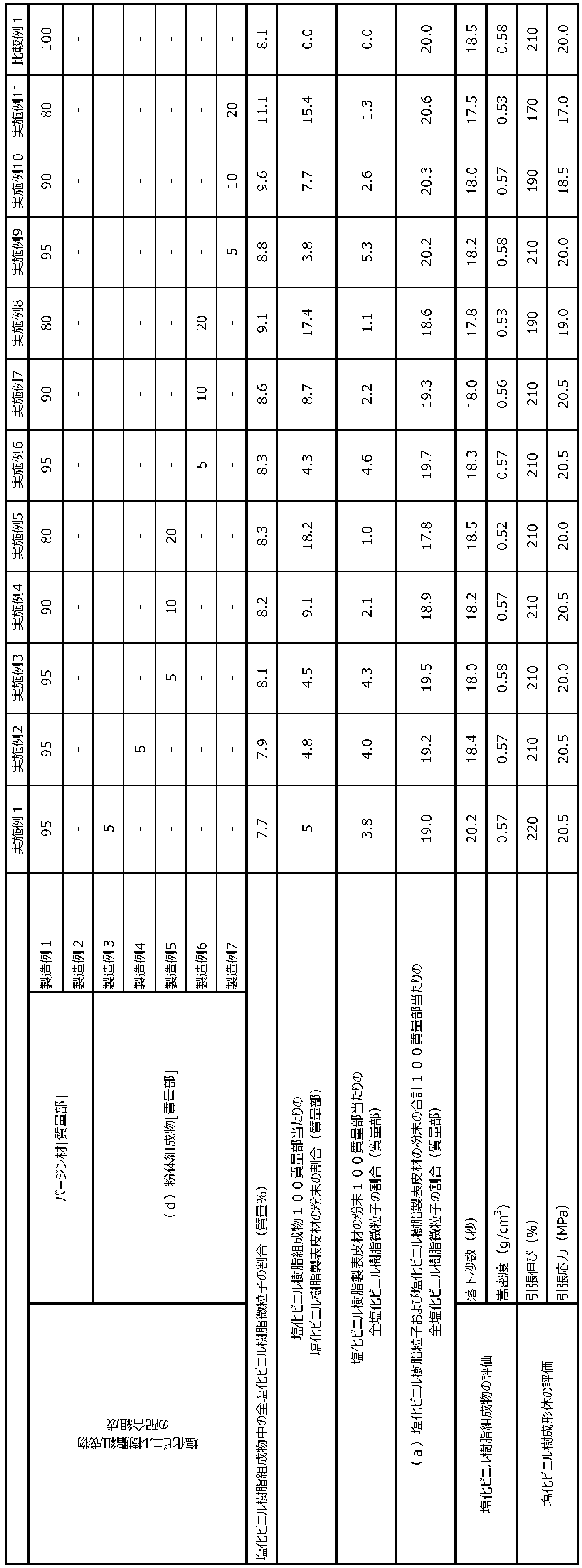

2)新第一塩ビ社製、製品名「ZEST PQLTX」(乳化重合法で調製、平均重合度:800、平均粒子径:1.8μm)
3)花王社製、製品名「トリメックスN-08」
4)ADEKA社製、製品名「HPN-3130」
5)ADEKA社製、製品名「アデカサイザー O-130S」
6)協和化学工業社製、製品名「アルカマイザー(登録商標)5」
7)水澤化学工業社製、製品名「MIZUKALIZER DS」
8)昭和電工社製、製品名「カレンズDK-1」
9)堺化学工業社、製品名「SAKAI SZ2000」
10)ADEKA社製、製品名「LA-72」
11)ADEKA社製、製品名「アデカスタブ LS-12」
12)大日精化社製、製品名「DA P 4720 ブラック」
13)新第一塩ビ社製、製品名「ZEST PQLTX」(乳化重合法で調製、平均重合度:800、平均粒子径:1.8μm)
また、本発明によれば、上記塩化ビニル樹脂組成物を成形してなる塩化ビニル樹脂成形体を提供することができる。
さらに、本発明によれば、上記塩化ビニル樹脂成形体を備える積層体を提供することができる。
Claims (18)
- (a)塩化ビニル樹脂粒子と、(b)塩化ビニル樹脂微粒子Aと、(c)可塑剤と、(d)塩化ビニル樹脂製表皮材の粉末を含む粉体組成物と、を含む、塩化ビニル樹脂組成物。
- 前記塩化ビニル樹脂製表皮材の粉末の量が、前記塩化ビニル樹脂組成物100質量部当たり、1質量部以上40質量部以下である、請求項1に記載の塩化ビニル樹脂組成物。
- 前記塩化ビニル樹脂製表皮材の粉末の体積平均粒子径が、50μm以上500μm以下である、請求項1に記載の塩化ビニル樹脂組成物。
- 前記粉体組成物が、(b-1)塩化ビニル樹脂微粒子Bを更に含む、請求項1に記載の塩化ビニル樹脂組成物。
- 全塩化ビニル樹脂微粒子の量が、前記塩化ビニル樹脂製表皮材の粉末100質量部当たり、3質量部以上40質量部以下である、請求項1に記載の塩化ビニル樹脂組成物。
- 全塩化ビニル樹脂微粒子の量が、前記(a)塩化ビニル樹脂粒子および前記塩化ビニル樹脂製表皮材の粉末の合計100質量部当たり、15質量部以上35質量部以下である、請求項1に記載の塩化ビニル樹脂組成物。
- 前記粉体組成物中における前記(b-1)塩化ビニル樹脂微粒子Bの含有割合が、2.0質量%以上25質量%以下である、請求項4に記載の塩化ビニル樹脂組成物。
- 前記粉体組成物の落下秒数が35秒以下である、請求項4に記載の塩化ビニル樹脂組成物。
- 前記粉体組成物が、前記(a)塩化ビニル樹脂粒子100質量部当たり、3質量部以上30質量部以下の割合で含まれる、請求項1に記載の塩化ビニル樹脂組成物。
- 前記(c)可塑剤が、トリメリット酸エステルおよびポリエステルの少なくとも一方を含む、請求項1に記載の塩化ビニル樹脂組成物。
- 粉体成形に用いられる、請求項1に記載の塩化ビニル樹脂組成物。
- パウダースラッシュ成形に用いられる、請求項1に記載の塩化ビニル樹脂組成物。
- (a)塩化ビニル樹脂粒子、(b)塩化ビニル樹脂微粒子A、および(c)可塑剤を含む原料塩化ビニル樹脂組成物を準備する工程と、
塩化ビニル樹脂製表皮材の粉末を含む粉体組成物を準備する工程と、
前記原料塩化ビニル樹脂組成物に前記粉体組成物を添加および混合する工程と、を含む、塩化ビニル樹脂組成物の製造方法。 - 前記塩化ビニル樹脂製表皮材の粉末を含む粉体組成物を準備する工程が、前記塩化ビニル樹脂製表皮材の粉末に(b-1)塩化ビニル樹脂微粒子Bを添加および混合する工程を含む、請求項13に記載の塩化ビニル樹脂組成物の製造方法。
- 請求項1~12のいずれかに記載の塩化ビニル樹脂組成物を成形してなる、塩化ビニル樹脂成形体。
- 自動車インスツルメントパネル表皮用である、請求項15に記載の塩化ビニル樹脂成形体。
- 発泡ポリウレタン成形体と、請求項15に記載の塩化ビニル樹脂成形体とを有する、積層体。
- 自動車インスツルメントパネル用である、請求項17に記載の積層体。
Priority Applications (2)
| Application Number | Priority Date | Filing Date | Title |
|---|---|---|---|
| CN202480027152.2A CN121002113A (zh) | 2023-07-05 | 2024-06-28 | 氯乙烯树脂组合物、氯乙烯树脂组合物的制造方法、氯乙烯树脂成型体以及层叠体 |
| JP2025531534A JPWO2025009482A1 (ja) | 2023-07-05 | 2024-06-28 |
Applications Claiming Priority (2)
| Application Number | Priority Date | Filing Date | Title |
|---|---|---|---|
| JP2023-110905 | 2023-07-05 | ||
| JP2023110905 | 2023-07-05 |
Publications (1)
| Publication Number | Publication Date |
|---|---|
| WO2025009482A1 true WO2025009482A1 (ja) | 2025-01-09 |
Family
ID=94171587
Family Applications (1)
| Application Number | Title | Priority Date | Filing Date |
|---|---|---|---|
| PCT/JP2024/023629 Ceased WO2025009482A1 (ja) | 2023-07-05 | 2024-06-28 | 塩化ビニル樹脂組成物、塩化ビニル樹脂組成物の製造方法、塩化ビニル樹脂成形体、および積層体 |
Country Status (3)
| Country | Link |
|---|---|
| JP (1) | JPWO2025009482A1 (ja) |
| CN (1) | CN121002113A (ja) |
| WO (1) | WO2025009482A1 (ja) |
Citations (7)
| Publication number | Priority date | Publication date | Assignee | Title |
|---|---|---|---|---|
| JPH0752175A (ja) | 1993-08-20 | 1995-02-28 | Sumitomo Chem Co Ltd | 塩化ビニル系樹脂製表皮材のリサイクル方法 |
| JPH11105159A (ja) * | 1997-09-30 | 1999-04-20 | Achilles Corp | スラッシュ成形靴およびその製造方法 |
| JP2004533362A (ja) * | 2001-05-22 | 2004-11-04 | アトフィナ | 車両の客室計器板、その他部品用の複合スキンと、その製造方法と、この製造に用いられる組成物と、その製造方法 |
| WO2016098344A1 (ja) | 2014-12-17 | 2016-06-23 | 日本ゼオン株式会社 | 塩化ビニル樹脂組成物及びその製造方法、塩化ビニル樹脂成形体及びその製造方法、並びに、積層体 |
| CN107418100A (zh) * | 2017-08-21 | 2017-12-01 | 刘子睿 | 一种汽车仪表板pvc搪塑表皮边角余料再利用方法 |
| WO2023277167A1 (ja) * | 2021-06-30 | 2023-01-05 | 日本ゼオン株式会社 | 粉体成形用塩化ビニル樹脂組成物、塩化ビニル樹脂成形体および積層体 |
| JP2023110758A (ja) * | 2022-01-28 | 2023-08-09 | 日本ゼオン株式会社 | 表皮およびその製造方法、並びに積層体 |
-
2024
- 2024-06-28 CN CN202480027152.2A patent/CN121002113A/zh active Pending
- 2024-06-28 WO PCT/JP2024/023629 patent/WO2025009482A1/ja not_active Ceased
- 2024-06-28 JP JP2025531534A patent/JPWO2025009482A1/ja active Pending
Patent Citations (7)
| Publication number | Priority date | Publication date | Assignee | Title |
|---|---|---|---|---|
| JPH0752175A (ja) | 1993-08-20 | 1995-02-28 | Sumitomo Chem Co Ltd | 塩化ビニル系樹脂製表皮材のリサイクル方法 |
| JPH11105159A (ja) * | 1997-09-30 | 1999-04-20 | Achilles Corp | スラッシュ成形靴およびその製造方法 |
| JP2004533362A (ja) * | 2001-05-22 | 2004-11-04 | アトフィナ | 車両の客室計器板、その他部品用の複合スキンと、その製造方法と、この製造に用いられる組成物と、その製造方法 |
| WO2016098344A1 (ja) | 2014-12-17 | 2016-06-23 | 日本ゼオン株式会社 | 塩化ビニル樹脂組成物及びその製造方法、塩化ビニル樹脂成形体及びその製造方法、並びに、積層体 |
| CN107418100A (zh) * | 2017-08-21 | 2017-12-01 | 刘子睿 | 一种汽车仪表板pvc搪塑表皮边角余料再利用方法 |
| WO2023277167A1 (ja) * | 2021-06-30 | 2023-01-05 | 日本ゼオン株式会社 | 粉体成形用塩化ビニル樹脂組成物、塩化ビニル樹脂成形体および積層体 |
| JP2023110758A (ja) * | 2022-01-28 | 2023-08-09 | 日本ゼオン株式会社 | 表皮およびその製造方法、並びに積層体 |
Also Published As
| Publication number | Publication date |
|---|---|
| CN121002113A (zh) | 2025-11-21 |
| JPWO2025009482A1 (ja) | 2025-01-09 |
Similar Documents
| Publication | Publication Date | Title |
|---|---|---|
| JP7367693B2 (ja) | 粉体成形用塩化ビニル樹脂組成物、塩化ビニル樹脂成形体および積層体 | |
| JP7775824B2 (ja) | 塩化ビニル樹脂組成物、塩化ビニル樹脂成形体および積層体 | |
| JP7823588B2 (ja) | 塩化ビニル樹脂組成物、塩化ビニル樹脂成形体および積層体 | |
| JP7567173B2 (ja) | 粉体成形用塩化ビニル樹脂組成物、粉体成形用塩化ビニル樹脂成形体および積層体 | |
| WO2023276857A1 (ja) | 塩化ビニル樹脂組成物、塩化ビニル樹脂成形体および積層体 | |
| JP7754086B2 (ja) | 塩化ビニル樹脂組成物、塩化ビニル樹脂成形体および積層体 | |
| JP7476884B2 (ja) | 塩化ビニル樹脂組成物、塩化ビニル樹脂成形体および積層体 | |
| JPWO2018173858A1 (ja) | 塩化ビニル樹脂組成物、塩化ビニル樹脂成形体および積層体 | |
| WO2022209872A1 (ja) | 塩化ビニル樹脂組成物、塩化ビニル樹脂成形体および積層体 | |
| WO2025009482A1 (ja) | 塩化ビニル樹脂組成物、塩化ビニル樹脂組成物の製造方法、塩化ビニル樹脂成形体、および積層体 | |
| WO2023277167A1 (ja) | 粉体成形用塩化ビニル樹脂組成物、塩化ビニル樹脂成形体および積層体 | |
| WO2023127608A1 (ja) | 塩化ビニル樹脂組成物、塩化ビニル樹脂成形体および積層体 | |
| JP7823374B2 (ja) | 塩化ビニル樹脂組成物、塩化ビニル樹脂成形体および積層体 | |
| WO2025205101A1 (ja) | 塩化ビニル樹脂組成物、塩化ビニル樹脂成形体、および積層体 | |
| WO2024203254A1 (ja) | 塩化ビニル樹脂組成物、塩化ビニル樹脂成形体、及び積層体 | |
| JP2021134298A (ja) | 塩化ビニル樹脂組成物、塩化ビニル樹脂成形体および積層体 | |
| WO2025062938A1 (ja) | 塩化ビニル樹脂組成物の製造方法 | |
| WO2024203040A1 (ja) | 積層体及び積層体の製造方法 | |
| WO2024070985A1 (ja) | 塩化ビニル樹脂組成物、塩化ビニル樹脂成形体および積層体 | |
| JP2024065973A (ja) | 塩化ビニル樹脂組成物、塩化ビニル樹脂成形体および積層体 |
Legal Events
| Date | Code | Title | Description |
|---|---|---|---|
| 121 | Ep: the epo has been informed by wipo that ep was designated in this application |
Ref document number: 24835995 Country of ref document: EP Kind code of ref document: A1 |
|
| ENP | Entry into the national phase |
Ref document number: 2025531534 Country of ref document: JP Kind code of ref document: A |
|
| WWE | Wipo information: entry into national phase |
Ref document number: 2025531534 Country of ref document: JP |
|
| WWE | Wipo information: entry into national phase |
Ref document number: 2024835995 Country of ref document: EP |
|
| NENP | Non-entry into the national phase |
Ref country code: DE |
|
| ENP | Entry into the national phase |
Ref document number: 2024835995 Country of ref document: EP Effective date: 20260205 |